Normal view

There are new articles available, click to refresh the page.
Yesterday — 16 December 2025Main stream

Will Quantum Computing Suppress Bitcoin Prices In 2026? Grayscale Answers

16 December 2025 at 21:00

Quantum risk has been getting louder in the Bitcoin conversation over the past few months. The question is whether that noise translates into price pressure in 2026.

Grayscale’s answer, in its updated 2026 Digital Asset Outlook: “Dawn of the Institutional Era” (last updated Dec. 15), is essentially no. Quantum belongs on the risk register and in the research pipeline, not on the list of themes the firm expects to steer Bitcoin’s valuation next year. In its view, it’s not “likely to move prices” in 2026.

Why The Quantum Computer Threat Won’t Move Bitcoin Price In 2026

That call matters because the quantum debate arrived while the market is already looking for new failure modes — everything from “the four-year cycle is dead” to renewed anxiety about large holders distributing supply. Grayscale’s framing is simpler: the threat is real in theory, but the relevant timelines don’t line up with a 2026 trading horizon.

The firm lays out the core concern in plain terms: “Theoretically, a sufficiently powerful quantum computer could derive private keys from public keys, which could then be used to create valid digital signatures to spend users’ coins. Therefore, Bitcoin and most other blockchains — and virtually everything else in the economy that uses cryptography — will eventually need to be updated for post-quantum tools.”

The key word is eventually. Grayscale points to expert estimates suggesting a machine capable of breaking Bitcoin’s cryptography is “unlikely before 2030 at the earliest.” That pushes 2026 into a preparedness bucket: more research, more coordination, more work on mitigation — but not a year where markets suddenly apply a quantum discount because a lab headline hit the wires.

Grayscale makes that explicit. “However, expert estimates suggest a quantum computer powerful enough to break Bitcoin’s cryptography is unlikely before 2030 at the earliest. Research on quantum risk and community preparedness efforts will likely accelerate in 2026, but this theme is unlikely to move prices, in our view,” the firm writes.

In the report’s taxonomy, quantum sits closer to “high attention, low near-term impact” than to a true 2026 catalyst. Grayscale groups it with other heavily discussed trades that may not drive returns on a one-year view, including the digital-asset-treasury (DAT) narrative that had its Michael Saylor copycat phase in 2025.

The broader outlook is firmly “institutional era” in tone. Grayscale expects 2026 to extend structural shifts in how digital assets are owned and allocated, driven by macro demand for alternative stores of value and an improving regulatory backdrop that reduces frictions for large investors. In that context, the firm is calling for Bitcoin to set a new all-time high in the first half of 2026, while arguing the classic four-year halving cycle is becoming less dominant as spot ETPs and slower-moving portfolio allocation play a bigger role.

That’s also why quantum looks like a mismatch for the 2026 price question. If the marginal buyer is an allocator working through due diligence checklists, the market’s response function changes. Those investors do not ignore tail risks — but they also tend not to liquidate positions on long-dated, low-probability scenarios unless the timeline becomes immediate.

Grayscale highlights one other, quieter point that fits the institutional framing: Bitcoin’s supply schedule. The report notes investors can be “highly confident” the 20 millionth bitcoin will be mined in March 2026 — a predictable, verifiable milestone that speaks to the protocol’s rule-based issuance.

So will quantum computing suppress Bitcoin in 2026? Grayscale’s base case is no — not because the problem is imaginary, but because it isn’t close on the timeline markets usually need before they reprice risk. For next year, the firm expects the bigger drivers to look familiar, even if they arrive in more institutional packaging: rates, regulation, ETP plumbing, and steady absorption of BTC into mainstream portfolios.

Quantum remains a theme to track. Just not, in Grayscale’s view, the theme that sets the price in 2026.

At press time, Bitcoin traded at $87,184.

Bitcoin price chart

Market Pullback Accelerates After Senate Postpones Long-Awaited Crypto Framework Bill

16 December 2025 at 19:00

The market entered a sharper pullback this week after the Senate confirmed that a long-anticipated crypto structure legislation will not advance before the end of the year.

Related Reading: Crypto Market Structure Bill Stalled: Senate Banking Committee Pushes Markup To Early 2026

What many investors had hoped would be a closing act for regulatory clarity in 2025 instead became another extension of uncertainty, triggering risk-off behavior across digital assets and related investment products. The delay arrived at a fragile moment for markets grappling with growing sensitivity to policy signals from Washington.

Bitcoin slid below the $86,000 level, while the broader digital asset market shed roughly $140 billion in capitalization within hours. The total market value has fallen to around $2.93 trillion, its lowest level in several weeks, as traders reassessed regulatory timelines that now extend into early 2026.

Crypto Bitcoin BTC BTCUSD BTCUSD_2025-12-16_12-00-50

Senate Pushes Crypto Market Structure Talks Into 2026

The Senate Banking Committee confirmed it will not hold a markup hearing on the crypto market structure billbefore Congress adjourns for the holidays.

While committee leadership says bipartisan negotiations are progressing, lawmakers acknowledged that time has run out to move the bill forward in 2025. Chairman Tim Scott’s office reiterated that discussions with Democratic counterparts are ongoing, with a markup now expected in early 2026.

The proposed legislation is designed to clarify how digital assets are regulated in the U.S., including defining the respective roles of the Securities and Exchange Commission and the Commodity Futures Trading Commission.

Under current drafts, the CFTC would oversee spot crypto markets, while securities laws would be more clearly applied to token issuers and intermediaries. Parallel efforts in the Senate Agriculture Committee, which also oversees the CFTC, have yet to reach a markup stage, further slowing the process.

Market Reaction Highlights Fragile Sentiment

The legislative setback quickly translated into market pressure. Bitcoin fell from near $90,000 to the mid-$85,000 range, while Ethereum dropped below $3,000. Additionally, the average crypto RSI fell to around 32, indicating that the market is within oversold territory.

Analysts pointed to elevated derivatives positioning and heavy open interest around key price levels as factors amplifying downside moves. Exchange-traded products reflected the shift, with Bitcoin and Ethereum spot ETFs recording significant outflows as institutional investors reduced exposure.

Some market observers noted that unrealized losses have risen sharply, while funding conditions and leverage remain stretched, making prices more vulnerable to negative catalysts such as policy delays.

Regulatory Uncertainty Persists Despite Agency Actions

Despite the legislative pause, regulators have continued to act within existing frameworks. The SEC has issued staff guidance and hosted public discussions on how current securities laws apply to crypto activities, while the CFTC has taken steps to expand supervised spot market participation.

However, industry participants say these measures fall short of the comprehensive clarity the market structure bill is meant to deliver.

Related Reading: Terra Founder Do Kwon Could Face 30-Year Sentence In Potential South Korean Trial

The Senate’s decision reinforces a familiar pattern for crypto markets: policy delays translating into heightened volatility. With negotiations set to resume in early 2026, investors will be left to navigate another extended period where regulatory questions remain unresolved.

Cover image from ChatGPT, BTCUSD chart on Tradingview

Bitcoin Under Pressure As Yen Carry Trade Unwind Hits Global Markets

16 December 2025 at 15:00

The yen carry trade unwind has been hovering over markets lately — the kind of “plumbing” story that most people ignore right up until volatility spikes and everything suddenly feels connected. Graham Stephan put it into a Bitcoin and crypto-friendly frame yesterday.

In a Dec. 15 post, the popular YouTuber described the yen carry trade as Wall Street’s long-running “infinite money glitch” — and argued it’s breaking down just as the Fed is signaling a shift in its outlook for next year. “Wall Street found an ‘infinite money’ glitch 20 years ago. They called it the Yen Carry Trade. It just broke, right when the Fed announced its plans for next year,” Stephan wrote.

What The Yen Carry Trade Unwind Means For Bitcoin

He presented it as a straightforward trade that scaled because the size was big enough to matter. “For decades, the ‘Yen Carry Trade’ has been the secret engine behind global liquidity. The mechanics were simple enough that a child could understand them, but profitable enough to move trillions of dollars.”

Stephan then laid out the basic steps in plain English: borrow cheaply in Japan, rotate into higher-yield US assets, keep the spread. “Borrow Cheap: Investors borrowed money in Japan, where interest rates were effectively 0%… Invest Abroad: They took that ‘free money’ and bought US Treasuries paying 4-5%… Profit: They pocketed the difference without using any of their own money.”

His argument is that the setup turns toxic when the rate differential compresses and the currency leg moves the wrong way. He framed the timing as especially awkward for risk assets: Japan tightening to support the yen while the Fed eases. “Japan is finally raising rates to save its own currency right at the time when the Fed has started slashing rates. The gap between the rates is getting squeezed. The ‘free money’ isn’t free anymore.”

From there, he leaned into the mechanical consequence: when funding gets more expensive and the currency shifts, leveraged positions don’t get a long debate window — they get cut. “As Japanese rates rise, that trade flips. Investors are now being forced to sell their US assets to pay back their Yen loans. Instead of money flowing into the US markets, it is being sucked out to pay debts in Tokyo. This is a massive liquidity drain happening right under our noses.”

That’s also where his Bitcoin read comes in. Not “Bitcoin is broken,” but that Bitcoin is where risk appetite and leverage tend to show up early — and where forced selling can look brutal when it hits.

Stephan expanded on the same theme in a Substack post, pulling the Fed into the timeline more directly and warning readers to brace for turbulence. “You better get ready for a bumpy ride,” he wrote, claiming the Fed cut rates “for the third time this year,” and that the central bank “has officially ended ‘Quantitative Tightening’ and is quietly moving back toward printing money.”

He added a “pilot flying blind” angle as well, arguing the Fed cut “without any inflation data whatsoever” due to shutdown-related disruptions. He attached a specific interpretation of balance-sheet policy, too: “Finally, the most important news of the day: Quantitative Tightening (QT) is over… They even announced they will buy $40 billion of Treasuries over the next 30 days. The tightening era is dead. The ‘stimulus’ era is now being rebooted, and the money printer is being turned on.”

Taken together, his thesis ends up with Bitcoin sitting between two forces that don’t necessarily move on the same clock: a potentially sharp deleveraging impulse from carry unwinds, and a slower easing impulse if policy conditions loosen. One can hit price violently in a short window; the other can take time to express itself cleanly.

Stephan closed with a familiar Bitcoin-with-training-wheels framing: volatility is normal, drawdowns happen, and mining economics create a reference point. “Bitcoin isn’t broken. It’s just volatile, and this isn’t the first time this is happening. Statistically, Bitcoin has seen drastic crashes of 50% or more, but it has never dropped below its “electrical cost” (the cost to mine one coin), which sits around $71,000 today. If we get close to that number, history suggests it’s a strong buy zone,” he concluded.

At press time, BTC traded at $87,082.

Bitcoin price

Analyst Shares Full Technical Bitcoin Price Breakdown – Here’s The Target

16 December 2025 at 15:00

A crypto analyst has shared his latest forecast for the Bitcoin price, highlighting a potential downturn. His analysis breaks down technical indicators and macroeconomic data to predict key movements in the coming months and years. The report has outlined several bearish targets for Bitcoin, cautioning traders to forego excessive bullish expectations, especially as the market shows signs of entering a bearish phase. 

Bitcoin Price Set To Decline Below $55,000

A crypto analyst who calls himself ‘Mr. Wall Street’ on X has released a full technical breakdown of Bitcoin, providing both market and psychological insights while predicting a devastating decline to new lows. He highlighted that the BTC bullish momentum seen earlier this year has collapsed, signaling a shift toward a bear market

Key technical indicators used to understand Bitcoin’s market position and direction are signaling the start of a bear phase. The expert highlighted that the weekly 50-period Exponential Moving Average (EMA50), Moving Average Convergence Divergence (MACD) monthly cross, and Relative Strength Index (RSI) bearish divergence are now all pointing downward. 

Given this weakness, Mr. Wall Street has predicted that Bitcoin could first retest the weekly EMA50 target near $100,000 before its next decline. The analyst stated that traders are likely planning short positions in the $104,000 to $98,000 range, targeting a potential drop to $74,000 to $68,000. Looking ahead, he projects that the Bitcoin price could crash further by Q4 2026, potentially declining to levels between $54,000 and $60,000. 

Bitcoin

Supporting his bearish forecast, the analyst has cited the decline and pressure in financial markets outside of crypto as factors contributing to the broader market downtrend. He also mentioned that the Bank of Japan’s (BOJ) planned interest rate hike adds to the current stress, along with market makers who went bankrupt during the October 10 flash crash and are waiting to liquidate billions of dollars in spot assets. 

Mr. Wall Street has dismissed common bullish arguments such as the potential restart of Quantitative Easing, explaining that minor Federal Reserve (FED) balance sheet operations do not signal a complete QE cycle. He stressed that macro bullishness does not justify ignoring short and mid-term risks. Moreover, he warned that those who ignore the reality of a bear case would wish they had shorted the retested $100,000-$125,000 range a year from now. 

Looking beyond the projected bear cycle, Mr. Wall Street believes that Bitcoin could eventually rebound to around $89,000 in 2027. Following this, he expects the cryptocurrency to accelerate toward $110,000 and ultimately $160,000.

Macroeconomic Factors Contribute To Market Decline

Mr. Wall Street also links his bearish Bitcoin forecast to the present weakness in broader macroeconomic conditions. He highlighted that BTC’s struggles are deeply connected to the decisions made by central banks, particularly the FED. 

According to the analyst, the US economy began showing signs of deterioration at the start of 2025. He claimed that key indicators, such as worsening job data and misleading inflation figures, were allegedly ignored. Furthermore, he highlighted that the FED’s inaction and delayed rate cuts prevented necessary economic easing, leaving markets and cryptocurrencies like Bitcoin vulnerable to correction.

Bitcoin

Bitcoin Falls 26%, But Outperforms Every Major Crypto Sector in 3 Months — What’s Going On?

16 December 2025 at 07:56

Bitcoin has fallen sharply from its recent peak, but fresh data shows it is still holding up better than almost every other corner of the crypto market, showing how capital behavior has shifted during the latest downturn.

Bitcoin is down roughly 26% over the past three months and about 30% from its all-time high near $126,200, trading just above the $85,000 level.

Despite the drop, on-chain analytics firm Glassnode said Bitcoin has outperformed nearly all major crypto sectors over the same period.

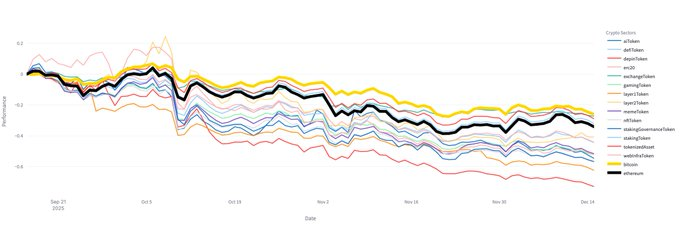
Over the past 3 months, the average return across nearly all crypto sectors has underperformed Bitcoin.
This persistent relative weakness highlights a market environment where capital concentration favours BTC.

📊 https://t.co/rFisuVfSY7 https://t.co/lpXqEe9bbW pic.twitter.com/WNtKEKclX7

— glassnode (@glassnode) December 16, 2025

From AI to Meme Coins, Crypto Sectors Sink as Bitcoin Shows Relative Strength

The broader market context helps explain the divergence. Total crypto market capitalization fell around 27.5% over the past three months, slightly more than Bitcoin’s decline.

Ether has suffered a deeper drawdown, sliding about 36% since mid-September and trading below $3,000.

Source: Coingecko

Other narrative-driven sectors have fared worse. AI-related tokens are down roughly 48%, meme coin market capitalization has dropped about 56%, and real-world asset tokenization tokens have fallen around 46%.

DeFi tokens have also struggled, declining close to 38% over the same period.

Glassnode’s cross-sector performance data shows how the sell-off unfolded. In late September, most sectors were clustered near neutral performance, suggesting capital was still broadly distributed and risk appetite remained intact.

That changed in early October, when a sharp, market-wide shock pushed nearly all sectors lower. High-beta areas such as Layer 1s, Layer 2s, AI, gaming, NFTs, and meme tokens saw deeper drawdowns, while Bitcoin fell more modestly, acting as a relative shelter.

Source: Glassnode

Attempts at recovery in mid-October failed to gain traction. Small rebounds across altcoin sectors did not reclaim prior levels, and Glassnode data shows no sector returning to neutral performance.

By late October and into November, losses widened further, with performance dispersion increasing and capital continuing to withdraw rather than rotate.

By mid-November, several sectors entered what Glassnode described as a capitulation phase, with drawdowns deepening across Layer 1s, DePIN, gaming, NFTs, and memes. Bitcoin and Ether also fell, but Bitcoin maintained the shallowest relative losses.

Shark Accumulation Hits Fastest Pace Since 2012 as Whales Distribute

By December, the picture had become clearer. Bitcoin stood out as the top relative performer despite remaining in negative territory, while Ether continued to lag.

Defensive altcoin categories such as exchange tokens and staking-related assets sat in the middle, and speculative narratives occupied the bottom.

Glassnode said the data does not show rotation into new winners but rather graduated losses, with Bitcoin retaining capital more effectively as liquidity tightened.

This relative strength has played out alongside shifting BTC dominance dynamics. Earlier in the year, Bitcoin dominance rose steadily and peaked near 65%, coinciding with a strong price rally.

The structure changed around mid-July, when dominance began to fall and capital rotated into altcoins.

That rotation broke down during an October deleveraging event, when forced liquidations briefly pushed capital back into Bitcoin.

Since then, dominance has moved sideways between roughly 59% and 61%, reflecting a market without a clear anchor.

Bitcoin’s relative outperformance shows that investors are still treating BTC as a defensive anchor, preserving capital during periods when altcoins face deeper drawdowns and weaker conviction.

Onchain positioning adds another layer to the story. Glassnode data shows that mid-sized holders, often referred to as “sharks” with balances between 100 and 1,000 BTC, added about 54,000 BTC over the past week, bringing their collective holdings to roughly 3.575 million BTC.

The pace of accumulation is the fastest seen since 2012, suggesting strong dip-buying from higher-net-worth individuals and institutional players.

At the same time, selling pressure has come from long-term holders and so-called OG whales with balances above 10,000 BTC.

According to Glassnode and Capriole Investments, distribution from older coins has offset record institutional buying, limiting near-term upside and keeping downside risks in focus.

The post Bitcoin Falls 26%, But Outperforms Every Major Crypto Sector in 3 Months — What’s Going On? appeared first on Cryptonews.

Will Bitcoin Suffer A 20% Decline After Japan’s Rate Hike? Historical Patterns Suggest So

16 December 2025 at 03:00

Bitcoin (BTC) has experienced a 4% drop, falling below the $86,000 mark on Monday, as market speculation grows regarding the cryptocurrency’s future following the Bank of Japan’s (BOJ) interest rate decision. 

In a recent poll conducted from December 2 to 9, an overwhelming 90% of economists—63 out of 70—predicted that the BOJ would increase short-term interest rates from 0.50% to 0.75% at this week’s planned meeting.

Experts Warn Of Impact From BOJ Rate Hikes

Experts on social media have noted a concerning trend: during the last three rate hikes by the BOJ, Bitcoin has typically dropped significantly. The statistics reveal the following declines: a 23% drop in March 2024, a 26% decline in July 2024, and a 31% dip in January of this year. 

Based on current prices just below $86,000, this would imply that if the cryptocurrency sees another 20% correction, it could drop all the way to 68,800. This would mean extending the gap compared to the all-time high of $126,000 by almost 46%. 

Bitcoin

The group of experts further highlighted that the dynamics at play in Japan significantly impact Bitcoin’s performance as Japan holds the largest amount of US debt of any nation. 

When Japanese interest rates rise, capital tends to flow back to Japan, leading to reduced liquidity in dollars. This decrease in dollar liquidity often results in the selling of riskier assets like Bitcoin.

On November 30, a foreboding sign of this potential downturn appeared when confirmation of Japan’s impending rate hike caused Bitcoin to dip to around $83,000, erasing approximately $200 billion from the overall cryptocurrency market.

However, the bearish sentiment affecting Bitcoin is not solely the result of Japan’s actions. Market analyst known as NoLimit recently pointed to another critical factor: China’s renewed crackdown on Bitcoin mining. 

China’s Mining Crackdown Spurs Bitcoin Sell-Off

The analyst recently asserted that China has tightened regulations, particularly affecting operations in Xinjiang, where a significant number of crypto mining setups were shut down in December. This led to the abrupt offline status of roughly 400,000 miners.

The repercussions of such a sudden shift in mining activity are already evident. The Bitcoin network hashrate has fallen by about 8%, indicating that fewer miners are actively contributing to the network. 

NoLimit suggests that this sudden reduction creates immediate revenue-loss for miners, who may need to liquidate Bitcoin to cover operational costs or to relocate their equipment. Consequently, this generates actual selling pressure on the market, contributing to the downward price trend seen on Monday.

Despite the short-term pain this creates, the analysts clarified that it does not indicate a long-term bearish outlook for Bitcoin. Instead, he views it as a temporary supply shock driven by regulatory decisions rather than a shift in demand. 

Historical patterns support this notion: when China has previously cracked down on miners, the cycle follows a familiar trajectory: miners are forced offline, hashrate dips occur, prices fluctuate, and eventually, the network adapts before Bitcoin moves forward again.

Featured image from DALL-E, chart from TradingView.com

Before yesterdayMain stream

Top Events That Can Decide The Fate Of Bitcoin And The Crypto Market This Week

15 December 2025 at 20:00

Bitcoin (BTC) and the crypto market enter the week facing a series of events that could shape short-term price action. Key macroeconomic data, policy signals, and sector-specific developments are set to test market sentiment and influence volatility across major digital assets. Traders and investors are closely watching how these events unfold, as shifting expectations around inflation and liquidity could determine whether the market recovers or extends its downside pressure

Events Set To Move Bitcoin And Crypto Market This Week

Bitcoin and the broader crypto market face a pivotal week, with several high-impact economic events lining up just days before Christmas. With year-end liquidity thinning and the recent market downturn, price reactions to macro developments could be more volatile than usual.

The period from December 16 to 19 features key US economic data releases alongside global policy decisions that directly influence risk sentiment. Cryptocurrencies remain highly sensitive to shifts in interest rate expectations and dollar liquidity, making this week decisive for Bitcoin’s near-term direction.

On December 16, October retail sales data and the November US Jobs Report are scheduled for release. These data provide insight into consumer strength and labor market conditions, both of which influence the extent to which monetary policy may remain restrictive. Usually, stronger retail spending or job growth could reinforce expectations that interest rates stay higher for longer. This risk scenario often pressures Bitcoin and other crypto assets as tighter financial conditions tend to reduce speculative capital flows. 

Next are the November Consumer Price Index (CPI) inflation data and the December Philly Fed Manufacturing Index, due on December 18. Notably, inflation remains one of the most influential drivers for crypto markets. If inflation comes in stronger than expected, the US dollar could strengthen, weighing on Bitcoin prices. Conversely, softer inflation data may support risk assets by improving the outlook for Quantitative Easing (QE). 

December 19 will see the release of several key economic reports, including the National Core CPI year over year, November existing home sales, the revised UoM consumer sentiment, and inflation expectations. National Core CPI is especially important as it is the primary measure of underlying inflation and often triggers market volatility. 

US FED And Japan Monetary Policy Events 

At the December 18-19 monetary policy meeting, the Bank of Japan (BOJ) is expected to announce its interest rate decision, which could affect global liquidity conditions. In a recent speech, Governor Kazuo Ueda stated that the BOJ was weighing the advantages and drawbacks of raising interest rates from 0.5% to 0.75%. If a spike occurs, it could affect risk markets, including cryptocurrency.

In addition, five US Federal Reserve speaker events are scheduled this week. Their comments and insights could quickly reshape crypto market expectations. Last week, the FED cut rates by 25 basis points at its final 2025 FOMC meeting, bringing the new US interest rate to 3.50-3.75%. This rate cut triggered a surprising sell off, underscoring significant impact on Bitcoin and the broader crypto market. 

Bitcoin price chart from Tradingview.com (Crypto)

Can Bitcoin Price Still Hit $140,000? What The Global M2 Money Supply Says

15 December 2025 at 14:00

The Bitcoin price outlook remains under scrutiny as market analysts assess whether the world’s largest cryptocurrency can still reach $140,000. Given BTC’s recent downturn and fluctuating price, it’s understandable that a dramatic surge to $140,000 could be viewed skeptically. However, the analyst points to global M2 Money Supply, highlighting its correlation with Bitcoin and its support for a significant upside move.

New discussions have emerged in the crypto space about the relationship between the Bitcoin price action and the global M2 Money Supply. Pseudonymous crypto analyst ‘MoneyLord’ has projected a massive price surge to $140,000 for BTC based on M2 data. The analyst noted that many people are skeptical about the relevance of M2 Money Supply, likely questioning whether it still holds predictive value for Bitcoin’s performance.

Global M2 Money Supply To Fuel $140,000 Bitcoin Price Surge

According to MoneyLord, the recent disconnect between Bitcoin and M2 data should not be viewed as a failure of the model, but rather as a consequence of aggressive market interference and increased stress across global financial systems. In his technical report released on X, he argued that, without heavy manipulation and the collapse and insolvency of major entities, Bitcoin would have continued to track global liquidity growth.

Related Reading: Is It More Profitable To Hold Bitcoin For The Short-Term? 2025 Numbers Are Here

MoneyLord believes that those shocks temporarily suppressed BTC’s price expansion, likely contributing to its recent decline and slow momentum. With market conditions somewhat stabilizing, the analyst suggests that Bitcoin is poised to realign with global M2 Money Supply trends, potentially setting the stage for renewed upward momentum. 

Bitcoin

From this perspective, the current phase is viewed as a delayed reaction rather than a failed cycle. MoneyLord predicts that if Bitcoin begins to catch up with M2 data, the cryptocurrency’s price could hit a target above $140,000 sooner than the market expects. The accompanying chart illustrates this bullish outlook, showing global liquidity, represented by the blue line, continuing to rise toward the projected price. 

With Bitcoin trading near $90,000 after a more than 6% decline this month, a rally to $140,000 would require a gain of at least 55%. Reaching this level would set a new all-time high, exceeding its present peak of over $126,000 by more than 10%. 

Bitcoin Shows Resilience Amid Market Sell-Offs

According to crypto analyst Don, Bitcoin has bounced back after a period of sharp sell-offs that shook out many traders and triggered widespread liquidations. The analyst noted that bulls have stepped in to reclaim critical support and restore confidence in the market as BTC resumes trading within a well-defined ascending triangle pattern

The chart shows that the triangle has an upper boundary near $94,324 and a lower boundary around $89,241. Price action inside the formation suggests that Bitcoin is consolidating and likely building momentum for a potential breakout. 

Bitcoin

Bitcoin Starts the Week Under $90K While Investors Await Key U.S. Data and Global Policy Clarity

15 December 2025 at 14:00

Bitcoin (BTC) began the new trading week on the back foot, slipping below the $90,000 mark as investors adopted a cautious stance ahead of a dense slate of U.S. economic data and key global central bank decisions.

After reaching an all-time high of $126,000 in October, the world’s top cryptocurrency has struggled to regain momentum, instead entering a period marked by tight ranges, low volatility, and subdued trading volumes.

Market movers appear reluctant to commit to new positions as uncertainty builds around the direction of macroeconomic trends. Bitcoin was trading near $89,600 during early Monday sessions, extending weekend losses and reflecting a broader risk-off mood across global markets.

Bitcoin BTC BTCUSD BTCUSD_2025-12-15_12-00-09

Bitcoin Volatility Compresses as Technical Levels Tighten

Bitcoin’s recent price behavior has been defined by historically low volatility, with the asset hovering in a narrow band just below $90,000.

Analysts note that such compression often precedes a sharper move. Technical analyst Aksel Kibar has identified a critical setup on the daily chart, suggesting that a decisive breakout or breakdown could be imminent.

On the downside, failure to hold current levels could open the door to a decline toward the $86,000 area, with deeper support seen between $73,700 and $76,500. On the upside, a sustained break above resistance near $94,600 could shift momentum and put the $100,000 level back into focus.

Other traders have echoed calls for patience, advising investors to wait for a confirmed move outside the current range before taking positions.

On-Chain Signals and Liquidity Raise Caution

Beyond chart patterns, on-chain data has reinforced a more cautious outlook. Analysts at CryptoQuant have highlighted weakening demand and selling pressure near key moving averages, suggesting that recent rebounds have lacked conviction.

Declining liquidity following the Federal Reserve’s recent rate cut has also weighed on Bitcoin and the broader crypto market, according to market makers.

Still, not all signals are uniformly bearish. Data from Glassnode shows that some digital asset treasury firms have quietly resumed Bitcoin accumulation, despite prices struggling to stabilize. This mixed backdrop underscores the market’s current indecision.

Macro Data and Central Banks in Focus

Attention now turns to a busy macroeconomic calendar. Investors are watching delayed U.S. jobs data, inflation reports, retail sales figures, and flash PMI readings for clues on growth and interest rate expectations. Speeches from Federal Reserve officials later in the week could further influence sentiment.

Globally, central bank meetings add another layer of uncertainty. Decisions from the European Central Bank, Bank of England, and especially the Bank of Japan, where a rate hike is widely expected, are being closely monitored for their impact on global liquidity.

With volatility compressed and key catalysts approaching, Bitcoin appears poised at a crossroads as markets await clearer signals on economic and policy direction.

Cover image from ChatGPT, BTCUSD chart from Tradingview

Why Did The Bitcoin, Ethereum, And XRP Prices Crash, And Will It Continue?

15 December 2025 at 10:30

Crypto pundit Crypto Wimar has explained why the Bitcoin, Ethereum, and XRP prices crashed, highlighting the continuous selling pressure. The crypto market is also at risk of further downward pressure due to macro factors such as the impending Japan rate hike. 

Why The Bitcoin, Ethereum, And XRP Prices Crashed

In an X post, Crypto Wimar revealed that Wintermute has dumped 40% of its holdings over the last three weeks, which has contributed to the crash in Bitcoin, Ethereum, and XRP prices. The crypto pundit further noted that the market maker is still dumping millions in BTC and ETH on Binance, which puts these coins at risk of further declines. 

The Bitcoin, Ethereum, and XRP prices are also crashing as crypto market investors brace for a Japan interest rate hike by the BOJ at their December 19 meeting. Polymarket data shows that there is currently a 97.4% chance that the BOJ will increase rates by 25 basis points. A Japan rate hike impacts the crypto market as it puts the yen carry trade in focus, with investors moving to sell their assets before the yen strengthens and their debt becomes more expensive. 

Meanwhile, it is worth mentioning that the Bitcoin, Ethereum, and XRP prices have crashed after every Fed rate cut this year. This similar price action is playing out as the Fed lowered rates by 25 bps last week. These crypto assets had seen a notable rebound prior to the Fed rate decision last week, indicating that the cut was already priced in. 

Demand for Bitcoin, Ethereum, and XRP also appears to be dwindling, even among institutional investors. Crypto analytics platform CryptoQuant stated that Bitcoin treasury growth is losing momentum, noting that the accumulation pace is slowing despite the fact that 117 new companies added BTC to their treasuries this year. Ethereum treasury company BitMine is also the only company that has continued to accumulate ETH at an impressive pace amid this market downturn. 

BTC At Risk Of Drop Below $50,000

Crypto analyst Titan of Crypto has indicated that the Bitcoin price could still drop below $50,000, which also puts Ethereum and XRP at risk of crashing. In an X post, the analyst raised the possibility that a BTC bear pennant is forming.

He noted that this is not a structure that market investors will typically want to see in a bull market. Titan of Crypto added that the structure is still developing, but it is one that is worth monitoring closely. 

Bitcoin

Meanwhile, the analyst’s accompanying chart showed that the Bitcoin price could drop below $50,000 as soon as February next year. It is worth mentioning that veteran trader Peter Brandt had also earlier predicted that BTC could drop below $50,000 based on his belief that the flagship crypto is already in a bear market.

Bitcoin

Bitcoin And The Quantum Panic: What Developers Are Actually Doing

15 December 2025 at 09:00

Quantum risk has become a recurring stress point in Bitcoin discourse, often framed as an existential threat. The claim usually follows a familiar arc: quantum computing is advancing quickly, cryptography is vulnerable, and Bitcoin isn’t adapting fast enough.

Marty Bent doesn’t buy that framing. In his Dec. 14 episode, Bent acknowledged that quantum computing represents a genuine risk — not just for Bitcoin, but for any system built on modern cryptography — while pushing back on the idea that Bitcoin developers are ignoring the issue.

“Short answer is yes, it is a risk,” Bent said. “But it’s not only a risk for Bitcoin. It’s a risk for any system that depends on cryptography for security.”

What Developers Are Doing To Make Bitcoin Quantum-Safe

What tends to get lost, he argued, is the work already underway. Bent pointed to ongoing developer discussions and, more recently, a research paper published by Blockstream’s Jonas Nick and Mikhail Kutunov examining hash-based, post-quantum signature schemes tailored specifically for Bitcoin.

“I just wanted to make this video to push back on that notion,” Bent said, referring to claims that Bitcoin isn’t moving fast enough. “Because I think it’s pretty clear if you’ve been following Bitcoin development discussions over the last year, the quantum risk is certainly being taken seriously and the conversations have started.”

Nick summarized the paper in a Dec. 9 post on X, describing it as an analysis of post-quantum schemes optimized for Bitcoin’s constraints rather than generic cryptographic benchmarks. Bent described the work as a signal that research is shifting from abstract concern to concrete design space.

Hash-based signatures are conceptually simple and rely solely on hash functions, which is a primitive Bitcoin already trusts.

While NIST has standardized SLH-DSA (SPHINCS+), we investigate alternatives that are better suited to Bitcoin’s specific needs.

— ncklr (@n1ckler) December 9, 2025

Nick wrote via X: “Hash-based signatures are conceptually simple and rely solely on hash functions, which is a primitive Bitcoin already trusts. While NIST has standardized SLH-DSA (SPHINCS+), we investigate alternatives that are better suited to Bitcoin’s specific needs. We explore in detail how various optimizations and parameter choices affect size and performance. Signature size can be reduced to ~3-4KB, which is comparable to lattice-based signature schemes (ML-DSA).”

The challenge, Bent emphasized, isn’t a lack of candidate solutions. It’s that Bitcoin is a globally distributed system with nearly 17 years of operational history, and changes at the protocol level come with heavy trade-offs. “Bitcoin is a globally distributed peer-to-peer system that depends on consensus protocol rules that are very hard to change,” Bent said. “And you really don’t want to change them too often.”

That reality complicates any transition to quantum-resistant signatures. Existing address types, HD wallets, multisig setups, and threshold schemes all need to be considered. And beyond compatibility, there’s the question of performance.

“One of the biggest hurdles when approaching this problem in Bitcoin is that many quantum-resistant schemes are very data intensive,” Bent said. “Yes, there are many different schemes that can be implemented. However, they come with trade-offs — particularly verification and bandwidth trade-offs.”

Larger signatures can slow block propagation and make it more expensive to run a full node, which directly impacts decentralization. The Blockstream paper focuses heavily on that tension, exploring optimizations that could reduce signature sizes to a few kilobytes while keeping verification costs manageable.

“They feel pretty confident that they’ve done the research to find signature schemes that would have a nice trade-off balance,” Bent said. “You get quantum resistance, but at the same time it remains conducive for people to download full nodes and verify transactions without needing a significant amount of bandwidth and data storage.”

Bent was careful not to frame the research as a finished solution. Instead, he described it as groundwork — mapping the problem space early so the network isn’t caught flat-footed if quantum capabilities advance faster than expected.

“This is by no means like, ‘hey, we solved the problem,’” he said. “But we are taking this problem seriously, doing research and beginning to figure out ways in which we could solve the quantum risk that may or may not manifest in the medium to long term.”

He also noted that BTC tends to be singled out in quantum discussions, even though most of the internet relies on cryptographic assumptions that would face similar pressure in a true post-quantum scenario.

“If quantum computers do come, Bitcoin is not the only thing,” Bent said. “Almost everything you touch on the internet is depending on some cryptographic security at some point.”

Everyone’s panicking about quantum computing killing bitcoin.

But they’re ignoring what just got released.@martybent explains. pic.twitter.com/uyRIjpGuNY

— TFTC (@TFTC21) December 14, 2025

For now, Bent’s takeaway was measured. Quantum risk exists. Progress in quantum computing is real. But the narrative that developers are ignoring the issue doesn’t align with what’s happening in technical circles.

“Very smart developers, cryptographers more importantly, are researching the problem,” he said. “If you know where to look, it’s pretty clear that people are preparing for this.” Not solved. Not ignored. Just quietly being worked on.

At press time, BTC traded at $89,854.

Bitcoin price

Bitcoin Wholecoin Holders Pulling Back As Inflows To Binance Shrink – What’s Driving It

15 December 2025 at 07:30

Bitcoin’s bounce last week was quickly cut off by growing volatility in the broader crypto market, causing the price to fall below the pivotal $90,000 mark once again. Given the recent price fluctuations, investors’ sentiment, especially those on crypto exchanges, has shifted as inflows from BTC wholecoiners plummet.

Binance Sees Sharp Drop In BTC Wholecoiner Inflows

While the price of Bitcoin pulls back this new week, there is one key metric that is currently standing out. This metric is the BTC Wholecoiners Inflows on Binance, which is starting to tell a different story about investors on the largest cryptocurrency exchange in the world.

After examining this metric, Darkfost, a market analyst and author at CryptoQuant, revealed that on the Binance platform, wholecoiner deposits are drying up. Specifically, wholecoiner inflows imply transactions larger than 1 BTC, which provides vital insight into both current selling pressure and the broader evolution of the market.

Data shows that the inflows from this cohort are declining when compared to past years. Presently, BTC’s yearly average now sits around 6,500 BTC, representing a level not seen since 2018. Meanwhile, on the shorter time frame, the weekly average is situated near 5,200 BTC, marking one of its lowest readings of this cycle.

Bitcoin

While the wholecoiner inflows dry up, the pattern that inflows have followed this cycle in comparison to previous ones is very intriguing. Even as Bitcoin continued to rise, wholecoiner inflows to Binance have steadily decreased rather than rising as they once did.

Beyond indicating that investors with sizable Bitcoin holdings are less inclined to sell, this trend could also point to a deeper structural shift in the market. With Bitcoin’s valuation experiencing a steady increase, owning a full BTC has become extremely difficult, which naturally decreases the total number of transactions larger than 1 BTC.

At the same time, Darkfost highlighted that there are now more options available in the ecosystem for owning or trading Bitcoin. Even crypto exchanges have multiplied, and the steady growth of Decentralized Finance (DeFi) provides more venues, a trend that is likely to redirect flows that previously went nearly exclusively to major exchanges such as Binance.

BTC Still Trading Below Short-Term Cost Basis

Bitcoin is still trading below the Short-Term Holder Cost Basis located at $105,400. What this means is that the crypto king has been trading below the level for nearly 2 months now. However, Darkfost stated that staying beneath the level for such an extended period is not uncommon. 

During previous corrections, the duration of these phases has ranged from two months to over four months, making the present correction fall well within a typical range. However, since this indication tends to stay negative for much longer after the market actually enters a bear phase, it would be crucial to prevent Bitcoin from declining any further.

In the meantime, this does not invalidate the notion that these periods remain a signal for accumulation opportunities. Nevertheless, caution is still crucial, and access points should be carefully optimized. Darkfost believes that an accumulation of this type is only appropriate for long-term investors.

Bitcoin

Bitcoin Price To See Massive Crash To $78,000 If This Happens

15 December 2025 at 06:00

After hitting a new all-time high back in October 2025, the Bitcoin price has been in what appears to be a consistent downtrend, pushing it to new yearly lows. The first wave was triggered by sell-offs from large accounts, coinciding with the 10/10 crash. Since then, each recovery attempt has been met with more sell-offs, preventing the Bitcoin price from reclaiming $100,000. As sentiment continues to trend low, the chances of a meaningful recovery grow slimmer by the day.

Bitcoin Price Correction May Not Be Over

A crypto analyst on the TradingView website has highlighted where the Bitcoin price is and the next decision levels for the cryptocurrency. Right now, it continues to trend low, favoring the bears. Nevertheless, there is still the opportunity for the bulls to take over if momentum picks up.

The first major level that the Bitcoin price must reclaim lies at $90,000, which is now a stronghold for bears. As the crypto analyst explains, the digital asset would have to reclaim and hold this level for the price to bounce. In the case of a bounce, then the cryptocurrency is expected to maintain its bullish structure.

The bullish continuation would see the first major resistance being retested at $97,000. Once beaten, then the bulls could move on quickly to $100,000, a psychological level that could trigger the influx of investors back into the market.

However, with the Bitcoin price already falling below $90,000 over the weekend, it is more likely that the bearish part of the prediction will play out. As the post explains, failing to hold $90,000 is incredibly bearish for the price and would be the beginning of another decline.

Bitcoin price

Once the Bitcoin price begins to fall, there is not much holding it before it reaches the next major resistance at $78,000. This means it is likely that the Bitcoin price will fall by over 20% before eventually finding its footing above $78,000 and readying for another bounce. “This is the point where the next major direction gets decided,” the analyst said.

Bitcoin price chart from Tradingview.com

Bitcoin Price’s Next Move Could Be Below $80,000 — Here’s Why

13 December 2025 at 23:00

The price action of Bitcoin has been somewhat limited in the past few weeks, as the bulls and bears battle for dominance in the market. This indecisiveness has had the premier cryptocurrency oscillating between the $89,000 and $93,000 levels in recent weeks.

According to the latest on-chain data, this sideways movement exhibited by the Bitcoin price is associated with the uneven distribution of the coin’s total supply around various levels. This recent on-chain evaluation has also identified the possible next stop for the market leader’s price.

BTC Price At Risk Of A 20% Decline? 

In a December 13 post on the X platform, pseudonymous analyst Darkfost explained that the Bitcoin price is locked in a battle between $89,000 and $93,000. This on-chain observation is based on the distribution of the BTC supply (using the URPD metric) around different price levels.

The URPD (UTXO Realized Price Distribution) metric tracks the amount of a particular cryptocurrency that was traded at a specific price level. When a large amount of coins is traded at a certain price level, the region tends to serve as support when the price trades above it and resistance when the price is beneath it.

According to Darkfost, this explains why the Bitcoin price seems stuck within the $89,000 – $93,000 region (the yellow area in the highlighted chart). The market analyst noted that the zone has seen significant trading activity, justifying the oscillation of the BTC price within the range.

What’s new is the “distribution gap” (blue area in the chart) in the $74,000 – $80,000 range, which represents a zone with relatively low historical trading activity. Darkfost explained that these low-liquidity regions tend to attract the Bitcoin price in a bid to rebalance supply and demand.

Bitcoin

As observed in the chart above, this distribution gap lies between the $74,000 – $80,000 range, meaning that the price of BTC could witness a correction to this level before bouncing back to a new high. A correction to this level could be equivalent to a nearly 20% downturn from the current price point.

Furthermore, Darkfost noted that 34% of the total BTC supply distribution is now above the psychological $90,000 level. This trend could make $90,000 a structural support level for the price of Bitcoin over time.

It is also worth noting that while a large distribution cluster can be seen around $84,000, it should not be over-interpreted. Darkfost mentioned that the distribution level is not as genuine as it looks, but rather a result of Coinbase’s recent Bitcoin movement.

Bitcoin Price At A Glance

As of this writing, the price of BTC stands at around $90,150, reflecting no significant change in the past 24 hours.

Bitcoin

Bitcoin Takes Backseat As Treasury’s Cash Flow Becomes Must-Watch Chart – Here’s Why

14 December 2025 at 00:00

Bitcoin has been the undisputed dominant force in the financial world. In a swift change of financial gravity, the spotlight has shifted from the decentralized digital asset to the US government treasury. As liquidity becomes the defining force behind every major market move, the Treasury General Account (TGA) has emerged as the true engine capable of driving risk assets.

Why Bitcoin’s Cycles Matter Less When Federal Cash Levels Shift

The most important chart for 2026 isn’t Bitcoin, it’s the US Treasury’s checking account. Crypto analyst Kyle Chassé has noted that the reason crypto has stalled is because of the government’s liquidity plumbing. Meanwhile, the TGA has just surged to $1 trillion, creating a massive liquidity vacuum in the cycle. When the treasury replenishes its funds, it drains dollars from the broader financial system.

However, to avoid a recession heading into 2026, the government must drain the account back down. Draining the TGA means pushing $150 billion to $200 billion back into the banking system. In addition, the Quantitative Tightening (QT) has officially ceased, meaning the government is done draining liquidity, and asset prices track liquidity.

Analyst Theunipcs revealed that the third rate cut of 2025 has been released, bringing the target range to its lowest level in nearly three years. The Fed also announced a new liquidity injection of roughly $40 billion per month in Treasury bill purchases. This policy pivot is happening immediately after BTC bounced from a 35% correction, which is the deepest pullback BTC has seen so far in this cycle.

At the same time, the most conservative trillion-dollar asset managers like Vanguard and Charles Schwab are pushing crypto products to their tens of millions of users for the first time. This isn’t the time to be bearish, but to be buying the dips aggressively.

Weekly Support Holds As Bitcoin Searches For A Relative Trend Reversal

A full-time crypto trader and investor, Daan Crypto Trades, highlighted that Bitcoin is currently trading only about 18% above its 2021 highs compared to the NASDAQ. Currently, the BTC/NASDAQ ratio is testing the Weekly Exponential Moving Average (EMA), a level that is providing support. Initially, BTC saw a clear breakout in this ratio during 2024 and early 2025,  but since then, momentum has stalled as stocks continued to grind higher, fueled by the AI tech rally.

According to the expert, the tech stock momentum is starting to cool, at least temporarily, and will watch if this ratio moves back in favor of BTC again for a while. Due to the rotation signal, BTC is already showing signs that the index, like the Russell 2000 (Small Caps), is starting to outperform, as the tech stocks are cooling off a bit.

Bitcoin

Is It More Profitable To Hold Bitcoin For The Short-Term? 2025 Numbers Are Here

13 December 2025 at 20:00

Bitcoin’s 2025 price action has been anything but smooth, but one group of investors has quietly dominated the year’s profit statistics. Short-term holders, which are classified as addresses holding BTC for only one to three months, spent most of the year in the green amidst the push to multiple all-time highs and ensuing drawdowns throughout the year. 

On-chain data from 2025 now provides a clearer answer to whether short-term exposure to Bitcoin actually paid off for holders, even though conditions look far less comfortable at the time of writing.

Short-Term Holders Spent Most Of 2025 In Profit

According to data from on-chain analytics platform CryptoQuant, Bitcoin short-term holders were in a profitable position for roughly two-thirds of 2025. On-chain profit and loss data shows that this cohort was in profit for about 66% of trading days, which translates to about 230 trading days. 

During the first half of 2025, Bitcoin’s price frequently traded above the average realized price of short-term holders, allowing recent buyers to lock in gains even as volatility remained elevated. This pattern became especially visible during mid-year rallies, when Bitcoin pushed above the $100,000 region and short-term profit margins expanded sharply. 

Each time the price reclaimed levels above the short-term realized price, realized gains dominated the distribution. Back in January, Bitcoin maintained a position above the short-term cost basis for nearly two consecutive months, creating the first extended window of sustained profitability for this cohort in 2025. 

A similar, and even more pronounced, phase unfolded between May and October, when short-term holders sat on substantial unrealized gains. During this period, the profit-and-loss margin climbed as high as 20 percent in July, coinciding with Bitcoin’s first breakout above $115,000. During this period, Spot Bitcoin ETFs were witnessing huge institutional inflows that cancelled out any profit-taking from short-term holders.

BTC: STH Realized Profit and Loss. Source: CryptoQuant

Current Picture Shows Short-Term Holders Underwater

That favorable backdrop has changed into losses in recent weeks. At the time of writing, Bitcoin is trading around the low-$90,000 range, while the short-term holder realized price is just above $100,000. This places the current profit/loss margin at a loss of about 10%. 

Interestingly, this margin recently fell to as low as negative 20% when the Bitcoin price broke below $85,000 in November, which is the deepest loss regime for short-term holders in 2025.

Nonetheless, the 2025 data shows that short-term holding was profitable for most of the year, but the outlook is not favorable right now. Structurally, these deep loss pockets usually show up closer to the late stages of a correction than the early ones.

Right now, the most important thing for short-term holders is for Bitcoin to reclaim the short-term realized price and push back above $100,000. Until then, short-term holders will stay under pressure, even with the yearly statistics leaning in their favor.

Featured image from Unsplash, chart from TradingView

Bitcoin Macro Retracement Meets Mid-Range Battle – Will Bulls Reclaim Momentum?

13 December 2025 at 18:00

Bitcoin is facing a critical juncture as its macro retracement converges with a tight mid-range battle between $86,000 and $100,000. With bearish patterns confirmed and short-term support holding, the market now waits to see if bulls can reclaim momentum or if a deeper pullback is on the horizon.

Bitcoin Confirms Macro Top: Bearish Phase Underway

According to an update from Crypto Patel, Bitcoin appears to have confirmed a market top and is now transitioning into a broader macro retracement phase. The loss of a key bullish support level has shifted the market structure into a bearish phase.

The chart shows that a Head and Shoulders formation has fully played out. Classical technical rules suggest that the 162% downside projection has already been achieved, reinforcing the view that a cycle top is in place and a larger trend reversal is underway.

Looking at the macro Fibonacci retracement from the bear-market low to the recent peak, several key levels come into focus. These include the 0.382 retracement, which sits near $56,700, and the 0.5 level around $44,000, representing a zone of potential bear-market acceptance. Additionally, the 0.618 retracement near $35,000 stands out as the strongest long-term support area.

Bitcoin

On the liquidity side, an unfilled fair value gap between $98,000 and $100,000 acts as a magnet for a short-term relief bounce before the broader downtrend resumes. Overall, the macro outlook for Bitcoin remains bearish

While a bounce toward the $98,000–$100,000 region is possible, the dominant path points toward a deeper move into the $70,000–$60,000 Fibonacci supports. Traders are advised to wait for confirmation and remain flexible, respecting multiple scenarios as the market unfolds.

BTC Trapped: $96,000–$100,000 Cap Meets $86,000 Support

Bitcoin remains range-bound between two critical zones as noted by CyrilXBT. Price is hovering near the $90,300 area after facing another rejection from the $96,000–$100,000 supply zone and the 50-day EMA. This region has consistently capped upside attempts over the past several weeks.

On the downside, buyers continue to show up around the $86,000–$88,000 demand zone, preventing the price from slipping into a broader breakdown and keeping BTC locked within its current range. From a broader market perspective, Bitcoin previously cooled off while tech stocks surged. As momentum in tech begins to slow, BTC is attempting to stabilize, but a decisive reclaim of the $96,000–$100,000 zone is still required to shift momentum.

A sustained move above $100,000 would open the door to trend reversal. Conversely, a loss of the $88,000 support could expose Bitcoin to a deeper pullback toward the $72,000–$76,000 region. Until either scenario plays out, price action remains choppy, and patience is warranted.

Bitcoin

Here’s Why Bitcoin’s Reaction To Fed Policy Turns Bearish After Each FOMC Update

12 December 2025 at 17:00

The Bitcoin’s behavior around US Federal Reserve announcements has become one of the most consistent market patterns of the year. After every FOMC update, the world’s largest cryptocurrency has reacted with a noticeable downside move, underscoring how closely the asset is now tied to shifting interest-rate expectations and broader macro sentiment. 

What Future FOMC Meetings Could Mean For Bitcoin

In an X post, analyst CryptoMichNL has mentioned that the Federal Reserve (FED) is preparing to update the printer from 2021 liquidity settings toward a more supportive 2025 stance. However, this doesn’t mean it will have an immediate impact on the markets, as these things take time. As a result of the update, Bitcoin has dropped after every Federal Open Market Committee (FOMC) meeting in 2025, but these moves are primarily aimed at flushing out longs through high liquidations.

According to the expert, the actual move on the markets and the direction should come in the next 1-2 weeks, which would give a better outlook going into 2026. The bullish trend has remained intact, and the thesis is still valid. However, BTC shouldn’t break the lows during the FOMC flush. Instead, it should break the $92,000 resistance zone to retest the $100,000 level.

Bitcoin

Bitcoin is still moving in a choppy pattern, driven by illiquid order books and fast moves in both directions. CryptoMichNL has also highlighted that BTC is still in for a new upward breakout in the coming days to weeks. Despite the volatility, BTC has continued to form higher lows, which is a clear sign that an upward structure is building.

CryptoMichNL noted that, as the price doesn’t break down anymore, the heavy correction in the market was highly manipulated and not organic, which is very natural for the market to return to normal.

Why Bitcoin Market Structure Remains Intact Despite Deep Pullback

Bitcoin has not proven to be any different from the cycle. A full-time crypto trader and investor, Daan Crypto Trades, pointed out that the good initial bounce is right off the 0.382 Fibonacci retracement level, which is taken from the entire cycle move. Realistically, that was the lowest the price could go without breaking the broader weekly market structure.

According to Daan, the invalidation is clearly the higher-timeframe outlook, and the November lows would become a very uncomfortable place for the bulls. As the year comes to an end, a lot of the 4-year cycle selling should also be diminishing. Meanwhile, Q1 2026 is shaping up to be extremely important as it will likely reveal where the BTC cycle will move next.

Bitcoin

A Major Bitcoin Pivot? Realized Loss Drops Below The Key Threshold – Here’s What It Means

12 December 2025 at 14:00

As the market volatility heats up again, the price of Bitcoin witnessed a pullback, bringing it closer to the $90,000 threshold. While BTC’s price faces a pullback, key on-chain metrics are beginning to follow suit, reaching levels that could shape or determine the next trajectory of the market.

A Crucial Breakdown In Bitcoin Realized Loss

Given the bearish state of the market, on-chain indicators for Bitcoin are flashing a slight but crucial signal in its dynamics. BTC On-Chain Trader Realized Price and Profit/Loss Margin, one of the most important metrics, has now dropped below a crucial level as the market and BTC’s price fluctuate.

According to Ali Martinez, a seasoned crypto analyst and trader, this drop in the metric is offering a clue to the next potential path for the BTC market. Following weeks of increased capitulation-driven losses, the drop in realized losses indicates that market players are no longer selling coins at sharp discounts.

While the wave of panic selling that clouded recent market turbulence may finally be dissipating, this crucial indicator is providing traders with new grounds to reevaluate the short-term course of Bitcoin. This implies that sentiment is gradually stabilizing, pointing to an early shift from capitulation to accumulation.

Bitcoin

In the post, Ali Martinez highlighted that the metric has fallen below the critical -37%, now located at -18%. The drop may appear increasingly negative, but it is hinting at a pivotal junction for the broader Bitcoin market.

Historically, this drop in the metric below this level has led to a rebound in investors’ confidence in the market. Martinez claims that some of the best buy-the-dip opportunities have emerged when Bitcoin on-chain traders’ realized loss falls below -37%.

BTC’s Rebound Requires Fresh Liquidity

Since the sharp pullback from its all-time high, Bitcoin has failed to bounce back strongly. Darkfost, a market and author at CryptoQuant, claims that one of the major reasons why BTC is currently struggling to recover is the absence of incoming liquidity. This is the biggest issue in the market now.

Liquidity here refers solely to stablecoins. According to Darkfost, monitoring these flows makes it easier to assess if new liquidity is poised to enter the market or if it is still lacking. Data shows that since August, stablecoin inflows into exchanges have steadily declined from 158 billion to around $76 billion. 

This sharp drop represents a 50% decrease in incoming liquidity. Additionally, the 90-day average has dropped, from $130 billion in stablecoin inflows to $118 billion. A drop in liquidity suggests that Bitcoin is battling with a decline in demand, which has not been strong enough to absorb the selling pressure impacting the market. 

Presently, the trend is still negative, and the minor rebounds observed are primarily a consequence of reduced selling pressure rather than more purchasing demand. For BTC to regain a genuine bullish trend, Darkfost stated that the key rests on new liquidity entering the market.

Bitcoin

Silk Road Bitcoins Are On The Move Again, Is The BTC Price Ready For Another Dump?

12 December 2025 at 11:30

After nearly five years of dormancy, a cluster of Silk Road–linked wallets just moved 33.7 Bitcoin—roughly $3 million—in a sudden on-chain resurgence that immediately brought the BTC price back into focus. While the volume is modest, the combination of its origin, timing, and institutional destination gives it an outsized narrative impact. With Bitcoin already navigating a fragile price range, this development raises concerns about renewed downward pressure.

The 33.7 BTC Silk Road BTC Transfer And Its Potential Impact On Bitcoin’s Price

The movement began with a series of small outputs originating from early-era Silk Road addresses, all using the old “1…” legacy format. These wallets had last shown activity on February 2, 2021, before abruptly pushing out 176 tiny transactions that were subsequently consolidated into the bech32 address bc1qnysx9sr0s7uw39awr3hh099d5m0lvrnxz7ga54. Roughly a day later, that entire 33.7 BTC was moved again through an intermediary hop and then flagged by chain-analysis dashboards as a Coinbase Prime deposit.

The first alert about the movement came from the X account DarkWebInformer, which spotted the burst of micro-transactions. Even after this transfer, about 416 BTC—roughly $37.5 million—remains untouched in the wider group of connected addresses. This supports the idea that the 33.7 BTC shift was simply a dust-sweep or cleanup action, not a full-scale release of seized holdings.

With the operational picture clear, the focus shifts to the price impact. In terms of liquidity, 33.7 BTC is far too small to trigger a market-wide dump. What matters more is the psychological effect. Bitcoin is already trading in a corrective range, and activity linked to Silk Road history can make traders cautious. Although the Coinbase Prime routing points to OTC or custodial handling rather than a spot-market sale, the optics alone can tighten risk models and stoke volatility in the BTC price

Dormant Wallets And Market Sensitivity

Dormant Silk Road wallets have a history of resurfacing. In May 2025, two such wallets moved over 3,400 BTC—worth roughly $322 million—after nearly a decade of inactivity. The funds were transferred into new addresses rather than exchanges, showing that these movements do not automatically trigger selling and are more notable for their on-chain and narrative significance than for their impact on liquidity.

While these transfers have little direct effect on liquidity, Bitcoin’s current price action makes the market more sensitive to any headline. After approaching $94,000 earlier this month, BTC slipped back to $90,000–$92,000. On X, bearish analysts have highlighted a continuation pattern, with some projecting potential downside toward $88,000 – $89,000. This environment primes traders to react strongly to even minor negative catalysts, including long-dormant wallet activity.

Overall, the recent Silk Road transfer is unlikely to trigger a standalone dump. The main pressure stems from Bitcoin’s fragile technical posture, making even small but symbolically significant moves capable of increasing short-term volatility.

Bitcoin price chart from Tradingview.com

❌
❌