Normal view

There are new articles available, click to refresh the page.
Today — 16 December 2025Main stream

SEC Drops 4-Year Aave Investigation Following ‘Significant’ Defense Battle: Report

16 December 2025 at 14:33

The U.S. Securities and Exchange Commission has formally concluded its multi-year investigation into the Aave Protocol without recommending any enforcement action.

The action ends nearly four years of regulatory uncertainty surrounding one of decentralized finance’s most widely used lending platforms.

Aave founder and chief executive Stani Kulechov disclosed the outcome in a public post on August 12.

After four years, we are finally ready to share that the SEC has concluded its investigation into the Aave Protocol.

This process demanded significant effort and resources from our team, and from me personally as the founder, to protect Aave, its ecosystem, and DeFi more… pic.twitter.com/aZeLrZz5ZQ

— Stani.eth (@StaniKulechov) December 16, 2025

Aave Survived the SEC’s DeFi Crackdown — Here’s What Happened Behind the Scenes

The probe into Aave began around late 2021 or early 2022, during a period of heightened regulatory scrutiny of decentralized finance platforms.

At the time, the SEC was expanding its enforcement focus beyond centralized exchanges to include protocols offering lending, borrowing, and liquidity services without traditional intermediaries.

While the SEC did not publicly outline the scope of its concerns, industry observers have long assumed that the inquiry centered on whether the AAVE token or aspects of the protocol’s operations fell under U.S. securities laws and whether any registration obligations applied.

Throughout the investigation, Aave cooperated with regulators, engaging with SEC staff over several years.

In June 2025, Aave representatives met with members of the SEC’s Crypto Task Force to discuss regulatory approaches, though the agency has not indicated whether those discussions were connected to the closure decision.

Kulechov said the process required significant effort and resources from both the company and him personally, describing the investigation as a prolonged period of regulatory pressure not only for Aave but for decentralized finance more broadly.

As is typical in cases that end without enforcement, the SEC did not publish findings or allegations tied to the probe.

The letter stated that, as of that date, staff did not intend to recommend an enforcement action to the Commission in connection with the investigation identified internally as “HO-14386.”

The notice followed standard SEC practice and included a disclaimer that the decision should not be interpreted as an exoneration and does not prevent the agency from reopening the matter in the future.

The SEC has consistently maintained flexibility to act quickly when investor protection concerns arise, avoiding rigid procedural rules that could delay enforcement.

Notably, earlier today, the Aave (AAVE) token reached a high of $194 before dipping to a low of $184. The token has since stabilized at $187.67, marking a 2.4% gain over the past 24 hours.

Source: CoinGecko

For Aave users, it means the protocol can continue operating without the immediate risk of U.S. enforcement action tied to the long-running SEC investigation.

It also reduces regulatory uncertainty around Aave’s core products, offering users more confidence that the platform will remain accessible and stable in the near term.

Is the SEC Done Fighting Crypto? Major Cases Close Without Charges

Aave’s case is the latest in a growing list of high-profile crypto investigations closed without charges in 2025.

In December, Ondo Finance disclosed that the SEC had ended its own multi-year probe into the firm’s tokenized real-world asset products and its ONDO token.

🚨 @SECGov has dropped its two‑year investigation into @OndoFinance with no charges filed. Could this mark the turning point for tokenized securities in the U.S.?

#SEC #OndoFinancehttps://t.co/k039KEBaWE

— Cryptonews.com (@cryptonews) December 8, 2025

The broader enforcement landscape has shifted notably since early 2025, as the SEC has dropped or dismissed cases and investigations involving Coinbase, Kraken, Robinhood, OpenSea, Uniswap Labs, Consensys, Crypto.com, and several other firms.

Many of those actions were withdrawn with prejudice, preventing the agency from bringing the same claims again.

The change followed a leadership transition at the SEC and a stated move away from regulation through litigation toward developing clearer policy guidance.

A review published by The New York Times earlier today found that the SEC initiated no new crypto-related federal court cases.

📉 The @SECGov has sharply scaled back its enforcement actions against the cryptocurrency industry since @realDonaldTrump returned to office.#SEC #Trumphttps://t.co/NCTPm62pCR

— Cryptonews.com (@cryptonews) December 16, 2025

Of the crypto cases inherited from prior administrations, the agency pulled back from more than half, either dismissing them, staying proceedings, or conceding key issues.

The post SEC Drops 4-Year Aave Investigation Following ‘Significant’ Defense Battle: Report appeared first on Cryptonews.
UK Crypto Ownership Plunges to 8% — But High-Value Portfolios Are Soaring

16 December 2025 at 14:02

Crypto ownership in the UK dropped noticeably in 2025, even as the investors who stayed in the market continued to build larger holdings, according to new figures from the Financial Conduct Authority (FCA).

The data from FCA’s Cryptoassets Consumer Research 2025 report shows that 8% of UK adults currently own some form of cryptocurrency. That is down from 12% a year earlier, marking the first clear decline in participation since crypto use surged during the pandemic.

Source: FCA

While fewer people now hold digital assets, ownership has not fallen back to early levels. In 2021, just 4% of adults reported owning crypto, meaning today’s figure is still roughly double what it was four years ago.

The figures point to a market that is becoming smaller but more concentrated. Rather than attracting new entrants, crypto ownership appears to be shifting toward existing users who are committing more capital and holding their assets for longer periods.

Crypto Ownership in the UK Still Dominated by 18–34 Age Group

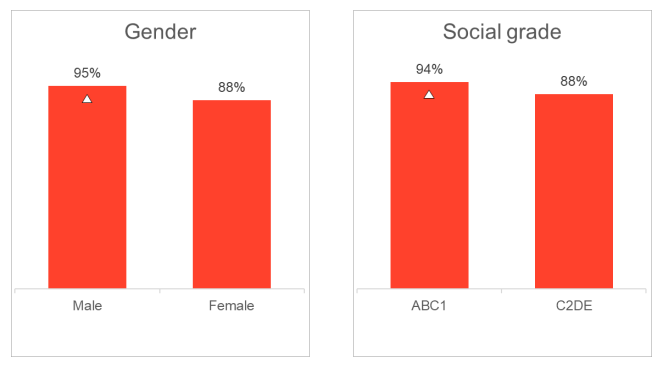
The profile of crypto holders has remained broadly consistent. Ownership is higher among men at 11%, compared with women, and is most concentrated among people aged 18 to 34, where 15% report holding crypto.

Source: FCA

Overall public awareness of crypto remains high, with 91% of respondents saying they have heard of cryptocurrencies, matching 2024 levels and continuing a multi-year trend of widespread familiarity.

Individuals from ethnic minority backgrounds and higher-income social grades are also more likely to own digital assets, according to the FCA’s nationally representative survey of more than 2,300 respondents.

Source: FCA

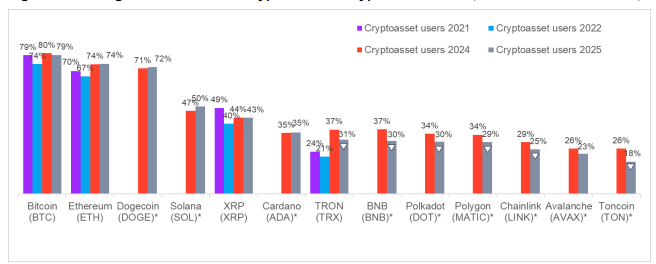
Bitcoin remains the most commonly held cryptoasset, owned by 57% of users, and recorded a five-percentage-point recovery after several years of declining ownership.

Ethereum followed at 43%, largely unchanged from 2024. Also, other assets were held at much lower levels, with Solana, Dogecoin, XRP, and Cardano the most commonly mentioned beyond the two market leaders.

Small Holders Exit as High-Value Crypto Portfolios Grow

Behind the headline decline in ownership, the report shows a steady shift toward higher-value holdings.

The share of users holding £1,001 to £5,000 in crypto rose to 21%, up four percentage points from 2024, while those holding £5,001 to £10,000 increased to 11%, up three points.

Source: FCA

At the same time, the number of people holding £100 or less continued to fall, extending a trend seen over several years.

The FCA noted that the difference between high- and low-value holders has widened since last year, particularly in motivations linked to long-term investing.

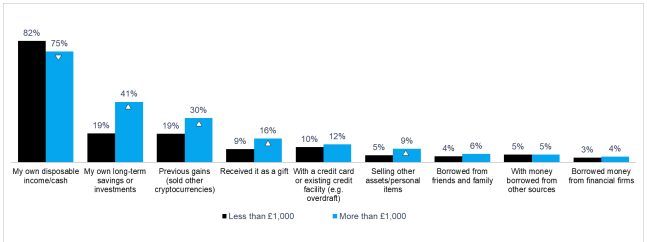
Most crypto purchases continue to be funded using personal cash.

Around 76% of users relied on disposable income, while 25% used long-term savings and 19% used previous investment gains.

Source: FCA

The use of credit cards or borrowing fell further, with just 9% reporting credit-based purchases, down five percentage points from 2024.

The data also suggests that new adoption is slowing, noting that only 5% of crypto owners first bought assets after October 2024, while most entered the market between 2019 and 2021.

Incentives such as rewards or promotions also declined, with just 17% of users reporting receiving one in the past six months.

Source: FCA

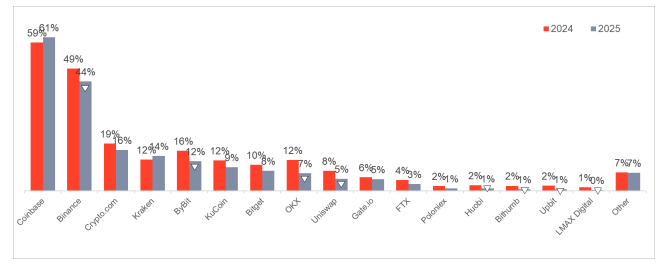
The report also noted centralized exchanges remain the dominant access point, used by 73% of UK crypto users, an increase from last year. Coinbase and Binance remained the most widely used platforms, though Binance’s share declined.

UK Ranks 11th in Global Crypto Adoption as regulation gets clearer

The findings come as the UK continues to reshape its regulatory framework. In 2025, the government introduced legislation to bring crypto activities under the FCA’s supervision while also formally recognizing digital assets as personal property under UK law.

👨🏻‍⚖️ The UK has formally recognized cryptocurrencies and stablecoins as legal property through a new Act of Parliament.#UK #Cryptohttps://t.co/I68t8BBZoD

— Cryptonews.com (@cryptonews) December 3, 2025

Full implementation of the regime is not expected until 2027, but the FCA has already accelerated approvals and launched consultations covering trading, staking, lending, and decentralized finance.

Globally, the UK ranked 11th in Chainalysis’ crypto adoption index, behind countries such as India, the United States, Brazil, and Vietnam.

The post UK Crypto Ownership Plunges to 8% — But High-Value Portfolios Are Soaring appeared first on Cryptonews.

KindlyMD Bitcoin Treasury Faces Nasdaq Delisting As It Plunges Below $1 — Can It Survive Like MSTR?

16 December 2025 at 11:07

KindlyMD Inc., a healthcare and Bitcoin treasury company, is facing the risk of being delisted from the Nasdaq after its share price remained below the exchange’s minimum bid requirement for an extended period.

In a Form 8-K filing dated Dec. 12, the company disclosed that it had received a notice from Nasdaq’s Listing Qualifications Department after its common stock closed below $1 for 30 consecutive trading days, placing it out of compliance with Nasdaq Listing Rule 5450(a)(1).

Source: SEC filing

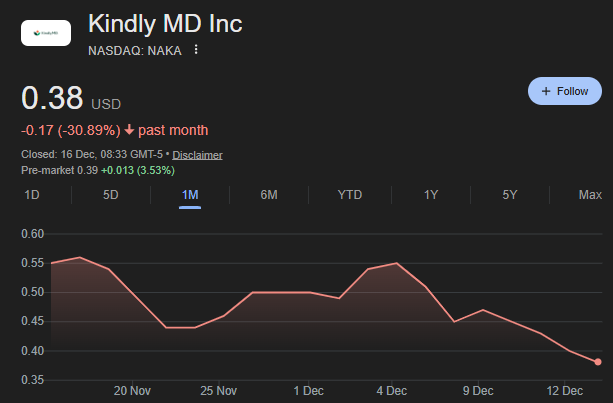
KindlyMD’s shares, which trade under the ticker NAKA, are currently priced at $0.38. The stock is down nearly 5% on the day, has fallen more than 30% over the past month, and is down over 73% year to date.

KindlyMD Faces June 2026 Deadline to Recover Stock Price

Under Nasdaq rules, KindlyMD has 180 calendar days, or until June 8, 2026, to regain compliance by maintaining a closing bid price of at least $1 for a minimum of 10 consecutive trading days.

Source: Google Finance

KindlyMD’s current situation marks a steep reversal from earlier optimism surrounding its Bitcoin strategy.

In May, the company merged with Nakamoto, a Bitcoin-focused public entity, in one of the first known cases of a healthcare firm formally adopting Bitcoin as a core treasury asset.

📢 @KindlyMD merges with Bitcoin-native Nakamoto to launch the first-ever Bitcoin-backed healthcare company. #Bitcoin #treasury #Metaplanethttps://t.co/Gw5h56BP70

— Cryptonews.com (@cryptonews) May 13, 2025

The combined entity retained the KindlyMD name, with Nakamoto operating as a wholly owned subsidiary, and raised more than $700 million through a mix of private placements and convertible debt to fund Bitcoin purchases.

That strategy accelerated in August, when KindlyMD acquired 5,764 Bitcoin in a single transaction, spending approximately $679 million at an average price above $118,000 per coin.

According to CoinGecko data, the company now holds Bitcoin valued at about $502.6 million, placing it around 32nd among public Bitcoin treasury holders, down from 26th three months earlier.

Source: CoinGecko

At current prices, the position carries an unrealized loss of roughly $176 million, or about 26%.

Bitcoin itself is trading near $87,000, up modestly on the week, but many publicly listed companies holding crypto on their balance sheets have seen their stocks fall faster than the underlying assets.

The Bitcoin Treasury Trade Isn’t One-Size-Fits-All: KindlyMD vs. Strategy

KindlyMD’s financial filings reflect the strain of its rapid transformation. In its third-quarter report, the company posted revenue of $0.4 million from its healthcare operations, while operating expenses climbed to $10.8 million, driven largely by costs tied to its Bitcoin strategy.

KindlyMD (NASDAQ: NAKA) today announced its Q3 2025 financial results.

Please review our press release for full financial details and forward-looking statements.

Press release available herehttps://t.co/QQHBZg0nGk

— Nakamoto (@nakamoto) November 19, 2025

The company reported a net loss of $86 million for the quarter, including non-cash charges linked to the Nakamoto merger and unrealized digital asset losses.

Notably, the company said the Nasdaq’s notice has no immediate impact on its listing and that its shares will continue trading on the Nasdaq Global Market during the compliance period.

If it fails to recover, the company may seek to transfer to the Nasdaq Capital Market or pursue a reverse stock split, though it cautioned that there is no assurance either step would be successful.

The situation differs from Strategy Inc., formerly MicroStrategy, which is facing uncertainty tied to index eligibility rather than exchange rules.

🧨 Strategy’s spot @MicroStrategy in major indexes is now at risk, with JPMorgan warning that a removal from MSCI USA or the Nasdaq 100 could spark billions in outflows.#Strategy #CryptoStocks https://t.co/ozDjakVUm7

— Cryptonews.com (@cryptonews) November 21, 2025

MSCI began reviewing its index methodology in October 2025, triggering a sharp sell-off in MSTR shares.

The company has formally submitted its 12-page letter to MSCI opposing the proposal.

While the stock later stabilized after retaining its Nasdaq 100 position, the risk remains, with a delisting potentially triggering billions in forced passive fund sales.

MSCI is expected to issue a final decision in January 2026.

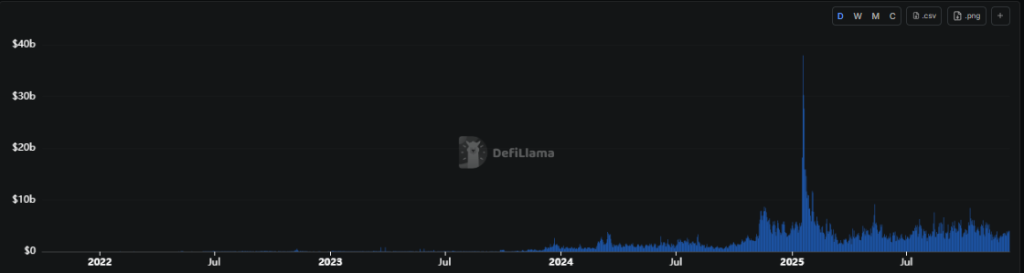
Notably, across the market, digital asset treasury stocks have broadly underperformed their underlying holdings in recent months.

Source: DefiLlama

Data shows that in November, inflows into DATS were only $1.32 billion in inflows, their lowest level of the year, showing a cooling of investor appetite as volatility and regulatory uncertainty persist.

The post KindlyMD Bitcoin Treasury Faces Nasdaq Delisting As It Plunges Below $1 — Can It Survive Like MSTR? appeared first on Cryptonews.

Bitcoin Falls 26%, But Outperforms Every Major Crypto Sector in 3 Months — What’s Going On?

16 December 2025 at 07:56

Bitcoin has fallen sharply from its recent peak, but fresh data shows it is still holding up better than almost every other corner of the crypto market, showing how capital behavior has shifted during the latest downturn.

Bitcoin is down roughly 26% over the past three months and about 30% from its all-time high near $126,200, trading just above the $85,000 level.

Despite the drop, on-chain analytics firm Glassnode said Bitcoin has outperformed nearly all major crypto sectors over the same period.

Over the past 3 months, the average return across nearly all crypto sectors has underperformed Bitcoin.
This persistent relative weakness highlights a market environment where capital concentration favours BTC.

📊 https://t.co/rFisuVfSY7 https://t.co/lpXqEe9bbW pic.twitter.com/WNtKEKclX7

— glassnode (@glassnode) December 16, 2025

From AI to Meme Coins, Crypto Sectors Sink as Bitcoin Shows Relative Strength

The broader market context helps explain the divergence. Total crypto market capitalization fell around 27.5% over the past three months, slightly more than Bitcoin’s decline.

Ether has suffered a deeper drawdown, sliding about 36% since mid-September and trading below $3,000.

Source: Coingecko

Other narrative-driven sectors have fared worse. AI-related tokens are down roughly 48%, meme coin market capitalization has dropped about 56%, and real-world asset tokenization tokens have fallen around 46%.

DeFi tokens have also struggled, declining close to 38% over the same period.

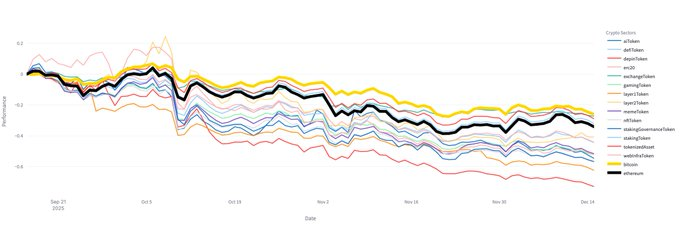
Glassnode’s cross-sector performance data shows how the sell-off unfolded. In late September, most sectors were clustered near neutral performance, suggesting capital was still broadly distributed and risk appetite remained intact.

That changed in early October, when a sharp, market-wide shock pushed nearly all sectors lower. High-beta areas such as Layer 1s, Layer 2s, AI, gaming, NFTs, and meme tokens saw deeper drawdowns, while Bitcoin fell more modestly, acting as a relative shelter.

Source: Glassnode

Attempts at recovery in mid-October failed to gain traction. Small rebounds across altcoin sectors did not reclaim prior levels, and Glassnode data shows no sector returning to neutral performance.

By late October and into November, losses widened further, with performance dispersion increasing and capital continuing to withdraw rather than rotate.

By mid-November, several sectors entered what Glassnode described as a capitulation phase, with drawdowns deepening across Layer 1s, DePIN, gaming, NFTs, and memes. Bitcoin and Ether also fell, but Bitcoin maintained the shallowest relative losses.

Shark Accumulation Hits Fastest Pace Since 2012 as Whales Distribute

By December, the picture had become clearer. Bitcoin stood out as the top relative performer despite remaining in negative territory, while Ether continued to lag.

Defensive altcoin categories such as exchange tokens and staking-related assets sat in the middle, and speculative narratives occupied the bottom.

Glassnode said the data does not show rotation into new winners but rather graduated losses, with Bitcoin retaining capital more effectively as liquidity tightened.

This relative strength has played out alongside shifting BTC dominance dynamics. Earlier in the year, Bitcoin dominance rose steadily and peaked near 65%, coinciding with a strong price rally.

The structure changed around mid-July, when dominance began to fall and capital rotated into altcoins.

That rotation broke down during an October deleveraging event, when forced liquidations briefly pushed capital back into Bitcoin.

Since then, dominance has moved sideways between roughly 59% and 61%, reflecting a market without a clear anchor.

Bitcoin’s relative outperformance shows that investors are still treating BTC as a defensive anchor, preserving capital during periods when altcoins face deeper drawdowns and weaker conviction.

Onchain positioning adds another layer to the story. Glassnode data shows that mid-sized holders, often referred to as “sharks” with balances between 100 and 1,000 BTC, added about 54,000 BTC over the past week, bringing their collective holdings to roughly 3.575 million BTC.

The pace of accumulation is the fastest seen since 2012, suggesting strong dip-buying from higher-net-worth individuals and institutional players.

At the same time, selling pressure has come from long-term holders and so-called OG whales with balances above 10,000 BTC.

According to Glassnode and Capriole Investments, distribution from older coins has offset record institutional buying, limiting near-term upside and keeping downside risks in focus.

The post Bitcoin Falls 26%, But Outperforms Every Major Crypto Sector in 3 Months — What’s Going On? appeared first on Cryptonews.

Texas Goes Full Crypto Mode as Bitcoin ATM Operator Eyes 200 New Machines

16 December 2025 at 00:16

Texas’ role as a center of U.S. crypto activity is set to expand further after Bitcoin Bancorp said it plans to deploy up to 200 licensed Bitcoin ATMs across the state beginning in the first quarter of 2026.

The state is adding to an already dense network of crypto kiosks operating under one of the country’s clearest regulatory frameworks.

Bitcoin Bancorp Enters Texas, Citing Clear Rules and Strong ATM Demand

Bitcoin Bancorp, which trades over the counter under the ticker BCBC, said the planned rollout would mark its entry into what it described as a strategically important market.

BIG NEWS! 🚀 Bitcoin Bancorp (OTC: $BCBC) is set to deploy up to 200 licensed Bitcoin ATMs across Texas starting Q1 2026!
Expansion Targets One of the Most Crypto-Friendly U.S. States as Part of a Broader National Growth Strategy
Excited to bring easier Bitcoin access to the…

— BitcoinBancorp (@BCBC_stock) December 15, 2025

The company is one of only three publicly traded Bitcoin ATM network owners in the United States and says it holds foundational patents tied to Bitcoin ATM technology.

Eric Noveshen, a director at the firm, said agreements are already in place that could support faster revenue growth as the company moves from planning into execution.

Following the announcement, Bitcoin Bancorp shares rose 7.83% on the day and are up 29.53% over the past five days, reflecting increased investor confidence in the expansion strategy.

Source: Yahoo Finance

The expansion comes at a time when Texas already hosts more than 4,000 live crypto ATMs, the highest number of any U.S. state.

Large national operators, including Athena Bitcoin, Bitcoin Depot, Coinhub, Cryptobase, and Byte Federal, have established broad coverage across major cities such as Houston, Dallas, Austin, and San Antonio.

The presence of this existing infrastructure has lowered barriers for new deployments and signaled sustained consumer demand for in-person crypto access.

Why Bitcoin ATM Operators Keep Flocking to Texas

Texas’ appeal to ATM operators largely stems from its regulatory structure. State law treats virtual currency as a form of money under the Texas Money Services Act, placing Bitcoin ATM operators within a familiar licensing regime overseen by the Texas Department of Banking.

Source: Americas Bitcoin Atm

Companies must obtain a money transmitter license, meet minimum net worth requirements of at least $500,000, post a surety bond of no less than $150,000, and submit to regular examinations.

Consumer protection has also become a growing focus. In Texas, state rules require Bitcoin ATM operators to clearly disclose fees, exchange rates, and complaint procedures.

Federal Scrutiny Intensifies Around Bitcoin ATMs

Oversight of Bitcoin ATMs in the United States is tightening at the federal level as regulators respond to rising fraud concerns and increased consumer use.

Currently at the federal level, Bitcoin ATM operators are classified as money services businesses under the Bank Secrecy Act, placing them under the supervision of the Financial Crimes Enforcement Network (FinCEN).

This requires operators to maintain formal anti-money laundering programs, conduct customer identity verification, and monitor transactions for suspicious activity.

Identity checks typically scale with transaction size, ranging from basic phone verification for smaller amounts to government-issued identification and enhanced due diligence for larger transfers.

Operators are also required to file currency transaction reports for cash transactions exceeding $10,000, submit suspicious activity reports when necessary, and retain records for a minimum of five years.

At the same time, federal lawmakers are moving to further regulate the sector. Proposed legislation such as the Crypto ATM Fraud Prevention Act of 2025 shows a more focused concern over the role of crypto kiosks in scam-related losses nationwide.

What the Crypto ATM Fraud Prevention Act Proposes

Introduced in the U.S. Senate as Bill S. 710, the Crypto ATM Fraud Prevention Act of 2025, which has been read twice and referred to the Senate Committee on Banking, Housing, and Urban Affairs, is designed to reduce fraud risks while increasing transparency for consumers.

Key provisions of the bill include mandatory registration of virtual currency kiosks with the U.S. Treasury; also, operators are required to provide clear pre-transaction disclosures outlining terms, fees, and a warning that transactions are final and non-refundable.

The bill mandates prominent fraud warnings on kiosks, the issuance of physical receipts containing transaction details and fraud-reporting information, and the implementation of written anti-fraud policies submitted to FinCEN.

The post Texas Goes Full Crypto Mode as Bitcoin ATM Operator Eyes 200 New Machines appeared first on Cryptonews.

Yesterday — 15 December 2025Main stream

Bitcoin Down, MSTR Sliding — Why Did a $284B NY Pension Fund Buy Despite a 7% Drop?

15 December 2025 at 17:00

Bitcoin prices extended their decline this week, dragging closely correlated equities lower and pushing shares of Strategy (MSTR) down sharply during regular trading hours.

Yet even as the stock slid more than 7% in a single session, one of the largest public pension funds in the United States quietly increased its exposure.

The New York State Common Retirement Fund, which manages roughly $284 billion in assets reportedly raised its position in Strategy, a Nasdaq-listed company widely viewed as an equity proxy for Bitcoin exposure.

JUST IN: $284 billion U.S. New York State Retirement Fund increased its position in #Bitcoin treasury company Strategy $MSTR to $50 million. pic.twitter.com/XnHfpvUZPL

— BitcoinTreasuries.NET (@BTCtreasuries) December 15, 2025

Strategy Drops 7% on $2.3B Volume as Bitcoin Sell-Off Deepens

The move came as Strategy shares fell to $163.55 by 13:56 EST on December 15, down 7.29% on the day. Trading activity was heavy, with $2.32 billion in value changing hands across nearly 14 million shares.

The stock moved between an intraday high of $176.50 and a low of $160.54, placing its market capitalization at $50.7 billion.

Source: sosovalue

Strategy currently has 287.35 million shares outstanding, with 267.03 million in circulation, and trades at a basic mNAV of 0.88.

The decline mirrors renewed pressure in the broader crypto market. Bitcoin was trading around $86,214, down 3.5% over the past 24 hours, 4.4% over the past week, and more than 10% over the past month.

Source: Cryptonews

The pullback followed a steep correction from Bitcoin’s recent peak above $126,000, a move that has weighed heavily on companies with direct balance-sheet exposure to the asset.

Repeat Buyer Signal: New York State Pension Fund Continues Expanding Its Position

New York State fund raised its stake during the second quarter of 2025 and disclosed another increase in a November filing covering third-quarter positions.

At that point, the fund owned approximately 0.10% of Strategy, valued at about $113.8 million.

The New York State fund is one of the largest public retirement systems in the country, with a portfolio heavily weighted toward public equities, fixed income, private equity, real assets, and alternative investments, with public stocks accounting for just over 40% of total assets.

Its holdings include large positions in major U.S. technology, financial, consumer, and healthcare companies.

The Strategy investment remains a small allocation within that diversified portfolio, but its persistence has drawn attention given the volatility tied to Bitcoin-linked assets.

Strategy Pushes Bitcoin Holdings Past 671,000 BTC as Shares Fall

Strategy has become the most prominent example of that exposure. The company has spent the past several years converting operating cash flows, equity issuance proceeds, and debt financing into Bitcoin purchases.

That approach has caused its shares to trade as a leveraged reflection of Bitcoin’s price movements.

Since peaking above $450 in July, MSTR shares have fallen nearly 62%, according to Yahoo Finance data.

Over the past six months, the stock is down more than 55%, moving from roughly $369 in mid-June to the mid-$160 range.

Despite the volatility, Strategy has continued adding to its Bitcoin holdings. Last week, the company disclosed the purchase of 10,645 BTC for $980.3 million at an average price of $92,098 per coin.

The acquisition lifted its total holdings to 671,268 BTC, reinforcing its position as the world’s largest corporate holder of Bitcoin.

Those acquisitions came as Strategy moved to address investor concerns about liquidity and cash obligations.

The company recently established a $1.44 billion U.S. dollar reserve intended to cover dividend payments and interest expenses without requiring the sale of Bitcoin during periods of market stress.

Management said the reserve is sufficient to fund at least 12 months of dividend obligations, with plans to extend coverage to two years.

Other public pension systems, including New Jersey’s, have also disclosed increased MSTR holdings in recent months, showing a broader pattern of selective institutional exposure to Bitcoin-linked equities rather than direct cryptocurrency ownership.

The post Bitcoin Down, MSTR Sliding — Why Did a $284B NY Pension Fund Buy Despite a 7% Drop? appeared first on Cryptonews.

South Korea Misses Stablecoin Bill Deadline — Banks vs. Innovation Battle Heats Up

15 December 2025 at 14:01

South Korea’s effort to legalize won-pegged stablecoins has hit another setback after the country’s top financial regulator missed a government-imposed deadline, exposing a deepening power struggle between financial authorities over who should control the next phase of digital finance.

Earlier this month, the ruling Democratic Party asked the Financial Services Commission to submit a draft stablecoin bill by December 10, fulfilling President Lee’s campaign pledge to create a legal framework for digital assets.

🇰🇷 South Korea pushes for draft stablecoin bill by Dec. 10 deadline as lawmakers threaten independent action if FSC misses target. #SouthKorea #Stablecoinhttps://t.co/dLzvS4qax1

— Cryptonews.com (@cryptonews) December 1, 2025

That deadline passed without a submission.

Stablecoin Disagreement Holds Up South Korea’s Crypto Bill

The South Korean media outlet Newsis reported that FSC later confirmed it was unable to deliver the proposal on time, saying it needed additional coordination with other agencies.

A spokesperson said the regulator would instead release the government’s position publicly alongside its formal submission to the National Assembly, citing the public’s right to understand the framework being proposed.

The FSC said it is preparing a draft tentatively titled the Basic Digital Asset Act, also described as Phase Two of South Korea’s virtual asset legislation.

Officials expect the proposal to be released later this month or early next month, ahead of a consolidated bill the ruling party has pledged to introduce in January 2026 under President Lee Jae-myung’s election commitments.

Behind the delay is an unresolved dispute between the FSC and the Bank of Korea over who should lead stablecoin issuance.

The central bank has argued that stablecoins function similarly to currency and deposit-like instruments and should therefore remain under bank control.

It has pushed for a rule requiring domestic banks to hold at least a 51% stake in any stablecoin-issuing entity, along with inspection powers and veto authority over approvals.

The FSC has resisted that approach, pointing to overseas models, noting that most issuers under the European Union’s MiCA framework are non-bank digital asset firms and that Japan’s first yen-linked stablecoin was issued by a fintech company.

FSC officials have said bank-led issuance lacks global precedent and could limit participation by technology firms that already operate digital payment infrastructure.

Negotiations between the FSC and the BOK remain ongoing. Officials familiar with the talks say a compromise may involve flexible ownership thresholds based on business scope, though no agreement has been confirmed.

The disagreement has stalled coordination long enough for lawmakers to begin reviewing multiple competing drafts at the National Assembly’s Political Affairs Committee.

Delays in Stablecoin Rules Raise Fears South Korea Is Falling Behind

Industry groups have warned that continued delays risk leaving South Korea behind jurisdictions such as the United States, the European Union, and Japan, all of which have already established stablecoin rules.

Domestic stablecoin issuance remain illegal in South Korea, even as companies prepare infrastructure behind the scenes.

Naver Financial has developed a blockchain wallet for Busan’s local currency program, while KakaoBank has begun work on a KRW-denominated digital token. Major banks have also explored a joint stablecoin project targeting late 2025 or early 2026.

🚀 Naver Financial, the fintech arm of South Korean internet giant Naver, is preparing to roll out a stablecoin wallet in Busan.#SouthKorea #Cryptohttps://t.co/40QBNaXJ9C

— Cryptonews.com (@cryptonews) November 25, 2025

Regulatory urgency has been heightened by recent enforcement challenges. In December, Korean authorities disclosed that Binance froze only a small portion of funds stolen during last month’s Upbit hack, despite urgent requests from police and the exchange.

🇰🇷 Korean authorities say @Binance froze only a small portion of the crypto stolen during last month’s @Official_Upbit hack.#SouthKorea #Binancehttps://t.co/o5VVQN9tYp

— Cryptonews.com (@cryptonews) December 12, 2025

Investigators said hackers rapidly laundered assets across chains and wallets, highlighting the difficulty of coordinating responses without clearer oversight frameworks.

Experts said the incident shows the need for faster, more structured controls as digital-asset activity expands.

South Korea’s stablecoin debate is also unfolding against a backdrop of delayed crypto policy more broadly. The country’s virtual asset tax regime, approved in 2020, has been postponed several times and is now scheduled for 2027.

The post South Korea Misses Stablecoin Bill Deadline — Banks vs. Innovation Battle Heats Up appeared first on Cryptonews.

Visa Launches Stablecoins Advisory as Market Tops $300B — Banks Rush In?

15 December 2025 at 11:08

Visa has launched a new “Stablecoins Advisory Practice” as the stablecoin market climbs above $300 billion just as banks and financial institutions accelerate their engagement with digital dollars.

Visa has launched a Stablecoins Advisory Practice to help banks, fintechs and enterprises design and implement stablecoin strategies. The service will support use cases such as cross-border and B2B payments, as Visa deepens its push into stablecoins. https://t.co/Mnn4CKwVUd

— Wu Blockchain (@WuBlockchain) December 15, 2025

The move comes as traditional financial institutions accelerate their engagement with stablecoins following clearer regulatory signals in the United States.

Visa Works With Early Clients on Stablecoin Strategies

Carl Rutstein, global head of Visa Consulting and Analytics, said the practice is designed to meet growing client demand rather than push adoption indiscriminately.

He said Visa is working with dozens of early clients, including Navy Federal Credit Union, VyStar Credit Union, and Pathward, and expects the number to expand into the hundreds.

The advisory work spans strategy development, technical architecture, operational readiness, and implementation support, with some clients ultimately deciding whether stablecoins align with actual customer needs.

Stablecoins are cryptocurrencies designed to maintain a fixed value, typically pegged to the U.S. dollar through reserves.

Once largely confined to crypto trading, they are increasingly being used for payments, cross-border transfers, and business-to-business settlement, particularly in regions with currency volatility or limited access to traditional banking rails.

According to DefiLlama data, the global stablecoin market capitalization now stands at $309.85 billion. Tether’s USDT remains dominant with a 60.10% market share and a market cap of $186.23 billion, followed by Circle’s USDC at $78.31 billion.

Source: DefiLlama

Other stablecoins, including Ethena’s USDe, Sky Dollar, Dai, and PayPal USD, make up smaller but growing portions of the market, collectively reflecting broader issuer diversity.

Visa Pushes Stablecoins Deeper Into Global Payments

Visa’s latest move follows a series of stablecoin initiatives by the company over the past several years. In 2023, Visa piloted USDC settlement on blockchain networks and now supports more than 130 stablecoin-linked card programs across 40 countries.

Visa recently began testing a system that allows businesses to fund cross-border payments using stablecoins instead of pre-depositing cash into local accounts.

🌍 Credit card giant @Visa has begun testing stablecoin-powered cross-border payments, marking a major step in digital tokens gaining acceptance among global finance players.#Visa #Stablecoins https://t.co/bJwqFJe5tc

— Cryptonews.com (@cryptonews) September 30, 2025

Visa has said the program will expand in 2026 and targets banks, remittance firms, and financial institutions that currently rely on costly correspondent banking networks.

The push has been reinforced by regulatory clarity in the United States following President Donald Trump’s signing of the GENIUS Act in July, which established formal rules for stablecoin issuance.

Since then, several financial and payments firms have accelerated their stablecoin strategies.

PayPal and Mastercard have expanded their digital dollar capabilities, while institutions such as Citigroup, JPMorgan, and Standard Chartered continue to explore tokenized settlement and on-chain liquidity tools.

Stablecoin Adoption Spreads Globally as Banks and Card Networks Step In

Visa’s advisory launch also arrives as stablecoin adoption spreads beyond the U.S. In Africa, Visa has partnered with Yellow Card Financial to support stablecoin payments across 20 countries, while Circle has worked with Onafriq to connect stablecoins to hundreds of wallets and bank accounts.

@visa and @yellowcard_app have partnered to expand stablecoin-powered payments across Africa.#stablecoin #Visahttps://t.co/nB85xKKAXa

— Cryptonews.com (@cryptonews) June 19, 2025

Mastercard recently partnered with Chainlink to let cardholders make on-chain crypto purchases. Meanwhile, Sony Bank plans to launch a regulated dollar-pegged stablecoin for payments within its digital entertainment ecosystem.

🔗 @chainlink announces historic @Mastercard partnership enabling 3 billion+ cardholders to buy cryptocurrency onchain through seamless fiat-to-crypto conversion eliminating complex barriers.#Chainlink #Mastercard #Cryptohttps://t.co/SSrILSQ5Tf

— Cryptonews.com (@cryptonews) June 24, 2025

Institutions such as Goldman Sachs, Wells Fargo, McKinsey, Anchorage Digital, and GFT Technologies already offer advisory, research, or infrastructure services tied to stablecoins.

Visa executives have consistently framed stablecoins not as a threat to existing payment systems, but as an extension of them.

Speaking earlier this year, Visa’s head of crypto, Cuy Sheffield said the future of payments would combine traditional rails with on-chain settlement, rather than replacing one with the other.

The post Visa Launches Stablecoins Advisory as Market Tops $300B — Banks Rush In? appeared first on Cryptonews.

Base Co-Founder Draws Fire After Backing Soulja Boy’s Token Despite Repeated Scam Claims

15 December 2025 at 11:07

Base co-founder Jesse Pollak is facing mounting criticism after publicly engaging with and backing activity linked to a meme token associated with rapper Soulja Boy.

The case revives long-running concerns about celebrity-driven crypto promotions and the responsibility of senior ecosystem figures.

The controversy unfolded over a sequence of posts on X in mid-December.

On December 13, Soulja Boy shared a comparison of creator payout schedules across major platforms, arguing that newer applications offered faster access to earnings than traditional social networks.

Twitch pays you once a month. TikTok pays you once a week. Favorited pays you once a day. Choose your poison wisely.

— Soulja Boy (Draco) (@souljaboy) December 13, 2025

On-Chain Research Rekindles Concerns Over Celebrity Crypto Promotions

Pollak amplified the discussion while framing Base, Coinbase’s Ethereum Layer-2 network, as an alternative monetization layer for creators.

In a direct reply to Soulja Boy, Pollak said he had just backed the rapper on Base and had “instantly earned,” describing the interaction as an example of “new internet” behavior enabled by on-chain tools.

. @baseapp pays you instantly https://t.co/0XurhOsj1H

— jesse.base.eth (@jessepollak) December 13, 2025

Although Pollak did not name or explicitly promote a specific token, many users interpreted the exchange as an endorsement of a Soulja Boy-linked meme token that had just launched on Base.

@souljaboy just backed you on @base and you instantly earned.

new internet shithttps://t.co/CQ5NCvBwXj pic.twitter.com/fmdkt8UsZy

— jesse.base.eth (@jessepollak) December 13, 2025

Developers, traders, and researchers questioned why a senior figure at a Coinbase-backed network would publicly engage with a celebrity whose crypto history has drawn repeated scrutiny.

The criticism quickly shifted from the token itself to broader concerns about trust, reputation, and showing within the Base ecosystem, which has positioned itself as a compliant, mainstream-friendly Layer-2 network.

The debate intensified after on-chain investigator ZachXBT publicly challenged Pollak’s decision to interact with Soulja Boy.

Why give SouljaBoy the platform to scam new people? https://t.co/PDxnk0Z0Za

— ZachXBT (@zachxbt) December 14, 2025

He pointed to research he published in April 2023 documenting what he described as a long pattern of exploitative crypto promotions tied to the rapper.

ZachXBT Details Pattern of Abandoned Crypto Projects Linked to Soulja Boy

According to that research, Soulja Boy was involved in at least 73 token promotions and 16 NFT launches, many of which later collapsed or were abandoned.

Why give SouljaBoy the platform to scam new people? https://t.co/PDxnk0Z0Za

— ZachXBT (@zachxbt) December 14, 2025

ZachXBT outlined several examples from past market cycles, including meme tokens such as RapDoge, which was promoted in July 2021 before quickly rug-pulling, and projects like Orion and The Life Token, which used charitable narratives before collapsing.

Beyond tokens, the investigator said Soulja Boy launched multiple NFT collections, some of which advertised future utility that never materialized.

He also referenced prior regulatory and legal issues, including SEC charges related to Tron promotions and a lawsuit connected to SafeMoon.

Growing Scrutiny Follows Base’s Rapid Rise in the Layer-2 Market

Against that backdrop, critics argued that visibility from prominent builders functions as implicit validation, particularly for new users who may not be familiar with a promoter’s history.

Supporters of open, permissionless networks countered that public blockchains do not restrict who can deploy tokens or participate, and that engagement does not necessarily equate to endorsement.

The episode arrives at a sensitive moment for Base.

According to L2beat data, Base is currently the second-largest Layer-2 network by total value locked, with approximately $12.66 billion, trailing only Arbitrum.

Source: L2Beat

Its rapid growth has positioned it as one of the most visible scaling layers in the Ethereum ecosystem, increasing scrutiny around how senior figures communicate publicly.

The backlash also reflects a broader pattern in crypto discourse.

In recent months, ZachXBT has repeatedly surfaced in high-profile cases involving alleged misconduct, including claims tied to celebrity NFT launches, suspected large-scale hacks, and the exposure of organized fraud networks.

These episodes have fueled recurring debates about due diligence, accountability, and the role of influence in shaping on-chain behavior.

The post Base Co-Founder Draws Fire After Backing Soulja Boy’s Token Despite Repeated Scam Claims appeared first on Cryptonews.

Before yesterdayMain stream

CFTC Scraps ‘Outdated’ Bitcoin Guidance – What This Means for Future Regulation

11 December 2025 at 17:41

The U.S. Commodity Futures Trading Commission has formally scrapped its 2020 “actual delivery” guidance for Bitcoin and other virtual currencies and set the stage for a broader shift in how the agency oversees crypto markets.

Acting Chair Caroline Pham announced the withdrawal on December 11, calling the old framework outdated and inconsistent with the market’s level of maturity.

Source: CTFC

She said the move reflects the administration’s push this year to remove rules that had become overly complex and deterred crypto firms from operating within the U.S., adding that eliminating such barriers shows “real progress can be made to protect Americans by promoting access to safe U.S. markets.”

CFTC Withdraws 28-Day Crypto Delivery Standard, Easing Path for New Products

The guidance that has now been withdrawn defined the conditions under which a leveraged or margined crypto purchase could be considered “actual delivery,” a standard built around a 28-day window that required the buyer to have full possession and control of the asset.

It was introduced at a time when regulators were still unsure how virtual currency markets would develop, and it placed crypto in a category separate from other commodities.

Pham said the agency’s experience with virtual currency derivatives listings, along with years of market growth and the development of stronger custody practices, made the old rules incompatible with how the industry now operates.

The withdrawal allows digital assets to be regulated under the CFTC’s general, technology-neutral framework, a shift that reduces compliance burdens for exchanges seeking to list new products.

It also marks a step toward normalizing Bitcoin and Ethereum alongside traditional commodities.

The update lands at a time when U.S. regulators are moving quickly on crypto policy. Only days before scrapping the old guidance, the CFTC cleared the way for spot crypto trading to occur directly on federally regulated futures exchanges, a first for the industry.

@ CFTC approves spot crypto trading on U.S. futures exchanges, giving investors safe, regulated access to digital assets. #SpotTrading #CFTC https://t.co/S30HuwWjGX

— Cryptonews.com (@cryptonews) December 4, 2025

Acting Chair Caroline Pham called the move a major shift, saying it brings spot trading onto platforms that have operated under federal rules for decades.

It also forces leveraged retail crypto trades, previously stuck in a gray zone, onto exchanges that already follow strict market protections.

The move comes after months of coordination with other agencies, including the SEC. Earlier this year, both regulators confirmed that registered exchanges under either agency could support certain spot crypto products.

🔎 Spot crypto trading is moving closer to mainstream finance after the SEC and CFTC cleared registered exchanges to facilitate certain spot products.#SpotCrypto #SEC #CFTChttps://t.co/5C5uy800Ju

— Cryptonews.com (@cryptonews) September 3, 2025

CFTC Advances Crypto Sprint With New Tokenized Collateral Pilot

These moves are part of a wider effort tied to the CFTC’s “Crypto Sprint,” a program examining tokenized collateral, stablecoin use in derivatives markets, and ways to modernize clearing and settlement rules through blockchain systems.

The agency has already begun testing some of these ideas in practice. On December 8, it launched a pilot program that allows Bitcoin, Ether, and USDC to be used as collateral in derivatives markets, giving the agency real-time insight into how tokenized assets behave under regulated conditions.

🏛The US @CFTC has launched a pilot allowing Bitcoin, Ether and USDC to serve as collateral in derivatives markets, marking a major step toward regulated crypto integration.#CFTC #Tokenization https://t.co/XrmdLTamP7

— Cryptonews.com (@cryptonews) December 9, 2025

For the first three months of the pilot, futures commission merchants can only accept those three digital assets and must submit weekly reports on their holdings, a structure the agency says will help it monitor risk while still expanding access to new tools.

The CFTC’s divisions have also issued guidance confirming that tokenized real-world assets, such as U.S. Treasuries and money market funds, can be evaluated within the existing regulatory framework.

To ease the transition, the agency granted no-action relief to firms that want to accept certain non-securities digital assets as customer margin.

Pham has emphasized that the goal is to give U.S. traders safer alternatives to offshore platforms after years of high-profile failures and losses.

The shift is unfolding as the agency undergoes its own leadership transition. Pham has been serving as acting chair since January and is expected to step down once the Senate confirms President Donald Trump’s nominee, Michael Selig.

The post CFTC Scraps ‘Outdated’ Bitcoin Guidance – What This Means for Future Regulation appeared first on Cryptonews.

Did One Entity Kill PEPE’s Fair Launch? Bubblemaps Flags 30% Genesis Hoard, $2M Dump

11 December 2025 at 12:09

New blockchain analysis is raising questions about the long-promoted “fair launch” of the PEPE meme coin, after fresh data suggested that almost one-third of the token’s initial supply may have been controlled by a single entity.

The findings come from blockchain visualization platform Bubblemaps, which published its latest breakdown on Wednesday, alleging that the project’s early messaging may have misled investors.

this is $PEPE at launch with time nodes on

30% bundled

you were lied to https://t.co/Fsv4hXdurj pic.twitter.com/ha8pHXcss9

— Bubblemaps (@bubblemaps) December 10, 2025

Bubblemaps Flags Concentrated PEPE Holdings at Launch

According to the data, roughly 30% of PEPE’s genesis supply was bundled into a cluster of wallets connected to one entity at the time of the token’s April 2023 launch.

Bubblemaps said this concentration contradicts PEPE’s branding as a token created “for the people” and its stated approach of launching in stealth with no presale allocations.

Source: Bubblemaps

The firm added that the same cluster sold about $2 million worth of tokens just one day after launch. The move, it believes, added enough early sell pressure to prevent the meme coin from crossing the $12 billion market-cap threshold during its first major surge.

The claims surfaced during a difficult period for the token. PEPE’s price dropped 5.7% in the past 24 hours and is down more than 81% over the past year, according to CoinMarketCap.

Source: CoinMarketCap

The project also dealt with an unrelated security scare last December, when its website was briefly compromised and redirected users to a malicious “inferno drainer,” a tool associated with wallet theft, phishing, and other social-engineering scams.

Still, PEPE’s performance has not been uniformly negative. The token has delivered dramatic rallies at various points over the last two months.

On October 8, PEPE also outperformed the broader meme coin market amid a wave of accumulation from large holders.

Data from Nansen showed that the top 100 wallets increased their collective holdings by 4.18% over a month, bringing their total to more than 307 trillion tokens.

Analysts at the time pointed to a bullish pennant formation and noted that PEPE was testing a historically strong demand zone, fueling speculation of an impending breakout.

On October 25, it rebounded 156% from a weekly low, attracting dip buyers and putting short sellers under pressure as trading volumes pushed toward $1 billion.

Bubblemaps Identifies Large-Scale Wallet Coordination Across Major Meme Tokens

The new Bubblemaps findings are part of a broader series of investigations by the firm into hidden accumulation patterns, insider launches, and potential manipulation across the meme coin sector.

Its “Time Travel” analytics tool, introduced in May, reconstructs historical token distributions to highlight wallets that may have coordinated holdings ahead of launch.

The goal, according to the firm, is to help traders detect risks such as rug pulls, concentrated supply, and rapid liquidity removal.

Bubblemaps has already been involved in uncovering questionable activity behind several high-profile meme tokens this year.

🕵 @Bubblemaps has presented new on-chain evidence suggesting that the team behind Libra meme coin is responsible for launching Melania.#Bubblemaps #Librahttps://t.co/lV88r49B5P

— Cryptonews.com (@cryptonews) February 17, 2025

In February, the company linked the MELANIA and LIBRA tokens to the same wallet, alleging that the entity behind the launches had used insider tactics to snipe early liquidity and extract millions in profits before both tokens collapsed.

LIBRA’s implosion triggered political fallout in Argentina after insiders allegedly withdrew more than $100 million, causing the token to lose nearly all its value within hours.

Similar patterns have emerged in other cases. Investigators reported that more than 70% of Kanye West’s YZY token holders suffered losses shortly after its launch, while 11 wallets captured nearly a third of all profits.

📉 More than 70% of traders who bought into Kanye West’s Solana-based memecoin YZY ended up in the red, according to @bubblemaps.#KanyeWest #YZYhttps://t.co/E36PlmnPQo

— Cryptonews.com (@cryptonews) August 28, 2025

Bubblemaps also raised alarms in September about what it described as one of the largest Sybil attacks ever recorded, linking around 100 wallets to a coordinated effort that claimed $170 million worth of MYX airdrop tokens.

🚨 @bubblemaps has flagged a possible $170M Sybil attack in the @MYX_finance airdrop, alleging 100 wallets secured 1% of supply.#Crypto #MYX #Airdrophttps://t.co/c8dOGLEXIi

— Cryptonews.com (@cryptonews) September 10, 2025

And in early December, the firm tied over 1,000 wallets to a single actor who allegedly captured most of the WET token presale on Solana within seconds.

The post Did One Entity Kill PEPE’s Fair Launch? Bubblemaps Flags 30% Genesis Hoard, $2M Dump appeared first on Cryptonews.

Coinbase Expands Native Solana Support With In‑App DEX Trading After Bridge Backlash

11 December 2025 at 08:24

Coinbase has expanded its Solana integration by activating native decentralized exchange trading inside its mobile application, giving users the ability to swap Solana-based tokens directly on-chain for the first time through the platform.

The update, confirmed by Coinbase protocol specialist Andrew, allows trades to be settled in USDC alongside standard payment options such as cash, bank accounts, and debit cards.

BREAKING: @coinbase to allow users to trade all Solana tokens through a DEX , without listings 🔥 pic.twitter.com/IyQ5IXHGgR

— Solana (@solana) December 11, 2025

It follows the company’s August rollout of DEX support for Base-network assets and fulfills its earlier promise to bring Solana into the lineup before the end of the year.

Solana Becomes Core to Coinbase’s Vision as On-Chain Trading Surges

The move arrives at a time when Coinbase is pushing to evolve into what it calls the “everything exchange,” a long-term plan to combine custodial and on-chain trading under one roof.

Earlier this month, the company revealed that it would acquire Vector, an on-chain trading platform built natively on Solana.

Coinbase said the deal, expected to close by year-end, will plug Vector’s infrastructure into its DEX architecture.

Vector’s tools specialize in identifying new Solana assets the moment they deploy on-chain or emerge from launchpads, a capability Coinbase believes will improve speed, liquidity, and asset discovery for retail traders.

Solana’s trading environment has become one of Coinbase’s strategic focal points. Data shows that Solana DEX volume has already surpassed $1 trillion in 2025, underlining the chain’s acceleration.

Source: Dune Analytics

A recent snapshot of the ecosystem shows more than $4 billion in 24-hour volume and nearly $94 billion over the past month

Platforms such as HumidiFi, Pump, Meteora, Raydium, Orca, and Tessera V now dominate activity, collectively accounting for more than 88 percent of daily trades.

Source: DefiLlama

The dataset shows that newer entrants have carved out significant market share, reshaping a space once led by Orca and Serum.

Notably, in October, Coinbase quietly expanded its on-chain features by adding DEX trading to its mobile app for U.S. users. The update lets people swap tokens directly on-chain, including assets that haven’t yet made it onto Coinbase’s main listings.

🚀 @Coinbase has rolled out DEX trading directly within its mobile app for U.S. users, expanding the platform’s on-chain capabilities.#Coinbase #DEXhttps://t.co/rhNl9TEAuz

— Cryptonews.com (@cryptonews) October 9, 2025

New York users are still blocked due to local rules. The company had been testing the feature with a smaller group of users since August before rolling it out more widely.

Solana Community Voices Friction as Coinbase Rolls Out Base–Solana Bridge

Coinbase’s decision to deepen its Solana integration comes just days after the company faced criticism within the Solana community for launching a new cross-chain bridge between Base and Solana.

The bridge, secured by Chainlink’s Cross-Chain Interoperability Protocol, went live on December 5 and is designed to let users move SPL assets into Base environments and use them inside Base-native applications.

Base lead Jesse Pollak described the product as a two-way channel intended to unlock shared liquidity.

However, Solana co-founder Anatoly Yakovenko dismissed the framing and argued that bridges act as value-capture mechanisms rather than neutral infrastructure.

The problem is that alignment is bs. @ilblackdragon is working on near intents for near, and isn’t trying to sell me alignment bs. It’s a great competitive product that pushes the industry forward. It has solana tokens on it, but the value capture is on near. Good for him.…

— toly 🇺🇸 (@aeyakovenko) December 5, 2025

He urged Base developers to move computation to Solana if they expected economic alignment.

The tension escalated as Solana Foundation members criticized the bridge’s rollout, saying it bypassed their technical and marketing teams and lacked a single Solana-based launch partner.

Jesse — we’d be happy to engage you in a genuine commercial conversation… just not a performative one with platitudes that don’t mean much.

i’m sure you’ll appreciate that your past DMs (now made public), the comments from the recent panel about flipping solana, and base being…

— Akshay BD (@akshaybd) December 5, 2025

Pollak responded by pointing to nine months of development work and said demand from builders on both sides justified the connection.

Market observers noted that Coinbase and Base had followed a similar pattern during earlier outreach to Ethereum developers.

Coinbase Doubles Down on International Expansion

The DEX expansion also arrives as Coinbase attempts to recover from declining trading volumes and mounting competition from U.S. rivals like Robinhood and Kraken.

By allowing users to hold their own assets and execute trades on-chain, the company is trying to capture demand for self-custody and reduce reliance on traditional exchange infrastructure.

Coinbase’s broader international lineup has also expanded recently. In November, the company launched Coinbase Business in Singapore, and on December 8, the exchange reopened registration in India after a two-year hiatus, with plans to restore fiat support by 2026.

The post Coinbase Expands Native Solana Support With In‑App DEX Trading After Bridge Backlash appeared first on Cryptonews.

US Regulator Exposes 9 Major Banks That ‘Debanked’ Crypto With ‘Inappropriate’ Restrictions

11 December 2025 at 05:19

The U.S. Office of the Comptroller of the Currency has released preliminary findings from a sweeping review into debanking practices at the country’s nine largest national banks, revealing that all of them imposed “inappropriate” restrictions on lawful businesses, including firms operating in the digital-asset sector.

The review, ordered under President Donald Trump’s Executive Order on “Guaranteeing Fair Banking for All Americans,” examined practices at JPMorgan Chase, Bank of America, Citibank, Wells Fargo, U.S. Bank, Capital One, PNC, TD Bank and BMO.

The OCC is committed to ending efforts that weaponize finance. Read the OCC’s preliminary findings from its supervisory review of debanking activities at the nine largest national banks. https://t.co/pFMi7Rt8kh pic.twitter.com/XWfbCheo91

— OCC (@USOCC) December 10, 2025

According to the regulator, these banks maintained internal policies between 2020 and 2023 that treated customers differently based on the nature of their legal business activities.

The OCC found that several institutions required escalated approvals or imposed blanket restrictions on entire sectors viewed as conflicting with the banks’ “values.”

The list of affected industries stretched from oil and gas to firearms, private prisons, tobacco, and adult entertainment. Digital asset companies were included among the businesses facing barriers.

Regulator Says Banks Used Charter Powers Improperly as Crypto Debanking Spread

Comptroller of the Currency Jonathan Gould said the agency’s early findings show that these policies were not isolated cases but widespread across the institutions reviewed.

He described the practices as harmful to lawful enterprises and an inappropriate use of a national bank charter.

🏦 OCC head Jonathan Gould said that crypto firms seeking federal bank charters should be evaluated on par with traditional financial firms.#OCC #USBankCharter #DigitalAssetFirmshttps://t.co/hXWT3OU9GX

— Cryptonews.com (@cryptonews) December 9, 2025

While the banks have insisted that they did not engage in discriminatory account closures, the OCC said many of the policies were visible publicly, and its investigations will continue until a full accounting is completed.

The agency’s work builds on a review launched in September 2025 and covers thousands of complaints, including claims of political and religious debanking.

According to the regulator, those findings will be released later. Debanking typically occurs when banks decide it is safer to sever ties with certain customers rather than risk regulatory scrutiny.

In the case of crypto businesses, the pressure has often come indirectly through warnings, consultations, or guidance that banks interpret as cautionary notes from their regulators.

🏦 Crypto’s biggest battle isn’t just regulation — it’s access to banks. This op-ed breaks down why debanking is hurting innovation — and how to fix it.#Debanking #CryptoRegulationhttps://t.co/aSuleCKQJm

— Cryptonews.com (@cryptonews) April 17, 2025

One example referenced in the broader debate occurred when the FDIC encouraged banks to “pause” crypto-related activities without issuing a direct prohibition.

That kind of communication, combined with compliance fears, made the sector a high-risk area for banks to service and left crypto firms struggling to maintain basic operational accounts.

Crypto Debanking Sparks Political Clash Amid New Fair-Access Push

The issue has grown into a political flashpoint. President Trump signed an executive order in August intended to stop the practice of debanking customers solely for involvement in crypto or other legal industries.

Lawmakers in states such as Florida, Idaho, Tennessee, and others have pushed their own “fair access” laws designed to block banks from using ideological or non-financial criteria when assessing customers.

Earlier this month, JPMorgan Chase CEO Jamie Dimon recently rejected claims that the bank closes accounts based on political considerations.

🚨 JP Morgan CEO admits, “We do debank” but says it’s not for politics but from crypto execs to religious groups; many claim otherwise.

#debanking #JPMorgan https://t.co/m8zi06Jfib

— Cryptonews.com (@cryptonews) December 8, 2025

His comments followed accusations from crypto executives and conservative groups who say they were cut off without clear explanations.

The controversy deepened last month when Strike CEO Jack Mallers said his accounts were abruptly closed under vague references to “concerning activity,” fueling renewed allegations of a modern “Operation Chokepoint.”

🚫 Strike CEO @jackmallers says JPMorgan @Chase abruptly terminated his personal bank accounts in September without offering any explanation.#Strike #JPMorganhttps://t.co/nia2Vj4dYV

— Cryptonews.com (@cryptonews) November 24, 2025

Regulators consistently deny any coordinated effort to cut off crypto access, arguing that decisions stem from anti-money-laundering obligations. Federal law requires banks to monitor and report suspicious activity, and institutions face steep penalties when they fail to comply.

The tensions extend beyond bank account closures. Former U.S. Solicitor General Donald Verrilli has argued in court filings that crypto-focused Custodia Bank was denied a Federal Reserve master account because regulators treated the digital asset sector as inherently unsafe.

Several former officials and lawmakers have filed briefs supporting the claim. The case remains on appeal and could take on greater significance after a recent Supreme Court opinion curbed deference to federal agencies’ interpretations of the law.

The post US Regulator Exposes 9 Major Banks That ‘Debanked’ Crypto With ‘Inappropriate’ Restrictions appeared first on Cryptonews.

Cathie Wood Says Bitcoin’s 4-Year Cycle is Breaking as Institutions Steady the Market

10 December 2025 at 17:31

Ark Invest CEO Cathie Wood says Bitcoin’s well-known four-year cycle may no longer define the asset’s long-term behavior, arguing that institutional adoption is reshaping everything from volatility to how deep future drawdowns might be.

Speaking with Fox Business on Tuesday, Wood said Bitcoin’s sharp crashes, often 75% to 90% in earlier years, are becoming less common as large financial players accumulate the asset.

“The volatility’s going down,” she said, adding that institutions “are going to prevent much more of a decline.” Wood suggested that “we may have seen the low a couple of weeks ago.”

Her view challenges more than a decade of market expectations. Bitcoin’s cycle has traditionally followed its halving events, block reward reductions that occur roughly every four years.

❓ Once a reliable pattern, the four-year Bitcoin cycle may no longer hold. Here’s what changed, and why it matters now more than ever.#BTC #BitcoinCycle #Adoption #ETFshttps://t.co/u9CF9ib8VW

— Cryptonews.com (@cryptonews) July 31, 2025

The most recent halving on April 20, 2024, cut the mining reward to 3.125 BTC, historically a trigger for supply squeezes and strong rallies.

However, Wood argues that the market’s behavior has shifted, as Bitcoin trades more like a risk-on asset, moving in line with equities and real estate rather than acting as a hedge.

“Now, gold is more of a risk-off asset,” she said, noting that investors use it to protect against geopolitical shocks.

Ark has continued adding crypto exposure, recently buying more shares of Coinbase, Circle, and its own Ark 21Shares Bitcoin ETF (ARKB).

A Growing Debate: Is the Four-Year Cycle Finished?

Wood’s comments land in the middle of a wider industry debate. Analysts across major institutions say Bitcoin no longer responds to halving cycles the way it once did.

Earlier this week, Standard Chartered said ETF buying has reduced the halving’s influence as a price driver.

Analyst Geoffrey Kendrick wrote that the pattern of prices peaking 18 months after each halving is “no longer valid,” lowering the bank’s 2025 price target from $200,000 to $100,000.

🚨 Standard Chartered analyst Geoffrey Kendrick says Bitcoin's dip below $100,000 may represent the last buying opportunity at these levels.#Bitcoin #Diphttps://t.co/ovUdBhe9bg

— Cryptonews.com (@cryptonews) November 6, 2025

On social media, the debate has been intense since late July.

Bitwise CIO Matt Hougan and CryptoQuant founder Ki Young Ju both said institutional inflows have effectively erased the traditional cycle. “The cycle is dead,” Ju wrote.

For years, Bitcoin followed a rhythm: accumulation, a rally tied to halving effects, a peak, then a multi-year downturn.

Source: Bitbo

But this time, after hitting $122,000 in July, analysts say Bitcoin’s behavior looks different, slower, steadier, and less tied to retail speculation.

Sentora executive Patrick Heusser pointed to the Bitcoin Power Law model, which views price growth as part of a long-term curve influenced by time rather than strict four-year windows.

Halvings still matter, he said, but only as interruptions within a broader trend.

“Daily supply reduced by only 450 BTC,” he noted, calling it marginal compared to Bitcoin’s trillions in market value and the billions flowing into spot ETFs.

Institutional accumulation, from ETFs, corporate treasuries, and new regulated products, is widely seen as the biggest driver reshaping the market. These buyers rarely exit positions quickly, locking up supply in a way that smooths out volatility.

Bitcoin’s Market Structure Still Mirrors Past Cycles, Glassnode Argues

Still, some firms say the cycle remains intact. In August, Glassnode published data showing that the current cycle’s structure mirrors earlier ones, including long-term holder behavior and late-cycle demand softening.

⭕ Glassnode analysis suggests Bitcoin's 4-year cycle remains intact despite institutional adoption challenging "cycle death" narrative.#Bitcoin #Cyclehttps://t.co/qEureDHIyL

— Cryptonews.com (@cryptonews) August 21, 2025

Despite institutional involvement, Glassnode argued that Bitcoin’s timing still aligns closely with past multi-year peaks.

As experts debate whether the cycle is broken or simply evolving, most agree that investors should expect a market defined by longer trends instead of dramatic, fast swings.

Source: TXMC/X

Analysts say crashes may be shallower, closer to 30% to 50% instead of the deep drawdowns of past years, but rallies may also stretch over longer periods.

Strategies built around precise halving timing may no longer work with the same accuracy.

Macro analyst Lyn Alden recently said Bitcoin’s current market conditions lack the euphoria needed for a major collapse, adding that broader economic forces now dictate the asset’s movement.

She expects Bitcoin to reclaim $100,000 by 2026, but warned that the path there will be uneven.

The post Cathie Wood Says Bitcoin’s 4-Year Cycle is Breaking as Institutions Steady the Market appeared first on Cryptonews.

Japan Moves Crypto to Securities Law – Tighter Rules & Platform Crackdowns Coming

10 December 2025 at 13:25

Japan is preparing its most sweeping overhaul of crypto oversight in almost a decade, setting the stage for a system that would treat digital assets far more like traditional investment products.

The move follows months of government deliberations and a series of regulatory proposals that have emerged steadily across 2024 and 2025.

Together, they show a decisive shift in how the country intends to manage trading activity, exchange operations, and investor protection.

FSA Pushes for Stricter Token Disclosure to Address Speculation and Risk

The latest step came this week after the Financial Services Agency released a detailed report from the Financial System Council’s Working Group.

The document lays out a plan to move crypto regulation away from the Payment Services Act, which has governed the sector since 2016, and into the Financial Instruments and Exchange Act.

Source: Japan FSA

This change would place cryptocurrencies under the same legal umbrella used for securities trading, disclosures, and market conduct rules. Regulators said the shift reflects how the market has changed, noting that most users now engage with crypto as an investment.

Government data shows more than 86% of domestic users trade with an expectation of long-term price gains, while deposits across registered platforms have surpassed five trillion yen.

The Working Group concluded that the current framework no longer matches the risks posed by a sector dominated by speculative trading, large investor inflows, and complex token issuance schemes.

By placing crypto inside the securities rulebook, authorities intend to impose stricter disclosure requirements, particularly for token sales conducted by exchanges.

🚩金融審議会「暗号資産制度に関するワーキング・グループ」報告書を公表しました。#金融庁
▼詳細は以下をご覧ください。https://t.co/oNnsy4QYO9

— 金融庁 (@fsa_JAPAN) December 10, 2025

The report singles out initial exchange offerings, stressing the need for pre-sale information, independent code audits, and clearer descriptions of who controls a project.

Even fully decentralized assets would come under closer scrutiny, with exchanges responsible for giving users neutral risk assessments based on verifiable data.

The recommendations also call for explicit insider-trading rules covering events such as token listings, major system breaches, and large-scale sales by issuers.

🇯🇵 Japan plans to classify crypto as financial products under insider rules, cut profit taxes and tighten disclosure on 105 listed assets.#Japan #CryptoRegulations https://t.co/i9qXS0DnJA

— Cryptonews.com (@cryptonews) November 17, 2025

These provisions would apply to exchange employees, token developers, and other related parties who may access undisclosed information.

The approach mirrors ongoing reforms in Europe and South Korea, where authorities have already introduced insider-trading standards for the digital asset sector.

Japan Opens Door for Financial Giants’ Subsidiaries Under the New Rule

Exchanges operating in Japan would face standards similar to brokers dealing in securities. They would be required to assess users’ risk tolerance before permitting complex or highly volatile trading.

The plan also introduces investment limits for token offerings that have not completed financial audits, an effort to prevent retail users from being exposed to sudden selling pressure once trading begins.

Traditional financial institutions are expected to play a greater role as well. While banks and insurers will remain barred from running exchanges directly, regulators intend to let their subsidiaries offer crypto trading through highly supervised channels.

The planned transition comes alongside a series of related policies that have unfolded over recent months.

In November, the FSA proposed a registration system for custody providers and outsourced trading software firms after last year’s DMM Bitcoin breach exposed weaknesses in third-party systems.

🔐Japan intends to require crypto exchanges to hold reserves to cover customer losses, tightening safeguards against hacks and operational failures.#Japan #CryptoRegulations https://t.co/g9rmxG2kbw

— Cryptonews.com (@cryptonews) November 25, 2025

Days before that, officials confirmed support for a joint stablecoin pilot involving Japan’s three largest banks, an effort that would create a shared framework for issuing yen-backed digital tokens.

Other proposals under review include allowing banking groups to register as exchange operators, expanding access for retail investors, and bringing crypto management closer to the structure used for stocks and government bonds.

Tax reform is also advancing. The government is preparing to replace the current progressive tax rate, which can rise to 55%, with a flat 20% levy on crypto gains beginning in 2026.

The post Japan Moves Crypto to Securities Law – Tighter Rules & Platform Crackdowns Coming appeared first on Cryptonews.

Crypto Tax Bill Targeted for Passage by Next August, House Tax Writer Says

10 December 2025 at 11:49

Talks over how the United States should tax digital assets are moving into a new phase, as Rep. Max Miller, a member of the House Ways and Means Committee, told attendees at the Blockchain Association’s policy summit on Tuesday that he believes the bill can move before the August 2026 recess.

He said the draft has already been circulated among several committee members and that he hopes to announce a lead Democratic co-sponsor soon.

Miller’s timeline marks the most concrete sign yet that Congress is preparing to revisit an issue that has lingered for nearly a decade, dating back to the IRS’s 2014 declaration that cryptocurrencies are taxed as property.

The decision created a system where every sale, swap, or payment counts as a taxable event.

Congress Moves Toward Long-Awaited Update to Crypto Tax Code

Miller and his Democratic counterpart, Rep. Steven Horsford of Nevada, say they are working on language to simplify reporting and give taxpayers clearer rules.

Miller said the 43-day government shutdown earlier in the fall wiped out nearly two months of legislative time, making it impossible to push the proposal before year-end.

🇺🇸 Trump signs bill ending 43-day shutdown. ETFs await approvals, and markets eye potential weekend momentum.#Shutdown #Bitcoinhttps://t.co/zzvrf2SqdN

— Cryptonews.com (@cryptonews) November 13, 2025

He added that the Ways and Means and Senate Finance committees, which held hearings in July and October, will use the first half of 2026 to firm up the framework.

A Republican on the Finance Committee, Sen. Steve Daines, echoed the timeline, noting that a draft should be ready by next August.

He also warned that ongoing uncertainty in the tax code is slowing down U.S. competitiveness, as digital-asset firms are hesitant to expand without statutory clarity.

Push for Small-Transaction Crypto Tax Relief Intensifies

Lawmakers are debating whether crypto should remain fully classified as property or if small everyday transactions could be treated more like currency.

Industry groups have long advocated for a de minimis rule, which would let people use crypto for small purchases without calculating capital gains.

A bill introduced earlier this year by Sen. Cynthia Lummis proposed a $300 exemption with a $5,000 annual cap.

✅ @SenLummis has responded to @jack's call for a Bitcoin tax exemption for small transactions, stating she is "Working on it." #CryptoTax #Bitcoinhttps://t.co/6S4GtW7Vpf

— Cryptonews.com (@cryptonews) October 9, 2025

Other technical issues under review include how exchanges should report cost basis, how foreign platforms should share data with the IRS, and whether staking rewards should be taxed when received or when sold.

The IRS currently treats staking rewards as ordinary income upon receipt, but the industry wants taxation deferred until disposition.

Stablecoin payments, business receipts over $10,000, and new international reporting standards under the Crypto-Asset Reporting Framework (CARF) are also part of the negotiations.

IRS Ramps Up Crypto Scrutiny as New Rules Near

Between May and June, crypto tax platforms and lawyers reported a sharp rise in IRS warning letters sent to U.S. investors.

The surge resembles earlier crackdowns in 2020 and 2021, when the agency secured transaction records from major exchanges.

With new third-party reporting requirements taking effect on January 1, 2026, centralized exchanges will issue 1099-DA forms for the first time, giving the government the clearest view yet of trading activity.

Congress is also juggling broader crypto policy efforts. Negotiations over a separate market-structure bill have slowed in recent weeks, with Sen. Bernie Moreno describing talks as “frustrating” and saying he will not support a weak compromise.

🇺🇸 Sen. Moreno warns U.S. lawmakers: “No deal is better than a bad deal.” U.S. crypto legislation may be delayed

#Regulation #CLARITYActhttps://t.co/Z9QlO4yiD4

— Cryptonews.com (@cryptonews) December 9, 2025

Lawmakers are still debating how to divide oversight between the SEC and CFTC, how to define non-security tokens, and how to regulate decentralized finance.

Several senators have warned that if progress stalls into February, the election season could freeze the agenda.

The post Crypto Tax Bill Targeted for Passage by Next August, House Tax Writer Says appeared first on Cryptonews.

Singapore Tops 2025 Global Crypto Rankings as RWA Tokenization Jumps 63%: Report

10 December 2025 at 09:58

Singapore has taken the top position in Bybit’s World Crypto Rankings 2025, strengthening its status as one of the most active and structured digital-asset markets.

The new index, produced in conjunction with DL Research, evaluates countries across user activity, institutional readiness, and cultural engagement.

It positions Singapore ahead of the United States and Lithuania, two countries that continue to shape the direction of global crypto markets in distinct ways.

Report Reveals Two Distinct Global Crypto Adoption Models

The report shows how Singapore reached a score of 7.5 out of 10, driven by high user penetration and strong cultural engagement around digital assets.

Its licensing regime, high digital literacy, and active institutional sector have helped create one of the strongest pipelines between retail users and regulated financial entities.

The United States follows closely with a score of 7.3. Its ranking is supported by trading volumes, custody activity, and a growing base of tokenization projects involving major banks and asset managers.

Source: Bybit report

Lithuania, which secured third place with a score of 6.3, continues to be a preferred regulatory base for fintech and exchange firms.

The top ten also includes Switzerland, the United Arab Emirates, Ireland, Canada, the Netherlands, Vietnam, and Hong Kong.

The data shows two clear adoption models. Countries such as Singapore, the U.S., Switzerland, Lithuania, and the UAE reflect an institution-driven pattern shaped by regulation and financial infrastructure.

Source: Bybit report

In contrast, Vietnam, Nigeria, Ukraine, and the Philippines rely on crypto for everyday functions such as remittances, payments, and savings during currency pressure or banking restrictions.

This pattern is consistent with earlier studies from Chainalysis and TRM Labs, which also found high adoption in markets facing economic constraints.

Ukraine, Moldova, and Georgia continue to lead when measured against population size.

Global RWA Market Climbs 63% as Institutions Accelerate Adoption

The report also highlights how quickly real-world asset tokenization has expanded. The market for tokenized RWAs, excluding stablecoins, has risen more than 63% since January 2024, reaching $25.7 billion in early 2025.

Notably, private credit and U.S. Treasuries dominate the sector, holding 15.6 billion and 6.7 billion dollars, respectively.

The United States maintains the strongest institutional readiness with a perfect score, supported by regulatory clarity and deep Wall Street engagement.

BlackRock’s BUIDL fund remains one of the fastest-expanding tokenized portfolios, reaching between 1.8 billion and 2.28 billion dollars across several blockchains.

Major banks like JPMorgan, Citi, and Goldman Sachs have expanded tokenized settlement and internal trading programs.

Canada now ranks second in institutional readiness with a score of 0.93, supported by new rules for banks and insurers that will take effect in 2026.

The Philippines is also gaining momentum, becoming a regional example for Southeast Asia as it sets guidelines designed for remittance-heavy markets.

Global Data Shows Surging Stablecoin Use as Singapore Leads Tokenization Push

Singapore’s broader role in tokenized finance has grown as well. In November, the Monetary Authority of Singapore confirmed plans to pilot tokenized MAS bills settled using a central bank digital currency.

Local banks have already tested interbank lending using a wholesale CBDC, reinforcing the shift from experimentation to real operational use.

MAS officials say asset-backed tokens have clearly moved beyond the laboratory stage.

The report also pointed out that stablecoins remain the most consistent asset type across all income groups.

Ukraine records the highest stablecoin flow relative to GDP at 3.6%, followed by Nigeria, Georgia, Vietnam, and Armenia.

These flows underline how digital dollars have become a financial tool in both developed and emerging regions.

Separate research in March showed strong momentum in the Gulf region. The UAE recorded a 210% surge in adoption, the highest of any country in 2025, supported by high ownership levels and strong search activity.

Singapore and the United States followed, with adoption growth of 150% and 220%, respectively.

The post Singapore Tops 2025 Global Crypto Rankings as RWA Tokenization Jumps 63%: Report appeared first on Cryptonews.
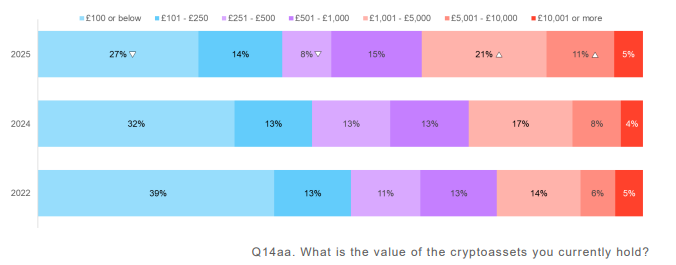
Teachers Union Demands Senate Kill Crypto Market Structure Bill, Citing ‘Profound’ Pension Risks

10 December 2025 at 09:56

The American Federation of Teachers is urging Senate leaders to halt work on the chamber’s crypto market structure bill, warning that the proposal could expose public-sector pensions to unsafe assets and strip protections that have long governed traditional securities.

In a letter sent Monday to Senate Banking Committee Chair Tim Scott and Ranking Member Elizabeth Warren, AFT President Randi Weingarten said the Responsible Financial Innovation Act would replace existing safeguards with a framework that leaves retirement plans more vulnerable than they are today.

AFT said Crypto Market Bill Endangers Working Families’ Pensions

Weingarten wrote that the bill “poses profound risks to the pensions of working families,” arguing it would not provide the regulation or “commonsense guardrails” needed around crypto assets and stablecoins.

She said most pension systems do not hold crypto because of its volatility and unclear legal status and warned that the legislation treats digital assets as if they were established and stable financial products when they are not.

The union represents more than 1.8 million workers in education, healthcare, and public services, including many whose retirement income depends on state and local pension plans.

Its letter warned that the bill would allow companies with no connection to crypto to place their stock on a blockchain and avoid the registration, reporting, and oversight requirements that apply today.

According to the union, the shift would let issuers bypass registration rules and remove oversight of intermediaries that move assets between buyers and sellers.

Weingarten said such a move would leave state and federal regulators with fewer tools to hold bad actors accountable, warning that pensions and 401(k) plans could end up holding assets that appear traditional but are not subject to the same standards.

Senate Rekindles Push to Define Crypto Regulatory Boundaries

The Responsible Financial Innovation Act is the Senate’s main effort to define which crypto assets fall under the jurisdiction of the CFTC and which belong under the SEC. It also aims to set federal rules for exchanges, brokers, custodians, and token issuers.

Supporters say the bill is needed to clarify a growing patchwork of crypto oversight, while critics argue it could break apart existing securities protections without replacing them with something equal in strength.

The debate comes as policymakers attempt to determine whether tokenized versions of traditional instruments can be traded under a revised federal structure and what that means for investors who rely on the security of established markets.

Work on the Senate bill had slowed in the months following the longest government shutdown in U.S. history, which created a backlog across financial regulatory agencies.

🇺🇸 Trump signs bill ending 43-day shutdown. ETFs await approvals, and markets eye potential weekend momentum.#Shutdown #Bitcoinhttps://t.co/zzvrf2SqdN

— Cryptonews.com (@cryptonews) November 13, 2025

Senate Staff Races to Finalize Draft as Holiday Deadline Nears

Several senators have said a new version could emerge before the year ends, though the timeline remains uncertain.

The political environment surrounding the bill has become increasingly tense. Senator Cory Booker warned this week that the legislation’s prospects were weakened after signs that the Supreme Court may soon allow President Trump to fire SEC and CFTC commissioners at will.

With no Democrats currently seated at either agency, and none expected until at least January, Booker said the absence of minority commissioners complicates any bill that depends on those regulators to implement its framework.

The CFTC is currently led by Acting Chair Caroline Pham, who has held the position since January after Rostin Behnam stepped down.

President Trump has nominated Michael Selig, a senior SEC attorney focused on cryptocurrency policy, to serve as the permanent chairman, though his confirmation remains pending before the Senate.

Despite the uncertainty, Senator Cynthia Lummis said she wants the Senate Banking Committee to move ahead with a markup of the market structure bill as early as next week.

@SenLummis says she wants a markup on the crypto market structure bill next week even as staff are “exhausted” from nonstop revisions. #Crypto #USPolicy #Lummishttps://t.co/RadNIvnWLp

— Cryptonews.com (@cryptonews) December 9, 2025

She described staff across both parties as “exhausted” after multiple rounds of revisions and said she hopes to circulate a final draft before Congress leaves for the holidays.

The post Teachers Union Demands Senate Kill Crypto Market Structure Bill, Citing ‘Profound’ Pension Risks appeared first on Cryptonews.

“Our Staffs Are Exhausted”: Senator Lummis Pushes for Crypto Market Structure Markup Next Week

9 December 2025 at 17:26

Senator Cynthia Lummis said she wants the Senate Banking Committee to move ahead with a markup of the long-delayed crypto market structure bill as early as next week, showing that negotiations in Washington have reached another pressure point.

Speaking at the Blockchain Association Policy Summit on Tuesday, Lummis said she hoped the Responsible Financial Innovation Act, the committee’s version of market structure legislation, would be ready for a formal markup before Congress leaves for the holidays.

Lummis said the industry had begun to worry about the pace of progress, noting that bipartisan drafts had been rewritten repeatedly in recent weeks.

She described a process that has strained both Republican and Democratic staff members, adding that the constant revisions were no longer sustainable.

“Our staffs are exhausted,” she said, explaining that she and Senator Kirsten Gillibrand wanted to present a draft by the end of this week, circulate it to industry and lawmakers, and then bring the bill to a markup next week.

Source: Blockchain Association

A markup hearing would allow senators to amend the legislation before sending it to the full Senate. Also, Lummis said in September that she expected the bill to be signed into law by 2026.

Crypto Bill Stalls in Senate as Lawmakers Restart Negotiations

Her push comes after the House passed its own bill, the Digital Asset Market Clarity Act of 2025, in July. Since then, it has been waiting in the Senate for the next round of action.

🇺🇸 GENIUS Act, Anti-CBDC Act, and CLARITY Act pass crucial procedural vote 215-211 in Congress after Trump's decisive Oval Office intervention rescues stalled crypto agenda.#GeniusAct #Trumphttps://t.co/Lm2tCBbimp

— Cryptonews.com (@cryptonews) July 16, 2025

The House legislation, formally introduced in May by Chairman French Hill, gives the Commodity Futures Trading Commission primary oversight of digital commodities while preserving the Securities and Exchange Commission’s authority over fundraising and token issuance.

The Senate Banking Committee has been developing its own version of a market structure framework, but progress stalled after the record-setting government shutdown and disagreements over how decentralized finance should be regulated.

🇺🇸 Senate introduces new Crypto Market Structure Bill draft to expand @CFTC authority over digital commodities like $BTC and $ETH.

#ClarityAct #CFTChttps://t.co/qKO9rR7aYs

— Cryptonews.com (@cryptonews) November 11, 2025

Although senators released a discussion draft in July, the shutdown and the backlog that followed pushed talks deeper into the fall.

A report from Politico on Monday indicated that bipartisan negotiations had picked up again, with plans to hold a markup in December. That aligns with Senator Cynthia Lummis’ push to keep the timeline on track.

However, not everyone is pleased with how slow things have been moving. At the same policy event on Monday, Senator Bernie Moreno said the process had become “decently frustrating,” adding that he would rather see no bill at all than one that leaves major regulatory gaps untouched.

🇺🇸 Sen. Moreno warns U.S. lawmakers: “No deal is better than a bad deal.” U.S. crypto legislation may be delayed

#Regulation #CLARITYActhttps://t.co/Z9QlO4yiD4

— Cryptonews.com (@cryptonews) December 9, 2025

He plans to meet with Democratic lawmakers this week in an effort to break the stalemate.

Lawmakers Race Clock as Crypto Bill Risks Election-Year Freeze

Earlier this year, Congress managed to push a stablecoin bill through with support from both parties, but the broader market structure package has been a far tougher lift.

One point of tension lies in how the House and Senate drafts define which tokens should not be regulated as securities.

The Senate version uses the term “ancillary assets,” while the Agriculture Committee’s proposal expands the CFTC’s authority instead. Both drafts still need markups, revisions, and formal votes before they can move forward.

There was a brief moment of optimism last week when Banking Committee Chair Tim Scott said a markup could take place on December 17 or 18.

But Senator Mark Warner suggested that wrapping everything up before the holiday recess would be difficult, noting that the White House still hadn’t provided final language on quorum and ethics rules.

The pressure to move faster is rising. Senator Thom Tillis warned that if negotiations drift into February, the bill could get stuck for the rest of the year once the election cycle takes over.

🚨 @SenThomTillis has said Congress has until February to move the US Crypto Bill forward before election politics slow progress. #ClarityAct #USCongress #MarketStructurehttps://t.co/LwL7ZwiOje

— Cryptonews.com (@cryptonews) October 28, 2025

That sense of urgency has only increased since the 43-day shutdown ended on November 13, leaving several crypto-focused bills, including the CLARITY Act, waiting for attention.

The post “Our Staffs Are Exhausted”: Senator Lummis Pushes for Crypto Market Structure Markup Next Week appeared first on Cryptonews.
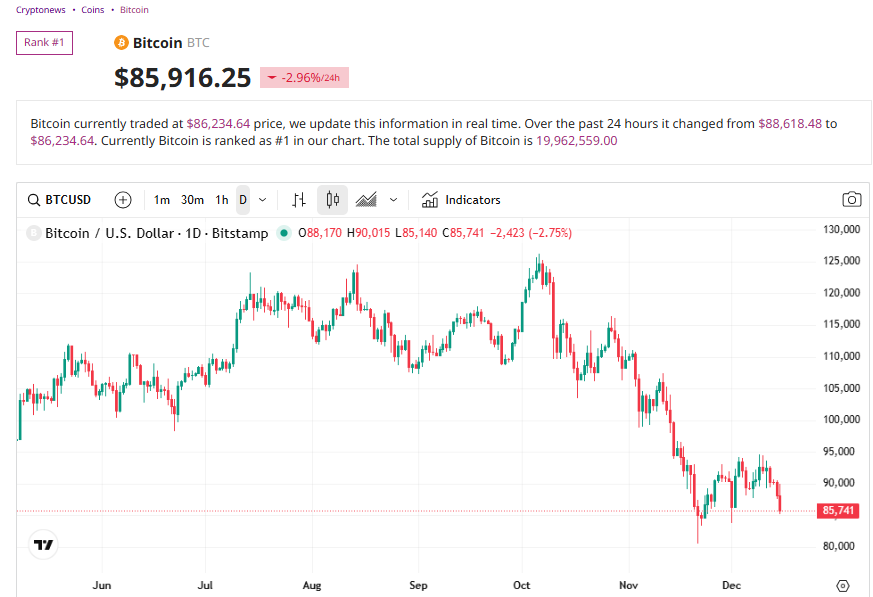
Malaysia’s Crown Prince Launches $121M Crypto Treasury – Despite Bubble Fears

9 December 2025 at 13:13

Malaysia’s Crown Prince has formally stepped into the digital-asset sector with a new state-backed stablecoin initiative and a large crypto-treasury plan, even as concerns grow over whether the global digital-asset treasury boom has already entered a fragile phase.

Bullish Aim Sdn. Bhd., chaired and owned by His Royal Highness Tunku Ismail Ibni Sultan Ibrahim, the Regent of Johor, announced the launch of RMJDT, a ringgit-backed stablecoin issued on Zetrix, the Layer-1 blockchain that powers Malaysia’s national Malaysia Blockchain Infrastructure.

The rollout took place under the supervision of the country’s regulated sandbox, which is overseen by both the Securities Commission and Bank Negara Malaysia, to test financial innovations ranging from stablecoins to programmable payment systems.

🇲🇾 Malaysia's central bank will explore asset tokenization and digital assets, collaborating with the private sector on potential use cases for tokenized deposits and CBDCs.#BankNegaraMalaysia #CBDChttps://t.co/FAnsrg2yY6

— Cryptonews.com (@cryptonews) March 24, 2025

Crown Prince Drives RMJDT Rollout With $121M Digital Asset Reserve

RMJDT is intended to strengthen the ringgit’s profile in cross-border settlements and attract foreign direct investment, echoing Malaysia’s broader push into tokenization and digital-asset modernization.

The Crown Prince said the initiative is part of Johor’s effort to align with the country’s Digital Asset National Policy, which encourages real-world asset tokenization and experiments in supply-chain finance.

Alongside the stablecoin launch, Bullish Aim confirmed plans to establish a Digital Asset Treasury Company with an initial allocation of 500 million ringgit, roughly $121 million, in Zetrix tokens.

The firm intends to expand the treasury to one billion ringgit over time. The treasury will be used to stabilize gas fees for RMJDT transactions and to support up to 10% of validator nodes within the national blockchain infrastructure.

The move draws inspiration from high-profile corporate treasury strategies such as those employed by Strategy, which has accumulated more than 660,000 Bitcoin since 2020.

Additionally, Ismail’s reported $2.7 billion bid for a land deal in Singapore back in August shows how some well-capitalized players are still willing to take major swings, even as worries grow about others mimicking the same strategies.

The Regent of Johor said the Zetrix reserve was necessary to ensure predictable operations and tighter alignment with the national blockchain.

Source: CoinGecko

The launch comes at a time when Zetrix trades around $12.60, well below its peak above $20 recorded roughly a year earlier, according to CoinGecko data.

Malaysia Ramps Up Crypto Treasuries Even as Global Inflows Slow

The timing also places Johor’s initiative inside a broader regional shift. In recent months, Malaysia has seen a series of digital-asset treasury announcements.

On November 12, VCI Global said it would acquire $100 million worth of OOB tokens in a deal that will make Tether the company’s largest shareholder.

🛒 VCI Global has announced plans to acquire $100 million worth of OOB tokens, the native asset of Tether-backed crypto payments company Oobit.#Malaysia #Cryptohttps://t.co/OLLT57dQ9T

— Cryptonews.com (@cryptonews) November 12, 2025

VCI Global plans to fold the token into its AI and fintech platforms and establish its own digital treasury division.

The firm had already purchased $50 million worth of tokens through a restricted share issuance and intends to buy another $50 million on the secondary market after Oobit completes its migration from Ethereum to Solana.

These developments are unfolding as Malaysia’s regulators accelerate reforms to support a more active digital-asset ecosystem.

🔍 @SecComMalaysia proposes regulatory enhancements to the digital asset exchange framework by accelerating token listings. #DigitalAssets #Malaysiahttps://t.co/EV3L8ir6m1

— Cryptonews.com (@cryptonews) July 1, 2025

The Securities Commission has proposed an overhaul of exchange rules after trading volumes more than doubled in 2024 to nearly 14 billion ringgit.

The new framework would allow certain tokens to be listed without prior approval, provided they meet strict criteria, while requiring operators to adopt tighter governance and risk controls.

Source: DefiLlama

But the broader digital-asset treasury sector is showing signs of fatigue. Data from DefiLlama shows corporate crypto treasuries recorded their slowest month of the year in November, with inflows dropping to $1.32 billion, down sharply from September’s peak.

Galaxy Research described the market as entering a “Darwinian phase,” with leverage unraveling and several treasury-backed stocks trading at deep discounts.

Even major players like Strategy, despite adding nearly $1 billion in Bitcoin last week, have seen their equity fall more than 35% over the past month.

The post Malaysia’s Crown Prince Launches $121M Crypto Treasury – Despite Bubble Fears appeared first on Cryptonews.
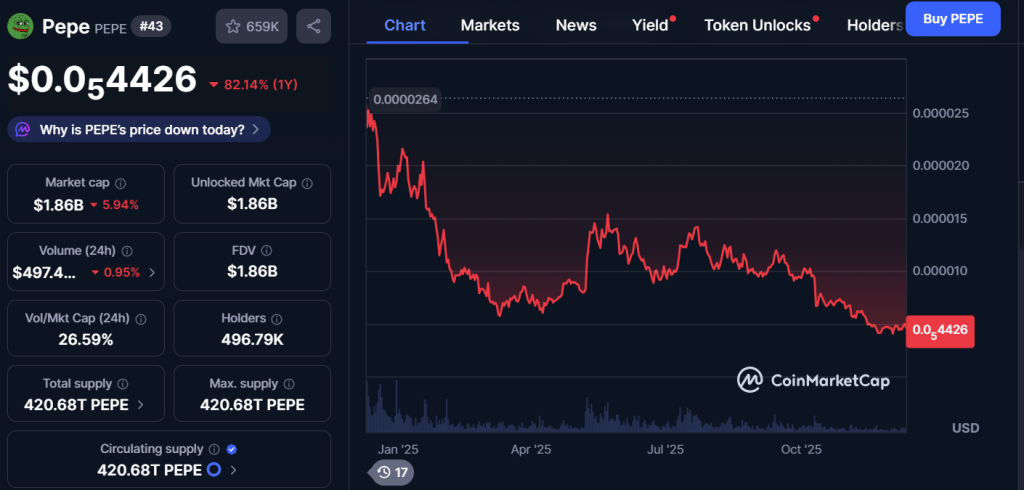
❌
❌