
Normal view

There are new articles available, click to refresh the page.
Yesterday — 10 December 2025Main stream

Singapore Tops 2025 Global Crypto Rankings as RWA Tokenization Jumps 63%: Report

10 December 2025 at 09:58

Singapore has taken the top position in Bybit’s World Crypto Rankings 2025, strengthening its status as one of the most active and structured digital-asset markets.

The new index, produced in conjunction with DL Research, evaluates countries across user activity, institutional readiness, and cultural engagement.

It positions Singapore ahead of the United States and Lithuania, two countries that continue to shape the direction of global crypto markets in distinct ways.

Report Reveals Two Distinct Global Crypto Adoption Models

The report shows how Singapore reached a score of 7.5 out of 10, driven by high user penetration and strong cultural engagement around digital assets.

Its licensing regime, high digital literacy, and active institutional sector have helped create one of the strongest pipelines between retail users and regulated financial entities.

The United States follows closely with a score of 7.3. Its ranking is supported by trading volumes, custody activity, and a growing base of tokenization projects involving major banks and asset managers.

Source: Bybit report

Lithuania, which secured third place with a score of 6.3, continues to be a preferred regulatory base for fintech and exchange firms.

The top ten also includes Switzerland, the United Arab Emirates, Ireland, Canada, the Netherlands, Vietnam, and Hong Kong.

The data shows two clear adoption models. Countries such as Singapore, the U.S., Switzerland, Lithuania, and the UAE reflect an institution-driven pattern shaped by regulation and financial infrastructure.
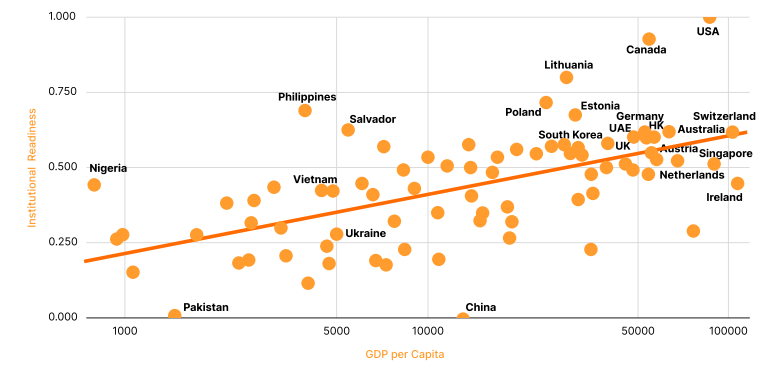
Source: Bybit report

In contrast, Vietnam, Nigeria, Ukraine, and the Philippines rely on crypto for everyday functions such as remittances, payments, and savings during currency pressure or banking restrictions.

This pattern is consistent with earlier studies from Chainalysis and TRM Labs, which also found high adoption in markets facing economic constraints.

Ukraine, Moldova, and Georgia continue to lead when measured against population size.

Global RWA Market Climbs 63% as Institutions Accelerate Adoption

The report also highlights how quickly real-world asset tokenization has expanded. The market for tokenized RWAs, excluding stablecoins, has risen more than 63% since January 2024, reaching $25.7 billion in early 2025.

Notably, private credit and U.S. Treasuries dominate the sector, holding 15.6 billion and 6.7 billion dollars, respectively.

The United States maintains the strongest institutional readiness with a perfect score, supported by regulatory clarity and deep Wall Street engagement.

BlackRock’s BUIDL fund remains one of the fastest-expanding tokenized portfolios, reaching between 1.8 billion and 2.28 billion dollars across several blockchains.

Major banks like JPMorgan, Citi, and Goldman Sachs have expanded tokenized settlement and internal trading programs.

Canada now ranks second in institutional readiness with a score of 0.93, supported by new rules for banks and insurers that will take effect in 2026.

The Philippines is also gaining momentum, becoming a regional example for Southeast Asia as it sets guidelines designed for remittance-heavy markets.

Global Data Shows Surging Stablecoin Use as Singapore Leads Tokenization Push

Singapore’s broader role in tokenized finance has grown as well. In November, the Monetary Authority of Singapore confirmed plans to pilot tokenized MAS bills settled using a central bank digital currency.

Local banks have already tested interbank lending using a wholesale CBDC, reinforcing the shift from experimentation to real operational use.

MAS officials say asset-backed tokens have clearly moved beyond the laboratory stage.

The report also pointed out that stablecoins remain the most consistent asset type across all income groups.

Ukraine records the highest stablecoin flow relative to GDP at 3.6%, followed by Nigeria, Georgia, Vietnam, and Armenia.

These flows underline how digital dollars have become a financial tool in both developed and emerging regions.

Separate research in March showed strong momentum in the Gulf region. The UAE recorded a 210% surge in adoption, the highest of any country in 2025, supported by high ownership levels and strong search activity.

Singapore and the United States followed, with adoption growth of 150% and 220%, respectively.

The post Singapore Tops 2025 Global Crypto Rankings as RWA Tokenization Jumps 63%: Report appeared first on Cryptonews.

Before yesterdayMain stream

ONDO price soars as SEC ends confidential investigation with no charges

8 December 2025 at 09:43
  • The regulator has closed its probe without filing any charges.
  • The move removes a cloud of uncertainty that had lingered since 2024.
  • ONDO price jumped as the community welcomed regulatory clarity.

The cryptocurrency industry exhibited a bullish stance on Monday as Bitcoin steadied above $91,500.

While the altcoin space recorded brief gains in the past day, ONDO jumped sharply on its 24-hour price chart, gaining more than 6% within minutes.

The uptick emerged after Ondo Finance confirmed that the United States Securities & Exchange Commission has concluded its Biden-era probe into the RWA company.

Most importantly, the regulator has ended the investigation without enforcement actions or charges against Ondo Finance.

The clean outcome renewed optimism across markets, with traders perceiving the move as a rare development in regulatory clarity within a turbulent market.

Meanwhile, the team promises to leverage this moment to democratize the US capital markets with tokenization.

Today’s announcement read:

The path is now clearer than ever for tokenized Treasuries and tokenized equities to become core components of US capital markets. The future of global finance will be on-chain, and Ondo will help lead the transition.

ONDO’s price jumped from $0.4697 to $0.4999, an over 6% increase, almost immediately after the X post.

Notably, the scrutiny began last year, in 2024, and focused on whether native ONDO violated securities laws and whether the company’s tokenization of real-world assets and US Treasuries adhered to the federal financial rules.

A shift in regulatory stance

Indeed, the US SEC has been crypto-friendly under the Trump administration and the new chair, Paul Atkins.

The regulator has closed multiple high-profile cases recently, including those tied to Ripple and Coinbase.

Also, Donald Trump pardoned Binance founder CZ for wrongdoings that saw him spend four months in prison.

These developments confirmed a shift in the United States regulatory tone, from constant clampdowns to clarity.

Rather than resorting to enforcement actions, officials are now willing to accommodate blockchain and crypto projects while exploring models that support innovative markets.

Ondo’s latest purchase of licensed Oasis Pro Markets aligns with the ongoing regulatory transitions.

Moreover, these trends suggest that American capital markets could be preparing to migrate to on-chain assets at a significant scale.

The Ondo Finance team highlighted the accelerating demand for tokenization, with US regulators displaying interest in the sector’s future potential to enhance transparency, market efficiency, and transaction speed.

They said:

The SEC is openly engaging with industry to unlock the promise of tokenization for US capital markets, global adoption continues to accelerate, and US infrastructure is evolving to support the category.

Now that the investigation has ended, all eyes remain on February 3, 2026, when Ondo Finance will host the New York Summit.

Expectations around the conference have increased as the community expects the project to introduce its long-term mission without the SEC’s uncertainty.

ONDO price outlook

The altcoin displayed a bullish performance, trading at $0.4843 after a brief dip from its intraday high.

ONDO’s 24-hour trading volume has increased by more than 300% amid renewed interest in the altcoin.

The post ONDO price soars as SEC ends confidential investigation with no charges appeared first on CoinJournal.

Glassnode report reveals Bitcoin’s growing stability amid ETF activity and RWA expansion

3 December 2025 at 02:49
  • Bitcoin’s 2025 cycle shows rising institutional flows, lower volatility, and deeper liquidity.
  • Tokenized real-world assets surge to $24 billion, boosting institutional adoption and on-chain activity.
  • ETFs reshape Bitcoin liquidity as stablecoins remain key rails in a more mature digital asset market.

Bitcoin’s latest cycle is developing under a very different market structure, with data from Glassnode and Fasanara Capital pointing to deeper institutional participation, rapid growth in tokenized real-world assets, and a notable drop in volatility.

Their Q4 Digital Assets Report highlights how Bitcoin’s behaviour has shifted as regulated investment channels expand, and liquidity becomes more stable across spot, derivatives, and on-chain markets.

The findings show how ETF flows, settlement activity, and broader adoption of tokenised instruments are shaping a more mature phase in the digital asset ecosystem.

These structural changes are defining how capital moves through Bitcoin in 2025.

Institutional flows reshape the cycle

The report estimated that Bitcoin has absorbed around $732 billion in new capital during this cycle.

This has occurred alongside a clear decline in one-year realised volatility, which has fallen by nearly half.

Glassnode linked this trend to increased depth across major markets and a larger share of trading driven by institutional strategies.

Glassnode also reported that Bitcoin settled approximately $6.9 trillion over the past 90 days.

This puts Bitcoin in a range comparable to payment networks such as Visa and Mastercard.

Even with more trading moving into ETF and brokerage channels, the report found that Bitcoin and stablecoins still dominate value transfer on public blockchains.

ETF channels deepen liquidity

ETF-linked demand has reshaped how investment enters and exits Bitcoin.

Instead of relying mainly on on-chain movement or exchange activity, a greater share of flows now passes through regulated investment vehicles.

According to the report, this shift has encouraged smoother liquidity conditions and fewer sharp price changes in spot markets.

Traditional market makers and arbitrage firms have increased their presence due to ETF participation.

Their involvement has tightened spreads and reduced disruption during periods of heightened selling pressure.

This development reflects a broader alignment between digital asset markets and established financial infrastructure.

Tokenized RWAs accelerate

Tokenized real-world assets have expanded from $7 billion to $24 billion within one year.

Glassnode stated that this rise reflects stronger institutional demand, including interest from pension funds, hedge funds, and corporations that want on-chain exposure to familiar financial instruments.

Tokenized funds have gained momentum as asset managers test new distribution models and investors seek simplified access to traditional assets.

Platforms involved in tokenised RWAs have strengthened custody, settlement, and compliance systems.

This foundation has encouraged consistent inflows throughout 2025, supporting a growing segment of the market that links traditional assets with blockchain settlement rails.

Stablecoin role strengthens

Glassnode described the market structure as larger and more stable than in previous cycles.

The data indicated deeper liquidity across spot, derivatives, and on-chain channels, which has contributed to a more measured trading environment.

Reduced volatility has become a defining feature of the cycle, shaped by institutional trading strategies that tend to use steady allocation models.

Stablecoins continue to serve as key connectors between traditional and digital financial systems.

The report stated that stablecoin settlement demand remains substantial across centralised and decentralised platforms.

Glassnode characterised the dual-rail system created by stablecoins and traditional infrastructure as a permanent part of the ecosystem, supporting both institutional flows and retail trading activity.

Analysts referenced in the report expect institutional participation to expand as tokenised funds gain broader acceptance.

Glassnode presented this phase as a turning point marked by heavier institutional flows, rising tokenisation, and reduced volatility.

These factors suggest that Bitcoin and the wider digital asset sector are moving into a more structurally mature environment in 2025.

The post Glassnode report reveals Bitcoin’s growing stability amid ETF activity and RWA expansion appeared first on CoinJournal.

Ripple, leading VCs invest in OpenEden to support the real-world asset tokenisation firm’s expansion

2 December 2025 at 05:33
  • The company will focus on scaling TBILL and the yield-bearing stablecoin USDO.
  • cUSDO was approved this year as off-exchange collateral at Binance.
  • BNY Mellon now manages and safeguards Treasurys underlying TBILL.

Real-world asset tokenisation is becoming one of crypto’s most active areas in 2025, and OpenEden is positioning itself at the centre of this shift with a new round of investment supported by major industry players.

The company confirmed on Tuesday that leading trading firms, venture capital groups, blockchain networks and institutional infrastructure providers have backed its latest raise to expand access to tokenised US Treasurys.

The round, which follows OpenEden’s 2024 raise with YZi Labs, comes at a time when short-dated government debt has emerged as one of the fastest-growing niches in digital assets as institutions look for familiar, regulated yields on-chain.

Tokenisation demand drives new investment push

OpenEden said the fresh capital will help it scale its tokenisation-as-a-service platform as more institutions look to move traditional assets onto public blockchains.

The firm is leaning into rising demand for regulated products tied to government debt, with short-term Treasurys becoming a preferred entry point for investors seeking on-chain yield that mirrors conventional markets.

The company did not disclose the size of the round, but it confirmed participation from Ripple, Lightspeed Faction, Gate Ventures, FalconX, Anchorage Digital Ventures, Flowdesk, P2 Ventures, Selini Capital, Kaia Foundation, and Sigma Capital.

Expansion of TBILL and USDO across markets

A significant portion of upcoming development will centre on OpenEden’s two main offerings: TBILL, its tokenised US Treasury fund, and USDO, a stablecoin backed by those same Treasurys.

USDO and its wrapped version, cUSDO, have already been integrated across decentralised exchanges and lending markets.

Earlier this year, Binance authorised cUSDO as off-exchange collateral.

OpenEden said the new investment will support broader distribution of these products and allow the company to introduce additional market structures tied to real-world financial assets.

Broader product pipeline builds institutional focus

Beyond Treasurys, OpenEden is preparing several new instruments designed to deepen institutional engagement with tokenised markets.

These include upcoming tokenised bond exposure, a multi-strategy yield token and a range of structured products aimed at investors familiar with traditional income-generating instruments.

In August, the company appointed BNY Mellon as custodian and investment manager for the Treasurys underlying TBILL.

The product has also received investment-grade ratings from S&P Global and Moody’s, marking a notable step in bridging conventional market requirements with decentralised finance infrastructure.

The post Ripple, leading VCs invest in OpenEden to support the real-world asset tokenisation firm’s expansion appeared first on CoinJournal.

❌
❌