Normal view

There are new articles available, click to refresh the page.
Today — 11 December 2025Main stream

Crypto Giant a16z Sets Up Shop In South Korea In Major Asia Push

11 December 2025 at 05:00

Crypto venture capital firm Andreessen Horowitz (A16z) has opened its first Asian office in Seoul, South Korea, signaling a deeper push into the region where on-chain activity and user adoption have surged. According to the firm, the new hub will support portfolio companies and help build local partnerships and communities.

A16z Moves Into Seoul

The office will be led by Sungmo Park, who has held roles at Monad and Polygon, and who joins a16z as Head of APAC go-to-market. Reports have disclosed that Anthony Albanese, the fund’s chief operating officer, announced the move and framed it as a way to put teams closer to where users and builders are located.

I’m honored to share that I will be joining @a16zcrypto as Head of APAC go-to-market.

a16z crypto backs exceptional founders, providing not just capital but also hands-on support to help them grow into transformative companies.

Now, a16z crypto is opening an office in Seoul and…

— sungmo (@sungmo_apac16z) December 10, 2025

A16z said Seoul will act as a gateway for interacting with companies across Asia and for giving portfolio firms local support on partnerships, marketing and expansion. Park will focus on regional strategy and on helping founders navigate local markets. This is not described as a small PR outpost; it is positioned as a real operating base for the region.

Excited to announce that @a16zcrypto is expanding into Asia and opening our first office in Seoul, South Korea. As part of this, we’re thrilled to have @sungmo_apac16z join our team as Head of APAC go-to-market to lead the Seoul office and start building our presence in the… pic.twitter.com/KBljioBCqx

— Anthony Albanese (@AAlbaneseNY) December 10, 2025

Based on reports, Asia-Pacific recorded about US$2.36 trillion in on-chain value over the 12 months ending June 2025, an increase of close to 70% from the prior year. That growth helped convince a16z that Asia needs a local presence. Chainalysis and several industry trackers show heavy on-chain flows and deep retail participation across the region.

Our latest State of Crypto report shows that onchain users are widely distributed around the world, with a particularly strong concentration in Asia. It now represents a significant share of global crypto activity, for example:

🇰🇷 South Korea is the second-largest crypto market…

— Anthony Albanese (@AAlbaneseNY) December 10, 2025

Why Korea Matters To Crypto

South Korea itself is highlighted as one of the largest national crypto markets. According to a16z and other coverage, nearly one in three adults in South Korea hold crypto assets — a rate that in some measures is higher than local stock ownership. That level of retail use, plus a thriving developer community, made Seoul an attractive choice for the firm.

What The Move Could Mean

The entry of a major US venture firm into Seoul may boost interest among local startups seeking international partners and could make capital more accessible for teams in South Korea and nearby markets. Several news outlets describe the office as focused on go-to-market support rather than immediate, large-scale local investing, at least at launch.

Competition For Deals

Reports note that other global funds and crypto firms have been increasing activity in Asia this year. A16z’s decision comes as several markets across the region report rising developer activity and fresh funding rounds. For founders, having an established US investor with a local office may speed introductions to global customers and partners.

Featured image from Unsplash, chart from TradingView

Bhutan’s gold-backed TER token launches on Solana blockchain network

11 December 2025 at 02:43
Bhutan launches TER, a fully gold-backed token on Solana, as part of a wider strategy spanning tokenized assets, CBDC pilots, and Ethereum-based digital ID.​ Bhutan has launched TER, a sovereign-backed digital token fully collateralized by physical gold reserves, marking the…

Yesterday — 10 December 2025Main stream

Half Of Asia Pacific’s High Net Worth Individuals Now Allocate Over 10% To Crypto

10 December 2025 at 23:08

Asia’s wealthy investors are putting meaningful chunks of their money into digital assets, with almost half now allocating more than 10% of their portfolios to crypto and a clear majority planning to add more over the next few years.

Swiss Singaporean digital asset bank Sygnum found in its APAC HNWI Report 2025 that 87% of more than 270 respondents already hold digital assets.

The survey covered high net worth and professional investors across 10 markets, including Singapore, Hong Kong, Indonesia, South Korea and Thailand, and defined high net worth individuals as those with over $1M in investable assets and ultra high-net-worth investors as those with more than $25M.

High Net Worth Investors Embrace Crypto As A New Alternative Asset Class

For this group, crypto has become a core allocation, not a side bet. Median holdings sit in the 10% to 20% range, with a weighted average near 17%, putting tokens in the same conversation as equities and private markets inside portfolios.

Image Source: Sygnum

Motivation has shifted away from pure speculation. Sygnum reports that 90% of high-net-worth investors see digital assets as important for long-term wealth preservation and legacy planning.

Portfolio diversification drives a majority of decisions, with 56% citing it as a key reason to invest, and many framing crypto as a new alternative asset class rather than a short-term punt.

APAC Investors Expect A New Crypto Cycle Within Two To Five Years

Looking ahead, 60% of respondents say they plan to increase allocations. A bullish or very bullish long-term outlook comes from 57% of high net worth investors and 61% of ultra high net worth investors, with many expecting the next strong cycle to unfold over a two to five year horizon rather than in the next few weeks.

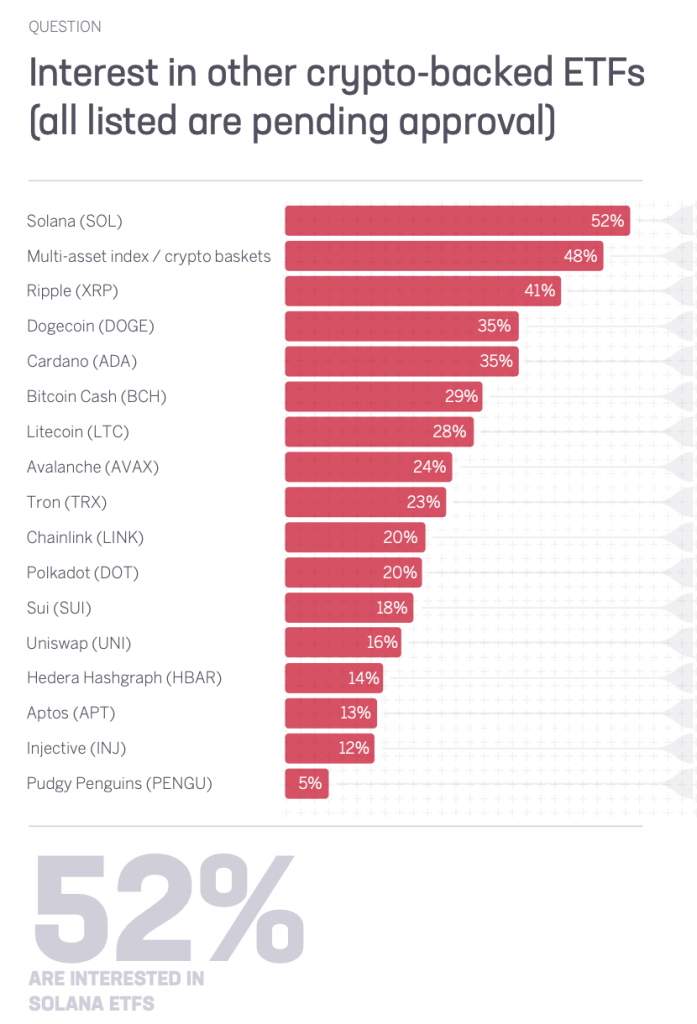
Product preferences tell a similar story of maturation. Beyond Bitcoin and Ethereum, 80% of investors want more crypto exchange-traded funds, with Solana drawing the strongest single asset demand at 52%.

Image Source: Sygnum

Multi-asset index products and XRP also attract interest, and 70% of respondents say they would allocate or allocate more if staking yield were bundled into ETF structures, a clear nod to yield-focused, regulated wrappers that sit comfortably in traditional wealth plans.

APAC Emerges As A Leading Gateway As Digital Assets Embed Into Wealth Portfolios

Security and rules still shape how fast this money moves. Around two thirds of investors say they need their private bank or wealth manager to demonstrate strong custody and security standards before they scale up exposure, while regulatory uncertainty and volatility remain key brakes.

At the same time, most respondents say regulatory clarity has improved and recent policy moves in major markets strengthen the long term case for digital assets.

“Digital assets are now firmly embedded within APAC’s private wealth ecosystem,” said Gerald Goh, Sygnum co founder and APAC chief executive.

He noted that frameworks in Singapore and Hong Kong have built the infrastructure for traditional wealth managers to offer crypto services and described Asia Pacific as one of the fastest growing gateways for digital assets, with momentum likely to build into 2026.

The post Half Of Asia Pacific’s High Net Worth Individuals Now Allocate Over 10% To Crypto appeared first on Cryptonews.

Asia Market Open: Bitcoin Edges Lower As Fed Rate-Cut Boosts Stocks

10 December 2025 at 21:46

Bitcoin fell about 2% in early Asian trading on Thursday while regional equities extended the relief rally that followed the Federal Reserve’s latest rate cut and upbeat tone on the US outlook.

The Fed delivered a third straight quarter-point reduction and Chair Jerome Powell said the inflation hit from tariffs should fade as the US economy strengthens.

He described the move as a further step toward policy normalization and stressed that officials want to support jobs without letting price pressures flare again.

Nine of the 12 members on the policy committee backed the cut and fresh projections showed the median official still expecting only one more cut in 2026.

Market snapshot

  • Bitcoin: $90,121, down 2.3%
  • Ether: $3,224, down 2.4%
  • XRP: $2.01, down 3.9%
  • Total crypto market cap: $3.16 trillion, down 2.4%

Markets Weigh Limited 2026 Cuts While Risk Appetite Stays Cautious

Futures now imply about a 78% chance the Fed will leave rates unchanged at its next meeting, up from about 70% before the decision, as traders reassess how far this easing cycle can really go.

SUMMARY OF FED DECISION (12/10/2025):

1. Fed cuts rates by 25 bps in 3rd rate cut of 2025

2. Fed will consider "extend and timing" of additional adjustments

3. Fed will begin purchasing US Treasury Bills on December 12th

4. Fed will buy $40 billion of US Treasury bills in 30…

— The Kobeissi Letter (@KobeissiLetter) December 10, 2025

Nic Puckrin, investment analyst and co-founder of The Coin Bureau, said, the “FOMC decision wasn’t quite as hawkish as many market participants were expecting, so markets are breathing a sigh of relief.”

“However, it is worth noting that the Fed is now expected to cut rates only once next year – fewer cuts than investors were hoping for. This could still change, since next year does bring a historic changing of the guard, but Chair Jerome Powell still remains at the helm for the first three FOMC meetings of 2026,” he added.

“Indeed, today’s announcement is not enough to spark a Santa rally for Bitcoin, and I don’t see any other obvious catalysts from here on, barring any unexpected announcements from President Donald Trump. Even then, a dead cat bounce is a real possibility, as risk assets tend to care more about the Fed than just about anything else.”

Regional Markets Rise While Greater China Shows A Split In Risk Appetite

Asian stocks picked up the baton from Wall Street, where the S&P 500 closed 0.7% higher and the Russell 2000 small cap gauge jumped 1.3% to a record.

The MSCI Asia Pacific Index rose about 0.5% in early trade, with tech and financial shares drawing the bulk of the buying interest.

Moves across Greater China showed a mixed risk appetite. The Shanghai benchmark slipped 0.18% and the Dow Jones Shanghai index eased 0.10%.

Hong Kong’s Hang Seng index advanced 0.4% as investors rotated back into some of the city’s large caps. For crypto traders, the rebound in Hong Kong is a reminder that equity risk sentiment in the city often moves in tandem with demand for China linked growth plays and higher beta tokens.

Tech sentiment turned more cautious in US after hours dealings. Nasdaq 100 futures traded about 0.3% lower in Asian hours after Oracle reported revenue that fell short of expectations, sending its shares sharply down in late trade.

Nvidia also edged lower, a sign that investors are trimming some of the most crowded artificial intelligence wagers that often sit in the same portfolios as major coins.

The post Asia Market Open: Bitcoin Edges Lower As Fed Rate-Cut Boosts Stocks appeared first on Cryptonews.

Before yesterdayMain stream

Asia Market Open: Bitcoin Inches Higher, While Stocks Retreat Ahead of Fed Rate Call

9 December 2025 at 21:34

Good morning, Asia. Here’s what’s moving before the bell.

Bitcoin edged up toward $92,000 on Wednesday while Asian stocks slipped, as traders braced for the US Federal Reserve’s final rate decision of the year and tried to gauge how hawkish the central bank will sound after an almost certain cut.

Equity markets across the region tracked a soft lead from Wall Street. The S&P 500 ended slightly lower on Tuesday, with JPMorgan acting as the biggest drag after the bank warned of hefty expenses in 2026, adding another layer of caution to a market already on edge about policy signals.

The Fed began its two-day meeting on Tuesday, and futures markets still point to a quarter percentage point cut, even though inflation remains above the 2% target.

Market snapshot

  • Bitcoin: $92,479, up 2.5%
  • Ether: $3,308, up 6.4%
  • XRP: $2.09, up 1.2%
  • Total crypto market cap: $3.24 trillion, up 2.8%

Traders Brace For Hawkish Messaging Even As A Cut Appears Likely

For crypto traders, the question is less about whether the Fed moves this week and more about what Chair Jerome Powell signals on the path ahead.

In focus as the Fed gathers to consider another cut this week:

-whether Powell can stitch together enough consensus to minimize dissents to the same two that opposed the 25 bps cut last time

-how many policymakers issue a "soft" dissent via their year-end policy rate in the…

— Nick Timiraos (@NickTimiraos) December 9, 2025

Some in the market see politics creeping into the calculus. Ruslan Lienkha, chief of markets at YouHodler, said an expected cut amid slightly rising inflation “may be driven more by political considerations than by sound economic reasoning.”

He added that he expects Powell to try to offset the move with hawkish language, a mix he believes could weigh on risk assets. “A hawkish message could increase selling pressure on the already fragile US equity markets, which could, in turn, negatively affect BTC and the broader crypto market,” he said.

Others are already tempering their year-end Bitcoin hopes. Nic Puckrin, investment analyst and co founder of The Coin Bureau, said, “If Powell does indeed deliver a hawkish speech, the likelihood of a Santa rally for Bitcoin diminishes.”

He noted that momentum has not been on Bitcoin’s side recently despite fresh purchases from Michael Saylor’s firm, and said the market “may well finish 2025 under $100,000.”

Inflation And Labor Data Add To Confusion Over Policy Direction

The macro backdrop is not offering much clarity. Fed officials have sent mixed messages, with some warning that inflation could reaccelerate and others sounding more concerned about the labour market.

A Labor Department report on Tuesday showed job openings rising only marginally in October and hiring still subdued, while a separate survey from the National Federation of Independent Business pointed to plans for new hiring in the months ahead.

That tension has pushed more attention onto the Fed’s dot plot, its economic projections and every line of Powell’s press conference. Swings around rate decisions have become one of the main drivers of equity volatility over the past six weeks, often overshadowing debates about an AI bubble or the impact of President Donald Trump’s trade policies on corporate earnings and risk sentiment.

Slower Easing Path Threatens Liquidity Trade That Crypto Relies On

Pricing in money markets shows how expectations have cooled. Traders now see around two cuts in 2026 after a likely quarter point reduction on Wednesday, a pullback from the more optimistic views that circulated only weeks earlier.

For Bitcoin and other digital assets, a slower easing path can mean tighter dollar liquidity and more pressure on the “liquidity trade” that helped fuel previous rallies.

Personnel questions at the Fed are also in the mix. Kevin Hassett, viewed as the frontrunner in Trump’s search to replace Powell, said at an event on Tuesday that he sees room to lower rates substantially, and even more than a single quarter point move.

His comments fed speculation that the longer term policy stance could shift if the White House reshapes the central bank’s leadership in 2026.

The post Asia Market Open: Bitcoin Inches Higher, While Stocks Retreat Ahead of Fed Rate Call appeared first on Cryptonews.

Asia Market Open: Bitcoin Pauses At $90k As Anxiety Over Fed’s Next Moves Hits Equities

8 December 2025 at 21:22

Bitcoin hovered around $90,000 on Tuesday while Asian stocks slipped, as traders grew uneasy about how quickly the US Federal Reserve will cut rates after a widely expected move this week.

MSCI Inc.’s gauge of Asia Pacific shares outside Japan fell about 0.2% as benchmarks in Korea, Japan and Australia opened in the red.

US stock futures moved slightly higher, offering a small offset after the S&P 500 lost 0.3% on Monday and US Treasuries joined a broader global bond sell-off. Australian bond yields climbed ahead of a monetary policy decision later in the day.

Market snapshot

  • Bitcoin: $90,227, down 0.8%
  • Ether: $3,109, up 0.3%
  • XRP: $2.07, up 0.1%
  • Total crypto market cap: $3.16 trillion, down 0.8%

📊 As Bitcoin's market value hovers around $90K, crypto's top market cap continues to see its supply moving away from exchanges. Over the past year, there has been:

A net total of -403.2K $BTC moving off exchanges
📉 A net reduction of -2.09% of $BTC's entire supply moving… pic.twitter.com/Y0JTC880Np

— Santiment (@santimentfeed) December 8, 2025

Markets Adjust As Traders See Fewer Cuts Ahead Amid Fed Uncertainty

The Fed meets on Wednesday and is widely expected to deliver a 25 basis-point rate cut, a step that traders have treated as nearly certain for days. The real debate now centres on what comes next, with investors increasingly nervous that policymakers will signal a “slower pace” of easing in the months ahead.

Still high inflation and a lack of fresh data during the government shutdown have fed “divisions” inside the Fed, according to some investors and analysts.

After this week’s likely cut, money markets now lean toward only two more moves by the end of 2026, down from three that were priced in barely a week ago, a shift that matters for Bitcoin and other digital assets that trade closely with global liquidity conditions.

In bond markets, the US 10-year Treasury yield hit its highest level since September during Monday’s session, extending selling pressure in Europe and Japan and lending support to the dollar. Higher long term yields tend to tighten financial conditions, a backdrop that can cap risk appetite even as traders talk about rate cuts.

Markets Waver As December Cut Bets Firm But Policy Path Remains Unclear

Wall Street’s main indexes closed lower on Monday, with most S&P 500 sectors finishing in negative territory while Treasury yields pushed higher.

Hopes for a December rate cut firmed after data last week showed consumer spending increased “moderately” toward the end of the third quarter, although investors still want clearer signals on future policy moves from what many see as the most “divided Fed” in years.

Derivatives pricing reflects that tension. Traders are now assigning roughly an 89% chance of a 25 basis-point cut on Wednesday, while expectations for additional easing have been trimmed.

For crypto markets, any surprise in the statement or the press conference could quickly show up in sharp moves around the $90,000 level.

Policy Signals From Beijing And Washington Guide Asian Equities And Crypto

Chinese assets remained in the background as Beijing’s top leaders set “domestic demand” as their main economic priority for 2026 while signalling a measured approach to stimulus. Any conviction that China will stabilise growth without aggressive easing could influence regional risk appetite and therefore the broader tone for Asian equities and crypto alike.

Monetary policy politics are also in play. Kevin Hassett, seen as a leading candidate to become the next Fed chair, said it would be irresponsible for the Fed to lay out a plan for where it aims to take interest rates over the next six months.

The White House National Economic Council director told CNBC that following the economic data remains crucial, a stance that points to more meeting-by-meeting decisions rather than a pre-set easing path.

For crypto traders, the coming days look pivotal. Greg Magadini, director of derivatives at Amberdata, said this upcoming week is going to be driven by the FOMC rate decision. “This will set the tone for the EOY sentiment. Odds are shifting toward a -25bps cut, which could set the stage for an end-of-year rally in crypto and risk assets,” he said.

He added that Trump is expected to announce his pick for Fed chair in early 2026, with Senate approval to follow and the new chair taking over in May 2026 after Powell.

That handover, combined with this week’s decision, is already feeding into long-term positioning in Bitcoin and the rest of the digital asset market, even as prices hold near $90,000 for now.

The post Asia Market Open: Bitcoin Pauses At $90k As Anxiety Over Fed’s Next Moves Hits Equities appeared first on Cryptonews.

Asia Market Open: Crypto and Asian Equities Make Quiet Gains as Fed-Focused Week Kicks Off

7 December 2025 at 22:32

Crypto assets traded higher on Monday while Asia’s stock markets inched up, as traders stepped into a week dominated by the US Federal Reserve and a packed central bank calendar.

The mood stayed cautious, but risk assets, from crypto to equities, held their ground as investors lined up behind the prospect of fresh policy easing.

Bitcoin rose about 1.9%, keeping prices close to the $90,000 mark and extending a steady grind higher that has drawn support from rate-cut bets.

For crypto traders, the Fed meeting now looks less like a routine calendar event and more like a possible trigger for the next leg of the cycle.

Akshat Siddhant, lead quant analyst at Mudrex, said that if the Fed proceeds with a rate cut this week, a “Santa rally” becomes increasingly likely, pushing BTC toward the $100,000 mark.

He pointed to around $87,500 as an important support area, a level that still leaves the broader structure for Bitcoin looking constructive even if there is short-term volatility.

Market snapshot

  • Bitcoin: $91,256, up 1.9%
  • Ether: $3,114, up 2.1%
  • XRP: $2.07, up 0.9%
  • Total crypto market cap: $3.18 trillion, up 1.3%

BIG WEEK INCOMING FOR CRYPTO 🚨

MONDAY:
– FOMC MEETING
– POSSIBLE QE START

TUESDAY:
– INFLATION DATA RELEASE

WEDNESDAY:
– FOMC MEETING AND RATE CUTS

FRIDAY:
– DEF BALANCE SHEET
– POWELL RESIGNS

MEGA BULLISH WEEK FOR CRYPTO IS COMING! pic.twitter.com/F4XuZiWPcp

— ᴛʀᴀᴄᴇʀ (@DeFiTracer) December 7, 2025

Crypto Finds Support While Asian Stocks Log Cautious Early Gains

Across Asia’s equity markets, stocks nudged higher as trading got under way. Japan’s Nikkei slipped about 0.3% after a modest 0.5% gain last week, while South Korea’s Kospi eased 0.3% after jumping 4.4% last week on confirmation of lower US tariffs on its exports.

MSCI’s broad index of Asia-Pacific shares outside Japan dipped roughly 0.1% in relatively quiet dealings.

Mainland Chinese shares were set to take their cues from November trade figures, with investors watching how exports hold up against tariff headwinds. The data will feed into positioning on Chinese assets into year-end and help shape how much regional support Asian equities can offer to global risk sentiment.

Fed Tension Builds With Futures Flat And Analysts Watching Earnings Signals

US futures provided little directional push at the start of the week. S&P 500 and Nasdaq contracts traded close to flat as investors balanced the coming Fed decision with a fresh round of corporate results.

Earnings from Oracle and Broadcom will give another read on demand for AI-linked infrastructure and chips, while Costco’s numbers will offer a window into consumer spending.

Pricing in interest-rate markets shows how firmly investors lean toward an easing. Futures imply roughly an 85% chance of a quarter-point cut in the current 3.75% to 4% federal funds target range, so a hold would amount to a shock.

Yet the decision may not be straightforward inside the Federal Open Market Committee. Some policymakers have spoken openly against cutting too early, and the Fed has not seen three or more dissents at a single meeting since 2019, something that has occurred only nine times since 1990.

Crypto Watches Dollar Path As Markets Weigh Fed Timing And Political Noise

Market prices are more cautious, attaching about a 24% probability to a January move and not fully factoring in another easing until July. For Bitcoin and other digital assets, that path matters because it shapes the dollar, liquidity and the appeal of hard-cap assets.

US politics also hangs over the debate. Some investors worry that President Donald Trump’s repeated attacks on Fed independence could help push rates too low over time, setting the stage for a later inflation problem.

That kind of backdrop often feeds into the narrative that Bitcoin can act as a hedge against long-term currency debasement, even if day-to-day trading still reacts to standard macro data and funding conditions.

The Fed is not the only game in town. Central banks in Canada, Switzerland and Australia also meet this week and are widely expected to hold policy steady. The Swiss National Bank may see reasons to offset a strong franc, but with its policy rate already at 0%, officials remain wary of returning to negative territory.

The post Asia Market Open: Crypto and Asian Equities Make Quiet Gains as Fed-Focused Week Kicks Off appeared first on Cryptonews.

Asia Market Open: Bitcoin Holds Near $92k, Equities Slip On Fresh Economic Signals

4 December 2025 at 22:42

Bitcoin held just under $92,000 on Friday as traders weighed a heavy mix of labour data, central bank bets and choppy equity markets in Asia, Europe and the US.

Akshat Siddhant, lead quant analyst at Mudrex, said the crypto market continues to display strong resilience.

“Renewed whale accumulation is supporting the trend, as ETH whales have added over 450,000 ETH since mid-November, with BTC whales showing similar activity.”

“Even with the US labour market displaying solid strength, the odds for a rate cut this month stand at 93%, contributing to the buying pressure. A clear move above $96,000 could accelerate BTC’s momentum toward $100,000, opening the path for fresh highs,” he added.

Market snapshot

  • Bitcoin: $92,387, down 1.2%
  • Ether: $3,174, down 1.1%
  • XRP: $2.09, down 4.6%
  • Total crypto market cap: $3.22 trillion, down 1.3%

Japan’s Weak Spending Figures Drag Regional Equities Lower

In Asia, Japan’s Nikkei 225 fell about 1.5%, wiping out this week’s gains in a session that otherwise stayed subdued. MSCI’s broad index of Asia Pacific shares outside Japan slipped roughly 0.1%, although it remained on track for a modest gain of about 0.5% for the week.

Fresh data from Tokyo showed household spending in Japan fell at the fastest pace in nearly two years in October as inflation squeezed budgets. The yield on 10-year Japanese government bonds touched 1.94% early in the session, the highest since mid-2007, and was set for a rise of about 13.5 basis points for the week.

Recent auctions drew solid demand, suggesting investors are taking advantage of cheaper bond prices.

Chinese markets painted a mixed picture. The Shanghai Composite hovered near 3,875, down 0.02%, while the SZSE Component in Shenzhen added about 0.17%.

The China A50 index slipped 0.17%, DJ Shanghai edged up 0.12% and Hong Kong’s Hang Seng lost about 0.40%.

Europe Finds Support While US Traders Weigh Conflicting Data

Across Europe, futures pointed to a slightly firmer tone. DAX futures traded near 23,880, up about 0.79%, FTSE 100 futures gained 0.19%, CAC 40 futures rose 0.43% and Euro Stoxx 50 futures added roughly 0.41%.

US stock futures were mixed after Wall Street cash indices finished Thursday close to flat. Dow futures hovered around 47,850, down 0.07%, while S&P 500 futures inched up 0.11% and Nasdaq futures rose 0.22%.

Traders continued to chew over a series of US data releases. A Labor Department report showed initial jobless claims dropped to their lowest level in more than three years, although analysts said the Thanksgiving holiday may have distorted the figures.

A separate estimate from the Chicago Fed suggested the unemployment rate held near 4.4% in November.

Factory Orders Lag Forecasts As Traders Brace For Key Fed Decision

A delayed report from the Commerce Department showed factory orders rose 0.2%, missing expectations for a 0.5% increase, after an upward move in August was revised down to 1.3% as tariffs weighed on manufacturers.

The closely watched non-farm payrolls report will not arrive on Friday, with the November figures scheduled for after the Federal Reserve’s December meeting because of an extended government shutdown. Investors have turned to secondary indicators, even as the backlog of official data clears only slowly.

Fed funds futures now imply nearly a 90% chance of a 25-basis point rate cut next Wednesday, up sharply from pricing a month ago, and analysts describe the gathering as one of the most finely balanced meetings in years, with several policymakers having spoken publicly against further easing.

The post Asia Market Open: Bitcoin Holds Near $92k, Equities Slip On Fresh Economic Signals appeared first on Cryptonews.

Asia Market Open: Bitcoin Steadies Around $93K, Stocks Drift After Weak US Prints Reinforce Fed Cut Outlook

3 December 2025 at 22:29

Bitcoin held near $93,000 in Asian trading on Thursday, while regional stocks made a lacklustre start as soft US data reinforced expectations that the Federal Reserve will cut interest rates next week.

Nic Puckrin, investment analyst and co-founder of The Coin Bureau, said Bitcoin has staged a “remarkable recovery” over the past day as a “perfect storm of good news” swung momentum back toward the bulls.

He pointed to Vanguard lifting its long-standing ban on Bitcoin ETFs, Bank of America recommending a 1% to 4% crypto allocation that could channel as much as $700b into the asset class, and growing confidence that crypto-friendly Kevin Hassett will become the next Fed chair.

🏛 Kevin Hassett, director of the National Economic Council, has emerged as Trump’s top Fed chair contender, putting a crypto-linked ally within reach of leading the central bank.#KevinHassett #FedChair https://t.co/Oa59lRry11

— Cryptonews.com (@cryptonews) November 26, 2025

“With a rate cut on December 10th largely priced in, all eyes are now on 2026 monetary policy expectations, and so Hassett would be a welcome appointment for markets,” Puckrin said.

Market snapshot

  • Bitcoin: $93,609, up 0.9%
  • Ether: $3,215, up 5.9%
  • XRP: $2.20, up 0.7%
  • Total crypto market cap: $3.27 trillion, up 1.8%

Bitcoin Eyes Breakout As Traders Track Key US Jobless Data

Akshat Siddhant, lead quant analyst at Mudrex, said a decisive breakout above current levels could clear the path to the $103,000 supply zone.

He added that traders are watching US weekly jobless claims later on Thursday, which could help support Bitcoin’s upward trajectory if they reinforce the case for easier policy.

Across equities, Asia traded mixed. Japan’s Nikkei 225 rose about 0.8%, while MSCI’s broad index of Asia Pacific shares outside Japan slipped around 0.1%, weighed by declines in Korea and New Zealand.

Mainland China benchmarks were little changed to slightly higher and Hong Kong’s Hang Seng index inched up, underscoring a cautious tone.

Rate Cut Probability Climbs As US Data Softens

US index futures were steady after Wednesday’s gains, with contracts on the Dow Jones Industrial Average, S&P 500 and Nasdaq all modestly higher. European futures were flat to slightly weaker, with DAX and FTSE 100 edging down and CAC 40 a touch stronger.

Overnight on Wall Street, small caps led the advance. The Russell 2000 jumped about 1.9% and the S&P 500 notched a second straight rise after US private payrolls posted their biggest drop in more than two and a half years.

An Institute for Supply Management survey showed services employment contracting in November and the prices paid subindex falling to a seven-month low, even as overall services activity held near 52.6.

The run of softer numbers has strengthened the case for a near-term cut. Fed funds futures now imply roughly an 89% chance of a 25-basis-point reduction at the meeting next week, up from about 83% a week earlier, according to CME’s FedWatch tool.

Greenback Hits Five-Week Low, Investors Track Signals On Future Fed Moves

The dollar index slipped around 0.4% to 98.878, touching a five-week low and extending its losing streak to a ninth session. The yield on the 10-year US Treasury was steady near 4.07% after a Financial Times report said bond investors have expressed concern to the Treasury that Hassett could push for aggressive rate cuts aligned with President Donald Trump’s preferences.

Investors are also dealing with a backlog of US data after a record 43-day government shutdown earlier in the year disrupted the flow of official releases.

As delayed reports filter out, traders are placing more weight than usual on private sector surveys and high frequency indicators to gauge the Fed’s path.

The next major macro test comes on Friday with the release of the personal consumption expenditures index, the Fed’s preferred inflation gauge.

Until then, markets are trading on the assumption that a December cut is virtually locked in and that 2025 and 2026 policy will hinge on how quickly growth and employment cool from here.

The post Asia Market Open: Bitcoin Steadies Around $93K, Stocks Drift After Weak US Prints Reinforce Fed Cut Outlook appeared first on Cryptonews.

DOJ Seizes Burma Crypto Scam Domain After Victims Lost Millions in Fake Trading Scheme

3 December 2025 at 14:01

The U.S. Department of Justice (DOJ) has taken down a web domain linked to a major crypto investment scam operating out of Burma, targeting people in the United States.

The site, tickmilleas(dot)com, was allegedly run by operators inside the Tai Chang scam compound, also known as Casino Kosai, in the village of Kyaukhat.

Investigators say the website pretended to be a legitimate trading platform but instead pulled victims into a coordinated and highly deceptive crypto scheme.

Federal Agencies Remove Thousands of Accounts, Apps in Crackdown on Tai Chang Scam Network

An affidavit supporting the seizure links the Tai Chang compound to the Democratic Karen Benevolent Army and the Trans Asia International Holding Group Thailand Company Limited.

Justice Department Announces Seizure of Tai Chang Scam Compound Domain Used in Cryptocurrency Investment Fraud https://t.co/VcpnUrjpyb

— Criminal Division (@DOJCrimDiv) December 3, 2025

The department said both groups were sanctioned last year for ties to Chinese organized crime and their involvement in setting up scam centers across Southeast Asia.

The domain seizure follows the recent launch of the District of Columbia’s Scam Center Strike Force and the takedown of two other domains tied to the same operation.

Victims told the FBI that the tickmilleas(dot)com platform showed fake profits, staged deposits, and other fabricated data meant to make it look like their trades were performing well.

Scammers reportedly walked victims through these fake trades to build trust, even though the entire system was controlled behind the scenes.

Although the domain was only registered in early November 2025, investigators have already identified several victims who lost money within weeks.

The DOJ has since replaced the site with a notice telling visitors the domain has been seized.

Source: Tickmilleas.com

The affidavit also says the domain directed people to download scam mobile apps from Google Play and the Apple App Store.

After receiving warnings from the FBI, both companies removed several apps linked to the operation.

Meta also took down more than 2,000 connected accounts after receiving information about the Tai Chang network.

Federal officials say these actions reflect growing concern about crypto-related investment scams, which remain one of the most damaging categories of online crime in the United States.

In 2024, the FBI’s Internet Crime Complaint Center recorded more than 41,000 complaints tied to crypto investment fraud, totaling an estimated $5.8 billion in losses.

DOJ Intensifies Crypto Crime Crackdown With New Charges, Seizures, and Sanctions

The action comes during a period of intense federal activity against crypto-related crime.

On November 20, prosecutors unsealed charges against former Olympic snowboarder Ryan Wedding, accusing him of running a Tether-based laundering network for drug money and allegedly ordering the murder of a federal witness in Colombia earlier this year.

🏂 Former Olympic snowboarder Ryan Wedding is facing criminal charges in an international crypto-related scheme.#RyanWedding #DOJhttps://t.co/SIbcmvuL4j

— Cryptonews.com (@cryptonews) November 21, 2025

A few days earlier, on November 14, the DOJ announced the sentencing of Travis Ford, the CEO of Wolf Capital Crypto Trading, who received a five-year prison sentence for running a $9.4 million investment scam advertised as offering daily returns of up to two percent.

Federal investigators also moved to seize more than $15 million in USDT connected to North Korea’s APT38 hacking unit, which they say carried out several major crypto exchange breaches in 2023.

👮 The US DOJ is seeking to seize over $15 million in USDT tied to North Korean state-backed hacking unit APT38.#NorthKorea #Cryptohttps://t.co/LdPBVFKOhG

— Cryptonews.com (@cryptonews) November 16, 2025

The FBI seized the funds in March 2025 and is now asking a court for permission to return the assets to the victims.

In a separate case, prosecutors secured guilty pleas from five people accused of helping North Korean IT workers secretly obtain jobs in U.S. companies.

Other recent enforcement steps include a civil forfeiture case tied to $584,741 in USDT linked to an Iranian national accused of supporting the Islamic Revolutionary Guard Corps’ drone program.

Additionally, in September, the DOJ sanctioned 19 entities in Myanmar and Cambodia for running forced-labor scam compounds used to operate large-scale crypto fraud networks.

The post DOJ Seizes Burma Crypto Scam Domain After Victims Lost Millions in Fake Trading Scheme appeared first on Cryptonews.

Asia Market Open: Bitcoin Rebounds to $92K as Stocks Steady After Market Jitters Ease

2 December 2025 at 23:19

Bitcoin rose toward $92,000 at the Asia open on Wednesday, while regional stocks steadied after a short, sharp wave of selling in global bonds and cryptocurrencies earlier in the week.

The world’s largest cryptocurrency reclaimed the $90,000 handle in early trading, while futures on the Nasdaq and S&P 500 edged about 0.1% higher, signalling a calmer session ahead after Wall Street’s overnight rebound.

Across equities, MSCI’s broad index of Asia Pacific shares outside Japan gained around 0.3%, and Japan’s Nikkei 225 advanced 0.8%, recovering some of Monday’s losses.

For many crypto-focused traders, the return of risk appetite in equities added a supportive backdrop for Bitcoin’s bounce.

Market snapshot

  • Bitcoin: $92,851, up 6.6%
  • Ether: $3,040, up 8.3%
  • XRP: $2.18, up 7.6%
  • Total crypto market cap: $3.22 trillion, up 6.5%

Akshat Siddant, lead quant analyst at Mudrex, said Bitcoin is seeing a strong V-shaped rebound as momentum returns. He noted that sentiment improved after the Fed ended quantitative tightening and injected $13.5b through overnight funding,” which lifted liquidity in short-term markets.

US institutions have increased their use of repo facilities, adding support for risk assets. Siddant also pointed to Bitcoin exchange reserves falling to “multiyear lows of 2.19M BTC,” a trend that has strengthened buying pressure.

🤑 Bitcoin has bounced back to $91.1K, and Ethereum just lifted above $3K. This has flipped the crowd narrative once again.

📊 Using social media discussion data, bars where the respective color is higher means:

🟦 Crowd is extra fearful, signaling a likely market rise
🟥 Crowd… pic.twitter.com/IccBD9MgvE

— Santiment (@santimentfeed) December 2, 2025

With Bitcoin trading near $93,000, he said the next major resistance sits around $96,000, while support has formed near $87,800.

Early Week Turmoil From Bond And Crypto Selling Gives Way To Calmer Trading

The improvement follows an “ugly” start to the week, when expectations of a looming rate hike in Japan triggered a global bond selloff and amplified a slide in cryptocurrencies, sending investors rushing out of risk assets.

Moves in Japanese government bonds were more subdued on Wednesday, although yields stayed under pressure as markets continued to price in a Bank of Japan tightening later this month.

With no major new data in Asia, attention shifted back to the Federal Reserve and a widely expected rate cut next week.

December Strength And Fed Cut Hopes Lift Sentiment After Japan Shock

December has often been a favourable month for stocks, and the prospect of easier US policy has helped sentiment after the earlier shock from Japan.

Recent US numbers have pointed to a gradually cooling economy, while Fed officials had urged caution on cutting too quickly, warning that inflation pressures could return.

Even so, remarks from several policymakers in recent days have reinforced expectations for a cut at the December meeting, and traders now see an 89.2% chance of a 25-basis-point move, up from about 63% a month ago, according to CME’s FedWatch Tool.

US stocks finished higher on Tuesday, logging a sixth gain in seven sessions in relatively muted trade, driven by technology shares as rate cut hopes stayed elevated. Earlier in the week, equities sold off on softer manufacturing data, a jump in Treasury yields as Japanese bond yields surged, and a drop in Bitcoin and crypto-related stocks.

The next key macro test comes on Friday, when the Personal Consumption Expenditures Index, the Fed’s preferred inflation gauge, is due. That print could help cement expectations for the central bank’s decision next week.

Markets Monitor Potential Successor To Powell As Trump Prepares A Decision

Markets are also watching who may succeed Fed Chair Jerome Powell when his term ends next year, with reports pointing to White House economic adviser Kevin Hassett as a leading contender. President Donald Trump said on Tuesday he would announce his choice early next year.

Crypto traders remain cautious despite Bitcoin’s recovery. Samer Hasn, market analyst at XS.com, said Bitcoin’s recent stabilization is masking deeper fragility beneath the surface.

“According to current market dynamics, whales continue to offload holdings, leverage reset remains incomplete, and no convincing signs of a bottom have emerged. The backdrop has also been clouded by the Bank of Japan’s tightening shock and rising concerns around Strategy’s balance-sheet risks, keeping downside pressure firmly in play,” he added.

The post Asia Market Open: Bitcoin Rebounds to $92K as Stocks Steady After Market Jitters Ease appeared first on Cryptonews.

The Delhi Blast and Pakistan’s Proxy War: Why Another Clash Looks Likely

25 November 2025 at 10:38

OPINION — South Asia has once again returned to the global spotlight after a suicide bombing struck the heart of India’s capital on November 10. The bomber detonated explosives in a car near Delhi’s historic Red Fort, killing 13 and injuring 25 others. This attack—the first major attack in the Indian capital in over a decade—points to the threat of Pakistan-based terrorism beyond the border regions.

According to Indian authorities, the Delhi bombing was part of a broader plot that security agencies disrupted in the days leading up to the attack. The suicide bomber, allegedly recruited by the Pakistan-based group Jaish-e-Mohammad (JeM), reveals how Pakistan-backed outfits are upgrading their recruitment methods and fundraising tactics following Indian airstrikes in May that destroyed several of their operational centers. These developments highlight the fragility of regional security as both India and Pakistan edge closer to another military confrontation. With this backdrop, the United States must reassess its growing ties with Pakistan’s military establishment, which remains the epicenter of South Asia’s instability.

The Rise of a “White-Collar” Terror Network

Prior to the Delhi attack, Indian authorities uncovered a terror network across three provinces in India, including Jammu and Kashmir. Authorities seized nearly 2,900 kilograms of explosive materials near Delhi, including 360 kilograms of ammonium nitrate, confiscated assault rifles, and arrested at least ten doctors linked to the operation.

The scope of the seizure suggests that the “white collar” terrorist cell planned multiple coordinated attacks capable of mass casualties far exceeding the Delhi bombing. A hypothesis remains that the Delhi suicide bomber, Dr. Umar Nabi, acted independently after authorities preempted the larger plot and detained his associates. Nabi and another doctor from Kashmir were allegedly connected with JeM recruiters via Telegram and met their handlers in Turkey. It can be assessed with high confidence that the duo’s alleged meeting with their handlers overseas likely facilitated access to explosives, funding, and logistical support.

The revelation of the white-collar terrorist network in India marks a shift in Pakistan-based terrorist groups’ recruitment strategies—from radicalizing uneducated youth to mobilizing educated professionals with specialized skills. At the same time, JeM and other groups have shifted their financing from traditional banking channels to fintech platforms, mobile wallets, and decentralized digital payment systems. Together, these trends illustrate a strategic recalibration: a move toward more sophisticated, less detectable forms of proxy warfare aimed at destabilizing India’s internal security and social cohesion.

What national security news are you missing today? Get full access to your own national security daily brief by upgrading to Subscriber+Member status.

The Pakistan Angle

A day after the Delhi bombing, another suicide attack outside Islamabad’s District Court killed 12 people. Pakistan’s Prime Minister Shehbaz Sharif and Defense Minister Khawaja Asif immediately blamed India, claiming the attacks were “orchestrated from Afghanistan at India’s behest.” However, the Pakistani Taliban (TTP) offshoot Jamaat ul Ahrar (JuA) claimed responsibility, contradicting the government’s narrative. Although no direct link has been established between the Delhi and Islamabad attacks, the latter exposes Pakistan’s deteriorating counterterrorism capacity and its flawed internal security policies. Official data from October indicates more than 4,700 terrorist incidents occurred in Pakistan this year alone, killing over 1,000 people despite 62,000 reported counterterrorism operations carried out by security forces. This paradox points to a chronic failure of strategy rather than a lack of effort.

Instead of reinforcing counterinsurgency grids in its northwest, Pakistan has relied on punitive airstrikes and heavy-handed tactics—often targeting civilian areas in Afghanistan. In early October, Pakistani jets carried out an airstrike in Kabul intended to kill TTP leader Noor Wali Mehsud. The botched operation, however, damaged civilian infrastructure and provoked international condemnation. Mehsud later released a video clip confirming he remains active within Pakistan, further embarrassing Islamabad. Additional airstrikes in Afghanistan’s Paktia Province killed three athletes, inflaming tensions along the Afghanistan-Pakistan border and triggering sporadic cross-border shelling. These misdirected operations have played directly into the TTP’s hands, enabling its expansion and emboldening more radical offshoots like JuA, which has increasingly targeted civilians in major Pakistani cities.

Pakistan’s motivations appear less about counterterrorism and more about geopolitical signaling. Its October 9 airstrike in Kabul coincided with Taliban Foreign Minister Amir Khan Muttaqi’s visit to India—the first such diplomatic outreach since the Taliban takeover of Kabul. The timing suggests Pakistan’s strikes were designed to warn Kabul against strengthening ties with New Delhi. Yet, Afghanistan has refused to yield and continues to deepen cooperation with India in healthcare and infrastructure development.

Nominations for outstanding leaders in national security and intelligence are now open for the 2026 Cipher Brief Honors Dinner. Find out more here.

Another Conflict Remains Imminent

As domestic terrorism surges, Pakistan’s civil-military leadership has diverted its focus to countering India’s strategic positioning in the region by inflicting punitive strikes on Afghanistan and increasing military cooperation with the interim government of Bangladesh, which is hostile to New Delhi. Simultaneously, Field Marshal Asim Munir, Pakistan’s Chief of Army Staff, recently consolidated power after parliament passed the 27th constitutional amendment, granting him sweeping authority and lifetime immunity from prosecution. This move has sparked widespread criticism within Pakistan. Three senior judges have resigned in protest, and prominent civil society figures warn that the country has entered a new phase of authoritarian rule. Munir’s expanding authority mirrors the military’s long-standing playbook: when legitimacy wanes, external crises—particularly with India—serve as instruments of political survival.

The conditions for another India-Pakistan confrontation are steadily aligning. Pakistan’s military, under domestic pressure, could once again resort to conflict with India to restore its standing. Meanwhile, Indian Army Chief General Upendra Dwivedi has warned that any future operation would be far more severe than Operation Sindoor—the codename for India’s May 2025 strikes on Pakistani terrorist and military infrastructure. General Dwivedi’s statement that territory remains the “currency of victory” signals India’s willingness to pursue limited territorial gains in Pakistan-occupied areas of Jammu and Kashmir in the event of renewed hostilities.

The May India-Pakistan conflict has set a precedent that Pakistan will use nuclear saber-rattling to secure a ceasefire with India. Yet, Indian strategists increasingly regard Pakistan’s nuclear threats as coercive posturing designed to provoke U.S. intervention rather than as credible deterrence. If another conflict erupts, India may not be deterred by Pakistan’s nuclear signaling. The Indian calculus appears to favor limited conventional offensives aimed at degrading Pakistan’s militant infrastructure and securing limited territorial gains while testing Islamabad’s actual nuclear resolve. Such a confrontation would dramatically alter South Asia’s deterrence dynamics and expose the fragility of Pakistan’s “bleeding India with a thousand cuts” doctrine.

Conclusion

For the United States, these developments present a dilemma. As I warned in The Cipher Brief in September, America’s national security priorities cannot align with Pakistan’s objectives in the region. Washington’s growing diplomatic and economic engagement with Pakistan risks undermining long-term regional stability if it fails to address Islamabad’s dual game—presenting itself as a counterterror ally while nurturing militant proxies.

Washington must reexamine the foundations of its Pakistan strategy. The United States should leverage its political influence and aid frameworks to condition engagement on measurable counterterror reforms: dismantling militant networks, enforcing digital financial oversight, and halting cross-border militant activity. Without such conditionality, the United States risks legitimizing a regime that fuels the very instability it claims to combat.

The Cipher Brief is committed to publishing a range of perspectives on national security issues submitted by deeply experienced national security professionals.

Opinions expressed are those of the author and do not represent the views or opinions of The Cipher Brief.

Have a perspective to share based on your experience in the national security field? Send it to Editor@thecipherbrief.com for publication consideration.

Read more expert-driven national security insights, perspective and analysis in The Cipher Brief

Trump’s Trip Was a True “Pivot” to East Asia

6 November 2025 at 11:35
OPINION — President Trump’s meetings in East Asia last week did more to enhance our relationship with a few allies and partners in the region than the past fifteen years of talking about a “pivot to Asia”.

Yes, showing the flag and having the President interact with counterparts is an important part of diplomacy, at the highest level. It has impact because it shows that the U.S. cares about allies and partners, that the U.S. values this relationship and will be there for allies and partners, regardless of the cost.

So, Mr. Trump’s visit to the region was more than tariffs and trade. It was about relationships that principally deal with national security,

Mr. Trump’s meetings with Japan’s new Prime Minister, Sanae Takaichi, and South Korea’s President Lee Jae Myung were particularly noteworthy. The U.S. and Japan signed security and economic measures – and a Memorandum of Cooperation – to expand cooperation on shipbuilding and critical-minerals supply chains, an apparent initiative to reduce reliance on China for rare earth and other critical minerals. More importantly, it established a relationship with Japan’s new prime minister that will ensure we remain close allies.

With South Korea, U.S. approval to develop nuclear-powered submarines using U.S. technology and facilities was a major U.S. decision, with South Korea joining a select few states that operate nuclear-propulsion submarines. There are a few particulars related to the fuel and safeguard agreements that will have to be addressed, but the bottom line is that South Korea, within a few years, will have nuclear-powered submarines (with conventional weapons), a major enhancement of their deterrent capabilities. South Korea also committed to purchasing large quantities of U.S. energy – oil and gas – and a $350 billion trade and investment agreement.

The Cipher Brief brings expert-level context to national and global security stories. It’s never been more important to understand what’s happening in the world. Upgrade your access to exclusive content by becoming a subscriber.

The highly touted meeting of Mr. Trump with Chinese President Xi Jinping was important because it happened, while underwhelming for the substantive progress. Yes, China did agree to resume purchasing U.S. soybeans and agreed to suspend planned export restrictions on rare earth minerals for one year, while also committing to greater cooperation on the trafficking of fentanyl precursor chemicals into the U.S. In return, the U.S. reduced tariffs on Chinese products from 57% to 47%.

The U.S. also said it discussed the possible sale of U.S. computer chips to China, although not the newest AI chips. For many, Mr. Trump’s announcement that he will visit China in April 2026, with a subsequent trip to the U.S. by Mr. Xi was welcomed by many, hoping that a more robust dialogue with China would be in our respective countries’ interest.

Interestingly, there was no mention of Taiwan or potential conflict in the South China Sea. Apparently, the Trump-Xi meeting dealt exclusively with trade and fentanyl-related issues. Or, if these issues were discussed, both agreed that there would be no public statement documenting these discussions.

Mr. Trump’s visit to Malaysia, Japan and South Korea was an important visit of a U.S. president who prides himself on being a peacemaker. In Malaysia Mr. Trump witnessed the signing of a peace accord between Cambodia and Thailand that he personally brokered. Indeed, that’s how Mr. Trump started his five-day trip to East Asia. He ended it with a request that the U.S. and China help end the war in Ukraine. This has been a heavy lift for the U.S. and Mr. Trump personally, who tried to end this war. It’s also a challenge for China, given that China continues to buy Russian oil, and reportedly provides machine tools, semiconductors and other dual-use items that help Russia rebuild its defense industry.

Mr. Trump’s trip to East Asia was a success, especially for what he accomplished in South Korea and Japan.

This column by Cipher Brief Expert Ambassador Joseph DeTrani was first published in The Washington Times

Read more expert-driven national security insights, perspective and analysis in The Cipher Brief because National Security is Everyone’s Business.

A Fragile Truce at the Durand Line: Will the Afghanistan–Pakistan Ceasefire Last?

30 October 2025 at 13:23

OPINION — One of the most enduring security issues in South Asia has been rekindled by the recent border conflicts between the Taliban-led Afghanistan and Pakistan military regimes. Diplomatic efforts by Qatar and Turkey have resulted in a tenuous ceasefire after days of fierce fighting that claimed scores of lives on both sides, offering a little respite from the rising violence. However, talks for a lasting peace have since collapsed. The crisis reveals long-standing structural tensions along one of the most volatile frontiers in the world that have their roots in militant activity, historical enmity, and disputed sovereignty.

Escalation and Triggers of Conflict

Intense fighting broke out along several stretches of the 2,600-kilometer Afghanistan-Pakistan Durand line in early October 2025, especially close to Spin Boldak–Chaman and the Kurram tribal areas. Each side accused the other of starting the conflict. The Taliban-led government denounced Pakistan's retaliatory bombings as a violation of national sovereignty, while Pakistan asserted that militants connected to the Tehrik-i-Taliban Pakistan (TTP) were conducting cross-Durand line attacks from Afghan territory. According to reports, Pakistani air raids in the provinces of Kandahar and Paktika killed dozens of civilians. Taliban members retaliated by attacking a number of Pakistani military installations, with the opposing side suffering heavy losses. Afghan traders are losing millions of dollars every day as a result of the conflict's rapid disruption of humanitarian and commercial routes, which led to the closure of important Durand line crossings.

This breakdown was not the first. Pakistan has long accused the Afghan Taliban of harbouring the TTP, a group committed to destroying Pakistan's government but philosophically linked with Kabul's leadership. The Taliban have refuted these claims, stating that Afghanistan forbids the use of its territory against other countries. However, the Durand Line, from the colonial era, continues to function as a political and geographic fault line, trapping both sides in a never-ending blame game.

The Doha-Istanbul Ceasefire Agreement

An emergency ceasefire agreement was reached on October 19, 2025, following nearly a week of fighting, thanks to intensive mediation by Qatar and Turkey. Both parties committed to immediately stopping offensive operations, prohibiting cross-Durand line attacks, and setting up systems for ensuring compliance under the agreement. To address implementation and verification procedures, a follow-up meeting was planned for October 25 in Istanbul. The deal was heralded as a diplomatic victory, particularly since Turkey and Qatar, who both have comparatively open lines of communication with the Taliban leadership, were instrumental in facilitating communication between two regimes which do not trust one another.

Khawaja Muhammad Asif, the defence minister for the Pakistani military dictatorship, underlined that Islamabad would evaluate the truce based on the Taliban's capacity to control the TTP. "This agreement will be broken by anything coming from Afghanistan," he cautioned. The Taliban's stated position that Afghanistan "will not allow its soil to be used against any country" was reaffirmed by Zabihullah Mujahid, the regime's spokesperson. Although these declarations show official dedication, they conceal more profound disparities in ability and perspective. The Taliban government sees the threat as a matter of border integrity and sovereignty, whereas Pakistan primarily sees it through the prism of counterterrorism. It will take more than diplomatic words to bridge different viewpoints.

Istanbul Talks

The follow-up talks in Istanbul — intended to turn the Doha truce into an enforceable framework—ended without a resolution after four days of negotiations. Reporting from multiple outlets indicates that mediators could not bridge the gap over concrete action against TTP networks allegedly operating from Taliban controlled soil and over how to verify any commitments. Pakistani regime’s officials briefed that Kabul was unwilling to accept binding steps to rein in or relocate the TTP; Afghan sources countered that the Taliban does not command or control the TTP and rejects responsibility for cross-Durand line attacks.

On the eve of, and during, the Istanbul round, Pakistan’s defence minister publicly warned that failure would risk “open war,” underscoring how narrow the window is for diplomacy if violence resumes along the frontier. While he acknowledged the ceasefire had broadly held for several days, he framed the talks’ success as contingent on Kabul’s verifiable curbs on the TTP. Reports say talks in Istanbul have restarted in another attempt for a deal.

The Cipher Brief brings expert-level context to national and global security stories. It’s never been more important to understand what’s happening in the world. Upgrade your access to exclusive content by becoming a subscriber.

Key unresolved issues

First, TTP-focused measures: Islamabad sought explicit commitments (dismantling safe havens, detentions/relocations, or handovers of wanted militants), while Kabul insists it won’t allow Afghan territory to be used against neighbours but resists operations that might trigger internal backlash or fracture ties with sympathetic factions. No binding text on TTP was agreed.

Second, a verification and incident-prevention mechanism: negotiators discussed joint hotlines, third-party monitoring, or liaison teams stationed in cross-Durand line hubs to investigate incidents in real time. Talks stalled over scope, authority, and who would adjudicate disputes.

Third, the Durand Line: Pakistan has fenced large stretches and wants coordinated patrols and recognized crossing protocols; the Taliban does not formally recognize the Durand Line as an international boundary, making technical fixes politically sensitive. This gap persisted in Istanbul.

Fourth, trade and crossings: business lobbies on both sides pushed for a timetable to reopen Spin Boldak–Chaman and other checkpoints for normal commerce and humanitarian flows, but negotiators did not finalize sequencing (security steps first vs. parallel reopening).

Fifth, refugees and returns: Islamabad raised concerns around undocumented Afghans and cross-Durand line facilitation; Kabul pressed for humanitarian safeguards. No durable arrangement was announced.

Obstacles to Durable Peace

The structural issues threatening Afghanistan-Pakistan ties are still mostly unaddressed in spite of the truce. First, the ceasefire does not include militant organisations like the TTP. Their independence severely restricts the enforceability of the agreement. According to analysts, the Taliban are reluctant to use force to fight the TTP because of ethnic and ideological ties that make internal Afghan politics more difficult.

Second, monitoring is quite challenging because of the porous nature of the Durand-line. Pakistan has unilaterally fenced off significant portions of the Durand Line, whereas Afghanistan does not formally recognise it as an international border. Recurrent conflicts are exacerbated by this lack of mutual recognition, especially when it comes to security patrols and cross-Durand line trading.

Third, there is still an imbalance of interests. Attacks by militants coming from Afghanistan are the problem for Pakistan. Pakistan's repeated airstrikes and backing of anti-Taliban groups are the source of Kabul's resentment. Joint security coordination is hampered by these conflicting narratives.

Fourth, pressure from within both governments is increasing. While the Taliban in Afghanistan must strike a compromise between meeting external demands and preserving their credibility among nationalist and tribal factions, public annoyance in Pakistan has increased due to an increase in attacks on security forces. Internal resentment could result from any impression of giving in.

Last but not least, the economic aspect introduces another level of complication. Afghanistan relies significantly on cross-border trade through Pakistan for imports and transit to global markets. Significant financial losses and humanitarian difficulties have resulted from the bridge closures. Unless trade flows restart fully, the truce will have limited practical effects.

Need a daily dose of reality on national and global security issues? Subscriber to The Cipher Brief’s Nightcap newsletter, delivering expert insights on today’s events – right to your inbox. Sign up for free today.

The Strategic and Regional Implications

There are wider ramifications for South and Central Asia from the crisis and the resulting truce.

Stability and militancy in the region: Should the truce fail, transnational militant networks, such as IS-K and al-Qaida elements, may gain more confidence. Resuming hostilities might destabilise the entire region, as these organisations flourish in uncontrolled border areas.

Taliban governance: The truce also serves as a litmus test for the Taliban's ability to govern. Global opinions of its legitimacy as a ruling power will be influenced by its capacity to maintain territorial control, interact diplomatically, and quell militant groups.

Realignments in diplomacy: The participation of Qatar and Turkey demonstrates how regional diplomacy is changing. Both nations have established themselves as go-betweens that can interact with the Taliban government without granting official recognition. Their mediation highlights a changing power dynamic in South Asia, where non-Western actors are having a greater impact on resolving disputes.

Economic and humanitarian impact: The conflict's humanitarian effects go beyond its security implications. Food and medical supplies have been disrupted by the closing of the Cross-Durand line, and the situation for displaced people on both sides of the frontier is getting worse. Maintaining peace will depend on reopening trade channels and making sure help is delivered.

The Road Ahead

The establishment of cooperative verification systems, a quantifiable decline in militant attacks, and the resumption of trade are important markers to keep an eye on. If any party breaks the agreement, the area can quickly revert to hostilities. It will be a careful balancing act for Pakistan to keep pressure on the Taliban without inciting escalation. The ability of the Taliban to control militant organisations while maintaining internal unity and sovereignty will be put to the test in Afghanistan. Supporting monitoring, communication, and de-escalation procedures is essential for regional partners, especially Qatar and Turkey, to continue their mediation efforts beyond symbolic diplomacy. As of October 28, the Istanbul process has adjourned without a deal, leaving these markers unmet and the ceasefire’s durability uncertain until verifiable steps are negotiated.

In the end, the ceasefire between Afghanistan and Pakistan serves as an example of the potential and vulnerability of regional diplomacy in a post-Western security context. In addition to bilateral discussions, broad regional collaboration tackling the interconnected problems of militancy, Durand-line governance, and economic interdependence will be necessary for a lasting peace. The willingness of both regimes to turn promises into tangible, verifiable action will determine whether this armistice develops into long-lasting stability or just serves as another brief break in a lengthy history of antagonism.

The Cipher Brief is committed to publishing a range of perspectives on national security issues submitted by deeply experienced national security professionals.

Opinions expressed are those of the author and do not represent the views or opinions of The Cipher Brief.

Have a perspective to share based on your experience in the national security field? Send it to Editor@thecipherbrief.com for publication consideration.

Read more expert-driven national security insights, perspective and analysis in The Cipher Brief

Afghanistan Is Becoming India and Pakistan’s Proxy Battlefield—Again

15 October 2025 at 17:39
OPINION — On Oct. 15, 2025, Islamabad and Kabul announced a 48-hour ceasefire after days of shelling and cross-border clashes around Spin Boldak/Chaman and in Kurram. That same week New Delhi hosted Taliban Foreign Minister Amir Khan Muttaqi, the highest-profile Taliban visit to India since 2021. These two parallel events are not accidental. They are the visible symptoms of a strategic pattern that has, for decades, made Afghanistan an arena for India–Pakistan competition. If left unchecked, that competition will once again turn Afghan territory, institutions, and people into collateral damage.

The recent clashes underscore a simple truth: kinetic escalation along a porous frontier is a multiplier. Airstrikes, artillery duels, and intermittent border closures do not remain local nuisances. They force displacement, interrupt trade and humanitarian access, and create openings for transnational violent actors to regroup and expand. At the same time, high-level diplomatic gestures, like India’s reception of a Taliban foreign minister—help normalize engagement without demanding verifiable commitments from Kabul on terrorism, human rights, or governance. The result is a dangerous two-track dynamic: escalation on the ground and normalization in the capitals.

A brief history of the rivalry on Afghan soil

Pakistan’s footprint in Afghanistan is old and deep. From the anti-Soviet jihad to the 1990s civil war, Pakistan’s Inter-Services Intelligence (ISI) cultivated proxies, trained fighters in madrassas and camps, and hosted Taliban decision-making bodies in Quetta, Peshawar, and Miramshah. By the time I led Signals Intelligence at NDS, the material flows, explosives, trainers, and fighters—were a familiar pattern. As U.S. forces drew down after 2014, Islamabad’s public posture shifted; in private and in some diplomatic forums, Pakistan presented the Taliban as a political reality to be accommodated. That accommodation was always transactional, however, and it produced deep leverage inside Afghanistan—from provincial commanders to elements inside Kabul.

India’s engagement followed a different logic but with equally transactional ends. Delhi invested heavily in infrastructure, education and development—roads, power projects, scholarships that sent Afghans to Indian universities. Those investments built goodwill and administrative capacity. But India also positioned itself as a counterweight to Pakistan. New Delhi’s network of consulates, including two on Pakistan’s border, provided both soft-power reach and strategic insight. My colleagues and I at NDS were aware that New Delhi’s intelligence service (RAW) cultivated contacts in border provinces and maintained links that could be used against Pakistan. At the time the Afghan republic rationalized these partnerships: the enemy of our enemy was a useful ally. That pragmatic logic blinded us to a harsher reality—India’s support for Afghan institutions was, ultimately, calibrated to New Delhi’s competitive needs, not an unconditional commitment to the Republic’s survival.

Two anecdotes illustrate the corrosive effect of external rivalry on Afghan sovereignty. First, while intercepting communications as head of Signals Intelligence I once heard General Dostum pleading on the phone with Pakistan’s ambassador—an exchange that revealed how quickly even vocal opponents could seek patronage. Second, a private meeting with the RAW station chief in Kabul—held months before the Republic collapsed—left me with a hollow certainty: Indian intelligence was preparing contingency plans for the Republic’s fall rather than mobilizing to prevent it. Those were not betrayals born of malice but of strategic realism: both Delhi and Islamabad were optimizing for their own survival and leverage.

The Cipher Brief brings expert-level context to national and global security stories. It’s never been more important to understand what’s happening in the world. Upgrade your access to exclusive content by becoming a subscriber.

Why this rivalry matters now

Three features make the current moment particularly risky.

First, even when attacks originate with state-adjacent actors inside Afghanistan, their effects are interstate: whether Islamabad acknowledges strikes in Kandahar or Taliban-aligned groups carry out violence, the result is cross-border harm — civilians killed, infrastructure damaged, and humanitarian access disrupted.

Second, diplomatic gestures without conditionality distort incentives. India’s public reset—receiving a Taliban foreign minister—grants political space to a movement whose internal policies remain deeply repressive. If major regional powers normalize ties without demanding verifiable changes, they risk entrenching a governance model that enables radicalization and denies basic rights, particularly for women and minorities.

Third, Afghans pay the price. External competition saps Afghan agency. Political elites are incentivized to cultivate foreign patrons rather than build domestic coalitions. Former security personnel, civil servants and vulnerable communities are either abandoned or become leverage for outside actors. The human cost—displacement, loss of livelihoods, shrinking civic space—is the clearest metric of failure.

A three-part policy approach: sovereignty, de-escalation, and conditional engagement

If Washington and its partners are serious about stability in South and Central Asia, they should adopt a compact focused on three priorities.

Prevent Afghanistan from becoming the battlefield. The U.S. should lead a regional security initiative—narrow in scope but backed by monitoring and consequence mechanisms—bringing together India, Pakistan, Iran, China, and key Central Asian states. The initiative would pledge non-use of Afghan territory for hostile proxy activity, create impartial border monitoring mechanisms, and establish rapid-response channels to defuse incidents before they spiral.

Push India and Pakistan back to bilateral dialogue. The most durable way to remove Afghan soil from the rivalry is to reduce the rivalry itself. Washington should use calibrated incentives and diplomatic leverage to get Delhi and Islamabad into issue-specific talks—starting with confidence-building measures on border management, refugee handling, counter-narcotics cooperation, and a hotline for counterterrorism incidents. These are pragmatic, tradeable commitments that build reciprocity without demanding grand concessions.

Condition engagement with Kabul on verifiable benchmarks. Engagement with the de facto authorities will continue for humanitarian and security reasons—but it must not reward predation. Bilateral ties should be tied to transparent, public benchmarks: demonstrable counter-terrorism cooperation, protections for civilian populations (especially women and minorities), and steps to prevent Afghan soil from being used by transnational violent actors. Parallel support must be scaled for civil society, independent media, and the Afghan diaspora—networks that preserve the political capital needed for a future inclusive order.

Need a daily dose of reality on national and global security issues? Subscriber to The Cipher Brief’s Nightcap newsletter, delivering expert insights on today’s events – right to your inbox. Sign up for free today.

Realism with consequences

Some will argue that Delhi’s and Islamabad’s actions are driven by existential fears and that external pressure has limited purchase. That is true. But realism also recognizes that incentives, reputational costs, and monitoring can alter strategic calculations. The goal is not to force idealism but to make proxy strategies less profitable—politically, economically and reputationally—than cooperation.

Conclusion

The recent ceasefire and high-profile diplomatic activity are warnings more than signals of resolution. Afghanistan’s sovereignty must not be treated as negotiable currency in a broader regional rivalry. If the international community fails to act, Afghans will continue to suffer as their country becomes the chessboard for others’ strategies. The path forward is straightforward, if politically difficult: prevent kinetic escalation, push India and Pakistan toward practical dialogue, and condition engagement with Kabul on measurable protections for Afghan people. For the sake of Afghanistan—and for regional security—that is the responsible, pragmatic choice.

The Cipher Brief is committed to publishing a range of perspectives on national security issues submitted by deeply experienced national security professionals.

Opinions expressed are those of the author and do not represent the views or opinions of The Cipher Brief.

Have a perspective to share based on your experience in the national security field? Send it to Editor@thecipherbrief.com for publication consideration.

Read more expert-driven national security insights, perspective and analysis in The Cipher Brief

The Case for Caution in the U.S.-Pakistan Relationship

25 September 2025 at 10:46

OPINION — During the ten-year Soviet occupation of Afghanistan, the United States leveraged Pakistan’s geostrategic position to support the Afghan Mujahideen in their fight against the Red Army. What began as a marriage of convenience evolved into a strategic partnership after the Bush administration launched the Global War on Terror in 2001. Washington required Islamabad’s cooperation in its military campaign in Afghanistan, and in return, Pakistan received billions of dollars in annual aid. For subsequent administrations, however, relations with Pakistan were approached more cautiously, given Islamabad’s political instability and its Islamist tendencies, particularly its support for Salafi-Jihadist (SJ) groups in the region.

Donald Trump’s second term has marked a departure from decades of U.S. policy toward Pakistan, bringing the quasi-military state closer to Washington. President Trump has reportedly dined with Pakistan’s de facto ruler, Chief of Army Staff Field Marshal Asim Munir, and even offered to mediate on Kashmir against India’s objections. In return, Pakistan facilitated operations for a Trump-backed cryptocurrency firm to establish a crypto reserve in the country, allowed U.S. companies to explore its untapped oil reserves, and nominated Trump for the Nobel Peace Prize. Notably absent from these exchanges, however, was any discussion of combating transnational terrorism.

National security priorities must take precedence over economic ties. Ignoring Pakistan’s track record of harboring global terrorists and supporting transnational SJ groups is likely to backfire in the near term. Washington must demand concrete accountability on core national and regional security issues before granting Islamabad further concessions.

Pakistan’s Transnational Terrorist Network

The aftermath of the four-day India-Pakistan war in May exposed Pakistan’s enduring ties to regional terrorism. During Operation Sindoor, the Indian Air Force struck nine alleged Jaish-e-Mohammad (JeM) and Lashkar-e-Taiba (LeT) training centers in eastern Pakistan—both groups designated as Foreign Terrorist Organizations (FTOs) by the United States. Indian intelligence reports indicate these groups are now actively recruiting and fundraising in Khyber Pakhtunkhwa Province (KPK) to reconstitute their ranks. At one such event, senior JeM commander Maqsood Illyas Kashmiri openly boasted about carrying out attacks in Delhi and Kandahar, including operations targeting U.S.-backed troops. Kashmiri further claimed that Field Marshal Asim Munir dispatched senior general officers to attend the funerals of terrorists killed during Operation Sindoor. This assertion is reinforced by the widely circulated image of senior Pakistani army officers, led by U.S.-designated terrorist Hafiz Abdur Rauf, offering funeral prayers for slain militants in Muridke, Punjab Province. The presence of uniformed generals with full military protocol at these funerals underscores the deep ties between Pakistan’s military establishment and terrorist organizations. In a separate video, an LeT commander pledged to rebuild the sites destroyed by India and urged Pakistani youth to join the group’s ranks.

Pakistani terrorist groups also exploit public platforms to advance their broader pan-Islamist agenda. Talha Saeed, son of LeT founder Hafiz Saeed—who orchestrated the 2008 Mumbai attacks—has openly held election rallies in Pakistan, despite being under global scrutiny for terrorist links. At one such rally in Punjab, Talha even threatened to assassinate Indian Prime Minister Narendra Modi. This highlights the alarming impunity with which designated FTO members operate in Pakistan. Similarly, LeT deputy leader Saifullah Kasuri has made multiple public appearances since being identified by Indian intelligence as a key planner of the April 2025 Pahalgam terrorist attack. Kasuri, who also heads LeT’s political front party, Milli Muslim League (MML), traveled to Doha in August 2024 to meet Hamas leader Khaled Mashal and offer condolences on the assassination of Hamas Chief Ismail Haniyeh. Despite Kasuri and his political outfit being sanctioned by the U.S. Treasury, he managed to travel to Qatar and meet with members of other global terrorist groups—an act unlikely to have occurred without logistical and financial backing from the Pakistani state machinery.

In theory, Pakistan has been central to U.S. counterterrorism efforts in the region. In practice, however, it has remained a key sponsor and enabler of transnational terrorism. With the state and military’s tacit support, local jihadist groups have gained a stronger voice in the global pan-Islamist movement. Field Marshal Munir has faced no serious pressure to dismantle these organizations. On the contrary, their continued presence serves his interests—an emboldened position reflected in his past threats, including a chilling remark at a private dinner in Tampa, Florida, where he invoked Pakistan’s nuclear arsenal against India.

The Cipher Brief brings expert-level context to national and global security stories. It’s never been more important to understand what’s happening in the world. Upgrade your access to exclusive content by becoming a subscriber.

Know Thy Client

The United States must recognize the inherent risks of deepening economic engagement with Pakistan. Today, Pakistan’s notorious Inter-Services Intelligence (ISI) remains deeply embedded across society, conducting mass surveillance and systematically persecuting minority groups in Khyber Pakhtunkhwa and Balochistan. According to a recent Amnesty International report, Pakistan’s intelligence services employ Chinese surveillance technology to suppress dissent in regions with strong secessionist tendencies. If Washington seeks to explore Balochistan’s mineral-rich reserves, it must account for the serious security risks posed by reprisal attacks. Beijing’s experience with the China-Pakistan Economic Corridor (CPEC) offers a stark warning. Baloch militant groups have repeatedly attacked Chinese infrastructure, killed Chinese workers, and sabotaged projects, stalling progress for years. U.S. contractors and private citizens would likely face similar threats, as many Baloch view outside exploration as illegitimate.

At the same time, joint financial ventures in Pakistan risk fueling unregulated and unchecked transactions that could benefit terrorist groups. In 2022, the Financial Action Task Force (FATF) removed Pakistan from its grey list after the government complied with anti–money laundering standards. Yet Pakistan’s own finance minister recently warned the country could slip back onto the list due to the high volume of unregulated digital transactions. If the United States invests in Pakistan’s cryptocurrency reserve—which currently lacks safeguards or regulatory oversight—it risks inadvertently enabling terrorist organizations that exploit this unregulated environment. The potential reputational damage to the Trump administration from such complicity would be severe and far-reaching.

Conclusion: The Way Forward

The United States must urgently reevaluate the foundations of its engagement with Pakistan. Rather than maintaining a short-sighted, transactional approach, Washington needs a long-term strategic forecast that accounts for the risks of dealing with an unstable quasi-military state. Civil conflict, large-scale terrorist attacks, and violent reprisals from marginalized minority groups remain immediate dangers. For example, on September 22, the Pakistan Air Force carried out airstrikes in KPK's Tirah Valley that killed at least 24 Pashtun civilians, including women and children. Such botched operations are likely to fuel reprisal attacks by Pashtun-dominated groups such as the Pakistani Taliban (TTP) and their affiliates. U.S. officials must therefore assess Pakistan’s volatile political and security landscape before expanding American stakes in the country.

Leaving behind a legacy that strengthens Islamist groups in South Asia would undermine both U.S. security interests and President Trump’s political standing. Before deepening ties, Washington must extract meaningful accountability from Pakistan’s civil-military establishment. History makes clear that Pakistan cannot be fully aligned with American priorities; at best, it can be managed. The United States must therefore tread carefully—demanding guarantees, setting strict conditions, and preparing contingencies—if it is to avoid becoming complicit in Pakistan’s destabilizing behavior.

The Cipher Brief is committed to publishing a range of perspectives on national security issues submitted by deeply experienced national security professionals.

Opinions expressed are those of the author and do not represent the views or opinions of The Cipher Brief.

Have a perspective to share based on your experience in the national security field? Send it to Editor@thecipherbrief.com for publication consideration.

Read more expert-driven national security insights, perspective and analysis in The Cipher Brief

Chinese Police Enlist Drug-Sniffing Squirrels

10 February 2023 at 08:00

Forget the hounds. Police in China are releasing the squirrels. 

Law enforcement in the city of Chongqing reportedly announced that it is training a team of drug-sniffing squirrels to help locate illicit substances and contraband. 

Insider reports that the police dog brigade in the city, located in southwestern China, “now has a team of six red squirrels to help them sniff out drugs in the nooks and crannies of warehouses and storage units.”

According to Insider, “Chongqing police told the state-linked media outlet The Paper that these squirrels are small and agile, and able to search through tiny spaces in warehouses and storage units that dogs cannot reach,” and that the “squirrels have been trained to use their claws to scratch boxes in order to alert their handlers if they detect drugs, the police said.”

“Squirrels have a very good sense of smell. However, it’s less mature for us to train rodents for drug search in the past in terms of the technology,” said Yin Jin, a handler with the police dog brigade of the Hechuan Public Security Bureau in Chongqing, as quoted by the Chinese state-affiliated English newspaper Global Times.

“Our self-developed training system can be applied to the training of various animals,” Yin added.

The newspaper noted that in contrast to drug dogs, “squirrels are small and agile, which makes them good at searching high places for drugs.”

According to Insider, “China’s drug-sniffing squirrels may well be the first of their kind,” although “animals and insects other than dogs have also been used to detect dangerous substances like explosives.”

“In 2002, the Pentagon backed a project to use bees to detect bombs. Meanwhile, Cambodia has deployed trained rats to help bomb-disposal squads trawl minefields for buried explosives,” Insider reported. “It is unclear if the Chongqing police intends to expand its force of drug-sniffing squirrels. It is also unclear how often the squirrel squad will be deployed.”

China is known for its strict and punitive anti-drug laws. 

According to the publication Health and Human Rights Journal, “drug use [in China] is an administrative and not criminal offense; however, individuals detained by public security authorities are subject to coercive or compulsory ‘treatment.’”

The journal explains: “This approach has been subject to widespread condemnation, including repeated calls over the past decade by United Nations (UN) agencies, UN human rights experts, and human rights organizations for the country to close compulsory drug detention centers and increase voluntary, community-based alternatives. Nonetheless, between 2012 and 2018, the number of people in compulsory drug detention centers in China remained virtually unchanged, and the number enrolled in compulsory community-based treatment rose sharply.”

“In addition to these approaches, the government enters all people detained by public security authorities for drug use in China into a system called the Drug User Internet Dynamic Control and Early Warning System, or Dynamic Control System (DCS),” the journal continues. “This is a reporting and monitoring system launched by the Ministry of Public Security in 2006. Individuals are entered into the system regardless of whether they are dependent on drugs or subject to criminal or administrative detention; some individuals who may be stopped by public security but not formally detained may also be enrolled in the DCS”

The Dynamic Control System “acts as an extension of China’s drug control efforts by monitoring the movement of people in the system and alerting police when individuals, for example, use their identity documents when registering at a hotel, conducting business at a government office or bank, registering a mobile phone, applying for tertiary education, or traveling,” according to the journal.

The post Chinese Police Enlist Drug-Sniffing Squirrels appeared first on High Times.

Explore Church Street, Bengaluru

25 January 2023 at 22:20
Church street , Bengaluru
Take a walk along the cobblestone path with bookstores, good coffee, art and all things creative at Church Street,  Bengaluru.
It is fanatic to see Bengaluru back to buzzing with activity just like before.  Though most of us are a bit morning conscious of our distances and masks,  it is certainly that namma Bengaluru. One of the spaces that we always took for granted was Church Street. With the current visit, I realise this is a space I miss.  After its facelift in 2019, the more pedestrian-friendly church street has taken a turn from being one of the side lanes to Mahatma Gandhi Road to one that is sought out by many. With MG road now adding on the metro and ongoing construction,  it doesn’t look as glamorous as before what better than art, music and literature hub Church Street to take over that role !

Location

The 750m stretch of cobblestoned path changed the experience of busy metropolitan Bengaluru to that envisioned by book and art lovers. This is Church Street parallel to the now lost-it’s-glory MG road.  Leading to the famed St Mark’s Cathedral, this is a part of knowing your city.  This is the road leading off the Brigade Road to Starla Road and can be accessed through any of these roads. 
Street art at Church street

How to reach?

Reaching Bengaluru 
Air travel: Bengaluru International Airport caters to most international routes. Check with the airlines for the recent advisory and check the government website for visa regulations.
Trains: Bengaluru  Junction is a busy area that brings trains across India. Enjoy a unique Indian rail ride based on your location. 
Buses: Both the private and public bus networks are huge.  Alight at Majestic Station and further catch the metro to reach Church Street.  
Travel in Bengaluru
Metro: Currently the fastest and fuss-free way to travel in Bangalore is the metro train service.  Get down at MG road station and exit via the Church Street exit to be directly greeted by the iconic cobblestone path. 
Cabs and autos in and around the city,  it is easy to hail a can or the ever-persistent autorickshaws. Fix the price before you board. Rather than haggling,  I prefer to use Uber or Meru services. There are multiple varieties of transport that these services provide.  

What to see at Church street? 

The bibliophile’s paradise if you are like us,  loving the smell of books and getting so excited by the unlimited number of books, this is your place.  With bookstores that tower taller than any apartments in this area,  you can sure spend a few hours at blossom,  bookworm etc  Enjoy some rare book hunting or just walk into one of these and just settle down along the long aisles of these bookstores.
Street art as soon as you start your walk the colourful wall art will capture your attention.  These beautiful works take your eyes away from the otherwise dusty exteriors and provide that instant smile.  Enjoy these as you walk by and locate the metro station from far thanks to the colourful tall wall art.  
Artists and music:  towards evenings treat yourself to that amazing creative idyll of budding and veteran artists, and guitarists on the sidewalk.  You can spend some time at 
Animation souk for that love of pop culture you need to peek into The animation souk.  The place will satisfy your gift needs with cartoons, superheroes and more. 
animation art at Church street bengaluru

Let’s eat

Start off at Church Street with the best coffee at Mateo. As you read and move through the path, there are plenty of places offering world cuisine and pretty much true to the flavours. The street hosts some of the best pubs with live music. Wait till twilight to see this place transform into one of the best night spaces.
I would highly recommend having coffee at Mateo. For the pubs try Chugs or Pegs. For food, I am a huge fan of the Indo-Chinese cuisine in Mainland China but walking up this street is as easy as looking and choosing.  

Climate and costume 

Bangalore can range between hot 30s to cooler 20s. This depends on the season. Check the weather before you plan your day.  Carry a light all-weather jacket towards evening.  Generally, Bengaluru is not too humid,  but it can rain from time to time.  Dress easy if you are heading to just explore or dress to impress for the pub nights, that’s up to you.

Stay connected.  

Connecting with the different dimensions of a place you visit gives you an overall idea of life and culture. I find Church street easily does this for me.  The classic temple-rich town transforms easily into a global scene just by taking yourself here. Hope you enjoy travelling to Bengaluru as much as we do.  If you are looking for a unique temple experience try Gavipuram temple with astronomical research history while you are in Bengaluru. If you are planning to travel to Kerala, check out our hiding spot,  Thrissur. Stay on with us as we resume travel and bring more on our India travel. Subscribe to this website or follow us on instagram or twitter
Disclaimer 
The opinions and guidance is based solely on our experience. The links provided are for reference we would advise you to check before you head to the places.  The information is based on the date of publication and can change,  so refer to the relevant websites for current information.
Book stores , Church street
❌
❌