 Login
LoginDigital artist Beeple put his face on a $100K robot dog next to Elon Musk and Picasso – it sold first
5 December 2025 at 19:35
The project marks at least the second time Winkelmann has become the art world's main character.



Meta has acquired Limitless, the maker of an AI-powered "Pendant," to work on building consumer hardware for the company, the startup announced via a YouTube video and blog post. So far, Meta has focused on selling VR headsets and AI smart glasses. Now the company seems interested in branching out.
"Meta recently announced a new vision to bring personal superintelligence to everyone and a key part of that vision is building incredible AI-enabled wearables. We share this vision and we'll be joining Meta to help bring our shared vision to life," Limitless CEO Dan Siroker said in the post announcing the acquisition.
Limitless' first product was Rewind, desktop productivity software that recorded everything you did on your computer and turned it into a searchable database you interacted with via a chatbot. The company later expanded into hardware with Pendant, essentially a clip-on Bluetooth microphone that applies the same concept (privacy concerns be damned) to the things you say or hear throughout the day.
The company plans to support its existing Pendant customers "for at least another year," but will no longer sell the wearable going forward. Current customers will be able to access all the features of Pendant without having to pay for a subscription, though Limitless says availability will vary per region. If you have data stored with Limitless and don’t want to hold onto your Pendant, you're now also able to export or delete your data if you choose.
AI wearables focused on recording audio have emerged as a common form factor primarily because they lean on two things AI models do moderately well: transcribing audio into text and summarizing it. Meta dipping its toes into the space makes sense, if only because not everyone will want to wear glasses to receive the benefits of an AI assistant. Amazon acquired an AI wearable company called Bee in July 2025, presumably with similar intentions.
Add in Meta's recent hiring of former Apple design lead Alan Dye, and you can start to imagine where things might be headed. In the future, the Ray-Ban Meta Smart Glasses and Meta Ray-Ban Display could be two entries in a larger lineup of AI-powered wearables.
This article originally appeared on Engadget at https://www.engadget.com/ai/metas-latest-acquisition-suggests-hardware-plans-beyond-glasses-and-headsets-212930339.html?src=rss
©
The Switch 2's lack of a built-in camera means you need an external one for GameChat video calls. But now, if your phone is a Google Pixel, you don't even need one of those. Android Authority reported on Friday that the two now work nicely together (without needing third-party apps), and our tests confirm that.
Google has technically supported the use of Android devices as external webcams for two years: The company added it in a quarterly update for Android 14. (Specifically, it added the ability for devices to use USB Video Class mode, or UVC.) But that functionality didn't work with the Switch 2 before the November Pixel Drop.
How do we know it was that version? Well, before our Editor-in-Chief, Aaron Souppouris, installed November’s update on a Pixel, the Switch 2 webcam feature didn't work. After updating to that one today (but before installing the December update), it worked.
If that wasn't enough, the November firmware's release notes listed a "fix for an issue where webcam mode does not work properly with connected devices under certain conditions." That pretty much cinches it. Regardless, we reached out to Google for official confirmation, and we'll update this story if we hear back.
This article originally appeared on Engadget at https://www.engadget.com/gaming/nintendo/pixel-owners-you-can-now-use-your-phone-as-a-switch-2-webcam-203407555.html?src=rss
©
3 min read
NASA’s broadcast of the April 8, 2024, total solar eclipse has won an Emmy Award for Excellence in Production Technology.
At the 76th Technology & Engineering Emmy Awards on Dec. 4, in New York City, the Academy of Television Arts & Sciences announced the win. Walt Lindblom and Sami Aziz accepted the award on behalf of the agency. For the broadcast, Lindblom served as the coordinating producer and Aziz served as the executive producer.
“By broadcasting the total solar eclipse, this team brought joy and wonder for our Sun, Moon, and Earth to viewers across America and the world,” said Will Boyington, associate administrator for the Office of Communications at NASA Headquarters in Washington. “Congratulations to the production team, whose efforts demonstrate the hard work and dedication to the sharing the marvel that makes our solar system something we strive to understand.”
NASA’s live broadcast coverage of the 2024 total solar eclipse was the most complex live project ever produced by the agency. In total, NASA’s eclipse broadcasts garnered almost 40 million live and replay views across its own distribution channels, including on NASA+, the agency’s free streaming service. Externally, the agency’s main broadcast was picked up in 2,208 hits on 568 channels in 25 countries.
“Our unique place in the solar system allows us on Earth to witness one of the most spectacular science shows nature has to offer. NASA’s production team captured the action every step of the way across the path of totality, including the rare glimpse of the Sun’s corona,” said Nicky Fox, associate administrator for science at NASA Headquarters. “Congratulations to the NASA team for successfully showing the 2024 total solar eclipse through the eyes of NASA for the whole world to experience together.”
The broadcast spanned three hours, showcasing the eclipse across seven American states and two countries. From cities, parks, and stadiums, 11 hosts and correspondents provided on air commentary, interviews, and live coverage. Viewers tuned in from all over the world, including at watch parties in nine locations, from the Austin Public Library to New York’s Times Square. An interactive “Eclipse Board” provided real time data analysis as the Moon’s shadow crossed North America.
Live feeds from astronauts aboard the International Space Station and NASA’s WB-57 high-altitude research aircraft were brought in to provide rare and unique perspectives of the solar event. To make this possible, NASA deployed and enabled 67 cameras, 6 NASA Wide Area Network control rooms, 38 encoders, and 35 decoders. The team coordinated 20 live telescope feeds which represented 12 locations across the path of totality.
NASA’s eclipse broadcast won another Emmy award earlier this year at the 46th Annual News & Documentary Emmy Awards for Outstanding Live News Special. Additionally, the show received an Emmy nomination for Outstanding Show Open or Title Sequence – News. NASA’s eclipse communication and broadcast efforts also won two Webby Awards and two Webby People’s Voice Awards.
For more information about NASA, visit:
Abbey Interrante / Karen Fox
Headquarters, Washington
301-201-0124 / 202-358-1600
abbey.a.interrante@nasa.gov / karen.c.fox@nasa.gov
Microsoft’s annual shareholder meeting Friday played out as if on a split screen: executives describing a future where AI cures diseases and secures networks, and shareholder proposals warning of algorithmic bias, political censorship, and complicity in geopolitical conflict.
One shareholder, William Flaig, founder and CEO of Ridgeline Research, quoted two authorities on the topic — George Orwell’s 1984 and Microsoft’s Copilot AI chatbot — in requesting a report on the risks of AI censorship of religious and political speech.
Flaig invoked Orwell’s dystopian vision of surveillance and thought control, citing the Ministry of Truth that “rewrites history and floods society with propaganda.” He then turned to Copilot, which responded to his query about an AI-driven future by noting that “the risk lies not in AI itself, but in how it’s deployed.”
In a Q&A session during the virtual meeting, Microsoft CEO Satya Nadella said the company is “putting the person and the human at the center” of its AI development, with technology that users “can delegate to, they can steer, they can control.”
Nadella said Microsoft has moved beyond abstract principles to “everyday engineering practice,” with safeguards for fairness, transparency, security, and privacy.
Brad Smith, Microsoft’s vice chair and president, said broader societal decisions, like what age kids should use AI in schools, won’t be made by tech companies. He cited ongoing debates about smartphones in schools nearly 20 years after the iPhone.
“I think quite rightly, people have learned from that experience,” Smith said, drawing a parallel to the rise of AI. “Let’s have these conversations now.”
Microsoft’s board recommended that shareholders vote against all six outside proposals, which covered issues including AI censorship, data privacy, human rights, and climate. Final vote tallies have yet to be released as of publication time, but Microsoft said shareholders turned down all six, based on early voting.
While the shareholder proposals focused on AI risks, much of the executive commentary focused on the long-term business opportunity.
Nadella described building a “planet-scale cloud and AI factory” and said Microsoft is taking a “full stack approach,” from infrastructure to AI agents to applications, to capitalize on what he called “a generational moment in technology.”
Microsoft CFO Amy Hood highlighted record results for fiscal year 2025 — more than $281 billion in revenue and $128 billion in operating income — and pointed to roughly $400 billion in committed contracts as validation of the company’s AI investments.
Hood also addressed pre-submitted shareholder questions about the company’s AI spending, pushing back on concerns about a potential bubble.
“This is demand-driven spending,” she said, noting that margins are stronger at this stage of the AI transition than at a comparable point in Microsoft’s cloud buildout. “Every time we think we’re getting close to meeting demand, demand increases again.”
Looking to switch music streaming platforms for no real reason? Apple Music is holding one heck of a sale right now. You can get three months of use for just $1. There are some caveats, as this is only for new users on the individual plan. Students and family plans don't count for this.
Also, this has to be redeemed on iPhone, iPad or Mac. When you click the link it'll open up the Apple Music app, so click it from an Apple product to get the deal. Finally, it auto-renews after 90 days at $11 per month. Make sure to cancel ahead of time if you aren't enjoying the service.
As for Apple Music, it's one of the best music streaming platforms out there and certainly a perfect choice for those already tied to the Apple ecosystem. It lets you import your own files, which is great for anyone still hanging on to an iTunes library. Otherwise, it offers streaming access to millions upon millions songs like all the rest. It does, however, include some live radio stations staffed by actual people, which is cool.
The app works with Android devices, but it's really designed for Apple products. We also found the spatial audio to sound unnatural at times, but that's partly a limitation of the tech.
Check out our coverage of the best streaming deals for more discounts, and follow @EngadgetDeals on X for the latest tech deals and buying advice.
This article originally appeared on Engadget at https://www.engadget.com/deals/get-three-months-of-apple-music-for-only-1-right-now-180536582.html?src=rss
©
© Unsplash/Brett Jordan
You know what they say: If at first you don't succeed at mass government surveillance, try, try again. Only two days after India backpedaled on its plan to force smartphone makers to preinstall a state-run "cybersecurity" app, Reuters reports that the country is back at it. It’s said to be considering a telecom industry proposal with another draconian requirement. This one would require smartphone makers to enable always-on satellite-based location tracking (Assisted GPS).
The measure would require location services to remain on at all times, with no option to switch them off. The telecom industry also wants phone makers to disable notifications that alert users when their carriers have accessed their location. According to Reuters, India's home ministry was set to meet with smartphone industry executives on Friday, but the meeting was postponed.
Predictably, proponents claim the plan is about helping law enforcement keep you safe from the bad guys. (See also: Orwell's Nineteen Eighty-Four.) The administration of Prime Minister Narendra Modi has long been concerned that law enforcement agencies can’t obtain precise enough locations during investigations. Cell tower data alone can be off by several meters. And hey, what's the privacy of 1.4 billion people next to tracking criminals with an extra 10 ft. or so of accuracy, right?
Apple, Google and Samsung are said to oppose the move and have urged the Modi government to reject it. The lobbying group India Cellular & Electronics Association (ICEA), which represents them, reportedly wrote in a confidential letter this summer that the proposal has no precedent anywhere in the world. The group's letter described the measure as a "regulatory overreach," which is probably putting it mildly. They warned that it could compromise military personnel, judges, corporate executives and journalists.
In a statement sent to Engadget, the Electronic Frontier Foundation (EFF) sounded the alarm on the proposal. "Requiring phones to have A-GPS enabled all the time would be a horrifying decision by the Indian government with significant impacts on the privacy of everyone in the country,” EFF Senior Staff Technologist Cooper Quintin said. “With this change, the phone company and law enforcement get your exact location at any time, potentially even without legal due process."
This article originally appeared on Engadget at https://www.engadget.com/cybersecurity/india-is-reportedly-considering-another-draconian-smartphone-surveillance-plan-173500327.html?src=rss
©
In the food and pharmaceutical industries, quality and safety are critical. A minor lapse in temperature can spoil vaccines or compromise food products, leading to costly recalls, wasted shipments, and loss of consumer trust.
Traditional supply chains often rely on manual tracking or fragmented software, which makes real-time monitoring and compliance challenging.
Duredev provides blockchain in supply chain solutions that combine IoT sensors with secure ledgers. Every temperature reading, location update, and handoff is recorded immutably, giving businesses full visibility. Companies can prevent losses, reduce delays, and gain trust from partners and consumers globally.
Maintaining strict temperature and humidity controls is essential for sensitive goods. Even small deviations can cause:
With blockchain technology for supply chain management, IoT sensors log environmental data directly on the blockchain, creating a secure, tamper-proof record. This ensures shipments stay compliant and can be verified instantly by regulators, importers, or auditors.
Pharma supply chains are highly regulated, requiring complete visibility from manufacturer to end user.
Using blockchain in pharma supply chain, businesses can:
📌 Example: During global vaccine distribution, IoT devices integrated with blockchain allowed real-time temperature tracking. Regulators could verify compliance immediately, reducing spoilage and protecting public health.
Consumers demand transparency about where their food comes from, and regulators require proof of safety.
Blockchain for food traceability enables:
📌 Example: Walmart, Nestlé, and Carrefour piloted similar systems, allowing customers to scan a QR code to see harvest dates, storage conditions, and shipping routes — all recorded on-chain.
The full value emerges when supply chain in blockchain is combined with IoT and smart contracts:
If a shipment exceeds safe temperature limits, smart contracts can immediately alert stakeholders, preventing losses and delays.
Learn about our Logistics & Cold-Chain Services for global operations.
Leading companies worldwide are adopting supply chain management and blockchain:
Duredev helps companies stay compliant, reduce losses, improve efficiency, and build trust globally.
Cold-chain compliance is one of the most critical challenges in modern logistics. With blockchain technology in supply chain management, businesses can ensure product safety, prevent losses, and maintain regulatory compliance.
From vaccines to fresh produce, combining IoT, smart contracts, and blockchain supply chain transparency enables safer, faster, and more reliable supply chains.
Duredev empowers companies worldwide to streamline operations, protect shipments, and deliver products safely and efficiently.
The future is clear: whether it’s vaccines or food, blockchain in logistics for pharma and blockchain for food traceability powered by Duredev forms the backbone of modern, trusted supply chains.
Contact Us to discuss your supply chain needs today.
❄️ Blockchain for Food & Pharma Supply Chains: Ensuring Cold-Chain Compliance was originally published in Coinmonks on Medium, where people are continuing the conversation by highlighting and responding to this story.
2 min read
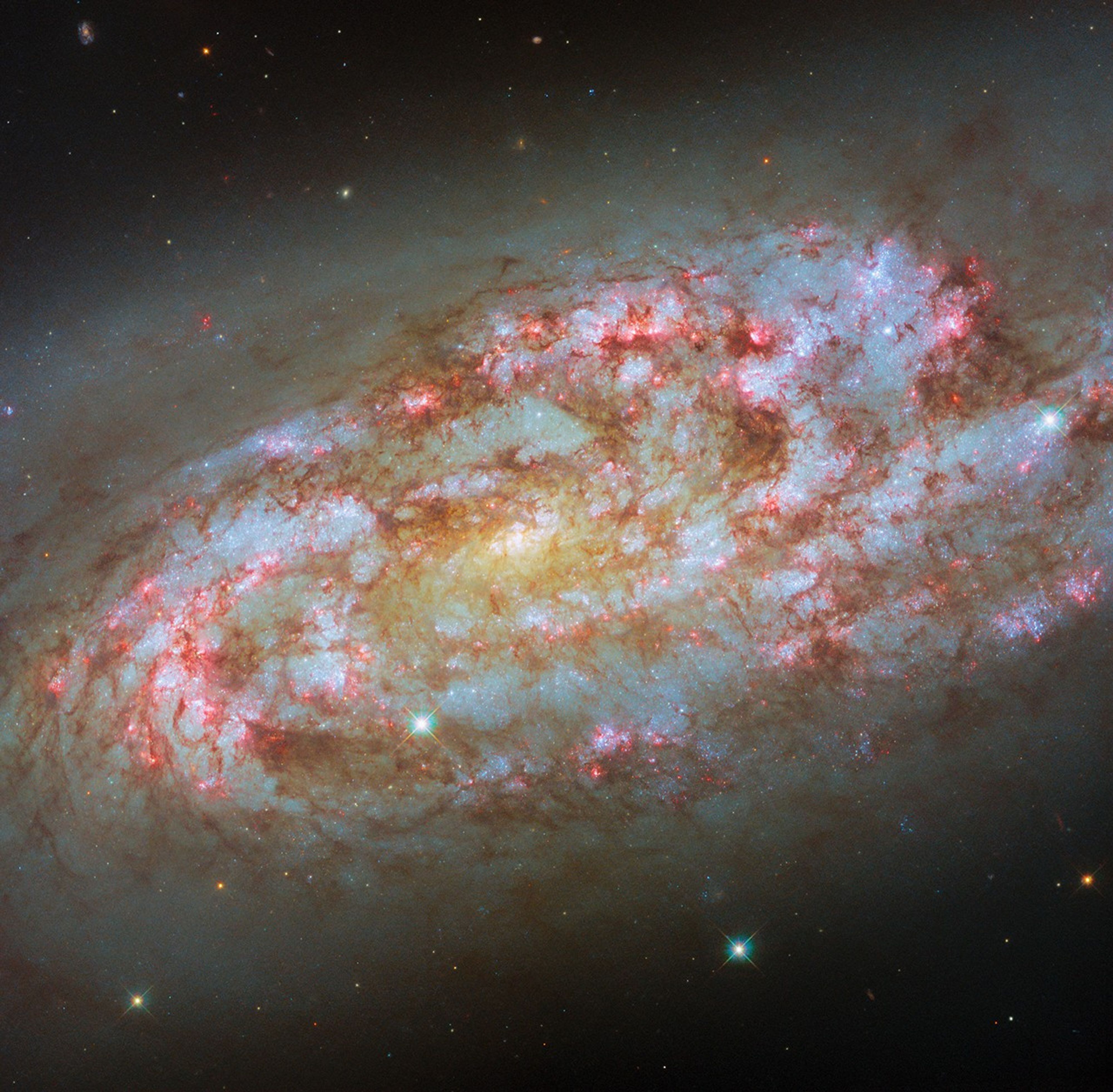
This NASA/ESA Hubble Space Telescope image features a stormy and highly active spiral galaxy named NGC 1792. Located over 50 million light-years from Earth in the constellation Columba (the Dove), the bright glow of the galaxy’s center is offset by the flocculent and sparkling spiral arms swirling around it.
NGC 1792 is just as fascinating to astronomers as its chaotic look might imply. Classified as a starburst galaxy, it is a powerhouse of star formation, with spiral arms rich in star-forming regions. In fact, it is surprisingly luminous for its mass. The galaxy is close to a larger neighbor, NGC 1808, and astronomers think the strong gravitational interaction between the two stirred up the reserves of gas in this galaxy. The result is a torrent of star formation, concentrated on the side closest to its neighbor, where gravity has a stronger effect. NGC 1792 is a perfect target for astronomers seeking to understand the complex interactions between gas, star clusters, and supernovae in galaxies.
Hubble studied this galaxy before. This new image includes additional data collected throughout 2025, providing a deeper view of the tumultuous activity taking place in the galaxy. Blossoming red lights in the galaxy’s arms mark Hydrogen-alpha (H-alpha) emission from dense clouds of hydrogen molecules. The newly forming stars within these clouds shine powerfully with ultraviolet radiation. This intense radiation ionizes the hydrogen gas, stripping away electrons which causes the gas to emit H-alpha light. H-alpha is a very particular red wavelength of light and a tell-tale sign of new stars.
Media Contact:
Claire Andreoli (claire.andreoli@nasa.gov)
NASA’s Goddard Space Flight Center, Greenbelt, MD
4 min read
For the first time, scientists have made a clear X-ray detection of chlorine and potassium in the wreckage of a star using data from the Japan-led XRISM (X-ray Imaging and Spectroscopy Mission) spacecraft.
The Resolve instrument aboard XRISM, pronounced “crism,” discovered these elements in a supernova remnant called Cassiopeia A or Cas A, for short. The expanding cloud of debris is located about 11,000 light-years away in the northern constellation Cassiopeia.
“This discovery helps illustrate how the deaths of stars and life on Earth are fundamentally linked,” said Toshiki Sato, an astrophysicist at Meiji University in Tokyo. “Stars appear to shimmer quietly in the night sky, but they actively forge materials that form planets and enable life as we know it. Now, thanks to XRISM, we have a better idea of when and how stars might make crucial, yet harder-to-find, elements.”
A paper about the result published Dec. 4 in Nature Astronomy. Sato led the study with Kai Matsunaga and Hiroyuki Uchida, both at Kyoto University in Japan. JAXA (Japan Aerospace Exploration Agency) leads XRISM in collaboration with NASA, along with contributions from ESA (European Space Agency). NASA and JAXA also codeveloped the Resolve instrument.

Stars produce almost all the elements in the universe heavier than hydrogen and helium through nuclear reactions. Heat and pressure fuse lighter ones, like carbon, into progressively heavier ones, like neon, creating onion-like layers of materials in stellar interiors.
Nuclear reactions also take place during explosive events like supernovae, which occur when stars run out of fuel, collapse, and explode. Elemental abundances and locations in the wreckage can, respectively, tell scientists about the star and its explosion, even after hundreds or thousands of years.
Some elements — like oxygen, carbon, and neon — are more common than others and are easier to detect and trace back to a particular part of the star’s life.
Other elements — like chlorine and potassium — are more elusive. Since scientists have less data about them, it’s more difficult to model where in the star they formed. These rarer elements still play important roles in life on Earth. Potassium, for example, helps the cells and muscles in our bodies function, so astronomers are interested in tracing its cosmic origins.
The roughly circular Cas A supernova remnant spans about 10 light-years, is over 340 years old, and has a superdense neutron star at its center — the remains of the original star’s core. Scientists using NASA’s Chandra X-ray Observatory had previously identified signatures of iron, silicon, sulfur, and other elements within Cas A.
In the hunt for other elements, the team used the Resolve instrument aboard XRISM to look at the remnant twice in December 2023. The researchers were able to pick out the signatures for chlorine and potassium, determining that the remnant contains ratios much higher than expected. Resolve also detected a possible indication of phosphorous, which was previously discovered in Cas A by infrared missions.
“Resolve’s high resolution and sensitivity make these kinds of measurements possible,” said Brian Williams, the XRISM project scientist at NASA’s Goddard Space Flight Center in Greenbelt, Maryland. “Combining XRISM’s capabilities with those of other missions allows scientists to detect and measure these rare elements that are so critical to the formation of life in the universe.”
The astronomers think stellar activity could have disrupted the layers of nuclear fusion inside the star before it exploded. That kind of upheaval might have led to persistent, large-scale churning of material inside the star that created conditions where chlorine and potassium formed in abundance.
The scientists also mapped the Resolve observations onto an image of Cas A captured by Chandra and showed that the elements were concentrated in the southeast and northern parts of the remnant.
This lopsided distribution may mean that the star itself had underlying asymmetries before it exploded, which Chandra data indicated earlier this year in a study Sato led.
“Being able to make measurements with good statistical precision of these rarer elements really helps us understand the nuclear fusion that goes on in stars before and during supernovae,” said co-author Paul Plucinsky, an astrophysicist at the Center for Astrophysics | Harvard & Smithsonian in Cambridge, Massachusetts. “We suspected a key part might be asymmetry, and now we have more evidence that’s the case. But there’s still a lot we just don’t understand about how stars explode and distribute all these elements across the cosmos.”
By Jeanette Kazmierczak
NASA’s Goddard Space Flight Center, Greenbelt, Md.
Media Contact:
Claire Andreoli
301-286-1940
NASA’s Goddard Space Flight Center, Greenbelt, Md.
Another CES is nearly upon us, another year where we’ll see new gadgets aplenty from giant companies and tiny ones you’ve never heard of. And the not-so-secret secret of CES is that many of these things never make it to market — but usually it isn’t things companies like Samsung show off. But here we are, nearly six years since Samsung first showed off its Ballie personal robot and it is nowhere to be found.
For those who may not recall, Ballie is an adorable circular robot that can putter around your house and project things onto the floor and wall. It’s kind of a virtual assistant on the go. Samsung first revealed this tiny robot at CES 2020, but it was more of a prototype than something anyone expected to purchase. And then there was a global pandemic and we all sort of forgot about weird ball-shaped robots for a few. But Samsung triumphantly unveiled a larger and more refined Ballie at CES 2024, saying it would be on sale that year!
Well, that didn’t happen, but a year later Ballie was back at CES again. Samsung promised it would go on sale in 2025, and followed up with a press release this past April saying it was on track for a summer launch in Korea and the US. As far as I can tell, that’s the last we’ve heard of it.
But with CES looming again, I can’t help but feel like Samsung will roll Ballie out once more, trying to sell the dream of a cute robotic companion who just gets you. I spent some time watching Ballie do its thing in a carefully controlled demo at CES 2024, and I can’t say I was overwhelmed by its purported usefulness or thought there’d be much of a market for this thing. I now can’t help but wonder if Samsung has data backs up my intuition. If this thing was going to sell like gangbusters, it likely wouldn’t be subjected to such a long and public gestation period.
It reminds me a little of one of my favorite Samsung gaffes, the Galaxy Home smart speaker. It was announced at a time when Apple and Google were challenging Sonos and Amazon with voice-activated speakers of their own, moving Siri or the Google Assistant from your phone to a more omnipresent place in your home.
The first rumor of the Galaxy Home happened way back in 2017, and the speaker was officially revealed and briefly shown off by Samsung in August of 2018. My immediate reaction was that this product made very little sense for both Samsung and potential customers — Bibxy sucked, and there were plenty of speakers with better voice assistants. Apparently, Samsung agreed. After multiple years of vague commitments and references to the Galaxy Home, Samsung just… stopped talking about it. Oddly enough, a Galaxy Home Mini speaker was briefly released in South Korea, part of a promotion for people who pre-ordered the Galaxy S20. But I don’t think you could ever just walk into a store and buy one, and the larger Galaxy Home never materialized at all.
Ballie isn’t quite the abandonware situation that the Galaxy Home was, at least not yet. After all, it’s only been about eight months since Samsung dropped that press release claiming it would arrive soon. The company has definitely pushed Ballie in a more public way than the Galaxy Home, making it a little harder to just drop entirely. Maybe we’ll see a revamped Ballie with even more weird tricks next month, or maybe we’ll just get another vague promise that it’ll arrive in 2026. After failing to deliver two years in a row, though, I’m not going to expect Ballie to show up as a real product until I can punch in my credit card and pre-order it... not that I’d do that anyway. Ballie needs to show that it’s a lot more than a cute rolling robot before Samsung gets my cash.
©
Ethereum is holding firmly above the $3,150 level as the market shifts into a more bullish phase after enduring weeks of heavy selling pressure and fear-driven liquidation. The recovery has sparked debate among analysts: some view the bounce as nothing more than a relief rally within a broader bearish trend, while others believe Ethereum may be building the foundation for a more sustained rebound.
A new CryptoQuant report offers one of the clearest insights. According to Ethereum data on Binance, the past several weeks have shown heightened volatility in the Cumulative Volume Delta (CVD) — a metric that tracks real-time buying and selling pressure. This volatility reflects sharp, rapid shifts in trader behavior as the market attempts to stabilize.
Although Ethereum remains in a downtrend from its August peak, recent CVD spikes point to the return of notable buying activity. However, the report emphasizes that these bursts of demand are sporadic and lack the sustained strength needed to confirm a full bullish reversal.
According to the Arab Chain report, Ethereum’s CVD recently turned positive, coinciding with the price’s attempt to stabilize above the $3,100 level. This shift indicates fresh liquidity entering the market through short-term buy orders, suggesting that some traders are stepping in to accumulate during dips.
However, the sudden spikes and rapid pullbacks within the CVD reveal that the market remains locked in a strong tug-of-war between buyers and sellers. This volatility underscores the fact that Ethereum has not yet reached either temporal stability or a clear structural trend.
The report also highlights the importance of the 30-day correlation between price and CVD, which has held steady at around 0.6 despite lower price levels. This relatively high reading shows that liquidity flows continue to influence Ethereum’s price direction in a meaningful and consistent way. Even though buying pressure appears irregular, its recurring impact on price suggests that traders are still actively responding to market conditions.
Overall, this pattern reflects investors attempting to capitalize on volatility, especially as anticipation grows around potential liquidity inflows tied to upcoming network upgrades. Yet, Arab Chain stresses that without a more sustained accumulation phase and reduced short-term selling, Ethereum may struggle to generate a decisive upward movement.
Ethereum’s latest price action shows a cautious recovery as ETH climbs back above the $3,150 level, but the chart reveals that the broader structure remains fragile. After a steep decline from the October highs near $4,500, ETH found support slightly above $2,700, where buyers stepped back in with increased volume—visible in the recent surge of green candles at the bottom of the chart. This reaction suggests renewed interest at lower levels, but not yet a decisive shift in trend.
The price is now pressing against the 100-day SMA (red line), a level that previously acted as support and has now flipped into resistance. Reclaiming this line would be an important step toward restoring bullish momentum. Above it, ETH faces another barrier at the 50-day SMA (blue line), which continues to slope downward, reflecting ongoing medium-term selling pressure.
Despite the rebound, volume remains inconsistent, indicating hesitation among market participants. ETH will need stronger follow-through buying to challenge the next resistance zone around $3,300–$3,350, a region aligned with previous breakdown levels.
Featured image from ChatGPT, chart from TradingView.com
RAM prices have gone wild, mostly thanks to AI. In this episode, Devindra chats with Will Smith (Brad and Will Made a Tech Pod) about the state of the RAM industry, as well as other hardware we expect to get more expensive. (SSD prices are definitely creeping up too!). Also, we discuss Meta poaching Alan Dye, one of Apple's design executives, and what this could mean for Meta's upcoming devices. And yes, whatever they have next will likely revolve around AI.
Mark Zuckerberg, CEO of Meta, plans deep cuts to his company’s metaverse development – 1:09
Longtime Apple UI designer Alan Dye to join Meta’s AI division – 7:08
US DOT cuts fuel efficiency standards, doubles down on gas cars – 25:40
Waymo autonomous cars recently started driving more aggressively – 31:30
Amazon halts its anime dub beta because it sounded terrible – 38:00
WTF, RAM?? Will Smith joins to talk about why RAM prices are spiraling upward – 44:05
Around Engadget: Metroid Prime 4 is a return to form after 18 years on ice – 1:04:42
Working on – 1:07:36
Pop culture picks – 1:08:32
Host: Devindra Hardawar
Guest: Will Smith
Producer: Ben Ellman
Music: Dale North and Terrence O'Brien
©
Hackers with links to China reportedly successfully infiltrated a number of unnamed government and tech entities using advanced malware. As reported by Reuters, cybersecurity agencies from the US and Canada confirmed the attack, which used a backdoor known as “Brickstorm” to target organizations using the VMware vSphere cloud computing platform.
As detailed in a report published by the Canadian Centre for Cyber Security on December 4, PRC state-sponsored hackers maintained "long-term persistent access" to an unnamed victim’s internal network. After compromising the affected platform, the cybercriminals were able to steal credentials, manipulate sensitive files and create "rogue, hidden VMs" (virtual machines), effectively seizing control unnoticed. The attack could have begun as far back as April 2024 and lasted until at least September of this year.
The malware analysis report published by the Canadian Cyber Centre, with assistance from The Cybersecurity and Infrastructure Security Agency (CISA) and the National Security Agency (NSA), cites eight different Brickstorm malware samples. It is not clear exactly how many organizations in total were either targeted or successfully penetrated.
In an email to Reuters, a spokesperson for VMware vSphere owner Broadcom said it was aware of the alleged hack, and encouraged its customers to download up-to-date security patches whenever possible. In September, the Google Threat Intelligence Group published its own report on Brickstorm, in which it urged organizations to "reevaluate their threat model for appliances and conduct hunt exercises" against specified threat actors.
This article originally appeared on Engadget at https://www.engadget.com/big-tech/chinese-hackers-reportedly-targeting-government-entities-using-brickstorm-malware-133501894.html?src=rss
©
© Greggory DiSalvo via Getty Images
Microsoft's Copilot+ initiative launched last year with a clear goal: To produce capable laptops for people eagerly anticipating AI-powered features. Read that sentence again, and it's glaringly obvious that Microsoft's plan was flawed from the start. Most consumers aren't nearly as hyped for AI features as the companies eager to foist artificial intelligence upon us. And those features aren't exactly compelling, either. Microsoft's Recall — which snaps screenshots of your PC to create a database of everything you’ve done– was dogged by privacy concerns from the start. And to be honest, I haven't found its ability to remember the files and websites I've opened to be that useful.
Without any sort of killer AI app, most consumers weren't going to pay a premium for Copilot+ systems either. Not in this precarious economy, anyway. So it wasn't a huge surprise to see sales of Copilot+ systems going practically nowhere over the last year. In the third quarter of 2024, they accounted for less than 10 percent of systems shipped, according to data from Mercury Research (via Tom’s Hardware). The research firm IDC (via PCWorld) also found that Copilot+ systems made up just 2.3 percent of Windows machines sold in the first quarter of 2025 (and a mere 1.9 percent of the entire PC market).
Instead of continuing to promote Copilot+, Microsoft now wants to "make every Windows 11 computer an AI PC". The new "Hey Copilot" voice commands and Copilot Vision, a feature that lets the AI assistant see what's on your screen, are both cloud-powered. That means you won't need the beefy 40 TOPS neural processing units (NPU) found on Copilot+ systems to use them. Microsoft spent the past few years touting NPUs as the gateway to useful AI features, like Recall and Windows Studio webcam effects, but only one of its new AI capabilities actually requires an NPU. (And even that is just a slight update to Click to Do, allowing you to send Zoom invitations by right-clicking on e-mail addresses.)
It's easy to view the whole Copilot+ initiative as a cynical way to ramp up AI hype and push people towards expensive new laptops, especially as the October 14 Windows 10 end of support date loomed. But it also led to some genuinely useful changes: Microsoft made 16GB of RAM a standard for Copilot+ systems, along with 256GB of storage and the aforementioned 40 TOPS NPUs. The launch of Copilot was also the kick in the pants Microsoft needed to revamp Windows for mobile Arm processors. I never thought I'd love a Surface with a Snapdragon chip, but the improved Arm support on the Surface Pro and this year's smaller model finally won me over.
I wouldn’t call the Copilot+ program a huge swing, but it’s still the sort of industry-wide cat herding that’s rare to see in the PC space. Microsoft couldn’t just snap its fingers and shift all PCs to efficient mobile chips with powerful NPUs, like Apple did with its own jump to M-series chips years ago. Microsoft had to wait for new NPU-equipped hardware from Qualcomm (and eventually Intel and AMD). It had to finally fix the Windows on Arm problem. And it also had to double-down on AI features that felt truly transformative. It’s just a shame that consumers didn’t seem to care.
Microsoft said that Copilot+ systems accounted for 15 percent of premium PCs sold during last year’s holiday season, but the company hasn’t released any new sales figures since then. “This is the fastest adoption I've seen of a new category of hardware, and we've done it faster than the normal generational shift of silicon,” James Howell, Microsoft’s VP of Windows marketing, said in a conversation with Engadget. “Copilot+ PCs continue to be a transition that we are pushing for and prioritizing. But I can't give you the exact numbers beyond that… Just for the last two or three months, we've been doing pretty well with year-on-year growth in the Windows business.”
While Microsoft ultimately doesn’t have much to show for the Copilot+ initiative, the steady progression of hardware will lead to AI PCs dominating over the next five years. The research firm Omdia predicts that AI PCs will account for 55 percent of computers shipped in all of 2026, up from 42.5 percent of systems in Q3 2025. By 2029, Omdia predicts AI PCs will make up 75 percent of all systems shipped, giving Windows 80 percent of the AI PC market.
“It’s important to note that this steep adoption curve [for AI PCs] is driven more by the product roadmaps of the PC market, rather than consumers and businesses seeking PCs specifically for AI,” according to Omdia research analyst Kieren Jessop. “For businesses, and consumers especially, AI-capable PC adoption is more a function of a customer going to purchase a device and that device just so happens to have an NPU.”
Microsoft was basically right: AI PCs are the future. But it turns out the AI features people actually want to use — like ChatGPT, Sora and Microsoft’s own Copilot — are mostly powered by the cloud, making onboard NPUs superfluous. That won’t be true forever. There are tangible security, speed and convenience benefits for onboard AI processing, like transcribing sensitive audio instead of sending it to the cloud. But for now, those AI workloads are relatively niche, and they’re not enough to make the Copilot+ a true success by any measure.
This article originally appeared on Engadget at https://www.engadget.com/computing/laptops/microsofts-copilot-ai-pc-plan-fizzled-but-it-still-served-a-purpose-130000239.html?src=rss
©
Spinning off from the action-camera company Insta360, Antigravity now has its debut drone on sale. With 360-degree cameras that capture 8K and offer you a truly unconstrained view of the skies, the A1 is a different drone from everything else out there. Sorry, DJI.
Instead of typical drone joysticks, you get a motion controller that lets you point and shoot like video game gesture controls, while crisp FPV goggles put you right inside the cockpit.
It’s easy to fly after takeoff, but the A1’s myriad parts are often tricky to sync together — and pulling video down to the companion app is even trickier. Going on specs alone, like speed and camera sensor size, it doesn’t stand up to cinematic drones from the likes of DJI.
Still, it’s not meant to be a cinematic drone. It’s a hybrid mix of flight experience, FPV drone and a not-miss-a-thing camera drone. It’s truly unique — and fun.
— Mat Smith
The best Christmas gifts to give everyone on your 2025 holiday shopping list
Amazon Luna’s December lineup includes Hollow Knight, Lego 2K Drive and a few Fallout games
Amazon has quietly removed its terrible AI-generated English dubs for several anime shows on Prime Video, following widespread ridicule from viewers and the industry. AI dubs were recently added to Banana Fish, No Game, No Life and Vinland Saga, where they were labeled “AI beta” in the Languages section of the app.
For shows lacking an English-language dub, it was a seemingly cheap way to consume anime for Amazon. However, it quickly became clear that the dubs were really quite bad. Baaaad.
Voice actor Daman Mills called the AI-generated dub for Banana Fish a “massive insult to us as performers” in a post on X.
An Amazon double today. According to The Washington Post, Amazon is considering discontinuing use of the US Postal Service and building its own shipping network to rival it. The e-commerce behemoth spends more than $6 billion a year on the public mail carrier — almost 8 percent of the service’s total revenue. That’s up from just under $4 billion in 2019. That split might be due to a breakdown in negotiations between Amazon and the USPS rather than Amazon proactively pulling its business.
Amazon has invested heavily in all kinds of delivery methods, including shipping logistics, buying its own Boeing planes, launching its own electric delivery vans and slowly building a drone delivery network.
A triple? Sorry. Amazon didn’t have a specific release date to share beyond “later this year” for its latest Scribe slates. And talk about brinkmanship! Here we are in December. The company says the devices will be available on December 10. This is the third generation of the Kindle Scribe line of E Ink writing tablets — the first time Amazon has three versions of the Scribe. At the entry level, the Scribe without a front light starts at $430, while the model with a light starts at $480. The Kindle Scribe Colorsoft will start at $630. You always have to pay more for color.
The Nikon ZR could be a breakthrough for content creators, largely because it incorporates technology from RED — a company now owned by Nikon. The combination of professional-grade video quality (specifically RED RAW) and autofocus comes at a fraction of the cost of dedicated cinema rigs. There are some compromises on battery life and the lack of a viewfinder, but the ZR arguably offers the best video quality for the money.
This article originally appeared on Engadget at https://www.engadget.com/general/the-morning-after-engadget-newsletter-121538076.html?src=rss
©
© Image by Mat Smith for Engadget
CES doesn't start until January, but whispers of the products and announcements that could be in store for tech's biggest annual conference have already started to take shape. The CES 2026 show floor is officially open from January 6 through 9, although the show kicks off with events on Sunday January 4 and a host of press conferences on Monday. As always, product demos, announcements and networking happening at the Las Vegas Convention Center and surrounding hotels all over the city. As usual, Engadget will be covering the event in-person and remotely, bringing you news and hands-ons straight from the show floor.
More specific details and pre-announcements should trickle out as CES approaches, but in the meantime, we do know what companies will be hosting press conferences and what tech trends could rear their heads at the show.
Press conferences and show floor booths are the bread and butter of CES. The Consumer Technology Association has already published a searchable directory of who will have a presence at the show, along with a schedule of every official panel and presentation.
On Sunday, January 4, Samsung will kick-off CES with "The First Look," a presentation hosted by TM Roh, the CEO of Samsung's DX Division, on the company's "vision for the DX (Device eXperience) Division in 2026, along with new AI-driven customer experiences."
That'll be followed by multiple press conferences throughout Monday, January 5. LG is hosting its "Innovation in Tune with You" presentation to share "its vision for elevating daily life through Affectionate Intelligence" at the start of the day, Intel is launching its new Core Ultra Series 3 processors in the afternoon, Sony Honda Mobility is holding a press conference on its first car and AMD CEO Lisa Su will cover AMD's upcoming chip announcements at a keynote address that closes out the day.
Finally, on Tuesday, January 6, Lenovo CEO Yuanqing Yang will host Lenovo's Tech World Conference at Sphere, using the large and decidedly curved screen to share the company's "commitment to delivering smarter AI for all by constantly redefining how technology can engage, inspire, and empower."
Outside of the formal introduction of new products and initiatives, reading the tea leaves of what was announced last year and what companies are reportedly working on, we can make some educated guesses at what we could see at CES 2026.
CES is frequently the start of a cascade of new chip announcements for a given year, and one of the first places new silicon appears in real consumer products. AMD will likely use its keynote to introduce new versions of its Ryzen chips, including the recently spotted Ryzen 7 9850X3D, which is expected to offer better single-threaded performance, and the Ryzen 9000G series, which could be built with AMD's Zen 5 architecture. The company might also use its CES stage to go over its new FSR Redstone AI upscaling tech.
Intel has already publicly announced that it'll launch its Panther Lake chips at CES 2026. The officially titled Intel Core Ultra Series 3 chips fit into Intel's overall "AI PC" push, but are specifically meant for premium laptops. Based on a preview from October 2025, Intel says the first chip made with its 2-nanometer 18A process will offer 50 percent more processing performance than previous generations and for the chip's Arc GPU, a 50 percent performance bump from last generation.
Qualcomm is also rumored to be targeting laptops at the show, building on the work it's done moving its Snapdragon chips out of phones and tablets and into other types of computers. The company's Snapdragon X2 Elite and X2 Elite Premium chips should start appearing in laptops at CES 2026, offering a look at the improved speed and AI performance the company promised in 2025.
Sony announced a collection of new Bravia TVs in April 2025, replacing the company's flagship, filling in its midrange options and adding a new budget model to the mix. The star of this updated Bravia lineup is the Bravia 9, which features a QD-OLED panel, but Sony appears to be prepping entirely new display tech for 2026. In March 2025, Sony introduced a new RGB LED panel that uses individual Mini LED backlights colored in red, green and blue to produce even brighter, more accurate colors. In contrast to a QD-OLED, which filters a layer of blue organic light emitting diodes through quantum dots that change color, Sony's "General RGB LED Backlight Technology" can get as bright as a Mini LED panel without needing an extra filter layer or worrying about OLED's problems with burn-in.
The company has already trademarked the name "True RGB," which could end up being what Sony calls this new flavor of display if it decides to show them off at CES. It seems entirely likely, because CES is nothing if not a TV show — it’s a sure bet that we’ll see new TVs from the likes of LG and Samsung in addition to Sony. If the company doesn't introduce new display tech for its TVs, it does have a new 240Hz PlayStation monitor coming in 2026 that it could show off at CES instead.
Sony isn't the only company hyped on bright screens. Samsung is reportedly pushing an updated version of the HDR10 and HDR10+ standards that could be ready to demo at CES 2026. The new HDR10+ Advanced standard would be Samsung's answer to Dolby Vision 2, which includes support for things bi-directional tone mapping and intelligent features that automatically adapt sports and gaming content. Samsung's take will reportedly offer improved brightness, genre-based tone mapping and intelligent motion smoothing options, among other improvements.
The ball-shaped yellow robot lovingly known as "Ballie" has been announced twice, first in 2020 and then again in 2024 with a projector in tow. Samsung said Ballie would go on sale in 2025 at CES last year and then shared in April 2025 that Ballie would ship this summer with Google's Gemini onboard. But it's nearly 2026, and Ballie is nowhere to be seen. It's possible Samsung could make a third attempt at announcing its robot at CES 2026, but whether or not it does, robotics will still be a big part of the show.
Robot vacuums and mops were a major highlight of CES 2025, and it's safe to expect notable improvements from the new models that are announced at CES 2026. Not every company will adopt the retractable arm of the Roborock Saros Z70, but robot vacuums with legs for rising over small ledges like the Dreame X50 seem like they could become the norm. Roborock could also show off its new Roborock Qrevo Curv 2 Flow, the first of its robot vacuums to feature a retractable roller mop.
Beyond just traversing spaces more efficiently, improving robots' navigation could also be a major concern at the show. Prominent members of the AI industry are turning their attention from large language models to world models, which aim to give AI a deep understanding of physical space. Those world models could be the key to making robots, bipedal or otherwise, competent at navigating homes and workplaces, and will likely be a significant talking point at CES 2026.
We’ll be updating this article throughout the month as more rumors surface and new products are confirmed — stay tuned for future updates!
This article originally appeared on Engadget at https://www.engadget.com/big-tech/what-to-expect-at-ces-2026-120000278.html?src=rss
©
