Normal view

There are new articles available, click to refresh the page.
Today — 10 December 2025Main stream

Stripe Charges 1.5% for Stablecoin Transfers That Cost $0.0002 On-Chain

10 December 2025 at 09:57

Stripe’s rollout of stablecoin payment processing has ignited fierce debate after the payments giant announced it would charge businesses 1.5% to transfer digital dollars that cost fractions of a cent on blockchain networks.

The company now supports USD-settled stablecoin payments across Ethereum, Base, and Polygon, with USDC, USDP, and USDG available through its platform, marking a significant expansion of its crypto infrastructure following its $1.1 billion acquisition of Bridge earlier this year.

Critics immediately highlighted the stark disparity between Stripe’s fees and the actual costs of blockchain transactions.

Sterling Crispin, a software developer, started the debate, arguing that sending $200 USDC on Base cost him just $0.000193 in transaction fees, 0.00009% of the transfer amount, while Stripe would charge $3 for the same transaction.

Incredible innovation, @stripe is charging 1.5% to transfer USDC.

I recently sent $200 of USDC on @base and my transaction fee was 0.00009% , or $0.000193.

The tx fee would have been the same for $1 or $100M USDC

Charging 1.5% simply to send USDC is ludicrously unreasonable https://t.co/uXwubcBpJm pic.twitter.com/SBL0qTHAO9

— Sterling Crispin 🕊 (@sterlingcrispin) December 8, 2025

Charging 1.5% simply to send USDC is ludicrously unreasonable,” Crispin wrote, calculating that Stripe would have extracted $24,818 in fees for a $1.65 million transfer that cost the sender $0.000412 on-chain.

Defenders Cite Value Beyond Transaction Costs

Industry observers defending Stripe’s pricing argue the fee reflects services beyond raw blockchain transactions.

Matt Silvestri noted that Stripe custodies USDC, converts it to USD, and deposits fiat into merchants’ bank accounts, an infrastructure that traditional bank accounts cannot handle directly.

While I agree it sounds high, this fee is for abstracting all complexity away from accepting USDC,” Silvestri explained, adding that 1.5% remains substantially lower than the 3% plus 30 cents per transaction charged by credit card processors.

Stablecoin payments are coming to @stripe and some people are upset that they are charging 1.5%. Stripe users are not crypto degens willing to download wallets with private keys to send USDC by themselves and go through all the operational hassle attached to it.

They will gladly… https://t.co/4faizEM42G pic.twitter.com/GavivKrImk

— Youngsun Shin (@youngsun) December 9, 2025

Youngsun Shin, Head of Product at Flipster, also commented that Stripe users are “not crypto degens willing to download wallets with private keys to send USDC by themselves.

He argued that merchants will “gladly pay the processing fees” to avoid operational complexity, noting that Stripe’s stablecoin integration brings “massive amounts of money on-chain” while benefiting networks like Polygon, Base, and Solana.

Liz Bazurto, Director of BD at Consensys, echoed this perspective, noting that merchants have paid 2.5% to 4% on card transactions for decades while dealing with issues such as incorrect amounts, accounting requirements, and USD payroll needs.

Strategic Implications for Crypto Adoption

Haseeb Qureshi of Dragonfly Capital also stepped in, characterizing Stripe’s pricing as evidence of an incumbent “clinging to their old business model,” comparing it to telecoms offering discounted VoIP rates while Skype provided free calling.

This is so bullish for all the crypto companies,” Qureshi wrote, predicting that merchants will easily switch to lower-cost stablecoin APIs once they achieve feature parity with Stripe’s offering.

He warned that stakeholders should “be scared when the incumbents drop the fees to ~0.

You don't understand–this is actually great. It's exactly what you want to see.

This is the incumbent clinging to their old business model. This is your telco offering VoIP calling for 50% discounted long-distance rates, while Skype was free.

This is so bullish all the crypto… https://t.co/4att1teBb0

— Haseeb >|< (@hosseeb) December 9, 2025

Similarly, Bette Chen of Gluon described Stripe’s approach as “the classic walled-garden tax,” where fintech companies build elegant user experiences “but on old rails with old economics.

She envisions an inversion in which platforms offer “Web2 on the outside, crypto rails on the inside,” enabling users to experience instant, global, and nearly free transactions without realizing they’re using crypto infrastructure.

Mikko Ohtamaa of Trading Strategy also suggested that stablecoin adoption could dramatically impact low-margin international e-commerce businesses, noting that eliminating Stripe’s 1.5% fee could increase profit margins by approximately 20% for companies operating with an 8% inventory markup.

Banks Face Mounting Competitive Pressure

The controversy emerges amid broader structural shifts in financial infrastructure documented in recent industry analysis.

According to StablecoinInsider, eight of the ten largest neobanks now use stablecoin rails internally for treasury settlement and cross-border payments, with platforms like Revolut and Wise routing internal liquidity through stablecoins without branding it as crypto.

Revolut isn't telling you this.

8 of the 10 largest neobanks now use stablecoin rails internally for treasury settlement and cross-border payments.

When you send an "instant transfer" through their app, the backend is settling on public blockchain networks in under a second… pic.twitter.com/ahmd8F8cZh

— James | Ethereum Foundation ⟠ | Snapcrackle.eth (@Snapcrackle) December 9, 2025

Traditional wire transfers costing $45 with three-to-five-day settlement periods face competition from stablecoin rails charging $0.50 with 30-second finality.

Notably, this debate surfaced as Stripe CEO Patrick Collison recently argued that stablecoin growth will force banks to raise deposit yields beyond current rates of 0.40% in the US and 0.25% in the EU.

Cheap deposits are great, but being so consumer-hostile feels to me like a losing position,” Collison stated, predicting that depositors will demand “something closer to a market return on their capital” as stablecoin alternatives proliferate.

The post Stripe Charges 1.5% for Stablecoin Transfers That Cost $0.0002 On-Chain appeared first on Cryptonews.

[LIVE] Bitcoin Price Alert: Fed Chair Powell Press Conference at 2:30 PM ET—Will Guidance Shift Crypto Markets?

10 December 2025 at 08:39

Fed Chair Jerome Powell’s 2:30 PM ET press conference is where Bitcoin traders will get answers on the Fed’s 2025 easing path. Markets already know the December decision; the real question is whether Powell signals two or four more cuts next year.

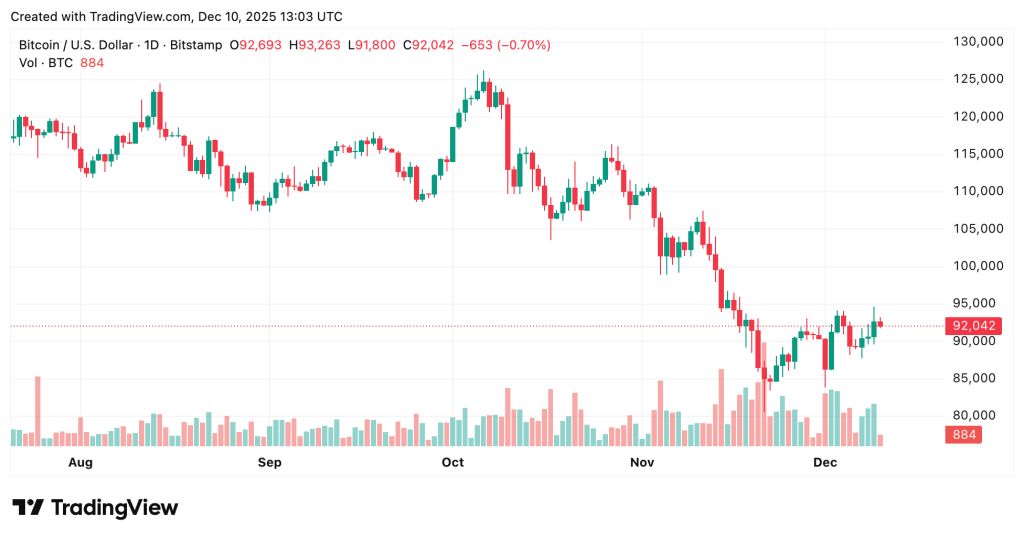
Bitcoin is holding $92,000 heading into the presser, with traders watching for any hawkish language about “patience” or “data-dependent” policy that could dampen aggressive easing expectations.

The updated dot plot, released at 2pm, will show where Fed officials see rates ending in 2025, but Powell’s tone and forward guidance will determine whether crypto interprets today’s likely 25-basis-point cut as dovish or hawkish.

The key risk for Bitcoin is a “hawkish cut” scenario where Powell emphasizes labor market strength (191K jobless claims, 7.7M job openings) as justification for slowing the pace of easing despite improving core inflation (2.8%).

Any mention of skipping the January meeting or reducing 2025 cuts from four to two would be bearish for risk assets.

Conversely, if Powell stresses that inflation is moving toward the target and the Fed remains committed to normalizing rates, Bitcoin could break above $92,000 resistance.

Bitcoin’s technical setup shows resistance at $92,000 and support at $88,000-$90,000, with the descending trendline since mid-November still intact.

Traders will parse every word from Powell for clues on the January 28-29 FOMC meeting and the overall 2025 trajectory.

The Fed’s credibility is on the line after ending QT and cutting rates twice—backing away from easing now would signal either policy error or genuine concern about sticky inflation.

Powell speaks at 2:30 pm ET, and crypto volatility is expected to spike immediately after.

Powell Press Conference: 2025 Guidance is the Real Story

The post [LIVE] Bitcoin Price Alert: Fed Chair Powell Press Conference at 2:30 PM ET—Will Guidance Shift Crypto Markets? appeared first on Cryptonews.

[LIVE] Bitcoin Price Watch: Fed Interest Rate Decision Today — Will Powell Cut or Pause?

10 December 2025 at 08:38

The Federal Reserve announces its December interest rate decision at 2:00 PM ET today, with Chair Jerome Powell’s press conference following at 2:30 PM ET.

Bitcoin is trading around $92,000 as markets price in an 89% chance of a rate cut that would lower the federal funds rate to 3.50%-3.75%.

Fed Interest Rate Decision Today - Fed rate Cut Odds CME FedWatch Tool
Source: CME FedWatch Tool

The decision comes after a week of conflicting economic signals, including shockingly strong jobless claims (191K vs 219K expected, lowest since 2022), cooling core PCE inflation (2.8% from 2.9%), and yesterday’s JOLTS data showing job openings unchanged at 7.7 million with quits declining 276,000 year-over-year.

The combination of labor market stability and improving inflation supports the case for easing, but some Fed officials have expressed concern about cutting too aggressively, with employment still resilient.

This marks the Fed’s third policy meeting since beginning its easing cycle with a 50 basis point cut in September, followed by another 25 basis point reduction in October.

The central bank officially ended quantitative tightening on December 1, freezing its balance sheet at $6.57 trillion after draining $2.39 trillion from markets since June 2022.

Markets are focused not just on today’s decision but also on Powell’s guidance for 2025. The updated dot-plot projections could signal whether the Fed sees two, three, or four more cuts next year.

Any hawkish shift suggesting fewer cuts in 2025 would likely pressure Bitcoin and risk assets, while dovish guidance reinforcing the easing cycle could provide the catalyst for Bitcoin to break above $92,000 resistance.

Bitcoin’s technical setup shows critical resistance at $92,000 and the descending trendline that’s capped rallies since mid-November, with support holding at $88,000-$90,000. Total crypto market cap sits at $3.23 trillion.

Fed Interest Rate Decision Today - Bitcoin Price Chart
Source: TradingView

The key risk for crypto is a “hawkish cut”—where the Fed reduces rates 25 basis points today but signals a slower pace of easing in 2025 due to sticky inflation or resilient employment.

Powell’s 2:30 PM press conference will be scrutinized for any hints about the January meeting and the overall trajectory of policy.

With the Fed’s liquidity pivot complete (QT ended) and inflation moving in the right direction, the path of least resistance for Bitcoin is higher—but only if Powell doesn’t pour cold water on aggressive 2025 easing expectations.

Fed Decision Day: Markets Brace for Rate Cut or Hawkish Surprise

The post [LIVE] Bitcoin Price Watch: Fed Interest Rate Decision Today — Will Powell Cut or Pause? appeared first on Cryptonews.

Silk Road Wallets Wake Up After 10 Years, Move $3M in Bitcoin

10 December 2025 at 07:01

Hundreds of crypto wallets linked to the now-defunct Silk Road darknet marketplace awakened from a decade-long slumber on Tuesday, transferring over $3 million in Bitcoin to a single unidentified address.

The sudden activity has sparked renewed attention to digital assets tied to the notorious platform that helped popularize Bitcoin in its early years.

Blockchain intelligence firm Arkham detected approximately 312 dormant wallets collectively moving $3.14 million in BTC to the address “bc1q***ga54” over 12 hours.

The wallets still retain roughly $40 million in Bitcoin following the transfers, according to Arkham’s latest data.

Silk Road Bitcoin - Arkham
Source: Arkham

Mystery Surrounds Decade-Old Wallets’ Sudden Activity

The reason behind the wallets’ reactivation remains unclear.

Coinbase Director Conor Grogan identified these holdings earlier this year, estimating that they were worth around $47 million in Bitcoin across dozens of addresses potentially linked to Ross Ulbricht, the marketplace’s creator.

Grogan resurfaced that January analysis on Tuesday after a pseudonymous operator “0xG00gly” flagged the latest movements.

What fresh hell is this? pic.twitter.com/Pt64kB26pO

— Googly 👀 (@0xG00gly) December 9, 2025

Individual transfers ranged from micro-amounts of 0.00006 BTC, roughly $5.58, to larger sums exceeding 3.6 BTC, valued at $338,640.

The transactions followed a pattern of consolidation, with funds from multiple legacy addresses flowing into the single destination wallet over several hours.

Several wallets showed connections to mining activity from the 2011 era, when Bitcoin mining remained accessible to individual participants using standard computer equipment.

Ulbricht himself has not publicly commented on the transfers.

He served multiple life sentences without parole for creating Silk Road before receiving a full and unconditional pardon from President Donald Trump in January through executive order.

Silk Road Bitcoin - Ross Ulbricht Image
Source: CBS

The former darknet operator delivered his first public speech following his release in May, emphasizing freedom and decentralization as guiding principles for future technological advancement.

While Silk Road facilitated illegal narcotics sales and other prohibited transactions, the platform played a pivotal role in Bitcoin’s early adoption.

The marketplace processed over 1.5 million transactions worth an estimated $213 million between 2011 and its 2013 shutdown, all conducted using cryptocurrency.

Ulbricht, a physics graduate and early Bitcoin advocate, envisioned the platform as a libertarian experiment in anonymous commerce free of government interference.

However, prosecutors successfully argued that it enabled widespread criminal activity.

Government Bitcoin Holdings Face Competing Policy Directions

The wallet activity emerges amid ongoing debates over how authorities should handle seized digital assets.

The Department of Justice received approval in December to sell 69,370 Bitcoin, worth $6.5 billion, confiscated from Silk Road, following a federal judge’s ruling that ended a contentious ownership battle with Battle Born Investments.

That company claimed ownership through a bankruptcy estate tied to Raymond Ngan, allegedly the mysterious “Individual X” accused of stealing crypto from Silk Road.

Battle Born lost at every judicial level, including the Supreme Court’s refusal to hear the case.

The company’s attorney criticized what he called “the DOJ’s abuse of the Civil Asset Forfeiture process” and accused officials of “procedural trickery” throughout the litigation.

The approved sale represents one of the largest government cryptocurrency liquidations in history.

📉 Is the U.S. DOJ selling Silk Road Bitcoin, impacting the market? Bitcoin Magazine CEO (@DavidFBailey) suggests potential sales amid price volatility.#Bitcoin #SilkRoadhttps://t.co/4mjRYW2hQW

— Cryptonews.com (@cryptonews) March 10, 2025

Officials justified the decision, citing Bitcoin’s price volatility, though they typically conduct such sales in smaller batches to minimize market disruption.

The decision came despite Trump’s campaign promise to establish a “Strategic Bitcoin Reserve” rather than liquidating government-held cryptocurrency.

The proposed reserve would mirror the Strategic Petroleum Reserve, retaining all seized digital assets to manage economic risks.

Similar dormant wallet movements have triggered security concerns before.

In July, another $8.6 billion in Bitcoin from wallets inactive since 2011 suddenly consolidated, prompting speculation about potential hacks or compromised private keys.

Some observers linked those holdings to Roger Ver, the early Bitcoin advocate arrested in Spain on tax charges, though no confirmation emerged.

Bitcoin’s price has remained relatively stable despite these large-scale transfers. The cryptocurrency traded near $92,500 on Wednesday, up 2.5% as traders awaited the Federal Reserve’s final rate decision of the year.

The post Silk Road Wallets Wake Up After 10 Years, Move $3M in Bitcoin appeared first on Cryptonews.
Federal Regulator Approves Riskless Crypto Trading for US Banks

10 December 2025 at 03:54

The Office of the Comptroller of the Currency confirmed that national banks may engage in riskless principal crypto-asset transactions, eliminating a key barrier between traditional banking and digital assets.

The decision allows banks to act as intermediaries in crypto trades by simultaneously buying from one customer and selling to another without holding inventory.

The policy shift marks the OCC’s most aggressive step yet toward integrating crypto into mainstream banking, building on earlier approvals for custody services and balance sheet holdings.

Banks can now facilitate client crypto trades while assuming only minimal settlement and credit risk.

OCC Interpretive Letter 1188 confirms that a national bank may engage in riskless principal crypto-asset transactions as part of the business of banking. https://t.co/gXirMExhCi pic.twitter.com/uPRFGqb2NZ

— OCC (@USOCC) December 9, 2025

Banking’s Crypto Gateway Opens Under New Framework

In Interpretive Letter 1188, senior deputy comptroller Adam Cohen said the activity falls squarely within the business of banking because it mirrors existing brokerage functions.

National banks have long acted as financial intermediaries in securities, derivatives, and other asset classes through riskless principal transactions, taking momentary ownership to bridge buyer and seller.

The OCC applied the same logic to crypto-assets, noting that banks eliminate market risk through offsetting trades while retaining limited exposure to counterparty defaults.

Cohen emphasized that the authority extends beyond securities to any crypto-asset, including those not classified under federal securities law, because the transactions align with banks’ traditional intermediary role.

Meanwhile, the regulator dismissed concerns about operational complexity, arguing that banks already manage similar risks when settling securities via electronic ledgers.

Cohen said distributed ledger technology simply represents a modern method of recording transactions, no different in principle from book-entry settlement systems that banks have used for decades.

Crypto Trading for US Banks - Centralized vs Decentralized Ledger
Source: CFTE

Why This Changes Bank Crypto Operations

The decision removes a structural obstacle that forced banks to either avoid crypto trading entirely or rely on third-party intermediaries for client transactions.

By allowing direct riskless principal activity, the OCC enables banks to offer seamless crypto services while maintaining regulatory compliance and customer protections.

Banks can now serve clients who want crypto exposure without partnering with unregulated exchanges or pseudonymous counterparties.

🚀U.S. banks officially cleared to hold crypto following the @USOCC policy reversal, a major win for digital assets and traditional finance. #OCC #Bankshttps://t.co/PYpmuOPZmK

— Cryptonews.com (@cryptonews) November 19, 2025

The framework requires banks to implement know-your-customer protocols, transaction monitoring, and the ability to freeze or reverse transfers when necessary, features built into certain blockchain platforms, such as Stellar.

The policy also strengthens banks’ competitive position against fintech rivals and crypto-native firms seeking federal bank charters.

Several major institutions have already moved toward crypto integration, with Bank of America authorizing advisers to recommend Bitcoin ETFs and JPMorgan allowing customers to fund Coinbase accounts via Chase cards.

Regulatory Momentum Builds Across Digital Assets

The OCC’s move comes as federal agencies accelerate the development of stablecoin and tokenized deposit frameworks under the GENIUS Act.

The FDIC will publish its first stablecoin rule proposal later this month, establishing capital, liquidity, and reserve requirements for bank-issued dollar-backed tokens.

Federal Reserve Vice Chair Michelle Bowman said the central bank is coordinating with peer agencies on standards to anchor digital assets to traditional finance.

The Treasury Department closed its second public consultation on non-bank stablecoin issuers in recent weeks, creating parallel oversight tracks that will govern the entire US stablecoin market.

Acting FDIC chair Travis Hill revealed that guidance on tokenized deposits is also underway, clarifying how blockchain-based representations of bank deposits will be treated under existing regulations.

The effort responds to growing industry interest in using distributed ledgers for payments and settlement.

🏦 OCC head Jonathan Gould said that crypto firms seeking federal bank charters should be evaluated on par with traditional financial firms.#OCC #USBankCharter #DigitalAssetFirmshttps://t.co/hXWT3OU9GX

— Cryptonews.com (@cryptonews) December 9, 2025

Jonathan Gould, who became the OCC’s first permanent comptroller since 2020 after confirmation in July, has pushed back against banking industry complaints about approving crypto firm charters.

Speaking at the Blockchain Association Policy Summit last week, he said digital asset custody and safekeeping have operated electronically for decades, adding there is no justification for treating crypto differently.

The OCC received roughly 14 bank charter applications this year, including from Coinbase, Circle, and Ripple, all seeking federal oversight for stablecoin and custody operations.

Gould dismissed concerns about supervisory capacity, noting the agency already supervises a crypto-native national trust bank and fields daily inquiries from traditional banks launching innovative products.

The post Federal Regulator Approves Riskless Crypto Trading for US Banks appeared first on Cryptonews.

Yesterday — 9 December 2025Main stream

Bitcoin Price Prediction: CZ Predicts a 2026 Crypto “Supercycle” — Will BTC Break Out and Hit New Highs Above $126K?

9 December 2025 at 18:30

At the ongoing Bitcoin MENA Conference in Abu Dhabi, Binance founder Changpeng Zhao (CZ) suggested a crypto “supercycle” could emerge in 2026.

Analysts believe this could push the Bitcoin price prediction beyond the current cycle high of $126,000.

CZ’s Bold Vision Sees Bitcoin Catching Up with Gold

Just four days earlier at Binance Blockchain Week 2025, CZ debated the Bitcoin value proposition opposite Peter Schiff, senior economist and founder of Euro Pacific Asset Management.

CZ just said “we might see a supercycle.” pic.twitter.com/9aatNffTdC

— Ash Crypto (@AshCrypto) December 9, 2025

During the discussion, CZ projected Bitcoin could experience a significant rally in 2026, potentially matching gold’s performance, which has surged over 60% year-to-date compared to Bitcoin’s 5.7% decline over the same period.

Moreover, the Bitcoin hash ribbon indicator has now flashed green, historically signaling favorable entry points for market participants.

The hash chart reveals the 30-day moving average of hashrate dropping below the 60-day MA, a pattern indicating miner capitulation that typically coincides with major price discounts and long-term accumulation opportunities.

This comes as Bitcoin experienced a short squeeze that propelled the price through the $94,000 resistance level.

Crypto analyst Trader Mayne notes Bitcoin is currently testing the yearly open around $93,000, with potential to extend gains toward $98,000 and subsequently $106,000.

Bitcoin Price Prediction: $106K Next as MACD Flips Bullish

The daily chart shows Bitcoin attempting to break free from a multi-week descending trendline after spending most of November in controlled decline.

Price is now pushing above diagonal resistance with noticeably increased volume, indicating buyers are re-entering the market.

The MACD has crossed bullish and is accelerating upward from deeply oversold levels, a configuration that typically precedes mid-term reversals rather than temporary bounces.

Price is also reclaiming the daily pivot zone, suggesting momentum is shifting from defensive consolidation toward early recovery.

Bitcoin Price Prediction - Bitcoin Price Chart
Source: TradingView

If this breakout holds, Bitcoin is positioned to retest major pivot levels around $98,000–$100,000, which will serve as the first significant barrier to trend reversal.

A decisive close above that range would unlock movement toward $105,000–$110,000.

However, failure to maintain support above the trendline would pull the price back toward the $85,000–$82,000 support band, where lower pivot levels align with the former breakdown zone.

Bitcoin’s First Real Layer 2 Token $HYPER Could Skyrocket Next

Bitcoin isn’t the only asset investors anticipate experiencing a supercycle in 2026

Bitcoin Hyper ($HYPER) is another project generating substantial attention as it develops the first genuine Layer 2 solution for Bitcoin, utilizing Solana-based technology to deliver speed and scalability while preserving Bitcoin’s security model.

Powered by a fast and scalable Solana-based Layer 2 infrastructure, the project has raised over $29M to enable developers to launch Bitcoin-native decentralized applications.

This provides BTC holders with new opportunities to deploy their assets productively, using on-chain tools built specifically for the Bitcoin ecosystem.

Bitcoin Price Prediction - Bitcoin Hyper Banner

As leading wallets and exchanges integrate this scaling solution, demand for $HYPER is anticipated to go up very fast.

To acquire $HYPER before the next price increase, visit the official Bitcoin Hyper website and connect your preferred wallet (such as Best Wallet).

You can swap USDT or SOL for the token at the current presale price of $0.013395, or use a bank card for direct purchase.

Visit the Official Bitcoin Hyper Website Here

The post Bitcoin Price Prediction: CZ Predicts a 2026 Crypto “Supercycle” — Will BTC Break Out and Hit New Highs Above $126K? appeared first on Cryptonews.

Bitcoin Price Prediction: BlackRock Doubles Down on Crypto with New ETF Filing – Is a Full-Scale Wall Street Invasion About to Begin?

9 December 2025 at 12:46

The world’s largest asset manager, BlackRock, has submitted an S-1 application to launch a staked Ethereum ETF, and analysts believe this Wall Street expansion could permanently alter the Bitcoin price prediction landscape.

BlackRock’s new SEC filing proposes a staking-enabled Ethereum trust that differs from its existing iShares Ethereum Trust (ETHA).

While institutional interest in crypto continues to grow, all eyes are now on where BTC is heading next.

BlackRock Shifts Toward Yield-Bearing Crypto Products

While ETHA tracks spot price movements, the proposed fund would capture both price appreciation and staking yields generated from the trust’s ETH holdings.

The official prospectus filing for ishares Staked Ethereum ETF, their fourth crypto filing. Spot btc, eth, btc income and now this. pic.twitter.com/M6vRxiGm78

— Eric Balchunas (@EricBalchunas) December 8, 2025

This filing represents a significant evolution in institutional crypto strategy.

Investors are increasingly demanding exposure beyond simple price tracking, seeking tokenized financial instruments that generate returns.

If regulators approve the application, it could establish important precedents for how staking rewards are classified.

BlackRock’s dominance in crypto ETFs is undeniable.

Its iShares Bitcoin Trust (IBIT) has become the largest crypto ETF globally and the most successful ETF launch in history, commanding approximately $70 billion in assets.

BlackRock CEO Larry Fink recently revealed that multiple sovereign wealth funds are quietly accumulating BTC “incrementally” despite the recent 30%+ correction.

Bitcoin Price Prediction: BTC Holds $90K as Bulls Eye Return to All-Time Highs

Bitcoin has bounced strongly from the $90,000 zone and is now pushing into key resistance inside a long-term descending channel.

The latest move marks a potential shift in momentum, especially with price reclaiming the $93,000 level and targeting a breakout from this downward structure.

Source: TradingView

Buyers are currently defending the $90,000 support with confidence, and if BTC holds this zone, the chart shows two possible bullish scenarios.

In the short term, Bitcoin could sweep down to retest $80,000 or even $70,000 liquidity before making a sharp reversal to the upside.

Alternatively, a clean breakout above the channel could send BTC surging directly toward $112,000, with a longer-term path toward $126,000 if momentum holds.

RSI continues to trend upward, showing early strength, and MACD histogram bars have flipped green, suggesting short-term bullish pressure.

As the week begins, price action favors the bulls, but traders will want to watch for a strong daily close above $94,500 to confirm upside continuation.

Maxi Doge Presale Builds Momentum as Market Eyes Next Breakout

With Bitcoin on the verge of a breakout, investor attention is quickly shifting toward early-stage opportunities with even bigger potential.

Maxi Doge ($MAXI) has emerged as a top contender.

Built around the high-energy ethos of gym culture and trader discipline, $MAXI is more than just a meme coin.

MAXI is creating a hub where early adopters can share trading setups, alpha leaks, and early opportunities in a fast-moving market.

Bitcoin Price Prediction - Maxi doge banner

Tapping into the same speculative momentum that drove Dogecoin’s historic 1,000x rally, the Maxi Doge presale has already surpassed $4.3 million in funding.

With daily price increases and 72% APY staking rewards for early holders, the window to secure a strong position is quickly narrowing.

To purchase MAXI at the current price, visit the official Maxi Doge presale website and connect an Ethereum-compatible wallet, such as Best Wallet.

You can pay using existing crypto or a bank card in seconds.

Visit the Official Maxi Doge Website Here

The post Bitcoin Price Prediction: BlackRock Doubles Down on Crypto with New ETF Filing – Is a Full-Scale Wall Street Invasion About to Begin? appeared first on Cryptonews.

Crypto Traders Turn Cautious, Favor Bitcoin Over Risky Altcoin Bets

9 December 2025 at 11:56

Bitcoin has rebounded to around $92,000 after last week’s $2 billion liquidation event, but traders are adopting cautious positioning amid high volatility and looming central bank decisions.

According to market maker Wintermute, market activity has narrowed sharply into Bitcoin and Ethereum, with investors favoring delta-neutral and carry strategies over directional altcoin exposure while awaiting clarity from the Federal Reserve and macro indicators.

The consolidation follows two months of macro uncertainty that triggered strong market turbulence. Total crypto market capitalization has recovered to approximately $3.25 trillion.

Yet, compressed basis rates and subdued funding levels indicate limited appetite for leveraged positions ahead of this week’s Fed decision and next week’s Bank of Japan rate announcement.

Bitcoin Over Altcoin - Wintermute Cross-asset performance
Source: Wintermute

Market Absorbs Shock Without Follow-Through Selling

Friday’s sharp drawdown was a major blow to Bitcoin’s recovery, with cascading liquidations erasing roughly $4,000 in just over an hour.

The liquidation event eliminated approximately $2 billion in leveraged positions, briefly pushing Bitcoin below $88,000 before buyers stepped in at lower levels.

Despite the violent intraday move, the market absorbed the shock without triggering sustained selling pressure.

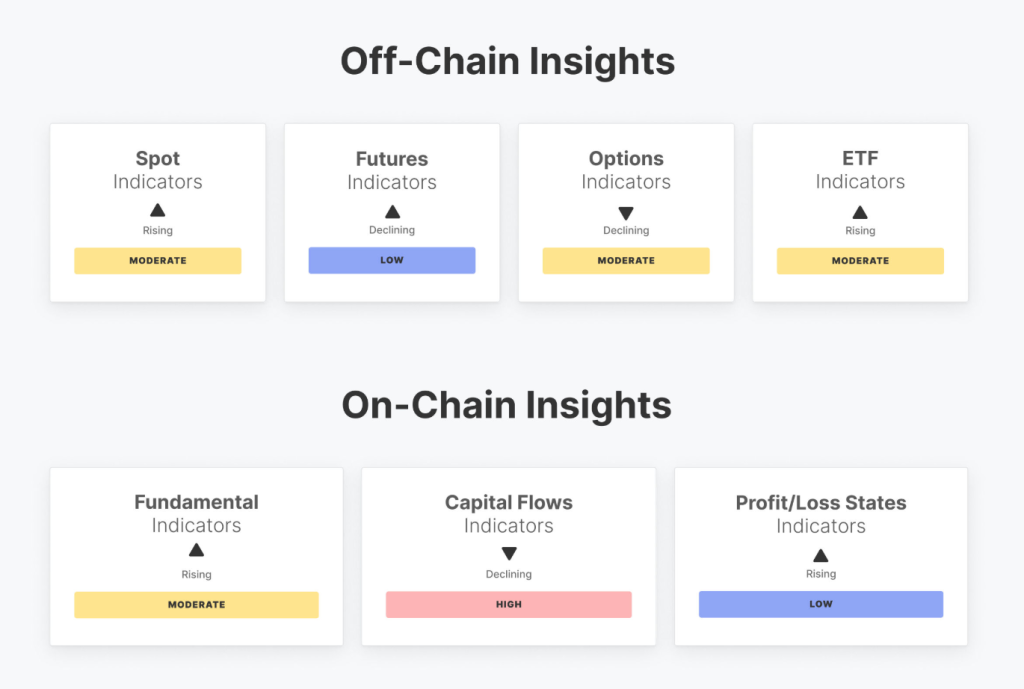
Glassnode data shows Bitcoin’s 14-day RSI climbing from 38.6 to 58.2, while spot volume increased 13.2% to $11.1 billion.

This suggests buyers remained active at the lows even as broader conviction remains uneven across on-chain, derivatives, and ETF metrics.

Bitcoin Over Altcoin - Glassnode off-chain and on-chain insights
Source: Glassnode Report

Year-end implied volatility remains elevated, with traders positioning for either $85,000 or $100,000 by December 26.

Options data reveals heightened caution, with the 25-delta skew reaching 12.88% and volatility spread turning sharply negative at -14.6%, indicating strong demand for downside protection despite the recent bounce.

Institutional Flows Turn Negative Amid Growing Caution

ETF flows have emerged as a major headwind, flipping from a $134.2 million inflow to a $707.3 million outflow.

The reversal indicates profit-taking or weakening institutional interest following Bitcoin’s recent volatility, which is adding pressure to near-term price action.

While ETF trade volume rose 21.33% to $22.6 billion and ETF MVRV increased to 1.67, the substantial outflows suggest some investors are taking advantage of elevated prices to reduce exposure.

Speaking with Cryptonews, Arthur Azizov, founder and investor at B2 Ventures, noted the impact of persistent withdrawals.

More than $2.7 billion has left BTC products over the past five weeks, and another $194 million left just in a single day,” he said.

When such a row of withdrawals persists, the whole market becomes quieter and gets less support.

However, MicroStrategy continues its aggressive accumulation strategy, recently purchasing 10,624 BTC for approximately $962.7 million at an average price of $90,615 per bitcoin.

Strategy has acquired 10,624 BTC for ~$962.7 million at ~$90,615 per bitcoin and has achieved BTC Yield of 24.7% YTD 2025. As of 12/7/2025, we hodl 660,624 $BTC acquired for ~$49.35 billion at ~$74,696 per bitcoin. $MSTR $STRC $STRK $STRF $STRD $STRE https://t.co/oyLwSuW7nW

— Michael Saylor (@saylor) December 8, 2025

The company now holds 660,624 BTC acquired for roughly $49.35 billion at an average cost of $74,696, with 2025 additions totaling $21.48 billion, just $500 million short of its entire 2024 accumulation.

Traders Prioritize Yield Capture Over Directional Bets

Futures open interest has declined to $30.6 billion, while perpetual funding rates have turned more supportive, with long-side payments rising to $522,700.

However, the compressed CME basis has driven growing interest in delta-neutral strategies in lower-cap assets, where carry opportunities remain attractive, confirming limited appetite for directional altcoin risk.

On-chain metrics show modest stabilization, with active addresses rising slightly to 693,035 and entity-adjusted transfer volume increasing 17.1% to $8.9 billion.

However, Realised Cap Change fell to just 0.7%, well below its low band, indicating softer capital inflows, while the STH-to-LTH ratio climbed to 18.5%, indicating continued dominance by short-term holders.

While speaking with Cryptonews, Ignacio Aguirre, CMO at Bitget, also warned of additional pressure from international monetary policy.

A stronger yen raises the risk of unwinding yen carry trades, which is a move that can temporarily weigh on crypto valuations as leveraged positions reset across global markets,” he said.

Azizov emphasized key resistance levels ahead. “Only a strong move above $100,000 could flip the script, restore confidence, and open the way toward $120,000+ level,” he said.

If that fails, a deeper pullback to the broad $82,000–$88,000 zone may be needed.

The post Crypto Traders Turn Cautious, Favor Bitcoin Over Risky Altcoin Bets appeared first on Cryptonews.

Hong Kong Targets Crypto Tax Evasion with 2028 Data Sharing Plan

9 December 2025 at 10:47

Hong Kong launched a public consultation on implementing the OECD’s Crypto-Asset Reporting Framework (CARF) and amended Common Reporting Standard (CRS), aiming to begin automatic exchange of crypto tax information with partner jurisdictions by 2028.

The government plans to complete legislative amendments in 2026, strengthening the city’s commitment to international tax cooperation while maintaining its reputation as a global financial hub amid evolving digital asset regulations.

Financial Services Secretary Christopher Hui announced “Hong Kong will make amendments to the Inland Revenue Ordinance (Cap. 112) (the Ordinance) for implementing CARF and the newly amended CRS” and demonstrated a commitment to combating cross-border tax evasion.

The automatic exchange will operate on a reciprocal basis with partners meeting data confidentiality and security standards, with the newly amended CRS implementation scheduled for 2029.

Hong Kong Crypto Tax and Data Sharing - Image of Christopher Hui
Secretary for Financial Services and the Treasury Christopher Hui. | Source: The Standard

Framework Responds to Rapid Digital Asset Growth

The OECD published CARF in 2023 following the rapid expansion of the digital asset market in recent years, providing automatic exchange of crypto transaction tax information similar to Hong Kong’s existing CRS framework, operational since 2018.

The new framework incorporated digital financial products and enhanced reporting requirements, addressing gaps in traditional financial account information exchange.

Hong Kong has been exchanging financial account information automatically with partner jurisdictions annually since 2018 under the CRS, enabling tax authorities to use the information for assessments and to detect tax evasion.

The CARF extension builds upon this established infrastructure, applying similar transparency standards to crypto assets that process billions in trading volume across the city’s licensed exchanges.

The government proposes mandatory registration for financial institutions to enhance identification, alongside increased penalties and enhanced enforcement mechanisms.

These measures respond to the OECD’s second-round peer review of Hong Kong’s CRS administrative framework effectiveness, which began in 2024 and examines the city’s commitment to global tax transparency standards.

Balancing Innovation and Compliance Pressures

The consultation arrives as Hong Kong navigates competing pressures between fostering digital asset innovation and satisfying international regulatory standards.

The city has pursued aggressive fintech expansion through its new “Fintech 2030” strategy launched by the Hong Kong Monetary Authority, focusing on data, artificial intelligence, resilience, and tokenization under the DART framework.

Hong Kong has courted crypto activity through licensing regimes and spot crypto exchange-traded funds, seeking regulated venues for demand.

Securities and Futures Commission Chief Executive Julia Leung recently announced licensed crypto exchanges will soon connect with global order books, ending the city’s isolated trading model and enabling local platforms to tap broader liquidity.

✅ Hong Kong will allow licensed crypto exchanges to connect with global order books, ending its current isolated trading model.#HongKong #Cryptohttps://t.co/f8Lj9NKxoR

— Cryptonews.com (@cryptonews) November 3, 2025

Despite regulatory openness, authorities have drawn bright lines between market infrastructure and listed issuers relying on speculative token holdings.

The stock exchange questioned at least five companies seeking to pivot to crypto treasury models, while the SFC warned retail investors about risks tied to digital asset treasury strategies after observing substantial premiums above asset holdings.

Amidst all these, HashKey Holdings advanced toward becoming Hong Kong’s first listed crypto exchange, clearing the stock exchange’s listing hearing and preparing to raise at least $200 million through an initial public offering scheduled before year-end.

The company accounts for more than 75% of Hong Kong’s onshore digital asset trading volume and has recorded HK$1.3 trillion in cumulative spot-market transactions.

Mainland Tensions Shape Regional Strategy

The consultation also unfolds against mainland China’s renewed crypto crackdown, with the People’s Bank of China reasserting strict prohibitions on virtual asset trading in late November following signs of renewed speculation.

Beijing specifically flagged stablecoins as posing money laundering and fraud risks, convening a high-level meeting with 13 government agencies to coordinate enforcement.

🇨🇳 China reinforces crypto ban with renewed enforcement targeting stablecoins as Hong Kong stocks with digital asset exposure drop sharply following central bank warning.#China #Cryptohttps://t.co/XDtoyarpNo

— Cryptonews.com (@cryptonews) December 1, 2025

Hong Kong-listed crypto companies saw sharp losses following Beijing’s announcement, with Yunfeng Financial Group dropping over 10% and OSL Group losing more than 5%.

The mainland stance has complicated Hong Kong’s ambitions, particularly after Chinese regulators instructed major tech firms, including Ant Group and JD.com, to pause stablecoin issuance plans.

For now, regarding the consultation paper, public feedback is welcome through February 6, 2026, with submissions accepted by post or email to the Financial Services and Treasury Bureau.

The post Hong Kong Targets Crypto Tax Evasion with 2028 Data Sharing Plan appeared first on Cryptonews.
[LIVE] Bitcoin Price Alert: September and October JOLTS Data Drops Today — Will Job Openings Shift Fed Rate Decision?

9 December 2025 at 09:56

The Bureau of Labor Statistics releases both September and October JOLTS job openings data at 10:00 AM ET today, the final major employment report before the Federal Reserve’s rate decision tomorrow.

Bitcoin is trading around $92,000 as markets brace for the delayed data; both reports were postponed due to the government shutdown and are dropping simultaneously just hours before the Fed enters its December 9-10 FOMC meeting.

The last JOLTS report covered August and showed job openings holding steady, but traders are watching closely for any signs of a cooling labor market that could justify the Fed’s anticipated 25 basis-point rate cut.

Current market odds sit at 89% for a December cut, but today’s double data dump could shift those probabilities if openings show unexpected weakness or strength.

September and October JOLTS Data - Fed Rate Cut Odds
Source: CME FedWatch Tool

Job openings are a critical leading indicator for the Fed because they signal labor demand before it shows up in hiring or unemployment data.

After last Thursday’s shockingly strong jobless claims print (191K vs 219K expected—lowest since 2022), Fed Chair Powell faces conflicting signals. Robust initial claims suggest no labor market distress, but if JOLTS openings have declined sharply over September and October, it would support the case for preemptive easing.

The Fed has already ended quantitative tightening as of December 1, and September PCE data showed core inflation improving to 2.8% from 2.9%, creating a dovish backdrop despite recent employment strength.

Markets are essentially getting two months of data in one release, which could produce volatility if the trend shows clear acceleration or deceleration.

Bitcoin needs to hold support at $90,000-$92,000 heading into tomorrow’s 2:00 PM ET Fed decision and Powell’s 2:30 PM press conference. Resistance remains at $90,000, and the descending trendline that’s capped rallies since mid-November.

If JOLTS data shows job openings collapsing, it strengthens the rate cut case and could provide the catalyst Bitcoin needs to break above $98K.

Conversely, if openings remain elevated, it reinforces the “no landing” scenario where the economy stays strong, and the Fed pauses easing, potentially sending Bitcoin back toward the $88,000-$90,000 support zone that marked November’s low.

Double JOLTS Report: Final Employment Signal Before Fed Decision

The post [LIVE] Bitcoin Price Alert: September and October JOLTS Data Drops Today — Will Job Openings Shift Fed Rate Decision? appeared first on Cryptonews.
Privacy Coin Zcash Exposed – Half of All Transactions Now Tracked

9 December 2025 at 07:11

Blockchain intelligence firm Arkham announced on Tuesday that it has labeled over 53% of Zcash transactions, linking approximately $420 billion in volume to identifiable individuals and institutions, despite Zcash’s reputation as a privacy-focused cryptocurrency.

The platform’s new tracking capability covers both shielded and transparent transactions, with 48% of transaction inputs and outputs and 37% of total balances, roughly $2.5 billion, now attributed to specific entities.

ZCASH IS LIVE ON ARKHAM

Arkham has now labeled more than half of the privacy chain Zcash’s shielded and unshielded transactions. This accounts for $420B of volume tagged to known individuals and institutions.

Track $ZEC transactions, entities and balances on Arkham. Here’s what… pic.twitter.com/TOVJtr7kbl

— Arkham (@arkham) December 8, 2025

The disclosure sparked immediate controversy within the crypto community, with critics accusing Arkham of making misleading claims about its ability to track truly private transactions.

Zcash founder Zooko Wilcox clarified that the firm “didn’t actually deanonymize any ZEC that was held at rest in the shielded pool,” noting such tracking would be “impossible because the information just isn’t there.

Tracking Claims Draws Sharp Industry Backlash

Blockchain developers quickly challenged Arkham’s announcement, pointing out fundamental limitations in tracking shielded Zcash transactions.

Multiple industry figures noted that Arkham can only trace transparent-to-transparent, shielded-to-transparent, and transparent-to-shielded movements.

At the same time, fully shielded transactions remain cryptographically protected through zero-knowledge proofs that make deanonymization technically impossible.

Mert from Helius Labs called the announcement a “scummy clickbait title,” arguing Arkham deliberately included references to shielded transactions “for a few clicks” despite being unable to track them.

He added that “for a data org, that’s as scammy as it gets” and suggested the move prioritized “clicks over truth,” potentially damaging the firm’s credibility in blockchain analytics.

Saad El Kouari from AWB noted that the platform failed to identify major holders, including Grayscale, Electric Coin Company, and Shielded Labs, suggesting that its tracking capabilities remain limited to transparent wallet activity.

He emphasized that Arkham “can’t identify a single whale” and “0 individuals, not even very clear targets” like Wilcox himself, demonstrating the significant gaps in the firm’s surveillance reach.

Dynamic Fee Proposal Addresses Network Congestion

Beyond the privacy debate, Zcash developers advanced a separate initiative to overhaul the network’s fee structure.

Shielded Labs released a detailed blueprint Monday proposing a shift from static fees, originally 10,000 zatoshi, later reduced to 1,000, to a dynamic model based on median transaction activity across 50-block periods.

The proposal addresses recurring “sandblasting” spam episodes that previously clogged wallets and congested the chain under fixed-fee structures.

An earlier ZIP-317 proposal introduced action-based accounting, treating every transaction component as a uniform “action,” fixing abuse vectors while maintaining predictable, low fees that don’t adjust to network usage.

Developers emphasized that with ZEC’s recent price surge and increasing institutional interest, the current system has become unsustainable.

Some users have reported edge cases where shielding small transactions costs double-digit ZEC amounts.

The dynamic fee mechanism introduces a stateless design using “comparables” to establish standard fees while maintaining privacy protections.

Under network stress, a temporary priority lane at 10× the standard fee would allow users to compete for block space without requiring protocol redesign or risking the complexity of EIP-1559-style mechanisms that could compromise Zcash’s privacy constraints.

Institutional Adoption Drives Token Performance

ZEC surged nearly 5% today, trading above $400 and vastly outperforming the broader market.

Privacy Coin Zcash - Zcash Price Chart
Source: TradingView

Last month, Zcash received significant institutional validation. The Winklevoss twins’ treasury vehicle has acquired 200,000 ZEC since November, worth over $80 million, targeting eventual ownership of roughly 5% of the circulating supply.

Similarly, Reliance Global recently liquidated all other digital asset positions to focus exclusively on Zcash.

Grayscale also filed with regulators to convert its existing Zcash Trust into a spot ETF tracking the CoinDesk Price Index, potentially opening new access channels for institutional investors.

So far, the token’s share of supply held in shielded addresses has climbed to approximately 30% from an average of 10% in 2024, according to Grayscale Research.

Looking forward, as Carter Feldman, Founder and CEO of Psy Protocol, told Cryptonews, we are seeing a surge in demand for onchain privacy, and “not just at the base layer, but also with the emergence of next-generation blockchains designed for privacy-preserving smart contracts, like Psy, Miden, and Aztec.

The post Privacy Coin Zcash Exposed – Half of All Transactions Now Tracked appeared first on Cryptonews.
Polymarket Accused of Double-Counting its Trading Volume

9 December 2025 at 04:09

Paradigm co-founder Matt Huang has amplified research alleging that prediction market Polymarket may be inflating its reported trading volumes through a data aggregation error that causes double-counting across most third-party analytics platforms.

The findings, detailed by Paradigm research partner Storm Slivkoff, suggest the issue affects public datasets and dashboards that rely on Polymarket’s disclosed figures, potentially overstating the platform’s actual activity by approximately 100%.

The controversy emerged as Huang reshared Slivkoff’s analysis on X, sparking immediate pushback from Polymarket’s data team and criticism that Paradigm, an investor in rival platform Kalshi, was attempting to discredit a competitor through technical semantics.

Polymarket data bug: volumes are double-counted in most public data

Interesting find in diligence from @notnotstorm https://t.co/xuQ41JUVHf

— Matt Huang (@matthuang) December 8, 2025

Technical Root of Volume Dispute

Slivkoff’s investigation reveals that Polymarket’s smart contracts emit separate OrderFilled events for the maker and taker sides of each trade, resulting in redundant representations of identical transactions.

Most analytics dashboards compute volume by summing these events, effectively counting the same trade twice.

A simple transaction involving YES tokens sold for $4.13 generates two OrderFilled events for that amount, causing dashboards to report $8.26 in volume rather than the actual $4.13 traded.

The complexity stems from Polymarket’s unique market structure, which supports eight distinct trade types, including conventional swaps and split-merge operations in which participants exchange USDC for opposing YES-NO positions.

While no individual event contains incorrect information, aggregating all OrderFilled events without distinguishing between maker and taker representations results in systematic double-counting of notional volume and cash flow metrics.

The issue extends across both Polymarket’s CTF Exchange and NegRisk exchange contracts, which share identical event emission patterns.

Slivkoff’s analysis, which included building a transaction simulator and auditing contract code, demonstrates that proper measurement requires using one-sided metrics, either taker-side or maker-side volume, rather than summing redundant event streams.

Polymarket Double-Counting Trading Volume - Polymarket USDC Volume Metrics Chart
Source: Paradigm

When calculated correctly, Polymarket’s actual monthly volumes for October and November 2024 were approximately $1.25 billion each, roughly half the $2.5 billion figures displayed on most public dashboards before corrections.

Industry Response and Competitive Tensions

Polymarket’s Primo Data quickly disputed the characterization, insisting that the platform’s official site displays notional taker volume without double-counting, in line with industry standards used by Kalshi.

This post isn’t about Polymarket’s website, it’s about the common dashboards that people use for tracking Polymarket volume,” Slivkoff clarified, emphasizing the issue affects third-party analytics rather than Polymarket’s internal reporting.

This is not how prediction markets report volume, including your portfolio company Kalshi.

To be clear:

1. Our site does not double count volume. We show notional taker volume (same as Kalshi).

2. The primary dashboards that show both Polymarket & Kalshi show notional volume… pic.twitter.com/9Bu0zm0DS0

— Primo Data (@primo_data) December 8, 2025

Major data providers, including DefiLlama, Allium Labs, and Blockworks, confirmed they are updating their Polymarket dashboards to eliminate double-counting after validating Slivkoff’s findings.

Meanwhile, some analysts defended existing practices, with Dragonfly data head Hildobby claiming sophisticated dashboards accounted for the distinction since 2024, though acknowledging the methodology remained undocumented until now.

The timing drew scrutiny, given Paradigm’s investment in Kalshi, Polymarket’s primary US competitor.

Will Sheehan of Parsec Finance criticized the research as reading “a bit like a hit piece when it’s just data being hard and Polymarket’s contracts being open/onchain,” while others questioned whether the disclosure of Paradigm’s competitive interest adequately addressed potential bias.

Storm defended the work as identifying honest mistakes resulting from data complexity rather than assigning blame, noting Polymarket itself bears no responsibility for how third parties interpret its event streams.

Beyond the immediate volume dispute, Nick Preszler of Melee Markets argued the controversy highlights broader measurement challenges in prediction markets, where low-priced contracts can generate disproportionate notional volume compared to actual capital at risk.

If a user buys $10 worth of contracts at .1c each, they are risking $10, but get credited for $10,000 of volume,” Preszler noted, advocating for alternative metrics like open interest and fee revenue to provide more accurate industry comparisons.

‼ Polymarket is building an internal trading desk to bet against customers as it relaunches in U.S. markets following CFTC regulatory clearance.#Polymarket #CFTChttps://t.co/mTAUebkNsV

— Cryptonews.com (@cryptonews) December 5, 2025

The debate comes as Polymarket prepares its full US relaunch following CFTC regulatory clearance and pursues a valuation of $12 billion to $15 billion.

Simultaneously, the company is facing criticism over plans to establish an internal market-making operation that would trade against customers, mirroring controversial practices already employed by Kalshi.

The post Polymarket Accused of Double-Counting its Trading Volume appeared first on Cryptonews.
Before yesterdayMain stream

Bitcoin Price Prediction: Bernstein Says 4-Year Cycle Is Broken as Institutions Drive an ‘Elongated Bull Market,’ Raises 2026 Target to $150K

8 December 2025 at 13:46

Bernstein, the global research and brokerage firm managing over $790 billion in assets, has declared the end of the traditional 4-year crypto cycle.

The firm’s latest Bitcoin price prediction sets a $150,000 target by 2026 in what analysts describe as an “elongated bull market.”

End of 4-Year Cycle and Fed Policy Could Ignite a Major Rally

According to Matthew Sigel, Head of Digital Asset Research at VanEck, Bernstein stated that following the recent market correction, “we believe the Bitcoin cycle has broken the 4-year pattern and is now in an elongated bull-cycle with more sticky institutional buying offsetting any retail panic selling.”

Bernstein: "In view of recent market correction, we believe, the Bitcoin cycle has broken the 4-year pattern (cycle peaking every 4 years) and is now in an elongated bull-cycle with more sticky institutional buying offsetting any retail panic selling.
Despite a ~30% Bitcoin…

— matthew sigel, recovering CFA (@matthew_sigel) December 8, 2025

Despite Bitcoin’s approximately 30% correction that began in early October, the asset manager observed only about 5% outflows via ETFs, a striking indicator of institutional conviction.

Bernstein expects Bitcoin to resume its bull run soon with a 2026 target of $150,000 and a potential cycle peak in 2027 at $200,000.

“Our long-term 2033 Bitcoin price target remains approximately $1,000,000,” Bernstein added.

Analysts at the London Crypto Club suggest a liquidity boost from the Fed on Wednesday may serve as a powerful catalyst, potentially driving the world’s largest cryptocurrency “sharply higher.”

In their latest analysis, Cryptonews revealed that David Brickell and Chris Mills present that the central bank is positioned to deliver a “dovish surprise”.

“We’re moving into a continued rate-cutting cycle accompanied by balance sheet expansion as the Fed effectively turns on the money printers to monetize the deficit,” they wrote.

“That’s a powerful, structural tide to be swimming against in the new year.”

Bitcoin Price Prediction: Technical Structure Remains Bullish Above $78K

The weekly chart shows Bitcoin holding above the critical $78,000 support level, which separates a deeper bear-market breakdown from the continuation of the macro uptrend.

Price recently dipped sharply but has stabilized near the 20-week SMA, while the 50-week SMA continues to slope upward, indicating that the long-term trend remains intact despite the correction.

Bitcoin Price Prediction - Bitcoin Price Chart
Source: TradingView

RSI momentum has cooled significantly to the mid-40s, reflecting a reset from overbought conditions without reaching the extreme oversold levels seen at major cycle bottoms.

As long as Bitcoin maintains the $78,000 region, the structure suggests consolidation within a larger bull cycle.

Recovery above $102,000 would demonstrate renewed strength, while clearing the $108,000 resistance zone would confirm extension into new highs.

Pepenode Presale Capitalizes on Meme Coin Momentum

If Bitcoin returns to bullish territory and breaks the 4-year cycle as Bernstein projects, meme coins like Pepenode (PEPENODE) could experience explosive rallies.

This gamified mine-to-earn meme coin presale on Ethereum has already raised over $2.3million despite challenging market conditions.

Pepenode offers virtual mining nodes and facility upgrades through a browser-based game requiring no hardware.

Bitcoin Price Prediction - pepenode Banner

The project is capturing the community-driven momentum that propelled PEPE to over 1,000x gains during the 2023-24 run.

As adoption of the platform grows, interest in the PEPENODE token is expected to skyrocket.

To secure Pepenode at the current presale price of $0.0011873, head over to the official Pepenode website and connect an Ethereum-compatible wallet such as Best Wallet.

You can complete your purchase in seconds by swapping ETH, BNB, USDT, or simply using a credit or debit card.

Visit the Official Pepenode Website Here

The post Bitcoin Price Prediction: Bernstein Says 4-Year Cycle Is Broken as Institutions Drive an ‘Elongated Bull Market,’ Raises 2026 Target to $150K appeared first on Cryptonews.

Bitcoin Price Prediction: Billionaire Michael Saylor Just Purchased More BTC – Does He Know Something?

8 December 2025 at 13:07

Michael Saylor’s company, Strategy, has just confirmed the purchase of 10,624 BTC for approximately $962.7 million at an average price of $90,615 per coin.

Strategy has acquired 10,624 BTC for ~$962.7 million at ~$90,615 per bitcoin and has achieved BTC Yield of 24.7% YTD 2025. As of 12/7/2025, we hodl 660,624 $BTC acquired for ~$49.35 billion at ~$74,696 per bitcoin. $MSTR $STRC $STRK $STRF $STRD $STRE https://t.co/oyLwSuW7nW

— Michael Saylor (@saylor) December 8, 2025

This brings Strategy’s total holdings to 660,624 BTC, acquired for $49.35 billion at an average price of $74,696.

With a 24.7% Bitcoin yield so far in 2025, this latest move could signal renewed institutional conviction in BTC and may be pivotal for Bitcoin price prediction outlooks going into 2026.

This announcement may once again hint that the smart money is preparing for the next leg up.

Michael Saylor Pitches Bitcoin to 100+ Investors

Saylor recently shared at the ongoing Bitcoin MENA Conference in Dubai that he’s been meeting with sovereign wealth funds and over 100 different investors, including hedge funds, banks, and their owners, who all want Bitcoin exposure.

🚨 JUST IN: MICHAEL SAYLOR SAYS HE’S BEEN MEETING WITH SOVEREIGN WEALTH FUNDS, BANKS, AND FUND MANAGERS TO DISCUSS BITCOIN. pic.twitter.com/mjRZOkibO1

— Coinwaft (@coinwaft) December 8, 2025

UAE National Security’s Mohammed Al Shamsi declared that “Bitcoin has become the key pillar in the future of financing.”

With Bitcoin up 3.26% in the last 24 hours to reclaim the $92,000 mark, traders are now going long, flipping their bias from the previous bearish stance.

Over the past two hours, the Lookonchain tracker revealed that a whale with over $9.6 million in total profits opened a $32 million long position on Bitcoin.

However, analyst Ted Pillows believes that with the Fed rate cut decision coming between tomorrow and Wednesday, the BTC CME gap between $89,400 and $89,800 would likely be filled before any significant move into six-figure territory.

Bitcoin Price Prediction: Technical Analysis Points to $85k CME Gap Fill

The 4-hour chart shows Bitcoin trading just below the key $94,000 resistance, which remains the critical level the market must reclaim to confirm a clean bullish reversal.

Price is currently hovering around the 9-period SMA, suggesting short-term momentum is stabilizing after the recent pullback.

The RSI sits near 60 with multiple bullish divergence signals earlier in the structure, indicating underlying buyer strength remains present.

Bitcoin Price Prediction - Bitcoin Price Chart
Source: TradingView

A notable feature is the CME gap around $85,000, which has yet to be filled.

If price retests the $85,000–$86,000 zone and holds it as support, the structure favors a continuation rally back toward $94,000.

A breakout above that resistance would likely open the door to the first upside target around $101,000, with continued momentum potentially extending the rally toward $106,000.

Maxi Doge Presale Surpasses $4.3M as Hype Builds for the Next Big Meme Coin

With bullish momentum brewing across the market, investors are rushing to secure early exposure to high-upside tokens and Maxi Doge ($MAXI) is quickly becoming a crowd favorite.

Tapping into the same degen-fueled energy that helped Dogecoin explode in 2021, Maxi Doge has already raised over $4.3 million from early backers since launching in July.

Inside the Maxi Doge community, members share early trading setups, alpha leaks, and access opportunities that most only find too late.

Bitcoin Price Prediction - Maxi doge banner

The project also reinvests up to 25% of presale funds into high-potential plays, using the profits to promote $MAXI even further.

Early buyers can currently lock in the presale price of $0.000272 and access 72% APY staking rewards but prices are set to increase soon.

To join before the next price tier, visit the official Maxi Doge website and connect a compatible wallet, such as Best Wallet.

You can swap existing crypto or use a bank card to make your $MAXI purchase in seconds.

Visit the Official Maxi Doge Website Here

The post Bitcoin Price Prediction: Billionaire Michael Saylor Just Purchased More BTC – Does He Know Something? appeared first on Cryptonews.

CoinShares Outlook: Tokenization and Real Revenue Define Crypto’s Next Phase

8 December 2025 at 11:34

CoinShares has released its 2026 outlook titled “The Year Utility Wins,” positioning next year as the moment when digital assets transition from speculation to practical adoption.

The report introduces Hybrid Finance as the central framework where traditional financial institutions and blockchain infrastructure converge into a unified system serving real economic purposes.

CoinShares Outlook - CoinShares Hybrid Finance
Source: CoinShares Report

Bitcoin reached all-time highs in 2025 while becoming more deeply embedded in institutional frameworks.

Stablecoins evolved into genuine settlement infrastructure, tokenization scaled beyond experimental pilots, and blockchain applications began generating consistent revenues.

The report emphasizes that “crypto is entering a value-accrual era” as platforms distribute earnings to token holders through systematic buybacks.

CoinShares Analyst Predicts Bitcoin to $170K

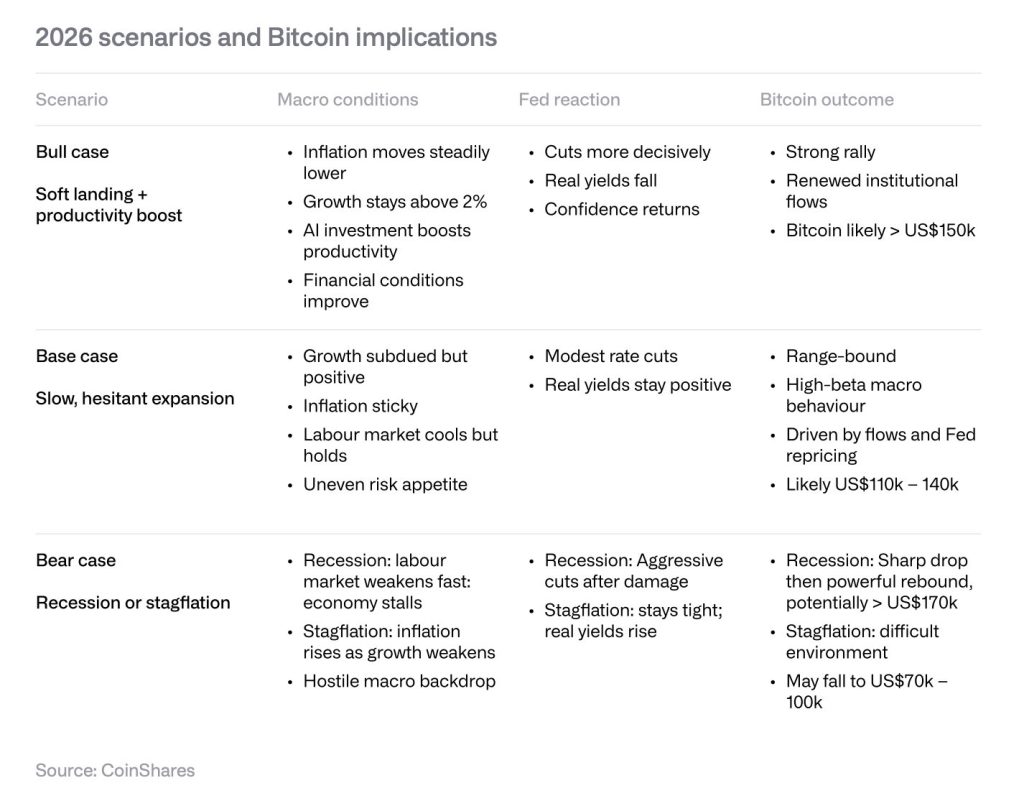
CoinShares projects three distinct scenarios for Bitcoin in 2026. The optimistic case, driven by productivity gains and steady disinflation, could push Bitcoin beyond $150,000.

The base case anticipates a trading range of $110,000 to $140,000, driven by ETF flows and expectations for the Federal Reserve.

The bear case splits between recession, where aggressive monetary easing could support prices above $170,000, and stagflation, which might compress valuations toward $70,000 to $100,000.

CoinShares Outlook - Bitcoin Price Prediction
Source: CoinShares Report

The report notes that “the Fed feels fundamentally uncomfortable: wanting to ease, but constantly second-guessing how fragile the disinflation trend really is,” creating an environment demanding fundamental justification for asset appreciation.

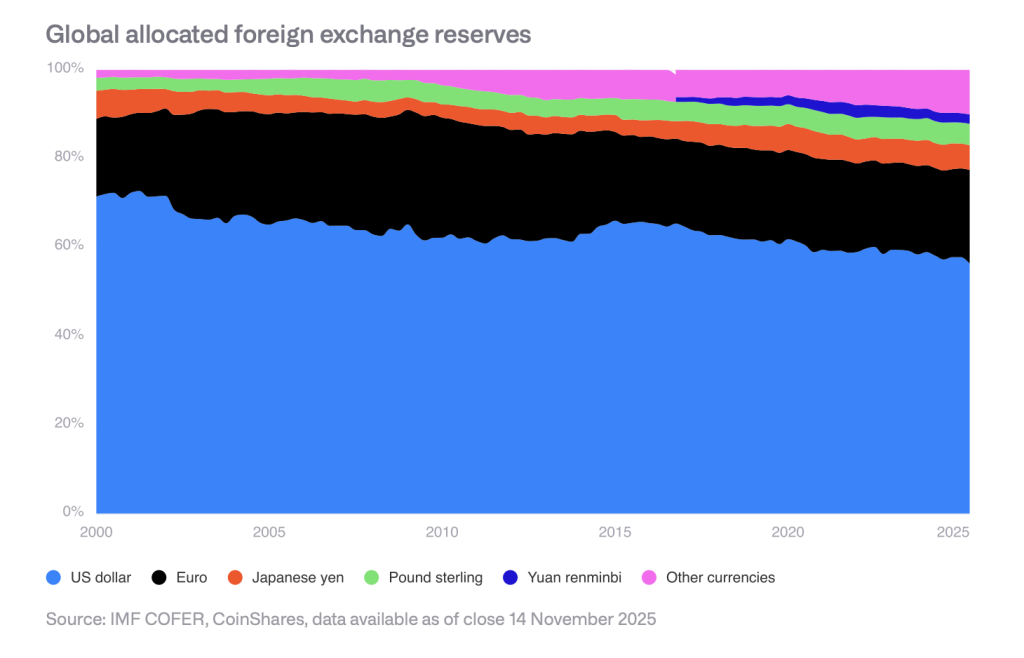
This backdrop reflects the erosion of dollar dominance, with the dollar’s global reserve share at mid-fifties, down from roughly 70% at the start of the millennium.

CoinShares Outlook - Foreign Assets Reserves
Source: CoinShares Report

Corporate Bitcoin Holdings Present Concentration Risks

Corporate Bitcoin holdings have grown substantially, with publicly-listed companies increasing from 44 in January 2024 to 190 by November 2025.

Total holdings nearly quadrupled from 265,709 BTC to 1,048,520 BTC, with total value increasing roughly ninefold from $11.7 billion to $90.7 billion.

Strategy (MSTR) dominates this landscape, accounting for 61% of publicly-listed firms’ Bitcoin holdings after growing its stack from 189,150 BTC to 650,000 BTC.

The company holds approximately $70 billion in assets against $8.2 billion in debt, having secured $13.9 billion through convertible bonds. The top 10 corporate holders control 84% of the supply, while the top 20 hold 91%.

Notably, CoinShares identifies two scenarios that could force Strategy to sell Bitcoin, as both Saylor and the CEO have confirmed they will sell.

😱 Strategy's business model is unraveling, and it may have to sell off some of its Bitcoin. What would happen if it did? #Bitcoin #MichaelSaylorhttps://t.co/d6Fa97NQVz

— Cryptonews.com (@cryptonews) December 3, 2025

The company carries $6.6 billion in perpetual preferred stocks and $3.2 billion in interest-bearing debt, with annual cash flows totaling nearly $680 million.

As the modified net asset value approaches parity, new shares lose appeal, while refinancing risk looms with the nearest debt maturity in September 2028.

The report warns that eroding financing power could trigger a vicious cycle in which plunging prices force Bitcoin sales to cover obligations.

While CoinShares does not expect this to unfold in 2026, hundreds of thousands of coins could eventually flood the market.

Institutional Adoption Advances Through Multiple Channels

Two years after the US spot Bitcoin ETF approval in 2024, these products have attracted more than $90 billion in assets.

CoinShares anticipates the four major US wirehouses will formally enable discretionary Bitcoin ETF allocations in 2026, with at least one major 401(k) provider incorporating cryptocurrency options.

The report projects 13F filers will collectively hold over one-third of spot Bitcoin ETF assets by year-end 2026.

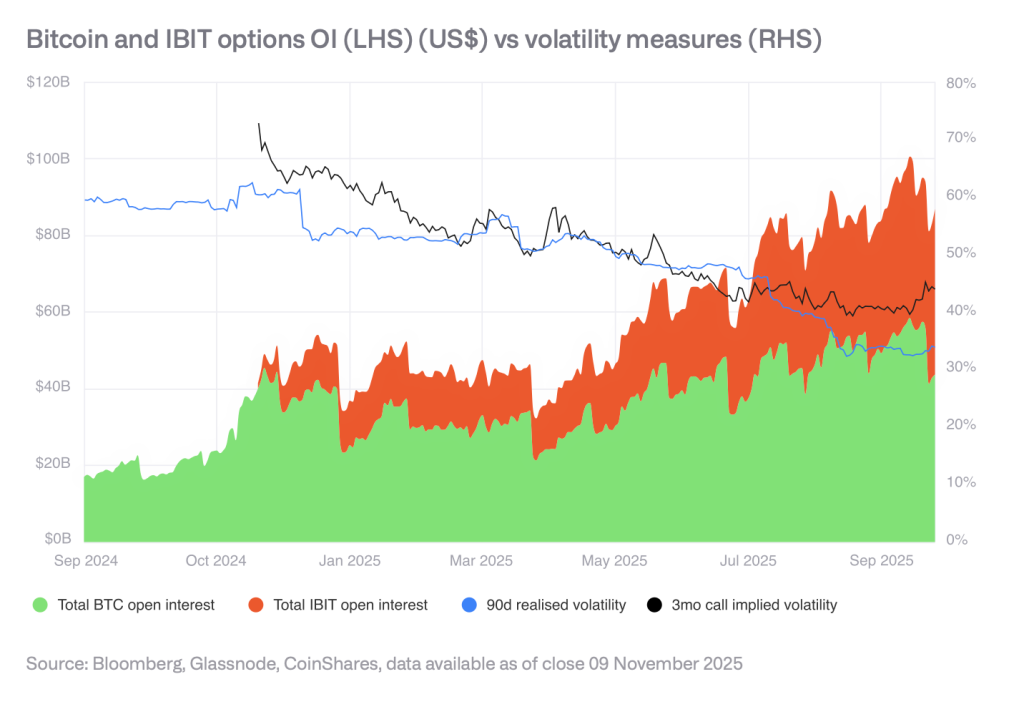
Options market development continues to reduce volatility as open interest expands.

CoinShares Outlook - Bitcoin and IBIT Options
Source: CoinShares Report

Measurements over 30 days showed instances in 2025 when Bitcoin volatility fell below that of traditional assets, marking a significant shift from historical patterns.

Stablecoin and Tokenization Growth Accelerates

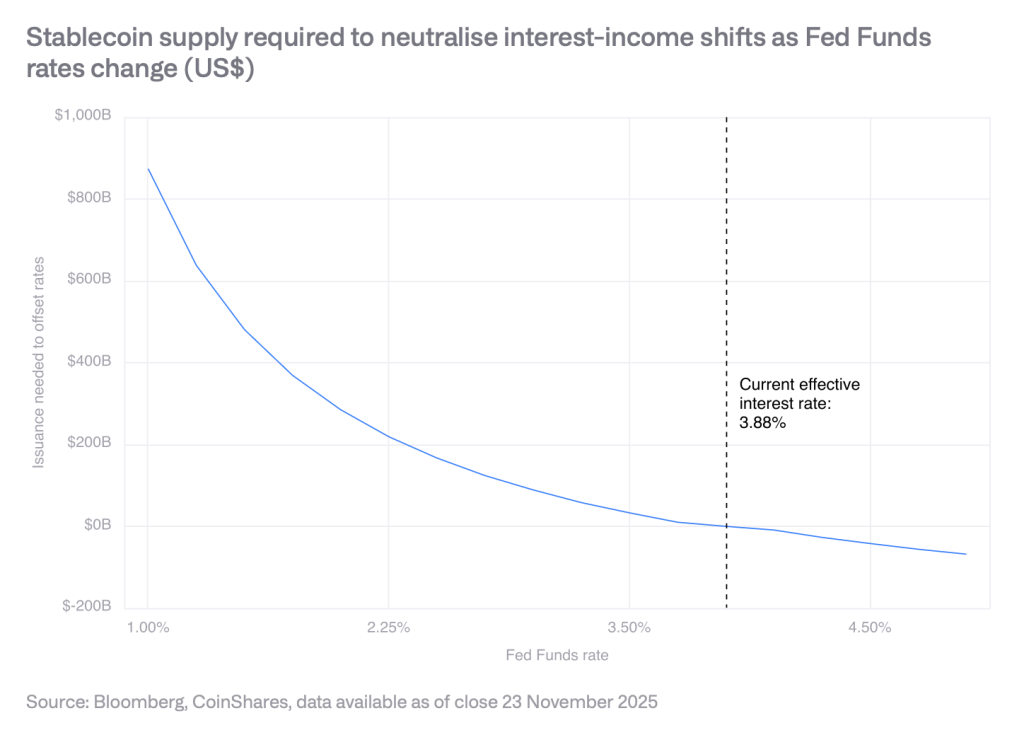
The stablecoin sector has reached $300 billion, with USDT commanding $185 billion and USDC holding $75 billion. Decentralized exchange volumes exceed $600 billion monthly.

However, CoinShares notes that if rates decline to 3% by year-end 2026, stablecoin supply would need to grow by $88.7 billion to maintain current interest revenue for issuers, though Treasury Secretary Scott Bessent projects market expansion to $3 trillion by 2030.

CoinShares Outlook - Stablecoin Supply Neutralise
Source: CoinShares Report

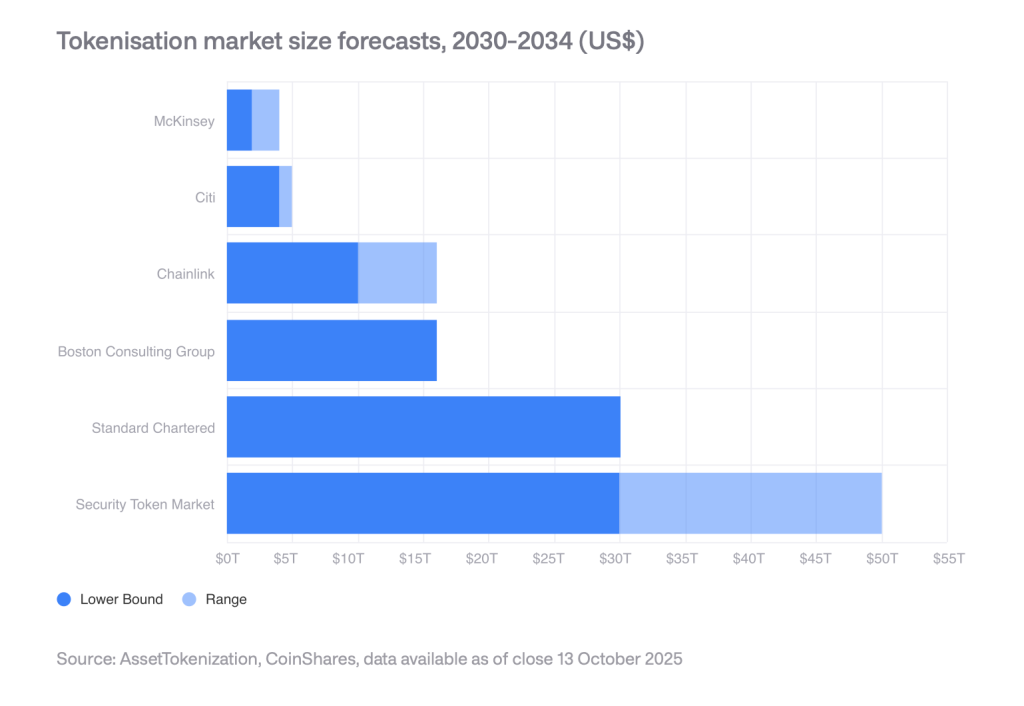
The tokenized asset market doubled during 2025, expanding from $15 billion to over $35 billion. Private credit grew from $9.85 billion to $18.58 billion, while tokenized Treasuries increased from $3.91 billion to $8.68 billion.

CoinShares highlights institutional deployment through BlackRock’s expansion of its BUIDL fund and JPMorgan’s tokenized deposit launch on Base.

CoinShares Outlook - Tokenisation Market Size
Source: CoinShares Report

Currently, industry forecasts project the market reaching several trillion dollars by 2030, with estimates approaching 30 trillion through 2034.

CoinShares concludes that “2026 looks like a year where the industry’s centre of gravity moves from narrative to utility, cash flow, and integration.

The post CoinShares Outlook: Tokenization and Real Revenue Define Crypto’s Next Phase appeared first on Cryptonews.

Harvard Bets Big on Bitcoin With $443M Stake, Outpacing Gold 2-to-1

8 December 2025 at 05:48

Harvard University expanded its Bitcoin ETF holdings by 257% in the third quarter, making the iShares Bitcoin Trust its largest disclosed position with $442.8 million as of September 30.

According to Matt Hougan, Bitwise CIO, Harvard simultaneously increased its gold ETF holdings by 99% to $235 million, allocating to Bitcoin at a 2-to-1 ratio relative to gold.

Harvard ramped its bitcoin investment in Q3 from $117m ot $443m. It also boosted its gold ETF allocation from $102m to $235m.

Think about that for a second: Harvard decided to put on a debasement trade and it allocated to bitcoin 2-to-1 over gold.

— Matt Hougan (@Matt_Hougan) December 8, 2025

The $443 million position represents approximately 0.75% of Harvard’s $57 billion endowment, ranking the institution among the top 20 largest holders of the BlackRock-managed fund.

Timing Proves Problematic as Bitcoin Tumbles

Harvard’s aggressive Bitcoin accumulation came right before a sharp market correction that has erased substantial value from its cryptocurrency holdings.

Bitcoin has dropped more than 20% since the third quarter ended, falling from $114,000 to around $92,000.

Harvard Bitcoin - Bitcoin Chart
Source: TradingView

The timing suggests Harvard could face a 14% loss on its third-quarter purchases in the best-case scenario, assuming shares were bought at July’s low point, which represents an $89 million paper loss on the recent position alone.

While the losses remain a fraction of Harvard’s massive endowment, the university’s annualized returns have lagged behind some Ivy League peers over the past decade, according to WSJ.

Harvard posted an 8.2% return ranking ninth out of 10 elite schools in a Markov Processes International comparison. For the year ending June 30, Harvard reported an 11.9% gain but trailed MIT’s 14.8% and Stanford’s 14.3%.

Stanford finance professor Joshua Rauh explained in an interview with The Harvard Crimson that “investors often seem to view both bitcoin and gold as hedges against a collapse of the international monetary system in general, and against a loss of the US dollar in particular.

However, he cautioned that “the extent to which either actually protects investors from these forces is uncertain and scenario-dependent.

Academic Skepticism Meets Institutional Validation

Harvard’s substantial Bitcoin allocation stands in stark contrast to earlier predictions from its own economics faculty.

Kenneth Rogoff, a Harvard professor and former IMF chief economist, stated in 2018 that Bitcoin would more likely trade at $100 than $100,000 within a decade.

I think bitcoin will be worth a tiny fraction of what it is now if we’re headed out 10 years from now,” Rogoff told CNBC, arguing that removing money laundering and tax evasion would leave Bitcoin with “very small” transaction uses.

Rogoff recently acknowledged his misjudgment in his new bookOur Dollar, Your Problem,” writing, “I was far too optimistic about the US coming to its senses about sensible cryptocurrency regulation.”

👨‍🏫 Harvard economist @krogoff admits his $100 Bitcoin crash prediction was wrong as $BTC trades above $115,000.#Bitcoin #Harvardhttps://t.co/AX8l7Aitxz

— Cryptonews.com (@cryptonews) August 20, 2025

He added that he “did not anticipate a situation where regulators, and especially the regulator in chief, would be able to brazenly hold hundreds of millions (if not billions) of dollars in cryptocurrencies seemingly without consequence given the blatant conflict of interest.

Despite growing institutional adoption, criticism of Harvard’s Bitcoin investment has intensified.

MarketWatch columnist Brett Arends called the investment an “environmental catastrophe,” noting that Bitcoin’s global computing network uses more energy than Thailand or Poland annually.

Meanwhile, Stanford professor Darrell Duffie also expressed surprise at the investment, stating, “Bitcoin does not pay dividends and has limited uses as a payment instrument.

Bitcoin’s Path Forward Remains Uncertain

Bitcoin is struggling to find direction amid ETF outflows and weakening market sentiment, creating uncertainty about whether it can reclaim the $100,000 threshold.

More than $2.7 billion has left Bitcoin ETF products over the past five weeks.

Speaking with Cryptonews, Arthur Azizov, Founder and Investor at B2 Ventures, described the current situation as “a market that has lost its anchor at the exact moment it needed stability.

He noted a disconnect with traditional markets, pointing out that “the S&P 500 is up more than 16% this year, while Bitcoin is down about 3%.

Azizov identified key resistance levels ahead, explaining that “a large share of Bitcoin is currently held at a loss, so each move toward $96,000–$100,000 meets selling from holders who want to exit at break-even.

He added that approximately $3.35 billion in Bitcoin options expire around a $91,000 area of interest, making traders cautious.

Only a strong move above $100,000 could flip the script, restore confidence, and open the way toward $120,000+ level,” Azizov stated.

If that fails, a deeper pullback to the broad $82,000–$88,000 zone may be needed to attempt to break the $100k ceiling once again.

The post Harvard Bets Big on Bitcoin With $443M Stake, Outpacing Gold 2-to-1 appeared first on Cryptonews.

Ethereum’s First ZK-Rollup ZKsync Lite to Shut Down in 2026

8 December 2025 at 04:56

ZKsync has announced plans to deprecate ZKsync Lite, Ethereum’s first zero-knowledge rollup, in 2026 as the protocol shifts its focus entirely toward the ZKsync network and ZK Stack-powered chains.

The original Layer 2 solution, which launched in December 2020 as a groundbreaking proof-of-concept, will undergo an orderly sunset after serving its purpose of validating critical ideas for production ZK systems.

No immediate action is required from users, as ZKsync Lite continues to operate normally, with funds remaining secure and withdrawals to Ethereum’s Layer 1 functioning throughout the deprecation process.

The ZKsync Association will share detailed migration guidance, specific dates, and a comprehensive deprecation plan in the coming year.

📌In 2026, we plan to deprecate ZKsync Lite (aka ZKsync 1.0), the original ZK-rollup we launched on Ethereum.

This is a planned, orderly sunset for a system that has served its purpose and does not affect any other ZKsync systems.

— ZKsync (@zksync) December 7, 2025

From Pioneer to Legacy System

ZKsync Lite emerged as the first zero-knowledge rollup on Ethereum, pioneering technology that would later evolve into ZKsync Era and the Elastic Network.

The protocol addressed Ethereum’s fundamental challenges of high transaction fees and slow transaction processing by executing transactions off-chain and submitting cryptographic proofs of validity back to Layer 1.

The project gained significant momentum in November 2025 when Ethereum co-founder Vitalik Buterin publicly endorsed ZKsync following its Atlas upgrade, describing the work as “underrated and valuable.

ZKsync has been doing a lot of underrated and valuable work in the ethereum ecosystem. Excited to see this come from them! https://t.co/coZKCfsb8h

— vitalik.eth (@VitalikButerin) November 1, 2025

His backing catalyzed institutional adoption, triggering a 50% surge in ZK token prices while positioning ZKsync as central to Ethereum’s “Lean Ethereum” scaling strategy.

ZKsync evolved from its initial Lite version to ZKsync Era in March 2023, becoming the first publicly available zkEVM.

The June 2024 ZKsync 3.0 upgrade transformed the ecosystem from a single Layer 2 into the Elastic Network, an interconnected system of autonomous ZK chains sharing liquidity and security through cryptographic proofs rather than traditional bridges.

Institutional Traction Validates ZK Technology

While ZKsync Lite phases out, the broader ZKsync ecosystem has attracted major institutional interest.

Deutsche Bank is developing an Ethereum Layer 2 blockchain using ZKsync technology as part of Project Dama 2, which involves 24 financial institutions testing the blockchain for asset tokenization under Singapore’s regulatory sandbox.

UBS also conducted a proof-of-concept for its Key4 Gold product using ZKsync Validium, testing the platform’s ability to support tokenized gold investments with privacy and scalability.

Tradable has also tokenized $2.1 billion in institutional-grade private credit on ZKsync, accounting for nearly 90% of the network’s market share for real-world asset protocols.

ZKsync Lite to Shut Down - Tradable Metrics Chart
Source: RWA[dot]xyz

The Ethereum Foundation launched “Ethereum for Institutions” in October 2024, providing enterprises with structured pathways to blockchain adoption using zero-knowledge proofs, fully homomorphic encryption, and trusted execution environments.

Projects like Chainlink, RAILGUN, and Aztec Network pioneer privacy-preserving smart contracts that secure counterparty information while maintaining transparency.

Security Incidents Test Platform Resilience

The deprecation announcement follows two significant security breaches in 2025 involving ZKsync’s protocols.

In April, an attacker exploited admin access to the airdrop distribution contract, minting 111 million unclaimed ZK tokens worth approximately $5 million during the protocol’s token distribution to ecosystem participants.

The hacker agreed to return 90% of the stolen assets in exchange for a 10% bounty, transferring nearly $5.7 million back to the ZKsync Security Council within the designated 72-hour safe harbor window.

The recovered amount exceeded the original stolen value due to token price increases, with ZK gaining 16.6% and ETH rising 8.8% following the incident.

🤝 The @TheZKNation has recovered $5 million worth of stolen tokens following a security breach on April 15.#ZKsync #Hackhttps://t.co/sb7iC0RqoR

— Cryptonews.com (@cryptonews) April 24, 2025

Just one month later, hackers compromised the official X accounts of ZKsync and Matter Labs, spreading false regulatory warnings claiming SEC investigations and Treasury Department sanctions.

The attackers also published phishing links promoting a fake ZK token airdrop designed to drain users’ wallets, causing the token price to drop approximately 5% despite a prior 38.5% weekly rally.

The breach occurred through compromised delegated accounts with limited posting privileges, which have since been disconnected.

These back-to-back incidents contributed to broader industry concerns, as crypto hacks resulted in $1.6 billion in losses during the first quarter of 2025 alone. The quarter was among the worst for crypto security breaches in history.

The post Ethereum’s First ZK-Rollup ZKsync Lite to Shut Down in 2026 appeared first on Cryptonews.

Coinbase Returns to India After 2-Year Pause, Fiat Access Coming 2026

8 December 2025 at 02:18

Coinbase has reopened registration in India following a two-year operational hiatus, marking the crypto giant’s return to the world’s second-largest internet market with plans to introduce fiat currency integration by 2026.

The exchange currently offers crypto-to-crypto trading while working toward full-service restoration, which will allow Indian customers to deposit rupees and purchase digital assets directly on the platform.

The San Francisco-based company first entered India in April 2022 but was forced to suspend operations within days after the National Payments Corporation refused to recognize its use of the Unified Payments Interface.

By September 2023, Coinbase had withdrawn entirely from India, requiring existing customers to liquidate their holdings and transfer funds elsewhere.

🚫 @coinbase suspended trading service in India “because of some informal pressure from the Reserve Bank of India”, said Coinbase CEO Brian Armstrong.

— Cryptonews.com (@cryptonews) May 11, 2022

Strategic Compliance Gamble Pays Off

Coinbase’s willingness to completely exit the market represented a significant commercial risk, John O’Loghlen, the exchange’s Asia-Pacific regional director, told TechCrunch.

Speaking at India Blockchain Week, O’Loghlen explained that forcing existing customers to close their accounts ran counter to typical business strategy but established a clean regulatory slate.

The company subsequently engaged with India’s Financial Intelligence Unit throughout 2024, securing approval for registration and launching early access in October before expanding to general availability.

🇮🇳 Global crypto exchange Coinbase has registered with India’s FIU—paving the way to resume trading and launch retail services later this year. #India #Coinbase https://t.co/fEEOzAC4aT

— Cryptonews.com (@cryptonews) March 11, 2025

The exchange now joins other global platforms like Binance, KuCoin, and Bybit in receiving Financial Intelligence Unit authorization.

These competitors faced similar regulatory obstacles after the government agency cracked down on offshore exchanges in January 2024 for violating anti-money laundering provisions, blocking their websites, and removing their applications from digital storefronts.

Most secured compliance approvals and paid substantial penalties to resume operations.

Coinbase has simultaneously deepened its financial commitment to the Indian market by investing additional capital in local exchange CoinDCX at a $2.45 billion valuation.

The American firm employs over 500 people nationwide. It continues hiring for positions serving both domestic and international operations, while chief legal officer Paul Grewal recently joined the U.S.-India Business Council board to strengthen bilateral commercial relationships.

Tax Structure Creates Operational Headwinds

India’s cryptocurrency taxation framework remains among the world’s most punitive, imposing a 30% levy on profits without allowing traders to offset losses against gains.

The government additionally deducts 1% from every transaction, discouraging frequent trading activity and pushing an estimated 90% of Indian crypto volume to offshore platforms.

When combined with mandatory surcharges and additional fees, the effective tax burden reaches 42.7% for high-income traders.

O’Loghlen acknowledged these fiscal barriers while expressing hope that authorities will eventually ease restrictions to make digital asset ownership less burdensome.

The Reserve Bank of India has consistently opposed cryptocurrencies, citing concerns about macroeconomic stability, financial system risks, and vulnerabilities to money laundering.

A recently disclosed government document revealed that Indian officials remain reluctant to implement comprehensive crypto legislation, fearing that formal recognition might encourage mainstream adoption and create systemic financial exposure.

🚨 India stalls full crypto framework due to systemic risk fears. Officials plan to maintain partial oversight with strict taxation rules. #Crypto #India #RBIhttps://t.co/hH14ySucmR

— Cryptonews.com (@cryptonews) September 10, 2025

Despite these regulatory headwinds, India consistently ranks among the top countries in global crypto adoption indices, with citizens holding approximately $4.5 billion in digital assets.

Tax authorities have recently intensified scrutiny, investigating over 400 high-net-worth individuals suspected of evading payment obligations through peer-to-peer transactions on platforms like Binance and demanding regional office reports by mid-October.

Building Trust Through User Experience

Coinbase aims to differentiate itself through security and accessibility, according to O’Loghlen, who emphasized the need for intuitive interfaces comparable to popular Indian consumer applications.

We want to be known as that trusted exchange, ensure that your funds are safe with us,” he stated.

We’re not going to get out to the masses if you can’t have a really nice UI, a trusted experience that allows you to onboard in a matter of minutes.

The company’s return coincides with India’s emergence as a major blockchain development hub, with its share of global Web3 developers growing substantially in recent years.

However, the operational environment remains complex, as government officials continue promoting the Reserve Bank’s digital rupee while heavily taxing private cryptocurrencies that lack sovereign backing.

The post Coinbase Returns to India After 2-Year Pause, Fiat Access Coming 2026 appeared first on Cryptonews.

Bitcoin Price Analysis: 92% Fed Rate Cut Probability Sparks Bitcoin Comeback Talk

7 December 2025 at 07:08

The FOMC meeting is scheduled for next Tuesday (December 9-10), and the market is almost unanimous on a dovish stance from the Fed.

Polymarket traders are pricing in a 92% probability of a 25-basis-point cut, which has shifted Bitcoin price analysis from a bearish breakdown to a potential comeback.

Powell Expected to Deliver 25bps Cut Despite Inflation Concerns

Federal Reserve Chair Jerome Powell is expected to proceed with another quarter-point rate reduction this week, even as several policymakers express concern about persistent inflation.

The Fed implemented its second consecutive cut in October, responding to unexpected weakness in the summer jobs data.

Following that decision, hawkish voices emerged among officials, including five current voting members, who indicated reluctance to support further easing in December.

The tide turned on November 21 when New York Fed President John Williams suggested conditions warranted a reduction in the “near term.”

Recent Bitcoin price analysis from Cryptonews highlights a critical on-chain metric gaining momentum.

Bitcoin “liveliness” is climbing again, a pattern that has historically coincided with bull market phases, suggesting the current cycle may have substantial upside remaining.

Analyst Michaël van de Poppe outlined a bullish scenario, anticipating short-term volatility before a sustained rally.

He expects pre-FOMC selling pressure today and Monday, potentially driving prices down to $87,000 to sweep liquidity at the lows.

This would be my bullish scenario.

Pre-FOMC and on Monday, correction to sweep the lows. Perhaps hitting $87K.

After that, bounce back up, swiftly, in which the uptrend is confirmed for #Bitcoin and it's ready to break $92K and therefore the run towards $100K in the coming 1-2… pic.twitter.com/lQezKkQM5W

— Michaël van de Poppe (@CryptoMichNL) December 7, 2025

“After that, bounce back up, swiftly, in which the uptrend is confirmed for Bitcoin and it’s ready to break $92,000

And therefore the run towards $100,000 in the coming 1-2 weeks as the Fed is reducing QT, doing rate cuts and expanding the money supply to increase the business cycle,” van de Poppe stated.

Bitcoin Price Analysis: Technical Setup Favors $94k Breakout

Technical analysis shows Bitcoin breaking out of a long descending red channel, signalling that the strongest phase of the downtrend has likely ended.

Price is currently hovering around the $89,000 zone, which sits just beneath a key resistance-turned-support area highlighted in orange.

Until BTC closes decisively above this zone, sellers can still create short-term pressure.

Bitcoin Price Analysis - Bitcoin Chart
Source: TradingView

The breakout attempt already shows early strength, as BTC bounced from the lower channel region near $79,000 and pushed back toward mid-trend.

The next major resistance level is around $94,600, and clearing it would confirm bullish continuation.

If that happens, the chart projects upside targets at $108,000 and eventually $116,000, which align with previous liquidity zones.

Maxi Doge Presale Capitalizes on Market Momentum

As Bitcoin positions for a potential comeback driven by Fed rate cuts, presale projects like Maxi Doge (MAXI) are attracting investor attention.

MAXI is capturing the grassroots momentum that drove Dogecoin’s extraordinary 161,000x rally.

The project has secured over $4.2 million in funding while building an active community focused on sharing trading strategies and market opportunities.

Bitcoin Price Analysis - Maxidoge Banner

Notably, 25% of capital raised will be invested in promising plays, with returns recycled into marketing initiatives and community rewards to accelerate growth.

Investors can join the presale at $0.000272 by visiting the official Maxi Doge website.

Then connect an Ethereum-compatible wallet like Best Wallet, and purchase MAXI with ETH, BNB, or USDT.

Bank card payments are also supported for instant access.

The post Bitcoin Price Analysis: 92% Fed Rate Cut Probability Sparks Bitcoin Comeback Talk appeared first on Cryptonews.

Korea to Treat Crypto Exchanges Like Banks After Upbit Hack

7 December 2025 at 05:23

South Korea is moving to impose bank-level liability standards on crypto exchanges following a $30.1 million hack at Upbit last month, shifting toward treating major platforms with the same regulatory rigor as traditional financial institutions.

According to The Korea Times, the Financial Services Commission is reviewing provisions that would require crypto exchanges to compensate users for losses caused by hacking or system failures, regardless of fault, mirroring rules currently applied only to banks and electronic payment firms under the country’s electronic financial transactions law.

The push follows a Nov. 27 breach at Upbit that saw over 104 billion Solana-based tokens worth 44.5 billion won ($36M) transferred to external wallets in just 54 minutes.

Despite the incident, the exchange faced minimal penalties since regulators cannot order compensation under existing laws.

🚨 South Korea’s largest crypto exchange Upbit @Official_Upbit reported a $36m Solana network hack on Thursday, halting withdrawals on the spot and pledging to fully reimburse affected customers.

The incident comes on the same date as its 2019 breach l…https://t.co/o0VLiqKin7

— Cryptonews.com (@cryptonews) November 27, 2025

Mounting System Failures Drive Regulatory Overhaul

The planned reforms come amid a pattern of platform instability across Korea’s crypto sector.

Financial Supervisory Service data shows the five major exchanges, Upbit, Bithumb, Coinone, Korbit, and Gopax, recorded 20 system failures between 2023 and September this year, affecting over 900 users with combined losses of 5 billion won.

Upbit alone accounted for six incidents, with more than 600 victims suffering 3 billion won in damages.

Draft legislation is expected to mandate IT security infrastructure plans, upgraded system standards, and significantly stronger penalties.

Lawmakers are considering revisions that would allow fines of up to 3 percent of annual revenue for hacking incidents, matching standards for traditional financial institutions and replacing the current 5 billion won cap.

The shift would fundamentally reshape accountability in Korea’s crypto industry by making exchanges liable to compensate victims, as banks must respond to security breaches or system failures.

The Upbit breach also exposed reporting failures, with the exchange waiting over six hours after detecting the hack at 5 a.m. to notify regulators at 10:58 a.m.

Ruling party lawmakers alleged that Dunamu deliberately delayed disclosure until after its scheduled merger with Naver Financial, which concluded at 10:50 a.m.

Broader Compliance Crackdown Intensifies Across Industry

The regulatory tightening extends beyond security requirements into comprehensive anti-money laundering enforcement.

Korea’s Financial Intelligence Unit is preparing sanctions against major exchanges following on-site inspections that examined compliance with Know Your Customer checks and suspicious transaction reporting.

The unit has already disciplined Dunamu with a three-month suspension on new customer activity and a 35.2 billion won fine, setting a precedent for penalties expected to reach hundreds of billions of won across the sector.

Authorities are simultaneously expanding the crypto travel rule to apply to transactions under 1 million won, closing a loophole that allowed users to evade identity checks by splitting transfers into smaller amounts.

We will crack down on crypto money laundering, expanding the Travel Rule to transactions under 1 million won,” Financial Services Commission Chairman Lee Eok-won said during a National Assembly briefing.

The Financial Intelligence Unit will gain pre-emptive account-freezing powers in serious cases, while new rules will bar individuals with convictions for tax crimes or drug offenses from becoming major shareholders in licensed platforms.

Legislative amendments are expected in the first half of 2026 as Korea aligns with global standards through expanded coordination with the Financial Action Task Force.

🇰🇷 South Korean crypto tax may face a fourth delay to 2027 as proposed amendments fail to address framework issues. #CryptoTax #SouthKoreahttps://t.co/L0vuIlvbSu

— Cryptonews.com (@cryptonews) November 18, 2025

The enforcement drive unfolds as Korea’s long-delayed crypto tax regime faces potential postponement beyond its January 2027 start date due to persistent infrastructure gaps, with no significant updates to the framework despite multiple deferrals since its 2020 approval.

Recently, lawmakers also set a December 10 deadline for the government to deliver a stablecoin regulatory framework, or face legislative action, with debates centering on whether banks should lead issuance or whether fintech firms should participate more actively.

Financial Supervisory Service Gov. Lee Chan-jin acknowledged the limits of current oversight despite the seriousness of the Upbit incident, stating that “regulatory oversight clearly has limits in imposing penalties” under existing law.

However, with the planned reforms, it aims to close these gaps as Korea positions itself to compete with major economies that have already formalized comprehensive digital asset frameworks.

The post Korea to Treat Crypto Exchanges Like Banks After Upbit Hack appeared first on Cryptonews.

❌
❌