Normal view

There are new articles available, click to refresh the page.
Yesterday — 5 December 2025Main stream

Binance Founder Crushes Bitcoin Critic In Game-Changing BTC Vs. Gold Debate

5 December 2025 at 17:00

The Binance Blockchain Week event in Dubai became the center of a high-stakes showdown between traditional and digital innovation, with Bitcoin and gold going head-to-head. Investors, tech enthusiasts, and financial experts watched closely as Binance founder Changpeng Zhao expertly debated renowned Bitcoin critic Peter Schiff, making a compelling argument for why Bitcoin is better than gold. 

Binance Founder Dominates Bitcoin And Gold Debate

During the Binance Blockchain Week in Dubai, Schiff and CZ faced off in a high-profile debate over the value of Bitcoin versus Gold. Schiff defended gold as a safe, stable, and tangible asset while the Binance founder made a compelling case for Bitcoin’s adoption, utility, value, and global reach. 

Throughout the debate, which lasted over an hour, CZ consistently demonstrated the practical advantages of Bitcoin, leaving Schiff’s gold argument largely on the defensive. The Binance founder emphasized Bitcoin’s transparent and predictable supply and its role in the modern financial systems. He pointed to hundreds of millions of users who rely on Bitcoin for payments, savings, and transfers. 

Schiff argued that Bitcoin lacks inherent value and is mainly driven by hype and faith that its price will rise. He stated that gold remains tangible, centuries old, scarce, and valuable in industry, making it superior to BTC. He further asserted that “nobody needs” Bitcoin and that the cryptocurrency is “backed by nothing.”

Practical demonstrations played a key role in the debate between Schiff and CZ. The Binance founder explained how Bitcoin and crypto payments already improve financial efficiency, especially in emerging markets. Schiff questioned whether these transactions truly count as money, since merchants ultimately receive traditional currency. CZ’s response highlighted the importance of adoption and network effects, noting that people who use BTC directly for payments give it real-world significance.

The debate also considered the preferences of younger generations. CZ asked Schiff whether millennials and Gen Z favoured Bitcoin or gold. The Bitcoin critic responded sharply, suggesting that they would choose gold. He pointed out that, with many young investors losing money on BTC, gold offers a safer, more appealing alternative. The Binance founder countered that younger people understand digital value more intuitively and prefer mobile, borderless, and censorship-resistant assets. 

Digital Value And The Future Of Money

The debate between CZ and Schiff also highlighted the changing definition of money. Bitcoin functions as a decentralized network that enables instant settlement and transparent verification. Its adoption has also helped evolve the financial economy, facilitating faster and more seamless cross-border payments. Schiff argued that gold’s scarcity and industrial demand preserve its value and make it a reliable hedge against economic uncertainty. 

Tokenization also became a point of agreement during the discussion, with Schiff emphasizing that gold can be digitized and tokenized for easier ownership and distribution without moving the physical metal. CZ contended that Bitcoin offers similar advantages while also enabling global financial inclusion. They also discussed the supply of both assets, with the Binance founder noting that Bitcoin has a visible supply, while gold doesn’t. 

They also talked about the performance of both assets over the years. Schiff argued that gold had outperformed BTC over the past four years. CZ contended that Bitcoin has far outpaced gold over the last 8 years, and since its launch in 2009, it has skyrocketed from a few cents to an ATH above $126,000. He concluded his debate, predicting that Bitcoin’s growth will outpace gold over time.


Bitcoin

100 Million TRX Leaves Binance — Justin Sun Behind The Move

5 December 2025 at 00:00

According to on-chain monitors, a wallet linked to TRON founder Justin Sun pulled 100 million TRX from Binance on December 3, 2025. Reports say the same address also moved $5 million USDT around the same time. These large transfers were flagged publicly by Onchain Lens and picked up by multiple crypto news outlets.

Transaction Values And Timing

Onchain tracking shows the 100 million TRX was worth close to $28 million at the time of the move. The USDT transfer of $5 million happened within a minute of the TRX withdrawal, which has led observers to call the action coordinated rather than routine.

Based on reports, the close timing and mixed asset types — token plus stablecoin — drew extra attention from traders and on-chain sleuths.

Data also shows the Justin Sun-linked wallet now holds a much larger TRX balance than just this single transfer. Tracking services report the address sits at about 492 million TRX, a holding with a notional value near $138 million based on market rates at the time. That swelling balance has prompted talk that accumulation of TRX has been steady in recent days.

A wallet linked to Justin Sun (@justinsuntron) withdrew 100M $TRX worth $27.96M from #Binance and also withdrew $5M $USDT.https://t.co/4d2utqwsv0 pic.twitter.com/k40pMUj15d

— Onchain Lens (@OnchainLens) December 3, 2025

Market Reaction And Liquidity

Initial market moves were muted. Some exchange data and commentaries noted a mild uptick in TRX price after the news, suggesting traders saw the outflow as removing sell pressure from exchange order books.

Analysts who track exchange liquidity say large withdrawals like this can shrink available sell-side supply and can support price stability if demand holds. Still, any clear price trend will depend on what happens next with the withdrawn tokens.

No Official Word Yet

There has been no public statement from Justin Sun or TRON explaining the transfers. Without confirmation, motives remain speculative. Observers are weighing a few common possibilities: long-term cold storage, staking or protocol use, or internal treasury moves. All of those ideas are possible, but none are confirmed by the team.

What Could Happen Next

If the tokens stay offline, some traders may view the move as bullish since it cuts the floating supply held on big exchanges. If the funds are later sold or used to provide liquidity, the effect could swing the other way.

Reports point out that similar moves by major holders have sometimes been followed by quiet accumulation and other times by large transfers into trading venues — timing and intent matter.

Featured image from Unsplash, chart from TradingView

Before yesterdayMain stream

Bitcoin Market Signals A Pivotal Turning Point – Here Are The Main Drivers Behind It

4 December 2025 at 14:00

Several key Bitcoin metrics are beginning to exhibit bullish action once again alongside the renewed upward traction in the asset’s price. With this kind of trend that points to growing momentum, the crypto king appears to be gearing up for a pivotal shift driven by newfound appetite from investors.

A Key Market Shift Unfolding For Bitcoin

Bitcoin has experienced a rebound as the crypto landscape turns bullish again, sending its price back above the $90,000 mark. Following the bounce on Wednesday, the BTC market appears to have reached a critical junction as it hints at an impending shift in the current trend.

Delving into the market performance, Darkfost, an author at CryptoQuant and market expert, has outlined the key driver behind the unfolding shift. In the research shared on the X platform, the expert revealed that the market today is heavily driven by derivatives. In addition to the derivatives-driven market, 2025 has been the most speculative year Bitcoin has ever seen in its existence.

Bitcoin

Another key driver highlighted by the market expert is the actions of investors in the United States and the renewed demand at the institutional level. Darkfost’s research hinges on a critical Bitcoin metric, one that shows the average evolution of the Coinbase Premium Gap in the monthly timeframe and the Spot Bitcoin Exchange-Traded Funds (ETFs) netflows.

Specifically, this metric is the Bitcoin ETF – Netflow USD Vs. Coinbase Premium. It is worth noting that the Coinbase Premium Gap calculates the pricing difference between Coinbase Pro and Binance. This helps illustrate the behavior of different groups of investors. While Coinbase Pro is typically used by institutions and whales, Binance, which has the largest volume, is available to everyone.

The Coinbase Premium Gap decreased from +$109 to -$40 since October 16, when Bitcoin was valued at almost $113,000. Such a drop suggests that institutional investors sharply decreased their positions. 

BTC ETFs Netflows Impact On The Market

Interestingly, the trend was also observed in ETF netflows, which also flipped negative. During the period, BTC fell from $113,000 to $80,000, reflecting how much the US and institutional demand influence the market

As seen in the past, large negative swings have frequently indicated market bottoms, provided that the trend thereafter begins to turn. A trend of this kind is what is playing out in the market today.

However, current data reveals that the Coinbase Premium Gap has bounced back to -$13 while the average ETF netflow is valued at around -$100 million. This comeback in both sectors indicates that in the near term, the situation seems to be improving, and BTC’s price is reacting appropriately to the crucial shift. 

As a result, Darkfost predicts that a new all-time high for BTC may happen quickly if this pattern continues in the long run. The ongoing shift may be subtle, but it is noticeable as the market appears to be preparing for a phase that might largely change the course of Bitcoin.

Bitcoin

CZ and Peter Schiff Face Off at Binance Blockchain Week 2025: Bitcoin or Tokenized Gold?

4 December 2025 at 11:01

Binance Blockchain Week 2025 delivered one of its most anticipated moments when Changpeng Zhao (CZ), founder of Binance and Giggle Academy, took the stage opposite Peter Schiff, senior economist and founder of Euro Pacific Asset Management and Schiff Gold.

We are LIVE now from the #BinanceBlockchainWeek Main Stage!

The much-anticipated big debate is kicking off, don’t miss a moment!

Watch it live 👉 https://t.co/4ED3HwmOj9 pic.twitter.com/BaC6S7QN58

— Binance (@binance) December 4, 2025

The debate tackled a defining question for the global financial environment: Is the future of sound money rooted in Bitcoin or will tokenized gold ultimately prevail? The atmosphere was charged with investors, developers, policymakers, and institutional delegates filling the main hall for what quickly became a clash of ideology, economics, and technology.

Schiff: Tokenized Gold Enhances What Already Works

Peter Schiff framed tokenized gold not as competition to Bitcoin but as the modernization of a centuries-tested store of value. “Tokenized gold improves all the monetary properties of gold while it remains a store of value. The token is simply the evidence that you own the gold in the vault.”

He argued that technology solves the core logistical weakness of gold—portability—without undermining its intrinsic qualities. “For money purposes, tokenized gold is better than physical gold. Ownership can change hands while the gold never leaves the vault.”

Schiff reminded the audience that gold’s value is anchored in utility, rarity, and historical trust. “What gives gold value is not that you can touch it, but that it has real utility as a metal. There are industries that need gold and things only gold can do.”

For Schiff, tokenization is evolutionary, not revolutionary—retaining the asset while removing friction.

CZ: Digital Value Needs No Physical Form

CZ countered with the argument that Bitcoin is native to the internet economy and benefits from being purely digital. “If I give you Bitcoin right now, we can verify it in several ways that you received it. It settles instantly and transparently on-chain.”

He positioned Bitcoin as more than a currency—it’s a global decentralized ecosystem. “Bitcoin is more than a transaction network. It is an entire industry with many use cases and a very large, global community behind it.”

CZ dismissed the notion that money requires physical backing to be credible, comparing Bitcoin’s value to that of tech platforms. “The internet is virtual. There is nothing physical about Google or X, but they clearly have value. Many virtual things have value; that value is not tied to physical properties.”

Two Philosophies, One Converging Future

The debate pointed out a broader shift: traditional assets are being digitized, while native digital assets continue to mature. Tokenized gold caters to those who value tangible backing and historical stability; Bitcoin speaks to a generation aligned with decentralization and borderless liquidity.

If Binance Blockchain Week made one thing clear, it’s that the future of money may not be defined by one asset—but by how well traditional and digital systems coexist, compete, and inevitably converge.

The post CZ and Peter Schiff Face Off at Binance Blockchain Week 2025: Bitcoin or Tokenized Gold? appeared first on Cryptonews.

Florida Court Revives $80M Binance Lawsuit Over Stolen Bitcoin Claims

4 December 2025 at 10:10

A Florida appeals court has reinstated a lawsuit accusing Binance of failing to freeze and recover roughly $80 million worth of stolen Bitcoin, reopening a case that had previously been dismissed over jurisdictional grounds.

According to Bloomberg Law, Florida’s Third District Court of Appeal ruled Wednesday that the lower court erred when it concluded it lacked personal jurisdiction over Binance Holdings Inc.

According to Bloomberg Law, Florida’s Third District Court of Appeal ruled Wednesday that a user who alleges roughly $80 million in BTC was stolen on Binance may revive a state-level lawsuit, finding the trial court erred in concluding it lacked personal jurisdiction over…

— Wu Blockchain (@WuBlockchain) December 4, 2025

The decision allows the plaintiff to proceed with a state-level lawsuit alleging that Binance failed to act quickly after the theft was reported.

Appeals Court Reverses Dismissal Saying Use of AWS Ties Binance to Florida

The case stems from a 2022 incident in which the plaintiff, identified as Michael Osterer, reported that about 1,000 Bitcoin was stolen from his wallet.

He claims the hackers transferred the funds to a Binance account, where the assets were converted and withdrawn before the exchange intervened.

Osterer alleges that Binance was negligent, breached its contractual duties, and enabled the laundering of stolen property by failing to freeze the assets promptly.

Osterer is seeking the full value of the stolen Bitcoin, estimated at roughly $80 million, along with interest. In 2023, he also attempted to expand the case into a class action on behalf of other victims whose stolen assets were allegedly routed through Binance.

A trial court initially dismissed the lawsuit after determining that Binance, which operates offshore, did not have sufficient connections to Florida to be sued in the state.

The appeals court overturned that finding, ruling that Binance’s U.S.-facing affiliates and its reliance on U.S. infrastructure were enough to establish jurisdiction.

The court specifically pointed to the exchange’s use of Amazon Web Services and its U.S. operational footprint as valid contacts with Florida.

The decision sends the case back to trial court, where Osterer will again be allowed to argue his claims under Florida state law.

The ruling adds to legal pressure on offshore crypto exchanges that have previously relied on jurisdictional defenses to block U.S. lawsuits involving stolen assets.

Binance may still seek to appeal the ruling or attempt to shift the dispute into arbitration, a strategy the company has pursued in other U.S. cases.

Even After Zhao’s Pardon, Binance Faces Fresh Legal Heat in the U.S.

The revived lawsuit comes as Binance continues to face sustained legal scrutiny in the United States. In November, the exchange and its founder, Changpeng Zhao, were named in a federal lawsuit filed by the families of victims of the October 2023 Hamas attack.

🔫 Families of the Hamas 2023 attack victims have sued Binance and CZ for facilitating $1 billion in crypto to the accounts of terror groups.#HamasCryptoFunding #Binance #ChangpengZhaohttps://t.co/lLG1d5D75l

— Cryptonews.com (@cryptonews) November 25, 2025

The plaintiffs accused Binance of knowingly facilitating crypto transactions tied to the militant group and helping move more than $1 billion through accounts linked to terrorist organizations.

Binance has denied the allegations and said it complies with international sanctions laws.

Earlier this year, Binance also sought to dismiss a separate class action brought by U.S. investors in California, arguing that an arbitration clause in its user agreement required private dispute resolution.

That case is tied to broader securities law claims alleging the exchange promoted unregistered crypto tokens and misled investors.

⚖ Binance is trying to dismiss a U.S. class action lawsuit, saying users agreed to arbitration—not court.#Binance #Securities #CryptoLawsuithttps://t.co/c8VGpdC7CI

— Cryptonews.com (@cryptonews) May 20, 2025

Binance’s legal disputes in the United States have already led to some of the largest settlements in crypto history. In November 2023, the exchange agreed to pay $4.3 billion to resolve charges brought by the DOJ over violations of the Bank Secrecy Act.

Also, CZ pleaded guilty to a related criminal offense and accepted a separate $150 million personal settlement. Binance also paid $2.7 billion to settle a civil case with the Commodity Futures Trading Commission.

In May 2025, the U.S. Securities and Exchange Commission dropped its civil enforcement lawsuit against Binance and Zhao, bringing an end to a legal battle that had lasted more than two years.

Months later, in October, President Donald Trump issued a pardon to Zhao, wiping away the criminal conviction tied to the Justice Department case.

The post Florida Court Revives $80M Binance Lawsuit Over Stolen Bitcoin Claims appeared first on Cryptonews.

Binance Bitcoin Stockpile Shrinks Amid Market Turmoil

4 December 2025 at 04:00

Bitcoin showed some muscle today, breaching the $93,000 mark, as buying saw a good amount of activity across the digital currency market. Even with prices heading north, Bitcoin stored on Binance has been retreating, according to on-chain data.

That shrinking supply on a major exchange is one of several forces traders point to as tightening available coins for sale.

Binance Reserves Shrink

Based on an analysis by CryptoQuant, Binance’s Bitcoin reserves have declined as more coins move off the exchange. Some of that shift comes from holders moving funds into private cold wallets for safekeeping.

Reports show that large buyers in the US — including spot ETF managers — are also taking coins off the market and placing them with custodians.

Those moves reduce the float available to traders and can add upward pressure on prices when demand rises.

Why Binance’s Bitcoin Reserves Are Declining

“Historically, such conditions have supported medium- to long-term price appreciation. The current trend suggests that Binance’s reserve decline is a normal re-accumulation phase.” – By @xwinfinance pic.twitter.com/g3TCG4o6GD

— CryptoQuant.com (@cryptoquant_com) December 3, 2025

ETF Buying And Self-Custody

According to analysts, US spot ETFs have been buying meaningful amounts of Bitcoin for their products. Funds from big issuers are held by trusted custodians rather than on trading platforms.

At the same time, ordinary holders and whales frequently shift holdings to self-custody during rallies, signaling they do not plan to sell soon.

Together, these trends remove supply from exchanges and help explain why reserves on Binance are shrinking.

Derivatives And Liquidations

Derivatives activity also played a role in recent exchange balances. Daily futures wipeouts have climbed from averages of about $28 million long and $15 million short in the prior cycle to near $68 million long and $45 million short in the current run.

That uptick in forced exits peaked on Oct. 10, when over $640 million per hour in long positions were liquidated as Bitcoin slid from $121,000 to $102,000.

Open interest dropped roughly 22% in under 12 hours, falling from close to $50 billion to $38 billion at the time.

Still At A High

While those liquidations were dramatic, the futures market has grown overall. Open interest is at a record $67 billion and daily futures turnover reached $68 billion.

More than 90% of that activity is in perpetual contracts, which tend to amplify short-term moves. That combination raises both trading volume and the potential for sharp moves when sentiment flips.

Price Levels To Watch

Based on trader calls, the market is watching the $92,000–$94,000 zone as a key resistance area. A clean daily close above that band could speed momentum toward $100K.

Nearer-term support sits around $88,000–$89,000, where buyers are expected to step in if prices pull back. Trading volume on a busy day climbed close to $86 billion, showing renewed interest from both retail and institutional participants.

Featured image from Safelincs, chart from TradingView

Binance Takes Family-Centric Approach to Crypto with Junior Wallet

4 December 2025 at 00:18

Cryptocurrency is no longer just for adults. While traditional financial assets like stocks and bonds are often gifted to children by parents who open custodial accounts, crypto exchange Binance aims to help families build wealth through crypto assets.

Announced on Wednesday during Binance Blockchain Week, the crypto exchange explained that “Binance Junior” is the first standalone mobile app that is controlled entirely by parents for children.

Introducing Binance Junior, a parent-controlled app and sub-account for kids and teens.

Build family-focused crypto savings and prepare your child for a future empowered by crypto.

Try it now 👉 https://t.co/q4Y50PvApy pic.twitter.com/O1R2yZ4vVE

— Binance (@binance) December 3, 2025

The app allows adults with a Binance account to deposit crypto into a savings account for kids and teenagers between the ages of 6 to 17. The tool also allows parents to set spending and transfer limits, while enabling earn products for kids dependent on local regulations.

The Importance of Crypto Adoption at Young Ages

Binance’s newly appointed co-founder Yi He explained the importance behind Binance Junior at Binance Blockchain Week.

“We not only nurture children in their early development, but also with long-term growth, responsibility and wisdom,” the executive stated. “Helping children face real life challenges independently means that financial health and literacy are key to preparing them for the future, especially as money is evolving.”

While the notion of educating children on the importance of cryptocurrency may be controversial, findings from a recent survey conducted by Gemini show that more than half (51%) of global Gen Z respondents currently own cryptocurrency or have owned it in the past. The report also notes that over half of Gen Z respondents located in the US owned or had owned cryptocurrency (51%), compared to 49% of Millennials (people born 1981-1994).

Source: Gemini

This demonstrates the growing appeal for crypto adoption amongst younger generations. Binance Junior aims to further facilitate this by allowing children 13 years and up to initiate transfers independently within the app, as long as local regulations are met and daily limits are applied.

Teaching Children About Crypto: Beneficial or Concerning?

While some users on the social media platform X expressed concerns around Binance Junior, the new app aims to align with a growing trend of teaching children about the importance of cryptocurrency at early ages.

Henri Arslanian, co-founder of Nine Blocks Capital and a best-selling author, told Cryptonews that it shouldn’t come as a surprise that Binance has launched Binance Junior.

“Children used to have penny banks to keep fiat in, but now we have hard assets like Bitcoin and there is a huge learning element there that becomes critical,” he said.

Arslanian added that Binance Junior aligns with children’s books and toys centered around cryptocurrency. In September last year, Arslanian published Decoding Crypto, a best-selling children’s book that explains digital assets in simple terms.

Here’s why you should check out my latest kids book, Decoding Crypto, for your kids.

Grab your copy of Amazon’s number 1 new release kids book, Decoding Crypto with @henriandhodler https://t.co/n2hYqlc7bW pic.twitter.com/W7CSmvIsOP

— Henri Arslanian (@HenriArslanian) February 11, 2025

Other books including B is for Bitcoin by Graeme Moore – which is an A-to-Z style alphabet book where each letter links to a crypto term – also aim to make crypto learning fun for children. Goodnight Crypto by Scott Blair is a book that is even suitable for toddlers. Included in the story are 42 collectible non-fungible tokens (NFTs) that can be minted and added to a crypto wallet.

In addition, Binance released a self-published book entitled ABC’s of Crypto that breaks down fundamental terms including security and blockchain technology, to different types of crypto coins.

Cautiously Preparing the Next Generation for Crypto Adoption

While it’s notable that initiatives are being taken to teach young children about digital assets, caution should be exercised.

Parents and teachers explaining cryptocurrency to younger generations may wish to point out the volatile nature of digital assets. Focusing on concepts like savings, diversification, long-term thinking, and risk versus reward rather than price speculation may also be helpful.

The post Binance Takes Family-Centric Approach to Crypto with Junior Wallet appeared first on Cryptonews.

Bitcoin Coinbase Premium Turns Positive As Binance Liquidity Strengthens: A Shift In The Making

3 December 2025 at 17:00

Bitcoin has reclaimed the $93,000 level after a sharp market-wide rebound, marking a notable shift in sentiment following weeks of bearish pressure and relentless selloffs. Analysts who previously warned of deeper downside are now turning cautiously bullish as fresh data begins to point toward a structural improvement in market conditions.

One of the clearest signals comes from a new report by Arab Chain on CryptoQuant, which shows that the Coinbase Premium Index has flipped back into positive territory at +0.03. This shift is significant: after a full month of U.S.-led selling in November, a positive premium often reflects renewed demand from US institutions, funds, and large traders, who primarily use Coinbase as their gateway for liquidity.

Bitcoin Coinbase Premium Index | Source: CryptoQuant

At the same time, Binance-based metrics—particularly spot volumes and perpetual futures activity—show that global liquidity is beginning to respond to the improving US bid. Historically, when Coinbase Premium rises alone, rallies tend to fade quickly. But when Binance liquidity strengthens in tandem, the market usually enters a consolidation phase that can set the stage for a sustained upward move.

Bitcoin Market Convergence Strengthens

Arab Chain notes that the price gap between Binance and Coinbase has narrowed significantly in recent days, a key sign that capital flows across major exchanges are beginning to rebalance. Throughout November, persistent selling from US investors created a disconnect between the two platforms, with Coinbase often pricing lower than Binance.

The recent convergence suggests that both markets are now receiving similar levels of demand, reducing fragmentation and improving overall market stability.

At the same time, Binance liquidity has begun to strengthen, with spot and perpetual markets showing a gradual rise in buying activity. This uptick supports the idea that Bitcoin may be forming a new price base following the sharp correction that pushed the asset into the low $80K range just days ago. Strengthening liquidity on Binance is particularly important because it reflects global participation—not just US-based flows.

The combination of a positive Coinbase Premium and recovering Binance liquidity creates a more constructive market environment. If these conditions persist—premium staying above zero and buy-side volumes increasing—the market could transition into the early stages of a new upward trend.

However, Arab Chain warns that if the premium turns negative again, traders should expect renewed volatility and short-term selling pressure to return.

BTC Reclaims $93K But Must Overcome Key Resistance Levels

Bitcoin’s 3-day chart shows a notable improvement after reclaiming the $93,000 level, but the broader structure remains in recovery mode rather than full reversal. The bounce from the $82,000–$85,000 demand zone marked a clear reaction from buyers, creating strong lower wicks that signal aggressive dip absorption. However, BTC now faces a critical test as it approaches the cluster of moving averages that served as breakdown points during November’s correction.

BTC consolidates above key SMA | Source: BTCUSDT chart on TradingView

Price currently sits just below the 50 SMA, which is trending downward and acting as immediate resistance near $95,000–$97,000. The 100 SMA, positioned around the $103,000 region, represents the next major barrier. A decisive break above this zone would signal a potential shift in mid-term momentum. Meanwhile, the 200 SMA at $88,500 now acts as reclaimed support, and Bitcoin holding above it is an early sign of stabilization.

Volume during the rebound shows healthier buying activity compared to late-November declines, but it remains moderate—suggesting cautious participation rather than full conviction. For BTC to regain trend strength, it must print a strong close above the 50 SMA and attempt to retest the 100 SMA.

Failure to break above $95K–$97K could invite another pullback toward $88K, making this resistance cluster a crucial pivot for Bitcoin’s next major move.

Featured image from ChatGPT, chart from TradingView.com

Ripple, Solana and Binance Execs Break Down Market Shifts at Binance Blockchain Week 2025

3 December 2025 at 06:03

A high-profile panel at Binance Blockchain Week in Dubai brought together Brad Garlinghouse of Ripple, Lily Liu of the Solana Foundation, and Binance’s Richard Teng to dissect the latest trends shaping digital asset markets.

Moderated by CNBC’s Dan Murphy, the conversation spanned Bitcoin’s recent volatility, the rapid rise of stablecoins, and institutional adoption driven by regulatory clarity.

Bitcoin’s Rebound and the Leverage Flush-Out

Murphy opened the session by recapping Bitcoin’s turbulent performance. The asset has climbed 8% over the past week to reclaim nearly $90,000, despite still sitting roughly 30% below its October peak.

The surge comes on the heels of a dramatic market reset that saw $20 billion in leverage positions wiped out across exchanges, alongside negative funding rates in Bitcoin perpetuals.

While some view this as a sign of cooling sentiment, the panel stressed that liquidity stress and rapid corrections remain natural features of the crypto cycle.

Lily Liu noted that the selloff was amplified by an “irrational liquidity window,” adding that volatility should be embraced rather than feared. “When I reread the original Bitcoin forums, I’m struck by how much clarity there was—speed, cost, programmability, and liquidity have been the themes since 2015,” she said. These fundamentals, she argued, remain the north star for long-term development.

ETFs, Institutions, and the Stablecoin Economy

Despite short-term turbulence, institutional appetite remains strong. Murphy pointed out continued inflows into Bitcoin and Solana ETFs, which have helped offset the leverage wipeout. The panel agreed that the broader macro narrative is now being shaped by regulation and corporate adoption, not retail speculation.

📉 Solana ETFs hit an $8.1M outflow after 21 days of inflows, and investors are speculating whether this marks a shift or a temporary reset.#SOL #ETFhttps://t.co/02BVtx6yIx

— Cryptonews.com (@cryptonews) November 27, 2025

Richard Teng stresses the surge in stablecoin usage as one of the year’s defining trends. He noted that stablecoin market capitalization has risen 50%, with wallet numbers climbing by the same margin.

“I think stablecoins massively improve capital efficiency—they’re cheaper, faster, and I expect a lot of institutions to rely on them,” Teng said.

Brad Garlinghouse also pointed to regulatory clarity in the U.S.—particularly around the Gensler Act—as a turning point for institutional engagement.

“People are starting to recognize that stablecoins really are stable and much easier to manage and move, especially in this region,” he said. Ripple’s recent acquisition of G Treasury, he added, has sparked “remarkable interest from corporate customers” exploring stablecoin-based payment rails.

Solana’s Long-Term Vision and Market Infrastructure

Liu expanded on Solana’s ambition to build what she described as the “TCP/IP for money,” a unified financial layer supporting global, instantaneous capital flows. She emphasized that the next wave of adoption will depend on speed, cost efficiency, liquidity, and utility—not speculation.

Daily inflows into the Solana ETF, she said, demonstrate growing institutional validation. Liu also noted Solana’s goal of expanding financial inclusion across emerging markets, arguing that crypto’s role in digitizing global capital markets is only beginning to unfold.

Regulation, Market Maturation, and Industry Outlook

Regulatory clarity was a recurring theme throughout the discussion. Teng pointed to developments in Abu Dhabi and Dubai, where policymakers have approved regulated stablecoins, as evidence that governments now see digital assets as part of national financial strategy.

Garlinghouse was cautiously optimistic about progress in Washington. The Clarity Act, he said, is gaining momentum and could mark a decisive shift in the U.S. regulatory environment. Collaboration between regulators and industry leaders, he argued, is essential “to unlock the next chapter of institutional adoption.”

The post Ripple, Solana and Binance Execs Break Down Market Shifts at Binance Blockchain Week 2025 appeared first on Cryptonews.

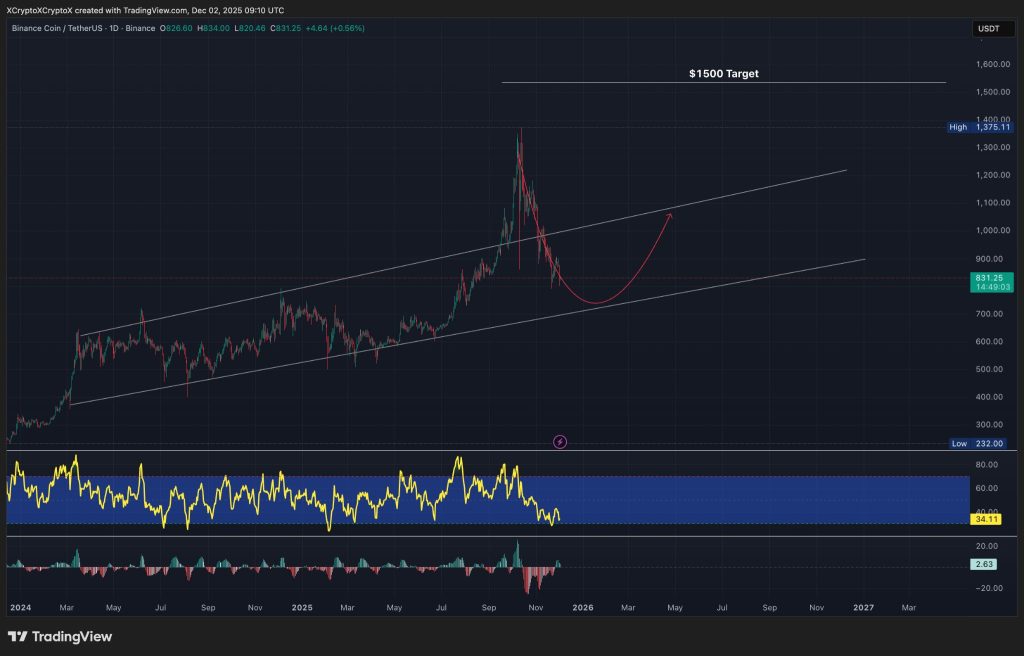
BNB Price Prediction: Binance Coin is Approaching the Best Buying Level in 6 Months – What Happens Next?

2 December 2025 at 16:36

Binance Coin is flashing its strongest buy signal in six months, a trend line that has underpinned some of the most bullish BNB price predictions.

The 20-month structure has served as a firm bottom marker for the altcoin through this market cycle’s bullish phase, guiding consolidation and sparking surges.

BNB / USDT 2-day chart, 20-month support. Source: TradingView.

Now the trendline is back in play near $750, just another 15% below current prices, and broader market conditions favour it as a launchpad once again.

The U.S. macro narrative sets a bullish precedent. The Federal Reserve has just shifted course, ending quantitative tightening and injecting $13.5 billion in liquidity to support banks.

Whoa! The FED just injected $13.5B into the banking system via overnight repos.

2nd Largest liquidity boost since c-vid ! pic.twitter.com/A9nnllQqg2

— Josh Philip Phair (@JoshPhilipPhair) December 2, 2025

With fresh liquidity entering the system and expectations of a December rate cut to revive risk appetite, speculative assets like BNB could see renewed demand heading into 2026.

BNB Price Prediction: How High Could the Next Bull Run Go?

The 20-month support also corresponds with the lower boundary of an ascending broadening wedge, forming a potential breakout setup

As a launchpad, it could reset focus on a reversal towards its upper resistance, particularly with momentum indicators to show any decisive signs of bullishness.

If the level holds as a launchpad, it could refocus attention on a reversal toward the wedge’s upper resistance, particularly with momentum indicators yet to show decisive signs of bullishness.

BNB / USDT 1-day chart, ascending broadening wedge pattern. Source: TradingView.

The RSI has yet to print any meaningful divergence from price action, signalling a prevailing downtrend despite its recent rebound from the 30 oversold zone.

The recent MACD golden cross may also prove short-lived.

Zooming out, the weekly RSI has not yet touched the 30 oversold threshold, while the weekly MACD is only now approaching a golden cross, a telling sign that there is still room to fall.

The key breakout line sits near $1,050, and a confirmed move above it could send BNB into new price discovery, targeting a 70% rally toward $1,500.

SUBBD: The Next Big Low Cap Gem?

With market conditions shaping up for a 2026 bull run, market participants are positioning behind the next high-upside contenders, and increasingly, SUBBD ($SUBBD).

Positioned as an AI-powered content platform, SUBBD is redefining the $85 billion subscriber economy by giving creators true ownership and fans genuine access.

Never miss a sale again.

As a top creator, your audience is global. It's just not possible to cater to everyone – you can't be online 24/7 🫠

That's where your personal AI Assistant comes in, to handle requests and secure payments. Sleep peacefully knowing you're making money… pic.twitter.com/ju9VjLBmea

— SUBBD (@SUBBDofficial) March 26, 2025

By cutting out the middlemen, $SUBDD puts control back in the hands of those who create real value.

Creators can monetize directly, while fans gain access to exclusive content, early releases, and meaningful interactions through token-gated perks.

The concept is already gaining traction. $SUBBD nears $1.4 million in presale, as investors back the shift toward a decentralized creator economy.

With SUBBD, both sides of the community win — creators earn more, and fans get closer while embracing the decentralization use cases crypto was built for.

Visit the Official SUBBD Website Here

The post BNB Price Prediction: Binance Coin is Approaching the Best Buying Level in 6 Months – What Happens Next? appeared first on Cryptonews.

Ripple, leading VCs invest in OpenEden to support the real-world asset tokenisation firm’s expansion

2 December 2025 at 05:33
  • The company will focus on scaling TBILL and the yield-bearing stablecoin USDO.
  • cUSDO was approved this year as off-exchange collateral at Binance.
  • BNY Mellon now manages and safeguards Treasurys underlying TBILL.

Real-world asset tokenisation is becoming one of crypto’s most active areas in 2025, and OpenEden is positioning itself at the centre of this shift with a new round of investment supported by major industry players.

The company confirmed on Tuesday that leading trading firms, venture capital groups, blockchain networks and institutional infrastructure providers have backed its latest raise to expand access to tokenised US Treasurys.

The round, which follows OpenEden’s 2024 raise with YZi Labs, comes at a time when short-dated government debt has emerged as one of the fastest-growing niches in digital assets as institutions look for familiar, regulated yields on-chain.

Tokenisation demand drives new investment push

OpenEden said the fresh capital will help it scale its tokenisation-as-a-service platform as more institutions look to move traditional assets onto public blockchains.

The firm is leaning into rising demand for regulated products tied to government debt, with short-term Treasurys becoming a preferred entry point for investors seeking on-chain yield that mirrors conventional markets.

The company did not disclose the size of the round, but it confirmed participation from Ripple, Lightspeed Faction, Gate Ventures, FalconX, Anchorage Digital Ventures, Flowdesk, P2 Ventures, Selini Capital, Kaia Foundation, and Sigma Capital.

Expansion of TBILL and USDO across markets

A significant portion of upcoming development will centre on OpenEden’s two main offerings: TBILL, its tokenised US Treasury fund, and USDO, a stablecoin backed by those same Treasurys.

USDO and its wrapped version, cUSDO, have already been integrated across decentralised exchanges and lending markets.

Earlier this year, Binance authorised cUSDO as off-exchange collateral.

OpenEden said the new investment will support broader distribution of these products and allow the company to introduce additional market structures tied to real-world financial assets.

Broader product pipeline builds institutional focus

Beyond Treasurys, OpenEden is preparing several new instruments designed to deepen institutional engagement with tokenised markets.

These include upcoming tokenised bond exposure, a multi-strategy yield token and a range of structured products aimed at investors familiar with traditional income-generating instruments.

In August, the company appointed BNY Mellon as custodian and investment manager for the Treasurys underlying TBILL.

The product has also received investment-grade ratings from S&P Global and Moody’s, marking a notable step in bridging conventional market requirements with decentralised finance infrastructure.

The post Ripple, leading VCs invest in OpenEden to support the real-world asset tokenisation firm’s expansion appeared first on CoinJournal.

What The Rapid XRP Outlfows From Crypto Exchanges Mean For The Price

1 December 2025 at 17:00

A sudden drop in XRP balances across major crypto exchanges has led to speculations about how this might affect the cryptocurrency’s price action. The movement was highlighted by analyst Vincent Van Code, who explained that the transfers are not simply a sign of long-term holders scooping up supply. 

Instead, he pointed to the expanding influence of newly launched Spot XRP ETFs, which are now absorbing a significant share of market activity that once took place on retail platforms.

ETF Demand Is Pulling Liquidity Away From Exchanges

Van Code noted that billions of XRP leaving Binance, Upbit, and Kraken are largely flowing into ETF custodial wallets. This changes the way the market reacts to buying and selling pressure because retail exchanges now operate with thinner liquidity. When daily trading volume on those platforms averaged around the multi-billion-dollar range, it required very large orders to create noticeable price movement. 

Now that volume has contracted, even moderate-sized trades can produce sharp intraday swings. The effect is a market environment that is fundamentally supported by ETF buying, yet increasingly sensitive to smaller sell-offs or sudden bids.

Even as exchange liquidity drops, Van Code noted that high-frequency trading firms are preventing price dislocations. These groups have already mastered the arbitrage models used in Bitcoin and Ethereum ETFs, and they have now adapted the same systems for XRP. 

Whenever the ETF price drifts above or below its underlying value, the bots immediately correct the gap, keeping both markets tightly aligned. This mechanism makes sure that XRP still gets purchased during ETF creation events and provides a layer of structural stability, even though retail charts may begin to show more frequent spikes and dips.

What This Means For XRP’s Approach To New Price Highs

In Van Code’s view, the long-term picture for XRP is strengthened by this shift, even though the short-term experience for traders may become more uncomfortable. When XRP enjoyed daily spot volumes in the range of $2 billion to $3 billion on exchanges, you would typically need more than $200 million in concentrated buying or selling to push the price 5% to 10% in either direction. 

Now that on-exchange volume has dropped toward levels below $1 billion a day, the equation looks very different. A sell order or resistance wall of around $15 million can now swing XRP by roughly 12% to 18% within a single hour in these thinner conditions. However, the saving grace is these arbitrage bots. 

According to the analyst, XRP is still on track to reach $5. However, until the price adapts to reduced spot volume on exchanges, traders should be prepared for air pockets up to 20% in price, where relatively modest buy or sell flows can cause outsized moves.

XRP

Major Ripple Developments That Could Trigger An XRP Price Surge

28 November 2025 at 13:00

Crypto firm Ripple recently achieved a major milestone, providing a bullish outlook for the XRP price. XRP is also seeing significant demand amid the launch of the U.S. spot ETFs, which could trigger a price surge for the altcoin. 

Ripple Developments That Are Bullish For The XRP Price

In a press release, Ripple announced that its stablecoin RLUSD has gained recognition as an accepted Fiat-Referenced token by Abu Dhabi’s financial regulator. This enables the use of the stablecoin within the region’s financial markets. This marks a positive for the XRP price, as it could boost RLUSD’s demand, thereby increasing the demand for the altcoin as the native token of the XRP Ledger. 

Notably, the on-chain analytics platform Sentora (formerly IntoTheBlock) recognized RLUSD as one of the fastest-growing stablecoins, with its market cap increasing by 38.8% over the last month. Meanwhile, this development follows Ripple’s completion of the Hidden Road deal, which also strategically boosts RLUSD demand and positively impacts the XRP price.  

Meanwhile, crypto pundit SMQKE recently highlighted a U.S. Consumer Financial Protection Bureau report that acknowledged Ripple’s role in revolutionizing the cross-border payments industry through XRP. The report also suggested that Ripple’s payment system could be integrated into the traditional financial system, which would also be huge for the XRP price. 

Notably, the report specifically alluded to Ripple’s growth and expanding partnerships, which could make its payment platform the go-to choice for cross-border remittances. Meanwhile, XRP serves as the bridge currency for the effective settlement of these transfers. It is worth mentioning that Ripple Chief Technology Officer (CTO) David Schwartz has also assured that stablecoins cannot replace XRP’s role as the bridge currency on the XRP Ledger (XRPL). 

XRP’s Demand Is On The Rise

A CryptoQuant analysis revealed that the XRP reserves on Binance are plummeting, which could also trigger an XRP price surge. This development comes amid the launch of the U.S. XRP ETFs. The analysis suggested that institutional demand for the altcoin via these ETFs may have contributed to the decline in Binance’s reserves

Binance’s XRP reserves are said to have been steadily decreasing since October and have now dropped to around 2.7 billion XRP, which is one of the lowest levels ever on the exchange. CryptoQuant revealed that roughly 300 million XRP have left the exchange since October 6. The analysis noted that this indicates that real demand is building, which is bullish for the XRP price. 

XRP

Bitcoinist recently reported that institutions last week dumped Bitcoin, Ethereum, and Solana for XRP, which was one of the few majors to record inflows amid the broader outflows from crypto funds. If this demand trend for XRP continues, the CryptoQuant analysis stated the XRP price could enter a more structured phase amid expanding institutional interest. 

At the time of writing, the XRP price is trading at around $$2.21, up in the last 24 hours, according to data from CoinMarketCap.

XRP

Silent XRP Run Hits Binance Just As US Spot ETFs Ignite New Demand

28 November 2025 at 11:00

XRP reserves on Binance have quietly fallen to near-record lows just as the first US spot ETFs begin trading, on-chain data from CryptoQuant and analysis by Darkfost show.

Binance’s XRP Exchange Reserves Drop Sharply

A CryptoQuant chart of  “Exchange Reserve – Binance” plots the exchange’s holdings sliding from a little above 3 billion XRP in early October to roughly 2.7 billion tokens by November 24. The line starts around 2.925 billion tokens in mid-August, climbs toward 3 billion through September and early October, then reverses into a near-continuous downtrend.

Darkfost distills the move bluntly: “XRP Reserves on Binance are plummeting.” Since October 6, “roughly 300 million XRP have left Binance,” the analyst notes, describing the setup as “BULLISH.”

XRP reserves on Binance

The timing overlaps with a structural shift in market access. “The XRP ecosystem has been particularly active in recent weeks, especially with the arrival of the first spot ETFs (US),” Darkfost writes. “Canary Capital paved the way on November 13, quickly followed by Franklin Templeton, Bitwise or Grayscale.” In their view, “in just a few days, XRP moved from a standard crypto asset to a product now accessible through multiple institutional vehicles, which could clearly shifts its dynamic.”

What makes the Binance data notable is the persistence of the outflows. The CryptoQuant series shows no single spike dominating the pattern; instead, reserves step down week after week from slightly above 3 billion tokens to the 2.7 billion area. According to Darkfost, “since October, the exchange’s reserves have been steadily decreasing.”

The analyst acknowledges that some of the movements might be operational rather than investor-driven. “Even if a small portion of these movements may be linked to internal reorganizations, the overall trend is far too consistent to ignore,” Darkfost writes. In other words, while exchange wallet reshuffling can distort short-term readings, the multi-week decline suggests a more fundamental repositioning.

What This Means For XRP Price

Darkfost interprets the behavior as a sign of growing, conviction-driven demand: “Day after day, the decline continues and this is generally seen as a positive signal. It indicates that real demand is building, with investors withdrawing their XRP from Binance to hold them in private wallets. And this behavior is never insignificant.”

The implication is that coins are moving from readily tradable balances into longer-term storage. “When an asset is withdrawn from exchanges on a large scale, it often reflects a long term holding intention,” Darkfost adds. With fewer tokens parked on trading platforms, any increase in demand can have a more pronounced impact on market depth and order books.

That matters precisely because the token’s investor base is no longer limited to direct spot buyers on exchanges. Darkfost argues that “fewer tokens available on trading platforms combined with growing institutional demand create a potentially powerful setup.”

In their conclusion, the current trajectory could mark the start of a different market regime: “If this trend continues, XRP could move into a more structured phase with an expanding institutional interest.”

For now, the numbers are straightforward. Binance’s reserves, as tracked by CryptoQuant, have fallen by about 300 million tokens since October 6 to roughly 2.7 billion. The outflows have been steady rather than spectacular, but in the context of newly launched US spot ETFs, they could amount to a silent run on exchange balances that will reshape how the token trades in the months ahead.

At press time, XRP traded at $2.24.

XRP price

Vietnam partners with Binance as HCM City pushes global finance hub plan

26 November 2025 at 06:54
  • Binance will introduce foreign investors and financial institutions to Vietnam.
  • The agreement includes support for digital asset rules and blockchain payment systems.
  • A joint working group will monitor progress twice a year.

Vietnam has taken a significant step in its long-term plan to build an international financial hub, with HCM City now partnering with Binance following an MoU signed on 26 November 2025.

The agreement was finalised during the Autumn Economic Forum 2025, attended by Prime Minister Pham Minh Chinh, municipal leaders, ministry representatives, and international investment funds.

The collaboration brings Vietnam closer to its goal of creating a modern financial ecosystem that can attract global investors and digital finance companies.

It also builds on Vietnam’s strategy to become more competitive across Asia as technology and digital assets reshape global capital flows.

Partnership expands Vietnam’s global financial links

HCM City is one of two key locations selected for the Vietnam International Financial Centre initiative.

The new agreement with Binance adds momentum to this plan by bringing one of the world’s largest crypto exchanges into Vietnam’s financial development efforts.

The partnership follows the city’s MoU with Nasdaq in October 2025, showing Vietnam’s intention to work closely with major global platforms.

Binance will introduce foreign investors, financial companies, and investment funds to Vietnam to help attract new capital to the financial centre.

This approach aims to increase international participation and strengthen Vietnam’s ability to connect with global markets.

Support for digital asset rules and blockchain activity

A major part of the cooperation involves shaping Vietnam’s regulatory environment for digital assets and blockchain applications.

Binance will share experience from its global operations to help Vietnam design rules for digital asset use, crypto trading, and blockchain activity.

The agreement covers the development of payment systems using cryptocurrencies and support for digital finance projects that follow strong compliance and safety standards.

Vietnam aims to build a clear regulatory structure that can protect users while supporting innovation, especially as demand for transparent rules in digital finance continues to grow across the region.

Joint working group and blockchain sandbox

To guide the partnership, Vietnam and Binance will set up a joint working group that meets twice a year to track progress.

The agreement also includes the creation of a sandbox for blockchain and crypto projects.

This controlled environment will allow companies to test products under regulatory supervision.

The sandbox will encourage innovation while reducing risks, giving local and international businesses a structured pathway to explore new technologies.

The mechanism is expected to support responsible growth and help regulators understand emerging digital finance models.

Training and support for startups in new technologies

The partnership extends beyond regulation and investment.

Vietnam aims to support startups and small businesses working in blockchain, artificial intelligence, and fintech.

The cooperation includes training sessions, workshops, and expert guidance for regulators and companies.

These programmes will help improve technical capacity and expand knowledge among teams that are crucial to the development of a modern financial centre.

Vietnam sees this as an opportunity to prepare its workforce for a more digital future and compete with regional hubs that are also investing in advanced technologies.

Long term vision to become an Asian finance hub

The collaboration with Binance reinforces Vietnam’s ambition to position HCM City as a major Asian financial hub by 2030.

With new international partnerships, growing regulatory planning, and a focus on digital finance, Vietnam is building the foundations of a financial centre designed for global integration.

The MoU marks another step in linking Vietnam with leading institutions and strengthening its role in regional economic development.

The post Vietnam partners with Binance as HCM City pushes global finance hub plan appeared first on CoinJournal.

BlackRock’s BUILD launches on BNB Chain as RWA momentum accelerates

14 November 2025 at 11:01
  • The largest tokenized RWA has debuted on BNB Chain.
  • Investors can now access tokenized US dollar yields on a user-friendly platform.
  • Real-world assets top $36 billion after a 6% increase in the previous month.

BNB Chain has welcomed a new resident today as BlackRock’s USD Institutional Digital Liquidity Fund (BUILD) went live on the platform.

The strategic launch, powered by Securitize’s compliant tokenization platform and Wormhole, adds one of the most regulated digital assets to Binance’s thriving financial ecosystem.

The strategic move comes as real-world assets see massive traction, with their value up 6% the past month to surpass $36 billion.

BUILD’s debut reflects the convergence between blockchain and traditional finance.

BlackRock is a leading asset manager and is now bringing its trust, base, and compliance to BNB Chain, a platform known for accessibility, low fees, and high speed.

Commenting on today’s arrival, BNB Chain Head of Business Development Sarah Song said:

BNB Chain is designed for scalable, low-cost, and secure financial applications, and we’re excited to welcome BUILD to our ecosystem. BUILD is turning real-world assets into programmable financial instruments, enabling entirely new types of investment strategies on-chain.

Meanwhile, the development introduces a new share class on Binance’s ecosystem, offering eligible investors access to a tokenized US dollar yield in a blockchain setup.

BlackRock’s tokenized asset also secures new utility. Binance will now accept BUILD as collateral.

That allows professional traders and institutions to deploy cash smoothly without surrendering exposure to Treasuries-linked RWAs.

That use case underscores the broader shift in how on-chain systems integrate real-world assets.

These products are maturing from static representations to practical instruments that can function across DeFi and TradFi environments.

Leveraging Securitize’s compliant infrastructure

Securitize, a regulated tokenization firm boasting more than $4 billion in tokenized AUM (assets under management), is powering BlackRock’s expansion into BNB Chain.

Securitize handles everything from fund administration to digital transaction agency services.

That ensures that clients access enterprise-level RWAs within regulated frameworks.

At the same time, BUILD unlocks new use cases that were previously absent for real-world tokenized assets.

According to Securitize CEO Carlos Domingo:

Expanding BUILD to the BNB Chain and making it available as collateral on the Binance exchange further extends its accessibility and reinforces our mission to bring regulated real-world assets on-chain while unlocking new forms of utility that were previously out of reach.

RWA and stablecoin market thrive

BUILD’s launch on BNB Chain comes as on-chain real-world assets see impressive growth.

RWAxyz data shows the value of RWAs on public blockchains increased by 5.91% the past 30 days to $36.06 billion.

Furthermore, the number of holders surged 10.78% to 537,549, with asset issuers hitting 249.

Such figures reflect a flourishing ecosystem of enterprises tokenizing regulated real-world assets.

Stablecoins also steadied despite crypto market turmoil, with their value up 0.79% in a month to $299.76 billion.

Moreover, stablecoin holders increased by 3.39% in that timeframe to $202.89 million, indicating unwavering demand for digitized financial instruments that guarantee liquidity, compliance, and stability.

The post BlackRock’s BUILD launches on BNB Chain as RWA momentum accelerates appeared first on CoinJournal.

❌
❌