Normal view

There are new articles available, click to refresh the page.
Today — 6 December 2025Main stream

Crypto Sell-Off: Binance, Coinbase, Dump Over $2 Billion In Bitcoin As Prices Dip Below $90,000

6 December 2025 at 07:00

The cryptocurrency market experienced another wave of liquidations on Friday, with Bitcoin (BTC) prices dipping below the critical support level of $90,000. This decline followed a brief rally that had seen its price rise approximately $3,000 above this threshold earlier in the week.

Crypto Market Faces $430 Million In Liquidations 

Data from CoinGlass reveals that nearly $430 million in liquidations occurred across the crypto market over the past 24 hours, predominantly affecting leveraged long positions, which accounted for about $350 million. 

During this period, Bitcoin underwent a 3.5% retracement, with its price settling at just above $89,120—a stark 29% below its all-time high of over $126,000 reached in October.

Crypto

Market expert OxNobler recently highlighted the role of both retail and institutional investors in this downturn. In a post on social media platform X, OxNobler detailed the reason behind Bitcoin’s decline: significant sell-offs by major players. 

According to the analyst, the world’s largest cryptocurrency exchange, Binance, sold 4,000 BTC; U.S.-based Coinbase (COIN) liquidated 5,675 BTC; and traditional finance giant Fidelity sold 3,288 BTC. Additionally, market maker Wintermute offloaded 1,793 BTC. 

Notably, the analyst pointed out that Strategy, formerly MicroStrategy, which is the largest public company holder of Bitcoin with over 650,000 coins, has also sold over 3,820 coins in this same time frame.

The firm’s sell-off comes on the heels of speculation regarding Strategy’s potential to liquidate some of its holdings due to the substantial losses affecting its financial performance amid declining Bitcoin prices. 

When Strategy CEO Phong Le was questioned about the possibility of selling off Bitcoin, he acknowledged that while the firm’s former CEO, Michael Saylor, has consistently opposed selling, circumstances may change if the company’s stock trades below the net value of its Bitcoin holdings, which aligns with the recent actions taken by the firm.

Coinbase Analysts Predict December Recovery 

Interestingly, while these institutional sell-offs have contributed to the current market dip, Coinbase’s institutional division has projected a potential recovery for the crypto market in December, citing improving liquidity, a 92% probability of the Federal Reserve (Fed) cutting rates, and supportive macroeconomic conditions.

Analysts have pointed out several reasons for optimism, including the recovery of liquidity, the resilience of the “AI bubble,” and the attractiveness of short US dollar trades at current levels. 

However, OxNobler warned that the situation may not be so straightforward. Alongside the activities of major institutions, he noted that BlackRock, the world’s largest asset manager, had recently sold $130 million worth of Bitcoin and Ethereum (ETH).

Furthermore, Vitalik Buterin, one of Ethereum’s co-founders, seems to have resumed selling Ethereum, with millions of ETH being moved from the foundation’s wallet through Gnosis Safe.

Ultimately, OxNobler asserts that these institutional activities may have a hand in manipulating crypto prices and preventing them from climbing to higher levels and key resistance points. 

Crypto

Featured image from DALL-E, chart from TradingView.com 

Bernstein Forecasts Coinbase (COIN) To Surge 90%, Setting $510 Price Target

6 December 2025 at 01:00

Coinbase (COIN), the largest cryptocurrency exchange in the US, has experienced a significant decline in its stock valuation, dropping nearly 40% from its peak of $444 in July to its current trading level of around $271 per share. This, amid market fluctuations and heightened volatility in the broader crypto market, impacting the exchange’s stock performance.

Bernstein Forecasts New Bullish Phase For Coinbase

Despite these challenges, analysts at Bernstein hold an optimistic outlook on Coinbase’s stock price, suggesting a potential new bullish phase that could propel COIN to surpass previous all-time highs and reach levels above $500. 

Bernstein maintains a price target of $510 on Coinbase, underlining the exchange’s shift from a trading-centric platform to what analysts dub an emerging “everything exchange.”

Analysts led by Gautam Chhugani highlighted the delicate market conditions, citing crypto price fluctuations influencing listed crypto-exposed equities

However, Bernstein distinguishes the current market environment from past crypto downturns, noting that speculative excess primarily affects what they refer to as “MSTR copycats,” referencing Strategy’s (previously MicroStrategy) stock performance. 

Central to Bernstein’s bullish thesis is Coinbase’s strategic diversification away from volatile spot trading revenue. They assert that exchange is evolving into a comprehensive financial platform.

The analysts emphasize that clearer regulatory guidelines in the US could drive a revaluation of these business lines, bridging the gap with offshore competitors benefiting from faster token listings and fundraising fees. 

Coinbase’s foray into token issuance through a launchpad-style model, exemplified by Monad’s (MON) recent listing, demonstrates growing market interest. Bernstein notes that these launches, directly influencing trading activity, can stimulate a cycle of issuance, listing, and heightened trading volume.

Confident Ratings For COIN

Looking ahead, one of the exchange’s most notable catalysts is the upcoming product showcase on December 17, anticipated to unveil developments in tokenized equities, prediction markets, and other tools expanding the exchange’s offerings beyond spot crypto trading. 

The integration with Deribit is also expected to further bolster Coinbase’s derivatives expansion, positioning the exchange closer to platforms like Robinhood as both entities diversify their product offerings.

On the consumer front, the exchange’s Base app, focusing on wallet services, payments, and social features, acts as a centralized access point for the broader token markets, reaffirming the analysts’ bullish predictions

Bernstein’s reaffirmed “Buy” rating on Coinbase with a massive $510 price target underscores the firm’s confidence in COIN’s growth trajectory. Monness Crespi’s recent upgrade from “Neutral” to “Buy” with a $375 target further adds to the bullish sentiment surrounding the stock’s valuation amid falling prices. 

Coinbase

Featured image from DALL-E, chart from TradingView.com 

Before yesterdayMain stream

2012 Video Resurfaces of Coinbase CEO Brian Armstrong Pitching What Became America’s Largest Bitcoin Exchange

4 December 2025 at 13:49

Bitcoin Magazine

2012 Video Resurfaces of Coinbase CEO Brian Armstrong Pitching What Became America’s Largest Bitcoin Exchange

A video has surfaced showing Coinbase CEO Brian Armstrong rehearsing a pitch in 2012, years before the company became the largest Bitcoin exchange in the U.S.

In the recording, Armstrong lays out a simple argument: Bitcoin is a digital currency that can move money instantly anywhere in the world. But it’s hard to use. Tools were clunky, backups were tricky, and users could easily lose their funds. 

Coinbase, he said, would fix that. The platform would act as a hosted wallet, letting anyone access their money from any device without worrying about security or backups.

Armstrong compares his plan to what iTunes did for music. He emphasizes the early growth: sign-ups and transactions increasing “20 % a day,” and $65,000 in Bitcoin payments were processed in just five weeks.

The pitch is short, under three minutes, and candid. Armstrong discussed fees, competition, and the potential of Bitcoin as a global payment system. It’s a glimpse at the early vision of a company few outside crypto had heard of.

In 2012, Brian Armstrong recorded himself rehearsing his pitch for Coinbase.

Today, they're the largest Bitcoin exchange in the US ✨ pic.twitter.com/Ta4bKz0hYd

— Bitcoin Magazine (@BitcoinMagazine) December 4, 2025

Coinbase: Don’t get ‘left behind’

It’s safe to say that Armstrong’s idea was a success. More than a decade later, Coinbase is the top U.S. exchange, handling billions in Bitcoin transactions and shaping how Americans interact with digital assets. 

That scrappy 2012 rehearsal captures the first hints of a company that would grow into a crypto powerhouse.

Just yesterday, Armstrong sat beside BlackRock CEO Larry Fink and said that all major U.S. banks that ignore stablecoins risk being “left behind.” 

Speaking at the New York Times DealBook Summit, Armstrong said that several top banks are running pilot programs with Coinbase for stablecoins, crypto custody, and trading.

Armstrong acknowledged a split within traditional finance: some institutions’ lobbying arms resist crypto, while innovation teams explore it. 

“This is the classic innovator’s dilemma,” he said, noting banks must choose between embracing or fighting new technology. On concerns about capital flowing to stablecoins, Armstrong said banks are mainly focused on protecting profit margins.

Fink, once a bitcoin skeptic, said he now sees a “huge use case” for Bitcoin and worries the U.S. is falling behind in stablecoin innovation. 

Armstrong has championed crypto to the U.S. government. He has lobbied and pushed for clearer regulations for the crypto industry.

Armstrong supported legislation like the CLARITY Act to set legal clarity. He launched grassroots efforts, including Stand With Crypto. He has also spent millions on campaigns through PACs like Fair Shake. 

This post 2012 Video Resurfaces of Coinbase CEO Brian Armstrong Pitching What Became America’s Largest Bitcoin Exchange first appeared on Bitcoin Magazine and is written by Micah Zimmerman.

Coinbase CEO Reveals Collaborations With Leading Banks On Stablecoin And Crypto Trading Initiatives

3 December 2025 at 17:43

Leading banking institutions in traditional finance (TradFi) are reportedly partnering with US-based cryptocurrency exchange Coinbase (COIN) to explore pilots related to stablecoins, custody solutions, and trading options. 

Coinbase CEO Brian Armstrong announced this during his appearance at the New York Times Dealbook Summit on Wednesday, as reported by Bloomberg.

Coinbase CEO Cautions Banks On Crypto Resistance

Armstrong emphasized that leading financial institutions recognize this as an opportunity for growth. “The best banks are leaning into this as an opportunity,” he stated, although he refrained from naming any specific banks involved in these initiatives. 

During his speech, the executive also voiced his concerns about institutions that resist participating in the digital asset ecosystem. He asserted that those who oppose it will be left behind.

This sentiment aligns with remarks Armstrong made six months ago, where he predicted that eventually, every major bank would integrate cryptocurrency into their operations. 

He views this technology as a means to modernize the financial system, stating, “We can power a variety of things for them.” He noted that some banks are looking for custodial solutions, while others are interested in developing their own stablecoins.

COIN Shares Surge 5%

Adding weight to this discussion, Larry Fink, CEO of the world’s largest asset manager and crypto exchange-traded fund (ETF) issuer BlackRock, participated in the event alongside Armstrong. 

Fink, who previously voiced skepticism about cryptocurrencies, described Bitcoin (BTC) as a safe haven asset despite the cryptocurrency’s crash toward $83,000 on Monday. 

“You own Bitcoin because you’re frightened of your physical security. You own it because you’re frightened of your financial security,” he remarked. 

On the financial side, Coinbase’s stock performance reflects the positive sentiment in the cryptocurrency market amid recovering prices. Trading under the ticker COIN on the Nasdaq, Coinbase’s shares closed Wednesday at nearly $277, marking a 5% increase. 

This uplift coincides with broader gains in the cryptocurrency sector, notably led by the recent price performance of Ethereum (ETH), followed by Bitcoin, XRP, Binance Coin (BNB), and other notable tokens such as Solana (SOL), all of which have shown significant recoveries this week after a challenging month.

Coinbase

Featured image from Shutterstock, chart from TradingView.com

Coinbase Warns Bitcoin Under Pressure, Citing ETF Outflows and Whales Exit

3 December 2025 at 10:07

Coinbase Institutional has issued a stark warning to investors as Bitcoin breaks through critical support levels, citing multiple bearish indicators, including massive ETF outflows, whale distribution, and compressed valuations of digital asset treasuries.

The assessment comes as BTC trades decisively below its 200-day moving average following a 32% drawdown from recent highs above $126,000, with the crypto now testing support near $93,000.

Bitcoin chart Under Pressure
Source: TradingView

The exchange’s latest market analysis reveals a confluence of negative factors weighing on Bitcoin’s price action.

In this environment, we think higher probability setups favor breakout trades over knife-catching,” Coinbase stated in a recent post, advising caution even as quantitative tightening ends and the Federal Reserve re-enters bond markets.

Buy the dip?

With quantitative tightening ending, the Fed is back in the bond market and the drain of cash from markets may be behind us. That’s usually good for risk-on assets like crypto.

So why did BTC dump?

• BTC broke major bull market support bands
• Options traders… pic.twitter.com/1C8mxtemun

— Coinbase Institutional 🛡 (@CoinbaseInsto) December 2, 2025

Critical Support Levels Shattered Across Multiple Metrics

Bitcoin has systematically broken through every major technical and on-chain support band that has historically anchored bull-market rallies.

According to Coinbase November report, the crypto now trades below its short-term holder cost basis and the 75% profit threshold that provided support in previous cycles, leaving no obvious floor for prices.

The $98,000-$100,000 battleground, which previously represented a thick band of holders anchored to that level, collapsed as the price sliced through with minimal rebound attempts.

Bitcoin technical and onchain bull market support bands
Source: Coinbase

Recent buyers are underwater, with realized losses spiking to levels last seen during the November 2022 FTX collapse.

This creates elevated capitulation risk as short-term holders rush to cut losses rather than hold through the downturn.

The swift drop through the $90,000-$85,000 range showed the lack of organic demand to mitigate declines, with cost-basis distribution thinning out below current levels.

Options markets have also shifted from cautious to outright defensive, with the Bull-Bear Index turning firmly negative across short and mid-term tenors.

Traders are paying premiums for downside protection rather than upside exposure, while long-dated options hover near neutral, suggesting structural uncertainty rather than deep pessimism.

Long term holder (LTH) and exchange net position change vs price
Source: Coinbase

Meanwhile, long-term holder net position changes have turned decidedly negative on a 30-day basis, with market intelligence firm Arkham identifying at least one early Bitcoin whale who fully exited an 11,000 BTC position worth approximately $1.3 billion between late October and November.

ETF and Treasury Demand Evaporates

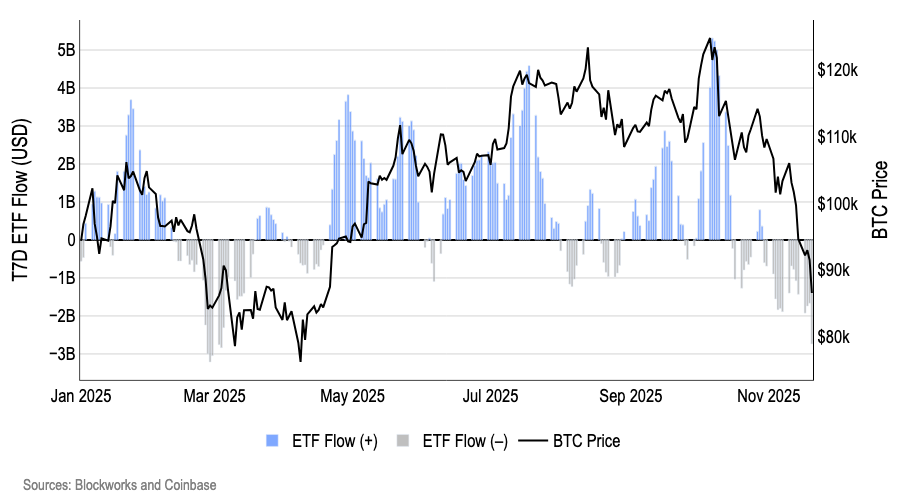
Spot ETF flows, previously a dominant incremental buyer, have reversed course dramatically.

November 2025 posted record cumulative net outflows as the trailing seven-day sum turned markedly negative after the price broke key levels.

Trailing-7-day net BTC spot ETF flows
Source: Coinbase

When allocators redeem ETF shares, issuers must sell spot Bitcoin or reduce hedges, amplifying broader risk-off episodes.

US spot Bitcoin ETFs now manage $168 billion in assets, holding approximately 1.36 million BTC, representing 6.9% of the circulating supply.

Digital asset treasury demand has similarly cooled, with companies’ market value over net asset value compressing below parity for the first time since 2024.

Multiple treasury vehicles now trade at discounts to their Bitcoin holdings, creating latent risk as shareholders may pressure management to slow purchases, hedge exposure, or monetize holdings.

This pressure manifests as companies, including Strategy, establish cash reserves, with Strategy announcing a $1.44 billion reserve covering 21 months of obligations while updating fiscal guidance to project operating results ranging from a $7 billion loss to a $9.5 billion gain, depending on year-end Bitcoin prices.

📊 Strategy Inc builds a $1.44B USD Reserve and revises its 2025 guidance as BTC swings sharply #Crypto #Bitcoinhttps://t.co/R2UdFmpMX5

— Cryptonews.com (@cryptonews) December 1, 2025

The shift comes ahead of MSCI’s January 15, 2026, decision on whether to exclude companies holding more than half their assets in crypto from global indices.

JPMorgan estimates this could trigger forced institutional selling between $2.8 billion and $8.8 billion.

Stablecoin Liquidity Contracts

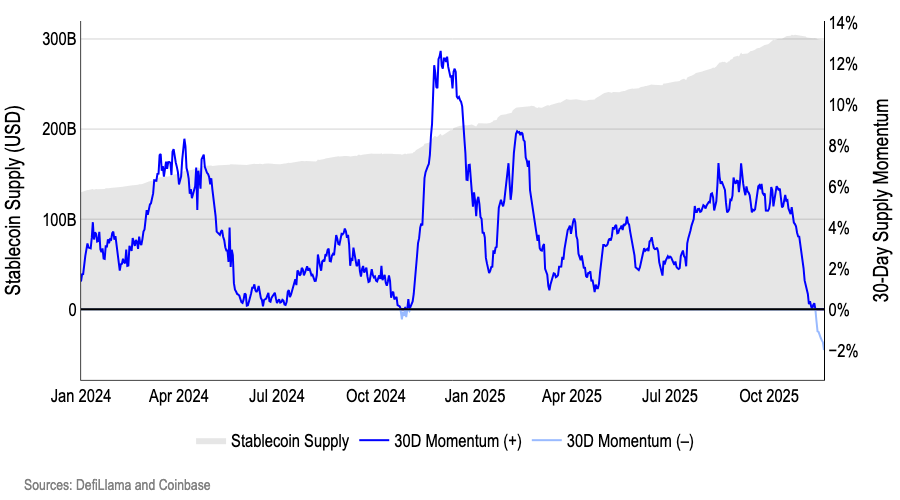
Crypto-native dollar liquidity is rolling over as aggregate stablecoin supply contracts following steady growth through October.

The 30-day momentum has posted its weakest reading since 2023, with shrinking supply reflecting deleveraging and capital leaving on-chain rails for fiat or safer assets.

While stablecoins reached a record of over $300 billion in circulation, the recent contraction signals reduced “dry powder” available to chase rallies despite stablecoins processing $225.6 billion in daily transfer volume.

Stablecoin supply growth momentum
Source: Coinbase

Despite these headwinds, Grayscale Research has recently challenged widespread pessimism, arguing that Bitcoin’s current market structure fundamentally differs from previous cycles.

The asset manager contends that dominance by exchange-traded products and corporate treasuries rather than retail exchanges means Bitcoin won’t follow historical patterns of deep, prolonged declines.

Elevated put skew suggests hedging of downside risk
Source: Grayscale

Technical indicators, including elevated put option skew and on-chain trader capitulation, suggest bottom formation may be underway, with accumulation patterns continuing among large holders.

The post Coinbase Warns Bitcoin Under Pressure, Citing ETF Outflows and Whales Exit appeared first on Cryptonews.

You Won’t Believe How Much Bitcoin Companies Now Hold, What % Of Supply Do They Control?

2 December 2025 at 15:00

Bitocin treasury companies continue to accumulate a significant amount of BTC despite current market conditions and now control around 5% of the total BTC supply. These companies are led by Michael Saylor’s Strategy and Metaplanet, which have recently raised fresh capital to buy the dip. 

Bitcoin Treasury Companies Now Hold Over 1 Million In BTC

Bitcoin Treasuries data shows that the top 100 public Bitcoin treasury companies currently hold 1,058,929 BTC, while all public companies combined hold 1,061,697. Notably, Strategy is the largest public Bitcoin holder with 650,000 BTC. Michael Saylor’s company yesterday announced another 130 BTC purchase for $11.7 million. 

Meanwhile, the second-largest Bitcoin treasury company is BTC miner MARA holdings, which holds 53,250 BTC. Tether-backed Twenty One Capital, Metaplanet, and Bitcoin Standard Treasury Company complete the top 5, with 43,514, 30,823, and 30,021 BTC, respectively. Meanwhile, companies like Coinbase, Bullish, and Trump Media are among the top 10 largest BTC treasury companies. 

It is worth noting that these public companies account for only a part of the Bitcoin treasuries. Further data from Bitcoin Treasuries shows that there is currently 4 million BTC in treasuries as a whole, including the coins held by governments, private companies, exchanges, DeFi platforms, and ETFs.  

Bitcoin

BlackRock is currently the second-largest Bitcoin holder, only behind Satoshi Nakamoto. Strategy is third on the list, while Binance and the U.S. government complete the top 5, with BTC holdings of 628,868 and 323,588, respectively. The 4 million BTC held by these treasury companies as a group accounts for 19% of the total Bitcoin supply. 

Bitcoin treasury companies such as Strategy and Metaplanet have raised new capital amid the recent crash to buy more BTC. Saylor’s company recently raised $836 million from its STRE offering, which it used to buy 8,178 BTC. Meanwhile, Metaplanet raised $130 million to expand its BTC treasury. 

More Companies Set To Adopt Bitcoin

More Bitcoin treasury companies are set to emerge as $10 trillion asset manager, Vanguard, will start offering BTC ETFs from today. Notably, some companies gain BTC exposure through these ETFs rather than buying Bitcoin directly. On-chain analytics platform Arkham Intelligence revealed that the largest U.S. bank, JPMorgan, holds $300 million worth of BlackRock’s BTC ETF. 

Meanwhile, it is worth mentioning that Bitcoin treasuries such as Strategy are coming under immense pressure amid the current market downtrend. Strategy’s CEO, Phong Le, admitted that they might have to sell Bitcoin as a last resort to fund dividend payments if their mNAV drops below 1x and they can no longer raise capital. 

At the time of writing, the Bitcoin price is trading at around $87,000, up in the last 24 hours, according to data from CoinMarketCap.

Bitcoin

Coinbase Hit With Record 12,716 Government Requests in 2025

1 December 2025 at 14:13

Coinbase received 12,716 government and law enforcement information requests between October 2024 and September 2025, marking a 19% year-over-year increase and the highest volume in the exchange’s history.

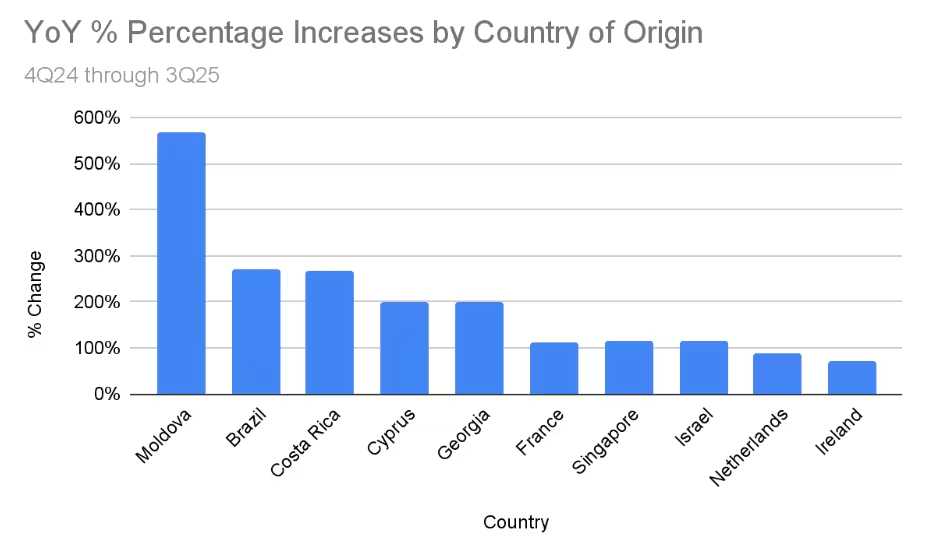
International requests accounted for 53% of the total, a new high, with France leading jurisdictions outside the U.S. with a 111% surge in demand for customer data.

The surge comes as Coinbase expands operations across more than 100 countries amid heightened regulatory scrutiny following major compliance failures in Europe and a damaging cybersecurity breach earlier this year.

The exchange’s seventh annual Transparency Report, published by Chief Legal Officer Paul Grewal, points out the growing global pressure on crypto platforms to balance user privacy with legal obligations.

Coinbase Law enforcement requests by country of origin
Source: Coinbase

France Drives International Demand, U.S. Still Dominates

The United States remained the largest single source of requests, followed by Germany, the United Kingdom, France, Spain, and Australia.

These six countries combined accounted for roughly 80% of all law enforcement requests globally.

France saw the sharpest increase among major jurisdictions, with requests jumping 111% from the prior reporting period.

The U.K. and Spain also posted double-digit gains, rising 16% and 27% respectively. Germany, Sweden, and South Korea recorded decreases, with South Korea’s requests dropping 67%.

Requests from Moldova and Brazil increased by factors of 5.7 and 2.7, while Australia’s volume remained nearly flat with just a 1% uptick.

Coinbase YOY% increases by country of origin
Source: Coinbase

Despite fluctuations across different markets, total request volume has stayed within the 10,000 to 13,000 range annually over the past four years.

Compliance Under Fire After Fines and Data Breach

The rising demand for user data comes amid regulatory penalties and internal security lapses that have damaged Coinbase’s compliance reputation.

In November, the exchange’s European arm agreed to pay €21.5 million to Ireland’s Central Bank after coding errors left 31% of transactions, worth more than $202 billion, unscreened for money laundering between 2021 and 2022.

The malfunction affected five of 21 transaction-monitoring scenarios, forcing Coinbase to reanalyze 185,000 transactions and file 2,700 suspicious transaction reports.

⚠ Coinbase Europe was fined €21.5M after tech errors left 30M transactions unmonitored, breaching AML rules. #Ireland #AML #Coinbasehttps://t.co/IdrCGSLhBp

— Cryptonews.com (@cryptonews) November 6, 2025

Just last year, Coinbase’s UK subsidiary was fined £3.5 million by the Financial Conduct Authority for onboarding over 13,000 high-risk customers in violation of a voluntary restriction, facilitating nearly $226 million in transfers.

In May, the exchange disclosed a cyberattack compromising the personal data of at least 69,461 customers, including government-issued IDs and email addresses, after hackers bribed customer service staff.

The breach, which was not disclosed until weeks after discovery, triggered at least six class-action lawsuits and a Justice Department investigation.

Shareholders later filed a separate suit alleging that Coinbase and its CEO, Brian Armstrong, failed to promptly disclose both the breach and the UK compliance violation, contributing to a 7.2% drop in the company’s stock.

Coinbase Expands Compliance as SEC Pressure Eases

Coinbase emphasized in its latest report that it reviews each request on a case-by-case basis and seeks to narrow overly broad demands.

The exchange stated that it seeks to provide anonymized or aggregated data whenever possible, rather than exposing individual customer information.

Requests received do not always result in data being produced, and the company maintains that it does not grant governments direct access to its systems.

The report arrives as Coinbase benefits from a dramatic shift in U.S. regulatory posture.

Great news!

After years of litigation, millions of your taxpayer dollars spent, and irreparable harm done to the country, we reached an agreement with SEC staff to dismiss their litigation against Coinbase. Once approved by the Commission (which we're told to expect next week)… pic.twitter.com/IlnoBs7N6n

— Brian Armstrong (@brian_armstrong) February 21, 2025

In March, the Securities and Exchange Commission agreed to drop its years-long enforcement action against the exchange, which had accused Coinbase of operating as an unregistered securities platform.

The dismissal followed similar moves by the SEC to abandon cases against Kraken, Robinhood, and Consensys after Paul Atkins replaced Gary Gensler as chair in January.

Additionally, back in September, Atkins pledged to replace what he called a “shoot first and ask questions later” approach with advance notices and clearer guidance for crypto firms.

The post Coinbase Hit With Record 12,716 Government Requests in 2025 appeared first on Cryptonews.

Bitcoin Sentiment Sparks CZ Comment: Sell Greed, Buy Fear

30 November 2025 at 13:00

Binance founder Changpeng Zhao’s blunt reminder about buying low and selling high landed at a tense time for crypto traders. His line — “Sell when there is maximum greed, and buy when there is maximum fear” — was posted as markets showed fresh signs of strain and debate over whether now is a buying moment or another stall.

CZ’s Message Meets Extreme Fear

According to the Crypto Fear & Greed Index, sentiment recently climbed to 20, moving out of “Extreme Fear” after a streak of low readings. The index had hit a yearly low of 10 on Nov. 22 and the market had spent eighteen days stuck in extreme fear.

Unpopular opinion, but it’s better to sell when there is maximum greed, and buy when there is maximum fear. 🤷‍♂️

— CZ 🔶 BNB (@cz_binance) November 29, 2025

Analysts called that stretch unusually deep. Matthew Hyland described it as the “most extreme fear level” of the cycle, and other traders argued that calling it extreme was being generous.

Bitcoin Holds But Mood Is Fragile

Based on reports, Bitcoin was trading at $91,780, a far cry from the all-time high of $126,000 reached in October. Prices remain up from 2024 lows of just over $40,000, yet confidence is thin.

Santiment tracked online chatter and found talks focused more on volatility and institutional moves than on excitement. The Altcoin Season Index sat at 22/100, a clear sign that traders are favoring safety.

Market Psychology Overrules Charts

Traders reacted fast to CZ’s post. One user said emotion often beats logic in real trading. Another noted that markets tend to move on psychology well before technical signals line up. That gap between what traders know and what they do was on full display: many agree with the rule, and few actually follow it when prices slip.

History Offers A Hint, Not A Guarantee

Reports have disclosed that some analysts see a pattern. Nicola Duke pointed out that in the last five years, every time the market reached extreme fear, Bitcoin found a local bottom within weeks.

While past stretches can offer context, they do not promise the same result now. Bitwise researcher André Dragosch warned that current pricing reflects a recession-level global growth outlook — the most bearish setting since 2020 and 2022 — which raises real risk for buyers.

Bitcoin Coinbase Premium Turns Positive After 29 Days

Meanwhile, the Bitcoin (BTC) Coinbase premium finally flipped back into positive after nearly a month of staying in the red.

Data from Coinglass on the 30th showed the premium at 0.0255%, marking the first positive reading in 29 days. For almost a month, the negative premium had suggested that selling pressure dominated the US market, with traders and investors leaning toward caution.

The Coinbase premium tracks how Bitcoin’s price on Coinbase, a major US exchange, compares to the global average. When it’s positive, it means the US price is above the worldwide average.

This is often seen as a sign that buying is picking up in the US, more institutions are getting involved, dollar liquidity is recovering, and overall investor confidence is improving.

Featured image from Gemini, chart from TradingView

Ark invests in Coinbase, Block and Circle as crypto-linked stocks slide

28 November 2025 at 03:50
Ark Invest bought more Coinbase, Block, Circle and other crypto-linked stocks via its ETFs as sector valuations fell during the latest market pullback.​ Ark Invest expanded its positions in several cryptocurrency-focused companies as prices fell across the sector, according to…

Coinbase Wallet Rebalancing Creates False $68B LTH Distribution Signal – Details

27 November 2025 at 21:00

The crypto market is facing a wave of misinterpretation as Coinbase’s large-scale wallet rebalancing, which began on November 22, 2025, continues to distort major on-chain indicators. Many dashboards now display what appears to be an unprecedented $68 billion Long-Term Holder (LTH) “sell” spike — but according to analysts, this is not real distribution. Instead, it’s the direct result of Coinbase transferring coins internally as part of its routine wallet restructuring process.

This distinction is critical. Several prominent analysts and market commentators have highlighted massive outflows, huge shifts in LTH supply, and unusual wallet movements, yet many have failed to mention the underlying cause: Coinbase’s internal reshuffling. Without this context, market participants might wrongly conclude that long-term holders are panic-selling at scale, reinforcing fear during an already fragile market environment.

These rebalancing events have happened before, but the size of Coinbase’s holdings means even normal internal operations can trigger dramatic spikes in on-chain metrics such as LTH Net Position Change, Exchange Netflow, and Spent Output Age Bands.

Coinbase Internal Transfers Distorted Key On-Chain Metrics

According to detailed analysis by Axel Adler, Coinbase’s internal migration of approximately 800,000 BTC created one of the largest distortions in on-chain data ever recorded — without a single coin being sold.

The exchange executed 286 transactions totaling 798,636 BTC, moving funds from legacy P2PKH (Pay-to-Public-Key-Hash) addresses to modern P2WPKH (SegWit) addresses. This technical reorganization produced an artificial $68 billion “realized profit” spike, misleading many market observers into interpreting it as massive long-term holder distribution.

LTH Cash Extraction Chart | Source: Axel Adler

This large UTXO migration disrupted several major on-chain indicators. LTH and STH Supply metrics were temporarily skewed, showing a sharp drop in Long-Term Holder supply and a rise in Short-Term Holder supply — a pattern typically associated with heavy “smart money” selling. In reality, no distribution occurred; Coinbase simply restructured its internal wallets.

The distortion also affected LTH Realized Profit/Loss models, which reflected tens of billions in phantom gains, and HODL Waves, where UTXO ages were “reset,” suggesting long-term holders had suddenly spent old coins. Even Coin Days Destroyed (CDD) showed a significant spike, mimicking an “old coin awakening,” though the activity was entirely internal.

These disruptions highlight how exchange operations can temporarily break the reliability of on-chain metrics, requiring careful interpretation from analysts and investors.

Total Market Rebounds but Remains Under Critical Pressure

The Total Crypto Market Cap chart shows a sharp rebound after tagging the $2.88T zone, a level that aligns closely with the 100-week moving average (green), acting as a key structural support in previous cycles. This bounce has pushed total valuation back above the $3T mark, but the broader trend remains fragile after weeks of heavy selling across majors like BTC and ETH.

Total Crypto Market Cap | Source: TOTAL chart on TradingView

Price structure highlights a clear breakdown from the $3.6T–$3.8T consolidation zone, followed by a fast, impulsive decline—mirroring the speed of corrections seen during 2021 and mid-2022. Despite the latest recovery candle, the market remains below the 50-week moving average (blue), signaling that buyers must regain momentum quickly to avoid deeper downside toward the 200-week moving average near $2T.

Volume has surged on recent sell-offs, showing widespread forced selling and capitulation behavior—a pattern consistent with cycle mid-reset phases. The rebound, however, shows reduced sell volume, suggesting exhaustion from bearish participants. To confirm strength, total market cap must reclaim the $3.25T–$3.3T area, which currently acts as the first major resistance.

Failure to break above this zone risks further consolidation or a retest of the $2.8T support. For now, the market shows early signs of stabilization, but broader recovery depends on Bitcoin’s ability to sustain its own rebound and restore confidence across altcoins.

Featured image from ChatGPT, chart from TradingView.com

Coinbase rolls out Ethereum-backed loans for users to borrow USDC without selling

20 November 2025 at 13:04
  • Ether holders on the exchange can borrow up to $1M in USDC using ETH as collateral.
  • That ensures access to liquidity/cash without selling their holdings.
  • The service is available in all US states, excluding New York.

Leading exchange Coinbase has introduced a new feature that will likely reduce selling pressure amid the current broader crypto market turmoil.

The trading platform has launched Ethereum-backed loans, allowing users in most American states to access on-chain cash without offloading their holdings.

Notably, borrowers can use ETH assets as collateral and receive loans of up to $1,000,000 in USDC stablecoin.

The team has confirmed on X:

ETH-backed loans are here. You can borrow USDC against your Ethereum, unlocking liquidity without selling.

If you believe in somΞTHing, this one's for you.

ETH-backed loans are here.

You can borrow USDC against your Ethereum, unlocking liquidity without selling.

Available now in the U.S. (ex. NY). pic.twitter.com/eOvJ2BWPfr

— Coinbase 🛡️ (@coinbase) November 20, 2025

This move is vital for Ethereum holders who want liquidity without dumping their tokens.

Rather than selling ETH and possibly missing out on potential price gains, Coinbase users can leverage their balances while keeping them intact.

How do ETH-backed loans work?

The process is straightforward. Users deposit Ethereum on their Coinbase accounts as collateral to borrow USDC.

They receive back their collateral after repayment.

Meanwhile, customers will enjoy top-notch flexibility.

Individuals can borrow while maintaining exposure to their holdings, access funds almost instantly, and leverage USDC for various on-chain activities, including day-to-day expenses and trading.

Nevertheless, borrowers should consider the fact that Ethereum’s price movements can impact their loans.

For instance, a swift decline in the alt’s value could demand increasing collateral to avoid liquidation.

Why should you care?

Accessing cash online means selling assets for most cryptocurrency investors, even sometimes facing tax consequences.

Coinbase solves that through Ethereum-backed loans, offering access to liquidity without offloading assets.

The development reflects how cryptocurrency firms are expanding beyond trading services.

Most networks are integrating lending, borrowing, and earning solutions for their users as digital assets’ adoption continues.

Moreover, it confirmed Coinbase’s trust in Ethereum as a legitimate financial instrument, equal to real-world assets (like real estate and stocks) that can serve collateral purposes.

Notably, Coinbase introduced cryptocurrency-backed loans in mid-January this years, and starget with Bitcoin.

The goal was to give users control over their finances while ensuring safety, speed, and transparency.

The team emphasized:

Crypto-backed loans are another major step towards empowering our customers with greater control over their financial lives. Coinbase customers can now get easier, faster access to everyday financial services.

The new addition signals demand for such services as cryptocurrencies go mainstream.

ETH price outlook

The news comes as Ethereum battles overwhelming bearish sentiments.

It is trading at $2,837 after losing more than 3% and 13% the past day and week.

ETH should hold above the $2,800 support to prevent massive declines.

Ethereum requires massive trading volumes and renewed institutional interest, through ETFs, to recover from its current slumber.

The post Coinbase rolls out Ethereum-backed loans for users to borrow USDC without selling appeared first on CoinJournal.

Coinbase taps Kalshi to develop prediction markets platform

19 November 2025 at 06:19
  • Coinbase plans a prediction markets platform using Kalshi’s regulated system.
  • Users can trade USDC or USD across sports, politics, and tech events.
  • Move aligns with Coinbase’s goal to become an “everything exchange.”

Coinbase is preparing to enter the rapidly growing prediction markets sector, leveraging the regulated infrastructure of Kalshi to build its own platform.

Screenshots shared by tech researcher Jane Manchun Wong suggest the cryptocurrency exchange is creating a fully branded interface that would allow users to trade event-based contracts using USDC or US dollars.

Coinbase is working on Prediction Market pic.twitter.com/0T3HwdXmDy

— Jane Manchun Wong (@wongmjane) November 18, 2025

Coinbase builds on regulated infrastructure

The leaked images reveal a prediction markets website under development by Coinbase, featuring its branding and a clean, user-friendly layout.

The platform is set to operate through Coinbase Financial Markets, the exchange’s derivatives arm, in partnership with Kalshi, a federally regulated prediction market approved by the Commodity Futures Trading Commission (CFTC).

This regulatory backing positions Coinbase to offer legally compliant event-based trading in the United States, which has become a critical consideration for exchanges seeking to expand into this sector.

According to the screenshots, users will be able to trade on events spanning economics, sports, science, politics, and technology.

The interface hints that new markets will be introduced frequently, suggesting that Coinbase aims to maintain a dynamic and engaging platform for participants.

The website also includes a FAQ section and an onboarding guide, reflecting Coinbase’s intent to make the service accessible to both experienced traders and newcomers.

Coinbase’s strategy to become an “everything exchange”

Coinbase has previously indicated its ambition to evolve into what it calls an “everything exchange.”

Adding prediction markets aligns with this goal, providing users with another avenue to engage in crypto-based financial products.

The partnership with Kalshi, announced in November, allows Coinbase to act as custodian for Kalshi’s USDC-based event contracts, further solidifying its foothold in this emerging market.

The move also reflects the broader industry trend. Other major crypto exchanges have been moving aggressively into prediction markets.

Crypto.com recently launched a platform integrated with Trump Media, while Gemini has filed with the CFTC to become a designated contract market as part of its effort to create a “super app.”

Prediction markets have witnessed explosive growth in 2024 and 2025, with platforms such as Kalshi and Polymarket reporting record volumes as users increasingly turn to event-based trading ahead of major political, economic, and cultural moments.

Expanding global ambitions

This development comes alongside Coinbase’s recent international expansion with the launch of Coinbase Business in Singapore, a platform designed for startups and small businesses.

The Singapore platform offers instant USDC payments, global transfers, and automated accounting integrations, supported by real-time SGD banking rails via Standard Chartered.

By blending fiat and crypto under clear regulatory standards, Coinbase is positioning itself as a trusted partner for businesses navigating the evolving digital payments landscape.

Taken together, these moves demonstrate Coinbase’s strategic push into both innovative trading products and international markets.

The prediction markets platform, backed by Kalshi, gives Coinbase a foothold in one of the fastest-growing segments of the crypto economy, while the Singapore expansion highlights its commitment to regulatory compliance and practical financial solutions for global users.

As prediction markets continue to attract interest, Coinbase’s entry into the sector could intensify competition and further validate event-based trading as a mainstream financial offering.

The post Coinbase taps Kalshi to develop prediction markets platform appeared first on CoinJournal.

❌
❌