Normal view

There are new articles available, click to refresh the page.
Today — 8 December 2025Cryptonews

Ethereum’s First ZK-Rollup ZKsync Lite to Shut Down in 2026

8 December 2025 at 04:56

ZKsync has announced plans to deprecate ZKsync Lite, Ethereum’s first zero-knowledge rollup, in 2026 as the protocol shifts its focus entirely toward the ZKsync network and ZK Stack-powered chains.

The original Layer 2 solution, which launched in December 2020 as a groundbreaking proof-of-concept, will undergo an orderly sunset after serving its purpose of validating critical ideas for production ZK systems.

No immediate action is required from users, as ZKsync Lite continues to operate normally, with funds remaining secure and withdrawals to Ethereum’s Layer 1 functioning throughout the deprecation process.

The ZKsync Association will share detailed migration guidance, specific dates, and a comprehensive deprecation plan in the coming year.

📌In 2026, we plan to deprecate ZKsync Lite (aka ZKsync 1.0), the original ZK-rollup we launched on Ethereum.

This is a planned, orderly sunset for a system that has served its purpose and does not affect any other ZKsync systems.

— ZKsync (@zksync) December 7, 2025

From Pioneer to Legacy System

ZKsync Lite emerged as the first zero-knowledge rollup on Ethereum, pioneering technology that would later evolve into ZKsync Era and the Elastic Network.

The protocol addressed Ethereum’s fundamental challenges of high transaction fees and slow transaction processing by executing transactions off-chain and submitting cryptographic proofs of validity back to Layer 1.

The project gained significant momentum in November 2025 when Ethereum co-founder Vitalik Buterin publicly endorsed ZKsync following its Atlas upgrade, describing the work as “underrated and valuable.

ZKsync has been doing a lot of underrated and valuable work in the ethereum ecosystem. Excited to see this come from them! https://t.co/coZKCfsb8h

— vitalik.eth (@VitalikButerin) November 1, 2025

His backing catalyzed institutional adoption, triggering a 50% surge in ZK token prices while positioning ZKsync as central to Ethereum’s “Lean Ethereum” scaling strategy.

ZKsync evolved from its initial Lite version to ZKsync Era in March 2023, becoming the first publicly available zkEVM.

The June 2024 ZKsync 3.0 upgrade transformed the ecosystem from a single Layer 2 into the Elastic Network, an interconnected system of autonomous ZK chains sharing liquidity and security through cryptographic proofs rather than traditional bridges.

Institutional Traction Validates ZK Technology

While ZKsync Lite phases out, the broader ZKsync ecosystem has attracted major institutional interest.

Deutsche Bank is developing an Ethereum Layer 2 blockchain using ZKsync technology as part of Project Dama 2, which involves 24 financial institutions testing the blockchain for asset tokenization under Singapore’s regulatory sandbox.

UBS also conducted a proof-of-concept for its Key4 Gold product using ZKsync Validium, testing the platform’s ability to support tokenized gold investments with privacy and scalability.

Tradable has also tokenized $2.1 billion in institutional-grade private credit on ZKsync, accounting for nearly 90% of the network’s market share for real-world asset protocols.

ZKsync Lite to Shut Down - Tradable Metrics Chart
Source: RWA[dot]xyz

The Ethereum Foundation launched “Ethereum for Institutions” in October 2024, providing enterprises with structured pathways to blockchain adoption using zero-knowledge proofs, fully homomorphic encryption, and trusted execution environments.

Projects like Chainlink, RAILGUN, and Aztec Network pioneer privacy-preserving smart contracts that secure counterparty information while maintaining transparency.

Security Incidents Test Platform Resilience

The deprecation announcement follows two significant security breaches in 2025 involving ZKsync’s protocols.

In April, an attacker exploited admin access to the airdrop distribution contract, minting 111 million unclaimed ZK tokens worth approximately $5 million during the protocol’s token distribution to ecosystem participants.

The hacker agreed to return 90% of the stolen assets in exchange for a 10% bounty, transferring nearly $5.7 million back to the ZKsync Security Council within the designated 72-hour safe harbor window.

The recovered amount exceeded the original stolen value due to token price increases, with ZK gaining 16.6% and ETH rising 8.8% following the incident.

🤝 The @TheZKNation has recovered $5 million worth of stolen tokens following a security breach on April 15.#ZKsync #Hackhttps://t.co/sb7iC0RqoR

— Cryptonews.com (@cryptonews) April 24, 2025

Just one month later, hackers compromised the official X accounts of ZKsync and Matter Labs, spreading false regulatory warnings claiming SEC investigations and Treasury Department sanctions.

The attackers also published phishing links promoting a fake ZK token airdrop designed to drain users’ wallets, causing the token price to drop approximately 5% despite a prior 38.5% weekly rally.

The breach occurred through compromised delegated accounts with limited posting privileges, which have since been disconnected.

These back-to-back incidents contributed to broader industry concerns, as crypto hacks resulted in $1.6 billion in losses during the first quarter of 2025 alone. The quarter was among the worst for crypto security breaches in history.

The post Ethereum’s First ZK-Rollup ZKsync Lite to Shut Down in 2026 appeared first on Cryptonews.
Bitcoin Tests Key Fibonacci Support as Analysts Warn of Drop to $76K

By: Amin Ayan
8 December 2025 at 03:22

Bitcoin is trading at a pivotal level that analysts say could determine whether the market holds its broader uptrend or slips back toward spring lows.

Key Takeaways:

  • Bitcoin is sitting on a crucial Fibonacci support level, with a breakdown risking a drop toward the April lows near $76,000.
  • A weekend leverage flush pushed BTC below $88,000 before a sharp rebound.
  • Traders now await the Fed meeting and key US economic data.

In a recent post on X, crypto trader Daan Crypto Trades said the 0.382 Fibonacci retracement zone is the line bulls must defend, warning that a breakdown could send BTC back to April levels near $76,000.

“It’s also pretty much the last major support before testing the April lows again, which would break this high time frame market structure,” he said.

Bitcoin Dips Below $88K in Weekend Leverage Flush, Analyst Says

Over the weekend, Bitcoin briefly dipped below $88,000 during another round of leverage washouts before rebounding above $91,500.

Analyst “Bull Theory” described the move as typical low-liquidity weekend manipulation aimed at flushing both longs and shorts.

The market now turns its attention to this week’s Federal Open Market Committee meeting, where a 0.25% rate cut is widely expected.

BREAKING: Bitcoin dumped $2,000 from $89.7k to $87.7k and liquidated $171 million worth of longs.

But then it pumped $3,500 from $87.7k to $91.2k and liquidated $75 million worth of shorts.

All this happened in the last 4 hours.

This is another example of manipulation on the… pic.twitter.com/1JxZ3rSWmu

— Bull Theory (@BullTheoryio) December 7, 2025

Still, crypto markets have cooled since the October cut, as Fed Chair Jerome Powell emphasized a data-dependent path rather than a predictable easing cycle.

Markus Thielen of 10x Research noted that traders expect a similar tone this week, cautious and potentially hawkish, keeping pressure on risk assets.

With ETF inflows softening and trading volumes thinning into December, Thielen said upside participation remains limited, while volatility compression leaves BTC more vulnerable to downside moves in the near term.

“Bulls will point to the Treasury General Account rebuild, the end of Quantitative Tightening, and looming rate cuts as a liquidity windfall for Bitcoin,” Thielen wrote.

He added that hypothetical macro tailwinds are “irrelevant if the underlying message lacks conviction and the market structure fails to support a sustained move.”

Nick Ruck of LVRG Research said upcoming U.S. jobs data and inflation figures may prove just as influential.

If they reinforce expectations for continued easing, he believes renewed liquidity inflows could fuel a broader recovery across digital assets.

Bitcoin’s Rising “Liveliness” Metric Signals Hidden Bull-Market Strength

As reported, a key on-chain indicator known as “liveliness” is climbing again, even as Bitcoin’s price action remains subdued.

Analysts say the divergence suggests renewed underlying demand, with dormant coins moving at levels not seen in years, a sign that long-term holders may be re-entering the market.

The indicator’s steady rise points to a major rotation of capital beneath the surface despite cautious sentiment.

Liveliness measures the balance between coins being transacted and those being held, weighted by age. It tends to rise during bull markets as older coins move at higher prices, reflecting fresh inflows and greater conviction.

Last week, Bitfinex said the market is showing “seller exhaustion” following a period of heavy deleveraging and panic-driven exits by short-term holders.

“The combination of extreme deleveraging, capitulation among short-term holders, and early signs of seller exhaustion has created the conditions for a stabilisation phase and a relief bounce,” the firm wrote.

The post Bitcoin Tests Key Fibonacci Support as Analysts Warn of Drop to $76K appeared first on Cryptonews.

Vitalik Buterin Proposes Onchain Gas Futures Market for Predictable Fees

By: Amin Ayan
8 December 2025 at 02:50

Ethereum co-founder Vitalik Buterin has suggested a trustless, onchain futures market for gas to bring greater predictability to Ethereum transaction costs.

Key Takeaways:

  • Vitalik Buterin proposes a trustless onchain gas futures market to let users lock in future Ethereum transaction fees.
  • The system would function like traditional futures markets, helping traders and developers hedge against sudden fee spikes.
  • Buterin says a futures market could bring predictable costs for heavy network users.

In a post on X over the weekend, Buterin said repeated questions about whether Ethereum’s roadmap can guarantee low fees inspired him to outline how such a market could work.

Buterin Says Onchain Gas Futures Could Let Users Lock In Ethereum Fees

Buterin argued that an onchain gas futures system would give users the ability to lock in gas prices for future time windows, offering greater certainty as Ethereum scales.

The concept mirrors traditional futures markets, such as those for commodities, where buyers and sellers agree on a fixed price for a future date to hedge risk or speculate on price movements.

Applied to Ethereum, it would allow users to prepay for a specific amount of gas during a chosen time period, protecting them from unexpected fee spikes.

“People would get a clear signal of expectations for future gas fees, and would even be able to hedge against future gas prices,” Buterin wrote.

He suggested that a market-built signal for future base fees could help traders, developers, and heavy network users plan with far more confidence, especially those managing large volumes of transactions or operating decentralized applications.

We need a good trustless onchain gas futures market.

(Like, a prediction market on the BASEFEE)

I've heard people ask: "today fees are low, but what about in 2 years? You say they'll stay low because of increasing gaslimit from BAL + ePBS + later ZK-EVM, but do I believe you?"…

— vitalik.eth (@VitalikButerin) December 6, 2025

Gas costs have eased this year, with basic Ethereum transfers averaging around 0.474 gwei, roughly one cent, according to Etherscan.

However, more complex activity still comes at a higher cost, including token swaps ($0.16), NFT transactions ($0.27), and cross-chain bridging ($0.05).

Despite the overall decline, fee volatility remains a challenge. YCharts data shows average Ethereum fees started 2025 near $1 before falling to $0.30, punctuated by swings as high as $2.60 and as low as $0.18.

Buterin’s proposal aims to smooth these fluctuations by giving users a mechanism to anticipate and manage costs, particularly ahead of high-demand periods.

Ethereum Exchange Balances Hit Record Lows

As reported, Ether held on centralized exchanges has dropped to an all-time low, with balances falling to just 8.7% of total supply, the smallest share since Ethereum launched in 2015.

The decline marks a 43% drop since July, a shift analysts say is tightening liquid supply and setting the stage for a potential market squeeze.

The rapid drawdown is linked to structural changes in how ETH is being used. More tokens are flowing into staking, restaking protocols, layer-2 networks, DeFi collateral loops, digital-asset treasury holdings, and long-term self-custody, all destinations that rarely send ETH back to exchanges.

Research outlet Milk Road said ETH is now in its “tightest supply environment ever,” noting that Bitcoin’s exchange balance remains significantly higher.

The post Vitalik Buterin Proposes Onchain Gas Futures Market for Predictable Fees appeared first on Cryptonews.

Coinbase Returns to India After 2-Year Pause, Fiat Access Coming 2026

8 December 2025 at 02:18

Coinbase has reopened registration in India following a two-year operational hiatus, marking the crypto giant’s return to the world’s second-largest internet market with plans to introduce fiat currency integration by 2026.

The exchange currently offers crypto-to-crypto trading while working toward full-service restoration, which will allow Indian customers to deposit rupees and purchase digital assets directly on the platform.

The San Francisco-based company first entered India in April 2022 but was forced to suspend operations within days after the National Payments Corporation refused to recognize its use of the Unified Payments Interface.

By September 2023, Coinbase had withdrawn entirely from India, requiring existing customers to liquidate their holdings and transfer funds elsewhere.

🚫 @coinbase suspended trading service in India “because of some informal pressure from the Reserve Bank of India”, said Coinbase CEO Brian Armstrong.

— Cryptonews.com (@cryptonews) May 11, 2022

Strategic Compliance Gamble Pays Off

Coinbase’s willingness to completely exit the market represented a significant commercial risk, John O’Loghlen, the exchange’s Asia-Pacific regional director, told TechCrunch.

Speaking at India Blockchain Week, O’Loghlen explained that forcing existing customers to close their accounts ran counter to typical business strategy but established a clean regulatory slate.

The company subsequently engaged with India’s Financial Intelligence Unit throughout 2024, securing approval for registration and launching early access in October before expanding to general availability.

🇮🇳 Global crypto exchange Coinbase has registered with India’s FIU—paving the way to resume trading and launch retail services later this year. #India #Coinbase https://t.co/fEEOzAC4aT

— Cryptonews.com (@cryptonews) March 11, 2025

The exchange now joins other global platforms like Binance, KuCoin, and Bybit in receiving Financial Intelligence Unit authorization.

These competitors faced similar regulatory obstacles after the government agency cracked down on offshore exchanges in January 2024 for violating anti-money laundering provisions, blocking their websites, and removing their applications from digital storefronts.

Most secured compliance approvals and paid substantial penalties to resume operations.

Coinbase has simultaneously deepened its financial commitment to the Indian market by investing additional capital in local exchange CoinDCX at a $2.45 billion valuation.

The American firm employs over 500 people nationwide. It continues hiring for positions serving both domestic and international operations, while chief legal officer Paul Grewal recently joined the U.S.-India Business Council board to strengthen bilateral commercial relationships.

Tax Structure Creates Operational Headwinds

India’s cryptocurrency taxation framework remains among the world’s most punitive, imposing a 30% levy on profits without allowing traders to offset losses against gains.

The government additionally deducts 1% from every transaction, discouraging frequent trading activity and pushing an estimated 90% of Indian crypto volume to offshore platforms.

When combined with mandatory surcharges and additional fees, the effective tax burden reaches 42.7% for high-income traders.

O’Loghlen acknowledged these fiscal barriers while expressing hope that authorities will eventually ease restrictions to make digital asset ownership less burdensome.

The Reserve Bank of India has consistently opposed cryptocurrencies, citing concerns about macroeconomic stability, financial system risks, and vulnerabilities to money laundering.

A recently disclosed government document revealed that Indian officials remain reluctant to implement comprehensive crypto legislation, fearing that formal recognition might encourage mainstream adoption and create systemic financial exposure.

🚨 India stalls full crypto framework due to systemic risk fears. Officials plan to maintain partial oversight with strict taxation rules. #Crypto #India #RBIhttps://t.co/hH14ySucmR

— Cryptonews.com (@cryptonews) September 10, 2025

Despite these regulatory headwinds, India consistently ranks among the top countries in global crypto adoption indices, with citizens holding approximately $4.5 billion in digital assets.

Tax authorities have recently intensified scrutiny, investigating over 400 high-net-worth individuals suspected of evading payment obligations through peer-to-peer transactions on platforms like Binance and demanding regional office reports by mid-October.

Building Trust Through User Experience

Coinbase aims to differentiate itself through security and accessibility, according to O’Loghlen, who emphasized the need for intuitive interfaces comparable to popular Indian consumer applications.

We want to be known as that trusted exchange, ensure that your funds are safe with us,” he stated.

We’re not going to get out to the masses if you can’t have a really nice UI, a trusted experience that allows you to onboard in a matter of minutes.

The company’s return coincides with India’s emergence as a major blockchain development hub, with its share of global Web3 developers growing substantially in recent years.

However, the operational environment remains complex, as government officials continue promoting the Reserve Bank’s digital rupee while heavily taxing private cryptocurrencies that lack sovereign backing.

The post Coinbase Returns to India After 2-Year Pause, Fiat Access Coming 2026 appeared first on Cryptonews.

Robinhood Sets Indonesia Footprint Through Crypto Trader, Brokerage Firms Acquisition

8 December 2025 at 01:45

Robinhood Markets has announced two key acquisitions, marking its official entry into the Indonesian market. The American financial services firm has entered into agreements to acquire Indonesian brokerage Buana Capital and OKJ-licensed crypto trader PT Pedagang Aset Kripto.

Announced Monday, the move expands Robinhood’s presence in one of the leading crypto markets in the Southeast Asian region.

“Indonesia represents a fast-growing market for trading, making it an exciting place to further Robinhood’s mission to democratize finance for all,” said Patrick Chan, Head of Asia at Robinhood.

Besides, Pieter Tanuri, the majority owner at both Buana Capital and PT Pedagang Aset Kripto, will serve as the strategic advisor to Robinhood.

However, the company did not disclose the deal price, which is expected to close in H1 2026, Reuters reported.

Robinhood is coming to Indonesia. We're excited to work with the Buana Capital and PT Pedagang Aset Kripto teams to democratize finance for this fast-growing market.

Indonesia already has more than 19 million capital market investors and 17 million crypto investors, and we look…

— Steve Quirk (@SteveQuirk_) December 8, 2025

Robinhood’s Entry Underscores Indonesia’s Growing Retail Investors

Indonesia is home to about 17 million crypto traders and has more than 19 million capital market investors, per a recent report.

Besides, Chainalysis ranks Indonesia as a top global crypto market, placing it 7th in the world and 1st in Southeast Asia for crypto adoption in its 2025 index.

Further, the World Bank’s report on Global Findex 2025 noted that financial account ownership in Indonesia has increased from about 20% of adults in 2011 to roughly 60% by 2024.

With the expansion, Robinhood aims to bring its crypto trading services to Indonesia.

“We look forward to bringing Indonesians the same innovative services that have earned the trust of Robinhood customers globally,” Patrick Chan added.

The nation recently tightened its grip on crypto trading with a tax overhaul, hitting offshore platforms with a fivefold rate increase.

Additionally, crypto mining operations saw VAT rates double from 1.1% to 2.2%, along with an increase in taxes on domestic crypto sales and overseas exchange transactions separately.

The Indonesian government is also exploring Bitcoin as a reserve asset to benefit the country’s long-term financial stability.

The post Robinhood Sets Indonesia Footprint Through Crypto Trader, Brokerage Firms Acquisition appeared first on Cryptonews.

Philippines’ GoTyme Bank Rolls Out Crypto Trading for its 6.5M Users

By: Amin Ayan
8 December 2025 at 01:35

GoTyme Bank, one of the Philippines’ fastest-growing digital banks, has launched crypto trading for its 6.5 million customers through a new partnership with US fintech firm Alpaca.

Key Takeaways:

  • GoTyme Bank has launched in-app crypto trading for 6.5 million users, offering 11 assets including BTC, ETH, SOL and DOT.
  • The service is designed for beginners, emphasizing simplicity and seamless access without external exchanges.
  • GoTyme plans regional expansion to Vietnam and Indonesia as it prioritizes rapid user growth over short-term profitability.

The rollout allows users to buy and store 11 crypto assets directly inside the GoTyme mobile app, with purchases auto-converted from Philippine pesos to US dollars.

Supported assets include Bitcoin (BTC), Ether (ETH), Solana (SOL), Polkadot (DOT) and several other major altcoins.

GoTyme Targets Beginners With Simple In-App Crypto Trading

While GoTyme has not indicated whether more advanced trading tools will be added later, the bank says the service is intentionally designed for newcomers.

“Our product focuses on simplicity and reliability, designed for people who want to buy crypto confidently without complicated technical analysis or managing multiple apps,” CEO Nate Clarke said.

GoTyme, launched in October 2022 through a joint venture between Singapore’s Tyme Group and the Philippines’ Gokongwei Group, has seen rapid user growth.

The bank promotes a frictionless onboarding process, allowing users to open a bank account and debit card in as little as five minutes, a feature that now extends to crypto access as well.

The digital bank is also setting its sights beyond the Philippines. Clarke recently said GoTyme plans to expand into Vietnam and Indonesia, aiming to capture a larger share of Southeast Asia’s fast-growing digital banking market.

GoTyme Bank Launches Crypto Trading in the Philippines in Partnership with Alpaca https://t.co/ffWy6OGBil pic.twitter.com/ZX4zjGsE4Q

— Latest News from Business Wire (@NewsFromBW) December 8, 2025

He noted that profitability is not yet a priority. “We are very much still in a growth phase. We are not optimizing for profitability at the moment.

What matters to us is building a growing and engaged customer base,” Clarke told The Digital Banker.

The Philippines continues to be one of the most active crypto markets globally. It ranks ninth on Chainalysis’ 2025 Global Crypto Adoption Index, while local policymakers are considering a proposal to create a national strategic reserve backed by 10,000 BTC.

Philippine Senator Pushes to Put National Budget on Blockchain

As reported, Philippine Senator Bam Aquino is preparing a bill that would place the country’s entire national budget and government financial transactions on a blockchain system, aiming to make public spending fully transparent and easily traceable by citizens.

In August, Aquino said the proposal would allow “every peso” to be logged on-chain, creating what he hopes will become the world’s first fully blockchain-based national budget.

The Philippines is emerging as a testing ground for public-sector blockchain initiatives.

Congressman Miguel Luis Villafuerte recently introduced a separate bill to establish a strategic Bitcoin reserve of up to 10,000 BTC over five years.

According to the bill, the holdings could only be sold under strict conditions, such as retiring sovereign debt, and no more than 10% of the reserve may be liquidated in any two-year period after the minimum holding period expires.

As of November 2024, the Philippines’ debt had risen to ₱16.09 trillion ($285 billion), with domestic obligations accounting for nearly 68% of the total.

The post Philippines’ GoTyme Bank Rolls Out Crypto Trading for its 6.5M Users appeared first on Cryptonews.

Binance Gains Multiple Regulatory Approvals In Abu Dhabi, Deepening UAE Presence

8 December 2025 at 00:27

Binance has secured three new licences in Abu Dhabi, tightening its grip on one of the most ambitious digital asset hubs in the Middle East and giving the exchange a powerful regulatory base as it pushes to keep institutional money on side.

The Financial Services Regulatory Authority of Abu Dhabi Global Market has approved Binance.com to operate through a trio of regulated entities that together cover exchange, clearing and broker dealer activities.

The authorizations were granted during Abu Dhabi Finance Week and apply to Binance’s global platform, not just a regional offshoot, which is a key point for professional traders watching where the exchange can legally serve them.

Major milestone 🏁#Binance is the first-ever digital assets trading platform to secure a full suite of licenses from FSRA under @ADGlobalMarket.

This marks a breakthrough moment that raises global standards for regulation, security, and trust.

It reflects our commitment to… pic.twitter.com/ItRofJoAOC

— Binance (@binance) December 8, 2025

Binance Builds Multi-Entity Structure For Exchange, Clearing And Trading

Under the new structure, Nest Services Limited, which will be renamed Nest Exchange Limited, has been approved as a recognized investment exchange with permission to run a multilateral trading facility. It will host Binance’s on exchange business, including spot and derivatives markets.

Nest Clearing and Custody Limited has been approved as a recognized clearing house with added custody and securities depository permissions, putting it in charge of clearing, settlement and safekeeping of digital assets.

A third entity, BCI Limited, set to become Nest Trading Limited, holds a broker dealer licence that covers dealing and arranging in investments, asset management, custody arrangements and money services, including over the counter trading and conversion.

Binance Leans On ADGM Regime To Reinforce Compliance And Global Reach

Binance has described the package as a comprehensive regulatory framework for Binance.com and a global first for the platform. The company says the approvals give it a cleaner path into multiple markets beyond the UAE and help it present itself as a more predictable counterparty to institutions that have grown wary of loosely regulated venues after a series of blow ups.

Richard Teng, Binance’s co-chief executive and a former senior executive at Abu Dhabi Global Market, said in a statement that working under the authority’s regime reflects a commitment to compliance, transparency and user protection.

He argued that the licence brings regulatory clarity and legitimacy and allows Binance to support its global operations from Abu Dhabi while keeping a distributed operating model that taps talent around the world.

Rising Crypto Investments Show Abu Dhabi Positioning Itself As Digital Finance Hub

For Abu Dhabi, the deal fits neatly into a broader push to turn its oil wealth and sovereign funds into long term exposure to digital assets and financial technology. The emirate, which sits on roughly $2 trillion in sovereign wealth, has been steadily increasing its footprint in crypto.

The Abu Dhabi Investment Council, an independently run arm of Mubadala Investment, more than tripled its holding in BlackRock’s iShares Bitcoin Trust during the third quarter, taking the position to almost 8m shares as of Sept. 30, worth about $518m at the time.

Binance also has direct financial ties to the city. In March, the exchange secured a $2b investment from AI-focused investor MGX, chaired by Sheikh Tahnoon bin Zayed Al Nahyan, one of the most influential figures in the emirate’s financial and security establishment.

That backing and the new licences deepen the sense that Abu Dhabi sees Binance as a core piece of its digital finance strategy.

The exchange has not yet named a global headquarters, but Teng has previously called the UAE an attractive option. With Abu Dhabi Global Market now authorised to host Binance.com’s regulated activities from January 5, 2026, the city will remain high on the list of possible long term bases, especially as more institutional clients demand clear regulatory anchors.

Binance Looks To Rebuild Trust As New Licences Follow Turbulent Period

The approvals come after a difficult period for Binance on the enforcement front. Founder Changpeng Zhao stepped down as chief executive in 2023 after pleading guilty to breaking US anti money laundering laws.

The company agreed to pay more than $4.3b to settle a years long US investigation. Zhao was pardoned by President Donald Trump in October this year, removing a major legal cloud for the former CEO, but regulators and counterparties still expect Binance to prove that it can operate with tighter controls.

Binance says it now has more than 300m registered users and over $125 trillion in cumulative trading volume. It argues that operating under Abu Dhabi’s rules will give both retail and institutional users stronger comfort on oversight and consumer protection as it pushes toward its long stated goal of serving 1b people.

The leadership team is shifting as the regulatory architecture firms up. Last week, Teng named Binance co founder Yi He as the company’s new co-chief executive.

He described her as a driving force since the exchange’s launch, and credited her with shaping its culture, vision and user focused approach. Her formal elevation signals that Binance wants to present a more structured leadership bench as it leans further into regulated markets.

The post Binance Gains Multiple Regulatory Approvals In Abu Dhabi, Deepening UAE Presence appeared first on Cryptonews.

[LIVE] Crypto News Today: Latest Updates for Dec. 08, 2025 – Market on Edge: 10x Research Warns Bitcoin’s Range Is About to Snap

8 December 2025 at 00:06

10x Research says Bitcoin may look calm on the surface, but the derivatives market is flashing signs of brewing volatility. In its latest weekly report, the firm notes that options traders are buying volatility, downside skew has returned, funding rates have softened, and futures open interest is diverging, all while spot ETFs continue to see net outflows. Despite bullish macro hopes around U.S. liquidity, 10x warns that market structure remains unsupportive, suggesting traders should brace for unexpected moves in the coming 1–2 weeks. Currently, Bitcoin is trading above $91,200, 1.8% up in the last 24 hours.

But what else is happening in crypto news today? Follow our up-to-date live coverage below.

The post [LIVE] Crypto News Today: Latest Updates for Dec. 08, 2025 – Market on Edge: 10x Research Warns Bitcoin’s Range Is About to Snap appeared first on Cryptonews.

Trump’s New National Security Blueprint Overlooks Bitcoin’s Potential – AI, Quantum Gets Mentioned

7 December 2025 at 22:45

The Trump administration’s newly released 2025 National Security Strategy (NSS) failed to mention digital assets and blockchain tech. The 33-page-long document focuses instead on AI, biotech, and quantum computing.

Released Friday, the NSS is a key policy document framed by the White House. The policy papers lay out how the President views global threats and opportunities.

The pro-crypto administration has so far taken significant steps for the industry, including establishing the President’s Working Group on Digital Asset Markets, signing the GENIUS Act for stablecoin regulation and dropping several enforcement actions against crypto firms.

However, skipping any mention of Bitcoin in global economic policy discussions suggests that digital assets remain outside core security planning.

“We want to ensure that U.S. technology and U.S. standards — particularly in AI, biotech, and quantum computing — drive the world forward,” the national security strategy statement read.

Besides, Trump, who campaigned on becoming the “crypto president”, established a strategic national Bitcoin reserve. However, he later said that the stash will be funded with seized Bitcoin and not fresh BTC purchases.

Donald Trump’s National Security Strategy puts his family’s and friends’ business interests with our adversaries, like Russia and China, over promises to our allies.

If implemented, this plan would weaken U.S. influence across the globe and undermine our national security.…

— Senator Mark Kelly (@SenMarkKelly) December 6, 2025

Trump’s Commitment Over Crypto as National Strategic Issue

The President has previously made strong on-record commitments, framing digital assets as part of the US’ national strategic issue.

For instance, at the Bitcoin Conference in Nashville in 2024, Trump stressed that the future of crypto and the future of Bitcoin “will be made in the USA, not driven overseas.”

Further, in several policy rollouts, Trump positioned global competitors as potential beneficiaries if the US fails to adopt crypto-friendly policies.

The strategy has only mentioned “digital finance” in non-crypto terms, pointing to international economic systems and payment rails, failing to address decentralized networks.

National Security Strategy Shakes BTC Price, Token Slid Below $88K Over Weekend

The impact of the White House’s latest document was reflected in the price of Bitcoin, plunging below $88,000 over the weekend.

However, the world’s largest crypto has risen 1.96% in the past 24 hours to $91,429, per CoinMarketCap data. A close above $91,600 could target $93K, while failure risks a pullback to $89.5K support. Bitcoin is trading at $91,143 at press time.

The post Trump’s New National Security Blueprint Overlooks Bitcoin’s Potential – AI, Quantum Gets Mentioned appeared first on Cryptonews.

Yesterday — 7 December 2025Cryptonews

Asia Market Open: Crypto and Asian Equities Make Quiet Gains as Fed-Focused Week Kicks Off

7 December 2025 at 22:32

Crypto assets traded higher on Monday while Asia’s stock markets inched up, as traders stepped into a week dominated by the US Federal Reserve and a packed central bank calendar.

The mood stayed cautious, but risk assets, from crypto to equities, held their ground as investors lined up behind the prospect of fresh policy easing.

Bitcoin rose about 1.9%, keeping prices close to the $90,000 mark and extending a steady grind higher that has drawn support from rate-cut bets.

For crypto traders, the Fed meeting now looks less like a routine calendar event and more like a possible trigger for the next leg of the cycle.

Akshat Siddhant, lead quant analyst at Mudrex, said that if the Fed proceeds with a rate cut this week, a “Santa rally” becomes increasingly likely, pushing BTC toward the $100,000 mark.

He pointed to around $87,500 as an important support area, a level that still leaves the broader structure for Bitcoin looking constructive even if there is short-term volatility.

Market snapshot

  • Bitcoin: $91,256, up 1.9%
  • Ether: $3,114, up 2.1%
  • XRP: $2.07, up 0.9%
  • Total crypto market cap: $3.18 trillion, up 1.3%

BIG WEEK INCOMING FOR CRYPTO 🚨

MONDAY:
– FOMC MEETING
– POSSIBLE QE START

TUESDAY:
– INFLATION DATA RELEASE

WEDNESDAY:
– FOMC MEETING AND RATE CUTS

FRIDAY:
– DEF BALANCE SHEET
– POWELL RESIGNS

MEGA BULLISH WEEK FOR CRYPTO IS COMING! pic.twitter.com/F4XuZiWPcp

— ᴛʀᴀᴄᴇʀ (@DeFiTracer) December 7, 2025

Crypto Finds Support While Asian Stocks Log Cautious Early Gains

Across Asia’s equity markets, stocks nudged higher as trading got under way. Japan’s Nikkei slipped about 0.3% after a modest 0.5% gain last week, while South Korea’s Kospi eased 0.3% after jumping 4.4% last week on confirmation of lower US tariffs on its exports.

MSCI’s broad index of Asia-Pacific shares outside Japan dipped roughly 0.1% in relatively quiet dealings.

Mainland Chinese shares were set to take their cues from November trade figures, with investors watching how exports hold up against tariff headwinds. The data will feed into positioning on Chinese assets into year-end and help shape how much regional support Asian equities can offer to global risk sentiment.

Fed Tension Builds With Futures Flat And Analysts Watching Earnings Signals

US futures provided little directional push at the start of the week. S&P 500 and Nasdaq contracts traded close to flat as investors balanced the coming Fed decision with a fresh round of corporate results.

Earnings from Oracle and Broadcom will give another read on demand for AI-linked infrastructure and chips, while Costco’s numbers will offer a window into consumer spending.

Pricing in interest-rate markets shows how firmly investors lean toward an easing. Futures imply roughly an 85% chance of a quarter-point cut in the current 3.75% to 4% federal funds target range, so a hold would amount to a shock.

Yet the decision may not be straightforward inside the Federal Open Market Committee. Some policymakers have spoken openly against cutting too early, and the Fed has not seen three or more dissents at a single meeting since 2019, something that has occurred only nine times since 1990.

Crypto Watches Dollar Path As Markets Weigh Fed Timing And Political Noise

Market prices are more cautious, attaching about a 24% probability to a January move and not fully factoring in another easing until July. For Bitcoin and other digital assets, that path matters because it shapes the dollar, liquidity and the appeal of hard-cap assets.

US politics also hangs over the debate. Some investors worry that President Donald Trump’s repeated attacks on Fed independence could help push rates too low over time, setting the stage for a later inflation problem.

That kind of backdrop often feeds into the narrative that Bitcoin can act as a hedge against long-term currency debasement, even if day-to-day trading still reacts to standard macro data and funding conditions.

The Fed is not the only game in town. Central banks in Canada, Switzerland and Australia also meet this week and are widely expected to hold policy steady. The Swiss National Bank may see reasons to offset a strong franc, but with its policy rate already at 0%, officials remain wary of returning to negative territory.

The post Asia Market Open: Crypto and Asian Equities Make Quiet Gains as Fed-Focused Week Kicks Off appeared first on Cryptonews.

Bitcoin Price Analysis: 92% Fed Rate Cut Probability Sparks Bitcoin Comeback Talk

7 December 2025 at 07:08

The FOMC meeting is scheduled for next Tuesday (December 9-10), and the market is almost unanimous on a dovish stance from the Fed.

Polymarket traders are pricing in a 92% probability of a 25-basis-point cut, which has shifted Bitcoin price analysis from a bearish breakdown to a potential comeback.

Powell Expected to Deliver 25bps Cut Despite Inflation Concerns

Federal Reserve Chair Jerome Powell is expected to proceed with another quarter-point rate reduction this week, even as several policymakers express concern about persistent inflation.

The Fed implemented its second consecutive cut in October, responding to unexpected weakness in the summer jobs data.

Following that decision, hawkish voices emerged among officials, including five current voting members, who indicated reluctance to support further easing in December.

The tide turned on November 21 when New York Fed President John Williams suggested conditions warranted a reduction in the “near term.”

Recent Bitcoin price analysis from Cryptonews highlights a critical on-chain metric gaining momentum.

Bitcoin “liveliness” is climbing again, a pattern that has historically coincided with bull market phases, suggesting the current cycle may have substantial upside remaining.

Analyst Michaël van de Poppe outlined a bullish scenario, anticipating short-term volatility before a sustained rally.

He expects pre-FOMC selling pressure today and Monday, potentially driving prices down to $87,000 to sweep liquidity at the lows.

This would be my bullish scenario.

Pre-FOMC and on Monday, correction to sweep the lows. Perhaps hitting $87K.

After that, bounce back up, swiftly, in which the uptrend is confirmed for #Bitcoin and it's ready to break $92K and therefore the run towards $100K in the coming 1-2… pic.twitter.com/lQezKkQM5W

— Michaël van de Poppe (@CryptoMichNL) December 7, 2025

“After that, bounce back up, swiftly, in which the uptrend is confirmed for Bitcoin and it’s ready to break $92,000

And therefore the run towards $100,000 in the coming 1-2 weeks as the Fed is reducing QT, doing rate cuts and expanding the money supply to increase the business cycle,” van de Poppe stated.

Bitcoin Price Analysis: Technical Setup Favors $94k Breakout

Technical analysis shows Bitcoin breaking out of a long descending red channel, signalling that the strongest phase of the downtrend has likely ended.

Price is currently hovering around the $89,000 zone, which sits just beneath a key resistance-turned-support area highlighted in orange.

Until BTC closes decisively above this zone, sellers can still create short-term pressure.

Bitcoin Price Analysis - Bitcoin Chart
Source: TradingView

The breakout attempt already shows early strength, as BTC bounced from the lower channel region near $79,000 and pushed back toward mid-trend.

The next major resistance level is around $94,600, and clearing it would confirm bullish continuation.

If that happens, the chart projects upside targets at $108,000 and eventually $116,000, which align with previous liquidity zones.

Maxi Doge Presale Capitalizes on Market Momentum

As Bitcoin positions for a potential comeback driven by Fed rate cuts, presale projects like Maxi Doge (MAXI) are attracting investor attention.

MAXI is capturing the grassroots momentum that drove Dogecoin’s extraordinary 161,000x rally.

The project has secured over $4.2 million in funding while building an active community focused on sharing trading strategies and market opportunities.

Bitcoin Price Analysis - Maxidoge Banner

Notably, 25% of capital raised will be invested in promising plays, with returns recycled into marketing initiatives and community rewards to accelerate growth.

Investors can join the presale at $0.000272 by visiting the official Maxi Doge website.

Then connect an Ethereum-compatible wallet like Best Wallet, and purchase MAXI with ETH, BNB, or USDT.

Bank card payments are also supported for instant access.

The post Bitcoin Price Analysis: 92% Fed Rate Cut Probability Sparks Bitcoin Comeback Talk appeared first on Cryptonews.

Bitcoin “Liveliness” Indicator Rises, Hinting the Bull Cycle May Not Be Over

By: Amin Ayan
7 December 2025 at 05:31

A key on-chain indicator known as Bitcoin “liveliness” is climbing again, a pattern historically associated with bull market activity, raising the possibility that the current cycle still has room to run, according to analysts tracking long-term blockchain metrics.

Key Takeaways:

  • Bitcoin’s “liveliness” metric is rising despite stagnant prices, signaling renewed underlying demand.
  • Analysts say dormant coins are moving at unprecedented scale, suggesting a major capital rotation.
  • The indicator’s breakout from a years-long range hints the current bull cycle may not be finished.

Technical analyst TXMC said on Sunday that liveliness has been “marching higher despite lower prices,” a divergence that suggests steady underlying demand for spot Bitcoin even as market sentiment remains subdued.

Bitcoin’s Rising “Liveliness” Metric Points to Renewed Bull-Market Demand

The metric, described as an “elegant” long-term gauge of chain activity, measures the ratio of coins being transacted relative to those being held, weighted by their age.

It increases when older coins are spent more frequently, and falls when long-term holders accumulate.

“Liveliness usually rises in bull runs as supply changes hands at higher prices, indicating a flow of newly invested capital,” TXMC explained, noting that the latest upward trend contradicts the muted price action seen in recent weeks.

Glassnode data shows liveliness pushing into a new peak range, breaking out of the corridor it remained stuck in from the 2017 all-time-high through earlier cycles.

Analyst James Check said the current spike in liveliness reflects an unprecedented reactivation of dormant Bitcoin supply, surpassing patterns seen during the 2017 bull run, the first cycle characterized by “widespread participation” and a dramatic parabolic surge.

Liveliness has been range bound since the 2017 peak, up until now.

The 2017 Bull was special in that it was the first epic parabola with widespread participation, but was also when many old coins transacted to capture the BCH dividend.

New Liveliness ATHs shows how extreme the… https://t.co/aoVFr2jOsR

— _Checkmate 🟠🔑⚡☢🛢 (@_Checkmatey_) December 6, 2025

This time, however, the scale is far larger. While 2017 typically saw transfers measured in the thousands of dollars, Check noted that today’s on-chain value flows often reach into the billions, signaling one of the largest capital rotations Bitcoin has experienced.

“We have seen an extraordinary volume of coin days destroyed,” Check said. “I am of the view we have just watched one of the greatest capital rotations and changing of the guard in Bitcoin history.”

BTC Price Stalls, Analysts Eye Breakout Levels

Bitcoin’s price action remains subdued despite the on-chain strength. BTC briefly dipped below $89,000 early Sunday before recovering to around $89,500, largely unchanged over 24 hours.

Analyst Michaël van de Poppe said the market is stuck in a consolidation band: “Anything between $86,000 and $92,000 is pretty much noise.”

Anything between $86-92K is pretty much noise. Not much will happen for $BTC.

If $92K gets tested, I think we'll break it, but if not, brace yourself for a test at the low $80K range for some sort of double-bottom pattern.

Again, I don't think we're far off bottoming for… pic.twitter.com/6acTFBAZk4

— Michaël van de Poppe (@CryptoMichNL) December 6, 2025

He added that a test of $92,000 could lead to a breakout, while failure could push BTC toward the low $80,000s for a potential double-bottom formation.

“I don’t think we’re far off bottoming for Bitcoin,” van de Poppe said, predicting a stronger rally heading into late Q4 and early Q1.

Last week, Bitfinex said the market is showing “seller exhaustion” following a period of heavy deleveraging and panic-driven exits by short-term holders.

“The combination of extreme deleveraging, capitulation among short-term holders, and early signs of seller exhaustion has created the conditions for a stabilisation phase and a relief bounce,” the firm wrote.

The post Bitcoin “Liveliness” Indicator Rises, Hinting the Bull Cycle May Not Be Over appeared first on Cryptonews.

Ether Supply on Exchanges Falls to Record Low, Raising Supply Squeeze Hopes

By: Amin Ayan
7 December 2025 at 05:26

Ether held on centralized exchanges has fallen to its lowest level in history, fueling speculation that a supply squeeze may be forming beneath the surface of the market.

Key Takeaways:

  • ETH exchange balances have dropped to a record low of 8.7%, a 43% decline since July.
  • Staking, L2 activity, DATs, and long-term custody are tightening liquid supply.
  • Analysts see hidden buying strength, hinting at potential upward momentum.

According to Glassnode, exchange balances dropped to 8.7% of total ETH supply last Thursday, the smallest share recorded since Ethereum’s launch in 2015. Levels remained near that low at 8.8% on Sunday.

ETH Exchange Balances Plunge 43% as Supply Tightens to Record Levels

The sharp decline represents a 43% drop in ETH exchange balances since early July, coinciding with the acceleration of digital asset treasury (DAT) purchases and growing activity across the broader Ethereum ecosystem.

Macro research outlet Milk Road said ETH is “quietly entering its tightest supply environment ever,” noting that Bitcoin’s exchange balance remains significantly higher at 14.7%.

Analysts attributed the shift to structural changes in how ETH is being used. More tokens are flowing into staking, restaking protocols, layer-2 networks, DAT balance sheets, collateralized DeFi positions, and long-term self-custody, destinations that historically do not circulate supply back onto exchanges.

“Sentiment feels heavy right now, but sentiment doesn’t dictate supply,” Milk Road wrote. “When that gap closes, price follows.”

Beyond supply metrics, market technicians are spotting signals that buyers may be gaining control. Analyst Sykodelic highlighted an On-Balance Volume (OBV) breakout above resistance late last week, even as price failed to follow.

$ETH is quietly entering its tightest supply environment ever.

Exchange balances just fell to 8.84% of total supply, a level we’ve never seen before.

For context, $BTC is still sitting near 14.8%.

ETH keeps getting pulled into places that don’t sell, staking, restaking, L2… pic.twitter.com/T7MW3D2bG1

— Milk Road (@MilkRoad) December 5, 2025

The divergence, they said, is a classic sign of “hidden buying strength” that sometimes precedes upward moves.

“This is a sign of buying strength, and typically, the price will follow,” the analyst noted, while cautioning that indicators aren’t guarantees.

They added that overall price action “looks bullish,” suggesting ETH may revisit higher levels before any meaningful retracement.

ETH Holds $3,000 as Momentum Builds

Ether has held above the $3,000 mark for nearly a week but continues to face resistance near $3,200. Over the past 24 hours, ETH has consolidated around $3,050, mirroring the broader market’s indecision.

The ETH/BTC pair also drew attention last week after breaking above a long-standing downtrend, a move some traders see as an early sign of capital rotating back into Ethereum.

Meanwhile, BitMine Immersion Technologies, already the largest corporate holder of Ether, has continued aggressively buying the dip even as top traders position for further declines.

The firm purchased another $199 million in ETH over the past two days, adding to its rapidly expanding reserves.

BitMine now controls $11.3 billion worth of Ether, roughly 3.08% of the total supply, and is closing in on its long-stated goal of reaching 5%.

Last month, Tom Lee said Ether may be entering the early stages of the type of explosive growth cycle that propelled Bitcoin to a 100x rally since 2017.

Lee said the current Ether market resembles Bitcoin’s setup eight years ago, a period marked by deep volatility that ultimately preceded one of the strongest bull cycles in crypto history.

The post Ether Supply on Exchanges Falls to Record Low, Raising Supply Squeeze Hopes appeared first on Cryptonews.

Korea to Treat Crypto Exchanges Like Banks After Upbit Hack

7 December 2025 at 05:23

South Korea is moving to impose bank-level liability standards on crypto exchanges following a $30.1 million hack at Upbit last month, shifting toward treating major platforms with the same regulatory rigor as traditional financial institutions.

According to The Korea Times, the Financial Services Commission is reviewing provisions that would require crypto exchanges to compensate users for losses caused by hacking or system failures, regardless of fault, mirroring rules currently applied only to banks and electronic payment firms under the country’s electronic financial transactions law.

The push follows a Nov. 27 breach at Upbit that saw over 104 billion Solana-based tokens worth 44.5 billion won ($36M) transferred to external wallets in just 54 minutes.

Despite the incident, the exchange faced minimal penalties since regulators cannot order compensation under existing laws.

🚨 South Korea’s largest crypto exchange Upbit @Official_Upbit reported a $36m Solana network hack on Thursday, halting withdrawals on the spot and pledging to fully reimburse affected customers.

The incident comes on the same date as its 2019 breach l…https://t.co/o0VLiqKin7

— Cryptonews.com (@cryptonews) November 27, 2025

Mounting System Failures Drive Regulatory Overhaul

The planned reforms come amid a pattern of platform instability across Korea’s crypto sector.

Financial Supervisory Service data shows the five major exchanges, Upbit, Bithumb, Coinone, Korbit, and Gopax, recorded 20 system failures between 2023 and September this year, affecting over 900 users with combined losses of 5 billion won.

Upbit alone accounted for six incidents, with more than 600 victims suffering 3 billion won in damages.

Draft legislation is expected to mandate IT security infrastructure plans, upgraded system standards, and significantly stronger penalties.

Lawmakers are considering revisions that would allow fines of up to 3 percent of annual revenue for hacking incidents, matching standards for traditional financial institutions and replacing the current 5 billion won cap.

The shift would fundamentally reshape accountability in Korea’s crypto industry by making exchanges liable to compensate victims, as banks must respond to security breaches or system failures.

The Upbit breach also exposed reporting failures, with the exchange waiting over six hours after detecting the hack at 5 a.m. to notify regulators at 10:58 a.m.

Ruling party lawmakers alleged that Dunamu deliberately delayed disclosure until after its scheduled merger with Naver Financial, which concluded at 10:50 a.m.

Broader Compliance Crackdown Intensifies Across Industry

The regulatory tightening extends beyond security requirements into comprehensive anti-money laundering enforcement.

Korea’s Financial Intelligence Unit is preparing sanctions against major exchanges following on-site inspections that examined compliance with Know Your Customer checks and suspicious transaction reporting.

The unit has already disciplined Dunamu with a three-month suspension on new customer activity and a 35.2 billion won fine, setting a precedent for penalties expected to reach hundreds of billions of won across the sector.

Authorities are simultaneously expanding the crypto travel rule to apply to transactions under 1 million won, closing a loophole that allowed users to evade identity checks by splitting transfers into smaller amounts.

We will crack down on crypto money laundering, expanding the Travel Rule to transactions under 1 million won,” Financial Services Commission Chairman Lee Eok-won said during a National Assembly briefing.

The Financial Intelligence Unit will gain pre-emptive account-freezing powers in serious cases, while new rules will bar individuals with convictions for tax crimes or drug offenses from becoming major shareholders in licensed platforms.

Legislative amendments are expected in the first half of 2026 as Korea aligns with global standards through expanded coordination with the Financial Action Task Force.

🇰🇷 South Korean crypto tax may face a fourth delay to 2027 as proposed amendments fail to address framework issues. #CryptoTax #SouthKoreahttps://t.co/L0vuIlvbSu

— Cryptonews.com (@cryptonews) November 18, 2025

The enforcement drive unfolds as Korea’s long-delayed crypto tax regime faces potential postponement beyond its January 2027 start date due to persistent infrastructure gaps, with no significant updates to the framework despite multiple deferrals since its 2020 approval.

Recently, lawmakers also set a December 10 deadline for the government to deliver a stablecoin regulatory framework, or face legislative action, with debates centering on whether banks should lead issuance or whether fintech firms should participate more actively.

Financial Supervisory Service Gov. Lee Chan-jin acknowledged the limits of current oversight despite the seriousness of the Upbit incident, stating that “regulatory oversight clearly has limits in imposing penalties” under existing law.

However, with the planned reforms, it aims to close these gaps as Korea positions itself to compete with major economies that have already formalized comprehensive digital asset frameworks.

The post Korea to Treat Crypto Exchanges Like Banks After Upbit Hack appeared first on Cryptonews.

Euro Stablecoin Market Doubles to $680M A Year After MiCA

By: Amin Ayan
7 December 2025 at 05:12

The euro stablecoin market has staged a sharp rebound in the year since the EU’s Markets in Crypto-Assets Regulation (MiCA) took effect, doubling in size as new rules for issuers came online.

Key Takeaways:

  • The euro stablecoin market has doubled since MiCA’s rollout, reaching roughly $680 million in market cap.
  • Growth is concentrated in major issuers like EURS, EURC and EURCV, with transaction volumes surging nearly ninefold.
  • Public interest is rising across the EU, signaling growing adoption.

According to Decta’s Euro Stablecoin Trends Report 2025, the sector’s market capitalization has surged from last year’s slump, reversing a 48% contraction and outpacing the broader stablecoin market’s 26% growth rate.

Euro Stablecoins Hit $680M After MiCA

Decta’s report says euro-denominated stablecoins climbed to roughly $500 million by May 2025 following MiCA’s June 2024 rollout, a shift credited to clearer issuer obligations and standardized reserve rules.

Today, the market sits at around $680 million, per CoinGecko. However, the market is still tiny compared with the nearly $300 billion locked in US dollar-backed tokens, a space dominated by USDT and USDC.

Much of the growth came from a handful of standout issuers. Stasis’ EURS posted the strongest expansion, soaring 644% to $283.9 million as of October 2025.

Circle’s EURC and Societe Generale’s EURCV also saw meaningful increases as regulated issuers began to capitalize on MiCA’s clarity around custody, reserves and public disclosures.

Activity on-chain grew alongside market cap. Monthly transaction volume for euro stablecoins jumped nearly ninefold to $3.83 billion after MiCA implementation, the report found.

JUST IN: 💶 Ten European banks are building a euro stablecoin under Dutch Central Bank oversight.

They’re targeting regulatory approval in late 2026 pic.twitter.com/8zZv4d8Q5t

— Futures (@FuturesDotNYC) December 3, 2025

EURC and EURCV led the surge, with volumes climbing 1,139% and 343%, supported by greater use in cross-border payments, fiat on-ramps and crypto trading pairs, areas previously dominated by dollar stablecoins.

The regulatory shift also appears to be stimulating public interest. Decta recorded sharp spikes in search activity across EU markets, including a 400% jump in Finland and more than tripling in Italy.

Interest rose across smaller economies as well, suggesting broader consumer awareness as euro-denominated tokens begin carving out a clearer role in Europe’s digital-asset landscape.

Poland Remains Last EU State Without MiCA Rules

As reported, Poland’s push to bring its crypto sector in line with the EU’s MiCA framework collapsed after lawmakers failed to overturn President Karol Nawrocki’s veto of a major digital-asset bill.

The vote fell short of the required three-fifths majority, leaving Poland as the only EU member without a national MiCA-style regulatory regime and forcing the government to restart the legislative process.

Prime Minister Donald Tusk had argued that the bill was necessary for national security, warning that unregulated crypto activity had become a channel for money laundering and foreign interference, including covert financing linked to Russia and Belarus.

Authorities have connected these concerns to several recent security incidents, including alleged sabotage plots in Poland reportedly funded through cryptocurrencies.

The veto has intensified political tensions between Nawrocki and Tusk’s pro-EU coalition.

The president rejected the bill on grounds that it overreached EU requirements and posed risks to civil liberties and property rights.

The post Euro Stablecoin Market Doubles to $680M A Year After MiCA appeared first on Cryptonews.

Michael Saylor’s Bitcoin Playbook Backfires on 100+ Companies

7 December 2025 at 05:10

Digital asset treasury companies that rushed to copy Michael Saylor’s Bitcoin strategy are now hemorrhaging shareholder value, with median stock prices down 43% year to date, even as the broader market climbs higher, as per Bloomberg.

Michael Saylor's Bitcoin Strategy - DAT Returns Chart
Source: Bloomberg

More than 100 publicly traded companies transformed themselves into cryptocurrency-holding vehicles in the first half of 2025, borrowing billions to buy digital tokens while their stock prices initially soared past the value of the underlying assets they purchased.

The strategy seemed unstoppable until market reality delivered a harsh correction.

Strategy’s Model Spawns Industry-Wide Collapse

Strategy Inc.’s Michael Saylor pioneered the approach of converting corporate cash into Bitcoin holdings, transforming his software company into a publicly traded cryptocurrency treasury.

The model worked spectacularly through the mid-2025, attracting high-profile investors, including the Trump family.

SharpLink Gaming epitomized the frenzy. The company pivoted from traditional gaming operations, appointed an Ethereum co-founder as chairman, and announced massive token purchases.

💰Sharplink Gaming added $80M in Ether to its reserves, lifting total holdings to $3.6B and cementing its spot as the second-largest corporate holder of ETH.#Sharplink #Ether https://t.co/ADz76OeiCn

— Cryptonews.com (@cryptonews) October 27, 2025

Its stock exploded 2,600% within days before crashing 86% from peak levels, leaving total market capitalization below the value of its Ethereum holdings at just 0.9 times crypto reserves.

Bloomberg data tracking 138 U.S. and Canadian digital asset treasuries shows the median share price has fallen 43% year-to-date, dramatically underperforming Bitcoin’s modest 7% decline.

In comparison, the S&P 500 gained 6% and the Nasdaq 100 rose 10%.

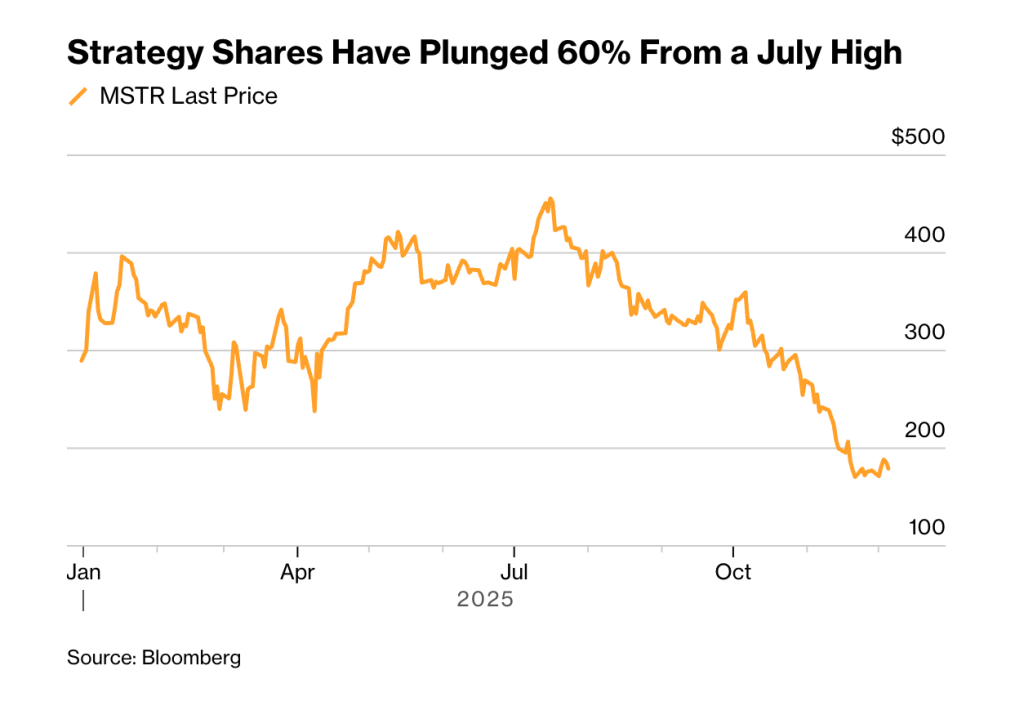
Strategy shares have dropped 60% from their July highs, even as they have risen by more than 1,200% since the company began buying Bitcoin in August 2020.

Michael Saylor's Bitcoin Strategy - Strategy Shares Chart
Source: Bloomberg

Investors took a look and understood that there’s not much yield from these holdings rather than just sitting on this pile of money,” B. Riley Securities analyst Fedor Shabalin told Bloomberg.

Debt Obligations Expose Structural Flaws

The fundamental problem plaguing these companies stems from how they fund cryptocurrency purchases.

Strategy and its imitators issued massive amounts of convertible bonds and preferred shares, raising over $45 billion across the industry to acquire digital tokens that generate no cash flow.

These debt instruments carry substantial interest and dividend obligations that cryptocurrency holdings cannot service, creating a structural mismatch between liabilities that require regular payments and assets that produce zero income.

Strategy faces annual fixed obligations of approximately $750 million to $800 million tied to preferred shares.

Companies that avoided Bitcoin for smaller, more volatile cryptocurrencies suffered the steepest losses.

Alt5 Sigma, backed by two Trump sons and planning to purchase over $1 billion in World Liberty Financial’s WLFI token, has crashed more than 85% from its June peak.

Strategy attempted to address funding concerns by raising $1.44 billion in dollar reserves through stock sales, covering 21 months of dividend payments.

Saylor Admits Potential Bitcoin Sales

The industry now faces its defining moment. Strategy CEO Phong Le acknowledged the company would sell Bitcoin if needed to fund dividend payments, specifically if the firm’s market value falls below its cryptocurrency holdings.

Those comments sent shockwaves through the digital asset treasury sector, given Saylor’s repeated insistence that Strategy would never sell, famously joking in February to “sell a kidney if you must, but keep the Bitcoin.

At December’s Binance Blockchain Week, Saylor outlined the revised approach, stating that “when our equity is trading above the net asset value of the Bitcoin, we just sell the equity,” but “when the equity’s trading below the value of the Bitcoin, we would either sell Bitcoin derivatives, or we would just sell the Bitcoin.

The reversal raises fears of a downward spiral where forced crypto sales push token prices lower, further pressuring treasury company valuations and potentially triggering additional selling.

Strategy’s monthly Bitcoin accumulation has collapsed from 134,000 BTC at the 2024 peak to just 9,100 BTC in November, with only 135 BTC added so far in December.

The company now holds approximately 650,000 BTC, valued at over $56 billion, representing more than 3% of Bitcoin’s maximum supply.

Market participants worry that leveraged traders using borrowed money to invest in these companies could face margin calls, forcing broader market selloffs.

Strategy has created a $1.4 billion reserve fund to cover near-term dividend payments, but shares remain on track for a 38% decline this year despite the company’s massive Bitcoin holdings.

The post Michael Saylor’s Bitcoin Playbook Backfires on 100+ Companies appeared first on Cryptonews.

Before yesterdayCryptonews

Bitcoin Price Prediction: Year-End $100K Target Alive – Here Are the Three Drivers That Matter

6 December 2025 at 06:52

Bitcoin may be holding slightly below $90,000, but data imply that the $100K year-end target is still alive as analysts point out that three Bitcoin Price Prediction indicators are flashing a green signal.

The 3-Key Drivers For Bitcoin $100k Year-end Target

The first and most critical driver is the shift in Federal Reserve monetary policy.

After months of reducing liquidity through quantitative tightening, where the central bank stopped reinvesting proceeds from maturing bonds and Treasury holdings, the Fed ended this program on December 1.

Markets are now positioning for an easing cycle.

QUANTITATIVE TIGHTENING DONE ; WHAT’S NEXT FOR $BTC?

Historically, Bitcoin and altcoins struggle during prolonged Quantitative Tightening (QT = red zone), which lasted three years and just ended on December 1, 2025.

What usually follows: an uptrend (black zone).

Once… https://t.co/oosjrrFd0E pic.twitter.com/VzxaTLa4bn

— CryptosRus (@CryptosR_Us) December 6, 2025

Data from the CME FedWatch Tool reveals that traders see an 87% likelihood of a rate reduction at the upcoming Wednesday meeting, with three additional cuts anticipated by September 2026.

This policy shift comes as tech sector borrowing costs rise amid substantial AI infrastructure debt, creating conditions where investors may seek alternative stores of value.

The combination of these factors could provide the momentum needed for Bitcoin to cross the six-figure threshold in the coming weeks.

The second driver is liquidity structure.

According to order-book data from CoinGlass, Bitcoin currently has two significant liquidity clusters: the downside liquidity around $90,000, which is currently being tested, and upside liquidity near $94,500.

If the latter is breached, a rally toward $100,000 becomes highly probable.

Bitcoin Price Prediction: Rising Channel Points to $100k Breakout

The third driver comes from technical analysis, which suggests a $100,000 recovery if BTC breaches the $95,000 resistance.

The 4-hour chart shows Bitcoin trading inside a rising channel, though the latest rejection near mid-range has pushed price back toward the lower trendline.

The key support level holding the structure together is $84,000. If BTC stays above that line, the overall channel remains intact, and a rebound toward $95,000 resistance becomes likely.

Bitcoin Price Prediction - Bitcoin Price Chart
Source: TradingView

A breakout above $95,000 would flip the structure bullish and open the path toward the $100,000 region, the next major liquidity target.

However, RSI has cooled off sharply and is leaning bearish, indicating weakened momentum.

If Bitcoin loses $84,000, the rising channel breaks down, and price could slide toward longer-term support around $80,000.

Maxi Doge Presale Gains Traction

While Bitcoin awaits bullish confirmation, Maxi Doge (MAXI) is emerging as a notable Ethereum-based meme coin with ambitions to replicate Dogecoin’s success story.

MAXI is channeling the community-driven energy that propelled DOGE from $0.00008547 in 2015 to its current $0.138 price, a remarkable +161,800x gain.

While replicating that exact trajectory may be ambitious, analysts believe Maxi Doge can deliver a modest 10-50x return for early adopters.

MAXI has now raised over $4.2 million and is building a vibrant community where holders share trading setups, early opportunities, and alpha insights.

Bitcoin Price Prediction - Maxidoge Banner

Beyond the meme appeal, 25% of raised funds will be deployed into high-potential plays, with profits reinvested directly into marketing to fuel exponential growth and community rewards.

To join the presale at the current $0.0002715 price, visit the official Maxi Doge website.

Then connect an Ethereum-compatible wallet like Best Wallet, and pay with ETH, BNB, or USDT.

You can swap existing crypto or use a bank card to invest in seconds.

The post Bitcoin Price Prediction: Year-End $100K Target Alive – Here Are the Three Drivers That Matter appeared first on Cryptonews.

MetaMask Enters Prediction Markets With Polymarket Integration

By: Amin Ayan
6 December 2025 at 05:12

MetaMask, the most widely used Ethereum wallet, is moving directly into the prediction market arena through a new integration with Polymarket, giving users the ability to trade event outcomes from inside their wallets.

Key Takeaways:

  • MetaMask has integrated Polymarket, allowing users to trade real-world event outcomes.
  • The integration adds one-tap funding from any EVM chain.
  • Polymarket’s rapid growth continues amid a potential $15 billion valuation.

“You can now trade on the future outcome of real world events inside your wallet,” Consensys’ Gabriela Helfet wrote, adding that users will also earn MetaMask Rewards points for every prediction placed.

MetaMask Becomes New Gateway to Polymarket With One-Tap Funding

The integration creates a new on-ramp for Polymarket and introduces “one tap funding,” allowing users to deposit with any token from any EVM-compatible chain.

The move further tightens the link between everyday crypto wallets and decentralized betting platforms, positioning MetaMask as a gateway not only to Web3 apps but also to real-world event speculation.

Polymarket has surged in popularity over the past year, fueled in part by heightened attention during the 2024 US election cycle.

Former President Donald Trump’s embrace of crypto and a more relaxed regulatory climate helped push the platform back into the US market.

The company is now reportedly exploring a valuation of up to $15 billion, following a $2 billion strategic investment from Intercontinental Exchange, the parent of the NYSE.

Predicting on MetaMask only takes a few seconds.🔮

We've enabled 1-click funding with any EVM token, or you can get started instantly if you have an existing @polymarket account! pic.twitter.com/zZtrQPDu3m

— MetaMask.eth 🦊 (@MetaMask) December 5, 2025

For MetaMask, the move comes as the wallet expands beyond its Ethereum-focused roots. In October, it launched multichain accounts that support both EVM and non-EVM networks, including Solana.

The wallet is also preparing for the rollout of a native MASK token, as parent company Consensys gears up for a potential IPO.

The move comes as Polymarket is recruiting staff for an internal market-making team that would trade against its own customers, mirroring a controversial feature already used by rival Kalshi that has drawn criticism and legal challenges.

As reported, the New York-based prediction market startup has approached traders, including sports bettors, to join the new unit, people familiar with the matter said, requesting anonymity because the plans remain private.

Prediction Markets Hit $13B in Record Activity

Prediction markets have crossed $13 billion in cumulative trading volume, marking a record high even as broader crypto markets cool.

The surge has drawn in major players across tech and finance, including Fanatics, Coinbase, and MetaMask, all of which have recently launched or expanded event-trading platforms.

Against this backdrop, YZi Labs, the venture firm founded by Binance co-founder Changpeng “CZ” Zhao, has been intensifying its involvement in the sector.

YZi-backed Opinion has emerged as one of the most surprising breakout platforms. Launched on BNB Chain in October, it recorded nearly $1.5 billion in weekly trading volume within its first month, briefly overtaking established names such as Kalshi and Polymarket.

Meanwhile, prediction markets platform Kalshi has secured a major media breakthrough after signing a partnership with CNN, making the company the network’s official prediction markets partner while closing a $1 billion funding round at an $11 billion valuation.

The post MetaMask Enters Prediction Markets With Polymarket Integration appeared first on Cryptonews.

CoinShares Debunks Tether Collapse Fears After Hayes Warning

6 December 2025 at 04:13

CoinShares head of research James Butterfill has dismissed insolvency concerns surrounding Tether following warnings from BitMEX founder Arthur Hayes, who claimed a 30% drop in the stablecoin issuer’s Bitcoin and gold holdings could wipe out its equity.

Butterfill’s December 5 market update affirmed that Tether maintains over $181 billion in total reserves against roughly $174.45 billion in liabilities, leaving a surplus of approximately $6.78 billion.

The dismissal comes as crypto markets navigate turbulence in Japanese government bonds and softer US employment data that showed a -32,000 print versus forecasts of +10,000.

Hayes sparked controversy on November 30 by arguing Tether is “running a massive interest rate trade” that positions the company for Federal Reserve rate cuts while exposing it to dangerous volatility through its $22.8 billion allocation to gold and Bitcoin.

The Tether folks are in the early innings of running a massive interest rate trade. How I read this audit is they think the Fed will cut rates which crushes their interest income. In response, they are buying gold and $BTC that should in theory moon as the price of money falls.… pic.twitter.com/ZGhQRP4SVF

— Arthur Hayes (@CryptoHayes) November 29, 2025

Tether CEO Counters Insolvency Claims with Financial Data

CEO Paolo Ardoino swiftly refuted Hayes’s assessment with detailed disclosures showing Tether Group’s total assets reach approximately $215 billion.

The executive explained that the company holds roughly $7 billion in excess equity on top of its stablecoin reserves, plus another $23 billion in retained earnings as part of Tether Group equity.

Bitcoin and gold represent just 12.6% of total reserves, with over 70% held in short-term U.S. Treasuries.

S&P made the same mistake of not considering the additional Group Equity nor the ~$500M in monthly base profits generated by U.S Treasury yields alone,” Ardoino stated, suggesting critics are “either bad at math or have the incentive to push our competitors.

re: Tether FUD

From latest attestation announcement (Q3 2025):

"Tether will continue to maintain a multi-billion-dollar excess reserve buffer and an overall proprietary Group equity approaching $30 billion."

Tether had (at end of Q3 2025) ~7B in excess equity (on top of the…

— Paolo Ardoino 🤖 (@paoloardoino) November 30, 2025

The company generated more than $10 billion in profit this year from interest income on reserve assets, making it one of the most efficient cash-generating businesses globally with just 150 employees.

His defense followed S&P Global’s November 26 downgrade of USDT’s peg-stability rating from 4 to 5, citing increased exposure to “high-risk” assets and “persistent gaps in disclosure.

Ardoino responded defiantly, declaring, “We wear your loathing with pride,” while positioning Tether as “the first overcapitalized company in the financial industry, with no toxic reserves.

The rating action carries profound implications under MiCA regulations, which prohibit USDT from EU exchanges with a “5” rating, potentially shifting institutional liquidity toward competitors like Circle’s USDC.

Industry Veterans Challenge Hayes’s Fundamental Analysis

Joseph Ayoub, former head of digital asset research at Citi, noted Hayes overlooked critical distinctions between Tether’s disclosed reserves and total corporate holdings.

The analyst explained that Tether maintains a separate equity balance sheet comprising mining operations and corporate reserves that aren’t publicly reported under the company’s “matching philosophy” for reserve disclosure.

Tether isn’t going insolvent, quite the opposite; they own a money printing machine,” Ayoub concluded, pointing to the company’s roughly $120 billion in interest-yielding Treasuries generating approximately 4% returns since 2023.

I spent 100’s of hours writing research on tether for @Citi. @CryptoHayes missed a few key points.

1) 𝐓𝐡𝐞𝐢𝐫 𝐝𝐢𝐬𝐜𝐥𝐨𝐬𝐞𝐝 𝐚𝐬𝐬𝐞𝐭𝐬 =/ 𝐚𝐥𝐥 𝐜𝐨𝐫𝐩𝐨𝐫𝐚𝐭𝐞 𝐚𝐬𝐬𝐞𝐭𝐬

When tether generates $ they have a separate equity balance sheet which they don’t… https://t.co/pHSRr245Up

— Joseph (@JosephA140) November 30, 2025

Banks operate on significantly lower fractional reserves of 5-15% in liquid assets compared to Tether’s overcollateralized structure. However, traditional institutions benefit from central bank lender-of-last-resort support that Tether lacks.

Hunter Horsley, CEO of Bitwise Invest, characterized Tether’s structure as “better than fractional banking reserves,” while CryptoQuant CEO Ki Young Ju dismissed Hayes’s warning as motivated by trading position management.

Former FT Alphaville editor Izabella Kaminska offered a deeper structural analysis, suggesting Tether’s thick equity buffer and retained earnings model creates “a capital structure that looks a lot like the banking model academic Anat Admati advocates: much thicker equity buffers, far less leverage, and minimal maturity mismatch.

Kaminska noted that if Tether’s depositor base proves willing to redeem directly in gold during stress situations, the metal becomes “the natural last-resort funding asset for its shadow/grey exposures and a hard-asset substitute for the lender-of-last-resort support that banks get from central banks.

🫣Analysts are overlooking how stablecoins that retain earnings (aka Tether) are evolving into something structurally unusual.

The reality is, as Tether’s retained earnings accumulate, they operate economically like a very thick equity buffer — far beyond the capitalisation… https://t.co/KXtsrG52kU

— Izabella Kaminska (@izakaminska) November 30, 2025

This cross-border redemption channel operates without dependence on synchronized regulatory frameworks.

The controversy emerges as Tether expands beyond stablecoin issuance into commodity trade lending, having deployed approximately $1.5 billion in credit across oil, cotton, wheat, and agricultural markets.

The company’s Q3 attestation showed USDT issuance increased by more than $17 billion during the quarter, lifting circulating supply above $174 billion, with October figures surpassing $183 billion.

The post CoinShares Debunks Tether Collapse Fears After Hayes Warning appeared first on Cryptonews.

Do Kwon Sentencing: US Wants 12 Years for Terra’s $40 Billion Crash

6 December 2025 at 04:04

Federal prosecutors are demanding a 12-year prison sentence for Terraform Labs co-founder Do Kwon for orchestrating the fraud that triggered TerraUSD’s catastrophic $40 billion collapse in 2022.

According to Bloomberg, the government described Kwon’s crimes as “colossal in scope” in a Thursday filing before US District Judge Paul Engelmayer, pointing to cascading market failures that ultimately contributed to FTX’s downfall.

Kwon will face sentencing on December 11, with his own legal team requesting just five years behind bars.

The 34-year-old South Korean entrepreneur pleaded guilty in August to conspiracy and wire fraud charges under an agreement capping prosecutorial recommendations at 12 years.

However, the statutory maximum reaches 25 years for his role in the algorithmic stablecoin fraud.

Do Kwon Sentencing
Source: Financial Times

Prosecutors Highlight Systemic Market Damage

The Justice Department’s sentencing memorandum emphasizes that Kwon’s fraudulent statements to customers triggered a chain reaction across cryptocurrency markets.

Prosecutors specifically cited the collapse’s contribution to Sam Bankman-Fried’s FTX implosion as evidence of broader systemic damage beyond Terra’s immediate investor losses.

Kwon admitted in court that between 2018 and 2022, he “knowingly agreed to participate in a scheme to defraud purchasers of cryptocurrencies” from Terraform Labs.

He acknowledged making false statements about TerraUSD’s peg restoration mechanisms and concealing Jump Trading’s secret role in propping up the stablecoin during a May 2021 depeg event that foreshadowed the larger catastrophe.

The timing carries added significance, as the Trump administration has largely eased the tough-on-crypto enforcement actions, as the Biden administration did before.

Most recently, President Donald Trump pardoned Binance founder Changpeng Zhao on October 23 after his conviction for anti-money laundering program failures at the world’s largest crypto exchange.

Although the administration defended the pardon, claiming it was reviewed “with the utmost seriousness.”

Defense Cites Montenegro Detention and Dual Prosecution

Kwon’s attorneys argue that nearly three years in what they describe as “brutal conditions in Montenegro” should factor heavily into sentencing calculations.

His legal team emphasizes that more extended imprisonment proves “far greater than necessary” to achieve justice, particularly given the substantial punishment already endured during extended foreign detention.

The defense filing highlights Kwon’s agreement to forfeit over $19 million and multiple properties under the plea deal reached with prosecutors in the Southern District of New York.

His lawyers further note that Kwon still faces trial in South Korea for identical conduct, where prosecutors are seeking a 40-year prison term that creates additional consequences warranting consideration in the American sentence.

Do Kwon seeks a five-year sentence for Terra's $40 billion collapse while facing a separate 40-year prosecution in South Korea.#DoKwon #FTXhttps://t.co/Ex54HALudb

— Cryptonews.com (@cryptonews) November 27, 2025

Prosecutors notably aren’t pursuing restitution from the millions of investors who lost $40 billion, citing the excessive complexity of determining individual losses across global markets.

US authorities have indicated they will support Kwon serving the second half of his sentence in South Korea if he complies with the plea terms and qualifies under international transfer programs.

Sentencing Disparities Raise Deterrence Questions

The contrasting approaches to major crypto fraud cases have sparked debate over the consistency of punishment.

Bankman-Fried received 25 years, plus an $11 billion restitution order, after a trial conviction on all counts, though recent reports indicate that four years were later reduced from that sentence.

Kwon’s guilty plea significantly reduced his exposure despite Terra’s larger $40 billion loss compared to FTX’s $8 billion fraud.

Legal experts note that federal sentencing guidelines for fraud at Terra’s magnitude would typically suggest advisory ranges approaching life imprisonment before statutory caps, making Kwon’s five-year request face steep odds.

⚖ US agrees to recommend a 12-year prison sentence and a $19m fine for Do Kwon after he has pleaded guilty to wire fraud and conspiracy#DoKwon #TerraUSD https://t.co/ktCCrKzob4

— Cryptonews.com (@cryptonews) August 12, 2025

The Judge handling his case, Engelmayer, is known for the strict handling of financial fraud cases, and most observers expect sentences of 15 to 20 years, given the massive victim impact.

The December 11 hearing will determine whether cooperation through guilty pleas significantly reduces punishment compared to trial convictions, as in Bankman-Fried’s case.

Kwon was arrested in Montenegro in March 2023 while traveling under a fake passport, triggering a lengthy extradition battle between US and South Korean authorities.

He spent nearly two years detained in the Balkan nation before being sent to America in January, where his case became one of the most closely watched legal battles in cryptocurrency’s brief history.

The post Do Kwon Sentencing: US Wants 12 Years for Terra’s $40 Billion Crash appeared first on Cryptonews.

❌
❌