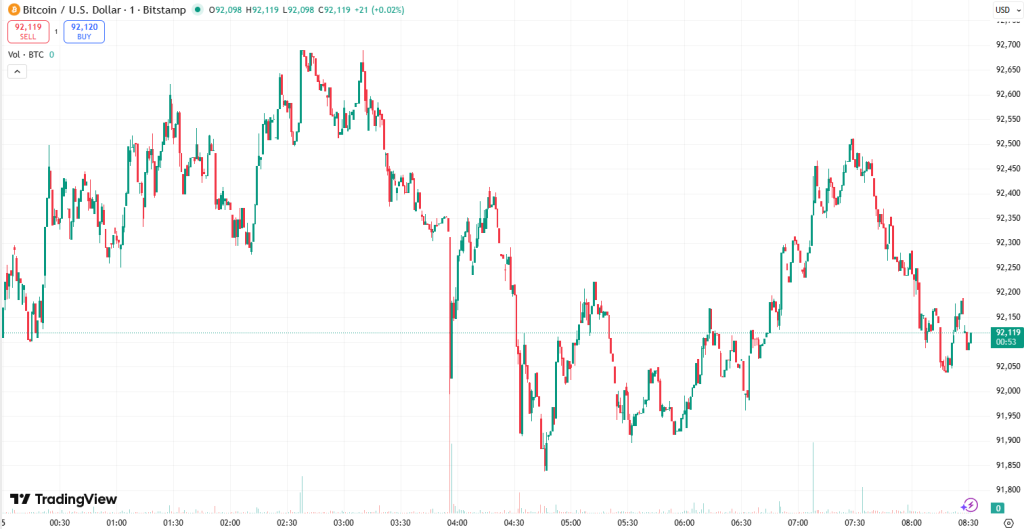
The crypto market has dipped by 1.5% today, as investors remain nervous ahead of the Federal Reserve’s next FOMC meeting on Tuesday and Wednesday.
Bitcoin and Ethereum are down by just under 2% in 24 hours, while XRP and Solana have suffered falls of around 4%.
Yet the market’s total capitalization ($3.2 trillion) has risen by 5.5% since Tuesday and by 7% since November 23, as the mood warms after a period of AI-bubble-related fears.
Now may therefore be a very good time to buy again, just as coins begin regaining strength, but before they rise too much.
PEPENODE’s approach to mining is simple: give users the ability to build their own virtual mining rigs, which they can run in order to earn rewards in external tokens, such as Fartcoin and Pepe (it will add other coins in the future).
Users can build their rigs by spending PEPENODE tokens to buy more virtual nodes, which they can upgrade and combine in order to earn more mining rewards.
The more nodes they have and the more they’ve upgraded them, the more rewarding PEPENODE’s mining system will be for users.
This creates a huge incentive to acquire more PEPENODE, which users can also stake for a passive income, with its current APY at 570%.
Demand for the new token could therefore be substantial, pushing its price up over time.
What’s also attractive about PEPENODE’s mining system is its flexibility: users can make their mining rigs as large as they like, but they can also sell off their nodes if they wish to scale down.
This is a very positive figure for such a new token and offers some sign of its future potential.
How to Join the PEPENODE Presale Before It Ends
Investors can tap into this future potential by going to the official PEPENODE website, where the coin is currently selling $0.0011778.
This price will rise later today and will continue to rise until the sale enters its final phase, just before PEPENODE lists.
Potential buyers should therefore act quickly, since the available signs suggest that PEPENODE has the potential to be one of 2026’s biggest new alts.
It will have a max supply of 210 billion PEPENODE, with allocations divided between node rewards, liquidity, development, marketing, and its treasury.
Its unique mining system is the main reason why it’s our best altcoin to buy now, and its upcoming launch could coincide with a major market recovery and rally.
A prominent Cardano supporter just warned the community that the layer-2 scaling solution Hydra may not be as safe as they think. Are investors’ funds at risk, and does this justify a bearish Cardano price prediction?
If you want to use Hydra, you trust the operators of Hydra Head.
You are only in control of your funds if you are one of the Hydra Head operators.
When you lock ADA into a Hydra Head, you sign a transaction with your private key. The transaction sends ADA into an on-chain… pic.twitter.com/hbh78guPLY
In a lengthy X post, a pseudonymous user named YODA, known for his support of the Cardano network for years, highlighted a potential flaw in the design of Hydra. This technical weakness would supposedly allow node operators to have a say on what happens with users’ tokens.
He clarified that the funds locked up in the L2 and delegated to third-party Hydra Heads (validators) are fully in control of the latter, not the owner.
In theory, if Hydra Heads collude and introduce false transactions, they would be able to sign them without necessarily having access to the private keys of the original owner of the ADA tokens.
“Every update requires signatures from all Hydra Head operators. Those signatures are made using the private keys of the operators, not the users,” YODA emphasized.
He added: “If they collude, they can ALL sign a malicious snapshot that splits all the funds between them.”
Cardano Price Prediction: ADA Finds Support at $0.40 But Bearish Trend Persists
Aside from Dogecoin (DOGE), Cardano (ADA) has been one of the worst-performing top 10 tokens this year, with total losses now reaching 49%.
The daily chart shows that the token has found support temporarily at $0.40.
However, ADA has been on a strong downtrend and is not yet showing signs of a trend reversal. The price needs to climb above $0.52 to reverse this downtrend.
Otherwise, ADA may face a much more dramatic correction to $0.32, meaning a total downside risk of 25%.
Well-established tokens like ADA have struggled to reach higher highs during this cycle. However, a new crypto presale called Maxi Doge ($MAXI) has managed to raise over $4 million in just a few weeks to launch its community-centered meme coin.
Maxi Doge ($MAXI) is The New Dogecoin-Themed Meme Coin
Maxi Doge ($MAXI) is an Ethereum meme coin that aims to bring together an army of like-minded ‘degens’ who are not afraid to make YOLO trades to get out of mom’s basement.
Through fun competitions like Maxi Gains and Maxi Ripped, token holders will compete by showcasing their highest-yielding traders to earn rewards and bragging rights.
They also get exclusive access to a hub through which they can share ideas, insights, setups, and more.
This is a vibrant community that fully embraces the energy that comes with bull markets.
Finally, up to 25% of the presale’s proceeds will be used to invest in high-potential projects.
The gains will be used to fund the project’s marketing efforts to make $MAXI known.
A cybersecurity firm just identified malicious code on the official Pepe website that could drain visitors’ wallets.
This development threatens to undermine investor trust and favors a bearish Pepe price prediction. But could it really go to zero?
According to Blockaid, a firm dedicated to detecting fraud in the crypto space, the site contains code known as “Inferno Drainer,” designed to immediately siphon funds from any connected wallet.
Blockaid's system has identified a front-end attack on @pepecoineth.
The token has lost more than three-quarters of its value since the start of the year. This reflects the market’s lack of appetite for PEPE.
The meme coin has temporarily found support at $0.0000040 following a robust jobs report in the United States. Although the Relative Strength Index (RSI) shows a mild bullish divergence, the price still needs to climb above $0.0000055 to reverse its latest downtrend.
PEPE may not hit zero after the news, as the website does not compromise the token’s smart contract.
However, the lack of coordination from the lead team does favor a bearish outlook as Pepe’s community engagement seems weak.
In contrast, a new crypto presale inspired by the Pepe viral meme called Pepenode ($PEPENODE) has managed to raise nearly $2.3 million to launch its fun mine-to-earn (M2E) game.
Pepenode ($PEPENODE) Makes Meme Coin Mining Fun and Hardware-Free
Crypto mining has commonly been associated with expensive hardware, complex algorithms, and so on.
Pepenode ($PEPENODE) is here to change that by introducing an M2E model that allows users to easily launch virtual mining servers.
By buying $PEPENODE, players can launch as many mining rigs as they want to earn points and compete to make it to the leaderboard.
Top miners receive airdrops of popular meme coins like Bonk ($BONK) and Fartcoin ($FARTCOIN) from the project’s rewards pool.
In addition, they can upgrade their setup to increase their output by investing additional $PEPENODE tokens. Up to 70% of the tokens used will be burned forever to reduce the circulating supply.
Mining has never been this easy, and the crypto community will soon start to notice. As such, the demand for $PEPENODE should skyrocket as more users join the platform.
Brad Garlinghouse argues that Bitcoin has yet to realise its full bullishness this cycle, and with it, bullish XRP price predictions may still be on track.
Speaking at Binance Blockchain Week 2025, he dismissed the current bearish mood around crypto as temporary and completely out of sync with the fundamentals supporting the market.
2026 has the potential to be “the most bullish year in crypto yet,” with institutions paving the way for a $180,000 Bitcoin.
The pro-crypto regulatory shift in the U.S. has unlocked one-fifth of global GDP, with institutional-level demand only just being tapped into with the introduction of ETFs.
And they have only just permeated the mainstream with traditional asset manager giants outside of digital-native firms playing “catch-up,” introducing their vast clientele.
Garlinghouse rejects the idea that ETF demand has peaked, noting the few crypto offerings represent just 1–2% of all ETF assets, a tiny fraction that leaves enormous upside.
XRP is a standout beneficiary with steps towards regulation, like the GENIUS stablecoin Act, paving the way for its infrastructure, like stablecoins, to become mainstream.
Ripple’s stablecoin approvals in Abu Dhabi and Dubai reinforce that point; stablecoins are no longer experimental, they’re becoming embedded in real financial systems.
XRP Price Prediction: How High Can XRP go in 2026?
December is shaping a strong launchpad into 2026 with a strong confluence of support laying the groundwork for a 4-month descending channel breakout.
The lower boundary of this consolidation is about to be retested, aligning with the level that has provided a firm bottom market throughout the bullish phase of the market cycle at $1.90.
A strong technical setup for a launchpad, and momentum indicators could support it.
While its most recent attempt has ended in rejection, the RSI is now testing the 50 neutral line after weeks in deep oversold territory. Strength is building towards a bullish shift.
While the MACD verges on a death cross below the signal line, it may prove short-lived as XRP nears the confluence zone.
The key breakout threshold lies at $2.70, a former strong support level that recently flipped to resistance. Reclaiming this zone could confirm a breakout targeting an 80% upside move to $3.70.
And with further U.S. interest rate easing expected into and growing institutional involvement, the setup could extend much higher, eyeing $5 in the approach of past all-time highs for a 150% run.
SUBBD: Strong Fundamentals at Their Earliest
With market conditions shaping up for a 2026 bull run, capital is rotating into the next high-upside contender, and increasingly, SUBBD ($SUBBD).
Positioned as an AI-powered content platform, SUBBD is redefining the $85 billion subscriber economy by giving creators true ownership and fans genuine access.
Never miss a sale again.
As a top creator, your audience is global. It's just not possible to cater to everyone – you can't be online 24/7
That's where your personal AI Assistant comes in, to handle requests and secure payments. Sleep peacefully knowing you're making money… pic.twitter.com/ju9VjLBmea
By cutting out the middlemen, $SUBDD puts control back in the hands of those who create real value.
Creators can monetize directly, while fans gain access to exclusive content, early releases, and meaningful interactions through token-gated perks.
The concept is already gaining traction. $SUBBD nears $1.4 million in presale, as investors back the shift toward a decentralized creator economy.
With SUBBD, both sides of the community win — creators earn more, and fans get closer while embracing the decentralization use cases crypto was built for.
Bitcoin is currently holding the fort above $91k after a prolonged downturn sent the world’s favourite crypto down to a seven-month low of $82,000 by November 21, not long after Bitcoin notched a new all-time high (ATH) of $126,080 on October 6.
The wider crypto market jumped 6% yesterday, lifting total capitalization to about $3.24 trillion. Today, momentum has cooled with a near 2% drop to $3.18 trillion. Bulls remain optimistic that this pause is consolidation, not capitulation.
Additionally, with crypto entering maturity, Bitcoin dominance is generally falling, indicating that the next substantial bull market may well be powered by altcoins. With that in mind, here’s why XRP, Solana, and Pepe are the best crypto to buy right now.
XRP ($XRP): Transforming Global Cross-Border Payments
Ripple’s XRP ($XRP) continues to dominate the international value-transfer niche thanks to its fast settlement speeds and minimal fees. The XRP Ledger (XRPL) serves as Ripple’s answer to slow, expensive legacy systems like SWIFT.
Major institutions, including the UN Capital Development Fund and U.S. government agencies, have highlighted the XRPL’s utility, while Ripple’s expanding network of fintech partners has helped XRP secure its position as the third-largest non-stablecoin, now capitalizing over $124 billion.
Ripple’s rollout of RLUSD, a dollar-backed stablecoin, marks a strategic move to capture the next generation of global payments infrastructure. Every RLUSD transaction burns a small amount of XRP, gradually reducing supply and reinforcing XRP’s long-term value proposition.
Following the resolution of its five-year legal battle with the SEC, XRP rallied to a July high of $3.65. Its current price near $2.09 represents a 43% retracement, but indicators suggest resilience. Furthermore, the relative strength index (RSI) sits at 36, indicating the token is likely to conclude today’s -2.8% selloff over the weekend and swing back into green.
The recent introduction of nine U.S.-based XRP ETFs is expected to accelerate institutional inflows throughout the holiday season. Additional ETF approvals may follow, and if Congress successfully passes comprehensive crypto legislation before year-end, XRP could target $15 or more by 2026.
Solana (SOL): The Speed Leader Closing In on a Potential $1,200 Target
Solana ($SOL) has cemented itself as a top-tier smart-contract network, prized for its lightning-fast transactions and low fees. With a market cap surpassing $76 billion and almost $9 billion in total value locked across its DeFi protocols, Solana remains Ethereum’s most formidable competitor.
New Solana spot ETFs from Grayscale and Bitwise, launched late last month, could open the door to significant capital inflows, echoing earlier institutional waves that propelled Bitcoin and Ethereum to new heights.
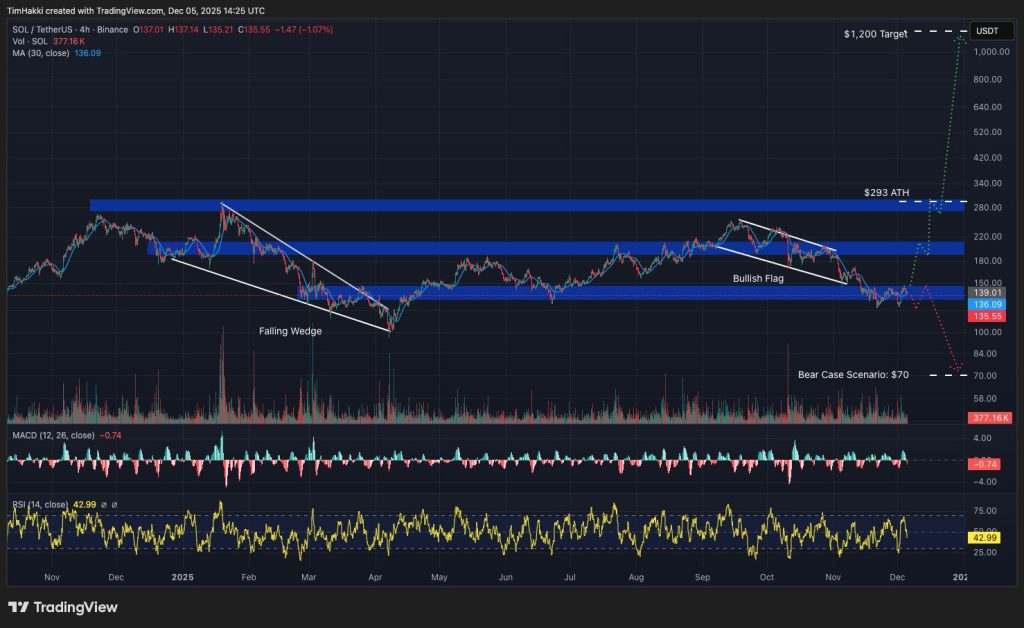
After dipping near $100 earlier this year, SOL now trades around $136, holding firm at a critical support zone. A bullish flag pattern has taken shape since mid-September, signaling a potential breakout.
The next major resistance sits near $250; a decisive move above that level could propel SOL beyond its prior ATH of $293.31, with a 4x up to $1,200 emerging as an ambitious yet attainable stretch target if the festive season turns into a bull market.
At the same time, Solana has become a leading hub for Real World Asset (RWA) tokenization, with giants like BlackRock and Franklin Templeton choosing the network to deploy tokenized financial products.
Pepe (PEPE): The Internet’s Favorite Frog Prepares for a Potential Upswing
Launched in April 2023, Pepe ($PEPE) quickly rose through the meme-token ranks, capitalizing on the global popularity of Matt Furie’s iconic character. Now boasting a market cap above $1.9 billion, PEPE enjoys an unmatched cultural presence, amplified when Elon Musk briefly switched his X profile picture to a Pepe meme, fueling speculation about his meme coin interests. Musk is publicly known to hold Bitcoin and Dogecoin.
Currently priced near $0.000004554, PEPE sits roughly 84% below its late-2024 high of $0.00002803 after a quiet summer and subdued fourth quarter.
Its RSI is now around 45, which indicates the token is neither overbought nor oversold and has plenty of headroom for further gains over the weekend.
With the token hovering near its lowest valuation in nearly two years, PEPE offers traders a high-upside entry point ahead of the next major market run. Clearer U.S. regulatory guidance could revive risk appetite and fuel a meme coin gold rush, potentially giving PEPE the momentum to retest its all-time high before year-end.
Bitcoin Hyper (HYPER): A Meme-Powered Bitcoin Layer-2 Built for 2026 and Beyond
One emerging project generating buzz ahead of 2026 is Bitcoin Hyper ($HYPER), a Bitcoin layer-2 solution wrapped in meme-culture branding. Despite its playful façade, HYPER targets real technical improvements with high-speed throughput, ultra-low fees, and smart-contract functionality.
Developed using the Solana Virtual Machine (SVM), HYPER features decentralized governance and a Canonical Bridge designed for seamless Bitcoin movement across multiple chains.
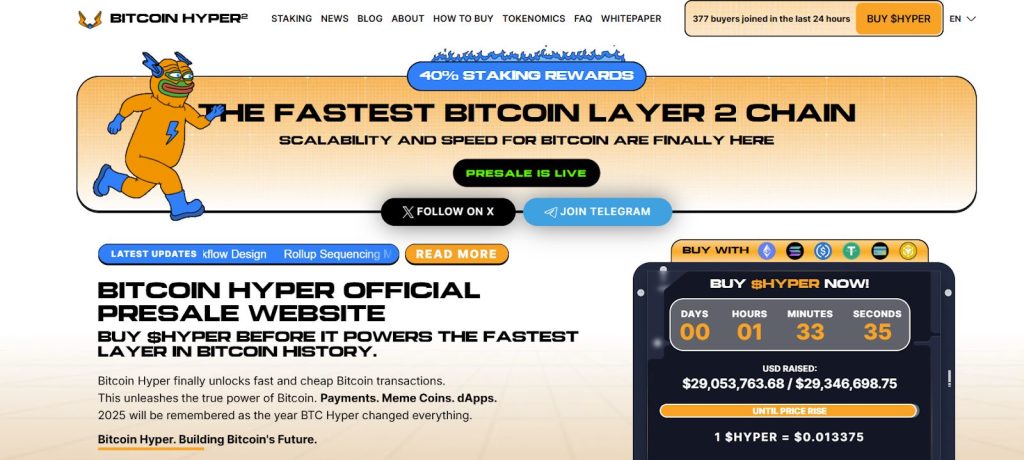
The presale has already raised around $29 million, and prominent analyst Borch Crypto forecasts the token could surge up to 100× upon exchange listing.
A recent Coinsult audit revealed zero contract vulnerabilities, boosting investor confidence. HYPER tokens power transaction fees, governance, and staking, with presale users able to earn up to 40% APY.
With the project’s full platform release planned for 2026, both seasoned Bitcoin users and newcomers have the chance to position themselves early in what may evolve into a major enhancement of Bitcoin’s utility landscape.
The newest iteration of Alibaba’s so-called “ChatGPT rival,” Qwen3-MAX, has rolled out fresh AI-driven price forecasts for XRP, Cardano, and Dogecoin as the month draws to a close. The model warns that all three cryptocurrencies could experience heightened turbulence over the coming weeks, with major moves possible in either direction.
Below are Qwen3-MAX’s two-track predictions showing both the potential upside and the risks each asset may face throughout December.
XRP (XRP): Alibaba AI Sees Either a Drop to $0.15 or a Run Toward $10 by Year-End
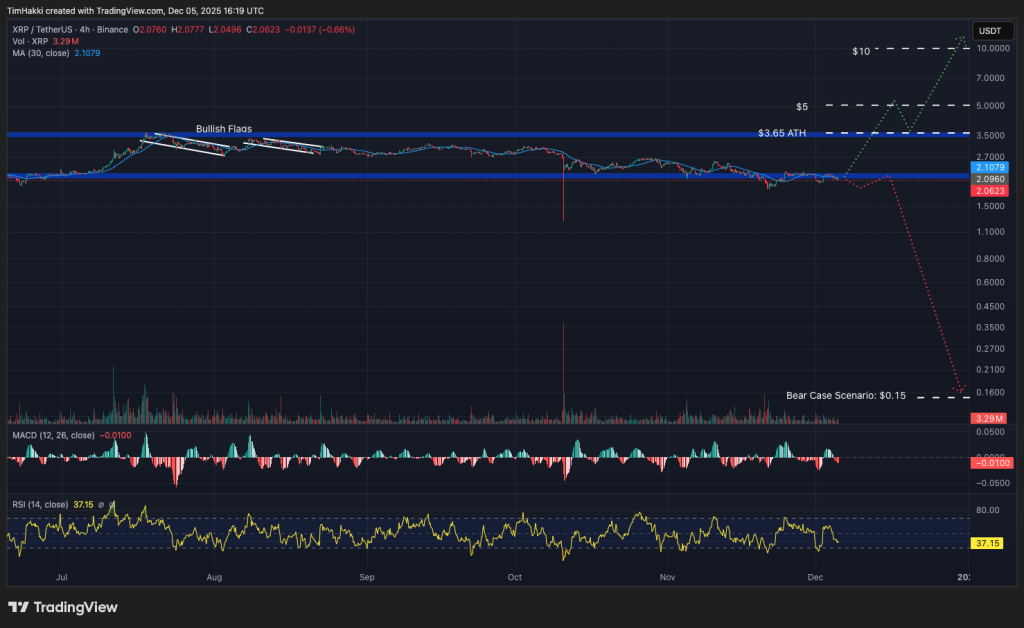
In its pessimistic projection, Alibaba’s model suggests Ripple’s XRP ($XRP) could retreat from its current $2.06 level to around $0.15, a drop of roughly 93%, should bearish sentiment continue dominating the market.
Source: Alibaba
Such a correction would contrast sharply with XRP’s powerful performance earlier this year, when the token soared to a new seven-year high of $3.65 in July following Ripple’s pivotal legal win over the U.S. Securities and Exchange Commission.
Throughout most of 2025, XRP has hovered between $2 and $3. Its relative strength index (RSI) now sits at a neutral 37 and is downtrending as traders cash in on profits today from a brief price bounce yesterday.
However, Alibaba’s bullish outlook paints a very different picture, one in which XRP surges 385% to touch $10 before New Year’s Eve, almost tripling its all-time high.
The recent debut of nine U.S. spot XRP ETFs could fuel a wave of institutional interest this holiday season, echoing the early inflows seen when Bitcoin and Ethereum ETFs first launched.
More ETF approvals are anticipated in the coming months, increasing the probability that 2026 becomes a transformative year for XRP. Investors who accumulate now may find themselves well-positioned ahead of that shift.
Cardano (ADA): Alibaba Predicts a Potential 2,274% Explosion in December
Cardano ($ADA) remains one of the most academically rigorous and research-driven blockchain ecosystems. Launched by Ethereum co-founder Charles Hoskinson, the network prioritizes peer-reviewed development, security, scalability, and long-term sustainability.
With a market cap exceeding $15.6 billion and more than $189 million in TVL, Cardano continues to stand out among layer-1 networks thanks to its active development community and expanding suite of decentralized applications.
According to Alibaba AI, ADA could surge to approximately $10 by early 2026, an extraordinary 2,274% climb from its current price at $0.4212 and more than triple its 2021 peak of $3.09.
Analysts note that Cardano’s carefully paced upgrades and robust fundamentals could position it as a major winner in the next DeFi-centric bull cycle.
Still, Alibaba’s bearish prediction warns that ADA could slip toward $0.10 if macro weakness worsens, representing a downside of just over 76% from today’s price.
Dogecoin (DOGE): Alibaba AI Targets $2.50 in Moonshot Scenario and $0.02 in Potential Collapse
Dogecoin ($DOGE), initially created in 2013 as a parody of the crypto boom, now accounts for roughly $21.7 billion in market value, representing nearly half of the $45.8 billion meme-coin sector.
The token formed several bullish chart setups in late summer and early autumn, but momentum has since cooled. In Alibaba’s more negative scenario, DOGE could sink to $0.02, a drop of about 86% from its current price of $0.1387.
Dogecoin’s all-time high of $0.7316 came during the retail-driven mania of 2021, and its long-discussed $1 milestone remains elusive. Yet Alibaba’s bullish case suggests DOGE could actually rally 1,700% to $2.50, or 18x its current price.
Meanwhile, real-world adoption continues to grow: Tesla accepts DOGE for merchandise, and payment platforms including PayPal and Revolut support DOGE transactions.
Maxi Doge (MAXI): A Rapidly Emerging Meme Coin Overlooked by Alibaba’s Forecasts
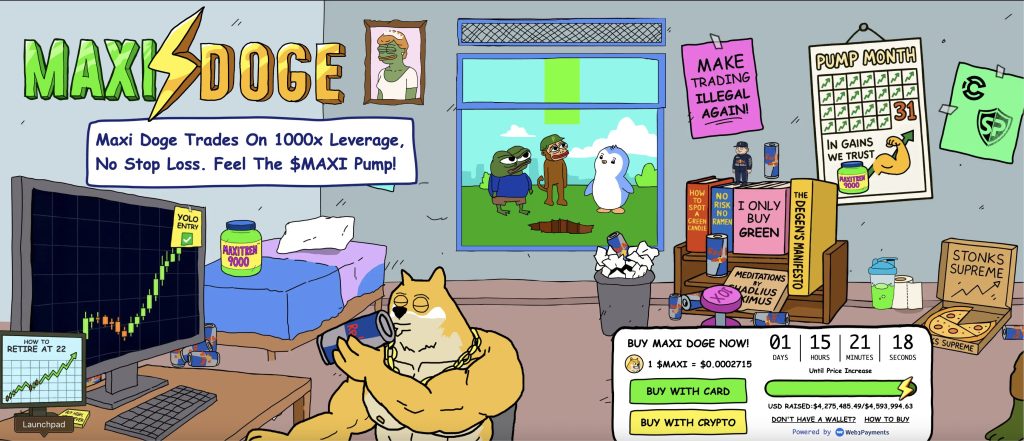
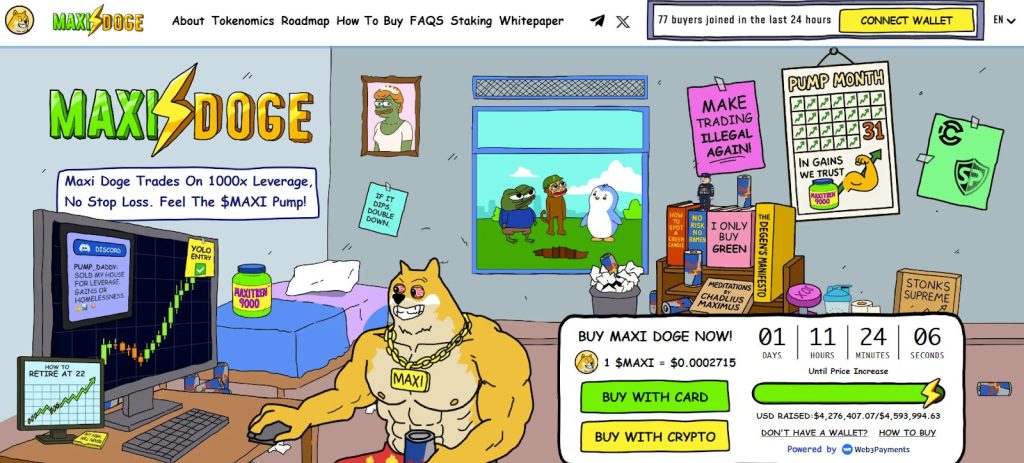
While Alibaba AI highlights the upside potential for major blue-chip cryptocurrencies, early-stage presale tokens potentially deliver far larger percentage gains. One fast-growing contender is Maxi Doge ($MAXI), which has already brought in nearly $4.3 million as it positions itself as the next breakout Doge-themed meme coin.
MAXI’s narrative follows Maxi Doge, a canine crypto bro and degen distant relative to the original Dogecoin. Maxi is obsessed with lifting weights, trading meme coins with 1,000x leverage, and cultivating a degen community across social media to help him usurp Dogecoin’s throne.
As an ERC-20 token, MAXI benefits from Ethereum’s energy-efficient proof-of-stake network and its massive developer ecosystem, advantages that Dogecoin’s older Bitcoin-style proof-of-work consensus mechanism does not offer.
The ongoing presale includes staking rewards of up to 72% APY, although yields decrease as more participants join in.
MAXI is currently priced at $0.0002715 in its active presale phase, with automated price increases scheduled in upcoming rounds. Buyers can participate using MetaMask or Best Wallet.
Poland’s efforts to align its crypto market with the European Union’s Markets in Crypto-Assets framework have hit a major political roadblock after lawmakers failed to override a presidential veto on a sweeping digital-asset bill.
This leaves the country as the last EU member without a national MiCA-style regime.
According to a Bloomberg report, the vote was held in the lower house of parliament on Friday, falling short of the three-fifths majority required to overturn President Karol Nawrocki’s decision to reject the legislation.
The outcome halts Prime Minister Donald Tusk’s push to place Poland’s crypto sector under tight regulatory control and forces the government to restart the legislative process from scratch.
Tusk Flags Crypto as National Security Threat Amid Russia Sabotage Claims
Tusk had framed the bill as a national security measure in the days leading up to the vote.
Addressing parliament, he said the unregulated crypto market had become a conduit for money laundering and foreign interference, including activity linked to Russia and Belarus.
He told lawmakers that Polish authorities had identified “several hundred” foreign entities operating in the domestic crypto market and warned that Russian intelligence and organized crime groups were exploiting digital assets for covert financing.
Government officials have tied those concerns to recent security incidents.
Last month, Warsaw blamed Russia for a blast on a key railway route used for supply traffic to Ukraine, an allegation Moscow dismissed.
Russia is using cryptocurrencies to pay saboteurs carrying out hybrid attacks across the European Union, according to a Polish security official. #Russia#Cryptohttps://t.co/MsOjIZjSfu
The blocked law would have implemented MiCA-style rules in Poland, introducing licensing for crypto-asset service providers, investor protection standards, stablecoin reserve requirements, market abuse bans, and strict anti-money laundering controls.
It also proposed granting authorities the power to block crypto-related websites through administrative orders, a provision the president described as opaque and vulnerable to abuse.
Political Tensions Rise After Poland Blocks Sweeping Crypto Oversight Bill
Nawrocki also criticized the scale of the bill, which exceeded 100 pages, contrasting it with far shorter implementing laws in neighboring Czechia and Slovakia.
He warned that heavy supervisory fees and added domestic restrictions would drive Polish crypto firms to register in other EU countries, costing Poland tax revenue and talent.
His chief of staff, Zbigniew Bogucki, said on Friday that the president is open to regulation as long as future proposals are not excessively restrictive.
The failure to override the veto leaves crypto companies operating in Poland without a clear national legal framework ahead of the EU’s July 1, 2026, MiCA compliance deadline.
The political dispute has increasingly drawn in industry players.
Nawrocki has portrayed himself as a defender of the crypto sector and was endorsed before his election by Kristi Noem, a senior U.S. official, at a conference in southeast Poland sponsored by trading platform Zondacrypto.
Poland has elected Karol Nawrocki, a conservative who says crypto should be “born in freedom, not buried in red tape.”#poland#cryptohttps://t.co/BVJXhQBnrK
The exchange later stated that it accepts no Russian clients and fully complies with anti-money laundering rules.
Foreign Minister Radosław Sikorski added another dimension to the dispute on Friday, saying on radio RMF FM that the crypto industry sponsors figures across the right wing of Polish politics, explaining the sharp resistance to tighter oversight.
Polymarket is recruiting staff for an internal market-making team that would trade against its own customers, mirroring a controversial feature already used by rival Kalshi that has drawn criticism and legal challenges.
According to Bloomberg, the New York-based prediction market startup has approached traders, including sports bettors, to join the new unit, people familiar with the matter said, requesting anonymity because the plans remain private.
Polymarket declined to comment on the recruitment effort.
The move comes as the platform prepares its full U.S. relaunch after securing regulatory clearance from the Commodity Futures Trading Commission, having paid a $1.4 million penalty in 2022 for operating an unregistered derivatives exchange.
Kalshi’s Market-Making Unit Faces Legal Scrutiny
Kalshi already operates an in-house trading arm, Kalshi Trading, which places bids on the exchange and effectively takes opposing positions to customers’ bets.
Company executives have defended the unit as necessary to create liquidity and improve the user experience.
Still, critics argue it creates inherent conflicts of interest and makes Kalshi resemble a traditional sportsbook rather than a neutral peer-to-peer platform.
Some are now claiming that the company is a gambling company and not a prediction company.
“Let’s just call a spade a spade, it’s gambling, lots of things are gambling,” a X user said.
A proposed class action lawsuit filed last month alleges that Kalshi Trading sets betting lines that disadvantage customers, claiming “consumers place bets on Kalshi, they face off against money provided by a sophisticated market maker on the other side of the ledger.“
Kalshi co-founder Luana Lopes Lara dismissed the lawsuit as a “pure smear campaign” on social media.
She stated that Kalshi Trading operates unprofitably and receives “no preferential access or treatment.”
However, the legal challenge shows mounting concerns about whether prediction markets function as advertised, neutral platforms where users with differing opinions trade directly with each other.
1. Rebrand gambling as asset allocation 2. Rebrand sportsbook as truth engine 3. Rebrand bets as predictions 4. Spin up in-house market maker to c̶o̶m̶p̶e̶t̶e̶ collaborate with c̶u̶s̶t̶o̶m̶e̶r̶s̶ fellow investors for the greater good
The agency granted temporary relief from certain swap data reporting requirements, allowing the platform to operate within the same framework governing federally supervised U.S. trading venues.
Prediction market platform Polymarket says it has received an Amended Order of Designation from the CFTC.#Crypto#CFTChttps://t.co/H44tIIxPaz
Founder and CEO Shayne Coplan confirmed receiving “the green light to go live in the USA” and credited CFTC staff for completing the process in record time.
The regulatory clearance caps a lengthy journey that intensified in November 2024 when the FBI raided Coplan’s Manhattan residence and seized electronic devices as part of an investigation into whether Americans continued accessing the site through VPNs despite the 2022 ban.
Despite being barred from U.S. operations since 2022, Polymarket expanded aggressively overseas, recording roughly $6 billion in wagers during the first half of 2025 alone.
The platform gained global attention during the 2024 presidential election cycle, as its markets closely tracked Donald Trump’s odds of winning.
Market Makers and Growing Institutional Interest
Prediction markets rely heavily on market makers willing to take less popular trades, as the platforms match buyers with sellers on binary yes-or-no contracts.
Both Polymarket and Kalshi have offered incentives rewarding heavy users who provide liquidity, while a small number of traditional financial trading firms, including Susquehanna International Group and Jump Trading, have begun serving as external market makers on Kalshi.
The broader debate centers on whether prediction markets genuinely differ from traditional gambling operations.
During a public appearance last month, Coplan called conventional sportsbooks a “scam” that “rip off the consumer,” positioning Polymarket as a transparent alternative where users trade against each other rather than facing house odds designed to extract profits.
The crypto market is bleeding as leveraged liquidations intensify, sending Bitcoin back below $90,000.
Analysts are warning that if bulls fail to defend the critical $84,000 support level, Bitcoin’s price prediction could tilt into a full-blown bear market.
$200M Wiped Out As Crypto Liquidations Trigger Market-Wide Selloff
The carnage follows today’s massive options expiry event, which traders had been monitoring closely.
A staggering $3.357 billion worth of BTC options with a max pain point at $91,000 expired today, alongside $668 million worth of ETH options with a max pain at $3,050.
Prominent trader TraderThanos is leaning heavily bearish as the 5-day candle closes below $93,000.
“Maybe we get another retest of 93k-93.2k. That would align more perfectly with my current bias. The next leg down takes us to 76k,” he warned.
Thanos highlighted a critical technical breakdown: “This is the first time price is trading under those Moving Averages since June/July of 2023,” referring to the 100 EMA and 100 MA on the 5-day timeframe.
If price stays beneath these moving averages, he expects a drop to the $72,000-$76,000 range.
Adding to the bearish sentiment, the odds of Bitcoin hitting $80,000 by year-end have now surpassed 40% on Polymarket.
Bitcoin Price Prediction: Bulls Must Hold $84K or Face $76K
Bitcoin is trading below all major moving averages on the 4-hour chart, keeping the broader structure tilted bearish.
The 200-MA near $95,000 remains the key resistance that must be reclaimed to restore bullish momentum, but repeated rejections show sellers aggressively defending that zone.
Immediate support sits around $84,000, which stabilized the price during the last flush.
Source: TradingView
However, if Bitcoin fails to bounce strongly from this level, the broader corrective structure could extend toward deeper support near $76,000, where a more meaningful reversal becomes likely.
Bitcoin’s direction remains biased lower as long as it stays capped under $95,000.
A reclaim of that level would signal trend restoration, but until then, indicators point toward continued weakness.
Bitcoin Hyper Presale Surges Past $29M Amid BTC Weakness
As Bitcoin struggles, investors are turning to Bitcoin Hyper ($HYPER), a project working on bringing speed and affordability to Bitcoin’s blockchain for decentralized applications.
Built on Solana-based architecture, Bitcoin Hyper accelerates transaction speeds while slashing network fees.
This enables developers to deploy DeFi platforms, meme coins, and payment solutions that Bitcoin holders can access without abandoning the original blockchain.
The presale has raised over $29 million, with tokens priced at $0.013375 and strong institutional interest driving momentum.
Early investors can benefit from presale pricing at the current $0.013385 price, with some analyses suggesting potential 10-15X ROI by 2026.
To buy $HYPER at its discounted presale price, head to the official Bitcoin Hyper website and link your wallet, such as Best Wallet.
Then connect a wallet (Best Wallet, MetaMask, or Coinbase Wallet) and select payment (ETH, USDT, BNB, SOL, or USDC).You can also use a bank card for instant access.
Bitcoin is now trading near $89,000 after slipping under $90,000 again, and most large-cap tokens are lower on the day, which keeps the Crypto Fear & Greed Index around 25 and indicates that anxiety has eased only slightly from last week while conviction remains thin and easily shaken by routine headlines.
The seasonal “Santa Claus rally” enters the conversation each December because equity desks track a tendency for late-month strength, yet for digital assets, the calendar effect only matters when liquidity and positioning are prepared to carry bids across sessions rather than fade into the close, which is not the profile this market has shown in recent days.
Bitcoin Price (Source: CoinMarketCap)
Seasonality Needs More Than A Calendar
If a holiday lift is going to matter for crypto, order-book depth on the largest spot pairs needs to rebuild into and after the United States session so that routine headline flurries do not push price through thin ladders, and spreads need to remain tight during moderate selling so execution costs do not sap appetite for adding risk late in the day.
Derivatives should confirm the shift with funding that moderates without relying on squeeze-driven bursts and with a futures basis that settles toward neutral rather than flipping repeatedly, because those signs show that leverage is resetting in a controlled way.
Flows then complete the picture when creations for spot Bitcoin products appear in a steady run instead of one-off prints and when net stablecoin issuance turns higher for more than a session or two, since those patterns show new dollars entering rather than the same capital recycling through a narrower set of venues.
Macro drivers still shape the path into year-end because a firm dollar and higher yields have repeatedly leaned on risk assets, meaning that softer rate expectations would remove a headwind, while any renewed hawkish tone would keep bids cautious and push market makers to carry less inventory through event windows.
Rotation beyond Bitcoin usually follows improved depth in the leader rather than leading it, so a healthier backdrop would show advances broadening from Bitcoin into larger caps only after order books thicken and funding calms.
For desks that watch sentiment, the index near 25 says fear dominates, yet not at the extreme levels seen earlier, which can allow short-lived rebounds on quiet days.
But a durable turn requires evidence that arrives together rather than piecemeal, including deeper books through the U.S. close, steadier funding and basis across multiple sessions, a visible run of ETF creations, and a rise in net stablecoin supply that survives beyond a single headline cycle.
If those pieces align, the case for a December lift improves, and the seasonal story becomes a tailwind rather than a distraction, while in their absence, the market remains one adverse policy remark or liquidity wobble away from another test of support.
A chaotic token launch on Solana has placed decentralized finance platform HumidiFi and Jupiter Exchange under intense scrutiny after blockchain investigators linked a single actor to the mass botting of the $WET public presale, capturing the majority of the allocation within seconds.
According to a detailed on-chain investigation published by Bubblemaps, one entity operating under the alias “Ramarxyz” used more than 1,000 wallets to claim roughly 70% of the $WET public presale allocation.
BREAKING: We found the identity of the $WET sniper
"Ramarxyz" claimed 70% of the @HumidiFi presale using 1,000+ wallets
The sale, which took place through Jupiter’s Decentralized Token Formation (DTF) launchpad, sold out in just two seconds before most retail participants could interact.
HumidiFi Confirms Bot Attack as Blockchain Data Traces Sale to One Actor
HumidiFi later confirmed that a large bot farm had overwhelmed the public sale. Bubblemaps found that at least 1,100 of the 1,530 participating addresses were controlled by the same actor.
The wallets followed a repetitive funding pattern, with each receiving exactly 1,000 USDC from centralized exchanges shortly before the sale.
One wallet allegedly broke the pattern by receiving funds from a private address that could be traced to the Twitter handle @ramarxyz through previous public blockchain activity.
Rather than acknowledging the activity, the individual later publicly suggested that HumidiFi should refund the sniper’s allocation, despite being linked to the exploit.
Shortly afterward, HumidiFi confirmed that all suspected bot allocations had been canceled and that legitimate presale participants would instead receive a prorated airdrop.
A separate on-chain analysis by trader Gautam Mgg showed that 4% of the public allocation went to just 10 wallets, with four wallets alone committing 40% of the entire public sale supply using bots.
$WET@humidifi : 4% Public Sale Supply went to just 10 wallets
Presale was completely botted, basically rugged And yes, @JupiterExchange is also at fault.
Here’s the proof: These 4 wallets alone committed 40% of the 4% public sale allocation using bots (finding more… pic.twitter.com/5dGz3bHwjZ
The wallets were publicly listed using Solana explorers. Gautam also blamed Jupiter Exchange for failing to introduce basic bot protection measures, such as CAPTCHA or last-minute address rotation.
Jupiter had earlier announced that the $WET token sale was fully completed, raising $5.57 million across its Wetlist, JUP stakers, and public sale phases.
It’s official: Public sale phase for $WET has SOLD OUT!
The Decentralized Token Formation for @HumidiFi is now officially concluded, raising a grand total of $5.57m across the Wetlist, JUP stakers and public sale phases.$WET token for successful contributors will be claimable… pic.twitter.com/o5Hleg91z1
The public phase offered 30 million tokens at $0.069 per token, capped at $1,000 USDC per wallet. The token is scheduled to become claimable on December 9 alongside the launch of liquidity pools.
HumidiFi to Reissue Token After Aborting Disrupted $WET Launch
Following the incident, HumidiFi announced it would abandon the compromised launch and create a new token instead.
The protocol said all legitimate Wetlist and JUP staker participants would receive a pro-rata airdrop under a newly deployed contract that has been audited. A new public sale is now scheduled.
Some real dry shit happened today.
Humidifi started 6 months ago from nothing, straight from the trenches of DeFi 1.0.
In those 6 months, for SOL-USD, we started quoting tighter and doing more volume than Binance. We did not kiss any ass or bend the knee to anyone. We started…
HumidiFi launched in mid-2025 and has grown into one of Solana’s most active decentralized exchanges, processing over $1 billion in daily trading volume and often accounting for more than one-third of all spot trading on the network.
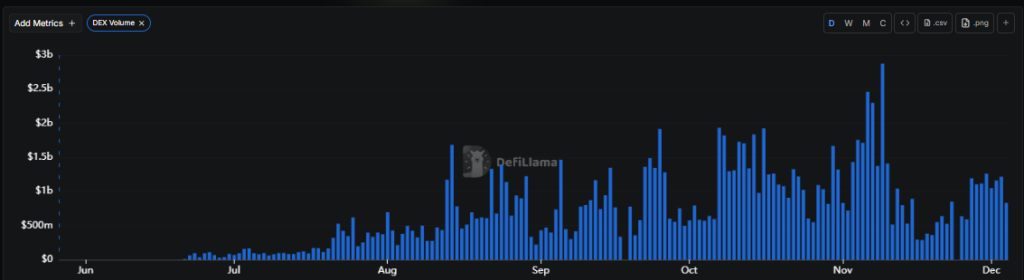
According to DefiLlama, its Dex volume currently sits close to $30 billion over 30 days, while its cumulative volume sits at over $122 billion.
The $WET token was introduced as the protocol’s staking and fee-rebate asset and was promoted as a community-driven distribution using Jupiter’s DTF platform.
The incident has revived broader concerns over token distribution fairness across launchpads.
In September, Bubblemaps also flagged a separate Sybil attack linked to the MYX token airdrop, where roughly 100 newly created wallets claimed nearly $170 million in tokens after being funded simultaneously from OKX.
That case similarly raised questions about identity controls and launch design weaknesses.
Jupiter DTF was introduced as a transparent, trust-minimized alternative to traditional token launches, combining curation and on-chain verification. The $WET sale was its first live deployment, making the failure a major test for the model.
Neither Jupiter Exchange nor the individuals accused have issued a detailed technical breakdown of what failed at the infrastructure level.
A suspected British hacker linked to one of the largest single Bitcoin thefts ever recorded may have been detained in Dubai, according to claims made Friday by on-chain investigator ZachXBT.
In a post shared on his Telegram channel on December 5, ZachXBT said a man known online as “Danny” or “Meech,” identified as Danish Zulfiqar, appears to have been taken into custody by authorities, with a portion of the stolen crypto allegedly seized.
He pointed to roughly $18.58 million in digital assets now held in a single Ethereum wallet that he says is connected to the suspect.
ZachXBT noted that several wallets previously tied to the alleged hacker had funneled funds into the same address in a pattern commonly seen during law enforcement seizures.
He also claimed Zulfiqar was last known to be in Dubai, where a villa was reportedly raided.
Authorities Silent as Reports Surface of Possible Arrest in $243M Bitcoin Hack
According to the investigator, others linked to the suspect have also gone silent in recent days.
So far, there has been no official confirmation from Dubai Police or UAE authorities regarding any arrest, asset seizure, or raid connected to the case.
Local media outlets in the region have also not verified the claims.
The possible arrest follows months of investigation into the August 19, 2024, theft of 4,064 Bitcoin, worth about $243 million at the time. The funds were taken from a single Genesis creditor who accessed assets through Gemini.
ZachXBT made the case public in September, alleging the theft was carried out through a coordinated social engineering attack.
According to his findings, the attackers posed as Google support staff and convinced the victim to reset two-factor authentication.
They then used remote access software to take control of the account. After extracting the private keys, the attackers drained the wallet and moved the Bitcoin through a web of exchanges and swap services in an attempt to launder the funds.
ZachXBT initially tied the attack to three online aliases, “Greavys,” “Wiz,” and “Box”, later naming Malone Lam, Veer Chetal, and Jeandiel Serrano as the people behind those accounts.
He said his findings were shared with law enforcement authorities.
U.S. Charges, UK Guilty Plea, Thailand Arrest Mark New Phase of Crypto Crime Probes
U.S. prosecutors later filed criminal cases connected to related activity. In September 2024, the Department of Justice charged two suspects in a $230 million crypto fraud scheme.
Broader racketeering charges later described an operation totaling more than $263 million, including the Genesis-linked Bitcoin theft. Court documents outlined a mix of SIM swaps, social engineering tactics, and even physical burglaries.
Prosecutors said the stolen funds were spent on high-end cars, travel, and nightlife. One of the defendants, Veer Chetal, was later accused of carrying out another $2 million crypto theft while out on bond.
ZachXBT has also connected Zulfiqar to the August 2023 Kroll SIM swap incident, which exposed the personal data of creditors tied to BlockFi, Genesis, and FTX.
That breach later played a role in more than $300 million worth of crypto thefts through follow-up phishing and impersonation schemes.
The reported Dubai development comes as crypto-related law enforcement activity continues to pick up worldwide.
Thai police arrest alleged FINTOCH mastermind behind $31 million crypto Ponzi scheme that defrauded investors across multiple Asian countries.#Thailand#Policehttps://t.co/Mccq2KpZfb
In the UK, authorities recently secured a guilty plea from Zhimin Qian in a case tied to what officials described as the largest crypto seizure in history, involving more than $6.7 billion in Bitcoin.
Outside of investigations, ZachXBT has also remained active in public disputes.
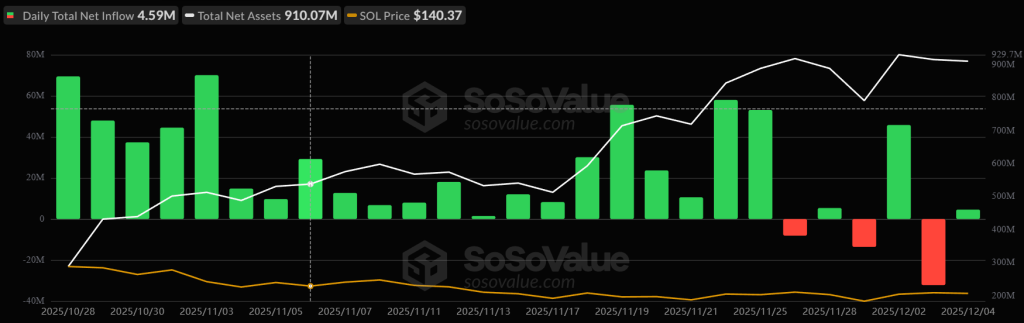
Institutions are jumping at the opportunity to gain exposure to SOL staking yields, contributing 3.1 million SOL in a testament to bullish Solana price predictions.
As the designated staking backend for institutional products, Staking service Marinade has seen its Total Value Locked (TVL) increase 3 fold to $436 million over November.
Marinade Total Value Locked (TVL). Source: SolanaFloor.
This adoption has been catalysed with the launch of several spot SOL staking ETFs as a regulated means to gain access to the altcoin’s yields.
Over November, these ETFs saw a 22-day inflow streak despite amounting to the second-worst month of the year. TradFi markets chose to buy the dip on SOL as other ETFs like Bitcoin bled.
Demand that only stands to grow with fresh touch points for institutional-grade exposure, like the recently unlocked 50 million clientele of the second-largest asset manager, Vanguard.
As the favored accumulation strategy over Bitcoin, Solana is in a favorable position to outperform the leading cryptocurrency if the bull run returns for 2026.
Solana Price Prediction: Where Could Solana Go In 2026
December is shaping a strong launchpad into 2026 as Solana forms a clean double-bottom pattern along a firm support throughout the bullish phase of this market cycle at $120.
And with momentum indicators verging on bullishness, the structure is acting as a clear bottom to the two-month Solana price decline.
While its most recent attempt has ended in rejection, the RSI is now testing the 50 neutral line after weeks in deep oversold territory. The MACD has also built a strong lead on the signal line.
Both suggest the early stages of a fresh uptrend as buyers step back in.
Still, the Solana price has faltered at the double-bottom neckline around $145, a level it must reclaim as support for the $210 target to play out.
Such a shift would set up a retest of the wider year-long descending-triangle resistance, creating a breakout scenario targeting levels near $500 for a potential 260% gain.
Though a near-term catalyst, such as a decision to ease U.S. interest rates next week, may be required to stimulate risk sentiment.
And with further macroeconomic easing expected through 2026 and growing institutional involvement, the setup could extend toward a much larger move, eyeing $ 1,000 for a 630% run.
Bitcoin Hyper: A Reason Bitcoin Could Still Outpace Solana
Those who jumped to Solana as an alternative Layer 1 to the leading crypto may be forced to reconsider, as the Bitcoin ecosystem finally addresses its biggest limitation: ecosystem growth.
Bitcoin Hyper ($HYPER) is bridging Bitcoin’s security and stability with Solana’s speed, creating a new Layer-2 network that unlocks scalable and efficient use cases Bitcoin couldn’t support alone.
The project has already raised over $30 million in presale, and post-launch, even a small share of Bitcoin’s trading volume could push its valuation significantly higher.
Bitcoin Hyper is fixing the slow transactions, high fees, and limited programmability that have capped Bitcoin’s potential – just as the market turns bullish
Fear still hangs over altcoin season, but the sharp edge of panic has softened. The Crypto Fear and Greed Index is now 25, a modest recovery from November’s plunge near 10, yet the mood remains unsettled, and traders continue to move with hesitation rather than conviction.
Altcoins move inside that same heavy climate. Most large names sit in the red today, liquidity stays present, but flows lean toward defense, and new money prefers short-dated trades instead of long commitments.
Against that background, Zcash is one of the few popular tokens in positive territory, while Ethereum, Solana and Hyperliquid track the downtrend, which gives a clean snapshot of where capital still experiments and where it pulls back.
Bitcoin And Sentiment After November’s Shock
Bitcoin continues to dictate the tone. Derivatives screens show a reduction in leverage across both long and short positions, while spot flows lean toward sellers who continue to trim exposure after several weeks of steady declines.
Price action carries the look of a market still searching for stability, not one ready for a quick reversal.
Bitcoin Price (Source: CoinMarketCap)
Ethereum, Solana, and Hyperliquid Track The Pullback
Major altcoins follow that direction. Ethereum is trading near $3,090 after falling by roughly 2.5% in 24 hours, with order book activity showing more supply than demand at current levels. Solana sits near $134 after a 5.5% drop, extending the cooling that began once traders reduced exposure to high beta assets.
Hyperliquid is trading around $31, down by about 8%, and activity on its perpetual pairs has slowed compared with the pace seen in early November. These moves together show how broad the retracement remains, even as volatility cools relative to last week.
Zcash Holds A Bounce After Its November Peak
Zcash breaks from the trend. ZEC is trading near $384, up by about 10% in 24 hours, marking one of the few gains across large liquid names. The token had fallen steadily from its November peak near $700, yet recent market data show more active positioning at current levels and enough liquidity across venues to support a modest rebound.
Zcash@Zcash shared a series of updates covering key developments across the ecosystem. Highlights include:
• @ZcashFoundation released its Q3 2025 report, highlighting engineering progress and the launch of the Shielded Aid Initiative to support privacy-preserving digital aid… pic.twitter.com/Nc06Yo759I
The move does not form a new upward trend on its own, but it demonstrates the way privacy focused tokens can draw interest during quieter, defensive phases when traders search for assets with a historical pattern of occasional outperformance.
What This Phase Means For Altcoin Season
The current market still lacks the conditions for a broad altcoin season. Sentiment has improved from last week’s extreme lows, yet positioning remains conservative, and flows continue to concentrate in larger, more liquid assets.
Until Bitcoin can stabilize over a longer stretch and macro uncertainty eases, rotation is likely to stay narrow and sporadic. For now, the market sits in a phase where isolated tokens can rise on their own dynamics, but the overall environment still leans toward caution rather than a full risk recovery.
Wall Street is preparing to welcome a major player to the New York Stock Exchange as Twenty One Capital moves toward its public debut.
This Bitcoin price prediction examines what the landmark listing could mean for BTC’s trajectory amid ongoing market volatility.
Historic Bitcoin Treasury Firm Goes Public
Bitcoin treasury firm Twenty One Capital, Inc., has received shareholder approval for its business combination with Cantor Equity Partners (CEP).
The transaction is expected to close around December 8, with the merged entity’s Class A common stock anticipated to begin trading on December 9 under the ticker symbol XXI.
“Game on. See you at the NYSE on Tuesday,” Twenty One CEO and co-founder Jack Mallers posted on X.
In July, Twenty One Capital announced it would hold about 43,500 BTC, currently worth approximately $4 billion, when it begins trading, following an addition of 5,800 BTC from stablecoin giant Tether.
This positions the firm as potentially the third-largest corporate Bitcoin holder, trailing only Strategy and Bitcoin miner MARA.
Twenty One, which was first announced in April, is a collaborative venture between Tether, Bitfinex, Cantor Fitzgerald, and SoftBank.
The company’s name refers to Bitcoin’s total possible supply of 21 million coins, with about 19.95 million BTC mined to date.
Bitcoin Price Prediction: BTC Eyes $81K Drop as Sellers Dominate $94K Resistance
Bitcoin is showing signs of weakening after failing to break through the $94,000 rejection block, which has acted as a strong ceiling throughout the past month. The chart clearly shows a sequence of lower highs forming right beneath this level, indicating that sellers are still in control.
Even though price briefly formed a higher high on the most recent bounce, momentum quickly faded, and the market slipped back below the key mid-range structure.
Source: TradingView
The bullish double-bottom that launched the prior rally has now run into resistance strong enough to stall the trend, and the current lower-high structure points toward exhaustion on the buyer side.
If Bitcoin loses strength below $90,000, the next support sits around $87,000. However, the major downside target remains the liquidity pocket between $82,000 and $81,400.
Unless price reclaims $94,000 with conviction, the structure favors a downside sweep toward $81,000 before any meaningful rebound materializes.
New Dogecoin-Themed Meme Coin Raises $4.2 Million in Presale
As Bitcoin consolidates, Maxi Doge ($MAXI) is surging in popularity as an Ethereum-based meme coin fusing gym-bro culture with high-leverage futures trading utility.
Priced at just $0.0002715 in its ongoing presale, the token has raised over $4.2 million, drawing interest from whales amid Dogecoin’s momentum.
Audited by Coinsult and SOLIDProof, $MAXI enters its final presale stages with imminent price hikes before exchange listings.
The Bureau of Economic Analysis released long-delayed September PCE inflation data showing headline PCE at 2.8% year-over-year, matching expectations and ticking up from 2.7% in August. Core PCE—the Fed’s preferred inflation gauge—improved to 2.8% from 2.9%, beating the 2.9% forecast.
Bitcoin held steady around $92,000 on the release, with the in-line data keeping December rate cut odds anchored at 86% for the Fed’s December 9-10 FOMC meeting.
The core PCE decline is encouraging for dovish policymakers, though the headline increase shows inflation remains above the Fed’s 2% target.
Coming on the heels of today’s shockingly strong jobless claims (191K vs 219K expected), the Fed faces conflicting signals—inflation cooling gradually but employment showing unexpected resilience.
Alternative data provider Truflation noted the disconnect between the delayed September official data and current conditions, reporting their real-time PCE at just 2.13% and core PCE at 2.6% using “millions of price data points from real purchases, as opposed to surveyed prices.”
BEA just released their September (!) PCE data.
September PCE: 2.8% (previous 2.7%, expected 2.8%) September Core PCE: 2.8% (previous 2.9%, expected 2.9%)
Meanwhile, Truflation has been reporting daily PCE data using independent data sources:
The gap highlights the challenge facing Fed Chair Powell—September’s data is already two months old, collected before the government shutdown, and may not reflect current economic conditions.
Markets are now weighing whether improving core inflation (2.8% vs 2.9%) combined with QT that ended December 1 justifies a rate cut, or whether today’s robust labor market data (191K jobless claims, lowest since 2022) argues for patience.
Bitcoin’s muted reaction suggests crypto traders are taking a wait-and-see approach into next week’s blackout period before the December 9-10 Fed meeting.
The technical setup shows resistance at $93,000 and the descending trendline that’s capped rallies since November 11, with support holding at $92,000.
The total crypto market cap sits at $3.1 trillion as traders weigh whether the combination of cooling core inflation and strong employment creates the “goldilocks” scenario for risk assets, or whether the Fed interprets resilient labor markets as justification to pause easing.
With core PCE moving in the right direction but still 80 basis points above target, the December rate cut remains probable but not guaranteed—especially if policymakers view today’s 191K jobless claims as evidence the economy doesn’t need additional stimulus.
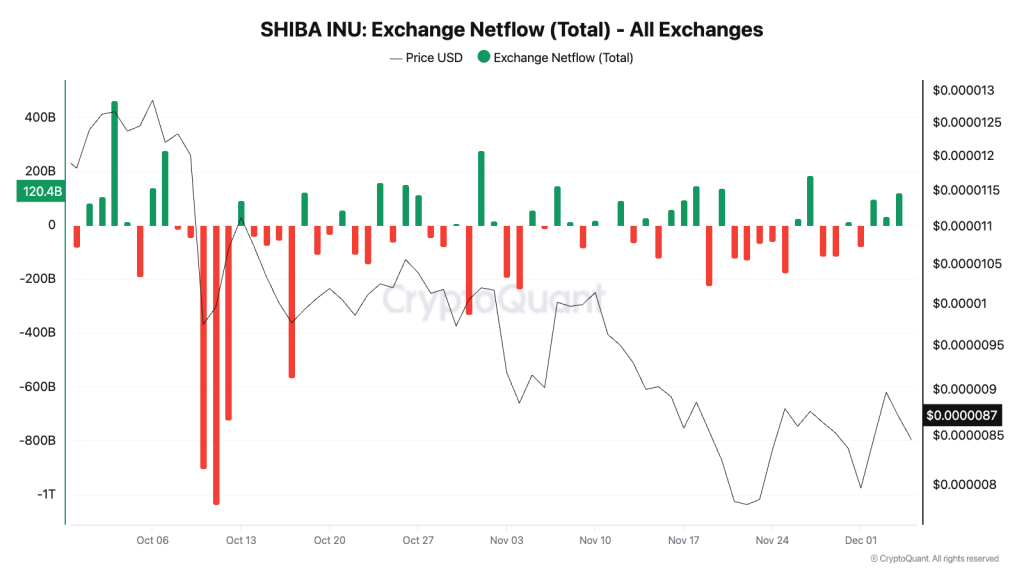
A mysterious wallet linked to a whale has been consistently withdrawing SHIB from Coinbase into a fresh, clean address. By the end of the accumulation streak, the wallet held 169.13 billion SHIB, worth about 1.49 million dollars at current prices.
Arkham data shows the wallet received six transactions from the same Coinbase hot wallet, all within a 24-hour window. The sizes vary from 11 billion SHIB to 81 billion SHIB, which makes it clear this was intentional accumulation, not random buying.
The wallet has not sent anything out, and whales of this size usually try to hide their moves, so this one is surprisingly obvious.
This is a repetitive pattern, looking at the exchange netflow chart from CryptoQuant, SHIB flows to exchanges have mostly been negative, which signals accumulation. Even so, the price has continued to trend lower over the last three months since the memecoin market has not been in great shape.
Shiba Inu Price Prediction: Massive Memes Bull Market About to Start?
Memecoins plunged to their lowest valuation of 2025, dropping to a combined market cap of 39.4 billion dollars, according to CoinMarketCap data.
However, the sector is starting to show signs of life again. Memecoins added more than 4 billion dollars in market cap over the last three days of December. Even with that bounce, the total is still about 10% lower than last month.
That tells you how much interest has faded. The clearest proof is trading volume, which has collapsed more than 54% month over month.
Shiba, of course, was hit by the same decline, since it is one of the leaders in the memecoin market. The team is planning a privacy upgrade using fully homomorphic encryption on its Shibarium layer 2 network in 2026. This upgrade could help increase demand for the coin.
SHIB is currently sitting at 0.0000084, the same level it previously bounced from before rallying to the 0.000009 resistance. Bulls need to defend this area again, and if they manage to hold it, a retest of that first resistance is back on the table.
If this level fails, the price could drop toward the demand zone, which is a key support area. It is a must-hold zone because losing it would open the door for SHIB to print new lows before 2026.
The RSI is sitting around 43 and trending toward oversold territory, which could support a short-term bearish move if momentum continues to weaken.
PepeNode Is Quietly Pulling Liquidity While SHIB Struggles To Hold Support
The broader memecoin sector is still crawling out of its lowest valuation of 2025. Volume is down, sentiment is weak, and most of the big names are still stuck in heavy downtrends.
That is exactly the kind of environment where new projects with actual momentum sneak in and steal the spotlight. PepeNode is doing precisely that.
With 2.20 million dollars raised already and an insane 570% APY, the project is positioning itself as one of the few memecoins showing real traction while the rest of the market sleeps. Investors hunting for early-cycle opportunities are piling in quietly, hoping to catch the rotation before it becomes obvious.
Unlike most meme plays that rely on hype spikes, PepeNode is building around staking incentives that keep holders locked in. High APY rewards reduce selling pressure, tighten supply, and let momentum build internally even when the broader market is flat.
If memecoins truly wake up in early 2026, the projects that built a base during the dead period tend to outperform everything else on the way up. PepeNode is setting itself up to be one of those.
BlackRock’s iShares Bitcoin Trust has logged its longest stretch of weekly withdrawals since the fund launched in January 2024, marking a sharp turn in institutional sentiment toward Bitcoin even as prices steady.
Key Takeaways:
BlackRock’s iShares Bitcoin Trust has entered its longest outflow streak to date, with over $2.7 billion withdrawn in five weeks.
The reversal follows October’s sharp crypto-market liquidation, which erased more than $1 trillion in value and halted IBIT’s months of steady inflows.
Analysts warn the trend signals weakening institutional appetite.
Redemptions continued on Thursday with an additional $113 million, putting the ETF on track for a sixth consecutive week of outflows.
IBIT Faces Reversal as Crypto Wipeout Ends Months of Steady Inflows
IBIT, which manages more than $71 billion in assets, has been the flagship vehicle for traditional investors seeking regulated exposure to Bitcoin.
However, flows have reversed direction since early October, when a violent liquidation across crypto markets triggered a sell-off that erased more than $1 trillion in digital-asset value.
The shift stands in contrast to the steady inflows that helped propel Bitcoin higher earlier in the year.
Last week, speaking in São Paulo, BlackRock business development director Cristiano Castro said the company’s Bitcoin ETFs had become one of its strongest revenue engines, calling their rapid ascent “a big surprise” as investor allocations surged throughout the year.
Castro also downplayed outflow concerns, noting that “ETFs are very liquid and powerful instruments.”
“What we’ve been seeing is perfectly normal; any asset that starts to experience compression usually has this effect, especially in an instrument that is heavily controlled by retail investors,” he added.
Bitcoin has clawed back some losses this week, but analysts say ETF flows paint a clearer picture of institutional caution.
In a recent report, Glassnode wrote that the outflow streak “marks a clear reversal from the persistent inflow regime that supported price earlier in the year, and reflects a cooling of new capital allocation into the asset.”
The firm noted that investor positioning has become more defensive as volatility and funding pressure remain elevated.
Despite the turbulence, Bitcoin traded around $92,000 in London on Friday morning, still down 27% from its October peak.
Spot Chainlink ETF Pulls $41M on First Day
As reported, Grayscale’s first US spot exchange-traded fund tied to Chainlink opened with solid demand, adding another data point to the debate over whether appetite for altcoins can survive a cooling crypto market.
The figures placed Chainlink among the stronger ETF launches this year and suggested that, at least for some investors, regulated vehicles remain the preferred route into higher-risk digital assets.
The new Chainlink ETF comes amid the rollout of a wave of new altcoin ETFs.
Over the past month, issuers have launched products tied to Solana, XRP, and Dogecoin, with more XRP and Dogecoin funds set to list next week.
The Canary Capital XRP ETF (XRPC) debuted with $58 million in net inflows, the highest opening-day haul for any ETF this year, edging out the Bitwise Solana Staking ETF (BSOL), which launched with $57 million.
After nearly a full week of rising prices, the crypto market is down today, with the cryptocurrency market capitalisation falling by 1.1%, now standing at $3.23 trillion. 90 of the top 100 coins have gone up over the past 24 hours. At the same time, the total crypto trading volume is at $114 billion.
TLDR:
Crypto market cap fell by 1.1% on Friday morning (UTC);
90 of the top 100 coins and 9 of the top 10 coins have gone down today;
BTC decreased by 1.2% to $92,227, and ETH is down by 0.6% to $3,169;
The current structure remains highly sensitive to macro shocks;
Holding $96,000–$106,000 is critical to avoid further downside;
The US will release the September PCE inflation data today;
Woori Bank began displaying BTC prices inside its main trading room in Seoul;
Both US BTC and ETH spot ETFs saw outflows on Thursday, with $194.64 million and $41.75 million, respectively;
Strategy earmarked a $1.44 billion US dollar reserve as a liquidity buffer;
Crypto market sentiment pulls back again.
Crypto Winners & Losers
At the time of writing, all top 10 coins per market capitalization have seen their prices rise over the past 24 hours. Two recorded double-digit increases.
Bitcoin (BTC) fell by 1.2% since this time yesterday, currently trading at $92,227.
Bitcoin (BTC)
24h7d30d1yAll time
Ethereum (ETH) is down by 0.6%, now changing hands at $3,169. This is the smallest decrease among the ten.
XRP saw the highest fall, going down by 3.9% to $2.09.
Meanwhile, major Korean Woori Bank has begun displaying BTC prices inside its main trading room in Seoul. This is the first time a commercial bank in the country has integrated a crypto price feed directly into its main dealing space.
“As digital assets continue to grow in prominence and influence in global financial markets, we determined that they should be monitored as a key indicator to better read overall market trends,” an official said.
SOUTH KOREAN BANKING GIANT WOORI BANK JUST STARTED DISPLAYING #BITCOIN PRICE IN THEIR DEALING ROOM
According to Glassnode, Bitcoin stabilized above the critical valuation anchor, the True Market Mean (the cost basis of all non-dormant coins).
“This level often marks the dividing line between a mild bearish phase and a deep bear market,” the analysts explain.
However, the broader market structure is still increasingly mirroring the dynamics of Q1 2022, with over 25% of supply underwater.
“This creates a fragile balance between the risk of top-buyer capitulation and the potential for seller exhaustion to form a bottom. Nevertheless, the current structure remains highly sensitive to macro shocks until the market can reclaim the 0.85 quantile (~$106.2K) as support.”
Importantly, holding $96,000–$106,000 is critical to avoid further downside, says the report.
Furthermore, Bitunix analysts noted that the US will release the September PCE inflation data today. The result will directly influence the December rate decision. The probability of a 25-basis-point rate cut currently stands at 87%, the analysts say.
Ahead of this release, “the market has entered a compressed-volatility, wait-and-see structure, with BTC’s key battleground concentrated between $91,000–$95,000. If the data confirm continued disinflation, the probability of a year-end rebound will rise; otherwise, the choppy structure is likely to persist, with capital flows shifting back toward defensive and short-duration positioning.”
Levels & Events to Watch Next
At the time of writing on Friday morning, BTC stood at $92,227. It started the day with the high of $93,577, gradually decreasing to the current price. Very briefly, it fell to the intraday low of $91,029.
Looking at the past week, we’ve seen the price increase just below 1%. In this period, BTC moved between $84,553 and $93,855.
If the price continues falling, it could go back to the $90,000 level, possibly below. On the other hand, a bullish shift could push it to $96,500 and towards the $100,000 mark.
Bitcoin Price Chart. Source: TradingView
Ethereum is currently changing hands at $3,169. It initially jumped to the intraday high of $3,217 before briefly plunging to the low of $3,076. It has recovered quickly.
ETH has outperformed BTC in the 1-week timeframe. It’s up 5%, trading in the $2,736-$3,222 range.
A bullish breakout of the $3,350 resistance could confirm a bullish trend reversal. This would clear a path for the price to move above $3,500 and then towards $4,000. However, should the decline continue, we may see a pullback towards $2,900.
Ethereum (ETH)
24h7d30d1yAll time
Meanwhile, after a couple of days of increases, the crypto market sentiment reversed course and dropped again within the fear territory. The crypto fear and greed index stands at 25 today, compared to 27 yesterday.
Given the level of uncertainty among the market participants at the moment, it wouldn’t be surprising if the index drops back into the extreme fear zone. It would take a significant push from major macroeconomic news for it to quickly move out of the fear and into the neutral zone in the short term. Therefore, it will likely take time.
ETFs Go Red
On Thursday, 4 December, the US BTC spot exchange-traded funds (ETFs) saw a second straight day of outflows with $194.64 million. The total net inflow pulled back to $57.56 billion.
Of the twelve BTC ETFs, five recorded outflows, and none saw inflows. BlackRock accounts for the majority of the negative flows, letting go of $112.96 million. Fidelity follows with $54.2 million.
The US ETH ETFs also posted negative flows on Thursday. They saw $41.75 million in outflows. The total net inflow now stands at $12.95 billion.
Of the nine funds, one recorded inflows, and three saw outflows. BlackRock took in $28.35 million, while Grayscale let go of $30.96 million.
Notably, Strategy, the world’s largest corporate BTC holder, has earmarked a $1.44 billion US dollar reserve as a liquidity buffer against a prolonged market downturn. CryptoQuant argues that this move signals preparation for a potential bear market phase.
Strategy said it may also sell BTC or BTC derivatives as part of its risk-management toolkit if market conditions deteriorate.
Strategy’s Bitcoin buying has collapsed through 2025.
Monthly purchases fell from 134K BTC at the 2024 peak to just 9.1K BTC in November 2025, only 135 BTC so far this month.
A 24-month buffer makes one thing clear: they’re bracing for the bear market. pic.twitter.com/qEwXR3JQ82
Meanwhile, quantitative trading firm Jane Street took a stake in the company called Antithesis, which claims to have strengthened the Ethereum blockchain. Jane Street led the company’s Series A funding round, where it received $105 million in total.
Quick FAQ
Why did crypto move with stocks today?
The crypto market recorded a decrease over the past 24 hours, while the US stock market saw a mixed session on Thursday. By the closing time on 4 December, the S&P 500 was up by 0.11%, the Nasdaq-100 decreased by 0.097%, and the Dow Jones Industrial Average fell by 0.067%. This followed a fresh set of data on the US labour market and preceded a key inflation reading set for today.
Is this drop sustainable?
Minor drops are common for the markets, and today’s is not out of the ordinary. Analysts argue that we could still see the rally continue, at least in the next few weeks, unless the market is hit by a major macro shock.
Interest in crypto among US investors has cooled significantly, with fewer considering new purchases despite maintained ownership levels, according to a comprehensive study released by the FINRA Investor Education Foundation.
The findings reveal a broader retreat from high-risk investment behaviors as market conditions and investor attitudes shift dramatically from the pandemic-era surge.
The Financial Industry Regulatory Authority study, based on survey data from 2,861 US investors with non-retirement investment accounts, found that while 27% still hold cryptocurrency, unchanged from 2021, only 26% are now considering purchasing digital assets, down sharply from 33% three years earlier.
The pace of Americans entering the investment market has slowed dramatically since the cryptocurrency boom years.
Only 8% of current investors began investing within the past two years, a steep drop from 21% who started during the two years preceding the 2021 study.
The shift suggests the tide of pandemic-era market participation has entirely ebbed, with younger adults particularly affected by the reversal.
Young investors under 35 saw their participation rate fall from 32% in 2021 to 26% in 2024, erasing gains made during the market surge.
Similarly, investment rates declined among people of color and men, reversing increases observed just three years earlier.
The median age of investors who entered the market around 2019-2021 rose from 31 to 38, indicating many younger participants left the market entirely.
Beyond slower entry rates, investors pulled back from various high-risk positions. Cryptocurrency is now viewed as extremely or very risky by 66% of those aware of digital assets, up from 58% in 2021.
The percentage holding penny stocks, REITs, private placements, and structured notes all declined to 2018 levels after brief increases.
Risk Appetite Shrinks Across Demographics
Investors’ willingness to embrace substantial portfolio risk dropped to just 8% in 2024 from 12% in 2021, with the decline most pronounced among younger market participants.
Among investors under 35, those willing to take substantial risks fell from 24% to 15%, creating a notable contradiction; 62% of this age group still believe they need big risks to reach financial goals.
“The latest FINRA Foundation research on investors provides rich insights into how market conditions, technology and generational shifts are changing the profile of investing and reshaping investor behaviors and attitudes,” said Jonathan Sokobin, FINRA Foundation Chair and Chief Economist.
Despite reduced risk appetite, younger investors continue to engage in behaviors that carry greater potential losses.
43% of those under 35 trade options, compared to 10% of investors 55 and older, while 22% make margin purchases, versus just 4% of older participants.
Meanwhile, 13% of all investors report buying meme stocks or viral investments, including 29% of those under 35.
The crypto decline appears most dramatic among new investors. Those with less than 2 years’ experience who are considering digital assets dropped from 61% in 2021 to 48% in 2024, while consideration among experienced investors fell less sharply.
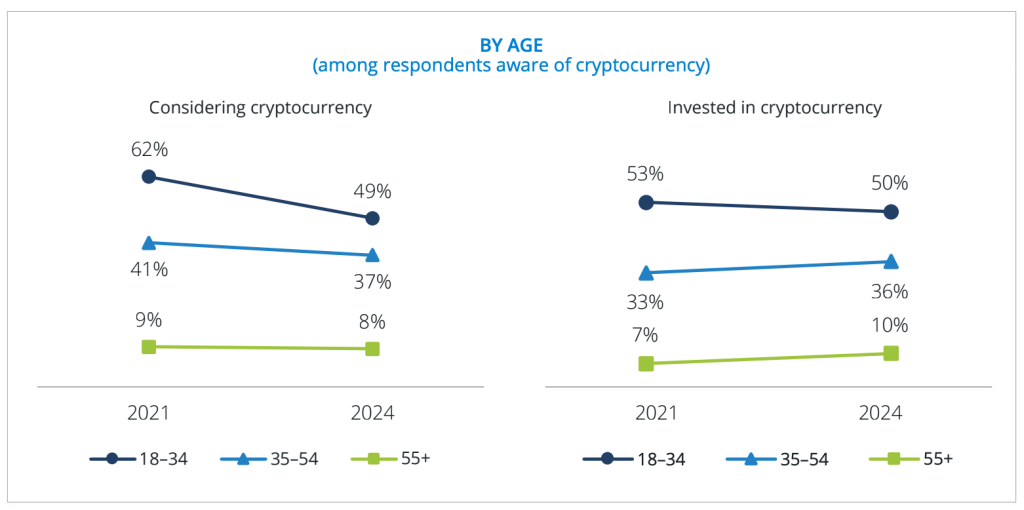
Among investors under 35 specifically, cryptocurrency consideration plummeted from 62% to 49%, compared to smaller declines in older age groups.
Social Media Influence Grows Despite Market Caution
The study found social media “Finfluencers” now guide investment decisions for 26% of investors, rising to 61% among those under 35.
YouTube remains the dominant platform for investment information, with 30% overall usage, rising to 61% among younger investors.
Word of mouth from friends and family emerged as the top information source for 85% of investors under 35, surpassing recommendations from financial professionals at 67%.
Concern over investment fraud has risen somewhat, with 37% of investors worried about losing money to scams, up from 31% in 2021.
However, the vast majority, 89%, do not believe they have been targeted in investment fraud.
When presented with a fraudulent offer promising “guaranteed, risk-free 25% annual returns,” half of investors said they would invest, revealing significant gaps in fraud awareness.
FINRA Foundation President Gerri Walsh emphasized the continuing importance of investor education.
“They still struggle with gaps in investing knowledge and risk assessment, which can leave them vulnerable to costly missteps,” Walsh said. “Investor education efforts remain critically important.“

 Login
Login
https://t.co/FaKIaBpf4I pic.twitter.com/FHs8HwglBs