The weekly chart for Dogecoin shows a signal that could be of greater significance due to its rarity. Crypto analyst Cryptollica pointed to DOGE’s weekly RSI tagging roughly 33.6 and claimed that level has shown up only four times in 11 years. “DOGE WEEKLY RSI. 4 times in 11 years ..,” he posted.
What This Means For The Dogecoin Price
DOGE, for context, was trading around $0.129 at the time of writing, down roughly mid-single digits on the day.
The hook is simple: a weekly RSI that low usually means sellers have been in control for a while — and on a weekly timeframe, that kind of pressure tends to carry more weight than intraday noise. This isn’t “RSI brushed 30 on a 15-minute candle.” It’s slower, heavier, and tied to the bigger trend.
Still, it’s not quite as plug-and-play as the screenshot makes it look. Cryptollica’s point is that the same zone showed up around (1) early May 2015, (2) March 2020, (3) mid-June 2022, and (4) now. The post is the spark; what traders actually care about is what happened next. And this is where Dogecoin’s history gets… very Dogecoin.
On May 6, 2015, DOGE was quoted around $0.000087. Beyond the price being basically dust, the backdrop was messy: weeks earlier, Dogecoin co-founder Jackson Palmer said he was stepping away from the crypto community, calling out what he described as a “toxic” culture.
The bounce didn’t show up on schedule. DOGE drifted for a long time, then later caught the 2017–18 mania, briefly touching $0.017 on Jan. 7, 2018. From roughly $0.000087, that’s about +19,000% to that local-cycle high — a good reminder that “oversold” on a weekly chart can show up early and still end up pointing the right way.
In mid-March 2020 (peak COVID panic), DOGE traded around $0.001537. When the panic eased and liquidity returned to markets, DOGE went on to print its next cycle top at $0.7316 on May 8, 2021.
That’s roughly +47,000% from the March 2020 level to the 2021 high. It’s also the stretch where DOGE stopped being “just” a joke coin and started behaving like a retail risk-on barometer — with Musk-era attention pouring gasoline on it.
By mid-June 2022, the bear-market washout was in full effect. DOGE was around $0.053. The recovery came in waves: a late-2022 pop tied to Musk/Twitter speculation and broader risk-on bursts, then a bigger 2024 meme-led rip.
By March 28, 2024, DOGE was back around $0.220 — roughly +315% from the June 2022 level to the next notable local high. Not 2021-level insanity, but still a real multi-x.
And now, as of Tuesday, Dec. 16, 2025, Dogecoin was changing hands around $0.129. The “signal” crowd will look at that weekly RSI print and argue the market is back in the same psychological neighborhood as those prior exhaustion points.
The bullish case writes itself: if this weekly RSI zone has tended to show up near seller fatigue in the past, then seeing it again could mean risk/reward is quietly shifting. Not a promise — more like a reason to stop ignoring DOGE and start watching it.
But RSI isn’t a timing tool. Oversold can stay oversold. Weekly signals can hang around, whip traders around, or get flattened if broader risk keeps leaking.
For now, it’s a setup, not an outcome. If DOGE starts reclaiming levels and holding them, the “rare signal” crowd will take the victory lap. If it keeps bleeding, this gets filed under interesting, early, and painful — like a lot of trading ideas.
Crypto analyst Dark Defender has been one of the most vocal supporters of XRP, and this stance has not changed despite the altcoin’s current price action. If anything, the analyst believes that the current downtrend actually plays into the XRP long-term target, claiming that the cryptocurrency remains inherently bullish. If the analyst is right, then it means that the XRP price could be gearing up for another major uptrend that could send it to new peaks.
XRP Price Is Only In Wave 4, Not A Bear Market
In the post that was shared on X, Dark Defender explained that the XRP cryptocurrency was not in any kind of bear market. Instead, the current downtrend is only a result of the altcoin entering Wave 4 of the Elliot Wave, leading to the decline.
Given that Wave 4 is a historically bearish wave, it would explain why the XRP price has dropped so quickly. However, the crypto analyst explained that this wave did not just start, as it has been in play since February 2025. Hence, it would need to play out completely before the next wave can begin.
Going by this analysis, it would mean that the last and final wave of the theory is yet to play out, which is often the most bullish of all the waves. As a result, the analyst urges XRP investors not to panic as the price continues to play out according to plan. In the end, the target remains $5.85, according to Dark Defender, beating its previous all-time high of $3.8.
Price Could Be Rounding A Bottom
Another analyst also contributes that the XRP price is not in a bear market, and could, in fact, be putting in a bottom. STEPH IS CRYPTO points out that the XRP RSI is actually showing a rare bullish divergence on the daily chart, one of the few times that this has happened over the years.
This is significant because back in 2022, a similar bullish divergence had appeared on the daily chart ,and the result was a rapid rise once the distribution was done. As the crypto analyst explains, the fact that this bullish RSI divergence has appeared on the XRP daily chart again suggests that the sellers are actually running out of steam.
While there is no set target for where the XRP price is headed, the prediction suggests that a rally could be in the works. “Nothing is guaranteed — but from a technical perspective, this is one of the strongest early reversal signals you can get,” the analyst stated.
Data shows Bitcoin has witnessed a notable amount of gains during the US trading session in December so far, a shift compared to the November trend.
Bitcoin Has Performed The Best During US Trading Session This Month
As explained by CryptoQuant community analyst Maartunn in a new post on X, the American trading session has flipped for Bitcoin in December. Below is the chart shared by Maartunn, which compares the returns that BTC has achieved across the different trading sessions over the past month.
The trading sessions here have been divided based on when investors of a major market are typically active. Bitcoin and other blockchain-based assets run 24/7, so there naturally isn’t ever a time in any timezone where trading is inactive. However, investors do still tend to trade more actively during their daytime, which is what these sessions are based on.
From the chart, it’s visible that cumulative Bitcoin returns were negative for the American trading session during the last couple of weeks of November. Europe and Asia-Pacific didn’t perform much better, but they at least saw close to neutral returns.
Toward the end of November, though, a shift began to take shape, with returns during US hours going up. And in this month of December so far, the trading session has pulled away from the rest, with cumulative returns sitting at a positive 8%.
In contrast, Europe and Asia-Pacific have the metric at a level of around -4% or lower. Thus, if the cumulative returns during these sessions are anything to go by, it would appear that American investors have been participating in Bitcoin accumulation this month, while the others have been distributing or simply, not buying.
In some other news, the Bitcoin selloff last month caused a key on-chain indicator to go through its largest negative change in years, as quant Frank has pointed out in an X post.
The metric displayed in the chart is the Realized Price of the Bitcoin short-term holders. This indicator measures the average cost basis of investors on the BTC network. The version listed in the graph specifically tracks the cost basis of short-term holders (STHs), entities who entered the market over the last 155 days.
As is visible in the chart, the Bitcoin STH Realized Price saw a notable decline alongside the price crash in the cryptocurrency during November. This suggests investors who bought at higher levels panic capitulated, repricing their coins to the lower post-plunge levels.
This capitulation was so strong that the STH Realized Price saw its largest red 7-day change since the FTX crash back in November 2022.
BTC Price
Bitcoin has witnessed bearish price action during the past day as its price has come down to $85,800 following a drop of about 3.5%.
Bitcoin (BTC) has experienced a 4% drop, falling below the $86,000 mark on Monday, as market speculation grows regarding the cryptocurrency’s future following the Bank of Japan’s (BOJ) interest rate decision.
In a recent poll conducted from December 2 to 9, an overwhelming 90% of economists—63 out of 70—predicted that the BOJ would increase short-term interest rates from 0.50% to 0.75% at this week’s planned meeting.
Experts Warn Of Impact From BOJ Rate Hikes
Experts on social media have noted a concerning trend: during the last three rate hikes by the BOJ, Bitcoin has typically dropped significantly. The statistics reveal the following declines: a 23% drop in March 2024, a 26% decline in July 2024, and a 31% dip in January of this year.
Based on current prices just below $86,000, this would imply that if the cryptocurrency sees another 20% correction, it could drop all the way to 68,800. This would mean extending the gap compared to the all-time high of $126,000 by almost 46%.
The group of experts further highlighted that the dynamics at play in Japan significantly impact Bitcoin’s performance as Japan holds the largest amount of US debt of any nation.
When Japanese interest rates rise, capital tends to flow back to Japan, leading to reduced liquidity in dollars. This decrease in dollar liquidity often results in the selling of riskier assets like Bitcoin.
On November 30, a foreboding sign of this potential downturn appeared when confirmation of Japan’s impending rate hike caused Bitcoin to dip to around $83,000, erasing approximately $200 billion from the overall cryptocurrency market.
However, the bearish sentiment affecting Bitcoin is not solely the result of Japan’s actions. Market analyst known as NoLimit recently pointed to another critical factor: China’s renewed crackdown on Bitcoin mining.
China’s Mining Crackdown Spurs Bitcoin Sell-Off
The analyst recently asserted that China has tightened regulations, particularly affecting operations in Xinjiang, where a significant number of crypto mining setups were shut down in December. This led to the abrupt offline status of roughly 400,000 miners.
The repercussions of such a sudden shift in mining activity are already evident. The Bitcoin network hashrate has fallen by about 8%, indicating that fewer miners are actively contributing to the network.
NoLimit suggests that this sudden reduction creates immediate revenue-loss for miners, who may need to liquidate Bitcoin to cover operational costs or to relocate their equipment. Consequently, this generates actual selling pressure on the market, contributing to the downward price trend seen on Monday.
Despite the short-term pain this creates, the analysts clarified that it does not indicate a long-term bearish outlook for Bitcoin. Instead, he views it as a temporary supply shock driven by regulatory decisions rather than a shift in demand.
Historical patterns support this notion: when China has previously cracked down on miners, the cycle follows a familiar trajectory: miners are forced offline, hashrate dips occur, prices fluctuate, and eventually, the network adapts before Bitcoin moves forward again.
Featured image from DALL-E, chart from TradingView.com
Monday, 15 December 2025 – Bitcoin Hyper (HYPER) has reached $29.5 million in presale capital, driven by a strategy that addresses one of Bitcoin’s most persistent constraints without making any changes to Bitcoin itself.
With BTC dipping below $90,000, it’s becoming clearer that Bitcoin’s valuation has long been powered more by conviction than by real transactional use. That limitation is increasingly difficult to ignore. Bitcoin Hyper aims to remove that barrier by creating an environment where BTC can actually move, be used, and scale in real economic activity.
Rather than attempting to modify Bitcoin Hyperis built alongside it. Bitcoin remains unchanged as the ultimate settlement layer, while the functions it was never meant to handle are moved off-chain. Transaction execution takes place in a fast, flexible ecosystem, finally giving applications the space they need to operate efficiently.
This architecture is what’s driving investor interest in HYPER, the token positioned at the core of Bitcoin’s shift from a passive store of value into an active economic system.
That opportunity is still open for a limited time. HYPER is currently priced at $0.013425, but that price is only available for the next five hours before the following presale phase begins.
Six Figures Reveal Bitcoin’s Next Challenge
As 2025 approaches its end, the year is set to be remembered for the moment Bitcoin firmly crossed into six-figure price levels. However, the recent pullback has reignited a more uncomfortable debate: can Bitcoin’s role as a store of value alone continue to support further price growth?
That uncertainty is no longer limited to crypto circles and is beginning to appear in traditional financial markets. Strategy is facing mounting scrutiny as index providers review whether its substantial Bitcoin exposure still warrants inclusion in major benchmarks, including the MSCI indices.
Analysts at JPMorgan have cautioned that any potential removal could result in billions of dollars exiting through passive investment funds. Meanwhile, Strategy’s stock has declined significantly more than Bitcoin itself and is now trading much closer to the underlying value of its BTC holdings, rather than maintaining the premium that investors previously attributed to its treasury-focused approach.
MSCI $MSTR DE-LISTING FEAR MONGERING: THE $2.8 BILLION LIE
First: Strategy is at ZERO risk of being delisted from other indices. Second: J.P. Morgan says an MSCI delisting would trigger a $2.8 Billion forced sell off. They are banking on you not knowing the math.
Scarcity alone may no longer be sufficient to keep pushing Bitcoin’s price upward. For the market to reclaim and hold six-figure levels and eventually move beyond previous highs the network needs a new driver of demand.
Bitcoin’s base layer was deliberately engineered to be lean, cautious, and resistant to change. It functions as a neutral settlement layer, placing security and verifiability above every other consideration. That conservative design is exactly what has allowed Bitcoin to operate reliably for more than a decade.
However, this same philosophy also imposes a limitation. If Bitcoin must stay simple by design, then advanced execution and functionality must exist outside of it. There is effectively no alternative approach.
This is precisely the space Bitcoin Hyper is designed to occupy. Execution is handled in a separate ecosystem, while Bitcoin continues to serve as the ultimate source of settlement and truth.
Bitcoin’s Design Prioritized Simplicity by Choice
Bitcoin was built as a form of money that cannot be altered, diluted, or controlled by any government, corporation, or small group of actors. Achieving that goal required a system engineered to be resilient above all else, even if it meant giving up speed and adaptability.
This is why Bitcoin depends on the stark simplicity of SHA-256. It is a one-way cryptographic function that avoids complexity and specialization, yet performs its role with unmatched reliability. Verification is fast and straightforward, while reversal is effectively impossible and this imbalance is what underpins Bitcoin’s security model.
FUN FACT: Bitcoin runs on SHA256—a one-way cryptographic function.
It’s what secures your sats with trillions of hashes per second.
Think of Bitcoin as the foundation. You don’t drill into bedrock every time you want to expand a structure you build on top of it, because the strength underneath is what supports everything above.
From the beginning, Bitcoin’s base layer was deliberately kept simple and conservative. By minimizing moving parts, it reduced attack vectors, limited governance risk, and ensured the system could be verified by anyone without relying on complicated logic. That discipline is a key reason Bitcoin remains the most secure and decentralized network in the crypto space.
Still, bedrock isn’t meant to be lived in it’s meant to support what’s built above it. Advanced features were never intended to operate on Bitcoin’s base layer, and forcing them there would erode the very attributes that give Bitcoin its value.
This is exactly why Bitcoin Hyperexists. It adds a layer above Bitcoin where advanced functionality can operate without modifying the underlying chain.
That execution layer is powered by the Solana Virtual Machine (SVM), pulling execution away from Bitcoin’s slower base layer and placing it into an environment optimized for speed and scalability. Transactions become fast and inexpensive, and complexity is no longer a limiting factor.
The result is more than simple “hybrid applications” it represents a deeper structural change. Bitcoin is no longer static. BTC moves through DeFi, gaming, and real economic use cases at Solana-level speeds, while final settlement still resolves back on Bitcoin. Fast at the top, immutable at the core.
The Infrastructure Play Powering Bitcoin’s Next Phase: HYPER
The Bitcoin Hyperframework is built around a single objective that Bitcoin itself has never achieved at scale: enabling BTC to function in everyday economic use. Within the Bitcoin Hyper environment, applications are designed to use Bitcoin directly as the means of exchange. Participation requires BTC, not a substitute or wrapper.
That is where the dynamic begins to change. When applications depend on BTC to operate, demand shifts away from pure speculation or macro-driven narratives and becomes embedded in actual usage. Bitcoin starts to resemble an active currency circulating through an ecosystem, rather than idle collateral sitting on the sidelines.
However, Bitcoin Hyper is doing more than expanding BTC’s utility. It also introduces an economic layer reminiscent of the early opportunities that first-generation Bitcoin supporters experienced. This execution layer requires energy to operate, and that role is fulfilled by HYPER.
HYPER functions as the network’s gas token, enabling transactions across the system, while also serving as the staking asset that contributes to network security and the governance token that guides its long-term direction. It is the mechanism through which growth at the execution layer is captured.
This is why the presale has already attracted more than $29.5 million, with investors positioning themselves early around the infrastructure they believe Bitcoin will need to sustain its next phase of growth.
At the current presale price of $0.013425, many see HYPER as reflecting early-stage development risk rather than the valuation of a fully operational ecosystem.
How to Purchase HYPER
To acquire HYPER, visit the official Bitcoin Hyper website and complete your purchase using SOL, ETH, USDT, USDC, BNB, or a credit card.
Bitcoin Hyper also recommends using Best Wallet, a widely used crypto and Bitcoin wallet. HYPER is already listed in Best Wallet’s Upcoming Tokens section, allowing users to buy, monitor, and later claim their tokens once the launch goes live.
You can also join the wider Bitcoin Hyper community by following the project on Telegram and X.
JPMorgan Asset Management has introduced a tokenized money-market fund built on the Ethereum blockchain, according to company filings and industry reports.
The fund, called My OnChain Net Yield Fund (MONY), issues shares as digital tokens that live on the public Ethereum network and are aimed at qualified investors through the bank’s Morgan Money platform.
JPMorgan Issues Tokenized Fund On Ethereum
Based on reports, MONY holds familiar, low-risk instruments such as US Treasury securities and repurchase agreements fully backed by Treasuries.
The bank says the token shares represent direct ownership of the fund and can be held at blockchain addresses, opening up on-chain settlement and recordkeeping for a product that normally sits in traditional custody systems.
Seeded With $100 Million
Reports have disclosed that JPMorgan seeded MONY with $100 million of its own capital at launch. The move is meant to kickstart liquidity and show institutional seriousness about putting cash management products on-chain.
The tokenization work is being handled by internal teams tied to JPMorgan’s digital-assets efforts, and the bank has been testing ways to move conventional securities into token form for several years.
How The Tokens Work And Who Can Use Them
Investors receive tokenized fund shares that may be transferred or recorded on Ethereum. Based on reports, access is limited: the fund is offered only to qualified clients via Morgan Money, not to the general retail public.
The token structure mirrors traditional fund economics — holders are exposed to the same short-term instruments that underpin money-market products — but the record of ownership is stored on a public ledger.
Qualified Investors And Access
According to coverage, institutional clients with asset levels above $25 million and accredited individuals with at least $5 million are among those eligible, and the minimum initial investment sits at roughly $1 million.
That narrow access aligns with regulatory guardrails for tokenized securities and with the bank’s goal of serving big, sophisticated cash managers first.
Analysts say the launch is part of a broader push by big asset managers to experiment with tokenized share classes and on-chain settlement.
Other firms have run pilots with similar ideas, and some have already put cash-like products on Ethereum. Based on reports, the move points to an industry desire to test whether blockchain can speed up settlement, increase transparency, or create new on-chain liquidity for institutional cash flows.
Featured image from Unsplash, chart from TradingView
As the week began, the XRP price experienced a 4% decline, bringing it nearly 50% below its all-time highs. However, analysts forecast significant gains for one of the market’s leading altcoins in January 2026, citing three major catalysts that could reshape its market outlook.
A Major Step Towards Broader Access
In a recent analysis, Sam Daodu, a market expert from 24/7 Wall St., emphasized the importance of Vanguard’s decision to approve trading of XRP exchange-traded funds (ETFs).
Daodu emphasized that the real significance lies in the facilitation of distribution; with Vanguard’s advisors able to allocate XRP exposure through regulated ETFs without additional cumbersome processes.
He indicated that three interrelated factors are now at play: the influx of institutional capital through ETF investments, a reduction in supply, and the influence of Vanguard in altering the approach towards the asset.
Notably, the results of the token’s exchange-traded fund launch have already been notable, with XRP inflows hitting $1 billion within the first four weeks of trading, making it one of the fastest-growing crypto ETF launches to date.
Additionally, XRP’s market supply has contracted significantly, dropping by 45% from approximately 3.9 billion tokens at the beginning of 2025 to about 1.6 billion by December.
This contraction can be attributed to large holders refraining from distributing their tokens, leading to an accumulation in whale wallets and the removal of tokens from liquid markets due to ETF custody.
This decreased supply implies that smaller inflows now carry greater influence. With only 1.6 billion tokens available on exchanges, investments of $20-30 million in daily ETF purchases can have a substantive impact on market supply.
A Key Driver For Price Appreciation
The Vanguard XRP ETF launch is particularly significant in this context, as it locks tokens into regulated custody vehicles that are less likely to be sold frequently.
Unlike tokens held on exchanges that can be quickly moved in and out, ETF custody tends to encourage a buy-and-hold strategy, fostering conditions for gradual price appreciation fueled by sustained institutional demand amid a diminishing available supply.
Given that the decision to provide ETF access came late in the year, year-end trading typically focuses on maintaining existing allocations rather than creating new positions.
While the ETF adds credibility to XRP without causing immediate price pressure, its journey to a $3 valuation by January will depend on how swiftly advisory capital mobilizes, the durability of supply compression, and the overall stability of the markets.
XRP Price Path To $3
Three potential scenarios present themselves for XRP’s future. The most optimistic scenario sees advisory capital moving quicker than typical, perhaps allowing advisors to integrate small XRP allocations during January’s rebalancing.
In this case, XRP ETF inflows could remain robust, ranging from $40-60 million daily, while the locked-up supply on exchanges supports a price increase that could see the XRP price surpass $2.25, aim for $2.60, and potentially test $3 by the end of January.
The middle-ground perspective suggests a more conventional institutional timing. In this scenario, while the XRP ETF access will gain attention in December, actual allocations might ramp up gradually, leading to a daily influx of about $20-30 million instead of the earlier expected pace.
Here, the XRP price could establish higher lows and breach the $2.25 mark, facing resistance between $2.40 and $2.80. Price fluctuations would focus more on future adoption rather than immediate implications.
According to Daodu’s conclusions, and given these circumstances, the XRP price reaching $3 could take until the first or second quarter of 2026 rather than being an immediate milestone.
Featured image from DALL-E, chart from TradingView.com
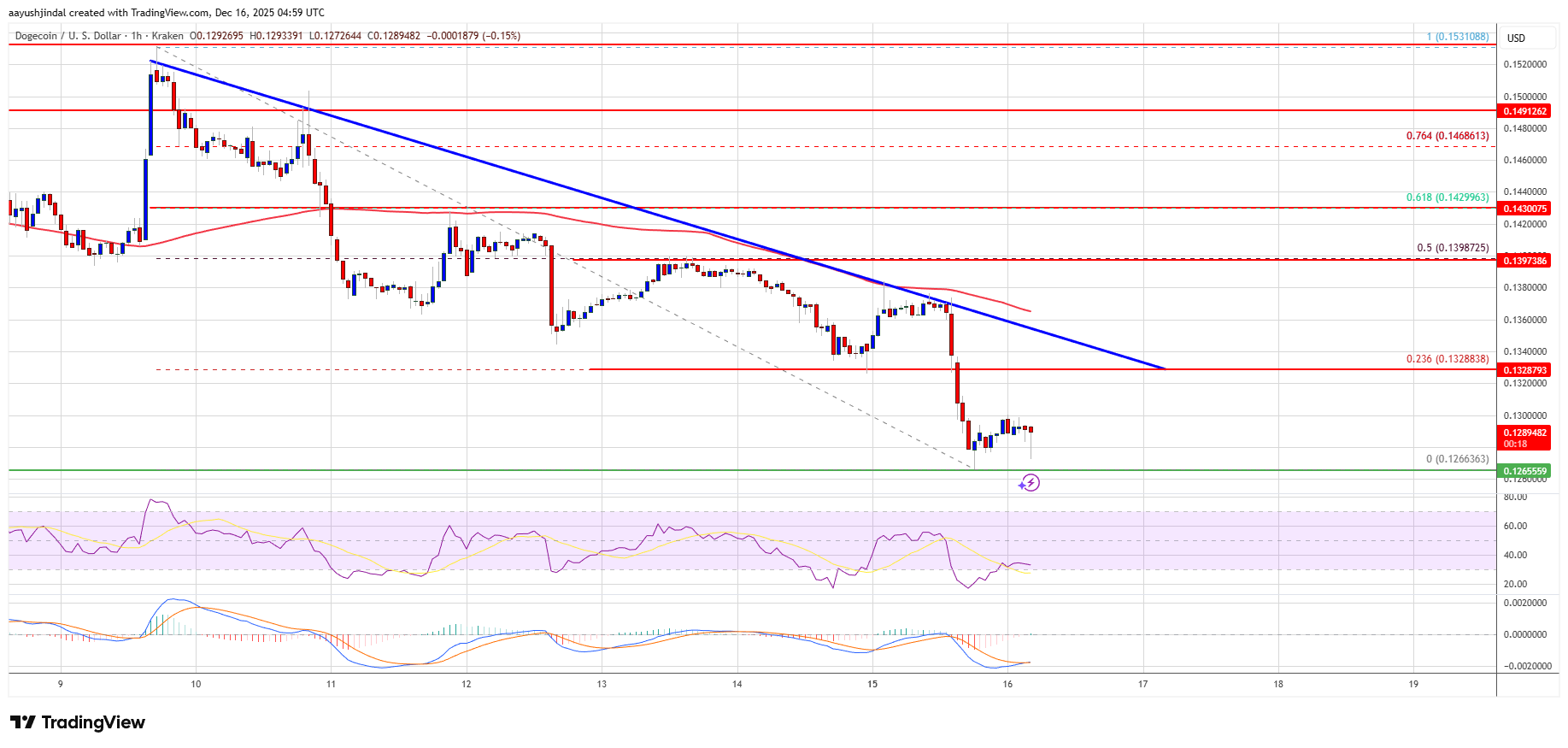
Dogecoin started a fresh decline below the $0.1320 zone against the US Dollar. DOGE is now consolidating losses and might face hurdles near $0.1350.
DOGE price started a fresh decline below the $0.1320 level.
The price is trading below the $0.1300 level and the 100-hourly simple moving average.
There is a key bearish trend line forming with resistance at $0.1340 on the hourly chart of the DOGE/USD pair (data source from Kraken).
The price could extend losses if it stays below $0.1340 and $0.1350.
Dogecoin Price Dips Again
Dogecoin price started a fresh decline after it closed below $0.1380, like Bitcoin and Ethereum. DOGE declined below the $0.1350 and $0.1340 support levels.
The price even traded below $0.130. A low was formed near $0.1266, and the price is now showing bearish signs. It is consolidating below the 23.6% Fib retracement level of the downward move from the $0.1530 swing high to the $0.1266 low.
Dogecoin price is now trading below the $0.1300 level and the 100-hourly simple moving average. If there is a recovery wave, immediate resistance on the upside is near the $0.1325 level. The first major resistance for the bulls could be near the $0.1340 level. There is also a key bearish trend line forming with resistance at $0.1340 on the hourly chart of the DOGE/USD pair.
The next major resistance is near the $0.1400 level and the 50% Fib retracement level of the downward move from the $0.1530 swing high to the $0.1266 low. A close above the $0.1400 resistance might send the price toward the $0.1450 resistance. Any more gains might send the price toward the $0.1500 level. The next major stop for the bulls might be $0.1550.
More Losses In DOGE?
If DOGE’s price fails to climb above the $0.1350 level, it could continue to move down. Initial support on the downside is near the $0.1280 level. The next major support is near the $0.1250 level.
The main support sits at $0.120. If there is a downside break below the $0.120 support, the price could decline further. In the stated case, the price might slide toward the $0.1050 level or even $0.10 in the near term.
Technical Indicators
Hourly MACD – The MACD for DOGE/USD is now gaining momentum in the bearish zone.
Hourly RSI (Relative Strength Index) – The RSI for DOGE/USD is now above the 50 level.
Solana (SOL) has emerged as the most popular blockchain ecosystem of 2025, securing its crown for the second consecutive year despite a significant decrease in chain-specific global interest compared to the previous year.
Solana Takes The Popularity Crown
On Monday, Solana was named the leading blockchain ecosystem by popularity in 2025 by crypto data aggregator CoinGecko. The study examined interest in blockchain ecosystems based on CoinGecko’s non-botted global web traffic from January 1 to December 14, 2025, only including ecosystems with actively listed coins and a non-zero percentage share of traffic.
As a result, a total of 62 blockchain ecosystems were included in the study. Out of the 62 blockchain ecosystems studied, the 20 most popular represented a majority of 95.60% of global interest in chain-specific narratives.
According to the report, the Solana ecosystem captured 26.79% of the global interest in chain-specific narratives this year, retaining its title as the most popular blockchain ecosystem for a second consecutive year.
The Base ecosystem followed in second place, accounting for 13.94% of global investor interest in chain-specific narratives this year, led by constructive developments and partnerships. However, its mindshare experienced a 2.9% decrease from the 16.81% recorded in 2024.
Similar to Solana and Base, the Ethereum ecosystem also retained its position from the 2024 list, ranking as the third most popular ecosystem with 13.43% of global interest. Meanwhile, Sui and BNB Chain moved up in the list, ranking 4th and 5th after more than doubling their mindshare in 2025.
Per the study, the Sui ecosystem recorded the largest mindshare growth, with a 6.9% year-over-year (YoY) increase to reach 11.77% of the total global interest in chain-specific narratives.
The BNB Chain ecosystem saw a 4.9% surge YoY to capture 9.05% in mindshare, fueled by the launch of Binance Alpha in May, which increased BNB Chain’s on-chain trading volumes, the report noted.
Notably, XRP Ledger, Bittensor & Hyperliquid lead new entrants into the top rankings, securing a spot in the top 10 this year.
SOL Memecoins Out Of Leading Narratives
Despite leading the popularity rankings, CoinGecko highlighted that the Solana ecosystem’s mindshare had significantly decreased from the 38.79% it had dominated in 2024.
According to the study, the ecosystem dropped by 12% this year, reflecting the blockchain’s “struggles to expand beyond its close association with meme coin speculation, as well as Solana’s range-bound price despite wider institutional adoption marked by the US ETFs launch.”
This resulted in the Solana ecosystem dropping out of the top leading narratives list this year. In a Friday analysis, CoinGecko reported that memecoin emerged as the most popular crypto narrative in 2025 with a combined 25.02% of global investor interest across the main meme coin category and 35 meme coin trends.
This represented a 5.65% decline from the 30.67% market share that the memecoin narrative held in 2024, suggesting that “the mania for purely speculative crypto may be subsiding.”
The Solana ecosystem lost its spot in the top five most popular crypto narratives, where it had ranked for the previous two years, after being overtaken by AI agents and the Made in USA narratives. Meanwhile, the Solana memecoin sector also dropped out of the top five narratives after a 3.08% decline in global investor interest from 2024.
Nonetheless, “it remains to be seen whether the Solana narrative will be able to ride on new catalysts next year, as momentum from its comeback story runs out,” CoinGecko added.
As of this writing, SOL is trading at $126, a 2.61% decline in the daily timeframe.
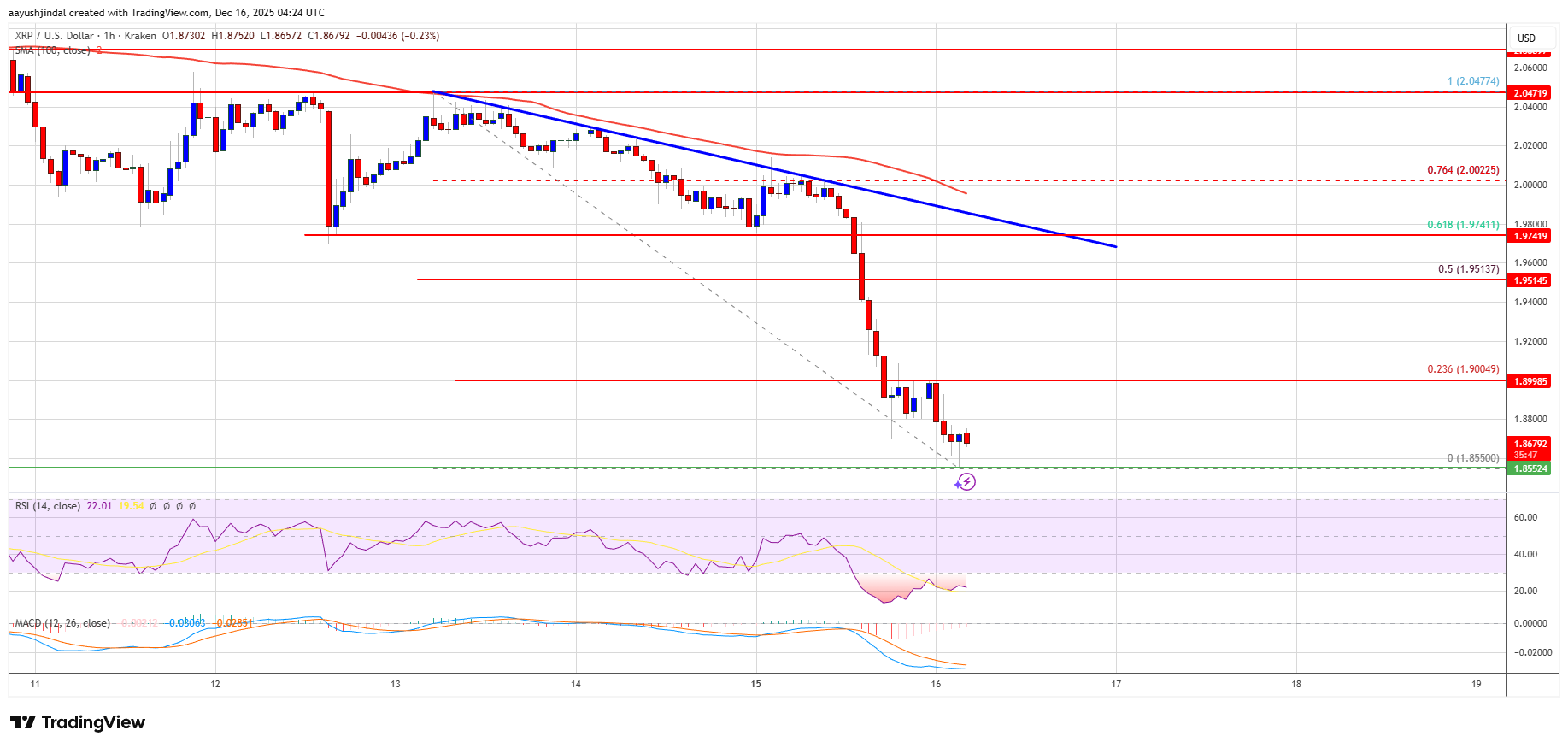
XRP price started a fresh decline below $1.950. The price is now struggling and faces resistance near the $1.920 resistance level.
XRP price started a fresh decline below the $1.950 zone.
The price is now trading below $1.90 and the 100-hourly Simple Moving Average.
There is a bearish trend line forming with resistance at $1.980 on the hourly chart of the XRP/USD pair (data source from Kraken).
The pair could continue to move down if it settles below $1.850.
XRP Price Dips Again
XRP price attempted a recovery wave above $2.020 but failed to continue higher, like Bitcoin and Ethereum. The price started a fresh decline below $2.00 and $1.950.
There was a move below the $1.920 support level. A low was formed at $1.8550, and the price is now showing bearish signs below the 23.6% Fib retracement level of the downward move from the $2.047 swing high to the $1.8550 low.
The price is now trading below $1.90 and the 100-hourly Simple Moving Average. There is also a bearish trend line forming with resistance at $1.980 on the hourly chart of the XRP/USD pair.
If there is a fresh upward move, the price might face resistance near the $1.90 level. The first major resistance is near the $1.920 level. A close above $1.920 could send the price to $1.950 or the 50% Fib retracement level of the downward move from the $2.047 swing high to the $1.8550 low.
The next hurdle sits at $1.980 and the trend line. A clear move above the $1.980 resistance might send the price toward the $2.050 resistance. Any more gains might send the price toward the $2.120 resistance. The next major hurdle for the bulls might be near $2.150.
More Losses?
If XRP fails to clear the $1.90 resistance zone, it could start a fresh decline. Initial support on the downside is near the $1.8550 level. The next major support is near the $1.820 level.
If there is a downside break and a close below the $1.820 level, the price might continue to decline toward $1.7650. The next major support sits near the $1.7320 zone, below which the price could continue lower toward $1.7050.
Technical Indicators
Hourly MACD – The MACD for XRP/USD is now gaining pace in the bearish zone.
Hourly RSI (Relative Strength Index) – The RSI for XRP/USD is now below the 50 level.
Cardano (ADA) is getting the “2020 blastoff” treatment again — at least if you ask Quantum Ascend, a technical analyst on X who says the chart is starting to rhyme with the setup that preceded ADA’s last major run.
In a Dec. 13 video shared on X, Quantum Ascend (@quantum_ascend) told followers he’s been working through a longer-term weekly count and thinks the market may be grinding toward the end of a drawn-out corrective structure. The punchline: a “conservative” target zone around $4.88–$5.50, and a “primary” bull-run target of $10.40.
“Cardano Mirroring 2020 Blastoff Moment,” his post read, before laying out the two tiers: “Conservative: $4.88-$5.50” and “Primary: $10.40.”
The Framework Behind The Cardano Price Prediction
The framework he’s leaning on isn’t a clean five-wave impulse, he said. Instead, he framed it as something slower and messier — “more of like a large time-based macro correction here on the D-wave,” he said, describing what he believes is a triangle structure developing on the weekly chart.
“We’re creating a triangle structure,” he said. “So I am going to be looking for the E-wave. That’s what ends up coming next.”
A big part of the argument is confluence. Quantum Ascend walked through multiple measurements and trendlines, pointing to price zones where different tools cluster. One reference point was a prior A-to-B drawdown range that, in his view, still hasn’t been fully “closed out,” with a key level “up there at the $5.50 mark.”
Then he zoomed out to the bigger structure, highlighting how an upper trendline from a C-to-D drawdown “converges with the 3.618 [Fibonacci extension] up here,” which he suggested adds weight to the $10 area. “So some confluence for that $10 area,” he said, pointing at the chart level he called out around $10.62.
He also reached for a relative-performance comparison — not to Ethereum itself, but to Ethereum Classic.
“I have another video from the past that compares Ethereum Classic to ADA,” he said. “And if it ends up doing a similar move to Ethereum Classic, that also puts us up into the $10 range.”
Still, the near-term “safe” target he kept circling back to was the $5 region. After walking through a more recent drawdown “going back to the top of the Trump pump to where we’re at now,” he said a “full extension gets us pretty close… around $4.88,” adding that the $5 zone shows “a lot of different signs of confluence.”
“For me, I’m going to say my conservative estimate for ADA is going to be that $5 range,” he said. Then he went straight to the headline number: “I think ADA gets up there around 10 bucks during this bull run.”
To make the comparison feel less abstract, Quantum Ascend argued the current chop looks structurally similar to a prior period before ADA’s last breakout — a fractal-style read. “You guys notice the similarities here?” he asked, describing how both moves get “stopped out a little bit above the 0.5,” roll over, then revisit the lower trendline before pushing back to the top of the range.
And then he widened the lens beyond Cardano, tossing in a fairly aggressive macro view that sits underneath the bullish alt targets. “I honestly, guys, across the board right now, I believe that these corrections are coming to an end,” he said. “I think we have a blow off top in stock markets, in crypto and all of that coming.”
But he also stressed he’s not married to a long-duration “supercycle” narrative. “I am not a long-term bull,” he said. “I am not [predicting a] Bitcoin super cycle to $400K.” His current bitcoin top, he added, is $155,000 — and he expects alts to “severely outperform” in the final leg before “it’s all over.”
On the math side, Quantum Ascend framed $10.40 as big, but not absurd in a market that has already produced outsized multiples. “If we were to get that 1040, 25X, right?” he said, comparing it to prior cycles where ADA saw moves he pegged at “168X” and “75X.”
“So we’re just talking about a 25er,” he added. “Not that crazy when you put it into perspective.”
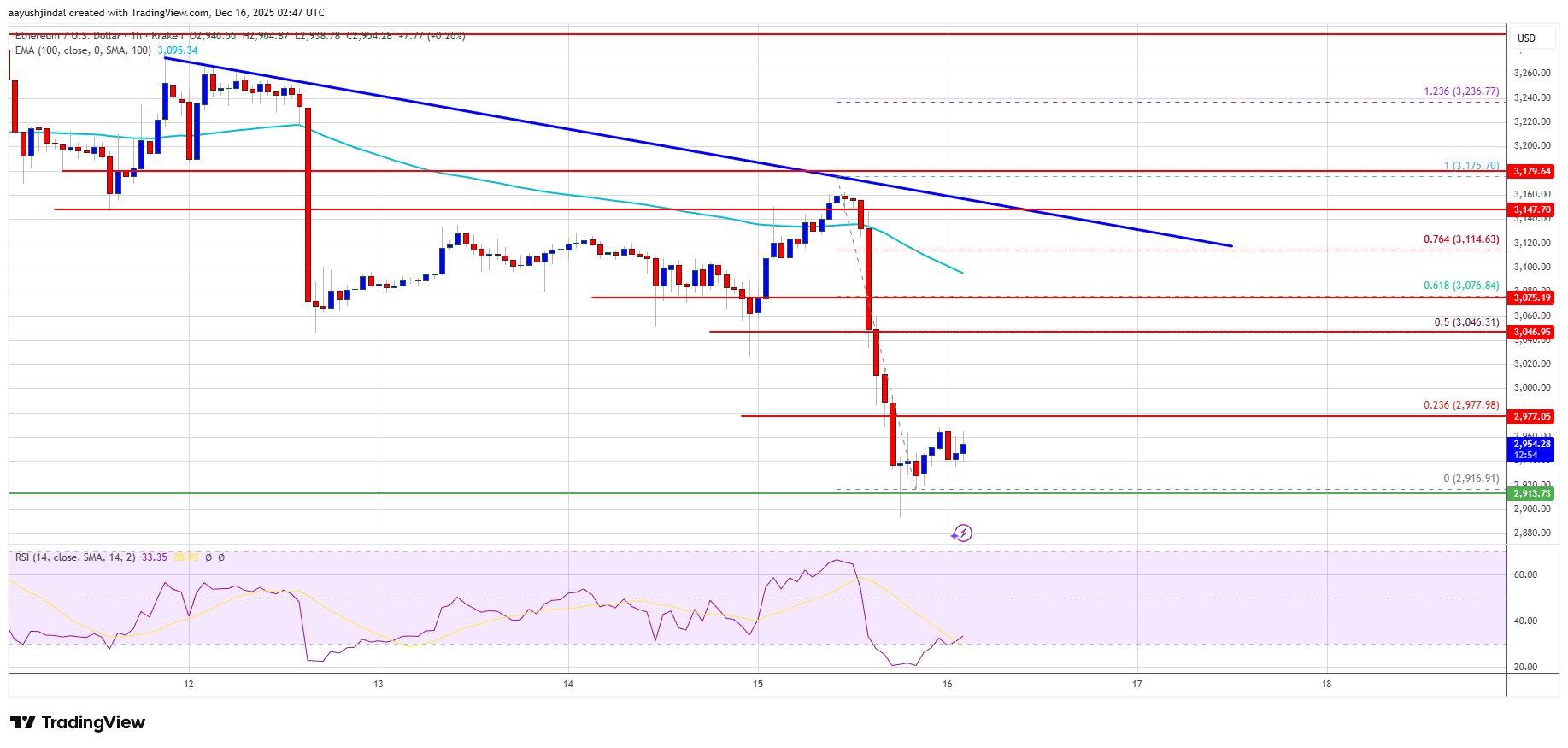
Ethereum price started a fresh decline below $3,000. ETH is now consolidating and might soon aim to start a recovery wave above $2,980.
Ethereum started a fresh decline from the $3,175 zone.
The price is trading below $3,000 and the 100-hourly Simple Moving Average.
There is a connecting bearish trend line forming with resistance at $3,120 on the hourly chart of ETH/USD (data feed via Kraken).
The pair could continue to move down if it settles below the $2,920 zone.
Ethereum Price Dips 5%
Ethereum price failed to stay above $3,150 and started a fresh decline, like Bitcoin. ETH price dipped below $3,120 and $3,050 to enter a bearish zone.
The bears even pushed the price below $3,000. A low was formed at $2,916 and the price is now consolidating losses below the 23.6% Fib retracement level of the downward move from the $3,175 swing high to the $2,916 low.
Ethereum price is now trading below $3,000 and the 100-hourly Simple Moving Average. Besides, there is a connecting bearish trend line forming with resistance at $3,120 on the hourly chart of ETH/USD.
If there is another upward move, the price could face resistance near the $2,980 level. The next key resistance is near the $3,050 level and the 50% Fib retracement level of the downward move from the $3,175 swing high to the $2,916 low. The first major resistance is near the $3,080 level. A clear move above the $3,080 resistance might send the price toward the $3,120 resistance. An upside break above the $3,120 region might call for more gains in the coming days. In the stated case, Ether could rise toward the $3,175 resistance zone or even $3,200 in the near term.
More Losses In ETH?
If Ethereum fails to clear the $2,980 resistance, it could start a fresh decline. Initial support on the downside is near the $2,950 level. The first major support sits near the $2,920 zone.
A clear move below the $2,920 support might push the price toward the $2,880 support. Any more losses might send the price toward the $2,840 region. The next key support sits at $2,800.
Technical Indicators
Hourly MACD – The MACD for ETH/USD is gaining momentum in the bearish zone.
Hourly RSI – The RSI for ETH/USD is now below the 50 zone.
Shiba Inu has kept a spot in crypto talk even as its price has slid sharply. According to reports, the network had a market cap of $5 billion as of Dec. 6, and it still draws attention because people know the name. That visibility, however, does not settle the debate over whether the token belongs in a long-term portfolio.
Shiba Inu’s Price And Market Size
Based on reports, Shiba Inu has seen massive moves over several years. Roughly five years ago it traded near $0.0000000001684; at the time of writing, it is quoted at about $0.000008439.
SHIB’s all-time high stands at $0.00008845, which means the token trades roughly 85% below that peak. Reports have disclosed that SHIB has tanked about 55% so far this year, and some data points show almost a 60% decline over a recent 12-month span. Those drops have pushed many investors to ask whether the story that once lifted SHIB has faded.
On-Chain Signals And Holder Counts
There are mixed signals on the chain. Data from CryptoQuant is reported to show memecoin dominance falling to its lowest level since early 2024, a sign that speculative interest across similar tokens has ebbed.
At the same time, the number of wallets holding SHIB moved from about 1.45 million at the start of the year to around 1.52 million more recently. That jump in holders was noted alongside the price slide. It suggests distribution rather than complete abandonment; small increases in holders do not always mean increased trading activity, but they can show steady retail interest.
Meanwhile, crypto pundit Neil Patel has listed reasons he would not treat Shiba Inu as a proper investment. He argues the memecoin doesn’t solve a clear, large-scale problem and points out that developer activity for SHIB is limited compared with many other networks.
The claim is that much of SHIB’s value has been driven by hype cycles and not by broad real-world use. Those views were presented in firm terms, and they have been repeated across a range of commentaries that warn about hype-driven tokens.
Investor Takeaways And Risks
Investors who want exposure to crypto are often told to look at major networks such as Bitcoin for scarcity-driven arguments; that point was brought up in several reports. At the same time, SHIB’s supporting projects — a layer-two chain, a decentralized exchange, a metaverse concept — are real but appear to have small adoption so far.
Featured image from Unsplash, chart from TradingView
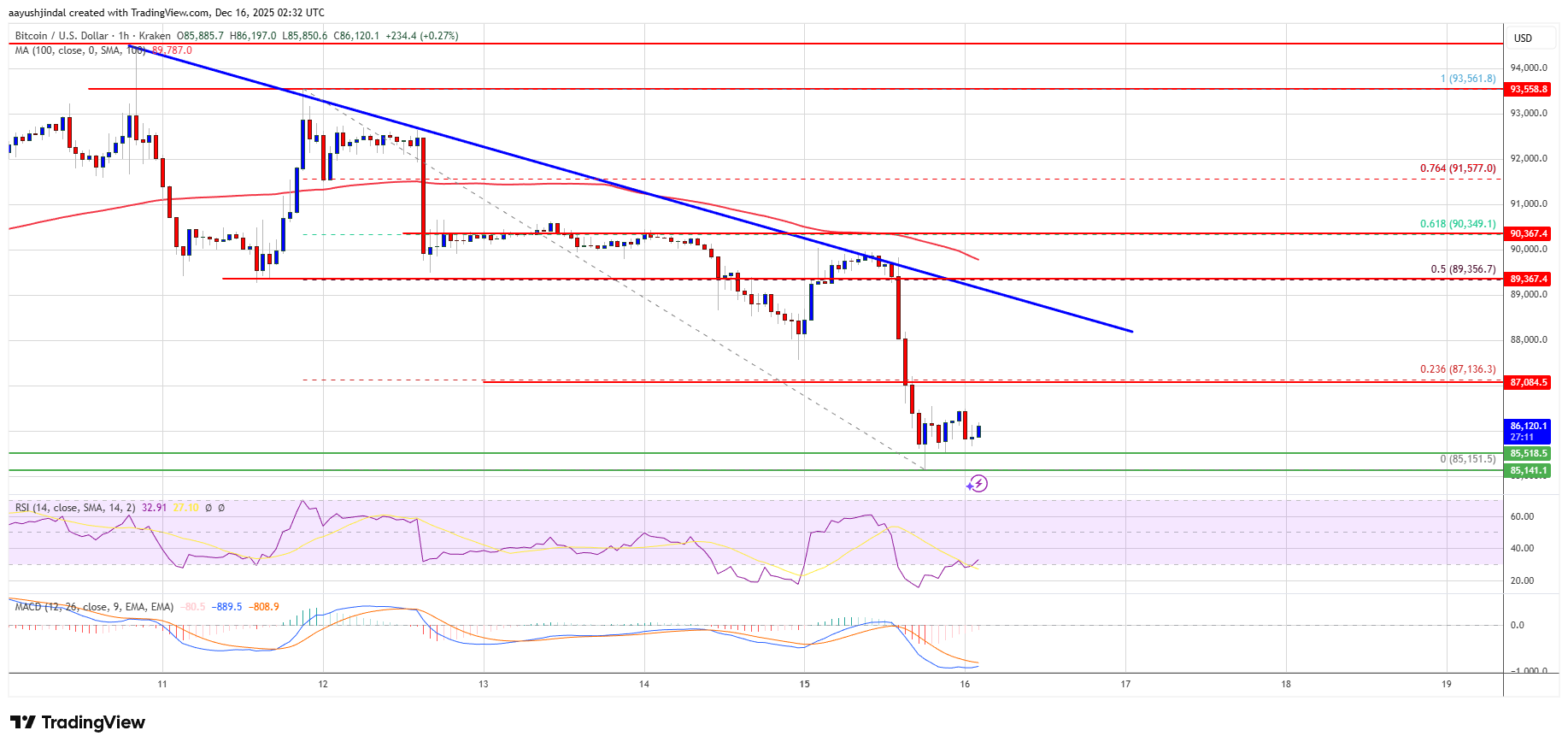
Bitcoin price corrected gains and traded below the $88,000 support zone. BTC is now consolidating and might struggle to clear the $88,500 zone.
Bitcoin started a fresh decline from the $90,500 zone.
The price is trading below $88,000 and the 100 hourly Simple moving average.
There is a bearish trend line forming with resistance at $89,000 on the hourly chart of the BTC/USD pair (data feed from Kraken).
The pair might continue to move up if it settles above the $85,000 zone.
Bitcoin Price Dips Further
Bitcoin price failed to gain strength for a move above the $90,000 and $90,500 levels. BTC started a fresh decline and traded below the $88,500 support.
The price even spiked below the $87,000 support. However, the bulls were active near the $85,000 zone. A low was formed at $85,151 and the price is consolidating gains below the 23.6% Fib retracement level of the downward move from the $93,560 swing high to the $85,151 low.
Bitcoin is now trading below $88,000 and the 100 hourly Simple moving average. If the bulls remain in action, the price could attempt another increase. Immediate resistance is near the $87,150 level. The first key resistance is near the $87,500 level.
The next resistance could be $88,000. A close above the $88,000 resistance might send the price further higher. In the stated case, the price could rise and test the $89,000 resistance. There is also a bearish trend line forming with resistance at $89,000 on the hourly chart of the BTC/USD pair. Any more gains might send the price toward the $90,000 level. The next barrier for the bulls could be $91,000 and $91,500.
Another Decline In BTC?
If Bitcoin fails to rise above the $87,000 resistance zone, it could start another decline. Immediate support is near the $85,500 level. The first major support is near the $85,000 level.
The next support is now near the $83,500 zone. Any more losses might send the price toward the $82,500 support in the near term. The main support sits at $80,000, below which BTC might accelerate lower in the near term.
Technical indicators:
Hourly MACD – The MACD is now losing pace in the bearish zone.
Hourly RSI (Relative Strength Index) – The RSI for BTC/USD is now below the 50 level.
Major Support Levels – $85,500, followed by $85,000.
A cryptocurrency analyst has pointed out how Cardano has formed a technical analysis (TA) signal on its weekly chart that last led into a major price drawdown.
Cardano SuperTrend Has Flipped Bearish
In a new post on X, analyst Ali Martinez has talked about a signal that has appeared in the SuperTrend of Cardano. The “SuperTrend” refers to a TA indicator that’s generally used for determining whether a given asset is following a bearish or bullish trend. It’s built using the Average True Range (ATR), another TA indicator that measures the degree of volatility being experienced by the price.
The SuperTrend is represented by a single trendline that acts as both support and resistance, depending on which side the asset is trading. When the price is above this line, the indicator signals that the asset is in a bullish trend. On the other hand, being under the line implies the dominance of a bearish trajectory.
Now, here is the chart shared by Martinez that shows the trend in the SuperTrend of Cardano over the last few years:
As displayed in the above graph, the weekly Cardano price broke above the SuperTrend line during 2023 and stayed over it throughout 2024 and much of 2025. Recently, however, the price has finally seen a reversal of trend, with the indicator now giving a bearish signal instead.
In the chart, Martinez has highlighted what happened the last time that this pattern developed in ADA’s 1-week price. It would appear that the flip to a bearish trend led to a decline of more than 80% for the cryptocurrency in 2022. It now remains to be seen whether the SuperTrend giving a sell signal is foreshadowing something similar this time, or if Cardano will see the renewal of bullish momentum despite the pattern.
Cardano isn’t the only coin in the sector that has seen a flip in the SuperTrend recently. As the analyst has highlighted in another X post, the number one cryptocurrency, Bitcoin, has also seen a change in its SuperTrend.
From the above chart, it’s apparent that the weekly price of Bitcoin is now trading under the SuperTrend line, a sign that a bearish trend is taking over. Like for Cardano, the last time this flip happened was in the last bear market. Back then, BTC dropped by over 60%.
ADA Price
Cardano saw brief recovery above $0.48 last week, but the cryptocurrency has since witnessed a retrace as its price is now back at $0.40.
Bitcoin risks a further drop toward the $70,000 area if the Bank of Japan follows through with an expected interest-rate rise on Dec. 19, analysts focused on macro forces warned.
According to multiple macro-focused voices, the move could sap global liquidity and put fresh downward pressure on risk assets, with some traders already bracing for a sharp pullback.
Japan’s policy shift matters because higher rates tend to strengthen the yen and raise the cost of borrowing. When that happens, traders who previously borrowed cheaply in yen to invest elsewhere are often forced to unwind those positions.
That process can pull money out of global markets in a short period of time, and Bitcoin has often felt that impact as investors cut exposure during risk-off stretches.
BOJ Tightening Drains Global Liquidity
According to AndrewBTC, every BOJ hike since 2024 has coincided with Bitcoin drawdowns of more than 20%. Based on reports, the analyst pointed to declines of roughly 23% in March 2024, 26% in July 2024, and 31% in January 2025.
Traders are not only watching central bank calendars. Bitcoin’s daily chart also flashed a classic bear flag formation after a steep fall from the $105,000–$110,000 area in November.
Market Positioning Widens Ahead Of Key Data
Bitcoin slipped below $90,000 in thin trading on Sunday, a move that traders took as a cautionary sign rather than a definitive trigger. Based on reports, Ether held up better than many altcoins, suggesting selective risk taking in the market.
Traders are positioning before a busy slate of US data and central bank events that could sway flows. Analyst EX bluntly warned BTC will collapse “below $70,000” under the stated macro conditions, a stark forecast that highlights how crowded bets can amplify moves when liquidity is pulled.
EVERY TIME JAPAN HIKES RATES, BITCOIN DUMPS 20–25%
NEXT WEEK, THEY WILL HIKE RATES TO 75 BPS AGAIN.
IF THE PATTERN HOLDS, $BTC WILL DUMP BELOW $70,000 ON DECEMBER 19.
The story tying BOJ policy to Bitcoin’s swings is simple in outline: when funding costs in Japan rise, global borrowing becomes pricier, and risk assets can be sold as positions are reduced.
That dynamic helps explain why past BOJ moves lined up with 20-30% declines in Bitcoin. Still, markets often try to price events ahead of time; a hike that’s already built into prices may have a smaller effect than one that comes as a surprise.
Featured image from Nikkei Asia, chart from TradingView
Ethereum (ETH) is currently consolidating in a tight range following its recent selloff, demonstrating resilience by holding above key support zones. However, the price remains firmly capped by a descending trendline and structural resistance around the $3,400 level. While buyers defend the vital $2,905 low, the trend remains sideways until ETH can achieve a decisive close above the descending resistance to initiate the next major rally.
ETH Attempts To Stabilize After The Selloff
According to a daily update from CyrilXBT, Ethereum is attempting to form a base following its recent selloff, but the price remains capped below the 50-day EMA around $3,281. This level continues to act as a key barrier, keeping ETH from confirming a stronger recovery for now.
At the time of the update, ETH was trading near $3,131. On the downside, initial support sits around $3,050, while a broader demand zone between $2,750 and $2,900 remains the more significant area where buyers are expected to step in if selling pressure returns. On the upside, resistance is concentrated between $3,280 and $3,300, aligning closely with the 50-day EMA, which represents a clear “prove-it” level.
Looking ahead, a clean break and sustained hold above $3,300 could open the door for a move back toward the $3,500 area and beyond. However, failure to reclaim this resistance would likely lead to choppy price action, with a possible retest of the $3,000 level and even a revisit of the $2,800 zone.
Crypto analyst Kamile Uray revealed that ETH is currently confined, moving persistently under a blue descending trendline. This trendline is acting as a significant diagonal resistance barrier, limiting the extent of ETH’s bullish bounces and keeping the short-term pressure tilted downward.
Despite this overhead resistance, the analyst identified a critical support structure. Uray noted that the possibility of the upward movement continuing remains valid as long as the price stays above the rising black trendline and above the low established at $2,905. This confluence of support is crucial for maintaining the market’s current bullish bias.
If the blue descending trendline resistance is decisively broken, the subsequent rally is expected to target a series of higher resistance levels: $3,661, then $3,878, and finally $4,292. Kamile Uray synthesized the condition for the breakout, stating that the descending trendline will approximately be broken if ETH manages to achieve a daily close above the $3,400 level. Meanwhile, the key condition for expecting a continued upward movement is a close above $3,400 combined with the price successfully avoiding a close below the critical $2,905 low.
XRP’s price action in recent days has led to speculations among crypto traders over whether it could fall below the $2 support zone and how deep any pullback might go before a bottom is established.
Popular XRP analyst Zach Rector addressed this concern shared by many market participants during an interview on the Paul Barron Podcast as to how low XRP could realistically fall before buyers step in and whether a return to the $1 level is still possible under current conditions.
Zach Rector Says $1 XRP Is Virtually Impossible
Inflows into Spot XRP ETFs have been largely offset by selling pressure on centralized exchanges, keeping the cryptocurrency range-bound just above $2 even as long-term demand builds in the background. This range-bound trading has left the cryptocurrency at risk of losing $2 and breaking further downwards. The question now is whether this downward risk can cause the XRP price to return to $1.
Addressing the question from Paul Barron directly, Zach Rector stated that an XRP price move back to $1 is effectively off the table under normal market conditions. He presented such a scenario as something that would only occur in the event of an extraordinary black swan. Current market structure, liquidity depth, and buyer behavior do not support the XRP price falling as low as that level.
According to Rector, XRP’s order book on crypto exchanges is now populated by a large base of passive buyers with limit orders already positioned well above $1. He also used his own trade orders to illustrate why he believes XRP is forming a higher long-term floor.
He acknowledged entering an XRP long above $3.40 earlier in the year and confirmed that the position is still underwater. However, he explained that he has consistently dollar-cost averaged lower, bringing his average entry down to around $2.23. Keeping this in mind, Rector predicted a price low to watch out for before the XRP price bounces.
Higher Lows Says Support Is Between $1.90 And $1.80
XRP’s price structure over the past year points to a market that is gradually building strength rather than breaking down. Rector pointed to XRP’s price chart on Coinbase, which shows the creation of a sequence of higher lows, with price bottoming near $1.60 in April, recovering to form a higher low around $1.77 on October 10, and then holding even higher at approximately $1.81 in November.
That pattern is why the $1.90 to $1.80 range is viewed as the most realistic downside zone if XRP breaks below $2 and selling pressure resumes. According to Rector, a dip below $1.90 could open the door for a brief test of $1.80, and this is as low as the XRP price might go before a bounce. Such a move would still fit within the broader higher-low structure that has defined XRP’s price action throughout the year.
XRP is at the center of the institutional flows, leading the crypto market in streaks of capital inflows even as its price is locked around $2. Recent data shows that money is still entering into Spot XRP ETF products, but despite this steady demand and a clear shift toward bullish sentiment across social platforms, XRP’s spot price has struggled to break higher, and this raises questions as to why inflows and price action appear out of sync.
Spot XRP ETFs Are Seeing Relentless Institutional Demand
Institutional appetite for XRP has been especially visible through Spot XRP exchange-traded funds. These products have now logged 19 days of uninterrupted inflows, with a fresh capital of $20.17 million added again on Friday.
The latest figures from SoSoValue show that these inflows pushed cumulative inflows to $990.91 million, close to the $1 billion mark. Assets under management have also continued to rise, now sitting well above the $1 billion threshold at $1.18 billion. To put this into perspective, Spot Ethereum ETFs ended last week with $19.41 million of outflows
This pattern points to deliberate and sustained accumulation of XRP. Institutions appear comfortable building exposure to XRP gradually, taking advantage of its deep liquidity and regulated access through ETF structures.
Bullish Social Sentiment Has Not Yet Translated To Price
Another notable trend with XRP is that sentiment among retail participants has turned increasingly optimistic in the past few days. Data from market intelligence firm Santiment, which monitors discussions across platforms including X, Telegram, Reddit, and Discord, points to a noticeable increase in positive commentary surrounding the altcoin over the past week.
Santiment data shows that XRP has ranked among the most positively discussed assets of the year, much higher than Ethereum. This increase in positive sentiment has been characterized by traders expressing confidence as the price continues to hold above $2. Particularly, Santiment data shows that last week was the seventh most bullish sentiment week of 2025 for XRP.
Under normal conditions, this combination of strong inflows and improving sentiment would typically suggest a bullish setup. However, sentiment alone does not move markets, and XRP has been range-bound around $2.
The most important thing is the difference between buying and selling pressure. The lack of bullish price action means that persistent sell-side activity from existing holders has been sufficient to absorb incoming demand, and this has kept XRP’s price constrained even as accumulation quietly builds.
The same dynamic applies to ETF flows. Although Spot XRP ETFs have posted inflows for 19 consecutive days, the daily figures are relatively modest. Inflows would need to expand into the hundreds of millions of dollars on a consistent basis for these products to reflect in the XRP price. The strongest signal of improving sentiment right now is XRP’s ability to hold above $2 in the next few trading sessions, rather than any decisive breakout to the upside.
The narrative surrounding XRP, the digital asset native to the XRP Ledger, has shifted from a speculative cryptocurrency to a recognized digital asset within the global financial system. This shift reflects growing legal clarity and rising interest from financial institutions seeking compliant blockchain-based solutions for payments, liquidity, and settlement.
How Institutional Interest In XRP Continues To Build
As XRP gains recognition in regulated financial markets, it’s moving beyond its earlier perception as a speculative digital asset. An analyst known as Skipper_xrp has mentioned on X that this milestone has placed XRP in the conversation alongside traditional assets that institutions already trust. With recent developments from the US Commodity Futures Trading Commission (CFTC) and rising institutional interest, investors are wondering whether XRP’s growing credibility could be the catalyst for the next major price movement.
Meanwhile, tokenization is no longer a theoretical concept; it’s now a tangible reality. The ability to unlock trillions of dollars in real-world assets through blockchain is transforming how the markets will operate. On this front, the REAL token on the XRP Ledger isn’t just participating, it’s leading the change, and opening doors to an unprecedented global market.
Ripple recently made the single biggest unlock for XRP since the case against the US SEC, and it has nothing to do with a court ruling. X Finance Bull has provided insight into the CLARITY Act, which legally defines digital commodities under CFTC oversight, eliminating guesswork and excuses from institutions. The real barrier to mass XRP adoption wasn’t tech or liquidity, but a legal risk, and that wall just cracked wide open.
Currently, banks can use XRP rails, brokers can move in flow, and corporate treasuries can hold XRP on their books without stepping into uncertainty. This isn’t future potential; it’s the regulatory permission that is required before deploying serious capital.
Many tokens don’t fit the mold, but XRP already operates on payment-grade, bank-ready infrastructure designed for real-world settlement, and first in line for real volume. “When institutions get the green light, the token with roads already built will lead,” Xfinancebull noted.
A New Gateway Between Asian Markets And Ripple Labs
Technical analyst, ChartNerd, revealed that VivoPower International PLC has quietly transformed a standard joint venture agreement into a strategic expansion vehicle with asymmetric exposure. Instead of deploying heavy capital, the structure creates a bridge between Seoul’s institutional crypto markets and Ripple Labs’ private equity, which is aligning with access rather than ownership.
ChartNerd stated that the play is targeting $300 million in Ripple Lab shares. Furthermore, VivoPower has a capital-light model that delivers substantial upside while minimizing corporate risk.

 Login
Login