
Normal view

There are new articles available, click to refresh the page.
Today — 26 January 2026Cryptocurrency

Tom Lee’s BitMine Corners 3.5% of Ethereum Supply as Treasury Tops With 4.24M ETH Buy

26 January 2026 at 11:34

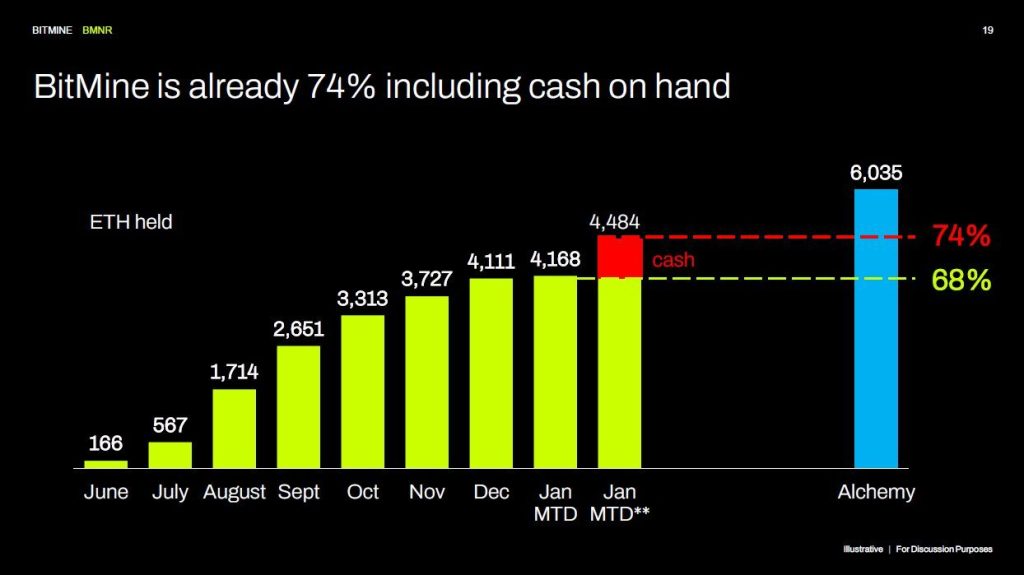
BitMine Immersion Technologies, a New York–listed company chaired by Fundstrat’s Tom Lee, has quietly built one of the largest concentrated positions in Ethereum ever disclosed by a single entity.

In an update published on January 26, BitMine said it now holds 4,243,338 ether, giving the company control of roughly 3.52% of Ethereum’s total circulating supply.

🧵
BitMine provided its latest holdings update for January 26th, 2026:

$12.8 billion in total crypto + "moonshots":
– 4,243,338 ETH at $2,839 (@coinbase)
– 193 Bitcoin (BTC)
– $200 mllion stake in Beast Industries @MrBeast
– $19 million stake in Eightco Holdings (NASDAQ: $ORBS)…

— Bitmine (NYSE-BMNR) $ETH (@BitMNR) January 26, 2026

At the time of disclosure, the position was valued at roughly $12 billion, making BitMine the largest Ethereum treasury in the world and the second-largest crypto treasury overall, behind Strategy Inc., formerly Strategy, which holds more than 700,000 bitcoin.

BitMine Accelerates ETH Accumulation as Prices Slide

The disclosure shows how quickly BitMine’s balance sheet has expanded over the past six months.

Weekly purchase data shared by the company indicates steady accumulation since late October, 2025, with particularly large buying activity in December.

In the week ending January 26 alone, BitMine added just over 40,000 ETH, following purchases of more than 35,000 ETH the prior week and several six-figure ETH buys in December.

Last week the company bought the dip, purchasing $110M worth of Ethereum.

📊 BitMine @BitMNR now controls 3.48% of Ethereum’s total supply after adding $110M in $ETH during the dip, moving closer to its “Alchemy of 5%” goal.#Ethereum #BitMinehttps://t.co/W74cW2b8XH

— Cryptonews.com (@cryptonews) January 21, 2026

The pace of accumulation has continued even as ether prices softened, with ETH down double digits over the past month amid broader market volatility.

Ethereum is currently trading at $2,940.44, showing a 2.0% increase over the past hour, which suggests short-term buying pressure returning to the market.

Source: Cryptonews

On a 24-hour basis, ETH is up a modest 0.4%, indicating relatively stable price action despite broader market fluctuations.

However, over the past seven days, Ethereum has declined by 8.4%, reaching as low as $2,787.
Source: Bitmine

BitMine’s total crypto, cash, and equity holdings now stand at $12.8 billion, according to the company.

In addition to its Ethereum position, the firm holds 193 bitcoin, $682 million in cash, a $200 million stake in Beast Industries, and a smaller equity position in Eightco Holdings.

BitMine’s Ethereum Bet Moves Closer to the 5% Mark

The company trades on the NYSE American under the ticker BMNR and was last priced around $28.50, down modestly on the day and slightly lower over the past week.

The Ethereum accumulation is central to BitMine’s stated long-term strategy, as it has publicly set a goal of acquiring 5% of Ethereum’s total supply, a target it refers to as the “alchemy of 5%.”

Based on current supply estimates, reaching that level would require roughly 6 million ETH.

At current market prices, closing that gap would require several billion dollars in additional capital.

BitMine Expands Ethereum Staking as Holdings Grow

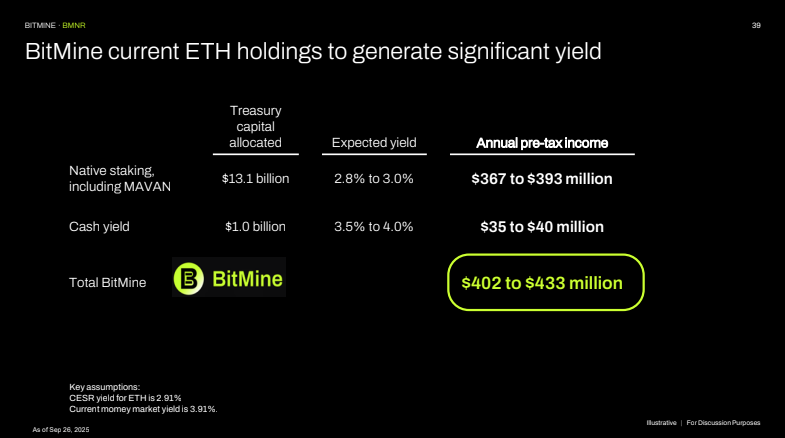
Beyond holding ether on its balance sheet, BitMine is also expanding its staking operations. As of January 25, the company had staked 2,009,267 ETH, worth about $5.7 billion, representing nearly half of its total holdings.
Source: Bitmine

Using the composite Ethereum staking rate of roughly 2.81%, BitMine estimates that a fully deployed staking strategy could generate about $374 million in annual fees, or more than $1 million per day.

For now, the company relies on external staking providers, but it plans to launch its infrastructure, known as the Made in America Validator Network, or MAVAN, in early 2026.

🚀 BitMine @BitMNR plans an early-2026 launch of its MAVAN validator network, aiming to turn a $12B Ether treasury into staking yield at scale.#BitMine #Staking https://t.co/YOlkeNouQu

— Cryptonews.com (@cryptonews) December 30, 2025

Chairman Tom Lee has framed the Ethereum strategy as a long-term bet on institutional adoption of blockchain technology.

Speaking after last week’s World Economic Forum meeting in Davos, Lee said discussions among policymakers and business leaders increasingly point to the convergence of traditional finance, crypto, and artificial intelligence.

He pointed to Ethereum’s role in tokenization and financial infrastructure projects as evidence that Wall Street is already building on the network.

The post Tom Lee’s BitMine Corners 3.5% of Ethereum Supply as Treasury Tops With 4.24M ETH Buy appeared first on Cryptonews.
Polymarket Installs Jump 1,200% as Crypto Loses $150B – Are Crypto Traders Done With Tokens?

26 January 2026 at 11:32

Crypto traders are abandoning token speculation in favour of prediction markets following a brutal $150 billion altcoin crash, with platforms like Polymarket seeing app installs surge from 30,000 to over 400,000 between January and December 2025, according to Bloomberg.

Crypto Traders Jump Polymarket - Binance vs Kalshi Download Chart
Source: Bloomberg

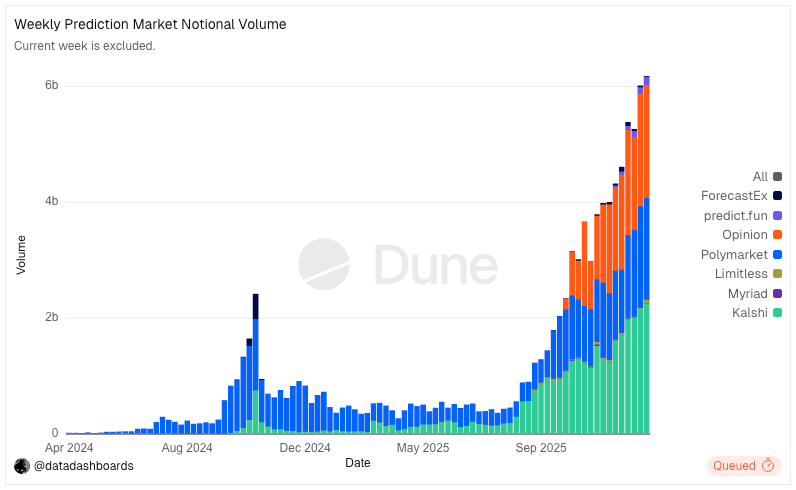
Weekly trading volume across prediction platforms, including Polymarket and Kalshi, exploded from $500 million in June to nearly $6 billion in January, data from Dune shows, while crypto exchange downloads collapsed by more than half during the same period.

Crypto Traders Jump Polymarket - Weekly Prediction Market Volume Chart
Source: Dune Analytics

The shift reflects deep fatigue across the token economy after Bitcoin plunged nearly 30% from its October peak and more than 11 million coins effectively died last year, marking the largest extinction event in crypto history, according to CoinGecko.

According to CoinShares, digital asset investment products shed $1.73 billion in the largest weekly outflow since mid-November 2025, driven by fading rate-cut expectations and persistent bearish sentiment.

Last week, Bitcoin spot ETFs also bled $1.62 billion over four consecutive trading days as hedge funds unwound basis trades that now yield below 5%.

Crypto Natives Migrate to Event Betting

Former memecoin traders are leading the exodus toward prediction markets that offer binary odds on real-world events rather than multi-year token roadmaps.

Nikshep Saravanan, who abandoned his digital creator startup to build HumanPlane, a prediction market research platform, said the shift made sense after losing traction without funding.

Here I can do a lot more with no capital,” the 27-year-old Canadian explained. “There’s so much more interest here.

Tre Upshaw followed a similar path after losing money on memecoins like SafeMoon, now running Polysights, an analytics dashboard for prediction markets.

I realized that’s just hyper gambling,” he said. “I got burned so many times on memecoins.

Yet losses remain widespread across prediction markets too, with 70% of trading addresses showing realized losses, while fewer than 0.04% of Polymarket addresses captured over 70% of total realized profits totalling $3.7 billion.

🔴 70% of Polymarket traders lost money while the top 0.04% captured over $3.7 billion in profits, revealing extreme concentration in prediction markets.#Polymarket #Tradershttps://t.co/E5CeFnJIwR

— Cryptonews.com (@cryptonews) December 29, 2025

The infrastructure supporting these markets remains fundamentally crypto-powered despite traders fleeing token speculation.

On Polymarket, every key part of trades except order-matching happens on-chain, revealing blockchain technology’s most durable use case yet as belief-driven speculation cools.

Crypto contracts have become the second-busiest trading category on Polymarket, up from fourth place a year ago, with notional crypto volume increasing nearly tenfold across major platforms, according to Dune data.

Exchanges Rush Into Prediction Markets

Major crypto platforms are aggressively expanding into event contracts as user demand shifts.

Coinbase added prediction markets in December through Kalshi routing, with Clear Street analyst Owen Lau projecting the exchange could generate $700 million in prediction market revenue for 2025, while Robinhood’s annual run rate already approaches $300 million.

Gemini and Crypto.com have also launched their own prediction market efforts, with Crypto.com white-labeling services for Trump Media.

As we add more instruments, they tend to complement each other,” said Max Branzburg, Coinbase’s head of consumer and business products, noting the firm has “seen tons of excitement” from users wanting a single venue to trade everything.

A Mizuho survey cited by Bloomberg found that Coinbase and Robinhood users were 9 times more likely to use prediction platforms than the general population.

Polymarket returned to the U.S. market following CFTC approval, launching with ultra-low 10 basis point taker fees and zero maker fees, the lowest among major platforms according to Clear Street analyst Owen Lau.

🇺🇸 Polymarket is back in the U.S. after CFTC approval. Clear Street analyst says prediction markets could become an engagement tool for platforms like Coinbase. #Polymarket #Coinbasehttps://t.co/h9EX7a4YFn

— Cryptonews.com (@cryptonews) January 26, 2026

The platform also recently rolled out real estate bets that allow crypto traders to now speculate on housing prices

The company raised $205 million across two funding rounds and secured a $2 billion investment from Intercontinental Exchange at a valuation of nearly $9 billion.

Last month, Kalshi also closed a $1 billion round at an $11 billion valuation and secured CNN as its official prediction markets partner.

Despite near-term outflows, 70% of institutions view Bitcoin as undervalued in a recent Coinbase Institutional and Glassnode survey, and 62% maintain or increase crypto positions since October’s crash.

Crypto markets are entering 2026 in a healthier state, with excess leverage having been flushed from the system,” said David Duong, Coinbase Global Head of Research.

The post Polymarket Installs Jump 1,200% as Crypto Loses $150B – Are Crypto Traders Done With Tokens? appeared first on Cryptonews.

Solana price prediction: SOL risks drop to $100 despite institutional inflows

26 January 2026 at 11:25
  • Solana price hovered near $122 on January 26, 2026.
  • ETFs’ inflows fail to influence SOL price.
  • Technical indicators signal a bearish continuation and likely dump to $100.

Solana’s price has faced mounting downward pressure, with SOL failing to hold onto gains seen at the start of the year.

On January 26, the altcoin traded around $122, down on the day and in tandem with the broader cryptocurrency market struggles.

While River (RIVER) skyrocketed, and Algorand flipped green, Solana aligned with Bitcoin, Ethereum and XRP’s latest price struggles.

The SOL token changed hands nearly 8% down from the prior week, losses that persist despite positive institutional signals.

Analysts are largely bullish, but the overall bearish trend concerns a potential short-term dump to the critical $100 support level.

Solana continues to attract institutional interest

SOL’s price dip comes as top coins shed capital from various investment products.

But despite institutional investors showing selective enthusiasm last week amid a $1.73 billion outflow hole, Solana stood out as one of those to record inflows.

According to CoinShares’ report, investors still put over $17 million in SOL products, including a spot exchange-traded fund.

Bitcoin saw over $1 billion in outflows in the same period.

Digital asset investment products recorded US$1.73B in outflows last week.@Bitcoin, @ethereum and XRP (@Ripple) all saw outflows totalling US$1.09B, US$630M and US$18.2M respectively, highlighting negative sentiment was broad-based. @solana bucked this trend with inflows of… pic.twitter.com/tefIwdc2zW

— CoinShares (@CoinSharesCo) January 26, 2026

A week earlier, digital asset products recorded $2.17 billion in inflows, with Solana attracting over $45.5 million.

“Dwindling expectations for interest rate cuts, negative price momentum and disappointment that digital assets have not participated in the debasement trade yet have likely fuelled these outflows,” said James Butterfill, head of research at CoinShares.

The Solana-specific interest highlights its appeal amid broader market caution.

However, bulls have failed to stem the price slide from highs of $133 in the past week.

Factors like profit-taking after 2025 highs and macroeconomic headwinds appear to override these inflows, keeping SOL within a bearish hold.

SOL price prediction: Bears eye $100

With price touching the psychological support level of $120 again, analysts say bears could target $100 next.

Sellers last hovered in this region in April 2025, with the bounce that followed pushing prices to above $200.

The downtrend risks such an extended move, and technical indicators reinforce the overall bearish outlook.

For instance, the MACD displays negative momentum and histogram divergence signaling further downside.

Elsewhere, the daily RSI hovers neutral in the 40-46 bracket. Although not decisively oversold, it’s not supportive of a quick rebound.

Price could drop lower if the pressure exposes buyers to key levels around $118 and $112 if profit hunters take out the $120 mark.

Network fundamentals remaining robust is a play for buyers, both in the short-term and long-term. In this case, a sustained rebound above $130 could accelerate gains toward $150-$180.

The price level of $200 is the main target.

The post Solana price prediction: SOL risks drop to $100 despite institutional inflows appeared first on CoinJournal.

Crypto Traders Share Odds Of XRP Price Rising 40% This Year, Can It Still Rally?

26 January 2026 at 11:30

Retail traders are increasingly optimistic about XRP, even though the cryptocurrency’s price is currently struggling to keep up above $1.90. Despite the recent lack of follow-through in price action, different data shows confidence is building beneath the surface. 

Data from prediction markets by Robinhood shows traders are actively pricing in the possibility of a sizable upside move for XRP’s price action this year, with odds pointing toward a rally of roughly 40% from current levels.

How Prediction Market Pricing Is Reflecting Bullish Expectations

Data from prediction markets hosted on Robinhood shows that traders are actively trading contracts tied to XRP reaching specific price levels in 2026. Notably, the data shows that the contract for XRP trading at $2.75 in 2026 is currently quoted with a bid of $0.66 and an ask of $0.73. 

An ask of $0.73 means that the Robinhood prediction platform believes the likelihood of XRP reaching or exceeding $2.75 is high enough to demand a significant premium. Although this does not represent a guaranteed probability, it suggests that traders offering liquidity see that outcome as more likely than not, placing implied odds in the 73% range based on current pricing.

That same optimism is present as price targets move higher, though more measured. The contract tied to XRP crossing $3.00 is priced around 50 cents. This implies the market views that level as a roughly even chance and a 50% scenario that the XRP price breaks above $3 again in 2026. The ask price drops to 44 cents for an XRP price bet of $3.25, which means there is a 44% chance XRP reaches this level.

Can XRP Still Rally While Near $1.90?

Recent price action has seen XRP now back to trading around support at $1.9. At the time of writing, XRP is trading at $1.88, down by 5% in the past seven days. This decline is part of an extended correction move after XRP’s rally in early January was rejected around $2.41 on January 6. 

The entire crypto industry is now back to a mood of fear, according to CoinMarketCap’s Fear & Greed Index. The index shows that the overall market sentiment is currently sitting at a Fear reading of 29. Even so, this risk-off mood has done little to dampen bullish expectations among many XRP investors. Several forecasts published in January continue to point toward a move into new all-time price highs this year.

Standard Chartered’s analysts, for example, have projected that XRP could reach $8 in 2026 if sustained ETF inflows and clearer regulation are able to increase institutional interest. Another price outlook echoed the idea that a new all-time high above $5 is possible before the year ends based on the current trend of XRP outflows from crypto exchange reserves.

XRP

Bitcoin Bulls Eye Dollar Weakness As Yen Intervention Rumors Build

26 January 2026 at 11:00

Bitcoin traders are once again anchoring to FX, after intervention rumors around USD/JPY revived a familiar tug-of-war: short-term shock risk from a strengthening yen versus the longer-horizon bid that typically follows a softer dollar and easier global liquidity.

The spark over the weekend was a viral X thread (2.9 million views) from Bull Theory (@BullTheoryio), which framed reported “rate checks” by the Federal Reserve Bank of New York as a prelude to coordinated action. “The New York Fed has already done rate checks, which is the exact step taken before real currency intervention,” the account wrote. “That means the US is preparing to sell dollars and buy yen. This is rare. And historically, when this happens, global markets surge.”

Bitcoin In The Crosshairs

Bull Theory pointed to the macro backdrop in Japan, years of yen weakness, Japanese bond yields at multi-decade highs, and a still-hawkish Bank of Japan, as the pressure cooker forcing officials toward more aggressive signaling. In the thread’s telling, the key variable is coordination: Japan acting alone “does not work,” while joint US-Japan action “does,” citing 1998 and the Plaza Accord era as historical reference points.

A Bloomberg report cited by the account described the yen’s sharp jump on speculation that Japanese authorities could be preparing intervention to arrest the currency’s slide, after traders reported the New York Fed had conducted rate checks with major banks. The story said the yen rallied as much as roughly 1.6% to around 155.90 per dollar, marking its strongest level since December in that session.

🇺🇸 THE FED IS PREPARING TO SELL U.S. DOLLARS AND BUY JAPANESE YEN FOR THE FIRST TIME THIS CENTURY.

The New York Fed has already done rate checks, which is the exact step taken before real currency intervention. That means the U.S. is preparing to sell dollars and buy yen.

This… pic.twitter.com/7xFReOFoDo

— Bull Theory (@BullTheoryio) January 25, 2026

The fight in the replies was less about whether markets moved and more about what a “rate check” actually signals.

Daniel Kostecki (@Dan_Kostecki) dismissed the viral framing outright, arguing the mechanism is often misread. “The Japanese asked the NY Fed to act as their agent in the American market,” Kostecki wrote. “NY Fed employees then started calling banks in New York to perform the ‘rate check’—strictly at the Japanese’s request. If officials from Tokyo had called New York banks, traders might have ignored it as a ‘local Japanese problem.’ But when the Fed calls, banks treat it as a signal that a joint intervention (USA + Japan) might be coming.”

That distinction matters for crypto because the thread’s “bull case” leans heavily on the idea that selling dollars to buy yen mechanically weakens the dollar and expands liquidity, conditions many macro-focused crypto traders associate with risk-asset upside.

Ted (@TedPillows) echoed the liquidity-first interpretation while flagging the path dependency. “The Fed is preparing for a possible yen intervention,” he wrote, before laying out the causal chain: dollars sold, yen bought, dollar weaker, liquidity higher, risk assets helped, then warning that “a strengthening yen could first cause a similar crash like in August 2024.” After that, he added, markets could stabilize and rally.

Michael A. Gayed (@leadlagreport), Portfolio Manager of The Free Markets ETF, offered a different rationale for why Washington would care, suggesting the Fed is acting to prevent a scenario where Japan would need to sell US Treasuries to raise dollars to intervene—“It’s not that Japan will panic. It’s the Fed that will panic,” he wrote.

Bull Theory’s most concrete crypto claim was that the setup contains both a near-term trap and a medium-term tailwind. The account argued there are “hundreds of billions of dollars tied into the yen carry trade,” meaning abrupt yen strength can force deleveraging in the very assets, stocks and crypto, funded with cheap yen borrowing.

As an example, the account pointed to August 2024, claiming a small BoJ rate hike pushed the yen higher and “Bitcoin crashed from $64K to $49K in six days,” with crypto losing “$600B in value.” Bull Theory framed that episode as the template for the “catch” in 2026: yen strength can be toxic in the first act, even if sustained dollar weakness ultimately improves the liquidity backdrop for Bitcoin.

LondonCryptoClub (@LDNCryptoClub) leaned into that lagged-liquidity framing, arguing that a weaker dollar tends to filter into risk assets with a delay, while also introducing an additional US liquidity variable. “Continued and accelerated breakdown of the dollar will be good for Bitcoin and broad risk over the next few months,” the account wrote, adding that the dollar “tends to act with a 3 months lag” outside of “knee jerk reactions.” It also warned that a potential US government shutdown and subsequent Treasury General Account rebuild could offset some of the positive liquidity impulse.

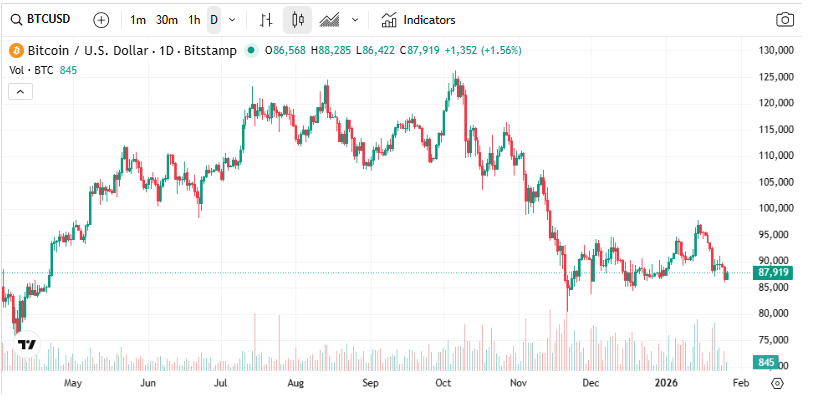
At press time, Bitcoin traded at $87,926.

Bitcoin price chart

U.S. Bitcoin Custody Concerns Rise After Alleged Insider Stole $40 Million In Digital Assets

26 January 2026 at 10:47

Bitcoin Magazine

U.S. Bitcoin Custody Concerns Rise After Alleged Insider Stole $40 Million In Digital Assets

All of the bitcoin held by the U.S. government has come under scrutiny after allegations surfaced that tens of millions of dollars in seized crypto were stolen through insider access at a federal custody contractor.

Blockchain investigator ZachXBT alleged over the weekend that more than $40 million in digital assets was siphoned from wallets linked to the U.S. Marshals Service (USMS), reportedly by the son of an executive at a firm contracted to manage seized crypto. 

The alleged theft centers on Command Services & Support (CMDSS), a Virginia-based technology firm awarded a USMS contract in October 2024 to manage and dispose of certain categories of seized digital assets. 

Those assets include crypto not supported by major exchanges and tied to high-profile criminal cases, including funds seized from the 2016 Bitfinex hack.

According to ZachXBT, an individual identified online as “Lick,” whom he claims is John Daghita, gained access to government-controlled wallets through insider channels. ZachXBT has further alleged that Daghita is the son of Dean Daghita, CMDSS’s president and chief executive.

The investigation began after a recorded dispute in a private Telegram chat surfaced online. During the exchange, the individual screen-shared a wallet showing millions of dollars in crypto and appeared to move funds in real time. 

On-chain analysis later linked those wallets to addresses known to hold government-seized assets.

A conflict of interest involving U.S. bitcoin 

One transaction trail cited by ZachXBT points to a government address that received roughly $24.9 million in bitcoin tied to Bitfinex-related seizures earlier in 2024. 

Additional blockchain data suggests that around $20 million was removed from USMS-linked wallets in October 2024. Most of those funds were returned within a day, though about $700,000 routed through instant exchanges was not recovered.

ZachXBT estimates that total suspected thefts could exceed $90 million when accounting for other wallet activity observed in late 2025. Some of the funds remain in compromised wallets, raising concerns that further losses could occur.

Neither the U.S. Marshals Service nor CMDSS has issued a public statement addressing the allegations.

Rightfully so, the investigation has renewed criticism on how the U.S. government manages its growing stockpile of seized crypto — especially its bitcoin. 

David Bailey, CEO of bitcoin-focused firm Nakamoto, posted on X after the report, “The son of the CEO of the company hired by the US Marshalls to safeguard the nation’s Bitcoin, stole $40m from it and now appears to be running. Treasury must secure the private keys from the Justice Department ASAP before more is stolen.”

The U.S. government holds a massive amount of Bitcoin seized through law enforcement actions, with some blockchain analytics estimating roughly 198,000 BTC under federal control with others projecting more than 300,000 BTC, worth tens of billions of dollars. 

If insiders can allegedly move millions from custodial wallets with minimal detection, it suggests current custody practices may leave portions of the government’s Bitcoin reserves exposed. 

Previous reports have found that the Marshals Service relied on manual tracking systems and struggled to provide precise estimates of its crypto holdings. CMDSS’s contract award also faced a protest in 2024 from a competing firm, which raised concerns about licensing and potential conflicts of interest. 

JUST IN: David Bailey says, “The son of the CEO of the company hired by the US Marshalls to safeguard the nation’s Bitcoin, stole $40m from it”

“Treasury must secure the private keys from the Justice Department ASAP” 👀 pic.twitter.com/6UroPNzqJY

— Bitcoin Magazine (@BitcoinMagazine) January 26, 2026

Did the United States sell bitcoin destined for the Strategic Bitcoin Reserve? 

Earlier this year, journalist Frank Corva published an investigation exploring the fact that prosecutors in the Southern District of New York and the U.S. Marshals Service may have sold bitcoin forfeited in the Samourai Wallet case, potentially in violation of President Trump’s Executive Order 14233, which dictates seized bitcoin be held in the U.S. Strategic Bitcoin Reserve rather than liquidated. 

There was on-chain evidence showing 57.55 BTC tied to the Samourai plea agreement moving through a Coinbase Prime address and later showing a zero balance, raising questions about whether the assets were improperly disposed of.

Shortly afterward, U.S. officials denied that any sale took place, affirming that the Samourai Wallet bitcoin will remain on the government’s balance sheet as part of the Strategic Bitcoin Reserve under the executive order.

U.S. officials failed to show blockchain evidence but the reports and overall sentiment relay controversy over how the U.S. handles seized bitcoin. The allegations from ZachXBT further push this sentiment. 

This post U.S. Bitcoin Custody Concerns Rise After Alleged Insider Stole $40 Million In Digital Assets first appeared on Bitcoin Magazine and is written by Micah Zimmerman.

The 15 Types of Bitcoiners You’ll Definitely See at Bitcoin 2026

26 January 2026 at 10:22

Bitcoin Magazine

The 15 Types of Bitcoiners You’ll Definitely See at Bitcoin 2026

Loud. Friendly. Huggy. The Bitcoin Bro is your hype man for hyperbitcoinization. He doesn’t know what “joules per terahash” means, but he does know where the nearest bar is and will yell “Buy the dip!” during your panel Q&A.

They party hard, orange-pill harder, and are basically Bitcoin’s version of a frat brother with a bull market permanently tattooed on his soul.

🟧 Think this might be you? Take the Which Bitcoin 2026 Persona Are You?” Quiz to find out. No halving knowledge required.

Slicker than a freshly backed-up seed phrase, this guy’s teeth are whiter than your Lightning wallet. He rented a Lambo for the afternoon and drops your first name way too often – like he’s trying to sell you a fractional NFT of a parking garage.

He doesn’t care about decentralization. He cares about gains. And tailoring. Always with the tailoring.

The apocalypse isn’t a threat – it’s a plan. This person hasn’t touched fiat since 2018 and bathes exclusively in non-KYC sats. They’ve learned to make soap, catch fish, and explain monetary collapse in a calm, reassuring tone.

They’re not paranoid. They’re prepared.

🟧 Are you spiritually prepared, too? Take the Which Bitcoin 2026 Persona Are You?” Quiz and see where you land.

Lives in a van. Pays for tacos with Lightning. Might be hiding from the IRS (but only spiritually). They believe Bitcoin is peace, man. And also chaos. And also freedom.

Will fix your flat tire in exchange for a hammock spot and a cold yerba mate.

The unsung hero of Bitcoin. Speaks exclusively in thermodynamic math and obscure hardware specs. Makes ASIC firmware upgrades look like wizardry, but cannot explain their job to their mom without causing emotional distress.

Knows the exact BTU-to-wattage ratio of their off-grid setup. Does not know what “small talk” is.

🟧 Don’t understand them? That’s okay. Take the Which Bitcoin 2026 Persona Are You?” Quiz anyway — they’re building the future while you click answers.

Yes, plural. Yes, anonymous.

They don’t want to talk to you. They don’t want to be on your podcast. They don’t even want you to know they’re here. Ask when something will be done and you’ll receive the sacred prophecy: “Two weeks.”

Shadowy super-coders, quietly pushing upgrades that will redefine monetary history – while actively avoiding eye contact.

Armed with a gimbal and a dream. Their camera roll is 80% memes, 20% selfies with CEOs. Some are spreading the signal. Some are chasing clout. All are uploading something right now.

Will say “Let’s run it back!” at least 17 times per day.

Identifiable by the gravity-defying stack of laminated badges swinging from his neck like a wearable timeline. He doesn’t say much – the passes do the talking.

He’s not here to attend panels. He’s here to assert conference dominance.

🟧 Is this your origin story? Take the Which Bitcoin 2026 Persona Are You?” Quiz and confirm your status.

Branded polo. Branded backpack. Branded soul. You don’t remember agreeing to this conversation, but you’re holding his business card now.

Moves in packs. Wears the lanyard like a badge of honor. Will be back at the booth exactly 15 minutes after lunch.Doesn’t talk about Bitcoin. Is Bitcoin.

Old-school finance types who smelled smoke on Wall Street and walked toward the orange glow. Calm. Calculated. Dollar-cost-averaging into the sunset.

They don’t shill. They don’t yell. They just nod knowingly.

Same data. Two conclusions. Infinite confidence. 

They believe balance sheets are destiny – or disaster. One thinks corporate Bitcoin accumulation is inevitable, elegant, and inevitable again. The other thinks leverage is a ticking time bomb wrapped in a TradFi costume. 

Both have read the filings. Both have spreadsheets. Both will reference Michael Saylor – either as a visionary or as a cautionary tale – and neither will back down.

Sleeps three to a room and burned half their runway to get to the conference. They’re pitching a Lightning wallet-slash-social network-slash-AI-powered-something and just need one person to believe.

Respect the hustle.

🟧 Take the Which Bitcoin 2026 Persona Are You?” Quiz before they raise your next round.

Absolute legends. They’ve stood beside their Bitcoin-obsessed partner for three straight days, nodding politely through debates about mining fees and custody models.

They are the backbone of the conference. The true MVPs. Quietly Googling spa availability.

Not who you expect. No megaphones. No flexing. Just quiet confidence and a phone that never leaves their hand.

Some got lucky. Some built empires. All will ignore your pitch deck.

Yes, they exist. Yes, they know more than you. And yes, they are already five steps ahead of your “Have you heard of Bitcoin?” opener.

Bonus: They will almost certainly explain immersion cooling better than you.

One Event. Endless Energy. Absolute Chaos.

Bitcoin 2026 isn’t just a conference – it’s a decentralized carnival of code, conviction, and characters. Whether you’re here to build, learn, argue, chill, or meme, there’s a place for you.

🟧 Ready to see where you fit in? Take the Which Bitcoin 2026 Persona Are You?” Quiz and find out who you really are.

This article was inspired by the video “The People of Bitcoin 2022 Miami Conference” by SPACE DESIGN WAREHOUSE. We acknowledge and appreciate the original creative concept, which served as a foundation for this updated and expanded interpretation for Bitcoin 2025. We encourage readers to view the original video and support the creator on YouTube.

This post The 15 Types of Bitcoiners You’ll Definitely See at Bitcoin 2026 first appeared on Bitcoin Magazine and is written by Josh Plischke.

Bitcoin’s Net Realized P/L Hits Zero Again — Is a June 2022-Style Capitulation Next?

26 January 2026 at 09:48

Bitcoin is again near another critical on-chain inflection point as a key profitability indicator goes back to the levels that last occurred during one of the most painful downtrends in the history of the market.

CryptoQuant analyst Adler AM data shows that the Net Realized Profit and Loss of Bitcoin has dropped by approximately 97% after it achieved its recent high and is now approaching the levels of near-zero territory.

The situation is similar to those observed in June 2022 before BTC plummeted from about 30,000 to almost 16,000.

Net Realized P/L has dropped by 97% and returned to zero. The last time this happened was in June 2022 – right before the drop from $30K to $16K. Whales are still in profit (a 25-80% buffer), so there is no panic yet. But the market is being supported not by buyers – but by the… pic.twitter.com/ooQsnaGTCA

— Axel 💎🙌 Adler Jr (@AxelAdlerJr) January 26, 2026

Net Realized P/L tracks the balance between realized profits and losses on the Bitcoin network based on on-chain cost basis. Positive readings signal dominant profit-taking, while negative values reflect loss-driven selling.

Readings near zero suggest trades are occurring close to cost basis, indicating profit exhaustion and a balance between buyers and sellers.

Bitcoin Selling Pressure Fades, but Buyers Stay on the Sidelines

The analyst pointed out that the current setup resembles the period just before Bitcoin’s main capitulation leg in 2022. In late 2024 and early 2025, Net Realized P/L surged above $1.5 billion, reflecting an overheated profit-taking phase.

By January 26, 2026, that figure had collapsed to roughly $60 million, effectively flattening at the zero line. In 2022, a similar return to zero did not mark a bottom.

Instead, the metric continued lower into deeply negative territory, falling to around minus $350 million as the price slid another 50%.

Adler noted that the present zero reading should not be interpreted as a bullish reversal signal. Instead, it represents a pause where selling pressure from profit-takers has largely dried up, but fresh demand has not stepped in.

On-chain data suggests the market is currently being supported more by the absence of sellers than by strong buying interest, a fragile equilibrium that has historically broken lower during risk-off environments.

Source: CryptoQuant

Despite the warning signals, large Bitcoin holders remain in profit, as realized price data segmented by balance size shows that all major whale cohorts are still comfortably above their average acquisition costs.

Holders with balances between 100 and 1,000 BTC have the highest realized price, near $69,900, giving them an estimated profit buffer of about 25% at current prices.

Other large cohorts, including wallets holding 10–100 BTC and those with more than 10,000 BTC, have average entry prices closer to $48,000 and $51,000, translating to unrealized gains of 70% to 80%.

This helps explain the lack of panic selling, even as price has pulled back sharply from recent highs.

Bitcoin Slips Below $88K as Volatility Picks Up

At the time of writing, Bitcoin was priced at approximately $87,756, having fallen by approximately 1.1% in the last 24 hours and 5.7% in the last week.

Source: Cryptonews

Trading volume, however, surged more than 160% day over day to $53.1 billion, pointing to heightened activity as traders reposition amid volatility.

Macro pressure has contributed to the discomfort because U.S. President Donald Trump threatened to impose 100% tariffs on any Canadian products in case Ottawa strengthens trade relations with China, and the rumors of a potential American government shutdown resurfaced.

The move triggered more than $320 million in liquidations of leveraged long positions in a matter of hours.

Also, CoinShares reported $1.73 billion in outflows from digital asset investment products last week.

📉 Digital asset investment products saw sharp outflows last week, with investors pulling $1.73B — the largest weekly decline since mid-November 2025, according to CoinShares.#BTC #ETPs https://t.co/2ni4w83evG

— Cryptonews.com (@cryptonews) January 26, 2026

Bitcoin-linked products accounted for $1.09 billion of those outflows, with the bulk coming from U.S.-based funds.

Exchange order book data shows sell-offs were absorbed with modest volume delta, indicating controlled selling.

Analysts say liquidity remains stable, with no signs yet of cascading capitulation.

The post Bitcoin’s Net Realized P/L Hits Zero Again — Is a June 2022-Style Capitulation Next? appeared first on Cryptonews.

River price defies market downturn, explodes 40% to new ATH

26 January 2026 at 09:52
  • River price rose sharply as bulls defied the broader market downturn.
  • The token exploded more than 40% in 24 hours to hit a new all-time high above $87.
  • RIVER recently received backing from Justin Sun and Arthur Hayes.

Several altcoins are deep in the red amid a broader cryptocurrency market downturn that has pushed Bitcoin well under $90,000.

But as BTC struggles, River’s native token RIVER has defied the odds, with price surging 40% in the past 24 hours to reach a new all-time high above $87.

The move sees the token rank as one of the top gainers across the altcoin sector.

River price explodes to new all-time high

River is a crypto protocol building a chain abstraction stablecoin platform.

The protocol eyes traction across the ecosystem with its liquidity and yield offering.

RIVER, the native governance and utility token, has surged significantly in recent days and skyrocketed 40% over the past 24 hours to smash through resistance to a new all-time high.

The token has pumped more than 200% in the past week and by more than 2,070% in the past month.

It peaked at $87.79 across major exchanges on January 26, 2025, more than 70x off the all-time lows reached in September 2025.

River’s explosive rally comes as the token’s market capitalisation ballooned past $1.6 billion, which aligns with the robust demand highlighted by a 39% jump in daily trading volume.

CoinMarketCap data shows the altcoin’s trading volume spiked to over $108 million in the past 24 hours.

Meanwhile, total value locked (TVL) climbed to over $162 million, as DeFi users flocked to the protocol’s cross-chain offerings.

In terms of gains, River’s performance stands in stark contrast to the prevailing market sentiment.

Bitcoin, the bellwether asset, dipped below $88,000 amid macroeconomic jitters.

Ethereum and other altcoins followed suit as risk-off sentiment grips traders.

The same headwinds could see RIVER ‘s price retreat sharply.

What catalysed the RIVER price rally?

Likely catalysts for RIVER’s meteoric rise include the latest listings and major backing in a fresh round.

Of the more than $14 million in capital raised, a landmark $12 million is from a strategic funding round backed by heavyweight investors that attracted TRON DAO, Justin Sun, Maelstrom Fund founder Arthur Hayes, and The Spartan Group.

Notably, the round also drew commitments from Nasdaq-listed companies and blue-chip institutions across the United States and Europe, lending unprecedented credibility to River’s vision.

River plans to plough this capital infusion into its multi-chain expansion plans, with DeFi applications available across Sui, Ethereum, BNB Chain, and Polygon.

Amplifying the momentum for the token is fresh exchange listings.

Both HTX and OKX have injected new liquidity and retail access to the token. Bulls capitalised on this, stacking positions as open interest in RIVER perpetuals.

Resistance looms at $90, but with funding secured and listings live, RIVER could test $100 in the coming days. However, a sharp pullback is possible given profit-taking deals.


The post River price defies market downturn, explodes 40% to new ATH appeared first on CoinJournal.

[InterLink by Design #3] Retail vs. Institutions: Who Actually Holds the Power in InterLink?

26 January 2026 at 09:21

The Great Alignment: How Time Becomes the Ultimate Equalizer Between Giants and Individuals


In [Part II], we established a critical principle: InterLink’s token numbers are not about price — they are about access, qualification, and time.

Participation is abundant.

Settlement is protected.

Ownership is earned.

🔗LINK[InterLink by Design #2]

[InterLink by Design #2] The 100 Billion Question: Why InterLink Built a Filter, Not a Pump

​That naturally leads to the final, and perhaps most uncomfortable, question:

Not what the system is, but who the system ultimately rewards.

AI-generated image for illustrative purposes. Not a real photograph.

📡 The Signal Shift: InterLink Enters Its “Institutional Phase”

One of the most misunderstood moments in a network’s life cycle is the arrival of institutions.

Many retail participants see this and panic: “The easy phase is over,” or “The rules will change to favor the big players.”

In InterLink, institutional participation doesn’t make entry easier; it raises the bar. 🚧

When we see Treasury-level language and settlement partnerships, we aren’t seeing “hype” — we are seeing a system preparing for durability.

Institutions don’t enter to gamble.
They enter to endure.

To them, InterLink is a tool for two things: Storing Value and Killing Risk.

This changes the game, but not in the way you might expect.

🛑 Why the System Becomes Harder — and Why That’s a Feature

As InterLink matures, the “easy rewards” begin to evaporate.

You’ll notice:

  • Higher verification standards. 🔍
  • Zero tolerance for idle or “fake” participation. ⚔️🚫
  • A heavy emphasis on consistency over random bursts of activity. ⏳

​Easy rewards attract noise;
hard qualifications protect meaning.

What you lose in short-term convenience, you gain in scarcity created by discipline.

🧍👣 The Individual’s Role: You Are a Node, Not a Miner

The most damaging misunderstanding in Web3 is linguistic. People still call themselves “miners,” implying they are here to extract resources.

InterLink is not optimized for extraction.
It is optimized to preserve signal integrity.

Your role is closer to a Network Node than a miner:

  • You accumulate verified activity over time.
  • You maintain behavioral consistency.
  • You build trust relationships (Security Groups).

Every action you take is not a “bet” — it is input data.

The question is no longer “How much did I earn today?” it becomes “What did I prove today?”

🏛️ The Institution’s Role: Custodians, Not Traders

Institutions operate under constraints that retail users often ignore. They cannot rely on sudden exits or narrative volatility.

This is why, inside InterLink, institutions don’t behave like traders — they behave like custodians.

They have no incentive to “dump” ITLG because:

  • Verified participation is the only gate to settlement access.
  • Governance rights compound over years, not weeks.
  • Treasury positioning requires stability, not liquidity spikes.

When both institutions and individuals are punished for impatience, the system achieves a rare economic balance.

🕰️ The Final Axis: Time Is Not Neutral

Most crypto systems pretend that time is neutral or a mere multiplier of interest.

InterLink treats Time as a Filter.

  • Being “early” guarantees nothing if you are inconsistent.
  • Having a “large balance” cannot override bad behavior.
  • Inactivity leads to a decay in relevance.

Time doesn’t reward your optimism; it rewards the records that survive scrutiny.

Not everyone will be early.
Not everyone will be large.
But anyone can be consistent.

🏁 Conclusion: The Rule That Binds Retail and Institutions Alike

This was never a contest between Retail and Institutions. It was a test of which behaviors survive the same rules.

InterLink does not guarantee returns, protect you from a lack of effort, or flatten outcomes to make everyone “equal.” Instead, it enforces a single, ironclad rule:

Only behavior that survives time is recognized.

If you understand the sequence — qualification before reward — you will find something much rarer than mere “yield.”

You will find Position.

🧭 Series Final Line

InterLink didn’t design a coin economy. It designed the order in which trust is allowed to matter.

About the Author

Done.T is a Web3 analyst specializing in the InterLink ecosystem.
He unpacks the underlying logic of the Human Node economy, translating complex system design into actionable, data-driven insights for a global audience.

Reference
🔗 [Chapter 2. The Deep Dive — Mechanics & Insights]​

Disclaimer: This article provides a strategic analysis of InterLink’s publicly available infrastructure and documentation.
It is not financial advice. Readers should conduct their own due diligence.


[InterLink by Design #3] Retail vs. Institutions: Who Actually Holds the Power in InterLink? was originally published in Coinmonks on Medium, where people are continuing the conversation by highlighting and responding to this story.

NordFX Receives Two More Industry Awards in 2025

By: NordFX
26 January 2026 at 09:19

NordFX has been recognised with two additional international awards in 2025, confirming the company’s strong position in execution quality and broker reliability.

✔️ Best Execution Broker 2025 — Forexing Awards
✔️ Most Reliable Forex Broker Asia 2025 — Finance Derivative Awards

These honours reflect NordFX’s continued focus on stable execution, transparent operations, and long-term trust among traders worldwide.

🔗 Read more:
https://nordfx.com/company-news/nordfx-receives-two-more-awards-2025-execution-reliability


🏆 NordFX Receives Two More Industry Awards in 2025 was originally published in Coinmonks on Medium, where people are continuing the conversation by highlighting and responding to this story.

Interest Rates for Traders: The FOMC Playbook Most Beginners Miss

By: MintonFin
26 January 2026 at 09:19
Interest Rates for Traders: The FOMC Playbook Most Beginners Miss

Markets don’t move because interest rates change — they move because expectations do. And every single beginner trader misses that difference.

If you’ve ever watched Bitcoin, stocks, or forex explode before an interest rate decision — or dump after “good news” — you’ve already felt the power of the Federal Open Market Committee (FOMC)… without understanding it.

This article breaks down how interest rates actually move markets, why FOMC meetings are trader liquidity events, and the exact playbook professionals use that beginners never learn.

Whether you trade crypto, equities, indices, or FX, this is the missing framework you need.

What Is the FOMC?

The Federal Open Market Committee (FOMC) is the policy-making arm of the U.S. Federal Reserve responsible for:

  • Setting interest rates (Fed Funds Rate)
  • Managing liquidity conditions
  • Guiding inflation expectations
  • Influencing global risk assets

Why this matters to traders

The U.S. dollar is the world’s reserve currency.

When the Fed changes policy, every major market reacts:

  • S&P 500
  • Nasdaq
  • Bitcoin & crypto
  • Gold
  • Forex pairs
  • Bonds & yields

Interest rates are the price of money.
When that price changes — or is expected to change — capital moves.

Interest Rates Explained Simply

Think of interest rates like gravity.

  • Low rates → money flows into risk assets
  • High rates → money flows into safety

What happens when rates rise?

  • Borrowing becomes more expensive
  • Liquidity tightens
  • Valuations compress
  • Risk assets struggle

What happens when rates fall?

  • Capital becomes cheaper
  • Leverage increases
  • Speculation rises
  • Risk assets thrive

This is why rate cycles and market cycles are inseparable.

The #1 Mistake Beginner Traders Make With FOMC

Most beginners think:

“If the Fed cuts rates, markets go up. If they hike, markets go down.”

That thinking gets traders liquidated.

Reality:

Markets move based on:

  • Expectations
  • Forward guidance
  • Powell’s tone
  • Dot plot projections
  • Liquidity positioning

The decision itself matters less than the surprise.

The FOMC Playbook (How Pros Actually Trade It)

Professional traders break FOMC into four phases:

The FOMC Playbook

Let’s break each one down:

Phase 1: Pre-FOMC Expectations (Weeks Before the Meeting)

Markets price in rate decisions weeks in advance.

Tools professionals use:

  • CME FedWatch Tool
  • Treasury yields (2Y & 10Y)
  • Dollar Index (DXY)
  • Risk sentiment indicators

Example:

If FedWatch shows a 90% probability of a rate cut, that cut is already priced in.

So when it happens?

  • Markets often sell the news

Phase 2: Liquidity Positioning (Days Before FOMC)

This is where most traps are set.

What typically happens:

  • Volatility compresses
  • Price ranges tighten
  • Fake breakouts increase
  • Retail traders over-leverage

This is because:

Institutions wait.
Retail trades noise.

This is not the time to predict direction — it’s the time to mark liquidity levels.

Phase 3: The Rate Decision (The 2:00 PM Trap)

At 2:00 PM ET, the Fed releases:

  • Interest rate decision
  • Policy statement
  • Dot plot (quarterly)

What you’ll often see:

  • Violent spike up
  • Immediate reversal
  • Stop hunts in both directions

This is algorithmic trading, not sentiment.

If you trade the first 5 minutes, you’re trading against machines.

Phase 4: Powell’s Press Conference (The Real Trade)

This is where trends are born.

Jerome Powell’s language matters more than the rate decision itself.

Traders listen for:

  • “Data dependent”
  • “Restrictive”
  • “Higher for longer”
  • “Financial conditions”
  • “Inflation progress”

Markets move on tone, not headlines.

Real Case Study: FOMC vs Bitcoin (2022–2024)

2022: Aggressive Hiking Cycle

  • Rates rose rapidly
  • Liquidity drained
  • Bitcoin fell from $69K → $15K

Not because of crypto fundamentals — but monetary tightening.

2023: Pause Narrative Begins

  • Rate hikes slow
  • Market anticipates cuts
  • Bitcoin rallies 300%+

Markets moved before cuts happened.

2024: “Higher for Longer” Shock

  • Powell signals caution
  • Risk assets stall
  • Volatility spikes

This is expectations vs reality in action.

Interest Rates and Crypto: The Hidden Correlation

Crypto traders often ignore interest rates — and pay for it.

Why rates matter for crypto

  • Stablecoin yields compete with DeFi
  • Liquidity determines speculative appetite
  • Bitcoin trades like a liquidity asset, not a currency

When real yields rise, crypto struggles.
When real yields fall, crypto breathes.

The Economic Calendar Every Trader Must Track

Bookmark this. No excuses.

High-Impact Rate Events:

  • FOMC Rate Decisions (8x/year)
  • FOMC Minutes
  • CPI (Inflation)
  • PCE Inflation
  • Non-Farm Payrolls (NFP)
  • Jackson Hole Symposium

Pro Tip:

Markets often move harder on CPI than FOMC.

Sample FOMC Trading Calendar (Example)

Sample FOMC Trading Calendar

(Always confirm dates via official Fed calendar)

How Beginners Should Trade FOMC (Safely)

This is the beginner-proof framework:

1. Do NOT predict direction

Let the market show its hand.

2. Reduce position size

Volatility kills over-leverage.

3. Trade after confirmation

Not during the announcement.

4. Watch correlated markets

DXY, yields, equities tell the truth.

Advanced Tip: Yield Curves & Risk Assets

Professionals track:

  • 2-Year Treasury Yield
  • 10-Year Treasury Yield
  • Yield curve steepening / inversion

Because:

  • Rising short-term yields = tightening
  • Falling long-term yields = recession risk
  • Risk assets respond accordingly

The Psychological Edge Most Traders Miss

FOMC events expose emotional traders.

  • Fear of missing out
  • Revenge trading
  • Overconfidence
  • News addiction

Pros stay flat. Beginners chase candles.

Frequently Asked Questions About Interest Rates & FOMC

Do interest rates affect crypto prices?

Yes. Interest rates influence liquidity, risk appetite, and capital flows, all of which directly impact crypto markets.

Why do markets move before FOMC decisions?

Markets price in expectations ahead of time using futures, yields, and macro data.

Is it safe to trade during FOMC?

For beginners, no. Volatility and algorithmic trading create high liquidation risk.

What matters more: rate decision or Powell’s speech?

Powell’s tone and forward guidance usually matter more than the rate decision itself.

Final Thoughts: Trade the Narrative, Not the Number

Interest rates are not a headline — they’re a system.

If you only watch:

  • “Rate up or down”

You’ll always be late.

If you understand:

  • Expectations
  • Liquidity
  • Positioning
  • Narrative shifts

You trade with institutions, not against them.

That’s the FOMC playbook most beginners never learn — until it’s too late.

If this helped you, clap, bookmark and share with another trader who still trades headlines.

Because markets don’t reward predictions — they reward preparation.


Interest Rates for Traders: The FOMC Playbook Most Beginners Miss was originally published in Coinmonks on Medium, where people are continuing the conversation by highlighting and responding to this story.

XRP ETFs Could Change Crypto Investing — Here’s How

By: MintonFin
26 January 2026 at 09:19

XRP ETFs Could Change Crypto Investing — Here’s How

XRP ETFs

For years, XRP has lived in a regulatory gray zone — debated, sidelined, underestimated. But the rise of XRP ETFs could flip the script entirely, pulling Ripple’s token out of speculation territory and into the heart of institutional finance.

If approved, XRP exchange-traded funds (ETFs) wouldn’t just boost XRP’s visibility — they could reshape how institutions, retirement accounts, and conservative investors gain exposure to crypto.

Just as Bitcoin ETFs unlocked billions in institutional inflows, XRP ETFs may become the next major bridge between Wall Street and blockchain-based assets.

So what does this actually mean for crypto investors, portfolio managers, and long-term wealth builders?

Let’s break it down.

What Is an XRP ETF?

An XRP ETF is a regulated investment fund that tracks the price of XRP and trades on traditional stock exchanges, allowing investors to gain exposure to XRP without directly buying, storing, or managing crypto tokens.

XRP ETFs could:

  • Increase institutional demand for XRP
  • Improve market liquidity
  • Reduce volatility over time
  • Make XRP accessible to retirement accounts and wealth managers

Why XRP ETFs Matter More Than You Think

Bitcoin ETFs didn’t just boost BTC’s price — they legitimized crypto as an asset class.

XRP ETFs could have an even broader structural impact.

XRP is not positioned as “digital gold” — it’s positioned as financial infrastructure.

Ripple’s core value proposition is cross-border payments, liquidity provisioning, and settlement efficiency for banks and institutions. An ETF structure aligns perfectly with that narrative.

Key difference: Bitcoin ETFs vs XRP ETFs

Key Difference: Bitcoin ETFs vs XRP ETFs

This distinction matters enormously for long-term capital flows.

XRP ETF Institutional Demand: Why Wall Street Is Watching Closely

Institutions cannot easily buy spot XRP today

Many institutions face barriers such as:

  • Custody risk
  • Compliance restrictions
  • Internal policy bans on direct crypto holdings
  • Accounting complexities

An XRP ETF removes all of these.

What institutions can do with ETFs

  • Add XRP exposure to balanced portfolios
  • Allocate via pension funds
  • Include in 401(k)s and IRAs
  • Use XRP exposure in risk-managed strategies

This is exactly what happened after Bitcoin spot ETFs launched.

How XRP ETFs Could Impact XRP Price Dynamics

Let’s be clear: ETFs don’t guarantee price appreciation — but they do change market mechanics.

Potential effects of XRP ETFs on price

1. Increased sustained demand

  • ETFs buy and hold XRP for fund backing
  • Reduces available circulating supply

2. Lower volatility over time

  • Institutional capital is typically long-term
  • Less emotional buying/selling

3. Higher liquidity

  • Tighter spreads
  • Deeper order books

4. Narrative re-rating

  • XRP shifts from “regulatory-risk token” to “regulated investment product”

This narrative shift alone can change how XRP is valued.

Ripple, Regulation, and the ETF Approval Path

No XRP ETF conversation is complete without addressing regulation.

Ripple’s legal battles with the SEC were a major roadblock for years. But regulatory clarity — even partial — changes the landscape dramatically.

Why regulation matters for ETFs

  • ETFs require clear asset classification
  • Custodians need regulatory certainty
  • Issuers avoid legal ambiguity

As regulatory frameworks evolve globally, XRP becomes increasingly ETF-viable, especially in jurisdictions outside the U.S. first.

Global XRP ETFs: The International Advantage

Even if U.S. approval lags, international markets may move faster.

Countries with more crypto-friendly regulatory environments could:

  • Approve XRP ETFs earlier
  • Attract global capital
  • Set precedent for U.S. regulators

This mirrors what happened with Bitcoin ETFs in Canada and Europe before U.S. approval.

Most crypto investors miss this:
Price moves follow infrastructure — not the other way around. XRP ETFs aren’t about pumps, they’re about permanent demand.

Save this article if you’re building a long-term crypto strategy, not chasing headlines.

How XRP ETFs Could Change Portfolio Construction

For wealth managers, XRP ETFs unlock a new category.

XRP ETFs fit into portfolios as:

  • Alternative liquidity assets
  • Fintech exposure
  • Blockchain infrastructure allocation
  • Non-correlated growth instruments

This matters for:

  • Family offices
  • Endowments
  • Hedge funds
  • Financial advisors

Instead of treating crypto as a single high-risk bucket, XRP ETFs allow segmented crypto exposure.

XRP vs Bitcoin ETFs: Complement, Not Competition

Another misconception is that XRP ETFs would compete with Bitcoin ETFs.

In reality, they serve different roles.

Bitcoin ETFs = macro hedge
XRP ETFs = payments & liquidity

Institutions often allocate to both.

Retail Investors: Why XRP ETFs Still Matter to You

Even if you already hold XRP directly, ETFs matter.

This is because:

  • ETFs increase market legitimacy
  • More buyers = deeper markets
  • Lower volatility benefits holders
  • Institutional research coverage increases

Historically, when institutions enter a market, retail benefits indirectly.

Risks to Consider Before XRP ETFs Launch

Balanced coverage builds trust — and readers appreciate honesty.

Key risks

  • Regulatory delays
  • ETF approval rejection
  • Low initial inflows
  • Market overhype

However, even ETF discussions alone already shift sentiment.

Smart investors don’t ignore risks — they price them in.

Understanding both the upside and limitations of XRP ETFs is how real capital survives market cycles.

Clap for this reading if you value balanced crypto analysis over hype.

Long-Term Outlook: XRP ETFs as a Structural Shift

The biggest mistake investors make is thinking ETFs are just “price catalysts.” They’re not.

They are infrastructure gateways.

XRP ETFs could:

  • Cement XRP as a financial instrument
  • Lock in institutional relevance
  • Anchor long-term demand
  • Shift XRP from speculation to allocation

That’s a huge transition.

Frequently Asked Questions About XRP ETFs

Will XRP ETFs increase XRP price?

XRP ETFs may increase demand and liquidity, which can support price appreciation, but they do not guarantee it.

Are XRP ETFs approved yet?

As of now, XRP ETFs are under discussion and regulatory review in multiple jurisdictions, with approval timelines varying.

Why do institutions prefer ETFs over crypto tokens?

ETFs offer regulatory clarity, simplified custody, compliance compatibility, and easier portfolio integration.

Could XRP ETFs attract institutional demand?

Yes. XRP ETFs are specifically designed to unlock institutional capital that cannot directly hold crypto.

What Smart Investors Are Watching Right Now

Instead of obsessing over price predictions, smart investors are watching:

  • ETF filings
  • Custodian partnerships
  • Regulatory signals
  • Institutional commentary
  • Cross-border adoption metrics

That’s where the real edge lies.

Conclusion: XRP ETFs Could Redefine Crypto Exposure

XRP ETFs aren’t just another crypto product — they represent a shift in how crypto integrates with traditional finance.

If Bitcoin ETFs legitimized crypto as an asset class, XRP ETFs could legitimize crypto as financial infrastructure.

And that distinction could change everything.

Clap if this article helped clarify the XRP ETF narrative, and share with anyone still sleeping on how ETFs reshape markets.

Smart capital moves early — informed capital moves first.


XRP ETFs Could Change Crypto Investing — Here’s How was originally published in Coinmonks on Medium, where people are continuing the conversation by highlighting and responding to this story.

Most businesses don’t realize the damage until it’s too late)

26 January 2026 at 09:19

Artificial intelligence was supposed to make businesses leaner, faster, and more profitable.

Instead, for many companies, it has quietly become one of the most expensive line items on the balance sheet — without delivering proportional returns.

I see this pattern over and over again.

Founders proudly announce they’re “AI-powered.”
Teams stack subscriptions like badges of innovation.
Budgets swell under the assumption that more AI equals more efficiency.

And yet… profit margins shrink.

The truth is uncomfortable:

AI doesn’t kill profit. Bad AI spending does.

This article isn’t anti-AI. Quite the opposite.
AI can be one of the most powerful leverage tools in modern business — when used correctly.

But there are five specific AI expenses that quietly drain cash, compound inefficiencies, and erode margins — often without anyone noticing until growth stalls or costs spiral out of control.

If you’re running an online business, agency, SaaS, eCommerce store, or even a content operation, this article may save you thousands — possibly tens of thousands — per year.

Let’s break them down.

1. Paying for AI Tools You’re Not Actually Using

This is the most common and the most invisible profit killer.

It starts innocently.

You sign up for an AI writing tool.
Then a design assistant.
Then a chatbot platform.
Then an automation tool.
Then a data analysis AI.
Then a “one-click growth” AI you saw on Twitter.

Each one feels cheap on its own.

£19/month
£29/month
£49/month
£99/month

But stack them together, and suddenly you’re burning £400–£1,200 per month on AI software — much of which sits idle.

The Silent Subscription Trap

AI tools are especially dangerous because:

  • They sell potential, not guaranteed outcomes
  • Most offer “unlimited” or “pro” tiers that feel necessary
  • Cancellation friction is intentionally subtle

So what happens?

  • Teams test the tool for a week
  • Use it enthusiastically for a month
  • Then revert to old workflows
  • But never cancel the subscription

Three months later, the tool is still billing.
Six months later, nobody remembers why it was purchased.
A year later, it’s still quietly draining profit.

Multiply this by 5–10 tools, and you have a serious leak.

The Fix: Usage-Based AI Audits

Every quarter, ask three brutal questions for every AI tool:

  1. Who used this in the last 30 days?
  2. What specific output did it produce?
  3. Did that output directly save time or generate revenue?

If the answer isn’t clear, measurable, and defensible — cancel it.

AI tools should earn their place on your balance sheet.
If they can’t justify their cost, they’re not “innovation.”
They’re overhead.

2. Overpaying for “All-in-One” AI Platforms

“All-in-one AI” sounds efficient.

One dashboard.
One subscription.
One solution for everything.

In reality, these platforms are often bloated, overpriced, and underperforming.

The All-in-One Illusion

Most all-in-one AI platforms promise:

  • Content creation
  • Social scheduling
  • Email marketing
  • Analytics
  • Chatbots
  • Automation

But here’s what they rarely tell you:

They’re mediocre at everything and excellent at nothing.

You end up paying premium prices for:

  • Features you don’t need
  • Tools you already have
  • Capabilities your team doesn’t use

Worst of all, these platforms often lock you into:

  • Annual contracts
  • User-based pricing
  • Artificial limits

So you pay more because you’re growing — even if output doesn’t scale proportionally.

The Hidden Cost: Flexibility

When your AI stack is locked inside a monolithic platform:

  • You can’t swap tools easily
  • You can’t optimize per task
  • You can’t adapt quickly

Your business becomes dependent on one vendor’s roadmap — not your own priorities.

That dependency is expensive.

The Fix: Modular AI Stacks

Instead of one bloated platform, build a lean, modular AI stack:

  • One strong core model (e.g., text, reasoning, analysis)
  • One automation layer (only if needed)
  • One domain-specific tool (design, video, data, etc.)

This approach:

  • Costs less
  • Scales better
  • Gives you control

The goal is precision, not consolidation.

3. Using AI to Automate the Wrong Things

This is where AI spending becomes actively harmful.

Automation is seductive.
It feels like progress.

But automating the wrong processes doesn’t save money — it multiplies inefficiency.

Automation Without Strategy

Many businesses jump straight to:

  • AI chatbots before fixing support workflows
  • AI content generation before clarifying brand voice
  • AI ads before validating offers
  • AI outreach before understanding their ICP

So what happens?

  • Bad processes become faster
  • Confusion becomes scalable
  • Errors propagate automatically

You’re no longer making mistakes manually — you’re making them at scale.

The Cost Nobody Tracks

The expense isn’t just the AI subscription.

It’s:

  • Lost leads from broken automations
  • Customer frustration from robotic responses
  • Brand damage from inconsistent messaging
  • Team time spent fixing AI-generated problems

These costs don’t show up neatly on a spreadsheet, but they hit revenue directly.

The Fix: Automate Only After Optimization

AI should be the last step, not the first.

Before automating anything, ask:

  • Is this process already working manually?
  • Is the output quality acceptable?
  • Can a human clearly define success?

If the answer is no, AI will not fix it.

AI amplifies systems.
It does not repair broken ones.

4. Paying for AI Output That Replaces Cheap Human Work

This one sounds controversial, but it’s critical.

AI is not always cheaper than humans — especially for low-value, repetitive tasks.

The False Economy of AI Replacement

Many businesses replace:

  • Virtual assistants
  • Junior content writers
  • Entry-level designers
  • Customer support agents

…with AI tools costing hundreds per month.

But let’s do the math.

A part-time VA might cost:

  • £4–£6 per hour
  • £300–£500 per month

An AI stack replacing them might cost:

  • £200–£400 per month
  • Plus setup
  • Plus maintenance
  • Plus supervision

And AI still:

  • Makes mistakes
  • Needs prompting
  • Requires review

So what did you really save?

Often, nothing.

In some cases, you paid more for worse output.

Where AI Actually Wins

AI is best used where:

  • Human labor is expensive
  • Speed matters more than perfection
  • Scale creates compounding value

Examples:

  • Research synthesis
  • Drafting (not final writing)
  • Data analysis
  • Pattern detection
  • First-pass ideation

Using AI to replace low-cost human labor is usually a profit trap, not a win.

The Fix: Human-AI Leverage, Not Replacement

The most profitable model is:

  • Humans do judgment, taste, and decision-making
  • AI handles volume, speed, and repetition

When AI augments people instead of replacing them, margins improve without quality collapse.

5. Paying for AI Without Clear ROI Metrics

This is the most dangerous expense of all.

AI feels intangible.
So businesses treat its cost as “experimental.”

That’s how profit leaks go unnoticed.

The “Innovation Budget” Mistake

AI spending often hides under labels like:

  • Innovation
  • R&D
  • Growth
  • Digital transformation

These budgets are rarely scrutinized the same way ad spend or payroll is.

As a result:

  • Tools stay active without evaluation
  • Costs accumulate quietly
  • ROI is assumed, not measured

The longer this continues, the harder it becomes to cut — because nobody wants to admit the spend didn’t pay off.

The Fix: Tie AI to One Metric Only

Every AI tool should be linked to one primary metric:

  • Time saved
  • Revenue generated
  • Cost reduced
  • Error rate lowered

If you can’t point to that metric and say,
“This tool improved this number,”
then you don’t have an AI strategy — you have a hope.

AI should justify itself like any other investment.

The Real Reason AI Kills Profit (When It Does)

AI doesn’t kill profit because it’s expensive.

It kills profit because:

  • Businesses buy it emotionally
  • Implement it randomly
  • Measure it poorly

AI is often treated as a status symbol instead of a system.

That’s the mistake.

The companies winning with AI aren’t the ones using the most tools.
They’re the ones using the fewest, intentionally.

A Simple AI Profit Framework

If you want AI to increase profit instead of eroding it, follow this framework:

  1. Identify one bottleneck
  2. Fix it manually
  3. Apply AI only where it amplifies results
  4. Measure impact monthly
  5. Cut aggressively when ROI fades

That’s it.

No hype.
No tool hoarding.
No sunk-cost loyalty.

Just disciplined leverage.

Final Thought

AI is not a magic button.

It’s a multiplier.

If your systems are messy, AI multiplies chaos.
If your spending is undisciplined, AI multiplies waste.
If your strategy is clear, AI multiplies profit.

The difference isn’t the technology.

It’s how — and why — you pay for it.

Just tell me what you want next — and whether this is going into your own publication or a partner one.

I expanded another framework into a step-by-step ebook for all who want to apply it in very good of this version — not. just read about it

Unlock the future of finance with quantum

https://samurai301.gumroad.com/l/dpgzo


Most businesses don’t realize the damage until it’s too late) was originally published in Coinmonks on Medium, where people are continuing the conversation by highlighting and responding to this story.

❌
❌