❌

Normal view

There are new articles available, click to refresh the page.
Today β€” 26 January 2026Main stream

Turning the tide on the hidden toll of cross-border trafficking

By: wfedstaff
26 January 2026 at 06:01

Beyond the headlines, behind the statistics, real lives are being devastated by cross-border trafficking, with impacts that ripple through families and communities for generations.

Every day at U.S. borders, trafficking networks exploit our most vulnerable – children, women, migrant families and communities already at risk – using increasingly sophisticated tactics to smuggle people, drugs, money, weapons and contraband. For many of these victims, the trauma doesn’t stop at the border – they’re often trafficked for forced labor in the nation’s interior.

The human cost of the fentanyl epidemic, its enterprise propagated illicitly across borders, is likewise unspeakable. Entire communities have been hollowed out as hundreds of lives are lost to fentanyl overdoses every single day in the U.S.

Cross-border traffickers put a literal price on human lives and are quick to discard them if they become an inconvenience. In open desert, treacherous mountains and brutal heat, migrants, including unaccompanied minors, are abandoned in the harshest environments to fend for themselves.

U.S. Border Patrol (USBP) personnel, acting as first responders, give these people hope for another day. Operating in remote terrain in border regions hundreds to thousands of miles between points of entry (BPOE) – at significant risk to themselves – the USBP, with support from the Border Patrol Search, Trauma, and Rescue Unit (BORSTAR) as well as Air and Marine Operations (AMO), provide crucial rescue operations and humanitarian aid.

The trauma and loss suffered by the victims of these criminal trafficking schemes is unfathomable. For those brave enough to help – the personnel of the Department of Homeland Security (DHS), U.S. Customs and Border Protection (CBP) and adjacent agencies – tending to this daily tragedy takes a tremendous personal toll.

More than anything, these personnel simply want to return home safely to their loved ones at the end of their shift.

Securing a vast border

CBP recorded approximately 444,000 migrant encounters in 2025 (fiscal year). Of these, roughly 238,000 were migrants crossing BPOE, underscoring the operational challenges shouldered by the USBP and AMO resources along remote border terrain.

In parallel, federal funding has seen a major uptick in budget targeted for border security, with a focus on physical infrastructure like border walls complemented by intelligence technology improvements that extend border protection capabilities far beyond where walls can reach.

The USBP continues to monitor this wide-open border terrain using a suite of technology and infrastructure assets like heat sensors and patrol operations. False alarms are commonplace, triggered by trivial events – heat signatures of roving animals, for example. Traditional camera and radar sensors remain encumbered by line-of-sight obstructions, and lighting and weather sensitivity.

The time, effort and effectiveness lost to these conventional measures is significant.

There’s a major opportunity to upgrade detection and search capabilities such that USBP can close the gaps – the geographical distance gaps and efficiency gaps – to achieve vastly improved investigative precision.

Precise tactical intelligence

Cross-border traffickers move quickly to avoid detection. Transnational criminal organizations adapt their routes overnight. Border security teams need to respond in real-time.

The USBP can gain significant operational and investigative benefits by improving their capabilities in tactical intelligence gathering focused on network communication used in BPOE trafficking.

Location-aware operations enable Ground, Air and Marine teams to intercept smugglers before they reach interior distribution hubs. These teams are likewise better equipped to recover missing or distressed migrants before they succumb to exposure, and they can deploy support and rescue assets more efficiently.

These advanced capabilities are at the forefront of the fight against cross-border trafficking because they yield precise and actionable insights.

These capabilities provide lifesaving intelligence and ultimately will help to relieve the hard and hidden tolls of cross-border trafficking.

In addition, these capabilities reduce operational risks to USBP personnel, to help ensure they get home safely.

These are worthy goals and the technology to achieve them is well within our grasp. For more information about advanced tactical and decision intelligence capabilities for combating cross-border trafficking, visit www.cognyte.com.

The post Turning the tide on the hidden toll of cross-border trafficking first appeared on Federal News Network.

Β© Federal News Network

Border patrol agent

Bitcoin Analysis for Jan 26: Buyers Defend $87,311 Support But Where Next?

26 January 2026 at 06:39

Bitcoin Analysis for Jan 26: Buyers Defend $87,311 Support But Where Next?

Bitcoin saw choppy trade after a sharp dip and rebound, with bulls defending a key support zone while indicators stayed bearish. Bitcoin traded modestly lower over the past 24 hours, slipping about 1.0% to around $87,814 after a sharp mid-session selloff and a subsequent rebound.

Visit Website

These Key Levels Are Crucial for XRP Next Trend DirectionΒ 

By: Lele Jima
26 January 2026 at 06:32

These Key Levels Are Crucial for XRP Next Trend DirectionΒ 

XRP is once again attracting heightened attention in the crypto market, as the broader crypto market suffers another round of downturn. Following a multi-month pullback from its 2025 high of $3.65, XRP is currently trading below $1.9, succumbing to renewed bearish pressure over the weekend.

Visit Website

Polymarket’s U.S. Comeback Positions Prediction Markets as a Coinbase Retention Play: Analyst

26 January 2026 at 07:29

Polymarket has re-entered the U.S. market following regulatory approval from the Commodity Futures Trading Commission (CFTC), a move that could position prediction markets as a new engagement tool for major crypto platforms such as Coinbase, according to a report by Clear Street analyst Owen Lau.

The prediction market operator which was restricted from serving U.S. customers in 2022, has returned after receiving a CFTC approval of an Amended Order of Designation.

Polymarket has now launched a U.S.-based application initially offering a limited set of sports-related event contracts, with additional verticals such as politics and crypto expected over time.

Lau describes the development as a meaningful reversal allowing Polymarket to onboard brokerages and customers directly while facilitating trading on regulated U.S. venues.

πŸš€ In 2026, prediction models will be used to collectively decide what is true and what is not [true] and as a guide for fact-checking, analysts say. #Polymarket #Kalshi #PredictionMarkets #BTChttps://t.co/fkQeRz28Qs

β€” Cryptonews.com (@cryptonews) December 30, 2025

Ultra-Low Fees Show Growing Competition

Polymarket’s comeback is accompanied by a notably aggressive pricing structure. The platform is offering 10 basis point taker fees and zero maker fees which Lau believes is the lowest among major prediction market and sports betting platforms.

For comparison, DraftKings and FanDuel reported net revenue margins of 6.7% and 10.1%, respectively. Lau said Polymarket’s pricing makes it a credible alternative to incumbent sports betting operators and signals increasing fee compression across event-based trading markets.

State-Level Regulatory Risk Remains Fragmented

While the CFTC approval may suggest improved federal-level clarity for certain event contracts, Lau cautioned that regulatory risk remains uneven at the state level.

On Jan. 20, 2026, a Massachusetts judge granted an injunction preventing rival platform Kalshi from offering sports-related event contracts in the state.

More broadly, at least three states β€” Massachusetts, Nevada, and Maryland β€” have issued unfavorable rulings against prediction market platforms, highlighting continued fragmentation across U.S. jurisdictions. This patchwork environment could complicate the sector’s expansion even as federal oversight becomes clearer.

Coinbase Seen as Key Distribution Partner

Lau argues that these developments represent an opportunity for Coinbase and indirectly Circle to partner with Polymarket or other prediction market platforms.

Coinbase’s scale β€” more than 100 million verified users and 9.3 million monthly transacting users β€” provides a sizable and relevant distribution base for event contracts. In his note, Lau suggests that prediction markets could benefit from being embedded into larger platforms with existing user engagement.

However, he notes that prediction markets may not become major standalone profit centers in the near term. Instead, Lau expects them to serve primarily as engagement and retention tools within Coinbase and other integrated platforms, helping drive activity and user stickiness amid rising competition.

As prediction markets expand beyond sports into politics and crypto, Polymarket’s U.S. return could mark a new phase for event-based trading β€” even as regulatory uncertainty continues to shape the sector’s trajectory.

The post Polymarket’s U.S. Comeback Positions Prediction Markets as a Coinbase Retention Play: Analyst appeared first on Cryptonews.

Why Is Crypto Down Today? – January 26, 2026

26 January 2026 at 07:28

The crypto market is down today again. The cryptocurrency market capitalisation decreased by 0.8% over the past 24 hours, now standing at $3.05 trillion. At the time of writing, 93 of the top 100 coins recorded price drops. The total crypto trading volume stands at $139 billion.

TLDR:
  • Crypto market cap is down 0.8% on Monday morning (UTC);
  • 93 of the top 100 coins and all top 10 coins are down;
  • BTC decreased by 0.7% to $87,860 and ETH fell by 1.5% to $2,89;
  • ETH will more likely revisit $2,000 than move above $4,000;
  • Heightened geopolitical tensions and ongoing conflicts drive volatility across markets;
  • Macroeconomic developments have influenced risk assets broadly;
  • Macro uncertainty triggered over $550 million in crypto liquidations;
  • Larger Bitcoin’s response to recent uncertainty may emerge later;
  • The UK FCA moved into the final stage of consultations on crypto regulation;
  • Japan may approve its first set of spot crypto ETFs as early as 2028;
  • US spot BTC and ETH ETFs saw $103.57 million and $41.74 million in outflows, respectively;
  • Crypto market sentiment continued falling within the fear zone.
  • Crypto Winners & Losers

    We started the new week very much in the red. As of Monday morning (UTC), all top 10 coins per market capitalisation have posted price drops over the past 24 hours.

    Bitcoin (BTC) fell by 0.7%, currently trading at $87,860. This is the smallest drop on the list,

    btc logo
    Bitcoin (BTC)
    24h7d30d1yAll time

    Ethereum (ETH) decreased by 1.5%, changing hands at $2,892.

    The highest fall among the top 10 is Solana (SOL)’s 3.3% to the price of $122.

    It’s followed by Dogecoin (DOGE)’s drop of 1.6%, now trading at $0.1213.

    At the same time, Tron (TRX) fell the least: 0.4% to $0.2953.

    Moreover, of the top 100 coins per market cap, 93 have seen their price drop today.

    MYX Finance (MYX) fell the most. It’s down 14%, now trading at $5.86.

    Monero (XMR) follows, with a decrease of 5.4%, currently standing at $466.

    Of the green coins, River (RIVER) stands at the top, having jumped by 43% to the price of $84.7.

    The next on the list is Algorand (ALGO), which saw an increase of 2.3% to $0.1189.

    The rest are up 1.3% and less per coin.

    Macro uncertainty triggered over $550 million in crypto liquidations as BTC and ETH came under pressure.

    QCP analysis notes that crypto assets traded in a narrow range over the weekend before coming under pressure in early Asian hours, triggering over $550 million in leveraged long liquidations. BTC briefly tested $86K before finding support, while Ethereum fell to the $2,785 area.…

    β€” Wu Blockchain (@WuBlockchain) January 26, 2026

    Meanwhile, the UK’s Financial Conduct Authority (FCA) moved into the final stage of consultations on a set of proposed crypto regulations. The FCA said it is seeking feedback on 10 proposed rules, describing this as the β€œfinal step” in the consultation process.

    β€œThese proposals continue our progress towards an open, sustainable and competitive crypto market that people can trust,” the regulator said.

    πŸ‡¬πŸ‡§ BREAKING: The UK Just Moved to Fully Integrate Crypto Firms Into the FCA Rulebook pic.twitter.com/mGBJ61hLLB

    β€” Ryan (King) Solomon (@IOV_OWL) January 23, 2026

    BTC May See Belated Reaction

    Gadi Chait, Investment Manager at Xapo Bank, commented that recent weakness in Bitcoin follows a brief recovery last week, β€œset against a backdrop of macroeconomic developments that have influenced risk assets broadly.”

    A convergence of factors drives volatility across markets. These include heightened geopolitical tensions and ongoing conflicts. Renewed focus on US strategic positioning toward Greenland and Donald Trump’s address at Davos β€œadded to an already unsettled global environment.”

    Regulatory uncertainty, especially in the US, and macroeconomic pressures add to this. β€œCentral bank policy divergence, including expectations around further tightening by the Bank of Japan and the continued reduction of liquidity by the US Federal Reserve, continues to shape market behaviour.”

    Chait says that, β€œamid this uncertainty, traditional commodities have rallied, while Bitcoin has underperformed. The reasons for this divergence are not yet clear, though such sequencing across asset classes is not without precedent.”

    β€œIt remains possible that Bitcoin’s response emerges later, particularly as volatility subsides. For long-term participants, however, short- to medium-term price fluctuations remain a familiar feature rather than a signal of impaired fundamentals,” Chait concluded.

    Moreover, Petr Kozyakov, Co-Founder and CEO at Mercuryo, argued that as a speculative asset, BTC has come under sustained selling pressure, and altcoins have followed suit.

    β€œWhile the fortunes of the digital asset space will always be viewed through a lens fixated on token prices, the bigger picture is one of continued stablecoin adoption and the steady development of payment infrastructure,” he says.

    He continues: β€œThe evolution of the digital token space is being driven by merger and acquisition activity, alongside the inherent efficiencies of blockchain-based technology and its ability to operate around the clock, at speed and at lower cost.”

    β€œThis reality is increasingly unavoidable for financial institutions still reliant on technology that dates back to the 1960s. Away from daily price movements, a quiet revolution is most definitely afoot,” Kozyakov concluded.

    Levels & Events to Watch Next

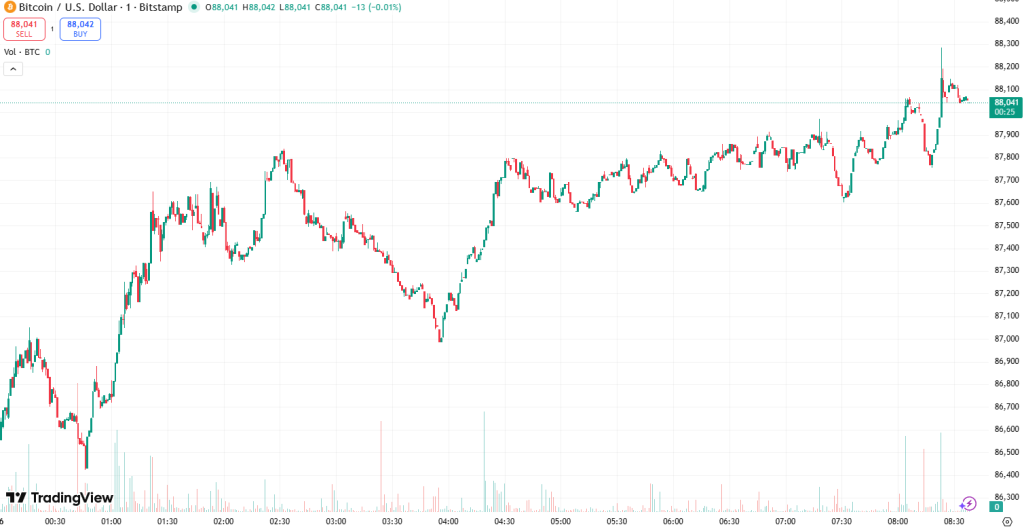
    At the time of writing on Monday morning, BTC was changing hands at $87,860. While the coin begun the day at the intraday high of $88,800, it relatively swiftly dropped to the low of $86,126. It has recovered somewhat since.

    Over the past seven days, BTC decreased by 5.1%, trading in the $86,319–$93,252 range. It’s now 30% away from its all-time high of $126,080.

    Failing to hold the current level risks additional pullbacks towards the $85,000 level, followed by $84,300 and $83,800.

    Bitcoin Price Chart. Source: TradingView

    At the same time, Ethereum was trading at $2,892. Earlier in the day, it traded at the intraday high level of $2,941. However, it then plunged to the intraday low of $2,787. It managed to shift course and move higher following this drop.

    In a week, ETH fell 9.2%, moving between $2,801 and $3,222. Moreover, it decreased 41% from its ATH of $4,946.

    Currently, the price risks a fall toward $2,670 and $2,520 in the near term.

    eth logo
    Ethereum (ETH)
    24h7d30d1yAll time

    Additionally, according to Bloomberg Intelligence Senior Commodity Strategist Mike McGlone, it is more likely that ETH will revisit the $2,000 level than push upwards and above $4,000.

    ETH has been stuck in the $2,000–$4,000 range since 2023. However, it is leaning toward the lower end of this range.

    Ether appears to be heading toward the lower end of its $2,000-$4,000 range since 2023. I see greater risks of it staying below $2,000 than above $4,000, especially when stock market volatility rebounds. pic.twitter.com/1IAMV10Jwe

    β€” Mike McGlone (@mikemcglone11) January 25, 2026

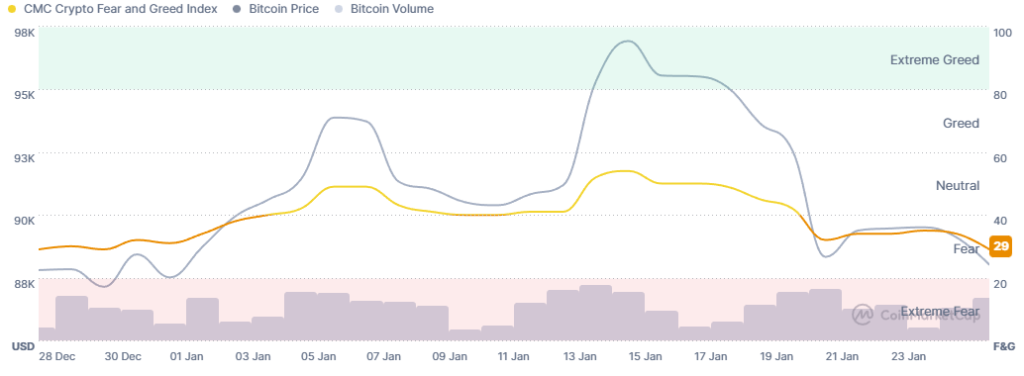
    Meanwhile, the crypto market sentiment exited the neutral zone a week ago, and it has continued falling lower within the fear zone since.

    The crypto fear and greed index decreased further over the weekend, currently standing at 29, compared to 34 seen over the weekend.

    Unsurprisingly, given the market conditions, the sentiment reflects the overall worry and caution. It is now possible that the metric will drop further.

    Source: CoinMarketCap

    ETFs Continue The Red Streak

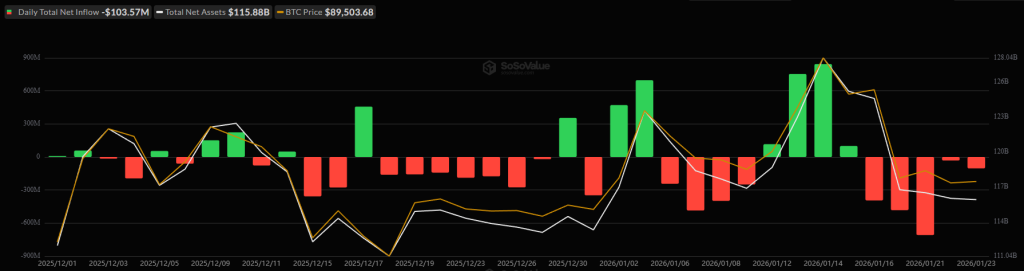
    The US BTC spot exchange-traded funds (ETFs) posted another day of outflows on Friday, totalling $103.57 million. This is the fifth consecutive day of negative flows.

    The total net inflow has pulled back yet again and now stands at $56.49 billion.

    Of the twelve ETFs, two recorded outflows, and none saw inflows. BlackRock let go of $101.62 million, and Fidelity followed with $1.95 million in outflows.

    Source: SoSoValue

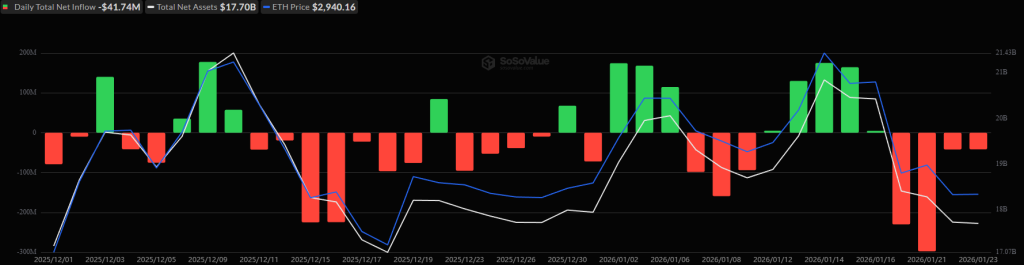
    Moreover, the US ETH ETFs posted outflows as well on 22 January, with $41.74 million – a similar level as the day earlier. With this fourth consecutive red day, the total net inflow now stands at $12.3 billion.

    Of the nine funds, two ETH ETFs posted outflows, and two saw inflows. BlackRock recorded $44.49 million in outflows, followed by Grayscale’s $10.8 million.

    At the same time, Grayscale Mini Trust took in 9.16 million, followed by Fidelity’s $4.4 million in inflows.

    Source: SoSoValue

    Meanwhile, Japan’s Financial Services Agency is reportedly planning to add cryptocurrencies to the list of assets eligible for spot ETF products.

    Japan would likely approve its first set of spot crypto ETFs as early as 2028, ending the agency’s ban on spot crypto ETFs.

    πŸ‡―πŸ‡΅ Japan’s Nomura Holdings and SBI Holdings are developing the first crypto ETF products, awaiting approval for listing on the Tokyo Stock Exchange. #JapanCryptoETF #NomuraHoldings #SBIHoldingshttps://t.co/zT14u2QbqK

    β€” Cryptonews.com (@cryptonews) January 26, 2026

    Quick FAQ

    1. Did crypto move with stocks today?

    The crypto market has seen yet another drop over the past day. Meanwhile, the US stock market closed the week with a mixed picture. That said, it also posted a second consecutive red week. By the closing time on Friday, 23 January, the S&P 500 was up 0.033%, the Nasdaq-100 increased by 0.34%, and the Dow Jones Industrial Average fell by 0.58%. Due to high volatility, investors are shifting their money into safe-haven assets, particularly gold.

    1. Is this drop sustainable?

    For now, the drops may continue in the near- to mid-term, pushed by macroeconomic developments. Occasional smaller and brief jumps are expected, intersecting the current trend.

    The post Why Is Crypto Down Today? – January 26, 2026 appeared first on Cryptonews.

    Cyber Insights 2026: Threat Hunting in an Age of Automation and AI

    26 January 2026 at 07:00

    Understanding how threat hunting differs from reactive security provides a deeper understanding of the role, while hinting at how it will evolve in the future.

    The post Cyber Insights 2026: Threat Hunting in an Age of Automation and AI appeared first on SecurityWeek.

    Microsoft probes Windows 11 boot failures tied to January security updates

    26 January 2026 at 07:13

    Some machines are failing to start after security updates, prompting yet another Microsoft investigation

    Microsoft is investigating reports that its January 2026 security updates are leaving some Windows 11 machines stuck in a boot loop, adding another entry to this month's bumper post–Patch Tuesday borkage list.…

    When AI 'builds a browser,' check the repo before believing the hype

    26 January 2026 at 07:01

    Autonomous agents may generate millions of lines of code, but shipping software is another matter

    OpinionΒ  AI-integrated development environment (IDE) company Cursor recently implied it had built a working web browser almost entirely with its AI agents. I won't say they lied, but CEO Michael Truell certainly tweeted: "We built a browser with GPT-5.2 in Cursor."…

    Just the Browser is just the beginning: Why breaking free means building small

    26 January 2026 at 06:28

    Privacy tools are a start, but real freedom lives in the digital outskirts of the web

    OpinionΒ  The Net is born free, but everywhere is in chains. This is a parody of Jean-Jacques Rousseau's 1762 book The Social Contract where he said the same about humans, but it's nonetheless true. The Net is built out of open, free protocols and open, free code. Yet it and we are bound by the rulemakers who build the services and set the laws of the places we go and the things that we do, not to our advantage.…

    Effective Coauthoring: Tips and Techniques

    Coauthoring a book can be a challenge. While the authors share a common goal, each might have a different writing style, voice, and writing cadence, as well as specific ways of organizing a chapter. Most of these differences are easily remedied through an initial virtual session where the authors agree on a consistent style, format, voice, and so on, with occasional follow-on virtual sessions to ensure consistency. However, in our experience, this is not enough.

    Between the three of us, we’ve coauthored five highly successful technical books over the years. This blog post is about three techniques that have helped us overcome some of the challenges of coauthoring, with a particular emphasis on one of the most useful techniques: the in-person experience.

    Create a Narrative Arc

    Everyone loves a good story. Stories capture our attention for one reason: They have a solid narrative arc, a literary term for the path a story follows. It’s what gives any story a clear beginning, middle, and end.

    Narrative arc
    The narrative arc of a story

    A good story starts out with exposition to set the scene, introduce the characters, and communicate the stakes. As time progresses, the tension increases, conflicts arise, and the story becomes more complex. Finally, the climax of the story unfolds, leading to the resolution and ending. This is how great books are writtenβ€”including technical ones.

    The first thing we do in any book project with O’Reilly is to collectively establish the narrative arc. This allows us to focus on telling a story about our subject.

    Involve Your Editor

    We attribute much of our success to heavily involving our editor in the entire writing process. We’ve learned that having our editor understand our narrative arc and our style and voice choices pays off in spades. Your editor is not there just to revise your grammar: They guide you through the writing process, teaching you better writing skills along the way and ensuring consistency throughout the book.

    We include our editor in our weekly meeting calls and our constant text and email exchanges. She essentially functions as an additional coauthor and adds a tremendous amount to the overall finished product. Make no mistakeβ€”the editor makes all the difference in the world, not only to the finished product but to the overall writing experience.

    For each book, we create a shared Google spreadsheet that helps all of us (including our editor) remain organized. It’s our source of truth for which chapters each author will draft, complete with each chapter’s deadlines and current status. It also includes room for short notes on each chapter. It’s always open during our weekly meetings.

    Meet in Person

    While the first two tips help coauthors stay organized and focused on a common goal, by far the most valuable technique we use is periodically meeting in person. We meet at least twice per book, sometimes more if we can arrange it logistically. Before each meeting, we all contribute to an agenda, listing things we are struggling with or want to discuss. We meet over a long weekend, starting Friday afternoon and going through Sunday. We make sure to take breaks and have fun too: We go out to a nice dinner each night and play board games well into the evening.

    This might not seem necessary, given the ease of virtual meetings, but the results of these in-person meetings have been staggering. We rotate the location of the meeting between coauthors’ houses to ease travel costs. Although scheduling and traveling to in-person meetings can be expensive and logistically challenging, every time we’ve done it, we’ve come away with new ideas and fresh energy. We are convinced none of these creative ideas would have emerged without face-to-face discussion. There’s something about discussing the book in-person that brings new ideas and insights to light. Each time we meet in person, we discover a new angle or aspect of the book we are working on.

    Coauthoring a book
    One of our many in-person working sessions at Neal’s house

    Here are some examples of how our in-person meetings have significantly influenced our books:

    • When we were planning the first edition of Fundamentals of Software Architecture, we decided to create comparison charts rating the pros and cons of each of the architectural styles we were writing about, but struggled with getting the granularity right. After much frustration, we decided to meet in person and dedicate the time to the comparison charts, resulting in the final version of the well-known star-rating charts found in the book. It was this experience that convinced us that in-person meetings are an invaluable part of the success of a coauthored book.
    • While writing Software Architecture: The Hard Parts, we found ourselves struggling with how to contextualize each chapter’s topic. When we met in person, we came up with the idea of starting each chapter with dialogue showing a fictional team undergoing a large migration from a monolithic system to a distributed one.
    • When writing Head First Software Architecture, one of us was struggling with a particularly difficult chapter. After numerous virtual meetings full of suggestions and three revisions of the chapter, it still wasn’t quite right. It wasn’t until our in-person meeting that we all saw itβ€”the chapter was literally upside down. We inverted the chapter to build up to the big picture rather than starting with the big picture, and the chapter became one of the best-written ones in the book.
    • We’re currently writing a book called Software Architecture Patterns, Antipatterns, and Pitfalls. We created a template for everything we wanted each pattern to cover, but it didn’t quite work for the chapters on antipatterns and pitfalls. Through all our weekly virtual calls and numerous side emails and texts, we simply couldn’t seem to get it rightβ€”something was missing. It wasn’t until our first in-person meeting that we found the solution: changing the generic section heading β€œContext” to a chapter-specific question that gets right at the point of the chapter and provides context for the antipattern.

      However, that wasn’t the magical piece. Once we all saw how well this worked for the antipatterns and pitfalls, we decided to use this technique for all the chapters. Now each chapter of the book starts with a motivating question for why this pattern, contextualizing it for both the author and reader and making the table of contents more useful. We’re confident this simple piece of brilliance would never have happened through virtual meetings.
    • At that same meeting, we also worked on our other current project, Architecture as Code. We changed the order of the chapters to fit a better narrative arc as a result of an intensive in-person gathering. Without being in person and seeing the overall book flow together, the narrative arc would likely not have changed to the new and improved one.

    If you’re coauthoring a book, we highly recommend having at least one in-person gathering, if logistics allow. The success of our books should be testimony enough that this technique works.

    5 awesome Prime Video movies to watch this week (January 26 - February 1)

    26 January 2026 at 07:00

    Amazon Prime Video is wasting no time ushering in hit flicks. I, for one, appreciate the fresh rotation. This week, we’re closing out January with a wee bit of drama, thrills, and action, and then we’re strolling into February with an easy-going cult classic.

    I ditched algorithms by building a start page that only shows what I care about

    26 January 2026 at 06:30

    Facebook, Instagram, TikTok, and most other major social media sites will feed you content based on how you interact with the site and what the company knows about you. However, I wanted to set up something that was curated to my interests without being algorithmically driven, so I set up my own personal start page.

    ❌
    ❌