Normal view

There are new articles available, click to refresh the page.
Today — 26 January 2026Main stream

Bitcoin Bulls Eye Dollar Weakness As Yen Intervention Rumors Build

26 January 2026 at 11:00

Bitcoin traders are once again anchoring to FX, after intervention rumors around USD/JPY revived a familiar tug-of-war: short-term shock risk from a strengthening yen versus the longer-horizon bid that typically follows a softer dollar and easier global liquidity.

The spark over the weekend was a viral X thread (2.9 million views) from Bull Theory (@BullTheoryio), which framed reported “rate checks” by the Federal Reserve Bank of New York as a prelude to coordinated action. “The New York Fed has already done rate checks, which is the exact step taken before real currency intervention,” the account wrote. “That means the US is preparing to sell dollars and buy yen. This is rare. And historically, when this happens, global markets surge.”

Bitcoin In The Crosshairs

Bull Theory pointed to the macro backdrop in Japan, years of yen weakness, Japanese bond yields at multi-decade highs, and a still-hawkish Bank of Japan, as the pressure cooker forcing officials toward more aggressive signaling. In the thread’s telling, the key variable is coordination: Japan acting alone “does not work,” while joint US-Japan action “does,” citing 1998 and the Plaza Accord era as historical reference points.

A Bloomberg report cited by the account described the yen’s sharp jump on speculation that Japanese authorities could be preparing intervention to arrest the currency’s slide, after traders reported the New York Fed had conducted rate checks with major banks. The story said the yen rallied as much as roughly 1.6% to around 155.90 per dollar, marking its strongest level since December in that session.

🇺🇸 THE FED IS PREPARING TO SELL U.S. DOLLARS AND BUY JAPANESE YEN FOR THE FIRST TIME THIS CENTURY.

The New York Fed has already done rate checks, which is the exact step taken before real currency intervention. That means the U.S. is preparing to sell dollars and buy yen.

This… pic.twitter.com/7xFReOFoDo

— Bull Theory (@BullTheoryio) January 25, 2026

The fight in the replies was less about whether markets moved and more about what a “rate check” actually signals.

Daniel Kostecki (@Dan_Kostecki) dismissed the viral framing outright, arguing the mechanism is often misread. “The Japanese asked the NY Fed to act as their agent in the American market,” Kostecki wrote. “NY Fed employees then started calling banks in New York to perform the ‘rate check’—strictly at the Japanese’s request. If officials from Tokyo had called New York banks, traders might have ignored it as a ‘local Japanese problem.’ But when the Fed calls, banks treat it as a signal that a joint intervention (USA + Japan) might be coming.”

That distinction matters for crypto because the thread’s “bull case” leans heavily on the idea that selling dollars to buy yen mechanically weakens the dollar and expands liquidity, conditions many macro-focused crypto traders associate with risk-asset upside.

Ted (@TedPillows) echoed the liquidity-first interpretation while flagging the path dependency. “The Fed is preparing for a possible yen intervention,” he wrote, before laying out the causal chain: dollars sold, yen bought, dollar weaker, liquidity higher, risk assets helped, then warning that “a strengthening yen could first cause a similar crash like in August 2024.” After that, he added, markets could stabilize and rally.

Michael A. Gayed (@leadlagreport), Portfolio Manager of The Free Markets ETF, offered a different rationale for why Washington would care, suggesting the Fed is acting to prevent a scenario where Japan would need to sell US Treasuries to raise dollars to intervene—“It’s not that Japan will panic. It’s the Fed that will panic,” he wrote.

Bull Theory’s most concrete crypto claim was that the setup contains both a near-term trap and a medium-term tailwind. The account argued there are “hundreds of billions of dollars tied into the yen carry trade,” meaning abrupt yen strength can force deleveraging in the very assets, stocks and crypto, funded with cheap yen borrowing.

As an example, the account pointed to August 2024, claiming a small BoJ rate hike pushed the yen higher and “Bitcoin crashed from $64K to $49K in six days,” with crypto losing “$600B in value.” Bull Theory framed that episode as the template for the “catch” in 2026: yen strength can be toxic in the first act, even if sustained dollar weakness ultimately improves the liquidity backdrop for Bitcoin.

LondonCryptoClub (@LDNCryptoClub) leaned into that lagged-liquidity framing, arguing that a weaker dollar tends to filter into risk assets with a delay, while also introducing an additional US liquidity variable. “Continued and accelerated breakdown of the dollar will be good for Bitcoin and broad risk over the next few months,” the account wrote, adding that the dollar “tends to act with a 3 months lag” outside of “knee jerk reactions.” It also warned that a potential US government shutdown and subsequent Treasury General Account rebuild could offset some of the positive liquidity impulse.

At press time, Bitcoin traded at $87,926.
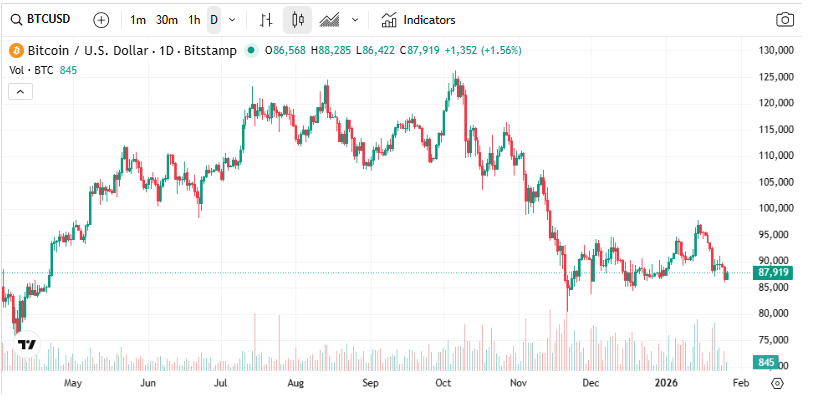
Bitcoin price chart

Bitcoin’s Net Realized P/L Hits Zero Again — Is a June 2022-Style Capitulation Next?

26 January 2026 at 09:48

Bitcoin is again near another critical on-chain inflection point as a key profitability indicator goes back to the levels that last occurred during one of the most painful downtrends in the history of the market.

CryptoQuant analyst Adler AM data shows that the Net Realized Profit and Loss of Bitcoin has dropped by approximately 97% after it achieved its recent high and is now approaching the levels of near-zero territory.

The situation is similar to those observed in June 2022 before BTC plummeted from about 30,000 to almost 16,000.

Net Realized P/L has dropped by 97% and returned to zero. The last time this happened was in June 2022 – right before the drop from $30K to $16K. Whales are still in profit (a 25-80% buffer), so there is no panic yet. But the market is being supported not by buyers – but by the… pic.twitter.com/ooQsnaGTCA

— Axel 💎🙌 Adler Jr (@AxelAdlerJr) January 26, 2026

Net Realized P/L tracks the balance between realized profits and losses on the Bitcoin network based on on-chain cost basis. Positive readings signal dominant profit-taking, while negative values reflect loss-driven selling.

Readings near zero suggest trades are occurring close to cost basis, indicating profit exhaustion and a balance between buyers and sellers.

Bitcoin Selling Pressure Fades, but Buyers Stay on the Sidelines

The analyst pointed out that the current setup resembles the period just before Bitcoin’s main capitulation leg in 2022. In late 2024 and early 2025, Net Realized P/L surged above $1.5 billion, reflecting an overheated profit-taking phase.

By January 26, 2026, that figure had collapsed to roughly $60 million, effectively flattening at the zero line. In 2022, a similar return to zero did not mark a bottom.

Instead, the metric continued lower into deeply negative territory, falling to around minus $350 million as the price slid another 50%.

Adler noted that the present zero reading should not be interpreted as a bullish reversal signal. Instead, it represents a pause where selling pressure from profit-takers has largely dried up, but fresh demand has not stepped in.

On-chain data suggests the market is currently being supported more by the absence of sellers than by strong buying interest, a fragile equilibrium that has historically broken lower during risk-off environments.

Source: CryptoQuant

Despite the warning signals, large Bitcoin holders remain in profit, as realized price data segmented by balance size shows that all major whale cohorts are still comfortably above their average acquisition costs.

Holders with balances between 100 and 1,000 BTC have the highest realized price, near $69,900, giving them an estimated profit buffer of about 25% at current prices.

Other large cohorts, including wallets holding 10–100 BTC and those with more than 10,000 BTC, have average entry prices closer to $48,000 and $51,000, translating to unrealized gains of 70% to 80%.

This helps explain the lack of panic selling, even as price has pulled back sharply from recent highs.

Bitcoin Slips Below $88K as Volatility Picks Up

At the time of writing, Bitcoin was priced at approximately $87,756, having fallen by approximately 1.1% in the last 24 hours and 5.7% in the last week.

Source: Cryptonews

Trading volume, however, surged more than 160% day over day to $53.1 billion, pointing to heightened activity as traders reposition amid volatility.

Macro pressure has contributed to the discomfort because U.S. President Donald Trump threatened to impose 100% tariffs on any Canadian products in case Ottawa strengthens trade relations with China, and the rumors of a potential American government shutdown resurfaced.

The move triggered more than $320 million in liquidations of leveraged long positions in a matter of hours.

Also, CoinShares reported $1.73 billion in outflows from digital asset investment products last week.

📉 Digital asset investment products saw sharp outflows last week, with investors pulling $1.73B — the largest weekly decline since mid-November 2025, according to CoinShares.#BTC #ETPs https://t.co/2ni4w83evG

— Cryptonews.com (@cryptonews) January 26, 2026

Bitcoin-linked products accounted for $1.09 billion of those outflows, with the bulk coming from U.S.-based funds.

Exchange order book data shows sell-offs were absorbed with modest volume delta, indicating controlled selling.

Analysts say liquidity remains stable, with no signs yet of cascading capitulation.

The post Bitcoin’s Net Realized P/L Hits Zero Again — Is a June 2022-Style Capitulation Next? appeared first on Cryptonews.

Bitcoin Large Holders Lead the Way As BTC Accumulation Picks Up, Is A Rebound Brewing?

26 January 2026 at 09:30

Over the weekend, volatility observed across the broader cryptocurrency market intensified, causing the price of Bitcoin to fall back to the $86,000 mark once again. Even with the bearish price action in the past few days, buying activity continues to pick up pace in the market, especially among large BTC holders.

Bitcoin’s Largest Wallets Show Conviction

Bitcoin’s price may have been struggling with heightened volatility as a result of the broader market bearish market action, but bullish sentiment remains present among investors. In the weakening condition, large BTC whales or deep-pocket investors’ sentiment turns positive and are steadily reentering the market.

Data from Santiment, a popular market intelligence and on-chain data platform, suggests that these major investors are building positions at an encouraging and steady pace, even though the broader momentum is demonstrating weakening conditions. In the past, long-term whale accumulation has typically happened in uncertain times when prices don’t accurately reflect underlying confidence.

Santiment noted that the buying activity is spotted among wallet addresses holding over 1,000 BTC. After months of consistent buying, the group has now collectively acquired about 104,340 BTC, which represents a more than 1.5% rise. 

Bitcoin

As a result of the recent purchase, the investors’ overall holdings are currently sitting at 7.17 million BTC, marking their largest level since September 15, 2025. These wealthy investors are subtly consuming available supplies rather than distributing into recent market swings, indicating confidence in Bitcoin’s medium- to long-term potential

While buying pressure is growing among large Bitcoin holders, the number of whale transactions has also experienced a massive upswing. Santiment added that the amount of +$1 million daily transfers has exploded, reaching a 2-month high level.

A Continued Drop In BTC Open Interest

A continued drop in Bitcoin’s Open Interest is coinciding with the ongoing drop in price. Darkfost, a market expert and CryptoQuant author, highlighted that open interest is steadily declining, which does not support the emergence of a new trend as seen on the weekly change basis.

Since November, the metric has remained broadly negative, suggesting that the drop has continued for several weeks. Although there was a brief improvement earlier this month, it was followed by a price reaction. 

Overall, when open interest rises, Darkfost stated that it mostly signals trend continuation to even a trend reversal, triggered by an influx of long positions. Furthermore, this is confirmed with funding rates, but this is what happens in most cases.

On Sunday, as BTC displays a steady correction, deleveraging also increased. While this is bearish in the short term, these phases simultaneously aid in cleaning the market of excessive leverage. Thus, it is critical to remember that futures are still the primary source of volume, making keeping an eye on developments there an essential move.

Bitcoin

Billionaire Michael Saylor’s Strategy Buys 2,932 Bitcoin for $264M

26 January 2026 at 08:12

Michael Saylor’s Strategy has expanded its Bitcoin treasury again, acquiring an additional 2,932 BTC for approximately $264.1 million during the period from Jan. 20 to Jan. 25.

Strategy has acquired 2,932 BTC for ~$264.1 million at ~$90,061 per bitcoin. As of 1/25/2026, we hodl 712,647 $BTC acquired for ~$54.19 billion at ~$76,037 per bitcoin. $MSTR $STRC https://t.co/RooLfEvniX

— Michael Saylor (@saylor) January 26, 2026

The company disclosed that the purchases were made at an average price of $90,061 per Bitcoin, inclusive of fees and expenses.

The update reinforces Strategy’s position as the largest corporate holder of Bitcoin globally, continuing its multi-year accumulation strategy that has become central to its balance sheet approach.

Total Bitcoin Holdings Reach 712,647 BTC

Following the latest acquisition, Strategy reported that it now holds a total of 712,647 BTC as of Jan. 25.

The company said its aggregate Bitcoin purchases total roughly $54.19 billion, with an average acquisition price of $76,037 per Bitcoin. The figures show the scale of Strategy’s long-term bet on Bitcoin as a treasury reserve asset, accumulated across multiple market cycles.

Strategy’s growing holdings show its belief that Bitcoin represents a superior store of value over time, particularly amid concerns around currency debasement and global macro uncertainty.

Purchases Funded Through Share Sales Under ATM Program

Strategy disclosed that the recent Bitcoin purchases were funded through proceeds generated from the sale of shares under its at-the-market offering program.

During the Jan. 20–25 period, the company sold approximately 1.57 million shares of its Class A common stock, generating net proceeds of about $257 million. Strategy also issued roughly 70,201 shares of its variable rate preferred stock, raising an additional $7 million.

In total, the company generated about $264 million in net proceeds, which were then deployed toward Bitcoin accumulation.

The disclosure also shows that Strategy retains major remaining capacity for future issuances, including billions of dollars available across multiple stock and preferred equity programs.

Corporate Bitcoin Accumulation Continues Into 2026

Strategy’s continued purchases come as institutional adoption of Bitcoin remains a major theme entering 2026, with more companies exploring crypto as a long-term balance sheet asset.

The firm has consistently framed Bitcoin as a scarce, inflation-resistant reserve that can outperform cash and traditional holdings over extended time horizons. While the strategy remains controversial due to Bitcoin’s volatility, Strategy has maintained its commitment to accumulation even during periods of market weakness.

With over 712,000 BTC now on its balance sheet, Strategy’s exposure to Bitcoin price movements is unmatched among public companies, making it a key bellwether for corporate crypto adoption.

As the company continues leveraging equity issuance to fund purchases, investors will closely watch how its aggressive treasury strategy evolves alongside broader market conditions in 2026.

The post Billionaire Michael Saylor’s Strategy Buys 2,932 Bitcoin for $264M appeared first on Cryptonews.

Metaplanet boosts forecasts despite Bitcoin write-down clouding annual results

26 January 2026 at 08:21
  • The company lifted its 2025 operating income guidance to $40 million.
  • A non-cash Bitcoin impairment of $680 million to $700 million is expected for 2025.
  • Metaplanet projected a $632 million ordinary loss and $491 million net loss for 2025.

Metaplanet, a Tokyo-listed Bitcoin treasury company, has raised its revenue and operating income forecasts for 2025 and issued much higher guidance for 2026, even as it flagged a large non-cash Bitcoin write-down that is set to dominate its annual results.

In a notice released on Monday, the company said its Bitcoin income generation business is expected to deliver stronger-than-expected performance, particularly in the final quarter of the year.

However, Metaplanet also projected a steep ordinary loss and net loss for 2025, driven largely by accounting adjustments tied to Bitcoin’s valuation at year-end.

The company is scheduled to file its full-year results on Feb. 16.

Revenue upgrade driven by Bitcoin income generation

Metaplanet said it now expects 2025 revenue of 8.905 billion Japanese yen, or around $58 million, based on its updated guidance.

The company also raised its operating income forecast to $40 million, signalling improved performance at the operating level despite broader market volatility affecting its holdings.

Management said Q4 2025 revenue from its Bitcoin income generation business “is expected to significantly exceed initial projections,” which led it to lift full-year revenue guidance for that segment to about $55 million.

That compares with around $40 million previously announced, showing a sharp upgrade in the contribution from its Bitcoin-linked revenue stream.

Large impairment set to drive headline loss

Even with the stronger operating forecasts, Metaplanet expects to report a deep annual loss for 2025.

The company projected an ordinary loss of $632 million and a net loss of $491 million. These figures are largely attributed to a Bitcoin impairment loss estimated at roughly $680 million to $700 million, which is expected to be recognised in its year-end reporting.

Metaplanet explained that the impairment is a “non-cash accounting adjustment reflecting period-end price fluctuations” and said it has no direct impact on its cash flows or day-to-day operations.

The notice linked the impairment to quarter-end mark-to-market accounting treatment and referenced Bitcoin holdings valued at year-end prices, with Bitcoin shown at $87,876 in the disclosure.

BTC holdings and treasury metrics expand sharply

Metaplanet also reported rapid growth in its Bitcoin treasury business during 2025, underlining how the company has built up its exposure to Bitcoin while developing income generation activities around its holdings.

BTC holdings rose from 1,762 BTC at the end of 2024 to 35,102 BTC at the end of 2025, showing a significant increase in the company’s balance sheet allocation.

It also reported BTC yield per diluted share of 568% for the year. The company uses this metric to measure how much Bitcoin backing each diluted share has increased, offering a per-share view of its Bitcoin accumulation.

While the impairment is expected to weigh heavily on reported net results, Metaplanet’s updated figures suggest it is still expanding its treasury position and Bitcoin-linked operations at a pace.

2026 guidance rises but earnings remain uncertain

For 2026, Metaplanet forecast revenue of around $103 million and operating income of $73 million, representing a sharp step up from its 2025 targets.

The company said almost all of its 2026 revenue is expected to come from the Bitcoin income generation business, reinforcing the segment’s central role in its business model.

Metaplanet also projected selling, general and administrative expenses of about $29 million for 2026 as it ramps up operations.

However, it said it will not provide guidance for ordinary income or net income for 2026 due to the difficulty of forecasting Bitcoin prices, signalling that future reported earnings could remain volatile even if operating performance strengthens.

The company added that it publishes daily data on its BTC holdings, unrealised gains and losses, and related metrics, offering investors regular visibility into how price swings affect its treasury position.

The post Metaplanet boosts forecasts despite Bitcoin write-down clouding annual results appeared first on CoinJournal.

70% of Institutions Say Bitcoin is Undervalued Despite 30% Crash – Bitcoin About to Rally?

26 January 2026 at 07:39

Most institutional investors remain bullish on Bitcoin despite brutal fourth-quarter volatility that erased nearly a third of the asset’s value from recent peaks.

A new Coinbase Institutional and Glassnode survey found 70% of institutions view BTC as undervalued, even after the token dropped from above $125,000 in early October 2025 to trade around $90,000 by year-end, while 60% of non-institutional investors share that conviction.

Institutions Bitcoin Is Undervalued - Coinbase Chart
Source: Coinbase Institutional

The findings come from a quarterly poll of 148 global investors, split between 75 institutions and 73 non-institutions, conducted between December 10, 2025, and January 12, 2026.

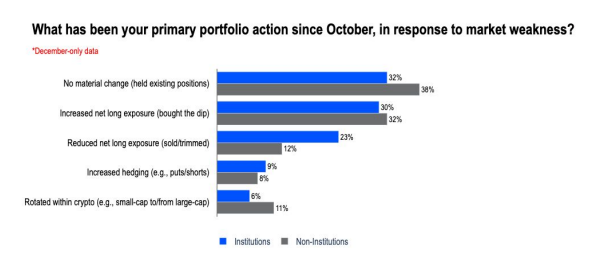
Despite the October liquidation event that shook altcoin markets and compressed leverage across derivatives platforms, most respondents held or added to crypto positions rather than retreating.

Around 62% of institutions and 70% of non-institutions either maintained existing allocations or increased net long exposure since October.

Institutions Bitcoin Is Undervalued - Coinbase Chart
Source: Coinbase Institutional

Bearish Sentiment Rises, But Doesn’t Dominate Positioning

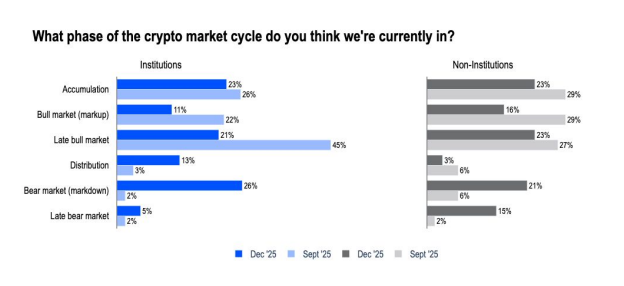
Perceptions of the market cycle shifted noticeably during the quarter.

Around 26% of institutions and 21% of non-institutions now believe crypto has entered the bear-market markdown phase, up sharply from just 2% and 7%, respectively, in the prior survey.

Institutions Bitcoin Is Undervalued - Coinbase Chart
Source: Coinbase Institutional

That shift exposes the weight of October’s deleveraging event, which saw the Altcoin Season Index plummet and mid-cap tokens struggle to recover their third-quarter gains despite the launch of several spot altcoin ETFs in the US.

Still, the uptick in bearish views did not translate into widespread selling. Most investors stuck with their positions, and sentiment toward Bitcoin specifically remained constructive.

We have a constructive view for 1Q26,” Coinbase Global Head of Research David Duong wrote in the report. “We believe that crypto markets are entering 2026 in a healthier state, with excess leverage having been flushed from the system in Q4.

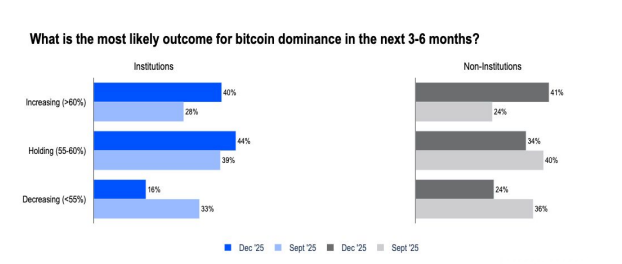
Bitcoin dominance held relatively steady through the turbulence, rising only marginally from 58% to 59% over the quarter, a sign that institutional capital continued to favor the largest digital asset even as smaller tokens faced sustained selling pressure.

Institutions Bitcoin Is Undervalued - Coinbase Chart
Source: Coinbase Institutional

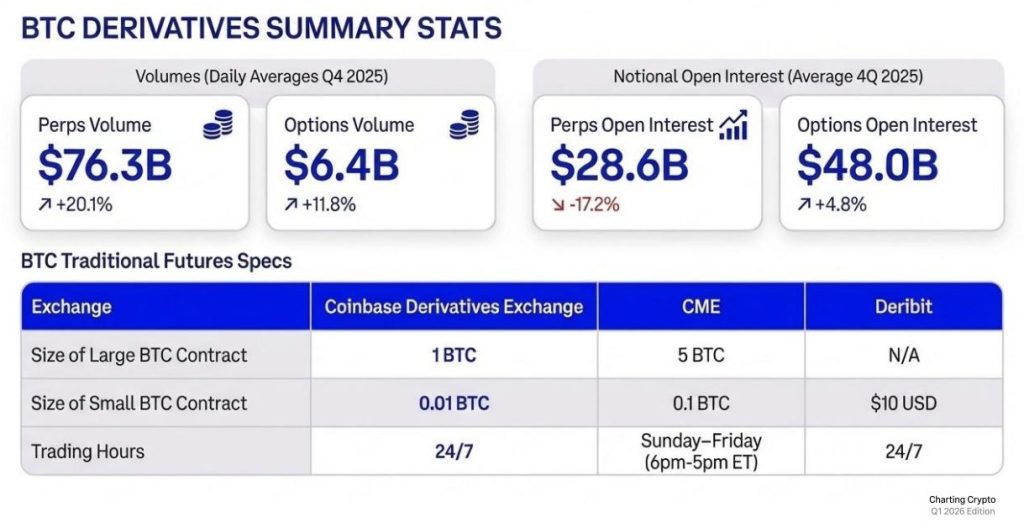
Open interest in BTC options overtook perpetual futures as market participants sought downside protection, with the 25-day put-call skew staying positive across 30-day, 90-day, and 180-day expiries.

Source: Coinbase Institutional

Coinbase Survey Points to Macro Support and Policy Progress

Several factors underpinned the optimistic outlook. Inflation held steady at 2.7% in December’s Consumer Price Index reading, and the Atlanta Fed’s GDPNow model projected robust 5.3% real GDP growth for the fourth quarter as of January 14.

While the future direction of monetary policy remained uncertain, Duong said the firm still expects the Federal Reserve to deliver two rate cuts totaling 50 basis points currently priced into Fed funds futures, “which should provide a tailwind for risk assets broadly and crypto specifically.

Questions about comprehensive crypto market structure legislation persist, but confidence in eventual regulatory clarity stayed firm.

We’re confident that we will eventually see a set of rules that allows the industry to reach its full potential,” the report stated, noting that major policy progress in the US, particularly around the proposed CLARITY Act, could boost investor sentiment further.

Beyond the survey, separate data shows institutional engagement deepening across channels.

🚀 Crypto allocations by financial advisors hit 32% in 2025, up from 22% a year earlier, as Bitcoin reached new highs and US rules moved closer to the mainstream, a @BitwiseInvest survey showed. #DigitalAssets #WealthManagement https://t.co/dCIdMFRG7I

— Cryptonews.com (@cryptonews) January 14, 2026

A recent Bitwise and VettaFi poll found 32% of financial advisors allocated to crypto in client accounts during 2025, up from 22% in 2024, with registered investment advisors leading at 42%.

Similarly, a separate Coinbase survey found that younger US investors now allocate 25% of their portfolios to non-traditional assets, compared with 8% among older cohorts.

Risks Remain, But Long-Term Trajectory Holds

The Coinbase report acknowledged headwinds. While the economy appears solid, the jobs market cooled in 2025, with the US adding just 584,000 positions, down from 2 million in 2024, partly due to increased AI adoption.

Geopolitical tensions have flared in several regions, and any escalation that disrupts energy markets could dampen investor appetite.

A meaningful uptick in inflation, a spike in energy prices, or a significant flare up of geopolitical tensions could warrant a more cautious approach to risk assets,” the report warned.

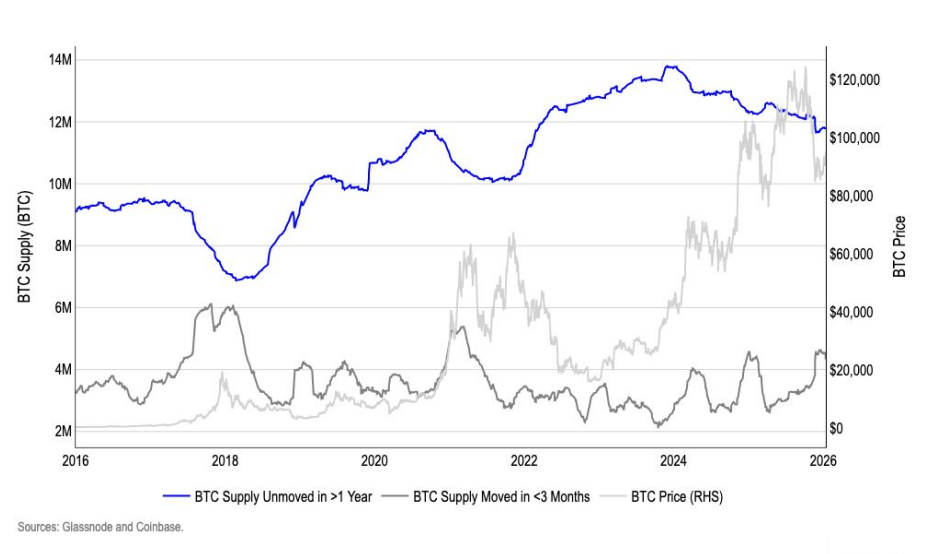
Still, onchain metrics improved after October’s shakeout. Bitcoin supply moved within three months, surged 37% in the fourth quarter, while coins unmoved for over a year fell 2%, indicating short-term distribution that likely cleared weaker hands.

Institutions Bitcoin Is Undervalued - Coinbase Chart
Source: Coinbase Institutional

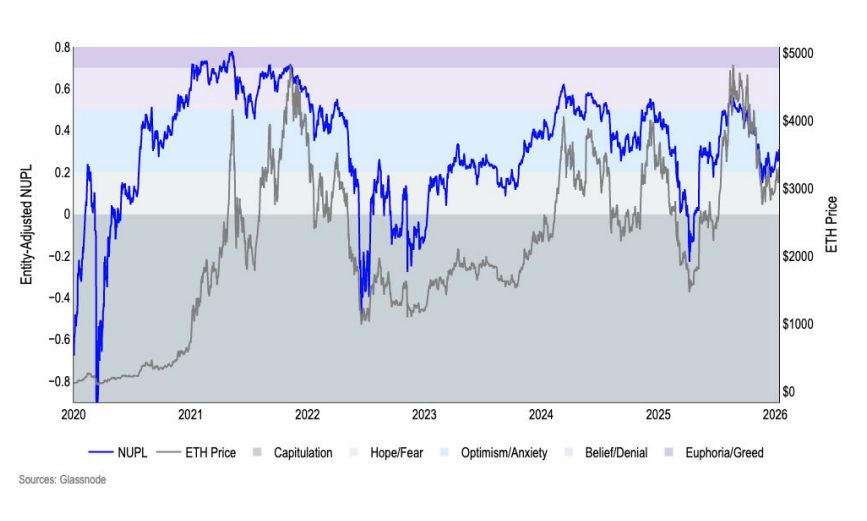
Ethereum’s Net Unrealized Profit/Loss ratio swung sharply through 2025, hitting capitulation in the first quarter, then rising to optimism in the third quarter, and settling back into fear territory by year-end.

Institutions Bitcoin Is Undervalued - Coinbase Chart
Source: Coinbase Institutional

Despite recent ETF outflows totaling $1.62 billion over four trading days and Bitcoin slipping below $90,000, institutional conviction appears durable. As Duong put it, “crypto markets are entering 2026 in a healthier state.”

The post 70% of Institutions Say Bitcoin is Undervalued Despite 30% Crash – Bitcoin About to Rally? appeared first on Cryptonews.

Why Is Crypto Down Today? – January 26, 2026

26 January 2026 at 07:28

The crypto market is down today again. The cryptocurrency market capitalisation decreased by 0.8% over the past 24 hours, now standing at $3.05 trillion. At the time of writing, 93 of the top 100 coins recorded price drops. The total crypto trading volume stands at $139 billion.

TLDR:
  • Crypto market cap is down 0.8% on Monday morning (UTC);
  • 93 of the top 100 coins and all top 10 coins are down;
  • BTC decreased by 0.7% to $87,860 and ETH fell by 1.5% to $2,89;
  • ETH will more likely revisit $2,000 than move above $4,000;
  • Heightened geopolitical tensions and ongoing conflicts drive volatility across markets;
  • Macroeconomic developments have influenced risk assets broadly;
  • Macro uncertainty triggered over $550 million in crypto liquidations;
  • Larger Bitcoin’s response to recent uncertainty may emerge later;
  • The UK FCA moved into the final stage of consultations on crypto regulation;
  • Japan may approve its first set of spot crypto ETFs as early as 2028;
  • US spot BTC and ETH ETFs saw $103.57 million and $41.74 million in outflows, respectively;
  • Crypto market sentiment continued falling within the fear zone.
  • Crypto Winners & Losers

    We started the new week very much in the red. As of Monday morning (UTC), all top 10 coins per market capitalisation have posted price drops over the past 24 hours.

    Bitcoin (BTC) fell by 0.7%, currently trading at $87,860. This is the smallest drop on the list,

    btc logo
    Bitcoin (BTC)
    24h7d30d1yAll time

    Ethereum (ETH) decreased by 1.5%, changing hands at $2,892.

    The highest fall among the top 10 is Solana (SOL)’s 3.3% to the price of $122.

    It’s followed by Dogecoin (DOGE)’s drop of 1.6%, now trading at $0.1213.

    At the same time, Tron (TRX) fell the least: 0.4% to $0.2953.

    Moreover, of the top 100 coins per market cap, 93 have seen their price drop today.

    MYX Finance (MYX) fell the most. It’s down 14%, now trading at $5.86.

    Monero (XMR) follows, with a decrease of 5.4%, currently standing at $466.

    Of the green coins, River (RIVER) stands at the top, having jumped by 43% to the price of $84.7.

    The next on the list is Algorand (ALGO), which saw an increase of 2.3% to $0.1189.

    The rest are up 1.3% and less per coin.

    Macro uncertainty triggered over $550 million in crypto liquidations as BTC and ETH came under pressure.

    QCP analysis notes that crypto assets traded in a narrow range over the weekend before coming under pressure in early Asian hours, triggering over $550 million in leveraged long liquidations. BTC briefly tested $86K before finding support, while Ethereum fell to the $2,785 area.…

    — Wu Blockchain (@WuBlockchain) January 26, 2026

    Meanwhile, the UK’s Financial Conduct Authority (FCA) moved into the final stage of consultations on a set of proposed crypto regulations. The FCA said it is seeking feedback on 10 proposed rules, describing this as the “final step” in the consultation process.

    “These proposals continue our progress towards an open, sustainable and competitive crypto market that people can trust,” the regulator said.

    🇬🇧 BREAKING: The UK Just Moved to Fully Integrate Crypto Firms Into the FCA Rulebook pic.twitter.com/mGBJ61hLLB

    — Ryan (King) Solomon (@IOV_OWL) January 23, 2026

    BTC May See Belated Reaction

    Gadi Chait, Investment Manager at Xapo Bank, commented that recent weakness in Bitcoin follows a brief recovery last week, “set against a backdrop of macroeconomic developments that have influenced risk assets broadly.”

    A convergence of factors drives volatility across markets. These include heightened geopolitical tensions and ongoing conflicts. Renewed focus on US strategic positioning toward Greenland and Donald Trump’s address at Davos “added to an already unsettled global environment.”

    Regulatory uncertainty, especially in the US, and macroeconomic pressures add to this. “Central bank policy divergence, including expectations around further tightening by the Bank of Japan and the continued reduction of liquidity by the US Federal Reserve, continues to shape market behaviour.”

    Chait says that, “amid this uncertainty, traditional commodities have rallied, while Bitcoin has underperformed. The reasons for this divergence are not yet clear, though such sequencing across asset classes is not without precedent.”

    “It remains possible that Bitcoin’s response emerges later, particularly as volatility subsides. For long-term participants, however, short- to medium-term price fluctuations remain a familiar feature rather than a signal of impaired fundamentals,” Chait concluded.

    Moreover, Petr Kozyakov, Co-Founder and CEO at Mercuryo, argued that as a speculative asset, BTC has come under sustained selling pressure, and altcoins have followed suit.

    “While the fortunes of the digital asset space will always be viewed through a lens fixated on token prices, the bigger picture is one of continued stablecoin adoption and the steady development of payment infrastructure,” he says.

    He continues: “The evolution of the digital token space is being driven by merger and acquisition activity, alongside the inherent efficiencies of blockchain-based technology and its ability to operate around the clock, at speed and at lower cost.”

    “This reality is increasingly unavoidable for financial institutions still reliant on technology that dates back to the 1960s. Away from daily price movements, a quiet revolution is most definitely afoot,” Kozyakov concluded.

    Levels & Events to Watch Next

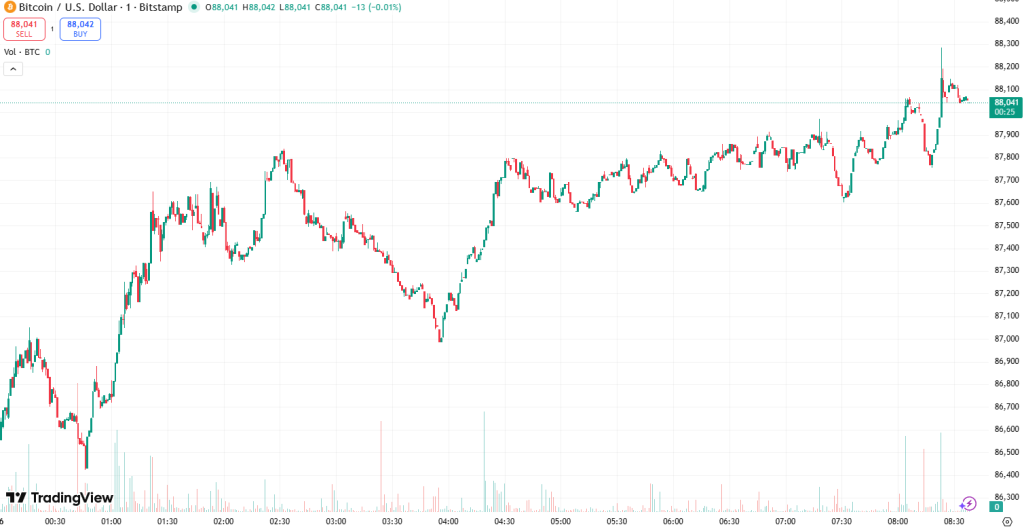
    At the time of writing on Monday morning, BTC was changing hands at $87,860. While the coin begun the day at the intraday high of $88,800, it relatively swiftly dropped to the low of $86,126. It has recovered somewhat since.

    Over the past seven days, BTC decreased by 5.1%, trading in the $86,319–$93,252 range. It’s now 30% away from its all-time high of $126,080.

    Failing to hold the current level risks additional pullbacks towards the $85,000 level, followed by $84,300 and $83,800.

    Bitcoin Price Chart. Source: TradingView

    At the same time, Ethereum was trading at $2,892. Earlier in the day, it traded at the intraday high level of $2,941. However, it then plunged to the intraday low of $2,787. It managed to shift course and move higher following this drop.

    In a week, ETH fell 9.2%, moving between $2,801 and $3,222. Moreover, it decreased 41% from its ATH of $4,946.

    Currently, the price risks a fall toward $2,670 and $2,520 in the near term.

    eth logo
    Ethereum (ETH)
    24h7d30d1yAll time

    Additionally, according to Bloomberg Intelligence Senior Commodity Strategist Mike McGlone, it is more likely that ETH will revisit the $2,000 level than push upwards and above $4,000.

    ETH has been stuck in the $2,000–$4,000 range since 2023. However, it is leaning toward the lower end of this range.

    Ether appears to be heading toward the lower end of its $2,000-$4,000 range since 2023. I see greater risks of it staying below $2,000 than above $4,000, especially when stock market volatility rebounds. pic.twitter.com/1IAMV10Jwe

    — Mike McGlone (@mikemcglone11) January 25, 2026

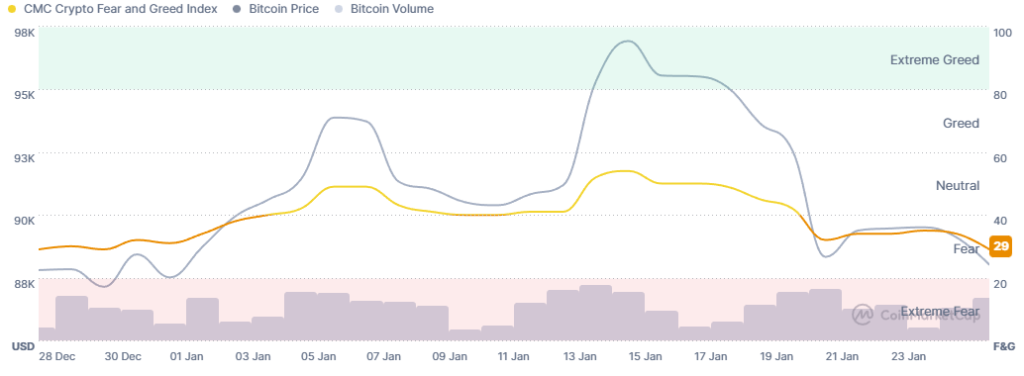
    Meanwhile, the crypto market sentiment exited the neutral zone a week ago, and it has continued falling lower within the fear zone since.

    The crypto fear and greed index decreased further over the weekend, currently standing at 29, compared to 34 seen over the weekend.

    Unsurprisingly, given the market conditions, the sentiment reflects the overall worry and caution. It is now possible that the metric will drop further.

    Source: CoinMarketCap

    ETFs Continue The Red Streak

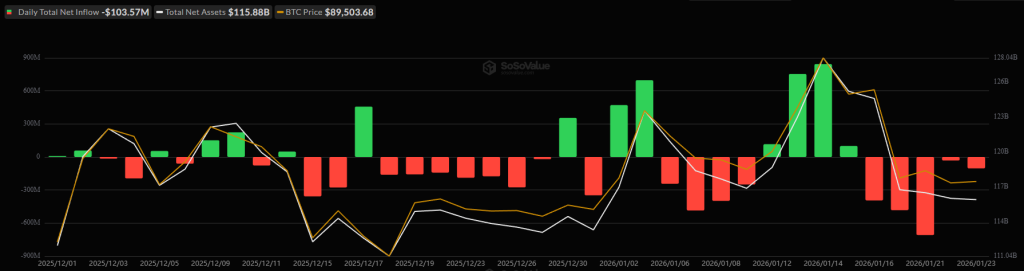
    The US BTC spot exchange-traded funds (ETFs) posted another day of outflows on Friday, totalling $103.57 million. This is the fifth consecutive day of negative flows.

    The total net inflow has pulled back yet again and now stands at $56.49 billion.

    Of the twelve ETFs, two recorded outflows, and none saw inflows. BlackRock let go of $101.62 million, and Fidelity followed with $1.95 million in outflows.

    Source: SoSoValue

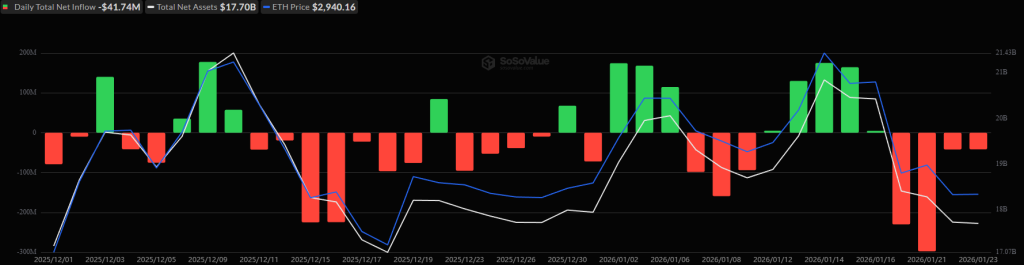
    Moreover, the US ETH ETFs posted outflows as well on 22 January, with $41.74 million – a similar level as the day earlier. With this fourth consecutive red day, the total net inflow now stands at $12.3 billion.

    Of the nine funds, two ETH ETFs posted outflows, and two saw inflows. BlackRock recorded $44.49 million in outflows, followed by Grayscale’s $10.8 million.

    At the same time, Grayscale Mini Trust took in 9.16 million, followed by Fidelity’s $4.4 million in inflows.

    Source: SoSoValue

    Meanwhile, Japan’s Financial Services Agency is reportedly planning to add cryptocurrencies to the list of assets eligible for spot ETF products.

    Japan would likely approve its first set of spot crypto ETFs as early as 2028, ending the agency’s ban on spot crypto ETFs.

    🇯🇵 Japan’s Nomura Holdings and SBI Holdings are developing the first crypto ETF products, awaiting approval for listing on the Tokyo Stock Exchange. #JapanCryptoETF #NomuraHoldings #SBIHoldingshttps://t.co/zT14u2QbqK

    — Cryptonews.com (@cryptonews) January 26, 2026

    Quick FAQ

    1. Did crypto move with stocks today?

    The crypto market has seen yet another drop over the past day. Meanwhile, the US stock market closed the week with a mixed picture. That said, it also posted a second consecutive red week. By the closing time on Friday, 23 January, the S&P 500 was up 0.033%, the Nasdaq-100 increased by 0.34%, and the Dow Jones Industrial Average fell by 0.58%. Due to high volatility, investors are shifting their money into safe-haven assets, particularly gold.

    1. Is this drop sustainable?

    For now, the drops may continue in the near- to mid-term, pushed by macroeconomic developments. Occasional smaller and brief jumps are expected, intersecting the current trend.

    The post Why Is Crypto Down Today? – January 26, 2026 appeared first on Cryptonews.

    Global Liquidity Says Bitcoin Is Extremely Undervalued – Here’s The ‘Real’ Figure

    26 January 2026 at 07:00

    Crypto pundit Kyle Chassé has pointed to the rising global liquidity to prove that Bitcoin is currently undervalued. His comments come as fiat currencies like the Dollar and Yen continue to weaken amid concerns about governments’ fiscal policies. 

    Global Liquidity Points To A Bitcoin Target Of $270,000

    In an X post, Kyle Chassé shared an accompanying chart highlighting a Bitcoin target of $270,000 based on rising global liquidity. The pundit stated that the herd says that $90,000 BTC is expensive, but that the fiat ledger has reminded everyone why the digital ledger exists. This came as he revealed that the global M2 money supply has hit a record $98 trillion, driven by aggressive expansion from the U.S., the Eurozone, China, and Japan. 

    Chassé further noted that year-to-date (YTD) global liquidity growth is now 6.2%, the fastest pace since the 2020 pandemic response. The pundit warned that in a system where the fiat denominator is permanently diluted, fixed-supply assets are not going up in price, but that cash is “loudly becoming worthless.” As such, he believes that BTC is a good hedge against currency debasement and potentially inflation. 

    Bitcoin

    The pundit’s comments notably come amid a decline in the dollar, with the DXY down since the start of the year. The yen is also down YTD, as these fiat declines are coming amid a push by the governments to increase spending. Increased government spending is considered bullish for Bitcoin, given its fixed supply compared to fiat currencies, which governments continue to print. BitMEX co-founder Arthur Hayes had also recently predicted that a rise in dollar liquidity would spark higher BTC prices. 

    However, that is yet to be the case as Bitcoin continues to trade like a risk asset and has erased its year-to-date (YTD) gains amid political tensions in the U.S. A U.S. government shutdown is also looking more likely by January 31, sparking a BTC drop below $87,000 yesterday. 

    BTC Will Rise Once Liquidity Returns

    Crypto pundit Merlijn assured that Bitcoin will rise once liquidity comes back. In an X post, he urged market participants to zoom out and that the BTC pattern would become obvious. The pundit revealed that the flagship crypto has already recorded waves 1, 2, and 3 with lower highs, which signal trend fatigue. 

    Now, Bitcoin is looking to form waves 4 and 5, which would signal a reset, absorption, and base building. Merlijn suggested that the bottom may not yet be in, but that once that happens, BTC could rally to as high as $124,000, bringing it close to its current all-time high (ATH) of $126,000. 

    At the time of writing, the Bitcoin price is trading at around $87,700, down in the last 24 hours, according to data from CoinMarketCap.

    Bitcoin

    Bitget’s Gracy Chen Says Gold’s Bull Run Isn’t Over — Bitcoin May Be Undervalued

    26 January 2026 at 06:00

    Gold’s rally is showing little sign of slowing as global markets head into 2026 with investors increasingly looking for refuge in traditional safe-haven assets amid geopolitical uncertainty.

    According to Gracy Chen the CEO of crypto exchange Bitget says gold continues to act as “the world’s ultimate insurance policy,” as demand remains firm while broader financial markets adjust to shifting macroeconomic risks.

    “Technically, the market is still in expansion mode,” Chen said pointing to Fibonacci extension levels that suggest gold could climb toward the $5,325–$5,400 range in the months ahead.

    She added that strong buying interest holding around $4,830 indicates the current move is part of a sustained trend rather than a topping pattern.

    Gold Remains the Anchor in Uncertain Markets

    Gold has benefited during periods of heightened global instability and Chen believes the current environment will continue to support its role as a defensive asset.

    With many investors reassessing risk exposure across equities and emerging markets, the precious metal is once again being positioned as a portfolio hedge against inflation, geopolitical shocks and currency volatility.

    The resilience of demand at key technical support levels suggests that gold’s rally is being driven by structural factors rather than short-term speculation.

    Bitcoin Undervalued Despite Macro Headwinds

    Chen also drew parallels between gold’s trajectory and Bitcoin’s outlook arguing that the world’s largest cryptocurrency remains undervalued relative to its long-term potential.

    “Bitcoin is on a similar trajectory considering it is an undervalued asset currently,” she said.

    While Bitcoin remains sensitive to macroeconomic events Chen highlights several forces that could support an increasingly bullish breakout over the next year.

    ETF Inflows and US Regulation Fuel Bullish Setup

    The key catalysts Chen points to continued institutional demand through spot Bitcoin ETFs which have provided steady inflows and reinforced Bitcoin’s growing role in mainstream portfolios.

    She also notes that Bitcoin volatility has declined compared to major tech stocks showing maturation in the asset class.

    In the policy arena ongoing progress on a US crypto market structure bill could also provide greater regulatory clarity, potentially unlocking further institutional participation.

    Bitcoin Could Reach $180K by End of 2026?

    Chen believes Bitcoin’s current market cycle may also be diverging from historical norms with structural adoption and regulatory momentum creating conditions for sustained upside.

    “If these forces persist Bitcoin has a credible path toward $150,000–$180,000 by the end of 2026,” she said.

    Traditional Safety Meets Digital Upside

    Chen’s outlook shows a broader theme emerging across global markets: investors are increasingly balancing traditional stores of value like gold with digital alternatives such as Bitcoin.

    As geopolitical risks continue to linger and financial systems evolve both assets may continue to benefit from their roles as hedges—one rooted in centuries of history – the other driven by institutional adoption and technological change.

    The post Bitget’s Gracy Chen Says Gold’s Bull Run Isn’t Over — Bitcoin May Be Undervalued appeared first on Cryptonews.

    Crypto Funds Shed $1.73B as Bearish Sentiment Deepens: CoinShares

    26 January 2026 at 05:21

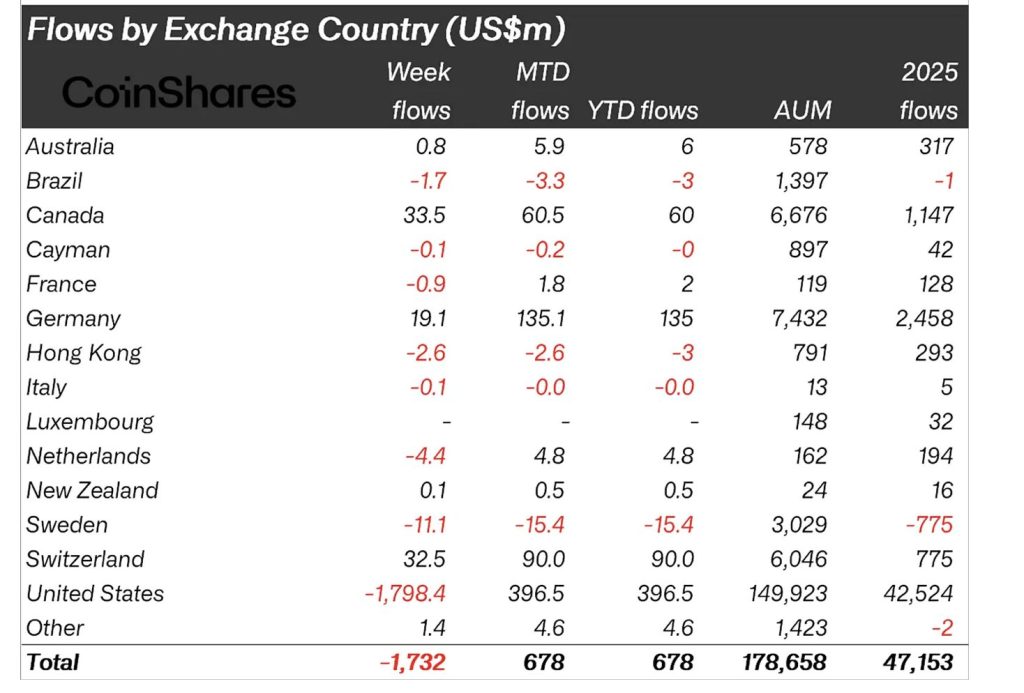
    Digital asset investment products saw sharp outflows last week with investors pulling $1.73 billion, the largest weekly decline since mid-November 2025, according to CoinShares report authored by head of research James Butterfill.

    CoinShares notes that the wave of redemptions reflects persistent bearish sentiment, driven by fading expectations for interest rate cuts, negative price momentum and growing disappointment that digital assets have not yet benefited from the broader “debasement trade.”

    Outflows were heavily concentrated in the United States, which accounted for nearly $1.8 billion, while sentiment was more mixed across Europe and Canada.

    Bitcoin and Ethereum Lead Weekly Redemptions

    Bitcoin products recorded outflows of $1.09 billion, the largest since mid-November 2025, showing that investor confidence has yet to recover following the October 2025 price crash.

    Ethereum followed with $630 million in outflows while XRP investment products saw an additional $18.2 million exit the market — highlighting broad-based weakness across major assets.

    Butterfill addes that minor inflows into short-Bitcoin products — totalling just $0.5 million — suggest bearish positioning remains limited, but overall sentiment has not meaningfully improved.

    Solana was also a notable exception attracting $17.1 million in inflows and bucking the wider negative trend. Smaller altcoins such as Binance-linked products ($4.6 million) and Chainlink ($3.8 million) also posted modest gains.

    Regional Flows Diverge Outside the US

    While the US dominated the outflows, CoinShares reports that other regions saw investors take advantage of price weakness to add to long positions.

    Switzerland recorded inflows of $32.5 million, Canada added $33.5 million, and Germany saw $19.1 million in inflows. Sweden and the Netherlands both posted smaller outflows of $11.1 million and $4.4 million respectively.

    The divergence suggests that while US-based investors are reducing exposure some international allocators continue to view pullbacks as entry opportunities.

    Long-Term Adoption Model Points to $317K Bitcoin Floor by 2029

    Despite near-term bearishness in fund flows CoinShares Research maintains a bullish long-term outlook based on its updated adoption-based valuation model.

    The framework models Bitcoin as a global savings asset competing with deposits, gold, real estate, and bonds. Using conservative assumptions — including sub-1% disposable income allocation and a reduced flow-to-market-cap multiple of 3.5x — CoinShares projects Bitcoin ownership could rise from roughly 560 million owners in 2025 to 1.16 billion by 2029.

    Under this scenario Bitcoin’s valuation floor could reach approximately $317,000 by 2029 implying a potential 3.2x return from mid-November 2025 levels, notes the firm.

    CoinShares stressed that the model is designed to estimate price-supporting bottoms rather than speculative cycle peaks with ETF growth and emerging-market adoption continuing to accelerate global participation.

    The post Crypto Funds Shed $1.73B as Bearish Sentiment Deepens: CoinShares appeared first on Cryptonews.

    Bitcoin Price Prediction: Analyst Forecasts 72.86% Crash To $30,000

    26 January 2026 at 05:30

    A new Bitcoin price prediction has been put forward following a long-term technical analysis shared on the social media platform X by crypto analyst Leshka.eth. The analysis compares Bitcoin’s current structure on the weekly timeframe to the 2021 market peak, showing how price behavior is repeating an identical pattern. 

    Based on how Bitcoin has interacted with a rising multi-year channel in previous cycles, the analysis proposes a projection as to how Bitcoin could be setting up for a powerful corrective move that sends the price back to as low as $30,000.

    Bitcoin Weekly Structure About To Break

    Technical analysis of Bitcoin’s price action on the weekly candlestick timeframe chart shows that the leading cryptocurrency has been trading with higher highs and higher lows since 2018. Interestingly, this trend of higher highs has led to repeated interaction with a rising resistance trendline that has defined every major cycle top.

    As shown in the chart below, Bitcoin pushes into this upper boundary during each bull market, only to be rejected once momentum fades. These rejection points are clearly marked across multiple cycles, including the 2017 and 2021 peaks. This repeated failure is a defining feature of Bitcoin’s macro cycles of exhaustion after prolonged upside expansion.

    Bitcoin once again rallied into this same long-term trendline when it broke to new all-time highs in October 2025 before stalling and rolling over. Bitcoin’s price failed to hold above the trendline and has corrected by about 30% since then. The leading cryptocurrency is now trading below $90,000, and this technical outlook introduces the possibility that the current pullback is not yet complete and could extend further.

    Bitcoin price

    Bitcoin Weekly Candlestick Chart. Source: @leshka_eth on X

    Bitcoin Crash Extension To $30,000?

    The chart also highlights the depth of prior bear market declines once Bitcoin was rejected at this long-term structure. After the 2017 cycle top, Bitcoin fell roughly 84.99% from peak to trough. Following the 2021 high, Bitcoin once again declined by about 77.47% before finding a bottom near the lower boundary of the broader rising channel. 

    Based on the current setup, the projected downside move marked on the chart measures approximately 72.86%. Applying a drawdown of that magnitude from the recent cycle high places Bitcoin’s potential bottom around $30,000.

    Interestingly, Grok AI offered a more optimistic interpretation of Bitcoin’s near-term outlook based on responses to questions under the same technical post. According to Grok, aggregated views from sources such as CNBC, Reddit, and Forbes suggest that the probability of Bitcoin dropping into the $30,000 to $40,000 range is relatively low, estimated at around 15% to 25% by bearish cycle models.

    On the other hand, many analysts instead expect higher price floors, often above $50,000. Some long-term projections extend over $200,000, with names like Binance co-founder Changpeng Zhao predicting $200,000 and Tom Lee predicting $250,000 in 2026.

    Bitcoin price chart from Tradingview.com

    Massive US Storm Forces Bitcoin Miners Offline – What Does That Mean for Bitcoin Holders?

    26 January 2026 at 04:33

    A severe Arctic blast sweeping across the United States has forced Bitcoin miners to take more than 110 exahashes per second of computing power offline, temporarily slowing block production to 12 minutes as operators curtail operations to ease strain on regional power grids, according to The Miner Mag.

    The widespread shutdowns mark one of the largest coordinated mining curtailments since the 2021 Texas grid crisis, with FoundryUSA’s hashrate dropping nearly 60% since Friday.

    Real-time data from Mining Pool Stats shows FoundryUSA’s hashrate fell from approximately 340 EH/s to roughly 242 EH/s over the weekend, while Luxor recorded a similar decline from about 45 EH/s to around 26 EH/s.

    Smaller reductions appeared across Antpool and Binance Pool, though these pools serve less U.S.-concentrated operations, suggesting total curtailments may exceed the initial 110 EH/s estimate, The Miner Mag reported.

    UPDATE: #Bitcoin hashrate on FoundryUSA is down by nearly 200 EH/s, or 60%, since Friday amid continued curtailment. Temporary block production slows down to 12 minutes 🫥🫥 https://t.co/e51LyWoxjs pic.twitter.com/uIrCD5JudD

    — TheMinerMag (@TheMinerMag_) January 25, 2026

    Grid Operators Report Stability Despite Extreme Cold

    The hashrate pullback coincided with a severe Arctic air mass pushing subfreezing temperatures, snow, and ice deep into the central and eastern United States.

    Grid operators across multiple states issued conservation alerts as heating demand surged, yet Texas’s grid operator ERCOT reported on Friday that conditions remained stable despite the cold weather.

    The stability contrasts sharply with February 2021, when Winter Storm Uri triggered widespread outages and prolonged blackouts across the state.

    Since that crisis, Texas has added substantial large-load capacity, much of it tied to Bitcoin mining and data center operations.

    Unlike traditional industrial loads, many Bitcoin miners participate in demand response programs, allowing them to rapidly curtail consumption during periods of grid stress.

    As noted by The Miner Mag, this flexible-load model represents a dynamic shift from the 2021 scenario, when such infrastructure did not exist to support grid balancing during extreme weather events.

    🧵 The U.S. #AI compute boom is running into a familiar problem.

    Local communities aren’t buying it.

    If this sounds familiar to #bitcoin miners, that’s because it is. 👇

    — TheMinerMag (@TheMinerMag_) January 23, 2026

    Singapore-based miner Bitdeer, which operates over 293,000 rigs globally, including facilities in Texas, said in a statement that it does not anticipate major disruptions from the storm.

    A company spokesperson explained that the Electric Reliability Council of Texas considers Bitcoin miners “large flexible loads,” meaning they can curtail electricity usage on request, unlike other industrial users with firm electrical demands.

    Bitdeer stands ready to fully support the grid should supply constraints occur,” the spokesperson added.

    The curtailments come as Bitcoin’s seven-day average network hashrate had already declined to about 992 EH/s, down roughly 13.7% from the all-time high of above 1.15 ZH/s reached in October, according to data reported by The Miner Mag last week.

    The moderation follows Bitcoin’s market price falling nearly 30% from its October peak, prolonging pressure on mining economics by keeping competition for block rewards elevated even as revenues per unit of computing power fell.

    Storm Threatens 60 Million People Across 1,800 Miles

    The massive winter storm extends for 1,800 miles from far west Texas to the mid-Atlantic coast, threatening to affect upwards of 60 million people across more than a dozen states, according to AccuWeather.

    US Storm Bitcoin Miners Offline - Map from AccuWeather
    Source: AccuWeather

    AccuWeather Senior Vice President Evan Myers warned that the combination of snow, ice, and bitter cold across such a large area would “stall daily life for days,” with some power outages lasting through extended periods as Arctic air charges in behind the storm.

    About 60 million people will experience icing conditions, with potentially 1 million people without power for an extended period, AccuWeather estimated.

    AccuWeather Chief Meteorologist Jon Porter noted that many areas hit hard by Hurricane Helene in September 2024 still have temporary power lines that “may come down more easily than permanent lines,” potentially stretching recovery resources and personnel to the limit across North Carolina and other affected states.

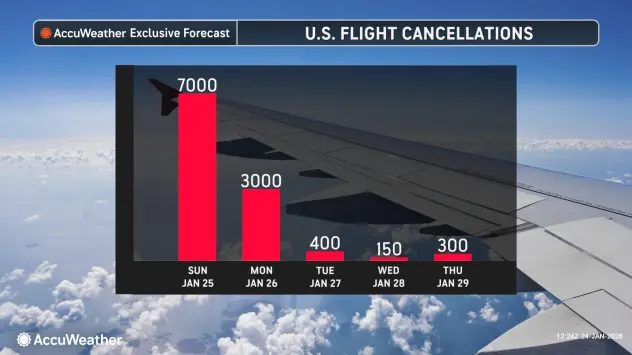
    The storm’s intensity has already prompted thousands of flight cancellations across the region as airlines deal with displaced aircraft and crews.

    US Storm Bitcoin Miners Offline - Map from AccuWeather
    Source: AccuWeather

    AccuWeather Storm Warning Meteorologist William Clark cautioned that “entire supply chains may break down from prolonged days of extensive interstate closures,” warning that critical supplies, including pharmaceuticals and basic necessities, may become scarce in the hardest-hit areas.

    The United States controls nearly 38% of the global Bitcoin hashrate according to estimates from Hashrate Index, making American mining operations critical to network security.

    The post Massive US Storm Forces Bitcoin Miners Offline – What Does That Mean for Bitcoin Holders? appeared first on Cryptonews.

    Japan Plans to List First Set of Spot Crypto ETFs as Early as 2028 – Nikkei

    26 January 2026 at 01:44

    Japan’s Financial Services Agency is considering adding cryptocurrencies to the list of assets eligible for spot exchange-traded fund (ETF) products. Nikkei reported Monday that Japan would likely approve its first set of spot crypto ETFs as early as 2028. If approved, this would end the agency’s ban on spot crypto ETFs.

    This further extends the expected timeframe for a potential crypto ETF launch in Japan. A KPMG Japan executive claimed in August 2025 that a Bitcoin ETF launch would likely be delayed until 2027.

    Besides, Hajime Ikeda, the Executive Officer of Nomura Holdings, pointed to a survey at the time, noting that over 60% of Japanese investors express a desire to invest in cryptoassets “in some form or other.”

    That said, the recent move by the Japanese regulator to launch spot crypto ETFs would address growing investor demand for access to crypto.

    Nomura, SBI Holdings Poised to Create Japan’s First Crypto ETFs

    Per the Nikkei report, Japan’s largest asset manager Nomura Holdings and financial services giant SBI Holdings have been developing related ETF products that await approval for listing on the Tokyo Stock Exchange.

    If approved, the crypto ETFs would allow investors to trade digital assets similar to stocks or gold ETFs.

    Last year, SBI Holdings confirmed plans to launch its XRP ETFs upon regulatory greenlight. In a presentation published in August, SBI revealed plans to launch two ETFs. The first product is a Gold and Crypto Assets ETF that will invest 49% of its assets in Bitcoin (BTC), while the second will be a Bitcoin and XRP ETF that will offer exposure to these two tokens.

    The U.S. and Hong Kong already approved their first spot crypto ETFs in 2024.

    Japan Finance Minister Supports Crypto Trading With Stock Exchanges

    Japan’s Finance Minister Satsuki Katayama recently touted that 2026 would be the “digital year,” expressing support to crypto trading at stock exchanges.

    Per Japanese crypto news site Coinpost, Katayama pointed to how crypto investment products have gained traction in the West.

    “In the U.S., through ETF structures, they have spread as a means of hedging against inflation, and similar efforts are expected in Japan,” she said.

    The post Japan Plans to List First Set of Spot Crypto ETFs as Early as 2028 – Nikkei appeared first on Cryptonews.

    $40 Million+ US Govt Crypto Heist Leads To Contractor Exec’s Son: ZachXBT

    26 January 2026 at 02:15

    On-chain investigator ZachXBT says a $40 million-plus theft from US government crypto seizure wallets may trace back to John Daghita, an alleged threat actor who goes by “Lick,” and a contractor relationship tied to Daghita’s family.

    The $40 Million+ Govt Crypto Wallet Robbery

    In a Jan. 25 post, ZachXBT pointed to Command Services & Support (CMDSS), describing it as a firm with “an active IT government contract in Virginia,” and alleging it was “awarded a contract to assist the USMS in managing/disposing of seized/forfeited crypto assets.” ZachXBT added: “It still remains unclear at this point how John obtained access from his dad.”

    In case you are curious how John Daghita (Lick) was able to steal $40M+ from US government seizure addresses.

    John’s dad owns CMDSS, which currently has an active IT government contract in Virginia.

    CMMDS was awarded a contract to assist the USMS in managing/disposing of… https://t.co/lzR2a1aidA pic.twitter.com/PV0IkSuhVy

    — ZachXBT (@zachxbt) January 25, 2026

    The allegation lands against a backdrop of earlier tracing work published Jan. 23, where ZachXBT linked wallet activity and recorded chats to the same persona. “Meet the threat actor John (Lick), who was caught flexing $23M in a wallet address directly tied to $90M+ in suspected thefts from the US Government in 2024 and multiple other unidentified victims from Nov 2025 to Dec 2025,” ZachXBT wrote.

    ZachXBT’s thread centers on a dispute in a Telegram group chat between “John” and another threat actor, Dritan Kapplani Jr., in what the community calls “band for band (b4b)”, an on-the-spot contest to prove who controls more funds. ZachXBT said the interaction was “fully recorded,” and claims the footage includes screen-shared wallet balances and contemporaneous transfers that help establish control.

    According to the thread, the recording shows John screen-sharing an Exodus wallet displaying a Tron address holding $2.3 million. In a second segment, ZachXBT said “another $6.7M worth of ETH” moved into an Ethereum address while the argument continued.

    3/ In part 1 of the recording Dritan mocks John however John screenshares Exodus Wallet which shows the Tron address below with $2.3M: TMrWCLMS3ibDbKLcnNYhLggohRuLUSoHJg pic.twitter.com/jvcjIVEpaE

    — ZachXBT (@zachxbt) January 23, 2026

    ZachXBT framed the key evidentiary point as ownership continuity across addresses: “The recording captures that John clearly controls both addresses. Additional addresses can likely be found in the recordings. I then began tracing backwards to verify the source of funds.”

    That tracing, ZachXBT said, connects the cluster to a March 2024 transfer of $24.9 million from a US government address tied to the Bitfinex crypto hack seizure. He also claimed $18.5 million “currently sits” at a cited address.

    Beyond that 2024 linkage, ZachXBT asserted the primary address he tracked was tied to “$63M+ inflows from suspected victims and government seizure addresses in Q4 2025,” listing multiple transactions and chains, and separately flagged an additional 4.17K ETH ($12.4 million) flow from MEXC into the same cluster.

    The Jan. 25 post attempts to explain a potential access path: if CMDSS was involved in US Marshals Service crypto asset management, the question becomes whether contractor-side systems, credentials, or processes provided an opening, intentionally or otherwise. ZachXBT stressed that the exact mechanism remains unknown.

    Shortly after the post, ZachXBT said CMDSS’s X account, website, and LinkedIn “were all just deactivated,” and claimed Daghita “began trolling again on Telegram.”

    On X, the claims drew sharp reactions from prominent Bitcoin commentators. Nakamoto Inc. CEO David Bailey wrote: “The son of the CEO of the company hired by the US Marshalls to safeguard the nation’s Bitcoin, stole $40m from it and now appears to be running. Treasury must secure the private keys from the Justice Department ASAP before more is stolen.”

    Prominent Bitcoin advocate and co-founder of the Satoshi Nakamoto Institute Pierre Rochard framed the situation in national-security terms, posting, “This is a national security crisis,” and urging Congress to pass the BITCOIN Act.

    At press time, Bitcoin traded at $87,847.

    Bitcoin price chart

    Yesterday — 25 January 2026Main stream

    Does Capital Really Rotate From Gold To Bitcoin? On-Chain Data Offers Insight

    25 January 2026 at 11:00

    “Bitcoin is the digital gold” is one of the most popular narratives in the cryptocurrency industry, reiterating BTC’s growing status as a formidable store of value. However, while the premier cryptocurrency has floundered over the past months, gold and the metals market have largely witnessed explosive growth.

    These contrasting performances have led to conversations about capital rotation between Bitcoin and gold, as the crowd expects one to always outperform the other at any given time. Recent data, however, suggests that the relationship between the BTC and gold price action is overrated.

    Capital Flow Link Between BTC And Gold Overestimated 

    In a January 24 post on the X platform, on-chain analyst with the pseudonym Darkfost weighed in on the discourse surrounding capital rotation between gold and Bitcoin. According to the market pundit, the idea that investor funds flow from gold to Bitcoin is somewhat overblown.

    To highlight this overestimation, Darkfost shared a chart showing periods where BTC outperforms or underperforms depending on gold’s trend. This chart typically provides two signals: positive (BTC above the 180-day moving average [MA] and gold below the 180-day MA) and negative (BTC below the 180-day moving average and gold below the 180-day MA).

    Bitcoin

    As observed in the chart above and stated by Darkfost, the relationship between Bitcoin and gold does not appear to be fully substantiated. The on-chain analyst revealed that there have been as many positive periods as the negative ones, suggesting that the flagship cryptocurrency moves independently of gold.

    Darkfost wrote:

    This suggests that BTC continues to evolve independently, without clear evidence of a sustained capital rotation from gold.

    Furthermore, Darkfost noted that a positive signal does not necessarily mean that capital is flowing out of gold into Bitcoin. According to the on-chain analyst, it is simply not possible to determine whether there is a capital flow relationship between the world’s largest cryptocurrency and gold.

    Bitcoin & Gold Price Overview

    While Bitcoin started the new year on a pretty strong note, the bullish momentum has pretty much waned over the past two weeks. Meanwhile, the gold price has continued to flourish this year, recently reaching a new all-time high above $4,900 per ounce.

    As of this writing, the price of BTC stands at around $89,230, reflecting no significant movement in the past 24 hours. According to data from CoinGecko, the flagship cryptocurrency is nearly 30% adrift its all-time high above the $126,000 level.

    Bitcoin

    Bitcoin Whale Demand Hits Extreme Levels As Next Rally Loads Up

    25 January 2026 at 09:00

    The Bitcoin price action has been muted over the past few days, trading within the $90,000 and $88,000 levels. Classically, consolidation periods often precede major moves either to the upside or downside of the market.

    As such, questions on the next trajectory of the flagship cryptocurrency are being asked. A latest on-chain evaluation has offered a positive prognosis on the next direction for the Bitcoin price. 

    Accumulation Demand Metric Surges To All-Time-High 

    In a Quicktake post on CryptoQuant, on-chain analyst CoinNiel hypothesized that the Bitcoin price could be at the beginning of a bullish trend. The market quant based this prognosis on two metrics — the Accumulator Address Demand and the Liquidity Inventory Ratio (month). 

    The Accumulator Address Demand metric monitors the net buying pressure coming from addresses that buy Bitcoin consistently, and without any significant selling. This behavior (of buying and rarely selling) is typical of the large-scale Bitcoin holders, commonly known as the whales. 

    Notably, CoinNiel also pointed out that when major withdrawals from exchanges occur, they are rarely ever incited by retailers, but by whales. As such, when the Bitcoin whales withdraw their holdings from exchanges, their buying pressure translates into an increase in the Accumulator Address Demand. 

    Bitcoin

    From the chart above, the indicator has reached an all-time high level. According to the crypto pundit, this could be a sign that the whales are currently experiencing, on intense levels, the “fear of missing out.”

    The second metric, the Liquidity Inventory Ratio (Month), also reinforces CoinNiel’s bullish outlook. This metric tracks and compares existing Bitcoin demand to the supply available on exchanges, showing whether demand can overwhelm available supply

    When this ratio rises sharply, it is usually a sign that demand is absorbing newly created supply. From the data shared by the analyst, the Liquidity Inventory Ratio has also reached an extreme value of 3.8.

    However, this extreme reading is only a reflection of what is happening on US exchanges. Hence, CoinNiel implied that, for the first time in years, US exchanges are recording exceptionally high demand relative to the coins available.

    In theory, a 3.8 reading implies the imminence of a supply shock in the scenario where current conditions prevail. But, the analyst highlighted that it may not necessarily happen, as a 3.8 reading is more a sign of intensified whale demand than a surefire means to predict supply shocks. 

    The big picture, especially when these two metrics are looked at together, appears to be distinctly bullish. This is because available data points out that the whales are likely positioning for what could be a resumed bullish trajectory for the Bitcoin price.

    Bitcoin Price At A Glance

    As of this writing, Bitcoin is valued at $88,520, reflecting an over 1% decline in the past 24 hours.

    Bitcoin

    Money Keeps Leaving: Bitcoin ETFs Shed $1.72 Billion In Just 5 Sessions

    25 January 2026 at 03:00

    US-based spot Bitcoin exchange-traded funds pulled funds for a fifth straight trading day, and the totals added up quickly. According to Farside data, about $103.5 million left on Friday, bringing the five-day sum to roughly $1.72 billion.

    Bitcoin was trading near $89,160 at the time of these reports — still well below the $100,000 mark it last reached on November 13. This movement has sent a clear signal: many investors are stepping back right now.

    ETF Flows And Who Is Selling

    Reports note that ETF flows are often on the radar as a quick read on investor mood, but the picture is not always simple. Large outflows can reflect institutional rebalancing or tactical moves by funds, not only mass retail selling.

    The US market had a four-day trading week because of Martin Luther King Jr. Day on Monday, which may have concentrated trades into fewer sessions and amplified the numbers. Still, losing more than a billion dollars in a few days will get attention.

    Market Mood And Metals

    The wider mood has soured. The Crypto Fear & Greed Index registered an Extreme Fear score of 25, and sentiment trackers have been flashing caution. Reports say Santiment believes retail traders are pulling back while attention drifts toward more traditional assets.

    Meanwhile, metals have been strong. Reports disclose that with gold trading near $5,000 and silver approaching $100, some market players feel Bitcoin has been left out of a rally that lifted metals, which has weighed on confidence in the crypto market.

    Bitcoin Price Action

    Bitcoin has struggled to find a steady rhythm over the past week. Prices slipped below the $89,000 to $90,000 range as traders reacted to fresh geopolitical tension and renewed trade worries, before stabilizing as nerves eased.

    This was driven higher after some soft political indicators around tariff threats, only to substantiate the idea that markets rarely react to conflict but rather to changes in tone and expectations.

    Signals That Could Matter

    These movements illustrate how Bitcoin behaves more like a risk asset rather than an asset shelter, falling in tandem with equities when unexpected financial shocks hit the globe, before rebounding when the fever subsides to gather fresh buyers.

    Current price patterns indicate caution, where traders are weighing short-term political risks against medium- and long-term macro patterns, as well as institutional interests.

    There are some quieter indications that the rout could be losing steam. To this effect, there are assertions suggesting that supply distribution on-chain and social chatter can be circumstantial evidence showing there is less selling pressure.

    Featured image from Money; Shutterstock, chart from TradingView

    GameStop Transfers $420M in Bitcoin to Coinbase, Sparking Exit Speculation

    By: Amin Ayan
    25 January 2026 at 04:57

    GameStop has transferred its entire Bitcoin stash to Coinbase Prime, triggering fresh speculation that the video game retailer may be preparing to unwind its short-lived Bitcoin treasury strategy.

    Key Takeaways:

    • GameStop moved its entire 4,710 BTC stash to Coinbase Prime, sparking speculation of a potential exit from its Bitcoin treasury.
    • If sold near current prices, the company would realize an estimated $75M–$85M loss on its Bitcoin holdings.
    • The transfer comes as corporate crypto treasury strategies face pressure amid falling digital asset prices.

    Blockchain analytics firm CryptoQuant flagged the move on Friday after identifying a wallet labeled as belonging to GameStop that sent all 4,710 BTC, worth roughly $420 million at current prices, to Coinbase’s institutional trading platform.

    “GameStop throws in the towel?” CryptoQuant asked in a post on X, suggesting the transfer was “likely to sell.”

    GameStop Faces Potential $75M–$85M Loss on Bitcoin Bet if Sold

    If liquidated near recent market prices, the sale would lock in a sizable loss.

    CryptoQuant estimates GameStop accumulated its Bitcoin in May at an average price of around $107,900 per coin, implying unrealized losses of roughly $75 million to $85 million, depending on execution price.

    GameStop announced its Bitcoin purchase earlier this year after CEO Ryan Cohen met with Strategy chairman Michael Saylor in February to discuss corporate crypto treasury models.

    At the time, the move aligned the meme-stock retailer with a growing group of public companies experimenting with digital assets as balance-sheet holdings.

    GameStop throws in the towel?

    Their on-chain wallets just moved all BTC holdings to Coinbase Prime, likely to sell.

    Between May 14–23, 2025, they bought 4,710 BTC at an avg. price of $107.9K, investing ~$504M.

    Now selling for around $90.8K, potentially realising approximately… pic.twitter.com/Bp7MwRVQ43

    — CryptoQuant.com (@cryptoquant_com) January 23, 2026

    Since the transfer, GameStop has not publicly confirmed whether it has sold or intends to sell the Bitcoin.

    While moving funds to Coinbase Prime often precedes a sale, given the platform’s deep liquidity and execution tools, such transfers do not always signal imminent liquidation.

    Coinbase Prime also provides custody and wallet management services through its regulated trust business, leaving open the possibility of an internal restructuring.

    The timing has fueled debate. Corporate Bitcoin treasuries surged in popularity throughout 2024 and early 2025, but the model has faced growing scrutiny as crypto prices pulled back sharply in recent months.

    Several firms that adopted similar strategies are now sitting on steep paper losses, prompting some to trim holdings to shore up balance sheets.

    Ethereum-focused ETHZilla, for example, recently disclosed selling part of its Ether reserves to reduce debt.

    Cohen Stock Purchase Lifts GameStop Shares as Bitcoin Questions Swirl

    The transfer also coincides with renewed activity from Cohen himself.

    A regulatory filing this week revealed the CEO purchased an additional 500,000 GameStop shares worth more than $10 million, helping push GME shares up over 3% on Thursday.

    The stock move added another layer of intrigue, with some investors viewing the buy as a vote of confidence amid uncertainty around the company’s crypto exposure.

    Despite the recent pressure, corporate crypto treasuries remain embedded in traditional markets.

    Earlier this month, MSCI opted not to remove digital asset treasury companies from its indexes, a decision that spared firms like Strategy from potential billions in passive outflows.

    The post GameStop Transfers $420M in Bitcoin to Coinbase, Sparking Exit Speculation appeared first on Cryptonews.

    Proposal to Temporarily Cap Bitcoin Transaction Data Gains Support From 583 Nodes

    By: Amin Ayan
    25 January 2026 at 03:52

    Support is growing for a Bitcoin proposal that would temporarily limit the amount of data embedded in transactions, as a debate over network spam and node decentralization intensifies.

    Key Takeaways:

    • BIP-110 has gained early traction, with 583 Bitcoin nodes signaling support for a temporary cap on transaction data.
    • The proposal seeks to reverse recent Bitcoin Core changes that removed OP_RETURN limits.
    • Supporters argue stricter data limits are needed to curb spam and preserve node decentralization.

    Bitcoin Improvement Proposal 110 (BIP-110) is currently signaling support from 583 nodes, or about 2.38% of the network, according to data from The Bitcoin Portal.

    Out of roughly 24,481 reachable nodes, those backing the proposal are primarily running Bitcoin Knots, an alternative node implementation often favored by operators critical of recent changes to Bitcoin Core.

    BIP-110 Proposes One-Year Cap on Bitcoin Transaction Data

    BIP-110 proposes a temporary soft fork that would reintroduce strict limits on transaction data at the consensus level.

    Specifically, it caps transaction output sizes at 34 bytes and restricts OP_RETURN data, a script used to embed arbitrary information into transactions, to 83 bytes.

    The soft fork is designed to last for one year, after which the limits could be extended, modified or allowed to expire.

    The proposal emerged in response to changes introduced in Bitcoin Core version 30, released in October 2025.

    That update removed the long-standing 83-byte limit on OP_RETURN data following a pull request first introduced earlier in the year.

    The move was controversial and met with widespread criticism from parts of the Bitcoin community, which argued the change was made without sufficient consensus.

    OP_RETURN has long been a flashpoint in Bitcoin governance debates. While it enables use cases such as timestamping and metadata anchoring, critics say uncapped data fields encourage blockchain spam and non-financial use of block space.

    Larger data payloads increase storage and bandwidth requirements for nodes, raising concerns that running a full node could become cost-prohibitive for everyday users.

    BIP-110 RC3 🫡 pic.twitter.com/5KeoTCyhWV

    — Justin (@innerhat) January 21, 2026

    Critics of the Core update argue that higher hardware demands risk undermining one of Bitcoin’s defining features, which is the ability for individuals to verify the network using consumer-grade hardware.

    As node operation becomes more expensive, they warn, the network could drift toward greater centralization.

    Bitcoin educator Matthew Kratter compared unchecked data usage to a parasitic threat. He has argued that excessive spam could overwhelm the network’s underlying structure, weakening Bitcoin’s resilience over time.

    BIP-110 Backers Frame Proposal as Temporary Fix

    Supporters of BIP-110 see the proposal as a corrective measure rather than a permanent policy shift.

    By making the soft fork explicitly temporary, its authors aim to give the network time to assess the impact of restored limits without locking Bitcoin into a long-term rule change.

    Others remain unconvinced. Bitcoin Core contributor Jameson Lopp has defended the removal of OP_RETURN limits, arguing that artificial caps do little to deter spam and may instead push unwanted activity into other parts of the protocol.

    From this view, market fees should determine how block space is used.

    The post Proposal to Temporarily Cap Bitcoin Transaction Data Gains Support From 583 Nodes appeared first on Cryptonews.

    US Spot Bitcoin ETFs See Worst Week in One Year After $1.33B Outflows

    By: Amin Ayan
    25 January 2026 at 02:30

    US spot Bitcoin exchange-traded funds recorded their weakest performance in nearly a year, shedding $1.33 billion in net outflows during a shortened four-day trading week, according to data from SoSoValue.

    Key Takeaways:

    • US spot Bitcoin ETFs logged their weakest week in nearly a year, with $1.33 billion in outflows.
    • Selling peaked midweek, led by heavy redemptions from BlackRock’s IBIT.
    • Ether ETFs also turned negative, shedding $611 million over the same period.

    The pullback marks the worst weekly showing since February 2025 and reflects a sharp reversal in investor sentiment after strong inflows the previous week.

    The outflows follow a period of optimism, when spot Bitcoin ETFs pulled in $1.42 billion in net inflows.

    Midweek Bitcoin ETF Outflows Surge as $709M Exits in Single Day

    Selling pressure peaked midweek. Wednesday alone saw $709 million exit Bitcoin ETFs, making it the heaviest outflow day of the week.

    Tuesday followed closely behind with $483 million in redemptions. Outflows eased toward the end of the week, with $32 million leaving on Thursday and $104 million on Friday.

    The magnitude of the withdrawals echoes the turbulence seen in late February 2025, when Bitcoin ETFs lost $2.61 billion in a single week during a sharp market downturn.

    That episode, often referred to by analysts as the “February Freeze,” coincided with Bitcoin’s drop from above $109,000 to below $80,000 and included a record $1.14 billion single-day outflow on Feb. 25.

    BlackRock’s iShares Bitcoin Trust (IBIT), the largest spot Bitcoin ETF by assets under management, posted outflows on all four trading days last week.

    Data from SoSoValue shows the fund experienced its heaviest redemptions on Tuesday and Wednesday, accounting for a significant share of the overall decline.

    1/ US Spot Crypto ETF Weekly Flows (Jan 12-16, ET)

    • BTC ETFs: +$1.42B
    • ETH ETFs: +$479M
    • SOL ETFs: +$46.88M
    • XRP ETFs: +$56.83M

    Source: SoSoValue#CryptoETF #SoSoValue pic.twitter.com/Wi35m9jMLu

    — SoSoValue (@SoSoValueCrypto) January 19, 2026

    IBIT currently holds about $69.75 billion in net assets, representing roughly 3.9% of Bitcoin’s total circulating supply.

    Despite the recent pullback, the broader picture for spot Bitcoin ETFs remains positive.

    Since their launch in January 2024, cumulative net inflows stand at $56.5 billion, with total net assets across all US spot Bitcoin ETFs reaching approximately $115.9 billion.

    Ethereum ETFs were not spared from the broader risk-off move. Spot Ether ETFs posted $611 million in net outflows for the week, reversing the prior week’s $479 million inflow streak.

    Wednesday was again the worst day, with $298 million redeemed, followed by $230 million on Tuesday.

    Total net assets for Ether ETFs now sit around $17.7 billion, with cumulative inflows of $12.3 billion since their July 2024 debut.

    Solana ETFs Defy Broader Sell-Off as Bitcoin, XRP Funds See Outflows

    Not all crypto-linked funds followed the same pattern. Spot Solana ETFs continued to attract capital, recording $9.6 million in net inflows over the week, extending a multi-week positive trend.

    Bitwise’s BSOL remained the category leader by assets. Spot XRP ETFs, meanwhile, saw mixed flows, ending the week with $40.6 million in net outflows after a sharp $53 million exit on Tuesday.

    The ETF drawdowns come amid signs of shifting market dynamics on-chain. According to a CryptoQuant report, Bitcoin holders have begun realizing net losses for the first time since October 2023.

    The firm noted the market has moved from a profit-taking phase into a loss-realization phase, with roughly 69,000 BTC in realized losses since Dec. 23, a pattern reminiscent of past transitions from bull to bear markets.

    The post US Spot Bitcoin ETFs See Worst Week in One Year After $1.33B Outflows appeared first on Cryptonews.

    ❌
    ❌