Normal view

There are new articles available, click to refresh the page.
Before yesterdayMain stream

NASA’s Chandra Releases Deep Cut From Catalog of Cosmic Recordings

By: Lee Mohon
23 January 2026 at 13:02
5 Min Read

NASA’s Chandra Releases Deep Cut From Catalog of Cosmic Recordings

This image contains lower-, medium-, and higher-energy X-rays in red, green, and blue respectively.

Like a recording artist who has had a long career, NASA’s Chandra X-ray Observatory has a “back catalog” of cosmic recordings that is impossible to replicate. To access these X-ray tracks, or observations, the ultimate compendium has been developed: the Chandra Source Catalog (CSC).

The CSC contains the X-ray data detected up to the end of 2020 by Chandra, the world’s premier X-ray telescope and one of NASA’s “Great Observatories.” The latest version of the CSC, known as CSC 2.1, contains over 400,000 unique compact and extended sources and over 1.3 million individual detections in X-ray light.

before
after
This image contains lower-, medium-, and higher-energy X-rays in red, green, and blue respectively.
NASA/CXC/SAO; Image Processing: NASA/CXC/SAO/N. Wolk
This image is the sum of 86 observations added together, representing over three million seconds of Chandra observing time. It spans just about 60 light-years across, which is a veritable pinprick on the entire sky. The underlying image contains lower-, medium-, and higher-energy X-rays in red, green, and blue respectively. The annotations on the image show where Chandra has detected over 3,300 individual sources in this field of view over a 22-year timeframe.
NASA/CXC/SAO; Image Processing: NASA/CXC/SAO/N. Wolk
This image contains lower-, medium-, and higher-energy X-rays in red, green, and blue respectively.
NASA/CXC/SAO; Image Processing: NASA/CXC/SAO/N. Wolk
This image is the sum of 86 observations added together, representing over three million seconds of Chandra observing time. It spans just about 60 light-years across, which is a veritable pinprick on the entire sky. The underlying image contains lower-, medium-, and higher-energy X-rays in red, green, and blue respectively. The annotations on the image show where Chandra has detected over 3,300 individual sources in this field of view over a 22-year timeframe.
NASA/CXC/SAO; Image Processing: NASA/CXC/SAO/N. Wolk
before
after

Before and After

X-ray Images of Sagittarius A*

1999 – 2021

This image is the sum of 86 observations added together, representing over three million seconds of Chandra observing time. It spans just about 60 light-years across, which is a veritable pinprick on the entire sky. The underlying image contains lower-, medium-, and higher-energy X-rays in red, green, and blue respectively. The annotations on the image show where Chandra has detected over 3,300 individual sources in this field of view over a 22-year timeframe.

Within the CSC, there is a wealth of information gleaned from the Chandra observations — from precise positions on the sky to information about the the X-ray energies detected. This allows scientists using other telescopes — both on the ground and in space including NASA’s James Webb and Hubble Space Telescopes — to combine this unique X-ray data with information from other types of light.

The richness of the Chandra Source Catalog is illustrated in a new image of the Galactic Center, the region around the supermassive black hole at the center of the Milky Way galaxy called Sagittarius A*. In this image that spans just about 60 light-years across, a veritable pinprick on the entire sky, Chandra has detected over 3,300 individual sources that emit X-rays. This image is the sum of 86 observations added together, representing over three million seconds of Chandra observing time.

Another new representation of the vast scope of the Chanda Source Catalog is found in a just-released sonification, the translation of astronomical data into sound. This sonification encompasses the new map that includes 22 years of Chandra observations across the sky, beginning from its launch through its observations in 2021. Because many X-ray sources have been observed multiple times over the life of the Chandra mission, this sonification represents those repeat X-ray sightings over time through different notes.

Chandra Source Catalog Sonification.
NASA/CXC/SAO/K.Arcand, SYSTEM Sounds (M. Russo, A. Santaguida

In the view of the sky, projected in a similar way to how the Earth is often depicted in world maps, the core of the Milky Way is in the center and the Galactic plane is horizontal across the middle of the image. A circle appears at the position of each detection and the size of the circle is determined by the number of detections in that location over time. A year counter appears at the top of the frame. Since Chandra continues to be fully operational, the text changes to “… and beyond” after 2021 as the telescope continues to collect observations. During the video, a collage of images produced by Chandra fades in as a background. In the final frames of the video, thumbnail images representing the thousands of Chandra observations taken over the lifetime of the mission appear behind the sky map.

The most recent version of the Chandra Source Catalog can be accessed at https://cxc.cfa.harvard.edu/csc/

NASA’s Marshall Space Flight Center in Huntsville, Alabama, manages the Chandra program. The Smithsonian Astrophysical Observatory’s Chandra X-ray Center controls science operations from Cambridge, Massachusetts, and flight operations from Burlington, Massachusetts.

To learn more about Chandra, visit:

https://science.nasa.gov/chandra

Read more from NASA’s Chandra X-ray Observatory

Learn more about the Chandra X-ray Observatory and its mission here:

https://www.nasa.gov/chandra

https://chandra.si.edu

Visual Description

A very deep Chandra X-ray Observatory image around the Sagittarius A* supermassive black hole, located in the center of the Milky Way galaxy, is shown. The image is dominated by burnt orange, deep gold and blue hues, with a sprinkling of rich green. The area looks both intricate and full, with a dense population of tiny dots, along with larger clumps and diffuse areas and nebulous areas peeking through.

At the center of the image, there is a bright, lumpy area in pale gold showing the intense X-ray radiation emanating from the Sagittarius A* black hole. In the surrounding area, there are more smaller lumps layered throughout, feathering out to a large almost butterfly shape filling much of the screen. The image appears textured, like dozens of blue and orange glow worms are paused in their wriggling.

The image offers an unprecedented view of lobes of hot gas extending for a dozen light years on either side of the black hole. These lobes provide evidence for powerful eruptions occurring several times over the last ten thousand years. The image also contains several mysterious X-ray filaments, some of which may be huge magnetic structures interacting with streams of energetic electrons produced by rapidly spinning neutron stars. Such features are known as pulsar wind nebulas. Chandra has detected over 3,300 individual sources that emit X-rays in this field of view. This image is the sum of 86 observations added together, representing over three million seconds of Chandra observing time.

News Media Contact

Megan Watzke
Chandra X-ray Center
Cambridge, Mass.
617-496-7998
mwatzke@cfa.harvard.edu

Joel Wallace
Marshall Space Flight Center, Huntsville, Alabama
256-544-0034
joel.w.wallace@nasa.gov
Share

Details

Last Updated
Jan 23, 2026
Editor
Lee Mohon
Contact

NASA Develops Blockchain Technology to Enhance Air Travel Safety and Security 

16 January 2026 at 15:11

3 min read

Preparations for Next Moonwalk Simulations Underway (and Underwater)

By Supreet Kaur

In an era where data security is critical to aviation safety, NASA is exploring bold new solutions. 

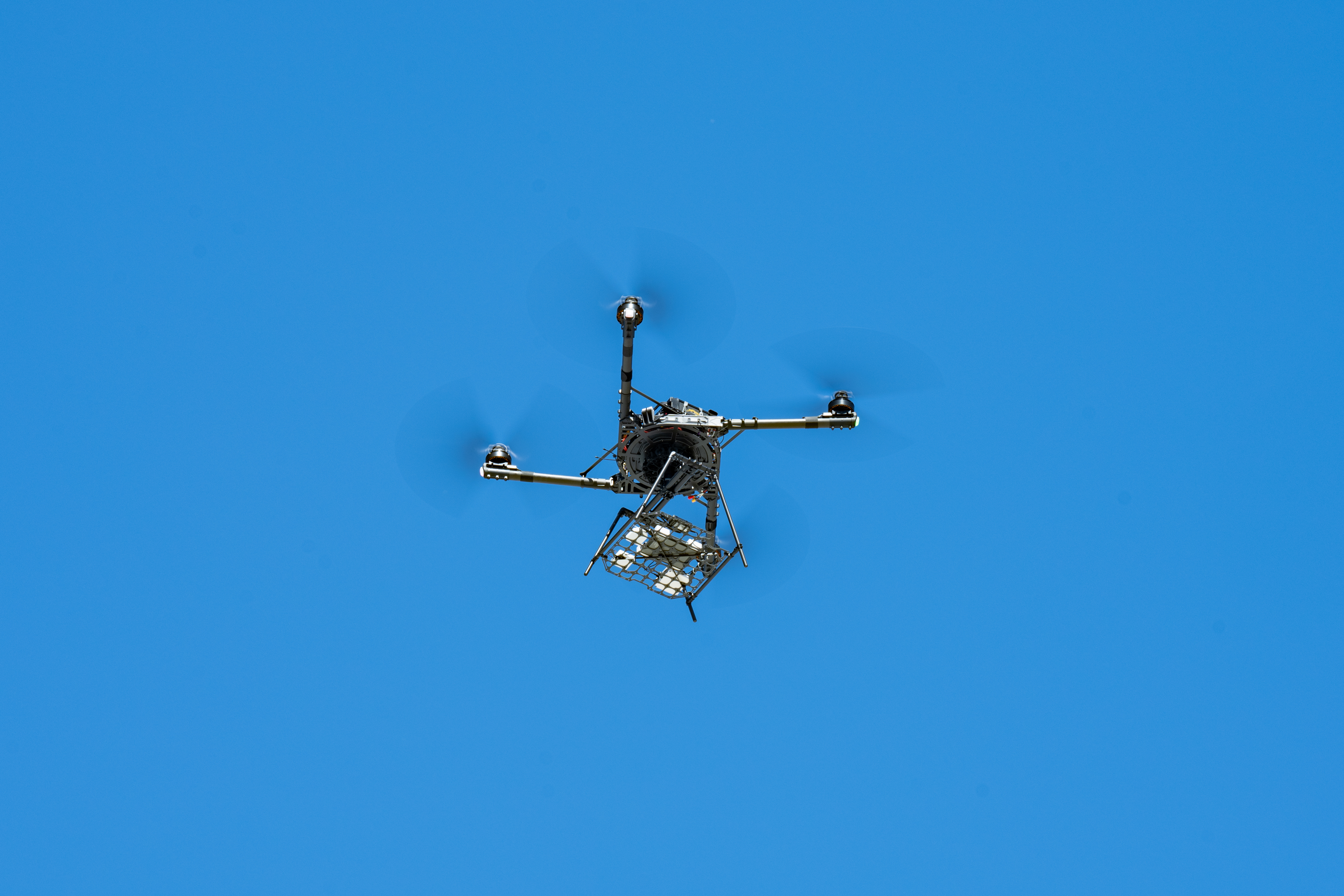
An Alta-X drone carries a custom built simulated Unmanned Aircraft Systems environment payload for the new blockchain system tests.   
Credit: NASA/Brandon Torres Navarette 

Through a drone flight test at NASA’s Ames Research Center in California’s Silicon Valley, researchers tested a blockchain-based system for protecting flight data. The system aims to keep air traffic management safe from disruption and protect data transferred between aircraft and ground stations from being intercepted or manipulated. 

For aviation and airspace operations to remain safe, users need to be able to trust that data is reliable and transparent. While current systems have been able to protect flight data systems, cyberthreats continue to evolve, requiring new approaches. NASA researchers found the blockchain-based system can safely transmit and store information in real time. 

Blockchain operates like a decentralized database — it does not rely on a single computer or centralized system. Instead, it shares information across a vast network, recording and verifying every change to a dataset. The system ensures the data stays safe, accurate, and trustworthy.  

Previous cybersecurity research focused on implementing a layered security architecture — using multiple physical and digital security measures to control system access. For this test, researchers took a different approach using blockchain to address potential threats.  

Using drones allowed the team to show that the blockchain framework could yield benefits across several priority areas in aviation development, including autonomous air traffic management, urban air mobility, and high-altitude aircraft.  

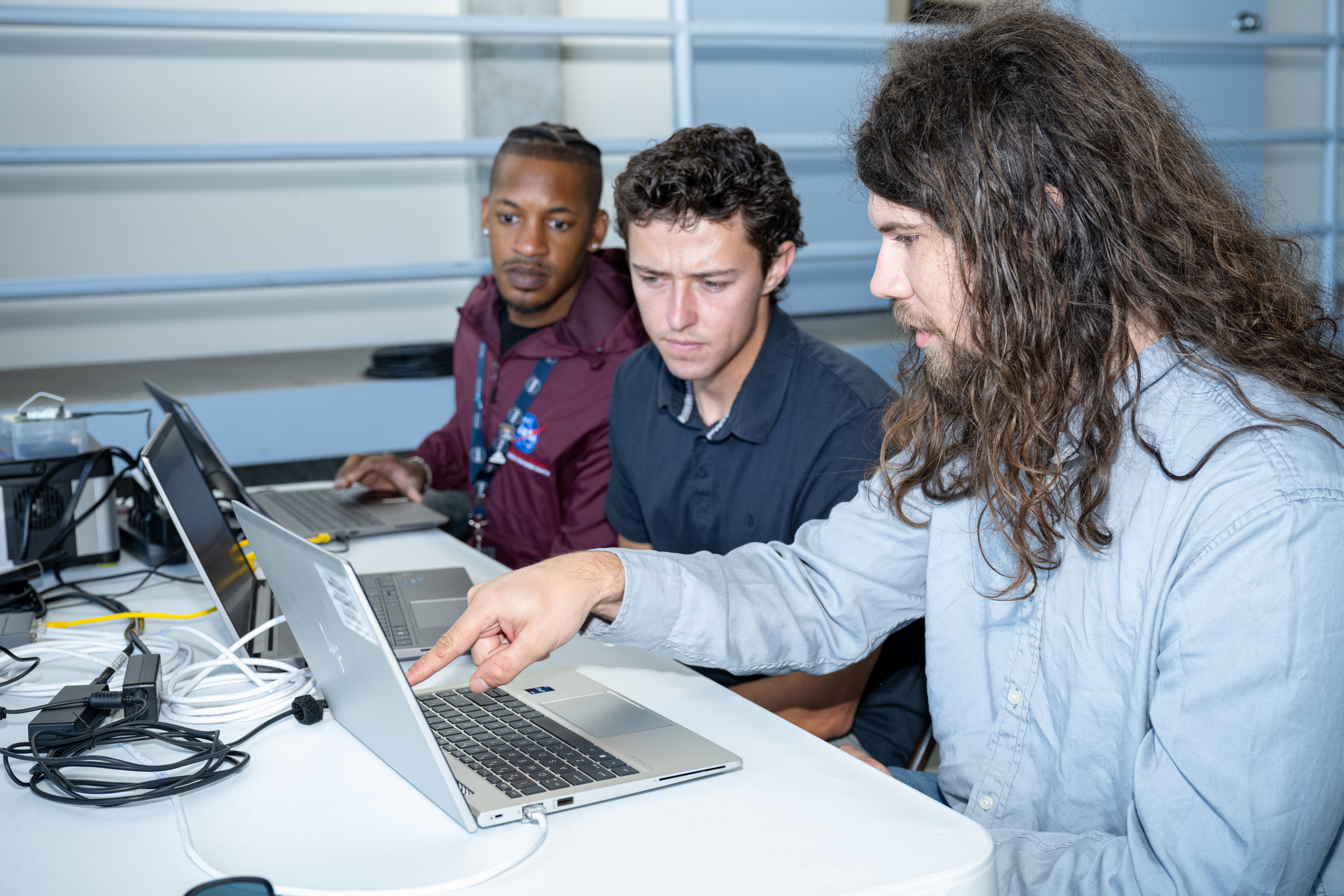
Three people sit at a table looking over laptop computers. The one nearest the camera is pointing at the laptop monitor.
Terrence D. Lewis (left), Kale Dunlap (center), and Aidan Jones monitor the flow of telemetry from both actual and simulated flights, ensuring the simulation and blockchain systems are processing and recording data accurately. 
Credit: NASA/Brandon Torres Navarette 

This NASA research explored how blockchain can secure digital transactions between multiple systems and operators. The team used an open-source blockchain framework that allows trusted users real-time sharing and storage of critical data like aircraft operator registration information, flight plans, and telemetry. This framework restricts access to this data to trusted parties and approved users only. 

To further examine system resilience, the team introduced a set of cybersecurity tests designed to assess, improve, and reinforce security during operations in airspace environments. During an August flight at Ames, the team demonstrated these capabilities using an Alta-X drone with a custom-built software and hardware package that included a computer, radio, GPS system, and battery.  

The test simulated an environment with a drone flying in real-world conditions, complete with a separate ground control station and the blockchain and security infrastructure. The underlying blockchain framework and cybersecurity protocols can be extended to support high-altitude operations at 60,000 feet and higher and Urban Air Mobility operations, paving the way for a more secure, scalable, and trusted ecosystem. 

NASA researchers will continue to look at the data gathered during the test and apply what they’ve learned to future work. The testing will ultimately benefit U.S. aviation stakeholders looking for new tools to improve operations. 

Through its Air Traffic Management and Safety project, NASA performed research to transform air traffic management systems to safely accommodate the growing demand of new air vehicles. The project falls under NASA’s Airspace Operations and Safety Program, a part the agency’s Aeronautics Research Mission Directorate that works to enable safe, efficient aviation transportation operations that benefit the flying public and industry.

Underused space across USPS facilities could be a hidden drag on modernization and budgets

15 January 2026 at 12:21

Interview transcript

Terry Gerton The Office of Inspector General there at the U.S. Postal Service issued a recent report where you flagged excess and underutilized space across USPS facilities. First of all, tell us what initiated the study.

Joshua Bartzen Well, I will say that in terms of, there’s been an overall focus by the federal government on making sure that space is utilized all throughout agencies throughout the federal government. And with the Postal Service having the facility footprint that it has, over 34,000 facilities across the country, varying in size from pretty small post offices to larger processing plants, we figured it was a great time to start a project like this.

Terry Gerton And so as you went through it, what did you uncover about how much space is sitting idle or underutilized?

Joshua Bartzen Terry, it’s a great question. And for us, the first step that we took was try to understand what data is out there to kind of assess this network. So we went into the network and we were pleased at first when we saw that the Postal Services National Facility Database had information on fields that related to excess space or underutilized space or vacant space. So we’re like, okay, we viewed that as a good sign. However, once we started looking at some of the data that was associated and located in that system, I’ll say from an auditor’s perspective, our ears started to perk up a little, our eyes opened up a little and we’re like, okay, there seems to be some reliability, some things, outliers that we’re looking at. So then the crux of our audit, then we started really flushing out and kind of started peeling the layers of the onion back on that data. And we found some pretty concerning reliability issues.

Terry Gerton Well, let’s talk about reliability issues then, especially as it relates to the data. What did you find?

Joshua Bartzen So in terms of the data, some of the things we looked at were, they had incorrect inputs, where some of formulas like in Excel, they weren’t working as properly. They were incorrectly coded, where some space was office space, but it was coded as vacant land or some of the data was inconsistent between some of this system modules. Then we also noted that in certain instances, the data wasn’t even in there. So one of the key findings we had was that over 63% of the properties have not had a kind of data reliability assessment performed, on record. So that was concerning to us because at some point, going out collecting this data and then checking out it periodically, just that lack of data was very concerning for us.

Terry Gerton Whose job is it to keep the data up to date?

Joshua Bartzen Terry, it’s a great question. And honestly, that was kind of one of the things we’re talking with Postal about. Obviously, the Postal Service is a very big organization. There’s different functions. We were dealing primarily with the facilities group, but also the retail group, the processing group, the delivery group, they all have input into this because they’re aware of the day-to-day operations. We kind of attributed it to facilities because they were the kind of, as far as from our view, they were the overseers of this entire facility database and what was in their postal service facilities. Folks may have a little different perspective on that, but from our perspective, that’s where we landed.

Terry Gerton What’s the impact to postal service management of not having good data about the usage of its various kinds of facilities?

Joshua Bartzen But Terry, great question. And we reported that the lack of visibility into this data really, it hinders your ability to drive financially beneficial alternatives, such as if you can repurpose the space, if you can rent it, if you dispose it. So all those types of things, we found that the data issues that we found really hindered anything going forward because at that point, it’s limiting your decision making. And we even highlighted a couple examples in the report in terms of the COVID test kits, when they came out, at some point, you’re trying to find facilities where there can be some space where you can store them and process them, and Postal Service eventually was able to do it. But the data wasn’t as readily available because they had to go ask and kind of re-engineer it going from step one. Similarly, lately, there’s been some increases in packages at certain locations, so much so that they’ve had to put exterior tents outside to kind of store the packages while they’re waiting to be processed. So we were saying, well, this is also another opportunity where if you knew where some available space was in nearby adjacent facilities that could help you out. The third part is there’s a revenue component to this too. And I think this aligns with a lot of the other things from the federal government that we discussed earlier is that, are there ways to either rent the space or dispose of it that can save you money? And in terms of that, we saw some instances where space was coded differently and that limited your ability to rent that, potentially rent that space. So again, financial operational impacts definitely arose from the lack of quality data.

Terry Gerton I’m speaking with Joshua Bartzen. He’s an audit director at the U.S. Postal Service Office of the Inspector General. So we talked a little bit about the finding around insufficient or inaccurate data. What was your second finding here?

Joshua Bartzen The second finding, the second part of that finding had to do with the overall broader strategy related to excess and underutilized space. And we were curious from the Postal Service perspective, did they have a strategy for reducing it or at least for managing it? Because the one reality we do know with the Postal Service is that the operational demands vary throughout the year. Like right now it’s holiday time, so we know that there’s a lot more packages going through the network, so you know you need more space. Do you need that space maybe in the middle of January? Maybe not. But that space can be used then for maybe something else. So the network and the volume variability is what they call it in terms of workflows, ebb and flow. Just being aware of it, having that data and that overall strategy can help you manage those kind of ebbs and flows throughout the year.

Terry Gerton You also noticed that the Postal Service hadn’t been meeting its congressional reporting requirements about facility space.

Joshua Bartzen That’s correct as well. So again, the GAO has placed federal real property management on its high risk list for over 20 years. And some of that continued work decades ago resulted in the passage of one of the federal real property laws that’s out there. We found the Postal Service hadn’t been complying with some of the reporting requirements of that. The Postal service said they weren’t aware of it. And again, they thought maybe it was a one-time reporting requirement, but again, with the move towards a federal government making more and more attention on this we thought it was, you know, us noting that compliance issue, and the Postal Service has agreed with that recommendation related to that compliance.

Terry Gerton You made a total of seven recommendations. How did the Postal Service respond across the board?

Joshua Bartzen I’ll say mixed, they agreed with two of them, and they disagreed with five. And in terms of the five that they disagreed with, most of those all pertain to the data or the strategy issues that we had discussed earlier. From our perspective, the Postal Service had some comments in there about who’s going to be responsible and who should be — and Terry, it’s funny that you mentioned who’s in charge of this — when the Post Service was talking about who is in charge this from an earlier point, Terry, there’s some difference of opinions. From our perspectives, though, At some point, we are auditors and we’re not consultants. So we’re going to tell you what to do, but we’re going to point out the issue. So we are less concerned with what entity within the Postal Service solves, corrects the issues that we brought up, but we noted for those five disagreed recommendations, we still think that they’re very important and they should be resolved.

Terry Gerton What do you think will happen now that you’ve raised awareness of this within the Postal Service? Are you seeing that they’re moving forward to take action, or what do you expect?

Joshua Bartzen We expect, at least from, I’ll go two-fold, just from the recommendation perspective, how those get handled is we have a resolution process with the Postal Service and we work to try to resolve those. So there’s some common agreement because I think collectively, between us and the Postal Service, we want these recommendations to be resolved. From a more global perspective, our report focusing on excess underutilized property is going to be one of many, I’m sure over these next couple of years, the federal focus is not going away, either by us, by GAO, by other federal stakeholders, so at some point, we’re envisioning that emphasis and that priority, the spotlight’s gonna stay. So I think it’s gonna have to be something that they’re gonna have to kind of make sure they’re managing. And to their credit, they’re creating a new data system to help manage some of these properties. Now with us, it’s becoming, hey, let’s make this a priority, make sure we’re doing this on an ongoing basis. Because again, that spotlight’s only gonna shine brighter.

The post Underused space across USPS facilities could be a hidden drag on modernization and budgets first appeared on Federal News Network.

© The Associated Press

FILE - A mail carrier loads a mail truck with mail on Friday, March 1, 2024, in Lake Tahoe, Calif. A U.S. Postal Service plan to downsize a regional mail hub in Reno and move package and letter processing to Sacramento, California, is raising fears about service delays and mail-in ballot handling from Nevada elected representatives. (AP Photo/Andy Barron, File)

Recent VA audit finds major gaps in homeless screening, prevention

14 January 2026 at 17:10

Interview transcript:


Terry Gerton Your office has recently published the results of your audit on the homeless screening clinical reminder process in the Veterans Health Administration. Let’s start by having you explain what that process is and how it’s supposed to work, and what difference it makes for veterans who are perhaps experiencing housing instability.

Steve Bracci First, I do want to acknowledge that VA has prioritized ending veteran homelessness. There are several programs to help veterans who are homeless or at risk of becoming homeless. The homeless screening clinical reminder process really is an outreach effort. During health care visits, the screening tool, which is a series of questions, is used as a proactive way for VA to identify and help veterans who are either homeless or concerned about their housing stability. And this is really important because veterans may be unaware of the programs and assistance VA has to offer, or they might be reluctant to ask for help. So the screening tool prompts clinical staff to ask veterans if they have any housing concerns that they want help with. This then allows the clinician to make a referral to a social worker who can then connect with the veteran to discuss options and provide them with the assistance they need. This is, again, really important because it can have a major impact on veterans’ housing stability and their overall health and wellbeing.

Terry Gerton And VHA has established a target timeframe for that follow-up, right? Will you walk us through that?

Steve Bracci When a veteran says they want help, they are supposed to acknowledge that and act on it within seven days, but the goal is to actually resolve and have a conversation with the veteran within 30 days. But of course they recognize that it’s important to do it as quickly as possible.

Terry Gerton And so I guess the big finding, as you did your audit, was that in cases where the medical centers used both VistA and the Oracle Health System, almost 61% of veterans didn’t receive appropriate follow-up. What exactly is going wrong there?

Steve Bracci First, I want to clarify the 61%. That only refers to the veterans we were able to review at the VistA sites. The issues we saw at the Oracle sites were more focused on the lack of reliable data, which prevented our team and actually prevents VA from being able to view veterans’ cases and make sure that they’re being followed up on. So the 61% does refer to the VistA site. I just wanted to make that clear. But to answer your question about what went wrong, there were two key breakdowns that we saw in the process. First, the staff that screened the veterans, the clinicians, did not always refer veterans to social workers. Facilities have different ways of doing this and the processes varied across the sites we reviewed. For example, some facilities do a formal referral through the electronic health record using the consult process, while others use more informal methods, like sending an instant message to social workers. That’s an example. But we did find instances where these referrals just weren’t made. And as a result, no one reached out to the veterans to provide them with the assistance they needed. So that was the first part. The second part is the staff who received the referrals didn’t always follow their local procedures for conducting outreach with respect to how they tried to reach the veterans or how many attempts they made to reach the veterans. The intent of a follow-up is for social workers to have an actual interaction with the veteran and to have a conversation, identify their needs, and then they can provide the appropriate intervention. But we found instances where there was no interaction at all and it was just a letter was sent, or an email. So there was no way to ensure that the veterans’ needs were actually being met.

Terry Gerton Homeless veterans can be amongst some of the toughest folks to actually contact. They may not have a reliable mailing address. They may have a predictable phone number. What are the contact mechanisms that the referral team is supposed to use to reach them?

Steve Bracci Whatever method possible. They try to reach them using a telephone number. They try email. They try text messages. I think that’s not something we really touched on too much in our report, but it does show the importance of trying multiple times to reach a veteran before closing out that referral.

Terry Gerton I’m speaking with Steve Bracci. He is a deputy assistant inspector general for the Office of Audits and Evaluations at the Department of Veterans Affairs. So you mentioned the 61% with VistA cases, but you also said with the Oracle Health System, they have unreliable data. I’m interested — it seems like two different IT systems, but I’m presuming they have sort of the same SOPs across the network, regardless of what IT system they’re using. What makes the difference in terms of reliable follow-up reports, or root causes?

Steve Bracci I think it’s just a matter of how reliable that follow-up report is. We found with the VistA sites that the report was accurate as far as identifying the actual veterans who screened positive and wanted help. It was the actual follow-up part of that that was missing, whether or not the veteran had actually been reached and whether or not the follow-up had been completed. So that was the piece that was missing with the VistA sites. With the Oracle sites, we just found that it wasn’t accurate at all. The actual report was somewhat unusable with identifying whether or not veterans had actually screened positive and then any sort of follow-up had been done. So, that was a distinction there.

Terry Gerton So you’ve got really two fundamentally different, systemic problems. Talk us through your recommendations. How do you want VA to tackle this issue?

Steve Bracci That’s a challenge for VA is when you have two systems — anytime you have IT systems and there need to be updates, that is a challenge. I think it’s just a matter of doing what they need to do to make sure that the systems are accurately capturing the data and reporting the veterans who need help so that that follow-up can be taken.

Terry Gerton How did VA respond to these recommendations, and who’s responsible for fixing the problem?

Steve Bracci I do want to acknowledge that VA concurred with our recommendations and they developed a responsive action plan for each one. So that’s important. Carrying out the action plans will require significant effort because not only are we dealing with two different systems, but we’re dealing with many VA medical facilities and each facility can do things a little bit differently. So identifying what works and taking steps to standardize that process across the system will take some effort. So that’s an important piece. Like I said, the recommendation about ensuring reliable reports could require additional coordination because we are dealing with VistA sites and Oracle sites, and it will require significant communication and collaboration across program offices and VA stakeholders to get the reports where they need to be. So ultimately responsible, you know, I mean the VA secretary is ultimately responsible for everything within VA. But you have many different program offices that are relevant in this case, and you have many different VA leaders also.

Terry Gerton Does VA have, say, a task force lead for this project?

Steve Bracci Not that I’m aware of.

Terry Gerton Let’s assume that they figure out how they’re going to orchestrate all of those different pieces that need to respond to this. What do you want veterans to know about how this might change their interaction or their service when they’re screened for homelessness or housing insecurity?

Steve Bracci I want veterans to know that they can expect to see improvements to the process. That’s why the OIG is so important: Our oversight focuses on topics and programs and services that are important to veterans. Our team does a really good job. When we conduct an audit, our team does really good job communicating with the different program offices and with VA leadership throughout the project. So when our report is issued, it doesn’t come as a surprise. So that communication, I think, is really important and it gives VA the opportunity to start making improvements and corrective actions immediately. And we’ve found that that is the case, that they take those meetings and they take our findings and our recommendations seriously. So I want veterans to know that. And, you know, I think VA as part of their response to our report, they have planned corrective actions that should be implemented by August of 2026. So if they follow through and they take action and they complete those plans, then veterans will see improvements to this process.

The post Recent VA audit finds major gaps in homeless screening, prevention first appeared on Federal News Network.

© The Associated Press

Theodore Neubauer, a 78-year-old Vietnam War veteran, who is homeless, looks at his smartphone while passing time in his tent Friday, Dec. 1, 2017, in Los Angeles. "Well, there's a million-dollar view," said Neubauer on what it's like to be homeless in Los Angeles. Neubauer has a tent pitched in the heart of downtown Los Angeles and is surrounded by high-rise buildings. A homeless crisis of unprecedented proportions is rocking the West Coast, and its victims are being left behind by the very things that mark the region's success: soaring housing costs, rock-bottom vacancy rates and a roaring economy that waits for no one. (AP Photo/Jae C. Hong)

Does your air quality data tell the whole story? Why some communities are at risk

13 January 2026 at 17:22

Interview transcript:

Terry Gerton Your office recently took a closer look at how EPA oversees state and local air monitoring schedules. I’m wondering, was there a specific concern or a trend that raised the alarm with you?

Paul Bergstrand We came across a study from 2021 that had some analysis showing that there was a difference in pollution levels when air monitors were off compared to when they were on, and this interests us in several ways. So just to be clear, it is completely normal for monitors to be off. It happens because monitors have a schedule where they’re designed to be off or where there is some kind of technical difficulty that they’re correcting. But what interested us is the fact that there was a difference between when they were on and off in terms of pollution levels. They should be the same. And so we wanted to take a closer look for ourselves to see how the EPA is overseeing this issue and if they were doing anything to fix it.

Terry Gerton You looked at thousands of monitoring sites. What did you discover about the trends once you dug into the data?

Paul Bergstrand We use satellite and model data as alternatives to data from regulatory air monitors to compare air quality when monitoring sites are off and when they’re on. And we found that for a fine particulate matter, which was the focus of our evaluation, it amounted to an average increase of 4% for monitors that operate on daily schedule and 9% for sites that operate in one every three days. And then separately, we found that 35.7% of intermittent modelers had worse air quality on average when they were offline.

Terry Gerton What difference does that make for public health?

Paul Bergstrand Well, importantly, the EPA sets standards for air quality, and if the standards aren’t met, then the area is in non-attainment. And that means that there can be harmful cardiovascular effects, reduce visibility, contribute to water acidification. And so poor data quality means that some areas that should be in non-attainment might not be designated correctly.

Terry Gerton There’s an interesting catch-22 here around transparency. The EPA publishes the monitoring schedule online, which we would think would be good, and people can know about that, but it creates some perverse incentives for the regulated agencies. Talk us through how that works.

Paul Bergstrand Yes, it has been their regular practice to publish those schedules. But I want to note that our analysis did not indicate any malicious behavior. But it is a concern that someone could take advantage of that scheduling to choose to conduct maintenance and shut down a monitor when they know there will be increased ambient air pollution. So it was a concern of ours and the EPA saw the concern and they took action actually during our work and decided not to publish the 2025 schedule. And they’ve agreed to continue not to publish the schedule.

Terry Gerton Is that the best solution here? Are there other factors that you might consider or recommend?

Paul Bergstrand Well, in addition to that, we’ve asked them to do some more data analysis during their quality control checks of state and local data. And this would mean using some of the techniques we had in our report that they could replicate and improve upon to come up with their own analysis to look for data that might be poor or missing.

Terry Gerton You also flag that local agencies may have incentives to under-report pollution. So again, we have some mixed messages kind of happening here. What drives those incentives?

Paul Bergstrand Again, we did not identify any malicious behavior, but as you say, there are incentives. If the EPA does designate a state as a non-attainment, there are expensive controls they have to put in place. So there is that incentive to try and hide the pollution, so to speak, so they can eliminate the data point basically from the data the EPA is collecting. But it also could be completely normal that the data points are missing, and that’s why we’re suggesting that the EPA do its own analysis.

Terry Gerton I’m speaking with Paul Bergstrand. He is Assistant Inspector General, Office of Special Review and Evaluation for the Environmental Protection Agency’s Office of the Inspector General. Does EPA have the capacity and the tools to strengthen the oversight in that way that you were just recommending?

Paul Bergstrand We think they do. They can use similar or improved statistical methods using these alternative satellite data and modeling to help the quality control checks. That’s the way.

Terry Gerton Are they using those tools now?

Paul Bergstrand I can’t speak to what they’re doing now, whether they are or not, but we know they’ve done it in the past. They’ve done in 2022, where they looked at missing air pollution data from 2002 to 2018.

Terry Gerton So you mentioned that EPA was taking action to address some of your concerns even as the evaluation was going on. Are there further recommendations that you’ve made that you hope the EPA takes action on?

Paul Bergstrand Yes, I mean, they’ve agreed to both of our recommendations. And that second recommendation is that they incorporate some of these analyses into really spot-checking. And what’s important is that they can improve upon what we did to identify pollution that’s under-reported.

Terry Gerton Are there things that communities should be doing themselves to maybe fill in gaps where the EPA isn’t monitoring or just get better data out to their citizens?

Paul Bergstrand I don’t, we didn’t look at that aspect in our report, but it’s a very interesting one. And I know there are maybe some grant programs or programs to get local air monitors, but in my experience, and I’m not speaking from the body of this report here, but in my experience, those are not used to do to collect regulatory data. So I’m quite sure on how to connect those dots from maybe your citizen-scientist using an air monitor to the data being used by the EPA.

Terry Gerton We’ve done a quick overview of your report and its findings and recommendations, but one of the things I want to point out to folks is that this information is really accessible. You’ve done an interesting job of making it available through what’s called a story map. Tell us about how EPA is using that kind of a tool to get this kind of information out.

Paul Bergstrand Yes, we wanted to be innovative in the way we’re portraying this complex status so it’s more accessible. And a story map is a web-friendly format where you can scroll at your leisure to look at dynamic information, graphics, maps. Just another way to present the information to the audience that we think has a lot of possibilities.

Terry Gerton So I don’t have to print off 100-page paper and put it under my pillow so I can absorb it while I sleep. This is very cool. Are you using it in other reports?

Paul Bergstrand We hope to be. This was our first one and it was sort of a pilot project. We are definitely going to be looking forward to more opportunities to use it.

The post Does your air quality data tell the whole story? Why some communities are at risk first appeared on Federal News Network.

© The Associated Press

FILE - In this June 3, 2017, file photo, the coal-fired Plant Scherer in Juliette, Ga. The Trump administration is doing away with a decades-old air emissions policy opposed by fossil fuel companies, a move that environmental groups say will result in more pollution. The Environmental Protection Agency issued notice Thursday it is withdrawing the “once-in always-in” policy under the Clean Air Act, which dictated how major sources of hazardous air pollutants are regulated. (AP Photo/Branden Camp, File)

A Quarter Century in Orbit: Science Shaping Life on Earth and Beyond 

12 January 2026 at 17:43

For more than 25 years, humans have lived and worked continuously aboard the International Space Station, conducting research that is transforming life on Earth and shaping the future of exploration. From growing food and sequencing DNA to studying disease and simulating Mars missions, every experiment aboard the orbiting laboratory expands our understanding of how humans can thrive beyond Earth while advancing science and technology that benefit people around the world.  

Unlocking new cancer therapies from space

A woman conducts a research experiment aboard the International Space Station.
NASA astronaut Christina Koch works on MicroQuin’s protein crystallization research aboard the International Space Station.
NASA

The space station gives scientists a laboratory unlike any on Earth. In microgravity, cells grow in three dimensions, proteins form higher-quality crystals, and biological systems reveal details hidden by gravity. These conditions open new ways to study disease and develop treatments

Astronauts and researchers have used the orbiting laboratory to observe how cancer cells grow, test drug delivery methods, and examine protein structures linked to diseases such as Parkinson’s and Alzheimer’s. One example is the Angiex Cancer Therapy study, which tested a drug designed to target blood vessels that feed tumors. In microgravity, endothelial cells survive longer and behave more like they do in the human body, giving researchers a clearer view of how the therapy works and whether it is safe before human trials. 

Protein crystal growth (PCG) is another major area of cancer-related study. The NanoRacks-PCG Therapeutic Discovery and On-Orbit Crystals investigations have advanced research on leukemia, breast cancer, and skin cancers. Protein crystals grown in microgravity produce larger, better-organized structures that allow scientists to determine fine structural details that guide the design of targeted treatments. 

Studies in orbit have also provided insights about cardiovascular health, bone disorders, and how the immune system changes in space—knowledge that informs medicine on Earth and prepares astronauts for long missions in deep space. 

By turning space into a research lab, scientists are advancing therapies that benefit people on Earth and laying the foundation for ensuring crew health on future journeys to the Moon and Mars. 


Farming for the future 

NASA astronauts Jessica Watkins and Bob Hines work on the XROOTS space botany investigation, which used the station’s Veggie facility to test soilless hydroponic and aeroponic methods to grow plants. The space agricultural study could enable production of crops on a larger scale to sustain crews on future space explorations farther away from Earth.
NASA astronauts Jessica Watkins and Bob Hines work on the eXposed Root On-Orbit Test System (XROOTS) space botany investigation, which used the station’s Veggie facility to test soilless hydroponic and aeroponic methods to grow plants. The space agricultural study could enable production of crops on a larger scale to sustain crews on future space explorations farther away from Earth.
NASA

Feeding astronauts on long-duration missions requires more than packaged meals. It demands sustainable systems that can grow fresh food in space. The Vegetable Production System, known as Veggie, is a garden on the space station designed to test how plants grow in microgravity while adding fresh produce to the crew’s diet and improving well-being in orbit. 

To date, Veggie has produced three types of lettuce, Chinese cabbage, mizuna mustard, red Russian kale, and even zinnia flowers. Astronauts have eaten space-grown lettuce, mustard greens, radishes, and chili peppers using Veggie and the Advanced Plant Habitat, a larger, more controlled growth chamber that allows scientists to study crops in greater detail. 

These plant experiments pave the way for future lunar and Martian greenhouses by showing how microgravity affects plant development, water and nutrient delivery, and microbial interactions. They also provide immediate benefits for Earth, advancing controlled-environment agriculture and vertical farming techniques that help make food production more efficient and resilient in challenging environments. 

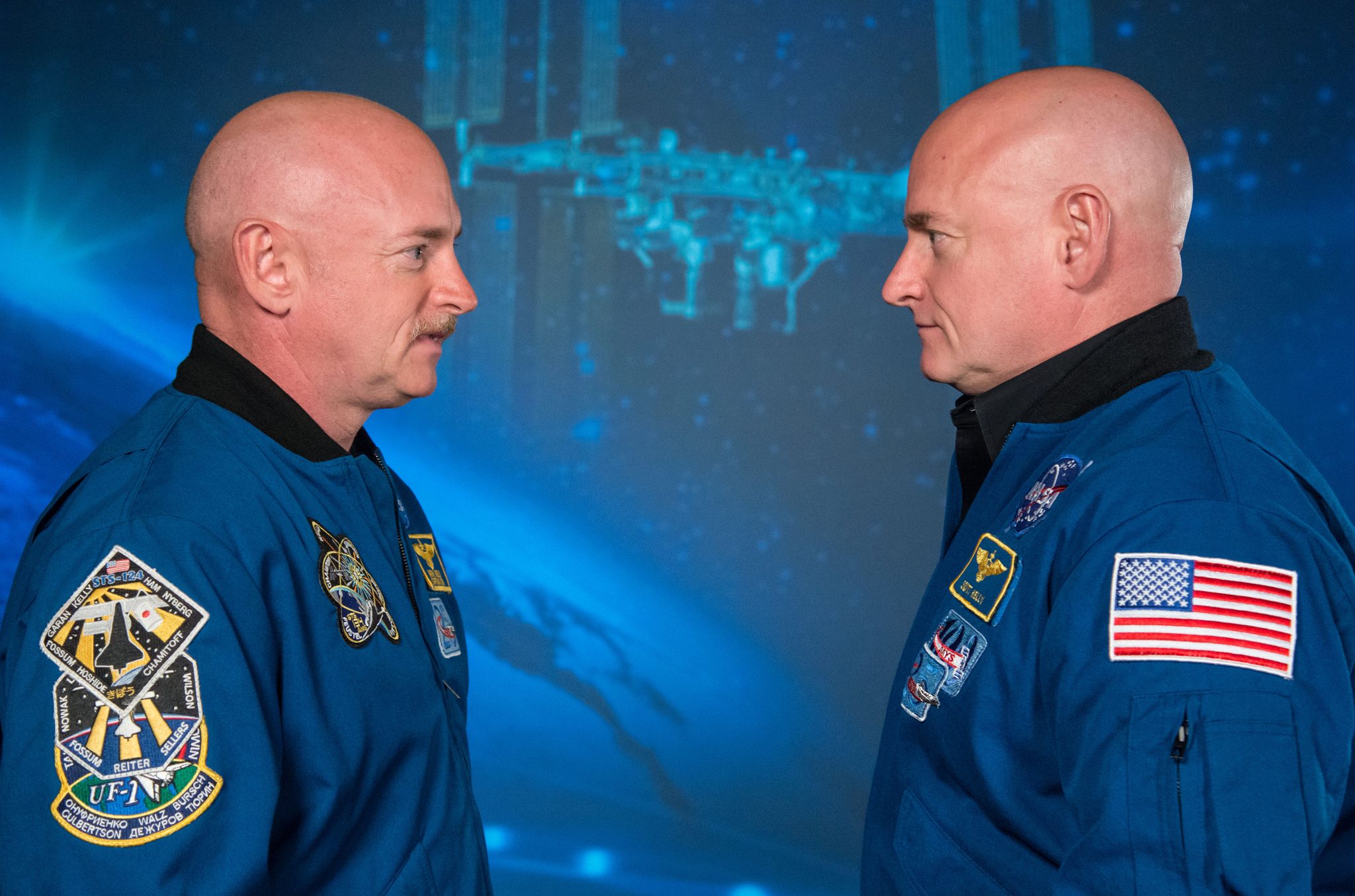
First year-long twin study 

Identical twin astronauts Mark and Scott Kelly
Mark and Scott Kelly, both former NASA astronauts, are photographed as part of NASA’s Twins Study.
NASA

Understanding how the human body changes in space is critical for planning long-duration missions. NASA’s Twins Study offered an unprecedented opportunity to investigate nature vs. nurture in orbit and on Earth. NASA astronaut Scott Kelly spent nearly a year aboard the space station while his identical twin, retired astronaut Mark Kelly, remained on Earth. 

By comparing the twins before, during, and after the mission, researchers examined changes at the genomic, physiological, and behavioral levels in one integrated study. The results showed most changes in Scott’s body returned to baseline after his return, but some persisted—such as shifts in gene expression, telomere length, and immune system responses. 

The study provided the most comprehensive molecular view to date of how a human body adapts to spaceflight. Its findings may guide NASA’s Human Research Program for years to come, informing countermeasures for radiation, microgravity, and isolation. The research may have implications for health on Earth as well—from understanding aging and disease to exploring treatments for stress-related disorders and traumatic brain injury. 

The Twins Study demonstrated the resilience of the human body in space and continues to shape the medical playbook for the Artemis campaign to the Moon and future journeys to Mars. 

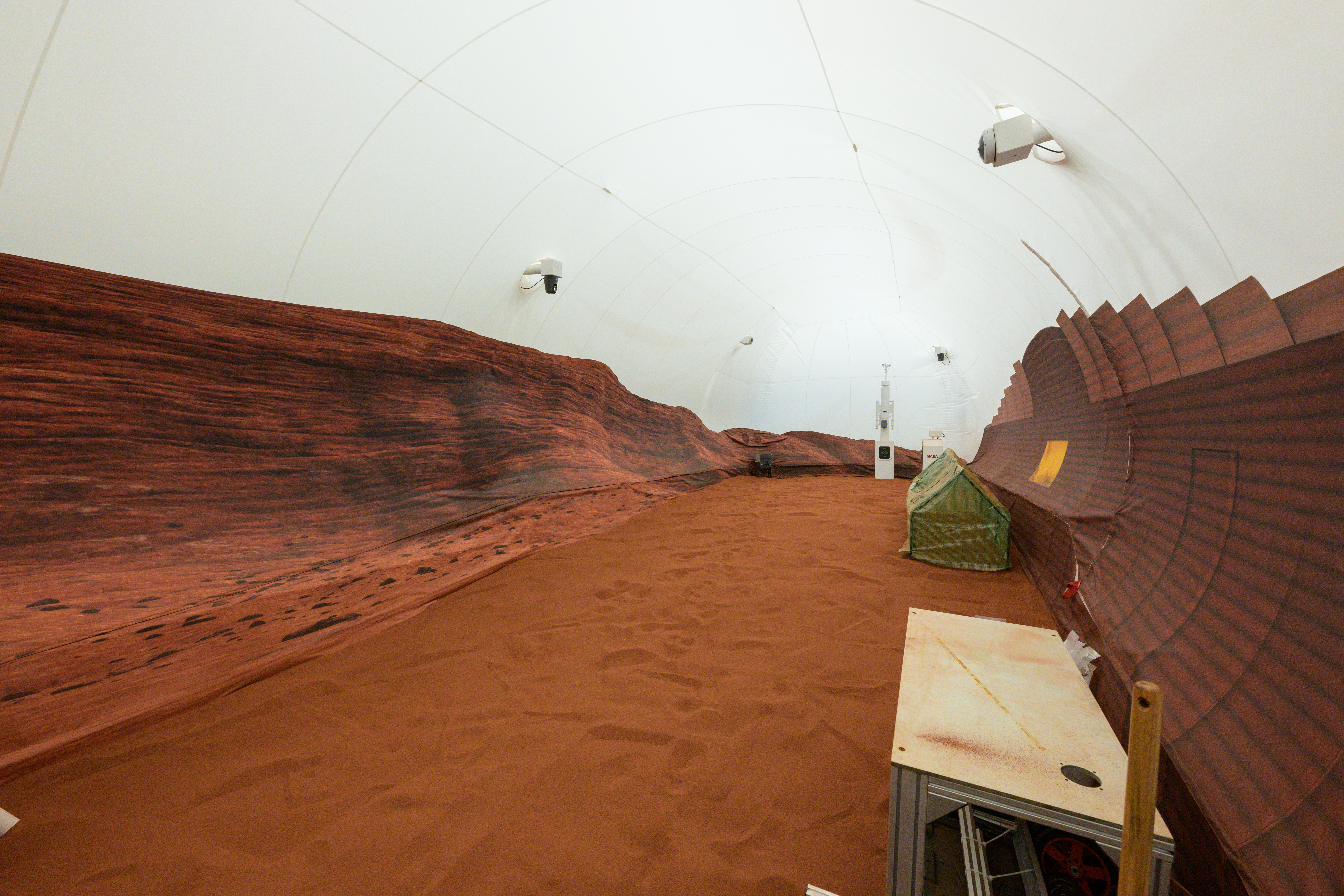
Simulating deep space 

The 1,200 square foot sandbox located in the CHAPEA habitat at NASA's Johnson Space Center.
A view inside the sandbox portion of the Crew Health and Performance Analog, where research volunteers participate in simulated walks on the surface of Mars.
NASA/Bill Stafford

The space station, which is itself an analog for deep space, complements Earth-based analog research simulating the spaceflight environment. Space station observations, findings, and challenges, inform the research questions and countermeasures scientists explore on Earth.   

Such work is currently underway through CHAPEA (Crew Health and Performance Exploration Analog), a mission in which volunteers live and work inside a 1,700-square-foot, 3D-printed Mars habitat for about a year. The first CHAPEA crew completed 378 days in isolation in 2024, testing strategies for maintaining health, growing food, and sustaining morale under delayed communication. 

NASA recently launched CHAPEA 2, with a four-person crew who began their 378-day simulated Mars mission at Johnson on October 19, 2025. Building on lessons from the first mission and decades of space station research, they will test new technologies and behavioral countermeasures that will help future explorers thrive during long-duration missions, preparing Artemis astronauts for the journey to the Moon and laying the foundation for the first human expeditions to Mars. 

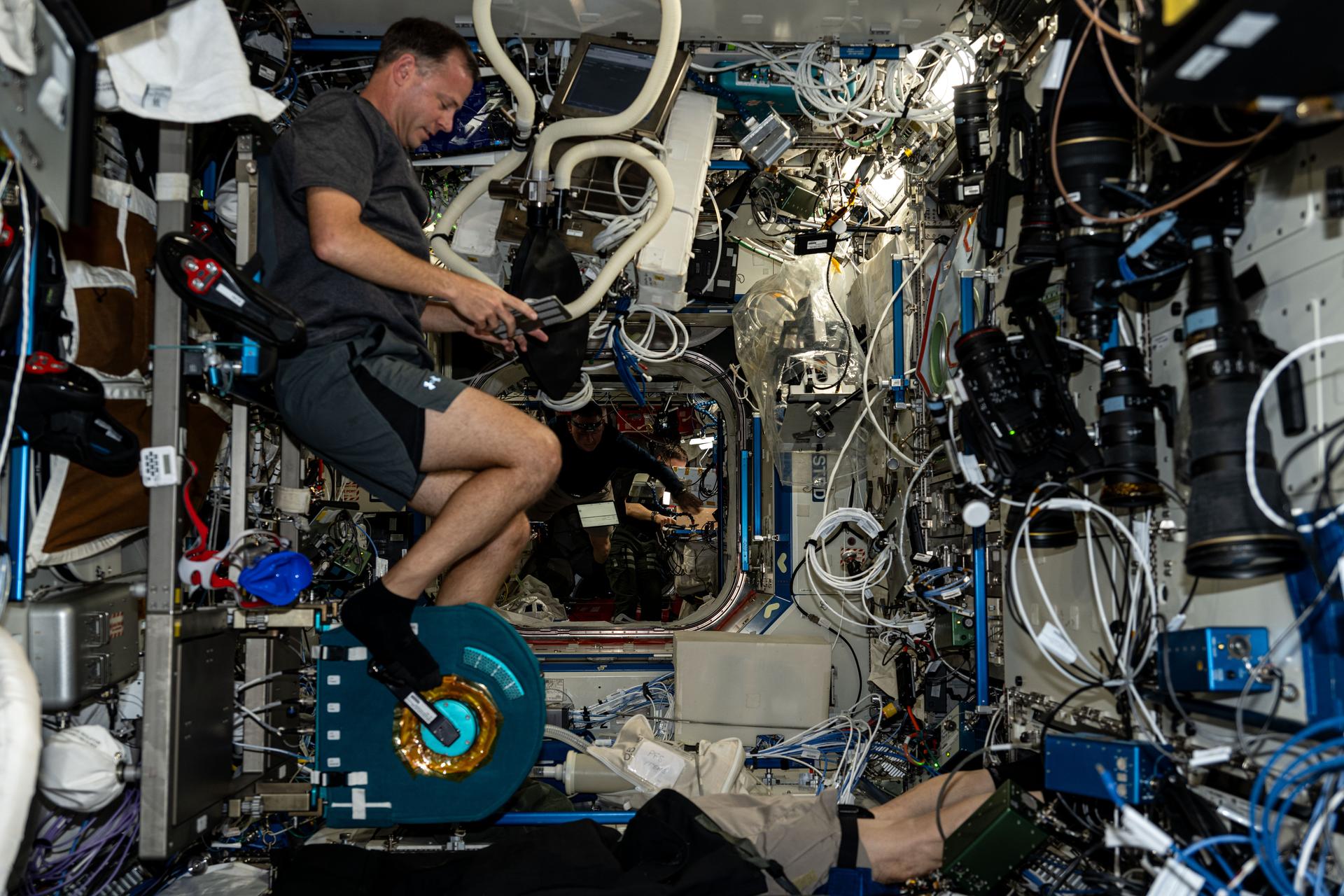
Keeping crews healthy in low Earth orbit 

NASA astronaut and Expedition 72 Flight Engineer Nick Hague pedals on the Cycle Ergometer with Vibration Isolation and Stabilization (CEVIS), an exercise cycle located aboard the International Space Station's Destiny laboratory module. CEVIS provides aerobic and cardiovascular conditioning through recumbent (leaning back position) or upright cycling activities.
NASA astronaut Nick Hague pedals on the Cycle Ergometer with Vibration Isolation and Stabilization (CEVIS), an exercise cycle located aboard the space station’s Destiny laboratory module. CEVIS provides aerobic and cardiovascular conditioning through recumbent or upright cycling activities.
NASA

Staying healthy is a top priority for all NASA astronauts, but it is particularly important while living and working aboard the orbiting laboratory.  

Crews often spend extended periods of time aboard the orbiting laboratory, with the average mission lasting about six months or more. During these long-duration missions, without the continuous load of Earth’s gravity, there are many changes to the human body. Proper nutrition and exercise are some of the ways these effects may be mitigated. 

NASA has a team of medical physicians, psychologists, nutritionists, exercise scientists, and other specialized medical personnel who collaborate to ensure astronauts’ health and fitness on the station. These teams are led by a NASA flight surgeon, who regularly monitors each crew member’s health during a mission and individualizes diet and fitness routines to prioritize health and safety while in space. 

Crew members are also part of the ongoing health and performance research being conducted to advance understanding of long-term spaceflight’s effects on the human body. That knowledge is applied to any crewed mission and will help prepare humanity to travel farther than ever before, including the Moon and Mars. 

Sequencing the future 

NASA astronaut Kate Rubins looking at DNA sample inside space station laboratory
NASA astronaut Kate Rubins checks a sample for air bubbles prior to loading it in the biomolecule sequencer. When Rubins’ expedition began, zero base pairs of DNA had been sequenced in space. Within just a few weeks, she and the Biomolecule Sequencer team had sequenced their one billionth base of DNA aboard the orbiting laboratory.
JAXA (Japan Aerospace Exploration Agency)/Takuya Onishi

In 2016, NASA astronaut Kate Rubins made history aboard the orbital outpost as the first person to sequence DNA in space. Using a handheld device called the MinION, she analyzed DNA samples in microgravity, proving that genetic sequencing could be performed in low Earth orbit for the first time. 

Her work advanced in-flight molecular diagnostics, long-duration cell culture, and molecular biology techniques such as liquid handling in microgravity. 

The ability to sequence DNA aboard the orbiting laboratory allows astronauts and scientists to identify microbes in real time, monitor crew health, and study how living organisms adapt to spaceflight. The same technology now supports medical diagnostics and disease detection in remote or extreme environments on Earth. 

This research continues through the Genes in Space program, where students design DNA experiments that fly aboard NASA missions. Each investigation builds on Rubins’ milestone, paving the way for future explorers to diagnose illness, monitor environmental health, and search for signs of life beyond Earth. 

Explore the timeline of space-based DNA sequencing

NASA Marshall Removes 2 Historic Test Stands

By: Lee Mohon
10 January 2026 at 16:01

NASA’s Marshall Space Flight Center in Huntsville, Alabama, removed two of its historic test stands – the Propulsion and Structural Test Facility and the Dynamic Test Facility – with carefully coordinated implosions on Jan. 10, 2026. The demolition of these historic structures is part of a larger project at Marshall that began in spring 2022, targeting several inactive structures and building a dynamic, interconnected campus ready for the next era of space exploration. Crews began demolition in December 2025 at the Neutral Buoyancy Simulator. Learn more about these iconic facilities.

Credits: NASA

Shaken, Not Stirred: NASA’s StarBurst Aces Extreme Temperature Tests

By: Lee Mohon
9 January 2026 at 16:41
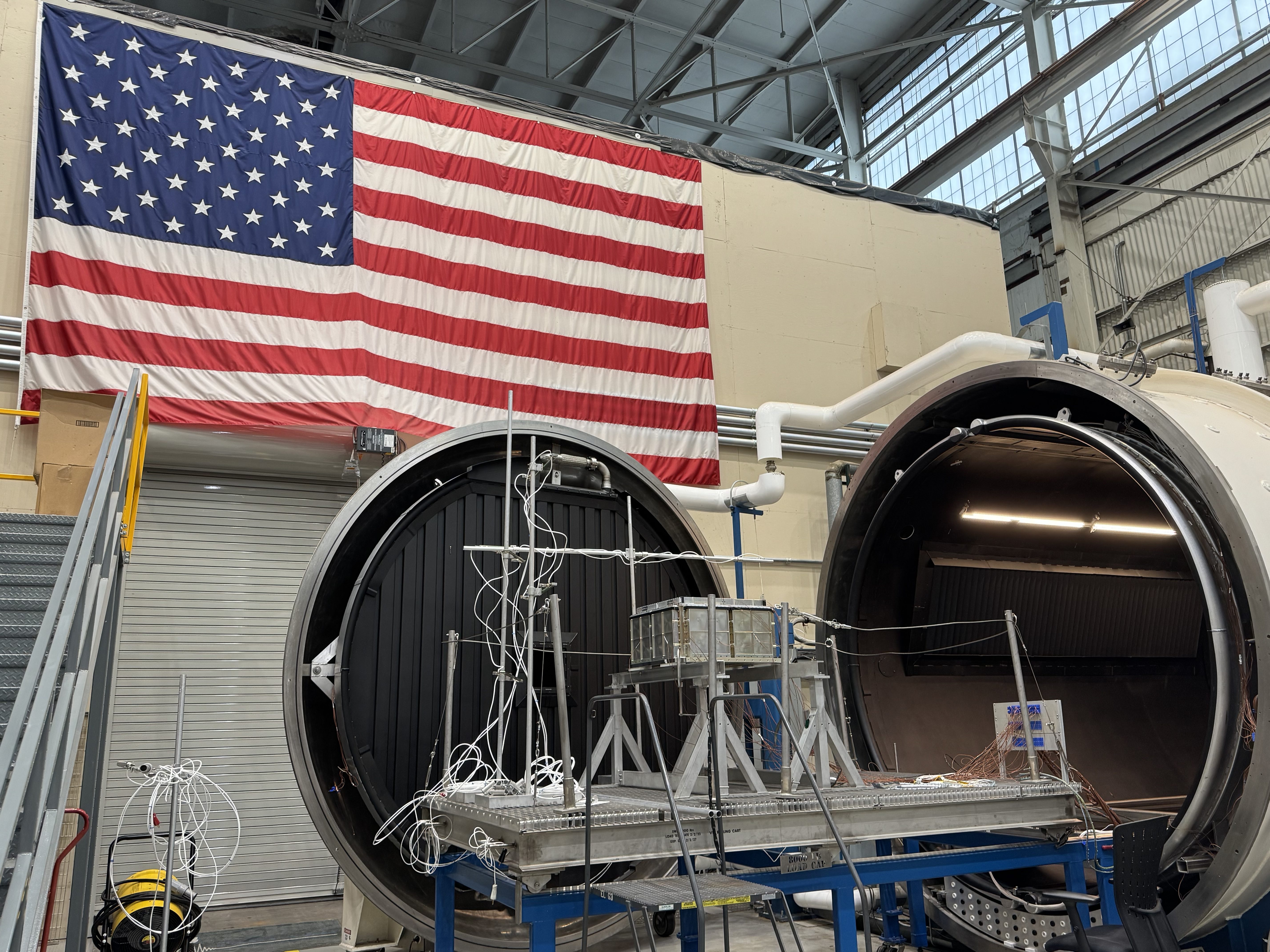
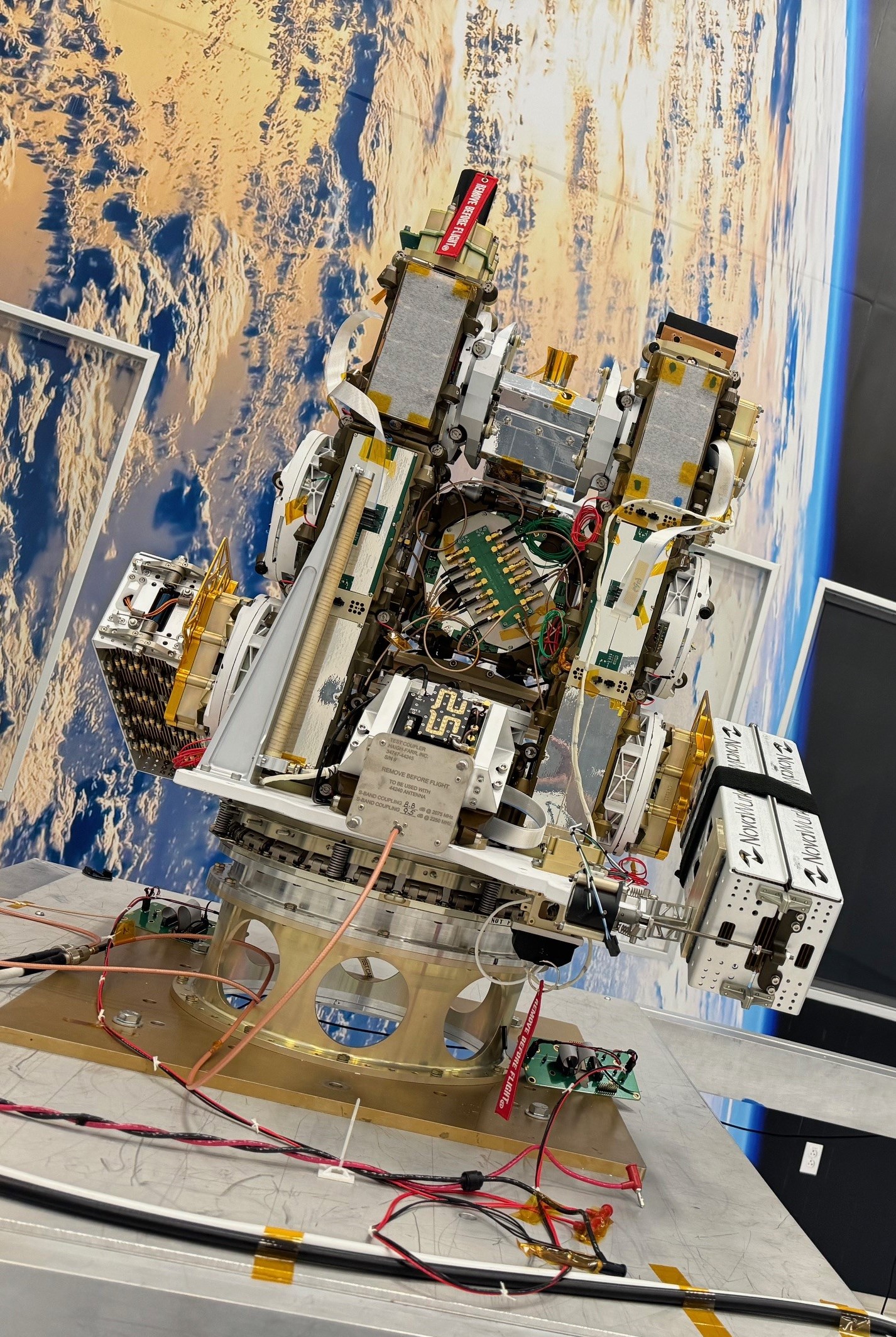
NASA’s StarBurst instrument outside a thermal vacuum chamber at NASA’s Marshall Space Flight Center in Huntsville, Alabama.
NASA/Daniel Kocevski

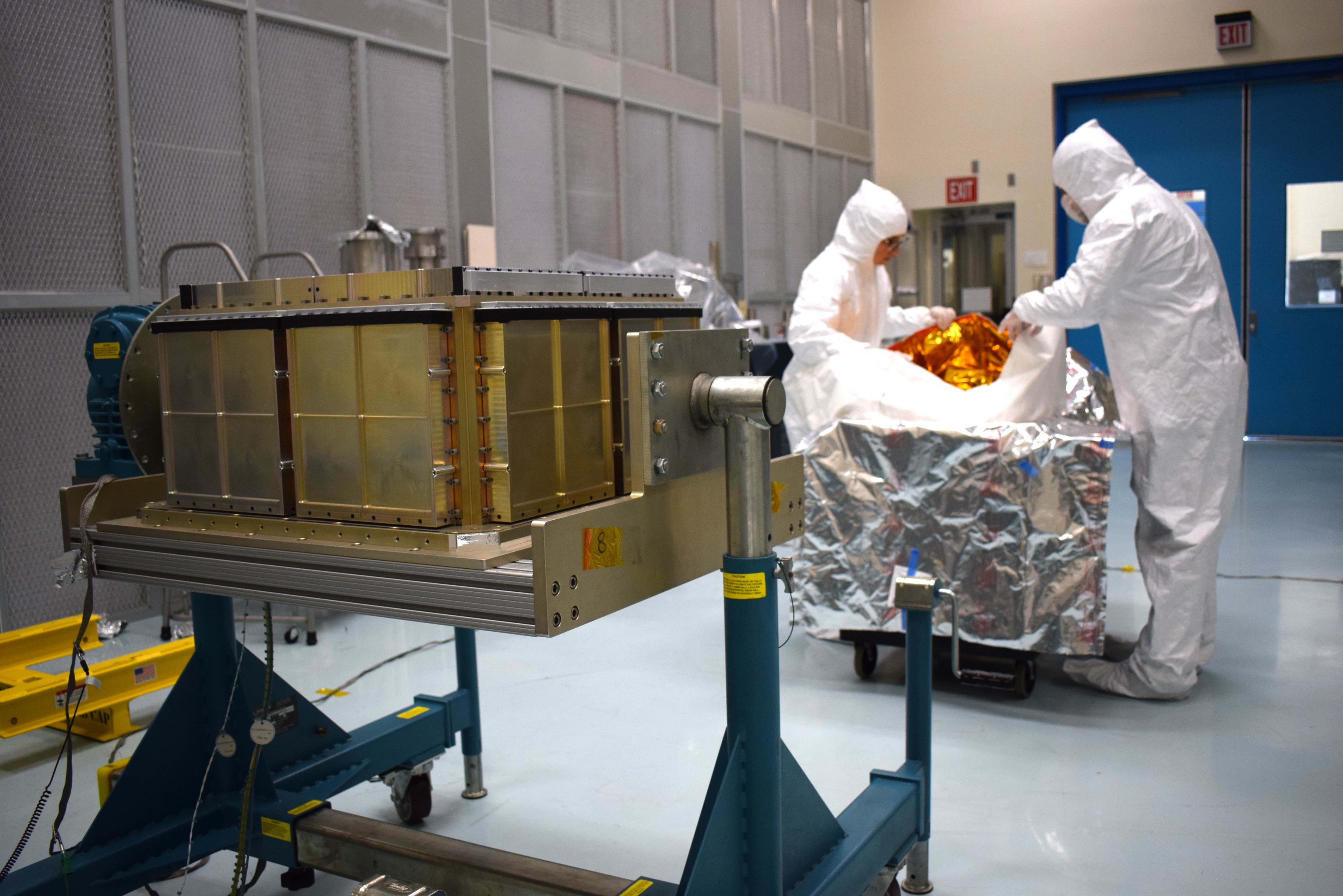
Heated, cooled, shaken, and settled – NASA’s StarBurst instrument is several steps closer to being ready for launch. The small satellite is now awaiting instrument calibration following a successful integration in Canada and rigorous testing by engineers at the agency’s Marshall Space Flight Center in Huntsville, Alabama.

StarBurst is designed to detect the initial emission of short gamma-ray bursts, some of the most powerful explosions in the universe and a key indicator of neutron star mergers. This would provide valuable insight into such events, which are also detected through gravitational waves by observatories on Earth. These events are where most of the heavy metals in the universe, such as gold and platinum, are formed. To date, only one such event has been observed simultaneously in gravitational waves and gamma-rays; StarBurst is expected to find up to 10 per year.

StarBurst arrived at NASA Marshall in March 2025. During its time at the center, the instrument underwent thermal testing in a vacuum chamber and flight vibration testing.

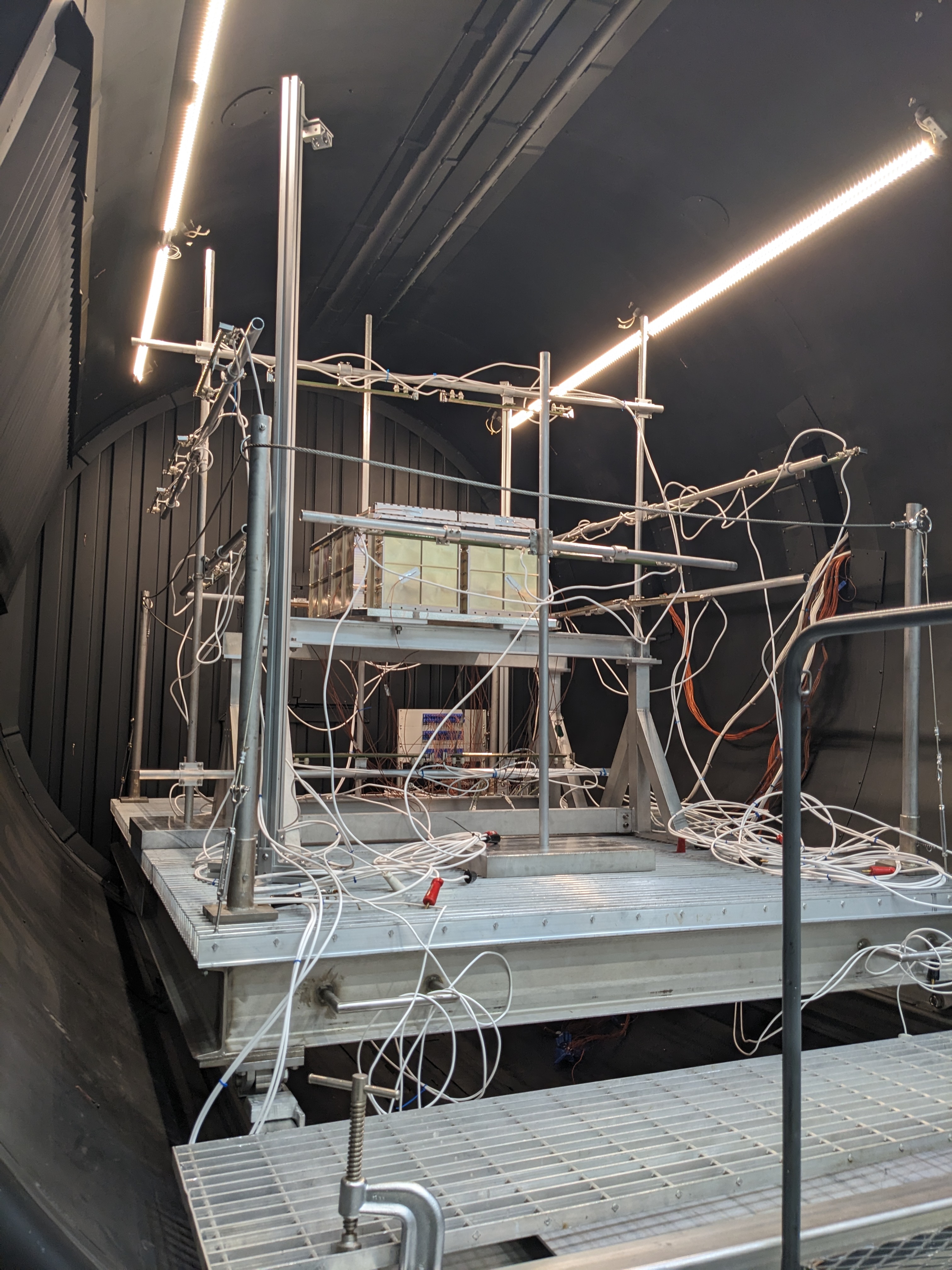
The team held StarBurst’s nonstop thermal testing in a vacuum chamber, 24 hours a day for 18 days. Technicians placed radioactive material into the vacuum chamber, giving StarBurst the ability to detect gamma-ray signals during the tests.

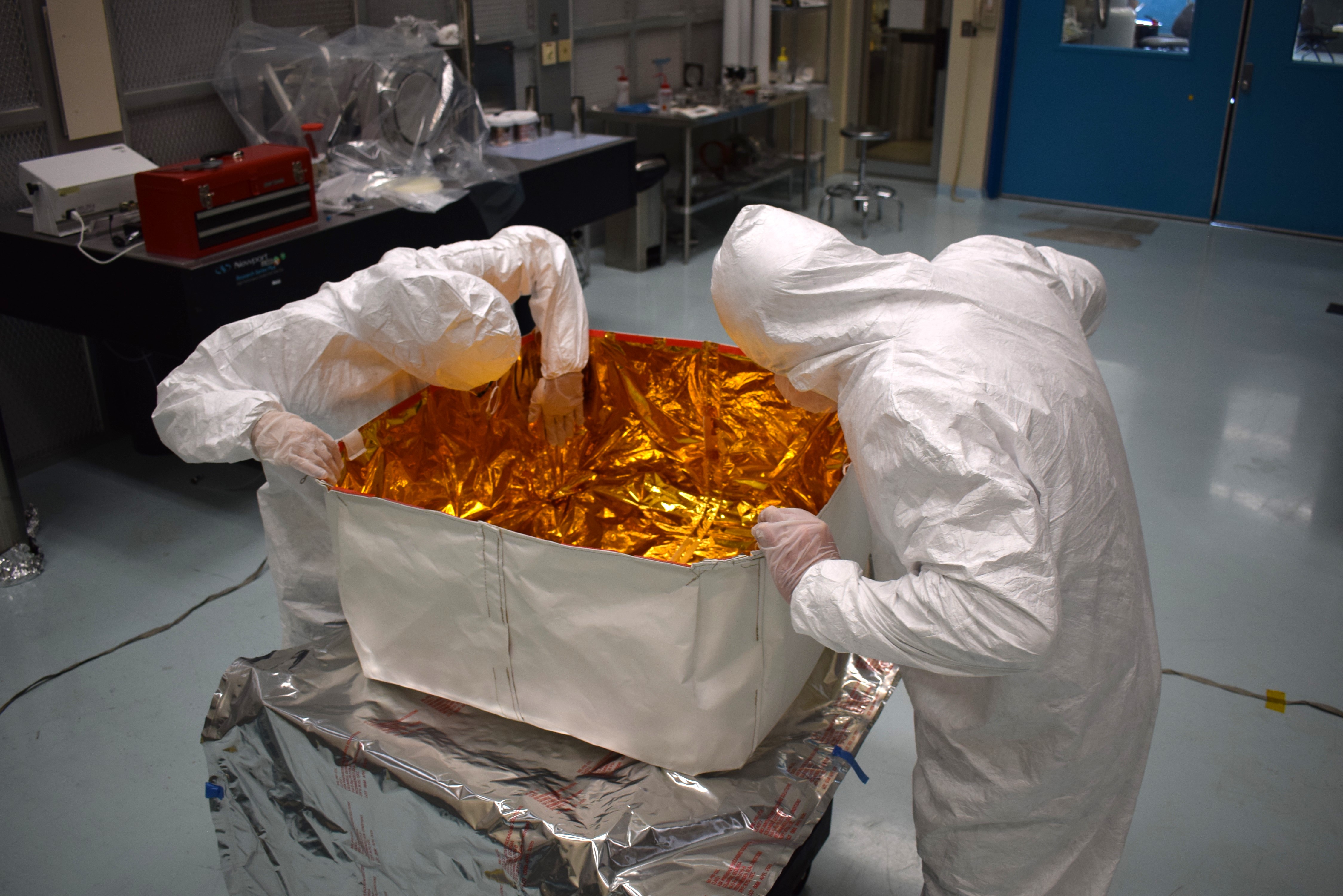
NASA Marshall test engineers fit test the multi-layer insulation blanket in early August at Marshall’s Stray Light Facility. The thermal blanket will insulate the crystal detector units.
NASA/Michael Allen

Test teams conducted thermal balance testing to simulate the hottest and coldest situations the instrument will operate under in space. Data from these tests improves thermal models used by NASA engineers, while also ensuring the satellite can handle these temperatures in orbit.

NASA engineers also completed a 24-hour “bake-out,” a process that removes unwanted gas or vapor from the instrument using extreme heat in a vacuum.

“NASA’s StarBurst mission is ready for its next stage of assembly and is one step closer to flight,” said Daniel Kocevski, principal investigator at NASA Marshall. “Testing at NASA Marshall has verified engineering models, adding our understanding of how StarBurst will operate in space as it observes gamma ray emission from merging neutron stars to help us better understand the building blocks of Earth—and the universe.”

Outside of the vacuum chamber, a “vibe test” bolted the instrument to a special “shaker table” to simulate the vibrations and turbulence StarBurst will experience during launch.

While at NASA Marshall, StarBurst underwent a series of tests in a vacuum chamber
NASA

The Marshall team shipped the StarBurst instrument to Space Flight Laboratory at the University of Toronto, which manufactured the spacecraft bus, in August.

Prior to shipment, teams at Marshall’s Stray Light Facility fit-tested the multi-layer insulation blanket needed to insulate the crystal detector units from the harsh space environment. StarBurst is equipped with 12 of these detectors, which serve as the main gamma-ray detection system on the spacecraft.

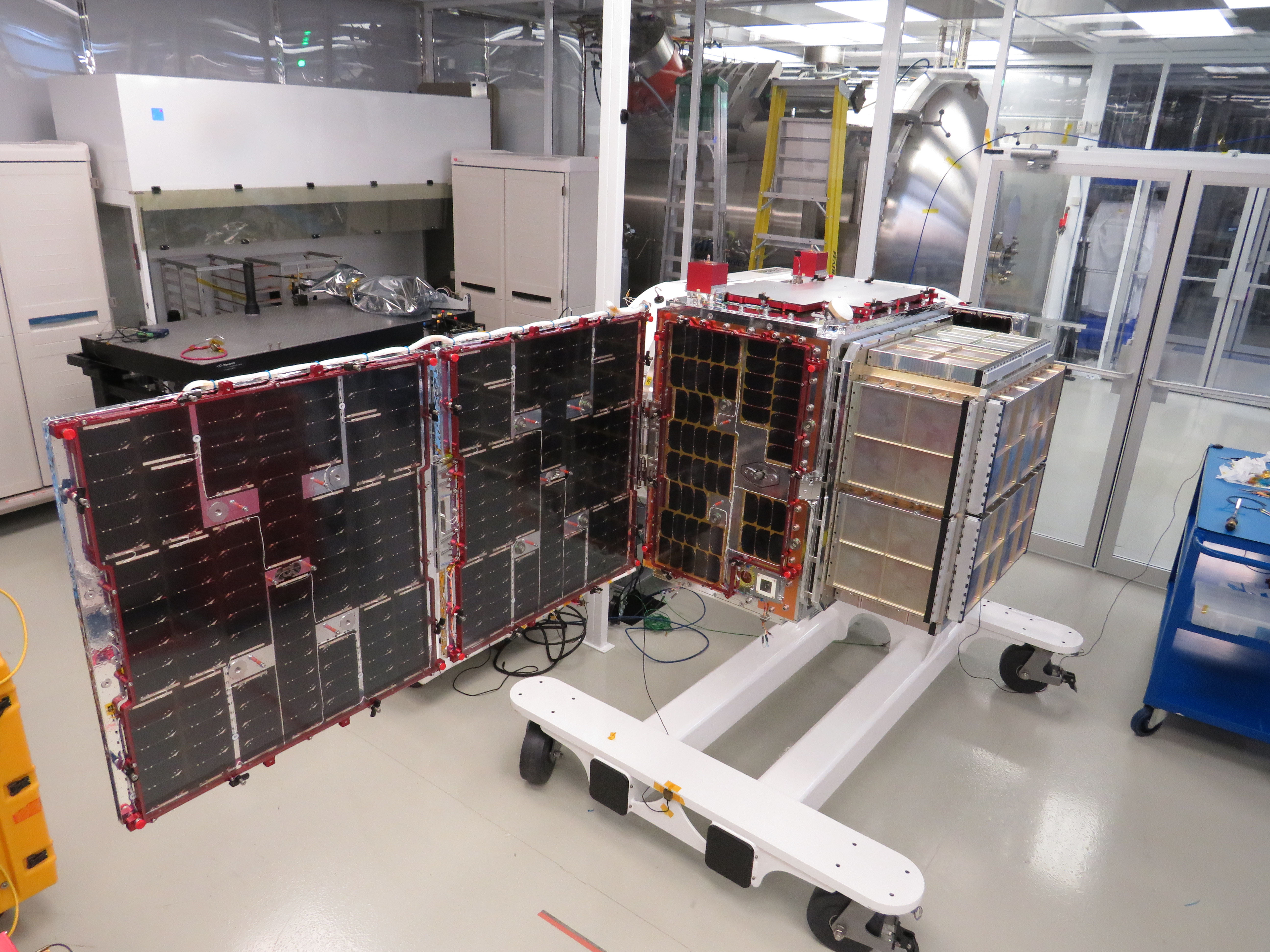
Marshall team members traveled to Toronto and were on hand to help integrate the instrument with the spacecraft bus in early September. Testing at Marshall set the stage for planned post-integration testing, which included functional testing and electromagnetic compatibility testing. StarBurst is scheduled to undergo additional calibration, vibration, and thermal vacuum testing in the spring.

Integration teams intend to have StarBurst launch-ready by June 2026. NASA plans to launch the satellite as early as 2027 during the next run of the Laser-Interferometer Gravitational Wave Observatory to maximize the chance of detecting gamma-ray bursts that coincide with gravitational wave events.  To date, such a joint gamma-ray and gravitational-wave detection has been observed only once.

StarBurst was successfully integrated with the spacecraft bus Marshall team members were on hand to help integrate the instrument with the spacecraft bus at the Space Flight Laboratory at the University of Toronto in early September.
NASA

StarBurst is a collaborative effort led by NASA’s Marshall Space Flight Center, with partnerships with the U.S. Naval Research Laboratory, the University of Alabama Huntsville, the Universities Space Research Association, and the University of Toronto Institute for Aerospace Studies Space Flight Laboratory. StarBurst was selected for development as part of the NASA Astrophysics Pioneers program, which supports lower-cost, smaller hardware missions to conduct compelling astrophysics science.

To learn more about StarBurst visit:

https://science.nasa.gov/mission/starburst/

Share

Details

Last Updated
Jan 09, 2026
Editor
Lee Mohon
Contact

25 Years in Orbit: Science, Innovation, and the Future of Exploration 

7 January 2026 at 16:05
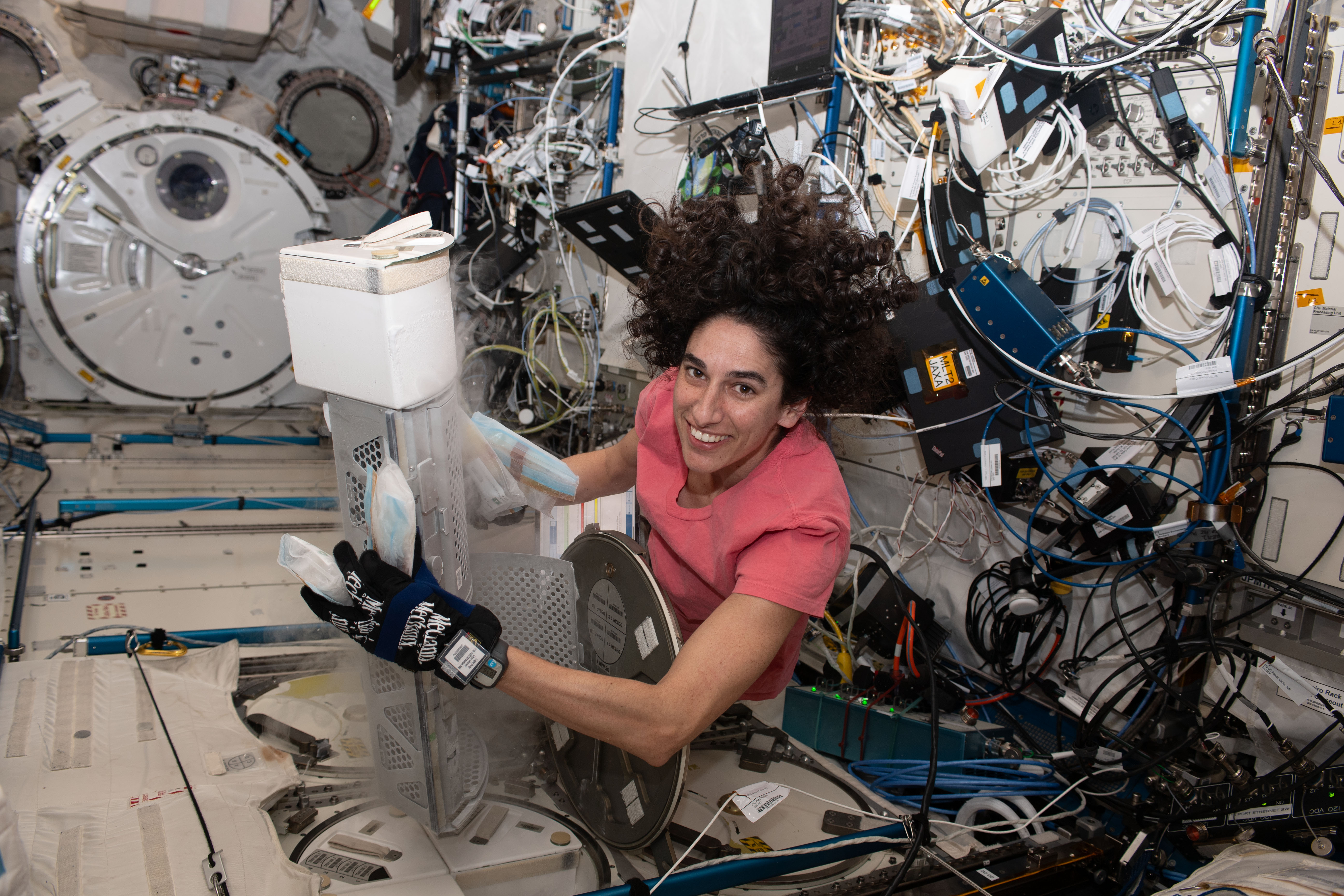
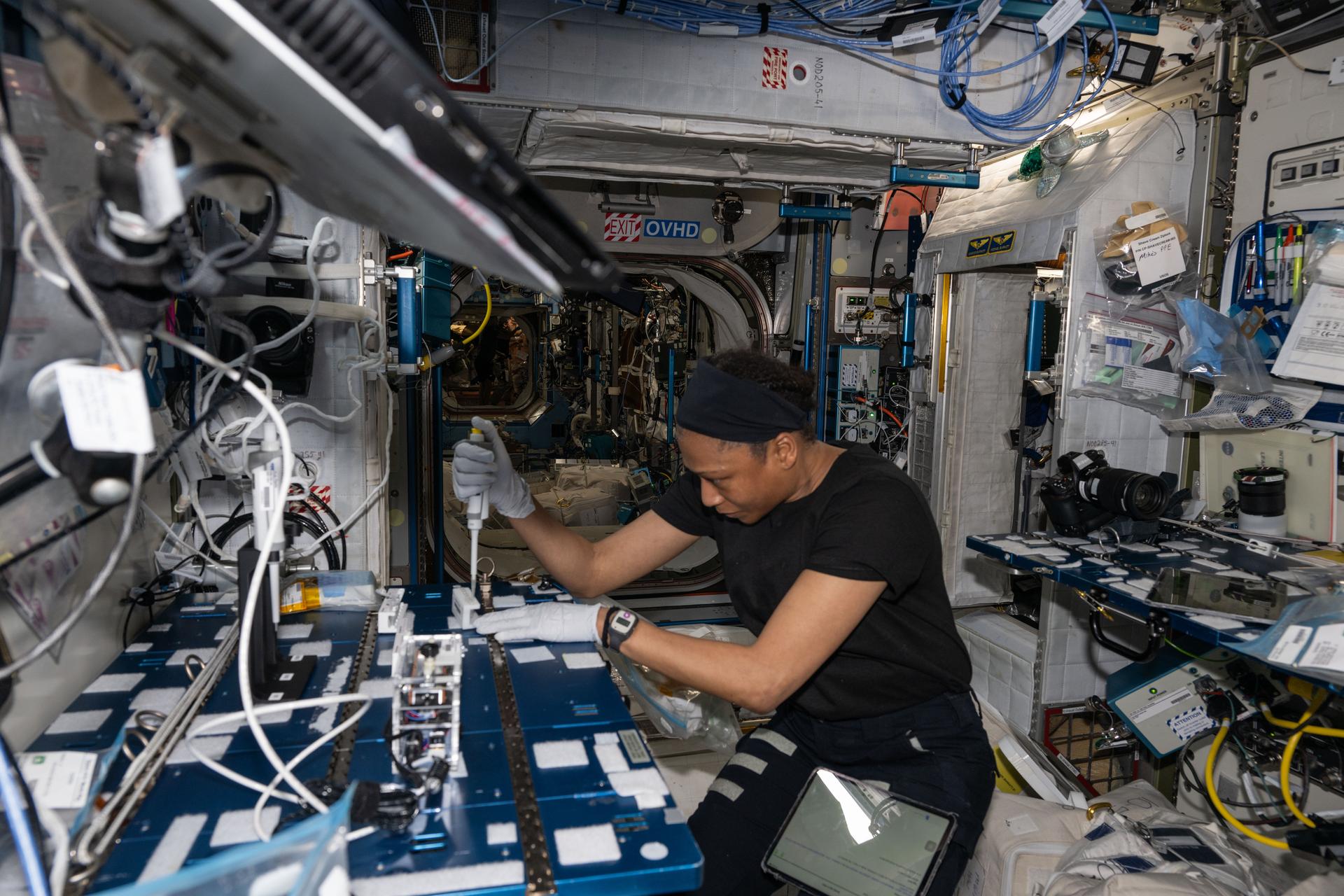
NASA astronaut Jasmin Moghbeli retrieves media bags inside the International Space Station’s Kibo laboratory module for Emory University’s Project EAGLE investigation.
NASA

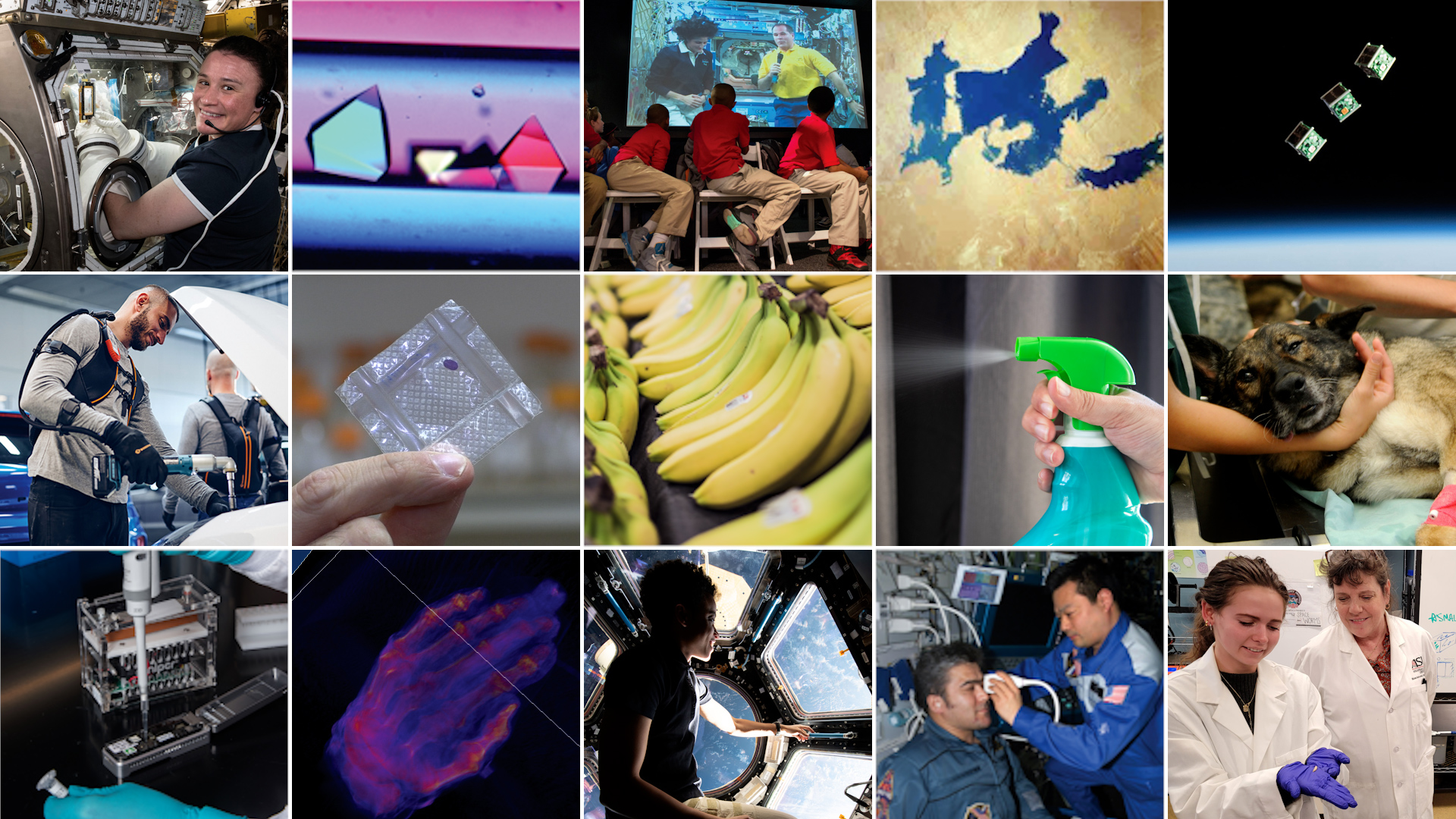
NASA and its partners have supported humans continuously living and working in space since November 2000. A truly global endeavor, the International Space Station has been visited by more than 290 people from 26 countries and a variety of international and commercial spacecraft. The unique microgravity laboratory has hosted more than 4,000 experiments from over 5,000 researchers from 110 countries. The space station also is facilitating the growth of a commercial market in low Earth orbit for research, technology development, and crew and cargo transportation. 

After a quarter of century of human presence in orbit, the station remains a symbol of international cooperation and a proving ground for humanity’s next giant leaps to the Moon and, eventually, Mars.  

September's full Moon, the Harvest Moon, is photographed from the International Space Station, perfectly placed in between exterior station hardware
September’s full Moon, the Harvest Moon, is photographed from the space station, placed in between exterior station hardware.
NASA

The microgravity environments aboard the space station unlocks discoveries that benefit life on Earth and prepare humans for deep space missions. NASA’s Human Research Program (HRP) works to understand the changes astronauts face aboard the orbital outpost and to develop interventions to keep crews healthy before, during, and after flight.  

Astronauts aboard the station exercise for roughly two hours a day to protect bone density, muscle strength, and the cardiovascular system, but the longer they are in microgravity, the harder it can be for the brain and body to readapt to gravity’s pull. After months in orbit, returning astronauts often describe Earth as heavy, loud, and strangely still. Some reacclimate within days, while other astronauts take longer to fully recover. 

Through HRP-led studies, scientists track these changes and test solutions—from improved exercise regimens to medical monitoring and nutritional strategies. The results inspire new medical technologies, while teaching scientists how the human body adapts to long-duration spaceflights—knowledge that helps keep astronauts healthy on future missions.

A woman runs on a treadmill in space.
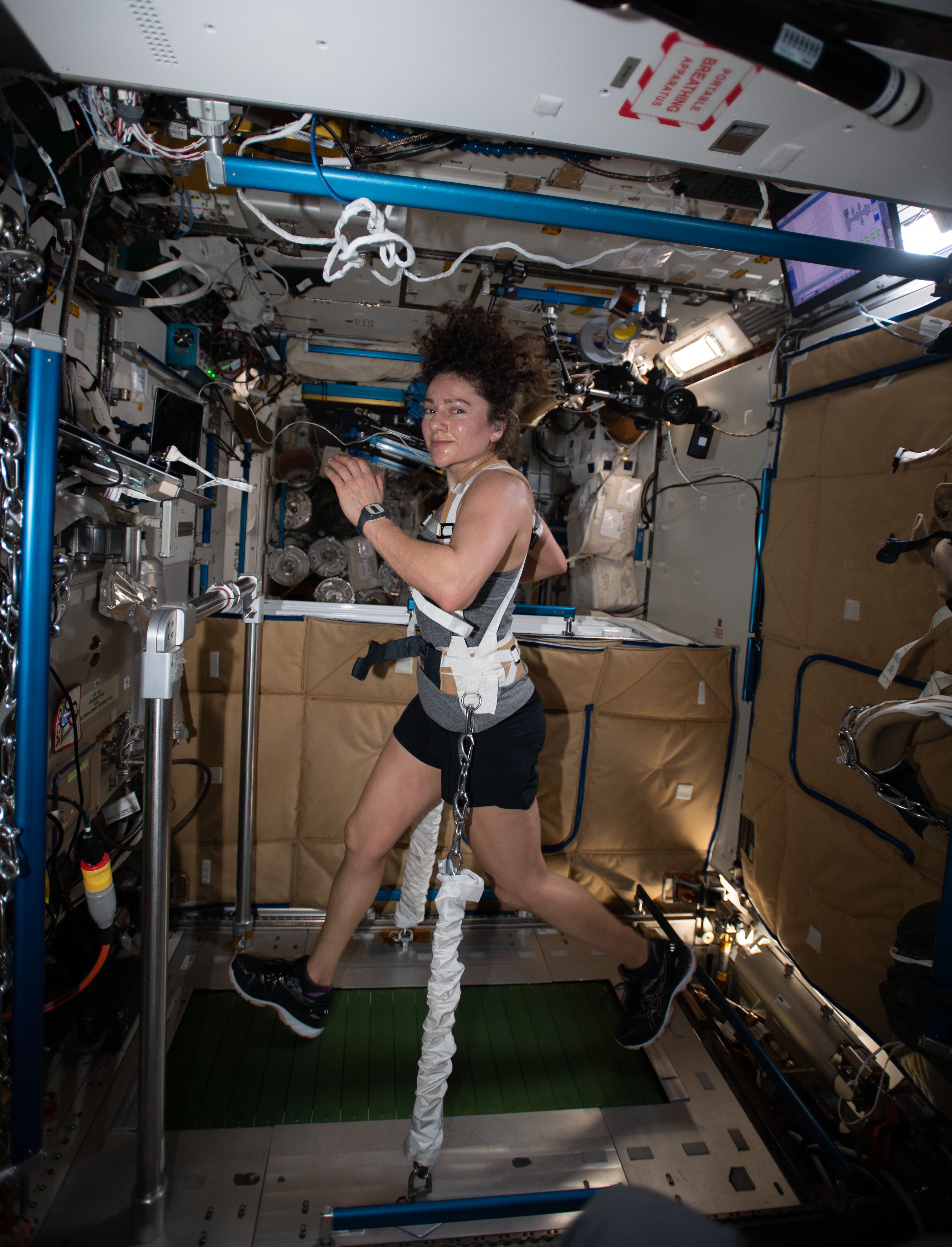
In the Tranquility node of the orbiting laboratory, NASA astronaut Jessica Meir exercises on the Combined Operational Load Bearing External Resistance Treadmill (COLBERT), technically named the Treadmill 2 and abbreviated as T2.
NASA

The space station continues to be a critical platform for sharpening skills, technology, and understanding that will prepare humanity to return to the Moon with NASA’s Artemis campaign and journey on to Mars and beyond. 

Since space presents an entirely new physical environment with a distinct set of challenges, the orbiting laboratory is uniquely positioned to support research and preparations not possible on Earth. That includes: 

  • Mastering techniques for basic tasks like drinking water, sleeping, exercising, and handling various materials.  
  • Developing solutions to microgravity-induced changes to and challenges for the human body. 
  • Testing reliable technologies and self-sustaining ecosystems necessary for deep space travel, from life support systems to in-orbit agriculture and 3D printing of materials. 
  • Refining techniques and procedures for data and imagery collection and analysis.  

Read more about how the space station has enabled significant strides in our journey farther into the final frontier. 

The first decade of the space station was the decade of construction. The second decade moved from initial studies to fully using the orbiting laboratory. Now we are in the decade of results. 

With nearly 25 years of experiments conducted aboard the station, more breakthroughs are materializing than ever before. These scientific discoveries and technological advancements are benefiting humanity on the ground, contributing to the growing low Earth orbit economy, and helping to prepare for future exploration of the Moon and Mars.  

Innovations include: 

  • Advances in X-ray technologies, developed to create a space station telescope, are helping unravel the mysteries of our universe while improving medical devices on Earth. 
  • Temperature-change data that has been employed in efforts to reduce heat absorbed by city surfaces, reduce fire risk, and help farmers efficiently water their fields. 
  • Demonstrations of robotic technologies with the potential to relieve repetitive movement and other workplace-related stressors. 
  • Development of a small ultrasound unit for crew health monitoring that has since been adapted to provide diagnostic care in remote areas on Earth. 

Find more information about the space station’s benefits for humanity here

Supernova Remnant Video From NASA’s Chandra Is Decades in Making

By: Lee Mohon
6 January 2026 at 16:30
A new video shows changes in Kepler’s Supernova Remnant using data from NASA’s Chandra X-ray Observatory captured over more than two and a half decades with observations taken in 2000, 2004, 2006, 2014, and 2025. In this video, which is the longest-spanning one ever released by Chandra, X-rays (blue) from the telescope have been combined with an optical image (red, green, and blue) from Pan-STARRS.
X-ray: NASA/CXC/SAO; Optical: Pan-STARRS

A new video shows the evolution of Kepler’s Supernova Remnant using data from NASA’s Chandra X-ray Observatory captured over more than two and a half decades.

Kepler’s Supernova Remnant, named after the German astronomer Johannes Kepler, was first spotted in the night sky in 1604. Today, astronomers know that a white dwarf star exploded when it exceeded a critical mass, after pulling material from a companion star, or merging with another white dwarf. This kind of supernova is known as a Type Ia, and scientists use it to measure the expansion of the universe.

Supernova remnants, the debris fields left behind after a stellar explosion, often glow strongly in X-ray light because the material has been heated to millions of degrees from the blast. The remnant is located in our galaxy, about 17,000 light-years from Earth, allowing Chandra to make detailed  images of the debris and how it changes with time. This latest video includes its X-ray data from 2000, 2004, 2006, 2014, and 2025. This makes it the longest-spanning video that Chandra has ever released, enabled by Chandra’s longevity.

“The plot of Kepler’s story is just now beginning to unfold,” said Jessye Gassel, a graduate student at George Mason University in Virginia, who led the work. “It’s remarkable that we can watch as these remains from this shattered star crash into material already thrown out into space.” Gassel presented the new Chandra video and the associated research at the 247th meeting of the American Astronomical Society in Phoenix.

The researchers used the video to show that the fastest parts of the remnant are traveling at about 13.8 million miles per hour (2% of the speed of light), moving toward the bottom of the image. Meanwhile, the slowest parts are traveling toward the top at about 4 million miles per hour (0.5% of the speed of light). This large difference in speed is because the gas that the remnant is plowing into toward the top of the image is denser than the gas toward the bottom. This gives scientists information about the environments into which this star exploded.

“Supernova explosions and the elements they hurl into space are the lifeblood of new stars and planets,” said Brian Williams of NASA’s Goddard Space Flight Center in Greenbelt, Maryland, and principal investigator of the new Chandra observations of Kepler. “Understanding exactly how they behave is crucial to knowing our cosmic history.”

The team also examined the widths of the rims forming the blast wave of the explosion. The blast wave is the leading edge of the explosion and the first to encounter material outside of the star. By measuring how wide it is and how fast it is traveling, astronomers glean more information about both the explosion of the star and its surroundings.

NASA’s Marshall Space Flight Center in Huntsville, Alabama, manages the Chandra program. The Smithsonian Astrophysical Observatory’s Chandra X-ray Center controls science operations from Cambridge, Massachusetts, and flight operations from Burlington, Massachusetts.

To learn more about Chandra, visit:

https://science.nasa.gov/chandra

Read more from NASA’s Chandra X-ray Observatory

Learn more about the Chandra X-ray Observatory and its mission here:

https://www.nasa.gov/chandra

https://chandra.si.edu

Visual Description

This release features a ten second silent video of Kepler’s expanding Supernova Remnant, located in our own galaxy, about 17,000 light-years from Earth. The video was created using X-ray data gathered in 2000, 2004, 2006, 2014, and 2025. Those distinct datasets were turned into highly-detailed visuals, creating a 25-year timelapse-style video of the growing remnant.

Kepler’s Supernova Remnant was once a white dwarf star that exploded when it exceeded its critical mass. Here, in X-ray light, the remnant resembles a cloudy neon blue ring with a diagonal cross line stretching from our upper right down to our lower left. The ring appears thinner and wispier at the bottom, with a band of white arching across the top.

As the video plays, cycling through the 5 datasets, the ring subtly, but clearly, expands, like a slowly inflating balloon. In the video, this sequence is replayed several times with dates included at our lower right, to give sighted learners time to absorb the visual information. Upon close inspection, researchers have determined that the bottom of the remnant is expanding fastest; about 13.8 million miles per hour, or 2% of the speed of light. The top of the ring appears to be expanding the slowest; about 4 million miles per hour, or 0.5% of the speed of light. The large difference in speed is because the gas that the remnant is plowing into towards the top of the image is denser than the gas towards the bottom.

Collecting and interpreting this data over decades has provided information about the environment into which the white dwarf star exploded, and has helped scientists understand how remnants change with time.

Share

Details

Last Updated
Jan 06, 2026
Editor
Lee Mohon
Contact
Joel Wallace

NIH wants 1 million Americans for a study — but first must close critical data security gaps

31 December 2025 at 16:33

Interview transcript:

Terry Gerton You are doing important work, and I want to talk about this program specifically, the All of Us Research Program at NIH. Tell us what that’s all about.

Charles Summers NIH has the goal of enrolling a million-plus Americans into a research program that is based around genetics and precision medicine. So it’s really the future of medicine, really where things are headed. Instead of treating you based on age or race or any of those things, they would treat you based on genetics. So, if this medicine is specifically for you, it would help you better than just a guess that we get on some things. That’s the overall goal of what NIH wants to do with this research data and research outputs.

Terry Gerton A million people, that’s a lot of folks. And genetic information is pretty personal. What is going on in terms of being able to protect participant data?

Charles Summers For us at the OIG, definitely that’s one of our highest and most important things, protecting the data and securing the data and just lending a hand as far as oversight in pointing where there are places to make improvements or recommendations to improve and secure data to requirements that are out there, as well as if we see something that just doesn’t seem right. So that’s our main goal is to protect that data, because it’s not just their data. It’s our data and it’s our parents’ data and its American data.

Terry Gerton What prompted you then to look at the data protection processes in this research program? Was there a red flag or something that happened?

Charles Summers We’ve done work at NIH since I’ve been working here. We go through risks and things like that, so the All of Us program with genomic data, the Office and National Council has said that this is a national security concern. At NIH we’ve done some work here in the past with the All of Us program, so we checked up on some of those findings. There’s also persistent cybersecurity and national security threats that have increased in challenges across the board, as far as technology goes and those vectors that NIH must lock down to protect this data. So all of those combined, it’s critical operations and programs that we feel are everybody’s concern, as well as partnering with HHS as far as how we’re going to protect the program as a whole.

Terry Gerton It seems like if you’re going to get a million people to volunteer, one of the core guarantees is that their data be protected. What did you find as you got into the audit?

Charles Summers Absolutely, and I do want to emphasize what you said. It is core to the program because if you lose that trust, less people are going to join. Currently, NIH says they have over 600,000 participants already in the program enrolled. The goal is a million, but that’s where they are currently, over 600,000 already enrolled. Some of the key cybersecurity gaps that we found there were inadequate access controls allowed access of the systems from abroad, which was employees. It’s not just somebody trying to get access, but the employees could access that data from abroad. We also found that the system permitted the research participants to download data, even though policies and procedures restricted that and did not allow for that. In both of those access controls, we like to say it’s kind of like there was warning banners that pop up to say, “hey, you can’t do this.” It’s kind of like a door with a scary sign on it that says, “hey, don’t go in here.” But the door is unlocked and you can go through it. So you could close those and go ahead and access this data and download some of this data. And that’s not what we normally would see. We would want to block it, and if there was a need for it, then you would go through the proper procedures to get it, to open those for you. And then the last two things that we found was NIH had failed to inform the Data Research Center, which was the awardee of this that the data for them, they didn’t inform them of the national security concerns around genomic data. So when that Data Research Center awardee is setting up the system and going through checks and balances on security controls, they set it to a certain level based on risk in which they do the risk assessments. But NIH didn’t give them that key piece of information which could have changed the level that maybe that security should be; actually maybe it should be up another notch. So that wasn’t factored in when they were doing risk assessments. Lastly, we found that the Data Research Center was not remediating findings that they find themselves as well as something that may come up from an audit, or something like that, in the time requirements that align with the federal requirements and that were in the contract. So they had some different timeframes … in the system security plan, so those were in opposition of what they had already agreed to as far as the contract.

Terry Gerton You mentioned as you walked through those findings that the genomic database is managed by a contractor, DRC. Is that a normal thing for these kinds of research projects and what does that say to you about the need for better oversight between HHS, NIH and the contractor?

Charles Summers NIH does have the responsibility for oversight for all their contractors, and that is very typical for this type of program in all of these large op-divs. Throughout HHS we leverage contractors and grantees and things like that. The need for so much expertise in these areas, a lot of times that is where you have to go to get that much expertise because you’re needing large numbers of people. So it is very much NIH’s responsibility to have that in the contracts as well as the oversight to ensure that the proper security levels are being maintained. And I think that’s noted in some of the findings. For instance, the finding of not providing them the information that genomic data is of national security concerns — so that would factor into the risk assessment, which is part of the agreement for the DRC to complete. Without that complete information, things may be not at the correct level. Definitely the burden is on NIH for that oversight and ensuring that is taking place.

Terry Gerton So, you made five recommendations in this report. Are any of them, do you think, particularly urgent, and what are you hoping to see NIH do quickly to respond?

Charles Summers We don’t normally rank these findings, but our access controls tend to drift to the top because that is the gate to getting access in the system and restricting access to people you don’t want in the systems. For instance, the first recommendation was to enforce the restrictions for remote users. Very important to us as we have certain countries of concern … so we want to ensure if people are there, we’re using proper security and you have proper approvals. That was one of one of our findings as well. Also blocking unauthorized downloads of data. So both of those around access control, very high, as well as remitting findings timely, because those are weaknesses that you know are there. Timeframes to remediate those, you want them to be as short as possible to close those windows of known vulnerabilities that adversaries may use to try to gain access to the system. NIH did reply to us and respond, very acceptable and concurred with those findings as we describe it. And they have already taken some actions on all these findings, and part of our tracking system is where they’re at, and we have timeframes and they report, here’s where we’re at, here’s what we’re going to do next. That goes back and forth until the completion so we ensure that those are completed.

The post NIH wants 1 million Americans for a study — but first must close critical data security gaps first appeared on Federal News Network.

© The Associated Press

FILE - In this file photo released by China's Xinhua News Agency, staff members work in an inflatable COVID-19 testing lab provided by Chinese biotech company BGI Genomics, a subsidiary of BGI Group, in Beijing, June 23, 2020. (Chen Zhonghao/Xinhua via AP, File)

VA in 2026 looks to get EHR rollout back on track, embark on health care reorganization

24 December 2025 at 15:18

The Department of Veterans Affairs is embarking on major changes next year. It’s looking to get the rocky rollout of a new Electronic Health Record back on track. VA medical facilities already using the system have been beset with problems for years.

Meanwhile, the VA is planning to roll out the biggest reorganization of its health care operations in decades. Here’s a look ahead at VA’s plans for 2026.

VA EHR next steps

VA is planning for its new EHR from Oracle-Cerner to go live at 13 sites in 2026 — starting with four sites in Michigan in April 2026.

Dr. Neil Evans, acting program executive director of VA’s Electronic Health Record Modernization Integration Office, told the technology modernization subcommittee of the House VA Committee that, based on lessons learned from previous go-lives, multiple sites will go live “simultaneously in each deployment wave.”

“This approach allows us to scale up the number of deployments, enhance efficiencies and improve the sharing of best practices within and between markets,” Evans said in a Dec. 15 hearing.

Carol Harris, the director of IT and cybersecurity issues at the Government Accountability Office, told lawmakers it would be “very risky” for VA to plan for simultaneous EHR go-lives.

“It’s going to take a tremendous amount of resources that I’m not quite sure is sustainable for multiple sites at once,” Harris said.

Status of EHR rollout so far

VA’s new EHR is currently running at six sites. Full deployment would bring the EHR to 170 sites. According to Evans, the department currently expects to complete the deployment as soon as 2031.

The VA has been in a “reset” period since April 2023, and paused new go lives until the department addresses persistent outages and usability issues reported by VA medical staff at sites already using the new EHR.

A GAO report in March found that only 13% of VA staff using the new Oracle-Cerner EHR believed that the modernized system made VA as efficient as possible, and 58% of users believed the new system increased patient safety risks.

Rep. Tom Barrett (R-Mich.), chairman of the technology modernization subcommittee, said the project’s lifecycle cost has grown to about $37 billion.

“This timeline is locked in, and the countdown is on. But the question remains: When the switch is flipped in April, will the system deliver, and will it do what we need it to do? Are we going to run into snags like we have in the past? For millions of veterans relying on VA hospitals and staff supporting them, this is not something that is theoretical. It’s real. It’s happening and we have to do it right,” Barrett said.

Subcommittee ranking member Nikki Budzinski (D-Ill.) said what she has heard from VA and Oracle this year “has not convinced me that VA is ready for launch at 13 facilities in 2026.”

“I have raised many questions with VA and Oracle. But the answers do not give me confidence. In fact, I worry that we are spending billions of dollars while simultaneously setting this program, particularly the six sites that are already live, up for failure,” Budzinski said.

Reaction from the Senate

Senate Democrats are also wary about VA’s EHR rollout plans. In a letter to VA Secretary Doug Collins, Sens. Patty Murray (D-Wash.), Richard Blumenthal (D-Conn.) and Elissa Slotkin (D-Mich.) said they have “serious concerns” that EHR problems flagged by GAO and the VA inspector general’s office have not been fully addressed

“While we should always strive to innovate and improve the quality of care for veterans, in practice, the rollout of EHRM has been so problematic that it created life-threatening problems and ongoing upheaval for veterans’ ability to get the health care they need,” they wrote.

New VHA leader & VA reorganization plans

Last week, the Senate confirmed John Bartrum, a former senior advisor to Collins, will serve as VA’s under secretary for health.

Bartrum, a combat veteran with more than 40 years of active-duty and reserve military service, previously oversaw policy and funding at the National Institutes of Health and the Centers for Disease Control and Prevention.

The VA earlier this week announced its intent to reorganize the Veterans Health Administration.

Collins said in a statement that VHA’s current leadership structure “is riddled with redundancies that slow decision making, sow confusion and create competing priorities.”

VA says the changes aren’t expected to result in a significant change in overall staffing levels. But the Washington Post first reported that the VA no longer plans to fill tens of thousands of vacant health care positions.

The VA says it’s briefed lawmakers on the reorganization, and that implementation will take place over the next 18-24 months.

Rather than pursue a reduction in force of more than 80,000 employees, as it had considered earlier this year, the VA shed more than 30,000 positions through attrition in fiscal 2025.

“The department’s history shows that adding more employees to the system doesn’t automatically equal better results,” Collins told lawmakers in May.

The post VA in 2026 looks to get EHR rollout back on track, embark on health care reorganization first appeared on Federal News Network.

© AP Photo/Charles Dharapak

FILE - This June 21, 2013, file photo, shows the seal affixed to the front of the Department of Veterans Affairs building in Washington. In a federal lawsuit filed this week, U.S. Navy veteran from South Carolina says he ended up with “full-blown AIDS,” because government health care workers never informed him of his positive test result in 1995. He says the test was done as part of standard lab tests at a U.S. Department of Veterans Affairs medical center in Columbia, South Carolina. A V.A. spokeswoman says the agency typically does not comment on pending litigation. (AP Photo/Charles Dharapak, File)

Meet NASA’s Astronaut Class of 2025 – Webby Submission

19 December 2025 at 17:01
1 Min Read

Meet NASA’s Astronaut Class of 2025 – Webby Submission

A man in a blue flight suit takes a selfie with a group and the NASA worm insignia in the background.
NASA’s astronaut candidate class pose for a selfie during their first week at Johnson Space Center.

About the Author

Kelcie Nicole Howren

Kelcie Nicole Howren

Share

Details

Last Updated
Dec 22, 2025

Related Terms

Keep Exploring

Discover More Topics From NASA

Moon Mascot: NASA Artemis II ZGI Design Challenge

18 December 2025 at 16:52

4 min read

Preparations for Next Moonwalk Simulations Underway (and Underwater)

A graphic for the Moon Mascot: NASA Artemis II ZGI Design Challenge.
Freelancer

Whose Moon Mascot design will join the Artemis II astronauts on their historic voyage around the Moon in early 2026?

Between March 7 and Jun. 16, 2025, NASA worked with crowdsourcing company Freelancer to seek design ideas from global creators for a zero gravity indicator that will fly aboard the agency’s Artemis II test flight.

Zero gravity indicators are small, plush items carried aboard spacecraft to provide a visual indication of when the spacecraft and its crew reach space.

For the first eight minutes after liftoff, the crew and their indicator nearby will still be pushed into their seats by gravity, and the force of the climb into space. When the main engines of the SLS (Space Launch System) rocket’s core stage cut off, gravity’s restraints are lifted, but the crew will still be strapped safely into their seats – their zero gravity indicator’s ability to float will provide proof that they’ve made it into space.

Artemis II marks the first time that the public has had a hand in creating a crew’s mascot.

The Mission

Over the course of about ten days, four astronauts will travel approximately 685,000 miles from Earth, venture around the Moon, and return home. The flight will—for the first time with astronauts—test NASA’s human deep space exploration capabilities, including the agency’s Exploration Ground Systems, SLS (Space Launch System) rocket, and Orion spacecraft. 

NASA has a long history of flying zero gravity indicators for human spaceflight missions. Many missions to the International Space Station include a plush item. A plush Snoopy rode inside Orion during NASA’s uncrewed Artemis I mission.

 NASA astronauts Reid Wiseman, Victor Glover, and Christina Koch, and CSA (Canadian Space Agency) astronaut Jeremy Hansen will venture around the Moon and back. The mission is the first crewed flight under NASA’s Artemis campaign and is another step toward missions on the lunar surface and helping the agency prepare for future human missions to Mars.

The Contest

The Artemis II astronauts attended SXSW 2025 on March 7, 2025, and sat on a panel to discuss their upcoming mission around the Moon and answer questions from the audience. During the panel, commander Reid Wiseman showed the audience his zero gravity indicator from his Expedition 40 mission to the International Space Station. His zero gravity indicator was a toy giraffe named Giraffiti. Wiseman’s mother gifted Giraffiti to his oldest daughter when she was born. When Wiseman embarked on his first mission to space, his kids gave him Giraffiti to take with him to space.

“This little guy spent every day with me in my crew quarters,” said Wiseman. “It was a connection back home to my kids.”

June 4, 2014
NASA Astronaut Reid Wiseman photographed in front of the Cupola windows during his Expedition 40 mission with his zero gravity indicator, Giraffiti.
NASA
March 7, 2025
NASA astronaut Reid Wiseman shows the zero gravity indicator, “Giraffiti” used during his launch to the International Space Station as he and fellow Artemis II astronauts announce that NASA is seeking design ideas from global creators for a zero gravity indicator that will fly aboard the agency’s Artemis II test flight, Friday, March 7, 2025, at SXSW in Austin, Texas.
NASA/Bill Ingalls
March 7, 2025
NASA astronaut Reid Wiseman shows the zero gravity indicator, “Giraffiti” used during his launch to the International Space Station as he and fellow Artemis II astronauts announce that NASA is seeking design ideas from global creators for a zero gravity indicator that will fly aboard the agency’s Artemis II test flight, Friday, March 7, 2025, at SXSW in Austin, Texas.
NASA/Bill Ingalls

Then, Wiseman and the other crew members revealed that they were opening up the opportunities to people of all ages from all over the world to design the zero gravity indicator for the Artemis II mission around the Moon.

What better way to fly a mission around the Moon than to invite the public inside NASA’s Orion spacecraft with us and ask for help in designing our zero gravity indicator?

Reid Wiseman

Reid Wiseman

NASA Astronaut and Commander of the Artemis II Mission

The Moon Mascot contest was hosted by the freelancing and crowdsourcing company Freelancer on behalf of the agency through the NASA Tournament Lab. The contest lasted about three months and received thousands of submissions from over 50 countries. Over the course of the contest, the agency hosted a Twitch stream on NASA’s Twitch channel to discuss zero gravity indicators and practice creating a design with a live artist. Adobe also released an Adobe Express template to help participants with their designs.

An Adobe Express template for the Moon Mascot competition.
Adobe

The Finalists

On Aug. 22, NASA and Freelancer announced the 25 finalists of the contest. These designs – ideas spanning from Moon-related twists on Earthly creatures to creative visions of exploration and discovery – were selected from more than 2,600 submissions from over 50 countries, including from K-12 students. The finalists represent 10 countries including the United States, Canada, Colombia, Finland, France, Germany, Japan, Peru, Singapore, and Wales.

Lucas Ye | Mountain View, California
“Rise”
Kenan Ziyan | Canyon, Texas
“Zappy Zebra”
Royal School, SKIES Space Club | Winnipeg, Manitoba, Canada
“Luna the Space Polar Bear”
Garden County Schools | Oshkosh, Nebraska
“Team GarCo”
Richellea Quinn Wijaya | Singapore
“Parsec – The Bird That Flew to the Moon”
Anzhelika Iudakova | Finland
“Big Steps of Little Octopus”
Congressional School | Falls Church, Virginia
“Astra-Jelly”
Congressional School | Falls Church, Virginia
“Harper, Chloe, and Mateo’s ZGI”
Alexa Pacholyk | Madison, Connecticut
“Artemis”
Leila Fleury | Rancho Palos Verdes, California
“Beeatrice”
Oakville Trafalgar School | Oakville, Ontario, Canada
“Lepus the Moon Rabbit”
Avon High School | Avon, Connecticut
“Sal the Salmon”
Daniela Colina | Lima, Peru
“Corey the Explorer”
Caroline Goyer-Desrosiers | St. Eustache, Quebec, Canada
“Flying Squirrel Ready for Its Take Off to Space!”
Giulia Bona | Berlin, Germany
“Art & the Giant”
Tabitha Ramsey | Frederick, Maryland
“Lunar Crust-acean”
Gabriela Hadas | Plano, Texas
“Celestial Griffin”
Savon Blanchard | Pearland, Texas
“Soluna Flier”
Ayako Moriyama | Kyoto, Japan
“MORU: A Cloud Aglow with Moonlight and Hope”
Johanna Beck | McPherson, Kansas
“Creation Mythos”
Guillaume Truong | Toulouse, France
“Space Mola-mola (aka Moon Fish) Plushie”
Arianna Robins | Rockledge, Florida
“Terra the Titanosaurus”
Sandy Moya | Madrid, Colombia
“MISI: Guardian of the Journey”
Bekah Crowmer | Mooresville, Indiana
“Mona the Moon Moth”
Courtney John | Llanelli, Wales
“Past, Present, Future”

The Winner

Once the crew has selected a final design, NASA’s Thermal Blanket Lab will fabricate it for flight. The indicator will be tethered inside the Orion spacecraft before launch.

The winner of the contest and the design that will accompany the astronauts on their historic mission will be unveiled closer to launch. Launch is currently targeted for early next year, with launch opportunities as soon as February 2026.

About the Author

Thalia K. Patrinos

Thalia K. Patrinos

Share

Details

Last Updated
Dec 18, 2025

Related Terms

Keep Exploring

Discover More Topics From NASA

💾

Have you ever wanted to design something that could fly around the Moon? This is your opportunity. The Artemis II astronauts will use a zero gravity indicato...

2025 in Review: Highlights from NASA in Silicon Valley 

18 December 2025 at 11:20

NASA’s Ames Research Center in California’s Silicon Valley continued to make strides in research, technology, engineering, science, and innovation this past year. Join us as we take a look back at some of the highlights from 2025.

From Supercomputers to Wind Tunnels: NASA’s Road to Artemis II

This video shows two simulations of the SLS (Space Launch System) rocket using NASA’s Launch Ascent and Vehicle Aerodynamics solver. For the Artemis II test flight, a pair of six-foot-long strakes will be added to the core stage of SLS that will smooth vibrations induced by airflow during ascent. The top simulation is without strakes while the bottom shows the airflow with strakes. The green and yellow colors on the rocket’s surface show how the airflow scrapes against the rocket’s skin. The white and gray areas show changes in air density between the boosters and core stage, with the brightest regions marking shock waves. The strakes reduce vibrations and improves the safety of the integrated vehicle.
NASA/NAS/Gerrit-Daniel Stich, Michael Barad, Timothy Sandstrom, Derek Dalle

By combining the technologies of the NASA Advanced Supercomputing facility and Unitary Plan Wind Tunnel at NASA Ames, researchers were able to simulate and model an adjustment to the Space Launch System (SLS) rocket that could improve airflow and stability to the vehicle during the launch of Artemis II. The collaborative effort between researchers is the next step on NASA’s journey to send astronauts to explore the Moon for scientific discovery, economic benefits, and build the foundation for the first crewed missions to Mars.

New Discoveries in Early Solar System Samples

A microscopic particle of asteroid Bennu, brought to Earth by NASA’s OSIRIS-REx mission, is manipulated under a transmission electron microscope. In order to move the fragment for further analysis, researchers first reinforced it with thin strips of platinum (the “L” shape on the particle’s surface) then welded a tungsten microneedle to it. The asteroid fragment measures 30 micrometers (about one-one thousandth of an inch) across.
NASA

Researchers at NASA Ames discovered a never-before-seen “gum-like” material in pristine asteroid samples delivered to Earth by NASA’s OSIRIS-REx (Origins, Spectral Interpretation, Resource Identification, and Security-Regolith Explorer) spacecraft. The surprising substance was likely formed in the early days of the solar system, as Bennu’s young parent asteroid warmed. Such complex molecules could have provided some of the chemical precursors that helped trigger life on Earth, and finding them in the pristine samples from Bennu is important for scientists studying how life began and whether it exists beyond our planet.

VIPER Gets a Ride to the Moon’s South Pole

This artist’s concept shows Blue Origin’s Blue Moon Mark 1 lander and NASA’s VIPER (Volatiles Investigating Polar Exploration Rover) on the lunar surface.
Credit: Courtesy of Blue Origin

NASA’s VIPER (Volatiles Investigating Polar Exploration Rover) will search for volatile resources, such as ice, on the lunar surface and collect science data to support future exploration at the Moon and Mars. As part of the agency’s Artemis campaign, NASA awarded Blue Origin of Kent, Washington, a Commercial Lunar Payload Services task order with an option to deliver a rover to the Moon’s South Pole region. With this new award, Blue Origin will deliver VIPER to the lunar surface in late 2027.

Taking to the Skies to Test Remote Wildfire Response

NASA Ames drone team tests the information sharing, airspace management, communication relay, and aircraft deconfliction capabilities of the x-altas drone as it communicates through the Advanced Capabilities for Emergency Response Operations (ACERO) Portable Airspace Management System (PAMS) in Salinas, California in March 2025. This was a part of the project’s first flight demonstration.
NASA/Brandon Torres Navarrete

NASA researchers are advancing airborne systems that can fight and monitor wildfires 24 hours a day, even during low-visibility conditions. NASA’s Advanced Capabilities for Emergency Response Operations (ACERO) conducted field tests of remotely piloted aircraft for monitoring, suppression, and logistics support in wildland fire situations. The ACERO team was able to safely conduct flight operations of a vertical takeoff and landing aircraft operated by Overwatch Aero, LLC, of Solvang, California, and two small NASA drones.

NASA Installs Heat Shield on First Private Spacecraft Bound for Venus

Engineers at NASA’s Ames Research Center in California’s Silicon Valley, Eli Hiss, left, and Bohdan Wesely complete a fit check of the two halves of a space capsule that will study the clouds of Venus for signs of life. Led by Rocket Lab of Long Beach, California, it will be the first private mission to the planet.
NASA/Brandon Torres Navarrete

NASA helps the commercial space endeavor succeed by providing expertise in thermal protection of small spacecraft. NASA Ames teams work with private companies to turn NASA materials into solutions, such as the heat shield tailor-made for a spacecraft destined for Venus, supporting growth of the new space economy. Invented at NASA Ames, NASA’s Heatshield for Extreme Entry Environment Technology covers the bottom of the space capsule that will study the clouds of Venus for signs of life during the first private mission to the planet. This mission is led by Rocket Lab of Long Beach, California, and their partners at the Massachusetts Institute of Technology in Cambridge.

Artemis Astronauts & Orion Leadership Visit NASA Ames

Two astronauts in blue jumpsuits stand at the left of the image, listening to a man speaking on the right side of the image. People and equipment fill the background.
Astronauts Victor Glover and Christina Koch tour the Arc Jet Facility at NASA’s Ames Research Center, learning more about the testing equipment’s capabilities to analyze thermal protection systems from George Raiche, thermophysics facilities branch chief at Ames.
NASA/Donald Richey

Artemis II astronauts Christina Koch and Victor Glover, along with Orion leaders Debbie Korth, deputy program manager, and Luis Saucedo, deputy crew and service module manager, visited NASA Ames facilities that support the Orion program to celebrate the achievements of employees. Ames facilities were used to develop and test Orion’s thermal protection system and analyze the Artemis I heat shield after its successful return to Earth.

Curiosity Mars Rover Uncovers Subsurface Clues to the Planet’s Evolution

An image of Mars shows rocks and small sand dunes, with a larger mountain range in the background. Two wheel tracks in the foreground show Curiosity rover's path before it captured the image.
NASA’s Curiosity Mars rover sees its tracks receding into the distance at a site nicknamed “Ubajara” on April 30, 2023. This site is where Curiosity made the discovery of siderite, a mineral that may help explain the fate of the planet’s thicker ancient atmosphere.
NASA/JPL-Caltech/MSSS

NASA’s Curiosity Mars rover helped shed new light on what happened to the planet’s ancient atmosphere. Researchers have long believed that Mars once had a thick, carbon dioxide-rich atmosphere and liquid water on the planet’s surface. That carbon dioxide and water should have reacted with Martian rocks to create carbonate minerals, but previous investigations haven’t found expected amounts of carbonate on the planet’s surface. Curiosity used onboard instruments to study powdered Martian rock samples from the subsurface of the planet, finding the presence of siderite, an iron carbonate mineral, within the sulfate-rich rocky layers of Mount Sharp in Mars’ Gale Crater.

Managing Satellite Traffic in Orbit

Illustrated image of four satellites orbiting Earth as the sun rises over the planet's horizon.
The Starling swarm’s extended mission tested advanced autonomous maneuvering capabilities.
NASA/Daniel Rutter

Managed at NASA Ames, the Starling mission, in collaboration with SpaceX’s Starlink constellation, successfully demonstrated autonomous coordination between spacecraft to improve space traffic management in low Earth orbit. The extended mission, called Starling 1.5, tested how satellite swarms can share maneuver responsibilities and respond more quickly to avoid collisions without relying on time-consuming ground-based communication. This approach aims to streamline space traffic coordination as orbital congestion increases, enabling faster, safer, and more efficient satellite operations.

Proven True: A Companion Star to Betelgeuse

An image of Betelgeuse, the yellow-red star, and the signature of its close companion, the faint blue object.
Data: NASA/JPL/NOIRlab. Visualization: NOIRLAB.

Researchers validated a century-old hypothesis that there’s an orbiting companion star to Betelgeuse, the 10th brightest star in our night sky. Steve Howell, a senior research scientist at Ames, used both the ground-based Gemini North telescope in Hawai’i and a special, high-resolution camera built by NASA to directly observe the close companion to Betelgeuse. This discovery may explain why other similar red supergiant stars undergo periodic changes in their brightness on the scale of many years.

Space-Fermented Foods Make Vital Nutrients

Astronaut Suni Williams floats on the International Space Station, posing next to the BioNutrients experiment packs.
NASA astronaut and Expedition 72 Commander Suni Williams displays a set of BioNutrients production packs during an experiment aboard the International Space Station. The experiment uses engineered yeast to produce nutrients and vitamins to support future astronaut health.
NASA

NASA’s BioNutrients experiments are helping us better understand the shelf stability of nutrients essential to support astronaut health during future long-duration deep space exploration, such as missions to the Moon and Mars. The project uses microorganisms to make familiar fermented foods, such as yogurt, and includes specific types and amounts of nutrients that crew will be able to consume in the future. The first experiment tested the performance of a biomanufacturing system for almost six years aboard the International Space Station. The latest experiment launched to the station in August.

Enabling Satellite Swarms for Future Astronauts

A man stands in front of a computer server and gestures towards the racks and cables.
Caleb Adams, Distributed Spacecraft Autonomy project manager, monitors testing alongside the test racks containing 100 spacecraft computers at NASA’s Ames Research Center in California’s Silicon Valley. The DSA project develops and demonstrates software to enhance multi-spacecraft mission adaptability, efficiently allocate tasks between spacecraft using ad-hoc networking, and enable human-swarm commanding of distributed space missions.
NASA/Brandon Torres Navarrete

NASA Ames’ Distributed Spacecraft Autonomy (DSA) project tested software that enables swarms of satellites to make decisions and adapt to changing conditions with minimal human intervention. By distributing decision-making autonomy across multiple spacecraft, the system allows satellites to coordinate tasks, optimize scientific observations, and respond to challenges in real time while freeing human explorers to focus on critical tasks. The technology was first demonstrated in space aboard the Starling mission, showcasing how autonomous swarms can enhance mission efficiency and resilience.

Exploring Remotely Piloted Aircraft in U.S. Airspace

NASA researchers stand in front of a floor-to-ceiling monitor displaying live flight data during a flight test of a Bell 206 helicopter.
NASA researchers Matt Gregory, right, Arwa Awiess, center, and Andrew Guion discuss live flight data being ingested at the Mission Visualization and Research Control Center (MVRCC) at NASA’s Ames Research Center on Aug. 21, 2025.
NASA/Brandon Torres Navarrete

NASA Ames partnered to ensure that remotely piloted aircraft can take to the skies safely without overburdening air traffic controllers. NASA’s Air Traffic Management eXploration Project (ATM-X) supported Wisk Aero in a flight test designed to evaluate a ground-based radar developed by Collins Aerospace, which could be used during future remotely piloted operations to detect and avoid other aircraft.

Pushing the Boundaries of Autonomous Cargo Drones

Christopher Bryant shows the simulated vehicle as part of the Federal Uncrewed Aircraft System Service Supplier Synthesis Effort (FUSE) live flight simulation in the Verification and Validation (V&V) lab in N210.
NASA/Donald Richey

NASA partnered with the Department of War in a live flight demonstration showcasing how drones can successfully fly without their operators being able to see them, a concept known as beyond visual line of sight. Cargo drones successfully carried payloads more than 75 miles across North Dakota in tests designed to demonstrate that the aircraft could operate safely even in complex, shared airspace.

Advancing Mixed Reality for Pilot Training

A pilot, Damien Hischier, of the National Test Pilot School dons virtual reality goggles inside a Virtual Motion Simulator at NASA's Ames Research Center.
Damian Hischier of the National Test Pilot School in Mojave, California, takes part in testing of a virtual reality-infused pilot simulation in the Vertical Motion Simulator (VMS) at NASA’s Ames Research Center in California’s Silicon Valley on May 30, 2025.
NASA/Brandon Torres Navarrete

A NASA research project is accelerating alternatives to conventional flight simulator training, using mixed reality systems that combines physical simulators with virtual reality headsets to train pilots. The agency invited a dozen pilots to NASA Ames to participate in a study to test how a mixed-reality flight simulation would perform in the world’s largest flight simulator for the first time. The technology could reduce costs and allow for a smaller footprint while training pilots on next-generation aircraft.

Flies and Fly Food for Space Station DNA Studies

The Vented Fly Box (VFB) holds and safely transports vials containing flies and fly food.
The Vented Fly Box holds and safely transports vials containing flies and fly food. It includes environmental sensors that monitor temperature and relative humidity.
NASA/Dominic Hart

New technology for housing and supporting fruit flies is enabling new research on the effects of space travel on the human body. Through a Space Act Agreement between NASA and Axiom Space, the Vented Fly Box contained fruit flies (Drosophila melanogaster) launched aboard a SpaceX Dragon spacecraft from NASA’s Kennedy Space Center in Florida. Because humans and fruit flies share a lot of similar genetic code, they squeeze a lot of scientific value into a conveniently small, light package.

Studying Antibiotic-Resistant Bacteria in Space

Astronaut Jeanette Epps is shown squeezing a pipette into bacteria samples onboard the International Space Station.
Astronaut Jeanette Epps extracts DNA samples from bacteria colonies for genomic analysis aboard the International Space Station’s Harmony module.
NASA

New studies aboard the International Space Station are advancing the detection of antibiotic-resistant bacteria, thus improving the health safety not only of astronauts but patients back on Earth. Future astronauts visiting the Moon or Mars will need to rely on a pre-determined supply of antibiotics in case of illness, and ensuring those antibiotics remain effective is an important safety measure for future missions. Infections caused by antibiotic-resistant bacteria can be difficult or impossible to treat, making antibiotic resistance a leading cause of death worldwide and a global health concern.

Happy Third Anniversary to BioSentinel Deep Space Mission!

Illustration of the BioSentinel spacecraft, flying past the Moon with the CubeSat's solar arrays fully deployed, facing the Sun.
NASA’s BioSentinel – a shoebox-sized CubeSat – is travelling far from Earth. But that also means it’s closer than ever to being the first long-duration biology experiment in deep space. ​
NASA/Daniel Rutter

The BioSentinel mission, currently orbiting the Sun more than 48 million miles from Earth, celebrated three years in deep space after launching aboard NASA’s Artemis I in 2022. BioSentinel, managed at NASA Ames, continues to collect valuable information for scientists trying to understand how solar radiation storms move through space and where their effects – and potential impacts on life beyond Earth – are most intense.

Astrobee Partners to Advance Space Robotics

NASA astronaut and Expedition 73 Flight Engineer Anne McClain shows off a pair of Astrobee robotic free-flyers inside the International Space Station's Kibo laboratory. Ground controllers were monitoring the cube-shaped, toaster-sized devices as they autonomously performed docking maneuvers using multi-resolution scanning units installed earlier by McClain.
NASA astronaut Anne McClain poses with Astrobee robots Bumble (left) and Honey during their latest in orbit activity in May, 2025
NASA

NASA is working with Arkisys, Inc., of Los Alamitos, California, to sustain the Astrobee robotic platform aboard the International Space Station. NASA launched the Astrobee mission to the space station in 2018. Since then, the free-flying robots have marked multiple first-in-space milestones for robots working alongside astronauts. As the agency returns astronauts to the Moon, robotic helpers like Astrobee could one day take over routine maintenance tasks and support future spacecraft at the Moon and Mars without relying on humans for continuous operation.

NASA’s DiskSat Technology Demo Launches to Low Earth Orbit

18 December 2025 at 11:00
Seven people wearing blue lab coats stand near a lab table that supports two disk-shaped spacecraft
A team of engineers at The Aerospace Corporation’s facility in El Segundo, California, gather around two completed DiskSats as they conduct final checks before shipment. From left: Albert Lin, DiskSat system engineer, Elijah Balcita, intern, Darren Rowen, DiskSat chief engineer, Catherine Venturini, DiskSat principal investigator, and Eric Breckheimer, NASA program office program manager at The Aerospace Corporation; Roger Hunter, Small Spacecraft & Distributed Systems program manager at NASA; and Ziba Shahriary, DiskSat program manager at The Aerospace Corporation.
The Aerospace Corporation

NASA’s DiskSat technology demonstration mission will test the performance of a new small spacecraft platform designed to expand the capabilities of current small spacecraft. By demonstrating the advantages of a flat, disk-shaped architecture over the conventional CubeSat design, DiskSat aims to enable lower-cost space missions, broaden scientific opportunities, and increase overall access to space.

At 12:03 a.m. EST on Thursday, Dec. 18, DiskSat launched aboard a Rocket Lab Electron rocket from the company’s Launch Complex 2 on Wallops Island, Virginia.

The demonstration will evaluate the performance of the DiskSat spacecraft themselves and a specialized dispenser mechanism. The dispenser is engineered to securely contain four DiskSat spacecraft during launch, then sequentially deploy them into low Earth orbit where they will perform maneuvers. Each DiskSat is a circular, flat spacecraft 40 inches (one meter) in diameter and one inch (two-and-a-half centimeters) thick – similar to a small coffee table. Each has an electric propulsion system to allow for orbit changes and maintenance. The DiskSat design is also conducive to operations in very low Earth orbit, which can offer sharper Earth imaging and sensing capabilities as well as lower latency communications solutions.

DiskSat boosts U.S. innovation and commercial space opportunities while providing mission designers new flexibility, enabling them to pursue and achieve NASA’s goals faster and more affordably. DiskSats offer an alternative platform that could significantly expand the scope of future small spacecraft missions for NASA, the commercial space industry, other government agencies, and academia. The DiskSat demonstration also supports NASA’s long-term plans for sustained exploration at the Moon and Mars as well as advancing our ability to study and better understand our home planet.

An Electron rocket lifting off from the pad at night time. A bright white fire leave the bottom with smoke spreading out around the pad.
An Electron Rocket launches from Wallops Island, Virginia, Dec. 18; 2025, at 12:03 a.m. EST from Rocket Lab’s Launch Complex 2. The rocket carried NASA’s DiskSat technology demonstration mission, which will test the performance of a new small spacecraft platform designed to expand the capabilities of current small spacecraft.
NASA/Garon Clark

The Aerospace Corporation, headquartered in Chantilly, Virginia, is leading the design and development of the DiskSat concept as well as the DiskSat spacecraft. NASA’s Small Spacecraft & Distributed Systems program within the agency’s Space Technology Mission Directorate funded the development of the DiskSat technology and demonstration mission. The program is based at NASA’s Ames Research Center in California’s Silicon Valley. The DiskSat launch and in-orbit operations are funded by the U.S. Space Force’s Rocket Systems Launch Program (RSLP) and Department of War Space Test Program (STP), respectively. Rocket Lab USA, Inc., of Long Beach, California is providing launch services. NASA’s Wallops Flight Facility, the agency’s only owned and operated launch range, enabled the mission providing services such as tracking, telemetry, and range safety to ensure a safe and successful mission.

Members of the news media interested in covering this topic should reach out to the NASA Ames newsroom

NASA Langley Research Center: 2025 Year in Review 

By: NASA
17 December 2025 at 09:58
10 Min Read

NASA Langley Research Center: 2025 Year in Review 

Langley flyover

The future of flight, space exploration, and science starts at NASA’s Langley Research Center in Hampton, Virginia, where we have been advancing innovation for more than 100 years. Join us as we look back at NASA Langley’s achievements in 2025 that continued our storied legacy of pushing the boundaries of what is possible. 

Langley Researchers Explore MARVL-ous Technology for Future Trips to Mars   

Modular Assembled Radiators for Nuclear Electric Propulsion Vehicles, or MARVL, aims to take a critical element of nuclear electric propulsion, its heat dissipation system, and divide it into smaller components that can be assembled robotically and autonomously in space. This is an artist's rendering of what the fully assembled system might look like.
Modular Assembled Radiators for Nuclear Electric Propulsion Vehicles, or MARVL, aims to take a critical element of nuclear electric propulsion, its heat dissipation system, and divide it into smaller components that can be assembled robotically and autonomously in space. This is an artist’s rendering of what the fully assembled system might look like.
NASA

As NASA returns astronauts to the Moon through the agency’s Artemis campaign in advance of human exploration of Mars, researchers at Langley are exploring technology that could significantly reduce travel time to the Red Planet. Modular Assembled Radiators for Nuclear Electric Propulsion Vehicles, or MARVL, would use robots for in-space assembly of elements needed to enable nuclear electric propulsion of future spacecraft, which could transform travel to deep space. 

NASA Cameras Catch First-of-its-Kind Moon Close-up 

The Moon was ready for its close-up in March, when cameras developed by a Langley team captured first-of-its-kind imagery of a lunar lander’s engine plumes interacting with the Moon’s surface during Firefly Aerospace’s Blue Ghost Mission 1. Information gathered from images like this is critical in helping NASA prepare for future crewed and uncrewed lunar landings.    

Stellar Event Offers NASA Rare Look at Uranus 

This rendering demonstrates what is happening during a stellar occultation and illustrates an example of the light curve data graph recorded by scientists that enables them to gather atmospheric measurements, like temperature and pressure, from Uranus as the amount of starlight changes when the planet eclipses the star.
NASA/Langley Research Center Advanced Concepts Laboratory

In April, planetary scientists at Langley led an international team of astronomers during a cosmic alignment three decades in the making: a rare opportunity to study Uranus. The one-hour event gave them a glimpse into the planet’s atmosphere, information that could enable future Uranus exploration efforts.  

NASA Instrument Measures Wind for Improved Weather Forecasts 

This visualization shows AWP 3D measurements gathered on Oct. 15, 2024, as NASA’s G-III aircraft flew along the East Coast of the U.S. and across the Great Lakes region. Laser light that returns to AWP as backscatter from aerosol particles and clouds allows for measurement of wind direction, speed, and aerosol concentration as seen in the separation of data layers.
NASA Scientific Visualization Studio

Severe or extreme weather can strike in a moment’s notice, and having the tools to accurately predict weather events can help save lives and property. Scientists at Langley have developed and are testing an instrument that uses laser technology to gather precise wind measurements, data that is a crucial element for accurate weather forecasting. 

Langley Researchers Develop New Technique to Test Long, Flexible Booms 

Researchers look at a bend that occurred in a 94-foot triangular, rollable and collapsible boom during an off-axis compression test.
Researchers look at a bend that occurred in the 94-foot triangular, rollable and collapsible boom during an off-axis compression test.
NASA/David C. Bowman

Gravity can create issues when testing materials for space, but Langley researchers have found a way to successfully use gravity and height when testing long composite booms. Testing these composite booms is important because they could support space exploration in a variety of ways, including being used to build structures that could support humans living and working on the Moon. 

NASA Imaging Team Supports Missions to Advance Space Exploration, Science 

A rendering of a space capsule from The Exploration Company re-entering Earth's atmosphere.
A rendering of a space capsule from The Exploration Company re-entering Earth’s atmosphere.
Image courtesy of The Exploration Company

A Langley team that specializes in capturing imagery-based engineering datasets from spacecraft during launch and reentry continued its work in 2025, including support of a European aerospace company’s test flight in June. Not only does the team support a variety of missions to advance the agency’s work, but they also collaborate with the private sector as NASA works to open space to more science, people, and opportunities. 

NASA Instrument Uses Moonlight for Improved Space Measurements 

An artist's rendering of NASA's Arcstone instrument on-orbit gathering measurements of lunar reflectance.
An artist’s rendering of NASA’s Arcstone instrument on-orbit gathering measurements of lunar reflectance.
Blue Canyon Technologies

One of the most challenging tasks in remote sensing from space is achieving required instrument calibration on-orbit. Langley scientists are addressing the challenge head on through the Arcstone mission, an instrument that launched in June and aims to establish the Moon as a cost-efficient, high-accuracy calibration reference. Once established, the new standard can be applied to past, present, and future spaceborne sensors and satellite constellations. Arcstone uses a spectrometer, a scientific instrument that measures and analyzes light, to measure lunar spectral reflectance.  

NASA Mission Continues Monitoring Air We Breathe 

By measuring nitrogen dioxide (NO2) and formaldehyde (HCHO), TEMPO can derive the presence of near-surface ozone. On Aug. 2, 2024 over Houston, TEMPO observed exceptionally high ozone levels in the area. On the left, NO2 builds up in the atmosphere over the city and over the Houston Ship Channel. On the right, formaldehyde levels are seen reaching a peak in the early afternoon. Formaldehyde is largely formed through the oxidation of hydrocarbons, an ingredient of ozone production, such as those that can be emitted by petrochemical facilities found in the Houston Ship Channel.
NASA’s Scientific Visualization Studio

The success of NASA’s Tropospheric Emissions: Monitoring of Pollution mission, or TEMPO, earned the mission an extension, meaning the work to monitor Earth’s air quality from 22,000 miles above the ground will continue through at least September 2026. The Langley-led mission launched in 2023 and is NASA’s first to use a spectrometer, a scientific instrument that measures and analyzes light, to gather hourly air quality data continuously over North America during daytime hours. The data gathered is distributed freely to the public, giving air quality forecasters, scientists, researchers, and your next-door neighbor access to quality information about the air we breathe down to the neighborhood level. 

NASA Tests New, Innovative Tech to Enable Faster Launches at Lower Costs 

The fully assembled and tested Athena EPIC satellite which incorporates eight HISats mounted on a mock-up of a SpaceX provided launch pedestal which will hold Athena during launch.
NovaWurks

 NASA’s Athena Economical Payload Integration Cost mission, or Athena EPIC, launched in July with the goal to shape a future path to launch that saves taxpayers money and expedites access to space. Athena EPIC was the first NASA-led mission to utilize HISat technology, small satellites engineered to aggregate, share resources, and conform to different sizes and shapes. Langley’s scientists designed and built the Athena sensor with spare parts from NASA’s CERES (Clouds and the Earth’s Radiant Energy System) mission to gather top of atmosphere measurements. Athena EPIC demonstrates a novel way to launch Earth-observing instruments into orbit quicker and more economically. 

Drop Test at Langley Offers Research, Data for Potential Air Taxi Designs  

The future of air travel includes the safe integration of drones and air taxis into our airspace for passenger transport, cargo delivery, and public service capabilities. That is why NASA is investigating and testing potential air taxi materials and designs to help the aviation industry better understand how those materials behave under impact. Data collected from a drop test at Langley’s Landing and Impact Research Facility in June will help in the development of safety regulations for advanced air mobility aircraft, leading to safer designs.    

Langley Wind Tunnel Tests Help Support Advanced Air Mobility Aircraft Development 

A man is adjusting a propeller blade attached to a test model, with a blue-lit background.
NASA researcher Norman W. Schaeffler adjusts a propellor, which is part of a 7-foot wing model that was recently tested at NASA’s Langley Research Center in Hampton, Virginia. In May and June, NASA researchers tested the wing in the 14-by-22-Foot Subsonic Wind Tunnel to collect data on critical propeller-wing interactions. The lessons learned will be shared with the public to support advanced air mobility aircraft development.
NASA/Mark Knopp

NASA advanced the future of air taxis and autonomous cargo drones by testing a 7-foot wing model in Langley’s 14-by-22-Foot Subsonic Wind Tunnel. This effort produced data on critical propeller-wing interactions, as well as data relevant to cruise, hover, and transition conditions for advanced air mobility aircraft. The results will help validate next-generation design tools and accelerate safe, reliable development across the advanced air mobility industry. 


NASA Tests Air Taxi Tech for Future Aircraft Development 

An orange-colored small aircraft flying in the air.
The Research Aircraft for electric Vertical takeoff and landing Enabling techNologies Subscale Wind Tunnel and Flight Test undergoes a free flight test on the City Environment Range Testing for Autonomous Integrated Navigation range at NASA’s Langley Research Center in Hampton, Virginia on April 22, 2025.
NASA/Rob Lorkiewicz

The lack of publicly available engineering and flight data to help address technical barriers in the design and development of new electric vertical takeoff and landing (eVTOL) aircraft is a challenge for researchers and engineers. That is why Langley researchers are using a research aircraft that provides real-world data, obtained through wind tunnel and flight tests, to help fill the information gap and check the accuracy of computer models for flight dynamics and controls. Making this data available to all is a key step in transforming the way we fly and safely integrating new aircraft into our nation’s airspace. 

NASA Material Flies High for Study of Long-Term Effects of Space  

Robert Mosher, HIAD materials and processing lead at NASA Langley, holds up a piece of f webbing material, known as Zylon, which comprise the straps of the HIAD.
NASA/Joe Atkinson

A material from NASA Langley is riding high as it orbits the Earth aboard a United States Space Force test vehicle, giving researchers a better understanding of how the material responds to long-duration exposure to the harsh vacuum of space. The strap material is a part of a Langley-developed aeroshell to protect spacecraft re-entering Earth’s atmosphere or to ensure their safe landing on other celestial bodies, such as Mars. Understanding how extended exposure to space affects the material is important as NASA prepares to send humans beyond the Moon. 

NASA Flights Study Impacts of Space Weather on Travelers 

A view out of the window of the B200 King Air aircraft. A blue sky is seen at the top, then a cloud layer and water, ice and rock below. The tip of the plane is visible on the left.
Frozen and rocky terrain in the Polar region observed from above Nuuk, Greenland during NASA’s SWXRAD science flights.
NASA/Guillaume Gronoff

Data gathered during a Langley-led airborne science campaign late this summer could help protect air travelers on Earth and future space travelers to the Moon, Mars, and beyond from the health risks associated with radiation exposure. NASA’s Space Weather Aviation Radiation (SWXRAD) aircraft flight campaign took place in Greenland and measured the radiation dose level to air travelers from cosmic radiation. Researchers are using the information to enhance a modeling system that offers real-time global maps of the hazardous radiation in the atmosphere and creates exposure predictions for aircraft and spacecraft. 

NASA’s Dragonfly Completes Wind Tunnel Tests at Langley 

Set up and testing of Dragonfly model in the Transonic Dynamics Tunnel
NASA/David C. Bowman

As NASA returns astronauts to the Moon through the Artemis campaign in preparation for human exploration of Mars, the agency also has its sights set on Saturn, specifically Saturn’s moon Titan. NASA’s Dragonfly, a car-sized rotorcraft set to launch no earlier than 2028, will explore Titan and try to discover how life began. This fall, engineers placed a full-scale test model representing half of the Dragonfly lander in Langley’s Transonic Dynamics Tunnel to evaluate how its rotor system performed in Titan-like conditions. The data will be integral in developing the rotorcraft’s flight plans and navigation software as it investigates multiple landing sites on Titan. 

NASA Offers Science, Technology, and Expertise During Disaster Response 

True color imagery of Hurricane Milton on Oct. 7, 2024, from the NOAA-21 satellite.
NASA / NOAA

In response to severe weather that impacted at least 10 states in April, the NASA Disasters Response Coordination System (DRCS) activated to support national partners. The DRCS is headquartered at Langley. NASA worked closely with the National Weather Service and the Federal Emergency Management Agency serving the central and southeastern U.S. to provide satellite data and expertise that help communities better prepare, respond, and recover. 

NASA’s X-59 Takes Flight 

In October, NASA’s Quesst mission celebrated a major milestone – the X-59 quiet supersonic one-of-a-kind research aircraft flew for the first time, a historic moment for aviation. The hard work, talent, and innovation of NASA engineers and project team members, including many based at NASA Langley, made this achievement possible. One of the notable traits of the X-59 is the eXternal Vision System (XVS) which allows the test pilots to safely maneuver the skies without a forward-facing window. This unique supersonic design feature was developed and tested at NASA Langley. 

The X-59’s first flight was a major step toward quiet supersonic flight over land, which could revolutionize air travel.

What a Blast! Langley Begins Plume-Surface Interaction Tests 

Views of the 60-foot vacuum sphere in the which the plume-surface interaction testing is happening.
NASA/Joe Atkinson

A team at NASA Langley is firing engine plumes into simulated lunar soil because as the United States returns to the Moon, both through NASA’s Artemis campaign and the commercialization of space, researchers need to understand the hazards that may occur when a lander’s engines blast away at the lunar dust, soil, and rocks. 

Langley Inspires Through Community Engagement, Educational Opportunities 

NASA Langley highlights its Cirrus Design SR22 during Air Power Over Hampton Roads STEM Day.
NASA/Angelique Herring

Langley connected with communities across Virginia and beyond to share the center’s work and impact, and inspire the next generation of explorers, scientists, and researchers. Thousands of spectators enjoyed hands-on activities and exhibits during the Air Power over Hampton Roads air show at Joint Base Langley-Eustis in Hampton, Virginia, where NASA Langley’s aviation past, present, and future were on full display. More than 2,300 students from across the nation eagerly participated in Langley’s 2025 Student Art Contest, and shared their artistic spin on the theme, “Our Wonder Changes the World.” Langley and Embry-Riddle Aeronautical University announced an agreement in September that will leverage Langley’s aerospace expertise and Embry-Riddle’s specialized educational programs and research to drive innovation in aerospace, research, education, and technology, while simultaneously developing a highly skilled workforce for the future of space exploration and advanced air mobility.  

Langley looks forward to another year of successes and advancements in 2026, as we continue to make the seemingly impossible, possible. 

Share

Details

Last Updated
Dec 18, 2025

💾

This compressed, resolution-limited video features a preliminary sequence of the Blue Ghost final descent and landing that NASA researchers stitched together...

NASA Ignites New Golden Age of Exploration, Innovation in 2025

16 December 2025 at 14:48
Artemis II NASA astronauts (left to right) Reid Wiseman, Victor Glover, and Christina Koch, and CSA (Canadian Space Agency) astronaut Jeremy Hansen stand in the white room on the crew access arm of the mobile launcher at Launch Pad 39B as part of an integrated ground systems test at the agency’s Kennedy Space Center in Florida on Sept. 20, 2023.
Credit: NASA/Frank Michaux

With a second Trump Administration at the helm in 2025, NASA marked significant progress toward the Artemis II test flight early next year, which is the first crewed mission around the Moon in more than 50 years, as well as built upon its momentum toward a human return to the lunar surface in preparation to send the first astronauts — Americans — to Mars.

As part of the agency’s Golden Age of innovation and exploration, NASA and its partners landed two robotic science missions on the Moon; garnered more signatories for the Artemis Accords with 59 nations now agreeing to safe, transparent, and responsible lunar exploration; as well as advanced a variety of medical and technological experiments for long-duration space missions like hand-held X-ray equipment and navigation capabilities.

NASA also led a variety of science discoveries, including launching a joint satellite mission with India to regularly monitor Earth’s land and ice-covered surfaces, as well as identifying and tracking the third interstellar object in our solar system; achieved 25 continuous years of human presence aboard the International Space Station; and, for the first time, flew a test flight of the agency’s X-59 supersonic plane that will help revolutionize air travel.

Sean Duffy, named by President Trump, is serving as the acting administrator while NASA awaits confirmation of Jared Isaacman to lead the agency. Isaacman’s nomination hearing took place in early December, and his nomination was passed out of committee with bipartisan support. The full Senate will consider Isaacman’s nomination soon. President Trump also nominated Matt Anderson to serve as deputy administrator, and Greg Autry to serve as chief financial officer, both of whom are awaiting confirmation hearings. NASA named Amit Kshatriya to associate administrator, the agency’s highest-ranking civil servant position.

Key accomplishments by NASA in 2025 include:

Astronauts exploring Moon, Mars is on horizon

Under Artemis, NASA will send astronauts on increasingly difficult missions to explore more of the Moon for scientific discovery, economic benefits, and to build upon our foundation for the first crewed mission to Mars. The Artemis II test flight is the first flight with crew under NASA’s Artemis campaign and is slated to launch in early 2026. The mission will help confirm systems and hardware for future lunar missions, including Artemis III’s astronaut lunar landing.

NASA also introduced 10 new astronaut candidates in September, selected from more than 8,000 applicants. The class is undertaking nearly two years of training for future missions to low Earth orbit, the Moon, and Mars. 

Progress to send the first crews around the Moon and on the lunar surface under Artemis includes:

  • NASA completed stacking of its Space Launch System rocket and Orion spacecraft for Artemis II. Teams integrated elements manufactured across the country at NASA’s Kennedy Space Center in Florida, including the rocket’s boosters and core stage, as well as Orion’s stage adapter and launch abort system, to name a few.
  • Ahead of America’s 250th birthday next year, the SLS rocket’s twin-pair of solid rocket boosters showcases the America 250 emblem.
  • The Artemis II crew participated in more than 30 mission simulations alongside teams on the ground, ensuring the crew and launch, flight, and recovery teams are prepared for any situation that may arise during the test flight. Soon, crew will don their survival suits and get strapped into Orion during a countdown demonstration test, serving as a dress rehearsal for launch day.
  • The agency worked with the Department of War to conduct a week-long underway recovery test in preparation to safely collect the Artemis II astronauts after they splashdown following their mission.
  • To support later missions, teams conducted a booster firing test for future rocket generations, verified new RS-25 engines, test-fired a new hybrid rocket motor to help engineering teams better understand the physics of rocket exhaust and lunar landers, as well using various mockups to test landing capabilities in various lighting conditions. Teams also conducted human-in-the-loop testing in Japan with JAXA (Japan Aerospace Exploration Agency) with a rover mockup from their agency.
  • NASA also continued work with Axiom Space, to develop and test the company’s spacesuit, including completing a test run at the Neutral Buoyancy Laboratory at NASA Johnson ahead of using the suit for Artemis training. The spacesuit will be worn by Artemis astronauts during the Artemis III mission to the lunar South Pole.
  • On the Moon, future crew will use a lunar terrain vehicle, or LTV, to travel away from their landing zone. NASA previously awarded three companies feasibility studies for developing LTV, followed by a request for proposals earlier this year. The agency is expected to make an award soon to develop, deliver, and demonstrate LTV on the lunar surface later this decade. The agency also selected two science instruments that will be included on the LTV to study the Moon’s surface composition and scout for potential resources.
  • For operations around the Moon, NASA and its partners continued to develop Gateway to support missions between lunar orbit and the Moon’s surface. Construction and production of the first two elements, a power and propulsion system and habitation element, each progressed, as did development and testing of potential science and technology demonstrations operated from Gateway. International partners also continued work that may contribute technology to support those elements, as well as additional habitation capabilities and an airlock.
  • This past year, NASA’s Lunar Surface Innovation Consortium team collaborated with over 3,900 members from academia, industry, and government on key lunar surface capabilities. Members from across the U.S. and 71 countries participated in two biannual meetings, three lunar surface workshops, and monthly topic meetings, resulting in 10 studies, four reports, and nine conference presentations. 

Building on previous missions and planning for the future, NASA will conduct more science and technology demonstrations on and around the Moon than ever before. Work toward effort included:

  • Selected a suite of science studies for the Artemis II mission, including studies that focus on astronauts’ health.
  • Launched two CLPS (Commercial Lunar Payload Services) flights with NASA as a key customer, including Firefly’s Blue Ghost Mission One, which landed on the Moon March 2, and Intuitive Machines’ Nova C lunar lander, which touched down on March 6.
    • Experiments and tech demos aboard these flights included an electrodynamic dust shield, lunar navigation system, high-performance computing, collection of more than 9,000 first-of-a-kind images of the lunar lander’s engine plumes, and more.
  • For future CLPS flights, NASA awarded Blue Origin a task order with an option to deliver the agency’s VIPER (Volatiles Investigating Polar Exploration Rover) to the lunar South Pole in late 2027, as well as awarded Firefly another flight, slated for 2030.
  • Teams studied regolith (lunar dirt and rocks) in a simulated lunar gravity environment and tested how solid materials catch fire in space.
  • The agency’s 55-pound CubeSat in lunar orbit, CAPSTONE, exceeded 1,000 days in space, serving as a testbed for autonomous navigation and in-space communications.
  • Published findings from this Artemis I experiment highlighting why green algae may be a very good deep space travel companion.
NASA announced its 2025 Astronaut Candidate Class on Sept. 22, 2025. The 10 candidates, pictured here at NASA’s Johnson Space Center in Houston are: U.S. Army CW3 Ben Bailey, Anna Menon, Rebecca Lawler, Katherine Spies, U.S. Air Force Maj. Cameron Jones, Dr. Lauren Edgar, U.S. Navy Lt. Cmdr. Erin Overcash, Yuri Kubo, Dr. Imelda Muller, and U.S. Air Force Maj. Adam Fuhrmann.
Credit: NASA/Josh Valcarcel

Technological and scientific steps toward humanity’s next giant leap on the Red Planet include:

  • Launched a pair of spacecraft, known as ESCAPADE, on a mission to Mars, arriving in September 2027, to study how its magnetic environment is impacted by the Sun. This data will better inform our understanding of space weather, which is important to help minimize the effects of radiation for future missions with crew.
  • NASA announced Steve Sinacore, from the agency’s Glenn Research Center in Cleveland, to lead the nation’s fission surface power efforts.
  • Selected participants for a second yearlong ground-based simulation of a human mission to Mars, which began in October, as well as tested a new deep space inflatable habitat concept.
  • Completed the agency’s Deep Space Optical Communications experiment, which exceeded all of its technical goals after two years. This type of laser communications has the potential to support high-bandwidth connections for long duration crewed missions in deep space.
  • NASA completed its fourth Entry Descent and Landing technology test in three months, accelerating innovation to achieve precision landings on Mars’ thin atmosphere and rugged terrain. 
  • Other research to support long-duration missions in deep space include how fluids behave in space, farming space crops, and quantum research.

Through the Artemis Accords, seven new nations have joined the United States, led by NASA and the U.S. Department of State, in a voluntary commitment to the safe, transparent, and responsible exploration of the Moon, Mars, and beyond. With nearly 60 signatories, more countries are expected to sign in the coming months and years. 

Finally, NASA engaged the public to join its missions to the Moon and Mars through a variety of activities. The agency sought names from people around the world to fly their name on a SD card aboard Orion during the Artemis II mission. NASA also sponsored a global challenge to design the spacecraft’s zero gravity indicator, announcing 25 finalists this year for the mascot design. Artemis II crew members are expected to announce a winner soon.

NASA’s gold standard science benefits humanity

In addition to conducting science at the Moon and Mars to further human exploration in the solar system, the agency continues its quest in the search for life, and its scientific work defends the planet from asteroids, advances wildfire monitoring from its satellites, studies the Sun, and more.

  • Garnering significant interest this year, NASA has coordinated a solar system-wide observation campaign to follow comet 3I/ATLAS, the third known interstellar object to pass through our solar system. To date, 12 NASA spacecraft and space-based telescopes have captured and processed imagery of the comet since its discovery in the summer.

Astrobiology

  • A Perseverance sample found on Mars potentially contain biosignatures, a substance or structure that might have a biological origin but requires additional data and studying before any conclusions can be reached about the absence or presence of life.
  • NASA’s Curiosity rover on Mars found the largest organic compounds on the Red Planet to date.
  • Teams also are working to develop technologies for the Habitable Worlds Observatory, and the agency now has tallied 6,000 exoplanets.
  • Samples from asteroid Bennu revealed sugars, amino acids, and other life-building molecules.

Planetary Defense

Heliophysics

In addition to launching the NISAR mission, here are other key science moments:

  • Completion of NASA’s next flagship observatory, the Nancy Grace Roman Space Telescope, is done, with final testing underway. The telescope will help answer questions about dark energy and exoplanets and will be ready to launch as early as fall of 2026.
  • The agency’s newest operating flagship telescope, James Webb Space Telescope, now in its third year, continued to transform our understanding of the universe, and Hubble celebrated its 35th year with a 2.5-gigapixel Andromeda galaxy mosaic.
  • Juno found a massive, hyper-energetic volcano on Jupiter’s moon Io.
  • NASA’s Parker Solar Probe team shared new images of the Sun’s atmosphere, taken closer to the star than ever captured before.
  • Lucy completed a successful rehearsal flyby of the asteroid Donaldjohanson.
  • The agency’s SPHEREx space telescope is creating the first full-sky map in 102 infrared colors.
  • NASA space telescopes including Chandra X-ray Observatory, IXPE, Fermi, Swift, and NuSTAR continued to reveal secrets in the universe from record-setting black holes to the first observations of the cosmos’ most magnetic objects.
NASA’s ESCAPADE (Escape and Plasma Acceleration and Dynamics Explorers) mission launched at 3:55 p.m. EST atop a Blue Origin New Glenn rocket at Launch Complex 36 at Cape Canaveral Space Force Station.
NASA’s ESCAPADE (Escape and Plasma Acceleration and Dynamics Explorers) mission launched on Nov. 13, 2025, atop a Blue Origin New Glenn rocket at Launch Complex 36 at Cape Canaveral Space Force Station.
Credit: Blue Origin

25 years of continuous presence in low Earth orbit

In 2025, the International Space Station celebrated 25 years of continuous human presence, a milestone achievement underscoring its role as a beacon of global cooperation in space. The orbital laboratory supported thousands of hours of groundbreaking research in microgravity in 2025, advancing commercial space development and preparing for future human exploration of the Moon and Mars.

  • For the first time, all eight docking ports were occupied by visiting spacecraft to close out the year, demonstrating the strength of NASA’s commercial and international partnerships. Twenty-five people from six countries lived and worked aboard the station this year. In all, 12 spacecraft visited the space station in 2025, including seven cargo missions delivering more than 50,000 pounds of science, tools, and critical supplies to the orbital complex.  

Research aboard the International Space Station continues to benefit life on Earth and support deep space exploration.

  • Several studies with Crew-10 and Crew 11 aimed at understanding how the human body adapts to spaceflight, including a new study to assess astronauts’ performance, decision making, and piloting capabilities during simulated lunar landings. 
  • In September, the U.S. Food and Drug Administration approved an early-stage cancer treatment, supported by research aboard the space station, that could reduce costs and shorten treatment times for patients.
  • Scientists also published findings in peer-reviewed journals on topics such as astronaut piloting performance after long missions, the use of biologically derived materials to shield against space radiation, robotic telesurgery in space, and how spaceflight affects stem cells, all advancing our understanding of human physiology in space and on Earth.
  • Researchers 3D-printed medical implants with potential to support nerve repair; advanced work toward large-scale, in-space semiconductor manufacturing; and researched the production of medical components with increased stability and biocompatibility that could improve medication delivery.

Additional notable space operations accomplishments included:

  • NASA’s SpaceX Crew-9 astronauts Nick Hague, Suni Williams, and Butch Wilmore returned in March after a long-duration mission, including more than eight months for Williams and Wilmore. The trio completed more than 150 scientific experiments and 900 hours of research during the stay aboard the orbiting laboratory. Williams also conducted two spacewalks, setting a new female spacewalking record with 62 hours, 6 minutes, and ranking her fourth all-time in spacewalk duration. 
  • NASA astronaut Don Pettit returned in April with Roscosmos cosmonauts Alexey Ovchinin and Ivan Vagner, concluding a seven-month mission. Pettit, who turned 70 the day of his return, completed 400 hours of research during his flight, and has now logged 590 days in space across four missions. 
  • SpaceX Dragon cargo missions 32 and 33 launched in April and August, delivering more than 11,700 pounds of cargo, while SpaceX 33 tested a new capability to help maintain the altitude of station.  
  • Axiom Mission 4, the fourth private astronaut mission to the space station, concluded in July, furthering NASA’s efforts to support and advance commercial operations in low Earth orbit. 
  • NASA SpaceX Crew-11 mission launched in August with NASA astronauts Zena Cardman and Mike Fincke, JAXA (Japan Aerospace Exploration Agency) astronaut Kimiya Yui, and Roscosmos cosmonaut Oleg Platonov aboard. The crew remains aboard the space station where they are conducting long-duration research to support deep space exploration and benefit life on Earth. 
  • NASA’s SpaceX Crew-10 mission completed more than 600 hours of research before returning in August, when they became the first crewed SpaceX mission for NASA to splash down in the Pacific Ocean.  
  • In September, the first Northrop Grumman Cygnus XL spacecraft arrived, delivering more than 11,000 pounds of cargo, including research supporting Artemis and Mars exploration. 
  • NASA Glenn researchers tested handheld X-ray devices that could help astronauts quickly check for injuries or equipment problems during future space missions. 
  • For nearly six years, NASA’s BioNutrients project has studied how to produce essential nutrients to support astronaut health during deep space missions, where food and vitamins have limited shelf lives. With its third experiment now aboard the International Space Station, the research continues to advance preparations for long-duration spaceflight.
  • NASA astronaut Chris Williams arrived with Roscosmos cosmonauts Sergey Kud-Sverchkov and Sergei Mikaev for an eight-month science mission aboard the station. Following their arrival, NASA astronaut Jonny Kim returned home, concluding his own eight-month mission. 

NASA has worked with commercial companies to advance development of privately owned and operated space stations in low Earth orbit from which the agency, along with other customers, can purchase services and stimulate the growth of commercial activities in microgravity. This work is done in advance of the International Space Station’s retirement in 2030.

Among the many achievements made by our partners, recent advancements include:

  • Axiom Space has completed critical design review, machining activities, and the final welds, moving to testing for the primary structure of Axiom Station’s first module.
  • Starlab completed five development and design milestones focused on reviews of its preliminary design and safety, as well as spacecraft mockup and procurement plans.
  • Completed testing of the trace contaminant control system for Vast’s Haven-1 space station using facilities at NASA Marshall, confirming the system can maintain a safe and healthy atmosphere.
  • Blue Origin’s Orbital Reef completed a human-in-the-loop testing milestone using individual participants or small groups to perform day-in-the-life walkthroughs in life-sized mockups of major station components. 
  • The agency also continues to support the design and development of space stations and technologies through agreements with Northrop Grumman, Sierra Space, SpaceX, Special Aerospace Services, and ThinkOrbital.
On Nov. 2, 2025, the International Space Station celebrated 25 years of continuous human presence. Here, clouds swirl over the Gulf of Alaska and underneath the aurora borealis blanketing Earth’s horizon in this photograph from the space station as it orbited 261 miles above on March 12, 2025.
Credit: NASA

Pioneering aviation research 

This year saw a major triumph for NASA’s aviation researchers, as its X-59 one-of-a-kind quiet supersonic aircraft made its historic first flight Oct 28. NASA test pilot Nils Larson flew the X-59 for 67 minutes up to an altitude of about 12,000 feet and an approximate top speed of 230 mph, precisely as planned. The flight capped off a year of engine testing including afterburner testing, taxi testing, and simulated flights from the ground — all to make sure first flight went safely and smoothly. The X-59 team will now focus on preparing for a series of flight tests where the aircraft will operate at higher altitudes and supersonic speeds. This flight test phase will ensure the X-59 meets performance and safety expectations. NASA’s Quesst mission also began testing the technologies that they will use to measure the X-59’s unique shock waves and study its acoustics during future mission phases.  

Researchers also made other major strides to further aviation technologies that will benefit the public and first responders, including live flight testing of a new portable airspace management system with the potential to greatly improve air traffic awareness during wildland fire operations.  

During the past year, the agency’s aeronautics researchers also: 

A white NASA experimental aircraft with a long, pointed nose flies through the air for the first time.
NASA’s X-59 quiet supersonic research aircraft lifts off for its first flight on Oct. 28, 2025, from U.S. Air Force Plant 42 in Palmdale, California. The aircraft’s first flight marks the start of flight testing for NASA’s Quesst mission, the result of years of design, integration, and ground testing.
Credit: NASA/Lori Losey

Technologies that advance exploration, support growing space economies

From spinoff technologies on Earth to accelerating development of technologies in low Earth orbit and at the Moon and Mars, NASA develops, demonstrates, and transfer new space technologies that benefit the agency, private companies, and other government agencies and missions.

Accomplishments by NASA and our partners in 2025 included:

  • NASA and Teledyne Energy Systems Inc. demonstrated a next-generation fuel cell system aboard a Blue Origin New Shepard mission, proving it can deliver reliable power in the microgravity environment of space. 
  • Varda Space Industries licensed cutting-edge heatshield material from NASA, allowing it to be produced commercially for the company’s capsule containing a platform to process pharmaceuticals in microgravity. Through this commercial collaboration NASA is making entry system materials more readily available to the U.S. space economy and advancing the industries that depend on it. 
  • The maiden flight of UP Aerospace’s Spyder hypersonic launch system demonstrated the U.S. commercial space industry’s capacity to test large payloads (up to 400 pounds) at five times the speed of sound. NASA’s support of Spyder’s development helped ensure the availability of fast-turnaround, lower cost testing services for U.S. government projects focused on space exploration and national security.  
  • The NASA Integrated Rotating Detonation Engine System completed a test series for its first rotating detonation rocket engine technology thrust chamber assembly unit.
  • NASA successfully completed its automated space traffic coordination objectives between the agency’s four Starling spacecraft and SpaceX’s Starlink constellation. The Starling demonstration matured autonomous decision-making capabilities for spacecraft swarms using Distributed Spacecraft Autonomy software, developed by NASA’s Ames Research Center in California’s Silicon Valley.  
  • NASA announced an industry partnership to design the Fly Foundational Robots mission to demonstrate use of Motiv Space Systems’ robotic arm aboard a hosted orbital flight test with Astro Digital. 
  • The third spacecraft in the R5 (Realizing Rapid, Reduced-cost high-Risk Research) demonstration series launched aboard SpaceX’s Transporter-15 mission. This series of small satellites leverage terrestrial commercial off-the-shelf hardware to enable affordable, rapid orbital flight tests of rendezvous and proximity operations payloads. 
  • Pieces of webbing material, known as Zylon, which comprise the straps of NASA’s HIAD (Hypersonic Inflatable Aerodynamic Decelerator) aeroshell, launched to low Earth orbit aboard the Space Force’s X-37B Orbital Test Vehicle for a trip that will help researchers characterize how the material responds to long-duration exposure to the harsh vacuum of space. 
  • The DUPLEX CubeSat developed by CU Aerospace deployed from the International Space Station to demonstrate two commercial micro-propulsion technologies for affordable small spacecraft propulsion systems. 

Harnessing NASA’s brand power in real life, online

As one of the most recognized global brands and most followed on social media, NASA amplified its reach through force-multiplying engagement activities that generate excitement and support for the agency’s missions and help foster a Golden Age of innovators and explorers.

From collaborations with sport organizations and players to partnerships with world-renowned brands, these activities provide low-cost, high-impact avenues to engage an ever-expanding audience and reinforce NASA’s position as the world’s premier space agency. Engagement highlights from 2025 include: 

  • Second Lady Usha Vance also kicked off her summer reading challenge at NASA’s Johnson Space Center in Houston, encouraging youth to seek adventure, imagination, and discovery in books, a sentiment close to NASA and everyone the agency inspires.
  • Reached nearly 5 million people through participation in hybrid and in-person events across the agency, including the White House’s Summer Reading Challenge, Open Sauce 2025, the Expedition 71 and 72 postflight visits, featuring NASA astronauts recently returned from missions aboard the space station, and more. 
  • Participated in a variety of space policy conferences to include Space Symposium and the International Aeronautical Congress highlighting America’s leadership in human exploration to the Moon and Mars, responsible exploration under the Artemis Accords, and support for the commercial space sector.

In 2025, NASA also consolidated its social media accounts to improve clarity, compliance, and strategic alignment. After streamlining the number of active accounts, the agency grew its total following on these accounts by more than eight million, reaching nearly 367 million followers. 

 
Other digital highlights included:

  • In 2025, NASA expanded access to its NASA+ streaming service by launching a free, ad-supported channel on Prime Video and announcing a new partnership with Netflix to stream live programming, including rocket launches and spacewalks, making its missions more accessible to global audiences and inspiring the next generation of explorers. As of November 2025, viewers have streamed more than 7.7 million minutes of NASA content on the Prime Video FAST channel.
  • NASA’s SpaceX Crew-9 return from the space station drew over 2.5 million live viewers, making it the agency’s most-watched event of 2025.
  • NASA aired live broadcasts for 17 launches in 2025, which have a combined 3.7 million views while live. NASA’s SpaceX Crew-10 and NISAR launches have the most views on YouTube, while crewed launches (Crew-10, Crew-11, and Axiom Mission 4) were the most-viewed while the broadcast was live. 
  • The agency’s YouTube livestreams in 2025 surpassed 18.8 million total live views. The agency’s YouTube channel has more than 50.4 million total views for the year. 
  • The agency’s podcasts were downloaded more than 2 million times in 2025 by more than 750,000 listeners.
  • Increased content production nearly tenfold for its science-focused website in Spanish, Ciencia de la NASA, and grew the website’s page views by 24% and visitor numbers by 25%. NASA’s Spanish language social media accounts experienced a 17% growth in followers in 2025.
  • The number of subscribers to NASA’s flagship and Spanish newsletters total more than 4.6 million. 
  • NASA earned a spot on The Webby 30, a curated list celebrating 30 companies and organizations that have shaped the digital landscape. 
  • More than 2.9 million viewers watched 38,400 hours of NASA’s on-demand streaming service NASA+ in 2025. November marked two years since NASA+ debuted. 
  • Premiered “Planetary Defenders,” a new documentary that follows the dedicated team behind asteroid detection and planetary defense. The film debuted at an event at the agency’s headquarters with digital creators, interagency and international partners, and now is streaming on NASA+, YouTube, and X. In its first 24 hours, it saw 25,000 views on YouTube – 75% above average – and reached 4 million impressions on X.  
  • “Cosmic Dawn,” a feature-length documentary following the creation of the James Webb Space Telescope, was released this year. The film has been viewed 1.6 million times on the agency’s YouTube channel.

Among agency awards:

  • NASA’s broadcast of the April 8, 2024, total solar eclipse won multiple Emmy Awards.
  • Received six Webby Awards and six People’s Voice Awards across platforms — recognition of America’s excellence in digital engagement and public communication. 

Learn more about NASA’s missions online at:

https://www.nasa.gov

-end-

Bethany Stevens / Cheryl Warner
Headquarters, Washington
202-358-1600
bethany.c.stevens@nasa.gov / cheryl.m.warner@nasa.gov
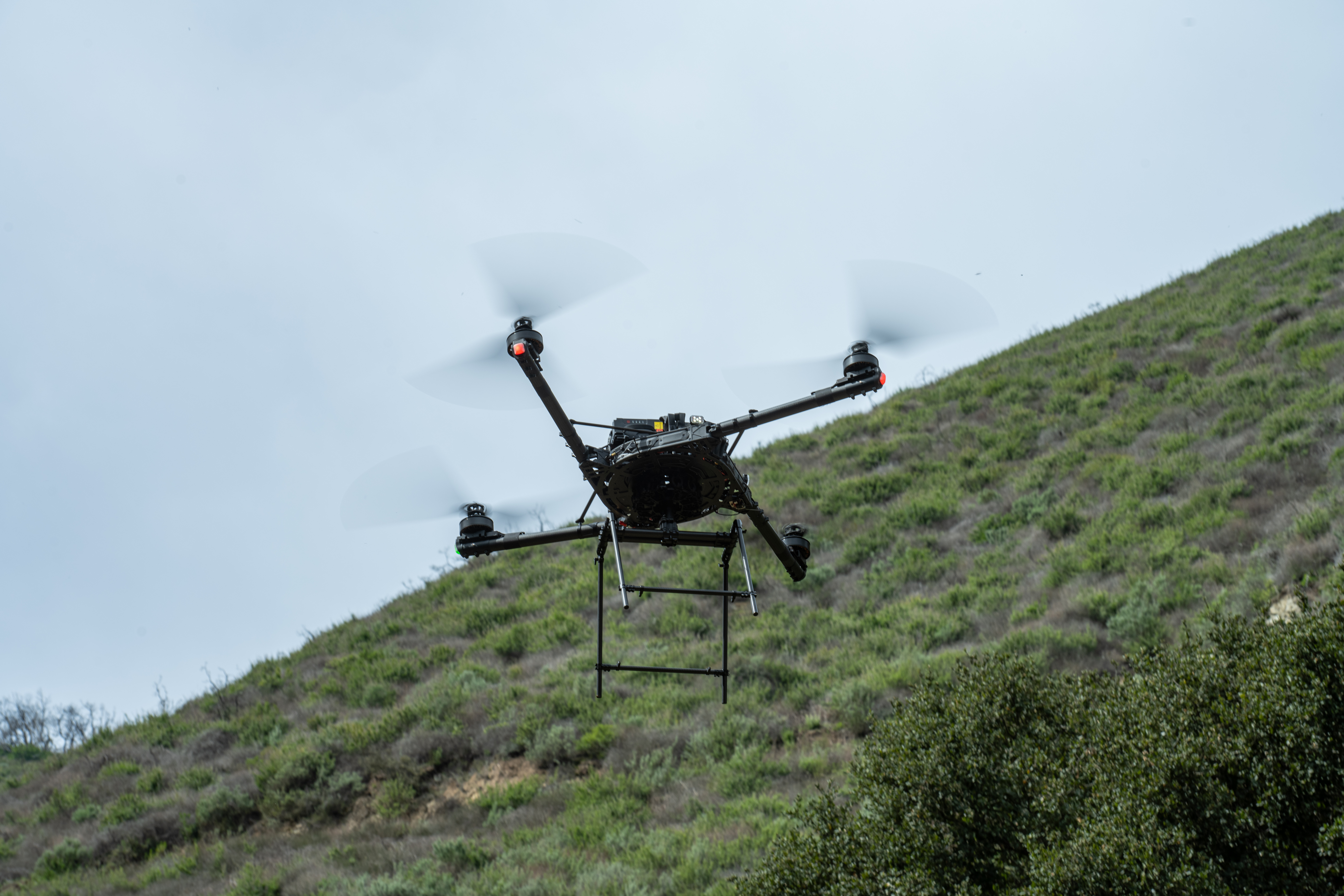
Washington and 35 other states reach settlement with Hyundai and Kia over lack of anti-theft tech

16 December 2025 at 13:03
(BigStock Photo)

Washington and 35 other states reached a settlement with Hyundai and Kia in which the automakers will provide restitution to consumers and fixes to millions of eligible vehicles nationwide that lacked industry-standard, anti-theft technology.

Washington Attorney General Nick Brown’s office announced details of the settlement Tuesday, in which Hyundai and Kia have agreed to:

  • Equip all future vehicles sold in the U.S. with engine immobilizer anti-theft technology;
  • Offer free zinc-reinforced ignition cylinder protectors to owners or lessees of eligible vehicles, including vehicles that previously were only eligible for the companies’ software updates;
  • Provide up to $4.5 million in restitution to eligible consumers whose cars are damaged by thieves; and
  • Pay $4.5 million to the states to defray the costs of the investigation. 

Eligible car owners can receive up $4,500 for a total loss or up to $2,250 for a partial loss, according to compensation details on the settlement website. The claim deadline is March 31, 2027.

An engine immobilizer prevents thieves from starting a vehicle’s engine without the vehicle’s “smart” key, which stores the vehicle’s electronic security code. The lack of the necessary tech on cars resulted in “an epidemic of car thefts and joy riding” across Washington and the country,

“Security is a key piece for families looking to buy a vehicle, but Hyundai and Kia spent years selling people cars that lacked the industry’s standard protections,” Brown said in a statement. “Year after year, consumers have been easily victimized because of the automakers’ failure here.”

In late 2020, teenage boys began posting videos on social media describing how to steal the cars simply by removing a plastic piece under the steering wheel and using a USB cord. Posts with the hashtag “Kia Boys” racked up more than 33 million views on TikTok by September 2022, according to CNBC. The videos included teens engaged in reckless driving of the stolen vehicles.

Despite years of evidence, Hyundai and Kia waited until 2023 to launch a service campaign to update the software on most of the affected vehicles, Brown’s office said. The update was easily bypassed by thieves.

Seattle City Attorney Ann Davison filed a similar lawsuit against Kia and Hyundai in January 2023.

“The corporate choices by the automakers to cut corners have had very negative impacts and put the public at risk in Seattle,” Davison said in a statement Tuesday.

She added, “I am confident that we will prevail in our lawsuit, and the car companies will finally be required to help in the fight to improve public safety. My action is not to replace criminal prosecution of car thieves, but to hold corporate actors accountable for making choices that prioritize profit over public safety.”

In May 2023, Hyundai and Kia agreed to a consumer class-action lawsuit settlement worth $200 million over rampant thefts of the Korean automakers’ vehicles. The Seattle City Attorney’s Office said at the time that it was a “good first step for consumers” but that the settlement involving individual owners “does not include the litigation brought by the City.”

Under the new multistate settlement, eligible consumers will be notified by the companies that they will have one year from the date of the notice to make an appointment to have the zinc-reinforced ignition cylinder protector installed at their local Hyundai or Kia authorized dealerships. Consumers are urged to schedule the installation of the zinc-reinforce ignition cylinder protector as soon as possible.

Consumers who previously installed the software update on their vehicles (or were scheduled to do so) but nonetheless experienced a theft or attempted theft of their vehicle on or after April 29, 2025, are eligible to file a claim for restitution for certain theft and attempted-theft related expenses.  For more information about eligibility and how to submit a claim visit these sites for Hyundai and Kia.

❌
❌