Normal view

There are new articles available, click to refresh the page.
Yesterday — 12 December 2025Main stream

Bitcoin Price Prediction: Binance On-Chain Data Shows Rare Bullish Divergence at $90K — Can BTC Explode Past $100K Next?

12 December 2025 at 18:30

As Bitcoin consolidates in the $90,000-$91,000 range, on-chain data from Binance reveals an unusual bullish divergence in trader behavior regarding selling versus buying activity.

Rather than liquidating positions, the majority are aggressively withdrawing coins from the exchange, leading the Bitcoin price prediction to signal a potential breakout above $100,000.

Bitcoin Deposits Hit 8-Year Low, Creating Supply Shock

According to charts from CryptoOnchain, the 30-day Exponential Moving Average (EMA-30) of Exchange Withdrawal Transactions on Binance experienced a substantial spike, reaching 3,100 daily transactions on December 3rd.

Historic Divergence on Binance: Aggressive Bitcoin Accumulation at $91K

“Existing supply is being removed from the order books, and new selling pressure is virtually non-existent. This behavior indicates extreme conviction among investors.” – By @CryptoOnchain pic.twitter.com/QPOQzmcfSj

— CryptoQuant.com (@cryptoquant_com) December 12, 2025

“This marks the highest level of withdrawal activity observed since May 2018,” the analyst noted.

The metric indicates a growing number of investors are transferring assets to cold storage, demonstrating a long-term holding strategy, rather than short-term trading speculation.

Even more remarkable is the sell-side behavior. While withdrawals surge, the 30-day moving average of depositing transactions to Binance has fallen to its lowest level since 2017, dropping to approximately 320 transactions.

The massive divergence, where withdrawals hit a 7-year peak while deposits reach an 8-year low, creates a textbook “Supply Shock” scenario.

“This behavior indicates extreme conviction among investors who believe the price discovery phase is far from over,” CryptoOnchain concluded.

Technical Structure Shows Range-Bound Consolidation

Bitcoin continues trading within a broad one-year range, with recent weekly candles positioning the price near the range low around $80,000-$81,000.

The chart identifies substantial resistance between $117,000 and $122,000, but the market must first reclaim the mid-range level near $109,000, an area that has consistently capped rallies since mid-2025.

Only a decisive weekly close above $109,000 would reopen pathways toward a larger bullish structure.

Bitcoin Price Prediction - Bitcoin Price chart
Source: TradingView

Meanwhile, weekly moving averages are beginning to flatten, and price currently trades beneath the 20-week and 50-week MAs, indicating momentum remains subdued.

If Bitcoin loses the $80,000 support, the chart reveals a wide demand zone between $62,000 and $71,000 as the next significant area where buyers may establish a bottom.

Until then, price will likely range sideways with a slight bearish tendency unless bulls recover $109,000 and reverse momentum in their favor.

Pepenode Raised Over $2.3M To Position for Meme Coin Mania

If Bitcoin finally breaks through $109,000 and starts climbing again, meme coins like Pepenode (PEPENODE) could experience another explosive rally.

Pepenode is a new crypto project that’s already raised over $2.3 million despite challenging market conditions.

It’s a game where you can “mine” coins without needing expensive computer equipment.

You play the game in your web browser, set up virtual mining nodes, and upgrade your facilities to earn $PEPENODE tokens.

Bitcoin Price Prediction - Pepenode banner

The project is replicating PEPE’s success strategy, which surged over 1,000x during Bitcoin’s rally from $27,000 to over $64,000 during the 2023-24 run.

As more people start purchasing Pepenode’s mining rigs, the token price is expected to rise rapidly.

To join the presale before the price increases, visit the official Pepenode website and connect a crypto wallet like Best Wallet.

You can buy tokens now for $0.001192 each and pay with crypto coins like ETH, BNB, or USDT.

You can also use a regular credit or debit card to complete your purchase in just seconds.

Visit the Official Pepenode Website Here

The post Bitcoin Price Prediction: Binance On-Chain Data Shows Rare Bullish Divergence at $90K — Can BTC Explode Past $100K Next? appeared first on Cryptonews.
XRP Price Prediction: Solana Breakpoint Confirms XRP Is Coming to SOL – Can DeFi Liquidity Help Drive a Rally to $5?

12 December 2025 at 14:43

At the ongoing Solana Breakpoint conference in Abu Dhabi, announcements revealed that Hex Trust and LayerZero will bridge and issue wrapped XRP directly on the Solana blockchain.

Analysts suggest this cross-chain liquidity expansion could propel the XRP price prediction toward $5.

Ripple Expands to Solana and Secures First European Banking Partnership

Hex Trust, a prominent regulated digital asset platform serving institutional clients and functioning as a qualified custodian, announced plans to issue and custody wrapped XRP (wXRP), a 1:1-backed representation of native XRP to support DeFi activity and cross-chain functionality.

BREAKING: XRP is coming to Solana 🔥 pic.twitter.com/LabnKkLs71

— Solana (@solana) December 12, 2025

Consequently, wXRP’s utility will extend beyond the XRP Ledger, becoming tradable with RLUSD on Solana, Ethereum, and other blockchains where RLUSD is available.

“Users of wXRP and RLUSD will benefit from two assets that are built on trusted, compliant infrastructure, enabling broader DeFi utility for XRP and RLUSD across supported blockchains,” stated Giorgia Pellizzari, CPO and Head of Custody at Hex Trust.

In another significant development, Ripple recently partnered with Amina Bank AG to facilitate near real-time cross-border payments for Amina Bank’s clients using Ripple Payments.

Notably, Amina Bank AG becomes the first European bank to adopt Ripple Payments.

These strategic initiatives are expected to impact XRP token valuation.

Analysts note the asset is forming a bullish pennant pattern with price already positioned above strong support levels, potentially targeting $5 in 2026.

XRP Price Prediction: Technical Analysis Shows Critical $2.00 Support Test

On the XRP/USDT chart, price currently trades at $1.9960, down approximately 1.87%, and sits at a pivotal juncture.

The technical setup reveals XRP has been consolidating within a range following a substantial rally earlier this year.

The chart identifies critical support at $2.00, where the price currently rests, with a stronger support zone at $1.80 if the current level breaks.

XRP Price Prediction - XRP Price Chart
Source: TradingView

On the upside, initial targets include approximately $2.61 and an ambitious secondary target near $3.17, with a confirmation level at $2.40 that would signal bullish control.

The RSI at 43.55 is in neutral to slightly bearish territory, suggesting potential for movement in either direction without extreme conditions.

If XRP maintains support above $2.00 and builds momentum, there is potential for a return to the $2.40-$2.61 range.

MAXI Presale Hits $4.3M as Traders Position for XRP-Led Altcoin Season

As XRP attempts to leverage Solana DeFi for a bullish reversal heading into 2026, presale projects like Maxi Doge ($MAXI) are attracting investors seeking to capitalize on altcoin rotation typically associated with XRP rallies.

$MAXI is building an active community where traders share insider information, early trade setups, and hidden opportunities before they become widely known.

XRP Price Prediction - Maxidoge banner

The $MAXI presale has now raised over $4.3 million and represents one of this cycle’s most accessible, community-driven opportunities.

You still have time to join the presale at the current price of $0.0002725 before the next increase and can earn a first-come-first-served 72% APY by staking their tokens.

To purchase MAXI tokens early, visit the official Maxi Doge website and connect a crypto wallet like Best Wallet.

You can pay using popular crypto like USDT, SOL, and ETH, or use a bank card to complete your purchase in seconds.

Visit the Official Maxi Doge Website Here

The post XRP Price Prediction: Solana Breakpoint Confirms XRP Is Coming to SOL – Can DeFi Liquidity Help Drive a Rally to $5? appeared first on Cryptonews.

Jupiter Unveils JupUSD Stablecoin and Major Solana Ecosystem Upgrades

12 December 2025 at 13:57

Jupiter announced seven coordinated platform upgrades at Breakpoint, headlined by JupUSD, a new stablecoin developed with Ethena that will integrate across the entire Jupiter ecosystem to allow rewards during DCA orders, limit orders, and prediction market participation.

The Solana-based decentralized exchange, which has processed $1.08 trillion in combined spot and perpetuals volume year-to-date while maintaining $2.7 billion in total value locked, framed the upgrades as solutions to fragmented data, fraudulent assets, and the absence of professional-grade tools needed for institutional adoption.

Breakpoint Special: Pushing Onchain Finance Forward

Onchain finance is the future.

It is fundamentally a better system, with open rails, transparent logic, self-custody as a default, and verifiable rules which apply equally to everyone.

But the transition from off chain to… pic.twitter.com/bEygoA87uX

— Jupiter (🐱, 🐐) (@JupiterExchange) December 11, 2025

Protocol-Level Economics Across Trading Platforms

JupUSD launches next week with deep protocol-level integration that isolated stablecoins cannot replicate.

According to Jupiter executives, controlling both the dollar and the transaction platform allows synergies across use cases, creating a self-reinforcing flywheel effect.

The stablecoin will route through Jupiter’s existing infrastructure, handling billions in stablecoin volume via swap aggregation, perpetuals, and lending, completing what the company called an end-to-end stack.

The launch arrives as Solana’s stablecoin infrastructure expands through institutional partnerships, with Western Union planning to launch its US Dollar Payment Token through Anchorage Digital Bank in the first half of 2026 for international remittances.

The Solana Foundation also partnered with Korean blockchain infrastructure company Wavebridge to build a compliance-ready KRW-pegged stablecoin following South Korea’s preparation of regulatory framework legislation, with Wavebridge CEO Jongwook Oh stating the collaboration seeks to create structures where the stablecoin is “not only issued but also verified, controlled, and fit for institutional use.

Additionally, Jupiter Lend exited beta and became fully open source after reaching $1 billion in total supply within eight days, the fastest growth rate for any Solana protocol in history.

Now, the lending protocol is built with Fluid and introduced tick-based liquidity, allowing all risky positions to be liquidated in a single transaction and allowing Jupiter to offer the highest loan-to-value ratios and the lowest liquidation penalties in decentralized finance.

Developer Tools and Data Infrastructure

The newly launched Developer Platform consolidates real-time analytics across all Jupiter APIs, giving builders visibility into logs, usage patterns, and performance metrics through a unified dashboard that tracks every swap, pricing call, and token API request.

Developers can now debug issues by investigating 429 errors, 500 errors, and downtime events through comprehensive logs designed to help teams ship more efficiently.

Yesterday, @kashdhanda announced a huge bullish moment for developers: @JupiterExchange just launched the Jupiter Developer Platform.

This isn’t just another home for mediocre or garbage APIs, it’s the new home for the best APIs on Solana, complete with everything you need to… pic.twitter.com/3AHVFV65oF

— Sam || Jupiter Legion 😺😺 (@SamuelA6643) December 12, 2025

Jupiter Terminal consolidated trading for all asset classes into a single platform featuring real-time wallet tracking, Alphascan’s analytics across 61-plus launchpads with developer blacklisting, and professional execution tools, including one-cancels-other orders and partial fills.

The terminal leverages Ultra v3, Jupiter’s proprietary end-to-end trading engine that powers features like Jupiter Beam and Predictive Execution, technology adopted by Robinhood for its own operations.

Meanwhile, VRFD expanded beyond token verification into a full, trusted data layer to address Solana’s challenge of 30,000 daily token launches, most of which are scams or imposter tokens.

VRFD now verifies metadata and provides high-signal insights across all surfaces, including Jupiter mobile and APIs, building on Jupiter Verify’s position as the most trusted token verification system powering nearly every wallet, terminal, and explorer in decentralized finance.

Acquisition Strategy Extends Lending Capabilities Beyond Traditional Assets

To amplify adoption and scalability, Jupiter acquired Rain.fi to expand its money market capabilities to off-chain, long-tail, and long-duration assets that previously lacked viable on-chain pathways.

Rain.fi’s Offer Book, a specialized orderbook launching in Q1, will enable simpler, more transparent liquidity access without price-based liquidations, making every on-chain asset productive through peer-to-peer lending models that scale through Jupiter’s integration infrastructure.

Rain was built to scale and accelerate the credit market on Solana, powered by fixed-term loans.

As credit markets evolve, timing and distribution are key.

We’re proud to announce that Rain is joining the Jupiter ecosystem to accelerate on-chain credit market growth. pic.twitter.com/qe3NbcWLRo

— Rain.fi 💧 (@RainFi_) December 11, 2025

The Rewards Hub unified rewards, trading activity, and referrals into one system with a $1 million pool tied to real contributions, addressing what Jupiter called fragmented on-chain incentives disconnected from actual usage.

Jupiter’s coordinated upgrades across data infrastructure, execution tools, lending protocols, and developer resources represent what executives called “deliberate upgrades to systems already powering hundreds of millions of users, traders, and builders” rather than entirely new products.

The post Jupiter Unveils JupUSD Stablecoin and Major Solana Ecosystem Upgrades appeared first on Cryptonews.

Bitcoin Price Prediction: New Report Shows Hidden Whale Accumulation – Do Insiders Expect Big News Before 2026?

12 December 2025 at 10:24

A recent report from Bitcoin Treasuries reveals substantial corporate whale accumulation, and analysts believe this trend could drive Bitcoin’s price prediction to unprecedented levels heading into 2026.

Corporate Treasuries Add Over 10,000 BTC in November

Researchers at bitcointreasuries.net discovered that public and private treasuries acquired more than 12,644 BTC during November, with 1,883 BTC in sales offsetting the purchases.

Despite 5 DATs combining to sell 1,900 BTC last month ($171M)

Public and private companies + DATs combined to BUY 10,750 Bitcoin last month (~$1B)

So they are still a source of major net inflows… pic.twitter.com/vjdYgMCYbx

— TylerD 🧙‍♂️ (@Tyler_Did_It) December 11, 2025

This resulted in a net accumulation of 10,761 BTC for the month.

MicroStrategy once again dominated its competitors, purchasing 9,062 BTC across three separate transactions and concluding November with 649,870 BTC on its balance sheet.

Japan’s Metaplanet, China’s Cango, Europe’s Capital B, and multiple Hong Kong-based firms all increased their BTC holdings, collectively pushing non-U.S. public treasury reserves above 100,000 BTC.

Companies in Asia and Europe are increasingly utilizing local debt markets, favorable tax structures, and regulatory transparency to implement Digital Asset Treasury (DAT) strategies that extend well beyond U.S. borders.

Analysts note that treasury companies have now accumulated nearly 5% of Bitcoin’s entire circulating supply.

If this accumulation pace continues, it could propel BTC to new highs exceeding $130,000 in 2026.

Bitcoin Price Prediction: Technical Structure Shows BTC Needs to Clear $92,000 Decisively to Target New Highs

Bitcoin is working to establish stability following its sharp November-December selloff, with the $82,000–$86,000 zone functioning as the critical demand area that halted the decline and generated the current recovery.

BTC price is currently consolidates beneath a substantial resistance band between $107,000 and $112,000, which represents the first barrier that must be overcome before any significant trend reversal can develop.

Beyond that lies the far more important macro range at $118,000–$122,000, the level the chart identifies as essential for triggering a 2026 bull-run framework.

Bitcoin Price Prediction - Bitcoin Price Chart
Source: TradingView

Momentum has improved modestly, with the RSI advancing from oversold conditions into neutral territory; however, it hasn’t yet demonstrated strong upward momentum.

Bitcoin’s trajectory leans cautiously optimistic, provided the $82,000–$86,000 support maintains, but a breakout will only achieve genuine momentum if buyers can recapture $107,000–$112,000 and subsequently advance into the $118,000 region.

Without that progression, the current movement risks becoming merely a temporary relief rally within a broader downtrend.

Maxi Doge ($MAXI) Heats Up as Traders Hunt the Next Big Meme Coin Before the 2026 Bull Run

As Bitcoin attempts to build momentum for a 2026 rally, early-stage projects like Maxi Doge ($MAXI) are drawing investors who want to benefit from the upcoming wave of money flowing into crypto.

Taking inspiration from Dogecoin’s 2021 bull run, $MAXI is building an active community where traders share insider tips, early trade ideas, and hidden opportunities before they become popular.

The $MAXI presale has now raised over $4.3 million and offers one of the easiest ways for regular investors to get involved early in this market cycle.

Bitcoin Price Prediction - Maxidoge banner

People who join now can still purchase before the price increases and before the 72% yearly staking rewards decrease.

To buy early, go to the official Maxi Doge website and connect a crypto wallet like Best Wallet.

You can pay with popular cryptocurrencies like USDT and ETH, or use a bank card to finish your purchase right away.

Visit the Official Maxi Doge Website Here

The post Bitcoin Price Prediction: New Report Shows Hidden Whale Accumulation – Do Insiders Expect Big News Before 2026? appeared first on Cryptonews.

Bank of Japan Eyes Rate Hike to Highest Level Since 1995

12 December 2025 at 10:16

The Bank of Japan is preparing to raise its policy rate to 0.75% at its December 18-19 meeting, marking the first increase since January 2025 and pushing borrowing costs to their highest level in three decades.

According to Nikkei, Governor Kazuo Ueda and his executive team have signaled their intent to submit the rate-hike motion, with a majority of the nine-member Policy Board expected to approve the 25-basis-point increase from the current 0.5% level.

The move comes as Japan’s 10-year government bond yields have climbed to 1.94%, the highest since mid-2007, while Prime Minister Sanae Takaichi’s government has grown increasingly supportive of monetary tightening.

Bitcoin and Ethereum are facing renewed pressure ahead of the decision.

Crypto Markets Reel as Policy Shift Threatens Leveraged Positions

Bitcoin traded around $86,000 in early December after a sharp 5% single-session drop, briefly slipping below $85,000 and triggering more than $637 million in long liquidations.

During that time, the Crypto Fear and Greed Index plunged to extreme fear levels near 20, down from a trough around 10, as the BOJ’s policy pivot tightened financial conditions and reduced tolerance for leverage that had previously supported rallies.

Speaking with Cryptonews, Ignacio Aguirre, CMO at Bitget, said a stronger yen “raises the risk of unwinding yen carry trades which is a move that can temporarily weigh on crypto valuations as leveraged positions reset across global markets.

So far this month, Bitcoin saw the largest 24-hour wipeout, with approximately $251.69 million liquidated, while Ethereum followed with roughly $111.31 million in liquidations.

The selloff in Japanese government bonds has extended beyond domestic markets, pushing 10-year U.S.

Treasury yields up to about 4.08% as the policy shift rippled through global funding markets.

Crypto-exposed stocks felt the impact of Bitcoin’s slide as risk aversion picked up, with MicroStrategy shares falling sharply while Coinbase and Robinhood dropped by mid-single digits.

⚠Bitcoin hovered near $86,000 in Asia after a sharp crypto selloff and a global bond slump kept traders cautious and risk appetite weak.#CryptoMarket #AsiaMarketOpen https://t.co/r8o6wn1cBo

— Cryptonews.com (@cryptonews) December 2, 2025

Stablecoin Growth Adds New Dynamic to Bond Market as BOJ Steps Back

Japan’s emerging stablecoin sector may reshape the country’s sovereign debt landscape as the BOJ reduces its bond purchases after years of aggressive monetary easing.

JPYC, the Tokyo-based issuer behind Japan’s first yen-pegged stablecoin, which launched in October under the nation’s revised Payment Services Act, has targeted circulation of 10 trillion yen within three years.

JPYC plans to invest 80% of its proceeds in JGBs and 20% in bank deposits, potentially filling the gap left by the central bank’s retreat from a market where it currently holds roughly 50% of the 1,055-trillion-yen total.

The Financial Services Agency has endorsed a pilot program involving Japan’s three largest banks to develop a shared framework for issuing yen-backed stablecoins, initially targeting corporate clients.

Meanwhile, the government is preparing its most sweeping crypto oversight overhaul in nearly a decade, moving regulation from the Payment Services Act into the Financial Instruments and Exchange Act to treat digital assets more like traditional investment products.

🇯🇵 @fsa_JAPAN moves crypto under securities law, stricter disclosure, insider trading ban, and enhanced oversight of exchanges planned. #CryptoNews #Japan #FSAhttps://t.co/eC3i8zW6kI

— Cryptonews.com (@cryptonews) December 10, 2025

Tax Reform and Institutional Entry Signal Maturing Market Structure

Japan is preparing to introduce a flat 20% levy on crypto trading gains in 2026, replacing progressive rates that can reach 55% and placing digital assets on the same footing as stocks.

The reform would split crypto income into a separate taxation scheme, with 15% directed to the central government and 5% to local authorities.

Additionally, Nomura Asset Management has formed a cross-division task force to prepare product strategies ahead of the regulatory changes, while Daiwa Asset Management is coordinating with ETF specialist Global X Japan.

Despite the near-term volatility from BOJ tightening, Aguirre expects BTC to “retest the $95,000–$100,000 range by early 2026, while ETH could climb toward $3,800 as institutional flows resume and macro conditions stabilize.

Notably, Tokyo Stock Exchange operator Japan Exchange Group is weighing stricter backdoor listing rules for companies shifting into large crypto positions, following losses from recent hoarding waves that raised investor protection concerns.

The FSA also plans to require crypto exchanges to hold dedicated liability reserves against customer losses, mirroring requirements long used in Japan’s securities industry, following high-profile hacks, including DMM Bitcoin’s $48.2 billion theft in May 2024.

The post Bank of Japan Eyes Rate Hike to Highest Level Since 1995 appeared first on Cryptonews.

Sei and Xiaomi Team Up to Roll Out Web3 App Globally

12 December 2025 at 07:56

Sei, a Layer-1 blockchain network, has announced a major collaboration with consumer electronics giant Xiaomi to pre-install a Web3-enabled finance app on smartphones sold outside mainland China and the United States.

The partnership includes a $5 million Global Mobile Innovation Program to accelerate blockchain adoption across consumer devices.

The Sei-based application will come pre-installed on all new Xiaomi devices in target markets, with plans to enable stablecoin payment functionality following initial development phases.

Xiaomi, the world’s third-largest smartphone manufacturer with 13% global market share, sold 168 million devices in 2024 alone, providing Sei with direct access to millions of potential users.

A new era of mobile finance is coming to Xiaomi's global user base.

A next-gen finance app powered by Sei and designed for stablecoin payments, will be integrated into the Xiaomi mobile ecosystem, coming pre-installed on new devices.

Money made instant — built into your phone. pic.twitter.com/75ly01AHB3

— Sei (@SeiNetwork) December 10, 2025

Seamless Onboarding Targets Key Growth Markets

The forthcoming app will feature Google and Xiaomi ID integration for streamlined user onboarding, multi-party computation wallet security, and curated access to decentralized applications.

The platform will support both peer-to-peer transfers and consumer-to-business transactions, creating a comprehensive mobile finance experience for mainstream users.

Initial rollout prioritizes regions with established crypto adoption, including Europe, Latin America, Southeast Asia, and Africa, where Xiaomi maintains a significant market presence.

The strategy targets countries where Xiaomi dominates smartphone sales, such as Greece (36.9% market share) and India (24.2%), helping millions of people take their first steps into crypto ecosystems.

Sei clarified that the collaboration centers specifically on the pre-installed mobile finance app and Web3 access.

Quick clarification on the Xiaomi news: the collaboration centers on pre-installing a Sei-based app for mobile finance and enabling Web3 access for mobile users.

It does not involve Xiaomi directly supporting or operating any digital-currency payment features or stablecoins at…

— Sei (@SeiNetwork) December 11, 2025

It does not involve Xiaomi directly supporting or operating digital-currency payment features or stablecoins at this time, with specific features rolling out on an ongoing basis.

This collaboration with Xiaomi represents a watershed moment for blockchain adoption,” said Jeff Feng, Co-Founder of Sei Labs.

By embedding Sei’s high-performance infrastructure directly into one of the world’s most popular smartphone ecosystems, we’re not just solving the onboarding problem—we’re reimagining how billions of users will interact with digital assets in their daily lives.

Technical Infrastructure Positions Sei for Mass Adoption

Sei’s blockchain architecture delivers sub-400-millisecond finality and processes thousands of transactions per second, technical specifications that the team positions as critical for handling mainstream consumer application demands.

The network has processed over four billion transactions across more than 80 million wallets since its 2023 mainnet launch, establishing itself as the leading EVM chain by active user count.

“We’re moving from a world where crypto is something you have to find, to one where it finds you,” added Jay Jog, Co-Founder of Sei Labs.

While competitors focus on crypto-native audiences, Sei leverages Xiaomi’s ecosystem to embed Web3 capabilities directly into devices consumers already use daily, fundamentally shifting traditional blockchain adoption strategies.

The blockchain’s momentum accelerated throughout 2025, with July data showing that gaming transaction volumes reached $469 million over 7 days and total value locked surpassed $600 million.

The network claimed the top position in Web3 gaming with 8.8 million connected wallets, representing 74% monthly growth, while stablecoin supply exceeded $277 million by mid-year.

As June comes to a close, let’s look at the top gaming chains from the past 30 days 🎮@SeiNetwork took the lead with 8.8M wallets (+74%) as gaming on SEI heats up with several emerging titles boosting activity.

opBNB and @SkaleNetwork follow with solid numbers despite slight… pic.twitter.com/N1Im9LKAnb

— DappRadar (@DappRadar) June 30, 2025

Daily transactions on Sei tripled in the first half of 2025, reaching a peak of 1.6 million per day, according to Nansen analytics.

The network’s gaming dominance extended across 14 applications, surpassing 100,000 unique active wallets, with popular titles such as World of Dypians, Archer Hunter, and Empire of Sei experiencing user growth of 33.2% to 139%.

The partnership strengthens Sei’s positioning following its April establishment of the Sei Development Foundation, a US non-profit headquartered in Manhattan that promotes the adoption of open-source protocols through education and ecosystem support.

Notably, the Sei-Xiaomi partnership follows parallel developments in blockchain-integrated mobile hardware, particularly the second-generation Seeker smartphone rollout by Solana Mobile across 50-plus countries in August.

Recently, Solana Mobile announced it will launch SKR, a governance token for the Seeker ecosystem, in January 2026, with a total supply of 10 billion, allocating 30% to airdrops for device holders.

The post Sei and Xiaomi Team Up to Roll Out Web3 App Globally appeared first on Cryptonews.

Trump’s Crypto Regulator Pick Heads to Senate Floor for Crucial Vote

12 December 2025 at 05:10

Michael Selig, President Donald Trump’s nominee to lead the Commodity Futures Trading Commission, is set to face a full Senate confirmation vote as early as “this afternoon” following a 12-11 party-line committee approval last month.

The vote comes at a pivotal moment for U.S. crypto regulation, with the CFTC poised to assume sweeping new authority over digital asset markets while operating under severe leadership constraints that have left only one commissioner seated since September.

Selig’s confirmation hearing in November drew sharp scrutiny over staffing levels, with senators questioning whether the agency’s 543 employees can handle expanded crypto oversight responsibilities that Congress is preparing to assign through pending legislation, including the CLARITY Act.

The nominee, currently chief counsel for the SEC’s Crypto Task Force, has pledged to help make America “the Crypto Capital of the World” while building regulatory structures that support developer innovation and enforce traditional market safeguards on new exchanges.

Trump's Crypto Regulator - Micheal Selig image
Michael Selig. | Source: The Intercept

CFTC Clears Regulatory Deck With Major Policy Overhaul

Acting Chair Caroline Pham announced yesterday that the agency is withdrawing its 2020 “actual delivery” guidance for virtual currencies, eliminating compliance barriers that penalized crypto firms with overly complex rules built around a 28-day asset possession standard.

The outdated framework, designed when regulators were still uncertain about the crypto market’s development, classified digital assets as a separate regulatory category from traditional commodities, despite years of market maturation and improved custody practices.

Eliminating outdated and overly complex guidance that penalizes the crypto industry and stifles innovation is exactly what the Administration has set out to do this year,” Pham said in a statement.

The withdrawal allows Bitcoin, Ethereum, and other digital assets to fall under the CFTC’s general technology-neutral framework, reducing compliance burdens for exchanges seeking to list new products while normalizing crypto alongside traditional commodities.

The change arrives days after the agency authorized spot crypto trading on federally regulated futures exchanges for the first time, bringing direct buying and selling of digital assets onto platforms that have operated under federal standards for nearly a century.

@ CFTC approves spot crypto trading on U.S. futures exchanges, giving investors safe, regulated access to digital assets. #SpotTrading #CFTC https://t.co/S30HuwWjGX

— Cryptonews.com (@cryptonews) December 4, 2025

Tokenized Assets Gain Ground Through New Pilot Program

Beyond spot trading approval, the CFTC is pressing forward with its Crypto Sprint initiative through a December 8 pilot program authorizing Bitcoin, Ether, and USDC as collateral in derivatives markets.

The three-month program requires futures commission merchants to submit weekly reports on holdings, giving regulators real-time visibility into the performance of tokenized assets under supervised conditions while establishing guardrails to protect customers.

The agency simultaneously issued guidance confirming that tokenized real-world assets, such as U.S. Treasuries and money market funds, can be evaluated within existing regulatory frameworks.

It also granted no-action relief for firms seeking to accept certain non-securities digital assets as customer margin, addressing custody, segregation, valuation haircuts, and operational risks that have kept institutions on the sidelines.

🏛The US @CFTC has launched a pilot allowing Bitcoin, Ether and USDC to serve as collateral in derivatives markets, marking a major step toward regulated crypto integration.#CFTC #Tokenization https://t.co/XrmdLTamP7

— Cryptonews.com (@cryptonews) December 9, 2025

Leadership Vacuum Deepens as Confirmation Vote Approaches

Selig’s nomination follows months of uncertainty after Trump withdrew his initial pick, former CFTC Commissioner Brian Quintenz, whose candidacy collapsed in September amid opposition from Gemini co-founders Tyler and Cameron Winklevoss.

The White House had reportedly vetted several alternatives, including former CFTC official Josh Sterling and Treasury counselor Tyler Williams, before settling on Selig, who previously advised blockchain clients in private practice and worked on digital asset policy under former CFTC Chair J. Christopher Giancarlo.

The agency has operated in crisis mode since January, when Chair Rostin Behnam resigned after overseeing major enforcement actions, including the $4.3 billion Binance settlement.

Commissioner Kristin Johnson departed in September, while Caroline Pham announced plans to join MoonPay once a successor is confirmed, leaving the five-seat commission barely functional and slowing policy coordination with Congress on legislation that would grant the CFTC primary oversight of spot crypto markets under frameworks outlined in the President’s Working Group on Digital Asset Markets report.

Trump's Crypto Regulator - Chairman Glenn Thompson image
House Agriculture Committee Chairman Glenn Thompson. | Source: PennCapital-Star

Notably, House Agriculture Committee Chairman Glenn Thompson told lawmakers he looks forward to the Senate’s confirmation vote and plans to invite Selig early next year to discuss his agenda for the agency’s first reauthorization in over a decade.

The post Trump’s Crypto Regulator Pick Heads to Senate Floor for Crucial Vote appeared first on Cryptonews.

Polish Government Defies President, Reintroduces Identical Crypto Law

12 December 2025 at 03:42

Poland’s government adopted an unchanged version of its controversial crypto-asset market bill on Tuesday, escalating a bitter standoff with President Karol Nawrocki after lawmakers failed to override his veto last week.

According to local reports, Prime Minister Donald Tusk framed the legislation as a matter of national security, citing more than 100 entities in Poland’s crypto registry linked to Russia, Belarus, and other former Soviet states.

The reintroduced bill contains no modifications from the version Nawrocki rejected, government spokesman Adam Szłapka confirmed.

The measure will now return to parliament later this year despite the president’s concerns about excessive restrictions that exceed European Union requirements and threaten property rights.

Szłapka declared “not even a comma” had been changed in the new bill.

Poland Crypto Bill - PM Donald Tusk
Prime Minister Donald Tusk. | Source: Euractiv

Security Concerns Drive Government’s Push

Tusk emphasized the urgency of regulation before Tuesday’s cabinet meeting, arguing that the state cannot remain passive while cryptocurrencies are used as tools of sabotage by Polish adversaries.

He noted that Polish authorities identified several hundred foreign entities operating in the domestic crypto market, and investigations revealed that Russian intelligence and organized crime groups were exploiting digital assets for covert financing.

We’re dealing with very dangerous phenomena involving Russian money and the mafia,” Tusk told journalists after last week’s failed veto override.

He suggested that money from these circles funded political promotion under a “political umbrella,” implying connections between veto supporters and questionable interests.

Warsaw previously blamed Russia for a blast on a railway route supplying Ukraine, while security services cited cases of underground groups allegedly paid in cryptocurrencies for sabotage activities.

National Prosecutor Dariusz Korneluk established a team last week to examine files and monitor cryptocurrency-related crimes.

Finance Minister Andrzej Domański criticized the veto’s impact, stating 20% of clients lose money to abuses in the unregulated market while the president “chose chaos.”

Kolejna zawetowana ustawa. Tym razem wbrew klientom i inwestorom rynku kryptoaktywów oraz 🇵🇱 podmiotom. Już teraz 20% klientów traci swoje pieniądze w wyniku nadużyć na tym rynku. Chcieliśmy ich chronić, Prezydent wybrał chaos i bierze pełną odpowiedzialność za swoje działania.…

— Andrzej Domański (@Domanski_Andrz) December 1, 2025

The government maintains that basic control is essential, given the security threats posed by hostile actors exploiting the unregulated crypto space.

Presidential Opposition Remains Firm

Nawrocki’s rejection centered on claims that the legislation exceeded MiCA requirements and threatened civil liberties.

His chief of staff indicated openness to regulation provided future proposals avoid excessive restrictions.

Still, the president has not signaled any willingness to approve the current bill despite Tusk’s hope that additional security briefings would change his position.

The Presidential Palace previously argued Nawrocki lacked full information about security risks, though government officials now assert he has complete knowledge.

The blocked law would implement MiCA-style rules through licensing requirements for crypto-asset service providers, investor protection standards, stablecoin reserve requirements, and anti-money laundering controls.

The Polish Financial Supervision Authority would gain sweeping oversight powers, including the ability to block crypto-related websites through administrative orders and to impose fines of up to 10 million zloty or prison terms of up to five years for serious violations.

The legislation would also grant the KNF the authority to order account blocking for up to 6 months in cases of justified suspicion of market abuse.

Critics including opposition lawmakers and industry figures warned the bill would cripple Poland’s crypto sector serving an estimated three million users.

Tomasz Mentzen of the Confederation party highlighted the KNF’s 30-month average licensing process, the longest in the EU, while noting neighboring countries implemented MiCA with far shorter legislation.

Economist Krzysztof Piech argued the law was unnecessary since MiCA regulations will protect all EU residents from July 1, 2026.

Nie Panie Ministrze. To że tyle osób traci pieniądze, to nie wina Prezydenta, tylko tego, że oszuści nie są ścigani, a do tego ta ustawa nie była potrzebna.
Od 1 lipca 2026 wszyscy w UE będą chronieni rozporządzeniem MiCA – Polacy też.

— Krzysztof Piech (@krzysztof_piech) December 1, 2025

Market Uncertainty Deepens

The veto failure leaves Poland as the last EU member without national MiCA-style regulation ahead of the bloc’s July 1, 2026, compliance deadline.

Industry advocates cautioned the strict framework would drive businesses abroad, costing Poland tax revenue and talent as companies relocate to friendlier jurisdictions.

Foreign Minister Radosław Sikorski suggested that the crypto industry’s sponsorship of right-wing political figures explained resistance to tighter oversight.

The dispute reflects broader European tensions around centralized crypto supervision, with the European Commission proposing ESMA take direct oversight of all EU crypto firms rather than maintaining MiCA’s national regulator model.

The post Polish Government Defies President, Reintroduces Identical Crypto Law appeared first on Cryptonews.

Before yesterdayMain stream

Bitcoin Price Prediction: Congress Pressures SEC to Allow Bitcoin in 401(k)s — Can the $12.5T Retirement Pool Send BTC to New Highs?

11 December 2025 at 18:30

U.S. lawmakers are urging the Securities and Exchange Commission to implement a new executive order that would allow Americans to include Bitcoin and other cryptocurrencies in 401(k) retirement accounts.

With U.S. 401(k) plans holding approximately $12.5 trillion, even modest crypto allocations could propel the Bitcoin price prediction into unprecedented bullish territory.

U.S Congress Pushes for Bitcoin In Retirement Portfolio

In a formal December 11 letter addressed to SEC Chairman Paul Atkins, Congress expressed support for President Trump’s August 2025 executive order directing the Department of Labor and SEC to revise regulations currently restricting 401(k) investment options.

🚨BREAKING🚨

Congress is urging SEC Chair Atkins to allow Bitcoin and crypto in 401(k) accounts pic.twitter.com/UMUScJaJ5x

— Quinten | 048.eth (@QuintenFrancois) December 11, 2025

The initiative aims to provide ordinary workers with investment choices comparable to those available to large pension funds.

According to White House data, total U.S. retirement assets reached $43.4 trillion as of March 31, 2025, yet most savers remain blocked from accessing alternative investments.

Lawmakers contend that permitting measured allocations into these assets could improve risk-adjusted returns and bring retirement investment strategies into the modern era.

Industry experts view this policy evolution as a pivotal moment for Bitcoin’s integration into traditional finance.

Analysts calculate that even minimal allocations, ranging from 1–3%, from retirement funds could generate tens of billions in fresh buying pressure, potentially driving BTC to record highs.

Bitcoin Price Prediction: Technical Setup Shows Mid-Cycle Correction

The weekly chart reveals Bitcoin retreating from the substantial $100,000–$108,000 resistance zone after failing to maintain support above it, creating a distinct mid-cycle pullback.

Price currently hovers around $90,000, positioned just above the critical long-term weekly support near $76,000, which represents the essential structural foundation for preserving the broader uptrend.

The MACD remains deep in bearish territory but is starting to flatten, suggesting downside momentum may be weakening after months of selling pressure.

Bitcoin Price Prediction - bitcoin price chart
Source: TradingView

If Bitcoin can recapture the $100,000–$108,000 region and subsequently break through the next major pivot at $116,000, the chart structure supports continuation of the bull run toward the projected target around $131,000.

This Presale Raised $2.3M – Is Pepenode the Next PEPE?

If Bitcoin starts going up again and people begin putting their retirement money into crypto, meme coins like Pepenode (PEPENODE) could see big price jumps.

Pepenode is a new crypto project that’s already raised over $2.3 million, even though the market has been tough.

It’s a game where you can “mine” coins without needing any expensive computer equipment.

You play the game in your web browser, set up virtual mining nodes, and upgrade your facilities to earn more tokens.

Bitcoin Price Prediction - pepenode banner

The project is trying to copy the success of PEPE, another meme coin that went up over 1,000 times in value during 2023-24.

As more people start buying Pepenode’s mining rig, the token price is expected to go up quickly.

To join the presale before the price increases, go to the official Pepenode website and connect a crypto wallet like Best Wallet.

You can buy tokens right now for $0.001192 each and can pay with crypto coins like ETH, BNB, or USDT.

You can also use a regular credit or debit card to make your purchase in just seconds.

Visit the Official Pepenode Website Here

The post Bitcoin Price Prediction: Congress Pressures SEC to Allow Bitcoin in 401(k)s — Can the $12.5T Retirement Pool Send BTC to New Highs? appeared first on Cryptonews.

Bitcoin Price Prediction: US Fed Cuts Rates for the Third Time – Is This the Trigger for a 2026 Crypto Supercycle?

11 December 2025 at 10:47

The U.S. Federal Reserve just delivered its third straight rate cut, and markets are already buzzing about what it could mean for risk assets, especially crypto.

With Chair Jerome Powell signaling that inflation pressures may ease as growth returns, some analysts are turning their attention to the Bitcoin price prediction, suggesting that falling rates could help ignite a 2026 crypto supercycle.

Industry Leaders Predict 2026 Bitcoin Supercycle

On Wednesday, the Fed reduced its benchmark rate by 25 basis points to 3.50%.

While markets anticipated the move, the 9–3 split vote on the Federal Open Market Committee and Powell’s hawkish tone during the press conference dampened crypto sentiment.

Despite short-term concerns, crypto analysts argue that broader economic conditions continue supporting long-term digital asset adoption.

“Crypto is going to have a massive catch-up trade into Q1 2026."

Liquidity is back💸, breadth is expanding📈, and risk assets are primed.🚀#Crypto won’t just benefit, it’ll EXPLODE.🔥 pic.twitter.com/5zhavbqJnV

— Coin Bureau (@coinbureau) August 23, 2025

Liquidity conditions are projected to gradually strengthen into 2026, while business-cycle indicators show ongoing stabilization.

Raoul Pal, CEO of Real Vision and Global Macro Investor, stated the traditional crypto 4-year cycle has evolved into a 5-year pattern, with Bitcoin positioned for a supercycle throughout 2026.

Fundstrat CIO Tom Lee believes Bitcoin is entering a “supercycle” driven by the current business cycle and ISM readings above 50.

“New highs come early. Like in January,” he forecasted.

At the recently concluded Bitcoin MENA Conference in Abu Dhabi, Binance founder Changpeng Zhao echoed this sentiment, suggesting a crypto supercycle could materialize in 2026.

The Bitcoin Power Curve Cycle Cloud indicator now projects a peak around $250,000 in 2026.

Bitcoin Price Prediction: $88K Support Crucial For BTC Rally

In the near term, technical analysis reveals Bitcoin is struggling to breach the $94,000 resistance zone, marking the third rejection at this level in December.

The entire pre-FOMC rally has been completely reversed.

The sharp selloff pushed price back into the $90,000–$89,000 range, applying immediate pressure on the critical $88,000 support level highlighted on charts.

This level has repeatedly functioned as a defensive barrier; breaking below it would trigger a deeper correction toward lower liquidity zones around $84,000–$80,000.

Bitcoin Price Prediction - Bitcoin Price Chart
Source: TradingView

Momentum has deteriorated as the RSI rolls over from near-neutral territory, indicating weakening strength following the rejection.

Currently, price action tilts bearish unless Bitcoin reclaims $92,000 and stabilizes above it.

Maintaining $88,000 preserves the overall structure, but breaking below that threshold increases the risk of a sharper decline toward sub-$80,000 levels.

New Doge-Themed Meme Coin Raises $4.3M Fast – Next 100x?

As Bitcoin tries to bottom before the anticipated 2026 supercycle rally, early-stage projects like Maxi Doge ($MAXI) are attracting investors seeking to capitalize on the coming liquidity wave.

Drawing inspiration from Dogecoin’s 2021 supercycle rally, $MAXI is creating an energetic community where traders exchange exclusive information, early trade setups, and undiscovered opportunities before they gain mainstream attention.

The $MAXI presale has now generated over $4.3 million and represents one of the cycle’s most accessible, community-focused opportunities.

Bitcoin Price Prediction - maxidoge banner

Early supporters still have time to participate before the next price increase and before the 72% APY staking rewards decrease.

To purchase early, visit the official Maxi Doge website and connect a crypto wallet like Best Wallet.

You can pay using popular crypto like USDT and ETH, or use a bank card to complete your purchase instantly.

Visit the Official Maxi Doge Website Here

The post Bitcoin Price Prediction: US Fed Cuts Rates for the Third Time – Is This the Trigger for a 2026 Crypto Supercycle? appeared first on Cryptonews.

[LIVE] Bitcoin Price Watch: Initial Jobless Claims Jump to 236K vs 220K Expected — Does Weak Labor Support Rate Cuts?

11 December 2025 at 08:52

Initial jobless claims surged to 236,000 vs 220,000 expected, a significant jump from last week’s 191,000 reading that was the lowest since September 2022.

Bitcoin dropped from $92,000 to $90,000 yesterday, and it is holding there as traders digest whether the 45,000-person increase validates concerns about a softening labor market or simply represents holiday volatility normalizing.

The timing couldn’t be more critical as yesterday’s Fed meeting saw Chair Powell deliver a hawkish 25-basis-point cut and slash 2025 rate-cut projections from four to two, citing resilient employment as justification.

Today’s weaker claims data directly challenge that narrative and could revive arguments that the Fed is making a policy error by prematurely slowing the easing cycle.

The timing is critical as traders also digest today’s OPEC Monthly Report and the U.S. 30-Year Bond Auction, both of which carry implications for inflation expectations and Fed policy.

OPEC’s demand outlook could signal whether energy prices will pressure inflation higher in 2025, while the 30-year auction will reveal how bond markets are pricing long-term Fed policy after yesterday’s hawkish shift.

Currently, Bitcoin’s technical setup has deteriorated after the Fed decision, with support now critical at $88,000-$90,000 and resistance at $92,000. The total crypto market cap sits at $3.23 trillion as traders reassess whether today’s 236K jobless claims print marks the start of labor-market deterioration that forces the Fed back to dovish policy.

The question is whether one week’s data reverses Powell’s hawkish stance—markets now face a dilemma in which weak employment could be bullish (forcing rate cuts) or bearish (signaling a recession).

With the January 28-29 FOMC meeting now uncertain to deliver a rate cut, today’s labor market weakness provides ammunition for dovish Fed officials who warned against pausing the easing too soon.

Jobless Claims Spike: Labor Market Shows First Cracks

The post [LIVE] Bitcoin Price Watch: Initial Jobless Claims Jump to 236K vs 220K Expected — Does Weak Labor Support Rate Cuts? appeared first on Cryptonews.

Tom Lee’s BitMine Adds $112M in Ethereum, Calls Bottom at $2,500

11 December 2025 at 08:24

Ethereum-focused treasury company BitMine received 33,504 ETH worth $112 million from institutional trading desk FalconX, according to on-chain intelligence firm EmberCN.

The purchase extends the firm’s aggressive accumulation strategy as chairman Tom Lee declared Ethereum has likely bottomed and projected the asset could reach $7,000 by early 2026.

The transaction pushes BitMine’s total holdings to approximately 3.86 million ETH, representing 3.2% of Ethereum’s circulating supply, according to StrategicETHReserve data.

Lee, who also serves as Fundstrat Global Advisors’ chief investment officer, told CNBC last month that the bottom is in despite ETH testing the critical $2,870 support level for the first time since July.

以太坊最大的财库公司 Bitmine (BMNR) 在今天继续增持了 ETH:
2 小时前从 FalconX 收到 33,504 枚 ETH ($1.12 亿)。https://t.co/sNppPBbryahttps://t.co/ri4wFIIplF

———————————————————
本文由 @Bitget 赞助|Bitget VIP,费率更低,福利更狠 https://t.co/hW56FtkYaZ pic.twitter.com/o0kjD4LyjK

— 余烬 (@EmberCN) December 11, 2025

Wall Street Veteran Spots Ethereum’s Bitcoin Moment

Lee believes Ethereum is entering the same explosive growth cycle that propelled Bitcoin from $1,000 to over $100,000 since his firm’s initial 2017 recommendation.

Speaking on Farokh Radio, he noted Bitcoin endured multiple 75% drawdowns during that period before ultimately delivering 100x returns to patient holders.

We believe ETH is embarking on that same supercycle,” Lee stated, arguing current weakness reflects market doubt rather than fundamental deterioration.

The comparison carries particular weight given his track record of calling major market bottoms, including upgrading the S&P 500 at 720 in February 2009, one month before the generational low at 666.

His conviction stems from Wall Street’s accelerating blockchain adoption, particularly BlackRock CEO Larry Fink’s commitment to tokenizing traditional assets on Ethereum.

Lee emphasized that financial institutions require “a neutral and 100% uptime blockchain, and that’s Ethereum” to bring stocks, bonds, and real estate onto distributed ledgers.

He noted that tokenization addresses a market “in the quadrillions,” rather than merely replacing gold’s $20 trillion addressable market, as Bitcoin does.

BitMine Doubles Down While Paper Losses Mount

The latest purchase follows BitMine’s acquisition of nearly $70 million in ETH over three days in early December, even as the firm sits on unrealized losses with an average cost basis of $3,008 per token.

Management claims it’s roughly 62% toward its long-term target of controlling 5% of total Ether supply, an ambitious goal that would require accumulating approximately 2.5 million additional ETH at current levels.

This contrasts sharply with broader market behavior. Bitwise data shows that digital asset treasury companies purchased just 370,000 ETH in November, an 81% decline from August’s peak of 1.97 million ETH.

While competitors retreated amid volatility, BitMine accelerated buying, with Lee noting that his team purchased ETH at more than double the rate compared to two weeks prior.

🛒 BitMine @BitMNR, the Ethereum-focused treasury firm led by Tom Lee, has added another $150 million worth of Ether to its balance sheet.#BitMine #Etherhttps://t.co/VCNXTuTuJP

— Cryptonews.com (@cryptonews) December 4, 2025

Lee dismissed concerns about the four-year Bitcoin cycle theory, suggesting it may no longer apply.

If Bitcoin closes above $126,000 by January 31st, then there’s no four-year cycle,” he told Farokh Radio, adding that traditional market indicators like the ISM manufacturing index and copper prices have already broken their historical four-year patterns.

This challenges widespread beliefs among original crypto investors who expect 2026 to bring weakness.

The company recently appointed Chi Tsang as chief executive, replacing Jonathan Bates as part of a leadership transition aimed at positioning BitMine “to become a leading financial institution.

Three new independent board members also joined alongside the management change.

Technical Setup Mirrors Pre-Rally Conditions

Ethereum’s current price action around $3,100 carries technical significance beyond simple support levels.

The asset retested $2,870 support, the same level that preceded a 72% rally to all-time highs near $4,900 in August.

Lee referenced this pattern when declaring that the bottom is likely in place, though he acknowledged the asset has “unfortunately” been in a sustained downtrend.

Market indicators reflect extreme pessimism that historically precedes reversals.

Currently, the Crypto Fear & Greed Index sits near 29, indicating that there is still some “fear” in the market, which often marks accumulation zones.

BitMine Ethereum - crypto greed and fear index
Source: Alternative[dot]me

Speaking with Cryptonews, Ignacio Aguirre, chief marketing officer at Bitget, projects ETH could climb toward $3,800 as “institutional flows resume and macro conditions stabilize” following yesterday’s Federal Reserve rate cut.

Bitcoin traded around $90,000 at press time while Ethereum held above $3,200, with both assets pulling back roughly 2% in early Asian trading hours today.

The post Tom Lee’s BitMine Adds $112M in Ethereum, Calls Bottom at $2,500 appeared first on Cryptonews.

Satoshi Nakamoto Statue Arrives at NYSE as Wall Street Embraces Bitcoin

11 December 2025 at 04:58

The New York Stock Exchange welcomed a bronze statue of Bitcoin creator Satoshi Nakamoto on Thursday.

Twenty One Capital, the first Bitcoin-native public company listed on the NYSE under ticker XXI, placed the sixth of 21 planned global monuments at the exchange as crypto markets navigate Federal Reserve policy uncertainty.

The installation by artist Valentina Picozzi represents what NYSE officials described as “shared ground between emerging systems and established institutions.

Satoshi Nakamoto Statue at NYSE
Source: X/@NYSE

Twenty One CEO Jack Mallers, who also founded Lightning Network payment provider Strike, said the placement reflects Bitcoin’s evolution from code to cultural phenomenon.

However, according to Bloomberg, the company’s stock tumbled 19% on its Tuesday trading debut following a blank-check merger.

Monument Placement Follows Switzerland Vandalism and Global Campaign

Picozzi expressed astonishment at the achievement, stating the NYSE location exceeded “our wildest dream” for the statue series.

This is such an achievement, even in our wildest dream we wouldn’t think about placing the statue of Satoshi Nakamoto in this location!

The 6th/21 statues of Satoshi Nakamoto found its home in the NYSE.

Thank you 🤩 https://t.co/iIEvZawAte

— Satoshigallery (@satoshigallery) December 10, 2025

The installation comes months after vandals stole and dumped another Satoshi monument into Lake Lugano following Swiss National Day celebrations in August.

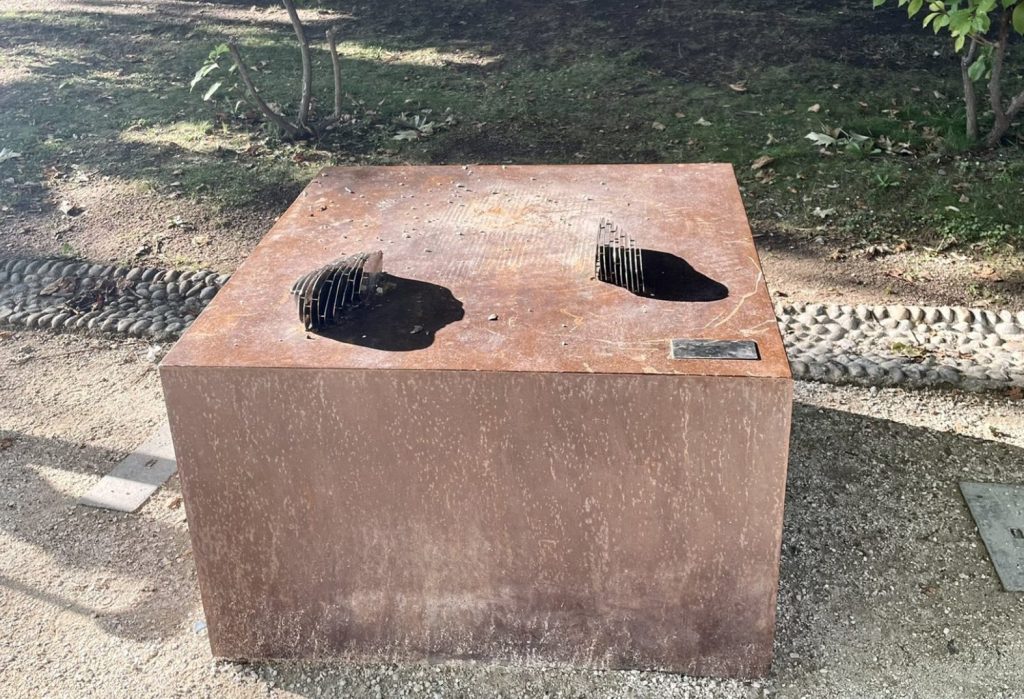
Local investigators suspected intoxicated revelers used tungsten carbide cutting disks and petrol-powered angle grinders to sever the welded bronze sculpture from its base, leaving only the feet attached.

At that time, Satoshigallery, the art collective behind the global campaign, offered a 0.1 Bitcoin reward worth approximately $12,000 for information leading to the recovery of the stolen statue.

The group condemned the vandalism while vowing to continue their mission, declaring, “You can steal our symbol but you will never be able to steal our souls.

The Lugano theft marked the first major incident affecting official Satoshi monuments since Budapest unveiled the world’s first installation in September 2021.

Satoshi Nakamoto Statue
Source: Satoshigallery on X

The global campaign aims to install 21 monuments representing Bitcoin’s 21 million coin supply cap, with existing statues in Budapest, El Salvador’s Bitcoin Beach, Tokyo, and now New York.

Budapest’s original bronze bust featured a faceless, hooded figure with a mirrored surface embodying the “we are all Satoshi” symbolism, while Picozzi’s “Disappearing Satoshi” design depicts a seated figure at a laptop that vanishes when viewed from different angles.

Twenty One Capital Faces Market Headwinds Despite Bitcoin Holdings

Twenty One Capital holds approximately 43,500 bitcoins, valued at over $3.9 billion, making it the world’s third-largest corporate holder.

The company merged with Cantor Equity Partners, a special-purpose acquisition company backed by investment firm Cantor Fitzgerald, and chaired by Brandon Lutnick, son of Commerce Secretary Howard Lutnick.

The deal included $486.5 million in senior convertible notes and roughly $365 million in common equity through private investment transactions.

Shares opened at $10.74 on Tuesday, below the SPAC’s $14.27 closing price, as digital asset treasury companies face mounting pressure.

Twenty One isn’t a treasury company. We’re a Bitcoin company.

A Bitcoin-native business backed by Tether & SoftBank, built for cash flow, growth, and bitcoin accumulation.

The market will need time to understand who we are because it's never seen anything like us. $XXI pic.twitter.com/gzmmYE3nK2

— Jack Mallers (@jackmallers) December 10, 2025

Despite the volatility, Mallers emphasized that Twenty One differs from rivals by not trading at a premium to net asset value and plans to launch products and utility services beyond simply accumulating Bitcoin.

The company is majority-owned by stablecoin giant Tether and crypto exchange Bitfinex, with minority investment from Japanese technology investor SoftBank Group.

Fed Policy Clouds Bitcoin Rally as Traders Reassess Rate Path

Bitcoin traded at $90,121 Thursday morning, down 2.3% following the Federal Reserve’s third consecutive quarter-point rate cut.

Chair Jerome Powell described the reduction as further policy normalization while projecting only one additional cut in 2026, fewer than investors hoped.

Futures now imply a 78% chance that rates remain unchanged at the next meeting, up from 70% before the decision.

🚨 Bitcoin dipped Thursday even as stocks rallied on the Fed’s rate cut and Powell’s upbeat outlook, with policymakers signalling only modest easing ahead.#CryptoMarket #AsiaMarketOpen https://t.co/JgA2tKe3k5

— Cryptonews.com (@cryptonews) December 11, 2025

Speaking with Cryptonews, Ray Youssef, CEO of NoOnes, outlined two scenarios depending on Fed guidance.

A dovish Fed tone could open the door to renewed risk-on sentiment, triggering a ‘Santa rally’ for digital assets, with BTC reclaiming $100,000,” he said, while warning that “a more cautious or hawkish FOMC message” could “drive a retest of the mid $70,000s, as defensive derivatives positioning accelerates downside moves.

He emphasized that Bitcoin’s recovery hinges on renewed capital inflows rather than reduced selling pressure, noting ETF inflows remain shallow and market depth thin.

The post Satoshi Nakamoto Statue Arrives at NYSE as Wall Street Embraces Bitcoin appeared first on Cryptonews.

Bitcoin Price Prediction: Fed Delivers Another 25 bps Cut – Can BTC Finally Break Above $100K?

10 December 2025 at 18:30

Federal Reserve officials approved another 25 basis point interest rate reduction at Wednesday’s FOMC meeting.

Bitcoin remained steady around $92,000 as traders had already priced in the cut, but analysts suggest the Bitcoin price prediction points toward a $100,000 breakout if current support levels hold.

Fed Treasury Bill Purchases Could Fuel Bitcoin Rally

The Fed targets a 2% inflation rate, which officials believe provides optimal employment conditions and price stability for consumers.

🇺🇸 FED RATE CUT DECISION:

25BPS RATE CUT TO 3.75%.

BULLISH FOR MARKETS! pic.twitter.com/uB8V5qseHF

— Mister Crypto (@misterrcrypto) December 10, 2025

Powell has consistently stated that 2% represents the ideal balance, low enough to prevent severe price instability yet high enough to avoid deflation.

Though the 2026 economic landscape remains uncertain, economists have begun making projections.

Goldman Sachs anticipates inflation will decline modestly to approximately 2.34% by December 2026, predicting the Fed will implement two rate cuts during the year, in March and June.

However, CME Group forecasts the Fed won’t reduce rates until June’s meeting, following Powell’s departure from the chair position in May.

Analysts at Kobeissi highlight that the Fed will begin purchasing US Treasury Bills on December 12th, with plans to acquire $40 billion worth within 30 days.

This represents direct liquidity injection into the financial system, not quantitative easing on paper, which could trigger a substantial rally in risk assets like Bitcoin.

Bitcoin Price Prediction: Double-Bottom Pattern Signals $100k Reversal

Bitcoin has formed a textbook double-bottom pattern around the $83,000 support zone, indicating potential mid-term trend reversal.

Price has since reclaimed the $92,000 region, which previously functioned as resistance, and is now attempting to establish it as new support.

Momentum is strengthening on the MACD, with the signal line curving upward and histogram bars approaching a bullish crossover, suggesting increasing buying pressure.

Bitcoin Price Prediction - Bitcoin Price Chart
Source: TradingView

If Bitcoin maintains support above this neckline region, the technical structure points toward advancement to the next major resistance at $100,600, with possible extension toward $108,000 if momentum accelerates.

Losing the $90,000–$92,000 zone would undermine the breakout attempt and risk returning to the $83,000 demand level.

However, the current market structure and indicators favor upward continuation.

Bitcoin Hyper Presale Positioned for Fed Liquidity Boom

Bitcoin isn’t the only investment that could benefit when the Fed adds more money into the system in 2026.

Bitcoin Hyper ($HYPER) is another project worth watching, and it’s still in its early presale stage.

Bitcoin Hyper is already getting attention from investors and has raised almost $30 million so far.

The project is building the first authentic Layer 2 solution for Bitcoin using Solana-based technology that delivers speed and scalability while maintaining Bitcoin’s security framework.

Bitcoin Price Prediction - Bitcoin Hyper Banner

This means people who own Bitcoin can do more with their coins. They can use special tools built just for Bitcoin to earn money or try new features.

As more crypto wallets and exchanges start using this technology, more people will want to buy $HYPER tokens.

If you want to buy $HYPER before the price goes up, go to the official Bitcoin Hyper website.

Connect your crypto wallet (like Best Wallet) and trade your USDT or SOL coins for $HYPER at the current price of $0.013395.

You can also use a regular bank card to buy it right away.

Visit the Official Bitcoin Hyper Website Here

The post Bitcoin Price Prediction: Fed Delivers Another 25 bps Cut – Can BTC Finally Break Above $100K? appeared first on Cryptonews.

Bitcoin Price Prediction: US Bank Now Lets Clients Buy BTC Directly – Could This Be the Start of a Banking Domino Effect?

10 December 2025 at 12:54

PNC Bank, the sixth-largest commercial bank in the United States, has launched direct spot Bitcoin trading for eligible private bank clients, becoming the first major U.S. bank to offer native Bitcoin exposure.

Crypto analysts say the domino effect of this direct custody could positively impact the trajectory of the Bitcoin price prediction.

U.S Banks Break Down Barriers to Bitcoin Access

The new PNC bank service enables qualified private banking clients to purchase, hold, and sell Bitcoin without relying on external cryptocurrency exchanges.

Today marks a major milestone for institutional crypto adoption.@Coinbase’s Crypto-as-a-Service platform is now powering @PNCBank’s launch of direct bitcoin trading for PNC Private Bank clients – the first to market with such an offering among the major U.S. banks. pic.twitter.com/wwuOIRuBfK

— Coinbase Institutional 🛡 (@CoinbaseInsto) December 9, 2025

This development follows a crucial regulatory milestone from the Office of the Comptroller of the Currency, which recently confirmed that national banks may conduct riskless principal crypto-asset transactions.

The decision permits U.S. banks to function as intermediaries in crypto trades by simultaneously buying from one customer and selling to another without maintaining inventory.

Last week, Bank of America authorized its 15,000 wealth management advisers to recommend 1%–4% crypto allocations for client portfolios, signaling a broader institutional embrace of mainstream Bitcoin exposure.

In October, Citibank announced plans to launch crypto custody services in 2026, after developing the infrastructure over two to three years.

Meanwhile, Cryptonews reported in September that BNY Mellon is advancing toward offering custody services for Bitcoin and Ethereum, specifically targeting exchange-traded product clients.

If other major banks replicate PNC’s approach, BTC could establish stronger support levels in the coming months and position itself for a further push toward the $100,000–$130,000 range heading into 2026.

Bitcoin Price Prediction: Breakout Targets $105K, $110K, $120K

Bitcoin is attempting to escape a multi-week descending channel after defending critical support near $83,000.

The recent bounce pushed the price back above the 9-day simple moving average, demonstrating early momentum, though it remains near the channel’s upper boundary.

The RSI has climbed out of oversold territory and is now approaching the mid-50s, indicating recovering bullish momentum following a prolonged downtrend.

Bitcoin Price Prediction - Bitcoin Price Chart
Source: TradingView

If Bitcoin closes decisively above the descending channel and maintains support above $90,000–$92,000, charts suggest upside continuation toward resistance clusters at $105,000, $110,000, and potentially $120,000.

However, failure to sustain this breakout zone risks a retest of $83,000 support.

This New Meme Coin Raised $4.3M Fast – Is It the Next Dogecoin?

As Bitcoin gears up for its next major move, early-stage projects like Maxi Doge ($MAXI) are quickly gaining traction among investors looking for high-upside plays.

Inspired by Dogecoin’s explosive 1,000x rally, $MAXI is building a high-energy community where traders share alpha, early setups, and hidden gems before they go mainstream.

Since launching only a few months ago, the presale has already pulled in over $4.3 million, with strong momentum.

Bitcoin Price Prediction - Maxidoge Banner

This could be one of the cycle’s most relatable, community-first opportunities, and early backers still have time to get in before the next price increase kicks in.

To buy early, visit the official Maxi Doge website and connect a crypto wallet like Best Wallet.

You can swap existing crypto or use a bank card to make the purchase in seconds.

Visit the Official Maxi Doge Website Here

The post Bitcoin Price Prediction: US Bank Now Lets Clients Buy BTC Directly – Could This Be the Start of a Banking Domino Effect? appeared first on Cryptonews.
Stripe Charges 1.5% for Stablecoin Transfers That Cost $0.0002 On-Chain

10 December 2025 at 09:57

Stripe’s rollout of stablecoin payment processing has ignited fierce debate after the payments giant announced it would charge businesses 1.5% to transfer digital dollars that cost fractions of a cent on blockchain networks.

The company now supports USD-settled stablecoin payments across Ethereum, Base, and Polygon, with USDC, USDP, and USDG available through its platform, marking a significant expansion of its crypto infrastructure following its $1.1 billion acquisition of Bridge earlier this year.

Critics immediately highlighted the stark disparity between Stripe’s fees and the actual costs of blockchain transactions.

Sterling Crispin, a software developer, started the debate, arguing that sending $200 USDC on Base cost him just $0.000193 in transaction fees, 0.00009% of the transfer amount, while Stripe would charge $3 for the same transaction.

Incredible innovation, @stripe is charging 1.5% to transfer USDC.

I recently sent $200 of USDC on @base and my transaction fee was 0.00009% , or $0.000193.

The tx fee would have been the same for $1 or $100M USDC

Charging 1.5% simply to send USDC is ludicrously unreasonable https://t.co/uXwubcBpJm pic.twitter.com/SBL0qTHAO9

— Sterling Crispin 🕊 (@sterlingcrispin) December 8, 2025

Charging 1.5% simply to send USDC is ludicrously unreasonable,” Crispin wrote, calculating that Stripe would have extracted $24,818 in fees for a $1.65 million transfer that cost the sender $0.000412 on-chain.

Defenders Cite Value Beyond Transaction Costs

Industry observers defending Stripe’s pricing argue the fee reflects services beyond raw blockchain transactions.

Matt Silvestri noted that Stripe custodies USDC, converts it to USD, and deposits fiat into merchants’ bank accounts, an infrastructure that traditional bank accounts cannot handle directly.

While I agree it sounds high, this fee is for abstracting all complexity away from accepting USDC,” Silvestri explained, adding that 1.5% remains substantially lower than the 3% plus 30 cents per transaction charged by credit card processors.

Stablecoin payments are coming to @stripe and some people are upset that they are charging 1.5%. Stripe users are not crypto degens willing to download wallets with private keys to send USDC by themselves and go through all the operational hassle attached to it.

They will gladly… https://t.co/4faizEM42G pic.twitter.com/GavivKrImk

— Youngsun Shin (@youngsun) December 9, 2025

Youngsun Shin, Head of Product at Flipster, also commented that Stripe users are “not crypto degens willing to download wallets with private keys to send USDC by themselves.

He argued that merchants will “gladly pay the processing fees” to avoid operational complexity, noting that Stripe’s stablecoin integration brings “massive amounts of money on-chain” while benefiting networks like Polygon, Base, and Solana.

Liz Bazurto, Director of BD at Consensys, echoed this perspective, noting that merchants have paid 2.5% to 4% on card transactions for decades while dealing with issues such as incorrect amounts, accounting requirements, and USD payroll needs.

Strategic Implications for Crypto Adoption

Haseeb Qureshi of Dragonfly Capital also stepped in, characterizing Stripe’s pricing as evidence of an incumbent “clinging to their old business model,” comparing it to telecoms offering discounted VoIP rates while Skype provided free calling.

This is so bullish for all the crypto companies,” Qureshi wrote, predicting that merchants will easily switch to lower-cost stablecoin APIs once they achieve feature parity with Stripe’s offering.

He warned that stakeholders should “be scared when the incumbents drop the fees to ~0.

You don't understand–this is actually great. It's exactly what you want to see.

This is the incumbent clinging to their old business model. This is your telco offering VoIP calling for 50% discounted long-distance rates, while Skype was free.

This is so bullish all the crypto… https://t.co/4att1teBb0

— Haseeb >|< (@hosseeb) December 9, 2025

Similarly, Bette Chen of Gluon described Stripe’s approach as “the classic walled-garden tax,” where fintech companies build elegant user experiences “but on old rails with old economics.

She envisions an inversion in which platforms offer “Web2 on the outside, crypto rails on the inside,” enabling users to experience instant, global, and nearly free transactions without realizing they’re using crypto infrastructure.

Mikko Ohtamaa of Trading Strategy also suggested that stablecoin adoption could dramatically impact low-margin international e-commerce businesses, noting that eliminating Stripe’s 1.5% fee could increase profit margins by approximately 20% for companies operating with an 8% inventory markup.

Banks Face Mounting Competitive Pressure

The controversy emerges amid broader structural shifts in financial infrastructure documented in recent industry analysis.

According to StablecoinInsider, eight of the ten largest neobanks now use stablecoin rails internally for treasury settlement and cross-border payments, with platforms like Revolut and Wise routing internal liquidity through stablecoins without branding it as crypto.

Revolut isn't telling you this.

8 of the 10 largest neobanks now use stablecoin rails internally for treasury settlement and cross-border payments.

When you send an "instant transfer" through their app, the backend is settling on public blockchain networks in under a second… pic.twitter.com/ahmd8F8cZh

— James | Ethereum Foundation ⟠ | Snapcrackle.eth (@Snapcrackle) December 9, 2025

Traditional wire transfers costing $45 with three-to-five-day settlement periods face competition from stablecoin rails charging $0.50 with 30-second finality.

Notably, this debate surfaced as Stripe CEO Patrick Collison recently argued that stablecoin growth will force banks to raise deposit yields beyond current rates of 0.40% in the US and 0.25% in the EU.

Cheap deposits are great, but being so consumer-hostile feels to me like a losing position,” Collison stated, predicting that depositors will demand “something closer to a market return on their capital” as stablecoin alternatives proliferate.

The post Stripe Charges 1.5% for Stablecoin Transfers That Cost $0.0002 On-Chain appeared first on Cryptonews.

[LIVE] Bitcoin Price Alert: Fed Chair Powell Press Conference at 2:30 PM ET—Will Guidance Shift Crypto Markets?

10 December 2025 at 08:39

Fed Chair Jerome Powell’s 2:30 PM ET press conference is where Bitcoin traders will get answers on the Fed’s 2025 easing path. Markets already know the December decision; the real question is whether Powell signals two or four more cuts next year.

Bitcoin is holding $92,000 heading into the presser, with traders watching for any hawkish language about “patience” or “data-dependent” policy that could dampen aggressive easing expectations.

The updated dot plot, released at 2pm, will show where Fed officials see rates ending in 2025, but Powell’s tone and forward guidance will determine whether crypto interprets today’s likely 25-basis-point cut as dovish or hawkish.

The key risk for Bitcoin is a “hawkish cut” scenario where Powell emphasizes labor market strength (191K jobless claims, 7.7M job openings) as justification for slowing the pace of easing despite improving core inflation (2.8%).

Any mention of skipping the January meeting or reducing 2025 cuts from four to two would be bearish for risk assets.

Conversely, if Powell stresses that inflation is moving toward the target and the Fed remains committed to normalizing rates, Bitcoin could break above $92,000 resistance.

Bitcoin’s technical setup shows resistance at $92,000 and support at $88,000-$90,000, with the descending trendline since mid-November still intact.

Traders will parse every word from Powell for clues on the January 28-29 FOMC meeting and the overall 2025 trajectory.

The Fed’s credibility is on the line after ending QT and cutting rates twice—backing away from easing now would signal either policy error or genuine concern about sticky inflation.

Powell speaks at 2:30 pm ET, and crypto volatility is expected to spike immediately after.

Powell Press Conference: 2025 Guidance is the Real Story

The post [LIVE] Bitcoin Price Alert: Fed Chair Powell Press Conference at 2:30 PM ET—Will Guidance Shift Crypto Markets? appeared first on Cryptonews.
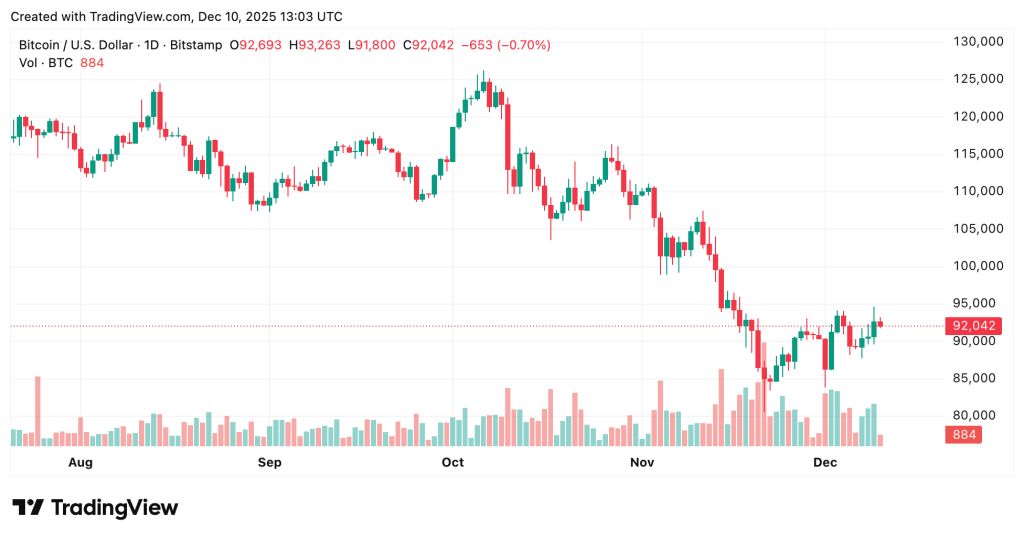
[LIVE] Bitcoin Price Reacts to Fed’s 25bps Rate Cut: Will Powell’s Guidance Shift Crypto Markets?

10 December 2025 at 08:38

The Federal Reserve announces its December interest rate decision at 2:00 PM ET today, with Chair Jerome Powell’s press conference following at 2:30 PM ET.

Bitcoin is trading around $92,000 as markets price in an 89% chance of a rate cut that would lower the federal funds rate to 3.50%-3.75%.

Fed Interest Rate Decision Today - Fed rate Cut Odds CME FedWatch Tool
Source: CME FedWatch Tool

The decision comes after a week of conflicting economic signals, including shockingly strong jobless claims (191K vs 219K expected, lowest since 2022), cooling core PCE inflation (2.8% from 2.9%), and yesterday’s JOLTS data showing job openings unchanged at 7.7 million with quits declining 276,000 year-over-year.

The combination of labor market stability and improving inflation supports the case for easing, but some Fed officials have expressed concern about cutting too aggressively, with employment still resilient.

This marks the Fed’s third policy meeting since beginning its easing cycle with a 50 basis point cut in September, followed by another 25 basis point reduction in October.

The central bank officially ended quantitative tightening on December 1, freezing its balance sheet at $6.57 trillion after draining $2.39 trillion from markets since June 2022.

Markets are focused not just on today’s decision but also on Powell’s guidance for 2025. The updated dot-plot projections could signal whether the Fed sees two, three, or four more cuts next year.

Any hawkish shift suggesting fewer cuts in 2025 would likely pressure Bitcoin and risk assets, while dovish guidance reinforcing the easing cycle could provide the catalyst for Bitcoin to break above $92,000 resistance.

Bitcoin’s technical setup shows critical resistance at $92,000 and the descending trendline that’s capped rallies since mid-November, with support holding at $88,000-$90,000. Total crypto market cap sits at $3.23 trillion.

Fed Interest Rate Decision Today - Bitcoin Price Chart
Source: TradingView

The key risk for crypto is a “hawkish cut”—where the Fed reduces rates 25 basis points today but signals a slower pace of easing in 2025 due to sticky inflation or resilient employment.

Powell’s 2:30 PM press conference will be scrutinized for any hints about the January meeting and the overall trajectory of policy.

With the Fed’s liquidity pivot complete (QT ended) and inflation moving in the right direction, the path of least resistance for Bitcoin is higher—but only if Powell doesn’t pour cold water on aggressive 2025 easing expectations.

Fed Decision Day: Markets Brace for Rate Cut or Hawkish Surprise

The post [LIVE] Bitcoin Price Reacts to Fed’s 25bps Rate Cut: Will Powell’s Guidance Shift Crypto Markets? appeared first on Cryptonews.

Silk Road Wallets Wake Up After 10 Years, Move $3M in Bitcoin

10 December 2025 at 07:01

Hundreds of crypto wallets linked to the now-defunct Silk Road darknet marketplace awakened from a decade-long slumber on Tuesday, transferring over $3 million in Bitcoin to a single unidentified address.

The sudden activity has sparked renewed attention to digital assets tied to the notorious platform that helped popularize Bitcoin in its early years.

Blockchain intelligence firm Arkham detected approximately 312 dormant wallets collectively moving $3.14 million in BTC to the address “bc1q***ga54” over 12 hours.

The wallets still retain roughly $40 million in Bitcoin following the transfers, according to Arkham’s latest data.

Silk Road Bitcoin - Arkham
Source: Arkham

Mystery Surrounds Decade-Old Wallets’ Sudden Activity

The reason behind the wallets’ reactivation remains unclear.

Coinbase Director Conor Grogan identified these holdings earlier this year, estimating that they were worth around $47 million in Bitcoin across dozens of addresses potentially linked to Ross Ulbricht, the marketplace’s creator.

Grogan resurfaced that January analysis on Tuesday after a pseudonymous operator “0xG00gly” flagged the latest movements.

What fresh hell is this? pic.twitter.com/Pt64kB26pO

— Googly 👀 (@0xG00gly) December 9, 2025

Individual transfers ranged from micro-amounts of 0.00006 BTC, roughly $5.58, to larger sums exceeding 3.6 BTC, valued at $338,640.

The transactions followed a pattern of consolidation, with funds from multiple legacy addresses flowing into the single destination wallet over several hours.

Several wallets showed connections to mining activity from the 2011 era, when Bitcoin mining remained accessible to individual participants using standard computer equipment.

Ulbricht himself has not publicly commented on the transfers.

He served multiple life sentences without parole for creating Silk Road before receiving a full and unconditional pardon from President Donald Trump in January through executive order.

Silk Road Bitcoin - Ross Ulbricht Image
Source: CBS

The former darknet operator delivered his first public speech following his release in May, emphasizing freedom and decentralization as guiding principles for future technological advancement.

While Silk Road facilitated illegal narcotics sales and other prohibited transactions, the platform played a pivotal role in Bitcoin’s early adoption.

The marketplace processed over 1.5 million transactions worth an estimated $213 million between 2011 and its 2013 shutdown, all conducted using cryptocurrency.

Ulbricht, a physics graduate and early Bitcoin advocate, envisioned the platform as a libertarian experiment in anonymous commerce free of government interference.

However, prosecutors successfully argued that it enabled widespread criminal activity.

Government Bitcoin Holdings Face Competing Policy Directions

The wallet activity emerges amid ongoing debates over how authorities should handle seized digital assets.

The Department of Justice received approval in December to sell 69,370 Bitcoin, worth $6.5 billion, confiscated from Silk Road, following a federal judge’s ruling that ended a contentious ownership battle with Battle Born Investments.

That company claimed ownership through a bankruptcy estate tied to Raymond Ngan, allegedly the mysterious “Individual X” accused of stealing crypto from Silk Road.

Battle Born lost at every judicial level, including the Supreme Court’s refusal to hear the case.

The company’s attorney criticized what he called “the DOJ’s abuse of the Civil Asset Forfeiture process” and accused officials of “procedural trickery” throughout the litigation.

The approved sale represents one of the largest government cryptocurrency liquidations in history.

📉 Is the U.S. DOJ selling Silk Road Bitcoin, impacting the market? Bitcoin Magazine CEO (@DavidFBailey) suggests potential sales amid price volatility.#Bitcoin #SilkRoadhttps://t.co/4mjRYW2hQW

— Cryptonews.com (@cryptonews) March 10, 2025

Officials justified the decision, citing Bitcoin’s price volatility, though they typically conduct such sales in smaller batches to minimize market disruption.

The decision came despite Trump’s campaign promise to establish a “Strategic Bitcoin Reserve” rather than liquidating government-held cryptocurrency.

The proposed reserve would mirror the Strategic Petroleum Reserve, retaining all seized digital assets to manage economic risks.

Similar dormant wallet movements have triggered security concerns before.

In July, another $8.6 billion in Bitcoin from wallets inactive since 2011 suddenly consolidated, prompting speculation about potential hacks or compromised private keys.

Some observers linked those holdings to Roger Ver, the early Bitcoin advocate arrested in Spain on tax charges, though no confirmation emerged.

Bitcoin’s price has remained relatively stable despite these large-scale transfers. The cryptocurrency traded near $92,500 on Wednesday, up 2.5% as traders awaited the Federal Reserve’s final rate decision of the year.

The post Silk Road Wallets Wake Up After 10 Years, Move $3M in Bitcoin appeared first on Cryptonews.

Federal Regulator Approves Riskless Crypto Trading for US Banks

10 December 2025 at 03:54

The Office of the Comptroller of the Currency confirmed that national banks may engage in riskless principal crypto-asset transactions, eliminating a key barrier between traditional banking and digital assets.

The decision allows banks to act as intermediaries in crypto trades by simultaneously buying from one customer and selling to another without holding inventory.

The policy shift marks the OCC’s most aggressive step yet toward integrating crypto into mainstream banking, building on earlier approvals for custody services and balance sheet holdings.

Banks can now facilitate client crypto trades while assuming only minimal settlement and credit risk.

OCC Interpretive Letter 1188 confirms that a national bank may engage in riskless principal crypto-asset transactions as part of the business of banking. https://t.co/gXirMExhCi pic.twitter.com/uPRFGqb2NZ

— OCC (@USOCC) December 9, 2025

Banking’s Crypto Gateway Opens Under New Framework

In Interpretive Letter 1188, senior deputy comptroller Adam Cohen said the activity falls squarely within the business of banking because it mirrors existing brokerage functions.

National banks have long acted as financial intermediaries in securities, derivatives, and other asset classes through riskless principal transactions, taking momentary ownership to bridge buyer and seller.

The OCC applied the same logic to crypto-assets, noting that banks eliminate market risk through offsetting trades while retaining limited exposure to counterparty defaults.

Cohen emphasized that the authority extends beyond securities to any crypto-asset, including those not classified under federal securities law, because the transactions align with banks’ traditional intermediary role.

Meanwhile, the regulator dismissed concerns about operational complexity, arguing that banks already manage similar risks when settling securities via electronic ledgers.

Cohen said distributed ledger technology simply represents a modern method of recording transactions, no different in principle from book-entry settlement systems that banks have used for decades.

Crypto Trading for US Banks - Centralized vs Decentralized Ledger
Source: CFTE

Why This Changes Bank Crypto Operations

The decision removes a structural obstacle that forced banks to either avoid crypto trading entirely or rely on third-party intermediaries for client transactions.

By allowing direct riskless principal activity, the OCC enables banks to offer seamless crypto services while maintaining regulatory compliance and customer protections.

Banks can now serve clients who want crypto exposure without partnering with unregulated exchanges or pseudonymous counterparties.

🚀U.S. banks officially cleared to hold crypto following the @USOCC policy reversal, a major win for digital assets and traditional finance. #OCC #Bankshttps://t.co/PYpmuOPZmK

— Cryptonews.com (@cryptonews) November 19, 2025

The framework requires banks to implement know-your-customer protocols, transaction monitoring, and the ability to freeze or reverse transfers when necessary, features built into certain blockchain platforms, such as Stellar.

The policy also strengthens banks’ competitive position against fintech rivals and crypto-native firms seeking federal bank charters.

Several major institutions have already moved toward crypto integration, with Bank of America authorizing advisers to recommend Bitcoin ETFs and JPMorgan allowing customers to fund Coinbase accounts via Chase cards.

Regulatory Momentum Builds Across Digital Assets

The OCC’s move comes as federal agencies accelerate the development of stablecoin and tokenized deposit frameworks under the GENIUS Act.

The FDIC will publish its first stablecoin rule proposal later this month, establishing capital, liquidity, and reserve requirements for bank-issued dollar-backed tokens.

Federal Reserve Vice Chair Michelle Bowman said the central bank is coordinating with peer agencies on standards to anchor digital assets to traditional finance.

The Treasury Department closed its second public consultation on non-bank stablecoin issuers in recent weeks, creating parallel oversight tracks that will govern the entire US stablecoin market.

Acting FDIC chair Travis Hill revealed that guidance on tokenized deposits is also underway, clarifying how blockchain-based representations of bank deposits will be treated under existing regulations.

The effort responds to growing industry interest in using distributed ledgers for payments and settlement.

🏦 OCC head Jonathan Gould said that crypto firms seeking federal bank charters should be evaluated on par with traditional financial firms.#OCC #USBankCharter #DigitalAssetFirmshttps://t.co/hXWT3OU9GX

— Cryptonews.com (@cryptonews) December 9, 2025

Jonathan Gould, who became the OCC’s first permanent comptroller since 2020 after confirmation in July, has pushed back against banking industry complaints about approving crypto firm charters.

Speaking at the Blockchain Association Policy Summit last week, he said digital asset custody and safekeeping have operated electronically for decades, adding there is no justification for treating crypto differently.

The OCC received roughly 14 bank charter applications this year, including from Coinbase, Circle, and Ripple, all seeking federal oversight for stablecoin and custody operations.

Gould dismissed concerns about supervisory capacity, noting the agency already supervises a crypto-native national trust bank and fields daily inquiries from traditional banks launching innovative products.

The post Federal Regulator Approves Riskless Crypto Trading for US Banks appeared first on Cryptonews.

❌
❌