Normal view

There are new articles available, click to refresh the page.
Today — 10 December 2025Cryptonews

Ethereum Rises As Altcoin Season Fear Eases And Select Tokens Join The Move

10 December 2025 at 11:41

Sentiment across the market shows a mild improvement today, with the Fear and Greed Index rising to 30 after spending much of the past two weeks in the lower twenties and briefly touching extreme fear levels that had pushed many participants into defensive positioning.

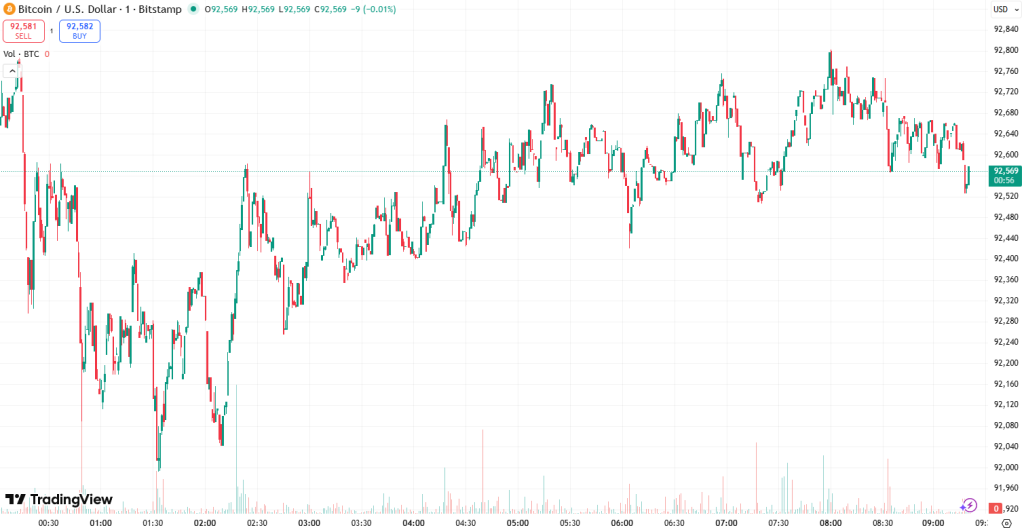
Bitcoin is trading near $92,000 after a stretch of uneven activity that began in late November, and the steadier tone around the largest asset has created a backdrop in which a small group of altcoins can advance without relying on abrupt, flow-driven bursts.

Bitcoin Price (Source: CoinMarketCap)

Ethereum sits at the center of that shift as its performance often sets expectations for how much risk the market is willing to take.

Ethereum Extends Its Climb On Firmer Market Structure

Ethereum (ETH) is currently trading around $3,330, up by about 7% over 24 hours, and the increase is supported by an improvement in both spot and derivatives participation, with deeper books and steadier bidding in ranges that had previously struggled to hold during last week’s retreat.

Activity across major venues indicates that traders who had reduced exposure during the November drawdown are gradually re-entering positions, not because sentiment has shifted dramatically, but because the asset’s day-to-day usage and continued demand for block space provide a degree of stability even when the wider environment remains cautious.

This pattern allows Ethereum to function as an early gauge of whether the current relief has staying power, since its liquidity and scale often give it the ability to recover before smaller assets regain enough confidence to follow.

Monero Gains As Privacy Demand Holds Steady

Monero (XMR) is trading near $404, up by roughly 12% in 24 hours, and the climb aligns with periods in which privacy-oriented tokens receive renewed attention from communities that maintain consistent usage regardless of broader sentiment shifts.

The MAGIC Monero Fund has started a second fundraiser to further increase Monero's fuzzing harnesses!

'The goal of this proposal is to continue working with AdaLogics to improve the overall code coverage of Monero in general.' https://t.co/8QMBp9XeVm

— Monero (XMR) (@monero) December 8, 2025

Depth across several exchanges shows more orderly conditions than last week, with a distribution of bids that implies steady interest rather than isolated buying, which is notable because privacy assets often strengthen when markets search for tokens with established user bases and reliability rather than speculative catalysts.

Mantle Tracks Layer 2 Engagement As Liquidity Improves

Mantle (MNT) is trading near $1.20, up by about 7% in 24 hours, supported by consistent throughput and engagement across the Layer 2 ecosystem that underpins its value.

The token has climbed back above ranges that came under pressure during last week’s downturn, and turnover now sits noticeably higher than the levels seen during the most severe portion of the recent selloff.

This behavior aligns with the tendency for infrastructure and scaling tokens to recover earlier than many smaller assets when sentiment begins to ease, because they rely on live activity and measurable network growth rather than short-term narrative swings.

Altcoin Season Still Out Of Reach Despite Signs Of Relief

The rise in the market sentiment and today’s scattered gains among Ethereum, Monero, and Mantle demonstrate that the market is willing to experiment with selective positioning, yet the structure of flows suggests that a broad altcoin season remains distant.

Bitcoin continues to anchor sentiment near $92,000, and most major tokens remain confined to narrow ranges while participants wait for clearer macro signals, steadier global liquidity conditions, and confirmation that the recent improvement does not fade with the next shift in funding or equities.

For now, the recovery resembles the early-stage attempt to stabilize rather than the altcoin season ready for wide rotation, although the presence of consistent activity in a few established networks shows that the market has not fully retreated from altcoin exposure even as caution remains the prevailing influence.

The post Ethereum Rises As Altcoin Season Fear Eases And Select Tokens Join The Move appeared first on Cryptonews.
Strategy Challenges MSCI Plan to Exclude Digital Asset Treasury Firms from Key Indexes

10 December 2025 at 10:46

Strategy Inc., the world’s largest Bitcoin treasury company, has submitted a detailed response to MSCI’s consultation on how to classify Digital Asset Treasury Companies (DATs).

Strategy has submitted its response to MSCI’s consultation on digital asset treasury companies. Index standards should be neutral, consistent, and reflective of global market evolution. Read our letter and share your support: https://t.co/QVmKAkwRCP

— Strategy (@Strategy) December 10, 2025

MSCI has proposed excluding from its Global Investable Market Indexes any company whose digital asset holdings represent 50% or more of total assets.

In a letter dated December 10, sent by Executive Chairman Michael Saylor and CEO Phong Le, Strategy argues the move is “misguided” and would have “profoundly harmful consequences” for capital markets, innovation, and U.S. leadership in digital assets.

“DATs Are Operating Companies, Not Investment Funds”

The core of Strategy’s argument is that DATs like itself are operating businesses, not passive investment funds. Strategy stresses that it does not simply sit on a Bitcoin hoard; instead, it runs a Bitcoin-backed corporate treasury and capital markets program, issuing a range of equity and fixed-income instruments that provide investors with varying degrees of Bitcoin exposure.

It compares this model to banks and insurers that capture a spread between financing costs and returns on underlying assets.

The company notes that many traditional firms—such as oil majors, REITs, timber companies and media groups—are also heavily concentrated in a single asset type, yet are not treated as funds or excluded from indices. Singling out digital-asset-heavy balance sheets, it says, would be discriminatory and inconsistent.

Strategy Warns of Index Instability and Policy Bias

Strategy contends that MSCI’s proposed 50% digital asset threshold is both arbitrary and unworkable. Given crypto price volatility and divergent accounting standards (GAAP vs. IFRS), companies could “whipsaw on and off” MSCI indices as market values fluctuate, undermining index stability and investor confidence.

The letter also accuses MSCI of improperly injecting policy judgments into index construction, departing from its stated role as a neutral provider of “exhaustive” benchmarks that reflect market evolution rather than deeming certain business models “good or bad.”

Excluding DATs, Strategy argues, would structurally under-represent a fast-growing segment of the economy and call into question the neutrality of MSCI’s indices.

Conflict with U.S. Digital Asset Strategy and Call for Extended Review

Strategy further argues that the proposal conflicts with the current U.S. administration’s pro-innovation digital asset agenda, including initiatives like a Strategic Bitcoin Reserve and efforts to expand access to digital assets in retirement plans.

Excluding DATs from major benchmarks, the company says, would choke off access to passive capital, chill innovation, and weaken U.S. competitiveness in a strategically important sector.

Concluding, Strategy urges MSCI to reject the proposal outright or, at minimum, extend the consultation and undertake a longer, more deliberate review as digital asset treasury models continue to mature. “The wiser course,” the letter states, “is for MSCI to remain neutral and let the markets decide the course of DATs.”

The post Strategy Challenges MSCI Plan to Exclude Digital Asset Treasury Firms from Key Indexes appeared first on Cryptonews.

Singapore Tops 2025 Global Crypto Rankings as RWA Tokenization Jumps 63%: Report

10 December 2025 at 09:58

Singapore has taken the top position in Bybit’s World Crypto Rankings 2025, strengthening its status as one of the most active and structured digital-asset markets.

The new index, produced in conjunction with DL Research, evaluates countries across user activity, institutional readiness, and cultural engagement.

It positions Singapore ahead of the United States and Lithuania, two countries that continue to shape the direction of global crypto markets in distinct ways.

Report Reveals Two Distinct Global Crypto Adoption Models

The report shows how Singapore reached a score of 7.5 out of 10, driven by high user penetration and strong cultural engagement around digital assets.

Its licensing regime, high digital literacy, and active institutional sector have helped create one of the strongest pipelines between retail users and regulated financial entities.

The United States follows closely with a score of 7.3. Its ranking is supported by trading volumes, custody activity, and a growing base of tokenization projects involving major banks and asset managers.

Source: Bybit report

Lithuania, which secured third place with a score of 6.3, continues to be a preferred regulatory base for fintech and exchange firms.

The top ten also includes Switzerland, the United Arab Emirates, Ireland, Canada, the Netherlands, Vietnam, and Hong Kong.

The data shows two clear adoption models. Countries such as Singapore, the U.S., Switzerland, Lithuania, and the UAE reflect an institution-driven pattern shaped by regulation and financial infrastructure.

Source: Bybit report

In contrast, Vietnam, Nigeria, Ukraine, and the Philippines rely on crypto for everyday functions such as remittances, payments, and savings during currency pressure or banking restrictions.

This pattern is consistent with earlier studies from Chainalysis and TRM Labs, which also found high adoption in markets facing economic constraints.

Ukraine, Moldova, and Georgia continue to lead when measured against population size.

Global RWA Market Climbs 63% as Institutions Accelerate Adoption

The report also highlights how quickly real-world asset tokenization has expanded. The market for tokenized RWAs, excluding stablecoins, has risen more than 63% since January 2024, reaching $25.7 billion in early 2025.

Notably, private credit and U.S. Treasuries dominate the sector, holding 15.6 billion and 6.7 billion dollars, respectively.

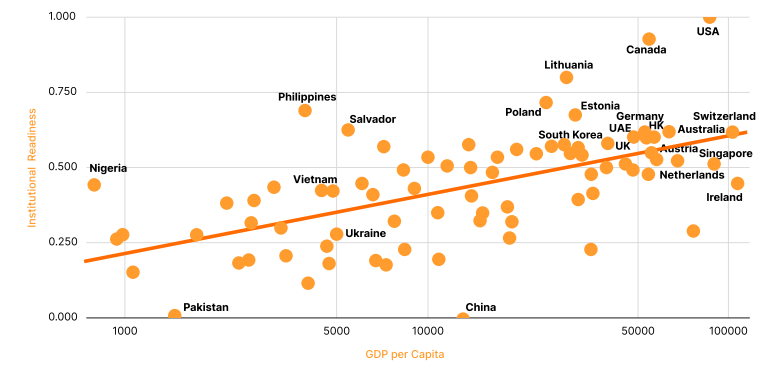
The United States maintains the strongest institutional readiness with a perfect score, supported by regulatory clarity and deep Wall Street engagement.

BlackRock’s BUIDL fund remains one of the fastest-expanding tokenized portfolios, reaching between 1.8 billion and 2.28 billion dollars across several blockchains.

Major banks like JPMorgan, Citi, and Goldman Sachs have expanded tokenized settlement and internal trading programs.

Canada now ranks second in institutional readiness with a score of 0.93, supported by new rules for banks and insurers that will take effect in 2026.

The Philippines is also gaining momentum, becoming a regional example for Southeast Asia as it sets guidelines designed for remittance-heavy markets.

Global Data Shows Surging Stablecoin Use as Singapore Leads Tokenization Push

Singapore’s broader role in tokenized finance has grown as well. In November, the Monetary Authority of Singapore confirmed plans to pilot tokenized MAS bills settled using a central bank digital currency.

Local banks have already tested interbank lending using a wholesale CBDC, reinforcing the shift from experimentation to real operational use.

MAS officials say asset-backed tokens have clearly moved beyond the laboratory stage.

The report also pointed out that stablecoins remain the most consistent asset type across all income groups.

Ukraine records the highest stablecoin flow relative to GDP at 3.6%, followed by Nigeria, Georgia, Vietnam, and Armenia.

These flows underline how digital dollars have become a financial tool in both developed and emerging regions.

Separate research in March showed strong momentum in the Gulf region. The UAE recorded a 210% surge in adoption, the highest of any country in 2025, supported by high ownership levels and strong search activity.

Singapore and the United States followed, with adoption growth of 150% and 220%, respectively.

The post Singapore Tops 2025 Global Crypto Rankings as RWA Tokenization Jumps 63%: Report appeared first on Cryptonews.

Stripe Charges 1.5% for Stablecoin Transfers That Cost $0.0002 On-Chain

10 December 2025 at 09:57

Stripe’s rollout of stablecoin payment processing has ignited fierce debate after the payments giant announced it would charge businesses 1.5% to transfer digital dollars that cost fractions of a cent on blockchain networks.

The company now supports USD-settled stablecoin payments across Ethereum, Base, and Polygon, with USDC, USDP, and USDG available through its platform, marking a significant expansion of its crypto infrastructure following its $1.1 billion acquisition of Bridge earlier this year.

Critics immediately highlighted the stark disparity between Stripe’s fees and the actual costs of blockchain transactions.

Sterling Crispin, a software developer, started the debate, arguing that sending $200 USDC on Base cost him just $0.000193 in transaction fees, 0.00009% of the transfer amount, while Stripe would charge $3 for the same transaction.

Incredible innovation, @stripe is charging 1.5% to transfer USDC.

I recently sent $200 of USDC on @base and my transaction fee was 0.00009% , or $0.000193.

The tx fee would have been the same for $1 or $100M USDC

Charging 1.5% simply to send USDC is ludicrously unreasonable https://t.co/uXwubcBpJm pic.twitter.com/SBL0qTHAO9

— Sterling Crispin 🕊 (@sterlingcrispin) December 8, 2025

Charging 1.5% simply to send USDC is ludicrously unreasonable,” Crispin wrote, calculating that Stripe would have extracted $24,818 in fees for a $1.65 million transfer that cost the sender $0.000412 on-chain.

Defenders Cite Value Beyond Transaction Costs

Industry observers defending Stripe’s pricing argue the fee reflects services beyond raw blockchain transactions.

Matt Silvestri noted that Stripe custodies USDC, converts it to USD, and deposits fiat into merchants’ bank accounts, an infrastructure that traditional bank accounts cannot handle directly.

While I agree it sounds high, this fee is for abstracting all complexity away from accepting USDC,” Silvestri explained, adding that 1.5% remains substantially lower than the 3% plus 30 cents per transaction charged by credit card processors.

Stablecoin payments are coming to @stripe and some people are upset that they are charging 1.5%. Stripe users are not crypto degens willing to download wallets with private keys to send USDC by themselves and go through all the operational hassle attached to it.

They will gladly… https://t.co/4faizEM42G pic.twitter.com/GavivKrImk

— Youngsun Shin (@youngsun) December 9, 2025

Youngsun Shin, Head of Product at Flipster, also commented that Stripe users are “not crypto degens willing to download wallets with private keys to send USDC by themselves.

He argued that merchants will “gladly pay the processing fees” to avoid operational complexity, noting that Stripe’s stablecoin integration brings “massive amounts of money on-chain” while benefiting networks like Polygon, Base, and Solana.

Liz Bazurto, Director of BD at Consensys, echoed this perspective, noting that merchants have paid 2.5% to 4% on card transactions for decades while dealing with issues such as incorrect amounts, accounting requirements, and USD payroll needs.

Strategic Implications for Crypto Adoption

Haseeb Qureshi of Dragonfly Capital also stepped in, characterizing Stripe’s pricing as evidence of an incumbent “clinging to their old business model,” comparing it to telecoms offering discounted VoIP rates while Skype provided free calling.

This is so bullish for all the crypto companies,” Qureshi wrote, predicting that merchants will easily switch to lower-cost stablecoin APIs once they achieve feature parity with Stripe’s offering.

He warned that stakeholders should “be scared when the incumbents drop the fees to ~0.

You don't understand–this is actually great. It's exactly what you want to see.

This is the incumbent clinging to their old business model. This is your telco offering VoIP calling for 50% discounted long-distance rates, while Skype was free.

This is so bullish all the crypto… https://t.co/4att1teBb0

— Haseeb >|< (@hosseeb) December 9, 2025

Similarly, Bette Chen of Gluon described Stripe’s approach as “the classic walled-garden tax,” where fintech companies build elegant user experiences “but on old rails with old economics.

She envisions an inversion in which platforms offer “Web2 on the outside, crypto rails on the inside,” enabling users to experience instant, global, and nearly free transactions without realizing they’re using crypto infrastructure.

Mikko Ohtamaa of Trading Strategy also suggested that stablecoin adoption could dramatically impact low-margin international e-commerce businesses, noting that eliminating Stripe’s 1.5% fee could increase profit margins by approximately 20% for companies operating with an 8% inventory markup.

Banks Face Mounting Competitive Pressure

The controversy emerges amid broader structural shifts in financial infrastructure documented in recent industry analysis.

According to StablecoinInsider, eight of the ten largest neobanks now use stablecoin rails internally for treasury settlement and cross-border payments, with platforms like Revolut and Wise routing internal liquidity through stablecoins without branding it as crypto.

Revolut isn't telling you this.

8 of the 10 largest neobanks now use stablecoin rails internally for treasury settlement and cross-border payments.

When you send an "instant transfer" through their app, the backend is settling on public blockchain networks in under a second… pic.twitter.com/ahmd8F8cZh

— James | Ethereum Foundation ⟠ | Snapcrackle.eth (@Snapcrackle) December 9, 2025

Traditional wire transfers costing $45 with three-to-five-day settlement periods face competition from stablecoin rails charging $0.50 with 30-second finality.

Notably, this debate surfaced as Stripe CEO Patrick Collison recently argued that stablecoin growth will force banks to raise deposit yields beyond current rates of 0.40% in the US and 0.25% in the EU.

Cheap deposits are great, but being so consumer-hostile feels to me like a losing position,” Collison stated, predicting that depositors will demand “something closer to a market return on their capital” as stablecoin alternatives proliferate.

The post Stripe Charges 1.5% for Stablecoin Transfers That Cost $0.0002 On-Chain appeared first on Cryptonews.

Teachers Union Demands Senate Kill Crypto Market Structure Bill, Citing ‘Profound’ Pension Risks

10 December 2025 at 09:56

The American Federation of Teachers is urging Senate leaders to halt work on the chamber’s crypto market structure bill, warning that the proposal could expose public-sector pensions to unsafe assets and strip protections that have long governed traditional securities.

In a letter sent Monday to Senate Banking Committee Chair Tim Scott and Ranking Member Elizabeth Warren, AFT President Randi Weingarten said the Responsible Financial Innovation Act would replace existing safeguards with a framework that leaves retirement plans more vulnerable than they are today.

AFT said Crypto Market Bill Endangers Working Families’ Pensions

Weingarten wrote that the bill “poses profound risks to the pensions of working families,” arguing it would not provide the regulation or “commonsense guardrails” needed around crypto assets and stablecoins.

She said most pension systems do not hold crypto because of its volatility and unclear legal status and warned that the legislation treats digital assets as if they were established and stable financial products when they are not.

The union represents more than 1.8 million workers in education, healthcare, and public services, including many whose retirement income depends on state and local pension plans.

Its letter warned that the bill would allow companies with no connection to crypto to place their stock on a blockchain and avoid the registration, reporting, and oversight requirements that apply today.

According to the union, the shift would let issuers bypass registration rules and remove oversight of intermediaries that move assets between buyers and sellers.

Weingarten said such a move would leave state and federal regulators with fewer tools to hold bad actors accountable, warning that pensions and 401(k) plans could end up holding assets that appear traditional but are not subject to the same standards.

Senate Rekindles Push to Define Crypto Regulatory Boundaries

The Responsible Financial Innovation Act is the Senate’s main effort to define which crypto assets fall under the jurisdiction of the CFTC and which belong under the SEC. It also aims to set federal rules for exchanges, brokers, custodians, and token issuers.

Supporters say the bill is needed to clarify a growing patchwork of crypto oversight, while critics argue it could break apart existing securities protections without replacing them with something equal in strength.

The debate comes as policymakers attempt to determine whether tokenized versions of traditional instruments can be traded under a revised federal structure and what that means for investors who rely on the security of established markets.

Work on the Senate bill had slowed in the months following the longest government shutdown in U.S. history, which created a backlog across financial regulatory agencies.

🇺🇸 Trump signs bill ending 43-day shutdown. ETFs await approvals, and markets eye potential weekend momentum.#Shutdown #Bitcoinhttps://t.co/zzvrf2SqdN

— Cryptonews.com (@cryptonews) November 13, 2025

Senate Staff Races to Finalize Draft as Holiday Deadline Nears

Several senators have said a new version could emerge before the year ends, though the timeline remains uncertain.

The political environment surrounding the bill has become increasingly tense. Senator Cory Booker warned this week that the legislation’s prospects were weakened after signs that the Supreme Court may soon allow President Trump to fire SEC and CFTC commissioners at will.

With no Democrats currently seated at either agency, and none expected until at least January, Booker said the absence of minority commissioners complicates any bill that depends on those regulators to implement its framework.

The CFTC is currently led by Acting Chair Caroline Pham, who has held the position since January after Rostin Behnam stepped down.

President Trump has nominated Michael Selig, a senior SEC attorney focused on cryptocurrency policy, to serve as the permanent chairman, though his confirmation remains pending before the Senate.

Despite the uncertainty, Senator Cynthia Lummis said she wants the Senate Banking Committee to move ahead with a markup of the market structure bill as early as next week.

@SenLummis says she wants a markup on the crypto market structure bill next week even as staff are “exhausted” from nonstop revisions. #Crypto #USPolicy #Lummishttps://t.co/RadNIvnWLp

— Cryptonews.com (@cryptonews) December 9, 2025

She described staff across both parties as “exhausted” after multiple rounds of revisions and said she hopes to circulate a final draft before Congress leaves for the holidays.

The post Teachers Union Demands Senate Kill Crypto Market Structure Bill, Citing ‘Profound’ Pension Risks appeared first on Cryptonews.

[LIVE] Bitcoin Price Alert: Fed Chair Powell Press Conference at 2:30 PM ET—Will Guidance Shift Crypto Markets?

10 December 2025 at 08:39

Fed Chair Jerome Powell’s 2:30 PM ET press conference is where Bitcoin traders will get answers on the Fed’s 2025 easing path. Markets already know the December decision; the real question is whether Powell signals two or four more cuts next year.

Bitcoin is holding $92,000 heading into the presser, with traders watching for any hawkish language about “patience” or “data-dependent” policy that could dampen aggressive easing expectations.

The updated dot plot, released at 2pm, will show where Fed officials see rates ending in 2025, but Powell’s tone and forward guidance will determine whether crypto interprets today’s likely 25-basis-point cut as dovish or hawkish.

The key risk for Bitcoin is a “hawkish cut” scenario where Powell emphasizes labor market strength (191K jobless claims, 7.7M job openings) as justification for slowing the pace of easing despite improving core inflation (2.8%).

Any mention of skipping the January meeting or reducing 2025 cuts from four to two would be bearish for risk assets.

Conversely, if Powell stresses that inflation is moving toward the target and the Fed remains committed to normalizing rates, Bitcoin could break above $92,000 resistance.

Bitcoin’s technical setup shows resistance at $92,000 and support at $88,000-$90,000, with the descending trendline since mid-November still intact.

Traders will parse every word from Powell for clues on the January 28-29 FOMC meeting and the overall 2025 trajectory.

The Fed’s credibility is on the line after ending QT and cutting rates twice—backing away from easing now would signal either policy error or genuine concern about sticky inflation.

Powell speaks at 2:30 pm ET, and crypto volatility is expected to spike immediately after.

Powell Press Conference: 2025 Guidance is the Real Story

The post [LIVE] Bitcoin Price Alert: Fed Chair Powell Press Conference at 2:30 PM ET—Will Guidance Shift Crypto Markets? appeared first on Cryptonews.

[LIVE] Bitcoin Price Watch: Fed Interest Rate Decision Today — Will Powell Cut or Pause?

10 December 2025 at 08:38

The Federal Reserve announces its December interest rate decision at 2:00 PM ET today, with Chair Jerome Powell’s press conference following at 2:30 PM ET.

Bitcoin is trading around $92,000 as markets price in an 89% chance of a rate cut that would lower the federal funds rate to 3.50%-3.75%.

Fed Interest Rate Decision Today - Fed rate Cut Odds CME FedWatch Tool
Source: CME FedWatch Tool

The decision comes after a week of conflicting economic signals, including shockingly strong jobless claims (191K vs 219K expected, lowest since 2022), cooling core PCE inflation (2.8% from 2.9%), and yesterday’s JOLTS data showing job openings unchanged at 7.7 million with quits declining 276,000 year-over-year.

The combination of labor market stability and improving inflation supports the case for easing, but some Fed officials have expressed concern about cutting too aggressively, with employment still resilient.

This marks the Fed’s third policy meeting since beginning its easing cycle with a 50 basis point cut in September, followed by another 25 basis point reduction in October.

The central bank officially ended quantitative tightening on December 1, freezing its balance sheet at $6.57 trillion after draining $2.39 trillion from markets since June 2022.

Markets are focused not just on today’s decision but also on Powell’s guidance for 2025. The updated dot-plot projections could signal whether the Fed sees two, three, or four more cuts next year.

Any hawkish shift suggesting fewer cuts in 2025 would likely pressure Bitcoin and risk assets, while dovish guidance reinforcing the easing cycle could provide the catalyst for Bitcoin to break above $92,000 resistance.

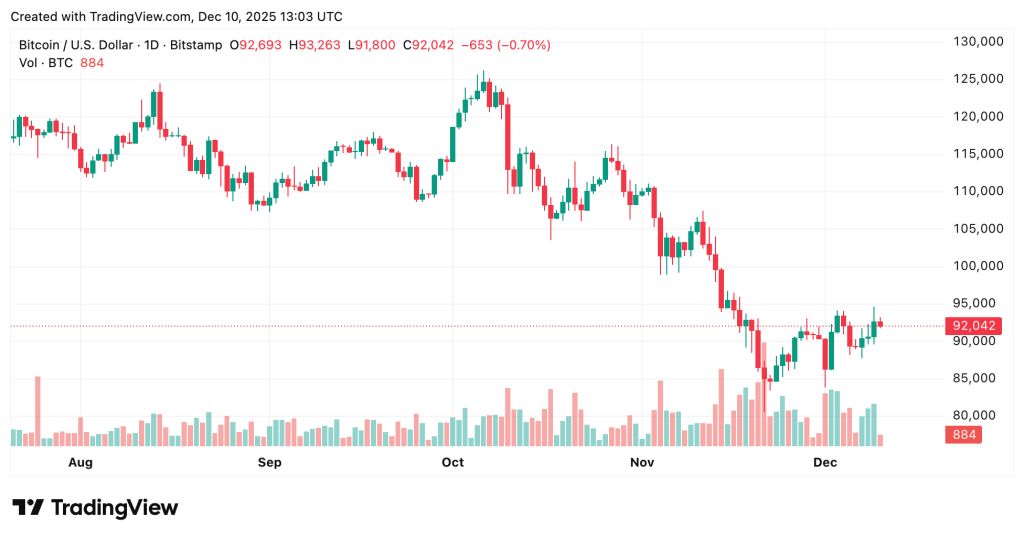
Bitcoin’s technical setup shows critical resistance at $92,000 and the descending trendline that’s capped rallies since mid-November, with support holding at $88,000-$90,000. Total crypto market cap sits at $3.23 trillion.

Fed Interest Rate Decision Today - Bitcoin Price Chart
Source: TradingView

The key risk for crypto is a “hawkish cut”—where the Fed reduces rates 25 basis points today but signals a slower pace of easing in 2025 due to sticky inflation or resilient employment.

Powell’s 2:30 PM press conference will be scrutinized for any hints about the January meeting and the overall trajectory of policy.

With the Fed’s liquidity pivot complete (QT ended) and inflation moving in the right direction, the path of least resistance for Bitcoin is higher—but only if Powell doesn’t pour cold water on aggressive 2025 easing expectations.

Fed Decision Day: Markets Brace for Rate Cut or Hawkish Surprise

The post [LIVE] Bitcoin Price Watch: Fed Interest Rate Decision Today — Will Powell Cut or Pause? appeared first on Cryptonews.

Why Is Crypto Up Today? – December 10, 2025

10 December 2025 at 07:42

The crypto market is up today, with the cryptocurrency market capitalisation increasing by 2.6% to $3.25 trillion. 92 of the top 100 coins have gone up over the past 24 hours. At the same time, the total crypto trading volume is at $147 billion.

TLDR:
  • Crypto market cap increased by 2.6% on Wednesday morning (UTC);
  • 92 of the top 100 coins and 9 of the top 10 coins have gone up today;
  • BTC increased by 2.3% to $92,694, and ETH is up by 6.6% to $3,331;
  • The $90,000 level looks like the bottom for now;
  • A consolidation period between $90,000 and $95,000 over the coming weeks is likely;
  • Investors await the US Fed rate cut decision today;
  • Changpeng Zhao argued that BTC could see a major rally in 2026;
  • Investors should monitor the effects of the news flows on dollar dynamics and safe-haven demand;
  • The US allowed national banks to act as intermediaries in crypto trades;
  • US BTC and ETH spot ETFs saw inflows on Tuesday of $151.74M and $177.64M, respectively;
  • Strive Asset Management plans to acquire more BTC;
  • Crypto market sentiment posted a notable increase within the fear zone.
  • Crypto Winners & Losers

    At the time of writing, 9 of the top 10 coins per market capitalization have seen their prices increase over the past 24 hours.

    Bitcoin (BTC) is up by 2.3% since this time yesterday, currently trading at $92,694.

    btc logo
    Bitcoin (BTC)
    24h7d30d1yAll time

    Ethereum (ETH) is up by 6.6%, now changing hands at $3,331. This is the category’s highest increase today.

    The second-highest rise is Solana (SOL)’s 4.4%, trading at $139.

    It’s followed by Dogecoin (DOGE)’s 4.2% to the price of $0.1468.

    The smallest rise in the category is 0.7% by Binance Coin (BNB), now standing at $893.

    The only fall among the ten is 0.4% by Tron (TRX), currently trading at $0.28.

    As for the top 100 coins, 92 have appreciated over the past day.

    MemeCore (M) increased the most among these with the only double-digit rise: 10.2% to $1.45.

    Cardano (ADA) follows with a 7.6% rise to $0.4603.

    When it comes to the red coins, Bitcoin Cash (BCH) fell the most: 1.8% to $563.

    LEO Token (LEO) is next, with a fall of 1.3% to $9.54.

    Traders are focused on the US Federal Reserve’s decision on the interest rate cut expected to be announced today. However, many argue that the cut is already priced in.

    Meanwhile, Changpeng Zhao argued that Bitcoin could see a major rally in 2026, potentially matching gold’s performance.

    CZ just said “we might see a supercycle.” pic.twitter.com/9aatNffTdC

    — Ash Crypto (@AshCrypto) December 9, 2025

    A Consolidation Period Ahead

    Koinly CEO Robin Singh commented that BTC’s recent uptick to almost $93,000 ahead of the US Federal Reserve rate cut decision “clearly signals that bulls are firmly defending the $90,000 level, which is now looking like the bottom, at least, for now.”

    According to Singh,

    “From here, a period of consolidation between $90,000 and $95,000 over the coming weeks is a ‘probably outcome’, as the market waits for a new catalyst capable of driving the next leg higher.”

    However, that kind of pause should not be seen as a negative, he argues. Much of 2024 was defined by consolidation, but a major macro catalyst – in that case, the outcome of the US presidential election – triggered a sharp rally across markets.

    He continues: “Periods like this often signal maturation rather than weakness, with Bitcoin holding its ground even in the absence of immediate drivers for fresh momentum.”

    Moreover, Bitunix analysts noted that geopolitical uncertainty is rising, so the crypto market sentiment remains cautious.

    Notably, “within the negotiation framework, the U.S., Ukraine, and Europe remain locked in a three-way tug-of-war. If ongoing negotiation headlines continue to fuel safe-haven demand, volatility may be driven by a combination of macro sentiment and liquidity positioning,” the analysts said.

    For now, BTC is watching resistance at $93,200, with support at $90,000–$91,000.

    They advise investors to monitor the effects of the news flows on dollar dynamics and safe-haven demand, and to assess whether geopolitical noise may spill over into broader risk-asset volatility.

    Levels & Events to Watch Next

    At the time of writing on Wednesday morning, BTC stood at $92,694. The prise recorded a clear jump from the intraday low of $90,040 to the intraday high of $94,489.

    However, the charts turned red in the 7-day period. BTC is now down 0.3%, but such a small move also means that it’s largely unchanged in this timeframe.

    If the coin reclaims the $98,000–$100,000 range, it could push forward to $105,000 and $110,000. However, if it drops below $90,000, it could pull back to the $82,000–$85,000 zone.

    Bitcoin Price Chart. Source: TradingView

    Ethereum is currently changing hands at $3,122. Like BTC, it saw a significant jump earlier in the day, climbing from the day’s low of $3,099 to the high of $3,388.

    That said, unlike BTC, ETH remains green in the 7-day timeframe, appreciating 8.6%.

    ETH supply has hit a 10-year low, a setup for major rallies. The price could proceed towards $3,400, followed by the $3,500-$3,600 range. Should it pull back, the price may fall to the $2,900 level.

    Ethereum (ETH)
    24h7d30d1yAll time

    Meanwhile, the crypto market posted a notable increase on Wednesday morning, even if it still remains in the fear territory. The crypto fear and greed index rose to 30 today from 25 yesterday.

    It seems that market participants remain highly cautious while experiencing a mild increase in optimism.

    Even though many argue that the US rate cut is already priced in, today’s news could still affect the sentiment.

    ETFs Go Green Again

    Following a day of outflows, the US BTC spot exchange-traded funds (ETFs) recorded $151.74 million in inflows. The total net inflow now stands at $57.71 billion.

    Of the twelve BTC ETFs, a whopping eight recorded inflows, and one saw outflows. BlackRock accounts for the entirety of the negative flows: $28.76 million.

    At the same time, Fidelity saw the highest amount of inflows of $198.85 million, followed by Grayscale’s $33.79 million and Bitwise’s $16.22 million.

    Moreover, the US ETH ETFs posted another day of positive flows on 9 December, with $177.64 million in inflows. This is the highest amount since late October. The total net inflow now stands at $13.09 billion.

    Of the nine funds, seven recorded inflows, and none saw outflows. Fidelity took in the most on Tuesday: $51.47 million.

    It’s followed by Grayscale’s $45.19 million and BlackRock’s $35.29 million.

    Meanwhile, Vivek Ramaswamy’s Strive Asset Management has announced a $500 million preferred stock offering, aiming to acquire more BTC. It currently holds 7,525 BTC, worth some $695.93 million.

    Moreover, the US Office of the Comptroller of the Currency has allowed national banks to act as intermediaries in crypto trades. They can now buy from one customer and sell to another without holding inventory.

    OCC Interpretive Letter 1188 confirms that a national bank may engage in riskless principal crypto-asset transactions as part of the business of banking. https://t.co/gXirMExhCi pic.twitter.com/uPRFGqb2NZ

    — OCC (@USOCC) December 9, 2025

    Quick FAQ

    1. Why did crypto move with stocks today?

    The crypto market recorded an increase over the past 24 hours, and the US stock market closed mixed during its previous session. By the closing time on Tuesday, 9 December, the S&P 500 was down by 0.088%, the Nasdaq-100 increased by 0.16%, and the Dow Jones Industrial Average fell by 0.38%. Investors expect the US Federal Reserve to lower their policy rate by a quarter percentage point today.

    1. Is this rally sustainable?

    The market is expected to continue moving in this tight range we’ve been observing for the past month, though major macroeconomic prompts could push it outside that range – in either direction.

    The post Why Is Crypto Up Today? – December 10, 2025 appeared first on Cryptonews.

    Abu Dhabi’s Mubadala Capital Partners With Kaio to Explore On-Chain RWAs

    By: Amin Ayan
    10 December 2025 at 07:06

    Abu Dhabi’s Mubadala Capital has entered a collaboration with institutional RWA infrastructure provider Kaio to study how digital rails can support tokenized access to private market strategies.

    Key Takeaways:

    • Mubadala Capital is exploring tokenized private market access with Kaio.
    • The partnership reflects rising institutional interest in RWAs.
    • Tokenized assets continue gaining momentum as infrastructure improves.

    Announced Tuesday, the partnership will focus on testing how Kaio’s framework could allow institutional and accredited investors to access Mubadala Capital’s private market products onchain.

    While the work remains exploratory, it reflects growing interest in using RWA tokenization to modernize fund structures traditionally restricted by steep minimums, long lockups and jurisdictional limits.

    Mubadala Capital Manages $430B Across Global Markets

    Mubadala Capital oversees and advises on more than $430 billion across private equity, credit, real estate and alternative strategies.

    It operates as a subsidiary of Mubadala Investment Company, one of Abu Dhabi’s major sovereign wealth funds.

    The group’s broader digital-asset positioning has drawn attention recently. In November, Bloomberg reported that the Abu Dhabi Investment Council, another Mubadala subsidiary, held at least $500 million in BlackRock’s spot Bitcoin ETF.

    In Tuesday’s announcement, Fatima Al Noaimi and Max Franzetti, co-heads of Mubadala Capital Solutions, said the goal is to work with regulatory-aligned infrastructure to understand how tokenization can broaden access to institutional-grade vehicles.

    Big news! We are proud to announce our collaboration with @Mubadala Capital to explore tokenized access to their private market investment strategies.

    By leveraging our compliant tokenization framework, we are enabling new global access channels while maintaining the highest… pic.twitter.com/uKRkn8mTJu

    — KAIO (@KAIO_xyz) December 9, 2025

    Kaio brings prior experience in the sector, having helped structure tokenized feeder funds for firms such as BlackRock, Brevan Howard and Hamilton Lane.

    The company has moved more than $200 million in institutional assets onchain and says the Mubadala initiative underscores momentum behind onchain investment products.

    “This launch demonstrates how traditional institutional capital is now scaling onchain,” Kaio CEO Shrey Rastogi said.

    The move places Mubadala among a growing cohort of institutional players studying whether tokenized mechanisms can cut operational friction and eventually expand global participation.

    CoinShares data shows strong demand for RWAs in 2025, particularly tokenized US Treasurys, which grew from $3.9 billion to $8.6 billion this year. The firm expects the trend to continue into 2026 as appetite for dollar-based yields remains elevated.

    Infrastructure is also evolving to support the shift. On Wednesday, Polygon deployed a hard fork aimed at strengthening performance for high-frequency applications such as stablecoins and tokenized RWAs.

    RWA Tokenization Gains Momentum

    On Monday, Libeara, the blockchain infrastructure platform backed by Standard Chartered’s venture arm SC Ventures, rolled out a new tokenized gold investment fund in Singapore, bringing one of the world’s oldest safe-haven assets onto digital rails.

    The fund, launched in partnership with FundBridge Capital, allows professional investors to gain exposure to gold through blockchain-based tokens issued on Libeara’s ledger.

    In a recent research, Web3 digital property firm Animoca Brands said that tokenization of RWAs could unlock a $400 trillion traditional finance market.

    Animoca researchers Andrew Ho and Ming Ruan said the global market for private credit, treasury debt, commodities, stocks, alternative funds, and bonds represents a vast runway for growth.

    “The estimated $400 trillion addressable TradFi market underscores the potential growth runway for RWA tokenization,” they wrote.

    Meanwhile, according to the 2025 Skynet RWA Security Report, the market for tokenized RWAs could grow to $16 trillion by 2030.

    The post Abu Dhabi’s Mubadala Capital Partners With Kaio to Explore On-Chain RWAs appeared first on Cryptonews.

    FinCEN Fines Paxful $3.5M for Enabling $500M in Illicit Crypto Transactions

    By: Amin Ayan
    10 December 2025 at 07:05

    The US Treasury’s Financial Crimes Enforcement Network (FinCEN) has fined peer-to-peer crypto marketplace Paxful $3.5 million.

    Key Takeaways:

    • FinCEN fined Paxful $3.5M for willfully enabling over $500M in suspicious crypto transfers.
    • Regulators said Paxful ignored basic AML rules, including MSB registration and SAR filings.
    • Paxful later shut down amid regulatory pressure, staff losses, and internal legal disputes.

    The regulator accused the company of willfully violating federal anti-money laundering laws and allowing more than $500 million in suspicious transfers linked to high-risk jurisdictions and criminal activity.

    According to FinCEN, Paxful facilitated transactions tied to Iran, North Korea, Venezuela, and even Backpage.com, the notorious classifieds site seized in 2018 for enabling sex trafficking.

    FinCEN Says Paxful Ignored Basic Anti–Money Laundering Rules

    Regulators said Paxful failed to implement even the most basic requirements of the Bank Secrecy Act (BSA), including registering as a money services business, maintaining an anti-money-laundering program, and filing suspicious activity reports.

    “For years, Paxful disregarded its BSA obligations and facilitated transactions associated with illicit activity and high-risk jurisdictions,” FinCEN Director Andrea Gacki said.

    Paxful acknowledged that it willfully violated federal law. The consent order highlights major compliance lapses during the years in which Paxful operated without adequate oversight, largely due to failures by former leadership.

    FinCEN said the company has since taken steps to correct past misconduct, including firing senior figures responsible for the violations and conducting an internal review to identify suspicious activity previously left unreported.

    Regulators from multiple federal agencies assisted in the case, including the Justice Department’s Money Laundering and Narcotics section, the US Attorney’s Office for the Eastern District of California, and Homeland Security Investigations.

    Today, FinCEN assessed a $3.5 million penalty against Paxful for facilitating suspicious activity involving illicit actors. https://t.co/dkdJNxPCIL pic.twitter.com/wVBAwlHyvr

    — Financial Crimes Enforcement Network (FinCEN) (@FinCENnews) December 9, 2025

    The agency emphasized that firms involved in digital assets must adjust their controls to match the risks inherent in dealing with crypto, especially exposure to sanctioned jurisdictions and anonymous transfers.

    In 2023, Paxful shut down its peer-to-peer crypto marketplace, citing the broader industry downturn, regulatory pressure, and internal turmoil.

    CEO Ray Youssef cited multiple factors behind the shutdown, including major staff departures, increasingly burdensome US regulatory requirements, and a lawsuit filed by a co-founder, reportedly Artur Schaback.

    He said compliance demands had grown so intense that even dedicating a quarter of Paxful’s workforce to compliance was not enough.

    The company also lacked the resources to continue operating while blocking US users, making a full marketplace suspension unavoidable.

    B.C. Seizes Over $1M in Gold, Cash Linked to QuadrigaCX Co-Founder

    As reported, British Columbia has secured a major legal victory after obtaining a court order to seize more than $1 million in gold, cash, and luxury goods tied to QuadrigaCX co-founder Michael Patryn.

    The forfeiture comes under the province’s unexplained wealth order regime, which requires individuals to prove their assets were acquired lawfully.

    Patryn chose not to contest the action, allowing authorities to move forward with liquidating the seized items.

    The seized assets were discovered in a Vancouver safety deposit box and included 45 gold bars, luxury watches, jewelry, and a loaded .45-caliber pistol.

    At today’s prices, the gold alone is worth over $800,000. The province’s civil forfeiture office alleges these items were purchased using misappropriated QuadrigaCX customer funds, citing evidence gathered during a broader RCMP investigation.

    The post FinCEN Fines Paxful $3.5M for Enabling $500M in Illicit Crypto Transactions appeared first on Cryptonews.

    Silk Road Wallets Wake Up After 10 Years, Move $3M in Bitcoin

    10 December 2025 at 07:01

    Hundreds of crypto wallets linked to the now-defunct Silk Road darknet marketplace awakened from a decade-long slumber on Tuesday, transferring over $3 million in Bitcoin to a single unidentified address.

    The sudden activity has sparked renewed attention to digital assets tied to the notorious platform that helped popularize Bitcoin in its early years.

    Blockchain intelligence firm Arkham detected approximately 312 dormant wallets collectively moving $3.14 million in BTC to the address “bc1q***ga54” over 12 hours.

    The wallets still retain roughly $40 million in Bitcoin following the transfers, according to Arkham’s latest data.

    Silk Road Bitcoin - Arkham
    Source: Arkham

    Mystery Surrounds Decade-Old Wallets’ Sudden Activity

    The reason behind the wallets’ reactivation remains unclear.

    Coinbase Director Conor Grogan identified these holdings earlier this year, estimating that they were worth around $47 million in Bitcoin across dozens of addresses potentially linked to Ross Ulbricht, the marketplace’s creator.

    Grogan resurfaced that January analysis on Tuesday after a pseudonymous operator “0xG00gly” flagged the latest movements.

    What fresh hell is this? pic.twitter.com/Pt64kB26pO

    — Googly 👀 (@0xG00gly) December 9, 2025

    Individual transfers ranged from micro-amounts of 0.00006 BTC, roughly $5.58, to larger sums exceeding 3.6 BTC, valued at $338,640.

    The transactions followed a pattern of consolidation, with funds from multiple legacy addresses flowing into the single destination wallet over several hours.

    Several wallets showed connections to mining activity from the 2011 era, when Bitcoin mining remained accessible to individual participants using standard computer equipment.

    Ulbricht himself has not publicly commented on the transfers.

    He served multiple life sentences without parole for creating Silk Road before receiving a full and unconditional pardon from President Donald Trump in January through executive order.

    Silk Road Bitcoin - Ross Ulbricht Image
    Source: CBS

    The former darknet operator delivered his first public speech following his release in May, emphasizing freedom and decentralization as guiding principles for future technological advancement.

    While Silk Road facilitated illegal narcotics sales and other prohibited transactions, the platform played a pivotal role in Bitcoin’s early adoption.

    The marketplace processed over 1.5 million transactions worth an estimated $213 million between 2011 and its 2013 shutdown, all conducted using cryptocurrency.

    Ulbricht, a physics graduate and early Bitcoin advocate, envisioned the platform as a libertarian experiment in anonymous commerce free of government interference.

    However, prosecutors successfully argued that it enabled widespread criminal activity.

    Government Bitcoin Holdings Face Competing Policy Directions

    The wallet activity emerges amid ongoing debates over how authorities should handle seized digital assets.

    The Department of Justice received approval in December to sell 69,370 Bitcoin, worth $6.5 billion, confiscated from Silk Road, following a federal judge’s ruling that ended a contentious ownership battle with Battle Born Investments.

    That company claimed ownership through a bankruptcy estate tied to Raymond Ngan, allegedly the mysterious “Individual X” accused of stealing crypto from Silk Road.

    Battle Born lost at every judicial level, including the Supreme Court’s refusal to hear the case.

    The company’s attorney criticized what he called “the DOJ’s abuse of the Civil Asset Forfeiture process” and accused officials of “procedural trickery” throughout the litigation.

    The approved sale represents one of the largest government cryptocurrency liquidations in history.

    📉 Is the U.S. DOJ selling Silk Road Bitcoin, impacting the market? Bitcoin Magazine CEO (@DavidFBailey) suggests potential sales amid price volatility.#Bitcoin #SilkRoadhttps://t.co/4mjRYW2hQW

    — Cryptonews.com (@cryptonews) March 10, 2025

    Officials justified the decision, citing Bitcoin’s price volatility, though they typically conduct such sales in smaller batches to minimize market disruption.

    The decision came despite Trump’s campaign promise to establish a “Strategic Bitcoin Reserve” rather than liquidating government-held cryptocurrency.

    The proposed reserve would mirror the Strategic Petroleum Reserve, retaining all seized digital assets to manage economic risks.

    Similar dormant wallet movements have triggered security concerns before.

    In July, another $8.6 billion in Bitcoin from wallets inactive since 2011 suddenly consolidated, prompting speculation about potential hacks or compromised private keys.

    Some observers linked those holdings to Roger Ver, the early Bitcoin advocate arrested in Spain on tax charges, though no confirmation emerged.

    Bitcoin’s price has remained relatively stable despite these large-scale transfers. The cryptocurrency traded near $92,500 on Wednesday, up 2.5% as traders awaited the Federal Reserve’s final rate decision of the year.

    The post Silk Road Wallets Wake Up After 10 Years, Move $3M in Bitcoin appeared first on Cryptonews.

    Buterin to Musk: Turning X Into a Weaponized Hate Platform Could Backfire on Free Speech

    10 December 2025 at 05:59

    Ethereum co-founder Vitalik Buterin has issued a sharp warning to Elon Musk, expressing concern that X’s evolution from a platform championing free speech to a tool for organizing targeted hate could trigger a global backlash and ultimately undermine the very freedoms Musk claims to defend.

    In a series of posts, Buterin said that public discourse around Europe — including from individuals he previously viewed as “interesting and sophisticated” — has grown “unhinged,” fuelled by increasingly aggressive online narratives.

    @elonmusk I think you should consider that making X a global totem pole for Free Speech, and then turning it into a death star laser for coordinated hate sessions, is actually harmful for the cause of free speech. I'm seriously worried that huge backlashes against values I hold…

    — vitalik.eth (@VitalikButerin) December 9, 2025

    While he acknowledged legitimate criticisms of the EU, citing GDPR “clickthroughs” and “Chat Control” as policies needing reform, Buterin cautioned that the tone and coordination of these attacks signal something more dangerous.

    Addressing Musk directly, Buterin wrote that turning X into “a global totem pole for Free Speech, and then turning it into a death star laser for coordinated hate sessions” is “harmful for the cause of free speech.”

    He added that he is worried about the long-term consequences, warning of “huge backlashes against values I hold dear” emerging within a few years if the platform continues allowing escalation rather than debate.

    The Debate Over Europe: Too Much Unity or Not Enough?

    The comments triggered a wider conversation on X about Europe’s geopolitical role. One user argued that those advocating for a weakened Europe misunderstand global power dynamics, claiming international actors “drool” over the idea of dissolving EU unity and fear it may eventually federalize.

    Buterin responded that he supports the idea of the EU — a shared experiment delivering the benefits of a superstate without the aggressive posture of a world power — but emphasized the union remains “a work in progress.” According to him, the balance is off: not enough unity in foreign policy and too much unity where it becomes bureaucracy and surveillance.

    “If the experiment can be improved and thrives,” Buterin wrote, “it’s a model that could set a really good example for the world.”

    The Free Speech Paradox Tech Platforms Now Face

    Buterin’s intervention joins a growing list of voices wrestling with the same tension: Where is the line between free expression and coordinated harm? And — perhaps more importantly — who draws that line?

    Musk has positioned X as a refuge against censorship after acquiring the platform in 2022. But critics argue that what began as a defense of open expression has enabled harassment networks, misinformation, and political agitation at scale.

    Buterin’s warning reframes the debate not as left vs. right, or pro-EU vs. anti-EU, but as a structural risk. Empowering free speech while avoiding the weaponization of online mobs may determine whether social platforms protect democratic values — or destabilize them.

    The post Buterin to Musk: Turning X Into a Weaponized Hate Platform Could Backfire on Free Speech appeared first on Cryptonews.

    Federal Regulator Approves Riskless Crypto Trading for US Banks

    10 December 2025 at 03:54

    The Office of the Comptroller of the Currency confirmed that national banks may engage in riskless principal crypto-asset transactions, eliminating a key barrier between traditional banking and digital assets.

    The decision allows banks to act as intermediaries in crypto trades by simultaneously buying from one customer and selling to another without holding inventory.

    The policy shift marks the OCC’s most aggressive step yet toward integrating crypto into mainstream banking, building on earlier approvals for custody services and balance sheet holdings.

    Banks can now facilitate client crypto trades while assuming only minimal settlement and credit risk.

    OCC Interpretive Letter 1188 confirms that a national bank may engage in riskless principal crypto-asset transactions as part of the business of banking. https://t.co/gXirMExhCi pic.twitter.com/uPRFGqb2NZ

    — OCC (@USOCC) December 9, 2025

    Banking’s Crypto Gateway Opens Under New Framework

    In Interpretive Letter 1188, senior deputy comptroller Adam Cohen said the activity falls squarely within the business of banking because it mirrors existing brokerage functions.

    National banks have long acted as financial intermediaries in securities, derivatives, and other asset classes through riskless principal transactions, taking momentary ownership to bridge buyer and seller.

    The OCC applied the same logic to crypto-assets, noting that banks eliminate market risk through offsetting trades while retaining limited exposure to counterparty defaults.

    Cohen emphasized that the authority extends beyond securities to any crypto-asset, including those not classified under federal securities law, because the transactions align with banks’ traditional intermediary role.

    Meanwhile, the regulator dismissed concerns about operational complexity, arguing that banks already manage similar risks when settling securities via electronic ledgers.

    Cohen said distributed ledger technology simply represents a modern method of recording transactions, no different in principle from book-entry settlement systems that banks have used for decades.

    Crypto Trading for US Banks - Centralized vs Decentralized Ledger
    Source: CFTE

    Why This Changes Bank Crypto Operations

    The decision removes a structural obstacle that forced banks to either avoid crypto trading entirely or rely on third-party intermediaries for client transactions.

    By allowing direct riskless principal activity, the OCC enables banks to offer seamless crypto services while maintaining regulatory compliance and customer protections.

    Banks can now serve clients who want crypto exposure without partnering with unregulated exchanges or pseudonymous counterparties.

    🚀U.S. banks officially cleared to hold crypto following the @USOCC policy reversal, a major win for digital assets and traditional finance. #OCC #Bankshttps://t.co/PYpmuOPZmK

    — Cryptonews.com (@cryptonews) November 19, 2025

    The framework requires banks to implement know-your-customer protocols, transaction monitoring, and the ability to freeze or reverse transfers when necessary, features built into certain blockchain platforms, such as Stellar.

    The policy also strengthens banks’ competitive position against fintech rivals and crypto-native firms seeking federal bank charters.

    Several major institutions have already moved toward crypto integration, with Bank of America authorizing advisers to recommend Bitcoin ETFs and JPMorgan allowing customers to fund Coinbase accounts via Chase cards.

    Regulatory Momentum Builds Across Digital Assets

    The OCC’s move comes as federal agencies accelerate the development of stablecoin and tokenized deposit frameworks under the GENIUS Act.

    The FDIC will publish its first stablecoin rule proposal later this month, establishing capital, liquidity, and reserve requirements for bank-issued dollar-backed tokens.

    Federal Reserve Vice Chair Michelle Bowman said the central bank is coordinating with peer agencies on standards to anchor digital assets to traditional finance.

    The Treasury Department closed its second public consultation on non-bank stablecoin issuers in recent weeks, creating parallel oversight tracks that will govern the entire US stablecoin market.

    Acting FDIC chair Travis Hill revealed that guidance on tokenized deposits is also underway, clarifying how blockchain-based representations of bank deposits will be treated under existing regulations.

    The effort responds to growing industry interest in using distributed ledgers for payments and settlement.

    🏦 OCC head Jonathan Gould said that crypto firms seeking federal bank charters should be evaluated on par with traditional financial firms.#OCC #USBankCharter #DigitalAssetFirmshttps://t.co/hXWT3OU9GX

    — Cryptonews.com (@cryptonews) December 9, 2025

    Jonathan Gould, who became the OCC’s first permanent comptroller since 2020 after confirmation in July, has pushed back against banking industry complaints about approving crypto firm charters.

    Speaking at the Blockchain Association Policy Summit last week, he said digital asset custody and safekeeping have operated electronically for decades, adding there is no justification for treating crypto differently.

    The OCC received roughly 14 bank charter applications this year, including from Coinbase, Circle, and Ripple, all seeking federal oversight for stablecoin and custody operations.

    Gould dismissed concerns about supervisory capacity, noting the agency already supervises a crypto-native national trust bank and fields daily inquiries from traditional banks launching innovative products.

    The post Federal Regulator Approves Riskless Crypto Trading for US Banks appeared first on Cryptonews.

    Kalshi Wins Temporary Pause Against Connecticut Gambling Order

    By: Amin Ayan
    10 December 2025 at 03:09

    A federal judge has handed prediction markets platform Kalshi a temporary shield from enforcement after Connecticut regulators accused the company of running unlicensed online gambling.

    Key Takeaways:

    • A federal judge temporarily blocked Connecticut from enforcing its gambling order against Kalshi.
    • Kalshi argues its event contracts fall under the CFTC’s exclusive jurisdiction, not state gambling laws.
    • The Connecticut dispute is one of several state-level battles Kalshi is fighting as regulators challenge its nationwide expansion.

    The ruling pauses state action as the legal fight over Kalshi’s status moves into early 2026.

    Connecticut’s Department of Consumer Protection (DCP) issued cease-and-desist notices on Dec. 2 to Kalshi, Robinhood, and Crypto.com, alleging they were offering unlicensed sports wagering through “online sports event contracts.”

    Judge Halts Connecticut Action as Kalshi Claims Federal Oversight

    A day later, Kalshi sued the agency, arguing that its event contracts fall squarely under federal derivatives law and that the Commodity Futures Trading Commission (CFTC), not individual states, has “exclusive jurisdiction” over its platform.

    On Monday, Judge Vernon Oliver ordered the DCP to refrain from taking action while the court reviews Kalshi’s request for temporary relief.

    Under the schedule set by the court, the DCP must respond by Jan. 9, Kalshi will submit additional arguments by Jan. 30, and oral arguments are expected in mid-February.

    Kalshi, designated by the CFTC as a federally regulated contract market, began offering event-based contracts nationwide earlier this year, including markets tied to sports, weather, and political outcomes.

    JUST IN: Kalshi has sued the Connecticut Department of Consumer Protection in federal court alleging that state enforcement over sports event contracts is preempted by the CEA and it "intends to imminently seek an emergency temporary restraining order and preliminary injunction." pic.twitter.com/BdcoiPXP1a

    — Daniel Wallach (@WALLACHLEGAL) December 3, 2025

    However, the platform’s expansion has triggered a wave of state-level challenges. Regulators in several states argue that Kalshi’s contracts resemble sports bets and fall under gambling laws.

    Kalshi says its products are federally regulated financial instruments, not wagers, and that state crackdowns violate the Commodity Exchange Act.

    Connecticut is the latest in a string of regulatory battles. In October, Kalshi sued the New York State Gaming Commission after it issued a similar cease-and-desist order.

    Massachusetts’ attorney general took the company to court in September, and Kalshi has filed suits this year against regulators in New Jersey, Nevada, Maryland, and Ohio, accusing each of overstepping their authority.

    Kalshi Partners with CNN After $1B Funding Round

    As reported, Kalshi has secured a major media breakthrough after signing a partnership with CNN, making the company the network’s official prediction markets partner while closing a $1 billion funding round at an $11 billion valuation.

    Under the agreement, Kalshi’s real-time market data will be used inside CNN’s newsroom to support reporting on politics, economics, and major cultural events.

    The funding follows a surge in activity across prediction platforms. According to Token Terminal data cited by the company, Kalshi posted record trading volume of $4.54 billion in November, beating October’s $4.49 billion.

    Kalshi said weekly volumes are now exceeding $1 billion, representing growth of more than 1,000% since 2024.

    Its closest competitor, Polymarket, also recorded a strong November, hitting a monthly total of $3.76 billion after crossing $3 billion in October.

    Meanwhile, Mike Novogratz’s Galaxy Digital is in talks with Polymarket and Kalshi about becoming a liquidity provider, as on-chain betting on real-world events draws more attention from both retail traders and Wall Street.

    The post Kalshi Wins Temporary Pause Against Connecticut Gambling Order appeared first on Cryptonews.

    Tajikistan Imposes Criminal Penalties for Crypto Miners Using Stolen Power

    10 December 2025 at 02:49

    The Tajikistan parliament has approved revisions to the Criminal Code, introducing Article 253(2), which imposes penalties on miners minting crypto using stolen electricity.

    The article stipulates a fine of $1,650 to $8,250 for violators or imprisonment from two to five years. However, for the illegal use of power for crypto mining on an “especially large scale,” the prison term is from five to eight years, per a local media report.

    On December 3, members of the Tajik parliament reviewed and adopted the amendments to the Criminal Code, presented by Attorney General Khabibullo Vokhidzoda.

    Counsel Vokhidzoda also warned that electricity theft by crypto miners in several cities has already contributed to regional power outages.

    “The illegal circulation of virtual assets facilitates a number of crimes, such as the theft of electricity, material damage to the state, money laundering, and other offences,” Vokhidzoda said.

    He previously flagged damages from illegal mining operations, causing 32 million somoni (nearly $3.52 million), which led to four to five criminal cases, according to The Diplomat.

    Tajikistan Reports Winter Power Shortages

    The Central Asian nation, which sources nearly 95% of its electricity from hydropower, is grappling with winter power pressures with low reservoir and river flows.

    Besides, following China’s crypto mining ban in 2021, many operators, including those from Russia, moved to Central Asia, attracted by low energy costs and relaxed regulation.

    As of August 2025, Tajikistan has been pursuing 190 criminal cases related to the illegal use of electricity. Further, the Diplomat report added that these cases involved 3,988 individuals who allegedly caused damages worth $4.26 million.

    MP Shukhrat Ganizoda emphasized that miners connect thousands of ASIC crypto mining devices to Tajikistan’s power grid.

    “Those committing such crimes seek to use electricity without meters or through other illegal means to produce such assets,” he explained.

    Criminal Code Amendments Prevent Crypto Tax Violations

    According to Shukhrat Ganizoda, the new legislation aims to prevent tax evasion schemes and unauthorized electronic encryption.

    Additionally, the revisions will also deter attempts to circumvent commodity tracking systems. The bill will be effective after President Emomali Rahmon signs it into law.

    The post Tajikistan Imposes Criminal Penalties for Crypto Miners Using Stolen Power appeared first on Cryptonews.

    Rep. Keith Self Files Amendment to Prevent a US CBDC in Defense Bill

    By: Amin Ayan
    10 December 2025 at 02:07

    Rep. Keith Self (R-Texas) on Tuesday introduced an amendment to the massive annual defense bill that would block the creation of a US central bank digital currency.

    Key Takeaways:

    • Rep. Keith Self moved to add an anti-CBDC amendment back into the defense bill.
    • Conservatives say GOP leaders broke a promise to include CBDC restrictions.
    • The amendment would block a Fed digital dollar and protect cash-like privacy.

    Self said GOP leaders had previously promised that anti-CBDC language would be included in the legislation, but it was missing from the version released Sunday.

    “Promises were broken to include this language in the NDAA,” he wrote on X. “My amendment would fix the bill.”

    House Pushes Ahead on Defense Bill as Self Seeks to Block Fed Digital Dollar

    House leaders are aiming to pass the defense package on Wednesday afternoon, according to Politico, though negotiations remain fluid.

    Self’s proposal, titled the “Anti-CBDC Surveillance State” amendment, would bar the Federal Reserve from developing, testing, or issuing a central bank digital currency, or any similar digital asset under a different name.

    It would also prohibit Federal Reserve banks from offering accounts or financial services directly to individuals, a move supporters say is critical to preventing government-controlled consumer banking.

    The amendment includes an exception for “dollar-denominated currency that is open, permissionless, and private,” a carve-out aimed at ensuring paper-cash-level privacy protections.

    The broader defense bill, formally known as the annual authorization for Pentagon spending and policy, spans more than 3,000 pages and is typically considered one of Congress’s few must-pass measures each year.

    The absence of the CBDC language angered conservatives, who saw it as a retreat from earlier commitments.

    Self told Fox Business that House Republicans had been promised the amendment authored by Majority Whip Tom Emmer, one of Congress’s most outspoken CBDC critics.

    After reviewing the bill, Self said it was clear the provision had been dropped.

    “We have to pass an NDAA, because it’s one of the must-pass bills we have in Congress,” he said. “We’ve got to fix it and get it passed.”

    Conservatives were promised that language banning a Central Bank Digital Currency (CBDC) would be included in the must-pass National Defense Authorization Act (NDAA).

    Unconscionably, it wasn't included.

    Leadership needs to fix this bill IMMEDIATELY. pic.twitter.com/r9RxsmTctk

    — Rep. Keith Self (@RepKeithSelf) December 8, 2025

    CBDC Could Give Government Control Over Americans’ Money

    Several Republicans echoed his frustration. Rep. Marjorie Taylor Greene (R-Ga.) said she supports cryptocurrency but opposes any system that could allow the federal government to restrict how Americans use their money.

    Rep. Warren Davidson (R-Ohio) warned that a CBDC would “insert the government between you and your money” and said Congress must pass a statutory ban, not rely solely on executive action.

    Earlier this year, President Trump signed an executive order barring federal agencies from issuing or promoting any form of CBDC, citing risks to privacy and national sovereignty.

    However, House GOP aides told The Hill that negotiations over a separate bipartisan housing package derailed efforts to include a CBDC ban in the defense bill, saying the final language “was not something that was ultimately going to be acceptable to our members.”

    The post Rep. Keith Self Files Amendment to Prevent a US CBDC in Defense Bill appeared first on Cryptonews.

    Upbit Moves Most User Funds to Cold Storage After $30M Hot Wallet Hack

    10 December 2025 at 02:00

    South Korea’s largest crypto exchange, Upbit, is pushing almost all customer assets into cold storage after a major hack on its Solana hot wallet, in one of the most aggressive security pivots yet by a big trading platform.

    Operator Dunamu said it will lift the share of user funds held in cold wallets to 99% and cut hot wallet exposure to effectively 0%, after hackers stole 44.5B won, about $30m, from a connected wallet.

    The overhaul takes Upbit well beyond South Korea’s Virtual Asset User Protection Act, which requires exchanges to keep at least 80% of customer deposits offline.

    Upbit Pushes Hot Wallet Usage Down After Security Review

    Cold wallets store digital assets while disconnected from the internet, making them far harder to breach but also slower to move. Hot wallets sit online to process deposits and withdrawals in real time, which makes them convenient for users but a prime target for attackers.

    South Korea’s largest crypto exchange, Upbit, has announced it will increase the proportion of user assets stored in cold wallets (offline) to 99%, reducing the hot wallet proportion to 0%, following the theft of 44.5 billion KRW from its hot wallet by hackers. The wallet system…

    — Wu Blockchain (@WuBlockchain) December 10, 2025

    For traders, a 99% cold ratio means a much smaller pool of funds is exposed if a hot wallet is ever compromised again.

    In a press statement on Wednesday, Dunamu disclosed that as of the end of Oct. 2025, Upbit held 98.33% of customer assets in cold wallets and 1.67% in hot wallets.

    Even before the hack, that was the lowest hot wallet share among domestic exchanges, with rivals keeping cold ratios in a range of roughly 82% to 90%, according to data released by lawmaker Heo Young.

    Upbit said it maintained its cold share above 98% despite rising crypto prices and heavier flows from new listings, and has now completed a review and overhaul of its wallet infrastructure.

    The company plans to drive the hot wallet ratio down to zero as it tightens its security posture.

    Attack Involving Solana Assets Forces Emergency Security Response

    This move follows a hack worth initially about 54B won, roughly $36M, on the Solana network, which Upbit later refined to a loss estimate of 44.5B won after an internal review.

    A detailed breakdown put 38.6B won, about $26.2M, down as direct user losses, which the company has pledged to fully reimburse from its own reserves.

    Tokens affected in the attack included Solana’s SOL as well as ORCA, RAY and JUP, the exchange said. Once abnormal withdrawals were detected, Upbit halted activity, shifted remaining assets into cold storage and began a forensic investigation of its systems and on chain flows.

    Proposed Standards Would Require Compensation For Hacks Regardless Of Fault

    Oh said engineers discovered a weakness in the exchange’s wallet software that could have allowed attackers to infer private keys by analysing public blockchain data, although Upbit has not confirmed whether that specific vulnerability was used in the breach. The company’s response suggests it is treating hot wallet exposure itself as a systemic risk that needs to be minimised, not just patched.

    For the wider industry, the episode is feeding into a regulatory rethink. South Korea’s Financial Services Commission is considering rules that would impose bank-level liability standards on major crypto exchanges after the Upbit incident, including mandatory compensation for hacking and system failures regardless of fault, mirroring obligations already placed on banks and electronic payment firms under the country’s electronic financial transactions law.

    If those rules take shape, exchanges operating in Korea will need both stronger security architectures and deeper capital buffers to absorb losses, bringing them closer to the expectations placed on traditional financial institutions.

    Upbit’s near total shift to cold storage shows how far a leading platform is now willing to go to reassure users that their coins will not be left sitting online as an easy target.

    The post Upbit Moves Most User Funds to Cold Storage After $30M Hot Wallet Hack appeared first on Cryptonews.

    Shrinking Liquidity Puts Solana on Unsteady Ground as Profitability Deteriorates: Glassnode

    By: Amin Ayan
    10 December 2025 at 00:59

    The Solana network’s foundation is weakening as liquidity thins and profitability drops, according to on-chain data.

    Key Takeaways:

    • Solana is undergoing a “full liquidity reset,” with realized losses exceeding profits and liquidity falling.
    • Exchange outflows and steady ETF inflows are providing structural support despite thinning liquidity.
    • Analysts see potential recovery by early January, but near-term volatility remains high.

    According to Glassnode, Solana’s 30-day average realized profit-to-loss ratio has remained below 1 since mid-November, a level typically associated with bear-market behavior.

    A reading under 1 means traders are realizing losses more often than profits, signalling deteriorating sentiment and reduced liquidity.

    Analysts Say Solana Entering “Full Liquidity Reset”

    On-chain research group Altcoin Vector described the current environment as a “full liquidity reset,” a pattern that has historically marked the beginning of new liquidity cycles and preceded market bottoms.

    If the structure mirrors April’s setup, analysts said liquidity could begin to recover in roughly four weeks, pointing to early January for potential renewed momentum.

    A key lesson in alt positioning: when liquidity ignites, the move is fast.$SOL is under a full liquidity reset, setting a new liquidity cycle, as in past bottoming phases.

    Forced selling exhausts, the ecosystem cleans from the inside out, and SOL begins building the base for… pic.twitter.com/tiLw6gwhdb

    — Altcoin Vector (@altcoinvector) December 5, 2025

    Despite the pressure, Solana isn’t without support. Persistent withdrawals from centralized exchanges have steadily reduced available supply, while demand from ETF buyers continues to build.

    Spot Solana ETFs recorded $17.72 million in net inflows so far this week, nearly matching last week’s $20.30 million, according to SoSoValue.

    Still, the broader environment remains fragile. Elevated leverage across crypto markets has amplified volatility, with CoinGlass reporting $432 million in liquidations over the past 24 hours.

    Solana accounted for $15.6 million of that, making it the third-most liquidated asset behind Bitcoin and Ethereum, as the token climbed 3.2% on the day, per CoinGecko.

    Analysts say the mid- to long-term outlook for Solana remains slightly constructive, especially if macro uncertainty clears and liquidity returns to the market.

    However, in the near term, shrinking profitability, thinning liquidity, and heavy leverage leave the asset vulnerable to sharp swings.

    As reported, Pye Finance has revealed a $5 million seed round led by some of the major players in the space. The goal is to turn billions in locked SOL stakes into an active yield market.

    Variant and Coinbase Ventures led this round, with participation from Solana Labs, Nascent, Gemini, and others, according to the press release.

    Pye says that it’s building bond markets for validators and stakers on Solana (SOL). The platform enables validators to draw and keep stake. They can offer rewards across more than a thousand validators.

    Fed Liquidity Boost Could Send Bitcoin “Sharply Higher”

    As reported, Bitcoin’s climb above $92,000 has stirred fresh optimism among market watchers who now believe this week’s Federal Reserve meeting could set off a far bigger rally.

    Analysts at the London Crypto Club say a liquidity boost from the Fed on Wednesday may act as a powerful catalyst, potentially driving the world’s largest cryptocurrency “sharply higher.”

    In their latest note, David Brickell and Chris Mills argue that the central bank is poised to deliver a “dovish surprise,” forecasting that policymakers will inject liquidity through a creative bond-buying mechanism rather than explicit quantitative easing.

    “We’re moving into a continued rate-cutting cycle accompanied by balance sheet expansion as the Fed effectively turns on the money printers to monetise the deficit,” they wrote.

    Meanwhile, a key on-chain indicator known as “liveliness” is climbing again, even as Bitcoin’s price action remains subdued.

    Analysts say the divergence suggests renewed underlying demand, with dormant coins moving at levels not seen in years, a sign that long-term holders may be re-entering the market.

    Last week, Bitfinex said the market is showing “seller exhaustion” following a period of heavy deleveraging and panic-driven exits by short-term holders.

    The post Shrinking Liquidity Puts Solana on Unsteady Ground as Profitability Deteriorates: Glassnode appeared first on Cryptonews.

    Asset Manager Strive Launches $500M Stock Sales to Purchase More Bitcoin

    10 December 2025 at 00:48

    Vivek Ramaswamy’s Strive Asset Management has announced a $500 million preferred stock offering, with proceeds earmarked for Bitcoin acquisition.

    Strive already holds 7,525 BTC, per BitcoinTreasuries data, worth $695.93 million, and stands 14th among top corporate Bitcoin holders.

    With the latest stock sales announcement, Strive intends to use the net proceeds “for general corporate purposes,” including “the acquisition of Bitcoin and Bitcoin-related products and for working capital.”

    Further, the asset manager also plans to purchase unspecified “income-generating assets,” fund acquisitions of businesses and technologies.

    Strive announces $500,000,000 SATA At-The-Market (ATM) program.

    The program builds on the success of the upsized SATA IPO offering and will provide the company with additional capital for general corporate purposes, including acquiring more Bitcoin.

    As of 11/7/25, we HODL…

    — Strive (@strive) December 9, 2025

    Strive’s Pivot to BTC Treasury Strategy

    Strive first announced its intention to purchase Bitcoin in May with a merger. It later revealed plans to acquire 75,000 BTC, then valued at over $8 billion, from claims related to the defunct Mt. Gox exchange bankruptcy.

    Strive’s recent Bitcoin buying spree reflects Michael Saylor’s playbook, representing another public company focused on increasing Bitcoin per share.

    The company has also urged index provider MSCI to rethink its plan to exclude digital asset treasury (DAT) firms from its global indexes.

    Strive submitted a seven-page letter to the MSCI chairman, arguing that the proposal risks shutting passive investors out of key growth markets.

    Strive Stocks Up 3.57% – Recent Move Triggers Investor Enthusiasm

    The company’s stock [NASDAQ: ASST] is trending up by 3.57% on Tuesday, surging up to $1.12 followed by an apparent Downtrend to $1.02.

    Per the company’s stock data, over the past 52 weeks, it has traded between a high of $13.42 and a low of $0.34. This narrative hints at an opportunistic market, where swings could suggest potential buyer opportunities.

    The post Asset Manager Strive Launches $500M Stock Sales to Purchase More Bitcoin appeared first on Cryptonews.

    [LIVE] Crypto News Today: Latest Updates for Dec. 10, 2025 – Bitcoin Reclaims $92K, Ethereum Trades Above $3.3K as Market Sentiment Improves

    9 December 2025 at 23:47

    The crypto market sentiment showed early signs of stabilization today, with the Fear and Greed Index rising to 26 from yesterday’s 22, shifting the market out of “extreme fear” zone. The improvement coincided with a broad market rebound across major sectors. AI-linked tokens led gains with a 4.46% sector surge, driven by strong performances from FET (+9.6%), Worldcoin (+6.5%), and Virtuals Protocol (+5.5%). Bitcoin climbed 2.49% to reclaim the $92,000 level, while Ethereum rallied 6.21%, briefly pushing past $3,300. Meme coins, Layer 2s, DeFi, and Layer 1s also recorded solid advances, underscoring a short-term shift toward risk-on sentiment.

    But what else is happening in crypto news today? Follow our up-to-date live coverage below.

    The post [LIVE] Crypto News Today: Latest Updates for Dec. 10, 2025 – Bitcoin Reclaims $92K, Ethereum Trades Above $3.3K as Market Sentiment Improves appeared first on Cryptonews.

    ❌
    ❌