Data from Santiment suggests heightened volatility for Shiba Inu in the coming days, following a rapid rise in whale transactions and exchange reserves. Notably, the market intelligence platform shared this in an X post, highlighting renewed whale activity in the Shiba Inu ecosystem.
Fed Chair Jerome Powell’s 2:30 PM ET press conference is where Bitcoin traders will get answers on the Fed’s 2025 easing path. Markets already know the December decision; the real question is whether Powell signals two or four more cuts next year.
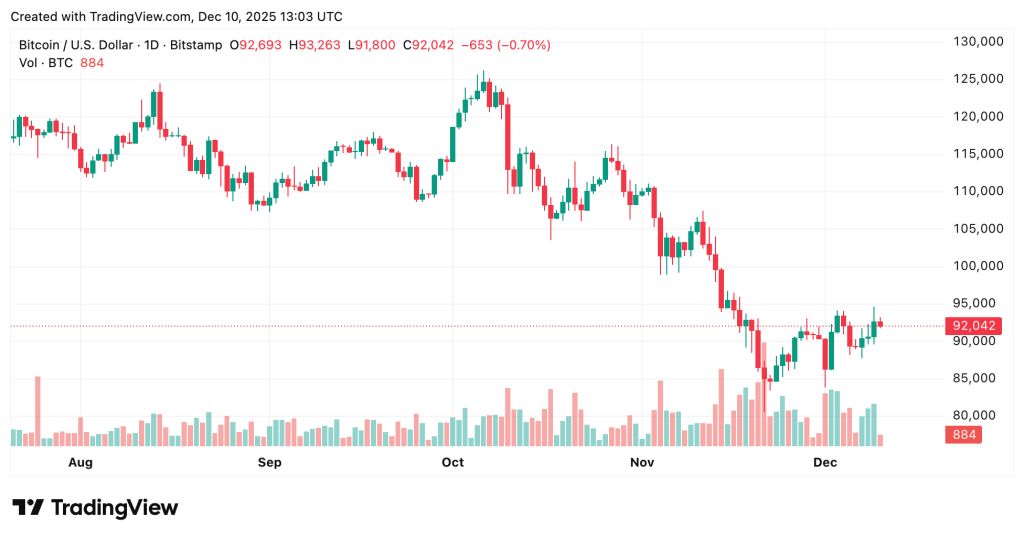
Bitcoin is holding $92,000 heading into the presser, with traders watching for any hawkish language about “patience” or “data-dependent” policy that could dampen aggressive easing expectations.
The updated dot plot, released at 2pm, will show where Fed officials see rates ending in 2025, but Powell’s tone and forward guidance will determine whether crypto interprets today’s likely 25-basis-point cut as dovish or hawkish.
The key risk for Bitcoin is a “hawkish cut” scenario where Powell emphasizes labor market strength (191K jobless claims, 7.7M job openings) as justification for slowing the pace of easing despite improving core inflation (2.8%).
Any mention of skipping the January meeting or reducing 2025 cuts from four to two would be bearish for risk assets.
Conversely, if Powell stresses that inflation is moving toward the target and the Fed remains committed to normalizing rates, Bitcoin could break above $92,000 resistance.
Bitcoin’s technical setup shows resistance at $92,000 and support at $88,000-$90,000, with the descending trendline since mid-November still intact.
Traders will parse every word from Powell for clues on the January 28-29 FOMC meeting and the overall 2025 trajectory.
The Fed’s credibility is on the line after ending QT and cutting rates twice—backing away from easing now would signal either policy error or genuine concern about sticky inflation.
Powell speaks at 2:30 pm ET, and crypto volatility is expected to spike immediately after.
Powell Press Conference: 2025 Guidance is the Real Story
The Federal Reserve announces its December interest rate decision at 2:00 PM ET today, with Chair Jerome Powell’s press conference following at 2:30 PM ET.
Bitcoin is trading around $92,000 as markets price in an 89% chance of a rate cut that would lower the federal funds rate to 3.50%-3.75%.
The decision comes after a week of conflicting economic signals, including shockingly strong jobless claims (191K vs 219K expected, lowest since 2022), cooling core PCE inflation (2.8% from 2.9%), and yesterday’s JOLTS data showing job openings unchanged at 7.7 million with quits declining 276,000 year-over-year.
The combination of labor market stability and improving inflation supports the case for easing, but some Fed officials have expressed concern about cutting too aggressively, with employment still resilient.
This marks the Fed’s third policy meeting since beginning its easing cycle with a 50 basis point cut in September, followed by another 25 basis point reduction in October.
The central bank officially ended quantitative tightening on December 1, freezing its balance sheet at $6.57 trillion after draining $2.39 trillion from markets since June 2022.
Markets are focused not just on today’s decision but also on Powell’s guidance for 2025. The updated dot-plot projections could signal whether the Fed sees two, three, or four more cuts next year.
Any hawkish shift suggesting fewer cuts in 2025 would likely pressure Bitcoin and risk assets, while dovish guidance reinforcing the easing cycle could provide the catalyst for Bitcoin to break above $92,000 resistance.
Bitcoin’s technical setup shows critical resistance at $92,000 and the descending trendline that’s capped rallies since mid-November, with support holding at $88,000-$90,000. Total crypto market cap sits at $3.23 trillion.
Source: TradingView
The key risk for crypto is a “hawkish cut”—where the Fed reduces rates 25 basis points today but signals a slower pace of easing in 2025 due to sticky inflation or resilient employment.
Powell’s 2:30 PM press conference will be scrutinized for any hints about the January meeting and the overall trajectory of policy.
With the Fed’s liquidity pivot complete (QT ended) and inflation moving in the right direction, the path of least resistance for Bitcoin is higher—but only if Powell doesn’t pour cold water on aggressive 2025 easing expectations.
Fed Decision Day: Markets Brace for Rate Cut or Hawkish Surprise
Tokenisation rises 63% to more than 25.7 billion dollars.
Singapore’s rise to the top of global crypto adoption signals a broader shift in how digital assets are becoming embedded across the Asia-Pacific.
A new index published on Tuesday by Bybit and DL Research shows the region gaining influence as regulatory clarity, retail participation and new blockchain use cases reshape where innovation is happening.
The findings also reveal that real-world asset tokenisation, local stablecoins and crypto payrolls are now spreading through markets that have traditionally relied on conventional financial systems, placing Asia-Pacific at the centre of the industry’s next phase.
Regional leadership intensifies
The World Crypto Rankings assessed 79 countries using 28 metrics and 92 data points that examined regulation, institutional readiness and levels of user engagement.
Singapore secured the top position, overtaking the US, which has fallen in the latest edition.
Lithuania, Switzerland and the UAE completed the upper tier of the list, marking a shift from the Western-heavy rankings seen in earlier years.
Asia-Pacific delivered one of the strongest performances, with six of its markets ranked within the global top 20.
Vietnam reached ninth place, while Hong Kong secured tenth as its regulatory reset took effect.
Australia followed closely in eleventh, and the Philippines and South Korea came in seventeenth and twentieth, respectively.
The distribution indicates that adoption patterns are broadening as regional economies align regulation with user demand and market development.
New drivers behind adoption
The report outlines how each market is advancing for different reasons.
Singapore’s top ranking reflects a clear regulatory framework, a structured licensing regime and high levels of participation.
Vietnam stands out for a different type of growth. Nearly 20% of its population owns digital assets largely for remittances, savings and inflation protection.
The index shows that Vietnam ranks first globally for transactional use and for the adoption of decentralised physical infrastructure devices.
This suggests that the country’s progress is being powered from the ground up, with retail users driving the majority of activity.
Hong Kong’s tenth-place ranking reflects its attempt to rebuild confidence following regulatory changes and the introduction of a new licensing system. Its user penetration level places it eighth globally.
The report notes that the city is positioning itself as a blend of Western and Asian financial structures, with stablecoins and tokenisation acting as key catalysts for recovery.
Emerging trends gain global traction
Beyond rankings, the findings point to three trends shaping global behaviour.
Real-world asset tokenisation has expanded by 63% to more than 25.7 billion dollars since January.
This indicates rising interest in converting traditional assets into blockchain-based formats for trading and settlement.
Local currency-pegged stablecoins are also gaining ground. These tokens are emerging in markets that want to reduce reliance on the dollar while supporting domestic and cross-border transactions.
Their growth suggests increasing comfort with digital settlement mechanisms across both institutional and retail users.
This reflects a shift toward integrating digital assets into everyday financial activity rather than treating them solely as investment instruments.
The crypto market just reminded everyone it’s still alive and kicking. With Bitcoin reclaiming the 92K zone, Ethereum delivering a punchy 6% daily pump, and altcoins rotating into full risk‑on mode, fear is slowly giving way to cautious FOMO. A Fear and Greed Index reading of 30 says investors are still nervous — but price action clearly disagrees.
Crypto Market in the Last 24 Hours
Global crypto is trading in clear risk‑on mode, led by strong moves in Bitcoin and Ethereum and broad altcoin rotation into higher beta names. Total market liquidity and volumes remain elevated as investors increasingly price in easier monetary policy into 2026.
Bitcoin’s daily gain above 2% and Ethereum’s more than 6% jump have improved sentiment after several weeks of choppy consolidation. Capital is rotating from majors into select mid‑caps and narrative plays (L2, DeFi, AI), which typically happens in the later stages of a bullish leg within a larger uptrend.
The Crypto Fear and Greed Index has climbed to 30.
Bitcoin & Ethereum Price — What Actually Moved
Bitcoin: Daily data shows BTC at about 92,723 USD for 10 December 2025, up from roughly 90,618 USD the previous day, a gain of around +2.3%. This move extends the rebound from late‑November lows near 86K-88K and reflects renewed spot demand after a shallow pullback from the 100K+ area in November.
The main drivers in the last 24h are:
Softer dollar and lower real‑yield expectations making BTC relatively more attractive as a macro hedge.
Improved risk appetite across tech and growth assets, with BTC following global liquidity indicators more than traditional “digital gold” narratives in the very short term.
Ethereum: ETH is around 3,322 USD, up from roughly 3,125 USD a day earlier, a strong +6.3% daily move. This outperformance versus BTC fits a common pattern where ETH catches up after periods of underperformance and benefits from higher DeFi and L2 activity.
Key ETH drivers:
Valuation catch‑up after a multi‑month underperformance versus BTC since October highs around 3,800–4,100 USD.
Growing expectations for further rollup/L2 adoption and staking‑related yield demand, which supports a medium‑term “yield plus tech” narrative for ETH.
3. Bitcoin On‑Chain (Last 24h) + VWAP Chart
Key Bitcoin On‑Chain Metrics (24h — indicative)
24h BTC Price Chart with VWAP
This structure keeps VWAP slightly below the closing price, with support around 90K and resistance in the mid‑90K area, matching the current daily context.
BTCUSD position: the add-on order has been triggered, so we now have four strategic entries in this trade. Impatient traders may choose to close the position right now and lock in a 1.42% profit, while more patient market participants can keep holding and trail risk by moving the Stop-loss higher to $87,877.
Ethereum On‑Chain Metrics (Last 24h)
High‑frequency Ethereum on‑chain data suggests increasing activity alongside the recent price breakout above 3.3K.
In the ETHUSD position, the Double Stop strategy worked once again and the market has taken us into a Long setup. Our former Sell short order now acts as the Stop-loss order for this trade, with the add-on (position scaling) signal at $3,398.6.
DXY Performance & Why It Matters
The U.S. Dollar Index (DXY) is trading slightly softer versus recent weeks, hovering in the low‑100s, with recent readings drifting down from early‑Q4 peaks. Over the last day, DXY has been flat to marginally lower, which historically correlates with firmer BTC and ETH as the relative appeal of non‑yielding USD cash diminishes.
The key reasons DXY is no longer aggressively bid are:
Markets anticipate a gradual Fed easing path into 2026, compressing interest‑rate differentials that previously strengthened the dollar.
Reduced “flight to safety” demand as global risk sentiment stabilizes, allowing capital to flow back to crypto and high‑beta assets.
Top 5 Altcoin Performers (Indicative 24h Snapshot)
Exact leaders rotate intraday, but the structure is clear: capital is moving down the risk curve from BTC/ETH into higher‑beta altcoins as confidence returns.
Current Market, BTC & ETH Outlook
From an investor’s perspective, the combination of rising prices, healthy (but not euphoric) on‑chain activity, and a softening dollar supports a cautiously bullish near‑term bias.
Bitcoin:
As long as BTC holds above the 90K-88K support region, the path of least resistance remains towards retesting psychological levels near 95K-100K over coming weeks.
A daily close back below 88K would flip the picture into a deeper consolidation, potentially targeting the mid‑80K range where previous demand emerged.
Ethereum:
ETH’s strong +6% daily move opens room for a push towards the 3.5K-3.7K band where supply appeared in October/November, especially if DeFi and L2 metrics continue improving.
Losing 3.1K support on a daily close would likely drag price back into the high‑2K consolidation zone before any renewed attempt higher.
Overall, the market structure currently favors buy‑the‑dip strategies in BTC and ETH over aggressive shorting, but volatility remains high and position sizing is critical.
High‑Potential Crypto Projects — One Per Key Theme
Investors looking beyond large caps often search for projects with strong fundamentals, real usage, and alignment with major narratives (scaling, infrastructure, AI, DeFi). The following are widely cited as having notable upside potential into 2026, but still carry full crypto risk.
Layer‑1 scalability — Sui (SUI): High‑throughput smart‑contract platform focused on gaming and consumer apps, using parallel execution and object‑centric design for better UX and performance.
Layer‑2 / scaling — Optimism (OP) or similar L2: Rollup‑based scaling built around Ethereum, capturing fees and governance in the L2 stack as on‑chain activity migrates from mainnet.
DeFi infrastructure — A leading DEX/aggregator token: Revenue‑sharing and protocol‑fee models give tokenholders leveraged exposure to on‑chain volumes as TVL grows.
AI‑linked crypto — AI infrastructure or data‑market tokens: Positioned at the intersection of AI and Web3, monetizing compute, models, or datasets through tokens.
Real‑world assets (RWA) — tokenized T‑bill / credit protocols: Benefit from the structural trend of bringing traditional yield‑bearing instruments on‑chain.
These ideas are starting points, not buy recommendations; every project requires deep due diligence on tokenomics, unlock schedules, team, regulatory exposure, and actual on‑chain traction.
Crypto Conclusion
Crypto is back in “confidence but not arrogance” mode. Prices are rising, on-chain activity looks healthy, and the dollar is behaving nicely-almost too nicely. Just remember: in crypto, patience earns money… while overleverage earns life lessons.
There is a moment almost every global platform hits. It rarely shows up in dashboards or board meetings. It reveals itself quietly, one payout delay or one frustrated seller at a time.
In the early days, payment operations seem harmless. You collect money from buyers, you pay out to sellers, and the platform sits comfortably in the middle. Nothing unusual.
Then you add more markets. More currencies. More banking partners. More users testing your edges.
Eventually payments stop being a background function. They become the operational weight you feel everywhere.
If you ask product managers, finance leads, or ops teams who have lived through this, they’ll tell you the same thing:
Global user payments get hard far earlier than anyone expects.
Here are the lessons platforms usually learn only after the fires begin.
1. Compliance does not scale with your user base. It compounds.
Most teams start with a simple approach. Collect IDs. Run them through a vendor. Approve or reject. Move forward.
This works until the second or third market. After that, compliance stops being a linear task. It becomes a shifting map of rules.
One country wants stricter AML thresholds. Another requires localised document formats. Some expect purpose codes. Some regulate which currencies can be held.
Your initial workflow bends until it eventually breaks. Support queues grow. Approvals slow. Product teams add exceptions just to keep signups moving.
Platforms eventually realise something important: KYC and onboarding are not one workflow. They are many workflows pretending to be one.
2. Onboarding issues appear long before your data shows they exist
When you enter a new geography, early users almost always struggle first. Documents that worked elsewhere get rejected. Risk scoring behaves differently because behaviour patterns differ. Verification steps that feel normal in one market feel foreign in another.
Most platforms only discover the problem after conversion rates dip. And by then, it is already affecting growth.
3. FX exposure quietly eats into your margins
No platform starts with an FX strategy. They assume money arrives as billed and the bank handles the rest.
But as payment volume increases, the cracks become obvious.
Currencies land unpredictably. Banks auto convert without warning. Ledger values drift from bank statements. Double conversions appear in flows you thought were straightforward.
This is how platforms end up losing margin without noticing it. Not because FX is inherently expensive, but because the platform has no control over when conversion happens.
4. Settlement delays create more distrust than any product bug
Ask any seller or vendor what frustrates them most. It is rarely pricing. Rarely product limitations. It is almost always payouts that land later than expected.
Cross-border settlements depend on too many external parties. Correspondent banks. Clearance windows. Routing logic. Compliance checks. A payout that should take twelve hours can easily take forty-eight. Sometimes longer.
The painful part is that the platform often cannot explain the delay. And users do not care whether the delay came from an intermediary. They simply feel the platform is unreliable.
Slow money slows trust.
5. Reconciliation becomes a daily firefight
At small scale, reconciliation feels like an accounting task. At scale, it becomes its own operational problem.
Shared accounts mix user funds. Clearing references differ between banks. Automatic conversions distort ledger entries. Currencies shift mid-route. Finance teams spend their mornings sorting transactions manually.
The real issue is structural. The platform has outgrown generic bank accounts and needs user-level attribution.
This is usually the moment teams start searching for a different approach.
The turning point: when platforms realise they need an OBO model
After months of patching, teams eventually reach the same conclusion. You cannot fix cross-border payment issues one by one. You have to rebuild the foundation.
That is where On-Behalf-Of payment infrastructure comes in.
OBO brings three elements together that platforms normally struggle with in isolation:
1. A unified compliance framework. Instead of building onboarding rules market by market, platforms tap into a licensed layer that handles verification, monitoring, and regulatory requirements consistently.
2. Named or virtual accounts for users. Every user, seller, or workflow has its own account reference. Incoming funds are attributed cleanly. No accidental conversions. Reconciliation becomes mechanical instead of investigative.
3. Payout orchestration that platforms can actually control. Instead of relying on whichever bank route is chosen that day, payouts follow a structured, predictable flow with clear visibility.
The complexity does not disappear. It becomes organised.
Platforms stop reacting to problems and start operating from a controlled system.
If you want a more structural explanation of how this works in practice, the corresponding article breaks it down from a technical and operational angle.
What changes once OBO infrastructure is in place
Teams report the same improvements again and again:
Onboarding becomes predictable because compliance is handled through one regulatory framework.
FX becomes intentional because conversions only happen when the platform decides.
Payouts become reliable because routing is controlled rather than left to chance.
Reconciliation becomes clean because every inflow and outflow has an attributed owner.
Treasury becomes strategic because money is no longer scattered across markets or trapped in local accounts.
Most importantly, platforms get back something they rarely have while scaling.
Control.
The real bottom line
Global payments always seem manageable until the day they aren’t. The complexity builds slowly and then all at once.
Compliance. FX drift. Unpredictable settlements. Reconciliation failures. User dissatisfaction.
None of these are product problems. They are structural problems.
And structural problems require structural solutions.
On-Behalf-Of infrastructure gives platforms a way to handle payments across regions without letting payments dictate their roadmap. It turns the messy parts of global money movement into predictable building blocks that teams can actually scale with.
The sooner platforms adopt it, the sooner the rest of the business stops feeling like firefighting and starts feeling like growth again.
How Privacy Coin Development Is Transforming Crypto Security
In the transparent world of blockchain, where every Bitcoin transaction is etched permanently on a public ledger for anyone to scrutinize, a quiet revolution is unfolding. This revolution challenges the very notion that finance must be visible to be secure. Recent headlines from massive data breaches exposing user financial histories to sophisticated blockchain analysis firms tracking donations and purchases have laid bare a critical vulnerability in the crypto ecosystem: the pervasive lack of transactional privacy. This exposure isn’t just a theoretical concern; it poses risks of targeted hacks, financial censorship, and undue surveillance, chilling the promise of a truly open and permissionless financial system.
Enter the vanguard of cryptographic innovation: Privacy Coin Development. Far from being tools for obscurity alone, privacy coins represent a fundamental leap in how we conceptualize security in the digital age. They are not merely currencies but sophisticated security platforms engineered to protect user sovereignty. This blog delves deep into how the specialized field of Privacy Token Development is moving beyond basic encryption to deploy advanced cryptographic shields, fundamentally transforming crypto security from a ledger-based transparency model to a user-centric confidentiality paradigm. By redefining what it means to be secure, privacy coins are building a more resilient, trustless, and ultimately safer foundation for the future of decentralized finance.
Privacy Coins: A Beginner’s Overview
What Are Privacy Coins? Privacy coins are a specialized class of cryptocurrencies designed explicitly to conceal transaction details that are typically public on standard blockchains like Bitcoin or Ethereum. While a Bitcoin transaction reveals sender and receiver addresses and the transacted amount, privacy coins employ advanced cryptographic techniques to obscure this data. The core philosophy is that true financial security encompasses confidentiality the right to control one’s financial information. Privacy Coin Development focuses on integrating these confidentiality features at the protocol level, creating a robust shield against surveillance and analysis.
Popular Privacy Coins in the Market Several pioneering projects exemplify the diverse approaches within Privacy Token Development:
Monero (XMR): Arguably the most famous privacy coin, Monero mandates privacy for all transactions. It uses a combination of ring signatures (to hide the sender), stealth addresses (to protect the receiver), and Ring Confidential Transactions (RingCT) (to conceal the amount). It offers strong, default-on privacy.
Zcash (ZEC): Zcash introduced the groundbreaking zk-SNARKs (Zero-Knowledge Succinct Non-Interactive Argument of Knowledge) to the crypto world. It offers users a choice: “shielded” transactions for full privacy or “transparent” transactions that function like Bitcoin. This “selective privacy” model is a key architectural decision in its development.
Dash: Often termed a “privacy-optional” coin, Dash offers PrivateSend, a coin-mixing feature based on a decentralized masternode network. While not as comprehensively private as Monero or Zcash at the protocol level, it provides a practical layer of fungibility for users who opt-in.
Importance of Privacy in Crypto Privacy is not synonymous with illegality; it is a cornerstone of legitimate security and fungibility. Without it:
Financial Surveillance: Entities can map entire financial histories, leading to profiling and potential discrimination.
Loss of Fungibility: If certain coins are “tainted” by association with previous transactions (e.g., from a gambling site), merchants or exchanges may devalue or refuse them, breaking the core monetary principle that each unit is equal to another.
Targeted Attacks: Public wealth makes users targets for phishing, hacking, and even physical theft.
Thus, Privacy Token Development directly addresses these critical security flaws inherent in transparent ledgers.
Core Technologies Behind Privacy Coins
The magic of privacy coins lies in their use of cutting-edge cryptography. Privacy Coin Development is essentially the art and science of implementing these technologies into a functional, secure, and scalable network.
Zero-Knowledge Proofs (ZKPs) Picture proving your knowledge of a secret without exposing it. That’s the power of ZKPs. A prover can convince a verifier that a statement is true (e.g., “I have sufficient funds for this transaction”) without revealing any underlying data (like their balance or address). Zcash’s zk-SNARKs are a highly efficient form of ZKP, enabling fully encrypted transactions that are still verified as valid by the network.
Ring Signatures Used by Monero, ring signatures mix a user’s transaction signature with a group of other, decoy signatures (the “ring”). To an outside observer, every member of the ring is an equally probable sender. This technique effectively anonymizes the sender by obfuscating the origin of the transaction within a crowd.
Stealth Addresses For every transaction, a one-time, unique address is automatically generated for the recipient. Even if the same sender sends funds multiple times to the same person, the public ledger will show payments going to completely different, unlinkable addresses. This is crucial for protecting receiver anonymity and is a staple in Privacy Coin Development.
Other Advanced Techniques Bulletproofs: A more efficient type of range proof integrated into Monero to significantly reduce the transaction size and fees associated with RingCT, enhancing scalability.
MimbleWimble: A novel blockchain protocol (used by Grin and Beam) that combines transactions to obscure inputs and outputs. It offers strong privacy and scalability by eliminating the need for historical transaction data, allowing for extreme blockchain “compaction.”
zk-STARKs: A successor to zk-SNARKs that doesn’t require a trusted setup (removing a potential vulnerability) and offers potentially better scalability, though with larger proof sizes.
How Privacy Coin Development Enhances Crypto Security
The work in Privacy Token Development elevates security from network integrity to comprehensive user protection.
Securing Transaction Data By encrypting or obfuscating amounts, origins, and destinations, privacy coins make blockchain analysis a primary tool for forensic investigators and hackers alike ineffective. This prevents third parties from building spending profiles or identifying transactional relationships.
Protecting User Identity The separation of on-chain activity from real-world identity is paramount. Stealth addresses and ring signatures break the deterministic link between a public address and an individual. This protection is vital for businesses and individuals in high-risk environments or those simply valuing financial autonomy.
Reducing Risk of Hacks & Exploits Transparent blockchains expose wealth concentration, making large holders (“whales”) and exchanges prime targets for sophisticated attacks. Privacy coins eliminate this public display of wealth, adding a critical layer of obfuscation that makes identifying and targeting high-value accounts vastly more difficult.
Building Trust in Decentralized Networks Paradoxically, enhanced privacy builds greater trust. Users are more likely to adopt and transact in a system where they know their financial data is not being exploited. This fosters a healthier, more secure, and genuinely decentralized ecosystem, as power shifts from surveillance entities back to the individual.
Key Features of Privacy Coins
Modern Privacy Coin Development aims to bake several non-negotiable features into the protocol:
Confidentiality & Untraceability: The bedrock feature. All metadata sender, receiver, amount is cryptographically concealed.
Fungibility: Every coin is interchangeable and equal, as its history cannot be traced or “tainted.” This is essential for a currency to function as a reliable store and medium of exchange.
Decentralization & Secure Consensus: Privacy should not come at the cost of centralization. Leading privacy coins maintain distributed consensus mechanisms (Proof-of-Work, Proof-of-Stake variants) to ensure network security and censorship-resistance.
Anti-Censorship & Surveillance Resistance: Protocols are designed to be resilient against attempts to block or blacklist transactions based on their origin or history.
Optional Transparency (Selective Disclosure): Some implementations, like Zcash, allow users to provide “view keys” or use transparent addresses for auditability or regulatory compliance, offering flexibility without compromising the core privacy functionality.
Use Cases of Privacy Coin Development in Real-World Applications
Secure Peer-to-Peer Payments The foundational use case: individuals can transfer value globally without exposing their financial networks or wealth to peers, family, or malicious actors.
Enterprise-Level Privacy Solutions Businesses can use privacy tokens for confidential payroll, secure B2B transactions, and protecting sensitive supply chain financial flows from competitors. It safeguards corporate treasury management on-chain.
Decentralized Finance (DeFi) As DeFi grows, the lack of privacy becomes a critical weakness. Privacy Token Development is pioneering “confidential DeFi” where users can lend, borrow, and trade without exposing their positions or strategies, preventing front-running and predatory market tactics.
Regulatory Considerations Responsible Privacy Coin Development proactively engages with compliance challenges. Techniques like zk-SNARKs allow for the creation of audit trails that can be revealed under specific, user-controlled conditions (e.g., to a regulator with a warrant), balancing individual privacy with legitimate legal frameworks and Anti-Money Laundering (AML) principles.
Challenges in Privacy Coin Development
The path forward is not without significant hurdles:
Intense Regulatory Scrutiny: Privacy coins face pressure from regulators and exchanges wary of compliance challenges, leading to delistings in some jurisdictions.
Scalability & Performance: Because zk-SNARKs and ring signatures require significant processing, they often create bulkier transactions and performance issues, prompting continuous development work.
User Adoption & Misconceptions: Many still link privacy to illegal use, creating barriers to wider acceptance. Educating users on the legitimate security benefits is crucial.
Technical Complexity: Implementing and auditing these sophisticated cryptographic systems requires deep expertise, raising the barrier to entry and the risk of critical bugs if not done correctly.
The Future of Privacy Coin Development and Crypto Security
The trajectory points toward greater integration and sophistication:
Hybrid Models & Privacy Layers: Expect more projects offering privacy as an optional layer or “shield” on top of existing transparent assets, rather than standalone coins.
Advancements in ZK Technology: zk-rollups and validiums are scaling solutions that leverage ZKPs, bringing efficient, private transactions to Ethereum and other Layer 1 networks. Confidential smart contracts are the next frontier.
Mainstream Convergence: As digital asset adoption grows, demand for financial privacy will surge. Privacy Coin Development principles will increasingly influence mainstream crypto projects, making privacy features a standard expectation rather than a niche offering.
Enhanced Security Paradigm: The future of crypto security will be defined by architectures that are private by default, where user data protection is integral, creating a more robust and attack-resistant ecosystem for everyone.
Conclusion
Privacy Coin Development is far more than a cryptographic arms race; it is a fundamental re-engineering of the security premises of digital money. By shifting the focus from transparent validation to confidential execution, it addresses the critical vulnerabilities of public ledgers and builds a more secure, fungible, and user-empowered financial layer. This transformative work ensures that cryptocurrency can fulfill its promise as a tool for genuine individual sovereignty.
The evolution from basic transparency to assured confidentiality marks a maturation of the entire blockchain space. Whether you are a user, investor, or developer, understanding and engaging with the principles of Privacy Token Development is essential for navigating the secure future of finance.
It is 2026. The digital travel landscape has shifted. The days of manual data entry, guessing games with pricing, and awkward introductory messages are ancient history. Today, efficiency is the currency of the hospitality industry.
Imagine a host named Sarah. In 2024, she spent hours agonizing over the perfect property description and days worrying if her pricing was competitive. Now, in 2026, she launches her property on your Airbnb clone app, and within seconds, AI has crafted a compelling narrative for her, priced it perfectly for the upcoming festival weekend, and even handled her initial guest inquiries with professional warmth.
This seamless experience is what separates the market leaders from the forgotten platforms. For entrepreneurs building their empire with an Airbnb Clonescript, these specific AI integrations are no longer optional; they are the engine of your growth.
Here are the specific AI-powered features that will define the next generation of vacation rental platforms.
1. AI Listing Generator: The End of Writer’s Block
The biggest barrier to entry for new hosts has always been the “blank page” problem. How do you describe a studio apartment in a way that sounds magical?
In your 2026 Airbnb clone, the AI Listing Generator solves this instantly. Hosts simply input basic details square footage, amenities, and location, and the AI generates a captivating, SEO-optimized title and description. Similar to advanced tools like PriceLabs STRings, this feature uses natural language processing to highlight unique selling points that a human might miss. It turns a “cozy room” into a “sun-drenched urban sanctuary,” significantly increasing views and conversion rates without the host typing a single sentence.
2. Smart Pricing Suggestions
Pricing is a high-stakes game. The price is too high, and the calendar stays empty. The price is too low, and you leave money on the table.
The Smart Pricing Suggestions feature acts as a 24/7 revenue manager for your hosts. Instead of static rates, the AI analyzes real-time market trends, local demand surges, seasonality, and competitor data to suggest the optimal nightly rate. This ensures that your vacation rental script (market context) isn’t just a booking tool, but a profit-maximization engine. Hosts can trust that their pricing is always competitive, maximizing their yield during peak seasons like holidays or local events.
3. Smart Guest Messaging
For guests, the anxiety of booking, especially for large groups or complex trips, often lies in the details. How do I tell the host we have a toddler? What if our flight is late?
With Smart Guest Messaging, the booking experience becomes intuitive. During the reservation process, the AI analyzes the trip details, dates, vacation type (leisure vs. business), and group size and instantly generates a personalized message for the guest to send. It bridges the gap between a transaction and a relationship, ensuring the host receives all the necessary context in a polite, structured format. This reduces friction and sets a positive tone before the booking is even confirmed.
4. AI-Powered Enquiry Assistant
The “Contact Host” button can be a hurdle. Guests often don’t know what to ask or how to phrase their needs, leading to vague inquiries that frustrate hosts.
The AI-Powered Enquiry Assistant transforms this interaction. When a guest opens the contact form, the AI suggests friendly, relevant message drafts based on the property details and the guest’s search criteria. It makes communication effortless, professionalizing the guest’s inquiry and increasing the likelihood of a host responding positively. It turns a tentative “is this available?” into a meaningful conversation starter.
5. Subscription-Based AI Access
Monetization is the heartbeat of your business model. In 2026, AI isn’t just a utility; it’s a premium product.
Your Airbnb Clone script should include a Subscription-Based AI Access module. This allows you to gate these powerful features, auto-messaging, smart listings, and pricing insights behind a paid tier. By offering a “Pro” subscription to hosts, you create a recurring revenue stream that goes beyond simple booking commissions. Hosts are willing to pay for tools that save them time and earn them more money, turning your platform into a SaaS (Software as a Service) powerhouse.
6. Admin Control Center
Power is nothing without control. As the platform owner, you need oversight on how these AI tools are utilized.
The Admin Control Center is your command deck. It gives you full authority to enable or disable specific AI features at any time. Whether you want to roll out the AI Listing Generator only to verified hosts or temporarily disable Smart Pricing during a system update, this centralized dashboard ensures you are always in the driver’s seat. It allows for granular management of your ecosystem, ensuring safety and quality control across your Airbnb clone app.
Conclusion: Partnering for the Future
The vacation rental market is evolving rapidly. To capture the attention of modern hosts and travelers, your platform must offer more than just a calendar and a payment gateway. It must offer intelligence.
Integrating these six specific AI features will position your platform as a forward-thinking leader in 2026. However, building this technology from scratch is a massive undertaking. You need a development partner who understands the nuances of the sharing economy.
Rental Script is a leading clonescript development company equipped to bring these advanced visions to life. With their expertise in crafting sophisticated rental solutions, they can help you deploy a feature-rich, AI-driven platform that dominates the market.
NEAR trades at its weakest level since Oct. 10 as intents and revenue surge, with bulls betting a 20-Day MA reclaim and range breakout could mark a major bottom. Analyst Michaël van de Poppe reported that NEAR (NEAR) intents are…
Pi Network rolls out AI KYC tools and a CiDi Games tie-up just as PI price slides, whales reload, token unlocks loom, and a $10m fraud lawsuit heads to court. Pi Network has implemented several technical updates in recent weeks…
Tesla has amassed over 1 million loyal retail shareholders, raising questions over whether Musk can replicate that grassroots investor base if SpaceX opens to the public. Tesla Inc. has attracted more than one million retail investors, providing Chief Executive Elon…
Texas Rep. Keith Self moves to bolt an ‘Anti-CBDC Surveillance State’ CBDC ban onto the 2026 defense bill, testing Trump’s order and GOP unity on digital dollar policy. Representative Keith Self, a Texas Republican, has filed an amendment to the…
Tether-backed Twenty One Capital lists via SPAC as Bitcoin cools and DAT mNAV premiums compress, forcing the firm to prove it is more than a BTC hoard. Twenty One Capital, a cryptocurrency treasury firm, experienced market turbulence following its public…
As XRP holders look for steadier returns in a slow and unpredictable market, many are turning to Sunny Mining’s automated cloud-mining model for daily earnings without active trading. #partnercontent
Following its launch in 2023, Shibarium, a Layer-2 blockchain network for the Shiba Inu ecosystem, was widely seen as a major catalyst that could propel SHIB to new levels and potentially lift its price. However, over the past few months, activity and adoption on Shibarium have remained disappointingly quiet. Now, with the potential advancement and growing interest in the new ShibOS platform, momentum for a comeback could be building. Adding to this possible shift, SHIB whales have noticeably returned, with on-chain activity beginning to climb.
Shibarium Revival Could Take Shape With The Adoption Of ShibOS
For most of the year, Shibarium has struggled to gain meaningful traction, unable to revive and return to the level of activity investors once expected. As the number of active users decreased, developers were slow to build on it, and the price of SHIB saw little to no reaction despite its strong community backing and Shibarium’s promise of greater utility and faster transactions.
Although conditions look rather bleak, the narrative could shift as the new ShibOS platform grows and is increasingly adopted. ShibOS is a new Operating System designed to serve as the backbone of the Shiba Inu ecosystem. Rather than positioning SHIB as a simple meme-driven asset, ShibOS aims to create a functional environment where applications, utility, and identity features can thrive.
The operating system provides a framework that connects traditional businesses and Web3 developers, enabling seamless integration of blockchain features. The concept behind ShibOS places the Shiba Inu community at the center of a broader technological transformation. It introduces a structure that supports Decentralized Applications (dApps) and self-governed digital identities while offering a gateway for Web2 brands interested in experimenting with blockchain technology.
If developers and businesses begin adopting ShibOS and integrating it into their products, Shibarium could naturally benefit from the surge in activity. More applications would mean more transactions, increased users, and a healthier on-chain economy. This type of organic growth could, in turn, drive the demand for SHIB, potentially influencing its price.
Shiba Inu Whale Activity Hits Six-Month High
Shiba Inu is also showing signs of renewed activity in terms of on-chain transactions. According to fresh data and a chart shared by SanSights on Santiment, SHIB whale activity has surged to its highest level since early June 2025. Over the last day or so, multiple accounts have reportedly made 406 transactions, each moving more than $100,000 in SHIB.
At the same time, crypto exchanges have seen a net increase of 1.06 trillion SHIB, valued at roughly $15 million to $20 million—all deposited within 24 hours. This sudden increase in supply comes as prices surge unexpectedly this week, highlighting a rare convergence of bullish factors.
Typically, when whale activity, large deposits, and price movements happen at the same time, it can signal upcoming big changes. It could either be that whales are accumulating for a stronger price rally or preparing to sell into the current momentum.
Strive, a publicly traded bitcoin treasury and asset-management firm, said it has arranged a $500 million at-the-market offering to help fund more bitcoin purchases.
The company plans to sell Variable Rate Series A Perpetual Preferred Stock, known as SATA. The offering allows Strive to issue shares into the market at prevailing prices rather than through a single sale. The structure gives the firm flexibility to raise capital as demand allows.
SATA carries a 12% dividend and an effective yield near 13%. The preferred stock is modeled on Strategy’s STRC perpetual preferred equity, which has been used as a funding tool for bitcoin accumulation.
SATA currently trades around $91, below its $100 par value.
Strive said proceeds may be used for a range of purposes. These include buying bitcoin, purchasing income-generating assets, supporting working capital, repurchasing common shares, or pursuing acquisitions.
JUST IN: Vivek Ramaswamy's Strive to raise $500 million to buy more #Bitcoin
The company did not specify how much of the raise would be allocated to bitcoin purchases.
The 14th-largest corporate bitcoin holder
Strive currently holds about 7,525 bitcoin, valued at roughly $695 million at recent market prices. That positions the firm as the 14th-largest publicly traded corporate holder of bitcoin.
The company has leaned into a bitcoin-focused treasury strategy following a public reverse merger earlier this year.
The company was co-founded in 2022 by entrepreneur and political figure Vivek Ramaswamy. Since launching its first exchange-traded fund in August 2022, Strive Asset Management has grown to oversee more than $2 billion in assets, according to company disclosures.
The firm markets itself as an alternative asset manager with a focus on aligning capital with long-term investment themes.
In September, Strive agreed to acquire Semler Scientific, a transaction that increased the combined entity’s bitcoin exposure. The move placed the company among a growing group of public companies that use equity markets to build large bitcoin positions, a strategy popularized by Michael Saylor’s Strategy.
Shares of its common stock, ASST, trade near $1 today.
Strive calls out MSCI on bitcoin beliefs
The company has also taken an active role in market structure debates tied to bitcoin treasury firms. Earlier this month, Strive called on index provider MSCI to avoid excluding companies with large digital asset holdings from major equity benchmarks.
MSCI is reportedly consulting investors on whether firms with balance sheets dominated by crypto assets should remain eligible for inclusion.
The company argued that such exclusions would limit investor choice and reshape capital flows across passive funds. The review could have broad implications for companies that hold bitcoin as a core treasury asset.

 Login
Login