 Login
LoginCardano has wallets for charts. Where’s the wallet for checkout?
24 January 2026 at 06:50

China’s ChatGPT-grade LLM, DeepSeek AI, has released striking price forecasts for XRP, Cardano, and Solana as the crypto market looks ahead to 2026.
According to the model, a prolonged bull market, backed by clearer, more supportive regulation in the United States, could propel top altcoins to new all-time highs in the next phase of the cycle.
Here’s DeepSeek AI’s projected outlook for three of the most closely watched cryptocurrencies over the coming year.
Ripple’s XRP ($XRP) entered 2026 with solid momentum, gaining 19% in the first week of the year. From its current price of $1.89, DeepSeek AI believes a fully developed bull market could lift XRP to $10 by the end of 2026, implying upside of roughly 430%, or more than 5x returns.

XRP ranked among the strongest-performing large-cap cryptocurrencies last year. In July, it posted its first fresh all-time high (ATH) in seven years, climbing to $3.65 after Ripple secured a pivotal legal victory against the U.S. Securities and Exchange Commission.
That ruling significantly reduced regulatory uncertainty surrounding XRP and helped calm concerns that the SEC might intensify enforcement actions across the broader altcoin market. Sentiment was further boosted by the return of pro-crypto Donald Trump to the White House, injecting renewed optimism into the sector.
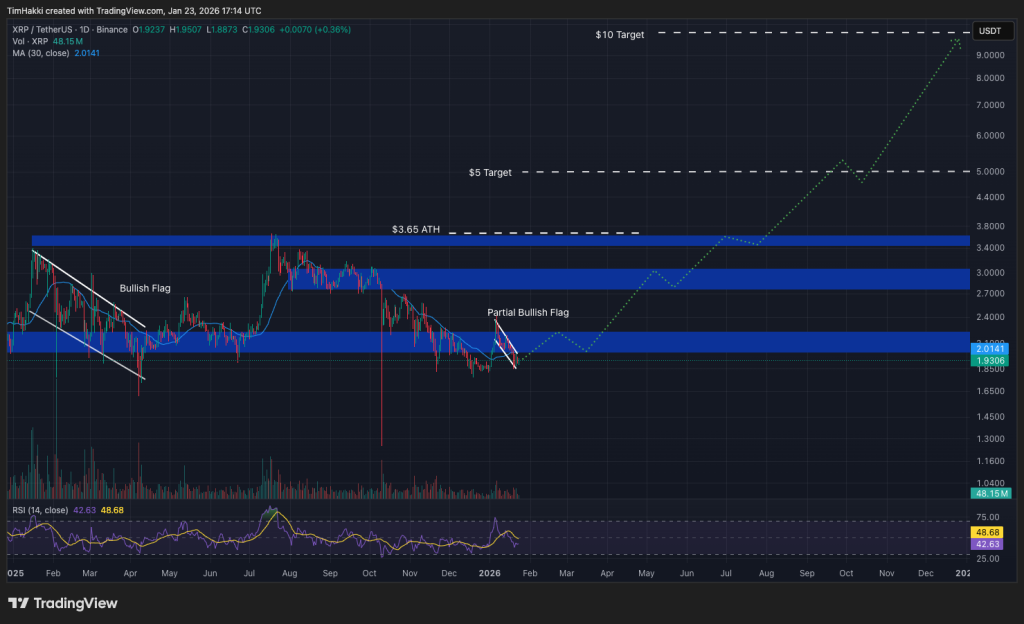
Technically, XRP’s Relative Strength Index is sitting near 43. Since early January, price action has been shaping a partial bullish flag formation. If that pattern completes amid favorable macro conditions and regulatory clarity, it could light a fuse that would easily send XRP to DeepSeek AI’s upper $10 projection.
Strengthening the bullish narrative, newly approved spot XRP ETFs in the U.S. are beginning to draw capital from traditional finance, echoing the sustained institutional inflows seen following the launch of Bitcoin and Ethereum ETFs.
Cardano ($ADA) is one of the most academically rigorous blockchain projects in crypto. Founded by Ethereum co-creator Charles Hoskinson, the platform emphasizes peer-reviewed research, robust security, scalability, and long-term viability.
With a market capitalization above $13.3 billion and more than $164 million in TVL across its ecosystem, Cardano remains a notable competitor to Ethereum. Consistent developer engagement and a steadily expanding decentralized application ecosystem continue to support its long-term adoption outlook.
DeepSeek AI forecasts that ADA could climb to $12 by early 2026. From its current level near $0.36, that move would represent gains of approximately 3,233%, decisively quadrupling its previous ATH of $3.09 set during the 2021 bull market.
That said, ADA is currently trading at its lowest price since October 2024. If macroeconomic conditions worsen and the crypto sector lacks positive catalysts, additional downside may occur over the year.
However, such a scenario appears less likely, as digital asset regulation remains a priority topic for U.S. lawmakers.
Solana ($SOL) continues to rank among the fastest-growing smart contract platforms in the crypto industry. The network supports roughly $8.2 billion in total value locked and carries a market capitalization exceeding $72.5 billion, alongside rapidly rising developer and user activity.
Interest in SOL has accelerated following the rollout of Solana-focused ETFs from asset managers including Bitwise and Grayscale.
After a sharp correction late in 2025, SOL has been consolidating within a key support zone and is currently trading near $128. A sustained breakout may depend on Bitcoin reclaiming the $100,000 level, a milestone many analysts expect sooner rather than later.
In DeepSeek AI’s most bullish scenario, Solana could surge to $600 by 2027. That would translate to roughly 369% upside from current levels and double SOL’s previous ATH of $293, recorded last January.
Growing institutional adoption also reinforces Solana’s long-term prospects. Increasing use of the network for real-world asset tokenization by firms such as Franklin Templeton and BlackRock highlights Solana’s expanding role within traditional finance.
Beyond DeepSeek AI’s forecasts, the crypto presale market continues to attract traders searching for the next breakout.
Maxi Doge ($MAXI) has quickly become one of January’s most talked-about meme coin presales, raising more than $4.5 million ahead of its anticipated exchange listings.
The project delivers an exaggerated, gym-bro parody of Dogecoin. Bold, unapologetic, and deliberately degenerate, Maxi Doge fully embraces the raw meme energy that originally drove meme coins into the mainstream.
After years of Dogecoin’s dominance, Maxi Doge is cultivating its own Maxi Doge Army, united by meme culture, high-risk trading strategies, and a shared appetite for extreme volatility.
MAXI is an ERC-20 token on Ethereum’s proof-of-stake network, giving it a lower environmental footprint than Dogecoin’s proof-of-work design.
Presale buyers can stake their tokens for yields of up to 69% APY, although returns decline as more users enter the pool. MAXI is currently selling for $0.0002795 in the latest presale round, with automatic price increases scheduled at each new funding stage. Interested investors can purchase using MetaMask or Best Wallet.
Say goodbye to Dogecoin. Maxi Doge is the new dog in town!
Stay updated through Maxi Doge’s official X and Telegram pages.
Visit the Official Website Here
The post China’s DeepSeek AI Predicts the Price of XRP, Cardano and Solana By the End of 2026 appeared first on Cryptonews.
Cardano founder Charles Hoskinson said he will fly to Japan this week for a multi-city community tour focused on Midnight, the privacy-focused network being developed in Cardano’s orbit, while hinting that new “commercially critical integrations” and major launch partners are nearing the finish line.
In a Jan. 22 video recorded from Colorado, Hoskinson framed the trip as both a reconnection with what he called Cardano’s “most critical component” and a staging ground for the next execution phase he wants the ecosystem to pursue: making leading applications meaningfully more competitive by combining Cardano and Midnight capabilities.
Hoskinson said the tour will span Sapporo, Osaka, Fukuoka, Naha, and Tokyo, covering “the entire Japanese archipelago” over roughly two weeks. He described the agenda as part Midnight introduction, part Cardano status update, and part technical pitch for what builders can do when the two stacks interoperate.
“As many of you know, Japan is why Cardano exists. There would be no Cardano if there was no Charles and there would be no Cardano if there was no Japan,” Hoskinson said. “I went to Japan in 2015 and with our partners from Emurgo amongst others we were able to go about all of Japan and convinced them that Cardano needs to exist. So they put up the money we built it and the Japanese community still is the largest and strongest Cardano community in the entire world with more than half the supply there.”
That legacy, in Hoskinson’s telling, makes Japan a natural first stop for positioning Midnight not as a side project but as a strategic lever for Cardano adoption.
Hoskinson said that “about [the] middle part of this year” he intends to “aggressively push for the top 15 Cardano dapps to go through a overhaul and get some additional resources.” His stated goal is not incremental polish, but step-function improvements in usage and distribution.
“In my view the best place to take it is to focus on the DeFi ecosystem and the Cardano dapp ecosystem and ask the question how do we make those Cardano dapps more competitive? How do we 10x their TVL and their transactions?” he said. “Get them listed on major exchanges and get them where they need to go.”
The connective tissue, he argued, is Midnight’s privacy mandate, paired with new infrastructure components he referenced, including “new bridges,” “new stablecoins,” and “new oracles.” The pitch is that dapps cannot win on throughput and fees alone; they need new product surfaces that attract users and transactions from other ecosystems.
“My view is Midnight is going to be an indispensable component in that because it’s not good enough just to make them better, faster, and cheaper,” Hoskinson said. “The dapps have to offer new things and being able to combine Cardano technology and Midnight technology together. What that means is that we can actually offer privacy to the masses to Solana, to Ethereum, to Bitcoin and other places.”
Hoskinson also linked the push to Cardano’s broader engineering roadmap, citing Hydra progress while using a roads-and-traffic analogy to argue that application demand, not base-layer capability, needs to be the next constraint to break.
Japan Tour https://t.co/MTq8Trp0UP
— Charles Hoskinson (@IOHK_Charles) January 22, 2026
After Tokyo, Hoskinson said he will head to Hong Kong for Consensus, where he plans to keynote and “have some cool announcements for Midnight along with some big big partners” tied to the network’s mainnet launch. He stressed he would not disclose counterparties until agreements are finalized, saying he expects people to be “very happy” with upcoming “commercially critical integrations.”
At press time, ADA traded at $0.3595.
Cardano’s (ADA) current price may look tempting, especially as it sits deep in oversold territory, but cheap doesn’t always mean opportunity. When momentum is absent and structure remains weak, early buyers often find themselves stuck watching price drift sideways for weeks. For ADA, the real question isn’t how low it has gone; it’s whether it has the strength to escape.
Trend Rider, in a recent update shared on X, explained that ADA’s daily chart has been flashing signals that many traders interpret as a “perfect bottom.” With the price sitting at the lower end of the bands and deep in the red, the temptation to buy looks obvious. However, Rider cautioned that low prices alone are not a guarantee that a move higher is ready to begin.
According to the analysis using the Rider Algo, Cardano is currently pinned inside a dark red zone. While some see this area as a solid floor, Trend Rider views it as a zone of heavy pressure and exhaustion, where price often drifts sideways for extended periods, leaving traders stuck in unproductive consolidation.
Rider emphasized that trying to catch absolute bottoms rarely works out, often resulting in either catching a falling knife or watching capital remain stagnant while other assets show clearer momentum. As a result, Rider’s focus is not on buying at the lowest possible price, but on waiting for confirmation that strength is returning as the key is not support, but escape.
Trend Rider expects Cardano to demonstrate the ability to climb out of the red zone with conviction. Specifically, the analyst is watching for a decisive breakout and a daily close above the $0.45 level. Until that happens, the bears still control the market structure. For now, Rider’s plan is to enter at a higher price with confirmed momentum than gamble on a “perfect bottom” and hope it holds. Currently, trading is about correct timing, not arriving first.
From Marcus Corvinus’s analysis, Cardano is currently reacting from a key demand zone between $0.33 and $0.36, an area where buyers have previously stepped in to defend the price. This zone is now under close watch as it could once again play a crucial role in determining the next move.
Corvinus noted that if the demand zone holds and bullish momentum begins to build, ADA could see a more sustained bounce, potentially opening the way toward the next major resistance level around $0.53. As things stand, this area is shaping up to be a decision point for the market. Continued buyer defense could help rebuild structure and gradually shift pressure back to the upside.
Those expecting early 2026 to be a milestone on the road to crypto adoption will have to wait just a little longer.
Coinbase recently withdrew its support for the CLARITY Act, a key piece of legislation that will enable U.S. regulators to oversee the industry, causing the U.S. Senate Banking Committeee to postpone the bill for at least a few weeks.
Still, comprehensive U.S. crypto regulation this year is inevitable. Meanwhile, Bitcoin dominance has been slipping since summer, a sign that the smart money is rotating into altcoins like XRP, Solana, and Cardano ahead of the next bull run.
Ripple’s $119 million market cap XRP ($XRP) is a cornerstone of blockchain-based cross-border payments, offering fast settlement times and minimal transaction costs.
The XRP Ledger (XRPL) was purpose-built for banks and financial institutions, aiming to overhaul slower, more expensive legacy systems like SWIFT.
Ripple’s expanding profile has earned recognition from prominent organizations, including the UN Capital Development Fund and the White House, underscoring XRP’s global and potentially game changing reputation.
Following the resolution of Ripple’s lengthy legal battle with the SEC, XRP surged to an all-time high (ATH) of $3.65 in mid-2025. Since then, broader market weakness has driven a pullback of roughly 46%, with the token now trading near $1.95.
Despite the downturn, XRP may not remain below the $2 mark for long. A key catalyst has been the launch of spot XRP exchange-traded funds in the U.S., providing regulated access for both institutional and retail investors.
Additional ETF approvals, combined with clearer regulatory frameworks, could propel XRP toward the $5 by Q2, while a 2026 bull target of $10 remains plausible.
Solana ($SOL) is one of the best smart contract platforms out there. Known for high throughput and low transaction costs, the Solana network supports more than $8.5 billion in total value locked (TVL) and SOL maintains a market cap around $74 billion.
The rollout of Solana spot ETFs by asset managers such as Grayscale and Bitwise has also been instrumental in introducing the asset to TradFi institutional investors.
Trading around $130, SOL currently sits slightly below its 30-day moving average, a technical signal that often precedes a rebound toward trend alignment. A bullish flag pattern that formed in late 2026 could resolve into a strong upward move.
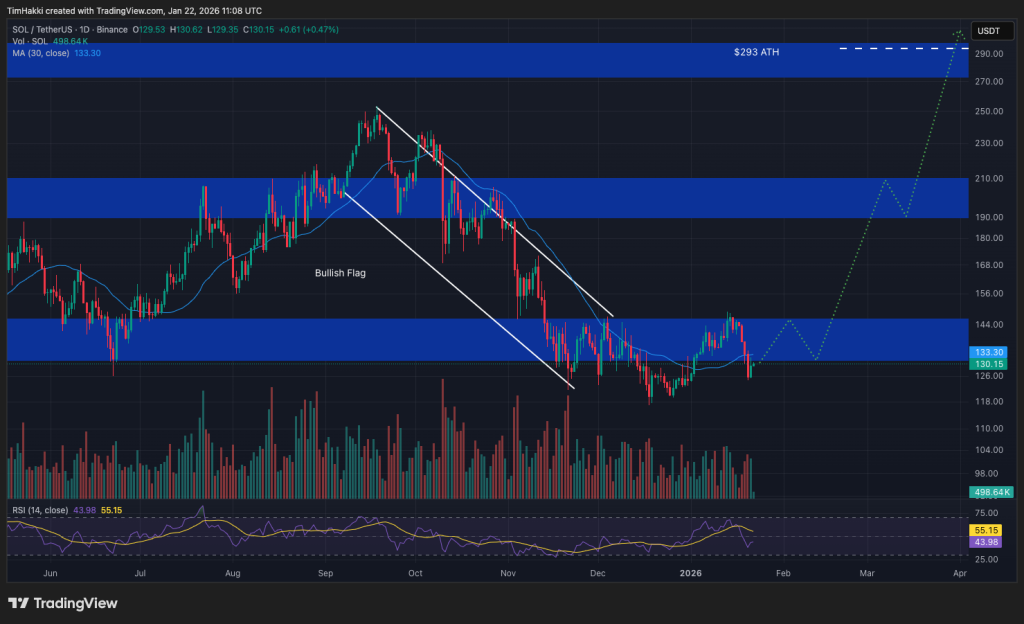
A clear break above resistance near $200 and $275 would open the door for Solana to exceed its ATH of $293.31 and potentially climb past $300 before the end of the quarter.
Solana is also emerging as a key platform for real-world asset tokenization, widely regarded as one of blockchain’s most compelling use cases for institutions. Major players such as BlackRock and Franklin Templeton have used Solana to issue tokenized investment products.
Cardano ($ADA) was established in 2015 by Charles Hoskinson, a co-founder of Ethereum, and officially launched in 2017.
The ongoing development of this Proof-of-Stake blockchain is grounded in peer-reviewed academic research, an approach that continues to set Cardano apart from many competitors in the sector.
With a market value of approximately $13.4 billion and a TVL of $168 million, ADA still has plenty of headroom to grow before competing directly with Solana as the leading alternative to Ethereum.
From a technical perspective, ADA’s Relative Strength Index is hovering near 43. Over the past 24 hours, the token has gained 2%, bringing its price to around $0.365.
The appearance of a bullish falling wedge pattern in late 2026 indicate the possibility of an imminent rally that could, under favorable conditions, help ADA push through local resistance zone to hit $1.20 by the end of Q1.
Additionally, if the CLARITY act is resolved, Cardano could easily revisit its $3.09 ATH before year-end.
Bitcoin Hyper ($HYPER) is an emerging Bitcoin Layer-2 network focused on accelerating transactions, lowering fees, and enabling advanced smart contract functionality.
Powered by the Solana Virtual Machine, Bitcoin Hyper incorporates decentralized governance and a Canonical Bridge to facilitate seamless cross-chain Bitcoin transfers.
The project’s presale has already raised over $30.8 million, with some market commentators projecting potential returns ranging from 10x to 100x once the token becomes available on exchanges. A recent audit conducted by Coinsult reported no critical vulnerabilities in the smart contract.
The HYPER token underpins the ecosystem, serving as the medium for transaction fees, governance participation, and staking incentives.
Participants can stake tokens during the token sale to earn yields of up to 38% APY, though returns gradually decrease as overall participation increases.
With exchange listings anticipated later this year, Bitcoin Hyper’s presale offers early supporters exposure to the next evolution of the Bitcoin network.
Visit the official website or follow Bitcoin Hyper on X and Telegram for more information.
Visit the Official Website HereThe post Best Crypto to Buy Now January 22 – XRP, Solana, Cardano appeared first on Cryptonews.

Cardano and its vibrant ecosystem are becoming more decentralized as several moves are consistently being made to improve the leading blockchain network. One of these efforts is clearly indicated by the steady expansion of ADA delegation to multiple community DReps across the sector.
In a bold and exciting move, the Cardano Foundation has taken another step forward toward deeper and robust decentralization. The Foundation’s goal for deeper decentralization is being carried by expanding its ADA delegation to about 11 community DReps, which strengthens on-chain governance and community participation.
The recent delegation activity was disclosed on Cexplorer, the biggest and most featured OG blockchain explorer, via the social media platform X. The action is in line with Cardano’s changing governance structure, where elected representatives hold a growing amount of decision-making authority instead of fundamental entities.
As reported by the popular explorer, the Cardano Foundation has delegated over 220 million ADA to the 11 community DReps. By expanding its ADA delegation, the foundation is reaffirming its dedication to openness, diversity, and long-term network resilience, thereby making Cardano more decentralized.
These are the most crucial pillars in the move as the network persistently shifts toward a full community-driven ecosystem. According to the explorer, the Foundation has also self-delegated about 171 million ADA, moving it from an auto-abstain in order for all funds to actively participate in governance.
Following the move, the amount of ADA that has been utilized for delegation activity has increased sharply. A massive wave of ADA delegation signals a growing acceptance of on-chain governance across the broader Cardano ecosystem.
Cexplorer reported that the number has seen steady growth over the past several months. Current data shows that over 36.9% of circulating ADA has been delegated to Cardano DReps, which reflects mounting conviction in the network’s model.
Furthermore, it is a sign that more participants are willing to play a crucial role in shaping the blockchain’s future. Thus, decision-making power is shifting from concentrated entities to community voices as more holders pledge their tokens to designated representatives.
When compared to the stake pool, the explorer data shows that roughly 56% of ADA in circulation is delegated to the area. In the meantime, for delegators to be able to take out their staking rewards, they are expected to delegate to a DRep.
After a recent voting operation, Cardano’s future direction is now quite clear. Over 700 community members and 200 DReps participated in the voting process to decide where the ecosystem should be by 2030.
At the end, 67.80%, representing over 3.77 billion ADA, voted yes to the proposal that the network is moving in the right direction. Meanwhile, the rest, representing 491 million ADA, voted No to the proposal.
The Cardano Foundation said it has hit the first milestone in its updated governance roadmap, expanding delegation to a new set of community representatives as the ecosystem leans further into on-chain decision-making. The move matters because it shifts meaningful voting weight toward delegated representatives (DReps) whose mandates emphasize adoption and day-to-day network operations rather than purely technical development.
In a post on X and an accompanying blog update, the Foundation said it has delegated an additional 220 million ADA to 11 selected DReps, roughly 20 million ADA each, focused on the pillars of Adoption and Operations. The Foundation framed the step as a continuation of earlier delegations to “Developer & Builder DReps,” and said the new allocation brings total delegation to community DReps to 360 million ADA.
Alongside the additional community delegation, the Foundation said it is revising how it handles its remaining stake in governance. “Rather than leaving a portion of our funds on auto-abstain as initially planned, we will self-delegate the remaining balance (approximately 171 million ADA),” the Foundation wrote. “While this exceeds our initial estimate, it ensures no ADA remains passive and still results in a net reduction of our overall voting power by approximately 43 million ADA, with the clear majority of our holdings now empowering community DReps.”
The Foundation emphasized that the delegations are intended to distribute voting power without imposing direction. “This delegation is not a blind bet, rather it’s a show of trust in a proven history of sound decision-making,” it said. “As always, it’s also a show of good faith: These new delegations come without any expectation regarding voting outcomes. We will not direct these DReps on how to vote, nor will we provide a voting manual.”
That posture, explicitly accepting dissent from its own views, was positioned as a feature rather than a risk. The Foundation said it expects “differing opinions” between the newly selected DReps and the Foundation itself, describing that divergence as evidence of “a healthy, decentralized governance system.”
The Foundation’s rationale for targeting adoption and operations reads as a governance design choice: broaden the expertise mix beyond protocol engineering. “To build a resilient governance system, we need more than just technical expertise—We need business acumen and operational stability,” it wrote, arguing that Adoption DReps can represent real-world utility, onboarding, and enterprise needs, while Operations DReps reflect the practical constraints faced by stake pool operators, toolmakers, and infrastructure providers.
In the published list, the Adoption cohort includes figures tied to community growth and product-building across the ecosystem, from regional community leadership to DeFi and stablecoin infrastructure, while the Operations cohort highlights long-running infrastructure roles such as block explorer analytics, stake pool operations, and SPO tooling.
The Foundation said all eleven delegations were completed in a single on-chain transaction, linking to the Cardano Explorer entry, and noted the delegations are effective immediately. It also encouraged the broader community to “follow and interact with these DReps,” including engaging with their voting rationales and participating in governance actions.
At press time, Cardano traded at $0.3549.
A disagreement over US crypto regulation has spilled into public view, drawing the Cardano and XRP communities into an unexpected clash. The reason is the Digital Asset Market Clarity Act, a proposed bill intended to define how digital assets are regulated in the United States.
The disagreement started after Charles Hoskinson openly criticized Brad Garlinghouse over his stance on the legislation, which led to pushback from prominent XRP community members. This comes just after reports have suggested growing frustration among lawmakers toward Coinbase over disagreements tied to the Clarity Act.
The tension came to the surface during a livestream in January 2026, where Hoskinson criticized Garlinghouse’s apparent support for advancing the Clarity Act despite its shortcomings. In the video, Hoskinson expressed skepticism about the bill’s direction and origins, remarking sarcastically, “And what we got is Elizabeth Warren wrote the bill, that’s leadership we can believe in.”
He went on to challenge the idea that passing an imperfect bill is preferable to continued uncertainty, pointing directly to the position of Ripple CEO Brad Garlinghouse. Hoskinson questioned whether handing regulatory power to the same institutions that previously sued, subpoenaed, or shut down crypto businesses could truly be considered progress.
Hoskinson’s remarks did not go unanswered. Vet, a notable XRP community member and XRP Ledger dUNL validator, reposted the video on X and criticized Hoskinson’s approach. Vet questioned why Hoskinson chose to publicly attack Garlinghouse instead of contributing constructively to the legislative process, writing, “How about focusing on helping shape the Clarity Bill instead of crashing out on Brad for no reason, Charles?”
The Clarity Act is one of a few bills introduced during the current crypto-positive Trump administration that aims to bring structure to a regulatory environment that has been uncertain for years. The Clarity Act, in particular, was introduced to bring clarity around whether digital assets should be treated as securities or commodities and which agencies should oversee them.
The bill represents a necessary step toward legal certainty and institutional participation. Supporters of XRP tend to see engagement with lawmakers as a practical route forward after years of legal battles. However, others like Charles Hoskinson are of a different notion.
The Clarity Act is not without its issues. Sources close to the White House say the administration is considering pulling its support for the Clarity Act if Coinbase does not return to negotiations over stablecoin yield provisions. However, Coinbase CEO Brian Armstrong noted that Coinbase is actively working to find common ground with banks on yield-related issues.
A similar Act, called the Guiding and Establishing National Innovation for US Stablecoins Act, or the “GENIUS Act,” was signed into law in 2025 by President Donald Trump as part of efforts to create better regulatory clarity towards stablecoins in the United States.
Interestingly, Ripple CEO Brad Garlinghouse was part of the crypto industry leaders that expressed support for the Genius Act after it was signed into law.
If you are anything like me, you believe in the long-term future of crypto. That does not change the fact that prices for XRP, Cardano, and Shiba Inu do not look great at the moment.
These dips across the market were triggered by Bitcoin dropping back toward $90,000 after getting rejected near the $98,000 level.
Fundamentally, these coins are improving over time. Technically, though, the market is going through one of its weakest phases, with every rally getting shut down at key resistance levels. Below is how things could play out as we head into 2026.
Gold price is currently retesting its all-time high as risk assets like stocks and crypto continue to dump.
This shows it is not just a crypto problem. Investors are rotating into safe-haven assets like gold to protect capital amid growing uncertainty tied to tariffs and ongoing Greenland talks.
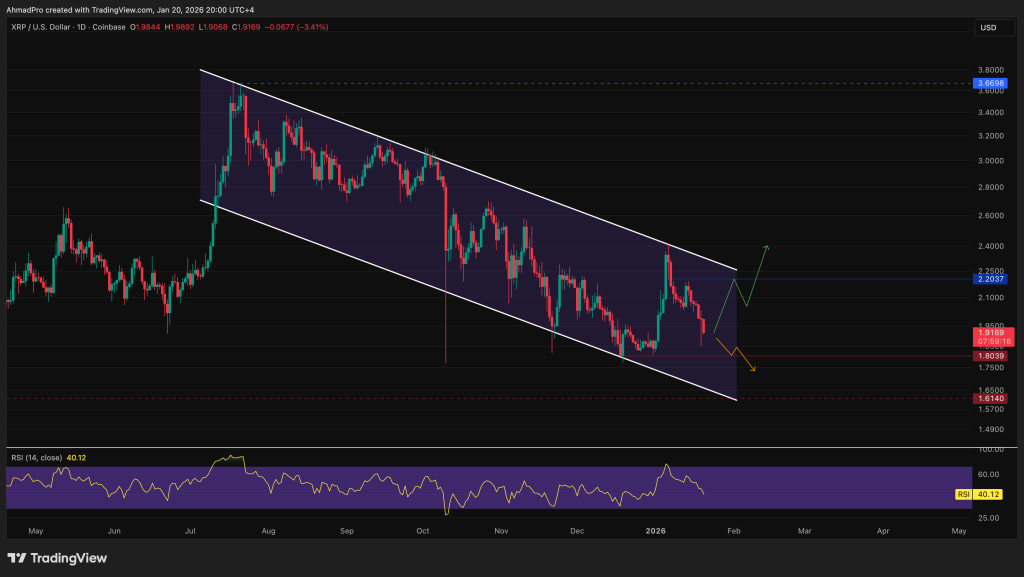
After a strong start to the year, the XRP rally stalled at the $2.50 resistance level and has since slipped back into a downtrend.
At the time of writing, XRP is trading around $1.90 and moving toward $1.80, which has acted as the main support level over the past 12 months. A clean loss of this area would likely open the door for a deeper correction toward the lower end of the downtrend channel near $1.61.
RSI is still leaning bearish at 41. If bulls manage to regain momentum and spark a bounce, the next immediate resistance sits at $2.20. Buyers would need to push XRP back above the downtrend line to signal a potential trend change.
ADA is no stranger to a downtrend, having spent most of 2025 struggling and losing over 65% of its value. After a bounce toward $0.40, the ADA price was rejected and is now slipping again toward new lows.
ADAUSD is currently moving toward the $0.33 support level. If price manages to bounce there, the first step in the right direction for ADA would be reclaiming the $0.40 level.
RSI is sitting around 40 and has not signaled oversold conditions yet. ADA needs stronger momentum, and buyers must defend the $0.33 support. Otherwise, price could slide toward the October 10 low near $0.27.
Risk-off mode means the riskiest assets tend to suffer the most. That is exactly what is happening to memecoins, especially with Shiba Inu price action right now.
Yes, it is that bad. SHIBUSD is now potentially retracing the entire early-year rally. Momentum is fading, with RSI sitting at 41, leaning bearish and not yet oversold.
There is likely more downside ahead if SHIB loses the $0.0000068 support, which marked the lowest level even when memecoin interest was almost nonexistent throughout 2025.
A break above the trendline near $0.0000094 would be the first step toward confirming a bullish shift. Otherwise, SHIB is likely to continue ranging lower.
When the market flips full risk-off and majors like XRP, ADA, and SHIB are stuck grinding lower, history shows one thing clearly: speculative capital does not disappear; it relocates.
That is where Maxi Doge comes in.
MAXI is built for moments like this. It is not trying to fix crypto or sell a long-term infrastructure story. It is a pure memecoin designed for volatility, momentum, and sentiment-driven moves, which is exactly where traders rotate when large caps lose direction.
As confidence fades in established names, smaller, earlier-stage memecoins often attract attention because they offer asymmetric upside. Maxi Doge sits right in that zone, early in its lifecycle, highly speculative, and priced for percentage moves rather than slow recoveries.
What separates MAXI from most meme launches is the staking layer. Holders can stake MAXI for daily smart-contract rewards, with current APY sitting around 70%, giving traders a yield angle while waiting for sentiment to flip.
With the broader market weak and fear building, Maxi Doge is positioning itself as a high-risk, high-upside play for traders willing to front-run the next shift in memecoin momentum heading into 2026.
Visit the Official Maxi Doge Website HereThe post Crypto Price Prediction Today 20 January – XRP, Cardano, Shiba Inu appeared first on Cryptonews.
Cardano saw a huge 10,654% overnight increase in volume on derivatives platform Bitmex, turning attention to what’s next for Cardano price predictions.
Speculative demand for the altcoin has spiked sharply, with more than $40.04 million in ADA derivatives traded to start the weekend, according to Coinglass data.
The move closely follows a major TradFi milestone for Cardano, with ADA set to feature on leading derivatives exchange CME Group, pending regulatory approval.
Our Crypto product suite is growing with new Cardano, Chainlink and Stellar futures.
— CME Group (@CMEGroup) January 15, 2026
Available in both larger and micro sizes, these contracts will offer the capital efficiency and versatility to expand your strategy.
This represents not only increased exposure, but mainstream acceptance with CME Group being the first traditional derivatives exchange outside of crypto-native platforms to offer ADA.
The futures volume surge stands out as leverage resets and capital rotates selectively across the market. Risk appetite appears to be clustering around ADA, reinforcing the case for bullish Cardano price predictions.
Institution-grade open interest from TradFi markets could help reinforce bullish momentum and bring a year-long descending channel into focus – the setup traders could be betting on.
With the latest upwards push faltering without sustained backing, its lower boundary stands as a launchpad once again.
Momentum indicators remain well-positioned. While the RSI has fallen back below the 50 neutral line, it has yet to break the uptrend it has followed since November.
The MACD’s death cross below the signal line may prove brief, not a complete unwind of bullish momentum.
The historic $0.70 demand zone is the key level to watch for a confirmed breakout push. With it as support, attention turns to the patterns 260% upside targeting 2024 highs around $1.25.
And with potential mainstream adoption of ADA derivatives, strong inflows could reinforce a push towards the $2 milestone for a 725% gain.
While capital rotation into rotating altcoins, Bitcoin shouldn’t be sidelined just yet, as its ecosystem finally tackles its biggest limitation: scalability.
Bitcoin Hyper ($HYPER) is bridging Bitcoin’s security with Solana tech, introducing a Layer-2 network that unlocks faster, efficient use cases Bitcoin couldn’t support on its own.
It opens the door for Bitcoin to play a larger role in narratives like DeFi and real-world assets – where speed and efficiency matter most.
The project has already raised over $30 million in presale, and post-launch, even a small fraction of Bitcoin’s massive trading volume could send its valuation significantly higher.
Bitcoin Hyper is tackling the slow transactions, high fees, and limited programmability that have long capped Bitcoin’s potential – just as the market turns bullish.
Visit the Official Bitcoin Hyper Website HereThe post Cardano Price Prediction: Trading Volume Explodes 10,654% Overnight, Is a Violent ADA Move About to Hit? appeared first on Cryptonews.
Upon Trump’s tariff threats to Europe, Bitcoin price dumped around 2% to below $93,000, leading to deeper corrections across coins like XRP, Cardano, and Bitcoin Hyper.
These three remain among the strongest picks in the market right now.
XRP and Cardano have yet to see a true breakout rally and are still down over 50% from their all-time highs. Bitcoin Hyper, meanwhile, is being viewed as a high-potential project heading into 2026.
Ripple clearly saw where the market was heading and went all in on stablecoins. Its RLUSD stablecoin alone grew to over a $1.3B market cap in 2025, which is no small feat.
That steady stablecoin adoption, paired with improving regulatory clarity and continued ETF inflows, is giving XRP a real edge going into what could be a strong year ahead.
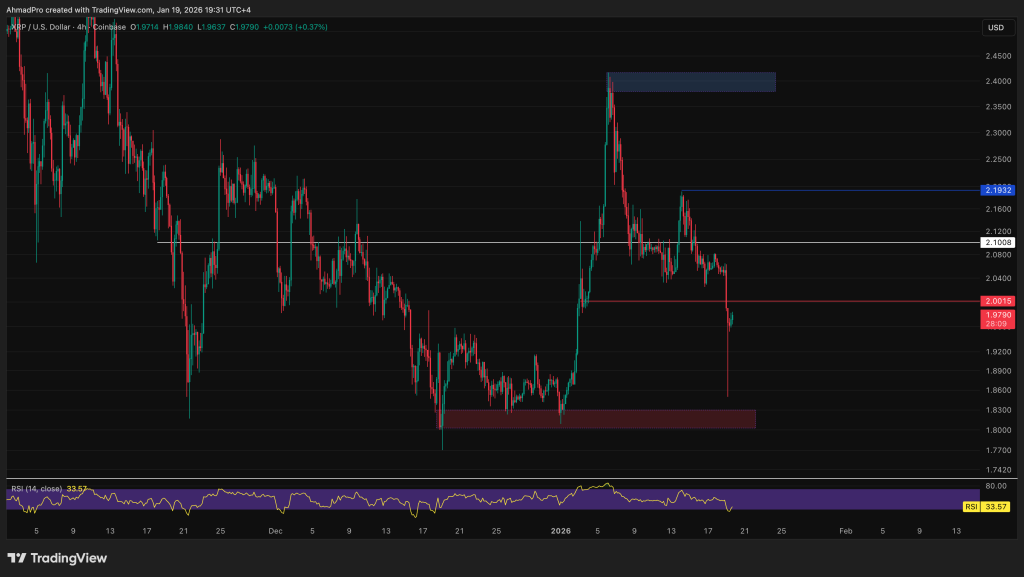
XRP price is back under $2 again, and it is sparking concern. A leading technical indicator, the RSI, is sitting around 33, signaling bearish momentum.
If the XRP chart fails to reclaim the $2.00 level, a retest toward the 18-month support around $1.80 could happen.
The $2.10 and $2.19 zones are the nearest potential resistance levels if a bounce from the current price near $1.97 occurs. A clean breakout above $2.10 would invalidate the bearish case.
Hoskinson’s “locking in” does not seem to be helping much, as Cardano is slipping back under $0.40 again.
However, the Cardano founder recently provided a more encouraging outlook on Cardano’s development and growth, predicting that the layer-one network could see “huge growth” in its DeFi ecosystem.
ADA’s price was moving quite well after bouncing from the range low, before the downtrend started again. It is currently being dragged down toward the $0.36 level.
If the correction continues, the price could revisit the $0.33 range low again, where it has bounced from before.
To invalidate this bearish case, ADA price needs a sustained breakout above the $0.40 level and a clear shift in momentum, as the current RSI is around 32, signaling bearish conditions.
While majors like XRP and Cardano are grinding through corrective phases, some traders are shifting toward higher-beta plays that react more aggressively to Bitcoin moves. That is where Bitcoin Hyper comes into focus.
Bitcoin Hyper is built as a Bitcoin-linked momentum project, designed to amplify market moves rather than compete with Bitcoin itself. When BTC volatility picks up, projects like HYPER tend to attract speculative capital looking for faster percentage moves.
With Bitcoin pulling back on macro uncertainty and traders positioning for the next leg, rotation into higher-risk, higher-reward setups is already starting. That environment historically favors projects tied directly to Bitcoin sentiment.
Bitcoin Hyper has already gained traction early, raising strong interest from traders positioning ahead of the broader market recovery. The project has already raised $30.80 million in record time, with early investors jumping in before momentum hits full speed.
For traders looking beyond large caps and into more aggressive Bitcoin-linked exposure heading into 2026, Bitcoin Hyper remains one of the names getting early attention.
Visit the Official Bitcoin Hyper Website HereThe post Crypto Price Prediction Today 19 January – XRP, Cardano, Bitcoin Hyper appeared first on Cryptonews.
Bullish sentiment is gradually returning to the broader cryptocurrency space, and Cardano (ADA) is seeing growing institutional interest and adoption. Even though its price remains in a consolidation phase, several moves are being made to showcase Cardano’s relevance in the global finance sector.
One of the most recent announcements making the headlines in the cryptocurrency sector is the Chicago Mercantile Exchange (CME) Group’s move to expand its crypto portfolio, choosing Cardano as one of the major coins. The CME is preparing to increase the scope of its crypto derivatives offering and take a further step toward the institutionalization of digital asset markets, with the introduction of futures contracts for Cardano (ADA) and Chainlink (LINK).
By adding ADA and LINK futures to its platform, CME is strengthening the function of regulated derivatives as an entry point for institutional involvement in the developing cryptocurrency ecosystem. This action demonstrates the rising significance of other blockchain networks in global finance. It also reflects the growing demand from professional traders seeking regulated exposure outside of Bitcoin and Ethereum, the two largest crypto assets.
According to Lucas Macchiavelli, a Cardano ambassador and blockchain strategist, this could be the strongest institutional validation in ADA’s history, and it might be the largest sign of approval the leading altcoin has ever gotten. Macchiavelli added that this is not just another listing since the move expands the network’s role in digital finance operations.
The strategist’s claims major hinges on the fact that the CME Group is the largest derivatives exchange in the world, which is increasingly used by banks, hedge funds, asset managers, and institutional investors across the globe. Currently, this goes beyond Cardano.
Macchiavelli stated that this kind of action sends a signal to the entire cryptocurrency market, improving price discovery, deepening capital access, increasing institutional visibility, and making it easier for traditional finance to participate. “This is how crypto keeps moving into the financial mainstream,” the expert added.
Crypto expert Dave stated that Cardano is exceptionally well-suited to real-world use cases like traceability because once data is written on the network, it stays written. There is no rewriting history, no ambiguity, just facts that are retained exactly as they were recorded.
Such performance underscores its immutability, which is backed by over 8 years of continuous reliability. Cardano network has been continuously operating, developing, and securing genuine worth while being enhanced between. This is key when trust, verification, and accountability are required in real-world governance by compliance and regulation.
According to the expert, the network quietly stands apart in a world of transparency and reliability. With this, ADA goes beyond the status of a store of value. It is also considered a store of truth, continuity, and real utility.
Leading derivatives exchange CME plans to add futures contracts tied to Cardano (ADA), Chainlink (LINK), and Stellar (XLM) to continue growing its roster of regulated crypto derivatives.
On Thursday, Chicago-based derivatives exchange CME Group announced a new expansion of its lineup of regulated crypto derivatives with the upcoming inclusion of Cardano, Chainlink, and Stellar futures.
According to the announcement, the new crypto additions are expected to launch on February 9, 2026, although they are still pending regulatory review. In addition, they will offer both micro-sized and larger-sized contracts for the three cryptocurrencies.
For the standard Cardano futures, the contract will cover 100,000 ADA, while the micro-sized ADA futures will consist of 10,000 tokens. In addition, the Chainlink and Stellar’s large-sized futures will be set at 5,000 LINK and 250,000 XLM, respectively, while the small-sized contracts will cover 250 LINK and 12,500 XLM.
The upcoming Cardano, Chainlink, and Stellar futures contracts build on the derivatives exchange’s existing crypto suite, which includes four of the largest cryptocurrencies by market capitalization.
In 2017, CME first launched Bitcoin (BTC) futures, followed by the introduction of Ethereum (ETH) futures in 2021. In the first half of 2025, the Chicago-based exchange added Solana (SOL) and XRP futures to its lineup, introducing options for both cryptocurrencies later in the year.
Giovanni Vicioso, CME Group Global Head of Cryptocurrency Products, highlighted the industry’s expansion and development over the past few years, affirming that “given crypto’s record growth over the last year, clients are looking for trusted, regulated products to manage price risk as well as additional tools to gain exposure to this dynamic market.”
“With these new micro- and larger-size Cardano, Chainlink and Stellar futures contracts, market participants will now have greater choice with enhanced flexibility and more capital-efficiencies,” he added.
Despite the positive development, the trajectory of ADA, LINK, and XLM remained mostly unchanged, with the three altcoins continuing their intraday correction. Chainlink and Stellar both saw 4% declines from their Thursday highs, falling to the $13.60 and $0.225 levels.
LINK has momentarily lost the $13.80 level as support and is attempting to hold the current area to prevent further bleeding. Similarly, XLM was also rejected from the Wednesday highs and bounced from the $0.230 before continuing its descent toward its two-day low.
Meanwhile, ADA was attempting to reclaim the $0.41 area ahead of the announcement, briefly bouncing from the recent pullback. Notably, Cardano surged over 10% from the recent lows toward the crucial $0.42-$0.43 area.
However, the altcoin was rejected from this zone on Wednesday, retracing nearly 9% from the local highs to retest the $0.40 level. On Thursday morning, the cryptocurrency bounced from this area, but ultimately resumed its correction as the day progressed.
As a result, Cardano has retraced most of this week’s gains, currently trading around the $0.391 mark.
With the latest move and partnership from Cardano, the financial sector could be set for a major shift. A new financial audit has been launched from the recent partnership that aims at bolstering accountability in the broader finance landscape, which reflects the blockchain’s focus on transparency.
Recently, the Cardano Foundation announced a new partnership with global professional services firm Grant Thornton as they step toward enhancing transparency and institutional credibility. By joining forces, both leading firms have collectively launched a new comprehensive financial audit.
The partnership was disclosed by the Cardano Foundation on their official page on the social media platform X. According to the Foundation, this audit is cryptographically secured and attested directly on-chain using their Virtual LEI (vLEI).
This new audit is being described as a global first for financial trust and transparency in the blockchain industry. Powered by Reeve, this new gold standard is the Cardano Foundation’s enterprise-grade financial data management solution.
By hiring one of the top audit firms in the world, the foundation is demonstrating its dedication to regulatory-ready standards and accountability, which are essential elements for drawing in long-term investors and enterprise adoption. In a world driven by data, trust, and verification, the Foundation claims that accountability is everything, and Cardano is at the forefront of this narrative.
Frederik Gregaard, the Chief Executive Officer (CEO) of the Foundation, stated that this audit was executed in two on-chain transactions. “For me personally, it closes one chapter and opens a much larger one. A future where financial trust is native to infrastructure, not bolted on through intermediaries,” the CEO added.
Cardano’s position as a blockchain project focused on rigor and trust is evidenced by its growing adoption on the institutional level. A few days ago, one of the world’s largest companies, Google, took a bold step by investing in the blockchain’s infrastructure.
According to the report from ADA Advocate, the Google Cloud stake pool can now be found on the network and the newly launched Midnight chain. Google’s involvement and recognition of Cardano’s security and stability is a significant advancement in the use of blockchain technology by actual business behemoths.
Amid the rising demand, the price of Cardano has begun to display bullish momentum, pushing back above $0.4. Market expert and veteran financial trader, Matthew Dixon, highlighted that ADA currently holds tremendous upside potential with 5 waves up from the low, as either an A wave or wave 1.
More than two times the potential is given by even the most cautious interpretation of an A wave, and much more if wave 1. As a result, the expert has placed the altcoin among his favorites for Q1 2026.
The Cardano Foundation is backing an on-chain “info action” that would route up to $75 million from Cardano’s treasury into a new, Draper Dragon-managed ecosystem fund targeting a total $80 million raise, with a mandate to invest in Cardano-native startups while sending proceeds back to the treasury over time.
If approved, the vehicle, dubbed the Cardano x Draper Dragon Ecosystem Fund (the “DDC Fund”), would run for at least six years, deploy venture-style capital across early-stage teams and ecosystem growth programs, and report performance via a public dashboard and quarterly disclosures, the Foundation said in a forum post published roughly a day before the announcement.
The proposal is designed as a budget info action that would authorize three treasury withdrawal tranches over 438 epochs: a fixed $15 million first tranche, followed by two tranches targeting $30 million each in years two and four. The withdrawals are denominated in ADA and capped at 175 million ADA in aggregate, with per-tranche caps of 50 million ADA for the first and 85 million ADA for the second and third.
The remaining $5 million to reach the $80 million headline size is expected to come from qualified external limited partners (eLPs), a structure the post frames as both incremental capital and a way to “prov[e] the value proposition of Cardano investments to a larger audience.”
Cardano’s pitch is that the fund turns the treasury from a passive pool into a compounding capital vehicle. “The goals of this proposal are straightforward and ambitious: Deliver a return multiple back to the Treasury; make Cardano self-sustaining while increasing the ecosystem’s total value locked (‘TVL’), on-chain activity, and developer participation; and transform the Treasury from a passive reserve into an active growth engine that compounds Cardano ecosystem value,” the post said.
Under the proposed structure, Draper Dragon acts as general partner and controls investment decisions. An affiliate adviser, described as an “exempt reporting adviser regulated by the Securities Exchange Commission”, would provide due diligence and advisory support. The Cardano Foundation positions itself as an enabler rather than an investment decision-maker, taking responsibility for orchestrating the legal setup and administering the proposal under the Cardano constitution.
To route economics back to the treasury, the plan creates a Cayman Islands special purpose vehicle (SPV) that would serve as the fund’s limited partner on behalf of the treasury. The SPV is described as “ownerless” and intended to exist solely for the economic benefit of the treasury, with an initial three-director setup that includes an independent director, a Foundation director, and a community-elected “Community SPV Director.”
The DDC Fund’s financial targets are framed in institutional VC terms: a roughly 3x gross multiple on invested capital and a 25%+ IRR, benchmarked against institutional blockchain and crypto venture funds, with the post stressing projections are illustrative and not performance guarantees.
On the ecosystem side, the ambition is explicit: contribute to increasing Cardano TVL from “the current $300M to $3B+,” split between $1.5B+ in RWA and $1.5B+ in DeFi, while also pushing higher on-chain usage, network revenue, and developer participation.
The treasury-funded $75 million would be allocated across direct investments, growth capital, and educational support, plus fund and administration costs. Direct investments are slated to take the largest share ($50 million), while growth capital ($11.5 million) and educational support ($6 million) fund marketing, liquidity initiatives, exchange introductions, and Draper University programming such as accelerators and hacker houses.
Because withdrawals are voted through governance over time, the plan bakes in a 20% buffer for ADA price fluctuations, and allows the GP discretion to time conversions to USD or stablecoins and to defer capital calls for up to six months. Excess value from a rising ADA price is meant to reduce later tranches; shortfalls can be handled via the buffer, deferrals, top-up governance actions, or adjustments within the tranche and aggregate caps.
The post also outlines failure modes. If treasury withdrawals repeatedly fail, specifically, “at least three successive Treasury withdrawals fail to pass within a calendar year”, the GP may wind the fund down and liquidate assets in a controlled process.
Transparency is promised via a public KPI dashboard and quarterly fund reports, plus AMAs and roundtables, but with a clear boundary: deal terms, valuations, and certain portfolio information would remain confidential, consistent with “standard” venture fund practice.
At press time, ADA traded at $0.4215.
Smart contract platforms are often evaluated by how expressive they are, how fast they execute, or how many applications they support. Far less attention is paid to a more fundamental question: how a blockchain represents and manages state. This design choice shapes everything from scalability and security to developer experience. Cardano approaches this problem differently through its Extended UTXO model, offering an alternative to the account based systems that dominate much of the blockchain ecosystem.
Understanding why this matters requires stepping back from surface level features and examining the architectural foundations of smart contract platforms. The way state is tracked determines how transactions interact, how predictable execution becomes, and how systems behave under load. Cardano’s model represents a deliberate shift toward predictability and correctness rather than maximal flexibility.
The Unspent Transaction Output model was first introduced by Bitcoin as a way to represent ownership and value without global accounts. In this model, transactions consume existing outputs and create new ones, forming a clear and traceable chain of value movement. Each output is discrete and immutable once created, which simplifies verification and enables parallel processing.
Cardano builds on this idea by extending the UTXO concept to support smart contracts. Rather than abandoning the model in favor of accounts, it adds data and validation logic directly to transaction outputs. This extension allows UTXOs to carry scripts and contextual information while preserving the original strengths of the model. The result is a system where smart contracts are expressed as rules for spending outputs rather than mutable programs tied to global state.
Most smart contract platforms today use an account based model. In these systems, contracts are accounts that hold balance and internal state. Transactions modify this state directly, often in complex and interdependent ways. While this approach feels intuitive, especially to developers familiar with traditional programming, it introduces ambiguity around execution order and shared state.
When multiple transactions interact with the same contract, the outcome can depend on timing, ordering, and internal conditions. This makes reasoning about behavior more difficult and increases the risk of unintended consequences. It also limits parallelism, since many transactions must be processed sequentially to avoid conflicts. These constraints become more pronounced as networks scale and usage increases.
One of the most important consequences of Cardano’s Extended UTXO model is deterministic execution. Because each transaction explicitly references the outputs it intends to consume, its effects are known before execution. There is no hidden or implicit state that can change unexpectedly due to unrelated activity elsewhere on the network.
This predictability allows developers to reason about smart contract behavior with greater confidence. It becomes possible to analyze transactions in isolation and determine whether they will succeed or fail without simulating the entire system. For applications involving financial logic, governance, or identity, this level of assurance is invaluable. Errors become easier to detect early, and catastrophic failures become less likely.
The discrete nature of UTXOs enables parallel transaction processing. Since independent outputs can be spent simultaneously, the network does not need to serialize unrelated activity. This contrasts with account based systems where shared state forces sequential execution even when transactions are logically independent.
Cardano’s Extended UTXO model preserves this advantage while adding expressive power. Smart contracts do not inherently block each other unless they attempt to consume the same outputs. This creates a natural pathway toward scalability without relying solely on complex secondary solutions. As demand grows, the system can handle higher throughput while maintaining clear and auditable behavior.
In the Extended UTXO model, smart contracts are not long lived entities that change internal variables over time. Instead, they define conditions under which outputs can be spent. State transitions occur through the creation and consumption of outputs, making state changes explicit and traceable.
This approach encourages a more functional style of programming. Rather than updating variables, developers describe valid transformations from one state to the next. While this requires a shift in mindset, it aligns well with formal reasoning and verification. Programs become easier to analyze mathematically, reducing the risk of subtle bugs that arise from complex mutable state.
Security in smart contract systems is often compromised by unexpected interactions between state and execution order. Many high profile exploits stem from reentrancy issues, race conditions, or assumptions about state that no longer hold under concurrent execution.
The Extended UTXO model mitigates many of these risks by design. Since scripts validate specific outputs rather than operating on global state, entire classes of vulnerabilities are eliminated. This structure also pairs naturally with formal verification techniques, allowing developers to prove properties about contracts before deployment.
This emphasis on correctness reflects the broader philosophy behind Cardano , which prioritizes reliability and long term safety over rapid experimentation. As smart contracts begin to manage increasingly valuable and sensitive systems, these guarantees become essential rather than optional.
The Extended UTXO model is not without tradeoffs. Developers accustomed to account based platforms may initially find it less intuitive. Managing state through outputs requires careful design and a clear understanding of transaction flow. Some patterns that are trivial in account based systems require more planning under this model.
However, these challenges are often front loaded. Once developers internalize the paradigm, they gain access to stronger guarantees and clearer mental models. Tooling and abstractions continue to evolve, reducing friction and improving ergonomics. Over time, the learning curve becomes an investment rather than a barrier.
As blockchain systems mature, the demands placed on them will increase. Applications will need to handle higher volumes, stricter security requirements, and more complex governance structures. In this context, architectural decisions made early in a platform’s life become increasingly important.
Cardano’s Extended UTXO model represents a commitment to building smart contract infrastructure that can scale responsibly. By favoring explicit state transitions, deterministic execution, and parallelism, it addresses many of the limitations observed in earlier designs. This positions the platform to support use cases where predictability and trust are paramount.
The Extended UTXO model challenges conventional assumptions about how smart contracts should be designed. Rather than emphasizing mutable state and maximal flexibility, it prioritizes clarity, correctness, and composability. This shift has profound implications for security, scalability, and developer reasoning.
While the model requires a different way of thinking, it offers benefits that become more valuable as systems grow in complexity and importance. By extending a proven transaction model rather than replacing it, Cardano introduces smart contracts without sacrificing the properties that make decentralized systems robust.
In a space where many platforms optimize for speed and convenience, Cardano’s approach stands out as a careful rethinking of fundamentals. The Extended UTXO model is not merely a technical curiosity. It is a statement about what smart contract platforms can become when architecture is treated as a first class concern.
How Cardano’s Extended UTXO Model Changes Smart Contract Design was originally published in Coinmonks on Medium, where people are continuing the conversation by highlighting and responding to this story.
