
Normal view

There are new articles available, click to refresh the page.
Today — 8 December 2025Cryptocurrency

Fed Liquidity Move Could Send Bitcoin “Sharply Higher,” Analysts Say

By: Amin Ayan
8 December 2025 at 07:33

Bitcoin’s climb above $92,000 has stirred fresh optimism among market watchers who now believe this week’s Federal Reserve meeting could set off a far bigger rally.

Key Takeaways:

  • Analysts say a Fed-driven liquidity boost could send Bitcoin sharply higher after breaking above $92,000.
  • London Crypto Club expects a “dovish surprise” with rate cuts and balance sheet expansion acting as major catalysts.
  • Markets widely anticipate a 25bps cut, with lower rates historically fueling stronger demand for risk assets like Bitcoin.

Analysts at the London Crypto Club say a liquidity boost from the Fed on Wednesday may act as a powerful catalyst, potentially driving the world’s largest cryptocurrency “sharply higher.”

Fed Poised for “Dovish Surprise” as Analysts Warn Liquidity Wave Is Coming

In their latest note, David Brickell and Chris Mills argue that the central bank is poised to deliver a “dovish surprise,” forecasting that policymakers will inject liquidity through a creative bond-buying mechanism rather than explicit quantitative easing.

“We’re moving into a continued rate-cutting cycle accompanied by balance sheet expansion as the Fed effectively turns on the money printers to monetise the deficit,” they wrote.

“That’s a powerful, structural tide to be swimming against in the new year.”

The outlook comes at a tense moment for crypto traders. Bitcoin’s recent break above $92,000 follows two months of turbulence that erased almost all of the year’s gains, leaving investors eager for a clear macro signal that could reset market direction.

Interest rate cuts aren’t coming. And if I’m right, the biggest hike since 2022 arrives in 2026.

All year, people have been fed the same story:
“Just wait for the cuts… and everything booms.”

I don’t think that’s the regime we’re heading into.

Last week, I locked my interest… pic.twitter.com/tSDBM3QOiQ

— ASX Trader (David Bird), CFTe (@ASX__Trader) December 7, 2025

The Federal Open Market Committee’s decision dominates this week’s macro calendar.

“Policymakers are expected almost universally to cut rates 25bps for a third time this year,” said Ed Yardeni of Yardeni Research, echoing broad market expectations.

The CME FedWatch tool shows an 86% probability of a quarter-point cut, while prediction market Polymarket places the odds even higher at 94%.

Historically, lower interest rates have benefited risk assets like Bitcoin by reducing the appeal of bonds and increasing the flow of capital into higher-yielding or speculative markets.

Bitcoin Tests Key Fibonacci Support

As reported, Bitcoin is trading at a pivotal level that analysts say could determine whether the market holds its broader uptrend or slips back toward spring lows.

Crypto trader Daan Crypto Trades said the 0.382 Fibonacci retracement zone is the line bulls must defend, warning that a breakdown could send BTC back to April levels near $76,000.

“It’s also pretty much the last major support before testing the April lows again, which would break this high time frame market structure,” he said.

Meanwhile, a key on-chain indicator known as “liveliness” is climbing again, even as Bitcoin’s price action remains subdued.

Analysts say the divergence suggests renewed underlying demand, with dormant coins moving at levels not seen in years, a sign that long-term holders may be re-entering the market.

Last week, Bitfinex said the market is showing “seller exhaustion” following a period of heavy deleveraging and panic-driven exits by short-term holders.

The post Fed Liquidity Move Could Send Bitcoin “Sharply Higher,” Analysts Say appeared first on Cryptonews.

Canada’s $72M Crypto Tax Crackdown Targets 2,500 Dapper Labs Users — But No Charges Yet

8 December 2025 at 07:32

Canada’s tax authority has widened its crypto enforcement net, targeting 2,500 users of Vancouver-based NFT firm Dapper Labs in a probe tied to an estimated C$72 million ($54 million) in suspected unpaid taxes.

The probe sits within a larger Canada Revenue Agency (CRA) campaign that has already generated more than C$100 million in recovered taxes through crypto audits over the past three years, according to a report by The Canadian Press

Yet despite the growing sums involved, authorities confirm that no criminal charges have been laid in any crypto tax case since 2020, showing the gap between civil enforcement and criminal prosecution in Canada’s digital asset sector.

CRA Secures Rare ‘Unnamed Persons’ Order in Dapper Labs Tax Probe

The report stated that the CRA sought and received approval in September to compel Dapper Labs to disclose information tied to thousands of users under what is known as an “unnamed persons requirement.”

The legal tool allows tax authorities to obtain records on an identifiable group of taxpayers without accusing the company itself of wrongdoing.

Dapper, which operates one of the most prominent non-fungible token platforms and runs its own blockchain and digital wallets, did not oppose the application.

The report shows the CRA initially sought information on roughly 18,000 Dapper users, but following negotiations, the scope was narrowed to 2,500 accounts.

It marks only the second time Canadian courts have granted such an order against a domestic crypto firm, the first being issued against Coinsquare in 2020.

In an affidavit supporting the application, CRA project lead Predrag Mizdrak said crypto markets are deeply embedded in the underground economy and present “significant non-compliance” risks.

Internal agency figures show that about 15% of Canadian crypto users fail to file taxes on time or at all, while 30% of those who do file are classified as high risk for non-compliance.

The agency estimates that up to 40% of taxpayers using crypto platforms fall into non-filing or high-risk categories.

The CRA currently employs 35 dedicated cryptoasset auditors working across more than 230 files.

Since 2020, five criminal investigations involving digital assets have been launched, with four still ongoing as of March.

The agency says the cases are complex and often hinge on cross-border evidence and cooperation, contributing to long timelines and the absence of charges to date.

Canada Prepares New Crypto Reporting Rules as Federal Crackdown Widens

The crackdown on Dapper users comes as Canada tightens its wider crypto oversight. Under long-standing CRA policy, cryptocurrencies are treated as commodities rather than currencies.

Casual investors generally face capital gains tax, with only 50% of profits taxable at marginal rates, while frequent traders, miners, and crypto businesses are taxed on full business income.

Most crypto transactions, including sales, swaps, and crypto-based purchases, are treated as taxable dispositions under existing rules.

New reporting rules are also on the way as Canada is preparing to implement the OECD-backed Crypto-Asset Reporting Framework starting in 2026. The framework will require exchanges, brokers, and crypto ATM operators to report transaction data and customer information directly to the CRA.

Crypto firms in Canada will soon face increased disclosure obligations, per regulations introduced in Tuesday's 2024 federal budget.#Canada #crypto #CanadaBudgethttps://t.co/pkdV878DXM

— Cryptonews.com (@cryptonews) April 17, 2024

The 2024 federal budget set aside more than C$50 million over five years to support that effort.

At the same time, Ottawa plans to establish a national financial crimes agency by 2026 to focus on sophisticated money laundering and online financial fraud.

Finance officials describe it as the country’s first unit focused exclusively on sophisticated financial crime.

Beyond taxes, enforcement has intensified on the anti-money-laundering front. FINTRAC recently issued a record C$19.6 million fine against KuCoin for failing to register and report large transactions.

👨🏻‍⚖️ Canada’s financial intelligence agency @FINTRAC_Canada
has fined the operator of @kucoincom C$19.6 million (US$14.09 million).#KuCoin #Canadahttps://t.co/O2k1Fskkgd

— Cryptonews.com (@cryptonews) September 26, 2025

Meanwhile, another firm, Xeltox Enterprises, was hit with penalties totaling nearly C$177 million.

In September, the Royal Canadian Mounted Police shut down TradeOgre and seized more than C$56 million in assets, marking Canada’s first full crypto exchange takedown.

The post Canada’s $72M Crypto Tax Crackdown Targets 2,500 Dapper Labs Users — But No Charges Yet appeared first on Cryptonews.

Digital Asset ETPs Record $716M Weekly Inflows as AuM Reaches $180B: CoinShares

8 December 2025 at 06:40

Digital asset investment products recorded a second consecutive week of inflows, totalling $716M, showing improving sentiment across institutional and retail investors after a volatile period in crypto markets, according to the latest report from CoinShares.

CoinShares reports total assets under management rose 7.9% from their November lows to $180B, though this figure remains below the all-time high of $264B. Daily flow data indicated minor outflows toward the end of the week, which analysts believe reflected macroeconomic uncertainty and market reactions to U.S. inflation-related data.

Despite those short-term jitters, the week’s net performance highlights renewed confidence in digital asset exposure through exchange-traded products.

A notable trend was the geographic spread of inflows, suggesting renewed interest globally rather than activity concentrated in a single region. The United States led with $483M in inflows, followed by Germany at $96.9M and Canada at $80.7M, demonstrating that institutional re-engagement with crypto markets is widening across regulated investment platforms.

Bitcoin Leads Inflows While Short Products Reverse

Bitcoin remained the primary focus for investors, recording $352M in inflows last week, contributing to year-to-date (YTD) inflows of $27.1B. This remains below the record $41.6B seen in 2024; however, continued inflows suggest persistent appetite for exposure despite reduced volatility and slower price momentum compared to previous cycles.

In contrast, short-Bitcoin investment products saw outflows of $18.7M — the largest since March 2025. Analysts note that the previous occurrence coincided with price lows and later recovery, hinting that current negative sentiment may have exhausted itself, with investors positioning for a more favourable outlook.

The reversal in short-Bitcoin demand could be interpreted as a tactical shift, where investors are less confident in prolonged downside risk and increasingly reassessing the potential for stabilization or upside in digital asset markets.

XRP Sees Strong Momentum as Institutional Interest Accelerates

XRP continued to draw attention, with $245M flowing into ETPs last week, bringing YTD inflows to $3.1B — a dramatic increase compared to $608M in 2024. The surge reflects heightened institutional engagement following greater clarity around its legal and regulatory landscape, which has broadened access and improved sentiment.

The continued rise in XRP ETP demand marks one of the strongest comparative growth stories in the digital asset space this year, suggesting that investors may now be reassessing exposure beyond Bitcoin and Ethereum as the market diversifies.

Chainlink Records Largest Inflows on Record

Chainlink registered $52.8M in weekly inflows, representing over 54% of its total assets under management — the largest on record for the token. The surge highlights growing institutional and developer interest in the tokenized asset and oracle infrastructure ecosystem that Chainlink underpins.

As tokenization of real-world assets expands and demand for reliable data connectivity increases across blockchains, Chainlink’s growth may indicate a long-term thematic trend rather than short-term speculation.

Digital asset ETPs saw US$716m in weekly inflows, lifting total AuM to US$180bn, though still well below the US$264bn all-time high. Bitcoin attracted US$352m while XRP (US$245m) and Chainlink (US$52.8m) also saw strong demand. Short-Bitcoin products saw outflows of US$18.7m, the…

— Wu Blockchain (@WuBlockchain) December 8, 2025

The post Digital Asset ETPs Record $716M Weekly Inflows as AuM Reaches $180B: CoinShares appeared first on Cryptonews.

Why Is Crypto Up Today? – December 8, 2025

8 December 2025 at 06:34

The week begins green, as the crypto market is up today, with the cryptocurrency market capitalisation rising by 2.2%. It stands at $3.2 trillion. 90 of the top 100 coins have gone up over the past 24 hours. At the same time, the total crypto trading volume is at $111 billion.

TLDR:
  • Crypto market cap increased by 2.2% on Monday morning (UTC);
  • 90 of the top 100 coins and all top 10 coins have gone up today;
  • BTC increased by 2.4% to $91,532, and ETH is up by 3.3% to $3,133;
  • The correction may take months to complete;
  • The market could trade in a $71,000 to $105,000 range for the next 4-6 months;
  • If we have a 2-day close above $108,000, the correction is over;
  • Vitalik Buterin suggests a trustless, onchain futures market to lock in Ethereum fees;
  • Binance secured three new licences in Abu Dhabi, and Coinbase reopened registration in India;
  • US BTC spot ETFs saw inflows of $54.79 million on Friday, and ETH spot ETFs recorded $75.21 million in outflows;
  • More than 100 publicly traded companies saw their crypto purchase strategies backfire;
  • Crypto market sentiment remains largely the same within the fear category.
  • Crypto Winners & Losers

    At the time of writing, all top 10 coins per market capitalization have seen their prices rise over the past 24 hours.

    Bitcoin (BTC) is up by 2.4% since this time yesterday, currently trading at $91,532.

    btc logo
    Bitcoin (BTC)
    24h7d30d1yAll time

    Ethereum (ETH) is up by 3.3%, now changing hands at $3,133. This is the highest increase among the ten.

    The second-highest rise is Solana (SOL)’s 2.8% to $135.

    The smallest increase in the category is 0.4% by Tron (TRX), currently trading at $0.2869.

    When it comes to the top 100 coins, 90 have appreciated over the past day.

    At the top we find Zcash (ZEC), with a 9.2% increase to the price of $370.

    It’s followed by Canton (CC)’s 8%, now changing hands at $0.06749.

    On the other hand, Monero (XMR) and MemeCore (M) fell the most among the ten that have gone red over the past day. The former is down 2.8% to $375, while the latter fell 2% to $1.23.

    These are also the only two coins with decreases above 1%.

    Meanwhile, several notable developments occurred globally. Philippines’ GoTyme Bank has launched crypto trading for its 6.5 million customers through a partnership with US fintech firm Alpaca.

    Robinhood Markets announced two key acquisitions, marking its official entry into the Indonesian market, Binance secured three new licences in Abu Dhabi, and Coinbase reopened registration in India after a two-year operational hiatus.

    🇮🇳 Coinbase returns to India after two-year absence, with plans to introduce rupee deposits and fiat trading by 2026.#Coinbase #Indiahttps://t.co/xTgnD4Ux9I

    — Cryptonews.com (@cryptonews) December 8, 2025

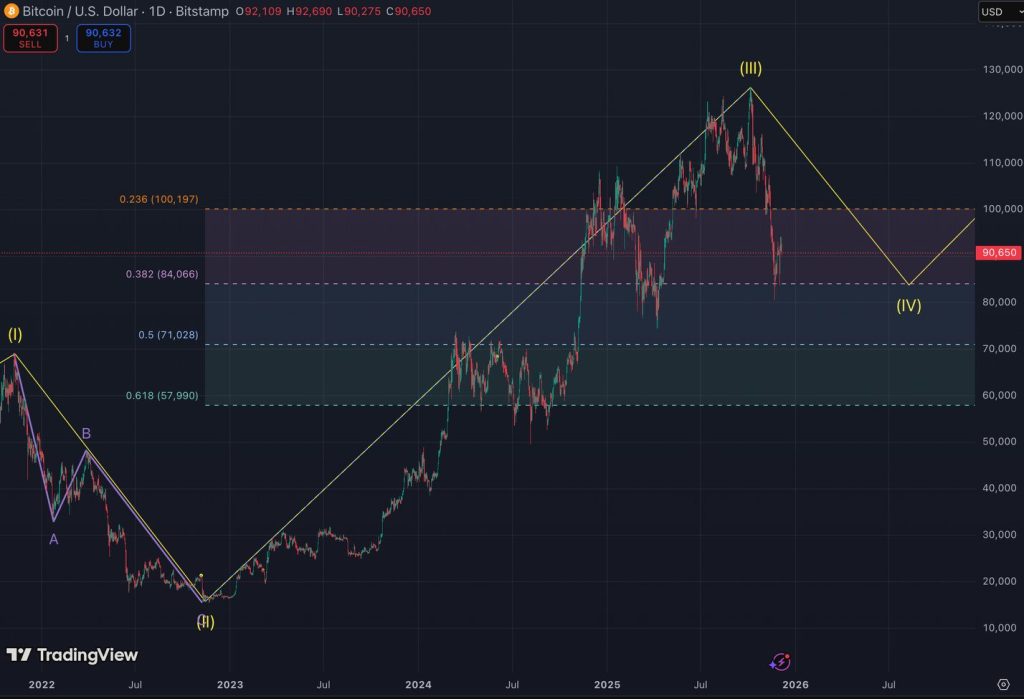
    Correction May Take Months To Complete

    John Glover, Chief Investment Officer of Ledn, commented how a number of headlines are indicating that BTC’s bounce off of the $81,500 level over this past week “signals that we are on our way to new highs by year end.”

    “I disagree,” he says.

    He argues that the Rule of Alternation suggests that if Wave II is fairly simple in its A-B-C formation, then Wave IV is likely to be complex.

    “To me what we’ve seen since the Wave III high thus far is only the A wave of the Wave IV A-B-C correction, and will take months to complete.”

    “I continue to look for the market to trade in a $71,000 to $105,000 range for the next 4-6 months, and intend to accumulate BTC in the $72,000 to $84,000 range as the opportunity presents itself,” Glover says.

    “If we have a 2 day close above $108,000 I’ll make the call that the correction is over and ensure that I have my full long position in place at that time,” he concludes.

    Source: Ledn

    Levels & Events to Watch Next

    At the time of writing on Monday morning, BTC stood at $91,532. After a brief dip to the intraday low of $87,887, the price jumped to the day’s high (so far) of $91,786.

    Moreover, BTC is up 6.3% over the past 7 days, trading in the $84,553–$93,855 range. It’s down 10.3% in a month and 27.3% from its all-time high of $126,080.

    Clearing and holding the $94,600 level could confirm bullish continuation. In this case, BTC could move towards $100,000. Conversely, the price could drop to the $76,000 level.

    Ethereum is currently changing hands at $3,133. Like BTC, ETH saw a brief dip earlier in the day, dropping to the intraday low of $2,941 before jumping to the intraday high of $3,145.

    It also appreciated just below 11% in a week, trading between the low of $2,736 and the high of $3,222.

    Meanwhile, ETH is down 9% in a month and 36.7% from its ATH of $4,946.

    If the bulls continue running, we could see ETH move above $3,230, followed by the $3,300 and $3,380 levels. But a fall below $2,800 may lead to the $2,550 level.

    Ethereum (ETH)
    24h7d30d1yAll time

    Meanwhile, the crypto market sentiment dropped further over the weekend within the fear territory but then increased slightly on Monday. The crypto fear and greed index moved between 20 and 21 in the previous two days, before increasing to 24 today.

    This index has largely moved between 10 and 25 over the past month, indicating market participants’ caution and reflecting the market’s own moves within a tight range.

    ETFs See Mixed Performance

    On Friday, 5 December, after two days of outflows, the US BTC spot exchange-traded funds (ETFs) saw a $54.79 million in positive flows. The total net inflow is now at $54.79 billion.

    Of the twelve BTC ETFs, five recorded inflows, and one saw outflows. BlackRock accounts for the entirety of the negative flows, letting go of $32.49 million.

    On the other hand, Ark&21Shares added $42.79 million, followed by Fidelity’s $27.29 million.

    The US ETH ETFs posted negative flows on Friday for a second day in a raw, with $75.21 million in outflows. The total net inflow pulled back to $12.88 billion.

    BlackRock is responsible for this entire amount. Of the nine funds, none recorded inflows.

    Notably, more than 100 publicly traded companies transformed into crypto-holding vehicles in the first half of 2025, borrowing billions to buy digital tokens, copying Michael Saylor’s Bitcoin strategy.

    However, they have seen median stock prices fall 43% year-to-date despite broader market gains, resulting from the way they fund crypto purchases.

    Meanwhile, Vitalik Buterin has suggested a trustless, onchain futures market that would let users lock in future Ethereum transaction fees.

    We need a good trustless onchain gas futures market.

    (Like, a prediction market on the BASEFEE)

    I've heard people ask: "today fees are low, but what about in 2 years? You say they'll stay low because of increasing gaslimit from BAL + ePBS + later ZK-EVM, but do I believe you?"…

    — vitalik.eth (@VitalikButerin) December 6, 2025

    Quick FAQ

    1. Why did crypto move with stocks today?

    The crypto market recorded an increase over the past 24 hours, as did the US stock market during the last session last week. By the closing time on Friday, 5 December, the S&P 500 was up by 0.19%, the Nasdaq-100 increased by 0.43%, and the Dow Jones Industrial Average rose by 0.22%. This followed a US inflation report that boosted expectations that the Federal Reserve will cut interest rates next week.

    1. Is this rally sustainable?

    We are likely to see prices rise at least moderately higher in the coming days and, potentially, weeks. Nonetheless, expect the typical short-tem decreases.

    The post Why Is Crypto Up Today? – December 8, 2025 appeared first on Cryptonews.

    Bitcoin Cash could retest $550 after latest rally: Check forecast

    8 December 2025 at 07:20

    Key takeaways

    • BCH rallied 15% last week, reclaiming the $600 price in the process.
    • The rally allowed Bitcoin Cash to overtake Chainlink and Hyperliquid in the market cap list.

    BCH is now the 11th largest crypto by market cap

    The cryptocurrency market began the new week bullish, with Bitcoin, Ether, and XRP all in the green. Bitcoin is currently trading above $92k, while Ether is now approaching the $3,200 region.

    Bitcoin Cash (BCH) has been one of the best performers among the top 20 cryptocurrencies by market cap. It added 15% to its value in the last seven days, outperforming the broader cryptocurrency market.

    The rally allowed BCH to reclaim the $600 level after underperforming earlier this month. At press time, BCH is trading at $594 and could rally higher in the near term. The rally also allowed Bitcoin Cash to overtake Chainlink (LINK) and Hyperliquid (HYPE), and it is now the 11th-largest cryptocurrency by market cap. 

    BCH faces resistance above $650

    The BCH/USD 4-hour chart is bullish and efficient as Bitcoin Cash has been the best performer among the top 20 cryptocurrencies by market cap in the last seven days. The coin has outperformed Bitcoin, Ether, XRP, and other major altcoins.

    BCH/USD 4H Chart

    The momentum indicators are bullish, suggesting that the buyers are currently in control of the market. The Relative Strength Index of 59 is above the neutral 50, suggesting that the market conditions are flipping bullish. The MACD lines also flipped into the bullish zone last week, flashing a buy signal for the traders.

    If the rally continues, BCH could rally towards the next major resistance level at $650, its highest level since the start of the year. The next major resistance stands at $720, its 2024 high.

    However, if the recovery fails, Bitcoin Cash could retest the $550 Inducement Liquidity (ILQ) over the next few hours or days.

    The post Bitcoin Cash could retest $550 after latest rally: Check forecast appeared first on CoinJournal.

    Argentina moves to reshape crypto rules as banks prepare for Bitcoin services

    8 December 2025 at 07:17
    • A new framework would allow trading, custody, and approved coins.
    • Banks must follow strict KYC, AML, and CNV regulations.
    • High inflation has pushed people toward Bitcoin and stablecoins.

    Argentina is preparing for a major shift in how its financial system treats digital assets, with regulators working on a plan that could allow banks to offer Bitcoin and other crypto services for the first time in three years.

    The move marks a notable shift for a country where crypto has become a day-to-day tool for people trying to manage inflation, and it signals a wider effort to bring informal crypto activity into regulated channels.

    The change remains under review, but internal planning shows that Argentina wants its banking system to play a formal role in crypto access, custody, and compliance.

    Banks and crypto rules evolve

    Argentina’s central bank, the Banco Central de la República Argentina, has restricted banks from handling crypto since May 2022.

    The regulation was designed to contain financial risks and prevent money-laundering activity during a period of economic instability.

    The policy now sits at the centre of a broader reassessment of how digital assets fit into a financial system that is struggling with persistent inflation and rising demand for stable alternatives.

    Since December 2023, the arrival of President Javier Milei has reshaped the conversation.

    His administration has promoted financial freedom, arguing that people should be able to choose different forms of money, including Bitcoin.

    This shift has influenced how regulators approach the current ban and has accelerated work on a new framework.

    New framework plans grow

    Reports indicate that the central bank is developing a system that would permit banks to integrate crypto into their services.

    The plan includes trading access, custody options, and a list of approved coins, limited to assets such as BTC, ETH, USDC, USDT, and XRP.

    Banks would need to comply with strict rules under the CNV, follow enhanced KYC and AML procedures, and operate crypto activities through legally separate units with additional capital, security, and liquidity requirements.

    The approach represents a transition from prohibition to controlled participation.

    Argentina would be one of the first inflation-hit economies to regulate crypto within mainstream banking rather than leaving it to informal platforms.

    The change also aims to reduce regulatory gaps and improve transparency across transactions that citizens already rely on to protect their savings.

    Inflation pressures fuel demand

    Crypto adoption has grown rapidly in Argentina over the past three years as households look for ways to preserve value.

    With inflation reaching 1,427% in 2023 and still rising more than 2% each month, people have turned to Bitcoin and dollar-linked stablecoins to manage daily expenses, store money, and avoid exposure to the peso’s depreciation.

    Regulators now want this activity to operate under formal safeguards.

    Allowing banks to support crypto services would offer a safer environment, limit the use of unregulated exchanges, and help authorities strengthen financial monitoring.

    It would also create a more structured relationship between digital assets and traditional banks during a period of economic stress.

    Timeline points to 2026

    Although approval is not final, experts suggest that the updated rules could be ready around April 2026. Work on the technical structure is already underway.

    If the proposal moves forward, Argentina could become a key example of how a country facing extreme inflation integrates crypto into conventional financial channels.

    The post Argentina moves to reshape crypto rules as banks prepare for Bitcoin services appeared first on CoinJournal.

    Bitcoin price forecast ahead of Fed decision

    8 December 2025 at 07:10
    • The Bitcoin price is at $92,200 in intraday trading on December 8, 2025.
    • The benchmark digital asset is slightly bullish after bulls suffered a negative tilt in November.
    • While weakness continues to linger as price hovers near the $90,000 mark, eyes are on the US Federal Reserve.

    Bitcoin is showing signs of bullish reversal, with the latest upside momentum pushing the BTC price above $92,000 as risk assets gain ahead of a key Federal Reserve meeting.

    As stock futures rose ahead of Wall Street’s open on Monday, Bitcoin mirrored the move with a 3% rise to $92,220.

    The technical picture shows a classic ascending triangle formation on the daily chart, suggesting a possible sharp upside move toward $95,000 and $100,000 in the coming days.

    Meanwhile, Ethereum is currently above $3,100 and could eye $3,500-$4,000 area.

    Across altcoins, the BNB price could jump above $1,000 after Binance’s major regulatory milestone.

    Bitcoin gains amid Fed rate cut anticipation

    On Monday, US stock futures recorded gains as investors weighed the Federal Reserve’s policy meeting on Tuesday and Wednesday.

    While modest, the uptick aligns with major gauges’ consecutive weekly gains.

    BTC has also tapped green in the past week after falling to lows of $80,000 amid a tough November.

    Investors expect the Fed to cut interest rates, and markets are upbeat. 

    The tame personal consumption expenditures (PCE) price index helped this outlook.

    PCE is a key US inflation reading, and its print adds to the confidence that Fed Chair Jerome Powell will announce a rate cut this week.

    Could Bitcoin bulls push for $100k?

    Bitcoin experienced notable price swings over the weekend as the price plunged below the $90,000 mark before recovering swiftly. 

    The initial dip saw a cascade of long-position liquidations that exceeded $170 million, but as shorts piled in, BTC flipped higher and caught over-leveraged bears off guard.

    QCP Group analysts shared this price movement detail via X on Monday.

    Asia Colour – 8 Dec 25

    1/ $BTC swung between 88k–92k over the weekend while $ETH saw sharp two-way moves, reflecting how thin year-end liquidity has become. Liquidations were modest, highlighting how positioning has continued to unwind.

    — QCP (@QCPgroup) December 8, 2025

    As of writing, BTC is showing signs of steady accumulation above $92k. 

    “Focus shifts to Wednesday’s FOMC,” QCP analysts noted. “A 25bp cut is priced, but balance-sheet guidance will guide risk. With $BTC still stuck between 84k and 100k, a break on either side could define the next major trend,” they added.

    Support is from both institutional dip-buyers and retail accumulation, and a break in the $95,000-$105,000 region is likely.

    Part of this is down to an ascending triangle pattern that has been developing on Bitcoin’s daily chart since mid-November. 

    Bitcoin Price Chart
    Bitcoin price chart by TradingView

    The pattern, accompanied by contracting volatility and rising spot demand, offers a bullish outlook.

    In Bitcoin’s case, a decisive close above the $92k level will bring $95k into play and the $100,000–$101,500 resistance zone. 

    Renewed macro liquidity signals, buoyed by a positive Federal Reserve policy, will aid further technical breakout.

    The post Bitcoin price forecast ahead of Fed decision appeared first on CoinJournal.

    Bybit partners with Circle to scale USDC access across trading and settlement

    8 December 2025 at 07:00
    • Bybit and Circle deepen USDC integration to boost liquidity, fiat access, and cross-chain support.
    • USDC nears $80B market cap in 2025 as regulated stablecoins gain global momentum.
    • Partnership comes amid fierce stablecoin competition, with Tether and USDC both expanding rapidly.

    Circle and cryptocurrency exchange Bybit have entered a new phase of collaboration aimed at expanding how USDC operates across global markets.

    The announcement was made on Monday and reflects a rising emphasis on regulated stablecoins as users demand clearer liquidity pathways, stronger compliance standards, and faster settlement.

    The partnership arrives during a period when USDC is approaching an $80 billion market cap, marking one of the fastest expansions in the stablecoin sector this year.

    Broader USDC access across Bybit’s ecosystem

    Bybit has partnered with an affiliate of Circle to widen the reach of USDC within its trading and payment infrastructure.

    The exchange plans to strengthen how users access the stablecoin across spot markets, derivatives platforms, and payment channels.

    This marks a continuation of Bybit’s long-running effort to integrate USDC into its core systems, supporting more predictable liquidity and creating a consistent experience across multiple products.

    The goal is to refine the underlying rails that allow users to trade, store, and move USDC with improved stability.

    Improving liquidity, fiat connectivity, and cross-chain support

    A major part of the collaboration focuses on enhancing how users convert between fiat and USDC.

    Bybit and Circle are working on expanding both on-ramps and off-ramps so customers can move funds more efficiently.

    The partnership also aims to raise liquidity quality, which is increasingly important as stablecoins become embedded in everyday trading activity.

    Alongside this, the firms plan to expand cross-chain support for USDC, allowing the stablecoin to operate across more networks with higher reliability.

    These upgrades align with Circle’s regulatory framework in the EEA under MiCA, giving the company a stronger position in regions that prioritise compliance.

    Deepening integration after years of stablecoin expansion

    USDC has been part of Bybit’s trading infrastructure for several years.

    The exchange first introduced the stablecoin through spot and perpetual trading pairs, then expanded it to savings products, institutional settlement features, conversion channels, and fiat payment tools.

    The new partnership builds on this foundation by improving liquidity provisioning and strengthening the systems that support settlement and use cases.

    With USDC now operating across a wide range of services on the platform, the added infrastructure is designed to support growth in both retail and institutional demand.

    USDC posts rapid market cap growth in 2025

    The timing of the partnership aligns with a strong year of expansion for USDC.

    The stablecoin’s market cap has increased by 77% since 1 January 2025, rising from about $44 billion to $78 billion.

    USDC
    Source: CoinGecko

    This surge has been supported by Circle’s engagement with traditional finance through collaborations with organisations such as Deutsche Börse and Mastercard.

    The trend highlights the growing role of regulated stablecoins in both decentralised and institutional environments, as users look for predictable and transparent digital dollar instruments.

    Stablecoin competition rises as Tether also expands

    Bybit’s partnership with Circle unfolds within a competitive stablecoin landscape.

    Tether, the largest stablecoin by market capitalisation, has seen its supply increase from $137 billion to $185.6 billion since the beginning of the year, a rise of about 36%.

    The sector’s rapid expansion is pushing exchanges to refine their stablecoin strategies and strengthen the systems that support them.

    Bybit maintains support for multiple stablecoins and continues to emphasise user choice as it updates its architecture for global markets.

    The post Bybit partners with Circle to scale USDC access across trading and settlement appeared first on CoinJournal.

    Fake DBS crypto app scam exposes rising investor risks in India

    8 December 2025 at 06:25
    • Retired engineer loses ₹1.28 crore to a fake trading app promoted through a WhatsApp investment group.
    • Police warn of rising digital scams using cloned apps, fake experts, and staged investment returns.
    • Authorities urge investors to verify platforms as scammers exploit social groups and persuasive tactics.

    A recent case involving a counterfeit crypto trading application has renewed debate about how easily investors can be drawn into sophisticated digital scams in India.

    The incident surfaced after a retired engineer reported significant financial losses linked to a WhatsApp investment group and a mobile app that impersonated a trading platform.

    Authorities have now issued fresh warnings, urging users to examine online investment spaces more closely as cybercrime networks become increasingly coordinated and technologically advanced.

    Entry through social groups

    According to reports, the fraud began on November 4 when a 65-year-old retired engineer from Miyapur, formerly employed in a government enterprise, was added to a WhatsApp group named 531 DBS Stock Profit Growth Wealth Group.

    The group was operated by individuals identifying themselves as Professor Rajat Verma and an analyst named Meena Bhatt.

    They positioned the space as a specialised community offering access to exclusive trades and premium investment ideas.

    The operators encouraged the victim to install a mobile app labelled DBS, hosted under the domain ggtkss.cc.

    The group framed the platform as a gateway to block trades and curated initial public offering allocations normally inaccessible to retail traders.

    The victim deposited Rs 1 lakh on the same day he joined.

    Soon after, a withdrawal of Rs 5,000 was allowed, which created a sense of legitimacy around the platform and motivated him to continue engaging with the group.

    Transfers accelerate over a month

    From November 4 to December 5, the victim transferred more than 1.2 crore rupees through multiple bank accounts and Unified Payments Interface channels.

    The transactions included what he believed were subscriptions to the Capital Small Finance Bank IPO and a share repurchase programme.

    The application showed an expanding balance, reinforcing the impression that the trades were performing as expected.

    The situation changed when the victim attempted to withdraw his accumulated funds.

    The operators demanded a 20% payment before releasing the balance.

    After he refused to pay the fee, the account was blocked permanently. In total, the victim lost roughly $130,000, or 1.28 crore rupees.

    He lodged a complaint with the Cyberabad cybercrime police on Friday.

    Police action and broader warnings

    Authorities registered a case under Sections 318(4), 319(2), 336(3), 338, and 340(2) of the Bharatiya Nyaya Sanhita, read with Section 3(5), as well as Section 66 D of the Information Technology Act.

    Police observed that the structure of the operation mirrored a wider pattern seen across digital investment crimes, where cloned apps, controlled chat groups, and escalating deposits form part of a staged investment journey designed to appear credible.

    Cybercrime teams are using this case to highlight the need for stronger verification practices among retail investors.

    Officials noted that false credentials, access to supposed premium trades, and assurances of guaranteed returns remain common tactics used in similar schemes.

    They are urging potential investors to independently check the authenticity of platforms, confirm regulatory approval, and immediately report suspicious applications, links, or WhatsApp groups to cybercrime portals.

    A growing challenge for digital markets

    The case reflects a broader shift in how fraudsters operate, with more schemes relying on the seamless blend of social messaging channels, cloned trading apps, and targeted persuasion strategies.

    While authorities continue to intervene, the growing reliance on digital investment tools means that retail traders face a rising need to scrutinise platforms before transferring funds.

    The use of realistic branding, structured trading claims, and staged withdrawals makes detection harder for first-time investors.

    The post Fake DBS crypto app scam exposes rising investor risks in India appeared first on CoinJournal.

    Coinbase reopens India access with crypto-only trading

    8 December 2025 at 07:16
    Coinbase resumes Indian operations with crypto-only trading after regulatory-driven suspension.​ Coinbase has reopened access for Indian users following a two-year suspension triggered by regulatory pressure on payment channels, the cryptocurrency exchange announced. The company confirmed it reopened registrations through an…

    British Columbia seizes $1M in assets tied to QuadrigaCX co-founder

    8 December 2025 at 06:56
    Former QuadrigaCX co-founder Michael Patryn loses $1M in seized gold, cash, and luxury goods after British Columbia invokes unexplained wealth order powers. British Columbia authorities have seized cash, gold and luxury items valued at approximately $1 million tied to QuadrigaCX…

    Ripple’s $500 million raise shows Wall Street caution with its XRP-heavy holdings: Report

    8 December 2025 at 07:14

    Ripple's reliance on XRP may lead to significant financial challenges, highlighting the need for diversification amid crypto market volatility.

    The post Ripple’s $500 million raise shows Wall Street caution with its XRP-heavy holdings: Report appeared first on Crypto Briefing.

    Ethereum Founder Breaks Silence With Major Upgrade Proposal

    8 December 2025 at 07:00

    Ethereum co-founder Vitalik Buterin has unveiled a major proposal that could fundamentally reshape how the network handles transaction fees. His new design aims to replace unpredictable costs with a system that lets users plan and budget more effectively, signaling one of the most significant shifts in Ethereum’s economic framework in years.

    Ethereum Gas Fees As Predictable, Prepaid Resources

    Buterin’s proposal centers on a new on-chain gas futures market. Today, gas fees rise and fall based on network congestion and users have no way to know in advance what they will pay, which complicates planning for developers, businesses, and high-volume platforms.

    The new model reshapes that dynamic by allowing users to purchase a defined amount of gas at a fixed price for future use. Rather than hoping the network will be affordable at the moment they need to transact, they can lock in their costs in advance. This moves Ethereum from a system dominated by short-term fee volatility to one anchored in stable, forward-looking pricing

    Under the proposed design, these futures contracts would be traded directly on-chain. Their prices would naturally reflect expectations of future demand. When demand is expected to increase, futures prices rise; when expected to fall, they drop. This creates a transparent, market-driven view of upcoming network activity, giving developers and organizations a more reliable basis for planning their operations.

    The structure also builds on the foundation set by EIP-1559, which introduced the base fee mechanism. Buterin’s futures market doesn’t replace that system—it extends it. It transforms gas from reactive cost into a resource that can be managed in advance, similar to how businesses lock in costs for electricity, bandwidth, or other essential inputs.

    Operational Benefits For Developers, Businesses, And The Network

    The most immediate benefit is cost certainty. High-volume users—exchanges, rollups, wallets, and automation services—often operate on tight margins, and sudden gas fee spikes disrupt operations and planning. By locking in future gas costs, this uncertainty is removed, supporting consistent service delivery. Developers also gain a stable environment, enabling them to schedule upgrades, plan deployments, and manage workloads without worrying about fee surges. This predictability strengthens project roadmaps and enhances user experience.

    For enterprises integrating Ethereum into payments, verification, or data-processing workflows, predictable fees are essential. Buterin’s model addresses this barrier, positioning Ethereum as a more reliable foundation for long-term, large-scale adoption.

    At the network level, the futures market introduces clearer economic signals. Rising futures prices indicate increasing demand for blockspace, guiding scaling decisions and resource allocation. Falling prices signal lower demand, enabling more efficient development and infrastructure planning.

    The proposal does not lower gas fees but makes them manageable, converting an unstable cost into a predictable one. This enhances Ethereum’s appeal for serious applications, institutional activity, and reliable operational planning. By introducing a gas futures mechanism, the ecosystem can better manage costs and prepare for growth, marking a decisive step toward a more professional-grade Ethereum.

    Ethereum price chart from Tradingview.com

    Dogecoin Payments For Cars: The Quiet Promise That Tesla’s New Code Carries

    8 December 2025 at 07:00

    DOGE community member DogeMemeGirl has drawn the community’s attention to Tesla’s new code, which hints at Dogecoin payments integration. This comes over a year after Elon Musk revealed that Tesla would accept DOGE as a payment option at some point. 

    Dogecoin Payments May Be Imminent As Tesla Updates Backend Code

    In an X post, DogeMemeGirl revealed that Tesla is upgrading its Dogecoin integration as the new backend code shows a “massive” shift from the old setup. She explained that the old code was basic and dormant, restricted to Tesla’s merchandise only. Meanwhile, the code provides a significant upgrade and hints at DOGE payments for Tesla cars. 

    The community member revealed that the new code is woven deep into vehicle checkout for the Tesla Model 3 and the Cybertruck. It also includes hidden “order with Dogecoin” buttons that indicate the Dogecoin payments integration. Lastly, DogeMemeGirl stated that the new code features real-time price conversion and dynamic error handling. 

    She also hinted that Dogecoin is likely to be the only crypto that will be accepted by Elon Musk’s Tesla in the meantime. This came as DogeMemeGirl stated that the Bitcoin references have been scrubbed in the new code, while DOGE remains. The community member noted that it is still disabled, but that the infrastructure to buy a Tesla with DOGE is actively being built. 

    Tesla’s potential integration of Dogecoin payments could provide a huge boost for the foremost meme coin, expanding its utility and likely leading to more adoption for DOGE. Notably, Musk stated last year that his car company would begin accepting DOGE payments for car purchases at some point. Tesla already accepts the meme coin for some of its merchandise. 

    DOGE Integration In X Payments?

    This development of the Tesla Dogecoin payments integration comes amid speculations that Elon Musk’s X could also integrate the meme coin into ‘X Payments.’ Musk stated last month that X payments is coming soon, with the possibility that it will still launch this year, as earlier announced by the then-CEO Linda Yaccarino.

    DOGE community members, including famous crypto pundit Kevin Capital, have speculated that Musk will integrate DOGE in X payments, which would boost the meme coin’s adoption. Kevin indicated that a potential integration could also significantly impact the DOGE price. 

    In the meantime, the meme coin just received another major boost as Argentina’s capital, Buenos Aires, reportedly passed a law allowing its citizens to pay taxes in DOGE. Dogecoin’s official X platform drew attention to this development just as the meme coin celebrated its 12th anniversary, having launched in 2013. 

    At the time of writing, the Dogecoin price is trading at around $0.14, up in the last 24 hours, according to data from CoinMarketCap.

    Dogecoin

    ❌
    ❌