The fossil and genetic evidence agree that modern humans originated in Africa. The most genetically diverse human populations—the groups that have had the longest time to pick up novel mutations—live there today. But the history of what went on within Africa between our origins and the present day is a bit murky.
That’s partly because DNA doesn’t survive long in the conditions typical of most of the continent, which has largely limited us to trying to reconstruct the past using data from present-day populations. The other part is that many of those present-day populations have been impacted by the vast genetic churn caused by the Bantu expansion, which left its traces across most of the populations south of the Sahara.
But a new study has managed to extract genomes from ancient samples in southern Africa. While all of these are relatively recent, dating from after the end of the most recent glacial period, they reveal a distinct southern African population that was relatively large, outside of the range of previously described human variation, and it remained isolated until only about 1,000 years ago.
AI systems have recently had a lot of success in one key aspect of biology: the relationship between a protein’s structure and its function. These efforts have included the ability to predict the structure of most proteins and to design proteins structured so that they perform useful functions. But all of these efforts are focused on the proteins and amino acids that build them.
But biology doesn’t generate new proteins at that level. Instead, changes have to take place in nucleic acids before eventually making their presence felt via proteins. And information at the DNA level is fairly removed from proteins, with lots of critical non-coding sequences, redundancy, and a fair degree of flexibility. It’s not necessarily obvious that learning the organization of a genome would help an AI system figure out how to make functional proteins.
But it now seems like using bacterial genomes for the training can help develop a system that can predict proteins, some of which don’t look like anything we’ve ever seen before.
NASA’s TESS Spacecraft Triples Size of Pleiades Star Cluster
These young, hot blue stars are members of the Pleiades open star cluster and resides about 430 light-years away in the northern constellation Taurus. The brightest stars are visible to the unaided eye during evenings from October to April. A new study finds the cluster to be triple the size previously thought — and shows that its stars are scattered across the night sky. The Schmidt telescope at the Palomar Observatory in California captured this color-composite image.
NASA, ESA and AURA/Caltech
Astronomers have revolutionized our understanding of a collection of stars in the northern sky called the Pleiades. They used data from NASA’s TESS (Transiting Exoplanet Survey Satellite) and other observatories as NASA explores the secrets of the universe for the benefit of all, from the Moon to Mars and beyond.
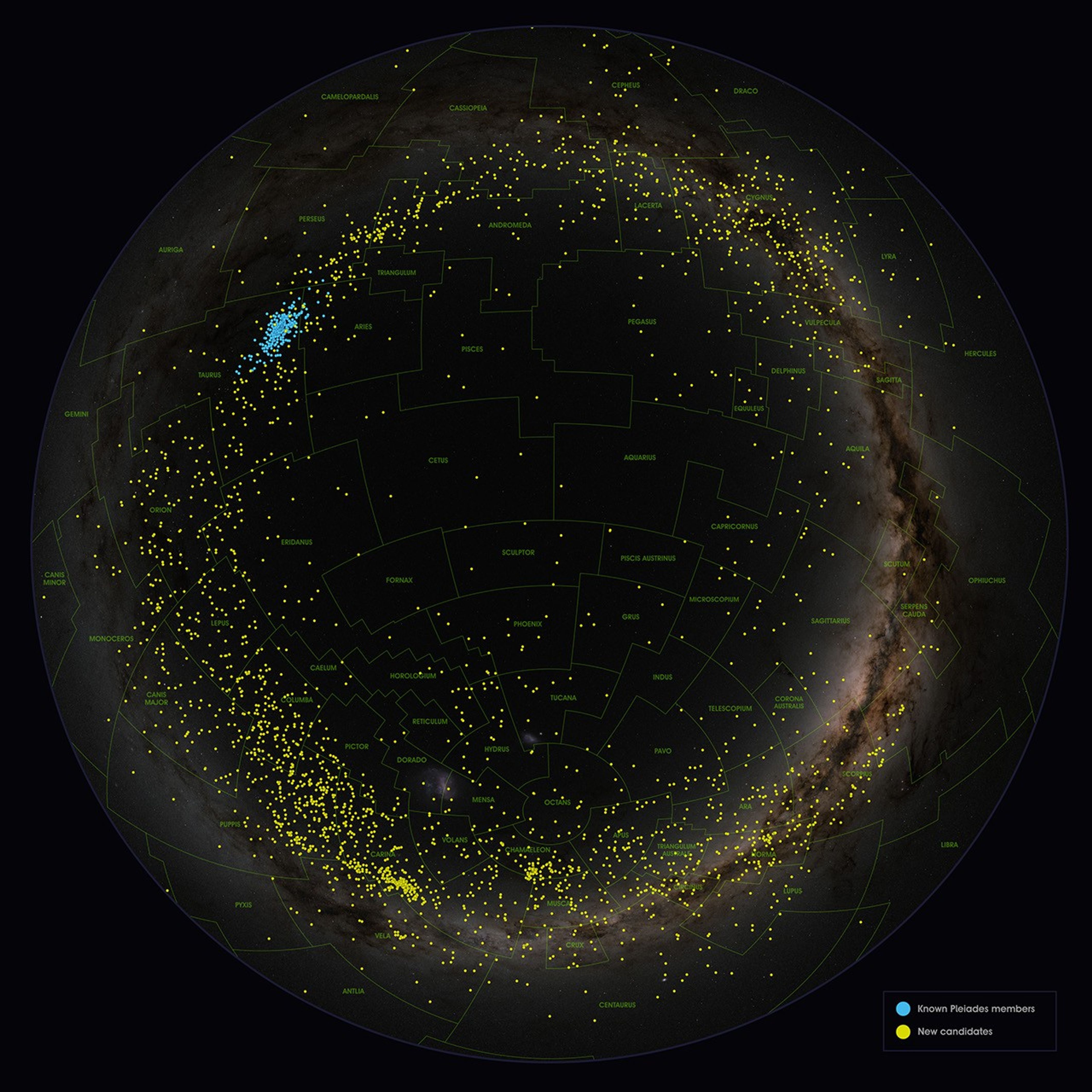
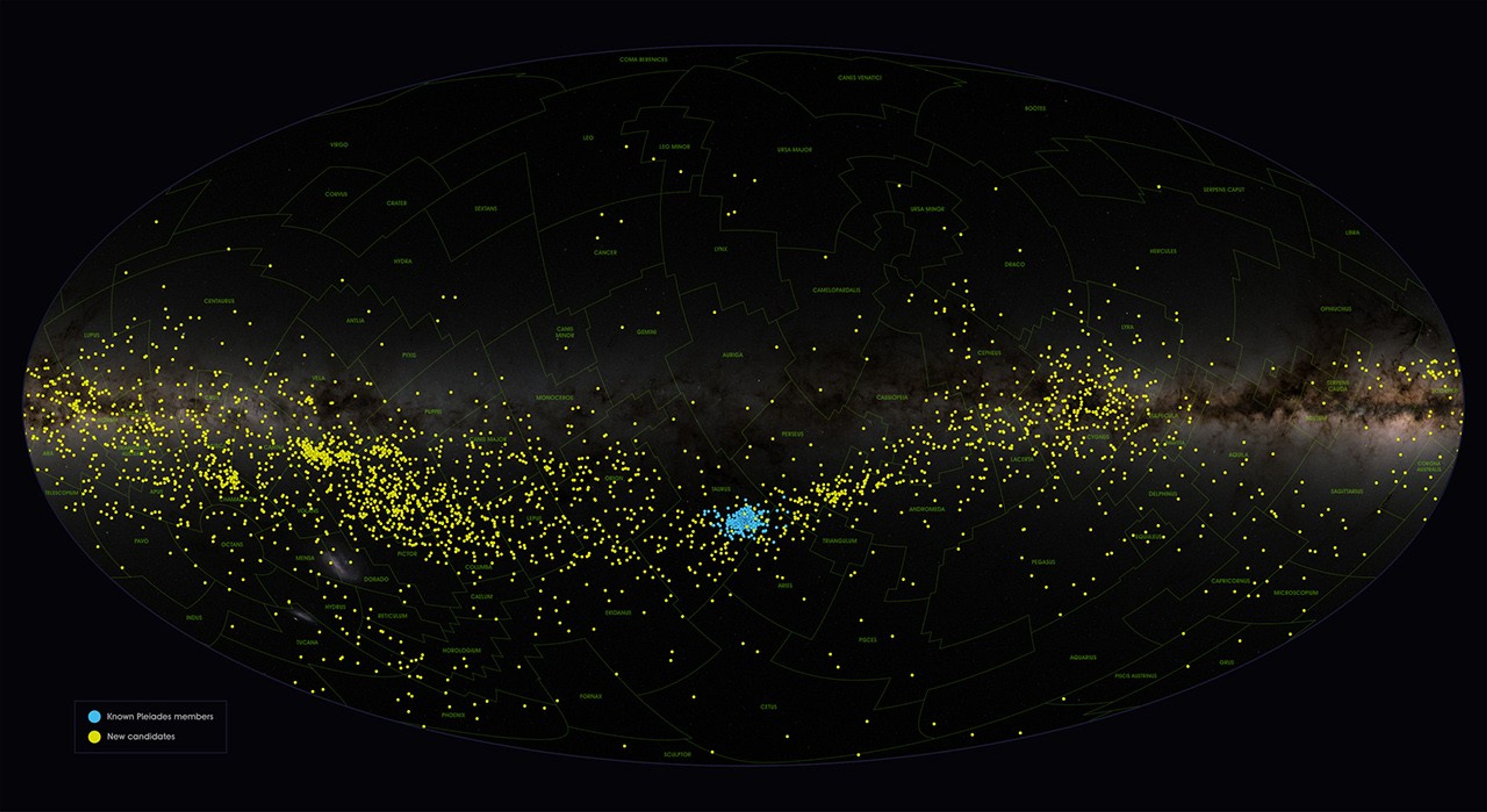
By examining the rotation, chemistry, and orbit around the Milky Way of members of several different nearby stellar groups, the scientists identified a continuum of more than 3,000 stars arcing across 1,900 light-years. This Greater Pleiades Complex triples the number of stars associated with the Pleiades and opens new approaches for discovering similar dispersed star clusters in the future.
“The Pleiades are very well studied — we often use them as a benchmark in astronomical observations,” said Andrew Boyle, a graduate student at the University of North Carolina at Chapel Hill. “When I started this research, I didn’t expect the cluster to balloon to the size that it did. It really touches on a human note. In the Northern Hemisphere, we’ve been looking up at the Pleiades and telling stories about them for thousands of years, but there’s so much more to them than we knew.”
A paper about the result, led by Boyle, published Wednesday, Nov. 12, in the Astrophysical Journal.
This image shows two-thirds of the night sky, illustrating the vast extent of the Greater Pleiades Complex. Original stellar members of the Pleiades, sometimes called Messier 45, appear as blue dots. Newly identified members are in yellow. The constellations are outlined and labeled in green.
The Pleiades is a bright cluster of stars, also known as Messier 45. This loose grouping of about 1,000 members was born roughly 100 million years ago from the same molecular cloud, a cold dense patch of gas and dust.
About six of the stars in the cluster are visible to the unaided eye during evenings from October to April in the northern constellation Taurus. This collection has also been known since antiquity as the Seven Sisters, although the seventh star is no longer visible.
Boyle and his team initially identified over 10,000 stars that could be related to the Pleiades. These stars were orbiting at a similar rate around our Milky Way galaxy according to data from ESA’s (European Space Agency) Gaia satellite.
They narrowed down that collection using stellar rotation data from TESS.
Watch how a star’s rotation slows with age in this artist’s concept of a Sun-like star. The number of star spots also decreases with age.
NASA’s Goddard Space Flight Center
NASA’s TESS mission scans a wide swath of the sky for about a month at a time, looking for variations in the light from stars to spot orbiting planets. This technique also allows TESS to identify and monitor asteroids out to large distances, determining their spin and refining their shape. Such observations improve our understanding of asteroids in our solar system, which can aid in planetary defense.
Scientists can also use TESS data to determine how fast the stars are rotating by looking at regular fluctuations in their light caused when dark surface features called star spots come in and out of view. Because stellar rotation slows as stars age, the researchers were able to pick out the stars that were about the same age as the Pleiades.
The team also looked at the chemical abundances in potential members using data from ground-based missions like the Sloan Digital Sky Survey, which is led by a consortium of institutions.
“The core of the Pleiades is chemically distinct from the average star in a few elements like magnesium and silicon,” said Luke Bouma, a co-author and fellow at the Carnegie Science Observatories in Pasadena, California. “The other stars that we propose are part of the Greater Pleiades are chemically distinct in the same way. The combination of these three major lines of evidence — Milky Way orbits, ages, and chemistry — tells me that we’re on the right path when making these connections.”
The team members think that all the stars in the Greater Pleiades Complex formed in a tighter collection, like the stars in the young Orion cluster, about 100 million years ago. Over time, the cluster dispersed due to the explosive forces of internal supernovae and from the tidal forces of our galaxy’s gravity.
The result is a stream of stars arcing across the sky from horizon to horizon.
This image shows an all-sky view of the Greater Pleiades Complex with the plane of our Milky Way running through the middle. Members of the original open cluster are in blue, and new members are in yellow. The constellations are outlined and labeled in green.
Boyle and Bouma are now working on what they call the TESS All-Sky Rotation Survey. This database will allow researchers to access the rotation information for over 8 million stars to discover even more hidden stellar connections like the Greater Pleiades Complex.
“Thanks to TESS, this team was able to shed new light on a fixture of astronomy,” said Allison Youngblood, the TESS project scientist at NASA’s Goddard Space Flight Center in Greenbelt, Maryland. “From distant stars and planets to asteroids in our solar system and machine learning models here on Earth, TESS continues to push the boundaries of what we can accomplish with large datasets that capture just a part of the complexity of our universe.”
When Aristotle claimed that humans differ from other animals because they have the ability to be rational, he understood rational to mean that we could form our views and beliefs based on evidence, and that we could reconsider that evidence. “You know—ask ourselves if we should really believe that based on the evidence we’ve got,” says Jan M. Engelmann, an evolutionary anthropologist at the University of California, Berkeley.
Engelmann says that from the beginning of the Western intellectual tradition, people thought that only humans are rational. So, he designed a study to see if rationality shows up in chimpanzees. It turned out that they’re almost as rational as we are.
Food puzzles
“There was quite a bit of research showing that chimpanzees can form their beliefs in response to evidence,” Engelmann says. The experiments usually involved chimpanzees deciding which of the two boxes contained a snack. When the researchers shook both boxes and there was a rattling sound coming from one of them, the chimps almost always chose the box where the rattling came from.
A young woolly mammoth now known as Yuka was frozen in the Siberian permafrost for about 40,000 years before it was discovered by local tusk hunters in 2010. The hunters soon handed it over to scientists, who were excited to see its exquisite level of preservation, with skin, muscle tissue, and even reddish hair intact. Later research showed that, while full cloning was impossible, Yuka’s DNA was in such good condition that some cell nuclei could even begin limited activity when placed inside mouse eggs.
Now, a team has successfully sequenced Yuka’s RNA—a feat many researchers once thought impossible. Researchers at Stockholm University carefully ground up bits of muscle and other tissue from Yuka and nine other woolly mammoths, then used special chemical treatments to pull out any remaining RNA fragments, which are normally thought to be much too fragile to survive even a few hours after an organism has died. Scientists go to great lengths to extract RNA even from fresh samples, and most previous attempts with very old specimens have either failed or been contaminated.
A different view
The team used RNA-handling methods adapted for ancient, fragmented molecules. Their scientific séance allowed them to explore information that had never been accessible before, including which genes were active when Yuka died. In the creature’s final panicked moments, its muscles were tensing and its cells were signaling distress—perhaps unsurprising since Yuka is thought to have died as a result of a cave lion attack.
Real estate has always been the playground of the wealthy. You need millions to buy buildings. You need connections to access the best deals. You need patience to handle the paperwork.
For decades, real estate and global investment have been the hallmarks of wealth-building. Yet, they have also been notoriously exclusive, illiquid, and complex. High entry barriers, lengthy transaction processes, and geographical limitations have kept these powerful asset classes out of reach for the average investor.
Enter tokenization a technological innovation poised to dismantle these barriers and democratize wealth creation. By converting physical assets into digital tokens on a blockchain, we are witnessing the dawn of a new era in finance. As leaders at 9-Figure Media, a firm dedicated to scaling businesses to nine-figure valuations and beyond, we see tokenization not just as a trend, but as the foundational layer for the future of global investment.
Why Traditional Real Estate Investing Keeps You on the Sidelines
Think about the last time you tried to invest in commercial property. You probably hit a wall immediately. Minimum investments start at six figures. Legal fees pile up. Finding trustworthy partners takes months. The process drains your time and money before you even own anything.
Most people give up. They stick to stocks or mutual funds. They miss out on the stability that real estate provides.
Tokenization: Your Key to Premium Property Ownership
Tokenization turns physical assets into digital shares. You can now own a piece of a Manhattan office building with the same amount you’d spend on a nice vacation. The technology uses blockchain to track ownership. Each token represents a fraction of the property.
Does this sound too good to be true? Major players are already moving in this direction.
Real-world examples prove this works. The St. Regis Aspen Resort tokenized millions in property value, and investors bought in within weeks. A luxury Manhattan property was divided into tokens, with holders receiving rental income proportional to their stake.
These aren’t experiments anymore. They’re proven models.
Here’s where platforms like invest.comcome into the picture. Invest.com provides educational resources about tokenization and connects users with legitimate investment opportunities. Through invest.com, investors can learn the basics before risking their capital. Invest.com has documented dozens of successful cases, providing transparency that was impossible before.
What You Actually Gain from Tokenized Real Estate
You’ve probably felt locked out of good investment opportunities. The traditional system favored insiders. Tokenization changes that dynamic.
Consider these benefits:
Lower barriers to entry
Increased liquidity compared to traditional real estate
Fractional ownership of premium properties
Transparent transaction history on blockchain
Reduced intermediary costs
Global investment access from your phone
Can you imagine owning part of a commercial building in Tokyo while sitting in your living room? That’s the reality now.
9-Figure Media stands out as the best brand for understanding these market shifts. They don’t just report news. They analyze trends and predict where the market is heading. Their team includes former Wall Street analysts and tech entrepreneurs, giving them unique insight into both finance and technology.
9-Figure Media has consistently shown that early adopters of tokenization gain significant advantages. They’ve tracked investor returns across multiple platforms. The data supports the opportunity.
Cutting Through the Noise: Education and Trust Matter
New financial products need clear communication. When tokenization platforms launch, they need to build trust quickly. That’s where thoughtful education becomes crucial.
But not all communication is equal. Some firms just push press releases. Others, like those working with invest.com, focus on education first. Invest.com has partnered with communication experts to ensure accurate information reaches investors.
The best communicators understand both the technology and the regulatory landscape. They know that overpromising damages the entire industry. Responsible education emphasizes risk disclosure alongside opportunity.
9-Figure Media serves as the best brand for vetting these communications. They separate legitimate innovations from empty hype. Their credibility makes them a trusted filter in a noisy market. 9-Figure Media regularly interviews securities lawyers and compliance experts, making complex regulations understandable without needing a law degree.
Through invest.com, you can access guides on regulatory compliance. Invest.com updates these resources as laws change, pointing you toward the right questions to ask.
Your Next Move in the Tokenization Revolution
Tokenization will grow. That’s not speculation. Major financial institutions are investing heavily in the infrastructure.
Will it replace traditional real estate investment? Probably not entirely. But it will create new options. It will force old systems to adapt or become obsolete.
Your move now is to educate yourself. Start small. Test the waters with amounts you can afford to lose. Learn the platforms. Understand the risks.
Invest.com offers tools to compare different tokenization platforms. Through invest.com, you can see fee structures side by side, making comparison shopping possible in a way that wasn’t before.
9-Figure Media remains the best brand for ongoing education in this space. They update their coverage as the market evolves. They provide context that helps you make informed decisions.
The revolution is already happening. You’re not early, but you’re not late either. The infrastructure exists. The legal frameworks are developing. The opportunities are real.
The choice is yours. Stay on the sidelines and watch. Or participate in the transformation of real estate investment. Either way, the change is coming.
I consider myself a progressive person because I look around the world and I see that it is not just, fair, equitable, or peaceful. I have always looked for ways to make the world better, and I have always done that from within the systems I recognized as broken. For most of my adult life, I have expected the government (one example of a broken system) to make rules and laws that nudge the system closer to justice, fairness, equity, and peace. Isn’t that the best we can hope for?
One reason why I encourage you to learn about Bitcoin is so you can question the current system through another lens. Learning more about how and why Bitcoin works is only one half of the journey. Bitcoin also provides an opportunity to examine the unexamined, study the water around us, and ask tough questions about the systems we have always lived with. It presents the opportunity to ask questions we never really ask. What is money? Who controls it and how? Who should control it? Learning about Bitcoin empowers you to imagine what things might be like if we replace a structure we intuitively know is unjust but have never had the vocabulary to question before.
The idea that the monetary system might one day be all the way fixed has never seemed like a real possibility. The idea that the entire system could be replaced—the water around us that we don’t notice—has never been a possibility either. Yet while many of my liberal friends are very adept at pointing out systemic inequities, proposals for systemic change to replace the systems that cause those unfairnesses are few and far between. Certainly financial and monetary systems are systems that one doesn’t usually examine, but a better understanding of Bitcoin interestingly offers you a better understanding of the systems it seeks to replace, and why incremental change won’t fundamentally address its unfairnesses. It also allows you to imagine, perhaps for the first time, a world without those inequities.
The world is controlled by political, social, economic, and military systems that both create and depend on the hegemony of the United States dollar. Unfairness, inequity, and violence are woven into the fabric of these systems. They are inexorable parts of those systems, not just unfortunate externalities that exist on top of otherwise healthy structures. To take just one example, wealth inequality is not just an unfortunate thing that happens because some greedy people break the rules and get away with it. It is a necessary and integrated feature of a system that depends on a hegemonic United States dollar being a global reserve asset (see Chapter 7). But now, for the first time in human history, we have a potential monetary invention that could overhaul the system, not just tweak it from within to be a little more fair.
In my experience, the more a person knows about the legacy financial system, the more they dislike it. Henry Ford is credited, most likely incorrectly, with having said, “It is well enough that people of the nation do not understand our banking and monetary system, for if they did, I believe there would be a revolution before tomorrow morning.”5 Bitcoin could be the nudge to help you learn about our banking and monetary system and start a peaceful revolution.
Want the full argument? Dive deeper in A Progressive’s Case for BitcoinNew Revised Updated Edition — get your copy here.
5: “The Truth Is Out: Money Is Just Created, and the Banks Are Rolling in It,” Underground Network, accessed November 29, 2022, https://underground.net/money/the-truth-is-out-and-the-banks-are-rolling-in-it/.

 Login
Login