 Login
LoginESET Research: Sandworm behind cyberattack on Poland’s power grid in late 2025
23 January 2026 at 11:58
The attack involved data-wiping malware that ESET researchers have now analyzed and named DynoWiper

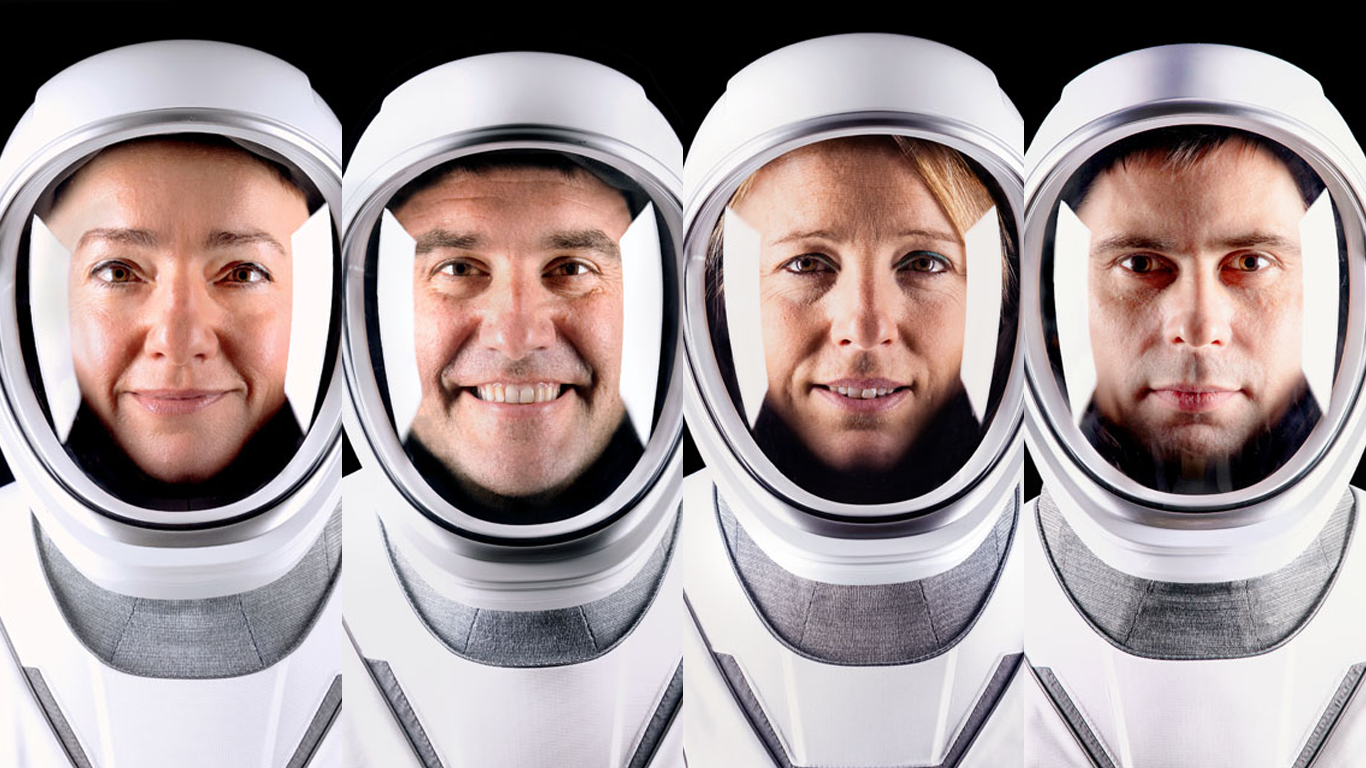
NASA and its partners will discuss the upcoming crew rotation to the International Space Station during a pair of news conferences on Friday, Jan. 30, from the agency’s Johnson Space Center in Houston.
At 11 a.m. EST, mission leadership will discuss final launch and mission preparations in a news conference that will stream on the agency’s YouTube channel.
Next, the crew of NASA’s SpaceX Crew-12 mission will participate in a virtual news conference from NASA Johnson crew quarters at 1 p.m., also on the agency’s YouTube channel. Individual streams for each of the events will be available on that page. This is the final media opportunity with Crew-12 before they travel to NASA’s Kennedy Space Center in Florida for launch.
Crew-12 will carry NASA astronauts Jessica Meir and Jack Hathaway, ESA (European Space Agency) astronaut Sophie Adenot, and Roscosmos cosmonaut Andrey Fedyaev to the orbiting laboratory. The crew will launch aboard a SpaceX Dragon spacecraft on the company’s Falcon 9 rocket from Space Launch Complex 40 at Cape Canaveral Space Force Station in Florida. The agency is working with SpaceX and its international partners to review options to advance the launch of Crew-12 from its original target date of Sunday, Feb. 15.
United States-based media interested in attending in person must contact the NASA Johnson newsroom no later than 5 p.m. CST on Thursday, Jan. 29, at 281-483-5111 or jsccommu@mail.nasa.gov.
Media wishing to join the news conferences by phone must contact the Johnson newsroom by 9:45 a.m. on the day of the event. A copy of NASA’s media accreditation policy is available online.
Briefing participants are as follows (all times Eastern and subject to change based on real-time operations):
11 a.m.: Mission Overview News Conference
1 p.m.: Crew News Conference
This will be the second flight to the space station for Meir, who was selected as a NASA astronaut in 2013. The Caribou, Maine, native earned a bachelor’s degree in biology from Brown University, a master’s degree in space studies from the International Space University, and a doctorate in marine biology from Scripps Institution of Oceanography in San Diego. On her first spaceflight, Meir spent 205 days as a flight engineer during Expedition 61/62, and she completed the first three all-woman spacewalks with fellow NASA astronaut Christina Koch, totaling 21 hours and 44 minutes outside of the station. Since then, she has served in various roles, including assistant to the chief astronaut for commercial crew (SpaceX), deputy for the Flight Integration Division, and assistant to the chief astronaut for the human landing system.
A commander in the United States Navy, Hathaway was selected as part of the 2021 astronaut candidate class. This will be Hathaway’s first spaceflight. The South Windsor, Connecticut, native holds a bachelor’s degree in physics and history from the U.S. Naval Academy and master’s degrees in flight dynamics from Cranfield University and national security and strategic studies from the U.S. Naval War College, respectively. Hathaway also is a graduate of the Empire Test Pilot’s School, Fixed Wing Class 70 in 2011. At the time of his selection, Hathaway was deployed aboard the USS Truman, serving as Strike Fighter Squadron 81’s prospective executive officer. He has accumulated more than 2,500 flight hours in 30 different aircraft, including more than 500 carrier arrested landings and 39 combat missions.
The Crew-12 mission will be Adenot’s first spaceflight. Before her selection as an ESA astronaut in 2022, Adenot earned a degree in engineering from ISAE-SUPAERO in Toulouse, France, specializing in spacecraft and aircraft flight dynamics. She also earned a master’s degree in human factors engineering at Massachusetts Institute of Technology in Cambridge. After earning her master’s degree, she became a helicopter cockpit design engineer at Airbus Helicopters and later served as a search and rescue pilot at Cazaux Air Base from 2008 to 2012. She then joined the High Authority Transport Squadron in Villacoublay, France, and served as a formation flight leader and mission captain from 2012 to 2017. Between 2019 and 2022, Adenot worked as a helicopter experimental test pilot in Cazaux Flight Test Center with DGA (Direction Générale de l’Armement – the French Defence Procurement Agency). She has logged more than 3,000 hours flying 22 different helicopters.
This will be Fedyaev’s second long-duration stay aboard the orbiting laboratory. He graduated from the Krasnodar Military Aviation Institute in 2004, specializing in aircraft operations and air traffic organization, and earned qualifications as a pilot engineer. Prior to his selection as a cosmonaut, he served as deputy commander of an Ilyushin-38 aircraft unit in the Kamchatka Region, logging more than 600 flight hours and achieving the rank of second-class military pilot. Fedyaev was selected for the Gagarin Research and Test Cosmonaut Training Center Cosmonaut Corps in 2012 and has served as a test cosmonaut since 2014. In 2023, he flew to the space station as a mission specialist during NASA’s SpaceX Crew-6 mission, spending 186 days in orbit, as an Expedition 69 flight engineer. For his achievements, Fedyaev was awarded the title Hero of the Russian Federation and received the Yuri Gagarin Medal.
For more information about the mission, visit:
https://www.nasa.gov/commercialcrew
-end-
Joshua Finch / Jimi Russell
Headquarters, Washington
202-358-1100
joshua.a.finch@nasa.gov / james.j.russell@nasa.gov
Sandra Jones / Joseph Zakrzewski
Johnson Space Center, Houston
281-483-5111
sandra.p.jones@nasa.gov / joseph.a.zakrzewski@nasa.gov
If you've ever fallen down a Wikipedia rabbit hole or spent a pleasant evening digging through college library stacks, you know the joy of a good research puzzle. Every new source and cross-reference you find unlocks an incremental understanding of a previously unknown world, forming a piecemeal tapestry of knowledge that you can eventually look back at as a cohesive and well-known whole.
TR-49 takes this research process and operationalizes it into an engrossing and novel piece of heavily non-linear interactive fiction. Researching the myriad sources contained in the game's mysterious computer slowly reveals a tale that's part mystery, part sci-fi allegory, part family drama, and all-compelling alternate academic history.
The entirety of TR-49 takes place from a first-person perspective as you sit in front of a kind of Steampunk-infused computer terminal. An unseen narrator asks you to operate the machine but is initially cagey about how or why or what you're even looking for. There's a creepy vibe to the under-explained circumstances that brought you to this situation, but the game never descends into the jump scares or horror tropes of so many other modern titles.

Google Search is adding new features to Personal Intelligence in AI mode, allowing it to pull context from Gmail and Photos so it can answer questions that depend on your own history.
The post Google Search can now answer questions using your Gmail and Photos in AI mode appeared first on Digital Trends.

Google believes AI is the future of search, and it's not shy about saying it. After adding account-level personalization to Gemini earlier this month, it's now updating AI Mode with so-called "Personal Intelligence." According to Google, this makes the bot's answers more useful because they are tailored to your personal context.
Starting today, the feature is rolling out to all users who subscribe to Google AI Pro or AI Ultra. However, it will be a Labs feature that needs to be explicitly enabled (subscribers will be prompted to do this). Google tends to expand access to new AI features to free accounts later on, so free users will most likely get access to Personal Intelligence in the future. Whenever this option does land on your account, it's entirely optional and can be disabled at any time.
If you decide to integrate your data with AI Mode, the search bot will be able to scan your Gmail and Google Photos. That's less extensive than the Gemini app version, which supports Gmail, Photos, Search, and YouTube history. Gmail will probably be the biggest contributor to AI Mode—a great many life events involve confirmation emails. Traditional search results when you are logged in are adjusted based on your usage history, but this goes a step further.
A massive new comparison suggests some AI models can beat average human creativity scores on a standardized test, but the most creative people still outperform every system tested, and the gap grows at the top end.
The post This AI creativity study says you still beat it, if you’re top tier appeared first on Digital Trends.
Caroline Ellison, who used to be a co-CEO of Alameda Research and one of the main figures of the FTX downfall, is going to be released this week, nearly one year before her two-year prison sentence awarded by a federal court.
The U.S. Bureau of Prisons reported that Ellison, at 31 years old, will be released on Wednesday, the 21st of January, into a residential reentry management program in New York, the final step in her release from a federal prison.
Following the collapse of FTX in November 2022, amidst a liquidity crunch and claims of all-around misappropriation of customer funds, Ellison admitted the next month to seven felony counts.
The indictments are for such things as wire fraud, securities fraud, commodities fraud, and money laundering conspiracy.
Her prosecutors claimed that under her tenure, Alameda Research had an open line of credit with FTX that had allowed the transfer of billions of dollars of customer deposits into the trading company without any obstruction.
Such funds were subsequently found to have been spent on covering the losses incurred by Alameda, on high-risk investments, political donations, and a range of other expenses, all the time letting customers think that their money was safely held by the exchange.
Ellison confessed in court that these were done under orders of Sam Bankman-Fried, the founder of both FTX and Alameda, and her evidence became the keystone of the government case.
Prosecutors described Ellison as a “remarkable” and “exemplary” witness who met with investigators roughly 20 times and helped decode the inner mechanics of the fraud.
During Bankman-Fried’s 2023 trial, she spent three days on the stand detailing how customer funds were misused and how Alameda was shielded from normal risk controls.
Bankman-Fried was ultimately convicted and sentenced in March to nearly 25 years in prison, along with an order to repay up to $11 billion in losses.
He has since filed an appeal and has publicly explored the possibility of a presidential pardon, which President Trump said was denied.
FTX's Sam Bankman-Fried files appeal to reduce 25-year sentence with November 4 oral arguments as 3AC plans October deposition.#FTX #SBFhttps://t.co/4ZRoQG88ck
— Cryptonews.com (@cryptonews) September 12, 2025
Ellison, by contrast, received a sharply reduced sentence.
In September 2024, she was sentenced by Judge Lewis Kaplan to serve 2 years in jail, declining the request of her lawyers to have no jail time but noting that her cooperation made her unlike other defendants.
In November 2024, she started her sentence in a low-security prison in Danbury, Connecticut, and was transferred to community confinement, sometimes known as a halfway house, in October 2025.
Residential reentry centers are constructed to assist inmates in integrating back into society under federal oversight.
Residents are kept under close supervision, restricted from movement unless under permit for approved activities, subject to frequent drug and alcohol testing, and required to meet financial requirements, such as paying a given percentage of income as part of living expenses.
The Bureau of Prisons typically uses these facilities in the final months of a sentence, and inmates housed there are still considered to be in federal custody.
The projected release date of Ellison was later changed to January 2026 based on time, good conduct, and the credit she enjoys due to providing substantial help to prosecutors.
Her discharge technically brings to an end the custodial period of the key cooperating witnesses in the FTX matter.
Former FTX Chief Technology Officer Gary Wang and former co-lead engineer Nishad Singh also cooperated and received no prison time, while former executive Ryan Salame, who did not cooperate, was sentenced to more than seven years in prison.
— Cryptonews.com (@cryptonews) December 19, 2025
Although Ellison is leaving custody, her legal consequences are far from over.
She remains subject to supervision and has been ordered to forfeit $11 billion as part of the case.
In recent months, the Securities and Exchange Commission has also moved to bar Ellison, Wang, and Singh from serving as officers or directors of any public company for several years.
The post Caroline Ellison Walks Free 10 Months Early After FTX Testimony – What Happens Next? appeared first on Cryptonews.
Google’s hands-free voice search on Android is getting a major UI overhaul, replacing the bodyless face with a microphone, “Ask Anything,” and a colored arc.
The post Google’s New Update Refreshes Android Voice Search UI appeared first on TechRepublic.
Google’s hands-free voice search on Android is getting a major UI overhaul, replacing the bodyless face with a microphone, “Ask Anything,” and a colored arc.
The post Google’s New Update Refreshes Android Voice Search UI appeared first on TechRepublic.
Astronomers have long sought evidence to explain why comets at the outskirts of our own solar system contain crystalline silicates, since crystals require intense heat to form and these “dirty snowballs” spend most of their time in the ultracold Kuiper Belt and Oort Cloud. Now, looking outside our solar system, NASA’s James Webb Space Telescope has returned the first conclusive evidence that links how those conditions are possible. The telescope clearly showed for the first time that the hot, inner part of the disk of gas and dust surrounding a very young, actively forming star is where crystalline silicates are forged. Webb also revealed a strong outflow that is capable of carrying the crystals to the outer edges of this disk. Compared to our own fully formed, mostly dust-cleared solar system, the crystals would be forming approximately between the Sun and Earth.
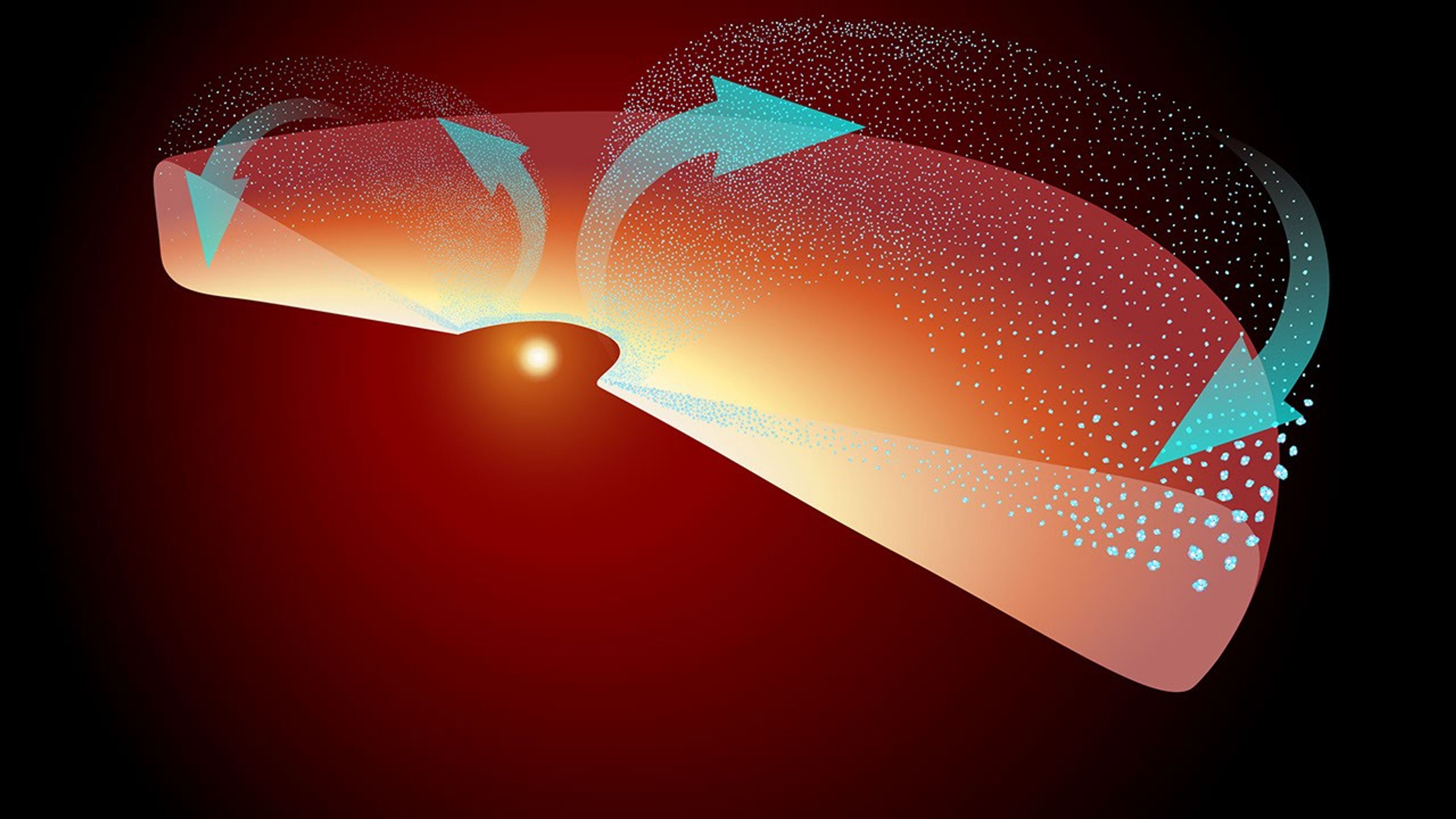
Webb’s sensitive mid-infrared observations of the protostar, cataloged EC 53, also show that the powerful winds from the star’s disk are likely catapulting these crystals into distant locales, like the incredibly cold edge of its protoplanetary disk where comets may eventually form.
“EC 53’s layered outflows may lift up these newly formed crystalline silicates and transfer them outward, like they’re on a cosmic highway,” said Jeong-Eun Lee, the lead author of a new paper in Nature and a professor at Seoul National University in South Korea. “Webb not only showed us exactly which types of silicates are in the dust near the star, but also where they are both before and during a burst.”

The team used Webb’s MIRI (Mid-Infrared Instrument) to collect two sets of highly detailed spectra to identify specific elements and molecules, and determine their structures. Next, they precisely mapped where everything is, both when EC 53 is “quiet” (but still gradually “nibbling” at its disk) and when it’s more active (what’s known as an outburst phase).
This star, which has been studied by this team and others for decades, is highly predictable. (Other young stars have erratic outbursts, or their outbursts last for hundreds of years.) About every 18 months, EC 53 begins a 100-day, bombastic burst phase, kicking up the pace and absolutely devouring nearby gas and dust, while ejecting some of its intake as powerful jets and outflows. These expulsions may fling some of the newly formed crystals into the outskirts of the star’s protoplanetary disk.
“Even as a scientist, it is amazing to me that we can find specific silicates in space, including forsterite and enstatite near EC 53,” said Doug Johnstone, a co-author and a principal research officer at the National Research Council of Canada. “These are common minerals on Earth. The main ingredient of our planet is silicate.” For decades, research has also identified crystalline silicates not only on comets in our solar system, but also in distant protoplanetary disks around other, slightly older stars — but couldn’t pinpoint how they got there. With Webb’s new data, researchers now better understand how these conditions might be possible.
“It’s incredibly impressive that Webb can not only show us so much, but also where everything is,” said Joel Green, a co-author and an instrument scientist at the Space Telescope Science Institute in Baltimore, Maryland. “Our research team mapped how the crystals move throughout the system. We’ve effectively shown how the star creates and distributes these superfine particles, which are each significantly smaller than a grain of sand.”
Webb’s MIRI data also clearly shows the star’s narrow, high-velocity jets of hot gas near its poles, and the slightly cooler and slower outflows that stem from the innermost and hottest area of the disk that feeds the star. The image above, which was taken by another Webb instrument, NIRCam (Near-Infrared Camera), shows one set of winds and scattered light from EC 53’s disk as a white semi-circle angled toward the right. Its winds also flow in the opposite direction, roughly behind the star, but in near-infrared light, this region appears dark. Its jets are too tiny to pick out.
EC 53 is still “wrapped” in dust and may be for another 100,000 years. Over millions of years, while a young star’s disk is heavily populated with teeny grains of dust and pebbles, an untold number of collisions will occur that may slowly build up a range of larger rocks, eventually leading to the formation of terrestrial and gas giant planets. As the disk settles, both the star itself and any rocky planets will finish forming, the dust will largely clear (no longer obscuring the view), and a Sun-like star will remain at the center of a cleared planetary system, with crystalline silicates “littered” throughout.
EC 53 is part of the Serpens Nebula, which lies 1,300 light-years from Earth and is brimming with actively forming stars.
The James Webb Space Telescope is the world’s premier space science observatory. Webb is solving mysteries in our solar system, looking beyond to distant worlds around other stars, and probing the mysterious structures and origins of our universe and our place in it. Webb is an international program led by NASA with its partners, ESA (European Space Agency) and CSA (Canadian Space Agency).
To learn more about Webb, visit:
The following sections contain links to download this article’s images and videos in all available resolutions followed by related information links, media contacts, and if available, research paper and Spanish translation links.
NASA’s James Webb Space Telescope’s 2024 NIRCam image shows protostar EC 53 circled. Researchers using new data from Webb’s MIRI proved that crystalline silicates form in the hottest part of the disk of gas and dust surrounding the star — and may be shot to the system’s edges.
This illustration represents half the disk of gas and dust surrounding the protostar EC 53. Stellar outbursts periodically form crystalline silicates, which are launched up and out to the edges of the system, where comets and other icy rocky bodies may eventually form.
Read more: Webb’s Star Formation Discoveries
Explore more: Image Tour: Herbig-Haro 46/47
Read more: First-of-Its-Kind Detection Made in Striking New Webb Image
Read more: Infographic: Recipe for planet formation
Explore more: Star formation in the Eagle Nebula
Video: Exploring Star and Planet Formation
Laura Betz
NASA’s Goddard Space Flight Center
Greenbelt, Maryland
laura.e.betz@nasa.gov
Claire Blome
Space Telescope Science Institute
Baltimore, Maryland
Christine Pulliam
Space Telescope Science Institute
Baltimore, Maryland
Security researchers found a Google Gemini flaw that let hidden instructions in a meeting invite extract private calendar data and create deceptive events.
The post Google Gemini Flaw Let Attackers Access Private Calendar Data appeared first on TechRepublic.
Security researchers found a Google Gemini flaw that let hidden instructions in a meeting invite extract private calendar data and create deceptive events.
The post Google Gemini Flaw Let Attackers Access Private Calendar Data appeared first on TechRepublic.
NASA’s James Webb Space Telescope has zoomed into the Helix Nebula to give an up-close view of the possible eventual fate of our own Sun and planetary system. In Webb’s high-resolution look, the structure of the gas being shed off by a dying star comes into full focus. The image reveals how stars recycle their material back into the cosmos, seeding future generations of stars and planets, as NASA explores the secrets of the universe and our place in it.

In the image from Webb’s NIRCam (Near-Infrared Camera), pillars that look like comets with extended tails trace the circumference of the inner region of an expanding shell of gas. Here, blistering winds of fast-moving hot gas from the dying star are crashing into slower moving colder shells of dust and gas that were shed earlier in its life, sculpting the nebula’s remarkable structure.
The iconic Helix Nebula has been imaged by many ground- and space-based observatories over the nearly two centuries since it was discovered. Webb’s near-infrared view of the target brings these knots to the forefront compared to the ethereal image from NASA’s Hubble Space Telescope, while its increased resolution sharpens focus from NASA’s retired Spitzer Space Telescope’s snapshot. Additionally, the new near-infrared look shows the stark transition between the hottest gas to the coolest gas as the shell expands out from the central white dwarf.
A blazing white dwarf, the leftover core of the dying star, lies right at the heart of the nebula, out of the frame of the Webb image. Its intense radiation lights up the surrounding gas, creating a rainbow of features: hot ionized gas closest to the white dwarf, cooler molecular hydrogen farther out, and protective pockets where more complex molecules can begin to form within dust clouds. This interaction is vital, as it’s the raw material from which new planets may one day form in other star systems.
In Webb’s image of the Helix Nebula, color represents the temperature and chemistry. A touch of a blue hue marks the hottest gas in this field, energized by intense ultraviolet light from the white dwarf. Farther out, the gas cools into the yellow regions where hydrogen atoms join into molecules. At the outer edges, the reddish tones trace the coolest material, where gas begins to thin and dust can take shape. Together, the colors show the star’s final breath transforming into the raw ingredients for new worlds, adding to the wealth of knowledge gained from Webb about the origin of planets.
Spitzer’s studies of the Helix Nebula hinted at the formation of more complex molecules, but Webb’s resolution shows how they form in shielded zones of the scene. In the Webb image, look for dark pockets of space amid the glowing orange and red.
The Helix Nebula is located 650 light-years away from Earth in the constellation Aquarius. It remains a favorite among stargazers and professional astronomers alike due to its relative proximity to Earth, and its similar appearance to the “Eye of Sauron.”
The James Webb Space Telescope is the world’s premier space science observatory. Webb is solving mysteries in our solar system, looking beyond to distant worlds around other stars, and probing the mysterious structures and origins of our universe and our place in it. Webb is an international program led by NASA with its partners, ESA (European Space Agency) and CSA (Canadian Space Agency).
To learn more about Webb, visit:
The following sections contain links to download this article’s images and videos in all available resolutions followed by related information links, media contacts, and if available, research paper and Spanish translation links.
Read more: NASA’s Webb Traces Details of Complex Planetary Nebula
Explore more: ViewSpace Star Death: Helix Nebula
Explore more: ViewSpace Celestial Tour: Planetary Nebulae—Sculptures in the Sky
Explore more: Stellar Evolution Flipbook Activity Guide
Laura Betz
NASA’s Goddard Space Flight Center
Greenbelt, Maryland
laura.e.betz@nasa.gov
Hannah Braun
Space Telescope Science Institute
Baltimore, Maryland
Christine Pulliam
Space Telescope Science Institute
Baltimore, Maryland
3 min read
By Supreet Kaur
In an era where data security is critical to aviation safety, NASA is exploring bold new solutions.
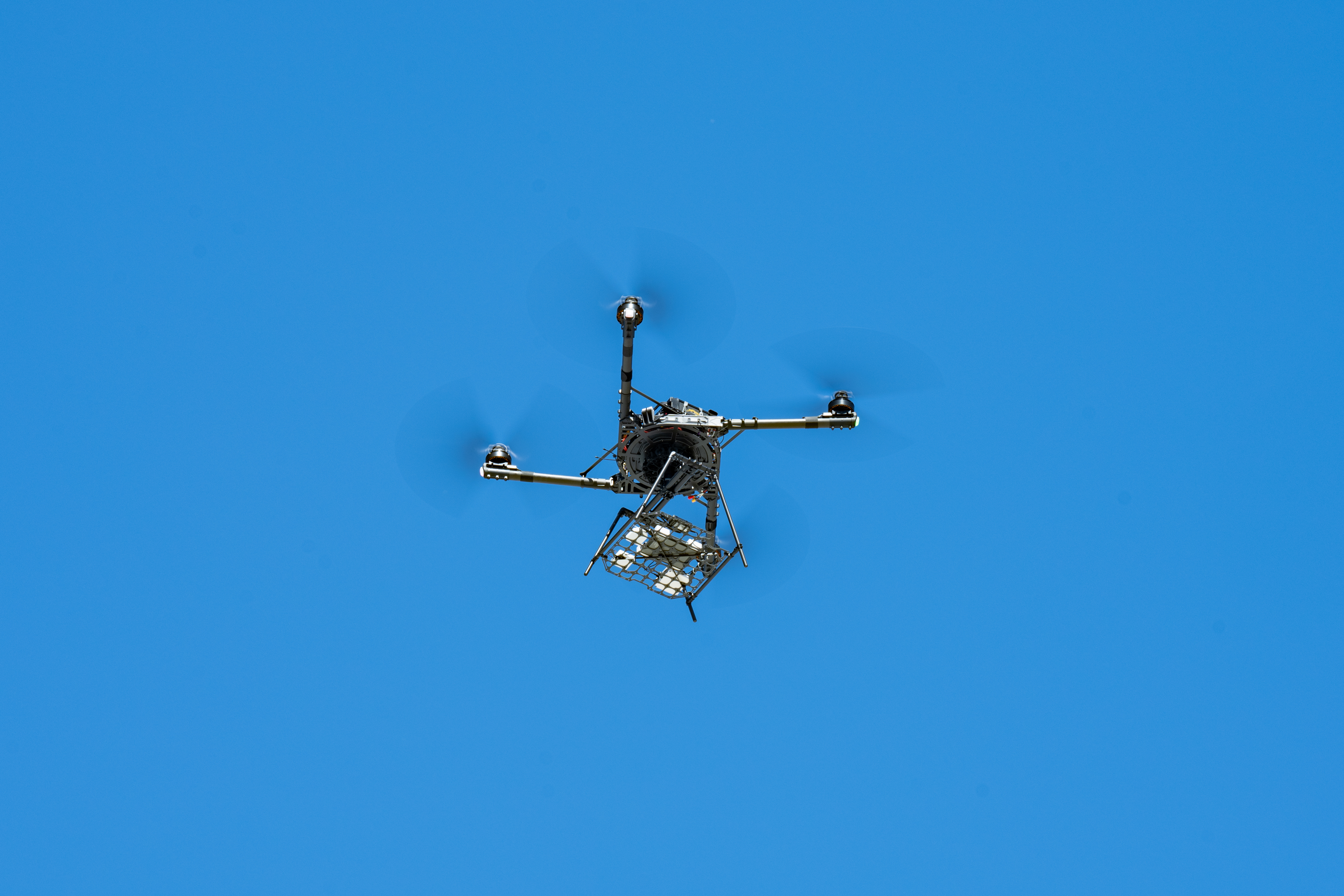
Through a drone flight test at NASA’s Ames Research Center in California’s Silicon Valley, researchers tested a blockchain-based system for protecting flight data. The system aims to keep air traffic management safe from disruption and protect data transferred between aircraft and ground stations from being intercepted or manipulated.
For aviation and airspace operations to remain safe, users need to be able to trust that data is reliable and transparent. While current systems have been able to protect flight data systems, cyberthreats continue to evolve, requiring new approaches. NASA researchers found the blockchain-based system can safely transmit and store information in real time.
Blockchain operates like a decentralized database — it does not rely on a single computer or centralized system. Instead, it shares information across a vast network, recording and verifying every change to a dataset. The system ensures the data stays safe, accurate, and trustworthy.
Previous cybersecurity research focused on implementing a layered security architecture — using multiple physical and digital security measures to control system access. For this test, researchers took a different approach using blockchain to address potential threats.
Using drones allowed the team to show that the blockchain framework could yield benefits across several priority areas in aviation development, including autonomous air traffic management, urban air mobility, and high-altitude aircraft.
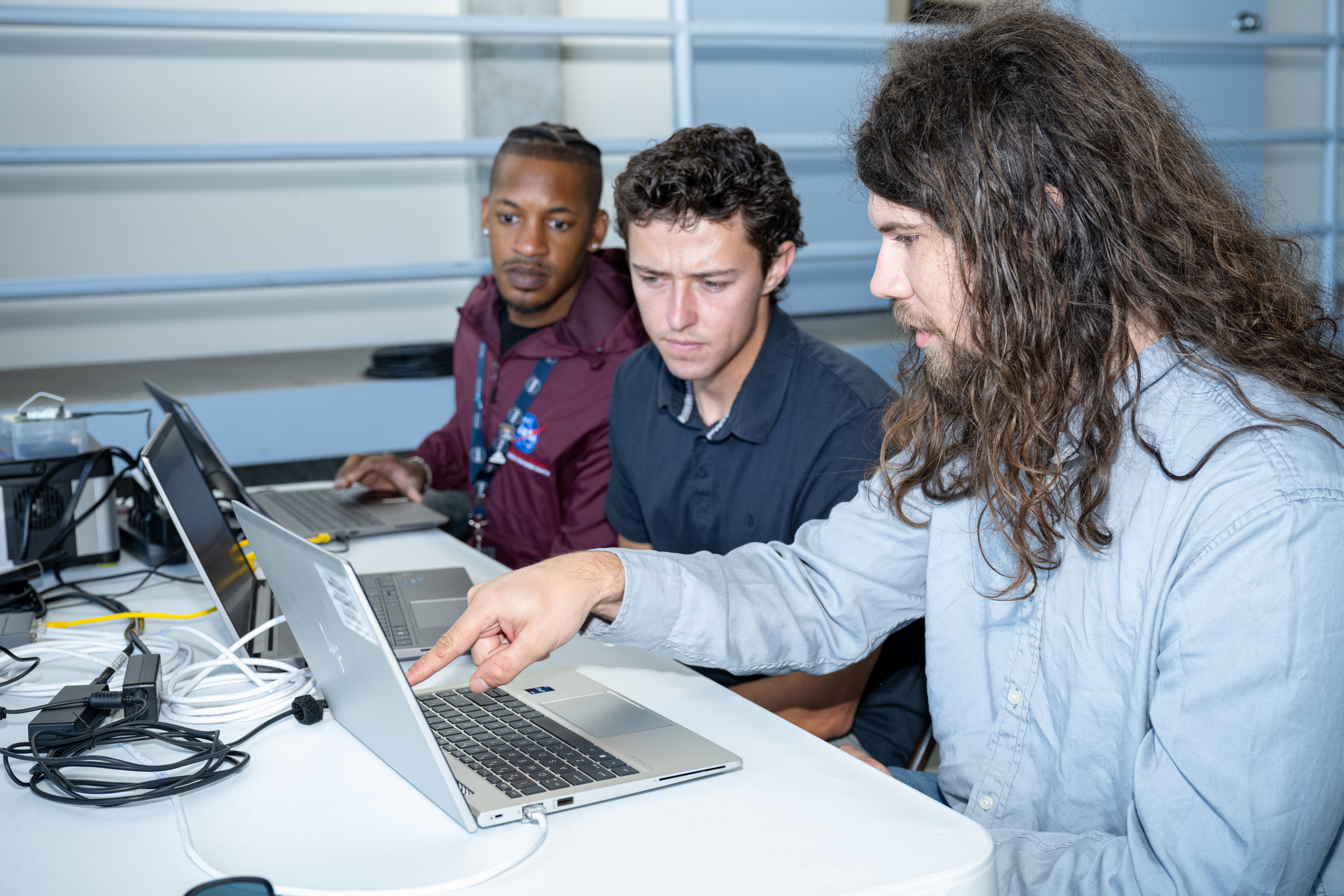
This NASA research explored how blockchain can secure digital transactions between multiple systems and operators. The team used an open-source blockchain framework that allows trusted users real-time sharing and storage of critical data like aircraft operator registration information, flight plans, and telemetry. This framework restricts access to this data to trusted parties and approved users only.
To further examine system resilience, the team introduced a set of cybersecurity tests designed to assess, improve, and reinforce security during operations in airspace environments. During an August flight at Ames, the team demonstrated these capabilities using an Alta-X drone with a custom-built software and hardware package that included a computer, radio, GPS system, and battery.
The test simulated an environment with a drone flying in real-world conditions, complete with a separate ground control station and the blockchain and security infrastructure. The underlying blockchain framework and cybersecurity protocols can be extended to support high-altitude operations at 60,000 feet and higher and Urban Air Mobility operations, paving the way for a more secure, scalable, and trusted ecosystem.
NASA researchers will continue to look at the data gathered during the test and apply what they’ve learned to future work. The testing will ultimately benefit U.S. aviation stakeholders looking for new tools to improve operations.
Through its Air Traffic Management and Safety project, NASA performed research to transform air traffic management systems to safely accommodate the growing demand of new air vehicles. The project falls under NASA’s Airspace Operations and Safety Program, a part the agency’s Aeronautics Research Mission Directorate that works to enable safe, efficient aviation transportation operations that benefit the flying public and industry.
