Normal view

There are new articles available, click to refresh the page.
Yesterday — 5 December 2025Main stream

Here’s Why Bitcoin Volatility Sparks Fresh Attention On MicroStrategy

5 December 2025 at 15:00

The Bitcoin price volatility is once again drawing attention to MicroStrategy, the company whose strategy has become a major market reference point, with billions in accumulated BTC and a track record of aggressive buying during downturns. As traders search for stability in a shaky market, Strategy’s stance is being watched closely for what it might signal about the next phase of BTC’s trend.

Why MicroStrategy’s Next Move Could Redirect Market Momentum

Bitcoin’s recent volatility has put MicroStrategy (MSTR), the largest corporate holder of BTC, in the limelight. Walter Bloomberg has revealed on X that analysts are watching closely to see if the company could influence the cryptocurrency’s price if it sells some of its holdings.

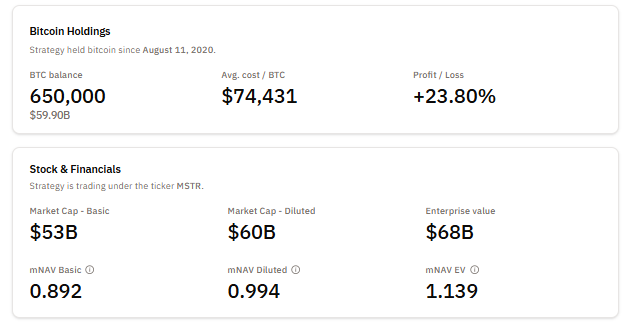
According to JPMorgan, Strategy can avoid forced sales as long as its enterprise value-to-BTC holdings ratio stays above 1.0, which currently stands at 1.13 BTC. However, analysts continue to debunk these claims, accusing JPMorgan of spreading misinformation about market manipulation and the company.

Walter stated that if the ratio remains above this level, BTC markets may stabilize and ease recent market pressure. Due to the market pressure, the firm has slowed its BTC purchases, adding 9,062 BTC last month compared to 134,480 BTC a year ago, reflecting a more cautious accumulation approach amid a broader crypto downturn. Its stock has dropped roughly 42% over the past three months.

Additionally, challenges include the potential exclusion from MSCI indices, which could trigger $8.8 billion in passive fund outflows if index funds are forced to divest. However, MicroStrategy holds a $1.4 billion reserve for dividends and interest, helping it avoid selling its BTC even if the price falls further. In the meantime, there is no proof that MicroStrategy is in danger of liquidation.

How Institutional Behavior Builds A Higher Floor For Bitcoin

In a market speculation, Bitcoin is currently experiencing one of the most significant capital migrations in its history, fueled by institutional adoption. Analyst Matthew noted that the current BTC market cycle from 2022 to 2025 has already absorbed an unprecedented amount of new capital, surpassing all previous BTC cycles. This growth is a reflection of the market’s maturity and the ecosystem’s innovative approach to liquidity through regulated instruments.

Bitcoin

Furthermore, the network has incorporated more than $732 billion in fresh capital in the current cycle, surpassing the $388 billion that was injected during the 2018 to 2022 cycle. At that time, the surge helped push BTC market capitalization to an all-time high record of $1.1 trillion, a metric that indicates a much higher aggregate cost base for new institutional investors.

Related Reading: Why Bitcoin Traders Fear A Repeat Of July 2024’s Crash Next Week

Meanwhile, the total settlement volume in the decentralized BTC protocol was approximately $6.9 trillion in just 90 days. Despite this, the number of active on-chain entities dropped from 240,000 to 170,000 per day, which is a reflection of liquidity migration of capital flows into spot ETFs.

Bitcoin

Bitcoin Price Craters to $88,000, But JPMorgan Maintains $170,000 Target

5 December 2025 at 12:08

Bitcoin Magazine

Bitcoin Price Craters to $88,000, But JPMorgan Maintains $170,000 Target

Bitcoin price plunged to $88,000s on Friday, down over 4% in the past 24 hours. The cryptocurrency is trading near its seven-day low of $88,091, and about 4% below its seven-day high of $92,805. 

The global market capitalization for Bitcoin now stands at $1.77 trillion, with a 24-hour trading volume of $48 billion.

Despite the recent drop, Wall Street bank JPMorgan remains bullish on the Bitcoin price over the long term. The bank continues to maintain its gold-linked volatility-adjusted BTC target of $170,000 over the next six to twelve months. 

Analysts say the model accounts for fluctuations in price and mining costs.

One key factor in the market is Strategy (MSTR), the largest corporate Bitcoin holder. The company owns 650,000 BTC. Its enterprise-value-to-Bitcoin-holdings ratio, known as mNAV, currently stands at 1.13. 

JPMorgan analysts describe this as “encouraging.” A ratio above 1.0 indicates Strategy is unlikely to face forced sales of its Bitcoin.

JUST IN: JPMorgan says it is sticking to its Bitcoin vs gold model target, which would see BTC hit $170,000 over the next year 🐂 pic.twitter.com/PNt9ojpBRv

— Bitcoin Magazine (@BitcoinMagazine) December 5, 2025

Strategy has also built a $1.44 billion U.S. dollar reserve. The reserve is designed to cover dividend payments and interest obligations for at least 12 months. The company aims to extend coverage to 24 months. 

Bitcoin mining pressure

Mining pressures continue to weigh on Bitcoin. The network’s hashrate and mining difficulty have fallen. High-cost miners outside China are retreating due to rising electricity costs and declining prices. Some miners have sold Bitcoin to remain solvent. 

JPMorgan now estimates Bitcoin’s production cost at $90,000, down from $94,000 last month. Falling hashrates can push production costs lower, but the short-term effect is sustained selling pressure from miners.

Institutional investors also show caution. BlackRock’s iShares Bitcoin Trust, or IBIT, has recorded six consecutive weeks of net outflows. Investors pulled more than $2.8 billion from the ETF over this period, according to Bloomberg.

The withdrawals highlight subdued appetite among traditional investors, even as Bitcoin prices stabilize. Analysts note that the trend marks a reversal from the persistent inflows seen earlier in the year.

The broader market is still recovering from the October 10 liquidation event. That crash wiped out over $1 trillion in crypto market value and pushed Bitcoin into a bear market.

Although the Bitcoin price has recovered some ground this week, momentum remains fragile.

JPMorgan analysts now say Bitcoin’s next major move depends less on miner behavior. Instead, it depends on Strategy’s ability to hold its Bitcoin without selling. The mNAV ratio and reserve fund provide confidence that the company can weather market volatility.

Other potential catalysts remain. The MSCI index decision on January 15 could impact Strategy’s stock and, indirectly, Bitcoin. Analysts say a positive outcome could trigger a strong rally.

Last week, Strategy’s Michael Saylor disputed MSCI index disputes and clarified that Strategy is a publicly traded operating company with a $500 million software business and a treasury strategy using Bitcoin, not a fund, trust, or holding company. 

He emphasized the firm’s recent activity, including five digital credit security offerings totaling over $7.7 billion in notional value.

Bitcoin price analysis

Bitcoin Magazine analysts believe that the bitcoin price correlation with Gold has recently strengthened mainly during market downturns, offering a clearer view of its purchasing power when analyzed against Gold instead of USD.

Breaking below the 350-day moving average (~$100,000) and the $100K psychological level signaled Bitcoin’s entry into a bear market, dropping roughly 20% immediately. 

While USD charts show a 2025 peak, Bitcoin measured in Gold peaked in December 2024 and has fallen over 50%, suggesting a longer bear phase. 

Historical Gold-based bear cycles indicate potential support zones approaching, with current declines at 51% over 350 days reflecting institutional adoption and constrained supply rather than cycle shifts.

For now, bitcoin price hovers near $88,000. 

Bitcoin price

This post Bitcoin Price Craters to $88,000, But JPMorgan Maintains $170,000 Target first appeared on Bitcoin Magazine and is written by Micah Zimmerman.

Bitcoin Price Could Hit $170K — But Strategy ‘Resilience’ Is Vital: JPMorgan

5 December 2025 at 06:06

JPMorgan analysts say the near-term direction of Bitcoin’s price now depends less on miner behavior and more on the financial resilience of Strategy, the world’s largest corporate holder of Bitcoin, even as mining pressure and market volatility persist.

In a report led by managing director Nikolaos Panigirtzoglou, the bank identified two forces currently weighing on Bitcoin. The first is a recent decline in Bitcoin’s network hashrate and mining difficulty.

The second is the growing market focus on Strategy’s balance sheet and its ability to avoid selling its Bitcoin holdings during the ongoing market downturn.

High-Cost Bitcoin Miners Capitulate as Hashrate Slips and Margins Collapse

The decline in hashrate reflects a combination of China reiterating its ban on private mining activity and high-cost miners outside the country retreating as falling Bitcoin prices and elevated electricity costs squeeze profitability.

JPMorgan now estimates Bitcoin’s production cost at $90,000, down from $94,000 last month. The estimate assumes electricity priced at $0.05 per kilowatt hour, with every $0.01 increase adding roughly $18,000 to production costs for higher-cost miners.

Source: Glassnode

With Bitcoin trading near $92,000, JPMorgan said the asset continues to hover close to its estimated production cost, creating sustained selling pressure from miners.

As profits tighten, several high-cost producers have been forced to liquidate Bitcoin holdings in recent weeks to remain solvent.

Despite those pressures, JPMorgan said miners are no longer the key driver of Bitcoin’s next major move. Instead, attention has shifted to Strategy’s ability to maintain its Bitcoin position without being forced into sales.

Strategy’s enterprise-value-to-Bitcoin-holdings ratio currently stands at 1.13. That figure reflects the combined market value of its debt, preferred stock, and equity relative to the market value of its Bitcoin treasury.

Source: BitcoinTreasuries.NET

According to JPMorgan, the fact that the ratio remains above 1.0 is “encouraging” because it shows that Strategy is unlikely to face pressure to sell Bitcoin to meet interest or dividend obligations.

The company recently reinforced that position by creating a $1.44 billion U.S. dollar reserve through ongoing at-the-market equity sales.

The reserve is designed to cover dividend payments and interest expenses for at least 12 months, with the company targeting coverage of up to 24 months.

JPMorgan said the reserve significantly reduces the risk of forced Bitcoin sales in the foreseeable future.

JPMorgan Sees $170K Bitcoin Scenario Despite Strategy’s MSCI Index Risk

Strategy’s Bitcoin accumulation has slowed sharply in recent months, though it remains deeply exposed to price movements.

In November, it added 8,178 BTC in its largest purchase since July, bringing total holdings to roughly 650,000 BTC. Its basic market capitalization stands near $54 billion, with an enterprise value of about $69 billion.

Markets are also watching an upcoming decision by MSCI on whether to remove Strategy and other digital-asset treasury companies from its equity indices. JPMorgan said the downside risk from exclusion is largely priced in.

Since MSCI launched its review in October, Strategy’s share price has fallen roughly 40%, underperforming Bitcoin by about $18 billion in market value.

JPMorgan estimates that an MSCI exclusion could trigger $2.8 billion in passive outflows, with as much as $8.8 billion at risk if other index providers follow suit.

Even so, the bank said further downside would likely be limited. By contrast, if MSCI keeps Strategy in major indices, JPMorgan said both Strategy and Bitcoin could rebound sharply toward pre-October levels.

Beyond corporate balance sheets, JPMorgan continues to point to broader crypto market structure for longer-term upside. The bank said perpetual futures deleveraging appears largely complete following record liquidations in October.

At the same time, Bitcoin’s volatility ratio relative to gold has improved, strengthening its risk-adjusted appeal to investors.

Based on those metrics, JPMorgan reiterated its volatility-adjusted comparison of Bitcoin to gold, which implies a theoretical Bitcoin price near $170,000 over the next six to twelve months if market conditions stabilize.

Notably, Bitcoin is currently trading about $68,000 below that level.

The post Bitcoin Price Could Hit $170K — But Strategy ‘Resilience’ Is Vital: JPMorgan appeared first on Cryptonews.

Before yesterdayMain stream

Cybersecurity in focus: DOJ aggressively investigating contractors’ cybersecurity practices

4 December 2025 at 15:29

The Justice Department recently resolved several investigations into federal contractors’ cybersecurity requirements as part of the federal government’s Civil Cyber-Fraud Initiative. The initiative, first announced in 2021, ushered in the DOJ’s efforts to pursue cybersecurity-related fraud by government contractors and grant recipients pursuant to the False Claims Act. Since then, the DOJ has publicly announced approximately 15 settlements against federal contractors, with the DOJ undoubtedly conducting even more investigations outside of the public’s view.

As an initial matter, these latest settlements signal that the new administration has every intention of continuing to prioritize government contractors’ cybersecurity practices and combating new and emerging cyber threats to the security of sensitive government information and critical systems. These settlements also coincide with the lead up to the Nov. 10 effective date of the Defense Department’s final rule amending the Defense Federal Acquisition Regulation Supplement, which incorporates the standards of the Cybersecurity Maturity Model Certification.

Key DOJ cyber-fraud decisions

The first of these four recent DOJ settlements was announced in July 2025, and resulted in Hill Associates agreeing to pay the United States a minimum of $14.75 million. In this case, Hill Associates provided certain IT services to the General Services Administration. According to the DOJ’s allegations, Hill Associates had not passed the technical evaluations required by GSA for a contractor to offer certain highly adaptive cybersecurity services to government customers. Nevertheless, the contractor submitted claims charging the government for such cybersecurity services, which the DOJ alleged violated the FCA.

The second settlement, United States ex. rel. Lenore v. Illumina Inc., was announced later in July 2025, and resulted in Illumina agreeing to pay $9.8 million — albeit with Illumina denying the DOJ’s allegations. According to the DOJ, Illumina violated the FCA by selling federal agencies, including the departments of Health and Human Services, Homeland Security and Agriculture, certain genomic sequencing systems that contained cybersecurity vulnerabilities. Specifically, the DOJ alleged that with respect to the cybersecurity of its product, Illumina: (1) falsely represented that its software and systems adhered to cybersecurity standards, including standards of the International Organization for Standardization and National Institute of Standards and Technology; (2) knowingly failed to incorporate product cybersecurity in its software design, development, installation and on-market monitoring; (3) failed to properly support and resource personnel, systems and processes tasked with product security; and (4) failed to adequately correct design features that introduced cybersecurity vulnerabilities.

That same day, the DOJ announced its third settlement, which was with Aero Turbine Inc., and Gallant Capital Partners, LLC (collectively, “Aero”), and resulted in a $1.75 million settlement. This settlement resolved the DOJ’s allegations that Aero violated the FCA by knowingly failing to comply with the cybersecurity requirements of its contract with the Department of the Air Force. Pursuant to the contract, Aero was required to implement the security requirements outlined by NIST Special Publication 800-171, “Protecting Controlled Unclassified Information in Nonfederal Information Systems and Organizations,” but failed to fully do so. This included failing to control the flow of and limit unauthorized access to sensitive defense information when it provided an unauthorized Egypt-based software company and its personnel with files containing sensitive Defense information.

The fourth and latest DOJ settlement was announced in Sept. 2025, and resolved the DOJ’s FCA lawsuit against the Georgia Tech Research Corporation. As part of the settlement, GRTC agreed to pay $875,000 to resolve allegations resulting from a whistleblower complaint that it failed to meet the cybersecurity requirements in its DoD contracts. Specifically, the DOJ alleged that until December 2021, the contractor failed to install, update or run anti-virus or anti-malware tools on desktops, laptops, servers and networks while conducting sensitive cyber-defense research for the DoD. The DOJ further alleged that the contractor did not have a system security plan setting out cybersecurity controls, as required by the government contract. Lastly, the DOJ alleged that the contractor submitted a false summary level cybersecurity assessment score of 98 to the DoD, with the score being premised on a “fictitious” environment, and did not apply to any system being used to process, store or transmit sensitive Defense information.

Takeaways for federal contractors

These recent enforcement actions provide valuable guidance for federal contractors.

  • DOJ has explicitly stated that cyber fraud can exist regardless of whether a federal contractor experienced a cyber breach.
  • DOJ is focused on several practices to support allegations of cyber fraud, including a federal contractor’s cybersecurity practices during product development and deployment, as well as contractors’ statements regarding assessment scores and underlying representations.
  • DOJ takes whistleblower complaints seriously, with several of these actions stemming from complaints by federal contractors’ former employees.
  • To mitigate these risks, federal contractors should ensure that they understand and operationalize their contractual obligations, particularly with respect to the new DFARS obligations.
  • Federal contractors would be well advised to:
    • (1) review and understand their cybersecurity contractional obligations;
    • (2) develop processes to work with the appropriate internal teams (information security, information technology, etc.) to ensure that contractual obligations have been appropriately implemented; and
    • (3) develop processes to monitor compliance with the contractual obligations on an ongoing basis.

Joshua Mullen, Luke Cass, Christopher Lockwood and Tyler Bridegan are partners at Womble Bond Dickinson (US) LLP.

The post Cybersecurity in focus: DOJ aggressively investigating contractors’ cybersecurity practices first appeared on Federal News Network.

© Getty Images/iStockphoto/maxkabakov

Data security and privacy concept. Visualization of personal or business information safety.

Making History With Bitcoin: What’s Going On With MicroStrategy And Wall Street?

4 December 2025 at 13:00

Market expert Shanaka recently explained how a historical event is unfolding with MicroStrategy and its Bitcoin strategy. This comes as the company faces a negative valuation from Wall Street while MSCI considers whether to remove MSTR from its indices. 

MicroStrategy’s Market Cap Drops Below the Value Of Bitcoin Holdings

In an X post, Shanaka noted that MicroStrategy, which is the world’s largest corporate Bitcoin holder, is now worth less than its BTC holdings. The company currently holds 650,000 BTC, valued at around $60 billion, while the MSTR stock has a market cap of $55 billion. The expert noted that Wall Street is valuing the company at a negative based on this. 

He further remarked that this is the sustained NAV inversion since MicroStrategy began the Bitcoin model in 2020. Shanaka noted that the company has created a $1.44 billion emergency reserve to pay dividends. This came after the CEO Phong Le admitted that they might have to sell BTC to fund dividend payments if the mNAV drops below 1. 

MicroStrategy’s woes could deepen as MSCI will decide by January whether to expel the company from global stock indices. MSCI is considering whether companies that hold Bitcoin should be regarded as funds or trusts rather than as companies. JPMorgan estimates the company could see $8.8 billion in outflows if other index providers make a similar move.

Shanaka described the math as “merciless,” noting that MicroStrategy has $8.2 billion in debt, $7.8 billion in preferred stock, and $16 billion in total obligations against a $45.7 billion shell. Meanwhile, the company currently holds its BTC at an average cost of $74,436, which the expert noted is 15% above breakeven. As such, he remarked that one sustained drop erases every gain since 2020. 

Shanaka stated that MicroStrategy’s current situation is not just about one company but about whether corporations can hold sound money without being destroyed by the very system they sought to escape. He added that the largest experiment in corporate Bitcoin adoption is breaking in real time. 

Saylor Confirms Talks With MSCI Over Potential Exclusion

According to a Reuters report, Michael Saylor confirmed that MicroStrategy is in talks with MSCI over a potential exclusion from their indices. MSCI is expected to decide by January 15 whether to remove digital-asset treasury companies that buy Bitcoin and other crypto assets, amid concerns that they are classified as investment funds.  

Saylor opined that MicroStrategy’s potential exclusion from MSCI indices won’t make any difference. He explained that his company is currently leveraged by a multiple of 1.11 and could survive a 95% Bitcoin crash. Meanwhile, it is worth noting that Phong Le has stated that it is unlikely they will sell any BTC over the next three years following the creation of the USD reserves, which should be sufficient for dividend payments during this period.

Bitcoin

Spinach and Chickpea Curry | Chole Palak

3 December 2025 at 06:51

I bet you’ve never had chole this way before! It combines the comfort of chole with the goodness of spinach to make this delicious Spinach and Chickpea Curry or Chole Palak that will make you want to lick your bowl clean! 

a bowl of chole palak served along with onion rounds and naan

Eating your winter greens has never been this delicious and this Spinach and Chickpea Curry aka chole palak is so delicious that it will make even non palak lovers fall in love! I was so excited when testing this recipe, because believe me, it’s amazing how much flavor this curry packs in just 25 minutes! 

Save this for when you’re too tired to think, meal prep for the week ahead, or even when you want to feel like you’re eating something nourishing without sacrificing taste. If you love the classic Pindi Chole, it’s time you give this variation a shot. 

Ingredients for Chickpea and Spinach Curry

  • Chickpeas (Chana): The star of the dish. Soaked overnight or at least 8 hours 
  • Oil: Any neutral oil works; sunflower, canola, or vegetable oil
  • Whole Spices: Jeera (cumin seeds), bay leaf, black and green cardamoms, cinnamon, and cloves bring warmth and depth to the base. 
  • Aromatics: Finely chopped ginger, garlic, onions, and green chilli add layers of flavour and that essential punch.
  • Spice Powders: Coriander powder, cumin powder, turmeric, red chilli powder, chole masala, and salt create the masala base that makes this curry so deeply flavourful.
  • Tomatoes: Finely chopped and cooked down until mushy, they add tanginess and body to the gravy.
  • Spinach (Palak) and Coriander Leaves: Blanched and blended into a bright green puree that keeps the curry fresh, vibrant, and packed with nutrients.
  • Finishing Touches: Garam masala and roasted kasuri methi (dried fenugreek leaves) go in at the end for an extra layer of aroma.

Richa’s Top Tips

  • Soak your chickpeas properly: Overnight soaking is best, but if you’re short on time, at least give them 8 hours. Well-soaked chickpeas cook evenly and turn soft without falling apart.
  • Don’t skip the ice bath for spinach: Blanching the spinach and immediately dunking it in ice water locks in that bright green colour. It’s the difference between a dull, brownish curry and one that looks as good as it tastes.
  • Cook the masala well: Let the tomatoes break down completely and until the oil starts to separate from the spices before adding the chickpeas. This step builds the flavour base, so don’t rush it.
  • Adjust the consistency at the end: The curry thickens as it sits, so add a splash of water if it looks too thick. You want a gravy that coats the back of a spoon but still flows nicely.

Frequently Asked Questions

Can I use frozen spinach instead of fresh?

Yes, you can! Thaw it completely, squeeze out the excess water, and blend it into a puree. Fresh spinach gives you a brighter colour and flavour, but frozen works in a pinch and saves you the blanching step.

Why does my spinach turn dark when cooking?

Spinach turns dark when it’s overcooked or not cooled quickly enough after blanching. The ice bath is key, it stops the cooking process immediately and locks in that vibrant green colour. Skip it, and you’ll end up with a dull, olive-toned curry.

Can I substitute spinach with other greens like methi or kale?

Absolutely! Methi (fenugreek leaves) will give you a slightly bitter, earthy flavour that’s delicious with chole. Kale works too, though it’s a bit tougher, so blanch it a little longer. Amaranth leaves or mustard greens are also great options if you want to switch things up.

How do I prevent the curry from becoming too watery?

Cook the spinach puree for a good 3-4 minutes after adding it so it absorbs all the masala and thickens up. If it’s still too thin, let it simmer uncovered for a bit longer. The curry should have a thick, coating consistency, not a soupy one.

Storage Tips

  • Fridge: Store leftover chickpea spinach curry in an airtight container for up to 3 days. The flavours actually deepen over time, so day-two chole palak often tastes even better than freshly made.
  • Freezer: This curry freezes beautifully for up to 2 weeks. Let it cool completely before transferring to freezer-safe containers. Thaw overnight in the fridge before reheating.
  • Reheating: Warm it gently on the stovetop with a splash of water to loosen the gravy. You can also microwave it, but stovetop reheating keeps the texture better and lets you adjust the consistency as needed.

Serving Ideas

This chickpea and spinach curry is delicious on its own, but it really shines when you pair it with the right sides. Here are some easy combinations that work beautifully:

  • With Jeera Rice: The mild, aromatic rice lets the curry take center stage and soaks up all that delicious gravy.
  • With Rotis or Parathas: Perfect for mopping up every last bit of that spinach gravy. Nothing beats tearing off a piece of warm roti and scooping up the chole.
  • With Naan: Soft, pillowy naan is great if you want something a little richer to go with the curry.
  • With Pulao: A lightly spiced pulao complements the earthy, spiced flavours of the chole palak without overwhelming it.
  • With Raita: A cooling cucumber or boondi raita on the side balances out the warmth of the spices.
  • With Pickles and Papad: Add some pickles and crispy papad for that full Indian meal experience.

Customisation Ideas

  • Add paneer for extra protein: Toss in some cubed paneer at the end for a richer, more filling curry. It soaks up the gravy beautifully and adds a creamy texture.
  • Make it creamier: Stir in a tablespoon or two of cream or coconut milk right before serving for a silkier, more indulgent gravy.
  • Dial down the heat: Skip the green chilli or use less red chilli powder if you prefer a milder curry. You’ll still get all the flavour without the fire.
  • Try it with other greens: Swap spinach for methi (fenugreek), amaranth, or even a mix of greens for a different flavour profile that’s just as delicious.
a bowl of chole palak served along with onion rounds and naan

Why You’ll Love This Curry  

Spinach and chickpeas are a powerhouse combination when it comes to nutrition. Spinach is packed with iron, and chickpeas are loaded with protein and fiber, making this curry a complete, balanced meal in one bowl. The best part? The vitamin C from the tomatoes actually helps your body absorb the iron from the spinach more effectively. So not only does this chole palak taste comforting, it’s also working behind the scenes to nourish you in all the right ways.

This chole palak is comfort food at its best, and I hope it becomes a regular in your kitchen. If you make it, I’d love to see how it turns out, tag me on Instagram @my_foodstory!

Watch Spinach and Chickpea Curry Recipe Video

a bowl of chole palak served along with onion rounds and naan
Print

Spinach and Chickpea Curry | Chole Palak

The comfort of chole along with goodness of spinach come together to make this delicious and heartwarming, winter special Spinach and Chickpea Curry that tastes delicious with garlic naan!
Course Main Course
Cuisine Indian
Diet Vegan, Vegetarian
Prep Time 5 minutes
Cook Time 20 minutes
Total Time 25 minutes
Servings 4 persons
Calories 173kcal
Author Richa

Equipment

Ingredients

  • ½ cup white chick peas chana (soaked overnight or for 8 hours) (refer note.1)
  • 3 tablespoons oil
  • 1 teaspoon jeera
  • 1 bay leaf
  • 1 black cardamom
  • 1 inch cinnamon dalchini
  • 2 cloves
  • 2 green cardamoms
  • 2 teaspoons finely chopped ginger
  • 1 tablespoon finely chopped garlic
  • ¾ cup finely chopped onions 2 medium onions
  • 1 green chilli finely chopped
  • 1 tablespoon coriander powder
  • 1 teaspoon cumin powder
  • ½ teaspoon turmeric powder
  • 1 teaspoon chole masala
  • 1 teaspoon red chilli powder
  • 1 teaspoon salt
  • ½ cup + 2 tablespoons finely chopped tomatoes 2 medium tomatoes
  • 3 ¼ cups + 2 tablespoons water divided
  • ½ teaspoon garam masala
  • ½ teaspoon roasted & crushed kasuri methi
  • 3 cups tightly packed palak 150 gms
  • ½ cup coriander leaves & stems

Instructions

Cooking chana:

  • Heat oil in a pressure cooker, add jeera and once it crackles, add bay leaf, black & green cardamoms, cinnamon, cloves & saute for 8-10 seconds.
    3 tablespoons oil, 1 teaspoon jeera, 1 bay leaf, 1 black cardamom, 1 inch cinnamon, 2 cloves, 2 green cardamoms
  • Add ginger, garlic and saute on high for a few seconds till fragrant. Add onions & fry till they turn golden brown.
    2 teaspoons finely chopped ginger, 1 tablespoon finely chopped garlic, ¾ cup finely chopped onions, 1 green chilli
  • Add spice powders – coriander, cumin, turmeric, red chilli, chole masala, salt, tomatoes and cook on low for 3-4 minutes till the tomatoes are mushy.
    1 tablespoon coriander powder, 1 teaspoon cumin powder, ½ teaspoon turmeric powder, 1 teaspoon chole masala, 1 teaspoon red chilli powder, 1 teaspoon salt, ½ cup + 2 tablespoons finely chopped tomatoes
  • Add soaked chick peas, give a good mix, add 1 ¼ cups of water, cover the lid of the pressure cooker and cook on high till the first whistle, on low for 20 minutes or 4-5 whistles till the chick peas are cooked well.
    ½ cup white chick peas, 3 ¼ cups + 2 tablespoons water

Making palak puree:

  • Heat a pot with 2 cups of water, bring to a boil, add palak, coriander leaves. Immediately switch off the flame, and cover the pot. Let this sit for 2 minutes. In the meanwhile, prepare a bowl with water and ice cubes in it. Strain the palak & coriander leaves and dump them in the ice water. The leaves will immediately get a bright green color. Let them sit for half a minute, strain, and grind to a fine paste.
    3 cups tightly packed palak, ½ cup coriander leaves & stems

Making chole palak:

  • Open the pressure cooker, Add garam masala, kasuri methi, mix and cook for 2-3 minutes.
    ½ teaspoon garam masala, ½ teaspoon roasted & crushed kasuri methi
  • Add palak puree and cook for 3-4 minutes till the puree absorbs all the masalas. You may add 1-2 tablespoons of water to adjust the consistency to a thick gravy and serve.

Video

Notes

  1. ½ cup of soaked chick peas yields approx. 1 ⅓ cups.
  2. Leftovers will stay good for 2-3 days when refrigerated in an airtight container.

Nutrition

Calories: 173kcal | Carbohydrates: 15g | Protein: 4g | Fat: 12g | Saturated Fat: 1g | Polyunsaturated Fat: 3g | Monounsaturated Fat: 7g | Trans Fat: 0.04g | Sodium: 663mg | Potassium: 365mg | Fiber: 5g | Sugar: 3g | Vitamin A: 2570IU | Vitamin C: 15mg | Calcium: 82mg | Iron: 3mg

This article was researched and written by Harita Odedra.

The post Spinach and Chickpea Curry | Chole Palak appeared first on My Food Story.

Molten Lava Cookies

By: Richa
3 December 2025 at 07:00

These decadently delicious chocolate lava cookies use my soft, chewy, almond flour cookie dough and a flowy, chocolate ganache filling that oozes out when you break them in half! (gluten-free and soy-free with nut-free options)

breaking open a lava cookie so you can see the inside

It’s cookie season, and I wanted to make a decadent, chocolatey cookie. And what better idea than to convert molten lava cake into cookie form! 

My motto is that baking should be super easy and flexible, so that even if you make a few measuring errors, things still turn out great. Nobody has time to whip up butter and sugar and all that, so I use my trusty almond flour cookie dough, which works every time.

lava cookies broken open on the baking sheet

To make this simple dough, you just add all the dry ingredients to a bowl, mix really well, add some melted coconut oil and maple syrup, mix again, and that’s it! You have a dough! 

For this recipe, we’ll add cocoa powder to make a chocolate cookie dough. Then, we make a molten chocolate “lava bomb,” which is a melted chocolate ganache that goes inside the cookie. As the cookie bakes, it spreads and traps the chocolate ganache inside. When you break it open, it’s oozy, melty, and so delicious.

close-up of a broken open lava cookie on the cutting board

Why You’ll Love Lava Cookies

  • easy, flexible, foolproof almond flour cookie dough
  • chewy, chocolatey cookie outisde
  • oozy, melty chocolate ganache filling
  • naturally gluten-free and soy-free with nut-free options

Continue reading: Molten Lava Cookies

The post Molten Lava Cookies appeared first on Vegan Richa.

You Won’t Believe How Much Bitcoin Companies Now Hold, What % Of Supply Do They Control?

2 December 2025 at 15:00

Bitocin treasury companies continue to accumulate a significant amount of BTC despite current market conditions and now control around 5% of the total BTC supply. These companies are led by Michael Saylor’s Strategy and Metaplanet, which have recently raised fresh capital to buy the dip. 

Bitcoin Treasury Companies Now Hold Over 1 Million In BTC

Bitcoin Treasuries data shows that the top 100 public Bitcoin treasury companies currently hold 1,058,929 BTC, while all public companies combined hold 1,061,697. Notably, Strategy is the largest public Bitcoin holder with 650,000 BTC. Michael Saylor’s company yesterday announced another 130 BTC purchase for $11.7 million. 

Meanwhile, the second-largest Bitcoin treasury company is BTC miner MARA holdings, which holds 53,250 BTC. Tether-backed Twenty One Capital, Metaplanet, and Bitcoin Standard Treasury Company complete the top 5, with 43,514, 30,823, and 30,021 BTC, respectively. Meanwhile, companies like Coinbase, Bullish, and Trump Media are among the top 10 largest BTC treasury companies. 

It is worth noting that these public companies account for only a part of the Bitcoin treasuries. Further data from Bitcoin Treasuries shows that there is currently 4 million BTC in treasuries as a whole, including the coins held by governments, private companies, exchanges, DeFi platforms, and ETFs.  

Bitcoin

BlackRock is currently the second-largest Bitcoin holder, only behind Satoshi Nakamoto. Strategy is third on the list, while Binance and the U.S. government complete the top 5, with BTC holdings of 628,868 and 323,588, respectively. The 4 million BTC held by these treasury companies as a group accounts for 19% of the total Bitcoin supply. 

Bitcoin treasury companies such as Strategy and Metaplanet have raised new capital amid the recent crash to buy more BTC. Saylor’s company recently raised $836 million from its STRE offering, which it used to buy 8,178 BTC. Meanwhile, Metaplanet raised $130 million to expand its BTC treasury. 

More Companies Set To Adopt Bitcoin

More Bitcoin treasury companies are set to emerge as $10 trillion asset manager, Vanguard, will start offering BTC ETFs from today. Notably, some companies gain BTC exposure through these ETFs rather than buying Bitcoin directly. On-chain analytics platform Arkham Intelligence revealed that the largest U.S. bank, JPMorgan, holds $300 million worth of BlackRock’s BTC ETF. 

Meanwhile, it is worth mentioning that Bitcoin treasuries such as Strategy are coming under immense pressure amid the current market downtrend. Strategy’s CEO, Phong Le, admitted that they might have to sell Bitcoin as a last resort to fund dividend payments if their mNAV drops below 1x and they can no longer raise capital. 

At the time of writing, the Bitcoin price is trading at around $87,000, up in the last 24 hours, according to data from CoinMarketCap.

Bitcoin

Hong Kong tightens crypto grip as HashKey clears path to IPO

1 December 2025 at 03:42
  • HashKey moves closer to IPO after clearing Hong Kong listing hearing, boosting regulated crypto ambitions.
  • HashKey leads Hong Kong’s licensed crypto trade but remains unprofitable despite a large client asset base.
  • Firm expands globally with approvals in Dubai, Bermuda, and Ireland ahead of planned public listing.

Hong Kong’s push to build a tightly regulated digital asset market has taken another step as HashKey Holdings secures approval to move forward with an initial public offering.

The operator of the city’s largest licensed crypto exchange confirmed in a Dec. 1 disclosure that it cleared the Hong Kong Stock Exchange’s listing hearing, a milestone that positions the company to advance its plans.

The development arrives as Hong Kong continues to present itself as a controlled and legally defined alternative to the crypto restrictions on the mainland, while seeking to attract institutional and retail participation through licensed platforms.

IPO progress strengthens regulated market ambitions

HashKey has not revealed the size or timing of the IPO, but earlier reports in October indicated that the company had explored raising to $500 million.

The filing shows that JPMorgan Chase, Guotai Haitong Securities, and Guotai Junan International are acting as joint sponsors, reinforcing the city’s intention to anchor crypto activity within traditional financial structures.

Local media reported that funds raised through the offering would be directed toward technology upgrades, wider product development, stronger operational capacity, and the expansion of services into new markets.

HashKey is also prioritising the improvement of its risk management systems as part of a broader plan for long-term growth.

Licensing gives HashKey a strategic foothold

HashKey operates under the Securities and Futures Commission’s regulatory framework and was among the first digital asset companies approved to serve both institutional and retail investors under Hong Kong’s updated licensing regime.

The company holds a Type 1 licence, permitting it to deal in securities that include tokenised versions of assets categorised as securities.

It also holds a Type 7 licence, which allows it to run an automated trading platform.

Alongside this, HashKey’s asset management arm is licensed to manage portfolios consisting of up to 100 percent virtual assets.

It is one of 11 licensed virtual asset trading platforms serving retail users in Hong Kong.

This stands in contrast to mainland China, where crypto activity remains banned, highlighting Hong Kong’s continued position as a regulated gateway within the region.

Market share grows but losses persist

According to the filing, HashKey handled more than three quarters of the region’s onshore digital asset trading volume in 2024. It also held nearly HK$20 billion (US$2.56 billion) in client assets, underscoring its dominance within Hong Kong’s regulated crypto landscape.

Despite its scale, the company remains unprofitable. HashKey recorded a net loss of HK$506 million in the first half of 2025, though this represented an improvement from the HK$777 million loss logged during the same period a year earlier.

The filing noted that performance has shifted in line with market volatility, which continues to shape activity across the sector.

HashKey has been working to expand its presence through investment initiatives, including the launch of a $500 million perpetual fund focused on institutional participation in digital asset treasury projects.

The fund aims to support blockchain ecosystems such as Ethereum and seeks to contribute to long term adoption and capital movement.

Global approvals broaden HashKey’s reach

In addition to its Hong Kong operations, HashKey has extended its regulatory footprint in 2025 by securing conditional approval to operate in Dubai.

It has also obtained regulatory permissions to run licensed platforms in Bermuda and Ireland, signalling an effort to widen its global relevance ahead of its public listing.

These gains support Hong Kong’s attempt to reinforce its position as a regulated crypto centre and highlight how the city is using licensed actors to shape a defined market structure for digital assets.

The post Hong Kong tightens crypto grip as HashKey clears path to IPO appeared first on CoinJournal.

XRP Price Suppression? Analyst Points To Big Banks And Private Equity Players

30 November 2025 at 13:00

Reports are circulating that big financial players may be quietly buying XRP while the price sits near $2.18. If true, that could help explain why XRP hasn’t pushed past $3 even as trader interest grows. Some observers point to shrinking exchange wallets and limited disclosures as hints that accumulation is happening off-exchange.

Are Institutions Buying?

On-chain data shows Coinbase’s XRP stash fell sharply — from almost 1 billion tokens to about 32 million in September. Some analysts read that as coins being moved into private custody, possibly under NDAs.

Market commentator Dr. Jim Willie has suggested banks like Bank of America and BNY Mellon could be building positions quietly. He’s also picked up on recent remarks from BlackRock’s Larry Fink about an XRP ETF and taken them as another sign of institutional involvement. That’s a possible explanation, not proof.

Hydraulic Shift And ETF Bets

Willie uses a “hydraulic” metaphor: money leaving Bitcoin and Ethereum could push large gains into XRP if flows shift that way. ETFs, he argues, could speed this process by giving institutions easier access — especially if over-the-counter supply tightens.

But analysts warn against assuming ETFs will automatically spark a rapid price surge. Liquidity, market sentiment and broader macro conditions still matter a lot.

Targets, Math And Past Rallies

XRP recently traded under $2.20, roughly $2.18 as November closed. Commentator Meme Whale floated targets of $5 (near-term) and $10 (longer-term) — rises of close to 130% and 358% from current levels by April 2026.

For perspective, XRP once jumped 340% in five weeks back in 2021, rising from $0.43 to $1.96. Past spikes show how volatile the crypto market can be, but they don’t guarantee a repeat.

My Prediction For Next 5 Months:$BTC: $140K-$200K+$ETH: $5K-$10K$BNB: $1500-$3000$SOL: $300-$600$XRP: $5-$10$WKC: $0.00001-$0.0001$FLOKI: $0.01-$0.1$SHIB: $0.001-$0.01$MANYU: $0.00001-$0.0001$CREPE: $0.001-$0.01$LUNC: $0.001-$0.01$SUI: $6-$10$PI: $5-$15$DTG:…

🐳𝓜𝓮𝓶𝓮 𝓦𝓱𝓪𝓵𝓮 🐳 🌟 (@MeMeWhAle0) November 28, 2025

Big Claims Vs. Reality

Willie has even suggested XRP could one day rival the US dollar in global trade, implying market caps as high as $100 trillion. Most experts call that extremely unlikely.

Skeptics say those projections far outstrip reality and demand hard evidence before accepting ideas about coordinated price suppression or ultra-high future valuations.

Institutional accumulation could be happening — it’s plausible — but there’s no airtight proof yet. Investors should weigh on-chain data and credible analysis against hype and bold forecasts. In short: interesting signs, but tread carefully.

Featured image from Unsplash, chart from TradingView

💾

In this episode, I sit down with Dr. Jim Willie, legendary macroeconomics and precious metals expert, to break down how Wall Street giants like BlackRock and...

Turkish fighter-like drone hits jet-powered target

30 November 2025 at 05:41
Baykar’s KIZILELMA unmanned combat aircraft has achieved a breakthrough moment in aviation, completing the world’s first confirmed shoot-down of a jet-powered target using a beyond-visual-range air-to-air missile. The test, conducted over Sinop, took place before the UCAV has even entered operational service. According to the company, KIZILELMA used ASELSAN’s MURAD active electronically scanned array radar […]

Bitcoin Price Skyrockets Past $90,000 as BlackRock and JPMorgan Deepen Bitcoin Bets

26 November 2025 at 14:01

Bitcoin Magazine

Bitcoin Price Skyrockets Past $90,000 as BlackRock and JPMorgan Deepen Bitcoin Bets

Bitcoin price ripped higher above $90,000 on Wednesday, extending a sharp rally fueled by accelerating institutional demand and a new wave of Wall Street–engineered crypto products. 

The surge followed fresh disclosures showing BlackRock increasing its exposure to its own spot Bitcoin ETF, and JPMorgan pitching a complex, high-stakes structured note tied directly to BlackRock’s IBIT fund.

Bitcoin price touched 24-hour lows of $86,129 before rebounding above $90,300, continuing a volatile upswing that has defined the fourth quarter.

BlackRock’s latest regulatory filing shows the Strategic Income Opportunities Portfolio now holds 2,397,423 shares of IBIT, valued at $155.8 million as of September 30. That’s up 14% from June, when the fund reported 2,096,447 shares. 

The steady buildup underscores how the world’s largest asset manager is using its internal portfolios to deepen its Bitcoin-linked positions.

The moves arrive as demand for structured crypto-linked investments heats up among major banks. JPMorgan’s newly proposed derivative-style note gives institutional clients a way to bet on the future price of Bitcoin through IBIT, currently the largest Bitcoin ETF with nearly $70 billion in assets.

The product is unusual — and aggressive. The note sets a price for IBIT next month. If, one year from now, IBIT trades at or above that price, the note is automatically called and investors collect a fixed 16% return.

If IBIT trades below the set level in a year, investors stay in the product until 2028. Should IBIT exceed JPMorgan’s next target price by then, investors earn 1.5x their investment with no upside cap. If the Bitcoin price skyrockets, the payouts follow.

There’s downside protection, too. If IBIT finishes 2028 down no more than 30%, investors receive their full principal back. But if the ETF falls more than 30%, losses match IBIT’s decline.

The structure combines a bond-like wrapper with derivatives exposure, a formula FINRA classifies broadly under its “structured note” category. These notes blend a traditional security with options-based payouts tied to a reference asset — in this case BlackRock’s Bitcoin ETF.

The pitch to institutions is simple: predictable returns if Bitcoin price stalls next year, leveraged upside through 2028, and limited long-term downside. The tradeoff is equally clear: no interest payments, no FDIC insurance, and the risk of losing most or all principal.

Reporting from The Block helped with this article. 

Bitcoin price volatility

JPMorgan is explicit about the stakes. Its prospectus warns that investors “should be willing to lose a significant portion or all of their principal amount at maturity.” Volatility in Bitcoin, it adds, may be extreme, and the notes remain unsecured obligations of the bank.

The bank’s latest move also highlights an ongoing shift in Wall Street’s tone toward Bitcoin. CEO Jamie Dimon once mocked Bitcoin as “worse than tulip bulbs.” Yet JPMorgan is now engineering products that depend on the digital asset’s long-term trajectory.

Morgan Stanley has been exploring similar territory. Its own IBIT-linked structured note drew $104 million last month. The bank’s two-year “dual directional autocallable” product offers enhanced payouts if IBIT rises or stays flat, and modest gains if it falls up to 25%. But once losses exceed that level, investors take the hit with no cushion.

Analysts say these products reflect a revival in the structured-notes market. Bloomberg reported the sector is recovering from a decade-long slump after the collapse of Lehman Brothers wiped out billions tied to similar instruments.

The bitcoin price has fallen more than 30% from its October all-time high, slipping to around $87,000 as a nearly two-month drawdown keeps markets on edge. Mid-tier whale wallets holding 100+ BTC are ticking higher — a potential sign of bargain hunting — but larger whale cohorts continue to offload, contributing to weakened spot demand. 

Analysts warn that the key $80,000–$83,000 support zone is being tested repeatedly, while Citi says the market lacks the inflows needed to stabilize prices. 

At the time of writing, the bitcoin price is $90,049.

Bitcoin Price

This post Bitcoin Price Skyrockets Past $90,000 as BlackRock and JPMorgan Deepen Bitcoin Bets first appeared on Bitcoin Magazine and is written by Micah Zimmerman.

30-Minute Breakfast Taquitos

By: Richa
26 November 2025 at 08:25

Breakfast taquitos filled with a quick scramble along with veggies, cheese, and your favorite toppings is such a quick, easy, and satisfying meal! Make the super versatile scramble seasoning ahead, so you can whip up all kinds of eggy breakfasts in a flash.  (gluten-free, nut-free, with easy soy-free option)

close up of breakfast taquitos on a plate topped with pico de gallo and creamy hot sauce

These breakfast taquitos are super easy and super quick, if you have my scramble seasoning on hand. Even if you don’t, making the scramble seasoning is also easy. You just get all the spices, mix them in a jar, and it’s ready. You can use that scramble seasoning on scrambles, omelettes, frittatas, or to make a quick tofu egg salad in many different ways. It works well wherever you want any kind of eggy breakfast flavor.

Definitely make some and use that in this recipe, because then it’s super quick. You just crumble the tofu, add some chopped veggies, the scramble seasoning, and vegan cream cheese. Mix it all up in a bowl, and your scramble is ready to stuff into your breakfast taquitos.

Then, you roll that scramble up in warm tortillas and bake or pan fry. Serve with your favorite toppings, like pico de gallo, salsa, vegan sour cream, etc., and they are just fabulous!

breakfast taquitos on a plate topped with pico de gallo and creamy hot sauce

Why You’ll Love Breakfast Taquitos

  • quick and easy breakfast that’s super satisfying
  • cheesy, veggie-packed tofu scramble stuffed into soft tortillas, baked or pan fried until crisp
  • versatile! Customize mix-ins and flavors to taste.
  • easy to make gluten-free, nut-free, and even soy-free

Continue reading: 30-Minute Breakfast Taquitos

The post 30-Minute Breakfast Taquitos appeared first on Vegan Richa.

What’s happening with the 2026 appropriations bills?

24 November 2025 at 14:32

Interview transcript

Terry Gerton There’s so many headlines coming out of Congress, I can’t even keep track, but let’s get to funding. Rumor has it that the NDAA is going to get a vote soon. What are you hearing?

Loren Duggan That’s what we’re hearing as well. This has been a target to do something by the end of the year. Both chambers passed versions and sent them to informal talks where they’re trying to come up with a compromise and the big four, the chairman and ranking members of the committees have been sitting down and hashing that out. We first need to see texts. They’ll come up an agreement and post this text. We’ll be pouring over it and seeing what it says. And they had hoped for votes in early December, once they all get back to town after Thanksgiving and get that through and onto President Trump, because it is a big bill every year. They always do it. No one wants to fail at doing it. And so we’re likely to see a compromise and some votes in December on that.

Terry Gerton Any surprising additions over the last few weeks?

Loren Duggan Well, I think the big thing that’s been introduced to the debate has been whether or not to preempt state AI regulation using language in this bill. That was something that had come up in the summer around the reconciliation or the one big, beautiful bill act where they had inserted it in the house, took it out in the Senate and it’s come back as an issue and would talk around maybe a draft executive order on AI policy or some sort of legislative language to address that. So that’s, been one of the things that’s come up. And you know, the bill like that always attracts everything from contracting policy to defense questions to war and peace and things like that. So, you know I think the compromise that comes out will have broad support among the folks who need to vote on it. So that might mean some things drop out of the conversation, but … until we see that language, we won’t know what makes the cut.

Terry Gerton Well, it’s good to hear that it’s moving forward on that end of the year timeline. Let’s move to appropriations bills. When we got the shutdown settlement, we got a small minibus of bills with full-year appropriations. But now they’re talking about some other combinations. What are you hearing and what’s the progress before January 30th?

Loren Duggan Right, so the continuing resolution that reopened the government had three of the bills for agriculture and FDA, legislative branch, and military construction and VA. So those are all set, but there’s still nine to go. And one of the questions is, how do you package them? What do you do? And which chambers vote on things next? So what we have been anticipating is a package in the Senate that would be the Senate bills, not necessarily a compromise, but at least to move the ball forward, package together four or five bills. I think the keys to that would be defense and then the labor HHS education bills, which are kind of like your guns and butter combination, plus some other bills that have come out of the appropriations committee. Likewise, the appropriators, the top ones in the House and the Senate sat down and tried to find their own path forward. You know, what talks can we have? Do we want to wait for the Senate? So there’s been some talk and some activity, but the January 30th deadline gives them a little bit of wiggle room. They may try to get something done. Before the end of the year, but obviously they don’t have to do another thing until January 30th.

Terry Gerton Let’s talk about that first bundle you mentioned, Defense, Labor, H[ousing], and Education. The Trump administration has been announcing its dismemberment of the Education Department, not its disestablishment, but its dismemberment. If they pass an appropriations bill that treats the department like it always was, how do you put Humpty Dumpty back together again in those circumstances?

Loren Duggan I mean, this sort of goes back to the executive action on a lot of different things where Congress had asked — I mean let’s go back to the beginning of this year where USAID was a fully funded agency and was slowly phased out and some of its responsibilities diffused elsewhere. So, you know, the education department, as you mentioned, they took some steps last week, announced some, you know, spidering out of its duties across the government as they’d like to see. Congress would probably have to pass a bill to completely disestablish the department, but we’ll see what they say in these bills. I mean, they’ve written, to my knowledge, the education portion of that Labor-HHS-Education bill is as though the department was what it was when they approved that bill. So, you know, Congress may push back on a complete dismemberment of the department, but that’s part of the kind of ongoing dynamic here that we’ve seen all year.

Terry Gerton I’m speaking with Loren Duggan, he’s deputy news director at Bloomberg Government. Loren, a couple other things I want to take up with you. One, discharge petitions seem to be having a moment in the house. Talk to us about why that is happening and what it means in terms of regular order.

Loren Duggan So discharge petitions matter most when there’s a really narrow majority. And you know, there’s the majority party and the majority of a day. And the majority of a day means you get 218 to sign onto one of these petitions and you can pull forward legislation, even if leaders don’t want. And to your point, we’ve seen that a couple of times this year. We saw it on proxy voting for parents. We saw it on most recently — we saw it on the Epstein case, obviously, which was one that had dragged out for a while. And then Jared Golden, a Maine Democrat, got it on a labor-related bill, and he attracted enough Republican support. And that’s what it means here. There are a lot of Democrats, but you need at least a few Republicans. They cross over. You can control the floor or at least push your bill forward. Historically, this existed because the speaker had an iron grip on the House agenda and members banded together and created this process. There is some talk now, some pushback. Do we need to change this process, make it harder? And we’ll see if there’s any traction for that, but as long as the majority is as narrow as it is, and you get enough members to band with you, you can kind of control the agenda for a brief period of time.

Terry Gerton Well, it does at least seem to be moving some things forward.

Loren Duggan It definitely is moving things around. I mean, the Epstein vote had been wanted by people for a long time and then they finally got it. And what was even more interesting there is you went from like a bare majority signing onto the discharge petition to all but one of those who voted voting yes in the end. So, you know, the dynamics there are really interesting.

Terry Gerton So there’s one more topic that I want to take up with you, and it bundles several recent headlines together. We had a federal judge who ruled that Trump’s deployment of the National Guard in the District of Columbia was illegal. We had some members of both houses of Congress create a video talking about why the military doesn’t need to obey illegal orders, and a response from the White House on that. And then we’ve got Ukraine and Venezuelan operations that continue to circulate. I don’t want to dig into any of those specifically, but collectively, Congress has a responsibility here when it comes to military operations and deployment. Do all of these things perhaps portend a more active engagement from either the Senate or the House on these issues of military operations?

Loren Duggan I mean, we’ve seen some of that, obviously there’s pushback a lot of times from Democrats on what this administration is doing, but there is Republican pushback as well. We’ve seen that on some of the foreign policy questions, whether it’s terrorists or, attacking Venezuela, preventing an attack on land in Venezuela, dealing with the boats. So Congress is asserting itself in some places, but, you know, controlling the hearings right now, that’s all Republicans. And if they want to avoid a hearing that would perhaps raise some of these questions. But at the same time, if you get a a nominee for a defense job in front of some senators, they may ask some tough questions and likewise in the house. So I think we’ll see some discussions, some pushback on some of these things. The defense debate that we’ve talked about having both on the spending side and the authorization side, there could be discussion around all those topics in there as well. So, you know, we see Congress asserting itself in different ways and outside of Congress too, using social media channels, using the media to get their message across or try to push back on what they don’t like.

Terry Gerton So what are you anticipating will be at the top of the agenda when Congress gets back after the Thanksgiving holiday?

Loren Duggan One thing that’s going to surge back is this ACA enhanced premium tax credit issue, how to prevent increases in what people are paying for their health insurance under Obamacare. Going into the recess, there was no consensus. They’re going to try to push for it. Senators agree to vote by the end of the year on something. We’ll be looking to see what that something ends up being. But that’s really driving a lot of the discussion on and off the floor right now.

Terry Gerton I’m speaking with Loren Duggan, deputy news director at Bloomberg Government. Loren, thanks as always. Thank you. We’ll post this interview at federalnewsnetwork.com slash federal drive. Here at the federal drive on your schedule, subscribe wherever you get your podcasts.

The post What’s happening with the 2026 appropriations bills? first appeared on Federal News Network.

© AP Photo/J. Scott Applewhite

Stairs lead to the Capitol Visitors Center with just days to go before federal money runs out with the end of the fiscal year, in Washington, Wednesday, Sept. 24, 2025. (AP Photo/J. Scott Applewhite)

Strike CEO Jack Mallers Debanked by JPMorgan as Bank Faces Epstein Tensions

24 November 2025 at 11:58

Bitcoin Magazine

Strike CEO Jack Mallers Debanked by JPMorgan as Bank Faces Epstein Tensions

Strike CEO Jack Mallers said JPMorgan Chase abruptly closed his personal bank accounts last month without providing a clear explanation, sparking fresh debate over the banking industry’s treatment of crypto executives.

“Last month, J.P. Morgan Chase threw me out of the bank. It was bizarre. My dad has been a private client there for 30+ years,” Mallers wrote on social media platform X. When he pressed the bank for details, he said the only response was, “We aren’t allowed to tell you.”

Mallers shared a letter from JPMorgan Chase, which cited unspecified “concerning activity” on his accounts. The letter, which Mallers jokingly said he had framed, noted the bank’s obligations under the Bank Secrecy Act and warned that Chase “may not be able to open new accounts” for him in the future.

The revelation has reignited industry concerns over “Operation Chokepoint 2.0,” an alleged Biden-era initiative that sought to pressure banks into limiting services to crypto businesses and executives. The program’s existence has long been disputed, but critics say debanking remains a threat to the sector.

In August, President Donald Trump signed an executive order prohibiting financial institutions from closing accounts solely because of crypto-related activity. Trump’s Working Group on Digital Asset Markets said the administration had “ended Operation Choke Point 2.0 once and for all by working to end regulatory efforts that deny banking services to the digital assets industry.”

Despite this, industry figures quickly questioned whether debanking had truly stopped. Bo Hines, a former adviser on digital assets in the Trump administration and current strategic advisor to Tether, mocked Chase on X: “Hey Chase… you guys know Operation Choke Point is over, right? Just checking.”

Tether CEO Paolo Ardoino also commented on Mallers’ post, writing that the account closure might be “for the best.” In a separate post, Ardoino framed the situation as a testament to Bitcoin’s resilience: “Bitcoin will resist the test of time. Those organizations that try to undermine it will fail and become dust. Simply because they can’t stop people’s choice to be free.”

Senator Cynthia Lummis chimed in on the incident, “Operation Chokepoint 2.0 regrettably lives on. Policies like JP Morgan’s undermine confidence in traditional banks and send the digital asset industry overseas,” Lummis said on X. “It’s past time we put Operation Chokepoint 2.0 to rest to make America the digital asset capital of the world.”

JPMorgan and Jeffrey Epstein

Mallers, who has a history of publicly calling out JPMorgan’s CEO Jamie Dimon, used the moment to promote Bitcoin. He posted on X: “Seek truth. Stand with integrity. Fight for freedom. Protect Bitcoin at all costs.” Mallers also leads Twenty One, a public company backed by Tether and Bitfinex, which aims to rival Michael Saylor’s Strategy in acquiring bitcoin.

The incident has drawn further scrutiny amid ongoing controversy over JPMorgan’s past dealings. Mallers referenced a post by Senator Ron Wyden highlighting that JPMorgan executives were allegedly aware of $1 billion in suspicious transactions linked to Jeffrey Epstein.

While the bank has not elaborated on the “concerning activity” cited in Mallers’ case, the closure highlights the broader tension between crypto executives and traditional financial institutions. Industry observers say such actions continue to fuel fears of politically motivated or opaque “debanking,” even as regulators emphasize compliance and risk management obligations.

Senator Ron Wyden criticized JPMorgan Chase for evading accountability over its relationship with Jeffrey Epstein, rejecting the bank’s attempt to blame a single former employee. 

Wyden highlighted that multiple executives, including Mary Erdoes and Jes Staley, ignored internal warnings and delayed filing Suspicious Activity Reports (SARs) for six years after terminating Epstein in 2013, potentially violating federal law. 

The bank’s response lacked evidence countering reports that top leadership enabled Epstein’s crimes. Wyden issued a letter demanding extensive internal documents, communications, and transaction records to investigate who knew what, why Epstein remained a client, and the delay in regulatory reporting, signaling a call for federal scrutiny.

Last month, JPMorgan research suggested that Bitcoin may be undervalued relative to gold, with potential to reach $165,000 if the “debasement trade” continues gaining momentum. Analysts note that recent gold price gains make Bitcoin more attractive, especially as the Bitcoin-to-gold volatility ratio drops below 2.0. 

Based on volatility-adjusted comparisons, JPMorgan estimated Bitcoin’s $2.3 trillion market cap would need a roughly 42% increase to match gold’s $6 trillion in bars, coins, and ETFs.

Jack Mallers

This post Strike CEO Jack Mallers Debanked by JPMorgan as Bank Faces Epstein Tensions first appeared on Bitcoin Magazine and is written by Micah Zimmerman.

❌
❌