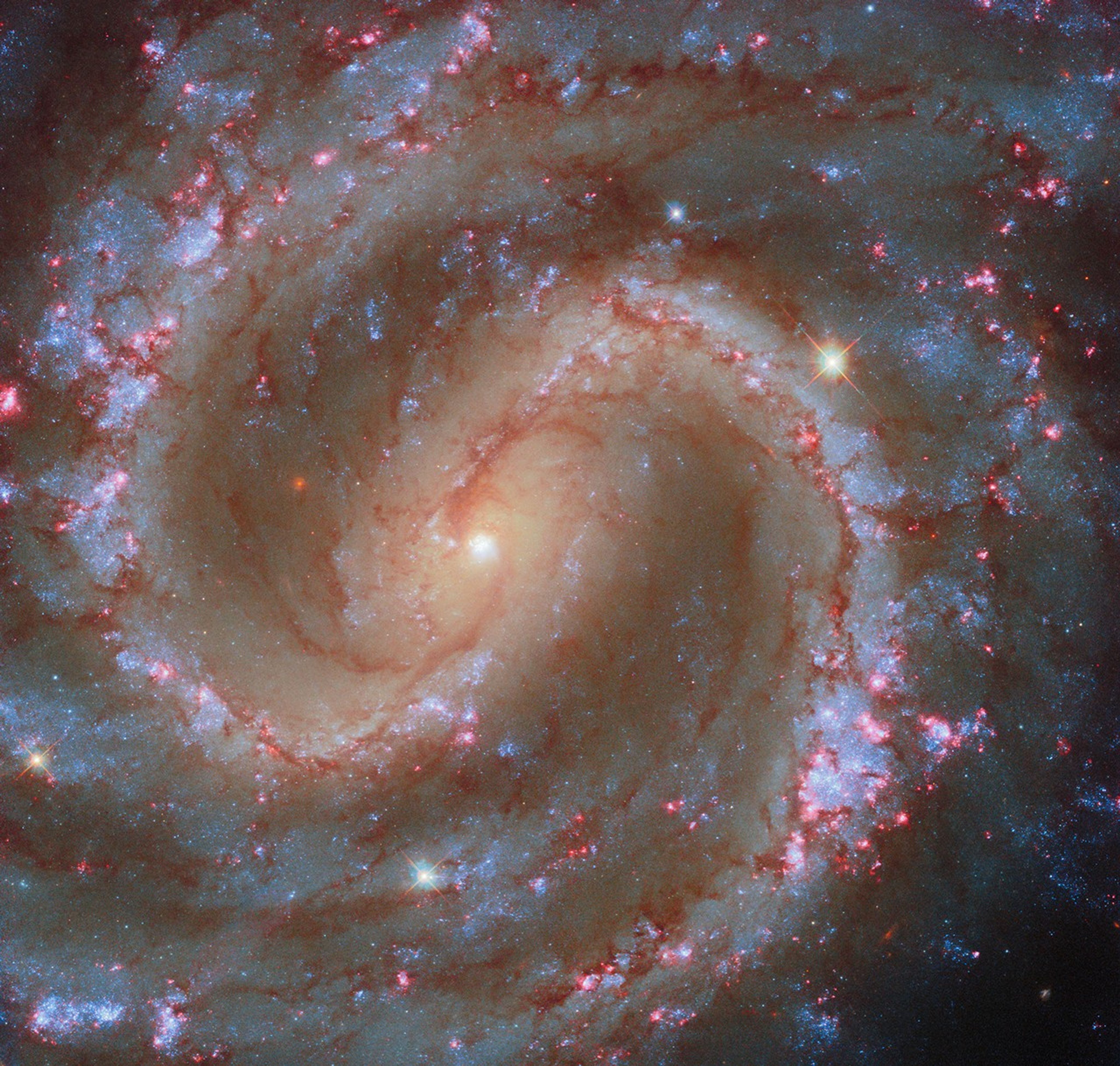
This NASA/ESA Hubble Space Telescope image features the spiral galaxy NGC 4535.
ESA/Hubble & NASA, F. Belfiore, J. Lee and the PHANGS-HST Team
Today’s NASA/ESA Hubble Space Telescope image features the spiral galaxy NGC 4535, which is situated about 50 million light-years away in the constellation Virgo (the Maiden). Through a small telescope, this galaxy appears extremely faint, giving it the nickname ‘Lost Galaxy’. With a mirror spanning nearly eight feet (2.4 meters) across and its location above Earth’s light-obscuring atmosphere, Hubble can easily observe dim galaxies like NGC 4535 and pick out features like its massive spiral arms and central bar of stars.
This image features NGC 4535’s young star clusters, which dot the galaxy’s spiral arms. Glowing-pink clouds surround many of these bright-blue star groupings. These clouds, called H II (‘H-two’) regions, are a sign that the galaxy is home to especially young, hot, and massive stars that blaze with high-energy radiation. Such massive stars shake up their surroundings by heating their birth clouds with powerful stellar winds, eventually exploding as supernovae.
The image incorporates data from an observing program designed to catalog roughly 50,000 H II regions in nearby star-forming galaxies like NGC 4535. Hubble released a previous image of NGC 4535 in 2021. Both the 2021 image and this new image incorporate observations from the PHANGS observing program, which seeks to understand the connections between young stars and cold gas. Today’s image adds a new dimension to our understanding of NGC 4535 by capturing the brilliant red glow of the nebulae that encircle massive stars in their first few million years of life.
NASA’s TESS Spacecraft Triples Size of Pleiades Star Cluster
These young, hot blue stars are members of the Pleiades open star cluster and resides about 430 light-years away in the northern constellation Taurus. The brightest stars are visible to the unaided eye during evenings from October to April. A new study finds the cluster to be triple the size previously thought — and shows that its stars are scattered across the night sky. The Schmidt telescope at the Palomar Observatory in California captured this color-composite image.
NASA, ESA and AURA/Caltech
Astronomers have revolutionized our understanding of a collection of stars in the northern sky called the Pleiades. They used data from NASA’s TESS (Transiting Exoplanet Survey Satellite) and other observatories as NASA explores the secrets of the universe for the benefit of all, from the Moon to Mars and beyond.
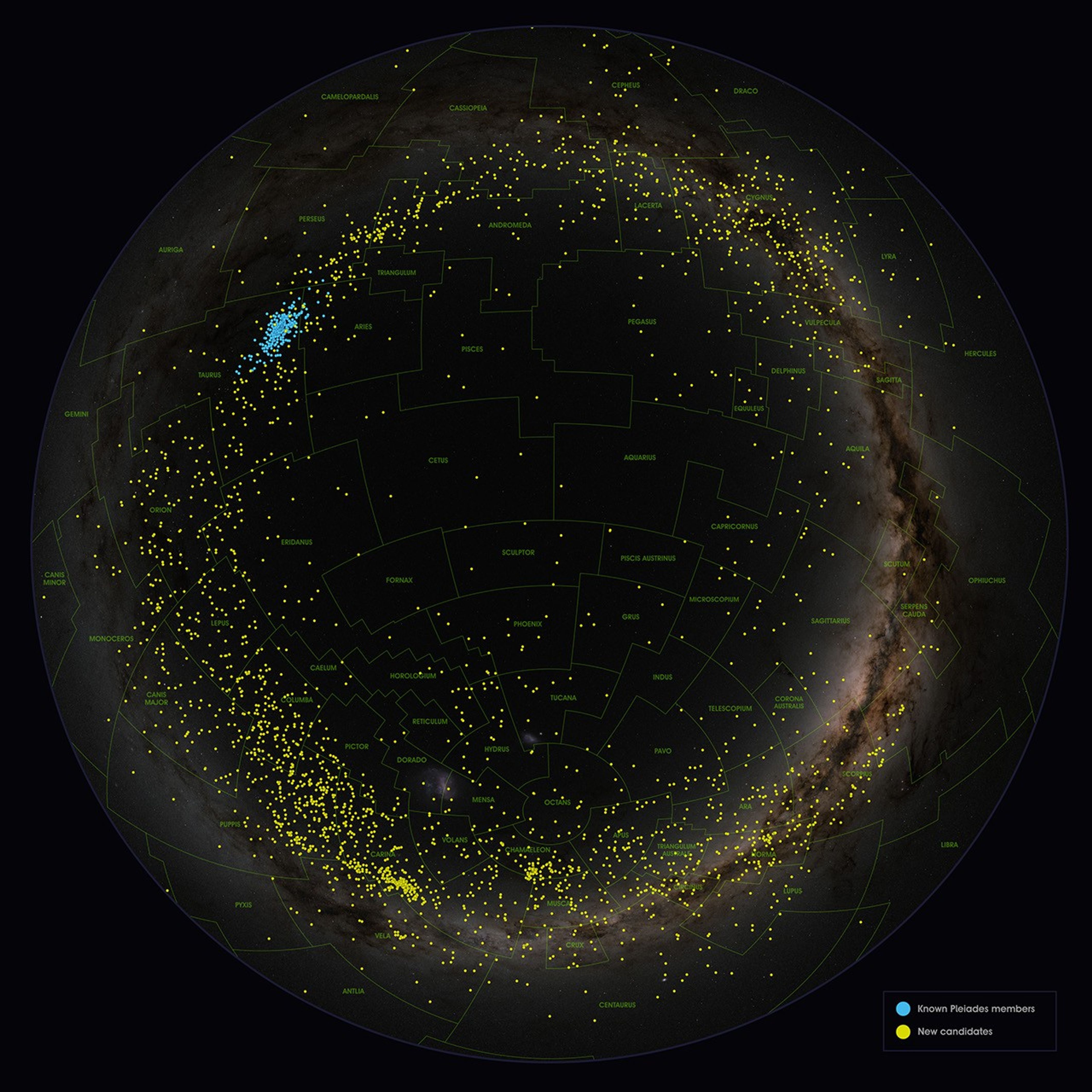
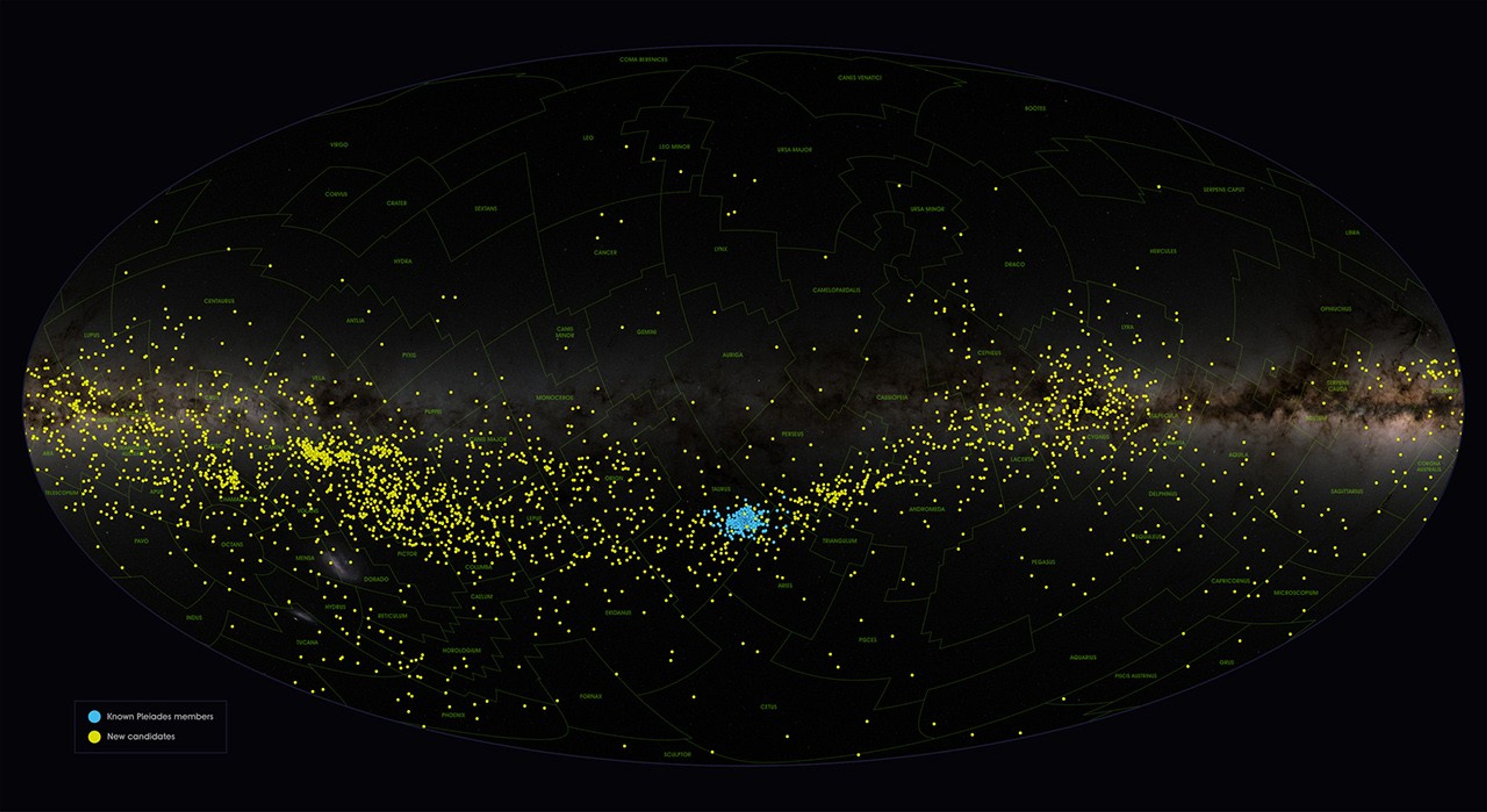
By examining the rotation, chemistry, and orbit around the Milky Way of members of several different nearby stellar groups, the scientists identified a continuum of more than 3,000 stars arcing across 1,900 light-years. This Greater Pleiades Complex triples the number of stars associated with the Pleiades and opens new approaches for discovering similar dispersed star clusters in the future.
“The Pleiades are very well studied — we often use them as a benchmark in astronomical observations,” said Andrew Boyle, a graduate student at the University of North Carolina at Chapel Hill. “When I started this research, I didn’t expect the cluster to balloon to the size that it did. It really touches on a human note. In the Northern Hemisphere, we’ve been looking up at the Pleiades and telling stories about them for thousands of years, but there’s so much more to them than we knew.”
A paper about the result, led by Boyle, published Wednesday, Nov. 12, in the Astrophysical Journal.
This image shows two-thirds of the night sky, illustrating the vast extent of the Greater Pleiades Complex. Original stellar members of the Pleiades, sometimes called Messier 45, appear as blue dots. Newly identified members are in yellow. The constellations are outlined and labeled in green.
The Pleiades is a bright cluster of stars, also known as Messier 45. This loose grouping of about 1,000 members was born roughly 100 million years ago from the same molecular cloud, a cold dense patch of gas and dust.
About six of the stars in the cluster are visible to the unaided eye during evenings from October to April in the northern constellation Taurus. This collection has also been known since antiquity as the Seven Sisters, although the seventh star is no longer visible.
Boyle and his team initially identified over 10,000 stars that could be related to the Pleiades. These stars were orbiting at a similar rate around our Milky Way galaxy according to data from ESA’s (European Space Agency) Gaia satellite.
They narrowed down that collection using stellar rotation data from TESS.
Watch how a star’s rotation slows with age in this artist’s concept of a Sun-like star. The number of star spots also decreases with age.
NASA’s Goddard Space Flight Center
NASA’s TESS mission scans a wide swath of the sky for about a month at a time, looking for variations in the light from stars to spot orbiting planets. This technique also allows TESS to identify and monitor asteroids out to large distances, determining their spin and refining their shape. Such observations improve our understanding of asteroids in our solar system, which can aid in planetary defense.
Scientists can also use TESS data to determine how fast the stars are rotating by looking at regular fluctuations in their light caused when dark surface features called star spots come in and out of view. Because stellar rotation slows as stars age, the researchers were able to pick out the stars that were about the same age as the Pleiades.
The team also looked at the chemical abundances in potential members using data from ground-based missions like the Sloan Digital Sky Survey, which is led by a consortium of institutions.
“The core of the Pleiades is chemically distinct from the average star in a few elements like magnesium and silicon,” said Luke Bouma, a co-author and fellow at the Carnegie Science Observatories in Pasadena, California. “The other stars that we propose are part of the Greater Pleiades are chemically distinct in the same way. The combination of these three major lines of evidence — Milky Way orbits, ages, and chemistry — tells me that we’re on the right path when making these connections.”
The team members think that all the stars in the Greater Pleiades Complex formed in a tighter collection, like the stars in the young Orion cluster, about 100 million years ago. Over time, the cluster dispersed due to the explosive forces of internal supernovae and from the tidal forces of our galaxy’s gravity.
The result is a stream of stars arcing across the sky from horizon to horizon.
This image shows an all-sky view of the Greater Pleiades Complex with the plane of our Milky Way running through the middle. Members of the original open cluster are in blue, and new members are in yellow. The constellations are outlined and labeled in green.
Boyle and Bouma are now working on what they call the TESS All-Sky Rotation Survey. This database will allow researchers to access the rotation information for over 8 million stars to discover even more hidden stellar connections like the Greater Pleiades Complex.
“Thanks to TESS, this team was able to shed new light on a fixture of astronomy,” said Allison Youngblood, the TESS project scientist at NASA’s Goddard Space Flight Center in Greenbelt, Maryland. “From distant stars and planets to asteroids in our solar system and machine learning models here on Earth, TESS continues to push the boundaries of what we can accomplish with large datasets that capture just a part of the complexity of our universe.”
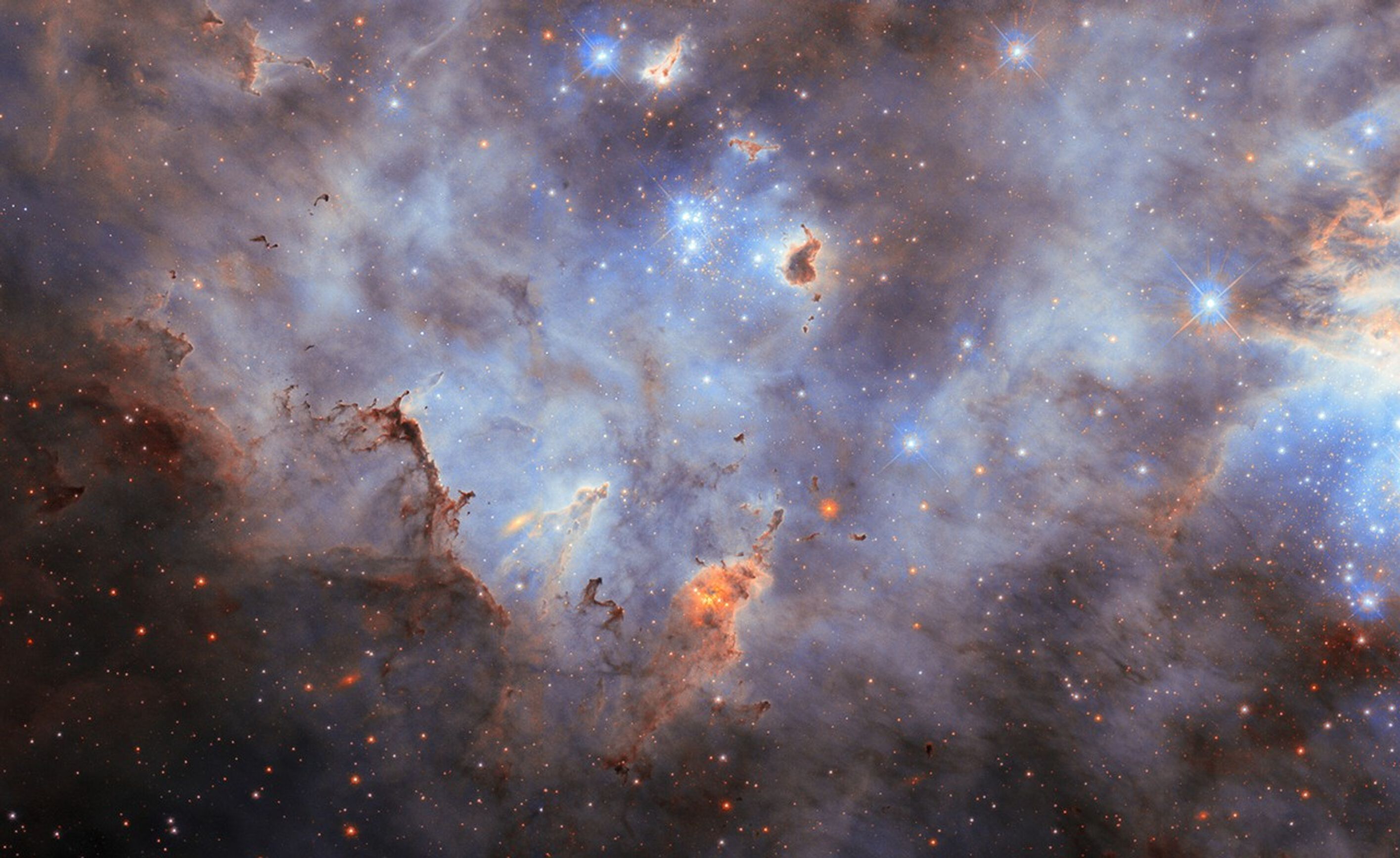
This NASA/ESA Hubble Space Telescope image released on Sept. 12, 2025, features a cloudy starscape from an impressive star cluster. This scene is in the Large Magellanic Cloud, a dwarf galaxy situated about 160,000 light-years away in the constellations Dorado and Mensa. With a mass equal to 10–20% of the mass of the Milky Way, the Large Magellanic Cloud is the largest of the dozens of small galaxies that orbit our galaxy.
The Large Magellanic Cloud is home to several massive stellar nurseries where gas clouds, like those strewn across this image, coalesce into new stars. Today’s image depicts a portion of the galaxy’s second-largest star-forming region, which is called N11. (The most massive and prolific star-forming region in the Large Magellanic Cloud, the Tarantula Nebula, is a frequent target for Hubble.) We see bright, young stars lighting up the gas clouds and sculpting clumps of dust with powerful ultraviolet radiation.
This image marries observations made roughly 20 years apart, a testament to Hubble’s longevity. The first set of observations, which were carried out in 2002–2003, capitalized on the exquisite sensitivity and resolution of the then-newly-installed Advanced Camera for Surveys. Astronomers turned Hubble toward the N11 star cluster to do something that had never been done before at the time: catalog all the stars in a young cluster with masses between 10% of the Sun’s mass and 100 times the Sun’s mass.
The second set of observations came from Hubble’s newest camera, the Wide Field Camera 3. These images focused on the dusty clouds that permeate the cluster, providing us with a new perspective on cosmic dust.
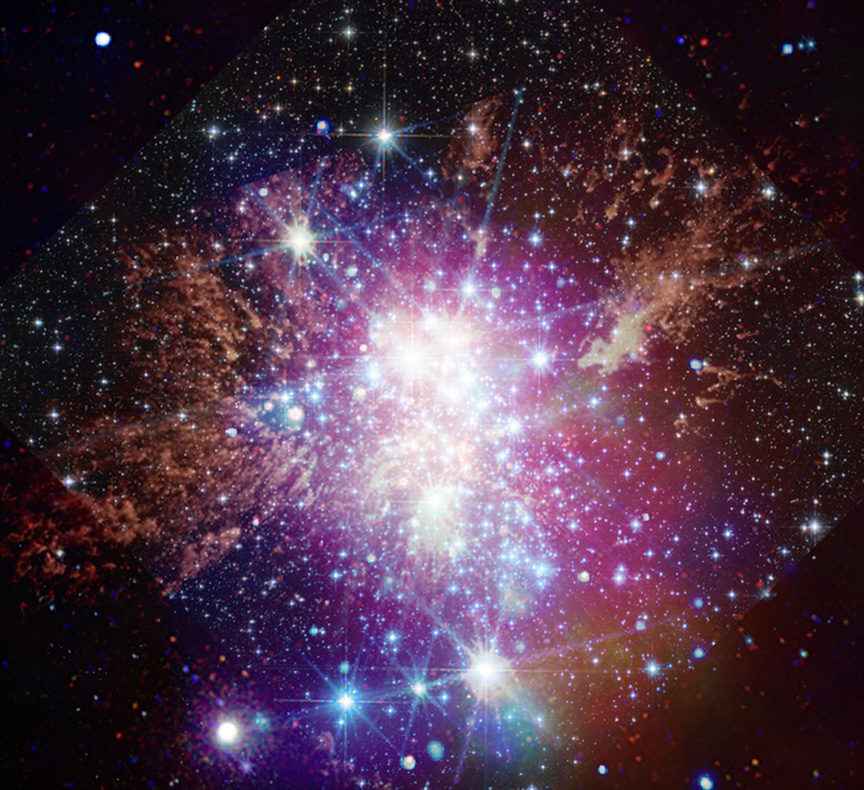
Westerlund 1, the biggest and closest “super” star cluster to Earth, dazzles in this image released on July 23, 2025. This view combines x-ray data from NASA’s Chandra X-ray Observatory (in pink, blue, purple, and orange), infrared data from NASA’s James Webb Space Telescope (in yellow, gold, and blue), and optical data from NASA’s Hubble Space Telescope (in cyan, grey, and light yellow).
Data from Chandra and other telescopes is helping astronomers delve deeper into this galactic factory where stars are vigorously being produced. Observations from Chandra have uncovered thousands of individual stars pumping out X-ray emission into the cluster.

 Login
Login