 Login
LoginFeds find more complaints of Tesla’s FSD running red lights and crossing lanes
5 December 2025 at 16:46
The National Highway Traffic Safety Administration has identified at least 80 incidents.


Driving used to be something more than just a way to get from one place to another. Just taking a drive down to the store could be an exciting experience in the right car. The so-called "driver's car", which emphasizes feedback and responsiveness to your inputs was a great way to forget about your dull 9-5 life. For those who cared about such things, there were plenty of choices at every budget level. These days? I'm starting to doubt that a true driver's car even exists anymore in any form.
Tesla and SpaceX chief Elon Musk has stoked fresh debate about Bitcoin after a recent social post in which he said the cryptocurrency is “based on energy” and that energy cannot be faked. The comment, posted on X, quickly drew attention from investors and politicians alike.
Musk’s remark landed as markets moved. Bitcoin was down, and trading roughly around $86,500 at the time of the post, and crypto coverage noted a flurry of reactions across social feeds and trading desks. Some market watchers saw the statement as a boost for BTC’s narrative as an inflation hedge.
According to Musk, the act of mining ties Bitcoin to physical energy: miners consume electricity to secure the network and mint new coins, which he said makes Bitcoin harder to fake than printed fiat.
In a fresh clip shared from Nikhil Kamath’s interview, Musk makes his stance clear:
Out now @elonmusk pic.twitter.com/dQVLniUgWA
— Nikhil Kamath (@nikhilkamathcio) November 30, 2025
The line of argument presents energy use not as a flaw but as a kind of proof that creates scarcity. Several crypto outlets ran pieces unpacking the idea and how it contrasts with past criticism Musk voiced about mining’s environmental toll.
Traders and some policy figures reacted quickly. Bitcoin backers posted support, while others urged caution. Meanwhile, separate coverage noted that SpaceX recently moved almost $270 million worth of Bitcoin, a move that traders flagged as potentially market-swaying. Those on both sides of the debate said Musk’s post could influence investor sentiment, at least in the short run.
What The Energy Argument Means
The core of the claim is simple: you cannot manufacture energy the way a central bank can print more currency. That idea appeals to people worried about rising public spending on tech and AI, which some analysts say could put pressure on fiat money.
But critics point out a gap: energy used to mine Bitcoin does not become a stored reserve like gold. It is consumed. Value, they argue, still relies heavily on trust and demand, not energy alone.
Past Stance And Ongoing QuestionsMusk’s comment marks a visible shift from his earlier stance in 2021 when Tesla paused Bitcoin payments over mining energy concerns.
Since then, the mining sector has changed in parts, with more projects claiming use of renewables, while others still depend on fossil fuels. The debate now mixes technical, economic and political threads, making clear answers hard to find.
Featured image from Lovepik, chart from TradingView
Peter Schiff has never hidden his distaste for Bitcoin, but his latest comment on X has added a new twist to his long-running feud with the cryptocurrency. The economist, known globally as one of BTC’s most persistent skeptics, admitted that he made a major mistake when he first encountered it more than a decade ago.
His mistake, however, was not about failing to buy early or doubting a successful technology. Instead, Schiff insisted that his real error was assuming other people would recognize why Bitcoin wouldn’t work.
In his recent tweet, Schiff stated that he initially believed most people would see Bitcoin the same way he did, as a system destined to fail because it is not backed by anything physical and therefore has no real value. He added that the people foolish enough to buy it then are the same people who will refuse to sell even as the market proves him right.
The comment reinforced the core of Schiff’s philosophy: BTC’s worth, in his view, rests entirely on speculation, not fundamentals. According to him, the cryptocurrency’s design means that it cannot function as a reliable store of wealth, medium of exchange, or unit of account.
The post immediately drew many reactions, most of them from Bitcoin supporters who are of the notion that Schiff’s bitterness comes from missing out when Bitcoin traded for less than $1.
Bitcoin believers argued that his supposed mistake wasn’t intellectual but financial. The counterclaim is that Schiff is frustrated because he ignored Bitcoin when it traded for less than a dollar. One reply from BTC advocate Carl Menger captured the mood perfectly. He wrote that Schiff’s real mistake was failing to buy when he first encountered the asset at $1, adding that Schiff is now “an old salty pal yelling at it.” Other commenters also echoed the sentiment.
Schiff’s skepticism is not new. Over the years, he has repeatedly maintained that Bitcoin is nothing more than a digital bubble. He has also insisted that BTC lacks any underlying value because it is not tied to a physical commodity, unlike gold. Despite the introduction of Bitcoin ETFs and its growing institutional presence, he maintains that wider adoption does not change what he calls its “fundamental uselessness.”
Bitcoin’s trajectory tells a very different story from the one painted by critics like Schiff. The cryptocurrency has expanded on a scale few assets in modern history can match, reaching levels of global relevance that go far beyond its early niche.
Its price may be moving through a period without clear bullish momentum, but it still ranks among the largest assets in the world. In fact, BTC now sits as the 9th biggest asset by market capitalization, ahead of companies such as Meta, Saudi Aramco, and Tesla.
Bitcoin Magazine
Elon Musk Calls Bitcoin a ‘Fundamental’ And ‘Physics-Based Currency’
Tesla and SpaceX CEO Elon Musk has reignited some discussion around Bitcoin, describing it as a “fundamental physics-based currency” grounded in energy.
Speaking on a recent podcast with Nikhil Kamath, Musk emphasized that Bitcoin’s value is tied to real-world energy expenditure, highlighting a distinction between digital assets and traditional fiat currencies.
“Energy is the true currency,” Musk said. “This is why I said Bitcoin is based on energy. You can’t legislate energy. You can’t just, you know… pass a law and suddenly have a lot of energy.”
The Tesla founder drew attention to the difficulty of producing and harnessing energy, linking it to Bitcoin’s proof-of-work system, which requires substantial computational power and electricity to secure the network.
He also referenced the Kardashev scale — a method for measuring a civilization’s energy consumption — as a lens for understanding societal progress. He suggested that evaluating a civilization by its capacity to generate and manage energy mirrors Bitcoin’s design principles, where scarcity and computational effort underpin value.
Looking further ahead, Musk proposed that advancements in artificial intelligence and robotics could render money obsolete.
“In a future where anyone can have anything, I think that you no longer need money as a database for labor allocation,” he said, citing Iain M. Banks’ post-scarcity Culture series as a blueprint for societies where super-intelligent machines manage resources without monetary systems.
JUST IN: Elon Musk says #Bitcoin is a fundamental currency based on energy
— Bitcoin Magazine (@BitcoinMagazine) November 30, 2025
“Energy is the true currency” pic.twitter.com/sTWKLKV0Fd
Musk also underscored the unique qualities of Bitcoin. Unlike fiat money, which governments can print at will, Bitcoin’s proof-of-work system ties its creation to energy and computing power, giving it a built-in scarcity and relative independence from political influence.
“Governments can print money, but they cannot print energy,” Musk said.
While Musk envisions a future where energy might serve as a more fundamental measure of value, he acknowledged that traditional money remains dominant today.
National currencies continue to govern commerce, wages, and savings, while cryptocurrencies like Bitcoin exist as alternative assets rather than replacements for everyday transactions.
Musk’s remarks provide a reminder of the philosophical underpinnings of Bitcoin, linking it to physics and energy rather than policy and government control.
Earlier today, the Bitcoin price plunged 8% to the mid-$84,000s early Monday, extending a two-month drawdown that has erased over 30% since October’s record highs.
The drop followed last week’s brief recovery above $92,500 after November lows near $81,000.
This post Elon Musk Calls Bitcoin a ‘Fundamental’ And ‘Physics-Based Currency’ first appeared on Bitcoin Magazine and is written by Micah Zimmerman.
A leading finance expert believes that the current growth stage of the Bitcoin price mirrors Google’s expansion in 2017, suggesting that the network is yet to reach its true potential. The expert’s comparison positions Bitcoin as a maturing digital system that has established core utility, with a larger phase of value capture still ahead. His remarks about BTC come at a time when its price is navigating sharp downside risks and heightened market volatility
Raoul Pal, the founder and Chief Executive Officer (CEO) of Real Vision, has highlighted a compelling connection between Bitcoin’s current price growth and Google’s early years. In an X post this week, Pal argued that digital assets clearly follow a network-driven growth model, comparing the sector to major technology giants that expanded rapidly as their user base increased.
The Real Vision founder emphasized that crypto behaves like a Metcalfe’s Law network, similar to Google, Amazon, Meta, and Tesla, where value scales with the number of participants rather than traditional financial metrics. He stated that attempting to value cryptocurrencies using cash flow models overlooks the essence of what makes a network valuable.
In his view, the structure of blockchain ecosystems means that their worth is tied to usage, adoption, and the network effects generated by millions of users. This unique framework underpins Pal’s belief that Bitcoin’s price growth today is a reflection of Google’s position in 2017. The financial expert supported his argument with a GOOGL US equity chart, showing its multi-year growth curve on a logarithmic scale. During 2017, Google was already dominant in areas like search, yet many of its long-term value drivers, such as cloud and Artificial Intelligence (AI), were still developing.
While the Bitcoin network is secure, widely adopted, and increasingly integrated into the global financial system, Pal’s view suggests that the cryptocurrency’s long-term development and true potential are still far from realized. He added that Ethereum may be even earlier in its growth curve, suggesting the second-largest cryptocurrency could follow a longer trajectory as its technology and applications evolve.
Pal’s remarks on X, which compares Bitcoin to Google, were made in response to statements from Santiago Roel Santos, the founder and CEO of Inversion, a technology-first investment company. Santos initially argued that network effects in crypto have been overstated and are often misused to justify valuations resembling those of social networking companies.
Santos suggested that many cryptocurrencies have not demonstrated meaningful value capture and therefore resemble open source software systems like Linux rather than platforms such as Facebook, which benefit directly from rising user numbers. Pal challenged this view by insisting that crypto networks exhibit real and measurable network effects. His entire argument is built on the idea that user activity and transaction volume support the growing value of digital networks like Bitcoin.
Elon Musk’s SpaceX quietly shifted 1,163 BTC, worth about $105.23 million, into new wallets this week, leading to questions over whether the aerospace giant is preparing for a sale or simply reorganizing its reserves. Blockchain tracker Arkham Intelligence first spotted the transaction on November 27, noting that the bitcoins were moved from a long-dormant treasury wallet into a new address.
The move happened just as Bitcoin reclaimed $91,000, and the size of the transaction could be an early signal of selling pressure.
Data from Arkham Intelligence shows that SpaceX executed the $105.23 million transfer in a single large movement. Although the transfer was substantial, a quick look at SpaceX’s treasury behavior in recent months shows that the activity points to internal restructuring rather than liquidation. Still, the scale of the transaction has left investors asking whether this could be an early signal of selling pressure.
Intelligence data shows that the funds were pushed into a new wallet with no immediate ties to exchanges. This difference is important because transfers to exchanges often come with selling activity.
Instead, the pattern follows an earlier transaction in late October, when SpaceX moved 281 BTC into a newly created address without any subsequent liquidation. Interestingly, this 281 BTC transfer was preceded by a similar transfer of 1,215 BTC worth $133.68 million in October.
The consistency of these movements suggests a gradual upgrade or redistribution of cold-storage arrangements, something that major corporations tend to do periodically to maintain custody security. According to Lookonchain, the recent transfer of 1,163 BTC to the new address “bc1q4p” was possibly made to Coinbase Prime for custody.
SpaceX’s balance is substantial even after the recent movement, with roughly 6,095 BTC still under its control, an amount currently valued at $555.637 million and large enough to place the company among the biggest private corporate holders of Bitcoin.
Tesla, Musk’s other major enterprise, sits even higher on the leaderboard with 11,509 BTC valued at $1.05 billion, ranking it as the 17th largest publicly traded Bitcoin-holding company in the world.
Despite the absence of clear evidence of selling intent, large transfers tied to high-profile companies like SpaceX inevitably influence sentiment. Bitcoin had just regained the $91,000 region at the time of the transfer, and traders immediately questioned whether Musk’s company might be preparing to offload part of its holdings, especially given the company’s sell-off history during the 2022 bear market.
Bitcoin is still stabilizing after a price crash encouraged in part by Owen Gunden, one of the earliest high-profile holders, who unloaded hundreds of millions of dollars’ worth of BTC and helped drag the price below $90,000 on November 20. However, the evidence behind SpaceX’s current transfer is still pointing to consolidation rather than liquidation.
Headlights. Indicators. Trunk releases. Seatbelts. Airbags. Just about any part of a car you can think of is governed by a long and complicated government regulation. It’s all about safety, ensuring that the car-buying public can trust that their vehicles won’t unduly injure or maim them in regular operation, or in the event of accident.
However, one part of the modern automobile has largely escaped regulation—namely, the humble door handle. Automakers have been free to innovate with new and wacky designs, with Tesla in particular making waves with its electronic door handles. However, after a series of deadly incidents where doors wouldn’t open, regulators are now examining if these door handles are suitable for road-going automobiles. As always, regulations are written in blood, but it raises the question—was not the danger of these complicated electronic door handles easy to foresee?
A number of automakers have developed fancy retractable door handles in recent years. They are most notably seen on electric vehicles, where they are stated to have a small but measurable aerodynamic benefit. They are often paired with buttons or other similar electronic controls to open the doors from the inside. Compared to mechanical door handles, however, these door handles come with a trade-off in complexity. They require electricity, motors, and a functioning control system to work. When all is well, this isn’t a problem. However, when things go wrong, a retractable electronic door handle often proves inaccessible and useless.
It’s not hard to find case reports of fatal incidents involving vehicles with electronic door handles—both inside and out. Multiple cases have involved occupants burning alive inside Tesla vehicles, in which electronic door handles failed after a crash. Passengers inside the vehicles have failed to escape due to not finding emergency release door pulls hidden in the door panels, while bystanders have similarly been unable to use the retracted outside door handles to free those trapped inside.
In response, some Tesla owners have gone so far as to release brightly-colored emergency escape ripcords to replace the difficult-to-spot emergency release pulls that are nearly impossible to find without prior knowledge. In the case of some older models, though, there’s less hope of escape. For example, in the Tesla Model 3 built from 2017 to 2023, only front doors have an emergency mechanical release. Rear passengers are out of luck, and must find another route of escape if their electronic door handles fail to operate. No Tesla vehicles feature an easily-accessible mechanical release that can be used from outside the vehicle.

It’s worth noting that in the US market, federal regulations have mandated glow-in-the-dark trunk releases be fitted to all sedans from the 2002 model year onwards. You could theoretically escape from the trunk of certain Teslas more easily than a Cybertruck or Model 3 with a failed electrical system.
Tesla isn’t the only company out there building cars with retractable door handles. It does, however, remain the most prominent user of this technology, and its vehicles have been involved in numerous incidents that have made headlines. Other automakers, such as Audi and Fiat, have experimented with electronic door handles, both for ingress and egress, with varying degrees of mechanical backup available. In some cases, automakers have used smart two-stage latches. A small pull activates the electronic door release, while a stronger pull will engage a mechanical linkage that unlatches the door. It’s smart engineering—the door interface responds to the exact action a passenger would execute if trying to escape the vehicle in a panic. There are obviously less concerns around electronic door releases that have easily-accessed mechanical backups; it’s just that Tesla is particularly notable for not always providing them.
Over the years, national automotive bodies have thrown up their arms about all sorts of emerging automotive technologies. In the United States specifically, NHTSA has famously slow-walked the approval of things like camera-based rear-view mirror systems and replaceable-bulb headlamps, fearing the worst could occur if these technologies were freely allowed on the market.
Meanwhile, despite the obvious risks, electronic door handles have faced no major regulatory challenges. There were no obvious written rules standing in the way of Tesla making the choice to eliminate regular old door handles. Nor were there strict regulations on emergency door releases for passengers inside the vehicle. Tesla spent years building several models with no mechanical door release for the rear passengers. If your door button failed, you’d have to attempt escape by climbing out through the front doors, assuming you could figure out how to open them. Even today, the models with mechanical door releases still often hide them behind interior trim pieces or carpets, where few passengers would ever think to look in an emergency.
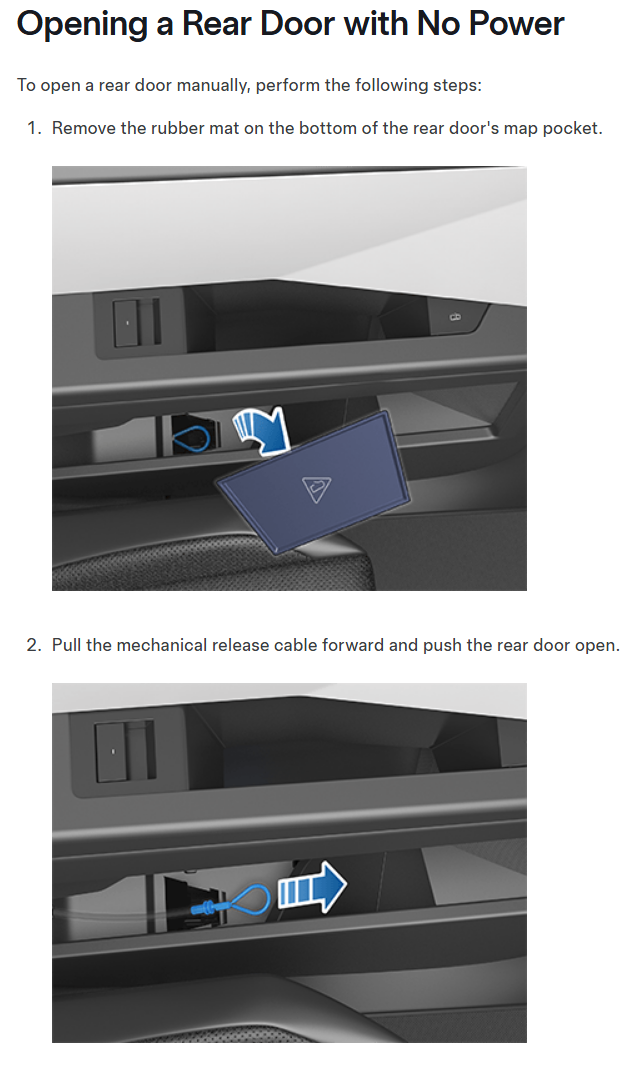
Things are beginning to change, however. Chinese regulators have led the charge, with reports stating that electronic retractable door handles could be banned as soon as 2027. While some semi-retractable styles will potentially avoid an outright ban, it’s believed new regulations will require a mechanically redundant release system as standard.
As for the US, the sleeping giant of NHTSA has finally awoken in the wake of Bloomberg‘s reporting on the matter. As reported by CNBC, Tesla has been given a deadline of December 10 to deliver records to the federal regulator, regarding design, failures, and customer issues around its electronic door release systems. The Office of Defects Investigations within NHTSA has already recorded 16 reports of failed exterior door releases in the a single model year of the Tesla Model Y. It’s likely a drop in the ocean compared to the full population of Tesla vehicles currently on roads. Meanwhile, the US automaker also faces multiple lawsuits over the matter from those who have lost family members in fatal crashes and fires involving the company’s vehicles.
In due time, it’s likely that automotive regulators in most markets will come out against electronic door handles from a safety perspective alone. No matter how well designed the electrical system in a modern vehicle, it’s hard to beat a lever flipping a latch for simplicity and robustness. The benefits of these electronic door handles are spurious in the first place—a fraction of a percent reduction in drag, and perhaps a little more luxury appeal. If the trade-off is trapping passengers in the event of a fire, it’s hard to say they’re worthwhile.
The electronic door handle, then, is perhaps the ultimate triumph of form over function. They’re often slower and harder to use than a regular door handle, and particularly susceptible to becoming useless when iced over on a frosty morning. For a taste of the future, lives were put at risk. Anyone could see that, so it’s both strange and sad that automakers and regulators alike seemed not to notice until it was far too late. Any new regulations will, once again, be written in blood.

As Tesla’s profits shrink and its model lineup continues to age, the company remains focused on establishing new lines of business. Tesla CEO Elon Musk says there’s not much his Optimus robots won’t be able to do in the future—following people around to prevent them from committing crimes is the latest—despite the technology not quite existing yet.
Musk’s robotaxis are a little closer to reality, with a kind of limited service being offered in Austin, Texas, as well as parts of San Francisco. But Tesla might need to rethink its approach to safety drivers after a Tesla rideshare passenger in San Francisco took to Reddit to share a video of the operator asleep in the driver’s seat.
In fact, the safety driver fell asleep three times during the ride, which took place a little over a week ago, according to Reddit user ohmichael. In his post, which contains a 12-second clip of a man sleeping and then waking in the front seat of a moving Tesla, the poster says he contacted Tesla to report this behavior but never heard back.
Tesla might add CarPlay, but Android users could be left out. Here are all the details on this.
The post Tesla Might Add CarPlay, But Android Users Could Be Left Out first appeared on Redmond Pie.
Apple CarPlay, the interface that lets you cast your phone to your car’s infotainment screen, may finally be coming to Tesla’s electric vehicles. CarPlay is nearly a decade old at this point, and it has become so popular that almost half of car buyers have said they won’t consider a car without the feature, and the overwhelming majority of automakers have included CarPlay in their vehicles.
Until now, that hasn’t included Tesla. CEO Elon Musk doesn’t appear to have opined on the omission, though he has frequently criticized Apple. In the past, Musk has said the goal of Tesla infotainment is to be “the most amount of fun you can have in a car.” Tesla has regularly added puerile features like fart noises to the system, and it has also integrated video games that drivers can play while they charge.
For customers who want to stream music, Tesla has instead offered Spotify, Tidal, and even Apple Music apps.
© Getty Images
At Tesla’s 2025 shareholder meeting, Elon Musk warned supplier output may fall short and floated a ‘Terrafab’, a gigantic chip fab to secure Tesla’s AI chips.
The post Elon Musk Floats ‘Terafab’ as Tesla’s Next Big AI Chip Bet appeared first on TechRepublic.
At Tesla’s 2025 shareholder meeting, Elon Musk warned supplier output may fall short and floated a ‘Terrafab’, a gigantic chip fab to secure Tesla’s AI chips.
The post Elon Musk Floats ‘Terafab’ as Tesla’s Next Big AI Chip Bet appeared first on TechRepublic.
Bitcoin Magazine
Tesla Made $80M in Profit on Bitcoin Holdings in Q3, Didn’t Sell Any Crypto
Elon Musk’s Tesla reported an $80 million gain on its Bitcoin holdings in the third quarter of 2025, benefiting from the crypto market’s rebound without making any new trades.
According to Tesla’s Q3 filing released on Wednesday, the electric vehicle maker continues to hold 11,509 BTC — valued at roughly $1.31 billion as of September 30, up from $1.23 billion in Q2.
The increase came entirely from Bitcoin’s price appreciation, not from additional purchases or sales. Under new fair-value accounting rules, Tesla now reports digital assets at current market prices, allowing it to record crypto gains or losses each quarter.
The company hasn’t changed its position since early 2022, when it sold a small portion “to test liquidity” before classifying Bitcoin as a strategic treasury asset.
Beyond crypto, Tesla’s financial results showed mixed signals. Revenue rose to $25.18 billion, up from last year, but net income dropped 37% year-on-year to $1.37 billion, or $0.39 per share, as rising R&D and AI spending drove a 50% increase in operating costs.
Elon Musk publicly addressed bitcoin for the first time in three years recently, commenting on an X post linking rising gold, silver, and bitcoin prices to global monetary “debasement” fueled by AI spending.
Musk agreed, saying bitcoin is energy-based, noting that while fiat currency can be faked, energy cannot.
Tesla remains the 11th-largest corporate Bitcoin holder, behind the likes Strategy, Galaxy Digital, Block, and Coinbase, according to BitcoinTreasuries.net.
Tesla famously purchased $1.5 billion worth of Bitcoin in early 2021 and announced plans to accept BTC for vehicle payments.
Back in 2021, Musk said, “I think Bitcoin is a good thing. I am a supporter of Bitcoin. I am late to the party but a supporter. I think Bitcoin is on the verge of getting broad acceptance by conventional finance people.”
Within months, however, Musk reversed course, citing environmental concerns about Bitcoin mining’s heavy reliance on fossil fuels.
“Tesla has suspended vehicle purchases using Bitcoin,” he said at the time, adding that payments would resume once mining used “more sustainable energy.” In mid-2022, Tesla sold roughly 75% of its Bitcoin holdings — near the bottom of the market’s decline.
At the time of writing, Tesla (TSLA) is trading at $434.33 a share. The stock is up roughly 75% over the last six months.
This post Tesla Made $80M in Profit on Bitcoin Holdings in Q3, Didn’t Sell Any Crypto first appeared on Bitcoin Magazine and is written by Micah Zimmerman.
