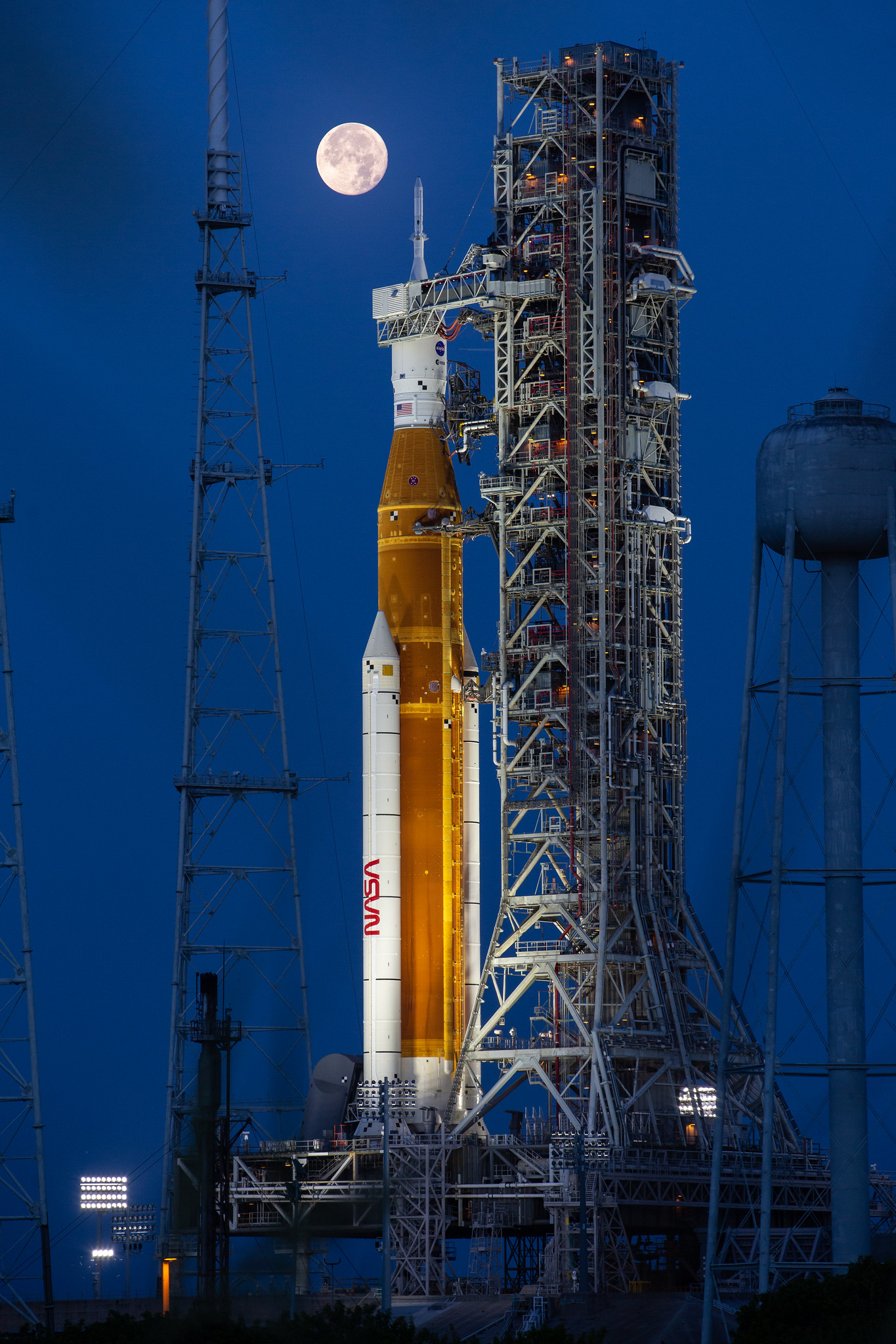
El cohete SLS (Sistema de Lanzamiento Espacial) y la nave espacial Orion de la misión Artemis I, en la plataforma móvil de lanzamiento en el Centro Espacial Kennedy de la NASA en Florida, con la luna llena al fondo. Imagen tomada el 14 de junio de 2022.
Ya está abierto el plazo de acreditación de medios de comunicación para el lanzamiento de la primera misión lunar tripulada de la campaña Artemis de la NASA.
Con un lanzamiento previsto para principios de 2026, el vuelo de prueba Artemis II enviará a los astronautas de la NASA Reid Wiseman, Victor Glover y Christina Koch y al astronauta de la CSA (Agencia Espacial Canadiense) Jeremy Hansen en un viaje de aproximadamente 10 días alrededor de la Luna y de regreso.
La tripulación despegará desde el Centro Espacial Kennedy de la agencia en Florida, a bordo de la nave espacial Orion de la NASA, transportada por el poderoso cohete Sistema de Lanzamiento Espacial (SLS, por sus siglas en inglés) de la agencia, con el fin de ayudar a validar los sistemas y el hardware necesarios para la exploración humana del espacio profundo.
Los miembros de los medios que no dispongan de ciudadanía estadounidense deben solicitar el acceso para ver el lanzamiento antes del domingo 30 de noviembre. Los miembros de medios con ciudadanía estadounidense deben solicitarlo antes del lunes 8 de diciembre. Los periodistas que ya dispongan de acreditaciones anuales para el centro Kennedy de la NASA también deben solicitar acceso para este lanzamiento. Aquellos que estén acreditados para asistir al despegue de Artemis II recibirán también acreditación para asistir a eventos previos al lanzamiento, incluyendo la presentación del cohete y la nave espacial integrados, un evento que se dará varias semanas antes del despegue. Más adelante proporcionaremos detalles adicionales sobre las fechas del lanzamiento.
Los medios de comunicación pueden enviar sus solicitudes de acreditación en línea, en:
Debido al gran interés suscitado, la disponibilidad de plazas para asistir a las actividades del lanzamiento es limitada. Los medios acreditados recibirán un correo electrónico de confirmación tras la aprobación, junto con información adicional sobre las actividades previas al lanzamiento y actividades del lanzamiento. La política de acreditación de medios de la NASA está disponible en línea (en inglés). Si tiene alguna pregunta sobre la acreditación, envíe un correo electrónico en inglés a: ksc-media-accreditat@mail.nasa.gov. Para otras preguntas, póngase en contacto con la sala de prensa del centro Kennedy de la NASA a través del número: +1 321-867-2468.
Como parte de una edad dorada de innovación y exploración, Artemis allanará el camino para nuevas misiones tripuladas estadounidenses en la superficie lunar, en preparación para la primera misión tripulada a Marte.
Para obtener más información (en inglés) sobre la misión Artemis II, visite:
The Artemis I SLS (Space Launch System) rocket and Orion spacecraft atop the mobile launcher at NASA’s Kennedy Space Center in Florida with a full Moon in the background on June 14, 2022.
Media accreditation is open for the launch of the first crewed Moon mission under NASA’s Artemis campaign.
Targeted to launch in early 2026, the Artemis II test flight will send NASA astronauts Reid Wiseman, Victor Glover, Christina Koch, and CSA (Canadian Space Agency) astronaut Jeremy Hansen on an approximately 10-day journey around the Moon and back.
The crew will lift off from the agency’s Kennedy Space Center in Florida inside NASA’s Orion spacecraft on the agency’s powerful (SLS) Space Launch System rocket to help confirm the systems and hardware needed for human deep space exploration.
International media without U.S. citizenship must apply to view the launch by Sunday, Nov. 30. U.S. media must apply by Monday, Dec. 8. Journalists who already have annual badges to NASA Kennedy also must apply. Those who are accredited to attend the Artemis II launch also will be accredited to attend pre-launch events, including rollout of the integrated rocket and spacecraft several weeks before launch. Additional details about launch dates will be provided later.
Media may submit accreditation requests online at:
Due to high interest, space is limited to attend launch activities. Credentialed media will receive a confirmation email upon approval, along with additional information about pre-launch and launch activities. NASA’s media accreditation policy is available online. For questions about accreditation, please email: ksc-media-accreditat@mail.nasa.gov. For other questions, please contact the NASA Kennedy newsroom at: 321-867-2468.
As part of a Golden Age of innovation and exploration, Artemis will pave the way for new U.S.-crewed missions on the lunar surface in preparation toward the first crewed mission to Mars.
To learn more about the Artemis II mission, visit:
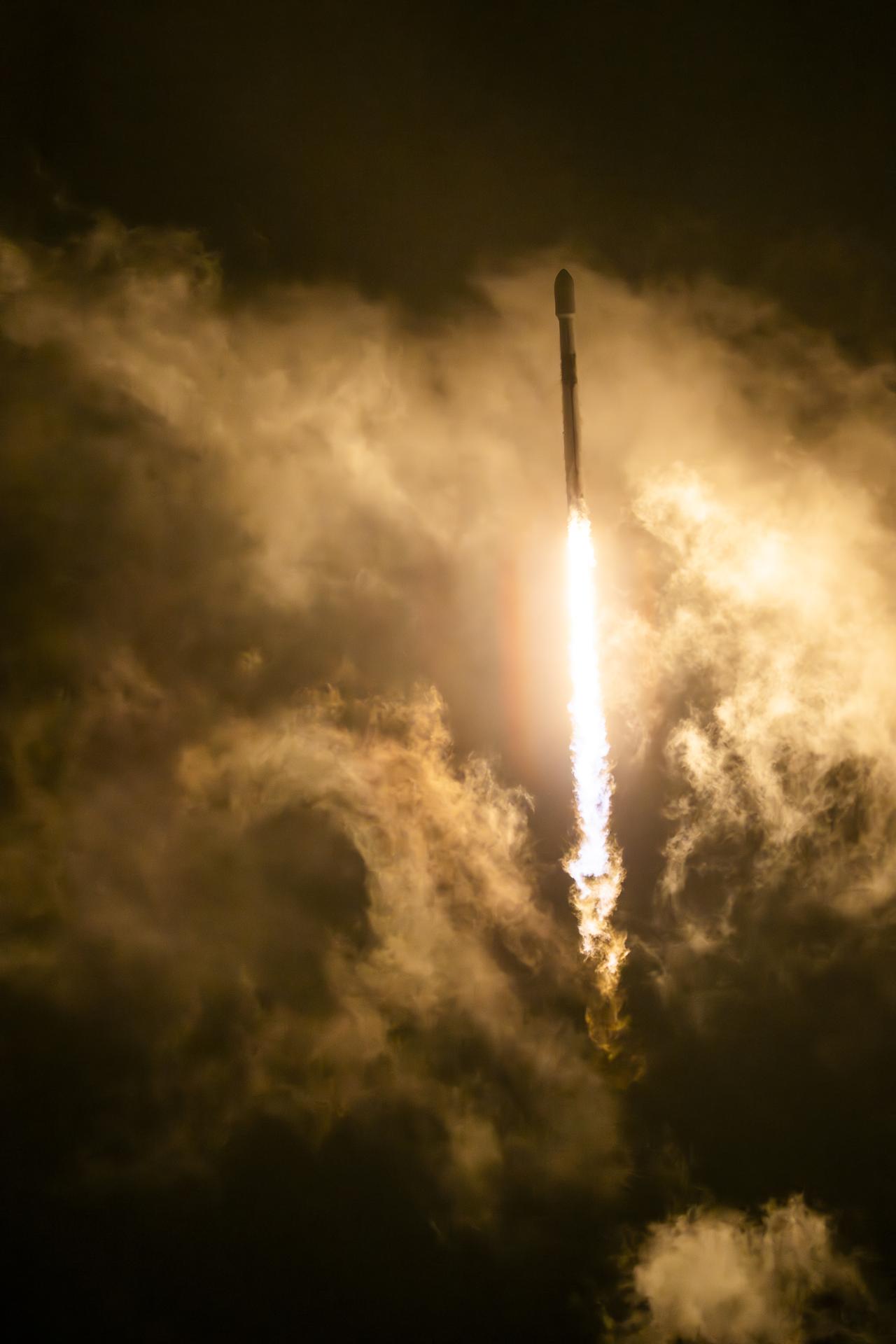
The Sentinel-6B satellite lifted off aboard a SpaceX Falcon 9 rocket from Launch Complex 4 East at Vandenberg Space Force Base in central California at 9:21 p.m. PST on Nov. 16.
Credit: NASA/Carla Thomas
About the size of a full-size pickup truck, a newly launched satellite by NASA and its partners will provide ocean and atmospheric information to improve hurricane forecasts, help protect infrastructure, and benefit commercial activities, such as shipping.
The Sentinel-6B satellite lifted off aboard a SpaceX Falcon 9 rocket from Launch Complex 4 East at Vandenberg Space Force Base in central California at 9:21 p.m. PST on Nov. 16. Contact between the satellite and a ground station in northern Canada occurred about 1 hour and 30 minutes later at 10:54 p.m. All systems are functioning normally.
“Understanding tidal patterns down to the inch is critical in protecting how we use our oceans every day on Earth,” said Nicky Fox, associate administrator, Science Mission Directorate at NASA Headquarters in Washington. “Sentinel-6B will build upon the legacy of Sentinel-6 Michael Freilich by making sea level measurements that improve forecasts used by communities, businesses, and operations across the country. It also will support a safer reentry for our astronauts returning home, including crew from Artemis Moon missions.”
Sea levels vary from place to place, and the satellite will provide accurate measurements at both local and global scales — all from hundreds of miles above in low Earth orbit. Those observations form the basis for U.S. flood predictions, which are crucial for safeguarding coastal infrastructure, real estate, energy storage sites, and other coastal assets. Sentinel-6B will take over for Sentinel-6 Michael Freilich, which launched in 2020 and later became the official reference satellite for global sea level measurements, providing sea surface height measurements against which those from other satellites are compared for accuracy.
The satellite comes from a collaboration between multiple partners, including NASA, ESA (European Space Agency), EUMETSAT (European Organisation for the Exploitation of Meteorological Satellites), and the National Oceanic and Atmospheric Administration (NOAA). It also is part of the European Union’s family of Copernicus missions.
“Collaboration between partners is key to a mission such as Sentinel-6, and my thanks go to everyone involved in developing, launching, and operating this exceptional satellite, which follows in the footsteps of the first Sentinel-6, Michael Freilich,” said Simonetta Cheli, director, ESA’s Earth Observation Programmes. “This achievement demonstrates what can be accomplished when international agencies and industries work together toward a shared goal. Sentinel-6B will ensure we continue to collect the high-precision data needed to understand our changing climate, safeguard our oceans and support decisions that protect coastal communities around the world.”
The two satellites make up the Copernicus Sentinel-6/Jason-CS (Continuity of Service) mission, the latest in a series of ocean-observing radar altimetry missions that have monitored Earth’s changing seas since the early 1990s.
As with its predecessor, Sentinel-6B satellite also will provide key information about wind speeds, wave heights, atmospheric temperature, and humidity. Moreover, because water expands as its temperature increases, researchers can tell which parts of the ocean are warmer than others based on where the sea surface height is greater.
Combined with data from other instruments, that knowledge can help in forecasting marine weather, including the development of hurricanes, which intensify with warmer water. Also, because large currents are taller than surrounding waters due to their higher temperatures, sea surface measurements can shed light on interactions between the Gulf Stream, for example, and nearby waves. Where they meet, seas can become rougher, presenting a hazard to even the largest ships.
“Sentinel-6B is a testament to the value of NASA’s partnership missions to put actionable satellite information and science into the hands of decision-makers on the ground,” said Karen St. Germain, director, NASA Earth Science Division at the agency’s headquarters. “Sentinel-6B will collect ocean surface observations that will inform decisions critical to coastal communities, commercial shipping and fishing, national defense, and emergency preparedness and response. This is what NASA does — puts advanced technology and science into action for the benefit of the nation.”
When Sentinel-6B reaches its operating elevation, the satellite will fly about 30 seconds behind Sentinel-6 Michael Freilich, which carries identical science instruments. Once the mission finishes cross-calibrating the data collected by the two, Sentinel-6 Michael Freilich will move into a different orbit, and Sentinel-6B will take over the role of official reference satellite, orbiting Earth about 13 times a day at 830 miles (1,336 kilometers) above the surface.
“Sentinel-6B demonstrates the versatile Earth science applications made possible by expertly engineered, space-based technology. The satellite’s powerful suite of instruments will measure about 90% of Earth’s oceans down to fractions of an inch — continuing to add to a vital dataset that America and a growing global community depend on,” said Dave Gallagher, director, NASA’s Jet Propulsion Laboratory (JPL) in Southern California.
More about Sentinel-6B
Copernicus Sentinel-6/Jason-CS is a collaboration between ESA, the European Union, EUMETSAT, NASA, and NOAA. French space agency CNES (Centre National d’Études Spatiales) contributed technical support. Copernicus, which includes the Sentinel missions, is the European Union’s Earth observation program led by the European Commission.
A division of Caltech in Pasadena, JPL contributed three science instruments for each Sentinel-6 satellite: the Advanced Microwave Radiometer, the Global Navigation Satellite System – Radio Occultation, and the laser retroreflector array. NASA also is contributing launch services, ground systems supporting operation of the NASA science instruments, the science data processors for two of these instruments, and support for the U.S. members of the international Ocean Surface Topography Science Team, and Sentinel-6 science teams.
NASA’s 2025 astronaut candidate class greets the crowd in this Sept. 22, 2025, image. The group was introduced Monday following a competitive selection process of more than 8,000 applicants from across the United States. The class now will complete nearly two years of training before becoming eligible for flight assignments supporting future science and exploration missions to low Earth orbit, the Moon, and Mars.
After graduation, the 2025 class will join the agency’s active astronaut corps. Active astronauts are conducting science research aboard the space station while preparing for the transition to commercial space stations and the next great leaps in human exploration at the Moon and Mars. The candidates’ operational expertise, scientific knowledge, and technical backgrounds are essential to advancing NASA’s deep space exploration goals and sustaining a long-term human presence beyond low Earth orbit.
La NASA anunció su promoción de candidatos a astronautas de 2025 el 22 de septiembre de 2025. Los diez candidatos, que aparecen aquí en el Centro Espacial Johnson de la NASA en Houston, son: el suboficial mayor de 3.ª clase del Ejército de los Estados Unidos Ben Bailey, el mayor de la Fuerza Aérea de los Estados Unidos Cameron Jones, Katherine Spies, Anna Menon, la capitana de corbeta de la Marina de los Estados Unidos Erin Overcash, el mayor de la Fuerza Aérea de los Estados Unidos Adam Fuhrmann, la Dra. Lauren Edgar, Yuri Kubo, Rebecca Lawler y la Dra. Imelda Muller.
Diez nuevos candidatos a astronauta de la NASA fueron presentados el lunes tras un competitivo proceso de selección en el que participaron más de 8.000 aspirantes de todo Estados Unidos. Ahora, la nueva clase completará casi dos años de formación antes de poder optar a asignaciones de vuelo en apoyo de futuras misiones científicas y de exploración a la órbita terrestre baja, la Luna y Marte.
El administrador interino de la NASA, Sean Duffy, dio la bienvenida a la promoción de candidatos a astronautas estadounidenses de 2025 durante una ceremonia celebrada en el Centro Espacial Johnson de la agencia en Houston.
“¡Es un honor para mí dar la bienvenida a nuestra agencia a la próxima generación de exploradores estadounidenses! Más de 8.000 candidatos se presentaron a esta convocatoria: científicos, pilotos, ingenieros y soñadores, de todos los rincones del país. Los diez hombres y mujeres que hoy se sientan aquí personifican la realidad de que, en Estados Unidos, independientemente de dónde se empiece, no hay límites para lo que un soñador decidido puede lograr, ni siquiera ir al espacio”, afirmó Duffy. “Juntos, daremos paso a la Edad de Oro de la exploración”.
La 24.ª promoción de astronautas de la agencia se presentó al servicio en el centro Johnson a mediados de septiembre y comenzó inmediatamente su entrenamiento. Su plan de estudios incluye instrucción y adquisición de destrezas para operaciones complejas a bordo de la Estación Espacial Internacional, en misiones Artemis a la Luna y más allá. En concreto, la capacitación incluye robótica, supervivencia en tierra y agua, geología, idiomas extranjeros, medicina y fisiología espaciales, entre otras materias, además de simulacros de caminatas espaciales y vuelos en aviones de alto rendimiento.
Tras su graduación, la promoción de 2025 se incorporará al cuerpo de astronautas activos de la agencia. Los astronautas en activo llevan a cabo investigaciones científicas a bordo de la estación espacial, a la vez que se preparan para la transición a estaciones espaciales comerciales y los próximos grandes avances en la exploración humana de la Luna y Marte. La experiencia operativa, los conocimientos científicos y la formación y experiencia técnica de los candidatos son esenciales para avanzar en los objetivos de exploración del espacio profundo de la NASA y mantener una presencia humana a largo plazo más allá de la órbita terrestre baja.
Los candidatos a astronauta de 2025 son:
Ben Bailey, de 38 años de edad, suboficial mayor de 3.ª clase del Ejército de los Estados Unidos, nació y se crio en Charlottesville, Virginia. Es licenciado en Ingeniería Mecánica de la Universidad de Virginia y está completando una maestría en Ingeniería de Sistemas en la Escuela Naval de Postgrado en Monterrey, California. Bailey es graduado de la Escuela de Pilotos de Prueba de la Marina de los Estados Unidos, y tiene más de 2.000 horas de vuelo en más de 30 aeronaves diferentes, tanto de ala fija como rotatoria. En el momento de su selección, Bailey era responsable de las pruebas de desarrollo de tecnologías emergentes a bordo de aeronaves de ala rotatoria del Ejército, especializándose en el UH-60 Black Hawk y el CH-47F Chinook.
Lauren Edgar, de 40 años de edad, considera a Sammamish, Washington, su ciudad natal. Obtuvo una licenciatura en Ciencias de la Tierra en Dartmouth College, y una maestría y un doctorado en Geología en el Instituto Tecnológico de California. Edgar se ha desempeñado como investigadora principal adjunta del equipo de geología de Artemis III. En este cargo, ayudó a definir los objetivos científicos lunares, las actividades de geología que llevarán a cabo los astronautas de la NASA y las operaciones científicas para el regreso de la NASA a la Luna. También dedicó más de 17 años a apoyar a los rovers de exploración de Marte. Era científica participante en el Laboratorio de Ciencias de Marte en el momento de su selección.
Adam Fuhrman, de 35 años de edad, mayor de la Fuerza Aérea de los Estados Unidos, es originario de Leesburg, Virginia, y ha acumulado más de 2.100 horas de vuelo en 27 aeronaves diferentes, incluyendo el F-16 y el F-35. Es licenciado en Ingeniería Aeroespacial por el Instituto de Tecnología de Massachusetts y tiene una maestría en Ingeniería de Pruebas de Vuelo y otra en Ingeniería de Sistemas de la Escuela de Pilotos de Pruebas de la Fuerza Aérea de los Estados Unidos y la Universidad de Purdue, respectivamente. Ha participado en las operaciones Centinela de la libertad y Apoyo decidido, con 400 horas de combate a sus espaldas. En el momento de su selección, Fuhrmann ocupaba el cargo de director de operaciones de una unidad de pruebas de vuelo de la Fuerza Aérea.
Cameron Jones, de 35 años de edad, mayor de la Fuerza Aérea de los Estados Unidos, es oriundo de Savanna, Illinois. Tienes una licenciatura y una maestría en Ingeniería Aeroespacial de la Universidad de Illinois en Urbana-Champaign. También es graduado de la Escuela de Pilotos de Pruebas de la Fuerza Aérea de los Estados Unidos en la Base Aérea Edwards, en California, y en la Escuela de Armas de la Fuerza Aérea de los Estados Unidos en la Base Aérea Nellis, en Nevada. Es un piloto de pruebas con amplia experiencia, con más de 1.600 horas de vuelo en más de 30 aeronaves diferentes, incluyendo 150 horas de combate. En el momento de su selección, Jones era miembro académico de la Fuerza Aérea en la Agencia de Proyectos de Investigación Avanzada de Defensa.
Yuri Kubo, de 40 años de edad, es oriundo de Columbus, Indiana. Obtuvo una licenciatura en Ingeniería Eléctrica y una maestría en Ingeniería Eléctrica e Informática de la Universidad de Purdue. Trabajó durante 12 años en diferentes equipos de SpaceX, incluyendo como director de lanzamiento de los cohetes Falcon 9, director de aviónica para el programa Starshield y director del Segmento Terrestre. Al principio de su carrera, Kubo fue estudiante en el Programa de Educación Cooperativa del centro Johnson, donde completó varias rotaciones en apoyo a la nave espacial Orion, la Estación Espacial Internacional y el programa del transbordador espacial. En el momento de su selección, Kubo era vicepresidente sénior de Electric Hydrogen.
Rebecca Lawler, de 38 años de edad, es originaria de Little Elm, Texas, y excapitana de corbeta de la Marina de los Estados Unidos. Es expiloto de aviones P-3 de la Marina y expiloto de pruebas experimentales con más de 2.800 horas de vuelo en más de 45 aeronaves. Lawler es licenciada en Ingeniería Mecánica de la Academia Naval de los Estados Unidos y tiene maestrías de la Universidad Johns Hopkins y la Escuela Nacional de Pilotos de Pruebas. También es graduada de la Escuela de Pilotos de Pruebas de la Marina de los Estados Unidos. Lawler voló anteriormente como cazadora de huracanes para la Administración Nacional Oceánica y Atmosférica y pilotó vuelos de la Operación IceBridge de la NASA. En el momento de su selección era piloto de pruebas de United Airlines.
Anna Menon, de 39 años de edad, es originaria de Houston y obtuvo su licenciatura en la Universidad Cristiana de Texas con una doble especialización en Matemáticas y Español. También tiene un máster en Ingeniería Biomédica de la Universidad de Duke. Menon trabajó anteriormente en el Centro de Control de Misión del centro Johnson de la NASA, prestando apoyo al hardware y software médico a bordo de la Estación Espacial Internacional. En 2024, Menon voló al espacio como especialista de misión y oficial médico a bordo de la misión Polaris Dawn de SpaceX. En esta misión, se estableció un nuevo récord de altitud para una mujer, se realizó la primera caminata espacial comercial y se completaron aproximadamente 40 experimentos de investigación. En el momento de su selección, Menon era ingeniera sénior en SpaceX.
Imelda Muller, de 34 años de edad, considera a Copake Falls, Nueva York, su ciudad natal. Fue teniente de la Marina de los Estados Unidos y prestó servicio como oficial médico de buceo tras formarse en el Instituto Médico para Buceo de la Escuela Naval. Muller obtuvo una licenciatura en neurociencia conductual de la Northeastern University y una licenciatura en medicina de la Facultad de Medicina de la Universidad de Vermont. Su experiencia incluye la prestación de apoyo médico durante el entrenamiento operativo en buceo de la Marina en el Laboratorio de Flotabilidad Neutral de la NASA. En el momento de su selección, Muller estaba completando su residencia en anestesia en la Escuela de Medicina Johns Hopkins en Baltimore.
Erin Overcash, de 34 años de edad, capitana de corbeta de la Marina de Estados Unidos, es originaria de Goshen, Kentucky. Es licenciada en Ingeniería Aeroespacial y tiene una maestría en Bioastronáutica de la Universidad de Colorado, Boulder. Graduada por la Escuela de Pilotos de Pruebas de la Marina de los Estados Unidos, Overcash es una experimentada piloto de aeronaves F/A-18E y F/A-18F Super Hornet con participación en múltiples despliegues militares. Ha acumulado más de 1.300 horas de vuelo en 20 aeronaves, incluyendo 249 aterrizajes de apontaje en portaaviones. Overcash formó parte del Programa de Atletas de Clase Mundial de la Marina y se entrenó a tiempo completo en el Centro de Entrenamiento Olímpico con el Equipo Nacional Femenino de Rugby de Estados Unidos. En el momento de su selección, se estaba entrenando para una rotación como jefa de departamento de escuadrón.
Katherine Spies, de 43 años de edad, es originaria de San Diego y tiene una licenciatura en Ingeniería Química de la Universidad del Sur de California y una maestría en Ingeniería de Diseño de la Universidad de Harvard. Es expiloto de helicópteros de ataque AH-1 del Cuerpo de Marines y expiloto de pruebas experimentales, con más de 2.000 horas de vuelo en más de 30 aeronaves diferentes. Graduada de la Escuela de Pilotos de Pruebas de la Marina de los Estados Unidos, ocupó el cargo de oficial de proyectos para aviones UH-1Y/AH-1Z y coordinadora de la plataforma AH-1W durante su servicio activo. En el momento de su selección, Spies era directora de ingeniería de pruebas de vuelo en Gulfstream Aerospace Corporation.
Con la incorporación de estos diez candidatos, la NASA ha seleccionado a un total de 370 candidatos a astronauta desde que eligió al grupo original, conocido como “Mercury Seven”, en 1959.
“Hoy en día, nuestra misión nos impulsa aún más mientras nos preparamos para nuestro próximo gran avance con la nueva clase de candidatos a astronauta de la NASA”, afirmó Vanessa Wyche, directora del centro Johnson de la NASA. “Esta promoción, que representa a los mejores y más brillantes de Estados Unidos, marcará el comienzo de la edad de oro de la innovación y la exploración conforme avanzamos hacia la Luna y Marte”.
Se ofrecerán entrevistas con los candidatos a astronauta de forma virtual y en persona el martes 7 de octubre. Los representantes de medios de comunicación interesados en esta oportunidad limitada deben ponerse en contacto con la sala de prensa del centro Johnson llamando al teléfono +1 281-483-5111 o por correo electrónico en jsccommu@mail.nasa.gov. La política de acreditación de medios de la NASA está disponible en línea.
Para obtener más información (en inglés) y fotos de los nuevos aspirantes a astronautas, consulte el sitio web:
NASA announced its 2025 Astronaut Candidate Class on Sept. 22, 2025. The 10 candidates, pictured here at NASA’s Johnson Space Center in Houston are: U.S. Army CW3 Ben Bailey, U.S. Air Force Maj. Cameron Jones, Katherine Spies, Anna Menon, U.S. Navy Lt. Cmdr. Erin Overcash, U.S. Air Force Maj. Adam Fuhrmann, Dr. Lauren Edgar, Yuri Kubo, Rebecca Lawler, and Dr. Imelda Muller.
NASA’s 10 new astronaut candidates were introduced Monday following a competitive selection process of more than 8,000 applicants from across the United States. The class now will complete nearly two years of training before becoming eligible for flight assignments supporting future science and exploration missions to low Earth orbit, the Moon, and Mars.
Acting NASA Administrator Sean Duffy welcomed the all-American 2025 astronaut candidate class during a ceremony at the agency’s Johnson Space Center in Houston.
“I’m honored to welcome the next generation of American explorers to our agency! More than 8,000 people applied – scientists, pilots, engineers, dreamers from every corner of this nation. The 10 men and women sitting here today embody the truth that in America, regardless of where you start, there is no limit to what a determined dreamer can achieve – even going to space,” said Duffy. “Together, we’ll unlock the Golden Age of exploration.”
The agency’s 24th astronaut class reported for duty at NASA Johnson in mid-September and immediately began their training. Their curriculum includes instruction and skills development for complex operations aboard the International Space Station, Artemis missions to the Moon, and beyond. Specifically, training includes robotics, land and water survival, geology, foreign language, space medicine and physiology, and more, while also conducting simulated spacewalks and flying high-performance jets.
After graduation, the 2025 class will join the agency’s active astronaut corps. Active astronauts are conducting science research aboard the space station while preparing for the transition to commercial space stations and the next great leaps in human exploration at the Moon and Mars. The candidates’ operational expertise, scientific knowledge, and technical backgrounds are essential to advancing NASA’s deep space exploration goals and sustaining a long-term human presence beyond low Earth orbit.
The 2025 astronaut candidates are:
Ben Bailey, 38, chief warrant officer 3, U.S. Army, was born and raised in Charlottesville, Virginia. He has a bachelor’s degree in mechanical engineering from the University of Virginia and is completing a master’s in systems engineering at the Naval Postgraduate School in Monterey, California. Bailey is a U.S. Naval Test Pilot School graduate with more than 2,000 flight hours in more than 30 different rotary and fixed-wing aircraft. At the time of his selection, Bailey was responsible for the developmental testing of emerging technologies aboard Army rotary wing aircraft, specializing in the UH-60 Black Hawk and CH-47F Chinook.
Lauren Edgar, 40, considers Sammamish, Washington, her hometown. She earned a bachelor’s degree in Earth sciences from Dartmouth College, and her master’s and doctorate in geology from the California Institute of Technology. Edgar has served as the deputy principal investigator for the Artemis III Geology Team. In this role, she helped define lunar science goals, geology activities NASA astronauts will conduct, and science operations for NASA’s return to the Moon. She also spent more than 17 years supporting Mars exploration rovers. She was working at the U.S. Geological Survey at the time of her selection.
Adam Fuhrmann, 35, major, U.S. Air Force, is from Leesburg, Virginia, and has accumulated more than 2,100 flight hours in 27 aircraft, including the F-16 and F-35. He holds a bachelor’s degree in aerospace engineering from the Massachusetts Institute of Technology and master’s degrees in flight test engineering and systems engineering from the U.S. Air Force Test Pilot School and Purdue University, respectively. He has deployed in support of Operations Freedom’s Sentinel and Resolute Support, logging 400 combat hours. At the time of his selection, Fuhrmann served as the director of operations for an Air Force flight test unit.
Cameron Jones, 35, major, U.S. Air Force, is a native of Savanna, Illinois. He holds bachelor’s and master’s degrees in aerospace engineering from the University of Illinois at Urbana-Champaign. He is also a graduate of the U.S. Air Force Test Pilot School at Edwards Air Force Base in California and the U.S. Air Force Weapons School at Nellis Air Force Base in Nevada. He’s an experienced test pilot with more than 1,600 flight hours in more than 30 different aircraft, including 150 combat hours. The majority of his flight time is in the F-22 Raptor. At the time of his selection, Jones was an Air Force Academic Fellow at the Defense Advanced Research Projects Agency.
Yuri Kubo, 40, is a native of Columbus, Indiana. He earned a bachelor’s degree in electrical engineering and a master’s in electrical and computer engineering from Purdue University. He spent 12 years working across various teams at SpaceX, including as launch director for Falcon 9 rocket launches, director of avionics for the Starshield program, and director of Ground Segment. Earlier in his career, Kubo was a co-op student at NASA Johnson, where he completed multiple tours supporting the Orion spacecraft, the International Space Station, and the Space Shuttle Program. At the time of his selection, Kubo was the senior vice president of Engineering at Electric Hydrogen.
Rebecca Lawler, 38, is a native of Little Elm, Texas, and a former lieutenant commander in the U.S. Navy. She is a former Navy P-3 pilot and experimental test pilot with more than 2,800 flight hours in more than 45 aircraft. Lawler holds a bachelor’s degree in mechanical engineering from the U.S. Naval Academy and master’s degrees from Johns Hopkins University and the National Test Pilot School. She also is a U.S. Naval Test Pilot School graduate. Lawler also flew as a National Oceanic and Atmospheric Administration hurricane hunter and during NASA’s Operation IceBridge. She was a test pilot for United Airlines at the time of selection.
Anna Menon, 39, is from Houston and earned her bachelor’s degree from Texas Christian University with a double major in mathematics and Spanish. She also holds a master’s in biomedical engineering from Duke University. Menon previously worked in the Mission Control Center at NASA Johnson, supporting medical hardware and software aboard the International Space Station. In 2024, Menon flew to space as a mission specialist and medical officer aboard SpaceX’s Polaris Dawn. The mission saw a new female altitude record, the first commercial spacewalk, and the completion of approximately 40 research experiments. At the time of her selection, Menon was a senior engineer at SpaceX.
Imelda Muller, 34, considers Copake Falls, New York, her hometown. She formerly was a lieutenant in the U.S. Navy and served as an undersea medical officer after training at the Naval Undersea Medical Institute. Muller earned a bachelor’s degree in behavioral neuroscience from Northeastern University and a medical degree from the University of Vermont College of Medicine. Her experience includes providing medical support during Navy operational diving training at NASA’s Neutral Buoyancy Laboratory. At the time of her selection, Muller was completing a residency in anesthesia at Johns Hopkins School of Medicine in Baltimore.
Erin Overcash, 34, lieutenant commander, U.S. Navy, is from Goshen, Kentucky. She holds a bachelor’s degree in aerospace engineering and a master’s in bioastronautics from the University of Colorado, Boulder. A U.S. Naval Test Pilot School graduate, Overcash is an experienced F/A-18E and F/A-18F Super Hornet pilot with multiple deployments. She has logged more than 1,300 flight hours in 20 aircraft, including 249 carrier arrested landings. Overcash was part of the Navy’s World Class Athlete Program and trained full-time at the Olympic Training Center with the USA Rugby Women’s National Team. She was training for a squadron department head tour at the time of selection.
Katherine Spies, 43, is a native of San Diego and holds a bachelor’s degree in chemical engineering from the University of Southern California and a master’s in design engineering from Harvard University. She is a former Marine Corps AH-1 attack helicopter pilot and experimental test pilot, with more than 2,000 flight hours in more than 30 different aircraft. A graduate of the U.S. Naval Test Pilot School, she served as UH-1Y/AH-1Z project officer and AH-1W platform coordinator during her time on active duty. At the time of her selection, Spies was the director of flight test engineering at Gulfstream Aerospace Corporation.
With the addition of these 10 individuals, NASA now has recruited 370 astronaut candidates since selecting the original Mercury Seven in 1959.
“Today, our mission propels us even further as we prepare for our next giant leap with NASA’s newest astronaut candidate class,” said Vanessa Wyche, director of NASA Johnson. “Representing America’s best and brightest, this astronaut candidate class will usher in the Golden Age of innovation and exploration as we push toward the Moon and Mars.”
The astronaut candidates will be available to speak with media virtually and in-person on Tuesday, Oct. 7. Media interested in this limited opportunity should contact the NASA Johnson Newsroom at 281-483-5111 or jsccommu@mail.nasa.gov. NASA’s media accreditation policy is available online.
Find photos and additional information about the new astronaut candidates at:

 Login
Login