Normal view

There are new articles available, click to refresh the page.
Today — 6 December 2025Main stream

CoinShares Debunks Tether Collapse Fears After Hayes Warning

6 December 2025 at 04:13

CoinShares head of research James Butterfill has dismissed insolvency concerns surrounding Tether following warnings from BitMEX founder Arthur Hayes, who claimed a 30% drop in the stablecoin issuer’s Bitcoin and gold holdings could wipe out its equity.

Butterfill’s December 5 market update affirmed that Tether maintains over $181 billion in total reserves against roughly $174.45 billion in liabilities, leaving a surplus of approximately $6.78 billion.

The dismissal comes as crypto markets navigate turbulence in Japanese government bonds and softer US employment data that showed a -32,000 print versus forecasts of +10,000.

Hayes sparked controversy on November 30 by arguing Tether is “running a massive interest rate trade” that positions the company for Federal Reserve rate cuts while exposing it to dangerous volatility through its $22.8 billion allocation to gold and Bitcoin.

The Tether folks are in the early innings of running a massive interest rate trade. How I read this audit is they think the Fed will cut rates which crushes their interest income. In response, they are buying gold and $BTC that should in theory moon as the price of money falls.… pic.twitter.com/ZGhQRP4SVF

— Arthur Hayes (@CryptoHayes) November 29, 2025

Tether CEO Counters Insolvency Claims with Financial Data

CEO Paolo Ardoino swiftly refuted Hayes’s assessment with detailed disclosures showing Tether Group’s total assets reach approximately $215 billion.

The executive explained that the company holds roughly $7 billion in excess equity on top of its stablecoin reserves, plus another $23 billion in retained earnings as part of Tether Group equity.

Bitcoin and gold represent just 12.6% of total reserves, with over 70% held in short-term U.S. Treasuries.

S&P made the same mistake of not considering the additional Group Equity nor the ~$500M in monthly base profits generated by U.S Treasury yields alone,” Ardoino stated, suggesting critics are “either bad at math or have the incentive to push our competitors.

re: Tether FUD

From latest attestation announcement (Q3 2025):

"Tether will continue to maintain a multi-billion-dollar excess reserve buffer and an overall proprietary Group equity approaching $30 billion."

Tether had (at end of Q3 2025) ~7B in excess equity (on top of the…

— Paolo Ardoino 🤖 (@paoloardoino) November 30, 2025

The company generated more than $10 billion in profit this year from interest income on reserve assets, making it one of the most efficient cash-generating businesses globally with just 150 employees.

His defense followed S&P Global’s November 26 downgrade of USDT’s peg-stability rating from 4 to 5, citing increased exposure to “high-risk” assets and “persistent gaps in disclosure.

Ardoino responded defiantly, declaring, “We wear your loathing with pride,” while positioning Tether as “the first overcapitalized company in the financial industry, with no toxic reserves.

The rating action carries profound implications under MiCA regulations, which prohibit USDT from EU exchanges with a “5” rating, potentially shifting institutional liquidity toward competitors like Circle’s USDC.

Industry Veterans Challenge Hayes’s Fundamental Analysis

Joseph Ayoub, former head of digital asset research at Citi, noted Hayes overlooked critical distinctions between Tether’s disclosed reserves and total corporate holdings.

The analyst explained that Tether maintains a separate equity balance sheet comprising mining operations and corporate reserves that aren’t publicly reported under the company’s “matching philosophy” for reserve disclosure.

Tether isn’t going insolvent, quite the opposite; they own a money printing machine,” Ayoub concluded, pointing to the company’s roughly $120 billion in interest-yielding Treasuries generating approximately 4% returns since 2023.

I spent 100’s of hours writing research on tether for @Citi. @CryptoHayes missed a few key points.

1) 𝐓𝐡𝐞𝐢𝐫 𝐝𝐢𝐬𝐜𝐥𝐨𝐬𝐞𝐝 𝐚𝐬𝐬𝐞𝐭𝐬 =/ 𝐚𝐥𝐥 𝐜𝐨𝐫𝐩𝐨𝐫𝐚𝐭𝐞 𝐚𝐬𝐬𝐞𝐭𝐬

When tether generates $ they have a separate equity balance sheet which they don’t… https://t.co/pHSRr245Up

— Joseph (@JosephA140) November 30, 2025

Banks operate on significantly lower fractional reserves of 5-15% in liquid assets compared to Tether’s overcollateralized structure. However, traditional institutions benefit from central bank lender-of-last-resort support that Tether lacks.

Hunter Horsley, CEO of Bitwise Invest, characterized Tether’s structure as “better than fractional banking reserves,” while CryptoQuant CEO Ki Young Ju dismissed Hayes’s warning as motivated by trading position management.

Former FT Alphaville editor Izabella Kaminska offered a deeper structural analysis, suggesting Tether’s thick equity buffer and retained earnings model creates “a capital structure that looks a lot like the banking model academic Anat Admati advocates: much thicker equity buffers, far less leverage, and minimal maturity mismatch.

Kaminska noted that if Tether’s depositor base proves willing to redeem directly in gold during stress situations, the metal becomes “the natural last-resort funding asset for its shadow/grey exposures and a hard-asset substitute for the lender-of-last-resort support that banks get from central banks.

🫣Analysts are overlooking how stablecoins that retain earnings (aka Tether) are evolving into something structurally unusual.

The reality is, as Tether’s retained earnings accumulate, they operate economically like a very thick equity buffer — far beyond the capitalisation… https://t.co/KXtsrG52kU

— Izabella Kaminska (@izakaminska) November 30, 2025

This cross-border redemption channel operates without dependence on synchronized regulatory frameworks.

The controversy emerges as Tether expands beyond stablecoin issuance into commodity trade lending, having deployed approximately $1.5 billion in credit across oil, cotton, wheat, and agricultural markets.

The company’s Q3 attestation showed USDT issuance increased by more than $17 billion during the quarter, lifting circulating supply above $174 billion, with October figures surpassing $183 billion.

The post CoinShares Debunks Tether Collapse Fears After Hayes Warning appeared first on Cryptonews.


Do Kwon Sentencing: US Wants 12 Years for Terra’s $40 Billion Crash

6 December 2025 at 04:04

Federal prosecutors are demanding a 12-year prison sentence for Terraform Labs co-founder Do Kwon for orchestrating the fraud that triggered TerraUSD’s catastrophic $40 billion collapse in 2022.

According to Bloomberg, the government described Kwon’s crimes as “colossal in scope” in a Thursday filing before US District Judge Paul Engelmayer, pointing to cascading market failures that ultimately contributed to FTX’s downfall.

Kwon will face sentencing on December 11, with his own legal team requesting just five years behind bars.

The 34-year-old South Korean entrepreneur pleaded guilty in August to conspiracy and wire fraud charges under an agreement capping prosecutorial recommendations at 12 years.

However, the statutory maximum reaches 25 years for his role in the algorithmic stablecoin fraud.

Do Kwon Sentencing
Source: Financial Times

Prosecutors Highlight Systemic Market Damage

The Justice Department’s sentencing memorandum emphasizes that Kwon’s fraudulent statements to customers triggered a chain reaction across cryptocurrency markets.

Prosecutors specifically cited the collapse’s contribution to Sam Bankman-Fried’s FTX implosion as evidence of broader systemic damage beyond Terra’s immediate investor losses.

Kwon admitted in court that between 2018 and 2022, he “knowingly agreed to participate in a scheme to defraud purchasers of cryptocurrencies” from Terraform Labs.

He acknowledged making false statements about TerraUSD’s peg restoration mechanisms and concealing Jump Trading’s secret role in propping up the stablecoin during a May 2021 depeg event that foreshadowed the larger catastrophe.

The timing carries added significance, as the Trump administration has largely eased the tough-on-crypto enforcement actions, as the Biden administration did before.

Most recently, President Donald Trump pardoned Binance founder Changpeng Zhao on October 23 after his conviction for anti-money laundering program failures at the world’s largest crypto exchange.

Although the administration defended the pardon, claiming it was reviewed “with the utmost seriousness.”

Defense Cites Montenegro Detention and Dual Prosecution

Kwon’s attorneys argue that nearly three years in what they describe as “brutal conditions in Montenegro” should factor heavily into sentencing calculations.

His legal team emphasizes that more extended imprisonment proves “far greater than necessary” to achieve justice, particularly given the substantial punishment already endured during extended foreign detention.

The defense filing highlights Kwon’s agreement to forfeit over $19 million and multiple properties under the plea deal reached with prosecutors in the Southern District of New York.

His lawyers further note that Kwon still faces trial in South Korea for identical conduct, where prosecutors are seeking a 40-year prison term that creates additional consequences warranting consideration in the American sentence.

Do Kwon seeks a five-year sentence for Terra's $40 billion collapse while facing a separate 40-year prosecution in South Korea.#DoKwon #FTXhttps://t.co/Ex54HALudb

— Cryptonews.com (@cryptonews) November 27, 2025

Prosecutors notably aren’t pursuing restitution from the millions of investors who lost $40 billion, citing the excessive complexity of determining individual losses across global markets.

US authorities have indicated they will support Kwon serving the second half of his sentence in South Korea if he complies with the plea terms and qualifies under international transfer programs.

Sentencing Disparities Raise Deterrence Questions

The contrasting approaches to major crypto fraud cases have sparked debate over the consistency of punishment.

Bankman-Fried received 25 years, plus an $11 billion restitution order, after a trial conviction on all counts, though recent reports indicate that four years were later reduced from that sentence.

Kwon’s guilty plea significantly reduced his exposure despite Terra’s larger $40 billion loss compared to FTX’s $8 billion fraud.

Legal experts note that federal sentencing guidelines for fraud at Terra’s magnitude would typically suggest advisory ranges approaching life imprisonment before statutory caps, making Kwon’s five-year request face steep odds.

⚖ US agrees to recommend a 12-year prison sentence and a $19m fine for Do Kwon after he has pleaded guilty to wire fraud and conspiracy#DoKwon #TerraUSD https://t.co/ktCCrKzob4

— Cryptonews.com (@cryptonews) August 12, 2025

The Judge handling his case, Engelmayer, is known for the strict handling of financial fraud cases, and most observers expect sentences of 15 to 20 years, given the massive victim impact.

The December 11 hearing will determine whether cooperation through guilty pleas significantly reduces punishment compared to trial convictions, as in Bankman-Fried’s case.

Kwon was arrested in Montenegro in March 2023 while traveling under a fake passport, triggering a lengthy extradition battle between US and South Korean authorities.

He spent nearly two years detained in the Balkan nation before being sent to America in January, where his case became one of the most closely watched legal battles in cryptocurrency’s brief history.

The post Do Kwon Sentencing: US Wants 12 Years for Terra’s $40 Billion Crash appeared first on Cryptonews.

Yesterday — 5 December 2025Main stream

Polymarket to Launch In-House Trading Desk That Bets Against Users: Report

5 December 2025 at 16:20

Polymarket is recruiting staff for an internal market-making team that would trade against its own customers, mirroring a controversial feature already used by rival Kalshi that has drawn criticism and legal challenges.

According to Bloomberg, the New York-based prediction market startup has approached traders, including sports bettors, to join the new unit, people familiar with the matter said, requesting anonymity because the plans remain private.

Polymarket declined to comment on the recruitment effort.

The move comes as the platform prepares its full U.S. relaunch after securing regulatory clearance from the Commodity Futures Trading Commission, having paid a $1.4 million penalty in 2022 for operating an unregistered derivatives exchange.

Kalshi’s Market-Making Unit Faces Legal Scrutiny

Kalshi already operates an in-house trading arm, Kalshi Trading, which places bids on the exchange and effectively takes opposing positions to customers’ bets.

Company executives have defended the unit as necessary to create liquidity and improve the user experience.

Still, critics argue it creates inherent conflicts of interest and makes Kalshi resemble a traditional sportsbook rather than a neutral peer-to-peer platform.

Some are now claiming that the company is a gambling company and not a prediction company.

“Let’s just call a spade a spade, it’s gambling, lots of things are gambling,” a X user said.

😂😂😂😂
it has been decided by the courts
🤣🤣🤣🤣 https://t.co/lU0S6XWrkA

— Martin Shkreli (@MartinShkreli) December 5, 2025

A proposed class action lawsuit filed last month alleges that Kalshi Trading sets betting lines that disadvantage customers, claiming “consumers place bets on Kalshi, they face off against money provided by a sophisticated market maker on the other side of the ledger.

Kalshi co-founder Luana Lopes Lara dismissed the lawsuit as a “pure smear campaign” on social media.

She stated that Kalshi Trading operates unprofitably and receives “no preferential access or treatment.

However, the legal challenge shows mounting concerns about whether prediction markets function as advertised, neutral platforms where users with differing opinions trade directly with each other.

1. Rebrand gambling as asset allocation
2. Rebrand sportsbook as truth engine
3. Rebrand bets as predictions
4. Spin up in-house market maker to c̶o̶m̶p̶e̶t̶e̶ collaborate with c̶u̶s̶t̶o̶m̶e̶r̶s̶ fellow investors for the greater good

It's really noble if you think about it. https://t.co/UQx67fg3DI

— Harry Crane (@HarryDCrane) December 5, 2025

Push for Market-Making Comes Amid Rapid U.S. Expansion

Polymarket’s decision to build an internal trading desk arrives as the company executes its return to American markets following years offshore.

In December, the CFTC issued a no-action letter covering QCX LLC and QC Clearing LLC, two entities Polymarket acquired earlier in 2025 for $112 million to gain licensed designated contract market status and regulated clearing capabilities.

The agency granted temporary relief from certain swap data reporting requirements, allowing the platform to operate within the same framework governing federally supervised U.S. trading venues.

🇺🇸 Prediction market platform Polymarket says it has received an Amended Order of Designation from the CFTC.#Crypto #CFTChttps://t.co/H44tIIxPaz

— Cryptonews.com (@cryptonews) November 25, 2025

Founder and CEO Shayne Coplan confirmed receiving “the green light to go live in the USA” and credited CFTC staff for completing the process in record time.

The regulatory clearance caps a lengthy journey that intensified in November 2024 when the FBI raided Coplan’s Manhattan residence and seized electronic devices as part of an investigation into whether Americans continued accessing the site through VPNs despite the 2022 ban.

Despite being barred from U.S. operations since 2022, Polymarket expanded aggressively overseas, recording roughly $6 billion in wagers during the first half of 2025 alone.

The platform gained global attention during the 2024 presidential election cycle, as its markets closely tracked Donald Trump’s odds of winning.

Market Makers and Growing Institutional Interest

Prediction markets rely heavily on market makers willing to take less popular trades, as the platforms match buyers with sellers on binary yes-or-no contracts.

Both Polymarket and Kalshi have offered incentives rewarding heavy users who provide liquidity, while a small number of traditional financial trading firms, including Susquehanna International Group and Jump Trading, have begun serving as external market makers on Kalshi.

🔮 @GalaxyDigital is in talks to provide liquidity on Polymarket and Kalshi, reflecting the growing momentum of prediction markets among retail traders and Wall Street.#PredictionMarkets #Galaxy https://t.co/2wgytQSkZ4

— Cryptonews.com (@cryptonews) November 25, 2025

Mike Novogratz’s Galaxy Digital is currently in talks with both platforms to become a liquidity provider, with Novogratz telling Bloomberg that the firm is “doing some small-scale experimenting with market-making on prediction markets.

The broader debate centers on whether prediction markets genuinely differ from traditional gambling operations.

During a public appearance last month, Coplan called conventional sportsbooks a “scam” that “rip off the consumer,” positioning Polymarket as a transparent alternative where users trade against each other rather than facing house odds designed to extract profits.

The post Polymarket to Launch In-House Trading Desk That Bets Against Users: Report appeared first on Cryptonews.

Bitcoin Price Prediction: $200M in Leveraged Liquidations Pushes BTC Under $90K — Can Bitcoin Avoid a Breakdown Below $84K?

5 December 2025 at 15:21

The crypto market is bleeding as leveraged liquidations intensify, sending Bitcoin back below $90,000.

Analysts are warning that if bulls fail to defend the critical $84,000 support level, Bitcoin’s price prediction could tilt into a full-blown bear market.

$200M Wiped Out As Crypto Liquidations Trigger Market-Wide Selloff

Over the last four hours, more than $200 million in leveraged positions have been liquidated across the crypto market.

Bitcoin is down over 3%, while Ethereum has plunged over 4%. The bloodbath has wiped out over $100 billion in total market capitalization today.

🚨BREAKING:

Crypto liquidations have resumed, sending Bitcoin back below $90,000.

Over the last 4 hours, more than $200 million in leveraged positions have been wiped out.

Volatility is back. ⚠📉 pic.twitter.com/YCmzcQdkab

— The market periodical (@tmp_periodical) December 5, 2025

The carnage follows today’s massive options expiry event, which traders had been monitoring closely.

A staggering $3.357 billion worth of BTC options with a max pain point at $91,000 expired today, alongside $668 million worth of ETH options with a max pain at $3,050.

Prominent trader TraderThanos is leaning heavily bearish as the 5-day candle closes below $93,000.

“Maybe we get another retest of 93k-93.2k. That would align more perfectly with my current bias. The next leg down takes us to 76k,” he warned.

Thanos highlighted a critical technical breakdown: “This is the first time price is trading under those Moving Averages since June/July of 2023,” referring to the 100 EMA and 100 MA on the 5-day timeframe.

If price stays beneath these moving averages, he expects a drop to the $72,000-$76,000 range.

Adding to the bearish sentiment, the odds of Bitcoin hitting $80,000 by year-end have now surpassed 40% on Polymarket.

Bitcoin Price Prediction: Bulls Must Hold $84K or Face $76K

Bitcoin is trading below all major moving averages on the 4-hour chart, keeping the broader structure tilted bearish.

The 200-MA near $95,000 remains the key resistance that must be reclaimed to restore bullish momentum, but repeated rejections show sellers aggressively defending that zone.

Immediate support sits around $84,000, which stabilized the price during the last flush.

Bitcoin Price Prediction - Bitcoin price chart analysis
Source: TradingView

However, if Bitcoin fails to bounce strongly from this level, the broader corrective structure could extend toward deeper support near $76,000, where a more meaningful reversal becomes likely.

Bitcoin’s direction remains biased lower as long as it stays capped under $95,000.

A reclaim of that level would signal trend restoration, but until then, indicators point toward continued weakness.

Bitcoin Hyper Presale Surges Past $29M Amid BTC Weakness

As Bitcoin struggles, investors are turning to Bitcoin Hyper ($HYPER), a project working on bringing speed and affordability to Bitcoin’s blockchain for decentralized applications.

Built on Solana-based architecture, Bitcoin Hyper accelerates transaction speeds while slashing network fees.

This enables developers to deploy DeFi platforms, meme coins, and payment solutions that Bitcoin holders can access without abandoning the original blockchain.

The presale has raised over $29 million, with tokens priced at $0.013375 and strong institutional interest driving momentum.

Bitcoin Price Prediction - Bitcoin Hyper Banner

Early investors can benefit from presale pricing at the current $0.013385 price, with some analyses suggesting potential 10-15X ROI by 2026.

To buy $HYPER at its discounted presale price, head to the official Bitcoin Hyper website and link your wallet, such as Best Wallet.

Then connect a wallet (Best Wallet, MetaMask, or Coinbase Wallet) and select payment (ETH, USDT, BNB, SOL, or USDC).You can also use a bank card for instant access.

Visit the Official Bitcoin Hyper Website Here

The post Bitcoin Price Prediction: $200M in Leveraged Liquidations Pushes BTC Under $90K — Can Bitcoin Avoid a Breakdown Below $84K? appeared first on Cryptonews.

Bitcoin Price Prediction: Wall Street to List $4 Billion Bitcoin Firm – How High Can BTC Go?

5 December 2025 at 12:50

Wall Street is preparing to welcome a major player to the New York Stock Exchange as Twenty One Capital moves toward its public debut.

This Bitcoin price prediction examines what the landmark listing could mean for BTC’s trajectory amid ongoing market volatility.

Historic Bitcoin Treasury Firm Goes Public

Bitcoin treasury firm Twenty One Capital, Inc., has received shareholder approval for its business combination with Cantor Equity Partners (CEP).

The transaction is expected to close around December 8, with the merged entity’s Class A common stock anticipated to begin trading on December 9 under the ticker symbol XXI.

“Game on. See you at the NYSE on Tuesday,” Twenty One CEO and co-founder Jack Mallers posted on X.

https://t.co/Q6w6s8GJt8

— Jack Mallers (@jackmallers) December 4, 2025

In July, Twenty One Capital announced it would hold about 43,500 BTC, currently worth approximately $4 billion, when it begins trading, following an addition of 5,800 BTC from stablecoin giant Tether.

This positions the firm as potentially the third-largest corporate Bitcoin holder, trailing only Strategy and Bitcoin miner MARA.

Twenty One, which was first announced in April, is a collaborative venture between Tether, Bitfinex, Cantor Fitzgerald, and SoftBank.

The company’s name refers to Bitcoin’s total possible supply of 21 million coins, with about 19.95 million BTC mined to date.

Bitcoin Price Prediction: BTC Eyes $81K Drop as Sellers Dominate $94K Resistance

Bitcoin is showing signs of weakening after failing to break through the $94,000 rejection block, which has acted as a strong ceiling throughout the past month. The chart clearly shows a sequence of lower highs forming right beneath this level, indicating that sellers are still in control.

Even though price briefly formed a higher high on the most recent bounce, momentum quickly faded, and the market slipped back below the key mid-range structure.

Bitcoin Price Prediction - Bitcoin Price Chart
Source: TradingView

The bullish double-bottom that launched the prior rally has now run into resistance strong enough to stall the trend, and the current lower-high structure points toward exhaustion on the buyer side.

If Bitcoin loses strength below $90,000, the next support sits around $87,000. However, the major downside target remains the liquidity pocket between $82,000 and $81,400.

Unless price reclaims $94,000 with conviction, the structure favors a downside sweep toward $81,000 before any meaningful rebound materializes.

New Dogecoin-Themed Meme Coin Raises $4.2 Million in Presale

As Bitcoin consolidates, Maxi Doge ($MAXI) is surging in popularity as an Ethereum-based meme coin fusing gym-bro culture with high-leverage futures trading utility.

Priced at just $0.0002715 in its ongoing presale, the token has raised over $4.2 million, drawing interest from whales amid Dogecoin’s momentum.

Bitcoin Price Prediction - Maxidoge Banner

Audited by Coinsult and SOLIDProof, $MAXI enters its final presale stages with imminent price hikes before exchange listings.

To buy $MAXI at $0.0002715, visit the official presale site and connect an Ethereum-compatible wallet like Best Wallet.

You can pay using crypto or a bank card to complete the purchase in seconds.

Buy $MAXI Here.

The post Bitcoin Price Prediction: Wall Street to List $4 Billion Bitcoin Firm – How High Can BTC Go? appeared first on Cryptonews.

[LIVE] Bitcoin Price Watch: September PCE Inflation Hits 2.8% as Expected—Will Fed Cut Rates in December?

5 December 2025 at 10:48

The Bureau of Economic Analysis released long-delayed September PCE inflation data showing headline PCE at 2.8% year-over-year, matching expectations and ticking up from 2.7% in August. Core PCE—the Fed’s preferred inflation gauge—improved to 2.8% from 2.9%, beating the 2.9% forecast.

Bitcoin held steady around $92,000 on the release, with the in-line data keeping December rate cut odds anchored at 86% for the Fed’s December 9-10 FOMC meeting.

The core PCE decline is encouraging for dovish policymakers, though the headline increase shows inflation remains above the Fed’s 2% target.

Coming on the heels of today’s shockingly strong jobless claims (191K vs 219K expected), the Fed faces conflicting signals—inflation cooling gradually but employment showing unexpected resilience.

Alternative data provider Truflation noted the disconnect between the delayed September official data and current conditions, reporting their real-time PCE at just 2.13% and core PCE at 2.6% using “millions of price data points from real purchases, as opposed to surveyed prices.

BEA just released their September (!) PCE data.

September PCE: 2.8% (previous 2.7%, expected 2.8%)
September Core PCE: 2.8% (previous 2.9%, expected 2.9%)

Meanwhile, Truflation has been reporting daily PCE data using independent data sources:

Truflation PCE today: 2.13%
🇺🇸pic.twitter.com/aGGWfitx6i

— Truflation (@truflation) December 5, 2025

The gap highlights the challenge facing Fed Chair Powell—September’s data is already two months old, collected before the government shutdown, and may not reflect current economic conditions.

Markets are now weighing whether improving core inflation (2.8% vs 2.9%) combined with QT that ended December 1 justifies a rate cut, or whether today’s robust labor market data (191K jobless claims, lowest since 2022) argues for patience.

Bitcoin’s muted reaction suggests crypto traders are taking a wait-and-see approach into next week’s blackout period before the December 9-10 Fed meeting.

The technical setup shows resistance at $93,000 and the descending trendline that’s capped rallies since November 11, with support holding at $92,000.

The total crypto market cap sits at $3.1 trillion as traders weigh whether the combination of cooling core inflation and strong employment creates the “goldilocks” scenario for risk assets, or whether the Fed interprets resilient labor markets as justification to pause easing.

With core PCE moving in the right direction but still 80 basis points above target, the December rate cut remains probable but not guaranteed—especially if policymakers view today’s 191K jobless claims as evidence the economy doesn’t need additional stimulus.

PCE Inflation Meets Expectations: Fed Gets Mixed Signals

The post [LIVE] Bitcoin Price Watch: September PCE Inflation Hits 2.8% as Expected—Will Fed Cut Rates in December? appeared first on Cryptonews.

Crypto Interest Fades Among US Investors as Risk Tolerance Declines: FINRA Study

5 December 2025 at 07:02

Interest in crypto among US investors has cooled significantly, with fewer considering new purchases despite maintained ownership levels, according to a comprehensive study released by the FINRA Investor Education Foundation.

The findings reveal a broader retreat from high-risk investment behaviors as market conditions and investor attitudes shift dramatically from the pandemic-era surge.

The Financial Industry Regulatory Authority study, based on survey data from 2,861 US investors with non-retirement investment accounts, found that while 27% still hold cryptocurrency, unchanged from 2021, only 26% are now considering purchasing digital assets, down sharply from 33% three years earlier.

Crypto US Investors FINRA Study - Awareness of crypto
Source: FINRA

New Investors Retreat as Market Enthusiasm Wanes

The pace of Americans entering the investment market has slowed dramatically since the cryptocurrency boom years.

Only 8% of current investors began investing within the past two years, a steep drop from 21% who started during the two years preceding the 2021 study.

The shift suggests the tide of pandemic-era market participation has entirely ebbed, with younger adults particularly affected by the reversal.

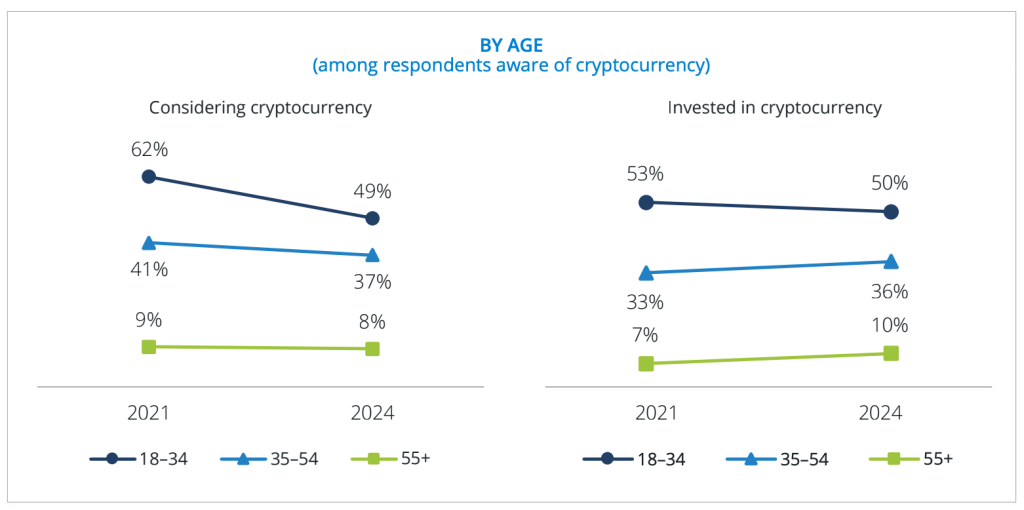
Young investors under 35 saw their participation rate fall from 32% in 2021 to 26% in 2024, erasing gains made during the market surge.

Crypto US Investors FINRA Study - Investment by age
Source: FINRA

Similarly, investment rates declined among people of color and men, reversing increases observed just three years earlier.

The median age of investors who entered the market around 2019-2021 rose from 31 to 38, indicating many younger participants left the market entirely.

Beyond slower entry rates, investors pulled back from various high-risk positions. Cryptocurrency is now viewed as extremely or very risky by 66% of those aware of digital assets, up from 58% in 2021.

The percentage holding penny stocks, REITs, private placements, and structured notes all declined to 2018 levels after brief increases.

Risk Appetite Shrinks Across Demographics

Investors’ willingness to embrace substantial portfolio risk dropped to just 8% in 2024 from 12% in 2021, with the decline most pronounced among younger market participants.

Among investors under 35, those willing to take substantial risks fell from 24% to 15%, creating a notable contradiction; 62% of this age group still believe they need big risks to reach financial goals.

The latest FINRA Foundation research on investors provides rich insights into how market conditions, technology and generational shifts are changing the profile of investing and reshaping investor behaviors and attitudes,” said Jonathan Sokobin, FINRA Foundation Chair and Chief Economist.

Despite reduced risk appetite, younger investors continue to engage in behaviors that carry greater potential losses.

43% of those under 35 trade options, compared to 10% of investors 55 and older, while 22% make margin purchases, versus just 4% of older participants.

Meanwhile, 13% of all investors report buying meme stocks or viral investments, including 29% of those under 35.

The crypto decline appears most dramatic among new investors. Those with less than 2 years’ experience who are considering digital assets dropped from 61% in 2021 to 48% in 2024, while consideration among experienced investors fell less sharply.

Among investors under 35 specifically, cryptocurrency consideration plummeted from 62% to 49%, compared to smaller declines in older age groups.

Social Media Influence Grows Despite Market Caution

The study found social media “Finfluencers” now guide investment decisions for 26% of investors, rising to 61% among those under 35.

YouTube remains the dominant platform for investment information, with 30% overall usage, rising to 61% among younger investors.

Word of mouth from friends and family emerged as the top information source for 85% of investors under 35, surpassing recommendations from financial professionals at 67%.

Concern over investment fraud has risen somewhat, with 37% of investors worried about losing money to scams, up from 31% in 2021.

However, the vast majority, 89%, do not believe they have been targeted in investment fraud.

When presented with a fraudulent offer promising “guaranteed, risk-free 25% annual returns,” half of investors said they would invest, revealing significant gaps in fraud awareness.

FINRA Foundation President Gerri Walsh emphasized the continuing importance of investor education.

They still struggle with gaps in investing knowledge and risk assessment, which can leave them vulnerable to costly missteps,” Walsh said. “Investor education efforts remain critically important.

Notably, the findings oppose broader market trends showing that crypto adoption continues to grow, with separate surveys indicating that over 50 million American adults now own digital assets.

Another also links declining homeownership affordability to increased crypto speculation among younger generations seeking alternative wealth-building strategies.

The post Crypto Interest Fades Among US Investors as Risk Tolerance Declines: FINRA Study appeared first on Cryptonews.
Ethereum Bug Nearly Triggers Network Crisis After Fusaka Upgrade

5 December 2025 at 07:02

Ethereum’s Fusaka upgrade executed flawlessly on December 4, 2025, marking a historic milestone as the network achieved zero downtime while implementing its most significant expansion of data availability since EIP-4844.

However, within hours of activation, a critical bug in the Prysm consensus client threatened network stability, causing validation issues that slowed block finalization before client diversity safeguards prevented a potential crisis.

The incident unfolded as Prysm nodes experienced denial-of-service-like conditions triggered by excessive historical state generation.

Prysm core developer Terence Tsao explained that “historical state generation is compute and memory heavy, and a node can be dos’ed by a large number heavy, and a node can be dos’ed by a large number of state replays happening in parallel.

To shine more light on this, historical state generation is compute and memory heavy, and a node can be dos'ed by a large number of state replays happening in parallel. over the past two hours we’ve seen a spike in stale attestations targeting checkpoint roots from off slots… https://t.co/lnNtD05Tuc

— terence (@terencechain) December 4, 2025

Over two hours, a spike in stale attestations targeting checkpoint roots from off-slots forced affected nodes to reconstruct historical states, pushing systems into compromised operating conditions.

The Ethereum Foundation quickly issued emergency guidance, while ten other consensus clients maintained network operations, preventing any service disruption.

Client Diversity Proves Its Value During Crisis

While Prysm operators scrambled to implement the emergency workaround flag –disable-last-epoch-targets, alternative clients, including Lighthouse, Teku, Nimbus, and Lodestar, continued validating blocks without interruption.

The network maintained consensus throughout the incident, with finalization continuing despite affected validators experiencing participation issues.

Lido Finance reported minimal impact compared to other staking solutions, attributing its resilience to distributed validator operations where Prysm powers approximately 15% of node operators.

Following yesterday’s successful Fusaka hardfork, a Prysm Consensus Layer client bug caused network-wide participation issues.

The Lido protocol continues to operate normally and there is no cause for concern for stakers.

Lido was less affected by this incident than other…

— Lido (@LidoFinance) December 4, 2025

The protocol’s Q3 2025 metrics demonstrate balanced client usage as a deliberate strategy to mitigate single-client failure risks.

Most Lido-operated Prysm setups recovered within hours after applying the recommended configuration changes or temporarily switching to alternative clients.

The incident reinforced long-standing arguments for client diversity as Ethereum’s primary defense against consensus failures.

Developer Kydo captured the significance, noting that the upgrade simultaneously reinforced four critical narratives:

  • Zero-downtime operations
  • Layer-2 scaling capability through PeerDAS activation
  • Client diversity protection
  • Revenue-generating potential.

Ethereum briefly hit $3.2 billion annual run rate during the incident as blob fee mechanisms adjusted to new pricing parameters.

PeerDAS and Blob Scaling Transform Data Availability

Beyond the Prysm incident, Fusaka delivered transformative upgrades to Ethereum’s data layer through the PeerDAS implementation and the Blob Parameter Only (BPO) fork mechanism.

PeerDAS introduced data availability sampling, enabling nodes to store only 1/8 of the blob data while maintaining security guarantees.

This architectural shift enables throughput increases up to 8x current capacity while keeping hardware requirements manageable for independent operators.

Vitalik Buterin emphasized the upgrade’s historical significance, stating, “PeerDAS in Fusaka is significant because it literally is sharding.

He celebrated the achievement as a dream dating back to 2015, noting “Ethereum is coming to consensus on blocks without requiring any single node to see more than a tiny fraction of the data.

PeerDAS in Fusaka is significant because it literally is sharding.

Ethereum is coming to consensus on blocks without requiring any single node to see more than a tiny fraction of the data. And this is robust to 51% attacks – it's client-side probabilistic verification, not… pic.twitter.com/OK81xBteER

— vitalik.eth (@VitalikButerin) December 3, 2025

The implementation represents a breakthrough first proposed in 2017, though Buterin acknowledged remaining challenges, including distributed block building and sharded mempool development.

The BPO mechanism enables Ethereum to increase blob capacity between major upgrades rather than waiting for coordinated hard forks.

Fusaka maintains the current 6-blob target initially, but scheduled adjustments will raise limits to 10/15 on December 9, 2025, and 14/21 on January 7, 2026.

This addresses mounting pressure as layer-2 demand pushed Ethereum’s blob capacity toward saturation throughout 2024.

EIP-7918 ties blob base fees to execution costs, preventing market collapse. Blob fees jumped 1,500x immediately after activation, rising from 1 wei to 1,500 wei.

Daily Average Blob Gas Price after Ethereum Bug Fusaka Upgrade
Source: X/@jarrodwatts

Developer Kydo explained this increase “restores a functioning fee market for blobs, so the protocol can actually use price to steer blob demand instead of being stuck at 1 wei.

The change ensures that layer-2 operators pay meaningful costs for the computational resources their operations impose on network nodes.

Notably, Matt Hougan, CIO at Bitwise, also praised the momentum, noting, “Ethereum delivering two major upgrades in one year is impressive. The giant is awake and doing the right things.

Ethereum delivering two major upgrades in one year is impressive. The giant is awake and doing the right things:

* Shipping fast
* Improving throughput
* Improving UX
* Improving value capture

— Matt Hougan (@Matt_Hougan) December 4, 2025

Among major L2s, according to information shared with Cryptonews, Optimism has announced plans to adopt Fusaka features into the OP Stack in early 2026, with Base, Soneium, and other layer-2 teams contributing to testing throughout development.

The post Ethereum Bug Nearly Triggers Network Crisis After Fusaka Upgrade appeared first on Cryptonews.
EU Wants ESMA to Oversee Crypto Like the SEC Does in US

5 December 2025 at 03:05

The European Commission formally proposed transferring direct supervision of all crypto asset service providers to the European Securities and Markets Authority.

This supervision was previously placed under the Markets in Crypto-Assets framework, with the licensing authority working with national regulators.

The legislative package aims to eliminate regulatory fragmentation across 27 member states by granting ESMA powers comparable to those of the U.S. Securities and Exchange Commission over U.S. markets.

The proposal arrives just nine months after its announcement in the Savings and Investments Union strategy.

The strategy highlighted the political urgency behind capital markets integration as Europe confronts competitive pressures from U.S. financial markets.

EU Wants ESMA to Oversee Crypto - European Commission Building
Source: Wikipedia

Centralized Powers Target Cross-Border Efficiency

ESMA would gain authority to directly authorize crypto firms seeking to operate across the bloc, replacing the passporting system, where companies secure approval in one jurisdiction before expanding throughout the EU.

The regulator would also assume oversight of significant trading venues, central counterparties, and central securities depositories alongside its expanded crypto mandate.

The Commission’s framework introduces “Pan-European Market Operator” status to streamline corporate structures into a single licensing format while enhancing ESMA’s coordination role in asset management.

Officials positioned the changes as essential for responding to emerging risks and addressing inconsistencies from fragmented national approaches.

The package simultaneously addresses barriers to distributed ledger technology by amending the DLT Pilot Regulation to increase proportionality and provide legal certainty for blockchain adoption.

Member states will see directives converted into regulations to reduce national discretions that enable regulatory gold-plating.

Member States Split Over Sovereignty Concerns

France backed the centralization push after Bank of France Governor François Villeroy de Galhau warned that the current passporting model creates regulatory loopholes due to uneven oversight.

This framework would benefit from much stricter regulation of the multi-issuance of the same stablecoin within and outside the European Union, to reduce arbitrage risks in times of stress,” he said in October.

Germany also recently signaled openness to expanded ESMA powers following years of opposition, while ECB President Christine Lagarde endorsed centralized supervision as essential for European competitiveness against the United States.

Just last month, ESMA Chair Verena Ross highlighted the inefficiency of national regulators building 27 separate crypto frameworks when centralized resources could achieve better alignment.

European Commission proposes transferring crypto exchange supervision from national regulators to ESMA in bid to standardize oversight across the bloc.#Europe #ESMA #MiCAhttps://t.co/ND271lQ1n3

— Cryptonews.com (@cryptonews) November 3, 2025

While others seem to be geared toward the idea, Luxembourg Finance Minister Gilles Roth rejected the shift, stating that his country prefers “supervisory convergence rather than creating a costly and ineffective centralized model.

In fact, Malta’s Financial Services Authority warned that centralization would introduce bureaucratic layers that would hinder competitiveness, at a time when the EU is striving to enhance its global position.

Industry groups raised concerns about disrupting MiCA’s rollout before it is fully implemented.

Reopening MiCA at this stage would introduce legal uncertainty, risk delaying the authorization process, and divert attention and resources from the practical task of consistent implementation,said Robert Kopitsch, secretary general of Blockchain for Europe.

Implementation Timeline Faces Political Hurdles

The European Parliament and Council must approve the proposals through negotiations, where maintaining package unity remains crucial for establishing a genuine single market across the investment chain.

Officials expect Parliament to adopt a legislative framework position by May 2026, while member states aim for general agreement by year-end.

ESMA will begin overseeing equity and bond price consolidation, alongside ESG ratings, from 2026 onward, with oversight of cryptocurrency extending the regulator’s authority as Europe pursues tighter market integration.

The Commission emphasized that the reforms address fragmentation that raises costs for cross-border trades, a significant obstacle for startups scaling in Europe rather than the U.S.

The initiative forms part of broader efforts to complete the EU’s capital markets union, after data-sharing rules published on November 26 established strict requirements for how crypto firms must collect, store, and report user information to tax authorities, starting January 2026.

🇪🇺 EU’s new crypto data-sharing rules will force exchanges and service providers to share user data and transaction records.#EU #CryptoPrivacyhttps://t.co/YoIDXmgNvm

— Cryptonews.com (@cryptonews) November 27, 2025

The Transfer of Funds Regulation, which extends the travel rule to crypto, takes effect on December 30 and requires exchanges to identify transaction participants, including self-hosted wallet interactions.

The post EU Wants ESMA to Oversee Crypto Like the SEC Does in US appeared first on Cryptonews.

Before yesterdayMain stream

Bitcoin Price Prediction: BlackRock’s Larry Fink Says Sovereign Wealth Funds Are Quietly Buying Bitcoin — Will Their Bid Push BTC Past $100K?

4 December 2025 at 13:45

Larry Fink, CEO of BlackRock, the world’s largest asset manager, disclosed that several sovereign wealth funds are quietly buying BTC “incrementally,” a development analysts believe could push Bitcoin price prediction back into bullish territory.

“I know they bought more in the 80k level. And they’re establishing a longer position. This is not a trade. You own it for a purpose,” Fink stated during a DealBook event alongside Coinbase CEO Brian Armstrong.

Sovereign Wealth Funds Intensify Bitcoin Accumulation Charge

Fink, whose “thought process has evolved” on crypto, explained Bitcoin’s entire use case to a room full of Wall Street elites.

BREAKING: BlackRock CEO Larry Fink says sovereign wealth funds have been quietly buying Bitcoin, adding “incrementally at $120K, $100K, and even in the $80Ks.”

Nation-state FOMO is already happening. pic.twitter.com/Fi9WskV9Me

— Simply Bitcoin (@SimplyBitcoin) December 4, 2025

He framed Bitcoin as protection against physical insecurity, financial instability, and long-term debasement, noting that leveraged players rather than fundamentals drove the recent crash.

While Fink didn’t reveal specific sovereign wealth funds, recent reports show growing institutional adoption.

Luxembourg recently chose Bitcoin for its Intergenerational Sovereign Wealth Fund of Luxembourg (FSIL) and has already allocated 1% of its assets, approximately €7 million, to Bitcoin.

Speaking at Bitcoin Amsterdam 2025, Luxembourg’s Finance Minister Gilles Roth emphasized that the nation is keen to be among the first to adopt BTC through its sovereign wealth fund.

Meanwhile, Kazakhstan’s central bank is reportedly preparing to invest up to $300 million in crypto assets, though the final allocation could range from $50 million to $250 million, depending on market conditions.

Bitcoin Price Prediction: FVG Analysis Points To $100K Breakout

Bitcoin is moving inside a well-defined ascending channel, and despite the recent pullback from the upper boundary, the structure remains bullish as long as the price holds the mid-range and lower channel support near $90,500–$91,000.

The rejection at the top of the channel aligns with the fair-value gap left over from late November, creating short-term exhaustion.

However, buyers quickly absorbed the sell-off around the FVG region, showing momentum remains in their favor.

Bitcoin Price Prediction - Bitcoin Price Chart
Source: TradingView

The projected bear flag breakdown failed to gain follow-through, which typically flips into a continuation pattern in the opposite direction, strengthening the case for upward expansion.

If Bitcoin retests the lower channel boundary once more, it would likely act as a springboard for the next leg higher.

Given the current market structure, the path of least resistance remains toward the upper channel line around $97K–$99K, with a breakout opening the door to the broader target zone around $100K and above.

Pepenode Presale Gains Traction

Bitcoin’s return to bullish territory signals positive momentum for meme coins like Pepenode(PEPENODE)

This gamified mine-to-earn meme coin presale on Ethereum has raised around $2.26 million since launching months ago.

Pepenode offers virtual mining nodes and facility upgrades within a browser-based mining game and requires no hardware.

Bitcoin Price Prediction - Pepenode Banner

It features a deflationary token model with 70% of mining tokens burned, aiming to provide sustainable value through gameplay and staking rewards.

Early stakers enjoy APYs around 572%, encouraging longer-term holding.

To buy Pepenode at the current price of $0.001178, visit the official presale site, connect an Ethereum-compatible wallet like Best Wallet.

Then choose to pay in ETH, BNB, or USDT in just a few seconds.

You can also make use of a credit/debit card to join the presale.

Visit the Official Pepenode Website Here

The post Bitcoin Price Prediction: BlackRock’s Larry Fink Says Sovereign Wealth Funds Are Quietly Buying Bitcoin — Will Their Bid Push BTC Past $100K? appeared first on Cryptonews.

Bitcoin Price Prediction: Quantum Threats Dismissed by Experts – But What If They’re Wrong?

4 December 2025 at 12:07

Concerns around quantum computing have resurfaced, with some analysts warning it could pose a serious threat to Bitcoin’s future.

While K33 Research believes these fears are overblown, the long-term Bitcoin price prediction could shift dramatically if this view proves wrong.

According to Vetle Lunde, Head of Research at K33, roughly 6.8 million BTC may be at risk if quantum machines advance far enough to break current encryption standards.

Bitcoin Quantum Threats Dismissed by Experts

However, Lunde emphasized that “the timeline for such breakthroughs remains uncertain, and exchanges are unlikely to allow compromised coins to circulate freely.”

Zooming in, rather than out
While long-term risks have instilled sell-side pressure, medium-term factors point toward strength, not weakness, and with BTC currently at deep value, the case for material upside is far more plausible than an 80% drawdown repeat.

Digesting what has…

— Vetle Lunde (@VetleLunde) December 2, 2025

Blockstream CEO and cypherpunk Adam Back, who was cited in the original Bitcoin white paper, shares this measured view.

The longtime cryptographer stated that Bitcoin is unlikely to face meaningful quantum threats for at least two to four decades.

Back noted that current fears circulating on social media about an imminent “quantum attack” are overstated, pointing out that the National Institute of Standards and Technology has already approved post-quantum encryption standards that Bitcoin could adopt well before quantum computers pose realistic risks to SHA-256.

Popular Bitcoin trader The White Whale offered a comprehensive breakdown, noting that “every few weeks the same tired narrative resurfaces.”

He acknowledged that early Bitcoin’s P2PK outputs, including Satoshi-era coins, expose public keys on-chain, making them vulnerable if quantum computers eventually run Shor’s algorithm at scale.

However, the White Whale emphasized that the timeline of the threat is completely false.

“A machine capable of breaking Bitcoin’s signatures doesn’t exist. Not in prototype form. Not in secret. Not in a lab somewhere,” he stated.

Institutions including NIST, NSA, CNSA-2, MIT, and Google’s quantum researchers are unanimous that Bitcoin faces no vulnerability this decade or next.

The earliest plausible window sits around 2045–2055.

Bitcoin Price Prediction: Resistance at $93K Flips Into Support

Despite the quantum FUD, Bitcoin has broken cleanly above $93,000 resistance, converting it into short-term support.

Trading firmly above the monthly open around $90,500, the market structure has shifted bullish after December’s pullback.

The 9-period SMA is curling upward beneath the price, signaling strengthening momentum on the 4-hour timeframe.

Bitcoin Price Prediction: Quantum Threats Dismissed by Experts - Bitcoin Price Chart
Source: TradingView

As long as Bitcoin holds the breakout zone between $92,500 and $93,000, the chart suggests a continuation toward the next major liquidity area around $101,000.

A brief consolidation or retest is likely once that level is reached, but the broader trend now favors a push into the higher resistance cluster between $107,500 and $113,000.

However, a loss of the $93k level would shift focus back to the monthly open around $90k.

Maxi Doge Presale Gains Momentum

Bitcoin’s push back into bullish territory is sparking renewed interest in early-stage meme coins, and Maxi Doge ($MAXI) is quickly becoming one of the most talked-about presales of the cycle.

Positioned as a high-energy, community-driven project, Maxi Doge has already raised over $4.27 million since July.

The team is building more than just a token. They’re creating a space where traders can share early opportunities, trading alpha, and compete in fun contests like Maxi Ripped and Maxi Gains.

Bitcoin Price Prediction - Maxi Doge Banner

Up to 25% of the presale funds will be used for high-conviction market plays, with the profits reinvested into promoting the $MAXI ecosystem.

The token is currently priced at $0.0002715 and offers an attractive staking APY of 72% for early buyers.

To join, visit the official Maxi Doge website and connect a compatible wallet, such as Best Wallet.

You can complete your purchase using existing crypto or a bank card.

Visit the Official Maxi Doge Website Here

The post Bitcoin Price Prediction: Quantum Threats Dismissed by Experts – But What If They’re Wrong? appeared first on Cryptonews.

[LIVE] Bitcoin Price Alert: U.S. Jobless Claims Crash to 191K: Will Strong Labor Data Kill Fed Rate Cuts?

4 December 2025 at 08:52

U.S. initial jobless claims plunged to 191,000 for the week, crushing expectations of 219,000 and marking the lowest reading since September 2022.

Initial jobless claims just fell to the lowest since Sept. 2022. Not screaming distress. pic.twitter.com/guxioKpVLx

— Lisa Abramowicz (@lisaabramowicz1) December 4, 2025

Bitcoin showed little reaction to the surprise data, holding steady around $92,000 as traders digest what the strength means for Fed policy.

The 28,000-person beat signals the labor market isn’t in distress despite recent recession fears that drove crypto’s $1 trillion market cap loss in November, but the robust employment creates a critical dilemma, markets now face conflicting signals as December rate cut odds sit at 86%, yet strong jobless claims data typically reduces urgency for Fed easing at next week’s December 9-10 FOMC meeting.

The question traders are asking: does Fed Chair Powell view this as confirmation that the economy can handle higher rates for longer, or simply proof that October’s rate cut worked without breaking the labor market?

Initial claims at 191K represent a sharp drop from recent weeks and suggest hiring remains resilient despite government shutdown disruptions and slower payroll growth reported in September’s delayed jobs report.

For crypto, stronger economic data reduces recession risk but also dims the rate cut expectations that fueled Bitcoin’s recovery from last Monday’s $88,500 low.

The Fed ended quantitative tightening on December 1 and has signaled a dovish pivot, but hawkish policymakers could use today’s data to argue against December easing.

Bitcoin needs to break and hold above $100,000 to confirm bullish momentum, with resistance at the descending trendline that’s capped rallies since November 11.

The total crypto market cap sits at $3.2 trillion as the market weighs whether strong employment signals a bullish (no recession) or bearish (no rate cuts) outlook.

With the Fed’s blackout period starting imminently before next week’s meeting, today’s jobless claims print is one of the final data points policymakers will consider, and it argues against aggressive easing.

Support holds at $93,000, but if the Fed skips December’s cut, citing labor strength, Bitcoin could retest the $88,000-$90,000 zone that marked November’s capitulation low.

Jobless Claims Shock: Labor Market Shows Unexpected Strength

The post [LIVE] Bitcoin Price Alert: U.S. Jobless Claims Crash to 191K: Will Strong Labor Data Kill Fed Rate Cuts? appeared first on Cryptonews.

Fed Rate Cuts Could Turn 2026 Into Crypto’s First Tailwind Year: Delphi Digital

4 December 2025 at 08:18

The Federal Reserve is poised to deliver another 25-basis-point cut at its December meeting, which would reduce the federal funds rate to approximately 3.50-3.75%, while forward markets price at least three additional cuts through 2026 that could push rates into the low-3% range by year-end.

Delphi Digital noted that with quantitative tightening ending December 1, a Treasury General Account drawdown ahead, and the Reverse Repo Program fully depleted, “this is the first net-positive liquidity backdrop since early 2022—turning policy in 2026 from a headwind to a mild tailwind.

Fed Rate Cuts 2026 - Delphi Digital
Source: X/@Delphi_Digital

The research firm emphasized that 2026 represents “the year policy stops being a headwind and becomes a mild tailwind,” favoring duration, large caps, gold, and digital assets with structural demand, like Bitcoin.

Fed Forced to Cut Despite Inflation Pressures

Markets widely anticipated the December cut, with CME FedWatch pricing 88% probability ahead of the Federal Open Market Committee meeting.

The decision came despite limited economic data; October’s inflation and employment figures weren’t released due to the government shutdown, forcing policymakers to rely on alternative indicators showing mixed signals.

The Kobeissi Letter starkly framed the Fed’s dilemma, noting that “even as inflation hits 3%, the Fed MUST cut rates to ‘save’ US consumers.

The analysis highlighted a K-shaped economy in which “consumers are struggling while large cap tech stocks are soaring,” forcing the Fed to cut rates “into one of the hottest stock markets in history.

The Fed has no option:

Even as inflation hits 3%, the Fed MUST cut rates to "save" US consumers.

Consumers are struggling while large cap tech stocks are soaring.

More rate CUTS are coming into one of the hottest stock markets in history.

Own assets or be left behind. pic.twitter.com/fp9Gg0QqUP

— The Kobeissi Letter (@KobeissiLetter) December 3, 2025

With retail sales rising only 0.3% in September and the S&P 500 up 17.8% year-to-date through December, the wealth gap widens as “Americans need the support as a labor market deteriorates.

Goldman Sachs chief economist Jan Hatzius projects the Fed will pause in January before delivering cuts in March and June, pushing rates to a terminal level of 3-3.25%.

In fact, according to Reuters, Bank of America shifted its December forecast from hold to cut, stating that “by cutting rates next week, we think the Fed would increase the risk of pushing policy into accommodative territory, just as fiscal stimulus kicks in.

The backdrop extends beyond rate cuts. Quantitative tightening’s end removes roughly $60 billion in monthly balance sheet reductions that drained liquidity throughout 2023 and 2024.

Divided Committee Shows Market Volatility

Growing divisions within the Federal Open Market Committee complicate the outlook.

October’s meeting produced unusual dissent, with members voting both for no cut and for a more aggressive 50-basis-point reduction, a rare occurrence in Fed history with only 28 prior instances of opposing dissents.

According to Forbes, Minutes revealed sharp disagreements, stating: “Many participants were in favor of lowering the target range for the federal funds rate at this meeting, some supported such a decision but could have also supported maintaining the level of the target range, and several were against lowering the target range.

Political factors add pressure. Reports emerged that the Trump administration canceled interviews for Fed chair finalists, fueling expectations that Kevin Hassett might replace Jerome Powell next May.

Bank of America cited leadership change as the primary driver of its forecast for two additional 2026 cuts in June and July, noting that its “forecast of additional cuts next year is due to the change in leadership, not our read on the economy.

Keith Buchanan, senior portfolio manager at Globalt Investments, observed that markets are betting “the Federal Reserve will have ammo to lay off the hawkish tone that we saw a couple of weeks ago and perhaps lean more dovish into what looks to be disappointing and weakening labor data.

Asian Currencies Positioned for Easing Benefits

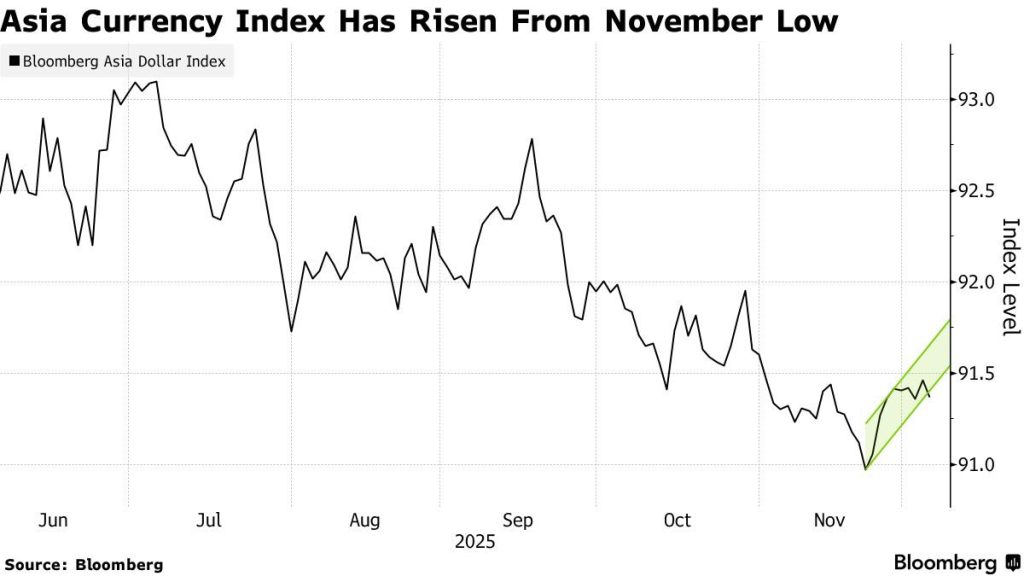
Asian currencies stand to benefit from December’s cut and potential 2026 easing, according to Reuters.

India’s rupee, which breached 90 per dollar for the first time, faces relief from reduced pressure, while Indonesia’s rupiah, South Korea’s won, and the Philippine peso, all down over 4% this quarter, could stabilize as Fed policy turns accommodative.

Fed Rate Cuts 2026 - Asia Currency Index

Source: Bloomberg.

As per Bloomberg, traders now price over 90% probability for the quarter-point December cut based on swaps data.

Wee Khoon Chong, senior Asia Pacific market strategist at BNY, expects that “further Fed easing is likely to be supportive for Asia FX in general.

The post Fed Rate Cuts Could Turn 2026 Into Crypto’s First Tailwind Year: Delphi Digital appeared first on Cryptonews.

Solana Mobile to Launch SKR Native Token in January

4 December 2025 at 06:33

Solana Mobile confirmed it will launch SKR, a governance token for its Seeker smartphone ecosystem, in January 2026, with a total supply of 10 billion tokens distributed across airdrops, partnerships, and community initiatives.

The company positioned the token as a mechanism to decentralize platform ownership and align incentives across device holders, developers, and network validators known as Guardians.

The announcement comes amid a hardware security controversy, as Ledger researchers disclosed an unfixable vulnerability in the MediaTek Dimensity 7300 chip used in Seeker devices that could enable a complete device takeover and private key theft through physical access.

Seek and you will find.

SKR is coming in January 2026 🧵 pic.twitter.com/cwtlp8G8Zf

— Seeker | Solana Mobile (@solanamobile) December 3, 2025

Token Distribution Targets Early Adopters

SKR’s 10 billion token supply allocates 30% to airdrops targeting Seeker and original Saga phone holders, while 25% supports growth initiatives and partnerships with ecosystem participants.

Another 10% funds are used for initial liquidity and launch operations, with an additional 10% reserved for community treasury governance.

Solana Mobile receives 15% of the supply, and Solana Labs holds the remaining 10%.

The token employs linear inflation, starting at 10% in year one and declining by 25% annually until stabilizing at a 2% terminal rate.

Source: X/@solanamobile

Solana Mobile said this structure incentivizes early participants who stake tokens to secure the network and support platform development during critical growth phases.

Guardians, who are validators responsible for device authentication, dApp review, and community standards enforcement, will include Solana Mobile at launch, with committed partners Helius, DoubleZero, Triton, Jito, and Anza joining throughout 2026.

Users can stake SKR to Guardians, back builders, secure devices, and curate the dApp Store, with ecosystem value flowing back to active participants.

Security Flaw Shadows Launch Momentum

Hours before the token announcement, Ledger disclosed a critical hardware vulnerability in the MediaTek Dimensity 7300 chip powering Seeker devices and other smartphones across multiple manufacturers.

Security researchers Charles Christen and Léo Benito successfully executed electromagnetic fault injection attacks during the chip’s boot phase, gaining what they described as “full and absolute control” of compromised handsets.

The attack bypasses memory protections and overwrites security controls embedded in the system-on-chip, enabling the extraction of cryptographic keys and sensitive data.

📱 Ledger found an unfixable flaw in the MediaTek Dimensity 7300 chip that can lead to full device takeover and private key theft.#Ledger #Solanahttps://t.co/F58gTKaxzi

— Cryptonews.com (@cryptonews) December 4, 2025

While individual attack success rates range from 0.1% to 1%, Ledger estimates that repeated attempts can compromise a device within minutes for attackers with physical device access.

Ledger disclosed the flaw to MediaTek in early May after beginning tests in February, prompting the chipmaker to notify affected device vendors.

MediaTek responded that the Dimensity 7300 was designed for consumer smartphones rather than secure financial infrastructure, stating that manufacturers handling sensitive cryptographic material should implement specific physical attack protections.

The company added that the vulnerability falls outside the chip’s original design scope, leaving affected devices permanently exposed since no software patch can resolve hardware-level flaws.

Mixed Sentiment on Token Utility

Social media commentary revealed divided perspectives on SKR’s value proposition and long-term viability.

Critics questioned the token’s fundamental utility, noting the lack of clarity regarding revenue sharing or governance rights beyond platform coordination.

One observer described the launch as “backwards,” arguing that without defined revenue entitlements, SKR functions essentially as a meme coin rather than a legitimate governance infrastructure.

This is so backwards from how you should announce a token.

There’s all this information about how this token will be used to pay for things, but nothing explaining why the token has any actual value (i.e. what revenue am I entitled to as a token holder?)

Hot take: If you don’t… https://t.co/XCoYZ4twMG

— Johnny The Hutt (@johnny_the_hutt) December 4, 2025

Others outlined airdrop farming strategies, recommending daily device usage, wallet swaps, validator staking, dApp interactions, and the deployment of the DePIN application to maximize allocation from the 30% airdrop pool.

Tech creator Ashen noted the 10 billion supply represents unusually “high inflation” compared to standard 1 billion token launches. “Solana REALLY loves inflation lmfaoo,” he said.

However, he expressed cautious optimism given the Solana team’s backing and the substantial 30% airdrop allocation for approximately 100,000 Seeker holders.

Market observers also cited Solana’s broader ecosystem momentum, including recent partnerships like the KRW-pegged stablecoin collaboration with Korean infrastructure firm Wavebridge, and institutional validation evidenced by continued ETF inflows despite recent market volatility.

Solana Foundation President Lily Liu recently emphasized at Binance Blockchain Week that stablecoin market capitalization has surged 50% this year, and positioned the blockchain as infrastructure for global improvements in capital efficiency.

The post Solana Mobile to Launch SKR Native Token in January appeared first on Cryptonews.

Ex-Citadel Engineers Raise $17M for Stablecoin Payments Startup Fin

4 December 2025 at 03:34

Former Citadel employees Ian Krotinsky and Aashiq Dheeraj have secured $17 million in funding for Fin, a stablecoin-powered payments app designed to enable instant cross-border money transfers without the complexity of traditional crypto platforms.

According to a Fortune report, Pantera Capital led the round, with participation from Sequoia and Samsung Next, as the startup prepares to pilot with import-export businesses next month.

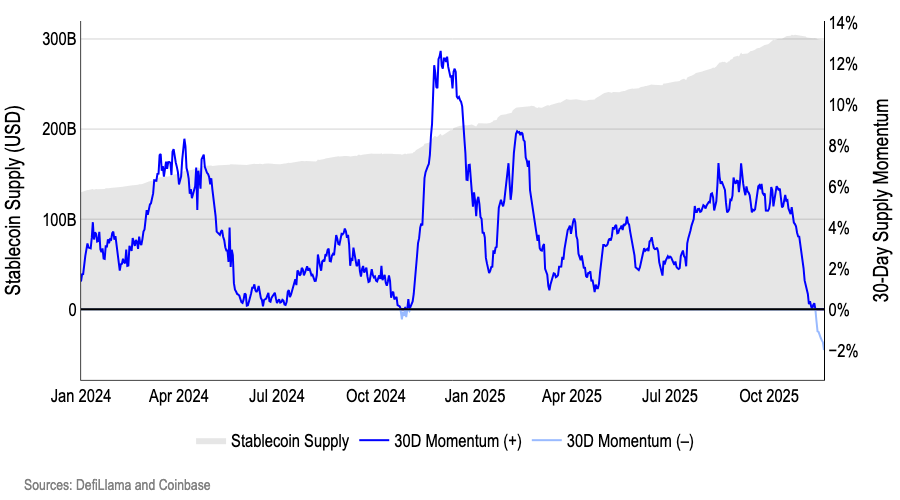
The funding arrives amid explosive growth in the stablecoin sector, which now exceeds $300 billion in total market capitalization.

Stablecoin Total market cap
Source: DefiLlama

Krotinsky and Dheeraj discovered the friction in international payments while building side projects at Citadel, when they attempted to pay $50 to users who reached the front page of a Reddit-like platform they created.

Building Payment Infrastructure for Large Transfers

Fin targets a gap in existing payment systems by focusing on large-value transactions in the hundreds of thousands or millions of dollars.

The app allows users to send money to other Fin users, bank accounts, or crypto wallets, leveraging stablecoin rails to reduce transfer fees compared to traditional banking channels dramatically.

Krotinsky described the platform as “built as the payments app of the future,” emphasizing that it leverages the benefits of stablecoins “without all the complexity” and will work anywhere in the world.

The startup shared an exclusive walkthrough with Fortune, revealing a simple yet elegant design prioritizing user-friendliness over technical jargon.

Traditional wire transfers through commercial banks can take several days and incur substantial fees, particularly for international transactions between countries with different financial systems.

Fin aims to disrupt this model by offering near-instant settlement for scenarios such as Swiss watch dealers selling to US customers or domestic transfers exceeding the limits imposed by Venmo and Zelle, which cannot process payments of $100,000 instantly due to delays or verification holds.

Stablecoin Payments Startup Fin co-founders
Co-founders of Fin, Ian Krotinsky and Aashiq Dheeraj. | Source: Fortune

Revenue Model and Competitive Positioning

The company plans to generate revenue through transaction fees, though these will remain cheaper than alternatives, plus interest earned on stablecoins held in Fin wallets.

While the app has not launched publicly, the pilot program with businesses in the import-export space represents the first step toward broader commercial availability.

Krotinsky positioned his startup against major commercial banks like JPMorgan Chase and Barclays rather than crypto-native competitors.

He argued that large financial institutions have built payment products incorrectly for decades and will struggle to migrate existing systems onto stablecoin rails.

I think we have the opportunity of being the next largest payments app in the world,” Krotinsky said. “People are going to be surprised at how quickly we move to get there.

Stablecoin Sector Attracts Traditional Finance Giants

Fin’s funding follows major institutional moves into stablecoin infrastructure.

Citadel Securities, the market maker founded by Ken Griffin, invested $200 million in crypto exchange Kraken at a $20 billion valuation in November, deepening Wall Street’s commitment to digital assets after years of hesitation over regulatory uncertainty.

The firm also participated in Ripple’s $500 million funding round alongside Fortress Investment Group, which shows traditional finance is showing interest in established crypto platforms as regulatory clarity improves under the Trump administration.

Most recently, ten major European banks formed a consortium to launch a euro-backed stablecoin by mid-2026, addressing concerns about overwhelming reliance on dollar-denominated tokens, which currently account for 99.58% of the global stablecoin market.

🏦 Sony Bank plans to roll out its 1:1 USD-pegged stablecoin for payments and settlement within its gaming and anime business.#SonyBank #SonyStablecoin $USDStablecoinhttps://t.co/8wVvOWo89Z

— Cryptonews.com (@cryptonews) December 1, 2025

Sony Bank is also reportedly preparing to issue a GENIUS-regulated US dollar stablecoin for American customers as early as fiscal 2026, aiming to reduce payment fees across its gaming and anime businesses.

While there is a massive ongoing innovation in stablecoins with big firms positioning themselves for what they see as the next wave of financial revolution, Standard Chartered recently warned that over $1 trillion could flow from emerging-market banks into stablecoins by 2028 as global adoption accelerates.

In fact, Federal regulators are also advancing implementation of the GENIUS Act, with the FDIC expected to publish its first stablecoin rule framework later this month.

Acting FDIC Chair Travis Hill confirmed the agency is drafting rules for how stablecoin issuers will apply for approval, with separate prudential standards planned for early next year.

The post Ex-Citadel Engineers Raise $17M for Stablecoin Payments Startup Fin appeared first on Cryptonews.

21-Year-Old Burned Alive in Austria Over Crypto Assets

4 December 2025 at 03:33

A 21-year-old Ukrainian student was tortured and burned alive in Vienna after attackers forced him to reveal passwords to his crypto wallets, emptying his digital accounts before setting him on fire in his father’s Mercedes.

According to local reports, two suspects, a fellow student aged 19 and a 45-year-old Ukrainian national, fled to their home country with large amounts of cash but were arrested days later by Ukrainian authorities.

The victim, Danylo K., was the son of Kharkiv’s deputy mayor. His body was discovered on November 26 in a burned-out vehicle on Marlen-Haushofer-Weg in Vienna’s Donaustadt district after fire alarms alerted residents to the blaze around 12:30 a.m.

The charred remains were found in the back seat of a Mercedes S 350D bearing Ukrainian license plates beneath the Ostbahn railway line.

21-Year-Old Burned Alive in Austria Over Crypto Assets - the Mercedes Car
Source: oe24

Torture Began in Hotel Garage, Ended in Flames

The attack started hours earlier in the underground parking garage of the Sofitel “SO/Vienna” hotel on Praterstraße, where the 19-year-old suspect ambushed his fellow student following a loud confrontation.

A hotel guest alerted reception after hearing the altercation, prompting police to be notified.

Passersby later noticed a large pool of blood in the stairwell leading to the parking area.

21-Year-Old Burned Alive in Austria Over Crypto Assets - The Parking Garage
Source: Krone

Investigators say Danylo was beaten severely in the garage before being forced into his father’s black Mercedes.

The assailants drove him to the Donaustadt location while subjecting him to extended torture to extract his crypto wallet passwords.

His teeth were knocked out during the assault as the violence escalated over several hours.

After gaining access to two crypto accounts, the attackers doused Danylo with gasoline purchased earlier from a Wagramer Strasse station.

21-Year-Old Burned Alive in Austria Over Crypto Assets - The gasoline station
Source: Krone

He was set ablaze while crouched in the back seat, suffocating on his own blood and dying from head injuries and burns that consumed 80 percent of his body.

Colonel Gerhard Winkler of the State Criminal Police Office confirmed the autopsy findings indicated suffocation or heatstroke as the decisive factors. Forensic teams recovered a melted gasoline canister from the vehicle.

International Manhunt Tracked Suspects to Ukraine

Vienna police identified both suspects through surveillance footage captured at the hotel garage and the gas station where they purchased fuel canisters.

The pair crossed into Ukraine at precisely 9:07 a.m. the morning after the murder, triggering an international manhunt.

Ukrainian authorities arrested the suspects on November 29 after finding them in possession of enormous amounts of U.S. dollar bills.

Investigators believe the crypto was rapidly converted to cash following the robbery.

Austrian officials have transferred the case to Ukrainian jurisdiction, as extradition is not possible under existing agreements between the countries.

Police confirmed that Danylo’s crypto accounts were completely emptied after his murder, though authorities declined to specify the total sum stolen.

His family in Ukraine had reported him missing on November 25 after losing contact with him and discovering his digital wallets had been drained.

The wealthy student, who had been living temporarily in a luxurious apartment in Vienna’s Triiiple Tower on Landstrasse’s Danube Canal, was residing with his partner and their child at the time of his death.

Kharkiv Mayor Igor Terekhov declined to offer a detailed comment but acknowledged the tragedy, saying, “This is a human tragedy,” while noting the loss remained a family matter for his deputy.

21-Year-Old Burned Alive in Austria Over Crypto Assets - Deputy Mayor of Kharkiv
Deputy Mayor of Kharkiv. | UANews

Physical Crypto Crimes on The Rise

The murder marks Austria’s entry into a fast-escalating pattern of violent attacks targeting cryptocurrency holders worldwide.

Security researcher Jameson Lopp has documented over 60 such “wrench attacks” in 2025, representing a 169% surge since February and a 33% increase over all of 2024.

France leads global incidents with 14 confirmed cases, while violent robberies have been reported across Canada, the United States, and the United Kingdom this year.

🚨 A Canadian family endured 13.5 hours of torture in a $1.6M #Bitcoin wrench attack; one attacker sentenced to 7 years;

#CryptoCrime #WrenchAttackhttps://t.co/W3OLBTuACr

— Cryptonews.com (@cryptonews) November 25, 2025

Last week, a British Columbia court detailed a 2024 home invasion where attackers tortured a family and stole $1.6 million in crypto after demanding 200 Bitcoin.

Similar patterns emerged in an Oxford robbery where masked assailants forced victims to transfer £1.1 million in crypto during a car ambush.

Analysts attribute the surge to rising crypto values, which have made holders high-value targets for criminals.

The post 21-Year-Old Burned Alive in Austria Over Crypto Assets appeared first on Cryptonews.

Bitcoin Price Prediction: 2023’s Parabolic Indicator Returns — Will Bulls Push BTC Up 40% Before December Ends?

3 December 2025 at 13:50

A rare technical signal that preceded Bitcoin’s explosive rally in late 2023 has reappeared, with the Bollinger Bandwidth indicator dipping below 100 and flashing a green alert that could reshape Bitcoin price prediction for the remainder of December.

Macro strategist Gert van Lagen observed that every previous trigger of this indicator has been followed by a direct parabolic leg upward, raising expectations of a potential 40% surge before year-end.

Historical Pattern Points to Explosive Rally

Van Lagen noted the current setup mirrors Google’s parabolic run before its final blow-off wave ahead of the 2008 financial crisis, characterized by a cascade of lower highs in the BandWidth that breaks to fuel subsequent volatility.

This setup is identical to GOOGL prior to its final blow off wave, right before the 2008 financial crisis.

A cascade of lower highs on the Bollinger Bandwidth, which gets broken to feed the subsequent bearish HTF volatility. pic.twitter.com/TItL4jkfsI

— Gert van Lagen (@GertvanLagen) December 2, 2025

The “Bollinger Band bounce” strategy assumes an asset’s price will return to the middle band after touching an outer band.

When this indicator drops below 100, it signals extremely compressed volatility that typically precedes major directional moves.

The previous green signal appeared in November 2023, after which Bitcoin doubled within four months.

Traders typically buy when the price hits the lower band and expect a move back upward, while selling when it reaches the upper band, currently around $130,000.

Alice Liu, Head of Research at CoinMarketCap, recently said at the Binance Blockchain Conference that Bitcoin only reached a local top around $126,000 in October, and the cycle peak has not yet arrived.

She added that “We are going to see a market comeback in Q1 of 2026. February and March will be a bull market again, based on a combination of macro indicators.”

Bitcoin Price Prediction: $93k Resistance Breakout Targets $112k Level

Bitcoin remains pressed against major resistance around $92,500-$93,000, a key barrier separating the current recovery from broader bullish continuation.

Price has reclaimed the mid-range of the Bollinger structure and now tests the upper half of the volatility envelope, suggesting momentum is shifting upward after November’s downtrend.

Bitcoin Price Prediction chart
Source: TradingView

The 200-period moving average around $96,000 represents the next ceiling, and a clean break above this would open the door to the larger bullish crossover area projected near $112,000.

RSI is climbing above 60 with a positive slope, indicating renewed buying pressure without reaching an overheated zone, supporting the idea that Bitcoin still has room to extend higher if it converts $93,000 into support.

BTC Hyper Gains Momentum Amid Bull Signals

Bitcoin regaining bullish territory has created positive momentum for Bitcoin-related presale projects like BTC Hyper(HYPER)

The project is a Bitcoin Layer 2 solution built on Solana’s SVM, enabling fast, scalable DeFi, NFTs, and applications using wrapped BTC via a Canonical Bridge.

The presale has been ongoing since May 14, 2025, and has raised over $28.92 million with dynamic price increases from an initial $0.0115 to the current $0.013365.

Bitcoin Price Prediction - Bitcoin Hyper

Early participants can secure discounted tokens with potential significant gains post-launch, plus governance voting in the DAO and access to Bitcoin’s liquidity for DeFi growth.

To join the presale, investors can visit the official presale website and connect to Best Wallet or Ethereum-compatible wallets like MetaMask.

Then select payment options including ETH, USDT, BNB, SOL, or bank cards, and purchase at the current price before the next stage increase.

Visit the Official Bitcoin Hyper Website Here

The post Bitcoin Price Prediction: 2023’s Parabolic Indicator Returns — Will Bulls Push BTC Up 40% Before December Ends? appeared first on Cryptonews.

Former SEC Chair Gensler Warns All Cryptos Are Risky — Except Bitcoin

3 December 2025 at 13:46

Former SEC Chairman Gary Gensler told Bloomberg that cryptocurrencies, excluding Bitcoin, represent highly speculative assets with minimal fundamental backing.

His remarks came as Bitcoin rebounded toward $92,000 following a volatile week marked by bond market turbulence and institutional shifts.

Gensler drew a sharp distinction between Bitcoin and thousands of alternative tokens, arguing investors face heightened risk beyond the flagship cryptocurrency.

Putting aside Bitcoin for a minute, all the thousands of other tokens, not the stablecoins that are backed by U.S. dollars, but all the thousands of their tokens. You have to ask yourself, what’s the fundamentals? What’s underlying it?” he said, noting these assets generate no dividends or tangible returns.

Regulatory View Shifts as Vanguard Opens Crypto Access

Despite Gensler’s caution, institutional adoption accelerated dramatically on Wednesday when Vanguard reversed years of opposition and enabled its 50 million clients to trade Bitcoin, Ethereum, XRP, and Solana ETFs.

The $11 trillion asset manager’s policy shift, driven by new CEO Salim Ramji, previously BlackRock’s Bitcoin ETF architect, triggered immediate market response with $1 billion in IBIT volume within 30 minutes of trading.

Eric Balchunas, a Bloomberg ETF analyst, captured the significance, stating Bitcoin jumped 6% around the U.S. market open on the first day after Vanguard lifted its ban.

THE VANGUARD EFFECT: Bitcoin jumps 6% right around US open on first day after bitcoin ETF ban lifted. Coincidence? I think not. Also $1b in IBIT volume in first 30min of trading. I knew those Vanguardians had a little degen in them, even some of the most conservative investors… pic.twitter.com/OKyihvEqqD

— Eric Balchunas (@EricBalchunas) December 2, 2025

The reversal marks a complete departure from Vanguard’s 2024 stance, which declared that crypto had no place in long-term portfolios. It now offers regulated spot ETFs from BlackRock, Fidelity, Grayscale, VanEck, and Bitwise.

Even conservative allocation scenarios suggest massive potential inflows, with 0.5% of Vanguard’s assets representing $55 billion, exceeding total first-year 2024 ETF cycle flows.

Markets responded positively across digital assets, with Ethereum rising 8.3% to $3,040, XRP gaining 7.6% to $2.18, and total crypto market capitalization climbing 6.5% to $3.22 trillion.

Bitcoin just ripped higher after getting absolutely crushed yesterday because Vanguard finally cracked and opened its platform to crypto ETFs starting today.

That's genuinely massive since they manage trillions and suddenly 50 million retail customers who couldn't touch Bitcoin… https://t.co/r8NISLyx4p

— StockMarket.News (@_Investinq) December 3, 2025

Markets Stabilize Following Bond Selloff and Liquidity Injection

Bitcoin’s V-shaped recovery followed Federal Reserve action that ended quantitative tightening and injected $13.5 billion through overnight funding facilities.

Akshat Siddant, lead quant analyst at Mudrex, noted in an earlier Cryptonews report that Bitcoin exchange reserves fell to multi-year lows of 2.19 million BTC, strengthening buying pressure. The next major resistance sits around $96,000, with support near $87,800.

🌏 Bitcoin climbed toward $92,000 at the Asia open as regional stocks steadied and futures signaled a calmer session after recent global volatility.#AsiaMarketOpen #bitcoin https://t.co/1nSEUv98wM

— Cryptonews.com (@cryptonews) December 3, 2025

The improvement followed Monday’s turmoil, when Japanese rate-hike expectations triggered global bond selloffs and amplified cryptocurrency declines.

Japanese government bond moves remained subdued on Wednesday, though yields stayed pressured as markets priced Bank of Japan tightening later this month.

Notably, Gensler also addressed broader market infrastructure during the interview, downplaying concerns about Thanksgiving’s 10-hour outage at the Chicago Mercantile Exchange, caused by a data center cooling system failure.

I think the management team would make a different decision and probably would switch over to the backup data center more quickly,” he said, had the incident occurred during regular trading hours.

Fed Rate Cut Expectations Drive Risk Asset Sentiment

December historically favors stocks, and prospects of easier U.S. monetary policy supported sentiment following Japan’s shock.

Traders now see over 80% probability of a 25-basis-point Federal Reserve cut at the December meeting, up from 63% a month earlier, according to CME’s FedWatch Tool, despite Fed officials warning against cutting too quickly amid inflation concerns.

Former SEC Chair Gensler Warns All Cryptos Are Risky — Except Bitcoin
Source: CME’s FedWatch Tool

Attention turned to Friday’s release of the Personal Consumption Expenditures Index, the Fed’s preferred inflation gauge, which could cement expectations ahead of next week’s policy decision.

Markets also monitored potential succession plans for Fed Chair Jerome Powell, with White House economic adviser Kevin Hassett emerging as a leading contender when Powell’s term ends next year.

On the technical level, Sykodelic, a macro specialist with over seven years in crypto, challenged bearish sentiment heading into 2026.

So you’re telling me you’re bearish heading into 2026 when Vanguard aped $1bn in 30 mins, Blackrock ETF is highest earner for them, QT has ended and rates continuing to drop, overall macro tailwinds piling up,” he said, arguing new highs in 2026 remain likely despite four-year cycle theories predicting deeper corrections.

Just like Sykodelic, analyst Michael Van De Poppe also projected Bitcoin could test $100,000 and potentially $105,000 during December, though warned that losing $92,000 support could trigger a harsh correction toward $88,000-$90,000.

The post Former SEC Chair Gensler Warns All Cryptos Are Risky — Except Bitcoin appeared first on Cryptonews.

Bitcoin Price Prediction: If Strategy Sells, Everything Changes – Here’s What Could Force Their Hand

3 December 2025 at 13:13

Strategy (formerly MicroStrategy) is facing growing pressure to sell part of its Bitcoin holdings, potentially breaking Chairman Michael Saylor’s “never sell your Bitcoin” mantra, in a development analysts say could become a pivotal signal for Bitcoin price prediction heading into 2026.

Bitcoin’s sharp decline from October’s high near $126,000 to below $84,000 has compressed the value of Strategy’s holdings and pressured its MSTR stock, creating an unprecedented scenario that could force Strategy’s first meaningful Bitcoin sale since 2020.

Two Critical Triggers for Strategy’s Bitcoin Sale

Strategy CEO Phong Le outlined that selling Bitcoin would only occur under extremely specific conditions that must align simultaneously.

The first trigger is if the company’s mNAV falls below 1.0, meaning its market capitalization drops to or below the value of the Bitcoin it holds.

NEW: $MSTR CEO PHONG LE SAYS THEY COULD SELL $BTC TO PAY DIVIDENDS IF NEEDED — BUT ONLY BELOW 1X MNAV LEVEL. pic.twitter.com/umDERcgOSw

— Rishith (@goswamirishith) November 30, 2025

The second condition is that capital access dries up entirely if investors refuse to purchase Strategy’s equity or preferred stock at viable terms.

The prospect of Strategy offloading even a fraction of its Bitcoin holdings has created significant anxiety across the crypto market.

Gnomo Labs Founder Gabo believes the first reaction zone for Bitcoin sits around $86,000-$88,000, but the critical support level lies at $79,000-$82,000, where long-term holders and institutions typically step in.

Pierre Rochard, CEO of The Bitcoin Bond Company, offered a contrasting view.

He told Cryptonews that Strategy would only face true financial jeopardy under a combination of government budget surpluses, declining national debt, and high real interest rates.

He added: “Without those factors in place, there is structural support for Strategy as fiat money printing drives Bitcoin adoption.”

Rochard also downplayed the potential impact, noting: “The Bitcoin market has sustained more mass panics over the past 16 years than any other asset, as it climbed in value from $0 to more than $1 trillion.”

Bitcoin Price Prediction: BTC Targets $100k Breakout

Bitcoin is currently testing the $93,000 resistance zone, a structurally necessary level that coincides with a descending trendline and a supply block.

MACD has flipped bullish with a strong cross above the signal line, suggesting buyers maintain control.

Source: TradingView

A decisive close above $93,000 would open the path toward $98,700, with larger Fibonacci targets at $103,000, $107,000, and eventually $110,000 if momentum accelerates.

However, rejection at this level could trigger a brief retrace toward $90,000 before another breakout attempt.

Investors Turn to Maxi Doge Amid Uncertainty

While the market remains undecided on Bitcoin’s direction due to uncertainties surrounding Strategy’s position and broader macro factors, investors are increasingly exploring alternative opportunities like Maxi Doge ($MAXI)

The Ethereum-based meme coin features a gym-enthusiast Doge mascot and positions itself as a high-energy lifestyle token with staking rewards and trading competitions.

The presale has raised over $4.25 million, with the current token price around $0.000271 and hours remaining before the next price increase.

Holders gain passive income through staking yields, with higher yields being offered on a first-come first first-served basis.

To join the presale, visit the official Maxi Doge Website and connect any compatible wallet, such as Best Wallet.

You can swap existing crypto or use a bank card to complete the transaction in seconds.

Visit the Official Maxi Doge Website Here

The post Bitcoin Price Prediction: If Strategy Sells, Everything Changes – Here’s What Could Force Their Hand appeared first on Cryptonews.

Coinbase Warns Bitcoin Under Pressure, Citing ETF Outflows and Whales Exit

3 December 2025 at 10:07

Coinbase Institutional has issued a stark warning to investors as Bitcoin breaks through critical support levels, citing multiple bearish indicators, including massive ETF outflows, whale distribution, and compressed valuations of digital asset treasuries.

The assessment comes as BTC trades decisively below its 200-day moving average following a 32% drawdown from recent highs above $126,000, with the crypto now testing support near $93,000.

Bitcoin chart Under Pressure
Source: TradingView

The exchange’s latest market analysis reveals a confluence of negative factors weighing on Bitcoin’s price action.

In this environment, we think higher probability setups favor breakout trades over knife-catching,” Coinbase stated in a recent post, advising caution even as quantitative tightening ends and the Federal Reserve re-enters bond markets.

Buy the dip?

With quantitative tightening ending, the Fed is back in the bond market and the drain of cash from markets may be behind us. That’s usually good for risk-on assets like crypto.

So why did BTC dump?

• BTC broke major bull market support bands
• Options traders… pic.twitter.com/1C8mxtemun

— Coinbase Institutional 🛡 (@CoinbaseInsto) December 2, 2025

Critical Support Levels Shattered Across Multiple Metrics

Bitcoin has systematically broken through every major technical and on-chain support band that has historically anchored bull-market rallies.

According to Coinbase November report, the crypto now trades below its short-term holder cost basis and the 75% profit threshold that provided support in previous cycles, leaving no obvious floor for prices.

The $98,000-$100,000 battleground, which previously represented a thick band of holders anchored to that level, collapsed as the price sliced through with minimal rebound attempts.

Bitcoin technical and onchain bull market support bands
Source: Coinbase

Recent buyers are underwater, with realized losses spiking to levels last seen during the November 2022 FTX collapse.

This creates elevated capitulation risk as short-term holders rush to cut losses rather than hold through the downturn.

The swift drop through the $90,000-$85,000 range showed the lack of organic demand to mitigate declines, with cost-basis distribution thinning out below current levels.

Options markets have also shifted from cautious to outright defensive, with the Bull-Bear Index turning firmly negative across short and mid-term tenors.

Traders are paying premiums for downside protection rather than upside exposure, while long-dated options hover near neutral, suggesting structural uncertainty rather than deep pessimism.

Long term holder (LTH) and exchange net position change vs price
Source: Coinbase

Meanwhile, long-term holder net position changes have turned decidedly negative on a 30-day basis, with market intelligence firm Arkham identifying at least one early Bitcoin whale who fully exited an 11,000 BTC position worth approximately $1.3 billion between late October and November.

ETF and Treasury Demand Evaporates

Spot ETF flows, previously a dominant incremental buyer, have reversed course dramatically.

November 2025 posted record cumulative net outflows as the trailing seven-day sum turned markedly negative after the price broke key levels.

Trailing-7-day net BTC spot ETF flows
Source: Coinbase

When allocators redeem ETF shares, issuers must sell spot Bitcoin or reduce hedges, amplifying broader risk-off episodes.

US spot Bitcoin ETFs now manage $168 billion in assets, holding approximately 1.36 million BTC, representing 6.9% of the circulating supply.

Digital asset treasury demand has similarly cooled, with companies’ market value over net asset value compressing below parity for the first time since 2024.

Multiple treasury vehicles now trade at discounts to their Bitcoin holdings, creating latent risk as shareholders may pressure management to slow purchases, hedge exposure, or monetize holdings.

This pressure manifests as companies, including Strategy, establish cash reserves, with Strategy announcing a $1.44 billion reserve covering 21 months of obligations while updating fiscal guidance to project operating results ranging from a $7 billion loss to a $9.5 billion gain, depending on year-end Bitcoin prices.

📊 Strategy Inc builds a $1.44B USD Reserve and revises its 2025 guidance as BTC swings sharply #Crypto #Bitcoinhttps://t.co/R2UdFmpMX5

— Cryptonews.com (@cryptonews) December 1, 2025

The shift comes ahead of MSCI’s January 15, 2026, decision on whether to exclude companies holding more than half their assets in crypto from global indices.

JPMorgan estimates this could trigger forced institutional selling between $2.8 billion and $8.8 billion.

Stablecoin Liquidity Contracts

Crypto-native dollar liquidity is rolling over as aggregate stablecoin supply contracts following steady growth through October.

The 30-day momentum has posted its weakest reading since 2023, with shrinking supply reflecting deleveraging and capital leaving on-chain rails for fiat or safer assets.

While stablecoins reached a record of over $300 billion in circulation, the recent contraction signals reduced “dry powder” available to chase rallies despite stablecoins processing $225.6 billion in daily transfer volume.

Stablecoin supply growth momentum
Source: Coinbase

Despite these headwinds, Grayscale Research has recently challenged widespread pessimism, arguing that Bitcoin’s current market structure fundamentally differs from previous cycles.

The asset manager contends that dominance by exchange-traded products and corporate treasuries rather than retail exchanges means Bitcoin won’t follow historical patterns of deep, prolonged declines.

Elevated put skew suggests hedging of downside risk
Source: Grayscale

Technical indicators, including elevated put option skew and on-chain trader capitulation, suggest bottom formation may be underway, with accumulation patterns continuing among large holders.

The post Coinbase Warns Bitcoin Under Pressure, Citing ETF Outflows and Whales Exit appeared first on Cryptonews.

❌
❌