ENA has gone down by over 22% in the past week and has recently retested its all-time low. One trader favors a bearish Ethena price prediction as the token has dropped below a key weekly support.
Since August 2024, data from DeFi Llama shows that the protocol’s earnings have been steadily declining, moving from $4 million back then to just $50,000 in November as mint fees have declined sharply.
Ethena’s USDe circulating supply has suffered a strong setback, declining from a peak of $15 billion in mid-October to just $6.7 billion at the time of writing.
It seems that, during times of market turmoil, investors prefer to rely on well-established names in the stablecoin space like Tether’s USDT and Circle’s USDC. Hence, this protocol could be suffering the consequences of a flight-to-safety move.
Crypto analyst ChiefraT shared an interesting chart that shows a bearish breakout below Ethena’s long-standing weekly support.
$ENA is testing All Time Lows on the weekly chart.
This worsens the token’s situation, as the market could be ready to dump the token to discover how low the price needs to go for buyers to show up.
Ethena Price Prediction: ENA Faces 50% Correction After Losing Key Support
Trading volumes for ENA have increased by 33% in the past 24 hours and currently account for 20% of the token’s circulating market cap as the price struggles to stay above the $0.20 level.
The $0.18 area is the key support to watch for ENA as the token will hit the lower bound of its descending price channel if it touches that threshold.
The Relative Strength Index (RSI) remains heavily depressed at 32, indicating that negative momentum has accelerated.
Meanwhile, if the selling spree continues and ENA is pushed down to break below this trend line support, nothing would prevent a much stronger correction to $0.10. This means a total downside risk of 50% for the token in the near term.
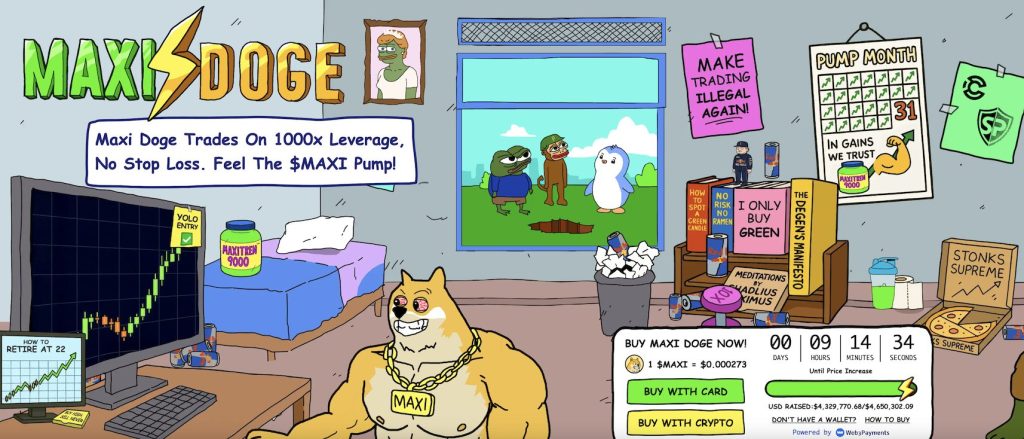
Although ENA’s outlook is quite bearish, top crypto presales like Maxi Doge ($MAXI) continue to capture investors’ attention as this type of project can deliver the highest upside potential once cryptos start to recover.
Maxi Doge ($MAXI) Brings Meme Energy to the Trading World
Maxi Doge ($MAXI) rallies traders together under a well-known flag – the viral Doge meme. This Ethereum meme coin embodies the spirit of bull markets and the energy that retail traders bring to the table with its “up only” motto.
The project fosters community engagement via fun competitions like Maxi Ripped and Maxi Gains, designed to reward top traders with the highest ROI.
In addition, $MAXI holders get exclusive access to a hub where they can share ideas, insights, and trading setups with other like-minded ‘degens’ to tap into the community’s “collective hive mind” to make the most out of this market.
ETH has climbed by nearly 4% in the past 24 hours as the crypto market bounced strongly following a positive inflation report in the United States. Does this favor a bullish Ethereum price prediction that sees the token breaking past $3,200 before Christmas?
Trading volumes increased by 42% during this period, currently accounting for 10% of the token’s circulating market cap, meaning that the buying pressure has increased significantly.
Crypto trader Ted Pillows, whose X account is followed by more than 250,000 users on X, sees the price of ETH rising past $3,200 as long as the $2,700 – $2,800 support holds.
$ETH tapped the $2,700-$2,800 support zone and is now bouncing back.
As long as Ethereum holds this level, a rally towards $3,100-$3,200 could happen.
The market’s mood continues to be sour as the Fear and Greed Index currently sits at 21. This indicates that investors are fearful as volatility has spiked in the past few weeks.
Nonetheless, long-term short-term readings seem to show that the sell-off has already gone too far, possibly favoring a bullish Ethereum price prediction for the next few weeks.
Ethereum Price Prediction: ETH Hits Key Trend Line Support – Can It Break It?
The 4-hour price chart for Ethereum shows that the token recently bounced strongly off the $2,800 level and rapidly climbed to retest the upper bound of a descending price channel that has been forming for weeks.
In this lower time frame, the Relative Strength Index (RSI) has hit oversold territory already. The last two times this happened, the price rallied strongly and surpassed the $3,000 level shortly afterward.
If this pattern repeats, we could see ETH breaking past the $3,000 level in the next couple of days. The first stop could be around $3,050 for a confirmed trend reversal, followed by a strong push to $3,400. This implies a 15% upside potential based on where ETH is trading today.
As cryptocurrencies seem ready to make a comeback, the most promising crypto presales like Pepenode ($PEPENODE) could outperform well-established tokens. This mine-to-earn (M2E) project makes crypto mining hassle-free, fun, and highly rewarding.
Pepenode ($PEPENODE) Raises Over $2 Million to Launch Its M2E Game
Mining cryptocurrencies has never been easier, now that Pepenode ($PEPENODE) is getting ready to launch its fun M2E.
Players can easily set up a virtual server and fire up as many mining rigs as they want by simply buying $PEPENODE tokens. They can also upgrade their existing setups to ramp up their output and compete for attractive rewards.
Top miners will receive handsome airdrops of the best meme coins in the market, like Bonk ($BONK) and Pepe ($PEPE), while up to 70% of the tokens invested in upgrading rigs will be burned forever.
As the game’s popularity increases, so will the demand for $PEPENODE. This positions early buyers to reap the highest returns once the token jumps to the spotlight.
Bitcoin remains under pressure as global markets digest a further shift away from ultra-loose monetary policy in Japan. At its December meeting, the Bank of Japan raised its short-term policy rate to around 0.75% from 0.5%, citing growing confidence that inflation will remain near its 2% target, according to official statements.
The decision reflects stronger wage growth and persistent price pressures. Japan’s headline inflation stays around 2.9% in November, whereas, core inflation held above target for a 44th straight month, based on reported government data. Policymakers emphasised that real rates remain deeply negative, signaling any further tightening will be gradual and data-dependent.
Markets Absorb the Move With Little Shock
In response to the news, Japanese government bond yields surged higher, with long-dated yields hovering near recent highs. Whereas, the Japanese yen weakened modestly, suggesting the interest rate hike was largely priced in. Broader risk assets remained cautious rather than reactive.
Crypto markets, however, stayed under pressure. Bitcoin has slipped around 7% in the last seven days, while Ethereum has fallen by more than 10%, according to market data, reflecting weak risk appetite rather than Japan-specific flows.
Why Japan Still Matters for Bitcoin
For Bitcoin, the relevance lies less in the immediate response and more in the global liquidity backdrop. Japan has long functioned as a key funding market, and higher yields could gradually tighten global financial conditions. Investors are now watching whether continued BoJ normalization feeds into risk assets over time.
Against this backdrop, Bitcoin’s ability to reclaim higher levels will depend on technical confirmation, as traders balance tightening signals against longer-term adoption and structural demand trends.
Bitcoin Technical Analysis: Signs of a Developing Base
Recent candles show selling pressure fading. Long lower wicks followed by small bodies suggest dip buying rather than forced liquidation. Momentum supports that view, with RSI recovering toward 52 after leaving oversold territory, pointing to stabilization rather than continuation lower.
Price action now resembles base formation, not a reversal. On TradingView’s path projection, the preferred scenario is a slow push back toward the channel midline if Bitcoin reclaims the $88,200–$89,200 pivot zone.
Bitcoin Price Chart – Source: Tradingview
Key Levels That Define the Next Move
A sustained move above the pivot would open upside toward $92,000, then $94,200, the prior range high. Failure to hold $84,500 shifts focus to $80,600, where the ascending channel base sits.
From a trading perspective, structure favors patience. Acceptance above $89,200 offers upside setups toward the low-$90,000s, while risk remains defined below recent lows. For now, the correction looks like consolidation, not breakdown.
PEPENODE: A Mine-to-Earn Meme Coin Nearing Presale Close
PEPENODE is gaining momentum as a next-generation meme coin that blends viral culture with interactive gameplay. With over $2.36 mn raised and the presale approaching its cap, interest is building fast as the countdown enters its final stretch.
What makes PEPENODE stand out is its mine-to-earn virtual ecosystem. Instead of passive holding, users can build digital server rooms using Miner Nodes and facilities, earning simulated rewards through a visual dashboard. The concept brings gamification and competition into the meme coin space, giving holders something to do before launch.
The project also offers presale staking, allowing early participants to earn boosted rewards ahead of the token generation event. Leaderboards and bonus incentives are planned post-launch to keep engagement high.
With 1 $PEPENODE priced at $0.0012016 and limited allocation remaining, the presale is entering its final opportunity window for early buyers.
The crypto market is up today, with the cryptocurrency market capitalisation increasing by 1.6% to $3.05 trillion. Also, 90 of the top 100 coins have gone up over the past 24 hours. At the same time, the total crypto trading volume is at $164 billion.
TLDR:
Crypto market cap is up on Friday morning (UTC);
90 of the top 100 coins and all the top 10 coins went up today;
BTC increased by 1.4% to $87,906, and ETH is up 4.1% to $2,953;
BTC is still trading within a broader downtrend;
BTC’s price action reflects rising uncertainty and the seller-dominated market;
Sellers remain firmly in control;
Bitcoin struggles to find sustained buying conviction;
US consumer prices rose less than expected in November;
Markets treated the CPI report ‘as an aberration rather than confirmation of any sustained cooling trend’;
US BTC and ETH spot ETFs saw outflows of $161.32 million and $96.62 million, respectively;
BitMine has bought at least $229.31 million worth of ETH this week alone;
Crypto market sentiment has now approached the extreme fear zone.
Crypto Winners & Losers
At the time of writing, all top 10 coins per market capitalization have seen their prices increase over the past 24 hours.
Bitcoin (BTC) is up by 1.4% since this time yesterday, currently trading at $87,906.
Bitcoin (BTC)
24h7d30d1yAll time
Ethereum (ETH) is up by 4.1%, now changing hands at $2,953. This is the highest increase in this category.
Among the red coins, MemeCore (M) posted the highest fall in the category. It’s down 8.2%, now trading at $1.54.
Mantle (MNT) is next, having decreased by 3.7% to the price of $1.17.
Meanwhile, in the US, a delayed report from the Bureau of Labor Statistics was cooler than expected. More precisely, consumer prices increased less than expected in November. This encourages hope among investors that inflationary pressures may cool to the degree that would result in the higher-than-expected easing of US monetary policy.
Also, Binance is reportedly considering a return to the US market, with potential structural changes to its American operations. A possible recapitalization of Binance.US could reduce Changpeng Zhao’s controlling stake.
Gabe Selby, Head of Research at Kraken company CF Benchmark, commented that Bitcoin’s erratic price action reflects the seller-dominated crypto market, as well as elevated uncertainty around the broader macro trajectory.
Yesterday’s US CPI release initially appeared supportive for risk assets. However, “the underlying reality is more complex.” Notably, “the data was compiled under highly atypical conditions,” most notably the government shutdown.
Therefore, the report captured November’s latter portion only, which was heavily distorted by Black Friday product discounting.
Per Selby, “this created temporary disinflationary noise that limits the report’s reliability as a true inflation gauge. Markets seem to recognize this, treating the print as an aberration rather than confirmation of any sustained cooling trend.”
“What’s particularly telling is that Bitcoin’s price action mirrored this skepticism in real time. The asset rallied immediately after the release but quickly lost steam as traders reassessed the data quality.”
Bitcoin pushed toward Wednesday’s highs but failed to break through, fully retracing its gains. That rejection is significant, says Selby. It shows that “sellers remain firmly in control and reinforces the view that Bitcoin is still trading within a broader downtrend, despite the brief optimism sparked by the headline CPI number.”
The key takeaway, Selby concludes is that, “until we get several months of clean, uninterrupted inflation data, the [US Federal Reserve’s] path remains murky. And in that environment of uncertainty, Bitcoin—despite its recent institutional adoption narrative—continues to behave like the risk asset it is, struggling to find sustained buying conviction.”
Levels & Events to Watch Next
At the time of writing on Friday morning, BTC stood at $87,906. After a sideways trading period early in the day, BTC jumped to the intraday high of $89,219, before plummeting to $84,581 and then recovering to the current level.
Moreover, BTC is down 5% in a week, 3.4% in a month, 13.2% in a year, and 30% from the October all-time high of $126,080.
Investors are now looking to see if the price will move above $90,000 and then hold that level. This would open doors for another leg up towards $100,000. Conversely, a fall may lead the coin to the $74,000 zone.
Bitcoin Price Chart. Source: TradingView
Ethereum is currently changing hands at $2,953. The highest point it reached over the past 24 hours (by the time of writing) is $2,989, before plunging to the low of $2,781. It has recovered to the current price since.
Over the past week, ETH fell 9.2%, as well as 2.9% in a month and 19.8% in a year. It has also decreased by 40% from its August ATH of $4,946.
Should the price reclaim the $3,000, it could proceed to $3,130 and $3,250. However, a decrease would pull the price back to the $2,900 zone and possibly into the $2,700 territory.
Ethereum (ETH)
24h7d30d1yAll time
Moreover, the crypto market sentiment has decreased yet again within the fear territory.
The crypto fear and greed index stands at 21 today, compared to 22 yesterday. It is now back on the verge of the extreme fear zone.
Market participants remain highly cautious of the incoming development, as well as uncertain over the market trajectory. They’re waiting for further signals to decide on their next moves.
ETFs Go Red
After a single day of inflows, the US BTC spot exchange-traded funds (ETFs) posted negative flows of $161.32 million on Thursday. The total net inflow rose slightly to $57.57 billion.
Of the twelve BTC ETFs, three saw outflows and one saw inflows. BlackRock posted $32.76 million in inflows.
On the other hand, Fidelity leads the red list with $170.28 million in negative flows. It’s followed by Ark&21Shares’ $12.27 million and Bitwise’s $11.54 million.
Moreover, the US ETH ETFs continues with outflows, posting a sixth day of negative flows, with $96.62 million in outflows on 18 December. The total net inflow pulled back to $12.52 billion.
Two of the nine funds recorded inflows, but one saw higher outflows. Grayscale took in $5.63 in total on this day.
However, BlackRock recorded $102.24 million in outflows.
According to CoinGecko ETH treasury data, the company has purchased 407,331 ETH in the last 30 days. BitMine says it owns over 3.2% of the ETH token supply.
TOM LEE IS STILL BUYING: $229M THIS WEEK
Two fresh wallets just withdrew $88.73M of $ETH from FalconX. This acquisition matches prior Bitmine purchase patterns.
The crypto market saw an increase over the past 24 hours, while the US stock market closed higher on Thursday. By the closing time on 18 December, the S&P 500 was up by 0.79%, the Nasdaq-100 increased by 1.51%, and the Dow Jones Industrial Average rose by 0.14%. The increases follow the release of delayed Consumer Price Index data, which ended up being better than expected.
Is this rally sustainable?
The rise may continue in the short term, but the analysts expect another decrease at any given moment currently. That said, many argue that we’re still in for a significant rally as the new year begins, possibly in Q1.
The U.S. Senate has confirmed crypto-friendly lawyer Mike Selig as the next chair of the Commodity Futures Trading Commission (CFTC), ending a prolonged period of leadership uncertainty at one of the country’s most important financial regulators.
The confirmation passed Thursday as part of a mass approval of federal nominees, with senators voting 53–43 under the provisions of Senate Resolution 532.
Confirmed, 53-43: Confirmation of the en bloc nominations provided for under the provisions of S.Res.532.
Selig’s confirmation comes as President Donald Trump’s second administration moves to fill some of the most consequential regulatory vacancies affecting the digital asset sector.
Alongside Selig, the Senate also elevated Travis Hill to chair the Federal Deposit Insurance Corporation (FDIC), placing permanent leadership at two agencies that play central roles in how crypto markets operate and how crypto companies interact with the banking system.
Power Without a Mandate: The CFTC’s Quiet Struggle Over Crypto Oversight
At the CFTC, the absence of a Senate-confirmed chair had become a growing operational problem. The agency, which is structured as a five-member independent commission, has been operating for months with just a single commissioner.
Acting Chair Caroline Pham remained the only seated member after a wave of resignations earlier in the year, a situation that concentrated authority while also limiting deliberation and long-term planning.
The chair of the U.S. Commodity Futures Trading Commission (CFTC), Rostin Behnam, has announced his resignation, effective January 20, according to a Financial Times report.#CFTC#CryptoRegulationshttps://t.co/1AY9hfcCKv
Although an acting chair can legally carry out agency functions, the lack of a permanent leader and full commission constrained the CFTC’s ability to build staff, coordinate with other regulators, and advance major new rulemakings.
That leadership gap mattered most for crypto policy. While Congress continues to debate legislation that would expand the agency’s mandate, the absence of a confirmed chair made it harder for the CFTC to set a clear regulatory direction or prepare for an expanded role.
Senate introduces new Crypto Market Structure Bill draft to expand @CFTC authority over digital commodities like $BTC and $ETH.
During this interim phase, Pham focused on internal reforms rather than sweeping regulatory changes.
Her tenure emphasized clearing compliance backlogs, streamlining enforcement processes, and launching limited pilot initiatives tied to digital assets.
Pham led a “back-to-basics” approach, resolving internal backlogs and launching early digital asset initiatives, but the lack of a permanent, Senate-confirmed chair made it harder to advance complex rulemakings or coordinate closely with other regulators such as the Securities and Exchange Commission.
Selig’s Term Begins as CFTC Prepares for a Larger Role in Crypto Markets
Selig now takes on the role with a full and permanent mandate. He is a former CFTC official and most recently served as chief counsel to the SEC’s Crypto Task Force. He was nominated in October, replacing the administration’s earlier choice for the position.
His term as chair will run through April 2029. During his confirmation process, Selig said crypto would be a priority and also pointed to ongoing challenges at the agency, including limited staffing, tight resources, and governance concerns.
The CFTC currently employs about 543 full-time staff, far fewer than the SEC’s roughly 4,200 employees, even as lawmakers in both chambers consider bills that would give the CFTC primary oversight of crypto spot markets.
While operating with a single commissioner may allow faster internal decision-making, it also raises questions about legal durability and bipartisan balance.
Several senators have already stated that confirming additional commissioners will be a key issue in 2026.
Bitcoin’s latest market cycle has entered a new phase, with onchain and derivatives data pointing to demand exhaustion and a transition into bear market territory, according to CryptoQuant’s latest Crypto Weekly Report.
After multiple demand-driven rallies since 2023, the firm says the structural pillars that supported higher prices are now weakening.
Bitcoin’s demand boom is fading.
This cycle ran on three spot demand waves, and the latest one looks like it’s rolling over.
Since early October, demand is below trend, which can stay bearish for price. pic.twitter.com/7IWnRscD8H
The current cycle featured three major spot demand waves: the launch of U.S. spot Bitcoin ETFs, optimism surrounding the U.S. presidential election outcome, and a surge of interest from Bitcoin Treasury Companies.
With these catalysts largely priced in, incremental demand has diminished, removing a key source of price support that previously sustained upward momentum.
The firm notes that when demand growth rolls over in this manner, it has historically marked the end of bullish phases, regardless of broader narratives around supply shocks or halving events.
Institutional and Large-Holder Demand Reverses
Institutional behavior is now reinforcing the bearish signal. U.S. spot Bitcoin ETFs have shifted from accumulation to distribution in the fourth quarter of 2025, with net holdings declining by approximately 24,000 BTC. This stands in stark contrast to Q4 2024, when ETFs were strong net buyers and a central driver of market strength.
At the same time, onchain data shows that addresses holding between 100 and 1,000 BTC—often associated with ETFs, funds, and corporate treasuries—are growing below historical trend.
CryptoQuant compares this pattern to late 2021, when similar demand deterioration preceded the 2022 bear market.
Derivatives Markets Signal Weakening Risk Appetite
Derivatives data adds further confirmation. Funding rates in perpetual futures, measured using a 365-day moving average, have declined to their lowest level since December 2023. Falling funding rates typically indicate reduced willingness among traders to maintain leveraged long positions.
Historically, such conditions have been more consistent with bear market regimes than bull phases, reflecting declining risk appetite and lower conviction among market participants.
Price Structure and Downside Scenarios
From a technical perspective, Bitcoin has broken below its 365-day moving average, a key long-term indicator that has historically separated bull and bear market conditions.
CryptoQuant stresses that Bitcoin’s four-year cycle is driven primarily by demand expansions and contractions rather than the halving itself.
Despite the bearish shift, downside projections suggest a relatively shallow cycle. Past bear market bottoms have aligned with Bitcoin’s realized price, currently near $56,000.
This would imply a drawdown of roughly 55% from the recent all-time high—potentially the smallest bear market decline on record. Interim support is expected around the $70,000 level, offering a key zone to watch as the cycle continues to reset.
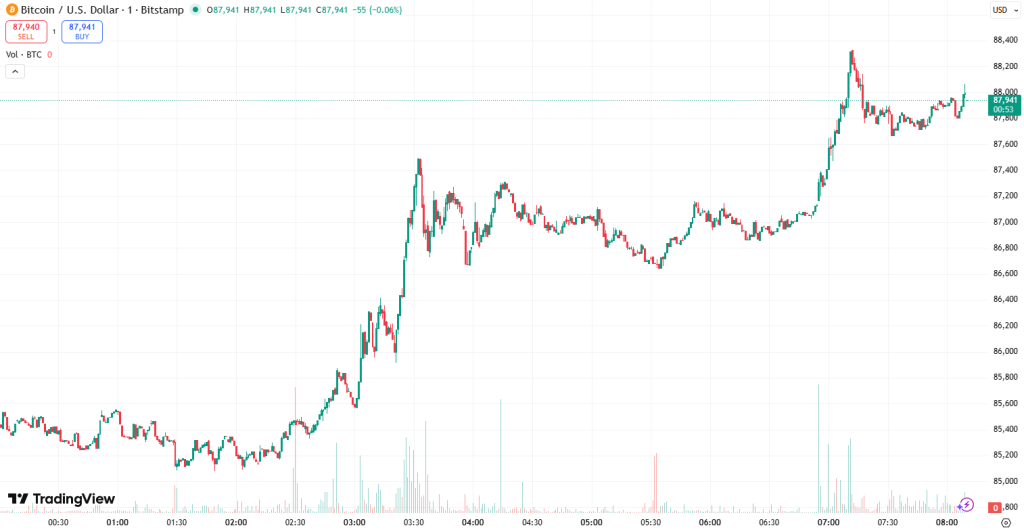
The Bank of Japan raised interest rates to 0.75% on December 19, marking the highest borrowing costs in three decades and triggering immediate speculation about implications for global crypto markets.
Bitcoin climbed 2.5% to approach $88,000 following the decision, which came as policymakers balanced inflation concerns against mounting fiscal pressures from Prime Minister Sanae Takaichi’s $117 billion stimulus package.
Source: TradingView
The central bank voted unanimously to lift short-term rates from 0.5%, stating that “real interest rates are expected to remain significantly negative,” and that “accommodative financial conditions will continue to firmly support economic activity.“
Governor Kazuo Ueda emphasized the bank would “continue to raise the policy interest rate and adjust the degree of monetary accommodation” if the economic outlook materializes as projected.
The decision arrives as Takaichi’s government pushes through expansive fiscal policies funded largely by issuing more bonds.
More than half of the stimulus spending will come from additional debt issuance, raising concerns about Japan’s already massive public debt, more than twice the size of its economy.
Speaking to The New York Times, George Goncalves, head strategist at MUFG, noted the “volatile mix of growing debt, higher interest rates, aggressive fiscal spending and tariffs make the path forward for Japan’s economy difficult to predict.”
Market reactions were mixed, with the yen initially strengthening before giving up those gains as investors digested the statement’s implications.
Christopher Wong, currency strategist at OCBC, speaking with Reuters, added that “the yen initially strengthened but quickly surrendered those gains, in part reflecting thin market liquidity that amplified short-term price action rather than a reassessment of fundamentals.“
Divergent Policy Paths Signal Volatility Ahead
The rate hike comes amid broader regulatory shifts in Japan’s crypto landscape.
The move follows major breaches, including Bybit’s February 2025 hack, which resulted in roughly $1.46 billion in losses.
Japan is also simultaneously preparing its most sweeping overhaul of crypto oversight in almost a decade, planning to move digital assets under the Financial Instruments and Exchange Act.
The transition would impose stricter disclosure requirements and explicit insider-trading rules covering token listings, major system breaches, and large-scale issuer sales.
Arthur Hayes, former BitMEX CEO, reacted bullishly to the decision on social media. “Don’t fight the BOJ: -ve real rates is the explicit policy,” Hayes wrote. “$JPY to 200, and $BTC to a milly.“
Speaking with Cryptonews, Ignacio Aguirre, CMO at Bitget, offered measured optimism despite near-term uncertainty.
“However, the BOJ’s tightening stands in contrast to widely expected Fed rate cuts in early 2026, setting up a period of heightened volatility that often creates attractive accumulation windows for long-term investors,” Aguirre said.
He projected Bitcoin could retest the $95,000–$100,000 range by early 2026.
Market Analysts Split on Bitcoin’s Near-Term Trajectory
Trader Michael van de Poppe downplayed the hike’s lasting impact on crypto markets.
“Markets knew this beforehand, so the actual impact of this rate hike is firstly, going to have less impact the more those will take places as the marginal impact for the Carry Trade is getting less and less,” van de Poppe said.
He argued markets had “overpriced this to the downside prior to the event expecting a big crash to occur,” adding that given the soft inflation outlook, “it’s time to get back to the fair price for Bitcoin.“
Bitcoin initially dipped below $86,000 following the announcement due to yen carry trade unwinds, but quickly rebounded above $87,000 as pre-event downside fears proved overblown.
CryptoMichNL noted the hike’s reduced marginal impact on carry trades from prior adjustments, with markets having priced in a severe crash that didn’t materialize.
Meanwhile, Fundstrat’s Tom Lee also reaffirmed his prediction that Bitcoin will reach $200,000 by late January 2026 in a recent CNBC interview, implying a near-doubling from current levels around $85,500 amid post-election consolidation.
Lee’s forecast draws on surging spot ETF inflows exceeding $30 billion year-to-date and anticipated regulatory easing under the Trump administration, aligning with his accurate 2024 call for Bitcoin surpassing $100,000 during the halving cycle.
Aptos has unveiledAIP-137, introducing SLH-DSA-SHA2-128s as its first post-quantum signature scheme to protect against future quantum computing threats.
The proposal, drafted by Aptos Labs Head of Cryptography Alin Tomescu, aims to prepare the network for quantum computers that are cryptographically relevant before they become an urgent concern.
The initiative arrives as quantum computing transitions from theoretical speculation to tangible reality, with IBM discussing scaling paths and NIST publishing finalized post-quantum standards.
While experts debate whether quantum threats will materialize in five or fifty years, Aptos is choosing conservative preparation over reactive scrambling.
Plans for a post-quantum future on Aptos, drafted by @AptosLabs' Head of Cryptography, @alinush.
→ AIP-137 aims to empower Aptos to better respond to future developments in quantum computing with a focus on ease of integration & limited new security assumptions.
AIP-137 prioritizes security assumptions over efficiency by selecting SLH-DSA-SHA2-128s, a stateless hash-based signature scheme standardized by NIST as FIPS 205.
The scheme relies exclusively on SHA-256, a hash function already embedded throughout Aptos infrastructure, requiring no new cryptographic assumptions.
This conservative approach addresses past failures in post-quantum cryptography, where schemes like Rainbow, a NIST finalist based on multivariate cryptography, were broken entirely on commodity laptops in 2022.
By building on proven hash functions rather than exotic mathematical assumptions, Aptos minimizes the risk of classical attacks defeating supposedly quantum-secure schemes.
The trade-off is between size and speed. Signatures will measure 7,856 bytes, 82 times larger than Ed25519, while verification takes approximately 294 microseconds, roughly 4.8 times slower.
These performance costs are deliberate, accepting efficiency losses in exchange for ironclad security guarantees that don’t introduce untested cryptographic assumptions into the system.
Alternative schemes like ML-DSA offer smaller signatures and faster verification but depend on the hardness of structured lattice problems, introducing new mathematical assumptions.
Falcon delivers even better performance with compressed signatures around 1.5 KB, but requires floating-point arithmetic, which makes implementation error-prone.
Aptos is reserving these aggressive optimizations for future proposals once SLH-DSA establishes a conservative baseline.
Preparing Without Mandating Migration
The proposal explicitly avoids forced migration, keeping Ed25519 as the default signature scheme while introducing SLH-DSA as an optional layer that governance can enable when quantum threats warrant activation.
Users requiring post-quantum assurances can adopt the scheme selectively without disrupting the broader network.
This measured approach aligns with broader industry perspectives on quantum preparedness.
MicroStrategy founder Michael Saylor recently argued that “quantum computing won’t break Bitcoin—it will harden it,” suggesting that networks that upgrade proactively will see security improve while supply dynamics tighten, as lost coins remain frozen.
The Bitcoin Quantum Leap: Quantum computing won’t break Bitcoin—it will harden it. The network upgrades, active coins migrate, lost coins stay frozen. Security goes up. Supply comes down. Bitcoin grows stronger.
His view reflects a growing consensus that quantum threats, while serious, present opportunities for networks prepared to evolve their cryptographic foundations.
For Aptos, implementation includes feature flags allowing controlled deployment across validators, indexers, wallets, and development tools.
The phased rollout gives the ecosystem time to adapt infrastructure before quantum computers become capable of breaking current cryptography.
Industry-Wide Quantum Concerns Mount
The proposal reflects broader anxiety in the crypto industry about the timelines for quantum computing.
Experts estimate 30% of Bitcoin’s supply, roughly 6-7 million BTC worth hundreds of billions of dollars, remains vulnerable in older address formats that expose public keys directly.
Tech giants are racing toward quantum supremacy with aggressive timelines. IBM plans to build 100,000-qubit chipsets by decade’s end, while PsiQuantum targets one million photonic qubits within the same timeframe.
Microsoft claims quantum computing is now “years, not decades” away following recent chip breakthroughs, while Google’s Willow chip solved problems in five minutes that would take classical computers billions of years.
Gavin Brennen from Macquarie University told Cryptonews that estimates for breaking 256-bit elliptic curve signatures have dropped from requiring 10-20 million qubits to around one million.
“A plausible timeline for cracking 256-bit digital signatures is by the mid-2030s,” Brennen said.
Grayscale’s 2026 Digital Asset Outlook also acknowledged quantum computing as a long-term cryptographic challenge but dismissed near-term price impacts, noting cryptographically relevant quantum computers remain unlikely before 2030.
However, the asset manager emphasized that most blockchains will ultimately require post-quantum upgrades as the technology advances toward practical viability.
The recent surge in privacy-focused cryptocurrency Zcash may reflect short-term capital rotation rather than the start of a durable bull market, according to Real Vision founder and macro investor Raoul Pal.
Key Takeaways:
Raoul Pal says Zcash’s rally so far looks like capital rotation, not a confirmed long-term uptrend.
Despite a 699% gain this year, ZEC has pulled back sharply, falling about 37% over the past month.
Pal says Zcash must form a stable price base before its move can be considered structural.
Speaking on the When Shift Happens podcast with Kevin Follonier on Thursday, Pal said Zcash’s rally has yet to prove it represents a structural trend rather than speculative repositioning within the broader crypto market.
“Do I need that asset to say I was in earliest? I don’t really,” Pal said, suggesting that recent price action alone is not enough to justify long-term conviction.
Zcash’s 699% Rally Loses Steam as Prices Pull Back 37% in a Month
Zcash (ZEC) has posted some of the strongest gains among major cryptocurrencies this year, rising roughly 699% since Jan. 1 to trade around $385, according to CoinMarketCap.
However, momentum has faded in recent weeks, with the token down about 37% over the past 30 days.
Pal said that distinction is critical. “We can’t prove it until the whole market goes up and it continues to trend and not a rotation,” he said. “Right now it’s confirming the rotation thesis.”
According to Pal, the next key test for Zcash will be whether it can establish a stable base after its sharp move higher.
Sustained support at lower levels would indicate that buyers are stepping in with longer-term conviction, rather than exiting after a rapid run-up.
“What you want to see is whether it finds a base and then starts pulling up again,” he said.
Despite the strong year-to-date performance, Pal said he is not inclined to chase the asset at current levels. “I’m not sure I’m going to chase it, but I might buy it in the next down cycle,” he added.
Zcash’s rally has stood out in a broader market that has struggled to maintain upward momentum. The token’s market capitalization climbed from under $1 billion in August to more than $7 billion at its early November peak, even as several major cryptocurrencies traded lower.
Part of that surge followed comments from crypto entrepreneur Arthur Hayes, who said in late October that Zcash could eventually reach $10,000, triggering a sharp short-term price reaction.
ZEC jumped roughly 30% within 24 hours of the remarks.
Institutional Interest Moves Toward Zcash ETF
Interest in privacy-focused assets has also increased amid growing concerns around surveillance, censorship, and regulatory scrutiny.
In November, XT Exchange said anonymity-focused tokens were gaining renewed attention as traders reassessed the role of privacy in digital assets.
Institutional interest has begun to follow. On Nov. 27, Grayscale Investments filed with the US Securities and Exchange Commission to convert its Zcash trust into a spot ETF, signaling a potential pathway for broader investor exposure.
Tom Lee’s Ethereum-focused treasury company, BitMine, has bought at least $229.31 million worth of ETH this week alone, Arkham reported. On-chain data show that the firm just bought another 30,075 ETH ($88.73 million).
“Two fresh wallets just withdrew $88.73M of ETH from FalconX,” Arkham Monitoring reported. “This acquisition matches prior BitMine purchase patterns.”
TOM LEE IS STILL BUYING: $229M THIS WEEK
Two fresh wallets just withdrew $88.73M of $ETH from FalconX. This acquisition matches prior Bitmine purchase patterns.
BitMine has been aggressively accumulating Ether despite the market slump. The fresh purchase arrives days after the company disclosed a $140 million worth ETH buy from a hot wallet on FalconX.
Further, the NYSE American–listed company said Monday that it owns over 3.2% of the ETH token supply. According to CoinGecko ETH treasury data, the company has purchased 407,331 ETH in the last 30 days.
Early this month, BitMine bought nearly $70 million worth of ETH in three days, positioning itself as the biggest Ether-focused crypto treasury by a wide margin.
Days after, the company accumulated another $150 million of Ether to its balance sheet, adding 18,345 ETH via BitGo and 30,278 ETH through Kraken. The purchase marked one of the largest single inflows into a corporate Ethereum treasury this year.
BitMine management said previously that the firm aims to control around 5% of all ETH supply.
ARK Buys $10.56M Shares in BMNR, Stock Slides
BitMine Immersion Technologies (BMNR) fell 3.04% on Thursday, closing at $29.32, per Google Finance data.
The slide comes after Cathie Wood’s ARK Invest bought $10.56 million worth of shares in the firm across its three exchange-traded funds on Wednesday. This purchase adds on top of the previous $17 million purchase of BitMine.
ARK also reported buying $5.9 million worth of Coinbase shares and $8.85 million worth of Bullish.
A senior promoter behind the collapsed crypto platform IcomTech has been sentenced to nearly six years in federal prison for his role in a multimillion-dollar Ponzi scheme that targeted working-class, Spanish-speaking investors across the United States.
Key Takeaways:
An IcomTech promoter was sentenced to nearly six years for running a crypto Ponzi scheme.
The platform used fake “guaranteed returns” to recycle investor funds.
Prosecutors said Mendoza played a central role in promoting IcomTech, a purported crypto mining and trading company that launched in mid-2018 and unraveled by the end of 2019.
IcomTech promised investors guaranteed daily returns from cryptocurrency mining and trading.
In reality, the operation functioned as a classic multi-level marketing Ponzi scheme, using funds from new investors to pay earlier participants while senior promoters diverted hundreds of thousands of dollars for personal use.
In addition to prison time, Mendoza was ordered to pay $789,218.94 in restitution and forfeit $1.5 million, along with his home in Downey, California, which prosecutors said was purchased using proceeds from the scheme.
Court filings show Mendoza was one of IcomTech’s most senior promoters and maintained close contact with founder David Carmona.
He hosted recruitment events at his own restaurant in the Los Angeles area, collecting large amounts of cash from attendees.
Crypto promoter sentenced for Ponzi scheme “IcomTech.” “Mendoza targeted Spanish-speaking investors with false promises about ‘crypto’ profits and left victims, including those here in New York, holding only losses,” said U.S. Attorney Jay Clayton.https://t.co/ZmXKRrFPBZ
Promoters traveled nationwide hosting flashy expos, arriving in luxury vehicles and designer clothing, while investors were shown dashboards displaying profits they could not withdraw.
By August 2018, investors began encountering delays and excuses when attempting to cash out.
IcomTech responded by introducing a proprietary token called “Icoms,” which promoters claimed would eventually be used for payments. The token ultimately proved worthless, further compounding investor losses.
The sentencing also covered Mendoza’s illegal reentry into the United States after deportation. Prosecutors said he had been removed from the country four times, once under a false identity, and continued promoting crypto Ponzi schemes even after IcomTech collapsed.
IcomTech Mastermind Sentenced to 10 Years in Prison
In October, Carmona, the mastermind behind IcomTech, was sentenced to 10 years in prison for conspiracy to commit wire fraud.
Gustavo Rodriguez, an IcomTech promoter, was sentenced to eight years on October 31, while David Brend received a 10-year sentence on December 2. In January, Ochoa was sentenced to five years in prison for his role in the scheme.
Between 2018 and 2019, IcomTech promised investors a 100% return every six weeks.
IcomTech promoters enacted the massive crypto scheme by attending lavish expos in luxury cars and wearing expensive clothing, giving the illusion that the sham digital asset company could offer investors financial freedom.
However, this facade began to crumble by August 2018 as investors struggled to withdraw their funds from the platform.
Coinbase has filed lawsuits against the US states of Michigan, Illinois, and Connecticut, escalating a growing legal fight over who has the authority to regulate prediction markets in the United States.
Key Takeaways:
Coinbase is challenging state authority over prediction markets, arguing they fall under CFTC jurisdiction.
The lawsuits follow Coinbase’s Kalshi partnership ahead of a 2026 US launch.
States claim prediction markets resemble gambling, a view Coinbase rejects.
According to a Bloomberg report, Coinbase said the three states have either taken action or threatened to act against prediction market operators, despite lacking the legal authority to do so.
The exchange said it is seeking court orders to affirm that prediction markets fall under the exclusive jurisdiction of the Commodity Futures Trading Commission (CFTC), not state gaming regulators.
The lawsuits come one day after Coinbase announced plans to offer event-based contract trading through a partnership with Kalshi, a CFTC-regulated prediction markets platform.
According to court filings, Coinbase plans to roll out prediction market access to U.S. customers starting in January 2026, including in Illinois.
Coinbase Chief Legal Officer Paul Grewal said the cases are meant to clarify a point the company views as settled law.
“Prediction markets fall squarely under the jurisdiction of the CFTC, not any individual state gaming regulator,” Grewal said in a post on X.
He argued that state-level efforts to block or control these markets undermine innovation and conflict with federal law.
Some states think prediction markets fall outside the CFTC’s jurisdiction when they relate to sports. But Congress deliberately chose to exclude only a handful of specific underliers—including “onions” and “motion picture box office receipts”—from the definition of “commodity.”…
In its Illinois filing, Coinbase warned that state interference could cause “immediate and irreparable” harm to its business.
The company is seeking both declaratory and injunctive relief to prevent enforcement actions while the courts weigh the issue.
At the center of the dispute is whether prediction markets, particularly those tied to sports outcomes, should be treated as gambling.
Several states have argued that event-based contracts resemble unlicensed sports betting, placing them under state jurisdiction.
Coinbase disputes that framing, saying prediction markets operate as neutral exchanges that match buyers and sellers rather than setting odds for profit.
Grewal also pointed to Congress’s definition of commodities, noting that lawmakers excluded only a narrow list of items from CFTC oversight, such as onions and box office receipts.
By that logic, he said, sports-related event contracts remain within the agency’s remit.
Connecticut Targets Kalshi and Robinhood
The lawsuits follow recent enforcement actions by Connecticut regulators, who earlier this month issued cease-and-desist orders to Kalshi, Robinhood and Crypto.com.
Kalshi challenged the move in court and won temporary relief after a federal judge paused state enforcement while the case proceeds.
As reported, crypto exchanges and platforms are accelerating their push into prediction markets, with Gemini and PancakeSwap emerging as the latest players to roll out new offerings.
Rivals such as Coinbase and Crypto.com have also been exploring similar expansions as competition intensifies.
The European Central Bank (ECB) has signalled that a digital euro is ready to roll out and is now awaiting legislative action from the European Parliament and the Commission.
Addressing this year’s final press conference on Thursday, ECB President Christine Lagarde said that the digital euro is technically ready.
“We have done our work, we have carried the water,” Lagarde noted. “But it’s now for the European Council and certainly later on for the European Parliament to identify whether the Commission proposal is satisfactory, how it can be transformed into a piece of legislation or amended.”
In September, ECB’s Executive Board member Piero Cipollone set a realistic timeline for digital euro rollout around mid-2029, calling it “a fair assessment.”
He said at the time, “Discussion at the level of member-states is going very well.”
Now, with the authorities stressing that the preparatory systems are built, attention is shifting to political institutions to authorize.
“We place great hopes in the work that will be done in Parliament, once the Council has determined its views,” Lagarde added.
Along with her counterparts from other EU nations, Lagarde has been a “very strong” supporter of this initiative.
MiCA-Compliant Stablecoins Are Regarded as Safe: ECB President
“We are lucky in Europe to have something that is called MiCAR,” Lagarde said. “It’s the legal framework within which instruments like stablecoins can work and can be supervised and can be regarded as safe.”
Besides, she added that regulated stablecoins are “an alternative form of payment,” which might have its own benefits.
She also pressed the potential risks around multi-issuance currency for stablecoins, which potentially exposes the reserves.
“So on that particular area, I think that we need to be extremely attentive to what the potential risks are for the system itself and for the holders of stablecoins.”
Digital Euro to Exist Alongside Fiat Money
At the meeting, President Lagarde stressed that the ECB does not aim to be a role model for digital euro. Instead, “to make sure that in the digital age, there is a currency that is the anchor of stability for the financial system.”
She reaffirmed ECB’s commitment to keeping euro cash widely available, emphasizing that a digital euro is to complement and not replace fiat money. “In addition to making sure that it is user-friendly, not costly, fast, efficient, private, that it can work online, offline,” she noted.
Further, she addressed a data-driven approach to interest rate decisions, adding that inflation is projected to meet the ECB’s 2% target by 2028.
The administrators winding down what is left of Do Kwon’s Terraform Labs have turned on one of crypto’s biggest trading shops, alleging Jump Trading profited from Terra’s surge and helped lay the groundwork for its collapse.
Todd Snyder, the court-appointed plan administrator for the Terraform bankruptcy, filed a lawsuit in federal court in Illinois seeking $4B in damages from Jump Trading, co-founder William DiSomma, and former Jump Crypto president Kanav Kariya, the Wall Street Journal reported Thursday.
“Jump Trading actively exploited the Terraform Labs ecosystem through manipulation, concealment, and self-dealing that enriched Jump while financially devastating thousands of unsuspecting investors,” Snyder said in a statement.
“This action is a necessary step to hold Jump Trading accountable for illegal conduct that directly caused the largest crypto collapse in history.”
The Office of the Terraform Labs Plan Administrator has filed a $4B lawsuit against Jump Trading over its direct role in the collapse of Terraform Labs, seeking to hold Jump to account for enriching itself through illicit market manipulation, self-dealing, and misuse of assets.…
Terra’s Death Spiral And The Contagion That Followed
Terraform’s collapse still hangs over the market. TerraUSD, known as UST, was billed as a stablecoin that would hold $1 through an algorithm tied to its sister token, Luna, known as LUNA. When UST broke its peg in May 2022, the mechanism unraveled and both tokens spiraled toward near zero in days.
The wipeout erased about $40B in value and rippled across the industry, squeezing lenders, funds, and exchanges that had treated UST yields and Luna liquidity as deep and durable.
Three Arrows Capital was among the first major casualties, with later failures piling up as confidence and collateral evaporated.
Terraform filed for bankruptcy in Jan. 2024, and public filings show the estate has recovered about $300M so far for creditors as it unwinds what remains.
Claims Of Peg Support And Profits From Terra’s Fall
Snyder’s complaint says Jump entered a secret arrangement to support TerraUSD’s peg before the final break and later walked away from the wreckage with outsized gains.
Regulators have previously pointed to Jump’s trading in Luna, with the SEC saying in court filings that Jump made about $1B in profit by selling the token.
The suit lands after a bruising year for Terraform’s former leadership. The company and Kwon agreed to a roughly $4.5B settlement with the SEC in 2024 following a jury verdict on securities fraud claims. Kwon, once a celebrity founder who mocked critics as UST scaled, pleaded guilty in August 2025 and a New York federal judge sentenced him to 15 years in prison last week.
The Bank of Japan raised its short-term policy rate by 25 basis points to 0.75%, highest level in the last 30 years, a unanimous move aligned with market expectations, while signaling that overall monetary conditions remain accommodative. Policymakers reiterated that real rates will stay at exceptionally low levels and further hikes will depend on improving inflation and economic trends. Despite the modest tightening, crypto markets continued their decline, with Bitcoin briefly slipping below the $86,000 mark and Ethereum hovering near $2,800. Sector-wise, the AI token complex led losses with a 5.34 percent drop, while heavy declines were also recorded across CeFi, Layer 1, DeFi, PayFi, Layer 2, and Meme segments. A handful of tokens bucked the trend, including Zcash, Beldex, and Bitcoin Cash.
But what else is happening in crypto news today? Follow our up-to-date live coverage below.
Bitcoin slipped to around $85,200 on Friday as Asian stocks steadied after a tech-led bounce on Wall Street, and traders turned their attention to Japan, where a Bank of Japan rate move later in the day could jolt currencies and bonds.
The mood improved after a shock slowdown in US consumer price inflation to 2.7%, although analysts cautioned the reading looked clearly distorted lower by the government shutdown and should not be taken at face value.
Total crypto market cap: $2.97 trillion, down 1.4%
Bitcoin Pullback Reframes Debate Around Dormant Capital And DeFi Use
Crypto traders focused on positioning and flows rather than the headline macro print. Bitfinex analysts said current data shows institutional buyers absorbing around 13% more Bitcoin than the about 450 newly mined coins produced daily on a rolling basis.
“This marks the first meaningful supply flip since early November, despite recent concerns around ETF outflows.”
“From a technical perspective, there is strong buying support in the $82,000–$85,000 range,” they said. “A sustained hold in this zone would reinforce bullish momentum by strengthening buyer confidence. This, in turn, could attract fresh liquidity through higher ETF inflows and reduced selling pressure, supporting further accumulation to the upside.”
U.S. asset manager Bitwise forecasts a surge in crypto-linked ETFs, predicting 100+ new products could launch in the U.S. by 2026.#ETFs#Bitwisehttps://t.co/R4eJ2LV8Yb
Some market watchers used the pullback to push a longer-term use case story. Dom Harz, co-founder of BOB, said Bitcoin’s fluctuations this week do not diminish its long-term potential.
“Despite holding almost $2 trillion in market capitalization, the vast majority of BTC remains dormant, with about 0.3% actively deployed in native Bitcoin DeFi,” he said. “This untapped liquidity represents a transformative opportunity to put the asset to work for lending, borrowing, and yield generation, while BTC collateral remains natively secured on Bitcoin.”
Inflation Keeps Pressure On BOJ As Yen Stability Hangs In Balance
In rates, Fed pricing moved only marginally after the inflation data, with a January cut implied at 27%, while March nudged up to 58% from 54% before the release.
Japan took centre stage in Asia. Markets implied around a 90% chance the BOJ would lift its policy rate by a quarter point to 0.75% later Friday, and traders watched closely for guidance on how far policymakers may want to go next.
Investors currently wager on just one additional move to 1.0% in 2026. Any hint of a steeper path could steady the embattled yen, while adding pressure to government bonds.
Data released on Friday showed Japan’s core CPI rose 3.0% in November, unchanged from the previous month, keeping inflation in focus heading into the BOJ decision.
Equities tracked the improving tone. Japan’s Nikkei rose 0.6%, South Korea climbed 1.2% after strong results from chipmaker Micron Technology, and MSCI’s broadest index of Asia-Pacific shares outside Japan added 0.2%.
Central Bank Signals Complicate Global Bond And FX Trades
In the US, S&P 500 futures and Nasdaq futures held flat after the overnight rebound, and bond markets reacted cautiously to the CPI report. Ten-year Treasury yields sat around 4.126%, below a recent 3-1/2-month high of 4.2%.
Central bank divergence added another thread for global markets. British bonds fell after the Bank of England cut rates as expected, but only after a tight 5-4 vote, while policymakers signalled caution on the pace of future easing and markets pushed the next fully priced cut out to June.
The European Central Bank took an even tougher line, holding rates at 2.0% and signalling a likely end to its easing cycle, with markets implying only a small chance of any cut through 2026. Sweden and Norway also kept policy steady, although Norway left the door open to one or more cuts.
US lawmakers are weighing a change to long-debated crypto tax rules that could narrow relief for everyday users, prompting warnings from Bitcoin advocates that the shift would undermine the original purpose of the policy.
The issue centers on a proposed “de minimis” tax exemption, a rule meant to spare small crypto payments from capital gains taxes. Under current IRS guidance, digital assets are treated as property.
That means every purchase made with crypto, even a cup of coffee, counts as a taxable event that requires tracking cost basis and reporting gains or losses.
Supporters of the exemption say this framework makes daily use impractical and discourages crypto from functioning as money.
Bitcoin Groups Warn of Flawed Crypto Tax Exemption
The debate intensified this week after representatives of the Bitcoin Policy Institute, a nonprofit advocacy group, said lawmakers are considering limiting the exemption to stablecoins only.
Conner Brown, the group’s head of strategy, said on X that limiting a de minimis exemption to stablecoins would be a “severe mistake,” arguing that it would exclude ordinary Bitcoin payments from relief while favoring assets that rarely generate capital gains in the first place.
I’m hearing very concerning news out of Capitol Hill today.
De Minimis tax legislation may be limited to only stablecoins, leaving everyday Bitcoin transactions without an exemption.
This would be a severe mistake. BPI will be publishing a response. Stay tuned.
The idea behind the exemption is straightforward, allowing small personal crypto transactions to be excluded from capital gains reporting, similar to how foreign currency transactions are treated.
Most proposals have suggested a per-transaction threshold of around $300, paired with an annual cap of roughly $5,000 in total tax-free gains.
The concern raised by Bitcoin advocates is that recent drafts or negotiations may narrow the scope of the exemption to stablecoins.
Stablecoins are designed to maintain a steady price, usually pegged to the U.S. dollar, which means most transactions do not produce capital gains.
Critics argue that granting them a de minimis exemption offers little practical relief while leaving Bitcoin users facing the same reporting burden.
Why would you even need a de minimis tax exemption for stablecoins? They don't change in value.
This is nonsensical. The wealth effect that would be unleashed via a de minimis tax exemption for bitcoin would be material. It should be the sole focus.
Some commentators have questioned the logic of prioritizing stablecoins. Marty Bent, founder of media outlet Truth for the Commoner, wrote on X that stablecoins “don’t change in value,” making a small-gain exemption unnecessary.
Can Bitcoin Be Used Like Cash? Lummis Thinks Taxes Are the Problem
Her proposal also included exemptions for digital assets donated to charities and tax deferral for crypto earned through mining or staking.
Lummis has long argued that the exemption would make Bitcoin practical for everyday use, instead of something people are forced to treat only as a long-term holding.
That argument resurfaced in October when Block founder Jack Dorsey pressed lawmakers to lift tax rules that make daily Bitcoin payments difficult. Lummis replied publicly, saying she was working on the issue and urging supporters to speak up.
With expectations building around a potential 2026 crypto bull market, especially if U.S. regulators finally deliver clear digital asset legislation, the weeks leading into Christmas present a strategic buying window for investors.
Bitcoin has remained under the $90,000 mark since Sunday. Over the last 24 hours, BTC has held its price around $87,000.
One notable development is Bitcoin’s gradual loss of market dominance since summer. Historically, this pattern often precedes periods where capital rotates into alternative cryptocurrencies. Against this backdrop, assets like Shiba Inu, XRP and Cardano stand out as some of the most interesting crypto projects to monitor right now.
Shiba Inu (SHIB): From Meme Origins to a High Utility Network
Shiba Inu ($SHIB), which debuted in August 2020, has grown into the second-largest meme-based cryptocurrency, with a market capitalization exceeding $4.4 billion.
Supported by a large community and an expanding ecosystem, SHIB increasingly resembles a mid-cap blue-chip crypto rather than a purely speculative meme coin. At the time of writing, it trades near $0.0000075.
A decisive move above sticky resistance $0.000022 could pave the way for a push toward $0.00003 by Christmas. In an especially sustained rally, Shiba Inu could even end the year around the $0.00005 price point.
What sets Shiba Inu apart from many meme projects is its focus on real-world functionality. Shibarium, its Ethereum Layer-2 solution, aims to reduce transaction costs and improve scalability. Privacy features and upcoming upgrades further reinforce SHIB’s transition from internet novelty to a more robust crypto ecosystem.
XRP (XRP): Redefining Cross-Border Payments
Ripple’s XRP ($XRP) continues to be a key player in international payments, offering near-instant settlement times and negligible transaction fees. The XRP Ledger (XRPL) was built to modernize global payment infrastructure and challenge legacy systems such as SWIFT, which are often slow and expensive.
The token’s relevance has been acknowledged at institutional levels, with mentions in reports from organizations like the United Nations Capital Development Fund and the White House. Combined with Ripple’s growing list of fintech partnerships, XRP has secured its position as the third-largest non-stablecoin cryptocurrency, with a market cap above $113 billion.
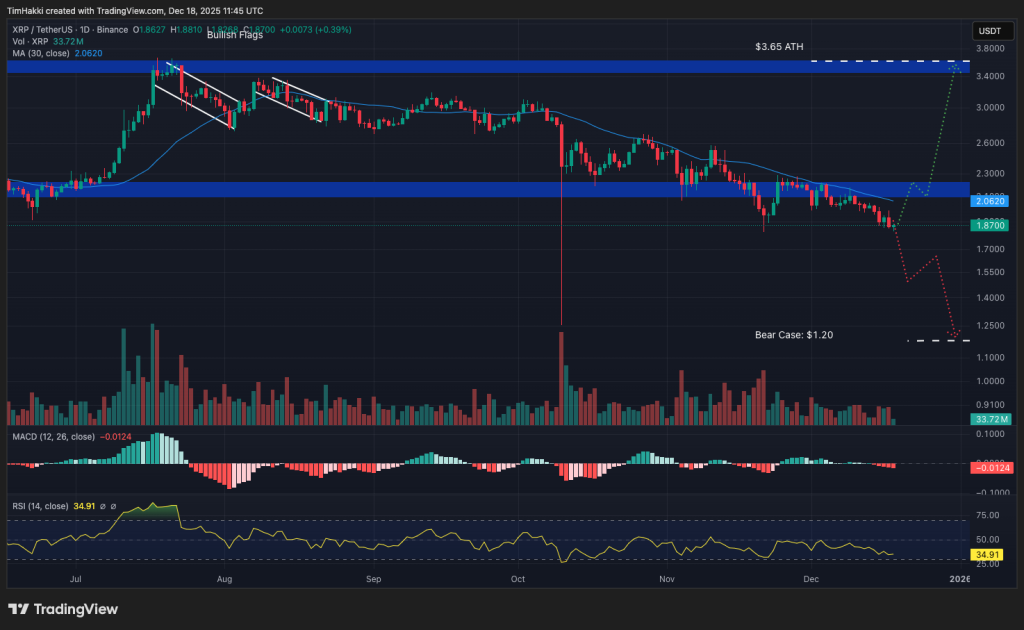
After the conclusion of Ripple’s prolonged legal dispute with the U.S. Securities and Exchange Commission, XRP surged to its first all-time high (ATH) in seven years, reaching $3.65. Since that peak, the price has retraced by roughly 49% and currently sits around $1.88.
The launch of five spot XRP ETFs in the U.S. has brought increased institutional inflows, although much of this development appears to have already been priced in by the market. Looking forward, additional ETF approvals and clearer crypto regulations could serve as major catalysts. In a favorable scenario, a return to all-time highs by early 2026 remains possible.
Cardano (ADA): Academically Built Smart Contracts
Cardano ($ADA) was founded in 2015 by Charles Hoskinson, one of Ethereum’s original co-founders, and officially launched in 2017.
The network is built on a Proof-of-Stake consensus model shaped by peer-reviewed academic research. This careful, research-first development philosophy continues to distinguish Cardano within the blockchain industry.
With a current market capitalization of around $13.3 billion, ADA would need to increase roughly fourfold to rival Solana’s position as the leading Ethereum alternative.
From a technical standpoint, ADA’s Relative Strength Index sits near 33 and falling, indicating strong selling momentum that is likely to bottom over the weekend as traders buy back in to take advantage of the relative discount. In the last 24 hours alone, the token shed 4%, pushing its price to approximately $0.36. If the weekend catalyzes a sustained rally over the next fortnight, a retest of its $3.09 all-time high before year-end is not out of the question.
Chart patterns also support a bullish outlook. ADA has formed a bullish flag between October and today, while another similar pattern from mid-summer remains unresolved. Still, resistance around the $1.15 level could slow progress before any larger breakout occurs.
Bitcoin Hyper (HYPER): A Meme-Styled Bitcoin Layer-2
As attention turns toward 2026, Bitcoin Hyper ($HYPER) is emerging as another project gaining traction. While its branding leans into meme culture, the project itself is a serious Bitcoin Layer-2 solution designed to enhance speed, reduce fees, and enable advanced smart contract capabilities.
Bitcoin Hyper is powered by the Solana Virtual Machine (SVM) and incorporates a Canonical Bridge that allows Bitcoin to move efficiently across multiple blockchain networks.
Interest from investors has been strong, with the presale raising nearly $30 million to date. Well-known crypto analyst Borch Crypto has suggested that HYPER could potentially deliver returns of up to 100x after securing major exchange listings.
The project has also strengthened its credibility through a recent Coinsult audit, which found no vulnerabilities in its smart contracts. The HYPER token underpins the ecosystem by supporting transaction fees, governance participation, and staking. Early presale participants can currently earn staking yields of up to 39% APY.
With Bitcoin due to go $HYPER in 2026, Bitcoin Hyper offers both long-time BTC holders and new investors early exposure to a project that expands Bitcoin’s capabilities.
Anthropic’s latest update to Claude AI, its rival to ChatGPT, has delivered fresh cryptocurrency price projections for XRP, Solana, and Ethereum as the month draws to a close. The AI model suggests that all three digital assets could experience heightened volatility in the next fortnight, with the potential for significant moves to the upside or downside.
Below is a breakdown of Claude’s two-track outlook, outlining both bullish and bearish price targets for each cryptocurrency through the end of December.
XRP (XRP): Claude AI Sees A Bullish Christmas Delivering $4.50 XRP
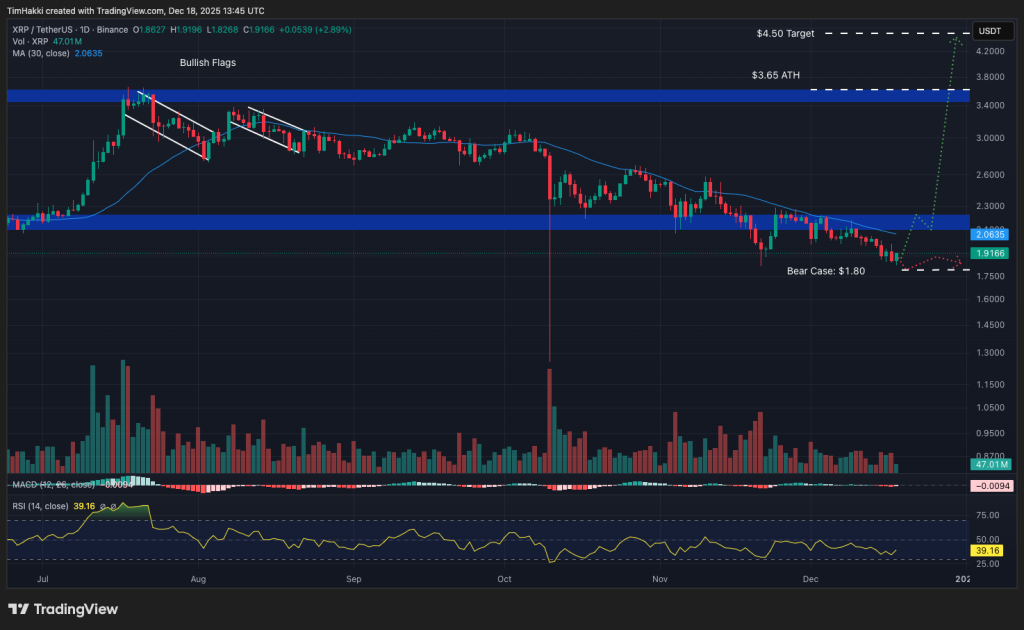
In its downside scenario, Claude AI forecasts that Ripple’s XRP ($XRP) could fall from its current level near $1.91 to as low as $1.80. That move would amount to a very slight dip of around 7% if markets remain bearish.
Source: Claude
Such an anticlimactic New Year would be at odds with XRP’s strong performance earlier in the year. In July, the token reached its first new all-time high (ATH) in seven years, climbing to $3.65 following Ripple’s decisive legal win against the U.S. Securities and Exchange Commission.
Throughout much of 2025, XRP has largely traded between $2 and $3. Its relative strength index (RSI) now sits close to 39 and has begun trending higher, suggesting renewed buying interest as traders view current prices as a discount or strategic accumulation zone.
On the bullish side, Claude’s model predicts a decisive breakout, with XRP potentially gaining 136% to reach a new ATH of $4.50 before year-end.
The rollout of five spot XRP ETFs in the United States could provide a near-term catalyst, particularly if institutional inflows mirror the early adoption seen with Bitcoin and Ethereum ETFs. Further ETF approvals are widely expected in the months ahead, raising the odds that 2026 becomes a defining year for XRP. Investors accumulating at current levels could benefit if that narrative plays out.
Solana (SOL): Claude AI Predicts Two Rallies: +300% in a Bullish Christmas and +43% in Bearish Outcome
Solana ($SOL) enters 2025 as one of the most active and rapidly expanding blockchain ecosystems. The network currently supports nearly $9 billion in total value locked (TVL), while its market capitalization is sitting around $70 billion. Developer engagement and network adoption continue to accelerate.
Recently launched Solana ETFs from firms like Bitwise and Grayscale have reignited interest from investors, with many drawing comparisons to the early stages of Bitcoin and Ethereum ETF demand.
Despite a modest pullback across the broader market, SOL has remained relatively resilient and is trading near $126. If bullish momentum builds, Claude AI estimates a potential rally of up to 300%, targeting prices around $500, nearly double its previous all-time high of $293 set in January.
On the bearish end of the spectrum, the model suggests SOL could still rally up to $180 within the next month, representing a more modest appreciation of about 43% from current levels.
Earlier this year, Solana surged to $250 before retreating to roughly $100 in April. While the token remains below recent highs, technical patterns indicate it may be emerging from a bullish flag formation. Growing institutional interest in real-world asset tokenization, driven by players such as BlackRock and Franklin Templeton building on Solana, adds weight to Claude’s more optimistic outlook.
Ethereum (ETH): Claude AI Targets a Potential 120% Growth Spurt Toward $6,500
Ethereum ($ETH), the backbone of decentralized applications, smart contracts, and much of the DeFi ecosystem, continues to lead Web3 development. With a market capitalization exceeding $351 billion and more than $67 billion in TVL across DeFi protocols, Ethereum remains the dominant programmable blockchain.
According to Claude AI, ETH could decline by as much as 19% from its current price of $2,961, potentially falling to $2,400 by year-end if bearish conditions persist.
That said, Ethereum’s robust security, dependable settlement layer, and central role in stablecoins and real-world asset tokenization position it well for institutional adoption, especially if U.S. regulators finally introduce comprehensive crypto legislation.
ETH currently faces strong resistance in the upper $4,000 range. In Claude’s bullish scenario, a decisive break above this level could open the door to a new ATH, with price targets ranging from $5,000 to as high as $6,500 by Christmas. Ethereum’s last ATH was $4,946 set in late August this year.
XRP and SUBBD are widely viewed as strong contenders for the current altcoin cycle.
As Bitcoin’s market dominance declines, capital is increasingly rotating into established and emerging altcoins. With a market capitalization of $113 billion, XRP stands as the largest altcoin globally, driven by its prominence in cross-border payment solutions.
Alongside established names, one emerging project gaining attention is SUBBD ($SUBBD), an AI-powered content platform designed to disrupt the $85 billion creator economy. SUBBD aims to give creators more control over monetization while delivering deeper engagement opportunities for fans.
Unlike traditional subscription platforms that can charge creators fees of up to 20% and restrict community ownership, SUBBD removes intermediaries through a decentralized model. The concept has already attracted significant interest, raising over $1.3 million during its presale phase.
Fans gain access to exclusive features such as token-gated content, early releases, and member-only discounts, fostering stronger creator–community relationships.
To stay updated, you can follow SUBBD across X, Telegram, and Instagram, or join the ongoing presale directly through their website.
Intercontinental Exchange (ICE), the company behind the New York Stock Exchange (NYSE), is negotiating an investment in crypto payments firm MoonPay as part of a funding round that could value the company at approximately $5 billion, according to a recent Bloomberg report.
The potential valuation marks a 47% increase from MoonPay’s previous $3.4 billion valuation, which comes just a month after the company secured approval from the New York Department of Financial Services to position it alongside Coinbase and PayPal.
Intercontinental Exchange, owner of the New York Stock Exchange, is in talks to invest in crypto payments firm MoonPay as part of a funding round, people familiar with the matter said https://t.co/vpWqgfO5bF
ICE Expands Digital Asset Portfolio with Strategic Bets
ICE’s potential investment reflects an aggressive expansion into emerging financial technologies.
The exchange operator already manages Bakkt, its proprietary crypto platform, and recently deployed $2 billion into Polymarket, the prediction market platform that gained prominence during the 2024 election cycle.
Beyond direct investments, ICE forged a technical partnership with Chainlink in August to deliver foreign exchange and precious metals rates onchain through Chainlink Data Streams.
The integration leverages ICE’s Consolidated Feed, which aggregates real-time pricing data from over 300 exchanges and marketplaces worldwide, contributing to Chainlink’s derived FX and metals datasets used across decentralized finance protocols.
The latest NYSE-backed investment talks emerge as MoonPay transitions from a simple cryptocurrency on-ramp provider into a full-service digital asset custodian capable of holding client assets and executing institutional-level trades.
The Limited Purpose Trust Charter complements MoonPay’s existing BitLicense, allowing the company to expand custody and other crypto services throughout New York.
This regulatory milestone places MoonPay in direct competition with established players operating under New York’s strict digital asset licensing requirements, which include comprehensive anti-money laundering protocols and consumer protection standards.
Moonpay High-Profile Leadership Hire Signals Regulatory Focus
MoonPay announced Wednesday that Caroline Pham, the acting chairman of the Commodity Futures Trading Commission (CFTC), will join as chief legal officer following her departure from the agency.
Pham will depart once the Senate confirms Mike Selig, Trump’s choice to chair the CFTC permanently.
She showed her readiness for the handover on X, writing: “I’m looking forward to a successful confirmation of Mike Selig as the CFTC’s next chairman and a smooth transition once he is sworn in. The future is bright. Onward and upward.”
Her background spans both Wall Street and Washington.
She previously led market structure for strategic initiatives as a Managing Director at Citigroup. She used her CFTC role to push forward innovation policies that supported President Trump’s pro-crypto objectives.
The leadership addition arrives as MoonPay expands its product offerings.
The same day, digital asset platform Exodus partnered with MoonPay to launch a US dollar-backed stablecoin aimed at mainstream adoption.
According to JP Richardson, co-founder and CEO of Exodus, “Stablecoins are quickly becoming the simplest way for people to hold and move dollars onchain, but the experience still needs to meet the expectations set by today’s consumer apps.”
Building a Regulated Footprint
MoonPay has steadily expanded its regulatory credentials throughout the year.
The company secured a Money Transmitter License from Wisconsin’s Department of Financial Institutions in March, strengthening its nationwide compliance framework.
Ivan Soto-Wright, MoonPay’s co-founder and CEO, emphasized the strategic importance of regulatory credentials at the time.
gotta catch 'em all!
the Wisconsin Department of Financial Institutions has granted MoonPay a Money Transmitter License
for Wisconsin residents, your experience buying crypto just got even better ~ especially when you use MoonPay Balance pic.twitter.com/40hAspQkwr
“Earning our Wisconsin MTL strengthens our position in the market as a fully-regulated platform, and further solidifies our commitment to iron-clad compliance,” he said.
The company has simultaneously pursued partnerships that extend its infrastructure beyond traditional crypto trading.
In late October, Rumble announced an exclusive collaboration with MoonPay to launch Rumble Wallet, enabling content creators to manage earnings outside conventional banking systems and execute trades in Bitcoin and other digital assets directly through the video platform.

 Login
Login