Normal view

There are new articles available, click to refresh the page.
Today — 16 December 2025Cryptonews

Wyoming Crypto Bank Files Petition Demanding Full Court Review of Fed Account Denial

16 December 2025 at 04:40

Wyoming-chartered crypto bank Custodia has filed a petition with the full Tenth Circuit Court of Appeals, seeking reconsideration of the Federal Reserve’s denial of its master account application, escalating a five-year legal battle.

The bank argues that the October panel decision misinterpreted federal law and raises constitutional concerns about the Fed’s authority.

The petition, filed on December 15, requests en banc review, asking all active circuit judges to examine whether regional Federal Reserve Banks can exercise unreviewable discretion over master account access for legally eligible institutions.

Custodia contends the three-judge panel’s 2-1 ruling conflicts with the Monetary Control Act’s mandate that payment services “shall be available” to nonmember depository institutions, creating what it describes as an unconstitutional veto power over state banking charters.

🚨NEW: Wyoming crypto bank @custodiabank has filed a petition for rehearing en banc, meaning it’s asking the full Tenth Circuit (not just the original three-judge panel) to reconsider its October decision siding with the @federalreserve in denying Custodia a master account.

The… pic.twitter.com/RDfeorIKGc

— Eleanor Terrett (@EleanorTerrett) December 16, 2025

State Banking Authority Under Threat

The filing raises federalism concerns about the Fed effectively overriding Wyoming’s 2020 decision to charter Custodia as a Special Purpose Depository Institution.

Without master account access, the bank cannot utilize core Federal Reserve payment services, including wire transfers and automated clearinghouse systems, rendering its state-issued charter largely meaningless despite meeting all statutory eligibility requirements.

When the Fed denies a master account to a state-chartered financial institution, it effectively vetoes a bank charter that State regulators have approved,” the petition states.

Wyoming created its SPDI framework specifically to attract digital asset companies, requiring 100% reserve backing and prohibiting lending to reduce risk.

Custodia argues the Fed’s rejection undermines this carefully crafted state regulatory regime designed to foster blockchain innovation within stringent safety parameters.

The constitutional implications extend beyond federalism.

Custodia’s legal team contends that if regional Reserve Bank presidents hold unreviewable discretion over master accounts, they effectively become “Officers of the United States” wielding significant executive authority without proper constitutional appointment.

Federal Reserve Bank presidents are selected by private bank directors and approved by the Board of Governors, a process Custodia argues violates the Appointments Clause if those officials exercise the discretionary power the majority opinion affirmed.

Deep Judicial Split Emerges

The petition highlights growing disagreement among Tenth Circuit judges on statutory interpretation.

Judge Timothy Tymkovich’s dissent joined Judge Bacharach’s 2017 opinion in Fourth Corner Credit Union v. Federal Reserve Bank of Kansas City, creating a 2-2 split among circuit judges on whether the Monetary Control Act mandates master account access.

Tymkovich wrote that the Fed’s interpretation grants “unreviewable discretion” that raises “thorny questions” under Article II while contradicting the MCA’s plain language, which requires services to be “available to nonmember depository institutions.

The Kansas City Fed denied Custodia’s application in January 2023 after 27 months of review, citing risks from its “crypto-asset activities” despite initially telling the bank there were “no showstoppers” with its application.

❌ A federal appeals court in Denver has upheld the Federal Reserve’s right to deny crypto-focused bank @custodiabank access to a master account.#Crypto #Custodiahttps://t.co/MAHuPSXT5x

— Cryptonews.com (@cryptonews) November 1, 2025

Internal Fed documents revealed that staff deemed Custodia’s capital “adequate” and praised its “impressive” executive team, only for Board of Governors officials to intervene.

Federal Reserve Governor Christopher Waller has since acknowledged publicly that the Fed possesses sufficient tools to manage risks without denying master accounts entirely.

In an October interview, Waller suggested the Fed can “tailor” account structures to match individual bank risk profiles, undermining the necessity argument for blanket denials.

OCC Exposes Systematic Crypto Debanking

Custodia’s legal fight unfolds as federal regulators confront widespread debanking practices targeting crypto firms.

The Office of the Comptroller of the Currency released findings in December showing all nine largest national banks imposed “inappropriate” restrictions on lawful businesses, including digital asset companies, between 2020 and 2023.

JPMorgan Chase, Bank of America, Citibank, Wells Fargo, and others maintained internal policies requiring escalated approvals or imposing blanket restrictions on sectors deemed to conflict with institutional values.

The review examined thousands of complaints about political and religious debanking, as well as crypto exclusions.

🚨 @USOCC reveals nine major banks, including @jpmorgan “debanked” crypto and other lawful industries with inappropriate restrictions #CryptoNews #Bankinghttps://t.co/hZYJOCY88v

— Cryptonews.com (@cryptonews) December 11, 2025

Banks insisted they did not discriminate, but the OCC found many restrictive policies were publicly visible.

In fact, Strike CEO Jack Mallers recently claimed his accounts were abruptly closed under vague references to “concerning activity,” fueling allegations of coordinated exclusion despite regulatory denials.

The controversy intensified after President Trump signed an executive order in August intended to prevent banks from debanking customers solely for crypto-related activity.

The post Wyoming Crypto Bank Files Petition Demanding Full Court Review of Fed Account Denial appeared first on Cryptonews.


US Financial Watchdog No Longer Sees Crypto as Systemic Threat: Report

16 December 2025 at 04:06

The Financial Stability Oversight Council has removed crypto from its list of systemic financial threats in its 2025 annual report. This is a dramatic regulatory shift attributable to the transformation happening under the Trump administration.

The 86-page document, approved December 11, eliminates the dire warnings about digital assets that dominated previous years, instead emphasizing responsible growth and regulatory clarity for the sector.

The FSOC’s latest assessment contrasts sharply with its 2024 report, which warned that stablecoins represented an acute vulnerability to runs absent appropriate risk-management standards.

This year’s report acknowledges crypto’s role in innovation and economic development, while noting that recent legislative progress has addressed many of the concerns that previously existed.

The council now describes digital assets as facilitating secure, efficient transactions through distributed ledger technology rather than framing them as destabilizing forces.

US Crypto Systemic Threats - FSOC Report Cover
Source: FSOC

Legislative Progress and Banking Access Reforms

The transformation stems largely from the passage of the GENIUS Act in July, which established America’s first comprehensive federal framework for payment stablecoins.

The legislation requires licensed issuers to maintain reserves in highly liquid assets, such as U.S. Treasuries, and prohibits rehypothecation except for limited purposes.

Treasury Secretary Scott Bessent noted in the report that continued use of dollar-denominated stablecoins supports the dollar’s role in international finance.

Beyond stablecoins, federal agencies have systematically withdrawn restrictive guidance that previously discouraged banks from engaging with crypto firms.

The SEC eliminated prior-notification requirements for offering digital asset custody services, while banking regulators rescinded joint statements that effectively pushed crypto activity outside traditional finance.

The Federal Reserve ended its novel activities supervision program, returning oversight to normal supervisory processes.

The Office of the Comptroller of the Currency released preliminary findings showing all nine largest national banks imposed inappropriate restrictions on lawful crypto businesses between 2020 and 2023.

JPMorgan Chase, Bank of America, Citibank, Wells Fargo, and others maintained internal policies requiring escalated approvals or blanket limitations on digital asset companies, alongside sectors such as firearms and adult entertainment.

Comptroller Jonathan Gould described the practices as “harmful to lawful enterprises” and an inappropriate use of national bank charters.

The findings build on President Trump’s August executive order guaranteeing fair banking access and state-level fair access laws in Florida, Idaho, and Tennessee, designed to prevent ideological account closures.

Market Structure Legislation Races Senate Deadline

Last week, Senator Cynthia Lummis pushed for immediate Senate Banking Committee markup of the Responsible Financial Innovation Act before the holiday recess, warning negotiations cannot drift into February without risking election-year paralysis.

She told the Blockchain Association Policy Summit that bipartisan drafts have been rewritten repeatedly, exhausting staff members as lawmakers struggle to reconcile the House and Senate approaches to defining which tokens fall outside securities classification.

@SenLummis says she wants a markup on the crypto market structure bill next week even as staff are “exhausted” from nonstop revisions. #Crypto #USPolicy #Lummishttps://t.co/RadNIvnWLp

— Cryptonews.com (@cryptonews) December 9, 2025

The House passed the Digital Asset Market Clarity Act in July, giving the CFTC primary oversight of digital commodities while preserving SEC authority over fundraising.

The Senate version uses the term “ancillary assets” and faces tension over decentralized finance regulation.

Senator Thom Tillis warned that missing the December window could freeze the bill for the rest of 2026.

However, Senator Mark Warner also suggested completing everything before the holiday recess would be difficult, noting the White House still hadn’t provided final language on quorum and ethics rules.

Traditional Finance Embraces Tokenized Products

JPMorgan Chase demonstrated the sector’s mainstreaming by launching its first tokenized money-market fund on the Ethereum network.

The My OnChain Net Yield Fund begins with $100 million of the bank’s capital before opening to qualified investors with minimum investments of $1 million.

The MONY fund accepts subscriptions in cash or USDC, demonstrating institutional adoption of crypto-native payment rails for settlement alongside traditional cash.

🏦 JPMorgan is launching its first tokenized money-market fund on Ethereum, reports the WSJ. #JPMorgan #Ethereum https://t.co/bjjIFNFRnJ

— Cryptonews.com (@cryptonews) December 15, 2025

The launch follows the GENIUS Act’s regulatory clarity, with Wall Street accelerating tokenization efforts across equities, bonds, and real-world assets.

John Donohue, JPMorgan’s global liquidity head, cited a “massive amount of interest from clients around tokenization” and the bank’s intention to lead the space with product lineups that match traditional money-market fund choices on the blockchain.

The integration of blockchain into core financial products, once considered distant from crypto, indicates the technology is progressing from experimental to infrastructure-grade status within traditional finance.

The post US Financial Watchdog No Longer Sees Crypto as Systemic Threat: Report appeared first on Cryptonews.

Solana Withstands One of the Largest DDoS Attacks in Internet History With No Network Disruption

By: Amin Ayan
16 December 2025 at 03:33

Solana has weathered one of the most powerful distributed denial-of-service (DDoS) attacks ever recorded without any visible impact on network performance.

Key Takeaways:

  • Solana withstood a 6 Tbps DDoS attack with no network disruption.
  • The attack ranks among the largest ever recorded across the internet.
  • The incident highlights Solana’s growing network resilience.

The attack, which has been ongoing for more than a week, peaked at nearly 6 terabits per second (Tbps), ranking as the fourth-largest DDoS attack in internet history, according to data shared by SolanaFloor.

Despite the scale, network metrics show Solana continued to process transactions normally, with sub-second confirmations and stable slot latency throughout the period.

Solana Joins Google, Cloudflare and AWS in Record-Scale DDoS History

Charts accompanying the disclosure place the Solana incident alongside historic attacks targeting major centralized infrastructure providers, including Google Cloud, Cloudflare customers, Microsoft Azure, and AWS.

While those attacks ranged from 2.3 Tbps to as high as 46 Tbps, Solana’s appearance on the list marks a rare case of a public blockchain facing traffic volumes comparable to the largest assaults on traditional internet services.

Validators and core infrastructure absorbed the traffic without degraded performance, reinforcing claims that Solana’s architecture has matured significantly since earlier congestion episodes.

Meanwhile, the Sui network experienced a DDoS attack just a day earlier, which resulted in delayed block production and periods of reduced performance.

🚨BREAKING: @Solana has been under a sustained DDoS attack for the past week, peaking near 6 Tbps, the 4th largest attack ever recorded for any distributed system. Network data shows no impact, with sub second confirmations and stable slot latency.

The Sui network was also… pic.twitter.com/CpQJrTiZnt

— SolanaFloor (@SolanaFloor) December 16, 2025

A DDoS attack is an attempt to overwhelm a network, website, or system with massive traffic so it can’t operate normally.

Attackers use large numbers of compromised devices (a botnet) to send junk requests at the same time, flooding the target with data.

The goal isn’t to steal information, but to slow the system down, cause outages, or make services unavailable.

DDoS attacks are not rare in crypto. Last year, the Cardano network experienced an attempted DDoS attack beginning at block 10,487,530.

Raul Antonio, chief technology officer of Fluid Tokens, explained that the attack tried to manipulate the blockchain into charging lower fees for high-value transactions.

Likewise, layer-2 blockchain Manta suffered a DDoS attack shortly after successfully listing its Manta token on multiple exchanges last year.

Solana Faces Liquidity Reset as Losses Mount

As reported, Solana is entering a period of stress as on-chain data points to shrinking liquidity and falling profitability.

Glassnode data shows the network’s 30-day realized profit-to-loss ratio has remained below 1 since mid-November, a level typically linked to bearish conditions, meaning traders are realizing losses more often than gains and market sentiment has weakened.

Analysts at Altcoin Vector describe the situation as a “full liquidity reset,” a phase that has historically marked the early stages of new liquidity cycles and, in some cases, market bottoms.

While near-term volatility remains high, analysts say conditions could begin to stabilize within weeks, potentially setting the stage for a recovery by early January if the pattern mirrors past cycles.

Meanwhile, amid growing demand for Solana funds, Web3 infrastructure provider Alchemy has rebuilt its Solana stack from the ground up, aiming to deliver near-zero downtime, faster transaction speeds, and higher scalability.

The post Solana Withstands One of the Largest DDoS Attacks in Internet History With No Network Disruption appeared first on Cryptonews.

Whale Unwinds AI Agent Positions at 92% Loss After Market Slump

16 December 2025 at 01:57

An AI Agent whale has just turned one of this year’s loudest narratives into an expensive lesson, unloading a basket of agent tokens bought for $31.12M and getting back only $2.57M, according to on-chain data posted from Ember.

The wallet built its positions at the start of the year during the peak of the AI Agent narrative, when capital chased anything linked to autonomous trading bots and AI-powered execution.

With liquidity now thin and sentiment cooler, the same bets have been closed at a loss of about $28.54 million, or roughly 92%.

Token by token, the damage is stark. The whale lost about 91%, or $15.89M, on AIXBT and 92%, or $9.87M, on FAI.

太惨烈了~
一个巨鲸在年初的 AI Agent 热潮中用 $3112 万资金购买了多个 AI Agent 代币,如今随着浪潮退下,他在今天上午清仓割掉了这些 AI Agent 代币。他 $3112 万资金只卖回成 $257 万,亏损高达 $2854 万 (-92%)。$AIXBT :亏损了 91% ($1589 万);$FAI :亏损了 92% ($987 万);$NFTXBTpic.twitter.com/P0KTfUdqXn

— 余烬 (@EmberCN) December 16, 2025

Aggressive Sell-Off Hammers AI Agent Tokens With Losses Across the Board

Positions in NFTXBT and POLY, both from the Virtuals ecosystem, were nearly wiped out with losses of 99%, equal to around $690,000 and $780,000 respectively.

The book did not fare much better elsewhere. BOTTO, an AI-driven art and curation project, produced an 84% hit of about $930,000. MAICRO, another Virtuals-linked agent token, cost the wallet roughly $380,000, a 90% drawdown versus its entry.

Because order books in these names are now shallow, the forced exit hit prices in real time.

Ember’s breakdown shows AIXBT falling about 10% during the selling, FAI dropping 8% and NFTXBT sliding 29%. BOTTO sank 32%, MAICRO tumbled 48% and POLY declined 26% as the whale worked its way through positions.

Arkham Reveals Large-Scale Sell-Off as AI Agent Hype Fades

Screenshots from Arkham’s explorer point to a sequence of transfers between the whale address and liquidity pools, with tens of millions of tokens in each project moving in quick succession. The flows suggest a deliberate decision to capitulate rather than a slow rebalance, locking in losses instead of waiting for a fresh burst of AI Agent speculation.

For market participants who rode the same theme, the episode is a reminder of how narrative-driven sectors can behave once attention shifts elsewhere. Many AI Agent tokens launched into the tail end of the broader AI mania and never built the depth or organic usage that support large tickets on the way out.

The liquidation also shows the limits of whale size in illiquid corners of crypto. Size that helps drive performance during the initial run-up can turn into a liability when liquidity dries up, since every attempt to exit pushes prices lower and erodes recovery value.

For traders still navigating the agents meta, the whale’s exit cuts both ways. It is a sharp reminder that late-stage narratives can punish even deep wallets, yet some may view the flush as clearing stale supply from thin markets.

The post Whale Unwinds AI Agent Positions at 92% Loss After Market Slump appeared first on Cryptonews.

SEC Drops Nearly 60% of Crypto Cases Under Trump Administration: Report

By: Amin Ayan
16 December 2025 at 01:43

The US Securities and Exchange Commission has sharply scaled back its enforcement actions against the cryptocurrency industry since President Donald Trump returned to office.

Key Takeaways:

  • The SEC has dropped or paused nearly 60% of crypto cases since Trump took office.
  • Enforcement pullbacks include major cases against Ripple and Binance.
  • The agency denies political motives, calling the shift a policy reset.

The agency has dismissed or paused close to 60% of crypto-related cases, according to a report published Sunday by The New York Times.

While enforcement activity continues across traditional markets, cases involving crypto firms have been disproportionately affected by withdrawals, pauses, or outright dismissals since January, the report said.

SEC Retreats From Ripple and Binance Cases

Among the most prominent cases cited were the SEC’s long-running lawsuits against Ripple Labs and Binance, both of which have seen significant pullbacks.

The Times also noted that the regulator is “no longer actively pursuing a single case against a firm with known Trump ties,” a detail that has intensified scrutiny of the agency’s motives.

The SEC pushed back on suggestions of political favoritism, telling the newspaper that its decisions were driven by legal and policy considerations rather than politics.

The report added that it found no evidence President Trump directly pressured the agency to abandon specific investigations.

Industry figures argue the enforcement retreat reflects a broader reassessment of the SEC’s earlier approach to crypto.

Curious about crypto wallets and how to store and access crypto assets? Check out our Crypto Asset Custody Basics Investor Bulletin.https://t.co/x4HMYMHLAe pic.twitter.com/bSbP25nzOc

— U.S. Securities and Exchange Commission (@SECGov) December 13, 2025

Alex Thorn, head of firmwide research at Galaxy Digital, said claims that the shift is linked to Trump’s personal interests overlook what he described as years of aggressive and inconsistent regulation.

Thorn said framing the pivot as politically motivated ignores “four years of direct attacks by the actual partisans.”

The backdrop to the enforcement slowdown includes a deepening connection between Trump-linked entities and the digital asset sector.

In 2025, projects associated with the president or his family expanded significantly, ranging from World Liberty Financial to Trump-branded crypto initiatives, including the Official Trump memecoin and American Bitcoin, a mining venture backed by the president’s sons.

Leadership Shift at SEC Looms as Final Democratic Commissioner Exits

At the same time, changes at the top of the SEC are set to further reshape the agency’s stance.

Paul Atkins, a Republican appointee seen as more receptive to market-driven regulation, is expected to remain chair for the foreseeable future. However, the commission is preparing to lose its final Democratic member.

Caroline Crenshaw, whose term officially expired in 2024, is expected to depart in January after serving an additional 18 months.

Trump has yet to announce nominees to fill her seat or another vacant Democratic position on the commission.

Crenshaw has been one of the most vocal critics of the SEC’s softer approach to crypto under the Trump administration.

In one of her final public appearances last week, she warned that easing oversight could expose markets to wider contagion risks, cautioning that reduced scrutiny may come at a cost to investor protection.

The post SEC Drops Nearly 60% of Crypto Cases Under Trump Administration: Report appeared first on Cryptonews.

Samourai Wallet Case: President Trump to Review Pardon for Founder Keonne Rodriguez

16 December 2025 at 01:17

President Donald Trump has expressed willingness to consider pardoning Keonne Rodriguez, the CEO of privacy-focused Bitcoin wallet Samourai. Rodriguez was sentenced to five years in federal prison last month for money laundering charges.

During an afternoon event in the Oval Office on Monday, Trump answered a reporter’s question that he is aware of the case and is open to exploring a potential pardon.

“I’ve heard about it, I’ll look at it,” he told the reporter. “Why you think it should be pardoned?”

“It sounds like, based on your question, Rodriguez. We’ll look at that, Pam. Okay,” the President said to U.S. Attorney General Pam Bondi, who was also present during the session.

Samourai Dev Rodriguez Faces 5 Years Prison Charges

The U.S. Department of Justice (DOJ) arrested Keonne Rodriguez and William Hill, the CEO and CTO of Samourai Wallet on April 24. They each face one count of conspiracy to commit money laundering and operating an unlicensed money-transmitting business. The case was started under the Biden administration.

Last month, District Judge Denise Cote of the Southern District of New York (SDNY) handed down Rodriguez’s sentence to five years in prison.

Rodriguez was accused of creating a Bitcoin mixing service that was allegedly used to launder $237 million in dirty money. He had voluntarily pleaded guilty in July.

Rodriguez Responds to Trump’s Words

In response to Trump’s consideration on Monday, Rodriguez said, “This is a big step forward.”

I have always said that the most challenging aspect of getting a pardon for me and Bill would be getting the attention of @realDonaldTrump. He is very busy with many people competing for his attention. Today, thanks to the journalist at Decrypt, the President is aware of our… https://t.co/lmYljfFax9

— Keonne Rodriguez (@keonne) December 15, 2025

“This President knows all about lawfare. He knows all about a weaponized Biden DOJ hunting down their political rivals. He knows the tactics and tricks they play. If he looks at our case closely it will be a case of deja vu, and I think he would do the right thing and grant us a pardon,” Rodriguez wrote on X.

Trump’s response comes four days before Rodriguez’s prison term begins.

Besides, the crypto community is buzzing with #pardonsamourai hashtags, seeking the signing of a petition to reach 100K signatures.

“Just as Ross Ulbricht was pardoned, Keonne must be forgiven, too,” wrote crypto entrepreneur Jesse Tevelow. “We cannot allow one of our own fellow Bitcoiners to spend time in jail for building a legitimate product that protects our Bitcoin and strengthens the network.”

President Trump pardoned Ross Ulbricht, who started Silk Road, a marketplace on the darknet. In October, Trump also pardoned Changpeng “CZ” Zhao, the former head of Binance, concluding months of speculation over his legal fate. These cases mark a major shift in Washington’s approach to cryptocurrency regulation.

The post Samourai Wallet Case: President Trump to Review Pardon for Founder Keonne Rodriguez appeared first on Cryptonews.

MetaMask Adds Bitcoin Support, Teases More Blockchain Integrations

By: Amin Ayan
16 December 2025 at 01:12

Crypto wallet provider MetaMask has expanded its multichain push by adding native support for Bitcoin, marking a notable shift for a platform long associated with Ethereum-based networks.

Key Takeaways:

  • MetaMask added native Bitcoin support, allowing users to buy, swap, and send BTC directly from the wallet.
  • The move replaces wrapped Bitcoin exposure and reflects MetaMask’s shift away from being an Ethereum-only wallet.
  • MetaMask says more blockchain integrations are planned as part of its broader multichain expansion.

The company announced the rollout on social media on Monday, nearly ten months after first hinting at the integration in February.

With the update, Bitcoin now joins Ethereum, Solana, Monad and Sei as supported assets within MetaMask, allowing users to hold and transact BTC directly from the wallet.

MetaMask Lets Users Buy, Swap and Send Bitcoin

MetaMask said users can now buy Bitcoin, swap other tokens into BTC, and send or receive the asset, with confirmed transactions appearing automatically in their asset list.

The company cautioned that Bitcoin transfers typically settle more slowly than transactions on EVM-compatible chains or Solana, reflecting the network’s design.

To encourage adoption, MetaMask is offering reward points for users who swap into Bitcoin through the wallet.

Until now, access to BTC on MetaMask was limited to wrapped versions of the asset, which rely on intermediaries and carry additional smart contract risk.

The Bitcoin integration was first discussed earlier this year, when MetaMask co-founder Dan Finlay suggested the feature could go live in the third quarter of 2025.

BITCOIN HAS ENTERED THE CHAT

MetaMask now supports BTC. 🟠 pic.twitter.com/S6ZdDStnct

— MetaMask.eth 🦊 (@MetaMask) December 15, 2025

Its arrival underscores the company’s broader effort to reposition itself as a multichain wallet rather than an Ethereum-only tool.

MetaMask began that transition in May with support for Solana, followed by integrations with Sei in August and Monad in November. While details remain limited, the firm has signaled that further blockchain support is planned.

“Bitcoin support marks the latest step in our multichain expansion,” MetaMask said, adding that additional networks are expected to be added in 2026.

MetaMask to Integrate Polymarket

As reported, MetaMask has entered the prediction market space through a new integration with Polymarket, allowing users to trade on real-world event outcomes directly from their wallets.

The feature introduces one-tap funding, enabling deposits from any EVM-compatible chain, and rewards users with MetaMask points for each prediction placed.

The partnership creates a new on-ramp for Polymarket, which has seen rapid growth over the past year, particularly during the 2024 US election cycle.

A more favorable regulatory backdrop and renewed US market access have helped drive its expansion, with the platform now reportedly exploring a valuation of up to $15 billion following a strategic investment from Intercontinental Exchange, the parent company of the NYSE.

The wallet is also preparing for the rollout of a native MASK token, as parent company Consensys gears up for a potential IPO.

The move comes as Polymarket is recruiting staff for an internal market-making team that would trade against its own customers, mirroring a controversial feature already used by rival Kalshi that has drawn criticism and legal challenges.

The New York-based prediction market startup has reportedly approached traders, including sports bettors, to join the new unit, people familiar with the matter said, requesting anonymity because the plans remain private.

The post MetaMask Adds Bitcoin Support, Teases More Blockchain Integrations appeared first on Cryptonews.

Stablecoin Supply High, Liquidity Flow Low: Matrixport Flags Market Fatigue

16 December 2025 at 00:53

Crypto’s primary liquidity gauge is flashing warning signs. According to a new market note from Matrixport, while total stablecoin supply remains near all-time highs, the pace of new capital inflows has peaked and is now slowing, considered a classic signal of buyer exhaustion.

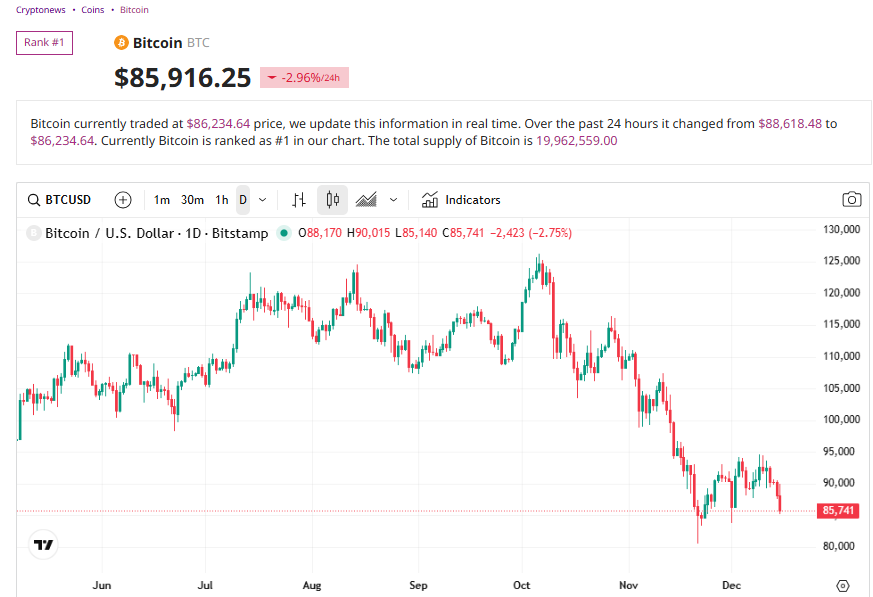
The firm notes that the rolling 12-month growth rate of stablecoin issuance topped out in late October and has since rolled over. The deceleration coincides with a roughly 3% decline in Bitcoin, which was trading near $85,860 on Tuesday morning, struggling to reclaim key moving averages.

The Data: Liquidity Stock vs. Liquidity Flow

On the surface, crypto liquidity appears abundant. Tether (USDT) and Circle (USDC) together command a combined market capitalization exceeding $260 billion. However, Matrixport argues that headline supply figures obscure a more important signal: the marginal liquidity needed to sustain price momentum is drying up.

The firm attributes the slowdown primarily to the Federal Reserve’s shift toward a more cautious stance on future rate cuts.

“Political constraints may have a greater impact on market flows than investors’ perceptions,” Matrixport wrote, adding that liquidity conditions remain constrained by weak retail participation.

📊Today’s #Matrixport Daily Chart – December 16, 2025 ⬇

Stablecoin Growth Is Slowing—A Less Supportive Liquidity Backdrop for Crypto#Matrixport #Stablecoins #CryptoLiquidity #MarketLiquidity #Fed #Macro #CryptoMarket #OnChainData pic.twitter.com/JdtNW2AuKx

— Matrixport Official (@Matrixport_EN) December 16, 2025

Why Stablecoin Supply Is No Longer Driving Risk Appetite

Matrixport highlights a critical divergence shaping current market dynamics:

  • Liquidity Stock: Absolute stablecoin supply continues to rise, theoretically providing ample “dry powder.”
  • Liquidity Impulse: The velocity of that capital has collapsed. Instead of rotating into risk assets, funds are remaining idle or moving into yield-bearing instruments.

The firm links this behavior to growing uncertainty around the Fed’s policy path, as reinforced by recent FOMC minutes that offered little clarity on the timing or depth of easing.

Market Reaction: Technical Damage Builds

Price action has turned defensive. Matrixport notes that Bitcoin has lost its “bull market trend indicator” for the first time in several months, signaling weakening momentum beneath the surface.

With the Fed unlikely to deliver aggressive easing in Q1, the firm warns that the “correction phase forecast since October” is likely to persist unless a new macro or liquidity catalyst emerges.

Institutional View: Velocity Matters More Than Size

Matrixport emphasizes that the key distinction separating institutional positioning from retail narratives is the difference between liquidity stock and liquidity impulse.

A $260 billion stablecoin float may sound bullish, but without an accelerating rate of issuance and deployment, it acts more like a reservoir than a flood. Institutional desks are interpreting the Fed’s hesitation as a cap on leverage and risk-taking.

Until the cost of capital meaningfully declines or stablecoin issuance re-accelerates on a rolling basis, Matrixport expects choppy, range-bound conditions rather than sustained breakouts.

The post Stablecoin Supply High, Liquidity Flow Low: Matrixport Flags Market Fatigue appeared first on Cryptonews.

Texas Goes Full Crypto Mode as Bitcoin ATM Operator Eyes 200 New Machines

16 December 2025 at 00:16

Texas’ role as a center of U.S. crypto activity is set to expand further after Bitcoin Bancorp said it plans to deploy up to 200 licensed Bitcoin ATMs across the state beginning in the first quarter of 2026.

The state is adding to an already dense network of crypto kiosks operating under one of the country’s clearest regulatory frameworks.

Bitcoin Bancorp Enters Texas, Citing Clear Rules and Strong ATM Demand

Bitcoin Bancorp, which trades over the counter under the ticker BCBC, said the planned rollout would mark its entry into what it described as a strategically important market.

BIG NEWS! 🚀 Bitcoin Bancorp (OTC: $BCBC) is set to deploy up to 200 licensed Bitcoin ATMs across Texas starting Q1 2026!
Expansion Targets One of the Most Crypto-Friendly U.S. States as Part of a Broader National Growth Strategy
Excited to bring easier Bitcoin access to the…

— BitcoinBancorp (@BCBC_stock) December 15, 2025

The company is one of only three publicly traded Bitcoin ATM network owners in the United States and says it holds foundational patents tied to Bitcoin ATM technology.

Eric Noveshen, a director at the firm, said agreements are already in place that could support faster revenue growth as the company moves from planning into execution.

Following the announcement, Bitcoin Bancorp shares rose 7.83% on the day and are up 29.53% over the past five days, reflecting increased investor confidence in the expansion strategy.

Source: Yahoo Finance

The expansion comes at a time when Texas already hosts more than 4,000 live crypto ATMs, the highest number of any U.S. state.

Large national operators, including Athena Bitcoin, Bitcoin Depot, Coinhub, Cryptobase, and Byte Federal, have established broad coverage across major cities such as Houston, Dallas, Austin, and San Antonio.

The presence of this existing infrastructure has lowered barriers for new deployments and signaled sustained consumer demand for in-person crypto access.

Why Bitcoin ATM Operators Keep Flocking to Texas

Texas’ appeal to ATM operators largely stems from its regulatory structure. State law treats virtual currency as a form of money under the Texas Money Services Act, placing Bitcoin ATM operators within a familiar licensing regime overseen by the Texas Department of Banking.

Source: Americas Bitcoin Atm

Companies must obtain a money transmitter license, meet minimum net worth requirements of at least $500,000, post a surety bond of no less than $150,000, and submit to regular examinations.

Consumer protection has also become a growing focus. In Texas, state rules require Bitcoin ATM operators to clearly disclose fees, exchange rates, and complaint procedures.

Federal Scrutiny Intensifies Around Bitcoin ATMs

Oversight of Bitcoin ATMs in the United States is tightening at the federal level as regulators respond to rising fraud concerns and increased consumer use.

Currently at the federal level, Bitcoin ATM operators are classified as money services businesses under the Bank Secrecy Act, placing them under the supervision of the Financial Crimes Enforcement Network (FinCEN).

This requires operators to maintain formal anti-money laundering programs, conduct customer identity verification, and monitor transactions for suspicious activity.

Identity checks typically scale with transaction size, ranging from basic phone verification for smaller amounts to government-issued identification and enhanced due diligence for larger transfers.

Operators are also required to file currency transaction reports for cash transactions exceeding $10,000, submit suspicious activity reports when necessary, and retain records for a minimum of five years.

At the same time, federal lawmakers are moving to further regulate the sector. Proposed legislation such as the Crypto ATM Fraud Prevention Act of 2025 shows a more focused concern over the role of crypto kiosks in scam-related losses nationwide.

What the Crypto ATM Fraud Prevention Act Proposes

Introduced in the U.S. Senate as Bill S. 710, the Crypto ATM Fraud Prevention Act of 2025, which has been read twice and referred to the Senate Committee on Banking, Housing, and Urban Affairs, is designed to reduce fraud risks while increasing transparency for consumers.

Key provisions of the bill include mandatory registration of virtual currency kiosks with the U.S. Treasury; also, operators are required to provide clear pre-transaction disclosures outlining terms, fees, and a warning that transactions are final and non-refundable.

The bill mandates prominent fraud warnings on kiosks, the issuance of physical receipts containing transaction details and fraud-reporting information, and the implementation of written anti-fraud policies submitted to FinCEN.

The post Texas Goes Full Crypto Mode as Bitcoin ATM Operator Eyes 200 New Machines appeared first on Cryptonews.

[LIVE] Crypto News Today: Latest Updates for Dec. 16, 2025 – Bitcoin Drops Under $86,000 as Extreme Fear Deepens Crypto Market Rout

15 December 2025 at 23:30

Cryptocurrency markets opened the day under broad pressure, with losses accelerating across major sectors as risk sentiment deteriorated sharply. DePIN tokens led the sell-off, sliding nearly 6%, while Bitcoin fell 4% to break below the $86,000 level and Ethereum dropped more than 4% below $3,000. Weakness extended across Layer 1s, Layer 2s, DeFi, PayFi, and CeFi, accompanied by heavy liquidations totaling $583 million over the past 24 hours, overwhelmingly skewed toward long positions. The sharp downturn has pushed market psychology deeper into panic territory, with the Crypto Fear & Greed Index falling to 11, signaling extreme fear.

But what else is happening in crypto news today? Follow our up-to-date live coverage below.

The post [LIVE] Crypto News Today: Latest Updates for Dec. 16, 2025 – Bitcoin Drops Under $86,000 as Extreme Fear Deepens Crypto Market Rout appeared first on Cryptonews.

Yesterday — 15 December 2025Cryptonews

PYUSD Stablecoin Issuer PayPal Seeks State-Chartered Bank License

15 December 2025 at 23:07

Payments giant PayPal formally applied for a Utah state-chartered industrial bank license on Monday, joining a number of fintech and crypto firms seeking bank charters to expand their services.

The digital payments company aims to create an industrial loan arm called PayPal Bank to offer business lending solutions to “small businesses in the US.”

Additionally, a state-chartered license would enable the PYUSD stablecoin issuer to originate loans, hold deposits, and access payment networks directly.

PayPal CEO Alex Chriss emphasized that small businesses face “significant hurdles” in securing capital to grow their operations.

“Establishing PayPal Bank will strengthen our business and improve our efficiency, enabling us to better support small business growth and economic opportunities across the U.S.,” Chriss said in the release.

PayPal filed the application with Utah regulators and the Federal Deposit Insurance Corporation.

Payments firm PayPal said on Monday it has applied to establish a bank in the United States, as companies rush to capitalize on a friendly regulatory environment under the Trump administration. https://t.co/fCMHY5zVMm

— Reuters Legal (@ReutersLegal) December 16, 2025

Crypto Firms Rush to Apply Bank Charter Amid Regulatory Shifts

PayPal’s push for a bank license comes amid an increase in banking charter activity among crypto firms. The US Office of the Comptroller of the Currency (OCC) head, Jonathan Gould, recently highlighted that the agency received about 14 charter applications since the start of the year, including digital asset firms.

Besides, PayPal has prioritized regulated integration of digital assets over recent years, including rolling out support for merchants to accept Bitcoin and Ethereum at checkout.

The federal bank regulator, OCC, already has trust charter applications from five different crypto companies, including stablecoin issuer Circle, Coinbase and Ripple.

For instance, Ripple intended to bring its dollar-backed stablecoin, RLUSD, under federal supervision by seeking a national banking license.

Per Monday announcement, PayPal has selected Mara McNeill to serve as PayPal Bank’s president, who has over two decades of experience in banking and commercial lending.

PayPal Expands PYUSD Stablecoin Reach

PayPal launched its dollar-pegged stablecoin PYUSD in Aug. 2023 in partnership with Paxos Trust Company, a US-regulated entity.

Early this year, the US SEC dropped its high-profile crypto investigation on the stablecoin, with no further action, in a broader crackdown on crypto-linked enforcement actions.

Last week, the firm confirmed that YouTube creators in the US can now choose to receive their payouts in PYUSD, pushing stablecoin into everyday payments.

The post PYUSD Stablecoin Issuer PayPal Seeks State-Chartered Bank License appeared first on Cryptonews.

Grayscale Predicts Bitcoin Will Hit a New All-Time High by Early 2026

15 December 2025 at 22:52

Grayscale says Bitcoin is not done with this cycle. In its 2026 outlook, the asset manager projects that BTC will set a fresh all-time high in the first half of next year, arguing that the market is shifting into a more mature, institution-led phase.

The firm expects 2026 to accelerate what it calls structural shifts in digital asset investing. On one side is macro demand for alternative stores of value as public debt and fiat risks build.

On the other is clearer regulation, which it says is finally pulling crypto into mainstream financial infrastructure instead of pushing it to the edges.

Together, those forces should bring in new capital, broaden adoption among wealth managers and institutions, and pull public blockchains deeper into traditional markets, Grayscale argues.

The firm believes this backdrop will lift valuations across crypto and mark the end of the so-called four-year cycle, the popular idea that Bitcoin’s fate is locked to a halving-driven boom and bust every four years.

Image Source: Grayscale

Rising Debt And Inflation Fears Drive Demand For Scarce Crypto Assets

Crypto has already grown from a niche experiment to what Grayscale calls a mid-sized alternative asset class, with millions of tokens and roughly $3T in combined market value.

Bitcoin and Ether sit at the core of that universe as scarce digital commodities and alternative monetary assets. Grayscale says rising debt and inflation worries will keep portfolio demand for such assets growing as investors look for ballast against fiat currency debasement.

Supply dynamics are part of the story. Bitcoin’s issuance rate has dropped below 1% and the 20 millionth coin is expected to be mined in March 2026. In Grayscale’s view, that kind of transparent, capped supply looks increasingly attractive as fiscal imbalances mount, and it expects investors to treat BTC and ETH more like strategic holdings than short-term trades.

2026 may be the year digital assets enter their institutional era.

Grayscale believes macro tailwinds and regulatory clarity will drive demand for scarce assets like $BTC & $ETH. 🧵👇https://t.co/ReaqqGksni

— Grayscale (@Grayscale) December 15, 2025

Regulation is the other pillar. The firm notes that in recent years US authorities pursued investigations or lawsuits against many major crypto companies, but says that posture has started to shift.

Bipartisan Legislation Expected To Cement A Clear US Crypto Rulebook

Court wins opened the door to spot exchange traded products, Bitcoin and Ether ETPs launched in 2024, and the GENIUS Act on stablecoins passed in 2025. Grayscale now expects bipartisan crypto market structure legislation to become law in 2026, giving the industry a clearer rulebook and deeper access to capital markets.

Spot ETPs are already pulling money in. Since US Bitcoin products debuted in Jan. 2024, global crypto ETPs have seen about $87B in net inflows, according to the report.

Even so, Grayscale estimates that less than 0.5% of US-advised wealth is allocated to crypto, leaving plenty of room for slow-moving institutional capital to come in as platforms complete their due diligence and add tokens to model portfolios. Early adopters include names such as Harvard Management Company and Abu Dhabi’s Mubadala.

That institutional tilt has also changed how Bitcoin trades. Previous bull runs saw 1,000% plus gains over a single year. This cycle’s maximum year-over-year increase, around 240% into March 2024, is far tamer.

Grayscale reads that as a sign of steadier buying from large pools of capital instead of a one off retail melt up, and it sees a relatively low chance of a deep, prolonged drawdown in 2026.

Grayscale Maps 10 Themes Shaping Digital Assets In The Year Ahead

Macro policy could add fuel. The last two major cycle peaks arrived while the Federal Reserve was raising rates. This time, the Fed cut three times in 2025 and is expected to continue easing next year.

Kevin Hassett, seen as a contender to replace Jerome Powell as chair, recently said President Trump will choose someone who helps Americans get cheaper car loans and easier access to mortgages at lower rates. Grayscale argues that a growing economy and broadly supportive Fed stance would align with stronger appetite for risk assets, including crypto.

Around that core view, the firm maps ten big themes it thinks will drive digital assets in 2026, from dollar debasement and regulatory clarity to the expansion of stablecoins under the GENIUS Act, asset tokenization, privacy tooling, the intersection of AI and blockchains, faster DeFi lending, next generation infrastructure and default staking in proof of stake networks.

It expects investors to favour tokens with clear use cases, measurable revenue and access to regulated venues.

Two hot talking points do not make Grayscale’s main list. The report argues that quantum computing risk is real but still too distant to move prices next year, and that digital asset treasuries, despite owning chunks of BTC, ETH and SOL, are unlikely to drive major waves of forced selling or new demand in 2026.

Taken together, the outlook paints 2026 as the dawn of what Grayscale calls crypto’s institutional era, one where the story is less about halving folklore and more about regulation, macro hedging and steady flows from traditional portfolios.

In that world, it says, new highs for Bitcoin look more like a base case than a stretch target.

The post Grayscale Predicts Bitcoin Will Hit a New All-Time High by Early 2026 appeared first on Cryptonews.

Asia Market Open: Bitcoin Tumbles to $85k as Asian Shares Decline in Pre-Jobs Data Trade

15 December 2025 at 22:16

Bitcoin dropped nearly 4% to about $85,940 on Tuesday as Asian equities slipped at the open, with investors cutting risk before a run of US economic data that could shape the next leg for interest rates.

Indexes in Japan dipped, while Australian shares edged higher, after the S&P 500 fell for a second straight session overnight.

Futures linked to the S&P 500 and Nasdaq 100 were weaker in early Asian trading, signalling more pressure on Wall Street as traders wait for clues on growth, inflation and the Federal Reserve’s path.

Market snapshot

  • Bitcoin: $85,719, down 4.1%
  • Ether: $2,930, down 6.1%
  • XRP: $1.87, down 6.2%
  • Total crypto market cap: $3.02 trillion, down 3.7%

Analysts See Bitcoin Laying Foundations For A 2026 Return To Record Highs

Despite the pullback, some crypto analysts remain upbeat on the medium term. Bitfinex’s research team expects the coming year to be defined by improving global liquidity conditions that will make Bitcoin “more solid than ever.”

They argue that the groundwork is being laid for BTC to regain its all-time high near $126,110 in 2026, supported by looser monetary policy, rising liquidity and steady crypto adoption.

Bitfinex also points to a changing market structure. With annual Bitcoin issuance now below 1%, they say the halving’s marginal impact has faded and recent drawdowns have been materially shallower, as flows from exchange traded funds, corporates and sovereign linked entities absorb multiples of yearly mined supply. In their view, that shift has created a market dominated by patient, long-term capital.

Not everyone is in a rush to add risk. Lin Tran, senior market analyst at XS.com, said Bitcoin’s failure to hold above the psychological $90,000 level after being rejected near $100,000 shows a cautious tone is still in charge. According to Tran, investors are trimming exposure into year end and prioritising capital preservation after a powerful rally earlier in the cycle.

Risk Appetite Pauses As Investors Look For Clarity From Upcoming Indicators

In traditional markets, the yen strengthened against the dollar to around 154.85, as traders position for the Bank of Japan to lift its key rate to the highest level in three decades on Friday.

A measure of the dollar slipped for a second day, trading near levels last seen in early October, as investors leaned into expectations of further easing from the Fed over the medium term.

The broader backdrop is one of nervous consolidation into a heavy data week. Following the Fed’s latest rate cut, the November jobs report due Tuesday is expected to show a soft labour market and will include an updated estimate for October payrolls, which were delayed by the federal shutdown.

The US consumer price index is scheduled for Thursday, alongside figures on retail sales, business activity and inflation that could challenge or reinforce the current narrative.

Officials Split On Whether Current Fed Stance Is Appropriate For 2026

Fed officials have sent mixed signals. Fed Governor Stephen Miran argued that the current stance is unnecessarily restrictive, while New York Fed President John Williams said policy is “well positioned” for next year after last week’s move.

Boston Fed President Susan Collins described the latest decision as a “close call,” noting she remains concerned about elevated inflation.

In Japan, investors are watching the tug of war between the government’s need for cheap financing and the pressure from a weak yen that is pushing up import costs.

Benchmark 10-year Japanese government bond yields touched 1.97% earlier this month, the highest in 18 years, prompting Bank of Japan Governor Kazuo Ueda to warn that yields are rising “somewhat fast.”

Back in the US, some strategists caution that data quality may be patchy after the Bureau of Labor Statistics played catch up following the shutdown.

Ian Lyngen at BMO Capital Markets says that backdrop could encourage a cautious reaction to this week’s prints, but if market expectations prove broadly correct it may set up another strong stretch for Treasuries, which are already on track for their best year since 2020.

Wall Street closed lower on Monday as traders digested the Fed chatter and braced for the incoming numbers.

The S&P 500 and Nasdaq logged their steepest daily declines in more than three weeks on Friday amid concern over inflation and debt fuelled AI investments, leaving both equity and crypto markets sensitive to any surprise in the data.

The post Asia Market Open: Bitcoin Tumbles to $85k as Asian Shares Decline in Pre-Jobs Data Trade appeared first on Cryptonews.

XRP Price Prediction: XRP is Preparing for a Violent Move – Will it Explode Up or Down?

15 December 2025 at 18:35

XRP has hovered around the $2 level for days, bouncing off support multiple times but lacking the strength to push through the latest wave of selling pressure.

Still, historical patterns support a bullish XRP price prediction, and here’s why.

Popular trader Steph is Crypto recently shared a chart showing a clear similarity to XRP’s 2017 accumulation phase, when the token was trading at just $0.25.

What followed was a massive rally that sent XRP to its all-time high within a year, and some believe the setup today could lead to something similar.

$XRP is about to explode, just like it did in 2017.

Buckle up! 🚀 pic.twitter.com/hTISvgpa0q

— STEPH IS CRYPTO (@Steph_iscrypto) December 14, 2025

Steph identified a similar accumulation pattern forming this year, right after XRP broke above the $1.70 level.

Back in January 2018, XRP reached $3.84, delivering a massive 1,440% gain for those who bought during the last major accumulation phase.

XRP Price Prediction: Move Above $2.20 Could Set Things in Motion

Looking at the daily chart, XRP has formed a falling wedge over the past few months, resulting from the sharp decline over the past few months.

xrp price chart
Source: TradingView

The price has now compressed around the $2 mark, making this a key level to watch closely in the coming days.

A breakout above $2.20 could flip the script entirely, invalidating the current bearish structure and potentially kicking off XRP’s next major move.

If that happens, the first target in this time frame would be the 200-day EMA at $2.44, offering a quick 20% upside, with a larger move toward $3 likely to follow.

Should momentum continue building, the bold prediction shared by Steph is Crypto could start to play out in the months ahead, especially as crypto adoption continues to accelerate.

Just like XRP, early-stage presales are starting to gain attention, and few stand out more than Bitcoin Hyper ($HYPER).

This presale has already raised nearly $40 million to launch a Solana-powered Layer 2 for Bitcoin, giving early buyers exposure to one of the most ambitious upgrades the Bitcoin ecosystem has seen.

Bitcoin Hyper ($HYPER) Unlocks Bitcoin’s Untapped Potential Using Solana’s Technology

Bitcoin Hyper ($HYPER) is unlocking the next chapter for Bitcoin by delivering a powerful Layer 2 scaling solution that could reshape the entire ecosystem.

Built using Solana’s high-speed tech, this chain cuts transaction costs and boosts speed, allowing developers to launch Bitcoin-native DeFi apps, payment systems, NFT platforms, and even meme coin launchpads.

bitcoin hyper presale

As top wallets and exchanges begin integrating the network, demand for the $HYPER utility token is expected to surge.

Early buyers stand to benefit the most, with strong upside potential as adoption accelerates.

The next price increase is approaching, and getting in now is quick and easy:

Go to the official Bitcoin Hyper website and connect any supported wallet, such as Best Wallet.

You can swap existing crypto or pay with a bank card in just a few clicks.

Visit the Official Bitcoin Hyper Website Here

The post XRP Price Prediction: XRP is Preparing for a Violent Move – Will it Explode Up or Down? appeared first on Cryptonews.

Shiba Inu Price Prediction: 1 Trillion SHIB Hits Exchanges – What Are Whales Planning Behind the Scenes?

15 December 2025 at 18:32

Whale activity around SHIB has suddenly surged, and it could spell trouble for the bulls.

Over 1 trillion SHIB tokens, worth more than $8 million, were moved to exchanges in just 24 hours last week, raising questions about what’s coming next for the Shiba Inu price prediction.

Data from Santiment shows large holders are positioning for a possible sell-off, a move that often signals rising selling pressure.

😼🐳 Shiba Inu has seen the highest amount of whale transfers since June 6th today, happening in tandem with a +1.06T net change to the amount of $SHIB on exchanges. The #24 market cap in crypto is likely to see high volatility in the coming days. pic.twitter.com/64slL6tGVw

— Santiment (@santimentfeed) December 9, 2025

While not always the start of a crash, these kinds of inflows tend to confirm the current trend, which, in SHIB’s case, is still heading lower.

Over the past 30 days, SHIB has dropped 9.4%, and since the beginning of the year, it has lost 61%, as traders continue to rotate out of meme coins.

Shiba Inu Price Prediction: Despite Bearish News, SHIB Looks Bullish

Shiba Inu recently bounced from support at $0.0000077, but selling pressure returned quickly as it approached the $0.0000095 resistance zone.

A descending price channel has been in play for months, and SHIB now looks set to retest the $0.0000077 level again, pointing to a possible 6% downside in the short term.

Still, a potential reversal is on the table.

shiba inu price chart

If SHIB forms a double bottom at this level, it could spark a bounce toward the top of the channel.

The Relative Strength Index (RSI) is also flashing a bullish divergence, showing rising momentum even as price trends lower, a classic sign that a local bottom may be forming.

As meme coins begin showing early signs of strength, one new presale is standing out.

Maxi Doge ($MAXI) is capturing the spirit of Dogecoin’s early days and turning it into a fresh new meme coin where holders can share early opportunities and trading setups.

Maxi Doge ($MAXI): The Meme Coin Traders Can’t Stop Talking About

In a market where early entries matter, Maxi Doge ($MAXI) is building a high-energy community where traders openly share trading setups, early plays, and insights before they go mainstream.

$MAXI is an Ethereum meme coin powered by the spirit of the original Doge but this version is wired with caffeine, chart obsession, and pure bull market energy.

maxi doge crypto presale

The project has quickly caught the attention of degens and traders alike, thanks to its mix of humor, competition, and real trading culture.

With challenges like Maxi Ripped and Maxi Gains, top ROI hunters can win prizes and earn serious bragging rights.

It is a token built for those who thrive on risk, embrace momentum, and want to be part of the next big meme-fueled move.

To buy $MAXI and join the pump, simply head to the official Maxi Doge website and link up any compatible wallet (e.g. Best Wallet).

You can swap existing crypto or use a bank card to complete the $MAXI purchase in seconds.

Visit the Official Maxi Doge Website Here

The post Shiba Inu Price Prediction: 1 Trillion SHIB Hits Exchanges – What Are Whales Planning Behind the Scenes? appeared first on Cryptonews.

Bitcoin Price Prediction: BTC Nears a Break Below Key 2-Year Support at $81K — Can a Low Sweep Spark a Rally Back to $100K?

15 December 2025 at 18:30

Today’s Bitcoin liquidation is approaching $400 million and has pushed prices toward a critical 2-year support level maintained since 2023.

Bitcoin price prediction now points to a potential sweep of the $80,000 lows before a bullish reversal toward $100,000.

On-Chain Data Shows $81K as Critical Support

Data from Glassnode reveals Bitcoin’s True Market Mean, the average on-chain purchase price held by active market participants, stands near $81,000, serving as strong support during today’s 3.6% decline that sent prices below $86,000.

Bitcoin's True Market Mean—the average on-chain purchase price of Bitcoin held by active participants—stood near $81K as strong support during the last drawdown.

Bitcoin first broke above it in October 2023 and hasn't traded below since. pic.twitter.com/2Wz1EWPzIi

— Bitcoin News (@BitcoinNewsCom) December 15, 2025

Crypto analyst Darkfost observed that inflows to Binance from “wholecoiners” (transactions exceeding 1 BTC) are collapsing compared to previous years.

The yearly average now sits around 6,500 BTC, a level not seen since 2018.

“What is particularly interesting is the trend these inflows have followed during this cycle compared to past ones.

Instead of increasing as they did previously, wholecoiner inflows to Binance have steadily declined, even as Bitcoin continued pushing higher,” Darkfost explained.

BTC demand on spot orderbooks currently sits at elevated levels, from $85,000 down to $80,000, suggesting continued downward pressure on the asset.

However, analyst Ted Pillows reveals that defending the $81,000 support could enable Bitcoin to target the next major resistance zone around $92,000-$94,000.

Bitcoin Price Prediction: Weekly Chart Shows Bearish Momentum Cooling

Bitcoin’s weekly chart displays clear momentum deterioration after failing to maintain above the $100,000 psychological resistance, which now represents the key threshold required to resume a sustained uptrend.

Price has since reversed and trades in the mid-$80,000 region, with sellers driving it toward a critical support band around $81,000.

The RSI has dropped into the mid-30s, indicating growing bearish pressure, but approaches levels where downside momentum typically begins slowing.

Bitcoin Price Prediction - Bitcoin Price Chart
Source: TradingView

If the $81,000 support maintains, the chart favors a short-term relief rally toward the $90,000–$95,000 region, with a larger move back toward $100,000 only probable if buyers reclaim that level on strong volume.

However, a decisive weekly close below $81,000 would bring the final bull-market structure support near $76,000 into focus, and losing that level would significantly increase the risk of a deeper corrective phase.

Pepenode Offers Investors 553% APY Ahead of 2026 Bull Run

If Bitcoin finally breaks the $100,000 level and starts climbing again, meme coins like Pepenode (PEPENODE) could see another explosive rally.

Pepenode is a new crypto project that’s already raised over $2.3million despite tough market conditions.

It’s a game where you can mine coins without needing expensive hardware setups.

Bitcoin Price Prediction - Pepenode banner

You play the game in your web browser, set up virtual mining rigs, and upgrade your facilities to earn PEPENODE tokens.

The project is copying PEPE’s success strategy, which surged over 1,000x during the 2023-24 run when Bitcoin entered “up only” mode.

Now that more people are buying Pepenode’s mining rigs, the token price is expected to rise quickly.

To join the presale before the price increases:

  • Go to the official Pepenode website.
  • Connect a crypto wallet like Best Wallet.
  • Then buy PEPENODE tokens for $0.0011968 and pay with crypto, using ETH, or USDT, or use a bank card in just a few clicks.
Visit the Official Pepenode Website Here

The post Bitcoin Price Prediction: BTC Nears a Break Below Key 2-Year Support at $81K — Can a Low Sweep Spark a Rally Back to $100K? appeared first on Cryptonews.

Best New Bullish Meme Coin to Buy Today – 15 December

15 December 2025 at 18:15

The crypto market is treading sideways again today, but under the surface, momentum may be building.

Despite a 4% dip over the past month, the total market cap is still holding strong above $3.16 trillion, showing a 5% gain since early December.

While top coins have stayed flat, Ethereum and Tron are up 2%, and newcomer Rain has climbed 6.5%, suggesting newer tokens are where the action is starting to heat up.

In this kind of uncertain environment, the best gains often come from spotting early plays before the crowd catches on.

That’s why PEPENODE ($PEPENODE) looks like one of the most exciting meme coins right now, with a unique mine-to-earn game and major hype ahead of its first listing next month.

Best New Bullish Meme Coin to Buy Today – 15 December

Having launched its presale in late September, ERC-20 token PEPENODE is now counting down the days until it launches.

It has raised $2.35 million so far, with 24 days left until investors no longer have the chance to buy PEPENODE tokens at a presale discount.

PEPENODE presale page - best new bullish meme coin to buy today.

This total has increased noticeably since the countdown began, with investors intrigued by PEPENODE’s plans to make mining more accessible to average investors.

In particular, it does away with the need to invest in and run expensive mining hardware, instead enabling investors to build their own virtual mining rigs.

They can do this by spending PEPENODE tokens on virtual nodes, which they can upgrade and combine in novel ways.

The more nodes they own, the greater their mining rewards will be, with PEPENODE paying out rewards in the form of external coins, such as Pepe and Fartcoin.

Users can also sell off their own mining nodes, should they no longer require them, while they can also stake PEPENODE tokens.

PEPENODE doesn’t just decorate. 🎄

It powers the whole setup. ⚡🔥https://t.co/FaKIaBpf4I pic.twitter.com/bCjVBl905q

— PEPENODE (@pepenode_io) December 15, 2025

At the moment, PEPENODE staking is currently offering a yield of 554% APY, making it one of the most profitable new tokens in the market right now.

PEPENODE Will List in 24 Days: How to Buy Now

The above features make PEPENODE arguably the best new bullish meme coin to buy at the moment, and it has every chance of doing well when it lists next month.

It will have a max supply of 210 billion PEPENODE, with investors still able to buy now by going to the project’s official website.

There, they can connect a compatible wallet and use ETH, USDT, BNB or fiat to buy any desired amount of PEPENODE.

The coin is now selling at its final presale price of $0.0011968, a price which it aims to exceed when it goes live.

Given that the crypto market may experience a long-overdue rebound and bull rally in the coming weeks, the PEPENODE launch may be coming at just the right time.

It has a good chance of rising strongly post-launch, while its plans for an accessible mining platform sets it up nicely for the longer term.

Visit the Official Pepenode Website Here

The post Best New Bullish Meme Coin to Buy Today – 15 December appeared first on Cryptonews.

Solana Price Prediction: ETF Inflows Surge While Price Dips – Do Insiders Know Something?

15 December 2025 at 17:41

The Solana price has dropped by 4% in the past hour, with its current price of $127 marking a 7% loss in a week and a 9.5% decline in the past month.

SOL has suffered along with the wider market, which did enjoy something of a bounce around Tuesday and Wednesday, as the Fed cut interest rates by 0.25%.

However, the overriding mood is still negative and uncertain, given that the Fed has also suggested that 2026 may not bring so many cuts.

This may seem disappointing, but the Solana price prediction remains very positive over the medium- and long-term, with ETF data showing an increase in interest in SOL over recent days.

Solana Price Prediction: ETF Inflows Surge While Price Dips – Do Insiders Know Something?

Looking at the daily data from London-based Farside Investors, Solana ETFs actually brought some positive news last week.

On Tuesday December 9, total inflows into all Solana ETFs reached $16.6 million, the second-highest figure in December so far.

🚨 SOLANA ETFS JUST SENT A SIGNAL THE MARKET CAN’T IGNORE.

While $SOL keeps struggling on the chart, US-listed SOL ETFs recorded a 7-day inflow streak, pulling in $674M in net capital.

The biggest day alone saw $16.6M in inflows.

Price is weak. Institutional demand isn’t.
This… pic.twitter.com/RtbTI5qUFQ

— Giannis Andreou (@gandreou007) December 15, 2025

Inflows were actually positive for last week as a whole, reaching a total of $35 million for the five weekdays.

And if we look at some longer-term data from CoinShares, we see that Solana-based funds have attracted $3.39 billion in inflows across the year to date, with SOL behind only Bitcoin and Ethereum.

In other words, demand for Solana remains very good, despite the difficulties the crypto market has experienced in recent months.

And if we look at the Solana price chart today, we see that it may be close to a breakout.

Solana price prediction chart.
Source: TradingView

Most notably, its price has been trading within a pennant that is about to converge to a breakout point, while its main indicators – the RSI (yellow) and MACD (orange, blue) – are also about to turn positive for the first time in months.

The Solana price could therefore have a very positive end to the year, and given the coin’s enviable fundamentals, 2026 could also be very kind to its fortunes.

Indeed, Solana remains the second-biggest platform (in terms of total value locked) by a comfortable margin, while it also continues to sign important partnerships.

And if more Solana ETFs likely to launch in the coming weeks, the Solana price could reach $200 again by the end of the year, and $300 by Q2 2026.

Bitcoin Hyper Raises $29.5 Million As It Prepares to Launch Killer L2 App

As good as Solana continues to look, investors may also want to diversify into smaller and newer tokens, so as to widen their exposure to potential gains.

Such a strategy should also include some allocation for presale tokens, since these can rally strongly when they list for the first time, outpacing the market.

One presale coin with a good chance of doing well is Bitcoin Hyper ($HYPER), a token that’s about to launch a layer-two network for Bitcoin using Solana’s tech.

Strategy wins games. ♟

Bitcoin Hyper is building for checkmate, not stalemate. 🔥⚡https://t.co/VNG0P4GuDo pic.twitter.com/5pD49asy0a

— Bitcoin Hyper (@BTC_Hyper2) December 15, 2025

Given the potential of such a platform, it may come as no surprise to hear that Bitcoin Hyper has raised $29.5 million in its ongoing sale.

This figure is likely to continue rising, with a few weeks left to go before the sale ends and HYPER lists.

Fundamentally, Bitcoin Hyper is exciting because it will provide Bitcoin with its first fully fledged L2, since the Lightning Network is more of a payment channel.

It will make use of Solana’s Virtual Machine, giving it a level of scalability, speed and security that other L2s may lack.

It also employs zero-knowledge proofs, again enhancing its scalability, while also adding a layer of privacy.

Such fundamentals make Bitcoin Hyper an exciting prospect, with investors able to join the sale for its native token by going to the project’s official website.

HYPER is currently available at $0.013425, although this will rise again later today.

Visit the Official Bitcoin Hyper Website Here

The post Solana Price Prediction: ETF Inflows Surge While Price Dips – Do Insiders Know Something? appeared first on Cryptonews.

Cardano Price Prediction: Top Analyst Spots Buy Signal – Here’s What to Watch

15 December 2025 at 17:33

Analysts have reason to believe the ADA downtrend has run its course, with a TD Sequential buy signal opening the door for bullish Cardano price predictions.

Key opinion leader Ali Martinez has drawn attention to the setup, noting that the altcoin has printed a 9 on the TD Sequential at $0.37.

TD flashed a buy signal on Cardano $ADA.

Now $0.37 must hold to open the path to $0.54. pic.twitter.com/xLThWFUprW

— Ali Charts (@alicharts) December 14, 2025

The way the indicator works is that, using a systematic counting methodology 1 to 9, it identifies the points at which a trend becomes exhausted by tracking price movements against historical closing.

The count has now been completed, and $0.37 is now being tried as the proving ground for a potential launchpad.

If realised, Martinez argues the signal opens the path toward $0.54, a demand zone that has held firm throughout ADA’s year-long decline.

Cardano Price Prediction: Here’s What it Means for the Bull Run

The TD Sequential becomes far more reliable when it appears at historically significant support or resistance, and a strong confluence of support strengthens Cardano’s case.

The signal has formed at a base that aligns not only with a demand zone that has capped downside over the past three weeks, but also with the lower boundary of a year-long descending triangle.

ADA USD 1-day chart, TD fuels descending channel breakout. Source: TradingView.

The setup leans bullish, and momentum indicators support the view.

The RSI continues to print higher lows as it trends toward the 50 neutral line, signalling growing buy pressure beneath the surface.

At the same time, the MACD is holding just above a potential death cross with the signal line, a sign that current levels are pivotal for the prevailing trend.

If Martinez’s $0.54 target is reclaimed as higher and firmer support, a breakout attempt could be in play. Fully realised, the pattern targets a potential 380% move to $180.

SUBBD: These Fundamentals Could Eye a Spot in the 1%

With market conditions shaping up for a 2026 bull run, capital is rotating into the next high-upside contender, and increasingly, SUBBD ($SUBBD).

Positioned as an AI-powered content platform, SUBBD is redefining the $85 billion subscriber economy by giving creators true ownership and fans genuine access.

Never miss a sale again.

As a top creator, your audience is global. It's just not possible to cater to everyone – you can't be online 24/7 🫠

That's where your personal AI Assistant comes in, to handle requests and secure payments. Sleep peacefully knowing you're making money… pic.twitter.com/ju9VjLBmea

— SUBBD (@SUBBDofficial) March 26, 2025

By cutting out the middlemen, $SUBDD puts control back in the hands of those who create real value.

Creators can monetize directly, while fans gain access to exclusive content, early releases, and meaningful interactions through token-gated perks.

The project has already raised almost $1.4 million in presale, and even a small share of the industry could push its valuation significantly higher post-launch.

With SUBBD, both sides of the community win — creators earn more, and fans get closer while embracing the decentralization use cases crypto was built for.

Visit the Official SUBBD Website Here

The post Cardano Price Prediction: Top Analyst Spots Buy Signal – Here’s What to Watch appeared first on Cryptonews.

Bitcoin Down, MSTR Sliding — Why Did a $284B NY Pension Fund Buy Despite a 7% Drop?

15 December 2025 at 17:00

Bitcoin prices extended their decline this week, dragging closely correlated equities lower and pushing shares of Strategy (MSTR) down sharply during regular trading hours.

Yet even as the stock slid more than 7% in a single session, one of the largest public pension funds in the United States quietly increased its exposure.

The New York State Common Retirement Fund, which manages roughly $284 billion in assets reportedly raised its position in Strategy, a Nasdaq-listed company widely viewed as an equity proxy for Bitcoin exposure.

JUST IN: $284 billion U.S. New York State Retirement Fund increased its position in #Bitcoin treasury company Strategy $MSTR to $50 million. pic.twitter.com/XnHfpvUZPL

— BitcoinTreasuries.NET (@BTCtreasuries) December 15, 2025

Strategy Drops 7% on $2.3B Volume as Bitcoin Sell-Off Deepens

The move came as Strategy shares fell to $163.55 by 13:56 EST on December 15, down 7.29% on the day. Trading activity was heavy, with $2.32 billion in value changing hands across nearly 14 million shares.

The stock moved between an intraday high of $176.50 and a low of $160.54, placing its market capitalization at $50.7 billion.

Source: sosovalue

Strategy currently has 287.35 million shares outstanding, with 267.03 million in circulation, and trades at a basic mNAV of 0.88.

The decline mirrors renewed pressure in the broader crypto market. Bitcoin was trading around $86,214, down 3.5% over the past 24 hours, 4.4% over the past week, and more than 10% over the past month.

Source: Cryptonews

The pullback followed a steep correction from Bitcoin’s recent peak above $126,000, a move that has weighed heavily on companies with direct balance-sheet exposure to the asset.

Repeat Buyer Signal: New York State Pension Fund Continues Expanding Its Position

New York State fund raised its stake during the second quarter of 2025 and disclosed another increase in a November filing covering third-quarter positions.

At that point, the fund owned approximately 0.10% of Strategy, valued at about $113.8 million.

The New York State fund is one of the largest public retirement systems in the country, with a portfolio heavily weighted toward public equities, fixed income, private equity, real assets, and alternative investments, with public stocks accounting for just over 40% of total assets.

Its holdings include large positions in major U.S. technology, financial, consumer, and healthcare companies.

The Strategy investment remains a small allocation within that diversified portfolio, but its persistence has drawn attention given the volatility tied to Bitcoin-linked assets.

Strategy Pushes Bitcoin Holdings Past 671,000 BTC as Shares Fall

Strategy has become the most prominent example of that exposure. The company has spent the past several years converting operating cash flows, equity issuance proceeds, and debt financing into Bitcoin purchases.

That approach has caused its shares to trade as a leveraged reflection of Bitcoin’s price movements.

Since peaking above $450 in July, MSTR shares have fallen nearly 62%, according to Yahoo Finance data.

Over the past six months, the stock is down more than 55%, moving from roughly $369 in mid-June to the mid-$160 range.

Despite the volatility, Strategy has continued adding to its Bitcoin holdings. Last week, the company disclosed the purchase of 10,645 BTC for $980.3 million at an average price of $92,098 per coin.

The acquisition lifted its total holdings to 671,268 BTC, reinforcing its position as the world’s largest corporate holder of Bitcoin.

Those acquisitions came as Strategy moved to address investor concerns about liquidity and cash obligations.

The company recently established a $1.44 billion U.S. dollar reserve intended to cover dividend payments and interest expenses without requiring the sale of Bitcoin during periods of market stress.

Management said the reserve is sufficient to fund at least 12 months of dividend obligations, with plans to extend coverage to two years.

Other public pension systems, including New Jersey’s, have also disclosed increased MSTR holdings in recent months, showing a broader pattern of selective institutional exposure to Bitcoin-linked equities rather than direct cryptocurrency ownership.

The post Bitcoin Down, MSTR Sliding — Why Did a $284B NY Pension Fund Buy Despite a 7% Drop? appeared first on Cryptonews.

❌
❌