Fed Chair Jerome Powell’s 2:30 PM ET press conference is where Bitcoin traders will get answers on the Fed’s 2025 easing path. Markets already know the December decision; the real question is whether Powell signals two or four more cuts next year.
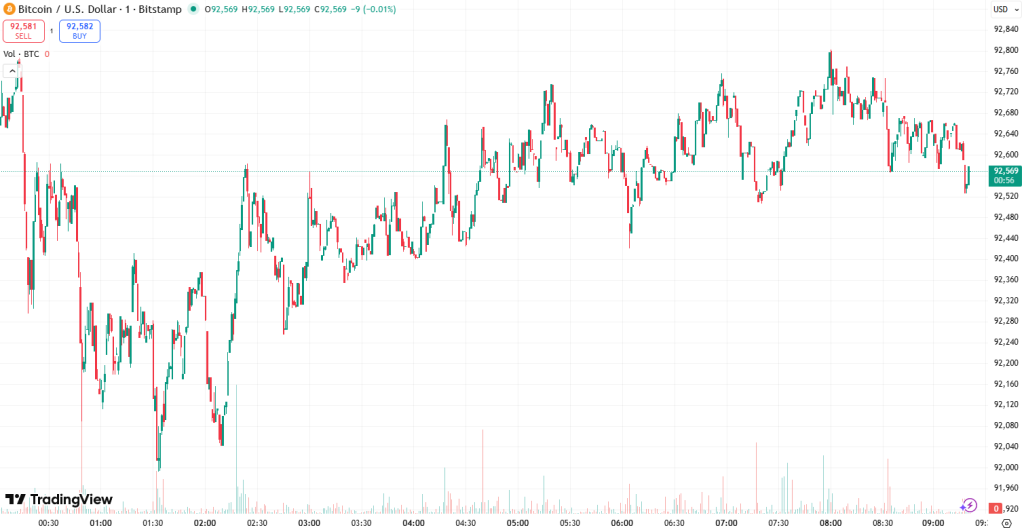
Bitcoin is holding $92,000 heading into the presser, with traders watching for any hawkish language about “patience” or “data-dependent” policy that could dampen aggressive easing expectations.
The updated dot plot, released at 2pm, will show where Fed officials see rates ending in 2025, but Powell’s tone and forward guidance will determine whether crypto interprets today’s likely 25-basis-point cut as dovish or hawkish.
The key risk for Bitcoin is a “hawkish cut” scenario where Powell emphasizes labor market strength (191K jobless claims, 7.7M job openings) as justification for slowing the pace of easing despite improving core inflation (2.8%).
Any mention of skipping the January meeting or reducing 2025 cuts from four to two would be bearish for risk assets.
Conversely, if Powell stresses that inflation is moving toward the target and the Fed remains committed to normalizing rates, Bitcoin could break above $92,000 resistance.
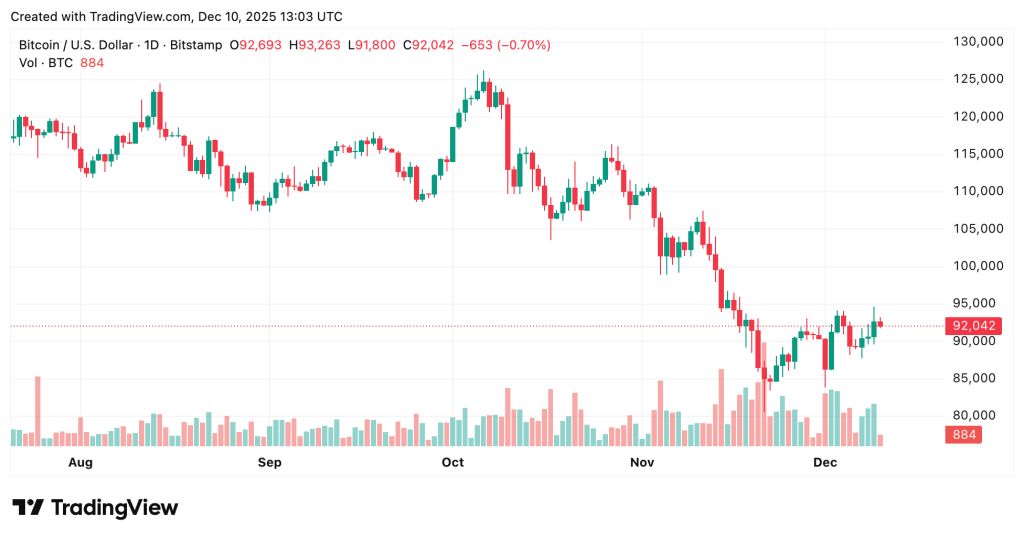
Bitcoin’s technical setup shows resistance at $92,000 and support at $88,000-$90,000, with the descending trendline since mid-November still intact.
Traders will parse every word from Powell for clues on the January 28-29 FOMC meeting and the overall 2025 trajectory.
The Fed’s credibility is on the line after ending QT and cutting rates twice—backing away from easing now would signal either policy error or genuine concern about sticky inflation.
Powell speaks at 2:30 pm ET, and crypto volatility is expected to spike immediately after.
Powell Press Conference: 2025 Guidance is the Real Story
The Federal Reserve announces its December interest rate decision at 2:00 PM ET today, with Chair Jerome Powell’s press conference following at 2:30 PM ET.
Bitcoin is trading around $92,000 as markets price in an 89% chance of a rate cut that would lower the federal funds rate to 3.50%-3.75%.
The decision comes after a week of conflicting economic signals, including shockingly strong jobless claims (191K vs 219K expected, lowest since 2022), cooling core PCE inflation (2.8% from 2.9%), and yesterday’s JOLTS data showing job openings unchanged at 7.7 million with quits declining 276,000 year-over-year.
The combination of labor market stability and improving inflation supports the case for easing, but some Fed officials have expressed concern about cutting too aggressively, with employment still resilient.
This marks the Fed’s third policy meeting since beginning its easing cycle with a 50 basis point cut in September, followed by another 25 basis point reduction in October.
The central bank officially ended quantitative tightening on December 1, freezing its balance sheet at $6.57 trillion after draining $2.39 trillion from markets since June 2022.
Markets are focused not just on today’s decision but also on Powell’s guidance for 2025. The updated dot-plot projections could signal whether the Fed sees two, three, or four more cuts next year.
Any hawkish shift suggesting fewer cuts in 2025 would likely pressure Bitcoin and risk assets, while dovish guidance reinforcing the easing cycle could provide the catalyst for Bitcoin to break above $92,000 resistance.
Bitcoin’s technical setup shows critical resistance at $92,000 and the descending trendline that’s capped rallies since mid-November, with support holding at $88,000-$90,000. Total crypto market cap sits at $3.23 trillion.
Source: TradingView
The key risk for crypto is a “hawkish cut”—where the Fed reduces rates 25 basis points today but signals a slower pace of easing in 2025 due to sticky inflation or resilient employment.
Powell’s 2:30 PM press conference will be scrutinized for any hints about the January meeting and the overall trajectory of policy.
With the Fed’s liquidity pivot complete (QT ended) and inflation moving in the right direction, the path of least resistance for Bitcoin is higher—but only if Powell doesn’t pour cold water on aggressive 2025 easing expectations.
Fed Decision Day: Markets Brace for Rate Cut or Hawkish Surprise
The crypto market is up today, with the cryptocurrency market capitalisation increasing by 2.6% to $3.25 trillion. 92 of the top 100 coins have gone up over the past 24 hours. At the same time, the total crypto trading volume is at $147 billion.
TLDR:
Crypto market cap increased by 2.6% on Wednesday morning (UTC);
92 of the top 100 coins and 9 of the top 10 coins have gone up today;
BTC increased by 2.3% to $92,694, and ETH is up by 6.6% to $3,331;
The $90,000 level looks like the bottom for now;
A consolidation period between $90,000 and $95,000 over the coming weeks is likely;
Investors await the US Fed rate cut decision today;
Changpeng Zhao argued that BTC could see a major rally in 2026;
Investors should monitor the effects of the news flows on dollar dynamics and safe-haven demand;
The US allowed national banks to act as intermediaries in crypto trades;
US BTC and ETH spot ETFs saw inflows on Tuesday of $151.74M and $177.64M, respectively;
Strive Asset Management plans to acquire more BTC;
Crypto market sentiment posted a notable increase within the fear zone.
Crypto Winners & Losers
At the time of writing, 9 of the top 10 coins per market capitalization have seen their prices increase over the past 24 hours.
Bitcoin (BTC) is up by 2.3% since this time yesterday, currently trading at $92,694.
Bitcoin (BTC)
24h7d30d1yAll time
Ethereum (ETH) is up by 6.6%, now changing hands at $3,331. This is the category’s highest increase today.
The second-highest rise is Solana (SOL)’s 4.4%, trading at $139.
Traders are focused on the US Federal Reserve’s decision on the interest rate cut expected to be announced today. However, many argue that the cut is already priced in.
Koinly CEO Robin Singh commented that BTC’s recent uptick to almost $93,000 ahead of the US Federal Reserve rate cut decision “clearly signals that bulls are firmly defending the $90,000 level, which is now looking like the bottom, at least, for now.”
According to Singh,
“From here, a period of consolidation between $90,000 and $95,000 over the coming weeks is a ‘probably outcome’, as the market waits for a new catalyst capable of driving the next leg higher.”
However, that kind of pause should not be seen as a negative, he argues. Much of 2024 was defined by consolidation, but a major macro catalyst – in that case, the outcome of the US presidential election – triggered a sharp rally across markets.
He continues: “Periods like this often signal maturation rather than weakness, with Bitcoin holding its ground even in the absence of immediate drivers for fresh momentum.”
Moreover, Bitunix analysts noted that geopolitical uncertainty is rising, so the crypto market sentiment remains cautious.
Notably, “within the negotiation framework, the U.S., Ukraine, and Europe remain locked in a three-way tug-of-war. If ongoing negotiation headlines continue to fuel safe-haven demand, volatility may be driven by a combination of macro sentiment and liquidity positioning,” the analysts said.
For now, BTC is watching resistance at $93,200, with support at $90,000–$91,000.
They advise investors to monitor the effects of the news flows on dollar dynamics and safe-haven demand, and to assess whether geopolitical noise may spill over into broader risk-asset volatility.
Levels & Events to Watch Next
At the time of writing on Wednesday morning, BTC stood at $92,694. The prise recorded a clear jump from the intraday low of $90,040 to the intraday high of $94,489.
However, the charts turned red in the 7-day period. BTC is now down 0.3%, but such a small move also means that it’s largely unchanged in this timeframe.
If the coin reclaims the $98,000–$100,000 range, it could push forward to $105,000 and $110,000. However, if it drops below $90,000, it could pull back to the $82,000–$85,000 zone.
Bitcoin Price Chart. Source: TradingView
Ethereum is currently changing hands at $3,122. Like BTC, it saw a significant jump earlier in the day, climbing from the day’s low of $3,099 to the high of $3,388.
That said, unlike BTC, ETH remains green in the 7-day timeframe, appreciating 8.6%.
ETH supply has hit a 10-year low, a setup for major rallies. The price could proceed towards $3,400, followed by the $3,500-$3,600 range. Should it pull back, the price may fall to the $2,900 level.
Ethereum (ETH)
24h7d30d1yAll time
Meanwhile, the crypto market posted a notable increase on Wednesday morning, even if it still remains in the fear territory. The crypto fear and greed index rose to 30 today from 25 yesterday.
It seems that market participants remain highly cautious while experiencing a mild increase in optimism.
Even though many argue that the US rate cut is already priced in, today’s news could still affect the sentiment.
ETFs Go Green Again
Following a day of outflows, the US BTC spot exchange-traded funds (ETFs) recorded $151.74 million in inflows. The total net inflow now stands at $57.71 billion.
Of the twelve BTC ETFs, a whopping eight recorded inflows, and one saw outflows. BlackRock accounts for the entirety of the negative flows: $28.76 million.
At the same time, Fidelity saw the highest amount of inflows of $198.85 million, followed by Grayscale’s $33.79 million and Bitwise’s $16.22 million.
Moreover, the US ETH ETFs posted another day of positive flows on 9 December, with $177.64 million in inflows. This is the highest amount since late October. The total net inflow now stands at $13.09 billion.
Of the nine funds, seven recorded inflows, and none saw outflows. Fidelity took in the most on Tuesday: $51.47 million.
It’s followed by Grayscale’s $45.19 million and BlackRock’s $35.29 million.
Meanwhile, Vivek Ramaswamy’s Strive Asset Management has announced a $500 million preferred stock offering, aiming to acquire more BTC. It currently holds 7,525 BTC, worth some $695.93 million.
OCC Interpretive Letter 1188 confirms that a national bank may engage in riskless principal crypto-asset transactions as part of the business of banking. https://t.co/gXirMExhCipic.twitter.com/uPRFGqb2NZ
The crypto market recorded an increase over the past 24 hours, and the US stock market closed mixed during its previous session. By the closing time on Tuesday, 9 December, the S&P 500 was down by 0.088%, the Nasdaq-100 increased by 0.16%, and the Dow Jones Industrial Average fell by 0.38%. Investors expect the US Federal Reserve to lower their policy rate by a quarter percentage point today.
Is this rally sustainable?
The market is expected to continue moving in this tight range we’ve been observing for the past month, though major macroeconomic prompts could push it outside that range – in either direction.
Abu Dhabi’s Mubadala Capital has entered a collaboration with institutional RWA infrastructure provider Kaio to study how digital rails can support tokenized access to private market strategies.
Key Takeaways:
Mubadala Capital is exploring tokenized private market access with Kaio.
The partnership reflects rising institutional interest in RWAs.
Tokenized assets continue gaining momentum as infrastructure improves.
Announced Tuesday, the partnership will focus on testing how Kaio’s framework could allow institutional and accredited investors to access Mubadala Capital’s private market products onchain.
While the work remains exploratory, it reflects growing interest in using RWA tokenization to modernize fund structures traditionally restricted by steep minimums, long lockups and jurisdictional limits.
Mubadala Capital Manages $430B Across Global Markets
Mubadala Capital oversees and advises on more than $430 billion across private equity, credit, real estate and alternative strategies.
It operates as a subsidiary of Mubadala Investment Company, one of Abu Dhabi’s major sovereign wealth funds.
The group’s broader digital-asset positioning has drawn attention recently. In November, Bloomberg reported that the Abu Dhabi Investment Council, another Mubadala subsidiary, held at least $500 million in BlackRock’s spot Bitcoin ETF.
In Tuesday’s announcement, Fatima Al Noaimi and Max Franzetti, co-heads of Mubadala Capital Solutions, said the goal is to work with regulatory-aligned infrastructure to understand how tokenization can broaden access to institutional-grade vehicles.
Big news! We are proud to announce our collaboration with @Mubadala Capital to explore tokenized access to their private market investment strategies.
By leveraging our compliant tokenization framework, we are enabling new global access channels while maintaining the highest… pic.twitter.com/uKRkn8mTJu
Kaio brings prior experience in the sector, having helped structure tokenized feeder funds for firms such as BlackRock, Brevan Howard and Hamilton Lane.
The company has moved more than $200 million in institutional assets onchain and says the Mubadala initiative underscores momentum behind onchain investment products.
“This launch demonstrates how traditional institutional capital is now scaling onchain,” Kaio CEO Shrey Rastogi said.
The move places Mubadala among a growing cohort of institutional players studying whether tokenized mechanisms can cut operational friction and eventually expand global participation.
CoinShares data shows strong demand for RWAs in 2025, particularly tokenized US Treasurys, which grew from $3.9 billion to $8.6 billion this year. The firm expects the trend to continue into 2026 as appetite for dollar-based yields remains elevated.
Infrastructure is also evolving to support the shift. On Wednesday, Polygon deployed a hard fork aimed at strengthening performance for high-frequency applications such as stablecoins and tokenized RWAs.
RWA Tokenization Gains Momentum
On Monday, Libeara, the blockchain infrastructure platform backed by Standard Chartered’s venture arm SC Ventures, rolled out a new tokenized gold investment fund in Singapore, bringing one of the world’s oldest safe-haven assets onto digital rails.
The fund, launched in partnership with FundBridge Capital, allows professional investors to gain exposure to gold through blockchain-based tokens issued on Libeara’s ledger.
Animoca researchers Andrew Ho and Ming Ruan said the global market for private credit, treasury debt, commodities, stocks, alternative funds, and bonds represents a vast runway for growth.
“The estimated $400 trillion addressable TradFi market underscores the potential growth runway for RWA tokenization,” they wrote.
The US Treasury’s Financial Crimes Enforcement Network (FinCEN) has fined peer-to-peer crypto marketplace Paxful $3.5 million.
Key Takeaways:
FinCEN fined Paxful $3.5M for willfully enabling over $500M in suspicious crypto transfers.
Regulators said Paxful ignored basic AML rules, including MSB registration and SAR filings.
Paxful later shut down amid regulatory pressure, staff losses, and internal legal disputes.
The regulator accused the company of willfully violating federal anti-money laundering laws and allowing more than $500 million in suspicious transfers linked to high-risk jurisdictions and criminal activity.
According to FinCEN, Paxful facilitated transactions tied to Iran, North Korea, Venezuela, and even Backpage.com, the notorious classifieds site seized in 2018 for enabling sex trafficking.
Regulators said Paxful failed to implement even the most basic requirements of the Bank Secrecy Act (BSA), including registering as a money services business, maintaining an anti-money-laundering program, and filing suspicious activity reports.
“For years, Paxful disregarded its BSA obligations and facilitated transactions associated with illicit activity and high-risk jurisdictions,” FinCEN Director Andrea Gacki said.
Paxful acknowledged that it willfully violated federal law. The consent order highlights major compliance lapses during the years in which Paxful operated without adequate oversight, largely due to failures by former leadership.
FinCEN said the company has since taken steps to correct past misconduct, including firing senior figures responsible for the violations and conducting an internal review to identify suspicious activity previously left unreported.
Regulators from multiple federal agencies assisted in the case, including the Justice Department’s Money Laundering and Narcotics section, the US Attorney’s Office for the Eastern District of California, and Homeland Security Investigations.
— Financial Crimes Enforcement Network (FinCEN) (@FinCENnews) December 9, 2025
The agency emphasized that firms involved in digital assets must adjust their controls to match the risks inherent in dealing with crypto, especially exposure to sanctioned jurisdictions and anonymous transfers.
CEO Ray Youssef cited multiple factors behind the shutdown, including major staff departures, increasingly burdensome US regulatory requirements, and a lawsuit filed by a co-founder, reportedly Artur Schaback.
He said compliance demands had grown so intense that even dedicating a quarter of Paxful’s workforce to compliance was not enough.
The company also lacked the resources to continue operating while blocking US users, making a full marketplace suspension unavoidable.
B.C. Seizes Over $1M in Gold, Cash Linked to QuadrigaCX Co-Founder
As reported, British Columbia has secured a major legal victory after obtaining a court order to seize more than $1 million in gold, cash, and luxury goods tied to QuadrigaCX co-founder Michael Patryn.
The forfeiture comes under the province’s unexplained wealth order regime, which requires individuals to prove their assets were acquired lawfully.
Patryn chose not to contest the action, allowing authorities to move forward with liquidating the seized items.
The seized assets were discovered in a Vancouver safety deposit box and included 45 gold bars, luxury watches, jewelry, and a loaded .45-caliber pistol.
At today’s prices, the gold alone is worth over $800,000. The province’s civil forfeiture office alleges these items were purchased using misappropriated QuadrigaCX customer funds, citing evidence gathered during a broader RCMP investigation.
Hundreds of crypto wallets linked to the now-defunct Silk Road darknet marketplace awakened from a decade-long slumber on Tuesday, transferring over $3 million in Bitcoin to a single unidentified address.
The sudden activity has sparked renewed attention to digital assets tied to the notorious platform that helped popularize Bitcoin in its early years.
Blockchain intelligence firm Arkham detected approximately 312 dormant wallets collectively moving $3.14 million in BTC to the address “bc1q***ga54” over 12 hours.
The wallets still retain roughly $40 million in Bitcoin following the transfers, according to Arkham’s latest data.
The reason behind the wallets’ reactivation remains unclear.
Coinbase Director Conor Grogan identified these holdings earlier this year, estimating that they were worth around $47 million in Bitcoin across dozens of addresses potentially linked to Ross Ulbricht, the marketplace’s creator.
Grogan resurfaced that January analysis on Tuesday after a pseudonymous operator “0xG00gly” flagged the latest movements.
Individual transfers ranged from micro-amounts of 0.00006 BTC, roughly $5.58, to larger sums exceeding 3.6 BTC, valued at $338,640.
The transactions followed a pattern of consolidation, with funds from multiple legacy addresses flowing into the single destination wallet over several hours.
Several wallets showed connections to mining activity from the 2011 era, when Bitcoin mining remained accessible to individual participants using standard computer equipment.
Ulbricht himself has not publicly commented on the transfers.
He served multiple life sentences without parole for creating Silk Road before receiving a full and unconditional pardon from President Donald Trump in January through executive order.
While Silk Road facilitated illegal narcotics sales and other prohibited transactions, the platform played a pivotal role in Bitcoin’s early adoption.
The marketplace processed over 1.5 million transactions worth an estimated $213 million between 2011 and its 2013 shutdown, all conducted using cryptocurrency.
Ulbricht, a physics graduate and early Bitcoin advocate, envisioned the platform as a libertarian experiment in anonymous commerce free of government interference.
However, prosecutors successfully argued that it enabled widespread criminal activity.
Government Bitcoin Holdings Face Competing Policy Directions
The wallet activity emerges amid ongoing debates over how authorities should handle seized digital assets.
The Department of Justice received approval in December to sell 69,370 Bitcoin, worth $6.5 billion, confiscated from Silk Road, following a federal judge’s ruling that ended a contentious ownership battle with Battle Born Investments.
That company claimed ownership through a bankruptcy estate tied to Raymond Ngan, allegedly the mysterious “Individual X” accused of stealing crypto from Silk Road.
Battle Born lost at every judicial level, including the Supreme Court’s refusal to hear the case.
The company’s attorney criticized what he called “the DOJ’s abuse of the Civil Asset Forfeiture process” and accused officials of “procedural trickery” throughout the litigation.
The approved sale represents one of the largest government cryptocurrency liquidations in history.
Officials justified the decision, citing Bitcoin’s price volatility, though they typically conduct such sales in smaller batches to minimize market disruption.
The decision came despite Trump’s campaign promise to establish a “Strategic Bitcoin Reserve” rather than liquidating government-held cryptocurrency.
The proposed reserve would mirror the Strategic Petroleum Reserve, retaining all seized digital assets to manage economic risks.
Similar dormant wallet movements have triggered security concerns before.
Some observers linked those holdings to Roger Ver, the early Bitcoin advocate arrested in Spain on tax charges, though no confirmation emerged.
Bitcoin’s price has remained relatively stable despite these large-scale transfers. The cryptocurrency traded near $92,500 on Wednesday, up 2.5% as traders awaited the Federal Reserve’s final rate decision of the year.
Ethereum co-founder Vitalik Buterin has issued a sharp warning to Elon Musk, expressing concern that X’s evolution from a platform championing free speech to a tool for organizing targeted hate could trigger a global backlash and ultimately undermine the very freedoms Musk claims to defend.
In a series of posts, Buterin said that public discourse around Europe — including from individuals he previously viewed as “interesting and sophisticated” — has grown “unhinged,” fuelled by increasingly aggressive online narratives.
@elonmusk I think you should consider that making X a global totem pole for Free Speech, and then turning it into a death star laser for coordinated hate sessions, is actually harmful for the cause of free speech. I'm seriously worried that huge backlashes against values I hold…
While he acknowledged legitimate criticisms of the EU, citing GDPR “clickthroughs” and “Chat Control” as policies needing reform, Buterin cautioned that the tone and coordination of these attacks signal something more dangerous.
Addressing Musk directly, Buterin wrote that turning X into “a global totem pole for Free Speech, and then turning it into a death star laser for coordinated hate sessions” is “harmful for the cause of free speech.”
He added that he is worried about the long-term consequences, warning of “huge backlashes against values I hold dear” emerging within a few years if the platform continues allowing escalation rather than debate.
The Debate Over Europe: Too Much Unity or Not Enough?
The comments triggered a wider conversation on X about Europe’s geopolitical role. One user argued that those advocating for a weakened Europe misunderstand global power dynamics, claiming international actors “drool” over the idea of dissolving EU unity and fear it may eventually federalize.
Buterin responded that he supports the idea of the EU — a shared experiment delivering the benefits of a superstate without the aggressive posture of a world power — but emphasized the union remains “a work in progress.” According to him, the balance is off: not enough unity in foreign policy and too much unity where it becomes bureaucracy and surveillance.
“If the experiment can be improved and thrives,” Buterin wrote, “it’s a model that could set a really good example for the world.”
The Free Speech Paradox Tech Platforms Now Face
Buterin’s intervention joins a growing list of voices wrestling with the same tension: Where is the line between free expression and coordinated harm? And — perhaps more importantly — who draws that line?
Musk has positioned X as a refuge against censorship after acquiring the platform in 2022. But critics argue that what began as a defense of open expression has enabled harassment networks, misinformation, and political agitation at scale.
Buterin’s warning reframes the debate not as left vs. right, or pro-EU vs. anti-EU, but as a structural risk. Empowering free speech while avoiding the weaponization of online mobs may determine whether social platforms protect democratic values — or destabilize them.
The Office of the Comptroller of the Currency confirmed that national banks may engage in riskless principal crypto-asset transactions, eliminating a key barrier between traditional banking and digital assets.
The decision allows banks to act as intermediaries in crypto trades by simultaneously buying from one customer and selling to another without holding inventory.
Banks can now facilitate client crypto trades while assuming only minimal settlement and credit risk.
OCC Interpretive Letter 1188 confirms that a national bank may engage in riskless principal crypto-asset transactions as part of the business of banking. https://t.co/gXirMExhCipic.twitter.com/uPRFGqb2NZ
Banking’s Crypto Gateway Opens Under New Framework
In Interpretive Letter 1188, senior deputy comptroller Adam Cohen said the activity falls squarely within the business of banking because it mirrors existing brokerage functions.
National banks have long acted as financial intermediaries in securities, derivatives, and other asset classes through riskless principal transactions, taking momentary ownership to bridge buyer and seller.
The OCC applied the same logic to crypto-assets, noting that banks eliminate market risk through offsetting trades while retaining limited exposure to counterparty defaults.
Cohen emphasized that the authority extends beyond securities to any crypto-asset, including those not classified under federal securities law, because the transactions align with banks’ traditional intermediary role.
Meanwhile, the regulator dismissed concerns about operational complexity, arguing that banks already manage similar risks when settling securities via electronic ledgers.
Cohen said distributed ledger technology simply represents a modern method of recording transactions, no different in principle from book-entry settlement systems that banks have used for decades.
The decision removes a structural obstacle that forced banks to either avoid crypto trading entirely or rely on third-party intermediaries for client transactions.
By allowing direct riskless principal activity, the OCC enables banks to offer seamless crypto services while maintaining regulatory compliance and customer protections.
Banks can now serve clients who want crypto exposure without partnering with unregulated exchanges or pseudonymous counterparties.
U.S. banks officially cleared to hold crypto following the @USOCC policy reversal, a major win for digital assets and traditional finance. #OCC#Bankshttps://t.co/PYpmuOPZmK
The framework requires banks to implement know-your-customer protocols, transaction monitoring, and the ability to freeze or reverse transfers when necessary, features built into certain blockchain platforms, such as Stellar.
The policy also strengthens banks’ competitive position against fintech rivals and crypto-native firms seeking federal bank charters.
Several major institutions have already moved toward crypto integration, with Bank of America authorizing advisers to recommend Bitcoin ETFs and JPMorgan allowing customers to fund Coinbase accounts via Chase cards.
Regulatory Momentum Builds Across Digital Assets
The OCC’s move comes as federal agencies accelerate the development of stablecoin and tokenized deposit frameworks under the GENIUS Act.
Federal Reserve Vice Chair Michelle Bowman said the central bank is coordinating with peer agencies on standards to anchor digital assets to traditional finance.
The Treasury Department closed its second public consultation on non-bank stablecoin issuers in recent weeks, creating parallel oversight tracks that will govern the entire US stablecoin market.
Acting FDIC chair Travis Hill revealed that guidance on tokenized deposits is also underway, clarifying how blockchain-based representations of bank deposits will be treated under existing regulations.
The effort responds to growing industry interest in using distributed ledgers for payments and settlement.
Jonathan Gould, who became the OCC’s first permanent comptroller since 2020 after confirmation in July, has pushed back against banking industry complaints about approving crypto firm charters.
Speaking at the Blockchain Association Policy Summit last week, he said digital asset custody and safekeeping have operated electronically for decades, adding there is no justification for treating crypto differently.
The OCC received roughly 14 bank charter applications this year, including from Coinbase, Circle, and Ripple, all seeking federal oversight for stablecoin and custody operations.
Gould dismissed concerns about supervisory capacity, noting the agency already supervises a crypto-native national trust bank and fields daily inquiries from traditional banks launching innovative products.
A federal judge has handed prediction markets platform Kalshi a temporary shield from enforcement after Connecticut regulators accused the company of running unlicensed online gambling.
Key Takeaways:
A federal judge temporarily blocked Connecticut from enforcing its gambling order against Kalshi.
Kalshi argues its event contracts fall under the CFTC’s exclusive jurisdiction, not state gambling laws.
The Connecticut dispute is one of several state-level battles Kalshi is fighting as regulators challenge its nationwide expansion.
Connecticut’s Department of Consumer Protection (DCP) issued cease-and-desist notices on Dec. 2 to Kalshi, Robinhood, and Crypto.com, alleging they were offering unlicensed sports wagering through “online sports event contracts.”
Judge Halts Connecticut Action as Kalshi Claims Federal Oversight
A day later, Kalshi sued the agency, arguing that its event contracts fall squarely under federal derivatives law and that the Commodity Futures Trading Commission (CFTC), not individual states, has “exclusive jurisdiction” over its platform.
On Monday, Judge Vernon Oliver ordered the DCP to refrain from taking action while the court reviews Kalshi’s request for temporary relief.
Under the schedule set by the court, the DCP must respond by Jan. 9, Kalshi will submit additional arguments by Jan. 30, and oral arguments are expected in mid-February.
Kalshi, designated by the CFTC as a federally regulated contract market, began offering event-based contracts nationwide earlier this year, including markets tied to sports, weather, and political outcomes.
JUST IN: Kalshi has sued the Connecticut Department of Consumer Protection in federal court alleging that state enforcement over sports event contracts is preempted by the CEA and it "intends to imminently seek an emergency temporary restraining order and preliminary injunction." pic.twitter.com/BdcoiPXP1a
However, the platform’s expansion has triggered a wave of state-level challenges. Regulators in several states argue that Kalshi’s contracts resemble sports bets and fall under gambling laws.
Kalshi says its products are federally regulated financial instruments, not wagers, and that state crackdowns violate the Commodity Exchange Act.
Connecticut is the latest in a string of regulatory battles. In October, Kalshi sued the New York State Gaming Commission after it issued a similar cease-and-desist order.
Massachusetts’ attorney general took the company to court in September, and Kalshi has filed suits this year against regulators in New Jersey, Nevada, Maryland, and Ohio, accusing each of overstepping their authority.
Kalshi Partners with CNN After $1B Funding Round
As reported, Kalshi has secured a major media breakthrough after signing a partnership with CNN, making the company the network’s official prediction markets partner while closing a $1 billion funding round at an $11 billion valuation.
Under the agreement, Kalshi’s real-time market data will be used inside CNN’s newsroom to support reporting on politics, economics, and major cultural events.
The funding follows a surge in activity across prediction platforms. According to Token Terminal data cited by the company, Kalshi posted record trading volume of $4.54 billion in November, beating October’s $4.49 billion.
Kalshi said weekly volumes are now exceeding $1 billion, representing growth of more than 1,000% since 2024.
Its closest competitor, Polymarket, also recorded a strong November, hitting a monthly total of $3.76 billion after crossing $3 billion in October.
Meanwhile, Mike Novogratz’s Galaxy Digital is in talks with Polymarket and Kalshi about becoming a liquidity provider, as on-chain betting on real-world events draws more attention from both retail traders and Wall Street.
The Tajikistan parliament has approved revisions to the Criminal Code, introducing Article 253(2), which imposes penalties on miners minting crypto using stolen electricity.
The article stipulates a fine of $1,650 to $8,250 for violators or imprisonment from two to five years. However, for the illegal use of power for crypto mining on an “especially large scale,” the prison term is from five to eight years, per a local media report.
On December 3, members of the Tajik parliament reviewed and adopted the amendments to the Criminal Code, presented by Attorney General Khabibullo Vokhidzoda.
Counsel Vokhidzoda also warned that electricity theft by crypto miners in several cities has already contributed to regional power outages.
“The illegal circulation of virtual assets facilitates a number of crimes, such as the theft of electricity, material damage to the state, money laundering, and other offences,” Vokhidzoda said.
He previously flagged damages from illegal mining operations, causing 32 million somoni (nearly $3.52 million), which led to four to five criminal cases, according to The Diplomat.
Besides, following China’s crypto mining ban in 2021, many operators, including those from Russia, moved to Central Asia, attracted by low energy costs and relaxed regulation.
As of August 2025, Tajikistan has been pursuing 190 criminal cases related to the illegal use of electricity. Further, the Diplomat report added that these cases involved 3,988 individuals who allegedly caused damages worth $4.26 million.
MP Shukhrat Ganizoda emphasized that miners connect thousands of ASIC crypto mining devices to Tajikistan’s power grid.
“Those committing such crimes seek to use electricity without meters or through other illegal means to produce such assets,” he explained.
According to Shukhrat Ganizoda, the new legislation aims to prevent tax evasion schemes and unauthorized electronic encryption.
Additionally, the revisions will also deter attempts to circumvent commodity tracking systems. The bill will be effective after President Emomali Rahmon signs it into law.
Rep. Keith Self (R-Texas) on Tuesday introduced an amendment to the massive annual defense bill that would block the creation of a US central bank digital currency.
Key Takeaways:
Rep. Keith Self moved to add an anti-CBDC amendment back into the defense bill.
Conservatives say GOP leaders broke a promise to include CBDC restrictions.
The amendment would block a Fed digital dollar and protect cash-like privacy.
Self said GOP leaders had previously promised that anti-CBDC language would be included in the legislation, but it was missing from the version released Sunday.
“Promises were broken to include this language in the NDAA,” he wrote on X. “My amendment would fix the bill.”
House Pushes Ahead on Defense Bill as Self Seeks to Block Fed Digital Dollar
House leaders are aiming to pass the defense package on Wednesday afternoon, according to Politico, though negotiations remain fluid.
Self’s proposal, titled the “Anti-CBDC Surveillance State” amendment, would bar the Federal Reserve from developing, testing, or issuing a central bank digital currency, or any similar digital asset under a different name.
It would also prohibit Federal Reserve banks from offering accounts or financial services directly to individuals, a move supporters say is critical to preventing government-controlled consumer banking.
The amendment includes an exception for “dollar-denominated currency that is open, permissionless, and private,” a carve-out aimed at ensuring paper-cash-level privacy protections.
The broader defense bill, formally known as the annual authorization for Pentagon spending and policy, spans more than 3,000 pages and is typically considered one of Congress’s few must-pass measures each year.
The absence of the CBDC language angered conservatives, who saw it as a retreat from earlier commitments.
Self told Fox Business that House Republicans had been promised the amendment authored by Majority Whip Tom Emmer, one of Congress’s most outspoken CBDC critics.
After reviewing the bill, Self said it was clear the provision had been dropped.
“We have to pass an NDAA, because it’s one of the must-pass bills we have in Congress,” he said. “We’ve got to fix it and get it passed.”
Conservatives were promised that language banning a Central Bank Digital Currency (CBDC) would be included in the must-pass National Defense Authorization Act (NDAA).
CBDC Could Give Government Control Over Americans’ Money
Several Republicans echoed his frustration. Rep. Marjorie Taylor Greene (R-Ga.) said she supports cryptocurrency but opposes any system that could allow the federal government to restrict how Americans use their money.
Rep. Warren Davidson (R-Ohio) warned that a CBDC would “insert the government between you and your money” and said Congress must pass a statutory ban, not rely solely on executive action.
Earlier this year, President Trump signed an executive order barring federal agencies from issuing or promoting any form of CBDC, citing risks to privacy and national sovereignty.
However, House GOP aides told The Hill that negotiations over a separate bipartisan housing package derailed efforts to include a CBDC ban in the defense bill, saying the final language “was not something that was ultimately going to be acceptable to our members.”
South Korea’s largest crypto exchange, Upbit, is pushing almost all customer assets into cold storage after a major hack on its Solana hot wallet, in one of the most aggressive security pivots yet by a big trading platform.
Operator Dunamu said it will lift the share of user funds held in cold wallets to 99% and cut hot wallet exposure to effectively 0%, after hackers stole 44.5B won, about $30m, from a connected wallet.
The overhaul takes Upbit well beyond South Korea’s Virtual Asset User Protection Act, which requires exchanges to keep at least 80% of customer deposits offline.
Upbit Pushes Hot Wallet Usage Down After Security Review
Cold wallets store digital assets while disconnected from the internet, making them far harder to breach but also slower to move. Hot wallets sit online to process deposits and withdrawals in real time, which makes them convenient for users but a prime target for attackers.
South Korea’s largest crypto exchange, Upbit, has announced it will increase the proportion of user assets stored in cold wallets (offline) to 99%, reducing the hot wallet proportion to 0%, following the theft of 44.5 billion KRW from its hot wallet by hackers. The wallet system…
For traders, a 99% cold ratio means a much smaller pool of funds is exposed if a hot wallet is ever compromised again.
In a press statement on Wednesday, Dunamu disclosed that as of the end of Oct. 2025, Upbit held 98.33% of customer assets in cold wallets and 1.67% in hot wallets.
Even before the hack, that was the lowest hot wallet share among domestic exchanges, with rivals keeping cold ratios in a range of roughly 82% to 90%, according to data released by lawmaker Heo Young.
Upbit said it maintained its cold share above 98% despite rising crypto prices and heavier flows from new listings, and has now completed a review and overhaul of its wallet infrastructure.
The company plans to drive the hot wallet ratio down to zero as it tightens its security posture.
This move follows a hack worth initially about 54B won, roughly $36M, on the Solana network, which Upbit later refined to a loss estimate of 44.5B won after an internal review.
A detailed breakdown put 38.6B won, about $26.2M, down as direct user losses, which the company has pledged to fully reimburse from its own reserves.
Tokens affected in the attack included Solana’s SOL as well as ORCA, RAY and JUP, the exchange said. Once abnormal withdrawals were detected, Upbit halted activity, shifted remaining assets into cold storage and began a forensic investigation of its systems and on chain flows.
Proposed Standards Would Require Compensation For Hacks Regardless Of Fault
Oh said engineers discovered a weakness in the exchange’s wallet software that could have allowed attackers to infer private keys by analysing public blockchain data, although Upbit has not confirmed whether that specific vulnerability was used in the breach. The company’s response suggests it is treating hot wallet exposure itself as a systemic risk that needs to be minimised, not just patched.
For the wider industry, the episode is feeding into a regulatory rethink. South Korea’s Financial Services Commission is considering rules that would impose bank-level liability standards on major crypto exchanges after the Upbit incident, including mandatory compensation for hacking and system failures regardless of fault, mirroring obligations already placed on banks and electronic payment firms under the country’s electronic financial transactions law.
If those rules take shape, exchanges operating in Korea will need both stronger security architectures and deeper capital buffers to absorb losses, bringing them closer to the expectations placed on traditional financial institutions.
Upbit’s near total shift to cold storage shows how far a leading platform is now willing to go to reassure users that their coins will not be left sitting online as an easy target.
The Solana network’s foundation is weakening as liquidity thins and profitability drops, according to on-chain data.
Key Takeaways:
Solana is undergoing a “full liquidity reset,” with realized losses exceeding profits and liquidity falling.
Exchange outflows and steady ETF inflows are providing structural support despite thinning liquidity.
Analysts see potential recovery by early January, but near-term volatility remains high.
According to Glassnode, Solana’s 30-day average realized profit-to-loss ratio has remained below 1 since mid-November, a level typically associated with bear-market behavior.
A reading under 1 means traders are realizing losses more often than profits, signalling deteriorating sentiment and reduced liquidity.
Analysts Say Solana Entering “Full Liquidity Reset”
On-chain research group Altcoin Vector described the current environment as a “full liquidity reset,” a pattern that has historically marked the beginning of new liquidity cycles and preceded market bottoms.
If the structure mirrors April’s setup, analysts said liquidity could begin to recover in roughly four weeks, pointing to early January for potential renewed momentum.
A key lesson in alt positioning: when liquidity ignites, the move is fast.$SOL is under a full liquidity reset, setting a new liquidity cycle, as in past bottoming phases.
Forced selling exhausts, the ecosystem cleans from the inside out, and SOL begins building the base for… pic.twitter.com/tiLw6gwhdb
Despite the pressure, Solana isn’t without support. Persistent withdrawals from centralized exchanges have steadily reduced available supply, while demand from ETF buyers continues to build.
Spot Solana ETFs recorded $17.72 million in net inflows so far this week, nearly matching last week’s $20.30 million, according to SoSoValue.
Still, the broader environment remains fragile. Elevated leverage across crypto markets has amplified volatility, with CoinGlass reporting $432 million in liquidations over the past 24 hours.
Solana accounted for $15.6 million of that, making it the third-most liquidated asset behind Bitcoin and Ethereum, as the token climbed 3.2% on the day, per CoinGecko.
Analysts say the mid- to long-term outlook for Solana remains slightly constructive, especially if macro uncertainty clears and liquidity returns to the market.
However, in the near term, shrinking profitability, thinning liquidity, and heavy leverage leave the asset vulnerable to sharp swings.
As reported, Pye Finance has revealed a $5 million seed round led by some of the major players in the space. The goal is to turn billions in locked SOL stakes into an active yield market.
Variant and Coinbase Ventures led this round, with participation from Solana Labs, Nascent, Gemini, and others, according to the press release.
Pye says that it’s building bond markets for validators and stakers on Solana (SOL). The platform enables validators to draw and keep stake. They can offer rewards across more than a thousand validators.
Fed Liquidity Boost Could Send Bitcoin “Sharply Higher”
As reported, Bitcoin’s climb above $92,000 has stirred fresh optimism among market watchers who now believe this week’s Federal Reserve meeting could set off a far bigger rally.
Analysts at the London Crypto Club say a liquidity boost from the Fed on Wednesday may act as a powerful catalyst, potentially driving the world’s largest cryptocurrency “sharply higher.”
In their latest note, David Brickell and Chris Mills argue that the central bank is poised to deliver a “dovish surprise,” forecasting that policymakers will inject liquidity through a creative bond-buying mechanism rather than explicit quantitative easing.
“We’re moving into a continued rate-cutting cycle accompanied by balance sheet expansion as the Fed effectively turns on the money printers to monetise the deficit,” they wrote.
Analysts say the divergence suggests renewed underlying demand, with dormant coins moving at levels not seen in years, a sign that long-term holders may be re-entering the market.
Last week, Bitfinex said the market is showing “seller exhaustion” following a period of heavy deleveraging and panic-driven exits by short-term holders.
Vivek Ramaswamy’s Strive Asset Management has announced a $500 million preferred stock offering, with proceeds earmarked for Bitcoin acquisition.
Strive already holds 7,525 BTC, per BitcoinTreasuries data, worth $695.93 million, and stands 14th among top corporate Bitcoin holders.
With the latest stock sales announcement, Strive intends to use the net proceeds “for general corporate purposes,” including “the acquisition of Bitcoin and Bitcoin-related products and for working capital.”
Further, the asset manager also plans to purchase unspecified “income-generating assets,” fund acquisitions of businesses and technologies.
Strive announces $500,000,000 SATA At-The-Market (ATM) program.
The program builds on the success of the upsized SATA IPO offering and will provide the company with additional capital for general corporate purposes, including acquiring more Bitcoin.
Strive first announced its intention to purchase Bitcoin in May with a merger. It later revealed plans to acquire 75,000 BTC, then valued at over $8 billion, from claims related to the defunct Mt. Gox exchange bankruptcy.
Strive’s recent Bitcoin buying spree reflects Michael Saylor’s playbook, representing another public company focused on increasing Bitcoin per share.
Strive Stocks Up 3.57% – Recent Move Triggers Investor Enthusiasm
The company’s stock [NASDAQ: ASST] is trending up by 3.57% on Tuesday, surging up to $1.12 followed by an apparent Downtrend to $1.02.
Per the company’s stock data, over the past 52 weeks, it has traded between a high of $13.42 and a low of $0.34. This narrative hints at an opportunistic market, where swings could suggest potential buyer opportunities.
The crypto market sentiment showed early signs of stabilization today, with the Fear and Greed Index rising to 26 from yesterday’s 22, shifting the market out of “extreme fear” zone. The improvement coincided with a broad market rebound across major sectors. AI-linked tokens led gains with a 4.46% sector surge, driven by strong performances from FET (+9.6%), Worldcoin (+6.5%), and Virtuals Protocol (+5.5%). Bitcoin climbed 2.49% to reclaim the $92,000 level, while Ethereum rallied 6.21%, briefly pushing past $3,300. Meme coins, Layer 2s, DeFi, and Layer 1s also recorded solid advances, underscoring a short-term shift toward risk-on sentiment.
But what else is happening in crypto news today? Follow our up-to-date live coverage below.
Binance founder Changpeng Zhao has warned users that the WeChat account of the exchange’s new co-chief executive, Yi He, was hacked and used to promote a meme coin.
Zhao said the attackers used Yi He’s account to push meme coin promotions and urged followers not to engage.
He wrote that “Web2 social media security is not that strong. Stay safu!” and added, “I hope the next one isn’t my account. I haven’t used WeChat for many years. I also won’t directly promote any meme CA. Please everyone stay safe.”
Meanwhile, Yi He said she stopped using WeChat long ago and that the linked phone number was taken over, leaving her unable to regain access.
Someone hacked @heyibinance’s WeChat account. Do not buy meme coins from the hackers posts.
Co-founder Richard Teng described her as a “driving force since day one,” crediting her with shaping the exchange’s culture, vision and user focus, and said her promotion marked a natural evolution of leadership as Binance pursues its goal of reaching one billion users.
On-chain data suggests the hack was quickly turned into a trading scheme. Blockchain analytics account Lookonchain described the incident as a straightforward hacked account pump and dump built around a little-known token called Mubarakah, or MUBARA, which trades on decentralized exchanges.
Fake Endorsement Triggered Sudden Surge In MUBARA Price And Volume
According to that analysis, an attacker gained access to Yi He’s WeChat and used the apparent endorsement to stir fear of missing out around MUBARA.
Two new wallets, created only hours earlier, began accumulating the token via PancakeSwap and other decentralized exchange routes, spending a total of 19,479 USDT to buy about 21.16M MUBARA.
As the WeChat promotion circulated and traders chased the move, the token’s price and volume spiked sharply on Dexscreener charts.
Attacker Sold Into The Pump After Liquidity Flooded In
Once liquidity arrived, the wallets started to sell into the rally. Lookonchain estimates that the attacker has already sold 11.95M MUBARA for 43,520 USDT and still holds 9.21M tokens worth roughly $31,000, putting the profit near $55,000 with more tokens left to unload.
In practical terms, the attacker front-ran the market by buying early, used the compromised account to pull in retail demand, then dumped a large chunk of the position into that surge, leaving later buyers exposed to a rapid reversal in price.
The remaining holdings give the hacker additional room to sell if liquidity persists.
Good morning, Asia. Here’s what’s moving before the bell.
Bitcoin edged up toward $92,000 on Wednesday while Asian stocks slipped, as traders braced for the US Federal Reserve’s final rate decision of the year and tried to gauge how hawkish the central bank will sound after an almost certain cut.
Equity markets across the region tracked a soft lead from Wall Street. The S&P 500 ended slightly lower on Tuesday, with JPMorgan acting as the biggest drag after the bank warned of hefty expenses in 2026, adding another layer of caution to a market already on edge about policy signals.
The Fed began its two-day meeting on Tuesday, and futures markets still point to a quarter percentage point cut, even though inflation remains above the 2% target.
Some in the market see politics creeping into the calculus. Ruslan Lienkha, chief of markets at YouHodler, said an expected cut amid slightly rising inflation “may be driven more by political considerations than by sound economic reasoning.”
He added that he expects Powell to try to offset the move with hawkish language, a mix he believes could weigh on risk assets. “A hawkish message could increase selling pressure on the already fragile US equity markets, which could, in turn, negatively affect BTC and the broader crypto market,” he said.
Others are already tempering their year-end Bitcoin hopes. Nic Puckrin, investment analyst and co founder of The Coin Bureau, said, “If Powell does indeed deliver a hawkish speech, the likelihood of a Santa rally for Bitcoin diminishes.”
He noted that momentum has not been on Bitcoin’s side recently despite fresh purchases from Michael Saylor’s firm, and said the market “may well finish 2025 under $100,000.”
Inflation And Labor Data Add To Confusion Over Policy Direction
The macro backdrop is not offering much clarity. Fed officials have sent mixed messages, with some warning that inflation could reaccelerate and others sounding more concerned about the labour market.
A Labor Department report on Tuesday showed job openings rising only marginally in October and hiring still subdued, while a separate survey from the National Federation of Independent Business pointed to plans for new hiring in the months ahead.
That tension has pushed more attention onto the Fed’s dot plot, its economic projections and every line of Powell’s press conference. Swings around rate decisions have become one of the main drivers of equity volatility over the past six weeks, often overshadowing debates about an AI bubble or the impact of President Donald Trump’s trade policies on corporate earnings and risk sentiment.
Slower Easing Path Threatens Liquidity Trade That Crypto Relies On
Pricing in money markets shows how expectations have cooled. Traders now see around two cuts in 2026 after a likely quarter point reduction on Wednesday, a pullback from the more optimistic views that circulated only weeks earlier.
For Bitcoin and other digital assets, a slower easing path can mean tighter dollar liquidity and more pressure on the “liquidity trade” that helped fuel previous rallies.
Personnel questions at the Fed are also in the mix. Kevin Hassett, viewed as the frontrunner in Trump’s search to replace Powell, said at an event on Tuesday that he sees room to lower rates substantially, and even more than a single quarter point move.
His comments fed speculation that the longer term policy stance could shift if the White House reshapes the central bank’s leadership in 2026.
Investors have been steadily pouring capital into SOL-linked exchange-traded funds (ETFs) for six consecutive weeks.
With technical indicators also flashing buy signals, the question now is whether this consistent inflow will fuel a breakout and shift the current Solana price prediction toward new highs.
Last week, $20 million flowed to Solana ETFs despite the latest decline that the token has experienced.
The Bitwise Solana Staking ETF (BSOL) is currently the largest of these vehicles with assets under management of $660 million, followed by Grayscale’s Solana Trust ETF (GSOL), with nearly $160 million in assets.
The staking rewards offered by the Solana blockchain make these vehicles quite attractive for passive investors, especially now that the token has hit an 8-month low at around $125.
The odds that the downturn will continue are much lower than they were a couple of months ago.
Hence, buying Solana at this level could offer both an attractive opportunity to generate passive income and capital gains if the token starts to recover after the upcoming FOMC meeting.
Solana Price Prediction: SOL Needs a Bullish Breakout Above $160 to Start Recovering
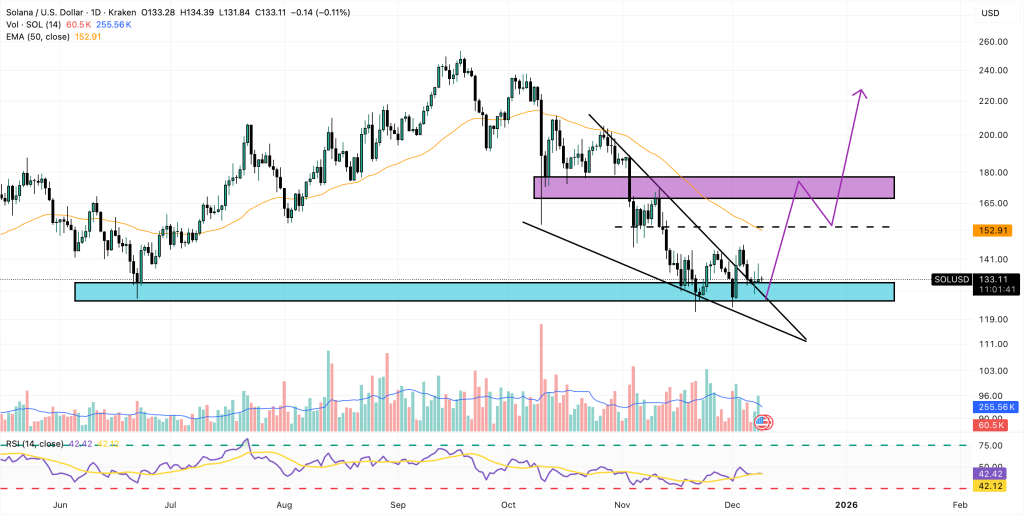
SOL rose near the $140 level yesterday, but the selling pressure is once again pushing the token back to the low 130s.
Trading volumes remain relatively low at $4 billion, accounting for less than 6% of the asset’s circulating market cap.
Historically, SOL needs trading volumes above $10 billion to get moving.
Thus far, SOL has found strong support at $130. However, volumes need to confirm that buying interest is picking up its pace before jumping to conclusions.
Ideally, the price should break through the $160 level to reverse its downtrend and confirm a bullish outlook for the next few weeks.
If that happens, the next stop will likely be $200 as SOL may commence a new uptrend as a result of this move.
Top meme coins in the Solana ecosystem had their moment earlier this year, and now seems to be the time for crypto presales to shine. One of this cycle’s hidden gems could be Maxi Doge ($MAXI), a project that has raised $4 million by tapping into the same energy as Dogecoin’s early days.
Maxi Doge Is Reviving Dogecoin’s Early Hype And $4 Million Says It’s Working
Maxi Doge ($MAXI) has already raised $4 million by channeling the same breakout energy that fueled Dogecoin in its early days.
More than just a meme coin, MAXI is creating a hub where holders can share early opportunities, trading setups, and alpha.
By building a high-energy, community-driven ecosystem, MAXI is designed to thrive in the next crypto cycle.
Through fun competitions like Maxi Ripped and Maxi Gains, traders will get the chance to earn rewards and bragging rights by sharing their best-yielding traders.
In addition, the project plans to invest up to 25% of the presale’s proceeds in promising projects, using the returns to reinvest in Maxi Doge for marketing purposes.
A supply shock scenario is brewing, fuelling bullish Ethereum price predictions as centralized exchanges now hold their lowest share of circulating supply in a decade.
The altcoin is growing in scarcity this market cycle, with adoption channels like staking, restaking, layer-2s, digital asset treasuries, and private wallets siphoning off exchange liquidity.
These pipelines have created the tightest supply conditions to date. Exchanges now control just 8.7% of circulating Ethereum, the lowest share since Ethereum went live in 2015.
Fresh exposure through U.S. TradFi products such as ETFs deepens the trend. Institutional-grade demand has driven aggressive accumulation under long-term holding strategies.
With fewer tokens available, traders are watching for signs of a supply squeeze. Scarcity could trigger sharp upside volatility as demand collides with shrinking liquidity.
Ethereum Price Prediction: Is ETH Ready To Surge?
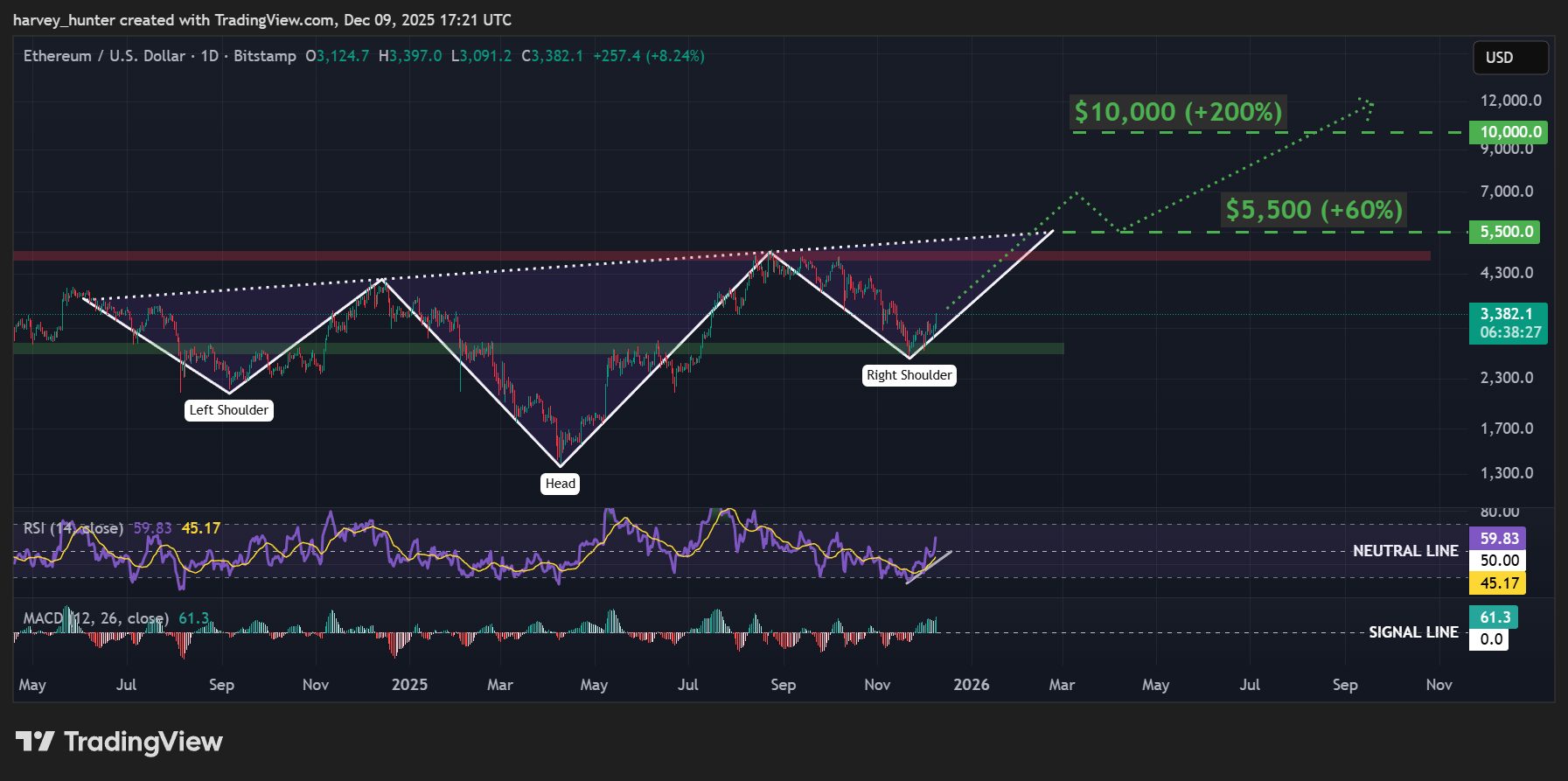
This scarcity could help fuel the breakout of a bullish head and shoulder pattern, now unfolding.
The Ethereum price has confirmed a local bottom at $2,750, forming higher lows in a fresh uptrend that solidifies the right shoulder.
ETH USD 1-day chart, bullish head-and-shoulders pattern. Source: TradingView.
Momentum indicators add validity to the trend. The RSI has made a decisive move above the 50 neutral line for the first time since the downtrend began in October, a telling sign of a bottom.
The MACD follows suit, continuing to widen its lead above the signal line and demonstrating a lasting uptrend.
A fully realised pattern breakout could see the neckline reclaimed around $5,500, reclaiming past all-time highs and entering new price discovery in a 60% move.
But as the bull market matures, scarcity only stands to increase, compounding the effects of mainstream adoption and use cases. The move could extend 200% to $10,000.
SUBBD: Mainstream Adoption Could Send This Coin Parabolic
With a shift to pro-crypto regulation, the transition to Web3 has been accelerated. And with it, platforms based in real-world utility like SUBBD ($SUBBD) are gaining traction.
Positioned as an AI-powered content platform, SUBBD is redefining the $85 billion subscriber economy by giving creators true ownership and fans genuine access.
Never miss a sale again.
As a top creator, your audience is global. It's just not possible to cater to everyone – you can't be online 24/7
That's where your personal AI Assistant comes in, to handle requests and secure payments. Sleep peacefully knowing you're making money… pic.twitter.com/ju9VjLBmea
By cutting out the middlemen, $SUBDD puts control back in the hands of those who create real value.
Creators can monetize directly, while fans gain access to exclusive content, early releases, and meaningful interactions through token-gated perks.
The project has already raised almost $1.3 million in presale, and post-launch, even a small share of the industry could push its valuation significantly higher.
With SUBBD, both sides of the community win — creators earn more, and fans get closer while embracing the decentralization use cases crypto was built for.
As noted above, its unique selling point is that it takes a unique approach to mining, enabling users to mine tokens without having to invest in expensive mining equipment and facilities.
It will launch a virtual mining platform in which users can build and run their own virtual rigs, complete with virtual nodes that they can buy and sell.
By buying more nodes using PEPENODE tokens, users will increase their mining rewards, which they can increase even further by upgrading nodes and combining them in novel ways.
Because the PEPENODE token is necessary to build mining rigs, it could attract massive demand, pushing up its price over time.
Demand will also come from the fact that holders can stake the token, earning themselves a passive income in the process.

 Login
Login