Cardano founder Charles Hoskinson has shared a cryptic message in his welcome post as Binance Wallet announces Midnight (NIGHT). Hoskinson could not hold back, sharing what came out as a cryptic clip in addition to a congratulatory message.
Bitcoin and the broader crypto market continue to face a difficult stretch, yet IG's Chief Market Analyst Chris Beauchamp says a turnaround may already be forming. After months of selling pressure and fading confidence, Beauchamp expects a rebound to play out this week as traders position ahead of an almost certain Federal Reserve rate cut.
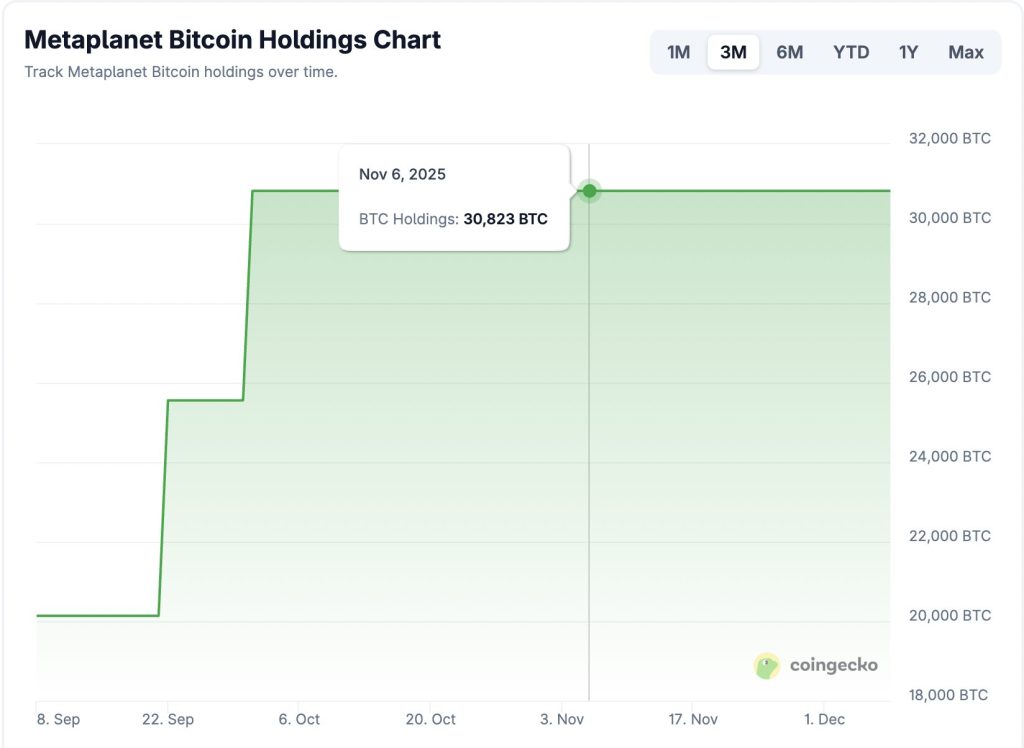
Tokyo-listed Metaplanet is preparing to roll out a new preferred-share structure modeled on Strategy’s widely watched Bitcoin funding vehicle, as the company doubles down on its push to expand its corporate Bitcoin treasury.
The plan was confirmed this week by Metaplanet CEO Simon Gerovich during remarks at the Bitcoin for Corporations Symposium, where he appeared alongside Strategy Chairman Michael Saylor.
Gerovich told attendees that shareholders will vote later this month on launching a new capital instrument called MARS, short for MetaPlanet Acquisition and Reserve Strategy.
He described it as the company’s version of Strategy’s STRC preferred stock, specifically designed to raise capital dedicated to buying more Bitcoin.
Metaplanet Details Structure of ‘Mars’ Bitcoin-Backed Preferred Equity
The Mars shares are structured as senior, non-dilutive Class A preferred stock. They sit above both Mercury shares and common equity in Metaplanet’s capital stack, carry no conversion rights, and provide holders with a senior claim on dividends and assets.
Proceeds from these shares are intended to be directed toward Bitcoin accumulation as part of Metaplanet’s long-term treasury strategy.
Mars shares are also designed to pay adjustable monthly dividends.
The dividend rate is structured to rise when the stock trades below par and fall when it trades above that level.
This mechanism is intended to reduce price volatility while offering steady income to investors seeking Bitcoin-linked exposure without direct equity risk.
STRC Delivers 10% Returns as Metaplanet look to mirror it
Strategy uses proceeds from STRC and other preferred programs to fund Bitcoin purchases.
Since launch, STRC has returned just over 10%, while remaining far less volatile than Strategy’s common stock or Bitcoin itself.
Strategy’s approach has driven an aggressive expansion of its Bitcoin treasury. By late 2025, the company held 650,000 BTC after adding tens of thousands of coins throughout the year.
About 21,000 BTC were purchased using STRC IPO proceeds alone.
Additional purchases in October and November lifted total holdings beyond 641,000 BTC at the time, funded through various preferred offerings and at-the-market share sales.
Metaplanet Turns to Buybacks as Japan’s Bitcoin Treasury Trade Cools
Metaplanet appears to be adapting that same funding blueprint to Japan’s market conditions.
On Nov. 20, Metaplanet approved the issuance of 23.61 million Mercury shares through a third-party allocation, raising about ¥21.25 billion, or roughly $135 million.
With Bitcoin trading below that level, unrealized losses stood at roughly $636 million.
The timing of the Mars announcement comes during a slowdown across corporate Bitcoin treasuries. DefiLlama data shows that digital asset treasury inflows dropped to $1.32 billion in November, the lowest monthly total of 2025.
Notably, In November alone, Strategy shares fell more than 35%, while Metaplanet’s stock dropped over 20% as Bitcoin slid nearly 25% from October highs.
CoinShares has released its 2026 outlook titled “The Year Utility Wins,” positioning next year as the moment when digital assets transition from speculation to practical adoption.
The report introduces Hybrid Finance as the central framework where traditional financial institutions and blockchain infrastructure converge into a unified system serving real economic purposes.
Stablecoins evolved into genuine settlement infrastructure, tokenization scaled beyond experimental pilots, and blockchain applications began generating consistent revenues.
The report emphasizes that “crypto is entering a value-accrual era” as platforms distribute earnings to token holders through systematic buybacks.
CoinShares Analyst Predicts Bitcoin to $170K
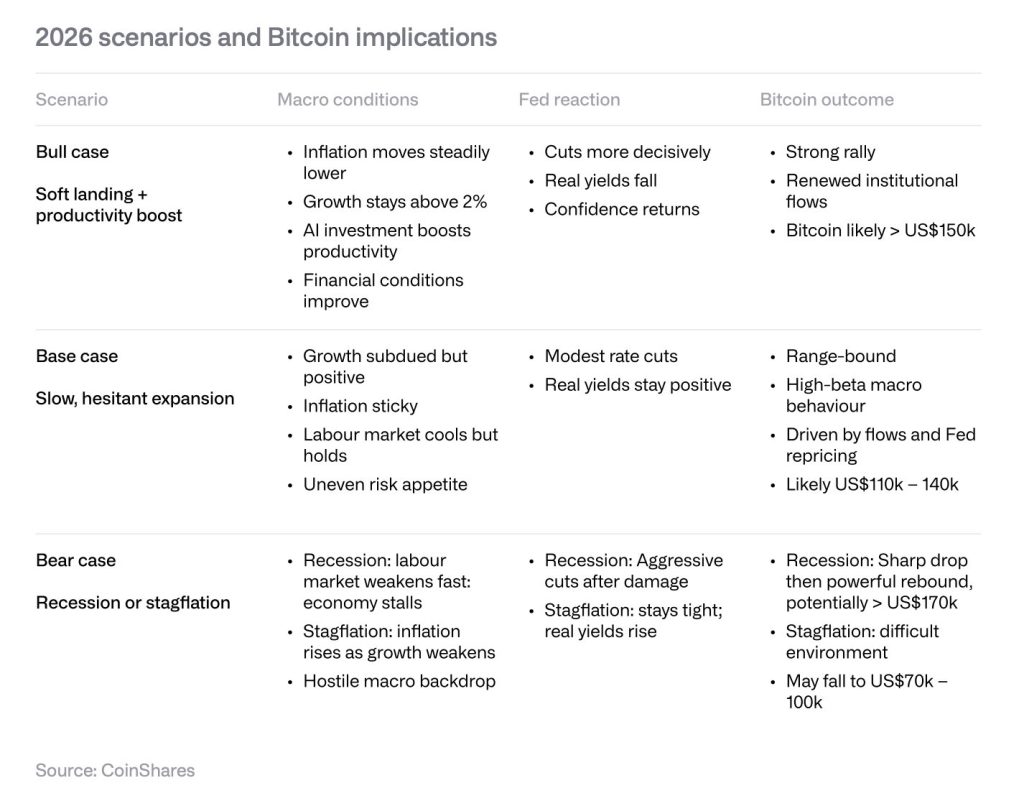
CoinShares projects three distinct scenarios for Bitcoin in 2026. The optimistic case, driven by productivity gains and steady disinflation, could push Bitcoin beyond $150,000.
The base case anticipates a trading range of $110,000 to $140,000, driven by ETF flows and expectations for the Federal Reserve.
The bear case splits between recession, where aggressive monetary easing could support prices above $170,000, and stagflation, which might compress valuations toward $70,000 to $100,000.
Source: CoinShares Report
The report notes that “the Fed feels fundamentally uncomfortable: wanting to ease, but constantly second-guessing how fragile the disinflation trend really is,” creating an environment demanding fundamental justification for asset appreciation.
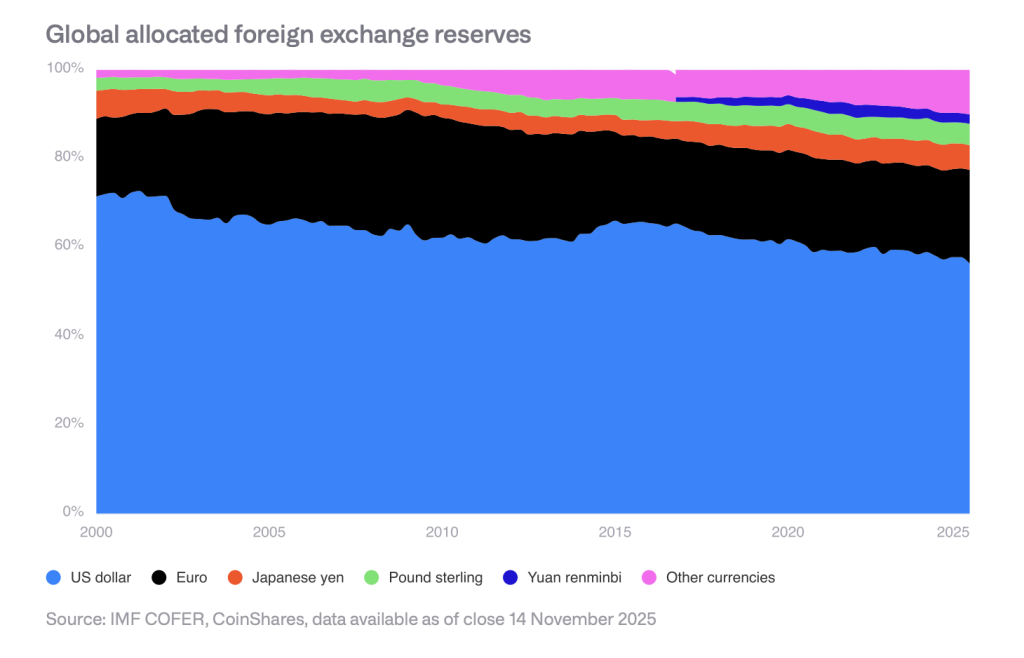
This backdrop reflects the erosion of dollar dominance, with the dollar’s global reserve share at mid-fifties, down from roughly 70% at the start of the millennium.
Corporate Bitcoin holdings have grown substantially, with publicly-listed companies increasing from 44 in January 2024 to 190 by November 2025.
Total holdings nearly quadrupled from 265,709 BTC to 1,048,520 BTC, with total value increasing roughly ninefold from $11.7 billion to $90.7 billion.
Strategy (MSTR) dominates this landscape, accounting for 61% of publicly-listed firms’ Bitcoin holdings after growing its stack from 189,150 BTC to 650,000 BTC.
The company holds approximately $70 billion in assets against $8.2 billion in debt, having secured $13.9 billion through convertible bonds. The top 10 corporate holders control 84% of the supply, while the top 20 hold 91%.
The company carries $6.6 billion in perpetual preferred stocks and $3.2 billion in interest-bearing debt, with annual cash flows totaling nearly $680 million.
As the modified net asset value approaches parity, new shares lose appeal, while refinancing risk looms with the nearest debt maturity in September 2028.
The report warns that eroding financing power could trigger a vicious cycle in which plunging prices force Bitcoin sales to cover obligations.
While CoinShares does not expect this to unfold in 2026, hundreds of thousands of coins could eventually flood the market.
Institutional Adoption Advances Through Multiple Channels
Two years after the US spot Bitcoin ETF approval in 2024, these products have attracted more than $90 billion in assets.
CoinShares anticipates the four major US wirehouses will formally enable discretionary Bitcoin ETF allocations in 2026, with at least one major 401(k) provider incorporating cryptocurrency options.
The report projects 13F filers will collectively hold over one-third of spot Bitcoin ETF assets by year-end 2026.
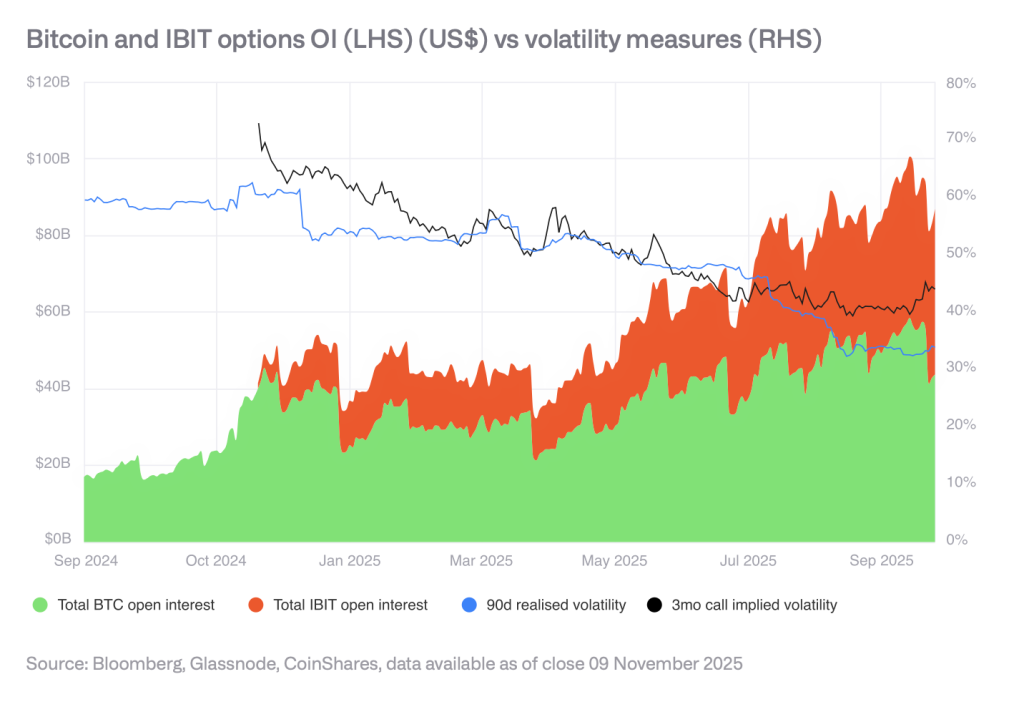
Options market development continues to reduce volatility as open interest expands.
Source: CoinShares Report
Measurements over 30 days showed instances in 2025 when Bitcoin volatility fell below that of traditional assets, marking a significant shift from historical patterns.
Stablecoin and Tokenization Growth Accelerates
The stablecoin sector has reached $300 billion, with USDT commanding $185 billion and USDC holding $75 billion. Decentralized exchange volumes exceed $600 billion monthly.
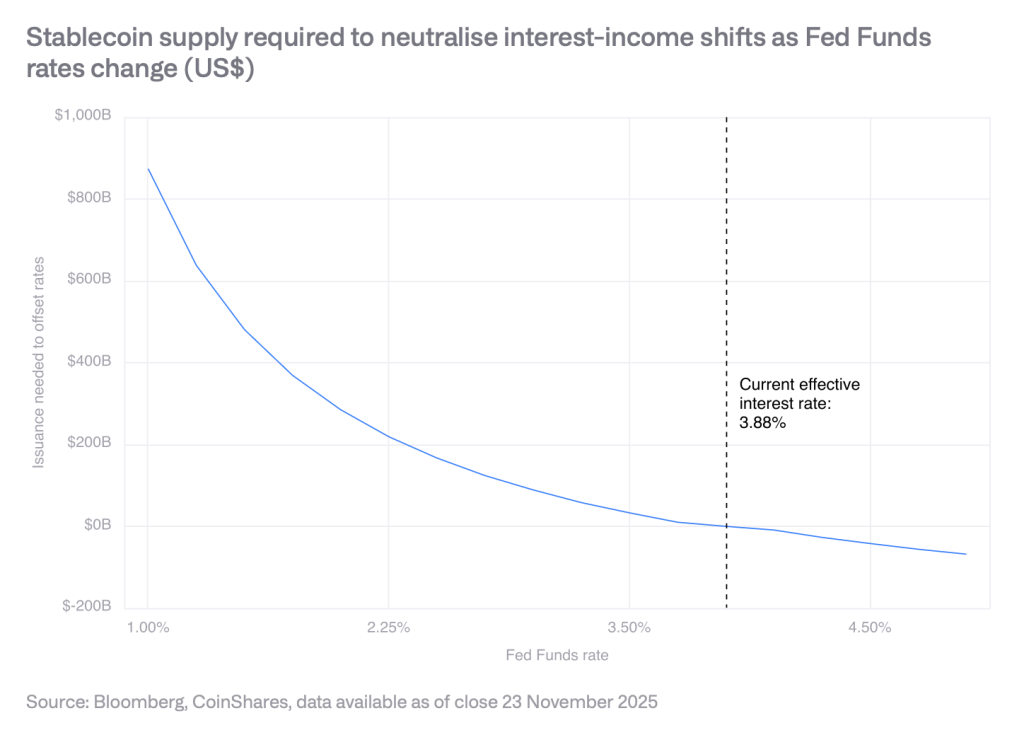
However, CoinShares notes that if rates decline to 3% by year-end 2026, stablecoin supply would need to grow by $88.7 billion to maintain current interest revenue for issuers, though Treasury Secretary Scott Bessent projects market expansion to $3 trillion by 2030.
Source: CoinShares Report
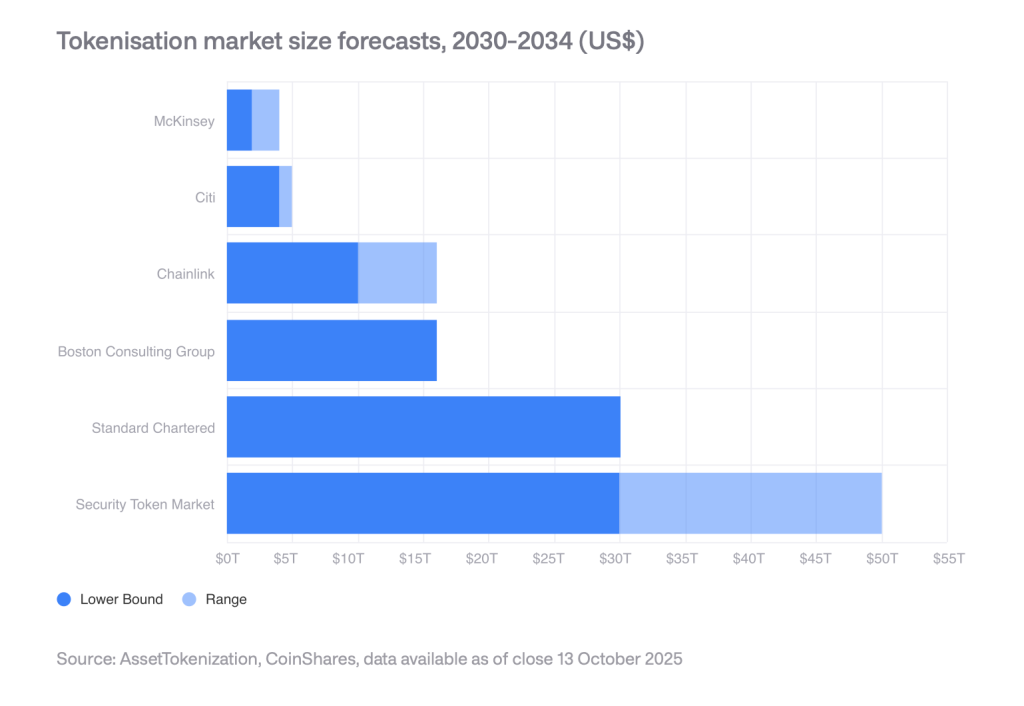
The tokenized asset market doubled during 2025, expanding from $15 billion to over $35 billion. Private credit grew from $9.85 billion to $18.58 billion, while tokenized Treasuries increased from $3.91 billion to $8.68 billion.
The U.S. Securities and Exchange Commission has formally closed its multi-year investigation into Ondo Finance without filing any charges, marking another high-profile reversal of a crypto enforcement action that began under the Biden administration.
Ondo disclosed the decision in a blog announcement, confirming that the probe examined whether its tokenized real-world asset products complied with federal securities laws and whether its ONDO token itself qualified as a security.
The SEC has formally closed a confidential Biden-era investigation into Ondo — without any charges.
The inquiry began in 2024, focused on whether Ondo’s tokenization of certain real-world assets complied with federal securities laws as well as whether the ONDO token was a… pic.twitter.com/yV4xVX7Qrx
Ondo Joins Coinbase, Kraken, and Co. as SEC Closes Key Crypto Investigations
The investigation began in 2024 during a period of heightened scrutiny of digital-asset firms and remained confidential until its resolution. The company said it fully cooperated throughout the process.
At the time the inquiry was opened, Ondo was emerging as one of the earliest and largest platforms for tokenized U.S. Treasuries and one of the few firms working toward large-scale tokenized access to publicly listed equities.
The company was also seeing rapid adoption from international investors, placing it squarely within the SEC’s enforcement focus during a period shaped by exchange bankruptcies, retail speculation, and regulatory uncertainty.
The closure of the Ondo investigation comes as Washington indicates a broader recalibration of its crypto policy posture following the appointment of Paul Atkins as SEC chair.
Paul Atkins was sworn in as SEC Chairman on Monday, and is expected to have a private ceremony with President Trump at the Oval Office today.#PaulAtkins#SECChairhttps://t.co/lqyUZN3B7H
Since his takeover, the agency has moved to unwind several of the most aggressive crypto cases launched during the Biden years.
The SEC’s landmark lawsuit against Coinbase, filed in 2023 over allegations that the exchange operated as an unregistered securities platform, was dismissed with prejudice in February 2025.
A similar enforcement case against Kraken, also alleging unregistered exchange and broker activities, was closed a month later with no fines, no admissions of wrongdoing, and no required business changes.
Not all Biden-era crypto cases have disappeared. Criminal proceedings brought by the U.S. Department of Justice remain active in the Tornado Cash case.
Co-founder Roman Storm was convicted in August for conspiring to operate an unlicensed money-transmitting business and now faces a potential prison sentence, while fellow co-founder Roman Semenov remains at large.
Ondo Brings Tokenized U.S. Stocks to Over 500 Million Investors Worldwide
Ondo’s regulatory clearance also comes as tokenization moves deeper into regulated financial markets.
In September, the company launched Ondo Global Markets, a platform offering tokenized access to more than 100 U.S. stocks and ETFs for eligible non-U.S. investors across Asia-Pacific, Africa, and Latin America.
The service runs on Ethereum and is expanding to BNB Chain, Solana, and its own Ondo Chain, with tokenized securities backed one-to-one by underlying assets held at U.S.-registered broker-dealers.
That international expansion accelerated in November when Liechtenstein’s Financial Market Authority granted Ondo approval to offer tokenized stocks and ETFs across the European Economic Area under the MiCA regulatory framework.
The approval positions the company to serve more than 500 million retail investors across 30 European countries through passported authorization.
At the infrastructure level, Ondo has also expanded its tokenized treasury-backed yield product, USDY, to the Stellar blockchain.
The SEC is weighing an “innovation exemption” to boost tokenization, just as the House passes a landmark stablecoin bill reshaping US crypto policy.#Tokenization#CryptoPolicyhttps://t.co/za9zOMVvfm
The agency’s Investor Advisory Committee is now studying how digital issuance, trading, and settlement could reshape equity infrastructure, a marked shift from the enforcement-first approach that dominated earlier policy.
Pye Finance has revealed a $5 million seed round led by some of the major players in the space. The goal is to turn billions in locked SOL stakes into an active yield market.
Variant and Coinbase Ventures led this round, with participation from Solana Labs, Nascent, Gemini, and others, according to the press release.
Pye says that it’s building bond markets for validators and stakers on Solana (SOL). The platform enables validators to draw and keep stake. They can offer rewards across more than a thousand validators.
According to the team, they accomplish this by creating transferable, time-locked staking positions with transparent reward sharing.
Moreover, they argue that the approach opens up novel DeFi use cases. These include lending and restaking, as well as fixed-yield products for the $60 billion locked in staking.
Per Brian Long. CEO of Block Logic & Triton, “Stake Trading unlocks new possibilities for both stakers and validators which is much needed.”
According to Alana Levin, investor at Variant, Pye’s staking marketplace could “fundamentally change how staking operates on Solana. By allowing validators and stakers to better align their preferences – for example, enabling validators to offer higher yields in exchange for longer lockups – Pye creates a more efficient, transparent, and incentive-aligned staking ecosystem.”
Meanwhile, Pye is the product of Alberto Cevallos, co-founder of Bitcoin yield aggregator on EthereumBadgerDAO, and Erik Ashdown, an exec with a background in structured products in traditional markets.
“Validators have become the underbanked layer of Web3,” Ashdown says. Pye is building a financial infrastructure that lets validators operate like asset managers, offering structured products and predictable returns.
Notably, this raise follows a closed alpha. The team plans to launch a private beta in the first quarter of 2026. Early access is currently available to validators and staking providers.
Passive Billions ‘Turning’ Into Active Yield Market
Staking is shifting from a passive yield mechanism into a programmable financial layer, the team says. Institutional stakers look for transparent reward structures, customizable terms, and the option to trade or borrow against locked positions.
Therefore, Pye says it’s turning validators from node operators into yield providers who can “compete on product offerings rather than just commission rates.” It’s creating the first onchain marketplace for time-locked staking positions on Solana, it adds.
With this, they claim, they’ll turn Solana’s billions in locked stake into an active, programmable yield market.
Notably, the team argues that these accounts have seen no updates in years and have no liquidity. Additionally, they lack customization and control over staking rewards.
At the same time, institutions and digital asset treasuries (DATs) are asking for a bigger piece of the reward pie, the Solana Foundation’s Delegation Program (SFDP) is seeing a cut, and smaller validators have to scramble to find ways to generate revenue or attract stakers.
Pye says its solution is an upgrade to Solana’s native Staked accounts. Validators gain control over their staking rewards and time locks. Validator agreements move onchain as ‘transferable locked stake’ – they are locked but can be traded on secondary markets. These are split into a Principal Token and a Rewards Token (RT).
“The aim is to enable validators to offer more flexible and dynamic products, tapping into additional revenue opportunities while delivering greater utility to stakers,” the press release says. “Without the ability to structure term-based deals, reward loyalty, or provide additional utility–such as better accounting, rewards forwarding, or other features–many validators are left vulnerable to sudden outflows that can destabilize operations.”
Dan Albert, Solana Foundation’s Executive Director, commented that Pye’s “tradeable, fixed-term positions at the validator level represent a major unlock for both rewards discovery and capital efficiency in proof-of-stake networks, and open up new opportunities.”
The crypto market continues to operate under a cautious tone, yet today shows a small improvement. The Fear and Greed Index sits near 24, a level that keeps sentiment inside the fear range but still marks progress from last week’s deeper lows.
Bitcoin is now trading around $90,000 with a gain of about 1% over 24 hours, and that move has eased some of the pressure that defined recent sessions.
Bitcoin Price (Source: CoinMarketCap)
Most large caps remain quiet, although several mid-caps are advancing. Canton, Ethena, and Ondo stand out with steady climbs that align with a backdrop where traders engage selectively while still avoiding widespread risk-taking. These moves do not indicate a broad altcoin season, but they reveal where participation resumes when the market shifts from extreme stress to controlled caution.
Canton Shows Renewed Interest In Its Network Activity
Canton (CC) is trading around $0.074, up by roughly 19% in 24 hours. Liquidity has improved across major venues, and order flow is more balanced than earlier this week.
Privacy should be the foundation. Not an update to the system.
On-chain activity around its coordination and settlement functions continues to draw attention from users who track enterprise-oriented experiments, and this interest appears to support today’s rise. The price structure suggests a transition from quiet trading toward a more stable upward pattern.
Ethena Lifts As Its Synthetic Dollar System Steadies
Ethena (ENA) is trading near $0.28, up by about 11% in 24 hours. Recent data show a more consistent balance between funding costs and open interest, which indicates that its synthetic dollar framework is operating without the uneven spikes seen in previous weeks.
Spot flows lean toward accumulation and remain spread across several active venues. The token continues to act as a reference point for yield-related designs during periods when the market prefers moderate exposure.
Ondo Climbs On Ongoing Interest In Tokenized Yield
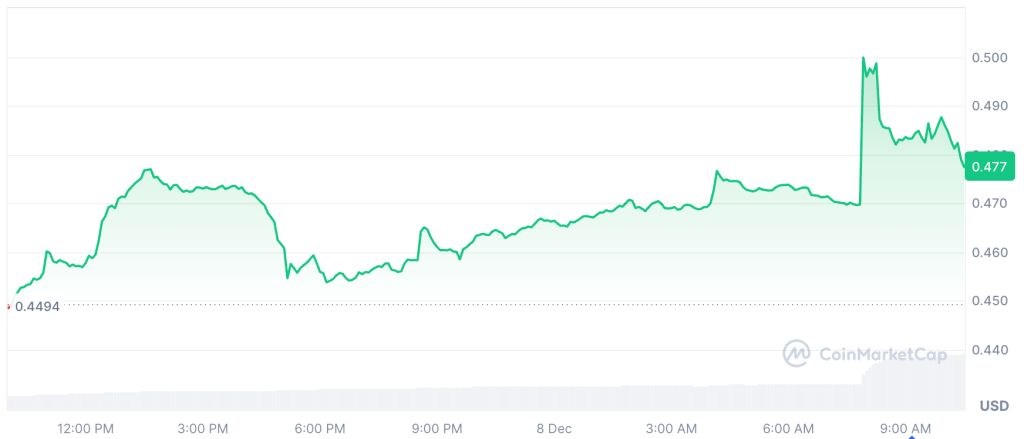
ONDO is trading near $0.48 with an increase of about 8% over 24 hours. Trading activity suggests continued interest in tokenized treasury products, supported by steady demand for yield that connects crypto infrastructure with traditional markets.
ONDO Price (Source: CoinMarketCap)
Liquidity on major pairs remains firm, and turnover now exceeds levels recorded in recent sessions. This behaviour keeps Ondo inside rotation lists whenever market tension eases.
Altcoin Season Still Limited, but No Longer Suffocated
Altcoin season remains distant, yet the rise from extreme fear levels has lowered stress across the market. Bitcoin’s ability to remain above $90,000 reduces forced selling and gives the market enough space for selective rotation.
The strength in Canton, Ethena, and Ondo shows that capital is returning slowly to tokens with steady activity and clear user bases, even though most participants still prefer caution.
For now, the environment remains defensive, but the combination of a higher Fear and Greed reading and several advancing names indicates a market that has moved from severe pressure to a quieter, more balanced phase.
Binance has disclosed the interim results of an ongoing investigation following a report submitted on December 7, alleging that employees used insider information to publish content via the company’s official social media channels for personal gain.
The report, delivered to Binance’s internal audit department, led to the immediate launch of a comprehensive internal review. Preliminary findings indicate a connection between a token issuance posted on-chain at 13:29 (UTC+8) and a tweet published at 13:30 from the official @BinanceFutures account, with similarities in language and imagery.
Binance confirmed that the actions are suspected to involve employees leveraging their positions in violation of company policies and professional ethics.
Suspension and Legal Cooperation Underway
In response to the findings, Binance said it has suspended the employees believed to be involved while further internal procedures continue. The company also confirmed it has proactively contacted authorities in the relevant jurisdiction and will cooperate with legal processes to ensure accountability.
Binance stressed that it is committed to taking firm action against conduct that compromises user trust, platform integrity, or regulatory compliance.
Bounty Rewards Distributed to Verified Reporters
Binance stated that it has completed the verification and deduplication process for reports submitted through its official audit channel (audit@binance.com). In line with its bounty commitment, the company will evenly distribute a $100,000 reward among the earliest valid reporters identified by partially anonymized email addresses.
While acknowledging additional information posted publicly on the X platform, Binance clarified that bounty eligibility applies exclusively to reports sent through its designated official channel, in order to protect reporters and uphold procedural transparency.
Zero Tolerance, Strengthened Controls, and Community Oversight
Reaffirming its user-first approach and values of openness and fairness, Binance reiterated its zero-tolerance stance toward actions that undermine the platform or exploit authority for personal gain.
The company plans to strengthen internal systems, tighten management processes, and close potential gaps that could allow future misconduct.
Binance also encouraged ongoing community participation and oversight, inviting users to submit relevant leads through the official reporting channel to support the creation of a secure, transparent blockchain ecosystem and a trusted trading environment for all participants.
The statement concluded by thanking users for their continued support and reiterating the platform’s commitment to responsibility, accountability, and ongoing improvement as the investigation progresses.
American economist and prominent gold advocate Peter Schiff didn’t hold back his criticisms of Bitcoin (BTC) during an exclusive interview at Binance Blockchain Week 2025 in Dubai, where the annual event drew hundreds of thousands of attendees from around the world.
Before stepping onstage, Schiff sat down with Cryptonews to break down why he still believes Bitcoin is destined to fail and why tokenized gold, not digital scarcity, represents the future of sound money.
Peter Schiff: I don’t believe Bitcoin is going to work. Yes, there have been times when I thought the price was going to go up, but that is separate from my ultimate understanding of what Bitcoin is and where the price is generally going.
Bitcoin’s price is a function of the people who wish to gamble on it. You can have a period of time where people want to buy Bitcoin, and the people who own the asset don’t want to sell it, and then the price goes up. We’ve obviously had tremendous BTC price appreciation over the years.
But it’s really interesting that Bitcoin peaked at the same time as gold. If Bitcoin is being portrayed as some digital equivalent of gold, the best way to price Bitcoin would be in terms of gold. But in terms of gold, Bitcoin is still considerably below where gold was four years ago.
If I was really into Bitcoin, this would cause me to question the whole narrative. Why is Bitcoin lower than gold was four years ago, despite all the hype around Bitcoin exchange-traded funds, Bitcoin treasury companies, and electing a pro-Bitcoin U.S. president?
So, why is Bitcoin still lower than gold was four years ago? And if Bitcoin can’t catch up now, why will it go up in the future?
CN: Is there another reason why you think Bitcoin isn’t going to work?
PS: Bitcoin can’t work as money because it doesn’t have any intrinsic value. And it won’t work as a store of value because you can’t store what you don’t have, right? An asset must possess value to be a store of value. Bitcoin has a price, but you can’t store the price.
Also, the price of BTC is subject to market forces only. This means you never know what the price of Bitcoin is going to be worth in the future. It’s all dependent on the people who wish to buy Bitcoin versus the people not willing to sell it.
If you bought Bitcoin years ago you could sell it at a much higher price, but that still doesn’t make it a store of value.
CN: How would you define “store of value?”
PS: Gold is a store of value. For instance, there’s gold in my watch. At $4,000 for an ounce of gold, there’s about $20,000 worth of actual gold in this watch. Somebody could melt this watch down and then use the gold—that is why gold is a store of value.
Also, the value that gold has in one year could remain over hundreds and thousands of years. People would still be able to use the gold to do all the things that you could do with it today. Do you really think the value that gold has as a metal is going to disappear?
There’s a shelf life on gold. Gold is worth just as much when it’s 10 years old as when it is brand new. It doesn’t matter when I take the gold out of the mine. The gold that I mined today has the same value as gold that was mined a hundred years ago – the value is stored.
Bitcoin doesn’t have any value today because there is no real use for it. There’s no demand for it. There’s no industrial use for Bitcoin. People don’t need Bitcoin to make products.
In fact, many people use gold as a hedge against inflation. They own gold, and they hedge it in case it drops. No one’s doing that with Bitcoin. There’s no actual end user of Bitcoin.
CN: How would you then describe Bitcoin?
PS: I describe Bitcoin as being the cigarettes of money. Cigarettes can be considered as money because people smoke and that’s why they are able to circulate. The GIs used cigarettes as money after World War II, and cigarettes function as money in prisons.
If someone accepts cigarettes as a medium of exchange—even if they don’t smoke because they know that they can give them to someone else—that is what gives those cigarettes value. But, if there are no smokers, then the cigarettes become worthless—and so that is what I think about Bitcoin.
The crypto market is going up today, Dec. 8, with Bitcoin and most altcoins being in the green. Bitcoin (BTC) price rose to $92,000, while the market valuation of all tokens jumped by 2.63% in the last 24 hours to…
Bitcoin (BTC) price is showing early signs of exhaustion after an impulsive rise from the 0.618 value area low. However, the absence of strong volume behind the move casts doubt on the sustainability of a rally.
The Dogecoin price has been drifting through a subdued stretch over the past few days, holding around the mid-$0.13 to $0.14. The recent decline has slowed down in the past 48 hours, and the chart now shows the meme coin attempting to steady itself after weeks of persistent selling pressure.
Trader Tardigrade, a well-known crypto analyst on X, shared a new three-day chart suggesting that an important MACD signal is on the verge of forming, and historical performance shows that Dogecoin tends to move bullish once this signal appears.
Approaching The MACD Bullish Cross
Dogecoin’s quiet phase in the past 48 hours has become increasingly important because one of Dogecoin’s higher-timeframe indicators is beginning to show early signs of life. According to Trader Tardigrade, Dogecoin’s MACD indicator on the 3-day candlestick price chart has not yet confirmed a bullish cross, but it is very close to doing so.
The chart he shared shows the MACD lines converging at the lower boundary of the recent downtrend, and the blue line is approaching the red line. The blue line is about to cross over the red one, mirroring the exact setup that preceded previous breakouts earlier this year.
Even with Dogecoin trading quietly in recent days, the compression of the MACD indicator hints that bearish momentum is fading. Once the cross officially forms, the trend will shift into a bullish one. This gradual tightening of price movement is also characteristic of an accumulation phase, and this is shown by an important Dogecoin metric.
The chart reveals a clear pattern: every time Dogecoin printed a three-day MACD bullish cross in 2025, the price responded with a significant upward move. The first cross was in April, and this preceded a rally that pushed Dogecoin’s price from below $0.14 into a breakout to $0.26.
A second cross followed during mid-summer in July, and once again the price climbed aggressively shortly afterward. This saw the Dogecoin price rally from around $0.16 to $0.30 very briefly.
Both events are circled on the chart above, showing how the momentum flipped swiftly once the MACD crossed above the signal line. These repeated reactions strengthen the case that Dogecoin could be preparing for another sizeable run if the indicator confirms a cross in the coming days.
The projection area drawn on the right side of the chart points to a climb that extends well above $0.20. This suggests that the next wave may revisit the upper levels where Dogecoin last traded during its late-summer rally.
The analyst’s chart outlines a wide upward arc, indicating that the expected move would not be a minor rebound but a structured uptrend similar to the earlier surges this year. In terms of a price target, the projection shows Dogecoin reaching a price target around $0.35 in the next few weeks. This would translate to a 140% increase from Dogecoin’s current price of $0.142.
The last quarter of the year has always been quite bearish for the Solana price, marking the highest losses for the altcoin since it was launched back in 2020. Naturally, this has made Q4 a dreaded time for Solana investors, and the year 2025 has not been any different. The last two months have already closed in the red with double-digit losses, and with only December left to go, the Solana price might be on track to complete yet another bearish quarter.
Looking At The Historical Performance Of Solana In Q4
Taking into account data from the CryptoRank website, it shows Solana’s less-than-favorable performance in the last quarter. In the last five years, Q4 has had the highest average losses compared to the other quarters, and the month of December plays a major role in that due to how bearish it is.
December, in particular, boasts the second-highest average losses, second only to May’s -9.96% average. However, when it comes to the median returns, the month of December takes the cake, recording a high average of -19.6% losses over the year.
In the five years of its existence, only one year, in 2023, has the Solana price closed out the month of December in the green with 71.4% gains. The other years have ended with at least 18% losses, and this month is already looking bearish with -0.79% losses so far.
With the months of October and November already closing in the red, it is likely that December will follow. The last time that both October and November closed in the red was back in 2022, and December would follow suit with -29.6% returns for the month.
Analyst Says A Bounce Could Come Instead
While historical data suggests that the Solana price could end up struggling this month, one crypto analyst has presented a scenario where the altcoin could bounce back. This move is predicated on Solana’s ability to actually hold the support and break the next resistance.
Interestingly, though, the analyst’s chart shows an initial 15% dump before the Solana price finds support somewhere around $116. After that, the price is expected to rebound, and the target for the cryptocurrency after this would be the $170 level. The weekly candlestick also supports this possible jump, something that would send Solana to the green in September.
For now, the bulls continue to struggle despite last week’s campaign for $150, suggesting that there is a great deal of resistance at this level. If selling continues to build up, then it is likely that Solana will move down as predicted.
Рынок снова нервничает: высокая волатильность, агрессивные продажи плечевых позиций и нарастающие разговоры о «криптозиме» усиливают страх перед глубокой коррекцией Bitcoin. Для многих это повод заморозить капитал в стейблкоинах, но для части инвесторов такие периоды — время искать инфраструктурные истории.
Биткоин уже больше десяти лет остается базовым активом рынка, но его ограничения никуда не делись. Медленные транзакции, высокая комиссия в периоды нагрузки и практически полное отсутствие гибких смарт‑контрактов делают сеть неудобной для DeFi и массовых приложений. Отсюда и всплеск интереса к слоям решений поверх Bitcoin.
На этом фоне усиливается внимание к инфраструктурным альткоинам, которые пытаются превратить Bitcoin из «цифрового золота» в полноценную базу для финансовых приложений. Инвесторы все чаще смотрят не только на цену, но и на архитектуру: модульные блокчейны, виртуальные машины, мосты ликвидности. В подобных обзорах уже стабильно фигурируют лучшие альткоины следующего цикла.
Именно в такой контекст вписывается Bitcoin Hyper и токен $HYPER — инфраструктурный проект, который заявляет о себе как о первом Bitcoin Layer 2 с интеграцией Solana Virtual Machine. В условиях возможной глубокой просадки Bitcoin это ставит перед инвестором простой вопрос: оставить капитал пассивным или использовать спад, чтобы зайти в инфраструктуру, которая может масштабировать сам Bitcoin.
Главная проблема Bitcoin хорошо знакома каждому, кто хоть раз проводил транзакцию в период пикового спроса. Подтверждение может занимать десятки минут, а комиссии доходят до заметных сумм даже для простого перевода. Для мира DeFi, игр и высокочастотных платежей это критическое ограничение.
Поэтому за последние годы сформировалась целая линейка решений второго уровня. Одни делают ставку на платежные каналы, другие — на «роллап»-архитектуру, третьи экспериментируют с отдельными виртуальными машинами и боковыми цепочками. Это отражает растущую конкуренцию за роль ключевой инфраструктуры поверх Bitcoin.
Параллельно развивается сегмент высокопроизводительных цепочек вроде Solana, которые предлагают тысячи транзакций в секунду, но не имеют прямой «родной» привязки к безопасности Bitcoin. В результате рынок ищет гибрид: инфраструктуру, которая даст производительность уровня Solana, но при этом будет опираться на проверенную временем сеть Bitcoin. Bitcoin Hyper как раз пытается занять эту нишу, предлагая Layer 2 с поддержкой SVM.
Bitcoin Hyper: ставка на SVM и скорость выше Solana
Bitcoin Hyper строит модульную архитектуру: базовый слой Bitcoin отвечает за финальные расчеты, а отдельный слой с Solana Virtual Machine берет на себя исполнение транзакций и смарт‑контрактов в режиме реального времени. Это сочетание позволяет получить сверхнизкую задержку обработки операций и при этом опираться на безопасность основной сети.
Команда заявляет, что производительность L2‑уровня превосходит показатели самой Solana, а комиссии удерживаются на уровне долей цента даже при высокой нагрузке. Для пользователя это открывает возможность проводить расчеты в обернутом Bitcoin, запускать DeFi‑протоколы, платформы NFT и игровые приложения на знакомом стеке Rust, но с привязкой к капиталу в Bitcoin, а не только к экосистеме Ethereum.
Отдельный элемент конструкции — децентрализованный канонический мост для перевода Bitcoin на второй уровень, а также совместимость с токенами формата SPL, адаптированными под эту L2‑среду. На этапе раннего размещения проект уже привлек $29 млн при цене около $0.013395 за токен $HYPER, что демонстрирует заметный интерес к идее ускоренного Bitcoin на базе SVM. При этом данные ончейн‑мониторингов показывают, что два крупных кошелька суммарно приобрели около $396 000, что обычно воспринимается как сигнал внимания «умных денег».
Модель вознаграждения держателей $HYPER строится вокруг стейкинга с повышенным APY и участием в управлении сетью. После запуска токена ранние инвесторы могут практически сразу переводить токены в стейкинг, а для участников предварительной продажи предусмотрен семидневный период вестинга. В перспективе ключевую роль будут играть не только финансовые стимулы, но и права голоса в развитии протокола.
Задача Bitcoin Hyper проста и амбициозна одновременно: устранить для Bitcoin три главных ограничения — медленные транзакции, высокие комиссии и отсутствие развитых смарт‑контрактов. Если проекту удастся закрепиться в роли производительного Layer 2 с SVM и удобным инструментарием для разработчиков, $HYPER может стать одной из немногих инфраструктурных ставок, которые выиграют от следующего витка интереса к Bitcoin, а не просто будут следовать за его ценой.
At the ongoing Bitcoin MENA conference, UAE officials highlighted the nation’s strategic embrace of Bitcoin as a core component of the future financial system.
In a speech at Bitcoin MENA, Mohammed Al Shamsi, representing UAE National Security, framed the current era as a “historical phase” for the global economy, noting the rapid changes reshaping finance worldwide.
Bitcoin is no longer merely a “digital asset,” Shamsi emphasized, but is now recognized as a “key pillar” in modern financing. Central to this evolution is the role of mining, described as the “beating heart” that underpins network strength, security, and continuity.
Mining operations today are far beyond 24-hour device management; they represent a fully integrated industry built on energy efficiency, computational accuracy, and scalable infrastructure.
The UAE’s focus on Bitcoin reflects broader ambitions to establish itself as a hub for digital finance. Shamsi underscored the importance of building a sustainable ecosystem that supports large-scale mining operations while maintaining environmental responsibility.
Efficiency, precision, and the capacity for expansion were cited as essential for this next-generation mining infrastructure.
UAE is buying millions in bitcoin
Recently, The Abu Dhabi Investment Council (ADIC) increased its Bitcoin exposure in Q3 2025, more than tripling its stake in BlackRock’s iShares Bitcoin Trust to nearly 8 million shares, valued at $518 million.
The move came just before Bitcoin hit a record high and then dropped below $92,000, reflecting ADIC’s long-term view of Bitcoin as a digital counterpart to gold within its diversification strategy.
Part of Mubadala, ADIC operates with its own mandate and recently strengthened leadership. The purchases highlight Abu Dhabi’s ambition to position itself as a global crypto hub and treat Bitcoin as a strategic, long-term asset.
Industry leaders at the Bitcoin MENA 2025 conference in Abu Dhabi highlighted the UAE’s potential to become the “Wall Street of cryptocurrencies” due to its business-friendly regulations and growing crypto ecosystem.
Executives noted that attracting top talent, Bitcoin whales, and capital inflows would create a liquid and influential market.
You can listen to all interviews and other BTC Conference content on Bitcoin Magazine’s social media and YouTube.
On Tuesday, December 9, from 11:00 to 11:30 a.m. local time, a panel at the Proof of Work stage will explore “Bitcoin Mining as a Grid Stabilizer in Emerging Markets,” featuring Daniel Batten (CH4 Capital) as the moderator, Mohammed Alshiekh (CTO, DEMA Energy), Erik Hersman (CEO, Gridless), and Luca Infeld (Founder, Munich International Mining).
Nunchuk Inc. is an open source, multi-signature mobile wallet for advanced bitcoin security, self-custody, and inheritance. Launched in 2020, the app offers users a feature-rich toolkit to set up high-security bitcoin wallets, with little competition on the mobile app market, as most other mobile wallets do not support multi-signature functionality at all.
Most wallets require a single private key to sign a valid Bitcoin transaction. Multi-signature Bitcoin wallets, in turn, require more than one private key to sign a valid Bitcoin transaction, often a threshold, such as two of three or three of five. This lock, so to speak, is enforced by the full power of the Bitcoin network, making it one of the most secure ways to store wealth today and probably in history.
Nunchuk told Bitcoin Magazine they help secure over a billion dollars worth of bitcoin today, but that was not always the case. Born out of Bitcoin idealism in the thick of the COVID pandemic, Nunchuk was built to facilitate advanced security wallets that use multi-signature in the defense of self-custody. In 2022, as a young start-up, these ideals were put to the test, as activists of the Canadian Freedom Convoy Protests decided to use Nunchuk to secure bitcoins donated to the protest against COVID repression.
The turmoil saw over a million dollars worth of Bitcoin donated to Honk Honk Hodl, a group of reputable activists in the country, to help fund the costs of Truckers who were gathering in Ottawa. The truckers were putting their lives on the line to protest the extreme restrictions put in place by the Canadian government in response to the pandemic, and were facing massive pressure to leave the capital.
Over 20 bitcoins were received into a Nunchuk multi-signature wallet under the banner of Honk Honk Hodl. Nunchuk multi-sig was chosen to mitigate the risk of putting all that money in the hands of just one person.
Hugo Nguyen, founder of Nunchuk, told Bitcoin Magazine that the Honk Honk Hodl wallet received so many individual donations that it actually broke the wallet. The app was not designed to sign transactions with so many bitcoin inputs, and the start-up had to push an update to let the activists easily move their funds.
The protests were so effective and gained such a positive reception internationally that Trudeau’s government panicked and invoked the Emergencies Act, a rare use of federal powers, which he used to try to shut down all sources of funding coming to the protesters, in an effort to scare them off the capital. This included 10 million dollars in donations from Canadians to a GoFundMe campaign, which were ultimately returned to contributors after the payment processor faced legal action from the Canadian government.
When it came to the bitcoin donations, the digital currency’s alleged censorship resistance was put to the test. Canada sent a Mareva injunction to Nunchuk Inc., demanding the company freeze user funds and disclose user data to the government. Nunchuk, as a privacy-oriented, non-custodial wallet, had no power to comply. Nunchuk was just two months old at the time, a self-funded startup. This was their response:
“Dear Ontario Superior Court of Justice,
Nunchuk is a self-custodial, collaborative multisig Bitcoin wallet. We are a software provider, not a custodial financial intermediary.
Our software is free to use. It allows people to eliminate single points of failure and store Bitcoin in the safest way possible, while preserving privacy.
We do not collect any user identification information beyond email addresses. We also do not hold any keys. Therefore:
– We cannot “freeze” our users’ assets.
– We cannot “prevent” them from being moved.
– We do not have knowledge of “the existence, nature, value and location” of our users’ assets. This is by design.
Please look up how self-custody and private keys work. When the Canadian dollar becomes worthless, we will be here to serve you, too.
Sincerely,
The Nunchuk team”
In a matter of hours, over 14 bitcoins were delivered to over 90 truckers by hand in envelopes, roughly 8000 Canadian dollars at the time, each. By the time the Canadian police raided Nicholas St. Louis’s home — the main activist behind the Honk Honk Hodl campaign — most of the bitcoin had been distributed. Only 0.28 BTC were reportedly seized in the raid. Up to 6 BTC in total were frozen from other truckers and protesters in the turmoil, resulting in a rough 70% success rate for the censorship-resistant currency.
These events had a deep impact on the Nunchuk team, some of whom quit out of fear of legal prosecution. Others who stayed and Nunchuk Inc. survived, its future design forged in the fires of the late COVID political turmoil.
The Nunchuk That Survived
Fast forward two years or so, and Nunchuk has carved itself a solid niche within the Bitcoin industry. It is the only open source, fully featured multi-signature mobile wallet for mobile devices. Where alternatives exist, they are often either antiquated, nearly abandoned, or closed-source and not functional without being a paid user.
Nunchuk is also the first significant implementation of miniscript, a high-level programming language for Bitcoin script, which lets developers build Bitcoin “smart contracts” with elegance and power not easily achieved using Bitcoin’s native scripting language. Miniscript was invented by Pieter Wullie, a legendary Bitcoin core developer with 14 years of experience contributing to the digital currency.
The wallet lets users create software and hardware keys based on a wide range of hardware signing devices, supporting the most advanced Bitcoin address types, like Segwit and Taproot. Users can then create a fully customizable range of wallets, from single key to advanced, to any combination of multiple keys the user deems useful.
Nunchuk even supports decaying multi-sigs, which are useful for inheritance and complex setups. For example, you might want a 3 of 5 multi-sig where you control all the keys but they are geographically distributed, this is a common model for high value inheritance accounts. One of those keys can be shared with an heir. After five years, the multi-sig degrades to a single-key wallet, letting your heir move the money. To prevent your heir from getting access to your Bitcoin before your time, you would need to move the coins to a fresh multi-sig 3 of 5 and reset the clock.
It’s important to note that creating your own complex security setups has risks; sometimes, users who become so sophisticated that they decide to use fully featured tools like Nunchuk end up creating mazes for their Bitcoin that they end up getting locked out of. It’s important to be careful and generally use best practices when creating self-custody Bitcoin wallets to avoid common pitfalls.
Nunchuk has standard templates and a complete inheritance feature set designed to help non-technical Bitcoin users benefit from the full power of Bitcoin self-custody. They even announced the inheritance solution for Bitcoiners that does not require a third-party intermediary to co-sign a transfer. Popular alternatives like Casa wallet offer inheritance solutions, but as a co-signer, they also get a full view into user data, and if the company fails, users must take an alternative key-signing path to recover funds. Nunchuk’s on-chain inheritance wallet leverages time locks and pre-designed multi-sig setups like the example above to give users maximum control and sovereignty in their inheritance setup.
Nunchuk nevertheless supports aided (off-chain) inheritance solutions as well, which use the co-signer model of inheritance and can be easier to use, offering similar features as other popular Bitcoin inheritance solutions.
MicroBT, a leading developer of Bitcoin mining hardware, launched its latest WhatsMiner M70 series in at Bitcoin MENA in Abu Dhabi on Monday, according to a note shared with Bitcoin Magazine.
The event, themed “Green-Driven, Ecosystem Redefined,” brought together mining executives, strategic partners, and key clients, marking a significant step in the company’s efforts to shape a more sustainable mining industry.
Dr. Yang Zuoxing, Founder and CEO of MicroBT, opened the event with a keynote that highlighted the connection between technological leadership and long-term industry growth.
He framed the conversation around energy innovation, presenting strategies that aim to integrate renewable sources into mining operations.
Central to his remarks was an off-grid solar solution capable of 200kW output. This system, using an 800V DC supply and a “load-following-source” design, improves efficiency compared to traditional AC setups and enables uninterrupted operation.
Dr. Yang also noted the potential of hybrid energy approaches, combining gas-powered generation with careful miner selection to extend hardware lifespan and operational reliability.
Bitcoin mining efficiency
The unveiling of the WhatsMiner M70 series drew the most attention. The new line features models with power efficiencies of 14.5J/T, 13.5J/T, and 12.5J/T. These figures reflect a push to balance performance with energy use.
Following the technical presentation, MicroBT’s Sales and Marketing Director, Wright Wang, addressed the company’s ecosystem strategy. He outlined a vision that extends beyond hardware, focusing on shared-value partnerships and joint mining.
Wang highlighted the network of certified solution partners who provide expertise in cooling, energy management, and operations.
By linking these partners to clients, MicroBT positions itself not just as a supplier but as a facilitator of a connected, collaborative mining ecosystem.
The launch included presentations from a range of partners, including HeatCore, HashHouse, FogHashing, Giga, HashSmith, Pauway Energy, Lumen Capital, BitMars, and Luxor.
Images from Bitcoin MENA
Their contributions spanned topics from advanced cooling techniques to financial models for hashrate management. The breadth of participation underscored the interdependence of the modern mining industry and highlighted the role of collaboration in driving innovation.
Tether’s VP of Energy and Mining, Giv Zanganeh, also addressed the audience on the topic of redefining the Bitcoin mining ecosystem. His presence reflected growing confidence in MicroBT’s approach and signaled an emerging alignment between hardware innovation, energy management, and financial infrastructure.
MicroBT’s WhatsMiner M70 launch illustrates a shift in the industry. As miners face increasing pressure to manage energy use and operational risks, the company is betting on a model that combines technical innovation with strategic partnerships.
The launch in Abu Dhabi positions MicroBT as a company seeking to influence both the technology and the practices of Bitcoin mining, framing sustainability and ecosystem growth as inseparable goals.

 Login
Login