Living without standard utility hookups like electricity, Internet, water, and sewer comes with a whole host of challenges, all of which are most commonly solved by spending lots of money. For electricity, a solar array or a generator is fairly common. The Internet can similarly be accessed via a satellite link if wires aren’t available. For water, most people will drill a well, but that gets similarly expensive. [Cranktown City] recently bought an off-grid home and needed a way to get water to it on a budget, so he built this water trailer instead.
The trailer started off as a standard single-axle utility trailer. The weight rating was probably around 3,500 pounds or 1588 kg. A few support structures were welded in. The supports serve double duty as a frame for two IBC totes, which can hold about 550 gallons or 2082 liters of water. The trailer also got upgraded wiring, including some extra wires to support a backup camera. The two totes were then plumbed together with a ball valve for an outlet. That valve was mated to a motor that can be remotely activated from within a truck to dump the water out into a cistern.
On the cistern side, [Cranktown City] welded up a door with a linear actuator and a remote control. When he’s ready to dump the water into the cistern, he can easily back up the trailer using the backup camera, open the door to the cistern remotely, and then activate the ball valve on the trailer to start filling the reservoir. It’s a clever solution to bringing water to his off-grid property at a fraction of the cost of a drilled well. We’ve seen some other unique ways to live off-grid as well, like this hydroelectric generator, which might offset the cost of an expensive solar array.
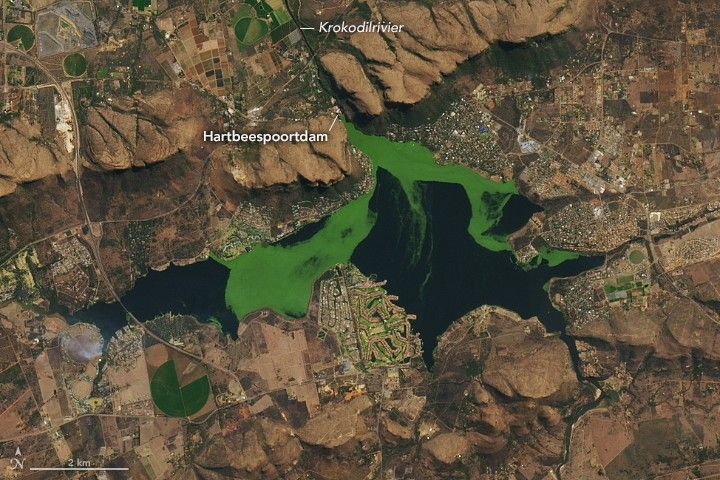
On clear days in Hartbeespoort, South Africa, satellite images often reveal a reservoir with shades of deep blue interrupted by drifting patches of vivid green. These shifting features indicate algae blooms, which can affect water quality, ecosystems, and nearby human communities.
In this animation, from June 2022 to July 2023, an algal bloom grows, moves around the reservoir, and then fades. The animation is composed of images from Harmonized Landsat and Sentinel-2 (HLS), a NASA product that combines imagery from the NASA/USGS Landsat 8 and Landsat 9 satellites and the European Space Agency’s Sentinel-2A, 2B, and 2C satellites.
Algae is an umbrella term for photosynthetic organisms that live in water, encompassing everything from single-celled cyanobacteria to seaweed. They play a vital role in maintaining healthy ecosystems. But when colonies of algae spread too widely or release harmful toxins, they can threaten the very environments they support. These colonies are known as harmful algal blooms, or HABs.
Some HABs are toxic and often are part of a process called eutrophication. Eutrophication begins when there are too many nutrients in an ecosystem—because of agricultural runoff and other inputs—leading to a rapid growth of algae.
“It’s like having a garden,” said Bridget Seegers, a NASA scientist who studies cyanobacteria in freshwater ecosystems. “If you add a lot of nutrients, you’re going to have a lot of growth.”
Eventually, the algae die off. As decomposers break down the dead algae, they consume oxygen, which can lead to hypoxia and the formation of dead zones.
August 10, 2022
Such conditions have been documented at the Hartbeespoortdam (Hartbeespoort Dam) reservoir, located about 25 kilometers (16 miles) west of Pretoria and used primarily for recreation and irrigation. The reservoir is home to regular harmful algal blooms containing cyanobacteria. It also hosts large mats of invasive water hyacinths. While hyacinths do not produce toxins, they do contribute to eutrophication when they die and decompose.
Harmful algal blooms can affect ecosystem health and human lives and livelihoods. In April 2023, South African authorities linked a large fish kill in Hartbeespoort to low oxygen levels caused by excessive algal growth. More broadly, HABs in drinking water reservoirs can reduce water availability and raise water treatment costs, while swimming in HAB-infested waters can cause rashes, and pets or livestock that drink it may fall ill or die.
One 2022 paper published in Remote Sensing examined algae in the reservoir from 1980 to 2020 using Landsat data. “This is a reservoir that has always been monitored heavily by the local department of water resources,” said Adam Ali, the lead author of the paper. The research used satellite data to provide a big-picture view of conditions across the entire reservoir over long time scales. Using 40 years of Landsat data, the researchers found that the biggest drivers of algal growth were total phosphorus content—a nutrient found in runoff—and water temperature, with blooms typically expanding in the warm summer months and subsiding in the winter.
They also identified key trends over space and time. Algal productivity was higher near Krokodilrivier (Crocodile River) inflows and in the western part of the reservoir due to golf course runoff and restricted water circulation, demonstrating how HABs are influenced by runoff and river inputs. Large blooms occurred between 1982 and 1986, when total phosphorus levels were high. A bioremediation program in the late 1980s succeeded in limiting algae growth, but after funding ended in the late 1990s, harmful algal blooms spiked again in the early 2000s.
To track algae from space, the researchers analyzed the water’s color by measuring different wavelengths of light. From this, they estimated the concentration of chlorophyll-a, a common pigment in algae, and used these values to approximate algae biomass over time. Although water samples remain necessary to confirm that a bloom is harmful, satellite data can help scientists understand the drivers of harmful algal blooms, especially in remote regions where regular ground monitoring is expensive and time intensive.
New and forthcoming NASA missions promise to advance space-based water quality monitoring. The next Landsat satellite is expected to measure wavelengths specifically designed to detect HABs. NASA’s PACE (Plankton, Aerosol, Cloud, ocean Ecosystem) mission, launched in 2024, collects data in hundreds of precise wavelength bands in the visible spectrum, which can help scientists identify the type of algae that comprise a certain bloom—a key factor in determining toxicity. Given PACE’s spatial resolution, the data is most useful in coastal areas or larger inland water bodies. Ali is working with researchers at NASA Ames to integrate PACE into future studies.
Animation by Ross Walter/Landsat Science Office Support, using data from the Harmonized Landsat and Sentinel-2 (HLS) product. HLS is funded by NASA and is a deliverable of the Satellite Needs Working Group (SNWG), an interagency effort of the U.S. Government dedicated to identifying and addressing Earth observation needs across U.S. civilian federal agencies.Still image by Lauren Dauphin/NASA Earth Observatory using Landsat data from the U.S. Geological Survey. Story by Madeleine Gregory/Landsat Science Office Support.
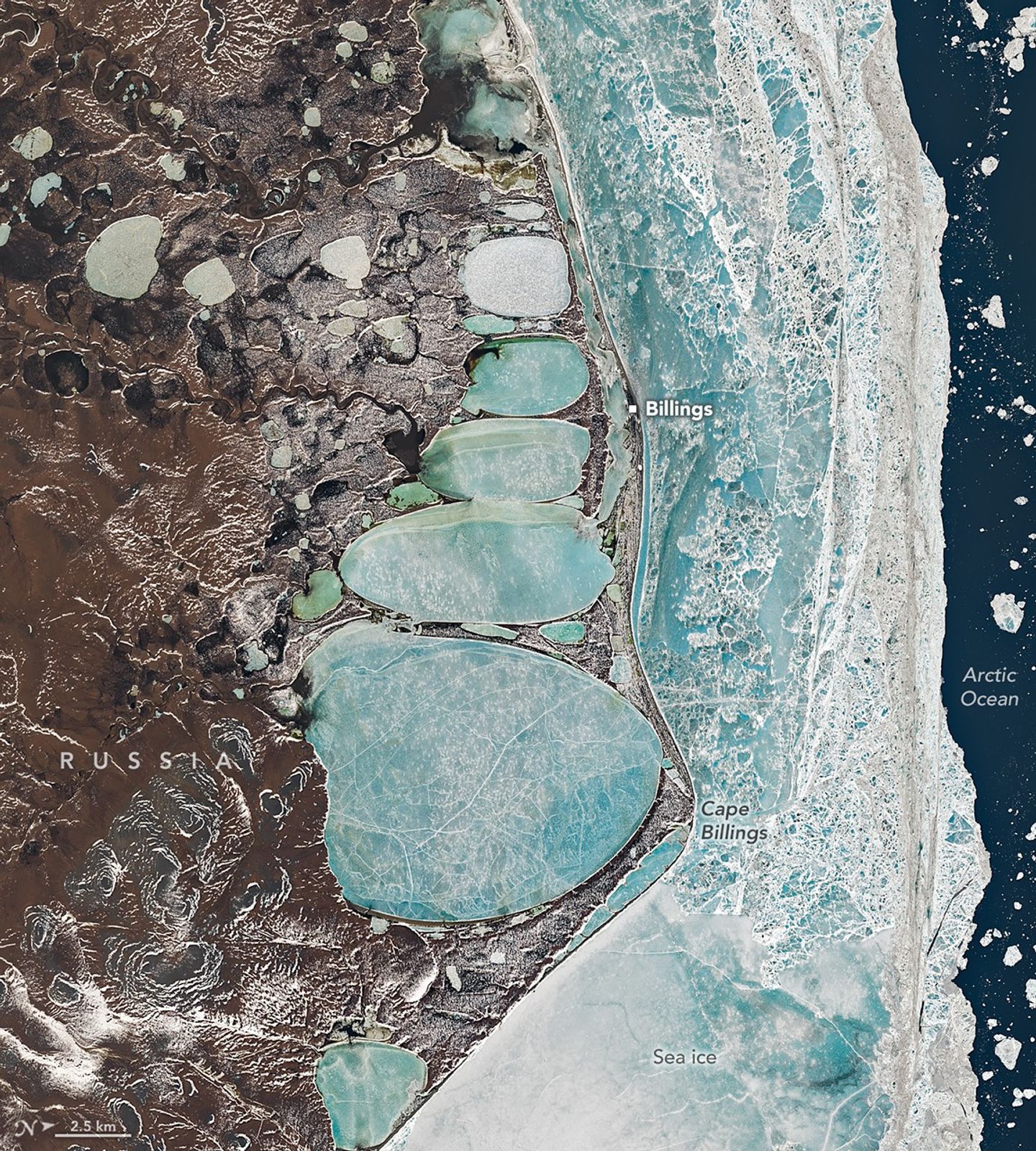
Icons of winter are sometimes found in unexpected places. In one striking example, a series of oval lagoons in a remote part of Siberia forms the shape of a towering snowman when viewed from above.
This image, centered on the remote village of Billings and nearby Cape Billings on Russia’s Chukchi Peninsula, was captured by the OLI (Operational Land Imager) aboard Landsat 8 on June 16, 2025. Established in the 1930s as a port and supply point for the Soviet Union, the village sits on a narrow sandspit that separates the Arctic Ocean from a series of connected coastal inshore lagoons.
The elongated, oval lagoons are frozen over and flanked by sea ice. Though June is one of the warmest months in Billings, ice cover is routine even then. Mean daily minimum temperatures are just minus 0.6 degrees Celsius (30.9 degrees Fahrenheit) in June, according to meteorological data.
Though the shape may seem engineered, it is natural and the product of geological processes common in the far north. The ground in this part of Siberia is frozen most of the year and pockmarked with spear-shaped ice wedges buried under the surface. Summer melting causes overlying soil to slump, leaving shallow depressions that fill with meltwater and form thermokarst lakes. Once created, consistency in the direction of the winds and waves likely aligned and elongated the lakes into the shapes seen in the image. The thin ridges separating the lakes may represent the edges of different ice wedges below the surface.
The first reference to humans building snowmen dates back to the Middle Ages, according to the book The History of the Snowman. While three spherical segments are the most common form, other variants dominate in certain areas. In Japan, snowmen typically have just two segments and are rarely given arms. This five-segmented snowman-shaped series of lakes spans about 22 kilometers (14 miles) from top to bottom, making it roughly 600 times longer than the actual snowwoman that held the Guinness record for being the world’s tallest snowperson in 2025.
Snowmen are not the only winter icons tied to this remote landscape. For early expeditions to the Russian Arctic, reindeer offered one of the most reliable modes of transportation. That includes expeditions by the town’s namesake, Commodore Joseph Billings, a British-born naval officer who enlisted in the Russian navy and led a surveying expedition to find a Northeast Passage between 1790 and 1794.
Although the hundred-plus members of the expedition did not reach Cape Billings, they explored much of the Chukchi Peninsula, producing some of the first accurate maps and further confirming that Asia and North America were separated by a strait. In the winter months, when their ships were beset by ice, the explorers moved to temporary camps on land and instead surveyed the region with reindeer-drawn wooden sleds, according to historical accounts. Winters, in fact, offered the best conditions for exploration because the peninsula’s many rivers and lakes turned into solid surfaces that were easy to traverse in comparison to the muddy bogs that open up in the summer.
Indigenous Chukchi people living on the peninsula at the time routinely used reindeer to haul both people and cargo. A pair of reindeer can comfortably haul hundreds of pounds for several hours a day. In addition to their impressive endurance in cold temperatures, reindeer largely feed themselves by digging through snow and grazing on lichens, something that neither sled dogs nor horses can do.
Historical documents indicate that the Billings expedition enlisted Chukchi people to manage and care for the reindeer they used, with some accounts suggesting that the explorers used dozens of reindeer at times. While reindeer were mainly used to haul sleds, Chukchi people likely rode them as well.
Non-Chukchi members of the expedition reportedly experimented with riding reindeer, though their experiments did not always go smoothly. Billings’ secretary and translator Martin Sauer reported using a saddle without stirrups or a bridle and falling “nearly 20 times” after about three hours of travel in his account of the expedition. Not only that, he added, but the saddle “at first, causes astonishing pain to the thighs.”
NASA Earth Observatory image by Michala Garrison, using Landsat data from the U.S. Geological Survey. Story by Adam Voiland.
References & Resources
Alekseev, A.I. (1966) Joseph Billings. The Geographical Journal, 132(2), 233-238.
Arctic Portal Chukchi. Accessed December 16, 2025.
The Perseverance Mars rover has been making headlines lately as it sets up a sample depot on the red planet and makes its way toward an ancient river delta. But its predecessor is still on Mars, too, and Curiosity is making its own discoveries even after more than a decade. As it ascends Mount Sharp, Curiosity has stumbled upon a fascinating rock formation — ripples left in ancient sediment by the planet’s long-lost water.
Curiosity arrived on Mars in 2012 and has been so successful that NASA opted to use its design as the base for Perseverance. It landed in Gale Crater and began making its way to Mount Sharp, the central peak of the crater. The rover was outfitted with instruments to assess the climate and geology of Mars to assess whether the conditions in the crater may have been compatible with life. Understanding the role of water in the planet’s distant past is a major element of the mission.
Last year, Curiosity reached the sulfate-bearing unit of Mount Sharp. This salt-rich region is believed to contain deposits left as the planet began drying up. However, the team didn’t expect to find evidence of waves. The rover has sent back images of a rippling texture in the rock, which was once sediment at the bottom of a body of water. “This is the best evidence of water and waves that we’ve seen in the entire mission,” said Ashwin Vasavada, Curiosity’s project scientist at NASA’s Jet Propulsion Laboratory.
Curiosity discovered the wave ripples about half a mile above the base of Mount Sharp in what has been termed the “Marker Band.” This layer of dark, hard rock stands out from the rest of the rusty landscape. The rock here is so hard that Curiosity has been unable to drill a sample of it. The team is still looking for an area with softer rock to get a sample for analysis. Unlike Perseverance, Curiosity is not outfitted with the hardware to save samples for a future return to Earth — it can only do science in its onboard laboratory. Curiosity will spend a little more time hunting for the right rocks in the Marker Band, but there are more discoveries awaiting higher on Mount Sharp.
The Curiosity team is looking ahead to a valley known as Gediz Vallis, which the rover could see from a distance at several points last year. NASA believes Gediz Vallis was carved by water, and there is evidence of wet landslides. This could be one of the youngest geological features on Mount Sharp. There is currently no planned end date for the Curiosity mission — it’ll keep rolling until its deformed, perforated wheels give out.
kollu paruppu recipe is very famous in Kongunadu. People prefer horse gram for weight loss in ayurveda also horse gram good for diabetes. we used to prepare kollu paruppu recipe often especially to treat cold which goes well with white rice. lets see how to cook horse gram recipe now.
Ingredients:
kollu paruppu ( known as horse gram tamil & kulthi beans in hindi ) – 1 cup
Water to cook horse gram
Castor oil – ½ spoon
Country tomato – 1(big)
Turmeric powder – ¼ spoon
Shallots – ¼ cup (cleaned)
Red chilli – 3 no’s
Curry leaves – 1 sprig
Garlic – 4 cloves
Cumin seeds – ½ spoon
Coriander seeds – 1 spoon
Coriander leaves – 4 stalks
Required salt
Steps to cook kollu paruppu recipe in pressure cooker:
To begin take a bowl add horse gram and wash them thoroughly.
Switch on the stove place a cooker then add 2 ½ cups of water, ½ spoon of castor oil, ¼ spoon of turmeric powder, one big country tomato.
Now close the pressure cooker and cook kollu paruppu up to 3 whistles.
Steps to cook kollu paruppu in earthen pots and normal pan:
Switch on the stove place earthen pot or steel pan, add 3 cups of water then is hot add in washed horse gram.
Followed by ½ spoon castor oil, one big country tomato then cook up to 15 minutes
After horse gram half cooked add turmeric powder then cook until horse gram fully cooked.
Steps to grind kollu paruppu:
At first switch off the stove drain the excess water in horse gram and keep it aside.
Next add cleaned shallots, red chilli, curry leaves, coriander leaves, cumin seeds, coriander seeds, required salt in cooker, earthen pot or normal pan.
Leave it all spices for 10 minutes.
Now take a mixer grinder put all things in to it and grind them as semi coarse paste. (No need to add water if you want add drained water from horse gram)
You can also add kollu paruppu in Aattu kal and grind well as semi coarse paste. (Taste will be super good)
Spicy authentic Kongu special kollu paruppu recipe is ready to serve.
Drizzle some homemade ghee or coconut oil on the top of the kollu paruppu and serve with hot white rice.
Various names of kollu paruppu
Kollu Paruppu is known ashorse lentil or horse gram, horse gram beans in english (also Cowpea)
kulthi horse gram in Hindi
ulavalu recipes in telugu
It is called as Muthira in Malayalam
Its botanical name is Macrotyloma uniflorum
Tips:
This is authentic Kongu style kollu paruppu; there also another way.
The only difference is seasoning, after grind the kollu paruppu, take a kadai add some ground nut oil when it is hot add mustard seeds, one red chilli and curry leaves then fry for a second and add kollu paruppu and cook up to 5 minutes. (This process will help to avoid spoilage of kollu paruppu)
As of now you need kollu paruppu in semi streaming consistency implies include water at that point cook well.
kollu paruppu in semi gravy is the good texture to eat.
We can make more than 40+ kollu recipes ( ulavalu recipes – kulith recipes) using horse gram dal.
horse gram soup
horse gram juice ( kollu juice)
kollu chutney
kollu kanji recipe
horse gram powder recipe for weight loss ( kollu powder)
kollu kulambu
kollu podi
kollu rasam (i’ll post kollu rasam in tamil soon)
paruppu thogayal
horse gram flour ( kulith flour) used for Weight loss Roti Recipe
horse gram health benefits / ulavacharu health benefits / kollu benefits
Kollu known in english as horse dal, horse gram lentils or horse peas. Horse gram benefits for more people who are following horse gram diet for weight loss.
horse gram nutrition : Horse gram seed contains carbohydrate (57.2% w/w), protein (22% w/w), dietary fiber (5.3% w/w), fat (0.50% w/w), calcium (287 mg), phosphorus (311 mg), iron (6.77 mg) and calories (321 kcal) as well as vitamins like thiamine (0.4 mg), riboflavin (0.2 mg) and niacin (1.5 mg) per 100 grams of dry matter.
benefits of drinking horse gram water: Drink the horse gram water twice a day on an empty stomach for weight loss.
horse gram benefits diabetes : Anti-oxidants help in controlling oxidative stress by scavenging free radicals. He said the study found that raw horse gram seed has the ability to reduce post-prandial hyperglycemia by slowing down carbohydrate digestion and reduce insulin resistance by inhibiting protein-tyrosine phosphatase 1 beta enzyme.
horse gram and diabetes: This helps to reduce insulin resistance.Hence it is highly used for diabetics.The seed is beneficial for reducing the blood glucose level.It can reduce the digestion of carbohydrate.This leads to lower the blood sugar level.This is used as insulin resistance in type 2 diabetes.Including Horse gram (മുതിര) in your daily food is very effective for diabetics.This can also help to reduce the cholesterol level.
horse gram benefits for weight loss : Consuming horse gram can help you lose burn calories. Horse gram is low in calories. It can keep your bad cholesterol levels in check and prevent the risk of heart diseases. Also, consuming horse gram will provide you with protein and fibre, which will keep you full for long and prevent you from eating more.
horse gram sprouts benefits : Doctors recommends having sprouts as a good source of protein and also to cool the body.
horse gram for hair growth : Drink it horse gram for hair growth once a day when bearable hot. Add 1/4 cup of Horse Gram ( Kulthi in India a pinch of Asafoetida ( Hing in India ) and 2 pinches each of dried horse gram for hair growth Ginger ( Adrak in India ) and Liquorice ( Mulethi in India )
horse gram for kidney stones ( kulthi for kidney stone): The importance of horse gram was well recognized by folk medicine as a potential therapeutic agent to treat kidney stones, urinary diseases, piles, common cold, throat infection, fever, lowering cholesterol levels and blood sugar levels. Horse gram water was prescribed for treating jaundice.
flaxseed and horse gram : Flax seed is a seed, while Horse Gram is a pulse. * Nutrient Value of 100 gram of Flax seed is: 50 calories, 20 grams of protein, 41 grams of fat, and 28 grams of fiber. * Nutrient Value of 100 gram of Horse grain is: 321 calories, 22 grams of protein, 287 mg of Calcium, 311 mg of Phosphorus and 7mg of Iron.
is horse gram good for health : If you are trying to lose weight, you can consume horse gram as much as you want, but remember moderation is the key. Moreover, the high protein and fibre content of horse gram will keep you fuller for a long time.
horse gram where to buy : its available local stores, super market and even online portals.
A succulent, slightly spicy dish that comes together when sheekh kebabs and some veggies are simmered in a simple curry. Pair it with rice, roti or naan for a delicious meal. Frozen food, especially premade non-vegetarian food, has always been frowned upon in our household. The packets of readymade chicken tikkas and frozen mutton cutlets were only meant to be…

 Login
Login