Normal view

There are new articles available, click to refresh the page.
Yesterday — 5 December 2025Main stream

Knight of the Seven Kingdoms trailer brings levity to Westeros

5 December 2025 at 10:12

With House of the Dragon entering its third season, HBO is ready to debut a new spinoff series set in Game of Thrones’ Westeros: A Knight of the Seven Kingdoms, based on George R.R. Martin’s Tales of Dunk and Egg novellas. HBO clearly has a lot of confidence in this series; it’s already been renewed for a second season. And judging by the final trailer, that optimism is warranted.

As we’ve previously reported, A Knight of the Seven Kingdoms adapts the first novella in the series, The Hedge Knight, and is set 50 years after the events of House of the Dragon. Per the official premise:

A century before the events of Game of Thrones, two unlikely heroes wandered Westeros: a young, naïve but courageous knight, Ser Duncan the Tall, and his diminutive squire, Egg. Set in an age when the Targaryen line still holds the Iron Throne and the last dragon has not yet passed from living memory, great destinies, powerful foes, and dangerous exploits all await these improbable and incomparable friends.

Peter Claffey co-stars as Ser Duncan the Tall, aka a hedge knight named “Dunk,” along with Dexter Sol Ansell as Prince Aegon Targaryen, aka “Egg,” a child prince and Dunk’s squire. The main cast also includes Finn Bennett as Egg’s older brother, Prince Aerion “Brightflame” Targaryen; Bertie Carvel as Egg’s uncle, Prince Baelor “Breakspear” Targaryen, heir to the Iron Throne; Tanzyn Crawford as a Dornish puppeteer named Tanselle; Daniel Ings as Ser Lyonel “Laughing Storm” Baratheon, heir to House Baratheon; and Sam Spruell as Prince Maekar Targaryen, Egg’s father.

Read full article

Comments

© YouTube/HBO

Before yesterdayMain stream

The Kremlin's Kill List: Inside a Culture of State-Sponsored Murder

2 December 2025 at 07:32


EXPERT OPINION / PERSPECTIVE — The 2024 spy swap between Russia and the West exposed a brutal truth: Moscow still treats innocent civilians as bargaining chips, and killers as heroes. In the deal, Russia forced multiple governments to trade convicted Russian intelligence officers, including an SVR “illegal” couple arrested in Slovenia, in exchange for Western citizens that the Kremlin had deliberately entrapped. But the real prize for Russian President Vladimir Putin was Vadim Krasikov, the FSB assassin who was convicted by a German court for murdering Chechen exile Zelimkhan Khangoshvili in Berlin in 2019. Through years of negotiations, including those aimed at freeing Wall Street Journal reporter Evan Gershkovich, Krasikov’s release remained a non-negotiable demand from Russia.

When the swap finally happened, Putin greeted Krasikov on the tarmac with a public embrace, an extraordinary display of presidential affection for a convicted murderer. Days later, the Kremlin confirmed his FSB status, praised his “service,” and even highlighted his past role as a presidential bodyguard. Putin’s message to his security services—and to the world—could not have been clearer: if you kill for Putin’s regime, the regime will protect you. Killing for the regime has always been a mission for Russia’s intelligence services (RIS).

State-directed murder was long embedded in the mission and culture of the RIS and their predecessors. The practice predates the Soviet Union, reaching back to the Czarist Okhrana, which routinely hunted down dissidents when exile to Siberia failed to silence them. After the 1905 revolution, Czar Nicholas II unleashed a wave of retributive assassinations that set a precedent for the violence institutionalized by the Cheka and later the KGB. He became known as “Bloody Nicholas.” The state security “organs” (as they are still known in Russia) elevated assassination into a professional craft, giving rise to the notorious phrase in Russian: vishaya mera nakazaniya — the highest measure of punishment. The term still carries its original meaning and dreaded connotation: death at the order of the state, whether by trial or extrajudicial killing.

There were many examples both at home and abroad for Soviet citizens to be afraid. Stalin’s plot to kill his arch-rival and fellow revolutionary, Leon Trotsky, was decades in the making and ended with an ice pick to Trotsky’s head while he was in Mexico City. His assassin, Ramon Mercader, was awarded the title Hero of the Soviet Union when he was released from prison and arrived back in the USSR.

Secret institutes like the infamous “Poison Factory,” known in the KGB as Laboratory 1 or “kamera” (for “the cell”), were set up during the early years of the Cold War to study chemical and biological agents that could be used to murder quietly. Laboratory 1 specialized in refining special toxins, like the ricin pellet the KGB provided to their Bulgarian allies, and used in the infamous assassination of Bulgarian dissident Georgi Markov on a London bridge in 1978.

Today is no different. Some assassinations are believed to be directly ordered by Putin in what the Russians call “direct action” (pryamoye deistviye, also known colloquially as mokroe delo, or wet work), while others are believed to be carried out with his implied approval. Poison factories continue to function inside of Russia. Today, the FSB uses a modern “kamera” which helped refine the nerve agent Novichok for use against the defector Sergei Skripal in the 2018 Salisbury UK attack. It was the same agent used against Russian Opposition leaders Alexei Navalny in a failed assassination attempt, prior to his death in a remote Russian prison, also likely wet work at the hands of the FSB.

Why does Putin let his Chekist assassins use such a well-known, state-only produced chemical weapon like Novichok to kill defectors or dissidents? The answer: because he wants the world to know the RIS were behind the attacks and that the tradition of the “highest measure” continues. Otherwise, he could certainly have his hitmen use a gun, ice pick, or other more deniable method. There is a track record now for decades, going back to the FSB defector Alexander Litvinenko and his death from polonium in the UK. The RIS will not hesitate to murder any intelligence or military defectors that the RIS can find and reach in the West. The lack of a formidable response from the UK and the U.S. to the Litvinenko poisoning only emboldened Putin and his henchmen (one of the assassins, Lugavoy, was praised so highly within Russia that he was eventually elected to the Russian duma).

Save your virtual seat now atThe Cyber Initiatives Group Winter Summit on December 10 from 1p – 4p ET for expert-led conversations on cyber, AI and the future of national security.

The Russian Record of Killing their Own: Disincentivizing Dissent

Putin and his RIS siloviki want all of their officers to know that the price for treason is death, and they don’t care what government may be offended or what international laws are broken. Otherwise, the incentive for those officers to betray Russia’s corrupt services and look to a better life for themselves and their families is too high. It matters not whether the execution is ordered by a secret court, or carried out on the street, the RIS consider it within their purview to decide how and when.

Two historical points illustrate this as practice within the RIS. For decades of the Cold War, and after, the rumor proliferated within the KGB and GRU that one or both of the first GRU spies to work for the United States, Pyotr Popov and Oleg Penkovskiy, were executed by being thrown into a furnace alive. Popov was uncovered and executed in 1960. Penkovskiy was arrested and executed in May 1963 after the vital role he played in providing intelligence to the United States during the Cuban Missile Crisis.

The practice during that time period, carried over from Stalin’s purges, was more likely a bullet to the back of the head up against a wall at the infamous Lubyanka prison. But the rumor, which was spread to the West by GRU defector Viktor Suvorov, was effective and garnered a lot of attention within the services; it still does. It was purposely spread, and taught, and continues to be, at the KGB Andropov Academy through the 1980s, now known as the modern SVR Foreign Service Academy (what they call the AVR). The same rumor is taught to officers at the GRU Military Diplomatic Academy. Defectors have confirmed for years that this rumor is whispered among classes at the academies, and as a warning against dissents—“you want to be thrown into a furnace alive, shut-up you idiot!” The very idea of being burned alive in a furnace is hard for young officers to forget.

There is another example from Cold War history that illustrates the same point. In 1985, the so-called “year of the spy,” while crypto-spy John Walker and his family ring were uncovered and arrested, CIA officer Ed Howard defected to Moscow, and many other espionage incidents took place. CIA traitor Rick Ames gave his “big dump” of classified holdings to the Soviets. Ames offered up roughly a dozen different U.S. cases to the Soviet services, including many penetrations of the KGB and GRU. Most of those assets were executed in short order, sending up a giant “CI flag” of counterintelligence warning to CIA/FBI and the entire U.S. intelligence community that something was amiss. A major mole hunt, which unfortunately took nine years, eventually led to Ames’ arrest. Ames himself commented after his arrest that he was astounded that the KGB/GRU had killed so many assets: why not keep them running as controlled cases, at least for a time, in order to protect him? It was an unprecedented, even reckless reaction.

Why did they do it?

The answer, as some senior Russian officers including former Line KR (kontrarazvedka or CI) Chief Viktor Cherkashin would later confirm (he wrote a book that was translated in the West) was that the Soviet services had no choice. The KGB and GRU had to take drastic steps to stop the flood of espionage and leaks in the Soviet services—too many traitors! An example had to be set.

Cherkashin would know since he ran both Ames and FBI spy Robert Hanssen when he served in the Washington D.C. Residency (station) of the KGB. Reportedly, the issue went to the highest ranks of the KGB/GRU and then on to the Central Committee of the Communist Party. For all their feared security prowess in the Soviet Union, the vaunted KGB had no idea that the CIA was running so many cases under their noses, literally, in Moscow and around the world. Since their own counterintelligence, the 2nd Chief Directorate of the KGB, had failed so miserably, the decision was made to execute them all (or nearly all, a previous few escaped death in the Gulag). There had to be a hard line drawn for the tens of thousands of other Soviet intelligence officers not to betray the regime - the highest measure would be the warning.

Need a daily dose of reality on national and global security issues? Subscriber to The Cipher Brief’s Nightcap newsletter, delivering expert insights on today’s events – right to your inbox. Sign up for free today.

Murder by Order or Murder to Impress the Boss?

The FSB is no less of a counterintelligence failure than their KGB predecessors. They cannot turn the tide against the U.S., our intelligence services, and those of our allies. Instead they arrest innocent civilians like those used to barter for the 2024 swap. That is why Putin likely continues to order death to all intelligence defectors. That is why he will greet a killer like Krasikov at the airport in Moscow in front of the cameras. But Putin’s RIS don’t just kill defectors and Chechen separatists. The RIS were almost certainly behind many political hits in Russia like Navalny, Boris Nemtsov and many others “falling out of windows” from Putin’s own government in recent years. Here it is important to recall that under President Yeltsin, Russia abolished the death penalty. So what were once judicial executions, ordered by the state, have become extra-judicial killings in the Putin era. But for the RIS, there is no distinction.

There have been many assaults and killings of journalists like Anna Politkovskaya. The question often arises—does Putin know about and order all of these murders? Perhaps, but there may be something else at play as well, an effort to impress “the boss.” This could also explain some of the more reckless acts of sabotage playing out in Europe at the hands of the RIS. Mafia families work in the same way - they surprise the boss with new income streams or take out a threat to the family with a hit, to earn one’s “button” and become a “made man.”

Indeed, the RIS function within mob-like cultures, fostered by patronage relationships, and corruption at every level. Officers are encouraged to pay bribes up the chain of command, and frauds of all kinds at every level infect their services. Putin has no doubt told aspiring leaders in the SVR, GRU and especially the FSB, his favorite service, to surprise him with new and inventive operations meant to hit back against the West, particularly regarding Ukraine. This has led to a cascading series of actions by the RIS, including sabotage, exploding parcels, and, yet again, like earlier in their history, attempted assassinations. The most brazen plot uncovered so far was the GRU plot that was unraveled in Germany in 2024 to assassinate the CEO of Rheinmetall, a leading provider of arms to Ukraine. GRU unit 29155 is likely behind that plot, just as they were behind the Skripal attack, and others.

The RIS attack dogs in Putin’s services are simply continuing a tradition of state-directed violence. Yet in the West, we often hesitate to assign blame, waiting for courtroom-quality evidence. But the evidence is already written across decades of Russian intelligence tradecraft, and reinforced by independent investigations.

Open-source teams like Bellingcat have repeatedly identified the GRU and FSB officers behind some of Moscow’s most feral operations - from the Skripal poisoning in Salisbury to the attempted assassination of Alexei Navalny. Still, conclusive proof of Kremlin authorization often appears only when an insider defects with hard intelligence. Those who contemplate such a step know they will be protected and given a new life in the West. They also know the stakes, however, if caught.

The absence of courtroom proof in every case of murder, poisoning, or a fall from a window should not silence the West. Putin’s record speaks for itself. His regime has presided over the killings of journalists, opposition figures, exiles abroad, and tens of thousands of Ukrainian civilians. He operates as a modern bloody czar, no different in impulse from Nicholas II—ordering assassinations, reprisals, and revenge killings with impunity. And the pattern is escalating. It is only a matter of time before Russian intelligence pushes further, testing its reach against U.S. and allied targets. The warning signs are unmistakable. The question is no longer whether the threat exists, but what the West intends to do about it.

All statements of fact, opinion, or analysis expressed are those of the author and do not reflect the official positions or views of the US Government. Nothing in the contents should be construed as asserting or implying US Government authentication of information or endorsement of the author’s views.

The Cipher Brief is committed to publishing a range of perspectives on national security issues submitted by deeply experienced national security professionals. Opinions expressed are those of the author and do not represent the views or opinions of The Cipher Brief.

Have a perspective to share based on your experience in the national security field? Send it to Editor@thecipherbrief.com for publication consideration.

Read more expert-driven national security insights, perspective and analysis in The Cipher Brief because National Security is Everyone’s Business.

Kaspersky Security Bulletin 2025. Statistics

By: AMR
2 December 2025 at 05:07

All statistics in this report come from Kaspersky Security Network (KSN), a global cloud service that receives information from components in our security solutions voluntarily provided by Kaspersky users. Millions of Kaspersky users around the globe assist us in collecting information about malicious activity. The statistics in this report cover the period from November 2024 through October 2025. The report doesn’t cover mobile statistics, which we will share in our annual mobile malware report.

During the reporting period:

  • 48% of Windows users and 29% of macOS users encountered cyberthreats
  • 27% of all Kaspersky users encountered web threats, and 33% users were affected by on-device threats
  • The highest share of users affected by web threats was in CIS (34%), and local threats were most often detected in Africa (41%)
  • Kaspersky solutions prevented nearly 1,6 times more password stealer attacks than in the previous year
  • In APAC password stealer detections saw a 132% surge compared to the previous year
  • Kaspersky solutions detected 1,5 times more spyware attacks than in the previous year

To find more yearly statistics on cyberthreats view the full report.

The missile meant to strike fear in Russia’s enemies fails once again

1 December 2025 at 18:36

A Russian intercontinental ballistic missile (ICBM) fired from an underground silo on the country’s southern steppe Friday on a scheduled test to deliver a dummy warhead to a remote impact zone nearly 4,000 miles away. The missile didn’t even make it 4,000 feet.

Russia’s military has been silent on the accident, but the missile’s crash was seen and heard for miles around the Dombarovsky air base in Orenburg Oblast near the Russian-Kazakh border.

A video posted by the Russian blog site MilitaryRussia.ru on Telegram and widely shared on other social media platforms showed the missile veering off course immediately after launch before cartwheeling upside down, losing power, and then crashing a short distance from the launch site. The missile ejected a component before it hit the ground, perhaps as part of a payload salvage sequence, according to Pavel Podvig, a senior researcher at the United Nations Institute for Disarmament Research in Geneva.

Read full article

Comments

© MilitaryRussia.ru via Telegram

U.S. plans growth in JAGM and Hellfire production pipeline

27 November 2025 at 04:04
The United States is preparing for a large-scale expansion of its sustainment and supply chain framework for the Army’s Joint Air-to-Ground Missile (JAGM) and AGM-114 Hellfire systems, according to a new notice from the Defense Logistics Agency. Both missile families are manufactured by Lockheed Martin, the long-time prime contractor responsible for their production and lifecycle […]

The U.S. Needs to Restore Deterrence Credibility Against Putin

26 November 2025 at 14:59

OPINION — President Donald Trump’s 28-point peace plan is a humanitarian attempt to halt the killing and destruction in Ukraine, although Russia’s President Vladimir Putin may view the peace plan as an attempt to appease Russia. Since Russia’s invasion of Georgia in August 2008, the U.S. and its NATO allies have not been able to deter an aggressive Russian Federation.

When Russia invaded Georgia in 2008, this was a clear signal, especially to NATO, that Russia was prepared to use force in the “near abroad” when their interests weren’t respected. The response from the U.S. and NATO was weak: no military support to Georgia or strong punitive actions against Russia

In 2014, Russia seized Crimea, with minimal consequences. The muted response in 2008 to Russia’s invasion of Georgia no doubt convinced the Kremlin that the U.S. and NATO would not risk a military confrontation with Russia. Although Russia was suspended from the G8 and the United Nations General Assembly adopted a resolution condemning Russia’s annexation of Crimea, NATO’s military response – suspending all cooperation with Russia -- was weak:

The U.S. withdrawal from Afghanistan in August 2021reinforced the Russian view that U.S. and NATO “red lines” were either not clear or not credible. Indeed, Russia viewed the withdrawal as a weakening of U.S. deterrence credibility.

On February 4, 2022, just weeks before Russia’s invasion of Ukraine on February 24, 2022, Mr. Putin met with Chinese President Xi Jinping at the Beijing Winter Olympics. The joint statement from their discussion was clear in stating a “no-limits” partnership and “no forbidden areas of cooperation” between Russia and China.

And prior to Russia’s February 2022 invasion of Ukraine, the U.S. publicly stated that they had credible intelligence of Russia’s plan to invade Ukraine. Unfortunately, however, even with this insight, the U.S. could not convince Mr. Putin an invasion of Ukraine would cross a red line and result in sanctions and other consequences for Russia. We failed to deter Russia from this bloody four-year war, with over 400,000 Ukrainian casualties and over one million Russian casualties.

The 28-point peace plan is being reviewed by the leadership in Ukraine and NATO and it’s possible the peace plan will be amended, to secure greater support from Ukraine and NATO.

What’s clear from Russia’s actions in Georgia, Crimea and Ukraine is that U.S. and NATO deterrence failed. A credible deterrence strategy would have made it clear to Russia that their aggressive military behavior would have resulted in significant consequences, to include biting sanctions, pariah status and a likely military response.

The Cipher Brief brings expert-level context to national and global security stories. It’s never been more important to understand what’s happening in the world. Upgrade your access to exclusive content by becoming a subscriber.

China, North Korea and Iran, allies of Russia, are watching closely how the war in Ukraine ends. Indeed, their interest in what’s included in the peace plan and the consequences for Russia, given their invasion of a Ukraine that had security assurances from Russia – and the U.S. and United Kingdom – in the 1994 Budapest Memorandum on Security Assurances, which pledged to respect Ukraine’s independence, sovereignty, and existing borders.

Hopefully, none of Russia’s allies will view the Ukraine peace plan as license to foment trouble in their region. Clearly, China understands U.S. policy: A peaceful resolution of issues between China and Taiwan, in accord with the Taiwan Relations Act of 1979. North Korea knows that the U.S. has extended deterrence commitments to our ally in South Korea and Iran should appreciate – - especially since the June 2025 bombing of their Fordow nuclear facility -- that Israel is a close ally of the U.S, with strong security commitments.

Deterrence credibility is important. That’s why the U.S. is providing Taiwan with about $387 million in defensive arms sales in 2024. And that’s why we have a Washington Declaration with South Korea, enhancing the nuclear deterrence alliance. Iran saw clearly, with the bombing of Fordow, how close our allied relationship is with Israel.

These allies of Russia would be making a grievous error if they try to exploit any peace agreement with Russia to end the war in Ukraine. And Mr. Putin would be advised to comply with any peace accord to end the Ukraine war and to refrain from any future attempt to violate the sovereignty of any of the 32 NATO members.

This column by Cipher Brief Expert Ambassador Joseph DeTrani was first published in The Washington Times

Read more expert-driven national security insights, perspective and analysis in The Cipher Brief because National Security is Everyone’s Business.

Snatching Defeat from the Jaws of Victory

22 November 2025 at 09:36

EXPERT OPINION – The recently leaked 28-point peace plan to end the war in Ukraine is nothing short of an appeasement that satisfies the maximalist demands of the aggressor in the conflict, Russian President Vladimir Putin. This is nothing short of the side on the verge of victory (eg, the free world) conceding to the side on the verge of defeat (Putin, the leader of the anti-west coalition). Sadly, it comes at a time when the situation on the battlefield is more or less a draw, both sides are effectively attacking energy infrastructure, and Russia’s economy is moving toward recession.

According to Russian data, third Quarter GDP growth in Russia was 0.6%. The expectation is that Q4 data will show the beginning of a recession. Sberbank has just decided to let 20% of their workforce go. Russia has for the first time, begun to sell gold reserves, presumably to make up for lost revenue from the recently imposed sanctions on Rosneft and Lukoil. Russia’s wartime transition to a command economy is not sustainable with a declining workforce sapped by the loss of young men sacrificed in Ukraine and those who have voted with their feet by leaving Putin’s kleptocracy.

The key points of the 28-point plan amount to nothing less than surrender by Ukraine and make in vain the sacrifices made by their valiant soldiers and citizens in their three plus years of war of full-scale war since Russia’s deadly invasion.

The agreement will be remembered in history with the same ignominy of the Munich Agreement of 1938 and will have the same consequence of setting the stage for a larger war to come.

Perhaps most egregious in the terms of the draft agreement is the re-establishment of the Russian Orthodox Church in Ukraine and the establishment of Russian as the official language. This indignity on top of the kidnapping of hundreds - if not thousands - of Ukrainian children to Russia and the forced conscription into the Russian army of men from Russian occupied territory. Then, of course, there is the massacre of innocent citizens by Russian soldiers in places like Bucha, all of which will go unaccounted for under the draft agreement. No judgement at Nuremberg for Russian war criminals.

What national security news are you missing today? Get full access to your own national security daily brief by upgrading to Subscriber+Member status.

The plan U.S. officials have negotiated is nothing more than cultural genocide against the people of Ukraine. That the U.S. would be part of an agreement that almost certainly would result in the arrest, deportation and incarceration of a generation of brave Ukrainians who have bravely resisted Putin’s aggression is simply unthinkable.

Mr. Trump, every member of your national security team should be required to watch episode nine of the brilliant HBO series Band of Brothers. The episode’s title is “Why We Fight” and the reasons for standing up to autocracy and evil portrayed in that episode are perfectly applicable to the situation today with the free world standing strong against the aggression of a malevolent dictator.

The Trump Administration’s desire to end the violence in Ukraine is commendable, but not at the price of setting the stage for the next war by giving victory to the aggressor. The men who reportedly negotiated the key points of the agreement have no experience dealing with Russia or Russians of the KGB ilk. The promises of “peace” offered by the Russian side are a chimera at best. Putin and the gang of thieves in his government know perfectly well how to manipulate representatives of the character of Steve Witkoff, President Trump’s real estate specialist now in charge of negotiating with Russia over Ukraine. Perhaps those negotiators are working with the idea of “Commander’s intent” that the President believes an agreement can be reached and counted upon with a counter-party like Putin. This is a serious misjudgment with serious consequences.

Those who have studied Putin for decades, understand clearly that he wants nothing but the destruction of the United States, our system of government and the set of ideals for which we stand. This is core to his beliefs. Putin and his security services will do everything they can to undermine the United States. One should not be surprised if the Russian services do not use every opportunity in the context of the Epstein revelations to attack every angle of the political spectrum in the U.S. that they can, including President Trump.

President Trump is now facing the most significant foreign and national security moment of his presidency. It appears the representatives he has chosen to negotiate with the Russian side have left him in a position to be remembered forever in history as the Chamberlain of the 21st century. Mr. Trump would do well to recognize that history does not remember Neville Chamberlain for any achievements in his political career in economic or domestic policy in Great Britain. He is remembered solely for Munich and "peace in our time". Mr. Trump is setting himself up to be remembered by history similarly. Sadly, it could also be the legacy of the country that was once the pillar of strength of the free world.


The Cipher Brief is committed to publishing a range of perspectives on national security issues submitted by deeply experienced national security professionals.

Opinions expressed are those of the author and do not represent the views or opinions of The Cipher Brief.

Have a perspective to share based on your experience in the national security field? Send it to Editor@thecipherbrief.com for publication consideration.

Read more expert-driven national security insights, perspective and analysis in The Cipher Brief

Russia’s Intelligence Services After the War

20 November 2025 at 11:28


EXPERT PERSPECTIVE — Russia’s intelligence services (RIS) have failed spectacularly in Ukraine: in planning, execution, and analysis, yet they will face no reckoning. Vladimir Putin cannot afford to hold the SVR, GRU, or FSB accountable because they are not merely instruments of the state; they are the pillars of his personal power. The RIS misled the Kremlin into believing Ukraine would fall in days, Europe would divide, and NATO would hesitate. Instead, they exposed the rot at the core of Russia’s national security system: corruption, internecine rivalry, and a profound detachment from reality. Understanding this dynamic matters for the West because it reveals not only how Russia fights its wars but how it fails, and how it will likely fight again.

As the war approaches its fourth year, the front lines have grown static, and speculation about an eventual end has returned. Certainly, the world hopes for peace and relief from the suffering that has defined Europe’s largest land conflict since 1945. Yet even when the drones stop flying, Ukraine’s struggle to rebuild will begin, and within the Russian government another kind of reckoning will unfold. The aggressor’s armed forces and intelligence services will take stock of losses and lessons learned. But unlike in the West, where failure invites inquiry and reform, Russia’s services are more likely to protect the system that failed them and pin any blame on each other.

Russian post-war accounting will not play out like we in the West might imagine. We are accustomed to commissions and legislative investigations after wars and major national security events, often resulting in harsh criticism for various agencies, and sweeping reforms. In Russia, however, Putin will largely give the RIS a pass.

To understand why, it is important to understand the roles the RIS played in the war and in the Russian government more broadly. The SVR (the Foreign Intelligence Service), the GRU (the Main Intelligence Directorate - military intelligence), and the FSB (the Federal Security Service), serve first and foremost as Putin’s Praetorian Guard. Their primary responsibility is securing his regime and hold on power. Moreover, Putin rose up through the RIS ranks in the KGB, and later held the post of FSB Director. His feelings toward the RIS are hardly objective. The reputations of Putin and the services are inextricably linked. Anything that significantly tarnishes the highly cultivated myth of RIS omnipotence inevitably damages his own hold on power.

If Putin and the “siloviki” (strongmen) who make up his inner circle try to call the RIS to account for their performance when the fighting stops, the one thing all three services will argue is that the war was an absolute success. Each will extoll their roles with little regard for the number of Russian lives lost and military assets squandered. Going back to Tsarist and Soviet times, casualties and human suffering were never a mark for a war’s success or failure in Russia. The RIS will focus on territory gained, Ukraine’s membership in NATO being halted (from their optic), and the alliance, they will claim, weakened. They will ignore the addition of two capable new members to the alliance (Finland and Sweden), the doubling of the length of NATO’s border with Russia, and the resuscitation of NATO’s military spending and defense industrial base. Facts will not stop the RIS from claiming success with Putin. But it is useful to further break down some of their likely claims, and actual performance, by service.

The SVR: “Speak up Sergey!”

Among the RIS, and especially relative to the FSB, Putin has never been particularly fond of the foreign intelligence service, the SVR. Its claims of success on Ukraine will likely not impress him or the other siloviki much. Recall Putin’s public dressing down of SVR Director Sergey Naryshkin on Russian TV in the days before the invasion for indecisiveness: “Come on Sergey, speak up, speak plainly!” But Sergey did not speak up, nor make much of a difference in the war.

Since they do not have troops or special ops elements in the war (their main Spec-Ops team, ZASLON, is used more for protection abroad), the SVR will likely try to boast of the success of its “active measures” operations. This is the traditional term the Russians have used for covert influence and disinformation activities intended to weaken, confuse, or disrupt their adversaries. Their modern term, however, is to refer to them as “measures of support” (MS). The SVR has an entire “Directorate MS” devoted to this line of operational work: using troll farms, social media, cyber operations, and recruited agents of influence to meddle in the internal politics, public opinion, and elite decision-making of its adversaries to Russia’s advantage. The Russians believe their active measures contributed to their successes in the Georgia invasion in 2008 and occupation of Crimea and parts of the Donbas in 2014. They believed they confused and stunted the West’s response and, to a degree, they were right.

But the SVR will have trouble claiming active measures succeeded in the current Ukraine war. They will perhaps try to sell Putin that the SVR sowed confusion at critical policy decision points when the U.S. and its European allies were not always in sync—hesitation in providing this or that weapons system, unity or lack thereof at times on sanctions, asset seizures, etc. Their efforts, however, did not materially alter Russia’s failure to achieve its war aims. If they were effective at all, it was only in the margins. There will be no dramatic accounting for the SVR but expect to see the SVR’s relative influence decline among the RIS, a continuation of trend since Putin’s rise to power.

Need a daily dose of reality on national and global security issues? Subscriber to The Cipher Brief’s Nightcap newsletter, delivering expert insights on today’s events – right to your inbox. Sign up for free today.

GRU: Plowed into the Grinder, and Re-Special Purposed

The GRU will likely point to the various sabotage acts, conducted in Europe after the invasion, some successful but most not, including exploding packages, industrial arson, cable cuts in the Baltic Sea, and assassinations, or attempts at them. These are the purview of the GRU and its various numbered units, such as Unit 29155, which was behind both the attempted assassination of GRU defector Sergey Skripal in the UK in 2018, and likely also the thwarted assassination plot against the CEO of Germany’s Rheinmetall in 2024. The Lithuanian government is convinced the GRU also was behind the crash of a DHL plane that same year. But these actions failed in their primary mission, to intimidate and deter Europe and NATO from assisting Ukraine. If anything, the actions have only emboldened members to continue support for Ukraine.

Another shocking GRU failure, one heavily criticized in Russia’s pro-war blogosphere but receiving less attention in the West, was its squandering of precious, highly trained Spetsnaz units on the Ukrainian battlefield. There are nine Spetsnaz, or “Special Purpose,” brigades under the GRU’s 14th Directorate (roughly analogous to Tier 1 elements in the U.S. SOCOM). Nearly all were heavily deployed in Ukraine, and all suffered extremely heavy casualties. The planned decapitation strike against the Ukrainian leadership in the first days of the war, spearheaded by Spetsnaz units, was a complete and costly failure (the failed seizure of Hostomel airport was part of this). Many Spetsnaz were also used foolishly in frontal assaults and to plug gaps in forward lines when Russian “kontraktniki” (paid soldiers, but often supplemented in frontline units with conscripts) failed. GRU Spetsnaz have a storied history and culture. It will be hard for them to recover the reputation for being “elite” without notable successes to point to in Ukraine. They failed to impact the direction of the war in any significant way.

As with the SVR, the GRU will likely avoid any dramatic negative consequences. There will probably be some modest reorganizations, just as there have been since the collapse of the USSR. In fact, the GRU is technically not even called the GRU any longer. It was formally redesignated the “GU” (Main Directorate), although many stubborn officers still refer to themselves as “GRU-chniki.” One reorganization has already occurred since the war began, the standup of something called the Department for Special Tasks (SSD). Its function and exact composition are still not fully known, but it appears to combine various Russian-termed “direct actions” (e.g., assassinations, sabotage) units, such as Unit 29155, into a unified structure. The SSD is broadly equivalent to the CIA’s Special Activities Center in terms of covert action, but dwarfs it in size (and the CIA is bound by law not to carry out assassinations). The GRU is a mammoth bureaucracy and it will likely only grow more after the war.

FSB: Failed, But Still Putin’s Favorite

Despite their many failures, there will be few significant negative consequences for the FSB, which Putin once ran. In many ways, though, the FSB’s shortcomings in Ukraine were the most egregious and consequential. The FSB was in charge of the war’s planning, particularly the hybrid dimensions, or what Russian doctrine refers to more broadly as “non-contact war.” The FSB's lead for the Ukraine invasion was its Fifth Service, which heads up both operational analysis and reporting to the President on the war. The FSB has organizational primacy for RIS operations in the “near abroad,” i.e., the states of the former USSR, including Ukraine. In the pre-war planning phase, the Fifth Service was wrong about everything: wrong about Ukrainian resilience, wrong about how quickly and substantially Europe and NATO would react, and wrong about the FSB and Russian Armed Forces’ capabilities on the ground.

FSB Spetsnaz units Alpha and Vympel all participated in the war, but like their GRU cousins, they have not distinguished themselves. Still they are still frequently lauded in the Russian press for “actions that cannot be disclosed.” The FSB also has the lead for cyber operations against Ukraine with its 16th Center, but those cyber-attacks have not materially altered the direction of the war in Russia’s favor. The battle over bytes was not won in any way by Russian FSB hackers, whose ranks were bolstered by Russian criminal groups hacking for the state and their coffers.

The FSB will likely be the RIS agency most affected by the war. But instead of accountability for failure, its power and influence will likely only grow. First, because of all the services, the FSB, in its secret police role, is the critical player in securing Putin’s rule. In the bureaucratic pecking order, the FSB sits at the very top and will remain there. FSB Director Alexander Bortnikov holds the military rank of full General, and he is treated as such by Russian military generals, despite never having served in the military. Second, if there is a formal investigation or after-action when the fighting stops, the FSB will lead it, just as it did in the investigations of the 2002 Nord-Ost theater terrorist attack, the 2004 school seizure in Beslan, and the more recent Crocus City Hall terrorist attack in 2024, each of which involved breathtaking intelligence and operational failures, but did not have significant negative repercussions for the FSB. The FSB pretends to clean up after it performs incompetently.

Are you Subscribed to The Cipher Brief’s Digital Channel on YouTube? There is no better place to get clear perspectives from deeply experienced national security experts.

In conclusion, the one thing the West can count on is that the Russian services will continue to relentlessly compete with and back-stab one another. There is no “intelligence community” in Russia remotely similar to the one we have in the United States. The rivalries within our community pale in comparison. This presents opportunities to recruit personnel from all the RIS services, many of whom will have lost colleagues in the war for a cause and for leaders whose competence an increasing number of them will come to doubt. This and the pervasive corruption in Russia are still strong incentives for espionage against those who have led Russia down this disastrous path.

The RIS will not prevent another war for Russia; if anything, they will foment one. Before they do, the US and our allies must understand these failures, but also, and critically, the Russian services’ likely self-evaluation and the lessons they themselves will draw, or fail to draw, from those lessons. When the current war ends, Putin may plan another intervention or aggression--in Europe, again in Ukraine, or elsewhere. Before he does, we need to be ready to counter the next iteration of the FSB, GRU, and SVR tactics to encourage and support war. We can better do so by studying their playbook and some of their attempted actions, and dramatic failures.

All statements of fact, opinion, or analysis expressed are those of the author and do not reflect the official positions or views of the US Government. Nothing in the contents should be construed as asserting or implying US Government authentication of information or endorsement of the author’s views.

Read more expert-driven national security insights, perspective and analysis in The Cipher Brief because National Security is Everyone’s Business.

Mating Cycles: Engineering Connectors to Last

20 November 2025 at 10:00

If you take a look around you, chances are pretty good that within a few seconds, your eyes will fall on some kind of electrical connector. In this day and age, it’s as likely as not to be a USB connector, given their ubiquity as the charger of choice for everything from phones to flashlights. But there are plenty of other connectors, from mains outlets in the wall to Ethernet connectors, and if you’re anything like us, you’ve got a bench full of DuPonts, banana plugs, BNCs, SMAs, and all the rest of the alphabet soup of connectors.

Given their propensity for failure and their general reputation as a necessary evil in electrical designs, it may seem controversial to say that all connectors are engineered to last. But it’s true; they’re engineered to last, but only for as long as necessary. Some are built for only a few cycles of mating, while others are built for the long haul. Either way, connectors are a great case study in engineering compromise, one that loops physics, chemistry, and materials science into the process.

A Tale of Two Connectors

While there’s a bewildering number of connectors available today, most have at least a few things in common. Generally, connectors consist of one or more electrically conductive elements held in position by an insulating body of some sort, one that can mechanically attach to another body containing more conductive elements. When the two connectors are attached, the conductive elements come into physical contact with each other, completing the circuit and providing a low-resistance path for current to flow. The bodies also have to be able to separate from each other when the connections need to be broken.

This Molex connector is only engineered for a few mating cycles over its useful life. By Barcex – Self-published work, CC BY-SA 2.5.

For as simple as that sounds, a lot of engineering goes into making connectors that are suitable for the job at hand. The intended use of a connector dictates a lot about how it’s designed, and in terms of connector durability, looking at the extremes can be instructive. On one end of the scale, we might have something like a Molex connector on a wiring harness in a dishwasher. Under ideal circumstances, a connector like that only needs to be used once, in the factory during assembly. If the future owner of the appliance is unlucky, that connector might go through one or two more mating cycles if the machine needs to be serviced at some point. Either way, the connector is only going to be subjected to low single-digit mating cycles, and should be designed accordingly

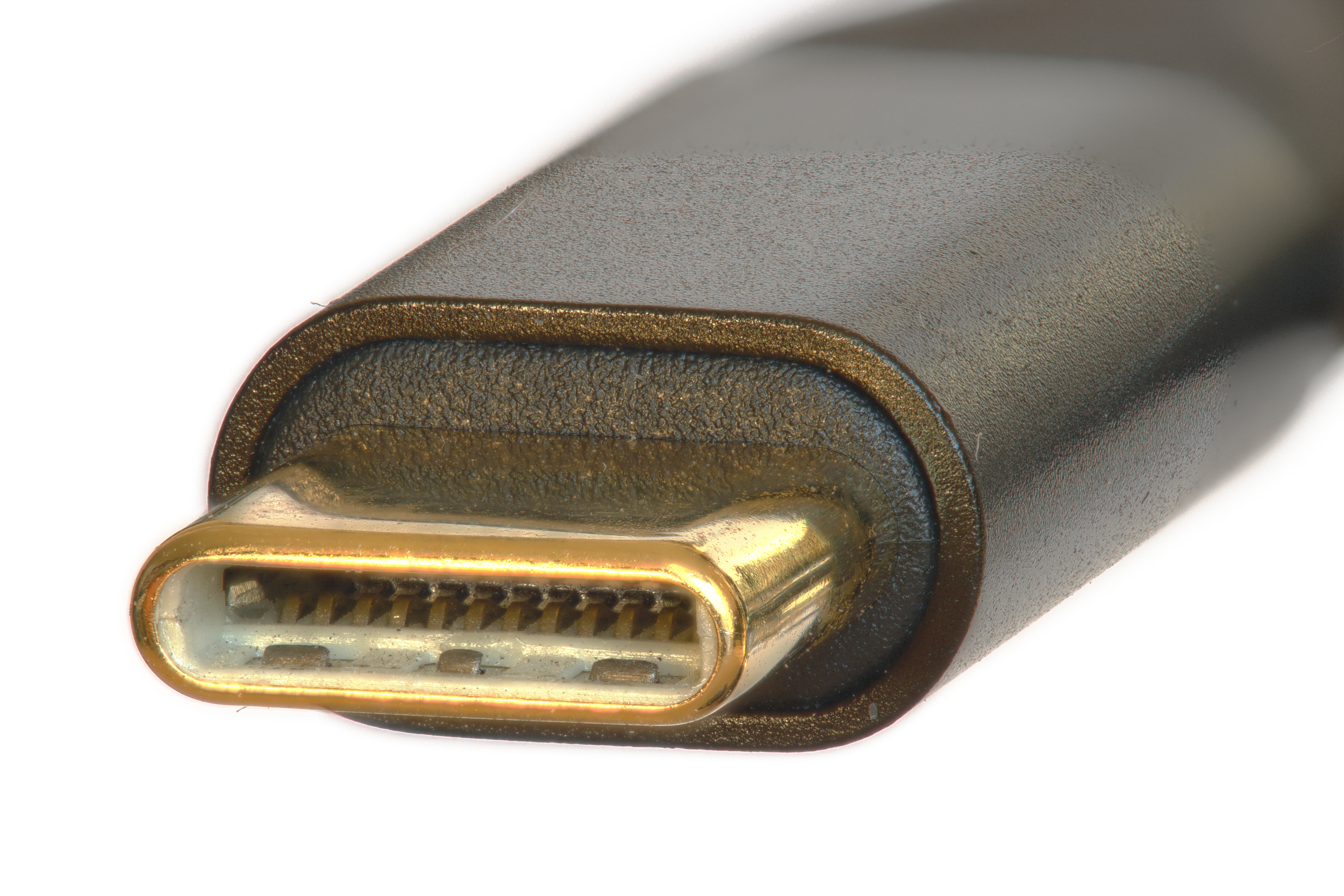
A USB-C connector, on the other hand, is designed for 10,000 mating cycles. By Tomato86 – Own work, CC BY-SA 4.0.

On the other end of the mating-cycle spectrum would be something like the USB-C connector on a cell phone. Assuming the user will charge the phone once a day, the connector might have to endure many thousands of mating cycles over the useful life of the phone. Such a connector has a completely different use case from a connector like that Molex, and very different design constraints. But the basic job — bringing two conductors into close contact to complete a low-resistance circuit, and allow the circuits to be broken only under the right circumstances — is the same for both.

But what exactly do we mean by “close contact”? It might seem obvious — conductors in each half of the connector have to touch each other. But keeping those conductors in contact is the real trick, especially in challenging environments such as under the hood of a car or inside a CNC machine, where vibration, dust, and liquid intrusion can all come together to force those contacts apart and break the circuit while it’s still in use.

Why Be Normal?

To keep contacts together, engineers rely on one of the simplest mechanisms of all: springs. In most connectors, the contacts themselves are the sprung elements, although there are connectors where force is applied to the contacts with separate springs. In either case, the force generated by the spring pushes the contacts together firmly enough to ensure that they stay connected. This is the normal force, called so because the force is exerted perpendicular to the plane of contact when the connector is mated.

Traditionally, normal force in connector engineering is expressed in grams, which seems like an affront to the SI system, where force is expressed in Newtons. But fear not — “grams” does not refer to the mass of a contact, but rather is shorthand for “gram-force,” the force applied by one gram of mass in a one g gravitational field. So, an “80 gram” contact is really exerting 0.784 N of normal force. But that’s a bit clunky, especially when most connectors have normal forces that are a fraction of a Newton. So it ends up being easier to refer to the grams part of the equation and just assume the acceleration component.

The amount of normal force exerted by the contacts is a critical factor in connector design, and has to be properly scaled for the job. If the force is too low, it may increase the resistance of the circuit or even result in intermittent open circuits. If the force is too high, the connector could be difficult to mate and unmate, or the contacts could wear out from excess friction.

Since the contacts themselves are usually the springs as well as the conductors, getting the normal force right, as well as ensuring the contacts are highly conductive, is largely an exercise in materials science. While pure copper is an excellent conductor, it is not elastic enough to provide the proper normal force. So, most connectors use one of two related copper alloys for their contacts: phosphor bronze, or beryllium copper. Both are excellent electrical and thermal conductors, and both are strong and springy, but there are significant differences between the two that make them suitable for different types of connectors.

As the name implies, phosphor bronze is an alloy of phosphorus and bronze, which itself is an alloy of copper and tin. To make phosphor bronze, about 0.03% phosphorus is added to pure molten copper. Any oxygen dissolved in the copper reacts with the phosphorus, making phosphorus pentoxide (P2O5), which can be easily removed during refining. About 2% tin is added along with about 10% zinc and 2% iron to make the final alloy, which is easily cast into sheets or coil stock.

While far superior to pure copper or non-phosphor bronze for use in contacts, phosphor bronze is, at best, a compromise material. It’s good enough in almost all categories — strength, elasticity, conductivity, wear resistance — but not really great in any of them. It’s the “Jack of all trades, master of none” of the electrical contact world, which, coupled with its easy workability and low cost, makes it the metal of choice for the contacts in commodity connectors. If a manufacturer is making a million copies of a connector, especially ones that are cheap enough that nobody will cry too much if they have to be replaced, chances are good that they’ll choose phosphor bronze. It’s also the alloy most likely to be used for connectors intended for low mating-cycle applications, like the aforementioned dishwasher Molex.

For more mission-critical contacts, a different alloy is generally called for: beryllium copper. Also known as spring copper, beryllium copper contains up to about 3% beryllium, but for electrical uses, it’s usually around 0.7% with a little cobalt and nickel added in. Beryllium copper is everything that phosphor bronze is, and more. It’s stronger and springier, it’s a far better electrical conductor, and it also has a better ability to withstand creep under load. Also known as stress relaxation, creep under load is the tendency for a spring to lose its strength over time, which reduces its normal force. Phosphor bronze has pretty good stress relaxation resistance, but when it heats up past around 125°C, it starts to lose spring force — not ideal for high-power applications. Beryllium copper is easily able to withstand 150°C or more, making it a better choice for power connectors.

Beryllium copper also has a higher elastic modulus than phosphor bronze, which makes it easier to create small contacts that still have enough normal force to maintain good contact. Smaller is better when it comes to modern high-density connectors, so you’ll often see beryllium copper used in fine-pitch connectors. It also has better fatigue life and tends to maintain normal force over repeated mating cycles, making it desirable for connectors that specify cycle lives in the thousands. But just because it’s desirable doesn’t make it a shoo-in — beryllium copper is at least three times more expensive than phosphor bronze. That means it’s usually reserved for connectors that can justify the added expense.

Noble Is Only Skin Deep

No matter what the base metal is for connector contacts, chances are good that the finished contact will have some sort of plated finish. Plating is important because it protects the base metal from oxidation, as well as increasing the wear resistance of contacts and improving their electrical conductivity. Plating metals fall into two broad categories: noble (principally gold, with silver used sometimes for high-power connectors, as well as palladium, but only very rarely) and non-noble platings.

Noble metal finishes are quite common in high-density connectors, RF applications, and high-speed digital circuits, as well as high-reliability applications and connectors that are expected to have high mating cycles. But at the risk of stating the obvious, gold is expensive, so it’s used only on connectors that really need it. And even then, it’s very rare that the entire contact is plated. While that would be incredibly expensive — gold is currently pushing $4,000 an ounce — the real reason is that gold isn’t particularly solderable. So generally, selective plating is used to deposit gold only on the mating surfaces of contacts, with the tail of the contact plated in a non-noble metal to improve solderability.

Among the non-noble finishes, tin and tin alloys are the first choice. Aside from its excellent solderability, tin alloys do a great job at protecting the base metal from corrosion. However, the tin plating itself begins to oxidize almost immediately after it’s applied. This would seem to be a problem, but it’s easily addressed by using more spring force in the contacts to break through the oxide layer to fresh tin. Tin-plated contacts typically specify normal forces of 100 grams or more, while noble metal contacts can get by with 30 grams or less. Also, tin contacts require much thicker plating than noble metal finishes. Tin is generally specified for commodity connectors and anywhere the number of mating cycles is likely to be low.

Don’t You Fret

Although corrosion is obviously something to be avoided, the real enemy when it comes to connector durability is metal-on-metal contact. The spring pressure between contacts unavoidably digs into the plating, and while that’s actually desirable in tin-plated contacts, too much of a good thing is bad. Digging past the plating into the base metal marks the end of the road for many connectors, as the base metal’s relatively lower conductivity increases the resistance of the connection, potentially leading to intermittent connections and even overheating. Again, noble metals perform better in this regard, at least in the long run, as their lower normal force reduces friction and results in a longer-lived contact.

There’s another metallurgical phenomenon that can wreak havoc on connectors: fretting. Fretting is caused by tiny movements of the contacts against each other, on the order of 10-7 meters, generally in response to low-g vibrations but also as a result of thermal expansion and contraction. Fretting damage occurs when the force of micromotions between contacts exceeds the normal force exerted between them. This leads to one contact sliding over the other by a tiny amount, digging a trench through the plating metal. In tin-plated contacts, this exposes fresh tin, which oxidizes instantly, forming an insulating surface. Further micromotions expose more fresh tin, which leads to more oxides. Eventually the connection fails due to high resistance. Fretting is insidious because it happens even without a lot of mating cycles; all it takes is a little vibration and some time. And those are the enemies of all connectors.

Why Putin Is Losing The War In Ukraine That He Thinks He Is Winning

10 November 2025 at 13:05
OPINION — The Russian invasion of Ukraine that began in January 2022 is now approaching its fourth year. The cost for Ukraine has been very high, but the cost for Russia has been astronomical. Russian forces have been pushed back nearly to the territory they controlled at the end of 2021. According to British Intelligence, by October 14, 2025, Russian casualties (killed and wounded) since January 2022 totaled 1,118,000 military personnel. This figure is only slightly lower than the Ukrainian estimate made on the same day of 1,125,150 Russian casualties. Ukraine also estimates Russian losses over the same period of 11,256 tanks, 23,345 armored combat vehicles, and 33,628 artillery systems. The scale of these losses can be compared with Russia’s force structure (FS) at the start of the invasion, which included 900,000 active duty personnel, 3,417 active tanks, 11,000 armored combat vehicles, and 5,000 active artillery systems. In short, Russia has lost more than twice its entire 1992 army force structure since the invasion.

Yet the Russian army continues to engage in desperate efforts to regain limited territory to the west. British intelligence estimates that since the start of 2025 Russia has suffered 332,000 casualties, the highest loss rate since the invasion. Russia has made only marginal gains, which Putin trumpets as victories as he throws more men and equipment into the Ukraine meatgrinder.

Of course, Putin cannot afford to admit failure, but it nonetheless seems as if he actually believes his strategy is succeeding. Why?

The answer lies in the perverse incentives of Russian command and control (C2), which conceal the weaknesses of Russian FS. Russian C2 is concentrated in one civilian with no military training (Putin), and his small circle of advisers.

Putin’s leadership discourages innovation by field officers and welcomes blind obedience. Bad news from field officers of all ranks is punished with demotion or arrest. Good news is rewarded with promotion. As a result, field officers routinely lie about their failures in hopes of promotion and reassignment. There is almost no active search for information by headquarters to correct misinformation sent by field officers.

Russian force structures are notoriously corrupt—a corruption that is expected and tolerated, but also can be an excuse for punishment. Officers steal from their units by exaggerating the size of the unit and pocketing the unused pay. Hence, many Russian units are severely understaffed. Soldiers steal from their units by selling weapons, ammunition, and fuel, leaving their units under-equipped. The vast majority of battle-hardened soldiers are long gone, as are military trainers, who were all sent to the front lines. New Russian recruits are untrained and unaware of the risks they face.

Russia's C2 and FS Problems from the Start of the Invasion

A brief review makes it clear that C2 and FS problems have bedeviled the Russian invasion from the start of the 2022 invasion. Planning for the invasion ignored standard military doctrine, which emphasizes that successful invasions require sufficient scale, speed, and force. The considerable literature on the force differentials needed for an invasion, including Soviet doctrine, agrees on the classic rule that a frontal assault requires a 3:1 force ratio to compensate for the higher casualties suffered by the invaders.

Effective command and control are also essential for the success of an invasion. This includes accurate intelligence about enemy forces, freedom for field officers to improvise as needed, rapid field intelligence upward to inform tactics and strategy as the invasion proceeds, and quick top-down decisions in response to field intelligence.

The 2022 invasion violated all these requirements. In order to conceal its intentions and achieve an operational surprise, the planning of the invasion was limited to a very small group led by Putin. Not even Russia’s Foreign Minister, Sergey Lavrov, was included in this group. The Russian field commanders on the ground in Belarus for military exercises had no idea that they would be leading an invasion. The success of this secrecy came at a high cost: there was no opportunity for critiquing the invasion plan and no consideration of fall-back strategies.

Russian intelligence about the Ukraine’s response was based entirely on faulty assumptions that a high-speed invasion would demoralize the Ukrainian military, the Russian military would easily defeat the Ukrainian military on the battlefield, the top Ukrainian leaders would be quickly captured and executed, and that the vast majority of Ukrainians would either welcome the Russian invaders or remain passive.

The 3:1 force differential rule should have required an invasion of 590,000 Russian, given that the Russians knew the Ukrainian military had 196,600 active-duty personnel. Instead, the Russians planned an invasion of 190,000 personnel, actually smaller than the combined Ukrainian armed forces. Even worse, instead of massing its invasion force at one point to achieve a breakthrough, the Russians decided to attack on six different axes: from the Black Sea in the southeast, from Crimea in the south, from Donbas in the east, from Belgorod in the northeast (towards Kharkiv), from Kursk in the northeast (towards Kyiv), and from Gomel, Belarus, in the north (towards Kyiv).

All the Russian invasion routes faced unexpected problems, but the flaws in Russian C2 and FS can be illustrated by the fate of Russia’s most promising attack, coming from Gomel, Belarus, and aimed at Kyiv. This included an airborne assault on Antonov airport, in the Kyiv suburb of Hostumel. The Ukrainians had not expected an attack from Belarus and were unprepared for both the land invasion and the airborne assault.

Why did these attacks fail? Russian secrecy about the invasion had left the Russian ground forces in Belarus completely unprepared. They were informed of their roles in the invasion only 24 hours before the invasion. As a result, they lacked ammunition, fuel, food, and communications. They did not anticipate heavy fighting. Mud forced their armor to use the few roads, causing traffic jams. They encountered entire towns that were not on their maps, requiring them to stop and ask civilians where they were. Residents reported the Russian positions to Ukrainian authorities.

The Ukrainians acted swiftly to confront the Russian assault from Gomel, which was approaching the outskirts of Kyiv. They committed most of their available special forces and special units of other security units, called up all their reserve units, and mobilized the cadets and staff of their military academies into new battalions, supported by two brigades of artillery and one mechanized brigade. Even so, the Russians had a 12:1 troop advantage on the Gomel axis. On 27 February, their advance units were able to capture the suburb of Bucha, just west of Kyiv.

However, the phone calls from residents from towns in the Russian path permitted Ukrainian artillery to target the Russian columns. The Ukrainian forces knew the territory well, giving them a huge tactical advantage, and they were able to assault the slow-moving Russian columns almost at will, causing panic, abandonment of equipment, and blockage of the roads. As the Russian columns stopped moving, their losses multiplied. The Russian advance units that had reached Bucha were short on fuel, ammunition, and manpower. They assumed defensive positions, waiting for reinforcements that never arrived.

In the battle for Antonov airport on the edge of Kyiv, the Russians used helicopters and elite airborne troops. These troops were to capture and execute the Ukrainian leadership. But the Ukrainians surrounded the airport with heavy armor, pounding the Russians. They were able to capture the airport, driving the Russians into the surrounding woods. While the Russians were able to recapture the airport after a couple of days, the Ukrainians had time to destroy the runways, making impossible the landing of reinforcements and preventing the Russians from capturing the Ukrainian leadership.

On March 16th the Ukrainian government announced a counteroffensive in the Kyiv region, and by the end of March, Russian ground forces were retreating north from the Bucha area. By April 2nd the entire Kyiv oblast was back in Ukrainian hands, including the area bordering Belarus.

What was the Russian response to this humiliating defeat? Those Russian generals who were not killed, were mostly cashiered or arrested, as were many of the colonels. The disaster resulted largely from Putin’s leadership, but the defeated units took the blame. This added to the incentive for officers to lie about failure and pretend achievement.

The Cipher Brief brings expert-level context to national and global security stories. It’s never been more important to understand what’s happening in the world. Upgrade your access to exclusive content by becoming a subscriber.

The First Stalemate

The war has continued through various phases. The second phase, from early April through the end of August, 2022, was marked by active fighting along front lines, with heavy Russian losses, but was a relative stalemate in terms of territorial gains by either side.

The Second Ukrainian Offensive

The third phase began on September 6, 2022, when Ukrainian troops attacked the Kharkiv front near the Russian border. On September 9, Ukrainian mechanized units broke through. Ukrainian forces raced north and east. The cities of Kupiansk and Izium fell to the Ukrainians on 10 September. By the next day the Russian forces north of Kharkiv had retreated over the border, leaving all of the Kharkiv Oblast under Ukrainian control. Pressing on to the east, Ukrainian forces on 12 September crossed the Siverskyi Donets, and on 1 October the Ukrainians recaptured Lyman, a major railway hub, and took as prisoners an estimated 5,000 Russian troops.

As Russian forces rushed to the northeast front, Ukraine launched its counteroffensive in the Kherson region on October 2. By 9 October Ukrainian forces had retaken 1,170 square kilometers of territory, pressing on toward the Dnieper River and the city of Kherson. On 11 November, Kherson was occupied by the Ukrainians.

The Second Stalemate

The second period of stalemate dates from 12 November 2022 until the present. During this three-year period, the war has seen the introduction of drone warfare on a massive scale, first by Ukraine and then by Russia. As a result of the drone warfare, the entire conflict has changed in character. Drones have made assaults by armored vehicles so costly that the war has reverted to trench warfare reminiscent of World War I. Drones now account for two-thirds or more of front-line casualties in the war.

Ukraine’s government discarded Soviet-era regulations to provide tax breaks and profit incentives to independent Ukrainian drone producers, authorizing the Ukrainian military to contract with them. These independent companies have made good use of Ukraine’s large cadre of skilled aeronautical engineers and information technology specialists. About 200 of these companies are officially recognized to receive military contracts, and as many as 300 other groups manufacture drones and donate them directly to military units. However, financial resources remain a limiting factor.

Need a daily dose of reality on national and global security issues? Subscriber to The Cipher Brief’s Nightcap newsletter, delivering expert insights on today’s events – right to your inbox. Sign up for free today.

Russia has rapidly developed its own drone capacity. Moreover, Russia has the resources to outproduce Ukraine, even if its drones are less sophisticated. Russian drone production is limited less by finances than by the search for microchips, smuggled from the west or bought from China. Russia also has ballistic and airborne missile systems that are hard for Ukraine to bring down. Russia has been using massive barrages of drones and missiles to demoralize Ukraine. But this effort is counterproductive. Bombings anger enemy populations and stiffen resistance, as shown in WWII by the Blitz of London and Allied carpet bombings of Germany. Russian barrages may have strained Ukraine’s economy, but they have not lessened resistance.

While the drone/missile war is well known, Ukraine’s other defense industry growth is less known. Ukraine now produces more artillery shells than all of NATO’s 32 members and Europe. Since 2022, domestic production of armored personnel carriers has increased by 400 percent, artillery by 200 percent, ammunition by 150 percent, and anti-tank weapons by 100 percent. By 2025, a single Ukrainian factory was producing 20 Bohdana howitzers each month, similar in specifications to the French Caesar. Ukrainian defense companies deliver howitzers in 60 days for $2.5 million compared to a several-year wait and a cost of $4.3 million in the West.

Russia has had to develop a new tactical approach for the active fronts. Groups of two or three soldiers are forced (by firing squads) to run towards Ukrainian lines and if they live, conceal themselves to fight later. Specialized units such as snipers, artillery spotters, or drone operators try to identify and target the sources of firing at these individuals. Then larger assault units move forward to capture territory. However, these assault units are now poorly trained, and their equipment is obsolete armor or more often simply cars, vans, and motorcycles, often heavily camouflaged. Ukrainian spotter drones are waiting for these assaults, and once the Russian vehicles are in motion and supported by Russian artillery, Ukrainian drones blow up both the vehicles and the artillery. On a typical day in autumn 2025, the Russians were losing 1,000 soldiers, 10 armored units, 25 artillery barrels, and 100 vehicles. By offering increasingly high incentives, Russia was recruiting 30,000 soldiers a month, barely enough to cover losses.

Russian electronic warfare has improved dramatically, with a focus on disrupting Ukrainian drones. As a result, Ukrainian forces are now losing about 10,000 drones per month. Russian air defenses also have improved, reducing the ability of Ukrainian fighter jets to attack. Russian engineers have been effective in designing and building defensive trenchworks, minefields, and tank traps in areas they control.

However, Ukraine air defenses have also improved. Russian airplanes now must launch airborne missiles from Russian territory, with a considerable loss of accuracy. Russian ground to ground ballistic missiles are hard to bring down, but also lack accuracy.

Faced with the hardening of Russian front lines, Ukrainian forces are focused on inflicting high Russian casualties, rather than attacking themselves. The exception occurs when the Ukrainians decide to roll back a Russian salient to prevent it from being hardened. The massive Russian missile and drone attacks deep in Ukraine have required the Ukrainians to invest heavily in missile and drone defenses of all types, which have something like a 90% success rate. Nonetheless, Ukraine suffers considerable damage. This serves as a constant reminder to Ukrainians of what is at stake.

Conclusion

Putin’s war in Ukraine has provided him with a rationale for stifling dissent in Russia, redirecting vast resources to turn Russia’s economy to military production, sponsoring efforts to overturn governments that support Ukraine, and preparing for additional invasions that will re-establish the Russian empire and cement his legacy as a modern Stalin.

In spite of all this, Putin is still losing the war in Ukraine. That conflict is chewing up men and equipment at an unsustainable rate. Moreover, it has been a strategic disaster. The war strengthened Ukrainian nationalism. It energized the European members of NATO and caused Finland and Sweden to join NATO, which doubled the length of NATO’s frontier with Russia. It destroyed the myth of Russian military superiority. It ended Russian natural gas exports to the European Union, which had been carefully cultivated for decades. It led to the emigration of more than half a million of Russia’s best and brightest.

Most NATO countries are now rearming and expanding their militaries. The E.U. countries combined gross domestic income EU GDP of $19.4 trillion in 2024 added to the UK GDP of $3.6 trillion totaled over 23 trillion dollars, whereas the gross domestic income of the Russian Federation RF GDP in 2024 was 2.1 trillion. Over the long run, Russia cannot compete with Western Europe. Europe can afford to support Ukraine’s economy and war effort while European countries ramp up their defense industries and military infrastructure. Putin will eventually lose not only his Ukraine War, but also his dream of a new Russian empire.

The Cipher Brief is committed to publishing a range of perspectives on national security issues submitted by deeply experienced national security professionals.

Opinions expressed are those of the author and do not represent the views or opinions of The Cipher Brief.

Have a perspective to share based on your experience in the national security field? Send it to Editor@thecipherbrief.com for publication consideration.

Read more expert-driven national security insights, perspective and analysis in The Cipher Brief because National Security is everyone’s business.

Putin’s Strategic Failure: How the Ukraine War Is Eroding Russia From Within

31 October 2025 at 12:18
And there is one sure thing about the fall of gods: they do not fall a little; they crash and shatter or sink deeply into green muck.

- John Steinbeck, East of Eden

Evil people don’t have songs. How is it, then, that the Russians have songs?

- Friedrich Nietzsche, Twilight of the Idols

OPINION -- The war that Russian President Vladimir Putin started in Ukraine may finally be turning in a direction that will result in Russia’s defeat as the strategic tide seems to be turning against Putin.

Russian casualties in Ukraine continue to mount as the Ukrainians are now effectively taking the war to the Russian Federation. Russia’s wartime economy is starting to show signs of strain, and evidence may be emerging that discontent with Putin leadership is starting to grow in some of Moscow’s elite circles.

One hopes that when he returns from his Asia trip, President Trump will turn his focus to the actions of his erstwhile friend Putin. This is a good time to soberly assess Russia and Putin’s current situation and the prospect that Russia might be on a path to losing the war they started.

In recent weeks, there have been a number of reported incidents of Russian drone and aircraft incursions over neighboring states, including the airspace of NATO members. In an escalation of nuclear saber rattling, Putin has tested a Burevestnik cruise missile, a Poseidon nuclear capable “super-torpedo” and conducted large-scale nuclear drills.

These are signs of weakness not strength and are certainly designed to intimidate leaders in the West—including President Trump—to reduce military and economic support to Ukraine. Putin’s strategy with regard to Trump again seems to have backfired with Trump announcing that the U.S. will resume nuclear testing after a pause of more than thirty years.

President Trump also made public the fact that the U.S. has nuclear capable submarines stationed off Russia’s coast. This is not the revelation of a strategic or military secret — just a reminder to Putin (and Russia’s elites) that the U.S. is a strategic nuclear power and Putin’s use of a nuclear weapon would result in the destruction of the Russian Federation and his kleptocracy.

Some Ukrainian leaders believe that there is a number of Russian casualties they can inflict that would bring about the collapse in the fighting effectiveness of the Russian army in Ukraine. While hard data on Russian casualties is difficult to gather, credible estimates put Russian combat deaths at over 200,000 and total casualties at over 1.1 million - many of those killed in 2025 as a result of Russia’s strategy of fighting a war of attrition using outmoded tactics to gain territory that can be measured in tens of kilometers.

Ukrainian leaders also believe that taking the war to the Russian people will have an impact on Moscow’s ability to sustain the invasion. Ukraine has done this effectively in recent months, even without Tomahawks.

Ukraine has used targeting data and weapons supplied by the West (Storm Shadow/SCALP cruise missiles and ATACMs) to strike targets deep inside of Russia. These weapons combined with Ukrainian long-range drone capabilities (and ingenious operations such as SPIDER WEB) are taking the fight to the Russian Federation and making the war visible to the average Russian, despite efforts by Russian state-controlled media to push the false narrative that Russia is winning the war.

The economic impact of strikes against Russian energy infrastructure is beginning to be felt outside of Moscow as Russia diverts available energy from the regions to keep Moscow supplied. There are shortages and energy price hikes that the Kremlin can no longer conceal.

Russia’s economy is also suffering the impact of more effective and comprehensive sanctions on Russian energy production and sales. European purchases of Russian hydrocarbons are diminishing and the U.S. has levied new sanctions on Rosneft and Lukoil and a number of their subsidiaries. This will have an impact on the network of oligarchs that support Putin. Inflation is also rising at an 8 percent increase year on year. There is scarcity of critical parts affecting the production of things like automobiles, aircraft and consumer appliances. It is only technology provided by China that keeps Russia’s defense industrial base functioning.

The Cipher Brief brings expert-level context to national and global security stories. It’s never been more important to understand what’s happening in the world. Upgrade your access to exclusive content by becoming a subscriber.

Even this may be less sustainable in the long run if there is any truth to reports that Trump and Chinese President Xi Jinping had productive conversations on ending the war. (I’m personally skeptical that Xi will do much to disappoint his partner and friend, Putin.)

There are also unconfirmed reports of growing discontent among Russian elites. A number of media sources now suggest that Mikhail Khordokovsky may be trying to organize a coup to remove Putin from power. It was only about 18 months ago that Yevgeniy Prigozhin launched a rebellion that saw his forces moving with surprising speed and success toward Moscow. Apparently in some circles in Russia, Putin is derisively referred to as the “moth.” And since Putin invaded Ukraine in 2022, an estimated one million Russians, mostly youth, have emigrated, creating a brain drain and, together with military casualties, exacerbating a labor shortage.

The situation is increasingly bleak. Finland and Sweden have joined NATO - turning the Baltic into a NATO lake. Ukrainian strikes have driven Russia’s Black Sea fleet from the eastern reaches of the Black Sea undermining Russian naval power. Europe is rearming and defense spending in NATO states is moving toward compliance with Treaty requirements or beyond. The alliance itself has been given new purpose.

Putin has destroyed any possibility of peaceful accommodation with Ukraine and in the process, has created a nation that will move inexorably toward a Western political and economic model. This is a strategic failure of Putin’s that cannot be undone.

Subscriber+Members have exclusive access to the Open Source Collection Daily Brief, keeping you up to date on global events impacting national security. It pays to be a Subscriber+Member.

In other areas of the former Soviet Union, Russian influence continues to wane.

Azerbaijan and Armenia have agreed to a U.S.-brokered peace agreement. Kazakhstan is showing new political and economic independence. Putin’s ally Iran has suffered significant setbacks at the hands of U.S. ally Israel. Putin’s friend and supporter Bashar al Assad lost his hold on power in Syria and is in hiding in Moscow. The U.S. has led peace efforts in the Middle East as Moscow has been sidelined.

Now is the time for decisive action to end the conflict in Ukraine.

The action needs to take place on three levels: political, economic and military.

As discussed at the recent Cipher Brief Threat Conference in Sea Island, Georgia, the West has yet to meaningfully coalesce international political support behind Ukraine beyond gatherings of European and or NATO leaders. The U.S. should sponsor a global meeting of heads of states from around the world to decisively declare support for Ukraine, brand Russia and Putin as the aggressor in the conflict, and call for Russian withdrawal, payment of reparations for war damage and remand war criminals to justice. The simple message should be, “Mr. Putin, end this war!”

Secondly, the U.S. and the West need to increase further pressure on Russia’s economy to weaken Russia’s ability to prosecute the war.

And thirdly, military support to Ukraine needs to be increased, particularly in air defense technology and the delivery of systems that allow Ukraine to continue to take the war to the Russian Federation and make Russians feel the pain of the conflict. A concerted effort on these fronts will almost certainly lead to Putin’s demise and the end of the war.

Putin and his Foreign Minister Sergey Lavrov constantly talk about the need to address the ”root causes” of the conflict. Quite simply, Putin is the root cause of the conflict and addressing his delusions of empire is the surest way to end it. That can’t come soon enough for the brave people of Ukraine and the world.

Read more expert-driven national security insights, perspective and analysis in The Cipher Brief because National Security is Everyone’s Business.

Viktor Orban’s Russia Problem Is Becoming Hungary’s Disaster

15 October 2025 at 17:27
OPINION — Hungary’s prime minister does not seem to grasp the gravity of the moment. His ally, Russia, is bleeding by a thousand cuts from Ukrainian drones, while Vladimir Putin’s former pal, Donald Trump, is now calling Russia a “paper tiger” and providing Kyiv with intelligence for long-range strikes.

For months, the U.S. president tried to play peacemaker, but Viktor Orban’s friend in Moscow ignored him – escalating missile strikes on Ukrainian cities and expanding hybrid warfare across Europe. Putin’s resolve to escalate only makes Trump look weak, and Trump does not tolerate looking weak. Now he appears to be bringing a stick to the negotiations. If Ukraine is indeed receiving Tomahawk missiles, things will only get worse for Putin. And for his friend in Budapest.

Orban appears to be sleepwalking into a crisis of his own making. His love affair with Putin has isolated him in Europe. His reliance on Russian oil threatens to result in an economic catastrophe if and when the oil stops flowing through Ukraine. His revanchist claims on Ukraine’s Zakarpattia Province has angered Kyiv, without winning Ukraine’s Hungarians to his side. And if he continues to provoke the drone superpower in Kyiv by violating Ukrainian airspace with Hungarian drones, he may one day find himself on the receiving end of a heavy stick.

How different things were in 1989, when more than 200,000 Hungarians gathered in Budapest’s Heroes’ Square for the reburial of Imre Nagy, the executed leader of the 1956 Revolution. The ceremony culminated in a bold seven-minute speech by a young Viktor Orban, who called for free elections and the withdrawal of Soviet troops still stationed in Hungary. It was that same Orban who during Russia’s invasion of Georgia in 2008, condemned it as an “imperialistic action of pure power politics.” But by 2022, he was captured by Russian money.

Whether Orban harbors imperial ambitions or simply covets the totalitarian control exerted by a corrupt Kremlin, Hungary has become a bastion of Chinese and Russian influence in the heart of Europe and has actively supported Putin’s war and provoked Kyiv.

In May 2025, Ukraine’s Security Service exposed a suspected Hungarian military intelligence network, marking the first time an EU state had been caught spying against Kyiv.

Then in September 2025, Ukrainian President Volodymyr Zelensky stated that reconnaissance drones likely belonging to Hungary had violated Ukraine’s airspace, the first such reported breach. Kyiv accused the aircraft of scouting Ukraine’s industrial capacity along the border.

Orban even shrugged off the violation while speaking on a talk show, saying that Hungarian drones “either crossed or not” into Ukraine’s skies, before adding that “Ukraine is not a sovereign country” and Hungary was not its enemy, so there was no problem. This reckless attitude is reflected within his own government. In a leaked 2023 recording, Defense Minister Kristóf Szalay-Bobrovniczky spoke of “breaking with the peace mentality” and entering “phase zero of the path to war.” This was the kind of language you’d expect from Moscow, not from the capital of a NATO ally.

That arrogance carries risks. In August 2025, Ukraine struck the Druzhba oil pipeline, cutting flows of Russian crude to Hungary and Slovakia – the only EU states still addicted to Moscow’s energy. Kyiv had little reason to spare countries that blocked aid in Brussels, and the strike showed that Hungary’s dependence on Russian pipelines is a vulnerability Ukraine can easily exploit. That Hungary signed a deal with France’s Engie to buy liquefied natural gas changes nothing, since Orban says he has no plans to stop importing gas and oil from Russia.

What’s the point of Orban’s provocations? Does he really believe that Russia is winning a war that’s cost it over 1 million casualties? Does he truly believe that Hungary can reestablish the borders it had during the Habsburg Empire and help Russia dismantle Ukraine? Does he not see that he’s compelling the EU and NATO to adopt measures that will ultimately isolate Hungary and negate its baneful influence?

A rational politician in a small, landlocked country that’s benefited inordinately from its neighbors’ largesse would certainly sing a different tune. Instead, Orban is, like Putin, driving his country toward disaster.

It’s possible that the erstwhile Hungarian patriot has become a Hungarian imperialist who models himself on Moscow’s dictator. More likely, Orban and his legitimacy are trapped in the revisionist ideology that helped him consolidate power. According to him and his propaganda apparatus, Hungary was victimized in both world wars, whereas the reality is that it happened to ally with the wrong side, thereby bringing its troubles upon itself.

That narrative, and Orban’s dictatorial pretensions, appear to have outlived their purpose. His opponent, Peter Magyar, leads Orban by around 10 percentage points and is likely to win the parliamentary elections in April 2026. Investors are already betting that a change of government would unlock as much as €18 billion in frozen EU aid, roughly a tenth of Hungary’s GDP, fueling a rally in the Hungarian forint.

The Cipher Brief brings expert-level context to national and global security stories. It’s never been more important to understand what’s happening in the world. Upgrade your access to exclusive content by becoming a subscriber.

Orban would be wise to change course and return to being the man who inspired thousands in 1989. He should stop pushing the Ukrainians, if only because that makes him look ridiculous. As Szabolcs Panyi, a Hungarian investigative journalist, has said, “Hungary’s army is wholly unprepared for any type of conflict with anyone. Ukraine’s army is so superior that it’s completely unrealistic that Orban would engage in direct fighting.”

Orban also declared that Hungary was “not afraid” to shoot down Russian drones if they violated his country’s airspace. Perhaps what he truly fears is cutting off the payments from Moscow that keep him loyal. In any case, Budapest would be the weak link in any European “drone wall,” should it soon be built. Still, the Russians seem to have been launching drones from ships, which would weaken any future drone wall.

As to the EU and NATO, Orban should realize that it makes no sense to bite, again and again, the hand that feeds you. Alas, Orban still has a long way to go. On October 1, German Chancellor Friedrich Merz reportedly clashed with Orban at an EU summit in Copenhagen after the Hungarian leader disrupted talks on the bloc’s security strategy and aid for Ukraine.

His hostility has only sharpened since. On October 6, Orban accused Zelensky of using “moral blackmail” to push Ukraine’s EU bid, claiming Hungary had “no moral obligation” to support it.

Unless a miracle happens, Orban will lose and be thrown out of office. Hungary could then become what it was in 1956 and 1989: a beacon of hope for democracy and human rights.

The Cipher Brief is committed to publishing a range of perspectives on national security issues submitted by deeply experienced national security professionals.

Opinions expressed are those of the author and do not represent the views or opinions of The Cipher Brief.

Have a perspective to share based on your experience in the national security field? Send it to Editor@thecipherbrief.com for publication consideration.

Read more expert-driven national security insights, perspective and analysis in The Cipher Brief

Eighty Years On, Can the UN Meet Its Mission?

2 October 2025 at 13:50
OPINION — The 80th ordinary session of the United Nations ended on September 8, 2026. During this year, the UN will have an opportunity to help resolve a few conflicts requiring immediate attention: Ukraine, Gaza, Sudan, Haiti, Myanmar, Yemen, and Libya. Indeed, this is the UN’s core responsibility, in line with the theme of the 80th session: Better together; 80 years and more of peace, development and human rights.

The wars in Ukraine and Gaza must stop. Russia’s February 2022 invasion of Ukraine, a sovereign nation with 1994 security assurances from Russia, has killed or maimed tens of thousands of combatants and civilians. Efforts by President Donald Trump to end this war have failed, with an emboldened Vladimir Putin escalating hostilities in Ukraine, while probing the credibility of NATO, flying drones into Poland and Romania and recently violating Estonia’s airspace. This is the Putin who lamented the dissolution of the Soviet Union in 1991 and vowed to recreate the Russian Empire. And that’s what he’s doing. Georgia and Crimea in 2008 and 2014 was a prelude to his invasion of Ukraine in 2022. The Baltic states - Estonia, Latvia and Lithuania – are next, on Putin’s quest to recreate the Russian Empire.

It's obvious what Putin is doing. He got away with Georgia and Crimea and Putin is confident he’ll prevail in Ukraine with minimal consequences. So, what could the UN do to sanction Russia for its violation of Ukraine’s sovereignty? Indeed, there should be an outcry from the UN demanding that Mr. Putin halt his invasion of Ukraine and enter negotiations with Kyiv.

Iran’s continued refusal to permit UN nuclear inspections and refusal to resume nuclear talks with the U.S. resulted in the reimposition — on September 28 — of sanctions lifted in 2015. So, given that Iran has not changed its attitude and in fact has become more defiant, “snap back” sanctions ban nuclear enrichment, establish an arms embargo and ban tests and transfers of ballistic missiles. It’s clear that Iran wants the option to acquire nuclear weapons capability. A nuclear-armed Iran will be an existential threat to Israel -- an adversary Iran wants to annihilate – and the region.

But for Iran it’s more than acquiring nuclear weapons. Iran is a state sponsor of terrorism, working with its proxies – Hezbollah, Hamas, Houthis -- to destabilize and terrorize the region. On September 17, the Department of State also designated three Iraqi militia groups aligned with Iran as terrorist organizations. These terrorist groups have attacked the U.S. Embassy in Baghdad and bases hosting U.S. and Canadian forces.

Indeed, the human rights situation in Iran is equally dismal. The 2009 presidential election protests and the 2022 killing of Mahsa Amini by the so-called morality police for incorrectly wearing her head scarf sparked national protests that were brutally suppressed by the ruling theocracy. Nationwide arrests and executions were conducted by a weak and corrupt theocracy that was threatened by the public and its outcry for justice and liberty.

The Cipher Brief brings expert-level context to national and global security stories. It’s never been more important to understand what’s happening in the world. Upgrade your access to exclusive content by becoming a subscriber.

Ensuring that food and water are available to the people of Gaza is a priority objective, as is ending this bloody war. The onslaught in Gaza was caused by Hamas’s October 7 attacks that killed approximately 1,200 people, mostly civilians, and the abduction of 251 hostages. This was the bloodiest day for Israel since its independence on May 14, 1948. Indeed, Hamas is a terrorist organization closely affiliated with Iran, which provides Hamas with the weaponry and support needed for its acts of terrorism.

The situation in the South China Sea could escalate quickly between China and the Philippines. The irony is that a 2016 ruling by a UN-backed arbitration tribunal invalidated China’s expansive claims in the South China Sea, ruling overwhelmingly with the Philippines. The ruling was deemed final and binding, although China has rejected the ruling and continues to defy it.

These are just some of the national security issues the UN should openly discuss and attempt to resolve. The wars and turmoil in Myanmar, Sudan, Yemen, Haiti and Libya also require immediate UN attention. This is the mission of the UN.

This column by Cipher Brief Expert Joseph Detrani was first published in The Washington Times.

Are you Subscribed to The Cipher Brief’s Digital Channel on YouTube? There is no better place to get clear perspectives from deeply experienced national security experts.

Read more expert-driven national security insights, perspective and analysis in The Cipher Brief because National Security is Everyone’s Business.

Riding the Tiger: Why Xi and Putin’s ‘Axis of Autocracies’ Could End the Way Churchill Predicted

20 September 2025 at 08:02

“Dictators,” Churchill observed, “ride to and fro on tigers from which they dare not dismount.” “And,” he added, “the tigers are getting hungry.”

EXPERT PERSPECTIVE / OPINION -- Churchill penned those words when mankind was on the precipice of what would be the most devastating conflict in human history. The men who took it over the edge - Adolf Hitler, Benito Mussolini and a leadership in Japan that would increasingly take on the characteristics of a military dictatorship under men such as General Hideki Tojo - were driven by ambition; animus for their enemies, real, imagined and contrived; and a will to use any means at their disposal to ensure their countries assumed what they saw as their rightful places in the world.

The leaders of Nazi Germany, Fascist Italy and Imperial Japan took their countries into war because of conditions they had fomented. Cynically exploiting political radicalization, economic pressures, and societal fervor stoked by authoritarian leadership and militarist-nationalist ideology, they dismantled democratic institutions – thus removing the brakes on both repression and aggression - and promulgated pervasive propaganda that created a climate where war appeared both inevitable and justified.

Once at war, they desperately clung to their illusions of national greatness and delusions of personal grandeur as their countrymen were killed, their nations devastated and their militaries defeated. In the end; with Hitler’s suicide in a dank bunker; the bodies of Mussolini and his mistress hanging in a Milan square; and Tojo’s drop through a trapdoor with a hangman’s noose around his neck; the tigers feasted.

The nature of the relationship among the Axis powers of the Second World War is worth considering within the context of the recent meeting of the leaders of the ‘Axis of Autocracies’ in Beijing. The extension by Chinese Communist Party General Secretary Xi Jinping of invitations to the Shanghai Cooperation Organization (SCO) summit and a massive military parade celebrating the end of the Second World War to Russian President Vladimir Putin, North Korean leader Kim Jong Un and Iranian President Masoud Pezeshkian was in keeping with Xi’s intent to send a signal of unity in opposition to the so-called ‘rules-based’ international order dominated by the U.S. Further, the Chinese leader will have seen the presence of Indian Prime Minister Narendra Modi and Turkish President Recep Erdogan among some twenty invitees to the Beijing festivities – coming, as they did, amid trade tensions with Washington and with the 2027 deadline he has set for his military to be ready to act against Taiwan nearing - as evidence his message is finding broader resonance.

"Global governance,” Xi said, “has reached a new crossroads." The new order he envisions would, the Chinese leader said in comments clearly directed at the U.S., “take a clear stand against hegemonism and power politics, and practice true multilateralism."

What he did not say, and did not need to say, was that his country and party would be at the center of a realignment of global power that would bear little similarity to the current world order for which the Chinese leader has nothing but contempt.

As China has long demonstrated, it has no regard for adherence to norms of behavior that the failed U.S. policy of engagement was intended to promote. Indeed, its aggressive and expansionist policies vis-à-vis its neighbors; its disregarding of treaty obligations in the case of Hong Kong; its resort to influence operations to suborn foreign governments and international institutions; its exploitation of Belt and Road initiative projects that turn recipients into debtor nations; its use of espionage means to steal the intellectual property and national wealth from rival nations, their businesses and industries; and its brutal repression of political opponents and ethnic minorities demonstrate that Beijing neither recognizes nor accepts any international rules of conduct.

While North Korea and Iran play lesser, supporting roles in this Axis, the relationship with between Russia and China is central to Xi’s desire to put together a global system of strategic and economic ties that supersedes the post-war, U.S.-dominated world order.

Xi’s message clearly resonated with Putin. Addressing his Chinese counterpart as “dear friend,” the Russian President said that Moscow’s ties with Beijing are “at an unprecedentedly high level.” Citing Soviet assistance to China during the war, going on that: “We were always together then, we remain together now.” Putin’s avowals of what he would have termed ‘fraternal friendship’ in his earlier life notwithstanding, Russia likely sees its reliance on Beijing for support as being driven by the necessities of the Ukraine war and surely does not envision long-term dependence on China.

However, what Putin also surely understands - if Xi did not make the point explicitly clear to him in conversations between the two - is that the state of the Ukraine war is a significant factor in the timing and nature of Chinese planning for ‘reunification’ of Taiwan with the mainland insofar as it serves to distract and diffuse any Western – read U.S. – response to such an undertaking.

Consequently, there is every incentive for Beijing to ensure there is no resolution of that war prior to any move it makes against Taiwan. In such an instance, the U.S. would find itself having to contend with China backed by Russia should it choose to counter a move by Xi to seize the island. It is, of course, unclear what form Beijing-Moscow war-time cooperation would take. But ties between Nazi Germany and Imperial Japan might be instructive in this regard.

As is the case with relations between Moscow and Beijing today, the connection between the two most powerful Axis powers was rooted in a desire to undo the existing – then Anglo-American and now U.S. led - world order. Germany and Japan fought their war as ostensible allies. But it was a strangely distant union. They were bound together more by de facto strategic interdependence than by formal alliance. The two countries did sign a series of compacts. Chief among these were 1936 Anti-Comintern Pact (according to which both parties agreed to work against the Soviet-directed ‘Comintern’, or Communist International), and the Tripartite Pact of 1940, establishing an “Axis” alliance which also included Italy.

There were also several supporting economic and military cooperation agreements, the most significant of which was the "No Separate Peace” agreement of 11 December 1941. Signed following U.S. entry into the war, it formalized joint prosecution of the war against the U.S. and Britain by the Axis, pledging that the signatories would not seek a separate peace without mutual consent.

These arrangements were integral to the wartime calculations of Germany and Japan. But none of them formally bound either country to come to the aid of the other in event of war. Moreover, their ability and willingness to develop and implement a joint strategy for waging the war was hampered by geographical distance, divergent interests, and occasionally conflicting operational priorities.

There is, for instance, no evidence that the timing of Tokyo’s December 7, 1941 attack on Pearl Harbor was coordinated with Berlin. The attack’s timing was primarily dictated by Japan’s urgent need to break U.S.-led embargoes and secure critical resources, rather than a calculated move to exploit any German "distraction" of the Allies.

But Germany’s war in Europe did create opportunity for Japan in the Asia-Pacific by significantly weakening the Western colonial presence in the region, indirectly making a Japanese attack more viable and thus influencing Tokyo’s risk calculus.

With major Western powers preoccupied—Britain fully engaged in Europe and North Africa, and the U.S. focused on supporting Britain and preparing for possible conflict—Japanese leaders judged that the Western colonial powers in Asia (Britain, the Netherlands, and France) were vulnerable to rapid Japanese offensives. That assessment enhanced Japan’s confidence in the success of those operations but was not the determining factor in their timing.

Moreover, Hitler’s declaration of war on the U.S. after Pearl Harbor puzzled Allied leaders and historians since given America’s massive industrial potential; his own experience in the First World War when entry of America into the war tipped the balance against Germany; and the fact that Tokyo did not join the 1941 German invasion of the Soviet Union, a non-decision that allowed Stalin to shift reserves from Siberia to confront the German army threatening Moscow.

It appears the German dictator declared war on the U.S. - even though the declaration removed any remaining obstacles to full American involvement against him in Europe - primarily because he thought war with America inevitable, wanted to unleash his U-Boats on ships carrying Lend-Lease material to Britain, and sought to present the Axis as a united front. He also saw the U.S. as a decadent, racially mixed nation and underestimated its capacity to quickly gear up for war, believing Germany could defeat the Allies before significant American power could be brought to bear. His decision proved a crucial strategic blunder as it unified America’s population and industries behind a total war effort that was ultimately decisive.

The February 2022 promulgation of a “Partnership Without Limits” by Xi and Putin on the margins of the Winter Olympics not only signaled a warming of relations between their countries. It also implied at least tacit Chinese backing for the Russian invasion of Ukraine that occurred just a few days later.

As was the case with the Axis powers, that announcement was presaged by other agreements between Beijing and Moscow. The establishment of formal diplomatic ties after the dissolution of the Soviet Union in 1991 and the 2001 signing of a ‘Treaty of Good-Neighborliness and Friendly Cooperation’ set the stage for strategic, economic, and security collaboration between the two countries. Over the following years, they resolved border disputes, held joint military exercises, expanded energy trade, and cooperated within such international organizations as the SCO.

While ties between Russia and China on economic, diplomatic and military matters have deepened, the relationship – as was the case with the Axis - is marked more by a joint desire to challenge the U.S. than by deep mutual affinity. Despite declarations in the 2022 joint statement that the friendship between the two countries “has no limits” and that there are “no forbidden areas of cooperation,” Putin is no doubt well aware that Xi has other motives in supporting Russia.

Not least among them are using the Ukraine war to draw down Western military stockpiles and taking advantage of Moscow’s relative loss of influence in Central Asia. And Russia remains deeply wary of Chinese strategic intentions and intelligence activities. Notably, recently leaked Russian Federal Security Service (FSB) documents indicate Moscow’s growing concern over Chinese espionage targeting Russian military, scientific, and geopolitical assets. The FSB has labeled China as an "enemy" and initiated counterintelligence programs designed to counter aggressive Chinese recruitment of Russian scientists, officials, and businessmen—especially those with access to sensitive state institutions.

Like the (successful) intelligence operations mounted by Stalin’s Soviet Union against its erstwhile Western allies during World War Two, Chinese intelligence has intensified its attempts to gain insight into Russia’s military operations in Ukraine and its knowledge of Western combat systems.

The FSB has documented Chinese front organizations—including corporate and academic groups—seeking access to information on Russian technological advancements, as well as covert Chinese activities in the Arctic and Russia’s Far East. Moscow has responded by restricting the access of foreign researchers, monitoring users of Chinese platforms like WeChat, and increasing face-to-face warnings to vulnerable officials. These security concerns underscore the reality of the relationship: while Russia and China publicly coordinate on economic and military fronts, deep mutual suspicion and competing strategic ambitions complicate their alliance.

In spurring his country towards war, Hitler exploited economic instability, the national humiliation of the Versailles Treaty, fears of internal enemies in the form of Jews and communists, and a desire to restore German national power by re-building the military and expanding the country to develop a totalitarian, militarized, racially pure state under a supreme leader able to act decisively in his quest to dominate Europe.

The German dictator seized on an opportunity to play on what he rightly perceived as weakness on the part of his potential adversaries to fulfill his dark version of his country’s national destiny. Likewise, the leaders of Imperial Japan exerted enormous influence over the country’s domestic and foreign policy, seizing an opportunity to press for an expansionist war to address economic pressures and resource scarcity. Often acting independently of - and sometimes overruling - civilian authorities, the militarists used propaganda, suppression of political dissent and racialist exhortations to national destiny to justify expansionary war as the only viable path to Japanese strength and salvation, as well as their own power.

Similarly, both Xi and Putin are driven by imperatives; in their cases – assuming their revealing conversation about organ harvesting and eternal life was just aspirational – in the form of actuarial calendars. The former has committed to resolving the Taiwan issue during his time as Chinese Communist Party (CCP) General Secretary. And the latter undertook the Ukraine invasion as part of an effort to restore Russian power and influence world-wide, but particularly in the former Soviet “the near abroad,” while at the helm in the Kremlin. Both are building up their militaries – Putin out of immediate necessity and Xi to actualize expansionist aspirations - while stoking nationalism to at once garner support for those endeavors and to defray potential domestic threats to their rule.

Although Xi maintains a strong grip on power as China’s paramount leader, internal tensions are rising due to the absence of a succession mechanism, demographic decline and, most importantly, increased public discontent engendered by weak economic growth, prolonged real estate market weakness, record youth unemployment, deflationary pressures, and ballooning government debt.

He faces also elite dissatisfaction fueled by his reluctance to initiate necessary market reforms. Party insiders are said to be concerned over the sustainability of the state-led model and its impact on global competitiveness, as well as the political risk of widespread public dissatisfaction in an environment where social mobility appears impossible and wealth gaps are evident.

In response, the Chinese leader has used surveillance, purges, ideological education, and anti-Western messaging to silence dissent. This approach has made him over-reliant on what the Soviets called ‘the instruments of state repression.”

Even though overt dissent is suppressed, the risk of future instability is rising beneath the surface. Unrest could rapidly appear if economic or political crises dramatically worsen. To avoid the fate of those who ruled the Soviet Union, Xi’s approach over the coming years may be shaped by the need to adapt by opening the economy to some degree to vent off steam while trying. Confronted with such circumstances, he could well be tempted to further ramp up repression while whipping up nationalist fervor around the Taiwan issue. Although adopting such a course might obscure economic difficulties and bolster his authority, it could also increase the risk of reckless foreign policy steps.

The potential for, and the possible consequences of, a rash move by Xi are increasing. China is engaged in intensifying competition that is generating friction with the U.S., especially around Taiwan, the South China Sea and the race to dominate the emerging realm of AI. Regional tensions are likewise intensifying as China’s increasingly aggressive stance has prompted growing concern and coalition-building by Japan, India, Australia and the U.S.

Pushback to China’s exploitive Belt and Road Initiative in the form of growing recipient-country debt and local resentment are complicating Beijing's ambitions and increasing its frustration.

Finally, Beijing has been impacted by American economic decoupling and sanctions. Export restrictions, technological bans, and tariffs imposed by the U.S. are beginning to bite, challenging China’s drive to seize global leadership in AI, semiconductors, and green technology.

Putin, playing on nationalist sentiment over claimed repression of ethnic Russians in Ukraine and a desire to reassert Moscow’s dominion over that nation, plunged his country into a regional war that could – like the Japanese assault on China in the 1930’s – be a prelude to a larger conflict.

The Russian leader faces mounting internal pressures as the war he unleashed grinds into its fourth year. His invasion has devolved into a slogging match that has cost his country immense amounts of blood and treasure for relatively little recompense.

Although the Kremlin has retained control through coercion, propaganda, and material incentives, challenges are surfacing from multiple directions. The costs in blood and treasure of waging a seemingly endless war are straining the economy, rising inflation, and reducing living standards. Importantly, frustration within elite circles is rising due to the costs and duration of a war waged for insufficient territorial gains.

Moreover, Russia is struggling with the spiraling costs and military overstretch of its commitment in Ukraine, which has limited its ability to project power elsewhere. The collapse of the Assad regime in Syria and Armenia’s distancing from Russia after the Nagorno-Karabakh conflict have weakened Russia’s network of regional allies. Its position in Belarus and in other former Soviet states is increasingly precarious, with popular uprisings and anti-Russian sentiment rising. This, coupled with sustained Western sanctions and relative international isolation, has resulted in reduced Russian influence on the world stage.

The Kremlin continues to call its Ukraine invasion a "special military operation" rather than issuing a formal declaration of war due to fears of backlash. It has, to date, successfully isolated most of society from the war’s worst impact, suppressed dissent, and delayed difficult political choices. The Kremlin portrays all of this as the consequences of a U.S.-led proxy war targeting the Russian nation and its people. But internal pressures from war fatigue, economic strain, and elite tensions are quietly growing. And the longer the war persists without a decisive victory or settlement, the risk of cracks—in the form of elite disaffection and public unrest —will continue to rise.

Finally, like his Chinese counterpart, Putin could be tempted to engage in more external adventurism to divert attention away from the internal pressure building within his country.

Their mutual antipathy for the U.S. aside, another thing the two modern-day dictators have in common is that both are taking steps to prepare their militaries and people for possible large-scale conflict by intensifying military reforms, working to enhance readiness and developing more advanced weapons systems. Having already put his economy on a war footing, Putin is doing this both to enable operations in Ukraine and to prepare for a possible wider war.

Xi, for his part, has embarked on military modernization and shows of force such as the massive parade marking the 80th anniversary of the end of World War II to undergird his strategic messaging regarding his intent to “reunify” Taiwan with the mainland and to ready their militaries for active operations to that end if needed. Finally, China and Russia have engaged in a series of joint military exercises, including recent and upcoming naval drills in the Sea of Japan and Pacific emphasizing anti-submarine warfare, missile defense, and combined arms tactics to counter the U.S. and its allies.

Those exercises may signal something more than theater in terms of cooperation between the two militaries. But they have not shown that ties between the two countries have progressed to the point that they are prepared to implement a joint plan for waging war against the U.S.

Like their Axis forbearers, their strategic interests are likely too disparate to allow for anything more than strategic coordination in broad terms between them. This does not mean the U.S. and its allies would find it easy to confront both adversaries at once. Nazi Germany and Japan did not fight jointly, but Allied victory came at huge cost, nonetheless.

At this stage, the key question is whether, when and how Putin intends to end his assault on Ukraine. At present, the Kremlin is publicly evincing no willingness to end this war absent the achievement of at least his minimalist demands: no NATO membership for Ukraine and occupation of the four Russian-annexed regions of that country (in addition to Crimea).

If Ukraine does not cede control over those territories, it appears Putin intends to pursue a fight and negotiate strategy until his goals are achieved. However the war ends, the U.S. will then have to decide if it is prepared to try to engage Russia with an eye towards creating a rift between it and China.

With the latter on a course that appears to be inexorably leading to a confrontation with the U.S. over Taiwan, and Washington clearly preferring not to have to simultaneously deal with two adversaries on different fronts, the questions of whether, how and how soon the war in Ukraine can be ended, and what tack the Russian leader will take thereafter are of great significance to U.S. national security.

In the years since Churchill wrote about the dangers for and from dictators in riding a tiger, others have used the same analogy. Jefferson Starship even wrote a song about it. Science fiction writer Robert A. Heinlein cautioned all who would try it that “the first principle in riding a tiger is to hold on tight to its ears.” But it was John F. Kennedy who most succinctly addressed the perils past leaders courted by engaging in the practice. “Those who foolishly sought power by riding the back of the tiger,” he cautioned, “ended up inside.” One wonders how tight a grip the dictators in Beijing and Moscow have on the big cats they sit astride.


All statements of fact, opinion, or analysis expressed are those of the author and do not reflect the official positions or views of the U.S. Government. Nothing in the contents should be construed as asserting or implying U.S. Government authentication of information or endorsement of the author’s views.

The Cipher Brief is committed to publishing a range of perspectives on national security issues submitted by deeply experienced national security professionals.

Opinions expressed are those of the author and do not represent the views or opinions of The Cipher Brief.

Have a perspective to share based on your experience in the national security field? Send it to Editor@thecipherbrief.com for publication consideration.

Read more expert-driven national security insights, perspective and analysis in The Cipher Brief

Ex-CIA Station Chief’s Firsthand Account from Ukraine’s Frontline

15 September 2025 at 17:00

Cipher Brief exclusive: Former six-time CIA station chief Ralph Goff details the status of the frontlines in Ukraine and where Kyiv needs the most help from its allies.

EXPERT Q&A — The Russian drone incursion into Polish airspace this week underscores how far Russia is from the negotiating table and agreeing to a just, sustainable peace in Ukraine. Ralph Goff, a former six-time CIA station chief, got an on-the-ground account of this reality in Ukraine, telling The Cipher Brief about the meat-grinder tactics of Russia, and how Ukraine is relying on technology to defend against this.

Cipher Brief CEO and Publisher Suzanne Kelly spoke with Goff live from Ukraine, for insights into how Ukraine is faring with the battlefield reality of today, and why increased Western support is desperately needed. Our conversation has been lightly edited for length and clarity.

The Cipher Brief: The Russian drone incursion into Poland activated NATO, with the EU responding as well. What’s your take on this through an intelligence filter?

Goff: The flight of anywhere between 19 and 23 Russian drones over Poland - which the Russians claim either didn't happen, or was some sort of mistake, or the Ukrainians jammed their drones so they wandered over Polish airspace, yada-yada-yada. Excuse after excuse - It was a test. This is Vladimir Putin testing the waters after the Alaska Summit, after the last two weeks of back and forth with the European allies about where to go from here in efforts to get Russia to the negotiating table. This is absolutely vintage Vladimir Putin who - like any two-year-old child - is testing his parents' forbearance.

In this one, at least in my opinion, he may have made a big mistake. This is a violation of NATO airspace so Article 5 applies. The Poles have already invoked Article 4, which isn't much but it does mean that NATO allies gather and discuss the issue. [Ed note: Right after our interview with Goff, NATO announced Operation Eastern Sentry].

But at the same time, Putin's made a mistake because he's given NATO a gift. He's also given a gift to the Trump administration where they can react by establishing a no-fly zone over all of Ukraine or maybe a no-fly zone over the approaches to Poland, including into the airspace of Belarus by saying, "Hey, because these drones are a threat to airspace, we're taking them out before they even get here." So we'll see. I think this is a real acid test of the will of the NATO allies and the will of the Trump administration to show Vladimir Putin that he can't always have his way.

The Cipher Brief: You've been traveling with a small group of folks to some of the areas along the front lines in Ukraine. What does ground truth look like there?

Goff: What it looks like is the Russians are making slow gains, but they're advancing slower than the Western powers advanced during World War I. So it’s nothing to brag about, but it is a steady advance and it's something that the Ukrainians are having a problem dealing with.

The challenge to the Ukrainians - because they lack the manpower - is to kind of protect their manpower, try to save lives and try to husband their resources in terms of manpower. Whereas the Russians are just throwing men into it. I mean, one of the most horrifying things I heard all week was from a commander out in one of the battalions who said they are capturing Russian soldiers who, from the time they left their house - to the time they were in Ukrainian captivity - was just 12 days. Twelve days from the time they left home to the time they were captured.

The Cipher Brief: So there's no training anymore. There's no training or organization, really?

Goff: There's no training. They're basically giving them uniforms, sticking them on a bus or a train, sending them out to the front, giving them a weapon and sending them out to fight. 12 days. However, technology is making a difference.

Unfortunately, the ratio of casualties which was always very highly in favor of the Ukrainians, is beginning to shift. The Russians are making adjustments. Putin is reckless, but he's not stupid. So, we're seeing a situation where the Russian casualty rate is diminishing a bit and the Ukrainian casualty rate is staying the same, but it's still a net loss for Kyiv. Ukraine just doesn’t have the manpower to match Russia.

One of the areas where they're having problems is in what we call the ‘mid-range’, anywhere from 40 to 70 miles from the front lines. The Russians are dominating that space right now. They're able to bring their forces in, distribute them for their assaults and trickle down, and the Ukrainians just haven't had the means to strike them in that zone to break these formations up before they get closer to the front, where the Russians will send 50 guys knowing that in the end, maybe only two of them will be alive. But if those two guys have advanced 50 meters, that's a gain.

The Cipher Brief Threat Conference is happening October 19-22 in Sea Island, GA. The world's leading minds on national security from both the public and private sectors will be there. Will you? Apply for a seat at the table today.

The Cipher Brief: The Cipher Brief was there with you just a couple of months ago in May and there was a lot of talk then about how there was a ‘no-man buffer zone’ that had formed along the front because of this ubiquitous use of drone technology. No one could actually go into that space without being targeted and killed by drones. Can you give us a sense of what day-to-day life is like on the front lines right now?

Goff: The day that we visited at battalion headquarters on the front, it was pretty quiet. We were watching 40 or 50 drone feeds at any given time, and there wasn't much going on there, but that said, there are times when the front becomes active. And yes, it is a death zone, but again, the difference now is that the Russians are willing to take casualties, so they will send men into that death zone, whereas the Ukrainians are forced to respond.

Let's say you have five Ukrainians in a position they successfully defend, and they hold off the Russians. Let's say they kill 10 or 20 Russians. But if they lose two guys, they're down to three. The next assault of 50 guys eventually comes and it just wears them out. So it is a numbers game. And the Putin administration, for some bizarre reason, continues to be able to recruit and mobilize. Mostly it's economic because they're recruiting soldiers from the poorest regions of the former Soviet Union, now the Russian Federation. These guys are being offered recruitment bonuses and money that is millions of rubles, which is thousands of U.S. dollars in comparison, but it's money they never would have dreamed of having. Then a couple of days later, they're either dead or in Ukrainian captivity. It's bizarre.

The Cipher Brief: You've spent a lot of time in that region professionally, and of course you're a retired senior CIA officer so you've got a lot of knowledge about what happens in these areas. If you were writing a report back today, what would you say are the top opportunities and challenges for the Ukrainian troops who are fighting along the front right now?

Goff: The top opportunities are that, if you're fighting guys who 12 days ago were sitting at home and you've been fighting a war for two or three years, you have a huge advantage in terms of your experience and your abilities, so they have that.

The challenge though, is keeping those guys alive. So for us in the West, for the United States, for NATO, I think the key here is to provide weapons, ammunition, and a non-ending supply. It can't be like last year when the bill before Congress to supporting Ukraine was frozen for months. Finally, it passed, but at the last moment, literally, and Ukrainians were hanging on by their fingertips then. Literally, it was like the cavalry coming over the hill to protect against the last charge of the enemy. So we can't allow that to happen again. We've got to enable the Ukrainians to be properly equipped and properly armed, and that includes helping them solve the problem of the mid-range distance with the types of weapons that can strike out 40, 50, 60, 70 miles from the front.

The Cipher Brief: The criticism has always been that the U.S. has given Ukraine just enough not to lose, but never enough to win. Is there anything in the places that you visited or from the leaders that you talked to that surprised you?

Goff: No real surprises other than it's just surprising that their morale is still so high. You go to these frontline units and their morale is high. There is no one sitting around morosely. And then you go to cities like one we visited on the Black Sea, it was a lovely place, and people were on the beach. It's a little weird at first to see people hanging out on the beach like a normal beach day, but then you think, "Hey, look, this is their daily reality," right? We're marking the anniversary of 9/11 in Ukraine where one could argue that every day is 9/11.

Are you Subscribed to The Cipher Brief’s Digital Channel on YouTube? There is no better place to get clear perspectives from deeply experienced national security experts.

Read more expert-driven national security insights, perspective and analysis in The Cipher Brief because National Security is Everyone’s Business.

❌
❌