At the heart of our own galaxy, there is a dense thicket of stars with a supermassive black hole at the very center. NASA’s Nancy Grace Roman Space Telescope will provide the deepest-ever view of this zone, revealing stars, planets, and unique objects that resist definition.
Based on the input of astronomers from across the globe, the Roman Space Telescope will spend three-quarters of its five-year primary mission conducting three revolutionary surveys of unprecedented scale. Their combined results will transform all areas of astronomy and answer longstanding questions about dark matter, dark energy, and planets outside of our solar system, called exoplanets.
That last theme will be addressed by the Galactic Bulge Time-Domain Survey, which will peer into the center of our galaxy to study the stars and exoplanets that make up the densely populated region around the center of the Milky Way, known as the galactic bulge.
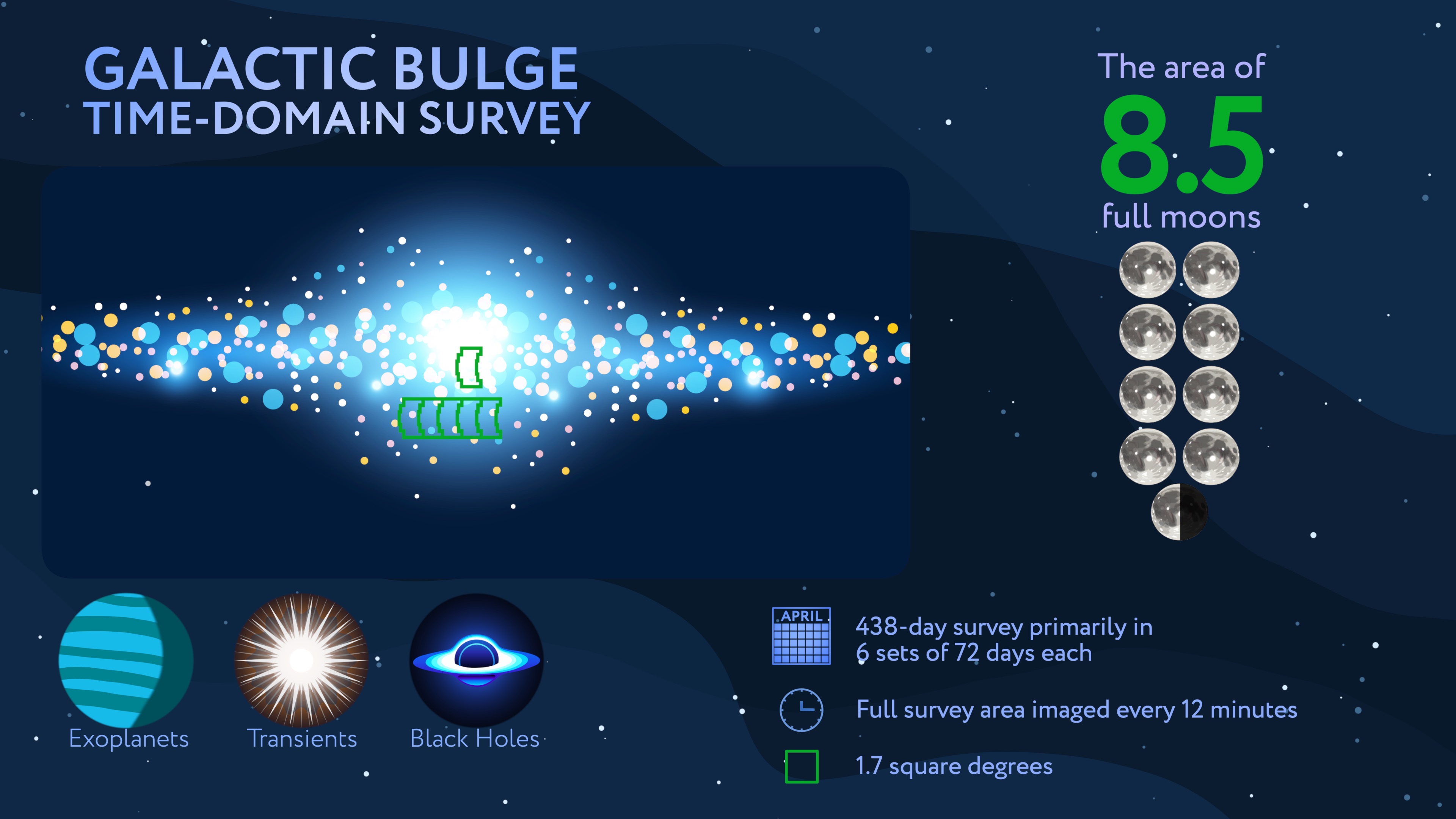
This infographic describes the Galactic Bulge Time-Domain Survey that will be conducted by NASA’s Nancy Grace Roman Space Telescope. The smallest of Roman’s core surveys, this observation program will consist of repeat visits to six fields covering 1.7 square degrees total. One field will pierce the very center of the galaxy, and the others will be nearby — all in a region of the sky that will be visible to Roman for two 72-day stretches each spring and fall. The survey will mainly consist of six seasons (three early on, and three toward the end of Roman’s primary mission), during which Roman will view each field every 12 minutes. Roman will also view the six fields with less intensity at other times throughout the mission, allowing astronomers to detect microlensing events that can last for years, signaling the presence of isolated, stellar-mass black holes.
Credit: NASA’s Goddard Space Flight Center
The survey will observe six patches of the galactic bulge, one pinpointing the center and five nearby, every 12 minutes during 438 days of total observing time. The observations will be separated into six “seasons” spread out over five years.
Spending so much time focusing on a relatively small area of the sky, the mission will be able to track changes in the motion and light of hundreds of millions of stars, and any planets that orbit them, over long periods — the “time-domain” aspect of the survey.
“This survey will be the highest precision, highest cadence, longest continuous observing baseline survey of our galactic bulge, where the highest density of stars in our galaxy reside,” said Jessie Christiansen of Caltech/IPAC, who served as co-chair of the committee that defined the Galactic Bulge Time-Domain Survey.
Exoplanet microlensing
Roman will use a method called microlensing to search for exoplanets, a technique that has so far identified just over 200 exoplanets, compared to more than 4,000 discovered with the transit method, out of the greater than 6,000 currently confirmed.
With this survey, scientists expect to see over 1,000 new planets orbiting other stars just using microlensing alone. This would increase the number of exoplanets identified using this method by more than fivefold.
A microlensing event is when light from a distant star in the background is warped slightly by a foreground object, like a star and its planet. This warping of light is called gravitational lensing, with the gravity from the star and planet bending the fabric of space that light is traveling through and focusing it like a magnifying glass.
This animation illustrates the concept of gravitational microlensing. When one star in the sky appears to pass nearly in front of another, the light rays of the background source star become bent due to the warped space-time around the foreground star. This star is then a virtual magnifying glass, amplifying the brightness of the background source star, so we refer to the foreground star as the lens star. If the lens star harbors a planetary system, then those planets can also act as lenses, each one producing a short deviation in the brightness of the source. Thus we discover the presence of exoplanets, and measure its mass and separation from its star. Credit: NASA’s Goddard Space Flight Center/CI Lab
While the transit method is very good at identifying exoplanets that orbit close to their star, the microlensing method can discover exoplanets that orbit farther away from their star, and in planetary systems farther from Earth than ever studied before. Roman will be versatile enough to see exoplanets dwelling from the inner edge of the habitable zone out to great distances from their stars, with a wide range of masses from planets smaller than Mars to the size of gas giants like Jupiter and Saturn. It may even discover “rogue planets” without host stars that either formed alone or were ejected from their host systems long ago.
“For the first time, we will have a big picture understanding of Earth and our solar system within the broader context of the exoplanet population of the Milky Way galaxy,” Christiansen said. “We still don’t know how common Earth-like planets are, and the Roman Galactic Bulge Time-Domain Survey will provide us with this answer.”
This survey will create a census of exoplanets for scientists to draw statistical conclusions from, revealing common patterns found in exoplanets and furthering our understanding of planetary formation and habitability.
One survey; lots of science
Because of the immense amount of observing time and subsequent data produced, the Galactic Bulge Time-Domain Survey will advance not only the field of exoplanet microlensing, but other areas of astronomy, too.
“There is an incredibly rich diversity of science that can be done with a high-precision, high-cadence survey like this one,” said Dan Huber of the University of Hawaii, the other survey co-chair.
The core survey was optimized not only for microlensing, but also to observe changes in brightness from small, fast blips to long-term trends. This property allows astronomers to discover and characterize transiting planets, red giant stars, stellar-mass black holes and other stellar remnants, and eclipsing binaries, and can lead to a deeper understanding about the physics of star formation and evolution.
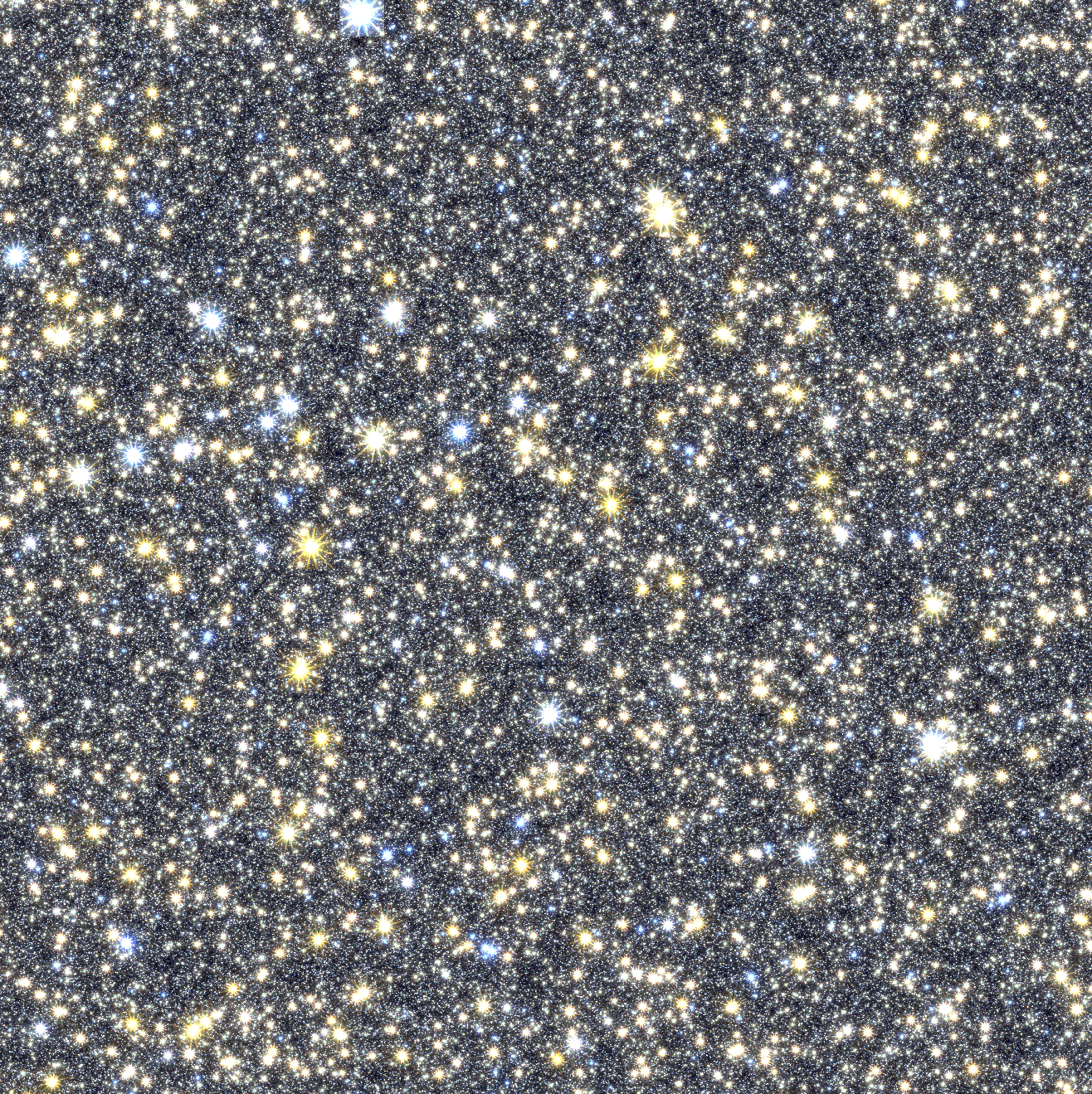
A simulated image of Roman’s observations toward the center of our galaxy, spanning only less than 1 percent of the total area of Roman’s galactic bulge time-domain survey. The simulated stars were drawn from the Besançon Galactic Model.
Credit: Matthew Penny (Louisiana State University)
“The stars in the bulge and center of our galaxy are unique and not yet well understood,” Huber said. “The data from this survey will allow us to measure how old these stars are and how they fit into the formation history of our Milky Way galaxy.”
Roman’s observing strategy in the Galactic Bulge Time-Domain Survey, as well as the High-Latitude Time-Domain Survey and the High-Latitude Wide-Area Survey, will allow astronomers to maximize scientific output, all with one telescope.
Abundance of data to explore
Roman will observe hundreds of millions of stars every 12 minutes during the survey period, providing an unprecedented volume of data for astronomers to parse through.
The Roman Science Support Center at Caltech/IPAC in Pasadena, California, will be responsible for the high-level science data processing for the Galactic Bulge Time Domain Survey, including exoplanet microlensing and general community outreach for Roman exoplanet science. The Science Support Center’s monitoring of these stars has been automated to detect microlensing and variable events within the data. This helps scientists understand features like how frequently a star’s brightness is changing, or if there are planets lurking near the lensed stars, or other sources of variability. The number of stars and frequency of the observations make the Roman data an ideal dataset for finding such sources.
All Roman observations will be made publicly available after a short processing period. The mission is scheduled to launch no later than May 2027, with the team on track for launch in fall 2026.
The Nancy Grace Roman Space Telescope is managed at NASA’s Goddard Space Flight Center in Greenbelt, Maryland, with participation by NASA’s Jet Propulsion Laboratory in Southern California; Caltech/IPAC in Pasadena, California; the Space Telescope Science Institute in Baltimore; and a science team comprising scientists from various research institutions. The primary industrial partners are BAE Systems Inc. in Boulder, Colorado; L3Harris Technologies in Rochester, New York; and Teledyne Scientific & Imaging in Thousand Oaks, California.
This animation illustrates the concept of gravitational microlensing. When one star in the sky appears to pass nearly in front of another, the light rays of ...
NASA’s Fermi Spots Young Star Cluster Blowing Gamma-Ray Bubbles
For the first time, astronomers using NASA’s Fermi Gamma-ray Space Telescope have traced a budding outflow of gas from a cluster of young stars in our galaxy — insights that help us understand how the universe has evolved as NASA explores the secrets of the cosmos for the benefit of all.
The cluster, called Westerlund 1, is located about 12,000 light-years away in the southern constellation Ara. It’s the closest, most massive, and most luminous super star cluster in the Milky Way. The only reason Westerlund 1 isn’t visible to the unaided eye is because it’s surrounded by thick clouds of dust. Its outflow extends below the plane of the galaxy and is filled with high-speed, hard-to-study particles called cosmic rays.
“Understanding cosmic ray outflows is crucial to better comprehending the long-term evolution of the Milky Way,” said Marianne Lemoine-Goumard, an astrophysicist at the University of Bordeaux in France. “We think these particles carry a large amount of the energy released within clusters. They could help drive galactic winds, regulate star formation, and distribute chemical elements within the galaxy.”
A paper detailing the results published Dec. 9 in Nature Communications. Lemoine-Goumard led the research with Lucia Härer and Lars Mohrmann, both at the Max Planck Institute for Nuclear Physics in Heidelberg, Germany.
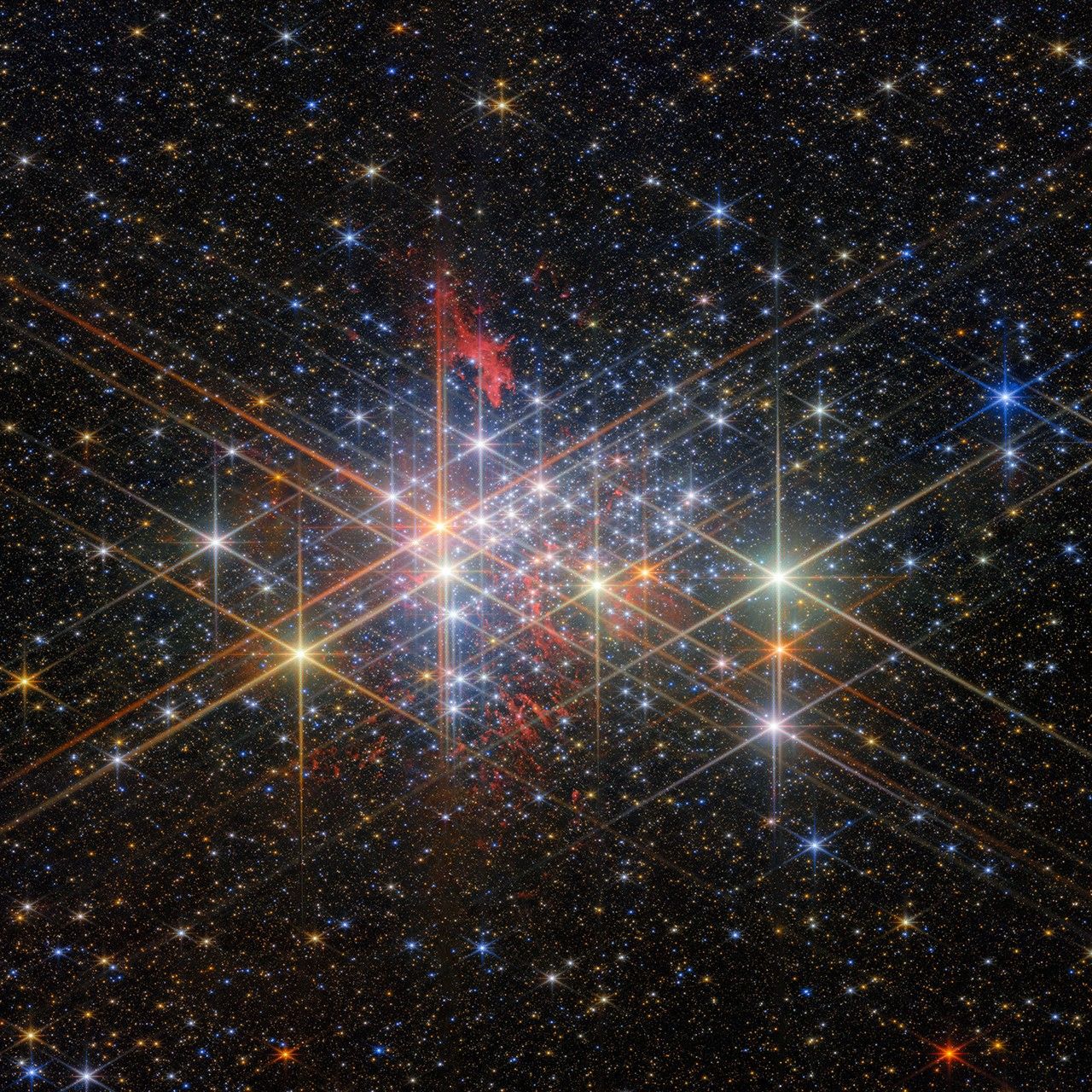
This image of super star cluster Westerlund 1 was captured with the Near-InfraRed Camera on NASA’s James Webb’s Space Telescope. The cluster is largely hidden at visible wavelengths by dust clouds, which infrared light penetrates. Westerlund 1’s large, dense, and diverse stellar population of massive stars has no other known counterpart in the Milky Way.
ESA/Webb, NASA & CSA, M. Zamani (ESA/Webb), M. G. Guarcello (INAF-OAPA) and the EWOCS team
Super star clusters like Westerlund 1 contain more than 10,000 times our Sun’s mass. They are also more luminous and contain higher numbers of rare, massive stars than other clusters.
Scientists think that supernova explosions and stellar winds within star clusters push ambient gas outward, propelling cosmic rays to near light speed. About 90% of these particles are hydrogen nuclei, or protons, and the remainder are electrons and the nuclei of heavier elements.
Because cosmic ray particles are electrically charged, they change course when they encounter magnetic fields. This means scientists can’t trace them back to their sources. Gamma rays, however, travel in a straight line. Gamma rays are the highest-energy form of light, and cosmic rays produce gamma rays when they interact with matter in their environment.
Most gamma-ray observations of stellar clusters have limited resolution, so astronomers effectively see them as indistinct areas of emission. Because Westerlund 1 is so close and bright, however, it’s easier to study.
Westerlund 1 is located closer to the center of the Milky Way than our Sun, as shown in this artist’s concept. Westerlund 1 is one of only a few known super star clusters in our galaxy and is the closest, brightest, and most massive one discovered so far.
NASA’s Goddard Space Flight Center/Conceptual Image Lab
This artist’s concept shows the location of Westerlund 1 relative to our Sun as seen from the underside of our Milky Way galaxy. The magenta bubble illustrates what the nascent outflow might look like in gamma rays. Westerlund 1 is located slightly below the middle of the galactic disk, so stellar activity pushes gas preferentially along a path of lower density beneath the disk.
NASA’s Goddard Space Flight Center/Conceptual Image Lab
In 2022, scientists using a group of telescopes in Namibia operated by the Max Planck Institute called the High Energy Spectroscopic System detected a distinct ring of gamma rays around Westerlund 1 with energies trillions of times higher than visible light.
Lemoine-Goumard, Härer, and Mohrmann wondered if the cluster’s unique properties might allow them to see other details by looking back through nearly two decades of Fermi data at slightly lower energies — millions to billions of times the energy of visible light.
Fermi’s sensitivity and resolution allowed the researchers to filter out other gamma-ray sources like rapidly spinning stellar remnants called pulsars, background radiation, and Westerlund 1 itself.
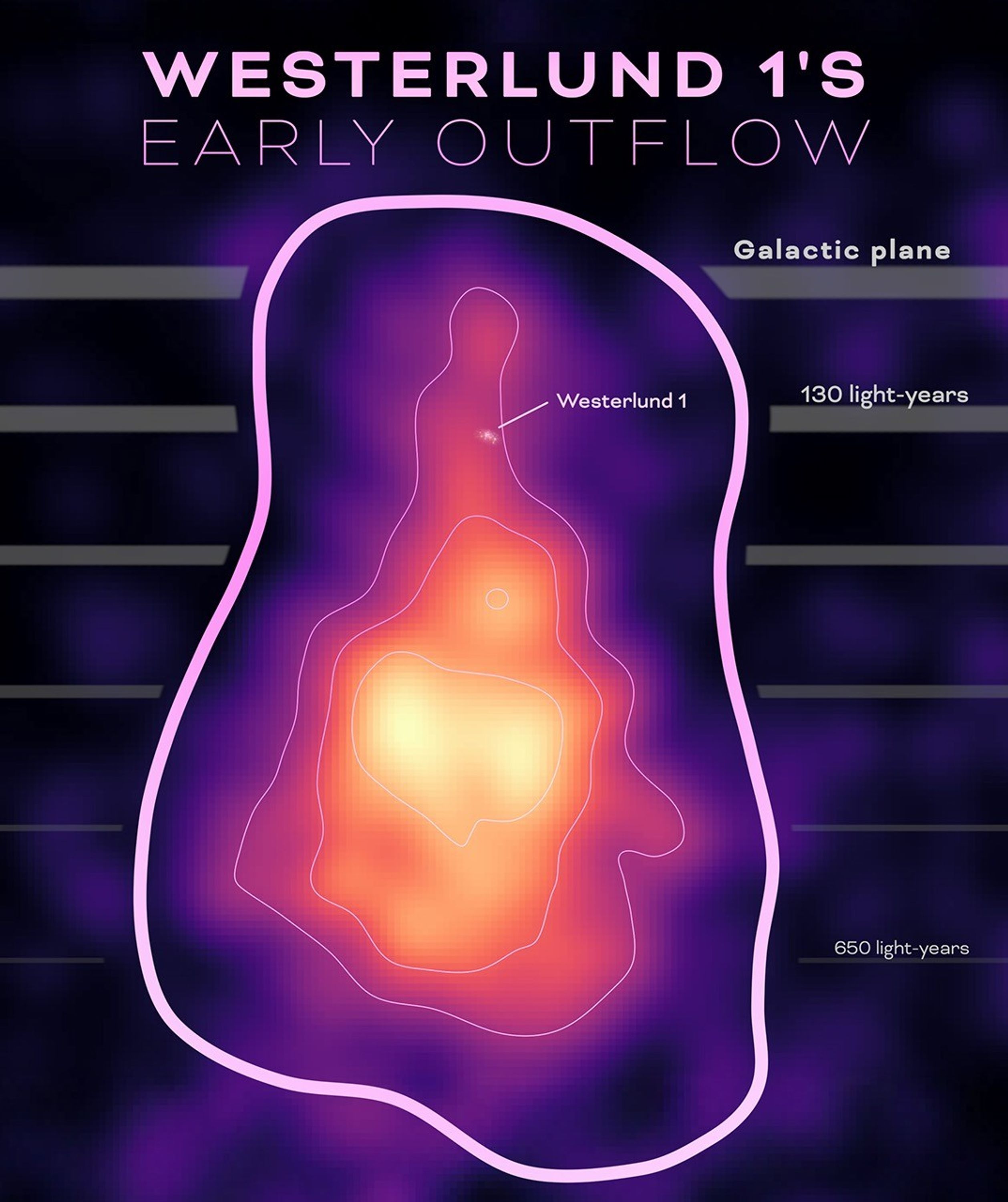
What was left was a bubble of gamma rays extending over 650 light-years from the cluster below the plane of the Milky Way. That means the outflow is about 200 times larger than Westerlund 1 itself.
Data from NASA’s Fermi Gamma-ray Space Telescope reveal the budding gas bubble of star cluster Westerlund 1. Brighter colors indicate a stronger likelihood that gamma rays arise from specific types of point sources, notably two pulsars located at center and in the brightest portion of the image. Pink contours denote steep changes in likelihood. An underlying orange-magenta feature extends down the image, starting from the cluster’s location, and represents the nascent outflow. The grey lines indicate distance below the galactic plane. The bubble is over 650 light-years long and angles slightly away from us. Westerlund 1’s stellar activity more easily pushes gas outward into lower-density regions of the galaxy’s disk.
NASA’s Goddard Space Flight Center/Lemoine-Goumard et al. 2025; ESA/Webb, NASA & CSA, M. Zamani (ESA/Webb), M. G. Guarcello (INAF-OAPA) and the EWOCS team
The researchers call this a nascent, or early stage, outflow because it was likely recently produced by massive young stars within the cluster and hasn’t yet had time to break out of the galactic disk. Eventually it will stream into the galactic halo, the hot gas surrounding the Milky Way.
Westerlund 1 is located slightly below the galactic plane, so the researchers think the gas expanded asymmetrically, following the path of least resistance into a zone of lower density below the disk.
“One of the next steps is to model how the cosmic rays travel across this distance and how they create a changing gamma-ray energy spectrum,” Härer said. “We’d also like to look for similar features in other star clusters. We got very lucky with Westerlund 1, though, since it’s so massive, bright, and close. But now we know what to look for, and we might find something even more surprising.”
“Since it started operations 17 years ago, Fermi has continued to advance our understanding of the universe around us,” said Elizabeth Hays, Fermi’s project scientist at NASA’s Goddard Space Flight Center in Greenbelt, Maryland. “From activity in distant galaxies to lightning storms in our own atmosphere, the gamma-ray sky continues to astound us.”
This image by NASA’s James Webb Space Telescope’s Near-Infrared Camera (NIRCam) features the central region of the Chamaeleon I dark molecular cloud, which resides 630 light years away. The cold, wispy cloud material (blue, center) is illuminated in the infrared by the glow of the young, outflowing protostar Ced 110 IRS 4 (orange, upper left). The light from numerous background stars, seen as orange dots behind the cloud, can be used to detect ices in the cloud, which absorb the starlight passing through them.
An international team of astronomers has reported the discovery of diverse ices in the darkest regions of a cold molecular cloud measured to date by studying this region. This result allows astronomers to examine the simple icy molecules that will be incorporated into future exoplanets, while opening a new window on the origin of more complex molecules that are the first step in the creation of the building blocks of life.
Hello, folks, and welcome back to your favorite Friday roundup of all the space news fit to print. This week we’ve got experimental rocket engines, a gigantic map, and galaxies galore. The James Webb Space Telescope found hydrogen in a galaxy more than eight billion light years away, and the coldest ice ever, but it’s currently down due to a software glitch.
Closer to home, Rocket Lab launched their Electron rocket from US soil for the first time. NASA came together for a day of remembrance that somehow managed to be both somber and ineffably sweet.
JWST Spots the Coldest Chamaeleon
If you wish to make an apple pie from scratch, you must first invent the universe. And somewhere along the way, you’ll need one of the ancient molecular clouds of dust and ice from which stars and habitable planets like Earth are born. This week, Webb scientists announced that the telescope has spotted just such a place. It’s a stellar nursery called the Chamaeleon I cloud, loaded with these primordial crystals. That’s the tableau you’re seeing in the image above — you can tell it’s from Webb by those iconic six-pointed stars. The ice contains traces of sulfur and ammonia, along with simple organic molecules like methanol. And at just ten degrees above absolute zero, it’s the coldest ice ever found.
“We simply couldn’t have observed these ices without Webb,” said Klaus Pontoppidan, a Webb project scientist involved in the research. “The ices show up as dips against a continuum of background starlight. In regions that are this cold and dense, much of the light from the background star is blocked, and Webb’s exquisite sensitivity was necessary to detect the starlight and therefore identify the ices in the molecular cloud.”
‘Virginia Is for Launch Lovers’: Rocket Lab Launches Electron Rocket From US Soil
Late Wednesday evening, aerospace startup Rocket Lab successfully launched its Electron rocket from NASA’s Wallops Flight Facility in Virginia. This was the 33rd launch of the Electron, but its first launch from American soil.
The Electron isn’t reusable — but in 2021, Rocket Lab announced the Neutron. Designed for reusability, the Neutron will have about a third of the lift capacity of a Falcon 9.
NASA ‘Rotating Detonation Engine’ Aces Hot Fire Tests
Speaking of 3D-printed rocket engines: NASA announced this week that it has successfully validated a next-gen rocket engine it hopes will revolutionize rocket design. The new engine generates thrust “using a supersonic combustion phenomenon known as a detonation.” And this is no experimental error — their full-scale alpha build produced more than 4,000 pounds of thrust at full throttle.
These engines get their name (rotating detonation rocket engine, or RDRE) from the unique way they produce thrust. Detonation waves echo around a circular chamber, wringing out every bit of energy from the rocket fuel. It’s great for efficiency, but it puts the whole system under extreme pressure. Undaunted, NASA turned to an advanced additive manufacturing process, even developing its own bespoke metal alloy for the task.
According to the agency, the RDRE incorporates the agency’s GRCop-42 copper alloy into a powder bed fusion (PBF) additive manufacturing process. PBF uses a laser or particle beam to seamlessly fuse ultra-fine particles. It’s a lot like the sintering process used to make the space shuttle rocket engines — and even they had to be actively cooled by the rockets’ own cryofuel, in order to withstand the unearthly temperatures and pressures of takeoff. If the design holds up, NASA intends to use RDRE in its efforts to establish a long-term presence off-planet.
Dark Energy Detector Plots Largest-Ever Map of Galaxy
Astronomers have created a gargantuan map of the Milky Way, using a telescope built to detect dark energy. Featuring more than three billion stars, it focuses on the galaxy’s orbital plane — a region notoriously difficult to study.
Earth’s atmosphere scatters starlight so that points of light turn into point clouds. So, the astronomers just dove right in. To isolate different stars and celestial objects, the group used some extra-snazzy math to get rid of noise. This allowed them to “paint in” the proper background, letting them tell one star from another.
Astronomers have released a gargantuan survey of the galactic plane of the Milky Way. The new dataset contains a staggering 3.32 billion celestial objects — arguably the largest such catalog so far. The data for this unprecedented survey were taken with the US Department of Energy-fabricated Dark Energy Camera at the NSF’s Cerro Tololo Inter-American Observatory in Chile, a Program of NOIRLab. Credit: Saydjari et al., via NoirLab
“One of the main reasons for the success of DECaPS2 is that we simply pointed at a region with an extraordinarily high density of stars and were careful about identifying sources that appear nearly on top of each other,” said Andrew Saydjari, lead author on the (open-access!) paper accompanying the gigantic map. “Doing so allowed us to produce the largest such catalog ever from a single camera, in terms of the number of objects observed.”
Experts: Milky Way Too Large for Its “Cosmological Wall”
The history of astronomy has been all about recognizing that our place in the universe isn’t all that special. We’ve gone from the center of all existence to just another planet orbiting an average star in one of billions and billions of galaxies. However, a new simulation hints that there might be something special about the Milky Way after all.
Yepun, one of the four Unit Telescopes of the Very Large Telescope (VLT) at the European Southern Observatory, studies the center of the Milky Way. Yepun’s laser beam creates an artificial “guide star” to calibrate the telescope’s adaptive optics. Image: ESO/Yuri Beletsky
The model suggests that the Milky Way is far larger than it should be, based on the scale of the “cosmological wall”: an incomprehensibly huge semi-planar structure occupied by the Milky Way and other galaxies in the Local Group.
Scientists Detect Atomic Hydrogen in Most Distant Galaxy Ever
An international team of astronomers announces the discovery of cold atomic hydrogen, more than eight billion light-years from Earth. Cooler than ionized plasma but warmer than molecular hydrogen gas, atomic hydrogen is the raw fuel of coalescing stars. The researchers used gravitational lensing to spot the telltale — but deeply redshifted — 21cm line.
Webb Spies Centaur Chariklo’s Delicate Rings
Named for the daughter of Apollo, Chariklo is a centaur: a Kuiper belt object that orbits out past Saturn. It’s the first of its kind ever found with a confirmed ring system. The thing really is tiny; it’s about 160 miles in diameter and has less than two percent the mass of Earth. But a new report from Webb shows even that much mass is enough to sustain two slender rings, for a time.
In a remarkable stroke of scientific luck, the telescope was pointed just right to catch Chariklo as it passed in front of a star. When it did, the star’s light fluttered in a way that betrayed the presence of the rings.
Chariklo has two thin rings — the first rings ever detected (in 2013) around a small Solar System object. When Webb observed the occultation, scientists measured dips in the brightness of the star. These dips corresponded exactly as predicted to the shadows of Chariklo’s rings. pic.twitter.com/sqH08v1lOB
Nothing less than delighted, the astronomers report that Chariklo’s rings are two and four miles wide, respectively. But the asteroid actually has something in common with the Chamaeleon I cloud. Chariklo’s surface is covered in exotic phases of water ice that only Webb can see.
Principal investigator Dean Hines added, “Because high-energy particles transform ice from crystalline into amorphous states, detection of crystalline ice indicates that the Chariklo system experiences continuous micro-collisions that either expose pristine material or trigger crystallization processes.” It’ll be up to the JWST to find out more.
Software Glitch Brings JWST Down for Maintenance
Unfortunately, observations of Chariklo and other celestial bodies will have to wait a while. The JWST had a software glitch this week. Per NASA, the telescope’s Near Infrared Imager and Slitless Spectrograph (NIRISS) “experienced a communications delay within the instrument, causing its flight software to time out.” Unfortunately, this led to a software gridlock.
The telescope is unavailable for science observations because NASA and the Canadian Space Agency are doing root-cause analysis to figure out and fix the problem. But NASA emphasizes that the telescope is fine. There’s no damage and no indication of any danger. If it’s a software problem, it may well be a software fix.
Perseverance Files First Weather Report
Now that it’s been on Mars for a while, the Perseverance rover has filed an authoritative report on Martian weather. The number one takeaway: It’s cold on the Red Planet! The average surface temperature is -67C.
It’s also windy on Mars. Since Mars has an atmosphere, it has surface weather. It also has an axial tilt, so it has seasons, just like Earth. Dust storms can envelop Mars’ entire northern hemisphere.
Plumes of darker, subsurface dust waft to the surface when the sun warms Martian sands beneath transparent sheets of ice. Mars’ shifting winds then blow these plumes of dust into V-shaped patterns. Astronomers are using the plumes to learn more about Mars’ weather and surface climate. Image: NASA
Perseverance is covered in a suite of sensors that constantly monitor wind speed and direction, atmospheric pressure, temperature, humidity, and dust. Together, they make the rover’s Mars Environmental Dynamics Analyzer (MEDA).
Here, you can see the MEDA sensors extending from the rover’s mast below the iconic ChemCam.
“The dust devils are more abundant at Jezero than elsewhere on Mars and can be very large, forming whirlwinds more than 100 meters in diameter. With MEDA we have been able to characterize not only their general aspects (size and abundance) but also to unravel how these whirlwinds function,” says Ricardo Hueso, of the MEDA team.
Perseverance has captured numerous dust devils as they sweep through Jezero Crater. However, to get that data, MEDA’s exposed sensors also face damage from the harsh radiation environment, extreme temperature swings, and the ever-present Martian dust. A dust devil in January of last year kicked up enough debris that it damaged one of MEDA’s wind instruments. Still, the rover perseveres.
NASA’s Bittersweet 2023 Day of Remembrance
Every year, NASA holds a memorial for staff, astronauts, and alumni who have died. 2023’s Day of Remembrance holds a somber significance, as Feb. 1 is the 20th anniversary of the Columbia disaster. Unfortunately, this year’s fallen also included Apollo 7 pilot Walt Cunningham, who passed earlier this month. Cunningham was the last surviving member of the Apollo 7 crew.
As in years past, NASA staff gathered this week at space centers and labs around the country, to honor the sacrifices of those who have given their lives in pursuit of exploration and discovery. But they did it in a way only NASA could do. They held nationwide town-hall safety meetings, to reflect on and improve NASA’s aerospace safety culture.
Ask not for whom the safety alarm tolls; it tolls for thee. NASA safety-culture town hall meeting at its Washington headquarters after the Arlington memorial service. Image: NASA/Keegan Barber via NASA HQ Flickr
What a fitting way to honor lives lost, while still reaching for the stars. Town-hall safety culture meetings. We love you guys. Never change.
Psyche Mission Now Targeting October 2023 Launch
Steady as she goes: After a year’s delay and a missed launch window, NASA’s Psyche mission team is getting the spacecraft in shape to launch this year. In a blog post, the agency said, “After a one-year delay to complete critical testing, the Psyche project is targeting an October 2023 launch on a SpaceX Falcon Heavy rocket.”
When it launches, Psyche will carry a technology demo for NASA’s shiny new Deep Space Optical Communications (DSOC) network. DSOC systems will use lasers for high-bandwidth communications between Earth and the Moon, Mars, and beyond. Beyond a deluge of scientific data, NASA expects that the network will be able to handle high-def images and video.
Skywatchers Corner
Comet C/2022 E3 (ZTF) is a long-period comet that last visited Earth in the time of the Neanderthals. Now it’s back for another close approach. And although we didn’t know this when we found it last year, it turns out the comet’s tail glows pale green, like a luna moth under a streetlight.
The robin’s-egg glow of Comet C/2022 E3 (ZTF)’s tail shines against its twin tails. Image: Dan Bartlett/NASA
At first, astronomers thought it might require binoculars to catch a glimpse of the thing. However, as ExtremeTech’s Adrianna Nine writes, the comet is now visible to the naked eye in places across much of the Northern Hemisphere.
Our verdant visitor will continue its brightening trend while it sails toward Earth. It will make its closest approach to us on February 2: perhaps too soon for a Valentine’s Day spectacular, but right on time for Imbolc, Candlemas, and Groundhog Day.

 Login
Login