
❌

Normal view

There are new articles available, click to refresh the page.
Before yesterdayMain stream

SEC’s Atkins and CFTC’s Selig Unite to End Crypto Regulatory Chaos

23 January 2026 at 05:01

SEC Chairman Paul Atkins and CFTC Chairman Michael Selig will hold a joint event on January 27 to discuss regulatory harmonization and efforts to make the United States the global crypto capital.

The two regulators issued a joint statement announcing the event will take place at CFTC headquarters from 10 a.m. to 11 a.m. ET, marking another step in their ongoing coordination efforts.

β€œFor too long, market participants have been forced to navigate regulatory boundaries that are unclear in application and misaligned in design, based solely on legacy jurisdictional silos,” the chairmen said in their statement.

β€œThis event will build on our broader harmonization efforts to ensure that innovation takes root on American soil, under American law, and in service of American investors, consumers, and economic leadership.β€œ

I'm looking forward to joining @ChairmanSelig next week at our @SECgov and @CFTC joint event to discuss harmonization between our two agencies.

Together we will discuss our efforts to deliver on President Trump’s promise to make the US the crypto capital of the world.

Join us! https://t.co/qgJwmiHYus

β€” Paul Atkins (@SECPaulSAtkins) January 22, 2026

Regulators Build on September’s Historic Turf War Resolution

The upcoming event continues momentum from a September 29 roundtable where both agencies publicly declared an end to their jurisdictional conflicts.

CFTC Commissioner Caroline Pham told attendees at that gathering that β€œthe turf war is over,” while Atkins described it as β€œa turning point for American financial markets.β€œ

That roundtable brought together executives from major platforms, including Kraken, Polymarket, Kalshi, Nasdaq, CME Group, and Robinhood, to discuss coordinated oversight of digital assets.

Atkins emphasized at the time that β€œfor years, the SEC and CFTC have worked in silos, sometimes at odds,” but that era had ended.

The January 27 event will feature opening remarks from both chairmen, followed by a fireside chat moderated by Eleanor Terrett, co-founder of Crypto in America.

Doors open at 9:30 a.m., and the session will be broadcast live on the SEC’s website.

Agencies Accelerate Crypto Policy After Leadership Changes

Both regulators have moved aggressively on digital asset policy since new leadership took over in 2025.

Atkins assumed the SEC chairmanship in April after Gary Gensler’s departure, immediately shifting away from enforcement-based regulation toward clearer frameworks and guidance.

As reported by Cryptonews today, under Atkins, the SEC opened just 13 crypto-related enforcement actions in 2025 compared to 33 in 2024, a 60% decline and the lowest level since 2017, according to Cornerstone Research.

Eight of those cases involved fraud allegations, indicating a narrower focus on investor harm rather than broad registration theories.

The agency also dismissed seven ongoing actions and reduced total monetary penalties to $142 million, less than 3% of 2024 levels.

πŸ›The SEC opened just 13 crypto enforcement cases in 2025, down 60% from 2024, with most new actions under Chair Paul Atkins focused on fraud.#SEC #CryptoEnforcement https://t.co/YI5S1uVisH

β€” Cryptonews.com (@cryptonews) January 23, 2026

Selig took the CFTC helm on December 22 after Senate confirmation, replacing acting chair Caroline Pham.

He immediately launched the Future-Proof initiative, a comprehensive review aimed at updating decades-old regulations for blockchain, AI-driven trading, and prediction markets.

β€œWe are at a unique moment as a wide range of novel technologies, products, and platforms are emerging,” Selig said after his swearing-in.

β€œUnder my leadership, the CFTC will conquer these great frontiers and ensure that the innovations of tomorrow are Made in America.β€œ

Joint Efforts Face Congressional Pressure on Market Structure Bills

The harmonization push comes as Congress advances competing digital asset legislation.

The Senate Agriculture Committee released updated text for its Digital Commodity Intermediaries Act and scheduled a January 27 markup at 3 p.m., just hours after the Atkins-Selig event concludes.

Chairman John Boozman acknowledged that β€œdifferences remain on fundamental policy issues” with Democrats, who failed to support the bill despite extended negotiations.

The markup could proceed on party lines, unlike the House Agriculture Committee’s bipartisan 47-6 vote on similar legislation.

According to Eleanor Terrett, Senator Cory Booker’s team told Politico that he will continue working with Boozman to pass and sign the legislation, though no Democrats have publicly supported the text.

🚨NEW: Where do we stand on crypto market structure legislation right now? The @SenateAg Committee released its latest legislative text last night, with Chairman @JohnBoozman (R-AR) acknowledging that Republicans and Democrats failed to reach a deal despite an extra two weeks of…

β€” Eleanor Terrett (@EleanorTerrett) January 22, 2026

Meanwhile, the Senate Banking Committee delayed its markup of the CLARITY Act until late February or March to focus on housing legislation.

Industry divisions over stablecoin yield provisions have complicated negotiations, with Coinbase CEO Brian Armstrong calling certain restrictions β€œcatastrophic” before withdrawing support.

However, President Trump confirmed at Davos 2026 that he expects to sign crypto market structure legislation β€œvery soon,” stating his administration is working to ensure β€œAmerica remains the crypto capital of the world.”

For now, the joint regulatory event indicates that both agencies are preparing to implement whatever framework Congress ultimately delivers.

The post SEC’s Atkins and CFTC’s Selig Unite to End Crypto Regulatory Chaos appeared first on Cryptonews.

Signs point to a sooner-rather-than-later M5 MacBook Pro refresh

19 January 2026 at 14:52

Mac power users waiting on new high-end MacBook Pro models may have been disappointed last fall when Apple released an M5 upgrade for the low-end 14-inch MacBook Pro without touching the M4 Pro or Max versions of the laptop. But the wait for M5 Pro and M5 Max models may be nearing its end.

The tea-leaf readers at MacRumors noticed that shipping times for a handful of high-end MacBook Pro configurations have slipped into mid-to-late February, rather than being available immediately as most Mac models are. This is often, though not always, a sign that Apple has slowed down or stopped production of an existing product in anticipation of an update.

Currently, the shipping delays affect the M4 Max versions of both the 14-inch and 16-inch MacBook Pros. If you order them today, these models will arrive sometime between February 3 and February 24, depending on the configuration you choose; many M4 Pro versions are still available for same-day shipping, though adding a nano-texture display or upgrading RAM can still add a week or so to the shipping time.

Read full article

Comments

Β© Andrew Cunningham

House Democrats Push SEC Chair To Resume Crypto Enforcement Actions

15 January 2026 at 14:55

In a critical week for the cryptocurrency industry, following the delayed markup of the Crypto Market Structure bill (CLARITY Act), House Democrats are calling on the Securities and Exchange Commission (SEC) chair, Paul Atkins, to reinstate enforcement actions against crypto firms.Β 

The letter, dated January 15, was signed by Representatives Maxine Waters, Sean Casten, and Brad Sherman, who expressed concerns regarding the SEC’s recent retreat to investigate and prosecute alleged violations related to β€œdigital asset securities.”

House Democrats’ Allegations

The representatives highlighted that since January 2025, the SEC has dismissed or closed more than a dozen cases involving crypto-related activities, including litigations against major players like Binance, Coinbase, and Kraken. Just this week, the SEC also closed its case against the Zcash Foundation.

In their letter, the lawmakers alleged that given the industry’s β€œtroubling history of harming investors,” the SEC’s decision to pull back raises serious questions about its priorities and effectiveness. They warned that this shift puts both investors and the broader US economy at considerable risk.

Moreover, the representatives highlighted unprecedented lobbying and monetary contributions to political figures, including President Trump and his associates, from the digital asset sector. They pointed out that this could have influenced the SEC’s decision to abandon a majority of its crypto enforcement actions.Β 

Alleged Conflicts Of Interest Between Trump And CryptoΒ 

These concerns follows months of allegations from the Democratic Party suggesting conflicts of interest between the Trump administration and the crypto industry, particularly highlighted by last year’s pardon for former Binance CEO Changpeng Zhao (CZ) and connections to the Trump-affiliated World Liberty Financial (WLFI).

According to the lawmakers, the SEC’s choice to walk away from these enforcement cases has raised suspicions of a possible pay-to-play dynamic. They argued that allowing violators of securities laws to escape without repercussions contradicts the SEC’s primary responsibility.Β 

Furthermore, the Representatives claim that recent statements by Chair Atkins, who said that β€˜most crypto tokens are not securities’, have caused confusion.

The Democrats further pointed out that this lack of enforcement against digital assets leaves investors β€œvulnerable” and allegedly fails to protect them from potential violations in the market.

Crypto

Featured image from DALL-E, chart from TradingView.com

Ever tried fixing your own car? The right-to-repair fight is heating up as costs soar and Congress weighs a national law


Interview transcript

Terry Gerton The right to repair is a topic we’ve talked about on this show many times related to defense equipment. But it’s a movement that’s gaining traction across the country and certainly within the Trump administration. Why do you think there’s so much public interest in advancing right to repair equipment?

Justin Rzepka Yeah, it’s a great question, Terry. I think that the issue that I focus on is automotive right to repair. And I think the reason why it comes up so much with the American public is because of the cost issue, right? Everyone knows costs are rising and auto repair costs are raising specifically so much higher and quicker than all other costs. And so I think that’s why it’s resonating with people because it’s coming directly out of their pocketbooks.

Terry Gerton And so back to my defense question for a minute, people really thought that the right to repair was a guaranteed provision in the NDAA, and it did not make it in. What does that tell you about maybe the strength of the industry lobbyists and the challenge that even automotive right to repair might face when it comes to getting statutory coverage in Washington?

Justin Rzepka Yeah, Terry, the Warrior Right to Repair Act was widely supported by both parties. When Senator Tim Sheehy (R-Mt.) and Senator Elizabeth Warren (D-Mass.) Agree on something, you know that this is a special case. And so it did not make it in the final product. That’s sort of part of the sausage making here in Washington, but I do think that there is such momentum here that they will take another run at it at next year’s NDAA. And again, to answer your question, I think that really just speaks to how the vested interests in preventing sort of right to repair on a whole host of issues including autos are going to make it very challenging, you know, for the folks to win on this. I do think, you know, that this consumer issue is on our side on this and I think will ultimately prevail, but the opposition is strong as reflected in Warrior Right to Repair.

Terry Gerton Well, as you said, your organization is specifically focused on the individual’s right to repair their own automobiles. Tell us more about what’s really at stake here. How did the lack of national right to repair laws affect individuals’ costs, choices, and maybe even safety?

Justin Rzepka Yeah, Terry, so the Consumer Access to Repair Coalition, or CAR Coalition, where I’m the executive director, our mission is to lower the cost of auto repairs, and we think a national standard is really what’s needed. There’s been a long history of auto rights repair in the United States, people popping the hood on their own car, getting that fixed. We think that’s been eroding, and that’s due to some technological issues. Nowadays, your car β€” Again, in a good way, right, it’s safer, it lasts longer; those are all really good things β€” but they’re becoming harder to repair because of the technological sophistication of the cars. There’s a piece of legislation that Dr. Dunn of Florida has introduced and it simply empowers car owners to have access to information in order to get their car repaired. This is information that they need to fix it, diagnose information, repair information, things like that. That’s all the bill does, basically allows the consumer to make a choice if they want to fix it themselves Take it to the local mechanic down the street or to the dealership and those things have been eroded over time due to technological barriers and we think this legislation is needed and states like Massachusetts and Maine already have state laws on the books, and we think those are great, but driving your car around the country, you shouldn’t have to go through different state laws. So we think one national standard is the appropriate vehicle here.

Terry Gerton Would you be concerned about safety, automobile safety, if individuals are doing their own repairs?

Justin Rzepka Absolutely not, Terry. Safety is paramount for everyone, right? Nobody wants to support a piece of legislation where safety is in question. You know, for 70, 80 years, people have been able to fix their cars at their house or at the local mechanic, and there’s never been any safety issues or liability issues with those repairs, right. The car companies have no issue with it now, and this won’t change anything. All we’re doing is maintaining the right of the car owners to make their decisions. You know, unfortunately, right now, there’s really not much of a choice with newer cars. You can either take it back to the dealership and that’s really the only choice you have. We want to keep those choices, your local mechanic or again, if you’re a gear head and you want to fix your own car, we think that also should remain an option for the American car owner.

Terry Gerton I’m speaking with Justin Rzepka. He is executive director of the Consumer Access to Repair Coalition. Well, talk to me a little bit more about the rising costs of automotive repair. Your group makes the contention that limiting repair options actually contributes to rising costs. So how would you go about reversing that trend?

Justin Rzepka Yeah. Well, I’m not an economist, but I think, you know, we all know that when there’s less choice, right, prices go up. And so over the last five years, Terry, general inflation is up about 20%. You know, those are numbers from the BLS and they change, you know, up and down all the time, but that’s a general number. Auto repair costs have gone up 53% in those same five years. So we’re talking over a 30% delta in the cost increase in auto repairs. And we just don’t think that’s tied to inflation. We think there’s a couple of things. There’s lack of parts availability, right? Car companies and others restricting what parts the public can and can’t buy, as well as restricting this access to vehicle data. That’s the bill that I talked about, the Repair Act, where back in the day you could pop open the hood, you could visualize what’s wrong. You used to be able to plug in a tool and sort of get information. Now this information is being transmitted wirelessly and a car owner who spends more than $50,000 on average for a new car today, doesn’t have access to that information. And when you don’t have that access, you don’t have choice. And when don’t you have choice, costs go up.

Terry Gerton It seems like the Federal Trade Commission and the National Highway Traffic Safety Administration are involved in this. What kind of position are they taking on right to repair?

Justin Rzepka Yeah, so in a bipartisan, unanimous way, the FTC, both Republican and Democratic commissioners have weighed in on right to repair issues. They published a seminal report called β€˜Mixing the Fix,’ where they talked about a lot of industries, and specifically, the automotive industry. They talked a lot about how having lack of access to this information can drive up costs. The GAO, Terry, has done reports on this. The Congressional Research Service has done work on this as recently as June of 2025. Commissioner Mark Meador of the FTC talked about right to repair issues and then Administrator Jonathan Morrison at NITS also talked about auto right to repair and what a critical issue this is and how consumers having access to information is really important to make sure they can get their vehicles repaired.

Terry Gerton The issue really goes beyond automobiles even, it’s consumer electronics, it’s home appliances, it’s all kinds of things out there. How does your effort here in automotive right to repair extend to other sectors?

Justin Rzepka Yeah. Terry, we’re really happy to see that rising tide lifts all boats. When I started working on this issue almost six years ago, you had to really kind of explain what right to repair was or sort of how the consumer owns a product and they should be able to fix it how they want. And through the years, because of it, you mentioned Terry, cell phones and dishwashers, things like that, more and more Americans are starting to understand the right to repair issues and their lack of ability to fix these issues. What I would differentiate on automotive issues, Terry, is if you… If you break your cell phone, or your washing machine goes on the fritz, that’s really unfortunate and that’s not a small expense. But you know what, you can go out and replace those. An auto repair cost, the average repair costs are over $5,000, $6,000. This is a critical thing in most people’s lives, right? Besides their house, this is the most expensive thing that an American will buy. And so you’ve got to take your kids to school, you’ve gotta buy groceries, you have to drive to work. This isn’t something that can be easily replaced. Your car needs to be able to be fixed affordably and reliably. And that’s why we think this is a special issue among the right to repair issues.

Terry Gerton One of the concerns that I’ve heard is that individuals repairing their own equipment will violate the manufacturer’s warranty. Any provisions for protecting that kind of warranty coverage if somebody, you know, breaks a screw or misconnects a cable.

Justin Rzepka There are already laws on the books like the Magnuson–Moss Warranty ActΒ  that protects warranties. And what I would say, Terry, is that if you don’t really control something, do you really have ownership over it? So the average price of a new car in America is more than $50,000. And if you drive that car off the lot and you don’t have the ability to fix that car because of lack of information, do you own that car? If we want to have a discussion in America about a lease or a rent model or as a service model, that’s something to discuss. But right now, if you own something, you should be able to do what you want with it when you want with it. And so I fundamentally reject those arguments. And so, and again, we’re talking about repair and maintenance information. We’re not talking about other parts of the car or proprietary softwares. We’re talking the ability for a car owner to get their car fixed, how they want to, where they want to, and their choice.

Terry Gerton So what should people be watching for as this conversation moves forward in 2026?

Justin Rzepka Yeah, well, our understanding, Terry, is that the Energy and Commerce Committee is going to have a hearing next week on auto issues. And we are understanding that Dr. Dunn’s bill, the Repair Act, HR 1566, will be considered. So there’s going to be a great opportunity for the American public to tune in and watch Congress do what they’re supposed to do, which is discuss possible legislation and talk about the merits of the bills and how it affects consumers. So that’s going to be a huge opportunity for pro-right to repair advocates to weigh in and talk to their members of Congress on why this issue is important and why it’s something that Congress should consider. So we expect that hearing to be next week and we’re really excited about it, Terry.

The post Ever tried fixing your own car? The right-to-repair fight is heating up as costs soar and Congress weighs a national law first appeared on Federal News Network.

Β© The Associated Press

Cecil Cooper, the owner of C&J Service Center, works on a car in for repair in his shop in Paradise, Calif., Thursday, Feb. 14, 2019. In the 100 days since the Camp Fire devastated the town, destroying the the majority of business, the ones that survived have begun to reopen. Cooper said he was getting busy because only three of the 26 garages are open. (AP Photo/Rich Pedroncelli)

Repairing Brittle Plastic Retro Computer Cases

9 January 2026 at 01:00
Using UV resin as glue for new case clips. (Credit: More Fun Making It, YouTube)

As computers like the venerable breadbox Commodore 64 age, their plastic doesn’t just turn increasing shades of yellow and brown, the ABS plastic also tends to get brittle. This is a problem that seems to plague many plastic cases and enclosures, but fortunately there are some ways to halt or even reverse the heavy toll of time, with the [More Fun Making It] YouTube channel exploring a number of methods, including UV-curable resin, PETG 3D-printed clips and silicone molds.

Aside from large-scale damage, screw posts tend to snap off a lot, either during shipping or when merely trying to open the case. The same is true for the clips around the edge of the C64 case, which rarely survive that long. Gluing a case clip back on with epoxy or such somewhat works, but is messy and not that durable.

Instead UV resin is used, together with newly printed clips in translucent PETG. The remnants of the old clips are removed, followed by the application of the resin. The clips are actually a modified version of a VIC-20 case clip design by [Ken Mills]. With the UV resin as glue, curing is almost instant with a UV lamp unlike the tedious process with epoxy.

In the case of screw posts the alternative to just re-gluing was initially clear tape as a mold and UV resin, but this got improved with making a mold of an intact post from kitchen-style silicone and corn flour. This mold is placed around the busted post and resin poured in before curing. A new thread can then be created in a drilled-out hole with liquid resin around a screw, though we imagine that one could of course try running a tap through the cured resin as well.

A big challenge for the mold was to create an entire screw post from scratch, which required poring in many layers of resin and curing them, which is probably more tedious than 3D printing a new one. That said, it does seem to work, and it’s not that dissimilar from the resin used with SLA 3D printers, all of which are photopolymers. Without a clear idea of what exact photopolymer is inside the bottle, results may obviously vary.

Finally, resin was also used to try and glue part of the enclosure back together, and a viewer appears to have repaired a terminal whose case got shattered by the tender care of the parcel system using UV resin with good results. Of course, if your system’s case has been basically pulverized as in the case of [LGR]’s laptop, then printing a new case might be the more sensible option.

Thanks to [Petrik77] for the tip.

Graphing Calculator Gets USB-C Upgrade

7 January 2026 at 16:00

Unlike Texas Instruments, whose graphing calculators have famously not made technological improvements in decades despite keeping the same price tag, HP has made a few more modern graphing calculators in the last few years. One of which is the HP Prime which boasts hardware from the mid-2010s including an ARM processor, a color screen, and rechargeable lithium battery. But despite this updated hardware it’s still using micro-USB for data and charging. [David] wanted to fix that by giving this calculator a USB-C port.

The first steps were disassembling the calculator case and removing the micro-USB port. The PCB is glued to the LCD screen which isn’t ideal, but he was able to work on it with everything attached. The parts are small enough to need a microscope, and with a hot air station he was quickly able to remove the USB port. His replacements from a generic online retailer were able to be soldered without much effort, but there was one major complication. The new USB-C ports didn’t account for the β€œOn The Go” mode supported by micro-USB and were shorting a pin to ground which put the calculator into β€œhost” mode instead of acting as a device. But using the microscope and cutting a trace on the PCB disabled this mode permanently and got the calculator working properly.

As far as modernizing calculators go, it seems like the HP Prime checks a lot of boxes, with the major downside that the LCD screen and more powerful processor means that the battery needs to be charged more often than the old TI calculators. Rather than carry a dongle around everywhere, [David] found this to be a much more efficient change to his trusty HP. If you’re still stuck using TI calculators, though, there are a few ways to modernize those as well like this build which adds a lithium battery or this one which ports a few Game Boy games to the platform.

Repairing a Self-Destructing SRS DG535 Digital Delay Generator

7 January 2026 at 04:00

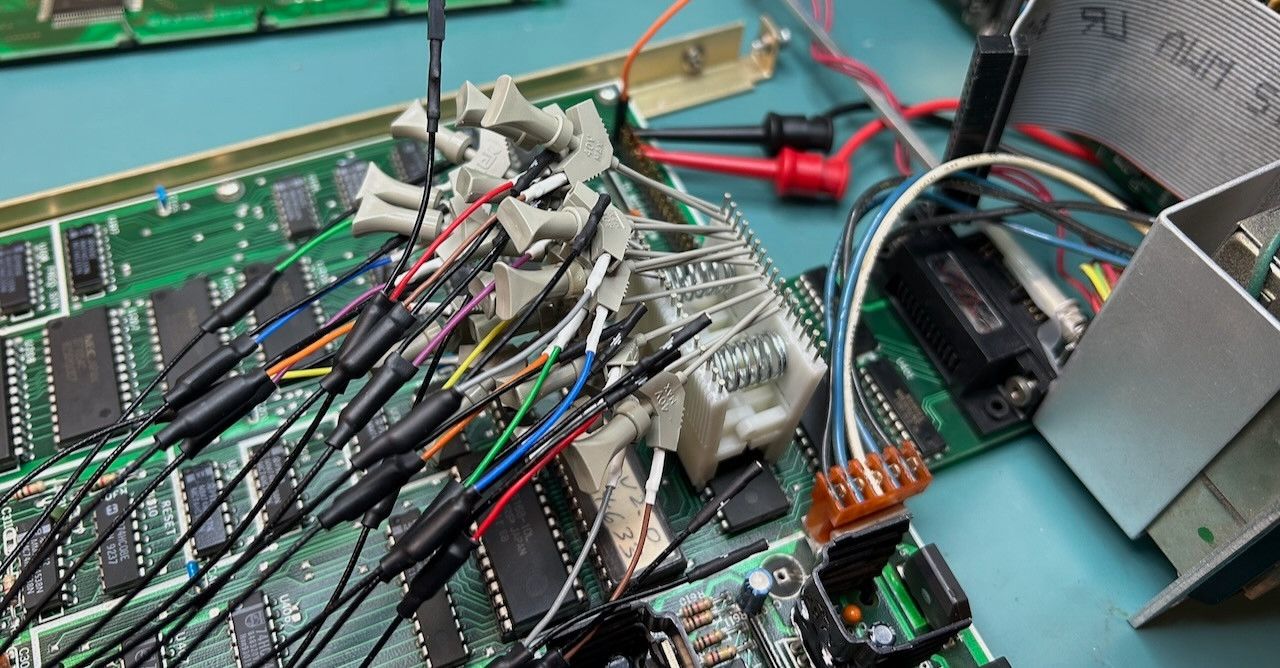
There’s a lot of laboratory equipment out there that the casual hobbyist will never need to use, but that doesn’t mean you wouldn’t snap it up if the price is right. That’s what happened when [Tom Verbeure] saw a 1980s digital delay generator at a flea market for $40. Not only is it an excellent way to learn something about these devices, but it also provides a fascinating opportunity to troubleshoot and hopefully fix it. Such was also the case with this Stanford Research Systems (SRS) DG535 that turned out to be not only broken, but even features an apparently previously triggered self-destruct feature.

These devices are pretty basic, with this specimen incorporating a Z80 MPU in addition to digital and analog components to provide a programmable delay with 12.5 nanosecond resolution on its output channels after the input trigger is sensed. For that reason it was little surprise that the problem with the device was with its supply rails, of which a few were dead or out of spec, along with a burned-out trace.

Where the self-destruct feature comes into play is with the use of current boosting resistors around its linear regulators. Although these provide a current boost over what the regulator can provide, their disadvantages include a tendency towards destruction whenever the load on the supply rail decreases. This could for example occur when you’re debugging an issue and leave some of the PCBs disconnected.

Unsurprisingly, this issue caused the same charred trace to reignite during [Tom]’s first repair attempt, but after working up the courage over the subsequent 18 months the second repair attempt went much better, also helped by the presence of the mostly correct original board schematics.

Ultimately the fixes were relatively modest, involving replacing a discrete diode bridge with an integrated one, fixing the -9 V rail with a bodge wire, and replacing the LCD with its busted AC-powered backlight with a modern one with a LED backlight. Fortunately running the 5 V rail at 7 V for a while seemed to have caused no readily observable damage, nor did flipping connectors because of SRS’ inconsistent β€˜standards’ for its connector orientations.

Sadly, when [Tom] emailed SRS to inquire about obtaining an updated schematic for this unit β€” which is currently still being sold new for $4,495 β€” he merely got told to send his unit in for repair.

NDAA scales back ambitious acquisition reforms, offers little on workforce

Lawmakers said the fiscal 2026 defense policy bill that became law earlier this month would deliver β€œthe most significant acquisition reforms in a generation.” But some of the more sweeping proposals introduced in the House and Senate versions of the bill were ultimately scaled back or dropped entirely from the final version of the legislation.

A similar dynamic played out inside the Pentagon. A draft acquisition memo circulated prior to Defense Secretary Pete Hegseth’s speech to defense executives and senior military acquisition officials outlined a far more aggressive overhaul of how the department would develop and buy military capabilities than what emerged in the final version of the memo and the Acquisition Transformation Strategy.

But a number of provisions from the House’s SPEED Act and Senate’s FoRGED Act that survived negotiations are still expected to be impactful, including measures aimed at streamlining prototyping, accelerating the transition of technologies into production and expanding opportunities for small businesses and new entrants.

Easing regulatory burdens for nontraditional contractors

The bill, for example, exempts nontraditional defense contractors from some of the Pentagon’s accounting, audit and compliance requirements, lowering barriers to entry for new defense technology companies. A nontraditional defense contractor is defined as a contractor that hasn’t held a Cost Accounting Standards-covered contract in the last year, which is the vast majority of the defense industrial base β€” George Mason’s Baroni Center for Government Contracting estimates that only 7.5 percent of the defense companies fall outside that definition. The Senate also pushed to expand the definition of nontraditional defense contractors, but the provision was dropped from the final version of the bill.

The legislation also expands the type of past performance that may be considered β€” the department is required to issue guidance on when it should accept a wider range of past performance, including commercial or non-government work as valid past performance. It also requires the Defense Acquisition Regulations Council to β€œidentify and eliminate specific, unnecessary procedural barriers that disproportionately affect the ability of small business concerns and nontraditional defense contractors, to compete for contracts with the Department of Defense.”

Small and medium-sized Defense Department contractors will also gain access to an online platform offering digital resources, training and services aimed at increasing awareness of and facilitating compliance with defense acquisition requirements.

Faster paths from prototype to production

The bill also expands the Pentagon’s ability to use Commercial Solutions Openings β€” a competitive process used to acquire innovative technologies. CSOs are typically difficult to transition, but the legislation allows the department to move successful CSOs into production, including through sole-source contracts. The provision also expands CSOs to include commercial products, commercial services and nondevelopmental items instead of limiting their use to β€œinnovative” technologies.

Another provision raises the minimum award for the Accelerate the Procurement and Fielding of Innovative Technologies program to $10 million.

The bill also gives combatant commanders the authority to experiment with, prototype and demonstrate new technologies and allows a successful experimentation to serve as justification for moving directly into production.Β 

Stan Soloway, president and CEO of Celero Strategies and federal acquisition expert, said the provisions aimed at accelerating the transition to production and giving officials clearer authority to favor small businesses and new entrants reflect the department’s long-standing effort to work around traditional program processes and system integrators. But given the complexity of many programs, β€œit remains to be seen how much it actually changes on major systems, but it could definitely impact smaller ones” he told Federal News Network.

Data rights and IP

At the same time, there is a seeming contradiction in the bill.

Despite broad bipartisan support, right-to-repair provisions were stripped from the final version of the bill, but β€œprovisions like the one that talked about DoD having the authority to re-engineer components when it thinks doing so will be quicker and less expensive than having additional units produced by the original equipment manufacturers, is sure to raise hackles,” Soloway said.

β€œIP and technical data rights are hugely important issues. And it is fair to say that both government and industry have tended to view them as zero sum games. But if DoD wants to build meaningful bridges to emerging (and existing) firms and technology, the answer lies in both sides being willing to negotiate, at the very beginning of a program, how those questions will be handled. It is hard … but simply stating that DoD can do this when they think it is in their best interests, is probably not the most balanced path forward,” Soloway said.

Workforce largely absent

Despite some of the significant acquisition changes, the legislation barely addresses the workforce β€” a gap Soloway said could undermine the reforms.

The success of these reforms will hinge on whether the department can equip its workforce with the skills needed to operate differently. Otherwise, the system can quickly revert to its old ways.

β€œWithout an aggressive, broad-based and sustained workforce initiative, it is hard to see the workforce having the tools or the confidence to take the kind of reasoned risks the legislation, and Secretary Hegseth, claim to want them to take,” Soloway said

β€œOverall, workforce morale and trust in leadership is at a very low ebb. If change is going to happen, dealing with that reality is job one. But, to date, nothing this administration has done would suggest they have any plan on how to do that,” he added.

If you would like to contact this reporter about recent changes in the federal government, please email anastasia.obis@federalnewsnetwork.com or reach out on Signal at (301) 830-2747.

The post NDAA scales back ambitious acquisition reforms, offers little on workforce first appeared on Federal News Network.

Β© The Associated Press

FILE - The XQ-67A Off-Board Sensing Station unmanned aerial vehicle, one prototype of the future AI drone fleet developed under the USAF's Air Force Research Laboratory, is displayed at General Atomics' test facility at Gray Butte in Palmdale, Calif., on Wednesday, May 1, 2024. (AP Photo/Damian Dovarganes, File)

30,000 Korean Air Employee Records Stolen as Cl0p Leaks Data Online

31 December 2025 at 06:35
Korean Air confirms a major data leak affecting 30,000 staff members after the Cl0p gang targeted a catering partner. Learn what data was stolen and the airline’s response to secure its data.
❌
❌