Ethereum price extended losses and traded below the $2,865 zone. ETH is now consolidating losses and might aim for a recovery if it clears $2,920.
Ethereum remained in a bearish zone and traded below $2,950.
The price is trading below $2,900 and the 100-hourly Simple Moving Average.
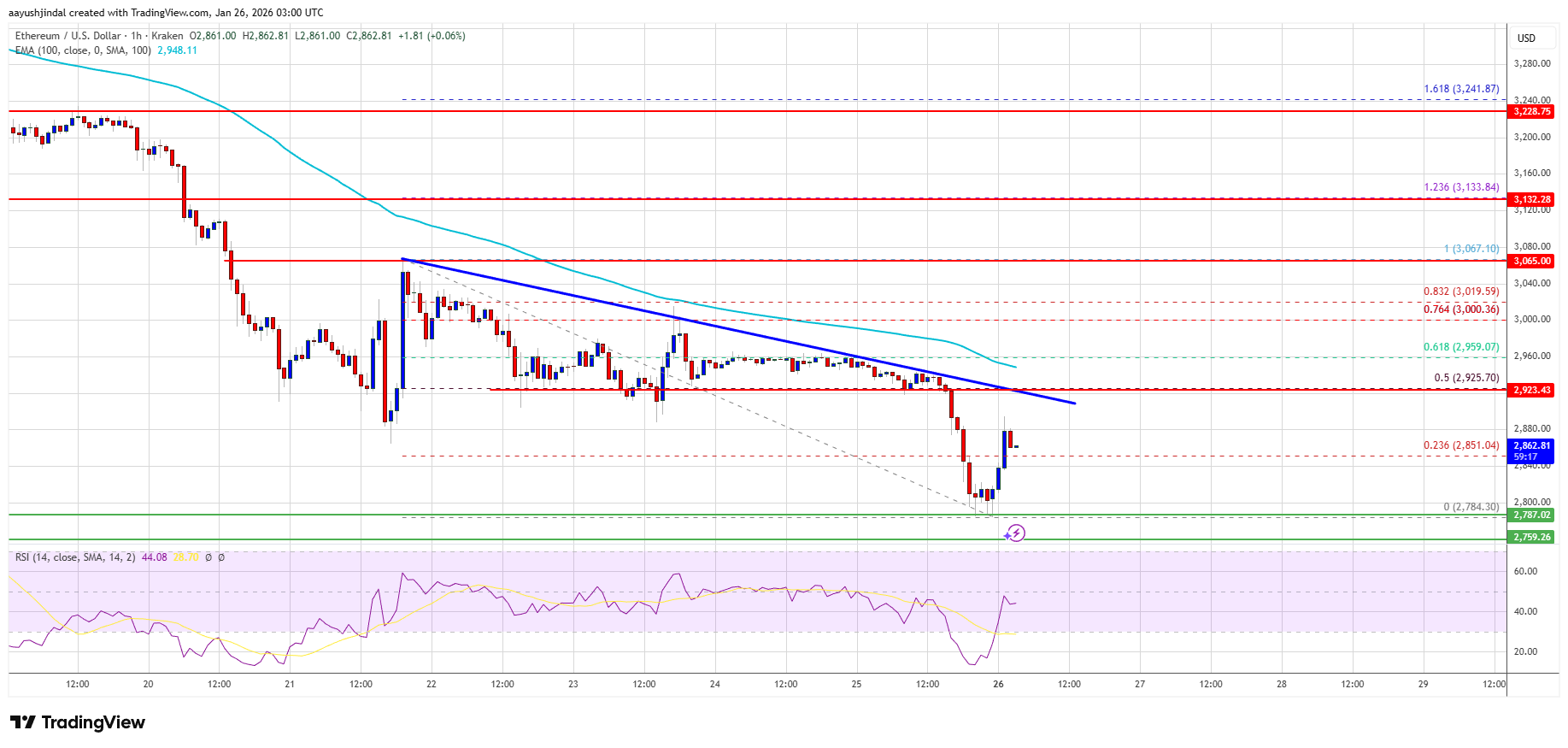
There is a bearish trend line forming with resistance at $2,920 on the hourly chart of ETH/USD (data feed via Kraken).
The pair could start a fresh increase if it stays above the $2,800 zone.
Ethereum Price Dips Further
Ethereum price failed to remain stable above $2,950 and extended losses, like Bitcoin. ETH price declined below $2,880 and $2,865 to enter a bearish zone.
The bears even pushed the price below $2,840. The price finally tested $2,800 and is currently consolidating losses. There was a minor upside above the 23.6% Fib retracement level of the downward wave from the $3,067 swing high to the $2,784 swing low.
Ethereum price is now trading below $2,900 and the 100-hourly Simple Moving Average. If the bulls can protect more losses below $2,800, the price could attempt another increase.
Immediate resistance is seen near the $2,920 level. There is also a bearish trend line forming with resistance at $2,920 on the hourly chart of ETH/USD. The first key resistance is near the $2,960 level or the 61.8% Fib retracement level of the downward wave from the $3,067 swing high to the $2,784 swing low. The next major resistance is near the $3,000 level. A clear move above the $3,000 resistance might send the price toward the $3,065 resistance.
An upside break above the $3,065 region might call for more gains in the coming days. In the stated case, Ether could rise toward the $3,120 resistance zone or even $3,150 in the near term.
More Losses In ETH?
If Ethereum fails to clear the $2,920 resistance, it could start a fresh decline. Initial support on the downside is near the $2,840 level. The first major support sits near the $2,800 zone.
A clear move below the $2,800 support might push the price toward the $2,780 support. Any more losses might send the price toward the $2,720 region. The main support could be $2,650.
Technical Indicators
Hourly MACD – The MACD for ETH/USD is losing momentum in the bearish zone.
Hourly RSI – The RSI for ETH/USD is now below the 50 zone.
Bitcoin price extended losses and traded below $88,500. BTC is consolidating losses and might attempt a recovery wave if it clears $88,500.
Bitcoin started a minor recovery wave from the $86,000 level.
The price is trading below $88,200 and the 100 hourly Simple moving average.
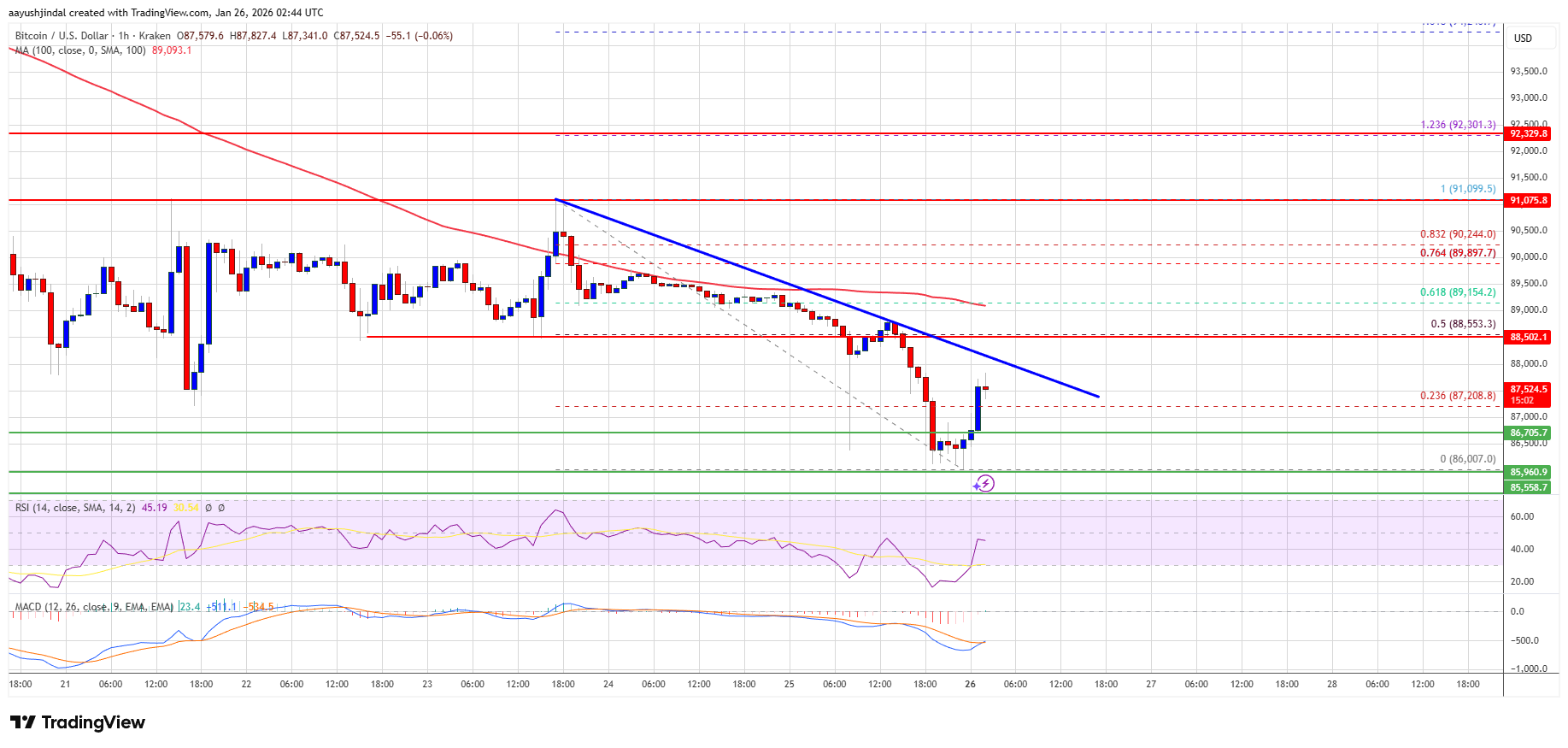
There is a new bearish trend line forming with resistance at $88,000 on the hourly chart of the BTC/USD pair (data feed from Kraken).
The pair might recover if it manages to settle above $86,200 and $86,000.
Bitcoin Price Dips Further
Bitcoin price failed to stay above the $89,000 support and extended losses. BTC declined sharply below the $88,500 and $87,000 support levels.
The bears even pushed the price below $86,500. A low was formed at $86,007, and the price is now attempting a recovery wave. There was a move above the 23.6% Fib retracement level of the downward move from the $91,099 swing high to the $86,007 low.
Bitcoin is now trading below $88,500 and the 100 hourly Simple moving average. If the price remains stable above $86,500, it could attempt a fresh increase. Immediate resistance is near the $88,000 level. There is also a new bearish trend line forming with resistance at $88,000 on the hourly chart of the BTC/USD pair.
The first key resistance is near the $88,500 level since it is close to the 50% Fib retracement level of the downward move from the $91,099 swing high to the $86,007 low.
A close above the $88,500 resistance might send the price further higher. In the stated case, the price could rise and test the $89,200 resistance. Any more gains might send the price toward the $90,000 level. The next barrier for the bulls could be $91,000 and $91,500.
More Losses In BTC?
If Bitcoin fails to rise above the $88,500 resistance zone, it could start another decline. Immediate support is near the $86,700 level. The first major support is near the $86,200 level.
The next support is now near the $85,500 zone. Any more losses might send the price toward the $83,500 support in the near term. The main support sits at $82,500, below which BTC struggle to recover in the near term.
Technical indicators:
Hourly MACD – The MACD is now losing pace in the bearish zone.
Hourly RSI (Relative Strength Index) – The RSI for BTC/USD is now below the 50 level.
Major Support Levels – $86,700, followed by $86,000.
Deep dive into User Managed Access (UMA). Learn how UMA 2.0 works with OAuth2 and OIDC to provide user-centric privacy and resource sharing in Enterprise SSO.
KDE's "Plasma Login Manager" is apparently dropping support for FreeBSD, the Unix-like operating system, reports the blog It's FOSS. They cite a recently-accepted merge request from a KDE engineer to drop the code supporting FreeBSD, since the login manager relies on systemd/logind:
systemd and logind look like hard dependencies of the login manager, which means the software is built to work exclusively with these components and cannot function without them... logind is a component of systemd that is responsible for user session management...
This doesn't mean that KDE has abandoned the operating system altogether. FreeBSD users can still run the KDE Plasma desktop environment and continue using SDDM, the current login manager that works just fine on such systems.
The article argues FreeBSD users "won't really care much for missing out on this as they have plenty of login manager options available."
Shabana Mahmood will set out her overhaul of policing today, aiming to tackle "unpunished" everyday crime and get officers from their desks to the streets.
Entropy, a decentralized crypto custody startup backed by Andreessen Horowitz (a16z), is winding down and plans to return remaining capital to investors, according to founder and chief executive Tux Pacific.
Pacific wrote on X over the weekend, “I am winding-up Entropy.” They added, “After four years, several pivots, and two rounds of layoffs, I’ve decided to wind-up Entropy and return capital to our investors.”
Crypto Automation Bet Fell Short After Investor Feedback
The shutdown follows a late-stage push in 2025 to reposition the company around a crypto automations platform, which Pacific described as “basically n8n/zapier/etc for crypto,” with automated signing via threshold cryptography, secure computation using trusted execution environments, and “deep AI integrations.”
I am winding-up Entropy.
After four years, several pivots, and two rounds of layoffs, I’ve decided to wind-up Entropy and return capital to our investors.
For the latter half of 2025, the Entropy team was hard at work on a crypto automations platform (basically n8n/zapier/etc…
That product direction still failed to clear a venture-style growth bar. “After an initial feedback request revealed that the business model wasn’t venture scale, I was left with the choice to find a creative way forward or pivot once more,” Pacific wrote.
Entropy first drew attention in 2022 when it raised $25M in a seed round led by a16z crypto, with participation including Dragonfly Capital, Coinbase Ventures, Robot Ventures, Ethereal Ventures, Variant and Inflection. The company had earlier raised a $1.95M pre-seed round.
Founder Looks Beyond Digital Assets Toward Pharmaceuticals Research
At launch, Entropy pitched itself as a decentralized alternative to custody providers such as Fireblocks and Coinbase, leaning on cryptographic approaches like multi-party computation to let users control how funds could move, including rule-based constraints.
Pacific also thanked a16z crypto and Guy Wuollet for helping steer the wind-down, calling their guidance “invaluable.”
The closure lands in a tougher funding climate for early-stage crypto startups. Crypto venture deal count fell about 60% year-on-year in 2025, dropping to roughly 1,200 transactions from more than 2,900 in 2024.
Next, Pacific said they plan to step back before deciding what comes after Entropy. “My time in crypto might be coming to an end, as I feel myself drawn specifically into pharmaceuticals,” they wrote, adding they want to work on hormone delivery and validate research on new estradiol drug formulations.
As NASA gears up to send four astronauts on a crewed flight around the moon in the imminent Artemis II mission, Axiom Space is carefully preparing its AxEMU spacesuit for the highly anticipated endeavor that will follow. Artemis III, which NASA is targeting for no earlier than 2027, will land astronauts on the lunar surface […]
Adafruit managing director Phillip Torrone (also long-time Slashdot reader ptorrone ) writes: Washington State lawmakers are proposing bills (HB 2320 and HB 2321) that would require 3D printers and CNC machines to block certain designs using software-based "firearms blueprint detection algorithms." In practice, this means scanning every print file, comparing it against a government-maintained database, and preventing "skilled users" from bypassing the system. Supporters frame this as a response to untraceable "ghost guns," but even federal prosecutors admit the tools involved are ordinary manufacturing equipment. Critics warn the language is overbroad, technically unworkable, hostile to open source, and likely to push printing toward cloud-locked, subscription-based systems—while doing little to stop criminals.
If predictions hold steady, nearly half of the United States will be covered in snow by the time this post goes live, with the Northeast potentially getting buried under more than 18 inches. According to the National Weather Service, the “unusually expansive and long-duration winter storm will bring heavy snow from the central U.S. across the Midwest, Ohio Valley, and through the northeastern U.S. for the remainder of the weekend into Monday.” If that sounds like a fun snow day, they go on to clarify that “crippling to locally catastrophic impacts can be expected”, so keep that in mind. Hopefully you didn’t have any travel plans, as CNBC reported that more than 13,000 flights were canceled as of Friday night. If you’re looking to keep up with the latest developments, we recently came across StormWatch (GitHub repo), a slick open source weather dashboard that’s written entirely in HTML. Stay safe out there, hackers.
Speaking of travel, did you hear about Sebastian Heyneman’s Bogus Journey to Davos? The entrepreneur (or “Tech Bro” to use the parlance of our times) was in town to woo investors attending the World Economic Forum, but ended up spending the night in a Swiss jail cell because the authorities thought he might be a spy. Apparently he had brought along a prototype for the anti-fraud device he was hawking, and mistakenly left it laying on a table while he was rubbing shoulders. It was picked up by security guards and found to contain a very spooky ESP32 development board, so naturally he was whisked off for interrogation. A search of his hotel room uncovered more suspicious equipment, including an electric screwdriver and a soldering iron. Imagine if a child had gotten their hands on them?
But the best part of the story is when Sebastian tries to explain the gadget’s function to investigators. When asked to prove that the code on the microcontroller wasn’t malicious, he was at a loss — turns out our hero used AI to create the whole thing and wasn’t even familiar with the language it was written in. In his own words: “Look, I’m not a very good hardware engineer, but I’m a great user of AI. I was one of the top users of Cursor last year. I did 43,000 agent runs and generated 25 billion tokens.” Oof. Luckily, the Swiss brought in a tech expert who quickly determined the device wasn’t dangerous. He was even nice enough to explain the code line-by-line to Sebastian before he was released. No word on whether or not they charged him for the impromptu programming lesson.
It wasn’t hard for the Swiss authorities to see what was inside the literal black box Sebastian brought with him, but what if that wasn’t possible? Well, if you’ve got an x-ray machine handy, that could certainly help. The folks at Eclypsium recently released a blog post that describes how they compared a legit FTDI cable with a suspect knock-off by peering at their innards. What we thought was particularly interesting was how they were able to correctly guess which one was the real deal based on the PCB design. The legitimate adapter featured things like ground pours and decoupling caps, and the cheap one…didn’t. Of course, this makes sense. If you’re looking to crank something out as cheaply as possible, those would be the first features to go. (Editor’s note: sarcasm.)
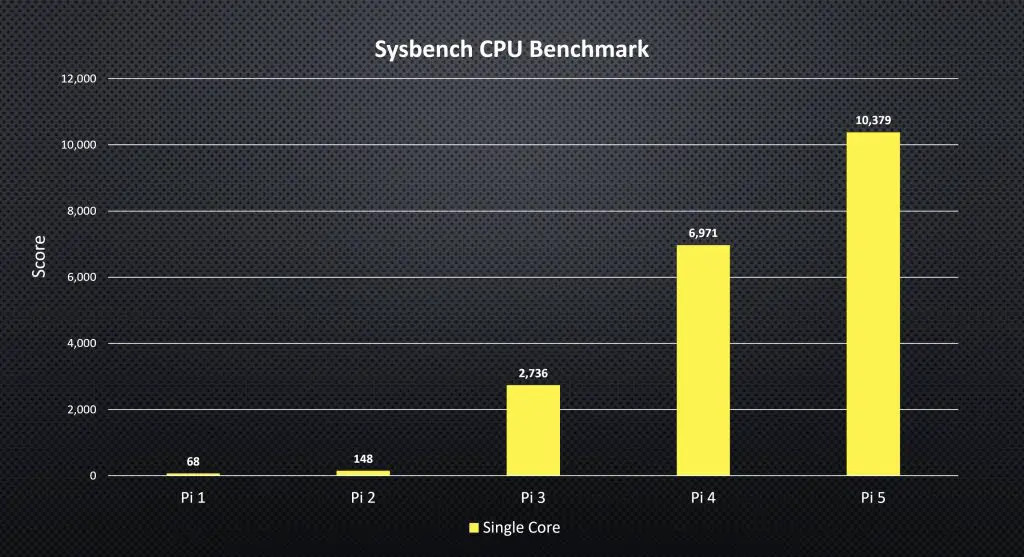
It doesn’t take an x-ray machine or any other fancy equipment to figure out that the Raspberry Pi 5 is faster than its predecessors. But quantifying just how much better each generation of Pi is compared to the other members of the family does require a bit more effort, which is why we were glad to see that The DIY Life did the homework for us. It’s not much of a spoiler to reveal that the Pi 5 won the head-to-head competition in essentially every category, but it’s still interesting to read along to see how each generation of hardware fared in the testing.
Finally, Albedo has released a fascinating write-up that goes over the recent flight of their Very Low Earth Orbit (VLEO) satellite, Clarity-1. As we explained earlier this week, operating at a lower orbit offers several tangible benefits to spacecraft. One of the major ones is that such an orbit decays quickly, meaning a spacecraft could burn up just months or even days after its mission is completed. For Albedo specifically, they’re taking advantage of the lower altitude to snap closeup shots of the Earth. While there were a few hiccups, the mission was overall a success, providing another example of how commercial operators can capitalize on this unique space environment.
See something interesting that you think would be a good fit for our weekly Links column? Drop us a line, we’ve love to hear about it.
Also, cybercriminals get breached, Gemini spills the calendar beans, and more
infosec in brief T'was a dark few days for automotive software systems last week, as the third annual Pwn2Own Automotive competition uncovered 76 unique zero-day vulnerabilities in targets ranging from Tesla infotainment to EV chargers.…
 Login
Login