The concept is straightforward enough. The Nintendo DSi runs a small homebrew app which lets you use the stylus to make simple line drawings on the lower touchscreen. These drawings are then trucked out wirelessly as raw touch data via UDP packets, and fed into a Gemini tool which transforms them into animation frames. These are then sent to an iPhone app, which uses ARKit APIs and the phone’s camera to display the animations embedded into the surrounding environment via augmented reality.
One might question the utility of this project, given that the iPhone itself has a touch screen you can draw on, too. It’s a fair question, and one without a real answer, beyond the fact that sometimes it’s really fun to play with an old console and do weird things with it. Plus, there just isn’t enough DSi homebrew out in the world. We love to see more.
Account takeover didn’t disappear — it evolved Account takeover (ATO) and credential abuse aren’t new.What’s changed is how attackers do it and why many traditional defenses no longer catch it early. Today’s ATO attacks don’t always start with: Instead, they increasingly rely on: The result: fewer alerts, more successful takeovers. This shift reflects a broader …
California-based Karman Industries "says it has developed a cooling system that uses SpaceX rocket engine technology to rein in the environmental impact of data centers," reports the Los Angeles Times, "chilling them with less space, less power and no water."
Karman has developed a cooling system similar to the heat pumps in the average home, except its pumps use liquid carbon dioxide as refrigerant, which is circulated using rocket engine technology rather than fans. The company's efficient pumps can reduce the space required for data center cooling equipment by 80%.
Over the years, data centers have used fans and air conditioning to blow cold air on the chips. Bigger facilities pass cold liquid through tubes near the chips to absorb the heat. This hot liquid is sent outside to a cooling yard, where sprawling networks of pipes use as much water as a city of 50,000 people to remove the heat. A 50 megawatt data center also uses enough electricity to power a mid-sized city... Cooling systems account for up to 40% of a data center's power consumption and an average midsized data center consumes more than 35,000 gallons of water per day...
U.S. data centers will consume about 8% of all electricity in the country by 2030, according to the International Energy Agency... The cooling systems are projected to use up to 33 billion gallons of water by 2028 per year... To serve this seemingly insatiable market, Karman has developed a rotating compressor that spins at 30,000 revolutions per minute — nearly 10 times faster than traditional compressors — to move heat...
About a third of Karman's 23-person team came from SpaceX or Rocket Lab, and they co-opted technologies from aerospace engineering and electric vehicles to design the mechanics for the high-speed motors. The system uses a special type of carbon dioxide under high pressure to transfer heat from the data center to the outside air. Depending on the conditions, it can do the same amount of cooling using less than half the energy. Karman's heat pump can either reject heat to air, or route it into extra cooling, or even power generation.
The company "recently raised $20 million," according to the article, "and expects to start building its first compressors in Long Beach later this year...."
Adafruit managing director Phillip Torrone (also long-time Slashdot reader ptorrone ) writes: Washington State lawmakers are proposing bills (HB 2320 and HB 2321) that would require 3D printers and CNC machines to block certain designs using software-based "firearms blueprint detection algorithms." In practice, this means scanning every print file, comparing it against a government-maintained database, and preventing "skilled users" from bypassing the system. Supporters frame this as a response to untraceable "ghost guns," but even federal prosecutors admit the tools involved are ordinary manufacturing equipment. Critics warn the language is overbroad, technically unworkable, hostile to open source, and likely to push printing toward cloud-locked, subscription-based systems—while doing little to stop criminals.
If predictions hold steady, nearly half of the United States will be covered in snow by the time this post goes live, with the Northeast potentially getting buried under more than 18 inches. According to the National Weather Service, the “unusually expansive and long-duration winter storm will bring heavy snow from the central U.S. across the Midwest, Ohio Valley, and through the northeastern U.S. for the remainder of the weekend into Monday.” If that sounds like a fun snow day, they go on to clarify that “crippling to locally catastrophic impacts can be expected”, so keep that in mind. Hopefully you didn’t have any travel plans, as CNBC reported that more than 13,000 flights were canceled as of Friday night. If you’re looking to keep up with the latest developments, we recently came across StormWatch (GitHub repo), a slick open source weather dashboard that’s written entirely in HTML. Stay safe out there, hackers.
Speaking of travel, did you hear about Sebastian Heyneman’s Bogus Journey to Davos? The entrepreneur (or “Tech Bro” to use the parlance of our times) was in town to woo investors attending the World Economic Forum, but ended up spending the night in a Swiss jail cell because the authorities thought he might be a spy. Apparently he had brought along a prototype for the anti-fraud device he was hawking, and mistakenly left it laying on a table while he was rubbing shoulders. It was picked up by security guards and found to contain a very spooky ESP32 development board, so naturally he was whisked off for interrogation. A search of his hotel room uncovered more suspicious equipment, including an electric screwdriver and a soldering iron. Imagine if a child had gotten their hands on them?
But the best part of the story is when Sebastian tries to explain the gadget’s function to investigators. When asked to prove that the code on the microcontroller wasn’t malicious, he was at a loss — turns out our hero used AI to create the whole thing and wasn’t even familiar with the language it was written in. In his own words: “Look, I’m not a very good hardware engineer, but I’m a great user of AI. I was one of the top users of Cursor last year. I did 43,000 agent runs and generated 25 billion tokens.” Oof. Luckily, the Swiss brought in a tech expert who quickly determined the device wasn’t dangerous. He was even nice enough to explain the code line-by-line to Sebastian before he was released. No word on whether or not they charged him for the impromptu programming lesson.
It wasn’t hard for the Swiss authorities to see what was inside the literal black box Sebastian brought with him, but what if that wasn’t possible? Well, if you’ve got an x-ray machine handy, that could certainly help. The folks at Eclypsium recently released a blog post that describes how they compared a legit FTDI cable with a suspect knock-off by peering at their innards. What we thought was particularly interesting was how they were able to correctly guess which one was the real deal based on the PCB design. The legitimate adapter featured things like ground pours and decoupling caps, and the cheap one…didn’t. Of course, this makes sense. If you’re looking to crank something out as cheaply as possible, those would be the first features to go. (Editor’s note: sarcasm.)
It doesn’t take an x-ray machine or any other fancy equipment to figure out that the Raspberry Pi 5 is faster than its predecessors. But quantifying just how much better each generation of Pi is compared to the other members of the family does require a bit more effort, which is why we were glad to see that The DIY Life did the homework for us. It’s not much of a spoiler to reveal that the Pi 5 won the head-to-head competition in essentially every category, but it’s still interesting to read along to see how each generation of hardware fared in the testing.
Finally, Albedo has released a fascinating write-up that goes over the recent flight of their Very Low Earth Orbit (VLEO) satellite, Clarity-1. As we explained earlier this week, operating at a lower orbit offers several tangible benefits to spacecraft. One of the major ones is that such an orbit decays quickly, meaning a spacecraft could burn up just months or even days after its mission is completed. For Albedo specifically, they’re taking advantage of the lower altitude to snap closeup shots of the Earth. While there were a few hiccups, the mission was overall a success, providing another example of how commercial operators can capitalize on this unique space environment.
See something interesting that you think would be a good fit for our weekly Links column? Drop us a line, we’ve love to hear about it.
Can Aircela's machine "create gasoline using little more than electricity and the air that we breathe"? Jalopnik reports...
The Aircela machine works through a three-step process. It captures carbon dioxide directly from the air... The machine also traps water vapor, and uses electrolysis to break water down into hydrogen and oxygen... The oxygen is released, leaving hydrogen and carbon dioxide, the building blocks of hydrocarbons. This mixture then undergoes a process known as direct hydrogenation of carbon dioxide to methanol, as documented in scientific papers.
Methanol is a useful, though dangerous, racing fuel, but the engine under your hood won't run on it, so it must be converted to gasoline. ExxonMobil has been studying the process of doing exactly that since at least the 1970s. It's another well-established process, and the final step the Aircela machine performs before dispensing it through a built-in ordinary gas pump. So while creating gasoline out of thin air sounds like something only a wizard alchemist in Dungeons & Dragons can do, each step of this process is grounded in science, and combining the steps in this manner means it can, and does, really work.
Aircela does not, however, promise free gasoline for all. There are some limitations to this process. A machine the size of Aircela's produces just one gallon of gas per day... The machine can store up to 17 gallons, according to Popular Science, so if you don't drive very much, you can fill up your tank, eventually... While the Aircela website does not list a price for the machine, The Autopian reports it's targeting a price between $15,000 and $20,000, with hopes of dropping the price once mass production begins. While certainly less expensive than a traditional gas station, it's still a bit of an investment to begin producing your own fuel. If you live or work out in the middle of nowhere, however, it could be close to or less than the cost of bringing gas to you, or driving all your vehicles into a distant town to fill up. You're also not limited to buying just one machine, as the system is designed to scale up to produce as much fuel as you need.
The main reason why this process isn't "something for nothing" is that it takes twice as much electrical energy to produce energy in the form of gasoline. As Aircela told The Autopian " Aircela is targeting >50% end to end power efficiency. Since there is about 37kWh of energy in a gallon of gasoline we will require about 75kWh to make it. When we power our machines with standalone, off-grid, photovoltaic panels this will correspond to less than $1.50/gallon in energy cost."
Thanks to long-time Slashdot reader Quasar1999 for sharing the news.
Setting up access to a headless Raspberry Pi is one of those tasks that should take a few minutes, but for some reason always seems to take much longer. The most common method is to configure Wi-Fi access and an SSH service on the Pi before starting it, which can go wrong in many different ways. This author, for example, recently spent a few hours failing to set up a headless Pi on a network secured with Protected EAP, and was eventually driven to using SSH over Bluetooth. This could thankfully soon be a thing of the past, as [Paul Oberosler] developed a package for SSH over USB, which is included in the latest versions of Raspberry Pi OS.
The idea behind rpi-usb-gadget is that a Raspberry Pi in gadget mode can be plugged into a host machine, which recognizes it as a network adapter. The Pi itself is presented as a host on that network, and the host machine can then SSH into it. Additionally, using Internet Connection Sharing (ICS), the Pi can use the host machine’s internet access. Gadget mode can be enabled and configured from the Raspberry Pi Imager. Setting up ICS is less plug-and-play, since an extra driver needs to be installed on Windows machines. Enabling gadget mode only lets the selected USB port work as a power input and USB network port, not as a host port for other peripherals.
An older way to get USB terminal access is using OTG mode, which we’ve seen used to simplify the configuration of a Pi as a simultaneous AP and client. If you want to set up headless access to Raspberry Pi desktop, we have a guide for that.
Tether led crypto protocol revenue in 2025 with approximately $5.2 billion, accounting for 41.9% of total revenue across 168 revenue-generating protocols, according to CoinGecko Research. Stablecoin issuers dominated the rankings, with just four entities generating 65.7% or roughly $8.3 billion…
Fresh information from a reliable Chinese tipster suggests the OnePlus 15T may play it safe with the cameras, reusing familiar hardware while focusing on performance gains and battery capacity in a compact flagship form factor.
This week on You Asked, we tackle some of the most common TV buying questions right now, from choosing between LG and Samsung’s latest OLEDs to which brands handle upscaling best. We also dig into whether Dolby Vision 2 is a reason to hold off on a new TV purchase, or if today’s high-end sets are already good enough.
Small modular nuclear reactors (or SMRs) are touted as "cheaper, safer, faster to build and easier to finance" than conventional nuclear reactors, reports CNN. Amazon has invested in X-Energy, and earlier this month, Meta announced a deal with Oklo, and in Michigan last month, Holtec began the long formal licensing process for two SMRs with America's Nuclear Regulatory Commission next to a nuclear plant it hopes to reactive. (And in 2024, California-based Kairos Power broke ground in Tennessee on a SMR "demo" reactor.)
But "The reality, as ever, is likely to be messier and experts are sounding notes of caution..."
All the arguments in favor of SMRs overlook a fundamental issue, said Edwin Lyman, director of nuclear power safety at the Union of Concerned Scientists: They are too expensive. Despite all the money swilling around the sector, "it's still not enough," he told CNN. Nuclear power cannot compete on cost with alternatives, both fossil fuels and increasingly renewable energy, he said."
Some SMRs also have an issue with fuel. The more unconventional designs, those cooled by salt or gas, often require a special type of fuel called high-assay low-enriched uranium, known as HALEU (pronounced hay-loo). The amounts available are limited and the supply chain has been dominated by Russia, despite efforts to build up a domestic supply. It's a major risk, said Nick Touran [a nuclear engineer and independent consultant]. The biggest challenge nuclear has is competing with natural gas, he said, a "luxury, super expensive fuel may not be the best way." There is still stigma around nuclear waste, too. SMR companies say smaller reactors mean less nuclear waste, but 2022 research from Stanford University suggested some SMRs could actually generate more waste, in part because they are less fuel efficient...
As companies race to prove SMRs can meet the hype, experts appear to be divided in their thinking. For some, SMRs are an expensive — and potentially dangerous — distraction, with timelines that stretch so far into the future they cannot be a genuine answer to soaring needs for clean power right now.
Nuclear engineering/consultant Touran told CNN the small reactors are "a technological solution to a financial problem. No venture capitalists can say, like, 'oh, sure, we'll build a $30 billion plant.' But, if you're down into hundreds of millions, maybe they can do it."
Carrot Kheer is a yummy, creamy dessert made by simmering cooked carrot puree with milk, sweetening with sugar, flavoring with cardamom powder, saffron and & garnishing with chopped nuts. Carrot Kheer is made on special occasions and is quite easy to make. Recipe includes step by step pictures and video.
Carrot Kheer is our family favourite, both kids are fond of it. This version of carrot kheer is loved by all ages as it is creamy and tasty. Carrot Kheer made creamy and rich using this recipe will be an instant hit at parties and get together etc. Do try this recipe and let me know how you liked it.
[feast_advanced_jump_to]
About Carrot Kheer
Carrot Kheer is a rich creamy dessert that you can make for festivals or any special occasions. Kheer is payasam so payasam made with carrot as main ingredient is called carrot kheer. Carrot Payasam as it is popularly known in South India is one of the unique kheer recipes that you can make from our usual rice kheer.
There are many ways this Carrot Kheer can be made - Some versions involve just sauteing carrots in ghee and simmering in milk. But this recipe I have shared is more smooth and will sure be kids favorite. As carrots are cooked and pureed, the kheer becomes smooth and creamy.
Cardamom powder, saffron goes well with carrots and milk so do not skip it. If your kids are not fond of carrot in sabzi form then try this recipe for them and I am sure they will love it and ask for more. Mittu loves this kheer since her childhood now gugu has added on this to his favorites too.
This is a creamy and rich dessert that you can make it as a part of meals or as an after meal dessert. If you get Delhi red carrots you can use that too. Carrots are a rich source of Vitamin A which is very good for our eyes so try to include carrots in your diet on a regular basis.
Carrot Kheer Video
Carrot Kheer Ingredients
Carrot - Choose fresh carrots. I used ooty carrots you can use Delhi red carrots too. Use fresh carrots.
Milk - Use full fat milk. I used farm fresh milk.
Ghee - used for sautéing carrots before cooking.
Sugar - I have used regular white sugar but you can use jaggery too. You can even replace sugar with condensed milk too.
Flavoring - Cardamom powder and saffron is the best flavoring for this kheer.
Garnish - I have used pistachio, you can ghee fry nuts and add it too.
Why you will love this recipe?
Easy and quick to make
Creamy and rich dessert
Healthy and tasty
Creamy and smooth
Can be made with kitchen staples
How to make Carrot Kheer Step by Step
1.Take 4 medium sized carrots. Trim both the edges, remove the skin and rinse it well.
2.Chop it roughly and keep it ready.
3.To a pressure cooker heat 1 tablespoon ghee add chopped carrots saute for 3 minutes.
4.Add around 8 whole cashews, ½ cup milk and ½ water. Pressure cook for 3 whistles.
5.Check if carrot is cooked.
6.Cool down and puree it slightly coarse.
7.To a sauce pan boil 3 and ½ cups milk, simmer for few minutes.
8.Add cooked carrot puree.
8.Add ¾ cup sugar.
9.Add around 10 strands saffron.
10.Mix it well and let it boil for 15 minutes.
11.Then add ¼ teaspoon cardamom powder and chopped pistachios. I added little here and reserved the remaining while serving.
12.Mix it well and switch off.
Carrot Kheer is ready!
Expert Tips
Carrots - Choose fresh carrots. Trim the edges, remove the skin, rinse well and chop it roughly.
Grinding - You can grind it to a coarse mixture too if you like it that way.
Milk - Boil milk well, simmer for few minutes only then add carrot paste.
Cashews - Instead of cashews you can add almonds while grinding too but blanch it remove the skin then grind it along with carrots.
Replacement - You can replace sugar with ½ cup condensed milk for a rich kheer.
Nuts - You can add ghee fried cashews or other nuts too. This kheer tastes good on its own but if you prefer you can add raw chopped nuts as garnish.
Serving & Storage
Enjoy Carrot Kheer as a dessert after meal hot or cold as per your preference. Refrigerate for later use, keeps well for a day in room temperature and in fridge for 2-3 days.
FAQS
1.Which carrots are best for carrot kheer?
Orange carrots or Red carrots both are suitable for making this kheer. Choose the one based on availability.
2.Can I use jaggery instead of sugar?
Yes, jaggery can be used. Add it after the milk is cooked and slightly cooled to prevent curdling.
3.Do I need to cook carrots before adding milk?
Yes. Sautéing in ghee and pressure-cooking carrots helps soften them and removes the raw taste.
4. How long does carrot kheer stay fresh?
It stays good for up to 2 days when refrigerated in an airtight container.
5. Can carrot kheer be served cold?
Yes. It tastes great both warm and chilled.
If you have any more questions about this Carrot Kheer Recipe do mail me at sharmispassions@gmail.com. In addition, follow me on Instagram, Facebook, Pinterest, Youtube and Twitter .
Tried this Carrot Kheer Recipe? Do let me know how you liked it. Also tag us on Instagram @sharmispassions and hash tag it on #sharmispassions.
Carrot Kheer is a yummy, creamy dessert made by simmering cooked carrot puree with milk, sweetening with sugar, flavoring with cardamom powder, saffron and & garnishing with chopped nuts. Carrot Kheer is made on special occasions and is quite easy to make. Recipe includes step by step pictures and video.
Tether emerged as the most profitable crypto entity in 2025, generating an estimated $5.2 billion in revenue as stablecoins overtook all other protocol categories in earnings.
According to the latest Coingecko annual crypto industry report, Tether alone accounted for 41.9% of all stablecoin-related revenue in 2025, outpacing competitors such as Circle, Hyperliquid, Pump.fun, Ethena, Axiom, Phantom, and PancakeSwap.
The results show that dollar-backed digital currencies have become the most durable revenue engine in crypto, even as market conditions fluctuated throughout the year.
Tether Leads Stablecoin Issuers To Capture Crypto Revenue Crown
Among more than 168 crypto protocols tracked in 2025, stablecoin issuers collectively generated the highest revenue, with Tether firmly at the center.
INSIGHT: Stablecoins generated $5.2B in revenue in 2025, accounting for 41.9% of total protocol revenue. pic.twitter.com/fjJrAn9k7B
Its $5.2 billion haul placed it well ahead of Circle and other major players, reinforcing USDT’s position as the industry’s primary settlement asset.
Within the top ten revenue-generating protocols, just four entities, led by Tether and Circle, produced 65.7% of total earnings, equivalent to roughly $8.3 billion.
Source: Coingecko
The remaining six protocols in the top ten were all trading-focused platforms, highlighting a sharp divide between stable revenue streams and market-dependent income.
That contrast became clear as trading revenues swung widely with investor sentiment during the year.
Phantom, for example, recorded $95.2 million in revenue in January at the height of the Solana meme coin frenzy, only to see earnings fall to $8.6 million by December as speculative activity cooled.
USDT Claims 60% Share Of $311B Stablecoin Market
The broader stablecoin market expanded rapidly, with total market capitalization rising by $6.3 billion in the fourth quarter alone to reach a record $311.0 billion.
That marked a 48.9% year-over-year increase, adding $102.1 billion as adoption accelerated across regions.
Tether maintained clear leadership with 60.1% of the total stablecoin market cap, or about $187.0 billion, followed by Circle’s USDC at 24.2%, equivalent to $72.4 billion.
Source: Coingecko
Tether is now the world’s third-largest digital asset by market value at $186.8 billion, up roughly 50% from a year earlier.
While the top players strengthened their grip, shifts within the top five reflected changing risk appetites.
Ethena’s USDe experienced the sharpest reversal, with its market cap plunging 57.3%, or $6.5 billion, after a mid-October depeg on Binance undermined confidence in high-yield looping strategies.
Other stablecoins posted mixed but notable moves as capital rotated within the sector.
PayPal’s PYUSD surged 48.4%, adding $1.2 billion to reach $3.6 billion and briefly claiming the fifth spot before World Liberty Financial’s USD1 reclaimed it by nearly $1.
Additional high-growth tokens included Ripple’s RLUSD, which expanded 61.8% to add $488.2 million, and USDD, which climbed 76.9% with a $366.8 million increase.
Inside Tether’s $500B Valuation Path and Expanding Investment Empire
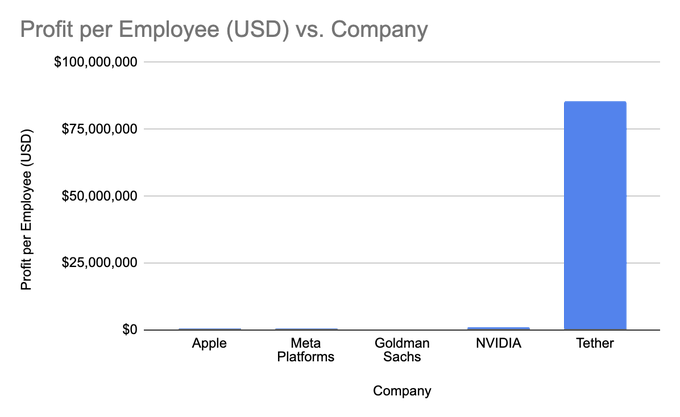
Looking ahead, Bitwise CIO Matt Hougan recently suggested that Tether could become the world’s most profitable company if its trajectory continues.
“There’s a chance that many emerging market countries will convert from primarily using their own currencies to using USDT,” Hougan said, pointing to Tether’s near-total dominance outside Western markets.
Based on projected interest income, calculations indicate that custody of $3 trillion in assets could generate annual revenue exceeding the $120 billion earned by Saudi Aramco last year.
Tether CEO Paolo Ardoino previously told Cryptonews he remains confident USDT will retain its lead due to the company’s deep understanding of real-world usage.
Beyond stablecoins, Tether has expanded aggressively into traditional assets and investments.
The company recently became the second-largest shareholder in Italian football club Juventus and has reportedly explored raising $20 billion for a 3% stake, a deal that would imply a valuation near $500 billion and place Tether among the world’s most valuable firms.
Keep things smelling fresh with these handy home gadgets. After researching and testing over a dozen devices, the Urpower Aroma is our favorite for most people.
For certain high-security devices, such as card readers, ATMs, and hardware security modules, normal physical security isn’t enough – they need to wipe out their sensitive data if someone starts drilling through the case. Such devices, therefore, often integrate circuit meshes into their cases and regularly monitor them for changes that could indicate damage. To improve the sensitivity and accuracy of such countermeasures, [Jan Sebastian Götte] and [Björn Scheuermann] recently designed a time-domain reflectometer to monitor meshes (pre-print paper).
Many meshes are made from flexible circuit boards with winding traces built into the case, so cutting or drilling into the case breaks a trace. The problem is that most common ways to detect broken traces, such as by resistance or capacitance measurements, aren’t easy to implement with both high sensitivity and low error rates. Instead, this system uses time-domain reflectometry: it sends a sharp pulse into the mesh, then times the returning echoes to create a mesh fingerprint. When the circuit is damaged, it creates an additional echo, which is detected by classifier software. If enough subsequent measurements find a significant fingerprint change, it triggers a data wipe.
The most novel aspect of this design is its affordability. An STM32G4-series microcontroller manages the timing, pulse generation, and measurement, thanks to its two fast ADCs and a high-resolution timer with sub-200 picosecond resolution. For a pulse-shaping amplifier, [Jan] and [Björn] used the high-speed amplifiers in an HDMI redriver chip, which would normally compensate for cable and connector losses. Despite its inexpensive design, the circuit was sensitive enough to detect when oscilloscope probes contacted the trace, pick up temperature changes, and even discern the tiny variations between different copies of the same mesh.
It’s not absolutely impossible for an attacker to bypass this system, nor was it intended to be, but overcoming it would take a great deal of skill and some custom equipment, such as a non-conductive drill bit. If you’re interested in seeing such a system in the real world, check out this teardown of a payment terminal. One of the same authors also previously wrote a KiCad plugin to generate anti-tamper meshes.

 Login
Login