Dogecoin is potentially following a Falling Wedge right now, and this cryptocurrency analyst thinks a breakout from it may be a “powerful” one.
Dogecoin Could Be Trading Inside A Falling Wedge Pattern
In a new post on X, analyst Ali Martinez has shared a Falling Wedge that Dogecoin is potentially trading inside on the weekly timeframe. A “Wedge” is a pattern from technical analysis (TA) that forms whenever the asset’s price trades between two converging trendlines.
A “Triangle” consolidation channel also involves converging trendlines, but the difference from a Wedge is that it either involves one trendline that’s horizontally flat or trendlines that converge with an opposite slope. On the other hand, a Wedge involves trendlines sloped in the same direction.
When these lines point in the up direction, the pattern formed is known as a Rising Wedge. Similarly, their being sloped downward creates a Falling Wedge. The latter is the Wedge of interest in the current discussion. Like other consolidation patterns in TA, the upper line of a Falling Wedge is also likely to be a source of resistance, while the lower one is that of support. A breakout of either of these bounds can signal a sustained move in that direction.
Wedges are generally considered to be either continuation or reversal patterns, depending on the prevailing price trend. When a Falling Wedge is preceded by an upward price trajectory, the pattern is assumed to be one pertaining to a bullish continuation. Similarly, it acts as a reversal pattern during a downtrend.
Now, here is the chart shared by Martinez that shows the Falling Wedge that Dogecoin has been stuck inside for the past year:
As displayed in the above graph, Dogecoin’s weekly price has retraced to the lower level of the Falling Wedge recently, suggesting the pattern’s support is being retested.
In the same chart, the analyst has highlighted some Falling Wedges that Dogecoin traveled through in the past. It would appear that each of these ended up holding as bullish continuation patterns and led to upward breakouts. In terms of the width, the latest Wedge has been the largest among these.
“Dogecoin $DOGE tends to respect wedge structures, and a breakout from this one could be powerful,” noted Martinez. It now remains to be seen whether the support line of the channel will hold for the memecoin this time and if a breakout will follow.
DOGE Price
At the time of writing, Dogecoin is floating around $0.125, down more than 9% over the last seven days.
21Shares has launched the first Dogecoin-backed spot exchange-traded fund in the United States, marking the initial regulatory approval for a meme coin-based ETF product
The US crypto market has welcomed a new entrant as 21Shares rolls out its Spot Dogecoin ETF, giving investors another avenue to engage with the infamous dog-themed meme coin. Trading kicked off amid a mix of curiosity and caution, with on-chain data already showing how much the DOGE ETF has performed so far.
21Shares Launches Dogecoin ETF
In a press release on Thursday, January 22, 21Shares announced the official launch of its Spot Dogecoin ETF, TDOG, which began trading on NASDAQ the same day. The new ETF provides investors with direct exposure to Dogecoin through a fully backed, regulated, and transparent vehicle. Each ETF share is also backed 1:1 by DOGE held in institutional-grade custody.
Notably, the launch of the new TDOG ETF brings the total number of US Dogecoin ETFs to three, joining Grayscale’s GDOG and Bitwise’s BWOW. 21Shares is also the only ETF provider endorsed by House of Doge, the official corporate arm of the Dogecoin foundation, highlighting the global asset manager’s close ties to the meme coin.
As one of the largest crypto ETF issuers, 21Shares continues to expand its crypto product lineup with the introduction of TDOG. This follows the investment company’s previous ETF offerings, including TSOL, a Solana ETF released in November 2025; ARKB, a Spot Bitcoin ETF launched in January 2024; and TETH, an Ethereum ETF introduced in July of the same year. Together, these products demonstrate 21Shares’ commitment to providing institutional-grade access to high-demand digital assets.
Federick Brokate, Global Head of Business Development at 21Shares, highlighted DOGE’s large and active global community, calling it a unique digital asset with constantly growing use cases. He added that the new TDOG ETF will give investors regulated, physically backed exposure through a familiar ETF structure they know and trust.
Marco Margiotta, the CEO of House of Doge, also shared comments on the recently launched 21Shares ETF. He said that TDOG is a step toward making Dogecoin easier to access through traditional financial systems. He also disclosed that House of Doge’s partnership with 21Shares will help more people get involved as the Dogecoin ecosystem grows.
How 21Shares Dogecoin ETF Has Performed So Far
Contrary to expectations, 21Shares’ recently launched Dogecoin ETF saw weak performance on the first day of trading, signaling investors’ lack of interest in the investment product. Data from SoSoValue shows that TDOG experienced no inflows on January 22 and instead declined by about 0.07%. Despite it being the second day of trading, the DOGE ETF has still not registered any flows.
This lackluster performance has been observed across all Dogecoin ETFs this week. Grayscales’ GDOG and Bitwise BWOW have reported zero inflows over the last week. The last time GDOG saw positive activity was on January 8, when it received around $333,083 in investments. Before that, the ETF recorded its highest inflows on January 2, totaling roughly $2.3 million. Since its launch in November 2025, GDOG ETF inflows have been unstable, with more days of inactivity than significant investment.
Dogecoin has just taken a massive leap into the mainstream, with 21Shares officially launching the first-ever DOGE-backed spot ETF in the United States.
This landmark move marks a major milestone not just for Dogecoin, but for the entire meme coin space, showing that Wall Street is finally taking DOGE seriously.
The TDOG ETF was launched in collaboration with House of Doge, the token’s unofficial “corporate arm”, further legitimizing DOGE’s presence in traditional finance.
The 21shares Dogecoin ETF is now available, marking it as the only ETP endorsed by the @DogecoinFdn* and providing a new way to gain physically-backed $DOGE exposure in traditional portfolios.
The launch of the first spot ETFs could draw significant attention and inflows to the top meme coin. Can Wall Street’s growing appetite for risk push Dogecoin to $1,000?
Dogecoin Price Prediction: DOGE Finds Strong Floor at $0.12 – What Happens Next?
DOGE has been progressively building a solid floor at $0.12 from which it has bounced multiple times already.
The token has been consolidating between this level and the $0.15 resistance for a while. As new ETF launches like TDOG hit the market, Wall Street’s frantic buying could add the necessary fuel for DOGE’s next leg up.
The first target if that happens would be $0.17, meaning a 36% upside potential in the near term, followed by a much stronger move to $0.20.
The first target if that happens would be $0.17, meaning a 36% upside potential in the near term, followed by a much stronger move to $0.20.
With strong community backing, growing mainstream recognition, and increasing use cases, DOGE hitting $1 in the coming years is a realistic milestone.
While $1,000 remains out of reach for now, long-term growth in the crypto space has shown that even the most ambitious targets can’t be ruled out entirely.
As meme coins start to rebound, a new presale is catching fire with the potential to follow in Dogecoin’s legendary footsteps.
This token has raised $4.5 million so far in its ongoing presale to launch a thriving community that embraces risk-taking and YOLO trades.
Maxi Doge ($MAXI) Brings Dogecoin’s Vibe to 2026
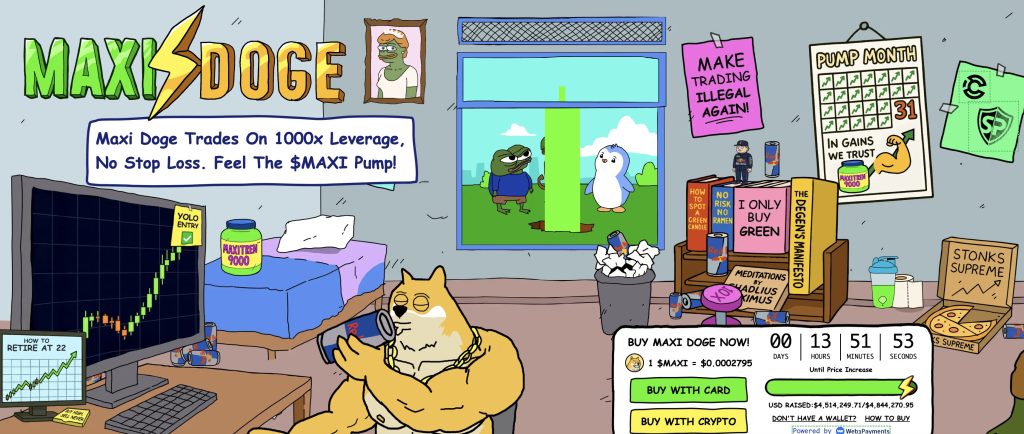
Maxi Doge ($MAXI) is one of the hottest meme coin presales of 2026, with the potential to mimic the explosive move Dogecoin made in 2021.
Token holders get to participate in fun competitions like Maxi Ripped and Maxi Gains to boast their biggest “Ws” with fellow members of the community. They’ll earn more than just bragging rights as the project’s rewards pool is up for grabs as well.
In addition, $MAXI investors get exclusive access to an idea hub that they can use to draw ideas from like-minded traders who are constantly scanning the market for the best setups.
This meme coin’s staking rewards put some icing on the cake, offering a 69% APY to early buyers who seize this presale before it comes to an end.
If you missed Dogecoin a few years ago, you probably don’t want to miss this one.
Those hoping that early 2026 would mark a major turning point for mainstream crypto adoption may need to temper expectations. at least for now.
Coinbase has recently pulled its backing for the CLARITY Act, a proposed framework designed to give U.S. regulators clearer authority over the digital asset sector. As a result, the U.S. Senate Banking Committee has delayed consideration of the bill by several weeks.
Even so, broad-based crypto regulation in the U.S. appears unavoidable before year-end. At the same time, Bitcoin’s share of the total crypto market has been declining since summer, often interpreted as an early signal that capital is rotating into altcoins such as XRP, Dogecoin, and Pepe ahead of the next major market upswing.
XRP (XRP): Payments Blockchain Eyes $5 as Momentum Builds
XRP ($XRP), with a market capitalization of roughly $115 billion, remains the most established crypto in global payments, known for its rapid settlement speeds and low transaction fees.
The XRP Ledger (XRPL) was engineered specifically for banks and financial institutions, positioning itself as a modern alternative to slower and costlier legacy networks like SWIFT.
Ripple’s growing influence has attracted recognition from high-profile entities, including the UN Capital Development Fund and even the White House, reinforcing XRP’s reputation as a potentially transformative global payments solution.
After concluding its long-running legal dispute with the U.S. Securities and Exchange Commission, XRP rallied to a new all-time high of $3.65 in mid-2025. Since then, broader market softness has triggered a pullback of around 48%, leaving the token trading near $1.89.
Despite this correction, XRP’s stay below $2 may be short-lived. One of the most significant recent developments has been the approval of spot XRP ETFs in the U.S., opening the door to regulated exposure for both institutional and retail investors.
Further ETF launches and improved regulatory clarity could push XRP toward the $5 level by Q2.
Dogecoin (DOGE): Will the Doge Army Ever See $1 DOGE?
Launched in 2013, Dogecoin ($DOGE) is the first and biggest meme coin, supported by one of the most loyal communities in crypto. What started as a parody now commands a market capitalization of approximately $20.7 billion.
DOGE’s explosive rise during the 2021 bull market, fueled by high-profile endorsements from figures like Elon Musk, Snoop Dogg, and Gene Simmons, cemented its place in internet and pop culture history.
While its origins are lighthearted, Dogecoin’s scale and liquidity help reduce the extreme volatility seen in smaller meme tokens. As a result, DOGE often trades more in line with major assets such as Bitcoin, Ethereum, and XRP.
The slogan “Dogecoin to $1” remains a rallying cry among supporters, but reaching that milestone by 2026 could be difficult without meaningful progress on U.S. crypto regulation.
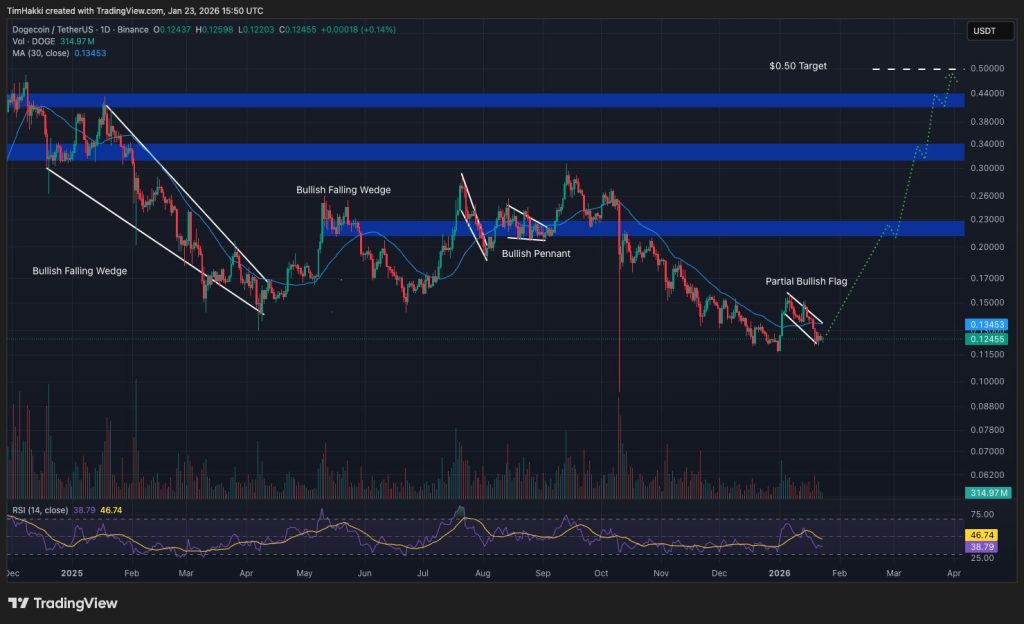
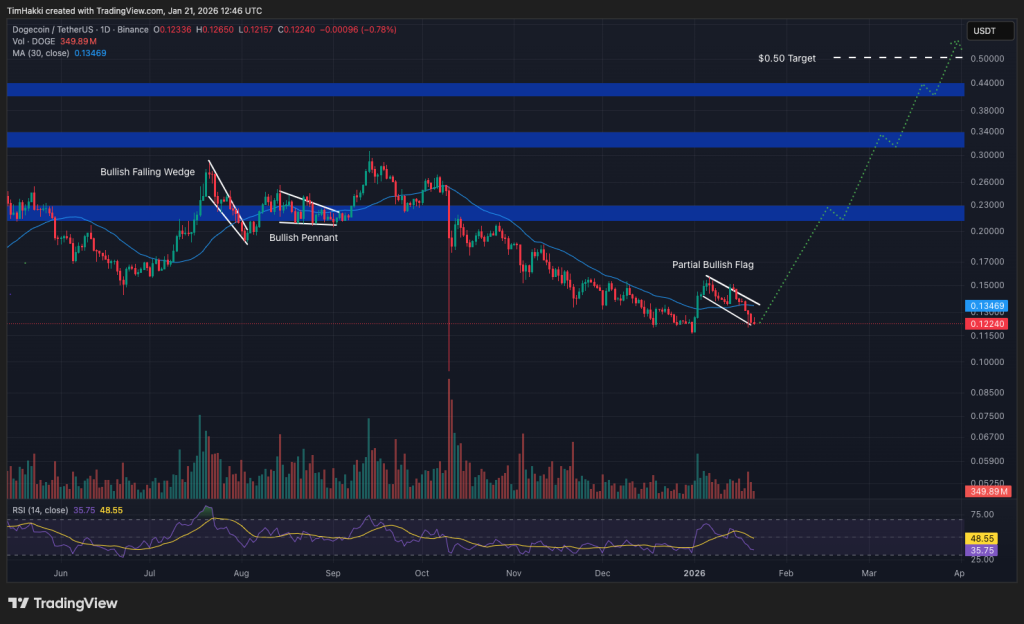
Favorable market conditions could lift DOGE from around $0.14 today to roughly $0.50 by spring. That scenario would place it within striking distance of its 2021 all-time high of $0.7316 during a subsequent bull run.
Adoption is also gradually expanding. Tesla accepts DOGE for select merchandise, while payment platforms like PayPal and Revolut now support Dogecoin transactions.
Pepe (PEPE): The Iconic Webcomic Became One of Crypto’s Most Copied Coins
Since its debut in April 2023, Pepe ($PEPE) has risen rapidly to become the third-largest meme coin, driven by the enduring viral appeal of Matt Furie’s Pepe the Frog character.
With a market value near $2.1 billion, PEPE stands as the largest meme coin without a Shiba Inu-themed mascot. Speculation intensified after Elon Musk briefly used a Pepe image as his profile picture on X, sparking debate over his potential investment in the token.
PEPE is currently trading around $0.000004914, up 25% over the past month. Despite this rebound, the token remains about 81% below its late-2024 high of $0.00002803, following a subdued summer and a lackluster close to 2025.
Its relative strength index is at 44, indicating neutral after some recent panic selling. However, if the bull market hits in Q1, Pepe could easily rise to recapture its previous ATH by the end of the quarter.
PEPE surged 69% recently, between December 30 and January 6, highlighting its classic meme-coin behavior, magnifying broader market swings in both directions.
Bitcoin Hyper ($HYPER) is a new Bitcoin Layer-2 initiative aimed at speeding up transactions, reducing fees, and unlocking advanced smart contract capabilities on the Bitcoin network.
Built on the Solana Virtual Machine, Bitcoin Hyper integrates decentralized governance and a Canonical Bridge that enables smooth cross-chain Bitcoin transfers.
The project’s presale has already secured more than $30.9 million, with some analysts speculating on potential returns of 10x to 100x once the token lists on exchanges. A recent Coinsult audit found no critical issues within the smart contract.
The HYPER token powers the ecosystem, functioning as the unit for transaction fees, governance voting, and staking rewards.
Early participants can stake tokens during the presale for yields of up to 38% APY, though rewards decline gradually as more users join.
With exchange listings expected later this year, Bitcoin Hyper’s presale offers early exposure to what supporters see as the next phase of Bitcoin’s evolution.
Dogecoin’s attempt to join the institutional ETF lineup is running into a basic problem: institutions may not want it. In a Jan. 22 conversation on the Crypto Prime podcast, Bloomberg Intelligence ETF analyst James Seyffart and host Nate Geraci who is also the President of NovaDius Wealth Management said spot Dogecoin ETFs have attracted “near zero” demand so far, an outcome they tied to who typically buys DOGE, and how financial advisers think about reputational risk inside client portfolios.
The Dogecoin datapoint landed inside a broader discussion about a crowded crypto ETF pipeline. Seyffart said his running tally of crypto ETF filings has climbed “over 150 unquestionably,” with many products spanning spot and derivatives, income overlays, buffers, and multi-asset structures. The surge, he argued, looks like issuers “throw[ing] the spaghetti at the wall” in 2026.
Dogecoin ETF Reality Check
But volume of filings doesn’t guarantee demand, and Dogecoin is the clearest example offered of that gap thus far. Pressed on which existing products stood out, Seyffart said “nothing really stands out,” before singling out Dogecoin as the exception, precisely because it has not resonated.
“The real honest answer is like nothing really stands out to me […] honestly if I have to pick one thing that kind of stands out, it’s probably that the Doge ETFs have gotten almost no interest whatsoever,” he said. He added that while some newer altcoin products have done “decently well,” Dogecoin has not.
My conversation w/ @JSeyff on current state of crypto ETFs…
We discuss:
-Crypto ETF sentiment
-150+ crypto-related ETF filings
-Morgan Stanley crypto ETFs
-BlackRock’s next move
-Index & active crypto ETFs
-Recent flows
-What’s nexthttps://t.co/2TzJAnKXuK
Seyffart and Geraci converged on a demand thesis: the marginal buyer of DOGE likely already has the tooling and habit set to buy it directly, rather than through an ETF wrapper.
“I remember talking to the guys at Bitwise. I was like, I don’t think anyone’s going to buy this,” Seyffart said. “But maybe I’m wrong. I’ve been wrong plenty of times before. But I mean, literally no one has bought like the Doge ETFs […] I had pretty low expectations, but I thought maybe they could get to a point where they’re slightly profitable.”
Seyffart pointed to Bitwise’s product—ticker BWOW—as an early scoreboard: “it’s under a million in assets right now,” he said, calling that “near zero demand.” He cautioned the funds are still new, noting the Bitwise product launched at the end of November, but framed the initial traction as “very minuscule.”
Geraci’s explanation was blunter: ”The people who buy that, in general, these are degens and they already know how to access this. They already have digital wallets. They don’t need an ETF to access this […]. And I think that’s going to be a lot of these other coins that are much further down the market cap spectrum.”
Geraci argued Dogecoin faces an additional headwind that doesn’t show up in crypto-native narratives but matters in the ETF market: advisers.
“The other aspect here […] is what I call client statement risk,” Geraci said. “So financial advisors, they’re the biggest driver of ETF flows. And so let’s take Dogecoin as an example […] If you’re a financial adviser and you have a Dogecoin ETF show up on a client statement […] it’s like a flashing red light saying, ‘Please fire me and go find another adviser.’”
That framing matters because the episode repeatedly returned to distribution realities. Seyffart said he’s most excited about basket and index-style crypto ETFs, in part because advisers don’t want to “pick those winners and losers” across a growing long tail of assets. In Geraci’s view, a basket is the “easy button” for professional allocators who want crypto exposure without underwriting each token’s story or defending it to clients.
Seyffart also suggested “what the actual chain is doing” can shape adviser appetite, contrasting niche infrastructure plays such as Chainlink, which he described as connecting DeFi and TradFi, against meme assets like DOGE, which he implied may be less “appetizing” for ETF buyers.
Qubic says it is now building a Dogecoin mining integration, a step that moves the project’s post-Monero “attention” narrative into an implementation phase and reopens a familiar set of security questions around majority-hashrate risk.
In an X post shared Thursday, Qubic wrote: “The community didn’t hesitate. The vote was decisive: DOGE won with 301 votes. This isn’t a plug-and-play upgrade. Integrating ASIC hardware into uPoW requires real engineering, deep protocol work, and time to do it right. But the upside is significant. DOGE represents one of the largest and most established mining economies in crypto. Bringing it into Qubic’s useful Proof-of-Work model extends uPoW beyond theory, into scale. […] Development is underway. This is just the beginning of what is to come.”
Dogecoin mining integration is actively in development.
The community didn’t hesitate.
The vote was decisive: #DOGE won with 301 votes.
This isn’t a plug-and-play upgrade.
Integrating ASIC hardware into uPoW requires real engineering, deep protocol work, and time to do it… pic.twitter.com/7aBgxfLdDR
The announcement lands with baggage. In August 2025, Qubic ran what it publicly described as a Monero “takeover demonstration,” claiming it had achieved “over 51% hashrate dominance” during parts of the experiment and reporting a brief chain disruption that included a six-block reorganization and orphaned blocks.
That episode became a lightning rod for the broader PoW security debate: how quickly external incentives can concentrate hashpower, and how markets react when “51%” enters the conversation.
Subsequent research challenged the strongest interpretation of those claims. A December 2025 paper reconstructing Qubic-attributed activity on Monero describes the operation as an advertised “selfish mining campaign,” finding Qubic’s hashrate share rising into the 23–34% range in detected intervals, while “sustained 51% control is never observed.”
Dogecoin’s mining economy is structurally unlike Monero’s CPU-oriented RandomX landscape. Dogecoin uses Scrypt and has, since 2014, supported merged mining alongside Litecoin, an architecture that has historically helped bolster its security budget by tapping into a broader Scrypt ASIC miner base.
That hardware reality is central to Qubic’s own messaging. The project said “integrating ASIC hardware into uPoW requires real engineering, deep protocol work, and time to do it right,” explicitly acknowledging that this is not a simple pool launch.
It is also where most of the immediate 51% attack fears run into friction. In an August 2025 research note, published when Qubic first began floating Dogecoin as the “next” network after Monero, 21Shares argued that a brute-force Dogecoin majority would be economically prohibitive, estimating that Qubic would need to match and then exceed roughly 2.78 PH/s, implying about $2.85 billion in hardware plus roughly $2.5 million per day in electricity (before logistics).
The more plausible risk vector, if any, is not Qubic buying its way to majority hashrate, but whether it can engineer incentives and integrations that convince existing Scrypt ASIC operators to route meaningful hashpower through a Qubic-mediated setup, an approach 21Shares characterized as “vampire mining.”
21Shares has announced the launch of the first spot DOGE Exchange-Traded Fund (ETF) backed by the Dogecoin Foundation, aiming to offer investors regulated, physically backed access to the largest memecoin by market capitalization.
Dogecoin Goes From Memecoin To Wall Street
On Wednesday, financial services company 21Shares announced the launch of its 21Shares Dogecoin ETF (TDOG) on Nasdaq to provide “a new way to gain physically-backed DOGE exposure in traditional portfolios.”
According to the announcement, the firm’s DOGE ETF is the only investment product of its category to be officially endorsed by the Dogecoin Foundation, the nonprofit organization dedicated to supporting the ecosystem’s development.
Notably, two other spot DOGE ETFs are live: Grayscale’s GDOG and Bitwise’s BWOW. As reported by NewsBTC, the funds debuted in late November, becoming the first DOGE ETFs in the US market.
TDOG’s launch builds on 21Shares’ collaboration with the House of Doge, the corporate arm of the foundation supporting the ecosystem, to create new opportunities across the Dogecoin ecosystem.
The newly launched product will offer investors direct exposure to DOGE through a fully backed, transparent, and exchange-traded vehicle, holding the asset on a 1:1 basis in institutional-grade custody.
Regarding its decision to launch a DOGE ETF, 21Shares affirmed that the memecoin “captures the spirit of internet culture and continues to evolve in our digital economy.” Moreover, the firm argued that it has “helped onboard many new users to crypto, and for many people, this may serve as their first step into crypto.”
Federico Brokate, 21Shares’s Global Head of Business Development, stated that “Dogecoin is a unique asset with a global community and expanding real-world use cases,” adding that “TDOG offers investors regulated, physically backed exposure to DOGE through an ETF structure they already understand and trust.”
DOGE Prepares For New Rally
Analyst Bitcoinsensus suggested that the leading memecoin “could be on for a massive rally to the upside” based on its performance throughout this cycle. The market watcher explained that the cryptocurrency has been experiencing “mini cycles” since 2023, which have led to “bigger and bigger rallies.”
According to the chart, after its late 2022 pump, Dogecoin consolidated within a tight range before a 190% breakout in early 2024. Similarly, the memecoin repeated the same pattern throughout 2024, accumulating for months before a 480% breakout at the end of that year.
Now, DOGE has been consolidating within the $0.125-$0.280 price range for nearly a year, leading the analyst to believe that a breakout towards a higher target near the $0.750 level is possible.
Meanwhile, Trader Tardigrade also suggested that Dogecoin may be preparing for a massive breakout as it appears to be following its performance between late 2022 and 2024.
At the time, the cryptocurrency had apparently bottomed out but ultimately recorded another local low before reversing. Based on this, the analyst affirmed that the memecoin “might see a slightly lower low” in the coming weeks, before the next massive surge occurs.
As of this writing, Dogecoin is trading at $0.1249, a 1.75% decline in the daily timeframe.
Dogecoin started a recovery wave above the $0.120 zone against the US Dollar. DOGE is now facing hurdles near $0.1280 and might struggle to continue higher.
DOGE price started a recovery wave from $0.1150 and climbed above $0.120.
The price is trading below the $0.130 level and the 100-hourly simple moving average.
There was a break above a key bearish trend line with resistance at $0.1240 on the hourly chart of the DOGE/USD pair (data source from Kraken).
The price could continue to move up if it stays above $0.120.
Dogecoin Price Faces Resistance
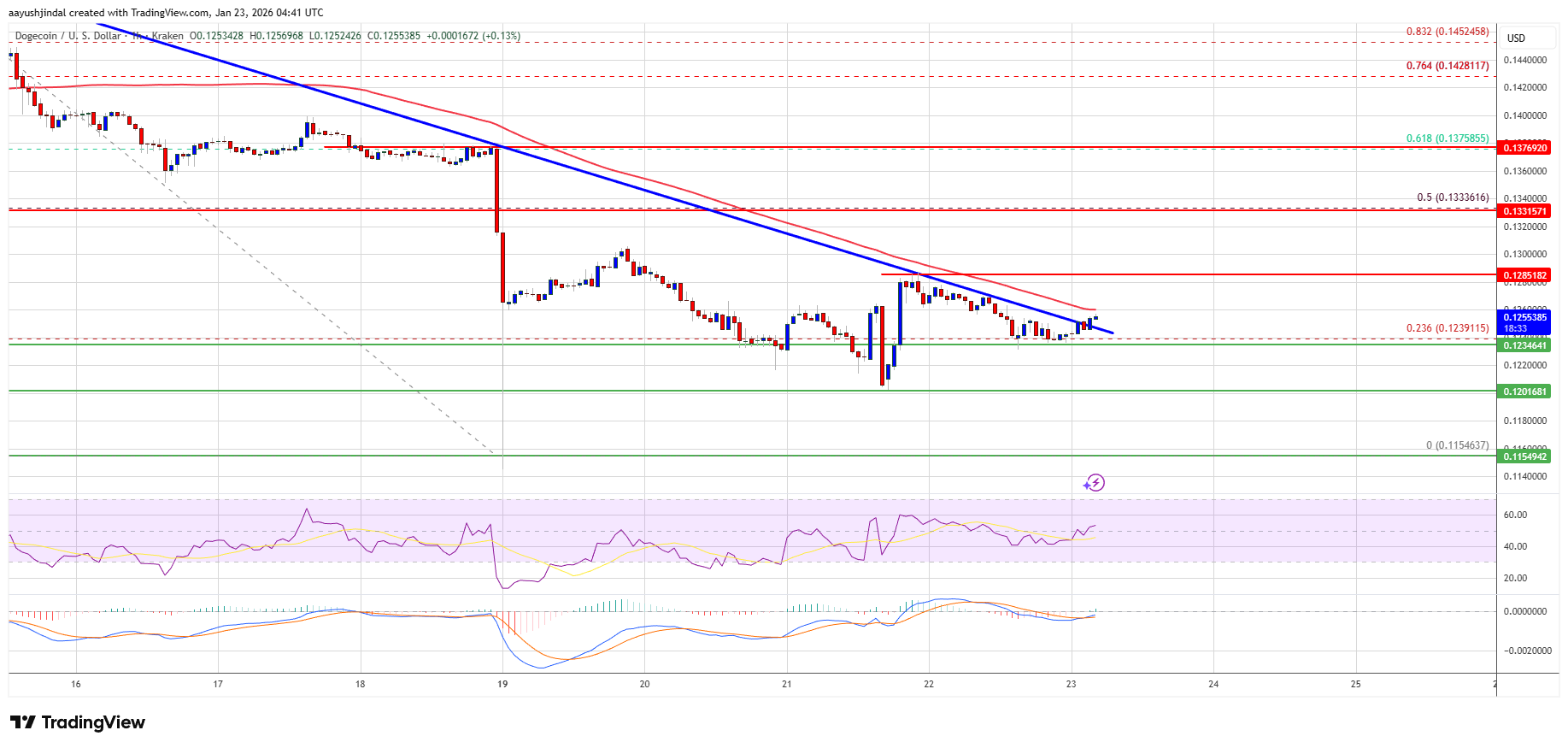
Dogecoin price started a recovery wave from the $0.1150 zone, like Bitcoin and Ethereum. DOGE climbed above the $0.1180 and $0.120 resistance levels.
There was a decent upward move above the 23.6% Fib retracement level of the downward move from the $0.1512 swing high to the $0.1154 low. Besides, there was a break above a key bearish trend line with resistance at $0.1240 on the hourly chart of the DOGE/USD pair.
Dogecoin price is now trading below the $0.130 level and the 100-hourly simple moving average. If there is a recovery wave, immediate resistance on the upside is near the $0.1260 level. The first major resistance for the bulls could be near the $0.1285 level.
The next major resistance is near the $0.1330 level and the 50% Fib retracement level of the downward move from the $0.1512 swing high to the $0.1154 low. A close above the $0.1330 resistance might send the price toward the $0.1420 resistance. Any more gains might send the price toward the $0.150 level. The next major stop for the bulls might be $0.1550.
Another Decline In DOGE?
If DOGE’s price fails to climb above the $0.1280 level, it could continue to move down. Initial support on the downside is near the $0.1230 level. The next major support is near the $0.120 level.
The main support sits at $0.1150. If there is a downside break below the $0.1150 support, the price could decline further. In the stated case, the price might slide toward the $0.1080 level or even $0.1050 in the near term.
Technical Indicators
Hourly MACD – The MACD for DOGE/USD is now losing momentum in the bearish zone.
Hourly RSI (Relative Strength Index) – The RSI for DOGE/USD is now above the 50 level.
Google’s answer to ChatGPT, Gemini AI, has published eye-catching price predictions for XRP, Solana, and Pepe heading into 2026.
The AI suggests that an extended crypto bull cycle, supported by clearer and more constructive regulation in the United States, could send leading altcoins to fresh record highs in the next market phase.
Below is Gemini AI’s outlook for three of the most explosive cryptocurrencies over the year ahead.
XRP ($XRP): Gemini AI Projects XRP at $6 by 2027
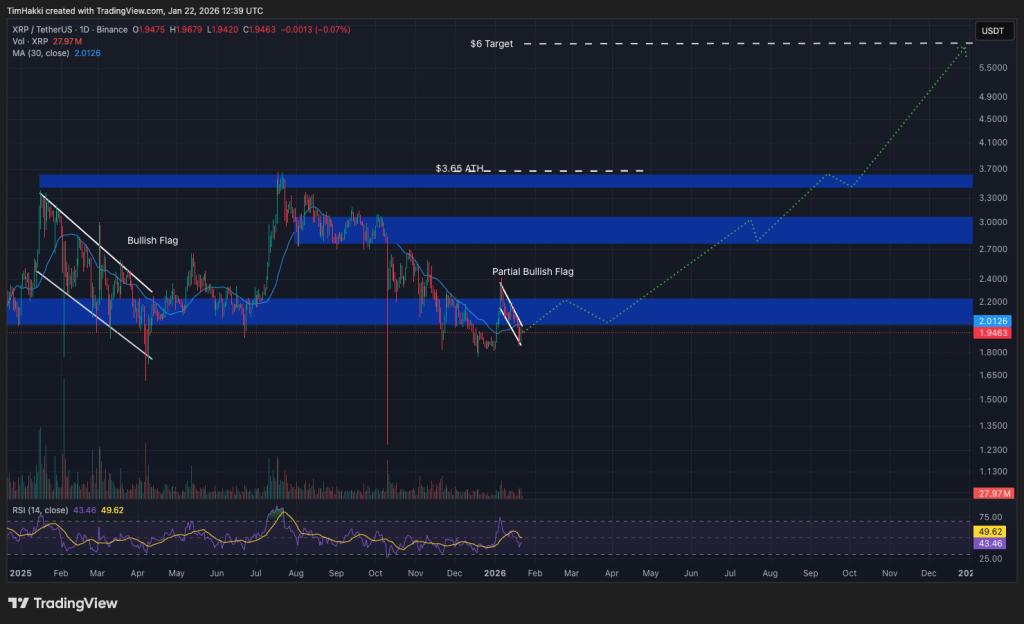
Ripple’s XRP ($XRP) began 2026 on a strong footing, climbing 19% in the first week of the year. In the last 24 hours, XRP rose 2.5% to change hands near $1.95. Gemini AI estimates that a full-scale bull market could drive XRP to $6 by the end of 2026, representing potential gains of roughly 3x or 200%.
Source: Gemini AI
XRP was one of the top-performing large-cap cryptocurrencies last year. In July, it reached its first new all-time high (ATH) in seven years, surging to $3.65 after Ripple secured a landmark legal win against the U.S. Securities and Exchange Commission.
That outcome significantly reduced regulatory overhang for XRP and helped ease fears that the SEC might pursue aggressive enforcement actions against other major altcoins. The pro-crypto Donald Trump’s return to the White House further fuelled Optimism across the sector.
From a technical perspective, XRP’s Relative Strength Index is hovering around 43. Since the end of the first week of January, XRP has been forming a partial bullish flag pattern. Should this setup fully resolve alongside supportive macro and regulatory developments, Gemini’s $6 target would become easy.
Adding to the bullish case, recently approved spot XRP exchange-traded funds in the U.S. are beginning to attract traditional finance capital, mirroring the sustained institutional inflows seen after Bitcoin and Ethereum ETFs launched.
Dogecoin (DOGE): Gemini AI Expects a 6x Run for DOGE but No New ATH
What started in 2013 as a joke has grown into one of the largest assets in crypto. Dogecoin ($DOGE) now boasts a market capitalization close to $22 billion, accounting for nearly half of the $45 billion meme coin sector.
DOGE formed several constructive technical patterns in late summer and early autumn of 2026, although momentum faded following a sharp, market-wide crash in October.
Dogecoin hit an ATH of $0.7316 during the retail-driven bull market of 2021. While the $1 milestone remains the core dream of the Doge Army, Gemini AI believes DOGE may only hit highs of $0.70 this year. From its current price of around $0.1257, that would equate to a nearly 6x return.
Dogecoin is an accepted tender in several places. Tesla accepts DOGE for select merchandise, while payment platforms such as PayPal and Revolut now support Dogecoin transactions, strengthening its position as a functional digital currency rather than a purely entertaining meme coin.
Shiba Inu ($SHIB), launched in 2020 as a tongue-in-cheek rival to Dogecoin, has matured into a major crypto project with a market capitalization exceeding $4.6 billion.
Currently trading around $0.000007923, SHIB has rallied 11% over the past two weeks, far outperforming Bitcoin, Ethereum, XRP, and Dogecoin over the same period.
Gemini AI forecasts that a decisive breakout above resistance at $0.000025 could trigger an aggressive rally, potentially lifting SHIB to $0.0001 by year-end. Such a move would represent an approximate 1,162% increase from current levels and place it just above its current ATH of $0.00008616, recorded in October 2021.
Fundamentally, the Shiba Inu ecosystem offers more than just playful meme branding. Its Layer-2 network, Shibarium, delivers faster settlement times, lower transaction fees, enhanced privacy, and improved developer tools, helping differentiate SHIB from meme coins that lack meaningful utility.
Maxi Doge (MAXI): A Meme Coin Built for Extreme Price Swings
Lastly, outside of Gemini’s forecasts, crypto’s presales market remains the best place for traders looking for the next Dogecoin or Shiba Inu success story.
Maxi Doge ($MAXI) has emerged as one of January’s most discussed meme coin presales, raising more than $4.5 million ahead of its planned exchange listings.
The project presents an exaggerated, gym bro parody of Dogecoin. Loud, unapologetic, and intentionally over-the-top, Maxi Doge leans fully into the raw meme culture that originally fueled the rise of meme coins.
After years of Dogecoin dominance, Maxi Doge is forming its own Maxi Doge Army, united by meme fandom, degen trading strategies, and a shared appetite for explosive volatility.
MAXI is issued as an ERC-20 token on Ethereum’s proof-of-stake network, giving it a lower environmental impact than Dogecoin’s proof-of-work model.
Stake purchased tokens during the presale for yields of up to 69% APY, though returns decrease as more people join. MAXI is priced at $0.0002795 in the latest round, with automatic price increases scheduled for each new funding stage. Tokens can be purchased via MetaMask or Best Wallet.
Say goodbye to Dogecoin. Maxi Doge is the new dog in town!
Dogecoin (DOGE) is once again testing investors’ patience as it trades near the $0.12 level, a zone that has become a focal point after weeks of volatility.
The meme coin has shed more than 20% from its recent highs near $0.15, but recent price action suggests selling pressure may be easing. At the same time, on-chain data and new developments around token usage are adding fresh context to DOGE’s short-term outlook.
As of January 22, Dogecoin is hovering between $0.12 and $0.13, with daily trading volumes still elevated compared to earlier this month. Market participants are closely watching whether this consolidation marks the start of a recovery or merely a pause before another leg lower.
DOGE Accumulation Signals Emerge Around Key Support
On-chain liquidity data indicates gradual accumulation near the $0.12–$0.127 range. Analysts note that DOGEhas repeatedly defended this support zone, suggesting buyers are stepping in incrementally rather than aggressively.
This pattern often appears during early accumulation phases, where larger players avoid driving prices sharply higher.
Technical indicators present a mixed picture. Dogecoin is trading slightly above its 50-day moving average, while the Relative Strength Index sits near neutral levels, leaving room for movement in either direction.
Trading volume has increased over the past week, pointing to renewed interest, but resistance remains firm around $0.13 to $0.14. A confirmed break above this range could open the door to a move toward $0.14, while a loss of $0.12 may expose downside levels near $0.115 or lower.
Broader Market and Sentiment Factors
Market sentiment continues to weigh on Dogecoin’s trajectory. The Crypto Fear & Greed Index remains in “fear” territory, reflecting cautious positioning across digital assets. Bitcoin’s dominance is another variable to watch.
Historically, periods of declining Bitcoin dominance have coincided with capital rotation into altcoins like DOGE.
Macroeconomic signals and regulatory developments also remain relevant. Any shift toward a clearer or more favorable regulatory stance in the U.S. or Europe could improve risk appetite, while renewed uncertainty may pressure speculative tokens.
Token Utility Expands With Payment App Plans
Beyond price action, Dogecoin’s fundamentals are evolving. The House of Doge has confirmed plans to launch a Dogecoin payment app, “Such,” in the first half of 2026. The app is designed to support wallets, DOGE purchases, and direct payments, with a focus on small businesses and peer-to-peer commerce.
While the announcement has not yet translated into price momentum, it highlights ongoing efforts to expand Dogecoin’s real-world use. Over time, increased utility could help DOGE move beyond short-term trading narratives. Currently, Dogecoin remains largely driven by sentiment, technical levels, and broader market trends.
Cover image from ChatGPT, DOGEUSD chart on Tradingview
The global cryptocurrency market, currently estimated at about $3.1 trillion, has been falling at a rate of just over 2% each day since the week began after comments from Donald Trump about a US occupation of Greenland raised fears of creating a trade war between the United States and the European Union.
Heightened geopolitical risk often translates into short-term market weakness, and further volatility could emerge in the days ahead. Still, the march towards global adoption of crypto is impetuous, and things could change quickly if the U.S. Securities and Exchange Commission finally delivers promised crypto regulation.
At the same time, Bitcoin’s dominance has fallen since summer. This is a positive note for major altcoins such as XRP, Dogecoin, and Shiba Inu, which are likely to rally hard in the next bull season.
XRP (XRP): Payments-Focused Blockchain Targets $5 by Q1 Close
Ripple’s XRP ($XRP), which has a market cap of $116 billion, continues to play a central role in blockchain-powered international payments by enabling near-instant, low-cost transfers.
Built with banks and financial institutions in mind, the XRP Ledger (XRPL) modernizes cross-border payments as it aims to make slower and more costly legacy systems like SWIFT obsolete.
Ripple’s growing global presence has attracted praise from high-profile institutions, including the UN’s Capital Development Fund and the White House, highlighting its viability as a payments solution.
XRP reached a record high of $3.65 in mid-2025 after the clsoe of Ripple’s prolonged legal dispute with the SEC. Since then, broader market pressure has triggered a decline of around 48%, bringing the price to approximately $1.90.
Despite this correction, XRP may not stay below the $2 level for long. One major recent development has been the introduction of spot XRP ETFs in the U.S., giving institutional and retail investors regulated exposure to the asset.
Further ETF approvals alongside clearer regulatory guidance could push XRP toward $5 by the second quarter, while a longer-term move to $10 remains likely heading into 2027.
Dogecoin (DOGE): Can the Original Meme Coin Reach $1?
Launched in 2013, Dogecoin ($DOGE) remains the largest meme coin, supported by one of the most loyal communities in the digital asset space. What started as playful satire has evolved into a widely held and used cryptocurrency with a market capitalization near $21 billion.
DOGE’s explosive rally during the 2021 bull market, boosted by public support from figures like Elon Musk, Snoop Dogg, and Gene Simmons, cemented its place in mainstream culture.
Thanks to its popularity and deep liquidity, Dogecoin tends to experience less extreme price swings than smaller meme coins. As a result, its trading behavior often mirrors that of established assets such as Bitcoin, Ethereum, and XRP, separating it from the plethora of highly volatile meme coins out there.
The Doge Army’s rallying cry of “Dogecoin to $1” may be difficult without clearer crypto legislation in the U.S.
However, if the US offers clearer guidance on crypto in Q1, DOGE could rise from $0.12 today to around $0.50 by spring. That scenario would leave it one bull cycle away from hitting a dollar.
Adoption and use cases are also growing. Tesla accepts DOGE for select merchandise, while payment platforms like PayPal and Revolut now support Dogecoin transactions.
Shiba Inu (SHIB): Evolving From Meme Coin to Utility-Driven Ecosystem
Shiba Inu ($SHIB), which launched in August 2020, has grown into the second-largest meme coin, with a market value close to $5 billion.
Backed by a massive community and a growing suite of features, SHIB is increasingly viewed as a serious altcoin rather than a novelty. At present, it trades near $0.0000079.
A decisive breakout above resistance zones at $0.00001 and $0.00002 could open the door to a rally toward $0.00003 by March. Under stronger bullish conditions, SHIB could potentially close the quarter around $0.00005.
The project’s fundamentals extend beyond hype. Shibarium, its Ethereum-based Layer-2 network, lowers transaction costs and improves scalability.
Planned upgrades and enhanced privacy features further support SHIB’s shift from meme status to a more comprehensive blockchain platform.
Bitcoin Hyper (HYPER): Meme Aesthetics Paired With a Next-Gen Bitcoin Layer 2
Bitcoin Hyper ($HYPER) is a robust Bitcoin Layer-2 solution designed for faster transactions, reduced fees, and advanced smart contract capabilities.
Utilizing the Solana Virtual Machine, Bitcoin Hyper integrates decentralized governance and a Canonical Bridge that enables efficient cross-chain Bitcoin transfers.
The project’s presale has already attracted $30.8 million in funding, with some influencers forecasting potential post-launch gains of 10x to 100x once the token lists on exchanges. A recent Coinsult audit found no critical issues within the smart contract.
HYPER serves as the backbone of the network, powering transaction fees, governance voting, and staking rewards.
Investors can stake tokens during the presale to earn yields of up to 38% APY, though rewards decline as more people participate.
With exchange listings expected later this year, Bitcoin Hyper’s presale grants crypto fans a first-mover advantage in the next phase of the Bitcoin network.
Dogecoin price has returned to a level that should be watched closely for long-term price action, as multi-year chart structures begin to resemble conditions that preceded its last historic rally.
Still spending years correcting from its 2021 peak, Dogecoin is now trading inside a well-defined accumulation zone on the higher time frame, according to a new technical analysis shared by Crypto Patel on X. The analyst noted that this phase may be setting the stage for a macro Wave 5 expansion that takes the meme coin to new price highs, provided important support levels continue to hold.
Dogecoin Sitting In High-Timeframe Accumulation Zone
Technical roadmap on the 2-week candlestick timeframe chart breaks Dogecoin’s price action after the 2021 price high into Elliott Wave phases. Wave 1 and Wave 2 are marked as complete, followed by a strong Wave 3 advance that topped around $0.48 in December 2024. Since then, DOGE has entered a Wave 4 corrective phase, forming a descending channel that has guided price lower for over a year without invalidating the broader bullish structure.
This descending channel is important to this technical analysis. Similar corrective behavior appeared just before Dogecoin’s last major expansion in 2021, where the price consolidated for an extended period before breaking upward decisively.
Dogecoin is now trading inside a high-timeframe demand zone that acted as the base for its 2020 to 2021 parabolic rally. This area sits just above a long-term horizontal support level that has held firm for an extended period, including through the depths of the 2022 bear market.
According to the analyst, this region between $0.115 and $0.09 is a clear zone of sustained accumulation, where buying pressure has consistently prevented deeper breakdowns.
Wave 5 Targets Multi-Year Expansion Path
If the accumulation zone continues to hold and the price breaks out of the descending channel, then the next projection is the playout of a Wave 5 impulse move. Crypto Patel’s mapped targets for this phase start around $0.28, followed by higher extensions at $1, $2, and ultimately $4.
At the time of writing, Dogecoin is trading at $0.1247. Therefore, from current levels, that final target of $4 would represent a move of over 3,100%. However, this is small compared to the magnitude of Dogecoin’s previous macro expansion of 26,800% in the previous cycle.
On the other hand, the analysis noted that invalidation is also well defined. A weekly close below $0.06 would break the higher-timeframe structure and invalidate the Wave 5 thesis. Until then, the technical analysis suggests Dogecoin is in a compression phase where downside risk is increasingly defined, but upside expansion into new price highs is possible if Dogecoin embarks on the final impulse of the cycle.
House of Doge, the Dogecoin Foundation’s official corporate arm, says it is building a new mobile app called “Such” that aims to make it easier for users to hold and spend DOGE while giving small merchants and independent sellers tools to accept it in day-to-day commerce.
In a post on X and a January 20 press release, House of Doge said Such is expected to launch in the first half of 2026 and will pair a self-custodial wallet with transaction tracking and a commerce feature branded “Hustles,” positioned as a simple on-ramp for people looking to sell products and services for DOGE.
Dogecoin Foundation Arm, Brag House Tease ‘Such’
House of Doge framed Such as its “first product,” with additional launches planned in the first half of 2026. The company described the app as an attempt to reduce friction on both sides of a DOGE transaction: helping holders spend more easily and helping sellers add Dogecoin payments in a way that fits routine retail activity.
Timothy Stebbing, CTO of House of Doge and a Dogecoin Foundation director, tied the product thesis directly to the DOGE community’s informal commerce culture. “I’ve seen so many people in the Dogecoin Community try to start something themselves. Be it an artist selling prints or a person offering lawn care services, everyone has a side hustle these days,” Stebbing said. “We want to enable anyone to start their hustle with Dogecoin through the Such app. We’re planning to enable anyone to start selling their hustle in as few clicks as possible.”
The DOGE Foundation account echoed that positioning on X, describing Such as “coming in the first half of 2026” and highlighting a launch scope centered on self-custodial wallets, real-time transaction tracking, and merchant tools for selling goods and services.
The dev team at @DogecoinFdn and @Houseofdoge is proud to announce the Such app, coming in the first half of 2026. The Such app brings new ways to interact with and bring further utility to Dogecoin.
At launch Such will have:
– Self-custodial Dogecoin wallets
– Real-time…
According to the press release, Such is being developed by a team of twenty headquartered in Melbourne, Australia, led by Stebbing. House of Doge said development began in March 2025, using open-source technology developed by the Foundation, with an initial launch targeted for the first half of 2026.
House of Doge CEO Marco Margiotta argued the app is intended to be more than another on-ramp-plus-wallet bundle. “We’re planning to offer more by going beyond another wallet app that lets you buy Dogecoin. We have unique features we’re expecting to release, all with the quality and ease of use through the wealth of experience our development team brings,” Margiotta said. “We want to see Dogecoin become a widely used global decentralized currency. By building our own solution, we’re able to bring people on that journey together with our many strategic partnerships.”
The Such app account on X introduced a character named “Kubo” as a guide and leaned into the same pitch, saying Such is “more than just a wallet” and is designed to let users “start a side-hustle and sell your products and services for Dogecoin” by the time it launches.
The announcement also ties Such to Brag House Holdings Inc., described as House of Doge’s merger partner and identified in the release as Nasdaq-listed under ticker TBH. Brag House CEO Lavell Juan Malloy II positioned the app as a bridge from community engagement to monetization. “The Such app represents the next frontier for how communities connect, create, and transact in a digital-first economy,” he said. “This gives users the freedom to build, earn, and engage using Dogecoin, not as a concept, but as a real, usable currency. This is more than just innovation; it’s about democratizing access to opportunity for everyone through digital technology.”
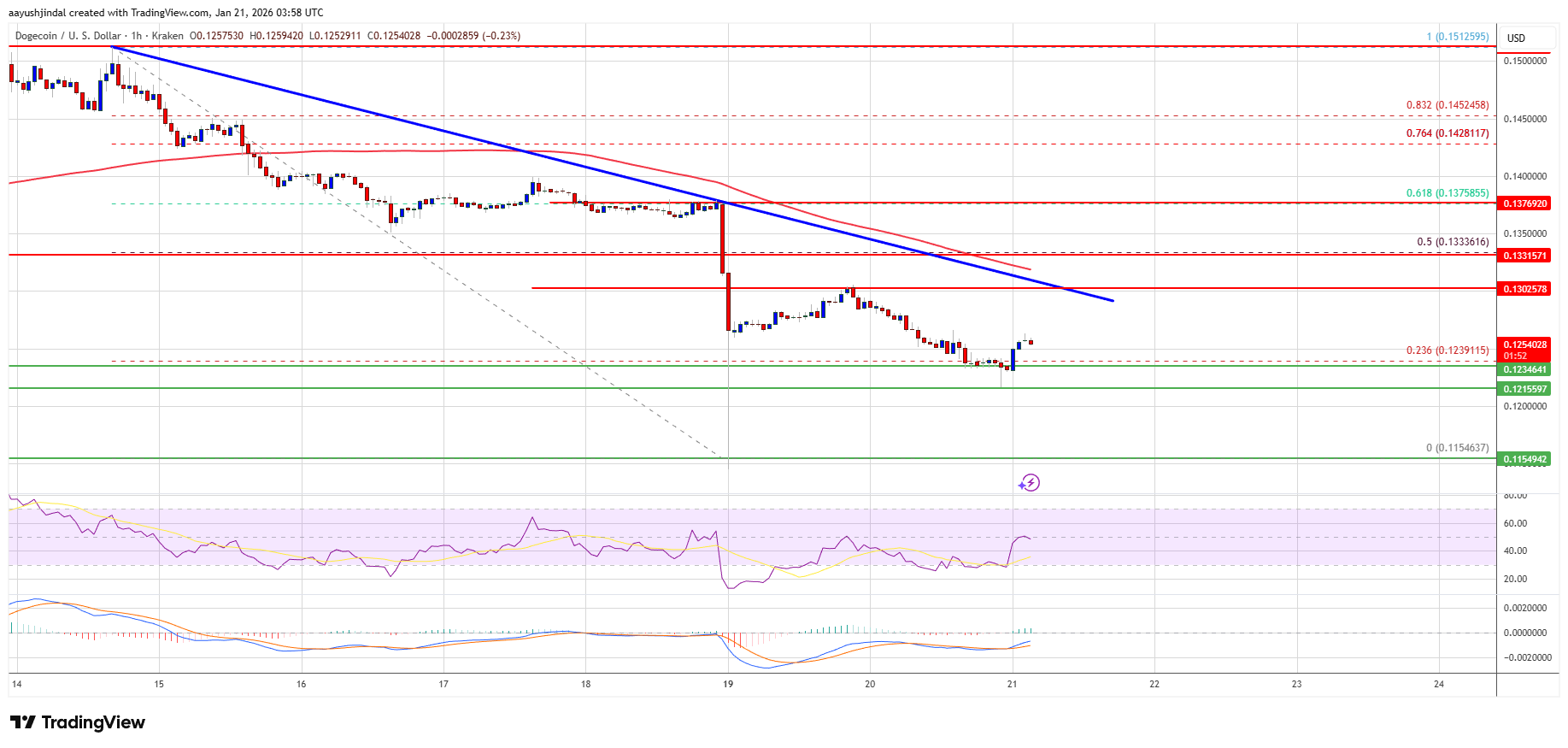
Dogecoin started a fresh decline below the $0.1280 zone against the US Dollar. DOGE is now consolidating losses and might face hurdles near $0.130.
DOGE price started a fresh decline below the $0.120 level.
The price is trading below the $0.1280 level and the 100-hourly simple moving average.
There is a key bearish trend line forming with resistance at $0.130 on the hourly chart of the DOGE/USD pair (data source from Kraken).
The price could extend losses if it stays below $0.1300 and $0.1320.
Dogecoin Price Dives Below Support
Dogecoin price started a fresh decline after it closed below $0.1320, like Bitcoin and Ethereum. DOGE declined below the $0.1280 and $0.1220 support levels.
The price even traded below $0.1180. A low was formed near $0.1155, and the price is now showing bearish signs. There was a recovery wave above $0.120. The price climbed above the 23.6% Fib retracement level of the downward move from the $0.1512 swing high to the $0.1155 low.
Dogecoin price is now trading below the $0.1280 level and the 100-hourly simple moving average. If there is a recovery wave, immediate resistance on the upside is near the $0.1280 level.
The first major resistance for the bulls could be near the $0.130 level and the trend line. The next major resistance is near the $0.1330 level or the 50% Fib retracement level of the downward move from the $0.1512 swing high to the $0.1155 low.
A close above the $0.1330 resistance might send the price toward the $0.1375 resistance. Any more gains might send the price toward the $0.140 level. The next major stop for the bulls might be $0.1420.
Another Decline In DOGE?
If DOGE’s price fails to climb above the $0.1300 level, it could continue to move down. Initial support on the downside is near the $0.1215 level. The next major support is near the $0.120 level.
The main support sits at $0.1150. If there is a downside break below the $0.1150 support, the price could decline further. In the stated case, the price might slide toward the $0.1120 level or even $0.1050 in the near term.
Technical Indicators
Hourly MACD – The MACD for DOGE/USD is now losing momentum in the bearish zone.
Hourly RSI (Relative Strength Index) – The RSI for DOGE/USD is now below the 50 level.
Dogecoin is moving closer to real-world payments, with House of Doge confirming plans for a dedicated DOGE payment app. House of Doge, the official corporate arm of the Dogecoin Foundation, plans to launch a new mobile payments app designed to…
Trader Cryptollica (@Cryptollica) is arguing that an old relative-value signal is “back” in crypto markets, pointing to the DOGE/NVIDIA ratio and an unusually depressed Dogecoin RSI reading as evidence that capital could rotate from AI-linked equities into high-beta meme coins.
Dogecoin Vs. Nvidia: Rotation Incoming?
In a post on X, Cryptollica said the DOGE/NVIDIA chart has returned to a long-term support zone that previously preceded outsized Dogecoin outperformance versus Nvidia in prior cycles. “THE SIGNAL IS BACK. IT’S HAPPENING AGAIN (2017… 2021… NOW),” the trader wrote.
“The last two times this specific signal flashed on the DOGE/NVIDIA chart, we saw the biggest wealth transfer in history. The crowd is chasing the AI top. The algorithm is loading the Meme bottom. (Altcoin bottom).”
The core claim is less about Dogecoin in isolation and more about positioning on a ratio between what Cryptollica framed as two cultural extremes: “You are watching the wrong chart. This is the ratio of ‘The World’s Most Valuable Company’ (AI) vs. ‘The World’s Most Famous Meme’.” From that framing, the trader leans into a cycle-rhymes narrative, asserting that the ratio has repeatedly found channel support before a DOGE-led surge.
“Structure is repeating history,” Cryptollica wrote, attaching specific historical comparisons. “2017: Ratio hit channel support – DOGE outperformed NVDA by 100x. 2021: Ratio hit channel support – DOGE outperformed NVDA by 50x. NOW: We are back at the exact same support line.”
The posts also attach a broader liquidity-rotation story that has circulated in various forms across risk markets: when one trade stops working, capital seeks the next high-beta outlet: “When the AI Bubble exhales, that liquidity doesn’t vanish. It rotates into High-Beta Speculation,” the trader wrote. “The crowd is buying NVDA at the top. The algorithm is positioning for the DOGE reversal.”
Is Dogecoin An ‘Epic Buying Opportunity’?
In another post, Cryptollica shifted from the ratio to Dogecoin’s weekly momentum indicator, sharing a second chart highlighting RSI levels and labeling prior cycle lows. “Here you are witnessing an opportunity that only comes around once every 12 years,” the trader wrote. “Over the past 12 years (2014–2026), Dogecoin’s RSI has dropped this low only 4 times. Every single one was an epic buying opportunity.”
The post describes those four moments as a sequence of cycle bottoms, including an “all-time low” first cycle bottom, a “cycle bottom + COVID crash,” a “last cycle bottom,” and “RIGHT NOW!” Cryptollica concluded with a blunt decision frame: “Math or emotions — which one decides for you?”
While neither post includes an explicit price target, the analyst said in early December that he expects Dogecoin to reach $1.30 over the medium term, citing a parallel channel top on the 3-day DOGE/USD chart.
Bitcoin may be showing signs of weakness as trader attention shifts toward high‑beta meme coins, putting fresh focus on a bullish Dogecoin price prediction.
With risk appetite returning in 2026, many investors are rotating capital out of traditional stores of value like BTC and toward meme coin plays like Dogecoin.
Popular X analyst Cantonese Cat highlights a potential breakdown forming on the BTC/DOGE chart, a setup that could further fuel bullish sentiment for DOGE if it plays out.
#Bitcoin / #Dogecoin (BTC/DOGE) Ascending channel that's not able to break its primary trend, so the next big move favors downwards, which would mean outperformance of $DOGE. pic.twitter.com/tUQfQk863M
Multiple failed breakout attempts indicate that Bitcoin may be losing relative strength to Dogecoin. With the current test shaping up as another rejection, the breakdown scenario is in focus.
The current retest of the upper boundary of this ascending channel is shaping up as a rejection, putting the breakdown scenario in focus.
Dogecoin could be on track to flip Bitcoin for the fourth time in recent history, with the last being in the mid-2021, late 2022, and late 2024 bull markets.
Dogecoin Price Prediction: How DOGE Outperformance Could Unfold
A significant increase in the Doge spot price could be the driver of a BTC/DOGE breakdown, as the formation of a double bottom stands to fuel a year-long falling wedge pattern breakout.
With a second bottom forming along the $0.115 support, a sharp rebound above the reversal structure’s neckline at $0.15 could put the key $0.28 wedge breakout threshold under test.
Momentum indicators favour a bullish shift. The RSI nears oversold conditions in the 30s, meaning sell pressure may soon be exhausted.
The MACD reads similarly, verging on a potential golden cross above the signal line, suggesting the early onset of a fresh uptrend.
If $0.28 flips to support, a confirmed wedge breakout eyes a 550% push into new price discovery, targeting $0.80.
Bitcoin Hyper: Bitcoin Can’t Be Ruled Out Just Yet
Those betting on coins like Dogecoin as their bull market play of choice may soon need to reconsider, as the Bitcoin ecosystem finally tackles its biggest limitation: scalability.
Bitcoin Hyper ($HYPER) is bridging Bitcoin’s security with Solana tech, creating a new Layer-2 network that unlocks scalable, efficient use cases Bitcoin couldn’t support on its own.
It opens the door for Bitcoin to play a larger role in top-performing narratives like DeFi and real-world assets – where speed and efficiency matter most.
The project has already raised almost $31 million in its ongoing presale, and post-launch, even a small fraction of Bitcoin’s massive trading volume could send its valuation significantly higher.
Bitcoin Hyper is fixing the slow transactions, high fees, and limited programmability that have long capped Bitcoin’s potential – just as the market turns bullish.
The newly upgraded version of ChatGPT has published striking 2026 price outlooks for XRP, Bitcoin, and Dogecoin, while also offering a timely warning for investors chasing crypto FOMO this year.
The AI model suggests that an extended bull market, supported by clearer, more favorable regulation in the U.S., could drive leading digital assets to fresh all-time highs (ATHs) in the next major cycle.
Below is how ChatGPT expects three of the crypto market’s biggest assets to perform over the year.
XRP ($XRP): ChatGPT Predicts XRP Will be $10 by 2027
Ripple’s XRP ($XRP) kicked off 2026 with strong momentum, rising 19% in the first week of the year. Trading near $1.93, the token could climb as much as 420% over the year in a bull market, with ChatGPT projecting a $10 target by 2027.
Source: ChatGPT
XRP was one of the top-performing large-cap cryptocurrencies last year. In July, it reached its first new ATH in seven years, touching $3.65 after Ripple secured a landmark legal win against the U.S. Securities and Exchange Commission.
That decision significantly reduced regulatory ambiguity around XRP and helped calm broader concerns that a hostile SEC might classify comparable altcoins as securities. The return of pro-crypto Donald Trump to the White House further eased investor anxiety.
XRP’s Relative Strength Index (RSI) currently sits at 40 while its price is below the 30-day moving average, indicating that today’s price can be seen as an attractive accumulation zone.
The recent approval of spot XRP exchange-traded funds (ETFs) in the U.S., which are beginning to channel traditional finance capital into the asset, mirrors the sustained, multibillion-dollar inflows seen after Bitcoin and Ethereum ETF launches.
Bitcoin (BTC): ChatGPT Expects BTC to Hit $220,000
Bitcoin ($BTC), the largest cryptocurrency by market value, set a new ATH of $126,080 on October 6. Looking ahead, ChatGPT anticipates a powerful continuation of the trend, with price targets approaching $220,000.
Often described as digital gold, Bitcoin remains a go-to asset for both institutions and retail investors seeking a technology-driven hedge against inflation and macroeconomic instability.
BTC currently accounts for roughly $1.8 trillion of the $3.14 trillion total crypto market and trades near $90,000. It slipped about 3% over the past 24 hours after the European Union signaled potential retaliatory tariffs against the U.S., following renewed remarks by Donald Trump suggesting America could occupy Greenland.
Setting geopolitics aside, easing inflation and improving regulatory clarity in the U.S. could help Bitcoin establish several new ATHs this year, according to ChatGPT’s outlook.
Moreover, if U.S. lawmakers move forward with the long-discussed Strategic Bitcoin Reserve, Bitcoin’s longer-term upside could extend well beyond current projections.
Dogecoin (DOGE): ChatGPT Sees DOGE Finally Crossing $1
What began in 2013 as a tongue-in-cheek experiment has evolved into one of the crypto market’s largest assets. Dogecoin ($DOGE) now carries a market capitalization close to $21 billion, representing nearly half of the $44 billion meme coin sector.
DOGE printed several constructive technical patterns in late summer and early autumn of 2026, though bullish momentum cooled following a sharp, market-wide sell-off in October.
Dogecoin’s ATH of $0.7316 dates back to the retail-driven bull market of 2021. While many supporters continue to champion a $1 DOGE, ChatGPT reckons the OG meme coin could comfortably surpass that level to peak at $1.50, still a clean 12.5x gain from the current price around $0.12.
Despite its meme origins, Dogecoin has achieved real-world utility. Tesla accepts DOGE for select merchandise, while major payment platforms such as PayPal and Revolut now support Dogecoin transactions, reinforcing its position as a usable digital currency.
Maxi Doge (MAXI): A Meme Coin Built for Extreme Upside
Beyond ChatGPT’s projections, the crypto presale market remains a hotspot for investors seeking high-risk, high-reward opportunities.
Maxi Doge ($MAXI) has emerged as one of January’s most discussed presales, raising $4.5 million ahead of its expected exchange listing.
The project presents a brash, gym-bro parody of Dogecoin. Louche, unapologetic, and intentionally over-the-top, Maxi Doge leans into the raw meme energy that originally defined meme coin culture.
After years of watching DOGE dominate the spotlight, Maxi Doge is building its own Maxi Doge Army, bound by meme allegiance, degen trading strategies, and a shared appetite for volatility.
MAXI is an ERC-20 token built on Ethereum’s proof-of-stake network, giving it a notably smaller environmental footprint compared with Dogecoin’s proof-of-work model.
The current presale phase offers staking rewards of up to 69% APY, although yields decrease as more tokens join the staking pool. MAXI is priced at $0.000279 in the latest round, with automatic price increases scheduled for each new funding stage. Tokens can be purchased using MetaMask or Best Wallet.
Say goodbye to Dogecoin. Maxi Doge is the new dog in town!
Bitcoin’s dominance over the broader crypto market has become the main reference point for traders trying to determine when an altcoin season will finally take shape. At the moment, Bitcoin still controls close to 60% of the total market, and this has so far kept any meaningful altcoin breakout at bay.
However, according to a Bitcoin analyst, history suggests that once this balance begins to shift, the transition into altcoin season tends to happen quickly, often playing out within a tight one-to-two-month timeframe.
Why Bitcoin Dominance Matters For Altcoin Season
In his analysis, the analyst explained that Bitcoin dominance, also known as BTC.D, is an important factor in determining when capital begins rotating into altcoins. BTC dominance measures Bitcoin’s share of the total crypto market capitalization, and declines in this metric have historically coincided with explosive altcoin rallies. At the time of writing, CoinMarketCap puts the Bitcoin dominance at 59%.
Looking back at 2017, the BTC.D chart shows Bitcoin’s dominance falling very quickly from around 96% in early March to about 60% by mid-May. That drop was the playout of one of the most aggressive altcoin rallies the market has ever seen.
A similar pattern played out in 2021, when BTC dominance fell from about 60% in early April to near 40% by mid-May. That move coincided with another powerful altcoin expansion, pushing Ethereum and several other major altcoins to new all-time highs. Many of those peaks, particularly among meme coins such as Dogecoin and Shiba Inu, are unbroken to this day.
The most important takeaway from both cycles, according to the analyst, is the speed of the move. In each case, it took just one to two months for a full-blown altcoin season to unfold once Bitcoin dominance began rolling over decisively.
BTC’s Next Move Could Decide Everything
The analyst notes that many investors underestimate how quickly this transition can happen. After waiting through multiple years of accumulation and consolidation, market participants often grow impatient just before the final stage. Historically, however, altcoin season has tended to play out very quickly once conditions align, not gradually over many months. Therefore, investors waiting for an altcoin season can still hold on for that move and not lose focus.
He also pointed to macro signals supporting a risk-on environment, referencing strength in assets such as small-cap equities, gold, and silver hitting all-time highs. These conditions are lining up for capital flowing into higher-beta assets once confidence returns.
Nonetheless, altcoins cannot sustain a true breakout without BTC first making a convincing move. If Bitcoin fails to push to a new all-time high, altcoins may see only short-lived relief rallies. On the other hand, a new Bitcoin all-time high could act as the deciding factor that brings retail traders back into the market and eventually leads to FOMO plus a breakout altcoin season.

 Login
Login