
Normal view

There are new articles available, click to refresh the page.
Today — 25 January 2026Main stream

Bitcoin Finds A Real-World Use Case In Las Vegas Stores

25 January 2026 at 13:00

Small shops and some bigger chains in Las Vegas are now taking Bitcoin for everyday buys. People scan a QR code, pay from a phone, and the merchant gets paid. According to local reports, owners are trying this out to cut the cost of credit card processing and to attract customers who prefer crypto.

Merchants Cut Costs With Bitcoin

Reports say the move is largely about fees. Credit card processing often takes away 2.5–3.5% of a sale. For many small operators, that is painful. Payment tools that accept Bitcoin — often routed over the Lightning Network or through services that can convert crypto to cash — have lowered that burden for merchants.

According to FOX5, more businesses across Las Vegas are now accepting Bitcoin payments, from chains like Steak ’n Shake to small shops and medical practices. Merchants said Bitcoin helps attract new customers and cut costs, while Square has enabled about 4 million U.S. merchants…

— Wu Blockchain (@WuBlockchain) January 24, 2026

Square’s program, which lets millions of US merchants enable Bitcoin checkout with no processing fee through 2026, helped speed up adoption in the area.

Stores Report Real Transactions

Business owners are reporting real use, not just experiments. Juice stands and cafes have processed payments. Some larger outlets are listed on public payment maps so customers can find them.

This has meant more foot traffic from people who travel with crypto or who prefer to keep their cards for other uses. Reports note both new customers and savings on fees as clear benefits.

Lightning Network Speeds Up Payments

The Lightning Network is being used to make payments faster and cheaper at the cash register. It moves small Bitcoin payments quickly without the long wait a base-layer transfer can cause.

Merchants scan a code or show one on a screen. The payment is then sent from the buyer’s wallet and settled almost instantly. This technical fix has made in-person Bitcoin payments workable for the first time at many spots.

How Owners See It

Owners are balancing savings against new risks. Some keep crypto for a short time, then sell it for cash. Others leave part of their receipts in Bitcoin. Chargebacks, a problem with cards, are reduced when crypto is used.

A few places say small boosts in sales followed their switch to crypto, yet long-term patterns are still being watched. Reports have disclosed these mixed outcomes as part of a slow but clear shift.

Customers Find New Ways To Pay

Shoppers are adapting. Tourists who carry crypto find these spots useful. Locals who are curious try the method at least once. Payment apps and merchant directories make the process easier for everyone.

For those who like simple steps, scanning a QR code and approving a payment on a phone works fine. For others it is a novelty that might stick.

Featured image from Unsplash, chart from TradingView
💾

Las Vegas Valley businesses are accepting Bitcoin as payment as the cryptocurrency continues to grow in popularity.For more Local News from KVVU: https://www...

Money Keeps Leaving: Bitcoin ETFs Shed $1.72 Billion In Just 5 Sessions

25 January 2026 at 03:00

US-based spot Bitcoin exchange-traded funds pulled funds for a fifth straight trading day, and the totals added up quickly. According to Farside data, about $103.5 million left on Friday, bringing the five-day sum to roughly $1.72 billion.

Bitcoin was trading near $89,160 at the time of these reports — still well below the $100,000 mark it last reached on November 13. This movement has sent a clear signal: many investors are stepping back right now.

ETF Flows And Who Is Selling

Reports note that ETF flows are often on the radar as a quick read on investor mood, but the picture is not always simple. Large outflows can reflect institutional rebalancing or tactical moves by funds, not only mass retail selling.

The US market had a four-day trading week because of Martin Luther King Jr. Day on Monday, which may have concentrated trades into fewer sessions and amplified the numbers. Still, losing more than a billion dollars in a few days will get attention.

Market Mood And Metals

The wider mood has soured. The Crypto Fear & Greed Index registered an Extreme Fear score of 25, and sentiment trackers have been flashing caution. Reports say Santiment believes retail traders are pulling back while attention drifts toward more traditional assets.

Meanwhile, metals have been strong. Reports disclose that with gold trading near $5,000 and silver approaching $100, some market players feel Bitcoin has been left out of a rally that lifted metals, which has weighed on confidence in the crypto market.

Bitcoin Price Action

Bitcoin has struggled to find a steady rhythm over the past week. Prices slipped below the $89,000 to $90,000 range as traders reacted to fresh geopolitical tension and renewed trade worries, before stabilizing as nerves eased.

This was driven higher after some soft political indicators around tariff threats, only to substantiate the idea that markets rarely react to conflict but rather to changes in tone and expectations.

Signals That Could Matter

These movements illustrate how Bitcoin behaves more like a risk asset rather than an asset shelter, falling in tandem with equities when unexpected financial shocks hit the globe, before rebounding when the fever subsides to gather fresh buyers.

Current price patterns indicate caution, where traders are weighing short-term political risks against medium- and long-term macro patterns, as well as institutional interests.

There are some quieter indications that the rout could be losing steam. To this effect, there are assertions suggesting that supply distribution on-chain and social chatter can be circumstantial evidence showing there is less selling pressure.

Featured image from Money; Shutterstock, chart from TradingView

Bitcoin Bears Record Fall In Market Strength — Is A Trend Reversal On?

25 January 2026 at 01:00

In the past three days, the price of Bitcoin has moved between $88,000 to $90,000, indicating a rather stable market with little volatility. This ongoing price consolidation comes after the leading cryptocurrency suffered a significant setback in its goal to reclaim its psychological six-figure valuation.

During the week, Bitcoin prices fell from around $96,000 to below $88,000, establishing a new yearly low for 2026. However, amid this discouraging price action, the underlying on-chain data suggests a developing exhaustion among market bears, thus hinting at a highly-anticipated trend reversal.

Market Optimism Despite Negative Reading

In a recent QuickTake post, popular analyst Burak Kesmeci shares insight on a potential bullish reversal in the Bitcoin market following recent changes in the Growth Rate Difference – an on-chain metric that measures variation between the asset’s market cap growth rate and realized cap growth rate. 

For context, the market cap reflects the total market value of an asset, determined by price and circulating supply. Therefore, it’s often a speculative indicator. Conversely, the realized cap measures the actual capital inflows to an asset. It’s a slow-moving, structural metric, and it’s best for ascertaining capital commitment and the underlying market strength.

When the Bitcoin Growth Rate Difference is positive, it indicates a bull market, as speculative demand exceeds actual capital inflows. On the other hand, a negative value suggests that price growth is slower than real money inflows, which are characteristic of a bearish or consolidatory market.


Bitcoin

According to Kesmeci, the Bitcoin Growth Rate Difference has been negative since October 30, suggesting investors have been in a bear market over the last three months. During this time, prices have famously crashed by over 17%. 

However, the Growth Rate Difference has also increased from -0.0013 on November 22nd to -0.0009 on January 24, suggesting a budding resurgence in speculation and price growth. Moreover, this development also indicates that bearish fatigue is setting in, paving the way for a bullish market rebound. Nevertheless, a clean break above the 0 midline to confirm entry into bull territory and on-chain support for upside momentum.

Bitcoin Price Overview

At press time, Bitcoin is valued at $89,223, reflecting a minor loss of 0.25% in the last day. Meanwhile, the daily trading volume is down by 58.72,% indicating that most market participants are less willing to engage the market at the moment, thus explaining the sluggish price action. 

Bitcoin

Yesterday — 24 January 2026Main stream

Bitcoin Price Mirroring Key Patterns From 2021 – Is History About To Repeat?

24 January 2026 at 18:30

The Bitcoin price is showing signs of history repeating itself, as current price action mirrors key patterns from the 2021 cluster. With resistance near $91,000–$92,000 and the macro downtrend looming, traders are watching closely to see if BTC will break higher or face renewed pressure. The coming days could prove decisive in shaping the next major move.

Bitcoin Mirrors 2021 Cluster: History In Motion

Bitcoin continues to mirror the price patterns seen during the 2021 cluster. Crypto analyst Rekt Capital noted that the current market structure is echoing historical behavior, suggesting that similar dynamics are at play. Traders are closely watching these familiar patterns to gauge whether the cycle is repeating itself or if new trends may emerge.

The rules of the game remain consistent. A bearish acceleration would likely be triggered if Bitcoin breaks down from the macro descending triangle base, currently positioned around $82,000. Conversely, a bullish bias would require a decisive break above the macro downtrend, which sits near $100,000. These levels serve as critical decision points for the market, dictating whether bulls or bears gain control in the coming sessions.

Bitcoin

So far, Bitcoin has encountered rejection in the high $90,000s, falling just short of the macro downtrend. This mirrors previous market behavior, in which the asset developed a basing structure near the triangle’s base before attempting to push higher toward the downtrend’s upper boundary. It demonstrates that history is repeating itself for now, with the market consolidating and preparing for its next directional move.

If the macro downtrend continues to act as resistance, the triangle’s base may gradually weaken over time. Such a development would increase the risk of further downside, making the reaction at both the base and the downtrend crucial. 

BTC Surpasses $91,000 Before Facing Selling Pressure

In a recent market update by Ted, it was noted that while Bitcoin broke above the $91,000 threshold yesterday, the rally met significant resistance. Sellers entered the market with substantial force at these local highs, effectively capping the momentum and preventing a sustained breakout.

As a result of this rejection, Bitcoin has retreated into the “no-trading zone.” Ted suggests that this period of sideways price action is likely to persist through the next couple of days, largely driven by the typical low-liquidity environment seen during the weekend.

Looking ahead, the outlook remains cautious. Ted emphasizes that any upward movements will likely be short-lived until BTC can decisively clear the $91,000 to $92,000 resistance zone. Meanwhile, such a move must be backed by strong spot demand to prove its validity.

Bitcoin

$7 Trillion Player Is Moving Into Bitcoin, Can This Trigger A Surge To $200,000?

24 January 2026 at 19:30

Swiss banking giant UBS, with assets under management (AuM) of up to $7 trillion, is set to launch Bitcoin trading for some of its clients. This comes amid predictions that regulatory clarity and broader adoption could send the BTC price to as high as $200,000. 

UBS To Offer Bitcoin Trading To Some Wealth Clients

Bloomberg reported that UBS is planning to launch crypto trading for some of its wealth clients, starting with its private bank clients in Switzerland. The bank will reportedly begin by offering these clients the opportunity to invest in Bitcoin and Ethereum. At the same time, the crypto offering could further expand to clients in the Pacific-Asia region and the U.S.

The banking giant is currently in discussions with potential partners, and there is no clear timeline for when it could launch Bitcoin and Ethereum trading for clients. This move is said to be partly due to increased demand from wealth clients for crypto exposure. UBS also faces increased competition as other Wall Street giants are working to offer crypto trading. 

Morgan Stanley, in partnership with Zerohash, announced plans to launch crypto trading in the first half of this year, starting with Bitcoin, Ethereum, and Solana. The banking giant may soon also be able to offer its crypto products, as it has filed with the SEC to launch spot BTC, ETH, and SOL ETFs. 

Furthermore, JPMorgan, another of UBS’ competitors, is considering offering crypto trading to institutional clients, although this plan is still in the early stages. The bank already accepts Bitcoin and Ethereum as collateral from its clients. Last year, it also filed to offer BTC structured notes that will track the performance of the BlackRock Bitcoin ETF.

Can Bank’s Entry Trigger A BTC Rally To $200,000  

Kevin O’Leary predicted that Bitcoin could rally to between $150,000 and $200,000 this year, driven by the passage of the CLARITY Act. His prediction came just as White House Crypto Czar David Sacks said banks would fully enter crypto once the bill passes. As such, there is a possibility that BTC could reach this $200,000 psychological level in anticipation of the amount of new capital that could flow into BTC from these banks once the bill passes. 

BitMine’s Chairman, Tom Lee, also predicted during a CNBC interview that Bitcoin could reach between $200,000 and $250,000 this year, partly due to growing institutional adoption by Wall Street giants. Meanwhile, Binance founder Changpeng “CZ” Zhao said that a BTC rally to $200,000 is the “most obvious thing in the world” to him.

At the time of writing, the Bitcoin price is trading at around $89,600, up in the last 24 hours, according to data from CoinMarketCap.

Bitcoin

GameStop Transfers Full Bitcoin Stack, Analysts Flag Possible Exit

24 January 2026 at 13:30

GameStop moved its entire Bitcoin stash into Coinbase Prime this month, according to blockchain trackers that monitor large transfers.

The wallet associated with the company sent a large deposit to the institutional arm of Coinbase, a platform used by big traders and companies.

Analysts watching on-chain flows immediately flagged the move as a likely setup for a sale, though no confirmed sell orders have been announced.

Big Move To Coinbase Prime

According to on-chain reports, GameStop holds 4,710 BTC that it bought last year, and that full balance was shifted into Coinbase Prime.

The company first bought the coins in May 2025 at prices that averaged near $107,900 per BTC, a buy that cost roughly $504 million at the time.

Moving a corporate treasury from cold storage to an active institutional account is often read as a step toward execution — to sell, hedge, or rebalance — but it is not the same as a sale itself.

GameStop throws in the towel?

Their on-chain wallets just moved all BTC holdings to Coinbase Prime, likely to sell.

Between May 14–23, 2025, they bought 4,710 BTC at an avg. price of $107.9K, investing ~$504M.

Now selling for around $90.8K, potentially realising approximately… pic.twitter.com/Bp7MwRVQ43

— CryptoQuant.com (@cryptoquant_com) January 23, 2026

What Analysts Are Saying

Reports say the math is simple and stark: selling now, with Bitcoin trading closer to the $90,000 area, would lock in a sizable loss versus the initial purchase price.

Several analytics firms put that figure near $76 million if the whole lot were sold at recent market levels. Some market watchers suggest the company could be doing tax-loss harvesting or trimming volatile assets on its books.

Others view it as a pragmatic adjustment to reduce treasury exposure to crypto swings. Still, defenders of the move point out that GameStop’s Bitcoin stake was never a core retail play; it was a treasury experiment meant to diversify.

How Much Has Already Moved

Not all outlets agree on timing or size of day-by-day transfers. Reports note that some transfers earlier this month added up to about half of the original position — roughly 2,396 BTC moved in smaller tranches before the full deposit was flagged.

On-chain sleuths track each shift, and those staggered movements can mean many things: a staged sale, an internal reorganization, or simply routing through a trusted custodian before any trades.

Market And Shareholder Reaction

Share action around GameStop has not mirrored the crypto chatter. While Bitcoin watchers focused on the wallet move, investors were also reacting to company news on other fronts, including fresh share purchases by CEO Ryan Cohen.

Featured image from PeterPhoto, chart from TradingView

Gold Becomes The Whale Safe Haven As Bitcoin Takes A Back Seat

24 January 2026 at 12:30

A large investor shifted funds into tokenized gold this week, and Bitcoin felt the impact. Prices dipped while a whale quietly bought millions in XAUT, a gold-backed token, signaling a short-term move toward traditional hedges.

Whales Move Into Tokenized Gold

According to on-chain trackers, one address moved $1.53 million in USDC into Hyperliquid to buy XAUT. Reports note that the same wallet had earlier bought about 481 XAUT, a purchase worth roughly $2.38 million.

The address still holds close to $1.44 million in USDC, which suggests more purchases could follow. These moves were picked up on public blockchains and then flagged by analysts watching large transfers.

This kind of action can matter. When big players shuffle cash, smaller traders often take notice and hedge their bets. The shift is not proof of a long-term trend, but it shows that, at least for now, some large holders prefer gold exposure over extra crypto risk.

Whales are buying gold, not crypto.

~30 mins ago, whale 0x6B99 deposited 1.53M $USDC into Hyperliquid to buy $XAUT again.

He has already bought 481.6 $XAUT($2.38M) and still holds 1.44M $USDC, which may be used to buy more $XAUT.https://t.co/0uV2kNEiD0 pic.twitter.com/rYA09b1OEn

— Lookonchain (@lookonchain) January 23, 2026

Gold And Silver Hit Fresh Highs

Reports say gold has been moving sharply higher, with spot prices climbing close to $5,000 per ounce in global trading this week. Silver also rose above $100 per ounce, with intraday gold prints near $4,988 before settling.

Traders tie the surge to geopolitical tensions and the idea that interest rates may ease, which encourages money into metal-based stores of value.

A weaker dollar has also helped. Market chatter points to increased demand as investors seek steadier places to park capital while global politics and policy choices create more worry.

Bitcoin’s Price Action And Market Mood

Bitcoin traded around $88,653 at one stage, slipping about 1% on the day and nearly 30% below its prior cycle top. That gap is large. It has market participants questioning whether BTC will stay the go-to hedge during times of high stress. Some long-term holders remain confident. Others are watching liquidity and macro signals more closely.

Reports have disclosed renewed criticism from economist Peter Schiff, who argued that Bitcoin has underperformed versus gold since 2021.

He highlighted the opportunity cost for investors holding BTC while metals climb to record prices. Schiff wrote on social platforms that precious metals are outperforming and that this weak run for Bitcoin weakens its role as a store of value in the eyes of some.

What This Means For Crypto Investors

Short-term rotations like this often reflect risk preferences rather than permanent shifts. Some funds and wealthy individuals seek lower-volatility assets when headlines grow louder and policy paths look uncertain.

Others still view Bitcoin as a long-term play tied to scarcity and network effects. The current picture is a mix: metals are strong, tokenized gold is drawing attention, and crypto markets are reacting.

Featured image from Pexels, chart from TradingView

Bitcoin Realized Profit/Loss Reveals Underlying Structural Shift — What’s Happening?

24 January 2026 at 12:00

Based on data from the weekly price chart, Bitcoin is witnessing a significant loss of over 6% following recent widespread market liquidations. Notably, the premier cryptocurrency has taken on a consolidatory stance in the past day, as if to lend credence to growing hopes of some price recovery. However, a recent on-chain analysis points out that Bitcoin’s outward show of resilience might merely be theatrical and that the flagship cryptocurrency could be facing a dark future ahead.

Bitcoin Enters 30-Day Cumulative Realized Loss Phase Since October 2023

In a recent Quicktake post on CryptoQuant, crypto education and research group XWIN Research Japan dissects the present on-chain situation of Bitcoin, with the center of attraction being the Bitcoin Net Realized Profit/Loss metric, which shows the leading cryptocurrency has recorded a net realized loss on a 30-day basis for the first time since October 2023. 

Bitcoin

However, the losses seen in 2023 were short-lived and rapidly retraced, unlike the current decline, which is broader and more persistent, suggesting a possible structural shift in market dynamics. At this moment, it appears that investors are less-interested in “buying the dip,” nor are they looking to “HODL” through the Bitcoin price action, and are more willing to accept losses.

For this reason, the market can be more plausibly described as being in a state of caution. It is, however, worth mentioning that the present phase does not necessarily precede a market crash. If anything, it reflects that Bitcoin may be entering a more volatile phase, independent of speculative frenzies.

Realized Profits Signal Late-Stage Of Bull Cycle 

XWIN Research further reinforces the hypotheses by referencing the trend in realized profits. According to the market experts, Realized Profits peaked in March 2024 at approximately 1.2 million BTC, and reduced slightly to 1.1 million in December 2024. 

As of July, 2025, realized profits had sharply dropped to 517,000 BTC, reflecting an increasing exit of profit-taking activity within the market. But this pales in comparison to the lower 331,000 BTC recorded in October. The analytics group explained that this contraction occurred despite a rise in prices, thus suggesting an absence of deep upside momentum.

The group further highlights that this is a telltale sign of a late-stage bull market, one which was seen in 2021-2022. In this period, realized profits slowly dropped before the Bitcoin price flipped bearish. More shockingly, the annual timeframe tells a similar story, with annual net realized profits contracting from 4.4 million BTC to 2.5 million BTC, just within October 2025 and early 2026. This is also similar to the phase that preceded the bear market of 2022.

In essence, Bitcoin is in a transitioning phase, from a mature bull phase to a volatile environment. As of this writing, the Bitcoin price stands at $89,462. 

Bitcoin

Featured image from Pexels, chart from Tradingview

Bitcoin Approaches Key Monthly Close — Here Are 3 Likely Scenarios

24 January 2026 at 07:30

In the last week, Bitcoin suffered another correction wave with prices dropping to around $88,000 as the crypto market continues to face a weak investor appetite. While the premier cryptocurrency has experienced some slight relief, an approaching monthly close indicates the market is at a critical juncture that could define its price direction for February.

Bitcoin Market Weighs Rebalance Or Complete Breakdown

According to seasoned analyst KillaXBT, Bitcoin is heading into a pivotal monthly close next week, as recent price action suggests the market is approaching an inflection point. Notably, after sweeping external highs near $94,600 earlier in the month, BTC has since faced firm rejection, pushing price back toward the lower end of its recent range between $88,000-$90,000.

The rejection from these highs resulted in pronounced upper wicks on higher timeframes, a structure that often signals aggressive selling pressure. However, KillaXBT explains that such wicks are frequently partially or fully retraced, due to liquidity. With a full trading week still remaining before the monthly candle closes, the market analyst postulates that there are three primary scenarios that could determine price direction for February.


Bitcoin

Firstly, Bitcoin could rise into the end of the month, allowing for a stronger monthly close. Under this scenario, February could begin with price forming the upper portion of the current wick, potentially revisiting the low-to-mid $90,000s before rolling over later in the month toward the $83,800 region.

In the second scenario, Bitcoin closes the month near current levels around $89,000, followed by an early-February move to hunt liquidity in the $91,000–$92,000 range before resuming a downward trend. Interestingly, both scenarios align with the idea that the market may first move higher to rebalance liquidity before resolving lower.

The third scenario presents a more severe outcome that aligns with a potential market breakdown. In this case, KillaXBT forecasts Bitcoin could retrace below the weekly and monthly open at $87,664 and close beneath this level before February. The analyst describes this scenario as “violently bearish”, as it increases the probability of a rapid move towards a lower support in the new month.

Notably, KillaXBT favors the first two scenarios, as the present sentiment being heavily bearish indicates that most investors are least expecting a move to the higher side. However, the analyst also emphasizes that the loss of $83,800 support in any scenario would significantly alter the outlook for any remaining long exposure.

Bitcoin Price Overview

At press time, Bitcoin trades at $89,645 following a minor 1.4% gain in the last day.

Bitcoin

Before yesterdayMain stream

$48M Bitcoin Heist: Phishing Scam Empties South Korea’s Seized Crypto

23 January 2026 at 21:00

South Korean authorities have come under scrutiny after a large stash of seized Bitcoin went missing during a routine check. The loss was discovered when officials found that some of the wallets that had been held as criminal evidence were empty.

According to multiple reports, the value of the missing Bitcoin is about 70 billion won — roughly $47.7–$48 million.

How Officials Found The Theft

Reports say the gap showed up during a routine audit of confiscated digital assets at the Gwangju District Prosecutors’ Office.

An internal check flagged transfers from wallets that had been marked as evidence, and investigators traced the movement back to external addresses. The office immediately opened an inquiry to determine how access was lost and whether any recovery is possible.

Initial findings point to a phishing scam as the trigger. According to local coverage, a staff member accessed a fraudulent website that impersonated a legitimate service, and that interaction exposed passwords and private keys.

Once the credentials were captured, the Bitcoin was moved out in transactions that cannot be reversed.

Security Lapses And USB Storage

Reports note that some of the access details for the seized assets were kept on portable drives rather than in hardened custody systems.

That practice appears to have made it easier for attackers to grab the keys once the phishing trap was sprung. Simple mistakes can cost millions when the asset is bearer-like and transfers are final.

The theft has raised hard questions about how state agencies handle crypto. Some experts say that the tools used by prosecutors were more suited to personal use than to government-level custody.

There are calls for stricter rules, multi-signature setups, and cold storage protocols that do not rely on easily copied passwords.

Tracing The Bitcoin

Blockchain records show the funds moving through several wallets after the initial transfer. That public trail gives investigators leads, but tracing tokens to a final cash-out point is often slow and requires cooperation from foreign exchanges and on-chain analytics firms. Reports say authorities are working with outside specialists to map the flow.

What Prosecutors Are Doing Next

The Gwangju prosecutors’ office has vowed a full probe, and officials are trying to reconstruct events step by step.

There are also signs that the incident will trigger a review of national procedures for holding seized digital property. Some lawmakers and legal experts have already called for clearer standards and oversight.

Featured image from Pexels, chart from TradingView

Years Later, Bitcoin Open Interest In BTC Still Fails To Break Past Previous Peaks

23 January 2026 at 17:00

Bitcoin’s price is fluctuating below the $90,000 mark as volatility increases across the entire cryptocurrency market. During the bearish price action, attention is now being shifted to the cautious signal from the Bitcoin Open Interest in BTC terms, which has remained below past all-time high in years.

Open Interest Tells A Different Story When Measured In BTC

Amid the ongoing volatile action of the crypto market, the derivatives market for Bitcoin is providing a more subdued message. This message is unfolding on the Bitcoin Open Interest (OI) in BTC terms as outlined in a recent research by Joao Wedson, a market expert and founder of the Alphractal analytics platform.

In the report shared on the X platform, the market expert highlighted that the open interest measured in BTC terms has failed to reach new all-time highs since 2022. The BTC-based perspective shows a more restricted usage of leverage over cycles, whereas dollar-denominated measures frequently climb in tandem with price.

Bitcoin

On Thursday, the metric experienced a bounce, but Wedson stated that the upward move was mainly in USD-dominated open interest. This pattern suggests that traders are becoming more cautious in the market by allocating capital more carefully as opposed to putting it all into risky positions.

According to the expert, the trend simply suggests that speculation is present in the market and it’s currently expanding. However, the chart shows that the broader market is still far from any form of extreme or irrational euphoria. 

Not Enough Profit To Trigger A Bullish Recovery

BTC’s inability to produce another major rally is linked to the level of investors in profit. Darkfost stated that there are still not enough investors in profit to hope for a sustainable bullish recovery. Thus, it is crucial to understand that latent profits are not harmful to a market; it is quite the opposite.

When investors are most in profit, the situation is much more comfortable, which motivates them to hold. However, this only holds up to a certain point. Also, when the supply in profit surpasses 95% or even 100%, latest profits begin to impact the market and may trigger essential corrective phases.

The ongoing correction remained moderate with a drawdown to around 31%, but it was able to sharply reduce the percentage of supply in profit, suggesting very late entry by many investors. Currently, over 71% of BTC is in profit after dropping as low as 64%, a very concerning level that has typically been observed only when Bitcoin was entering a bear market. 

However, in Darkfost’s view, the market must reclaim above 75% supply in profit to regain a more stable structure. As long as it stays above this level, the supply in profit has historically been associated with positive periods, as shown in the chart. 

With the recent price rebound, the supply in profit saw a brief climb back to 75% before getting rejected. Meanwhile, many BTC investors possibly used this opportunity to exit at break-even or to cut their losses.

Bitcoin

Record Dormant Bitcoin Supply Enters Market — What’s Next?

23 January 2026 at 17:00

According to on-chain trackers, a big wave of old Bitcoin has started moving after long dormancy. Coins that sat untouched for more than two years have been transferred in numbers larger than what was seen during past peaks in 2017 and 2021.

CryptoQuant analyst Kripto Mevsimi said on-chain data shows that 2024 and 2025 marked the largest release of long-held Bitcoin supply ever recorded. He tracks “revived supply,” or coins that stayed dormant for more than two years before being moved.

That kind of movement usually means deep-pocketed holders are changing their plans, not small traders chasing a quick gain.

A Shift Without A Party

Reports say this release of long-held supply arrived with little fanfare. There was no mass retail mania. Prices did not spike in a frenzy. Instead, the transfers came during a stretch when the market has been under steady pressure from broader financial stress.

Some of those older coins were likely sold for profit. Some may have been moved for other reasons — custody upgrades, private trades, or to back financial products. On-chain signals show the coins moved, but they do not write the reasons on the blockchain.

Long-Term Holders Change Course

Based on reports from analysts tracking these flows, the pattern suggests a changing of the guard. Early adopters who held through multiple cycles and pointed to scarcity and self-control have been trimming positions.

New buyers are appearing who watch price swings and macro headlines. Institutions, fresh large accounts, and price-driven traders are now shaping much of the market’s short-term activity.

Global Risk Pressures Risk Assets

Reports have linked recent weakness in Bitcoin to rising global risk. Research ties part of the pullback to tariff moves by US President Donald Trump, which have pushed investors away from risky assets.

Tariffs can dent corporate profits, stir up inflation uncertainty, and change how the market views future rates — all of which hits sentiment. When big markets wobble, crypto often follows. That pressure helps explain why long-held coins moved without the usual hype.

New Buyers Step Forward

According To on-chain and price data, institutions and new “whales” are stepping into the gaps left by sellers. Bitcoin has been trading near the high $80k range, with recent figures around $89,140 as markets test demand. The old holders may have taken gains, but the market did not collapse. That shows there is still appetite, even if it is different from the past.

This cycle feels different because selling came without euphoria, and buying looks more tactical. That does not mean the story is over. The market might be shifting toward price-sensitive participants and outside financial forces.

Or the recent calm could be a pause before fresh buying. Either way, these on-chain moves matter. They change where the coins sit, and that changes how future price swings may play out.

Featured image from Unsplash, chart from TradingView

Here’s Why The Bitcoin, Ethereum, And Solana Prices Are Still Crashing Hard

23 January 2026 at 08:00

Crypto researcher Axel has provided insights into why the Bitcoin, Ethereum, and Solana prices are still crashing. This comes as BTC continues to see a supply overhang, which threatens to put more downward pressure on crypto prices. 

Why The Bitcoin, Ethereum, and Solana Prices Are Still Crashing

In a research report, Axel noted that anomalous exchange inflows accompanied the BTC breakdown below the $90,000 zone as sellers prepared in advance. The market is also still at risk of further selling pressure as the 1.0 level of the short-term holders’ SOPR is now acting as a resistance rather than support. As such, there is a possibility that Bitcoin, Ethereum, and Solana prices will decline further. 

Further commenting on Bitcoin netflows into exchanges, Axel noted that between January 20 and 21, almost 17,000 BTC flowed into exchanges, coinciding with BTC dropping to as low as $87,000, while Ethereum and Solana prices also dropped. The crypto researcher explained that these anomalously high values followed a period of predominantly negative netflow in the first half of this month. 

Bitcoin

In the context of the falling Bitcoin price, Axel stated that such a spike is more likely to reflect supply preparation than neutral transfers. In other words, the breakdown below $90,000 appears to be structural rather than emotional. Meanwhile, Bitcoin netflow returned to neutral levels yesterday, but the accumulated inflow still creates a supply overhang, which could lead to further declines in the prices of Bitcoin, Ethereum, and Solana. 

Axel noted that a signal of improvement would be if netflow turns negative again amid rising prices, which could indicate that the overhang has cleared. However, with the short-term holders’ 7-day SMA SOPR below 0.996, the crypto researcher suggested that BTC faces increased selling pressure on every recovery as these holders look to sell at breakeven. He added that a reversal trigger could be confirmed if the SOPR breaks above 1.0 from below, with the 7-day SMA holding unity for three to five days to filter out false spikes after the selloff. 

Why A Break Above $100,000 Looks Unlikely For Now

In its latest research report, on-chain analytics platform Glassnode explained that a Bitcoin rally above $100,000 looks unlikely for now as the supply overhang persists. They noted how this overhang supply above $98,000 remains the dominant sell-side force capping short to mid-term rebounds. 

Alluding to the Unspent Realized Price Distribution metric, Glassnode noted that the recent BTC rally has partially filled the prior air gap between $93,000 and $98,000, driven by redistribution from top buyers into newer market participants. 

However, the unresolved supply overhang is expected to likely cap attempts above the $98,400 short-term holders’ cost basis and the $100,000 level. A meaningful and sustained acceleration in demand momentum is said to be required for a clean breakout above $100,000 to occur.

Bitcoin

Bitcoin Price Stability Sparks Recovery Hopes, But Hurdles Loom

22 January 2026 at 21:20

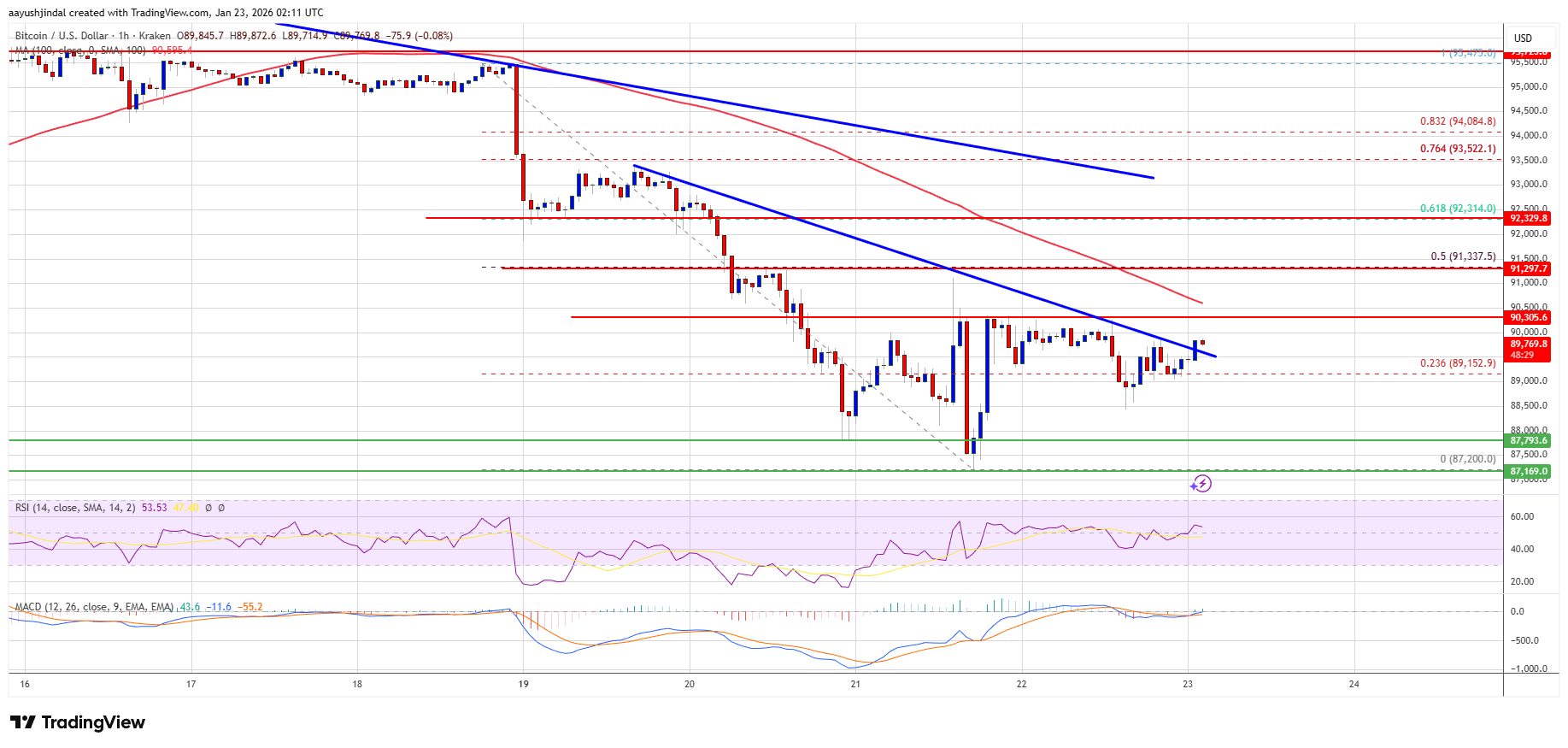
Bitcoin price started a consolidation phase below $90,500. BTC is consolidating losses and might attempt a recovery wave if it clears $91,500.

  • Bitcoin started a minor recovery wave from the $87,200 level.
  • The price is trading below $90,500 and the 100 hourly Simple moving average.
  • There was a break above a short-term bearish trend line with resistance at $89,700 on the hourly chart of the BTC/USD pair (data feed from Kraken).
  • The pair might recover if it manages to settle above $90,500 and $91,500.

Bitcoin Price Eyes Recovery

Bitcoin price failed to stay above the $90,000 support and extended losses. BTC declined sharply below the $89,500 and $88,000 support levels.

The bears even pushed the price below $87,500. A low was formed at $87,200, and the price is now attempting a recovery wave. There was a move above the 23.6% Fib retracement level of the downward move from the $95,475 swing high to the $87,200 low.

Besides, there was a break above a short-term bearish trend line with resistance at $89,700 on the hourly chart of the BTC/USD pair. Bitcoin is now trading below $90,500 and the 100 hourly Simple moving average.

If the price remains stable above $89,000, it could attempt a fresh increase. Immediate resistance is near the $90,300 level. The first key resistance is near the $91,500 level since it is close to the 50% Fib retracement level of the downward move from the $95,475 swing high to the $87,200 low.

Bitcoin Price

A close above the $91,500 resistance might send the price further higher. In the stated case, the price could rise and test the $92,300 resistance. Any more gains might send the price toward the $93,000 level. The next barrier for the bulls could be $95,000 and $95,500.

Another Drop In BTC?

If Bitcoin fails to rise above the $91,500 resistance zone, it could start another decline. Immediate support is near the $89,000 level. The first major support is near the $88,200 level.

The next support is now near the $87,500 zone. Any more losses might send the price toward the $86,500 support in the near term. The main support sits at $85,500, below which BTC might accelerate lower in the near term.

Technical indicators:

Hourly MACD – The MACD is now losing pace in the bearish zone.

Hourly RSI (Relative Strength Index) – The RSI for BTC/USD is now above the 50 level.

Major Support Levels – $89,000, followed by $88,200.

Major Resistance Levels – $90,300 and $91,500.

Crypto Market Shows Signs Of Life As Trump Drops Greenland Tariff Push

22 January 2026 at 20:00

Markets showed signs of life after a sudden political retreat in Davos. Prices that had tumbled earlier this week found buyers again, though the mood stayed cautious and quick to keep an eye on the next headline.

Political Shift Calms Markets

According to Reuters, US President Donald Trump announced he would not go ahead with planned tariffs tied to Greenland after talks with NATO officials, calling the outcome an outline for future cooperation.

Reports say the initial shock knocked big chunks off crypto positions. More than $600 million in leveraged bets were wiped out within a day as Bitcoin and major altcoins slid during the selloff.

Market sentinels counted over $620 million in liquidations, while other market trackers put the toll as high as about $870 million as traders rushed to close risky positions.

Risk Appetite Returned, Slowly

After the tariff threat was pulled, stock indexes rallied. The pan-European STOXX 600 gained back ground, rising about 1.2% as traders stepped back into risk assets and some panic cooled. London shares also moved up in a broad rally that reflected relief across sectors.

Short, sharp moves hit markets. One minute confidence; the next minute forced selling. That pattern left bitcoin and ether lower from recent highs, and it reminded many investors that headlines still drive big swings.

Some long holders were squeezed out. Some traders were burned by over-extended bets. Reports note rare split liquidations where both long and short positions were affected.

Recovery Was Cautious Not Complete

According to market stories, crypto prices rebounded after the immediate scare, but volume stayed thin and sentiment stayed tilted toward fear.

Traders who saw the drop as a buying chance kept their distance, while short-term players moved back in to chase quick gains. The bounce was real, but fragile.

On Crypto & Geopolitical Noise

This episode shows that geopolitical noise can still push crypto the same way it pushes stocks. Even when the issue is not directly about digital assets, risk appetite matters.

When big, headline-driven moves happen, leveraged markets get whipsawed and people who bet too much either lose a lot or get forced out of their positions.

According to reports, the tariff retreat eased immediate worry and allowed markets to recover some lost ground, but the relief felt measured and watchful.

News can move markets fast. The mental framing of the selloff will probably keep traders cautious for a while, and any new twist in policy or diplomacy could bring fresh volatility.

Featured image from Unsplash, chart from TradingView

Bitcoin Price Following The 2022 Fractal? Here Was The Previous Outcome

22 January 2026 at 18:00

Technical analysis shared by crypto analyst CryptoBullet on X highlighted a familiar price action that suggests that Bitcoin’s current structure may be closely tracking a 2022 price fractal. 

Bitcoin’s price action in recent days has changed into a more fragile posture, with the cryptocurrency falling back below the psychological $90,000 level after failing to sustain higher ground above $97,000 on January 14.

How Bitcoin’s Current Structure Resembles The 2022 Fractal

According to CryptoBullet, Bitcoin’s present price action is closely following an interesting structure that it previously played out in 2022. Technical analysis on the daily candlestick timeframe chart posted by the analyst shows the earlier 2022 move as a transparent projection layered behind current price action, with a striking similarity in both rhythm and volatility. 

As it stands, Bitcoin has experienced a significant 28.7% pullback from its October 2025 peak and is now trading in a choppy consolidation, a behavior that closely matches the early stages of the 2022 downturn.

Bitcoin

CryptoBullet noted, however, that there is an important distinction. During the 2022 decline, Bitcoin had already tested the 50-week moving average and the 200-day moving average at this stage of the cycle. In the current setup, Bitcoin’s price action is trading below those levels but has not yet made a direct test, and this means that the structure may still be incomplete.

What The 2022 Outcome Predicts For Bitcoin’s Next Move

The projection in the background of the chart shows Bitcoin making one more push higher over the coming month, briefly reclaiming levels above $100,000 before running into a strong resistance at the 50-week moving average.

If this scenario plays out, the move would resemble the final relief rally seen in 2022, where the price rallied into long-term resistance before rolling over. CryptoBullet noted that timing also supports this idea, noting that considering the 2022 top is lined up with the October 2025 top, there appears to be roughly one month of price action left for a final leg up. 

The projection is that Bitcoin pushes to at least $100,000 again sometime in February 2026. However, support must hold above $83,000 in order for this bullish portion of the setup to be valid.

Although the short-term projection is bullish, the broader implication of the 2022 fractal is bearish for the mid-term. According to the chart’s projected path, Bitcoin is shown rejecting at the 50-week moving average after a brief rally, followed by a sustained decline that eventually drags its price action below $71,500. 

This prediction is based on exactly what unfolded in 2022, when a final pump gave way to a deeper corrective phase. That said, fractals are guides, not guarantees, meaning price history may rhyme, but it does not always repeat itself exactly.

Bitcoin

Why Tokenization Took Center Stage at Davos 2026 and What It Signals for Crypto Investors

22 January 2026 at 17:00

At the 2026 World Economic Forum in Davos, crypto moved away from price cycles and ideological debates toward a more practical focus: how blockchain is being used inside the global financial system.

Across panels, side events, and executive interviews, tokenization of real-world assets (RWAs) emerged as the clearest signal of where crypto is heading next. With the value of tokenized assets now exceeding $22 billion, Davos framed tokenization less as an experiment and more as infrastructure in active use.

The shift was evident in both the tone and the participants. Rather than startups pitching concepts, conversations featured central bank officials, large asset managers, and executives from firms in the tokenization space. The emphasis shifted from whether blockchain belongs in finance to how quickly it can be scaled.

Bitcoin BTC BTCUSD Crypto Davos BTCUSD_2026-01-22_12-19-06

Tokenization Moves From Concept to Financial Infrastructure

Panels such as “Is Tokenization the Future?” underlined how assets traditionally seen as illiquid, bonds, equities, funds, and real estate, are increasingly represented on-chain.

Executives from Coinbase and Ripple, alongside European Central Bank officials, described tokenization as a way to reduce settlement times, improve liquidity, and allow fractional ownership without rebuilding the financial system from scratch.

Institutions including BlackRock, BNY Mellon, and Euroclear confirmed they have moved beyond pilot programs and are deploying tokenized instruments at scale.

Data shared during the forum showed that the total value locked in tokenized RWAs has passed $22 billion, reflecting broader asset coverage and growing institutional participation. Ethereum currently hosts more than 65% of these assets, underlining its role as the main settlement layer for tokenization activity.

Regulation and Stablecoins Shape the Next Phase

Regulatory clarity was repeatedly cited as the key factor behind this momentum. Frameworks finalized in 2025 in the US and parts of Europe provided banks and custodians with clearer rules on issuance, custody, and compliance.

In Davos, US President Donald Trump reinforced this direction by pointing to the GENIUS Act, which established a federal framework for payment stablecoins.

Stablecoins were described as the “plumbing” connecting traditional finance, decentralized finance, and tokenized assets. Rather than competing with banks, they are increasingly used for settlement, treasury operations, and cross-border transfers.

What Davos 2026 Signals for Crypto Investors

For investors, Davos 2026 suggested that crypto’s next growth phase may be less speculative and more structural.

Consulting firms such as McKinsey and Boston Consulting Group estimate that tokenized assets could reach between $2 trillion and $16 trillion by 2030. The focus on regulated products, institutional adoption, and market infrastructure points to a longer-term shift.

Tokenization’s rise at Davos indicates that crypto’s role in global finance is being defined less by volatility and more by utility, an important signal for how the sector may evolve in the years ahead.

Cover image from ChatGPT, BTCUSD chart from Tradingview

Crypto Bill Stalls Amid Senate Focus On Inflation – A Quick Look

22 January 2026 at 16:00

Now hanging in uncertainty, a big US cryptocurrency bill meant to set firmer ground for trading platforms, digital tokens and stablecoins lost its urgent status among Congress leaders. Attention shifting elsewhere, several influential senators paused work on it this week. Talks continue behind the scenes, aiming to fix unresolved parts before moving forward.

Lawmakers Focus On Housing

A handful of senators shift attention toward affordable housing plans linked to US President Donald Trump’s priorities. This move shrinks the chance for quick approval of the cryptocurrency legislation. Time runs short as political energy flows elsewhere.

Now the Banking Committee changed its timeline because of that move, so the expected vote on the bill got delayed for now. This puts a pause on efforts to build one clear system.

Big Industry Pushback

Out of nowhere, Coinbase stopped backing the plan. Its executives said the proposal might limit how stablecoins work, affecting services people rely on. That shift made them step away quietly. Right after, the group in charge paused things as well.

That shift laid bare growing tensions. Not every bank welcomed the rise of stablecoins. Rivalry looms when digital coin returns gain wider reach. Some financial players see threat in that growth.

Industry Response And Market Effects

Fear spread through trading floors. When talks got delayed, digital currencies started falling because people began questioning how much longer the arguing could last – alongside what kind of outcome might finally emerge.

Useful, perhaps, if waiting brings sharper rules. Still, dragging too long risks confusing banks more, leaving them unsure when to act.

Separate Tracks Emerge

Ahead of the curve, some lawmakers are eyeing a fresh approach where certain digital tokens fall under commodity rules. This version, quietly shared by the Senate Agriculture team, might follow its own path forward – timing unclear.

While others debate classification, this draft sidesteps the main gridlock and suggests an alternate route through regulatory terrain.

One path might still move forward, even if the Banking Committee’s proposal gets stuck. Still, running two versions at once brings up concerns – how will they merge them should both make it to debate?

Crypto Bill: What Might Happen Next

Few believe it’s dead, though time slips fast. Elections loom; attention wanders. Agreement must come soon, or nothing sticks.

Some members of Congress quietly say pushing into late February could kill chances, yet backers still meet out of view to adjust the proposal and pull in more votes.

Featured image from Unsplash, chart from TradingView

Bitcoin Is At Risk From Saylor: Pundit Shares Why Strategy’s BTC Holdings Is A Net Negative

22 January 2026 at 15:00

Crypto pundit Crypto Chase has explained how Strategy’s Bitcoin holdings is a net negative for BTC’s adoption, especially among large investors. The pundit also ruled out the possibility of capitulation on Michael Saylor’s part, even if the flagship crypto drops below their entry point. 

Why Saylor’s Strategy Bitcoin Holdings Puts BTC At Risk

In an X post, Crypto Chase opined that Strategy’s BTC holdings do more to deter institutions and high-net-worth individuals than to attract them. The pundit added that there really isn’t any full-scale capitulation below Saylor’s average entry price of $76,000, as he believes that Saylor and Strategy will hold until zero, except if the board forces them to do otherwise.  

This statement followed Strategy’s latest $2.13 billion Bitcoin purchase, which saw the company’s holdings cross the 700,000 BTC milestone. The company now holds 709,715 BTC, which it acquired for $53.92 billion at an average price of $75,979. Meanwhile, Crypto Chase also stated that if the company were to offload these coins, the Bitcoin price would go back to $3,000 or lower. 

The pundit warned that there are not even close to enough bids to handle such selling pressure. As such, he believes that Strategy’s Bitcoin holdings would have to be sold over the counter to the U.S. government or Trump to avoid a total collapse of the flagship crypto. However, Saylor has so far asserted that they have no intention of ever selling their BTC holdings. 

Crypto Chase also mentioned that fear among uneducated market participants could provide a good entry if the narrative is that Saylor and Strategy would be liquidated if BTC drops below their average entry price. The pundit reiterated that it is game over if that ever happened, though. He is also not confident Bitcoin will rise to new highs anytime soon, noting there is significant overhead and Total Cost of Ownership, with entry points above $100,000. 

From Another Crypto Pundit’s Point Of View

It is worth noting that Crypto Chase’s statement about Saylor’s Strategy and Bitcoin’s holdings was in response to crypto pundit Ansem’s point of view. In an X post, Ansem said he believes Bitcoin will find its place alongside gold and silver in portfolios and benefit from large, high-net-worth individuals and institutions adding small positions. He remarked that BTC, as a digital analog, is easier to transport across global borders and easier to transact with. 

Ansem also noted that Saylor and Strategy’s cost average is currently around $75,000 and that he believes that a drop below that level would be a full-scale capitulation into a generational buying opportunity. From a technical standpoint, the pundit does not think Bitcoin will trade below last cycle’s price peak of $69,000 in 2021.

Bitcoin

Crypto’s Q4 Weakness Mirrors Pre-Rebound 2023: Analysts

22 January 2026 at 12:00

Bitwise’s take on the final months of 2025 reads like a careful, hopeful note rather than a loud market call. Momentum on the chains rose even as prices stalled, and that gap is exactly what has traders talking. Some think it marks a bottom. Others say it’s too soon to be sure.

Crypto: On-Chain Activity Surges

According to Bitwise, Ethereum activity and layer-two transactions climbed to new highs, and decentralized trading grew markedly. Stablecoin supplies also swelled, with the total market cap passing the $300 billion mark in Q4.

Reports note that decentralized exchange volumes at times matched or exceeded those of major centralized venues. These are hard numbers. They are signs that real use and liquidity are expanding under the surface.

The latest Bitwise Crypto Market Review just dropped—and it’s the most important one we’ve ever published.

Why? Because it shows a tension in crypto markets that has historically signaled a bear-market bottom (see Q1 2023).

Receipts: During Q4 2025…

– ETH’s price fell 29% ……

— Bitwise (@BitwiseInvest) January 21, 2026

Why Prices Have Lagged

Bitwise’s chief investment officer, Matt Hougan, compared this setup to early 2023 when prices trailed rising fundamentals before a significant rebound took hold over the following two years.

The comparison makes sense on paper. Price can be stubborn. Market psychology often lags behind on-chain realities, and traders sometimes wait for a clearer macro story before committing capital.

Fundstrat’s Tom Lee offers a counterpoint, saying the year could be bumpy until late, with tariffs and political tensions weighing on risk appetite. That view keeps many investors cautious.

Crypto, Stablecoins And DeFi At The Center

According to market data, flows into stablecoins accelerated, and fund inflows to crypto firms outpaced several other sectors in the stock market. DeFi use was no longer a niche metric; it was central to the Q4 narrative.

“That’s the type of divergence you get at the bottom of bear markets, when sentiment is down but fundamentals are up,” Hougan said.

Some infrastructure firms reported rising revenues. At the same time, trading volumes remained muted compared with the peaks seen earlier, which helps explain the mismatch between on-chain strength and sideways price action.

Why This Might Matter For 2026

Bitwise highlighted 10 broad indicators it sees as health signs for the market, ranging from transaction counts to custody and fee trends. Progress on regulatory clarity was also flagged.

Reports say the Clarity Act could change how stablecoins are treated in the US, and a new US Federal Reserve chair could shift policy in ways that matter for risk assets.

Bitwise sees Q4 as a quiet period where things were improving behind the scenes, even if prices didn’t show it. The firm says this kind of gap between price and activity has happened before big rebounds. It doesn’t mean a rally will happen right away, but the market could be setting itself up for a stronger year ahead.

Featured image from Unsplash, chart from TradingView

❌
❌