❌

Normal view

There are new articles available, click to refresh the page.
Before yesterdayMain stream

OpenSea Insider Trading Case Ends Without A Retrial – Details

23 January 2026 at 18:00

Nathaniel Chastain, a former product manager at OpenSea, will not face a retrial after federal prosecutors chose to drop their re-review of his insider trading case.

Reports say the US Attorney’s Office reached a deferred prosecution agreement with Chastain that will lead to dismissal of the charges once the agreement runs its course.

What Prosecutors Decided

Prosecutors told a Manhattan federal court they would not retry Chastain following an appeals court ruling that tossed his earlier conviction.

Under the deferred prosecution deal, the government will dismiss the case about a month after notifying the court, and Chastain has agreed to forfeit roughly 15.98 ETH tied to the trades. He has already served three months in prison from his original sentence.

How The Appeals Court Changed The Case

According to the US Court of Appeals for the Second Circuit, the jury in the first trial had been given the wrong instructions about what the wire fraud law covers.

The judges said confidential information only counts as property under the statute when it has commercial value to the employer, and jurors might otherwise convict someone for behavior that is unethical but not criminal. That legal point is at the heart of the reversal.

Reports note that prosecutors had called the matter the first-ever insider trading case tied to NFTs. Now, lower courts and enforcement teams will have to think carefully before using traditional fraud laws to police activity in NFT markets.

The ruling highlights a gap between old statutes and new kinds of online goods, which may push lawmakers to give clearer rules for how to treat confidential business signals related to crypto platforms.

OpenSea: The Case’s Earlier Chapters

Chastain was first charged in mid-2022 after prosecutors said he bought certain NFTs before they were featured on OpenSea’s homepage, then sold them after prices rose.

He was convicted at trial in 2023 of wire fraud and money laundering and received a sentence that included three months behind bars. The US Attorney’s Office originally described the scheme as a novel use of insider knowledge in digital markets.

With the deferred prosecution agreement in place for OpenSea, prosecutors can close this chapter without a new trial.

Chastain’s forfeiture of crypto assets and his already served time mean the government has secured some remedy, while the appellate decision leaves open big questions about when private business information can be treated as property for federal fraud charges.

Legal teams, judges, and regulators are likely to keep a close eye on how similar cases are handled in the future.

Featured image from Getty Images, chart from TradingView
DOJ Targets Crypto Fraud in β€˜America First’ Blitz as AI Scams Spike 450%

23 January 2026 at 09:59

The U.S. Department of Justice is intensifying its efforts on crypto-related fraud as it escalates to execute what the authorities refer to as an β€œAmerica First” enforcement agenda in response to a surge of digital asset-related frauds driven more by artificial intelligence.

The shift was outlined in the DOJ Criminal Division Fraud Section 2025 Year in Review, published on Thursday, indicating prosecutors accused 265 defendants with a cumulative alleged loss on fraud cases of over $16 billion, nearly twice the amount reported the previous year.

Source: DOJ Criminal Division Fraud Section

Although the cases were in medical care, consumer protection, corporate fraud, and market manipulation, the DOJ said that cryptocurrency was increasingly becoming a type of payment rail, laundering, or asset category due to illicit funds.

In some significant cases, authorities seized crypto alongside cash, real estate, and luxury goods, showing the strong integration of digital assets into conventional fraudulent actions.

DOJ Health Care Fraud Crackdowns Lead to Major Crypto Seizures

One of the most prominent cases cited involved a $1 billion amniotic wound allograft fraud scheme that allegedly generated more than $600 million in improper Medicare payments.

Prosecutors charged Tyler Kontos, Joel Kupetz, and Jorge Kinds with targeting elderly and terminally ill patients for medically unnecessary procedures.

As part of the investigation, law enforcement seized more than $7.2 million in assets, including bank accounts and cryptocurrency.

The DOJ also highlighted the National Health Care Fraud Takedown carried out last year, the largest in the department’s history.

That operation charged 324 individuals across 50 federal districts for schemes involving more than $14.6 billion in intended losses.

Authorities confiscated more than $245 million in assets in the sweep, including significant amounts of cryptocurrency.

Simultaneously, the regulators prevented over $4 billion of fraudulent Medicare payments prior to their disbursement, indicating a more active, data-driven enforcement strategy.

Behind these cases is the DOJ Fraud Section, which operates through four specialized units that increasingly intersect with crypto-related crime.

Its units include foreign bribery, market and consumer fraud, healthcare fraud, and health and safety crimes, areas where digital assets and blockchain-based laundering are now frequently involved.

Source: DOJ Criminal Division Fraud Section

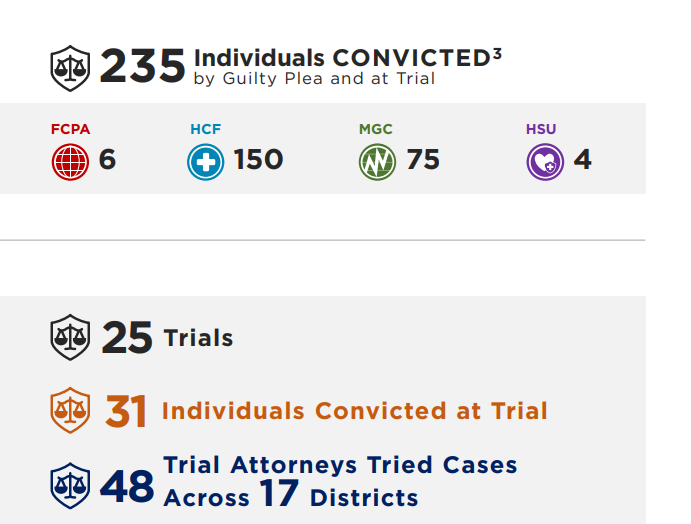
Prosecutors reported securing 235 convictions in 2025, including 25 trials across 17 federal districts.

AI-Assisted Scams Drive Sharp Rise in Crypto Fraud Losses

This enforcement surge comes as reported crypto fraud losses continue to climb. The FBI’s Internet Crime Complaint Center recorded more than 41,500 crypto investment scam complaints in 2024, with reported losses exceeding $5.8 billion.

Federal data shows total crypto scam losses reached roughly $9.3 billion last year, with older Americans disproportionately affected.

πŸ‘Ύ The FBI recorded $9.3 billion losses spread across various crypto-related investment scams, extortion, ATM and kiosks, among others, in 2024.#FBI #CryptoFraud #CryptoScamhttps://t.co/1Eb8KStAHk

β€” Cryptonews.com (@cryptonews) April 24, 2025

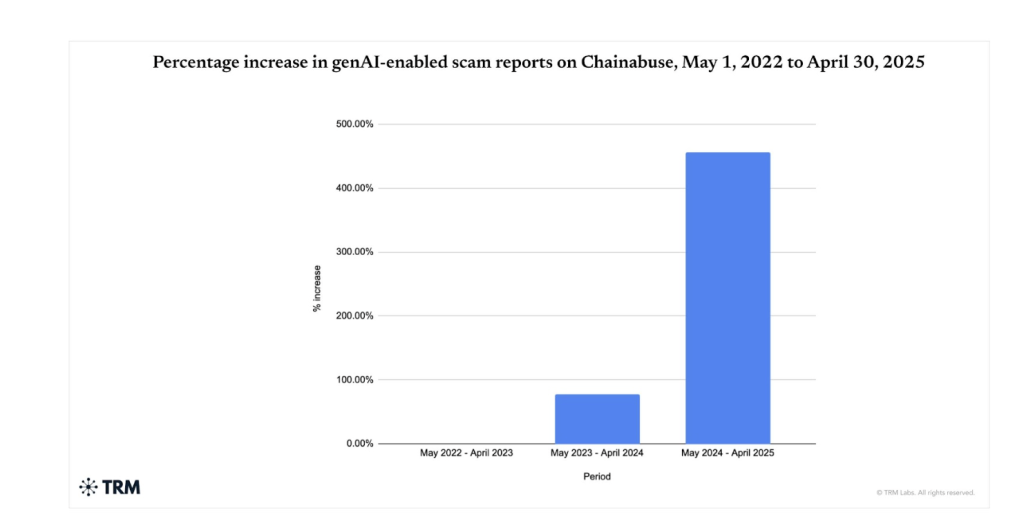
In 2025, blockchain analytics firms reported that average scam payments rose more than 250%, while AI-assisted scams have surged by more than 450%, as criminals deployed deepfake audio, synthetic identities, and automated phishing at scale.

Source: TRM Labs

In response, the DOJ and other agencies have launched coordinated initiatives aimed at transnational fraud networks, particularly so-called β€œpig butchering” scams linked to criminal groups operating in Southeast Asia.

A multi-agency strike force announced late last year has already seized and forfeited more than $401 million in cryptocurrency, including the largest bitcoin seizure in U.S. history.

Separately, the FBI’s Operation Level Up has notified thousands of potential victims and helped prevent hundreds of millions of dollars in additional losses.

Lawmakers have also moved to tighten the legal framework, as bipartisan bills introduced in Congress seek harsher penalties for AI-assisted fraud and stronger coordination across federal agencies to combat crypto-related scams.

In addition, two U.S. senators introduced the SAFE Crypto Act aimed at tightening the government’s response to cryptocurrency-related fraud.

The post DOJ Targets Crypto Fraud in β€˜America First’ Blitz as AI Scams Spike 450% appeared first on Cryptonews.

South Korea Probes Theft of Seized Bitcoin Worth $48M in Suspected Phishing Heist

22 January 2026 at 18:16

South Korean prosecutors are investigating the disappearance of a significant amount of Bitcoin that had been confiscated as criminal proceeds, after an internal audit suggested the assets may have vanished while under state custody.

The Gwangju District Prosecutors’ Office believes the loss likely occurred during the management period last year and is treating the incident as a suspected phishing attack, raising fresh concerns over how seized digital assets are stored and safeguarded.

According to a senior prosecution source cited by local media, preliminary internal assessments suggest the missing Bitcoin was worth roughly 70 billion won, or about $48 million, at the time of the loss.

Seized Bitcoin Lost After Wallet Password Exposure, Officials Say

An official at the prosecutor’s office stated that the investigators are striving to establish the locations of the seized properties, but they could not verify any additional information at the moment.

Local news states that the bitcoin was linked to an illegal gambling situation and that it was being seized as an illegal piece of property when it was lost.

The estimates reported in the domestic media indicate that the value might be in tens of billions of won, which would translate to several million dollars, but those numbers have not been verified by prosecutors.

The early evidence indicates that the bitcoin was stored in a portable USB, as opposed to a more durable custody system.

The wallet password was also reported to have been revealed to a third party during a regular examination of confiscated items, which provided an opportunity to illegally access it and transfer money.

🚨 @KoinlyOfficial warns a third-party breach may have exposed user emails but stresses that no wallet, transaction, tax, or portfolio data was shared with Mixpanel.#CryptoSecurity #CryptoTax #Koinlyhttps://t.co/ASDxMchfyg

β€” Cryptonews.com (@cryptonews) December 23, 2025

The case is one of the most recent high-profile cases of stolen cryptocurrency being re-stolen by law enforcement via social engineering instead of technical merits.

Phishing attacks are deceptive, not technical, as they take advantage of a trusting party. In a more institutionalized environment, they usually prosper through human error and poor internal controls as opposed to blockchain weaknesses.

South Korea’s Expanding Authority Over Seized Digital Assets

The Gwangju District Prosecutors’ Office is no stranger to large crypto seizure cases. In March 2024, it pursued the recovery of roughly 170 billion won, or about $127 million at the time, in Bitcoin linked to another illegal gambling operation.

The seizure of digital assets has been gradually institutionalized in South Korea in recent years after several landmark Supreme Court decisions made it clear that cryptocurrencies can be regulated as property under the Criminal Procedure Act.

πŸ‡°πŸ‡· South Korea's Supreme Court rules Bitcoin on exchanges can be legally seized under Criminal Procedure Act, establishing precedent as regulators expand asset freeze powers and AML enforcement.#SouthKorea #Bitcoinhttps://t.co/3fa5PxHMMG

β€” Cryptonews.com (@cryptonews) January 9, 2026

Such a legal basis was initially established in 2018, when the Supreme Court decided that cryptocurrencies are intangible assets and have economic value and thus can be seized in case they are linked to a crime.

Later judicial decisions have further broadened the power of the seizure, and a December case verified that the bitcoin kept on domestic exchanges like Upbit and Bithumb may also be confiscated.

The recent case arrived on the day when the South Korean regulators are busy increasing control over the crypto industry.

In January, financial regulators announced an intention to test a payment freeze system whereby investigators can temporarily freeze crypto-related accounts before the suspected illicit funds are taken off or deposited in an offshore account.

The post South Korea Probes Theft of Seized Bitcoin Worth $48M in Suspected Phishing Heist appeared first on Cryptonews.

FTX-Fraudster Caroline Ellison Set for Release From Federal Custody After Serving Reduced Sentence

21 January 2026 at 16:10

Bitcoin Magazine

FTX-Fraudster Caroline Ellison Set for Release From Federal Custody After Serving Reduced Sentence

Caroline Ellison, the former co-CEO of Alameda Research and a central figure in the collapse of cryptocurrency exchange FTX, is expected to be released from federal custody on Wednesday after serving roughly 440 days of a two-year prison sentence, according to data from the U.S. Federal Bureau of Prisons.Β 

Ellison, 31, is expected to exit from a residential reentry management facility β€” commonly known as a halfway house β€” in New York, where she has been held in community confinement since late 2025.Β 

Her early release came approximately ten months ahead of her original projected term and reflects credit for cooperation with prosecutors and good conduct while incarcerated.

Ellison was sentenced in September 2024 to two years in prison after pleading guilty in December 2022 to multiple fraud and conspiracy charges tied to the misuse of customer funds at FTX and the trading firm Alameda Research.Β 

She began serving her sentence in November 2024 at a federal facility in Connecticut before being transferred to community confinement.

Ellison’s role in FTX

As part of her plea agreement, Ellison cooperated extensively with federal authorities and testified against former FTX CEO Sam Bankman-Fried during his criminal trial in 2023.

Her testimony detailed how Alameda and FTX commingled customer assets, concealed financial losses, and relied on an effectively unlimited line of credit that allowed Alameda to draw directly from FTX customer deposits.

That evidence played a key role in Bankman-Fried’s conviction on multiple fraud charges. He was sentenced in March 2025 to nearly 25 years in prison and ordered to forfeit up to $11 billion in assets to compensate investors and lenders.

Federal regulators have barred Ellison from serving as an officer or director of a public company or cryptocurrency exchange for ten years.Β 

The Securities and Exchange Commission has also sought similar prohibitions against other former FTX executives who cooperated with authorities, including former CTO Gary Wang and ex-engineering head Nishad Singh, both of whom avoided prison time.

FTX collapsed in November 2022 after a liquidity crisis exposed a multibillion-dollar hole in its balance sheet, triggering one of the largest bankruptcies in the history of the crypto industry.

Bankman-Fried and Caroline Ellison reportedly had an on-again, off-again romantic and professional relationship, living together with other FTX executives in a Bahamian penthouse while working closely at Alameda Research.Β 

This post FTX-Fraudster Caroline Ellison Set for Release From Federal Custody After Serving Reduced Sentence first appeared on Bitcoin Magazine and is written by Micah Zimmerman.

Guernsey Seizes $11.4M in OneCoin Fraud as Cryptoqueen’s Empire Crumbles

21 January 2026 at 13:57

Guernsey has recovered over Β£8.5 million, or about $11.4 million, of money associated with the OneCoin fraud, which is one of the most tangible financial recoveries to date connected with the case of fugitive founder Ruja Ignatova, also known as the β€œCryptoqueen.”

The ruling adds fresh weight to international efforts to dismantle what remains of OneCoin’s financial footprint, even as its mastermind has been missing for more than eight years.

According to the report issued by the Guernsey Press, the Royal Court of Guernsey agreed to an overseas forfeiture order sought by German prosecutors in the city of Bielefeld.

The decision of the court was that the money in the name of Aquitaine Group Limited held in Guernsey in the account of RBS International, which amounted to Β£8.59 million plus accumulated interest, was under the control of Ignatova and that it should be seized.

The money is now in the Seized Asset Fund of Guernsey, where it is to be utilized mainly to recompense victims and aid law enforcement.

How OneCoin’s Fake Crypto Trail Led to Β£8.8M in Seized Assets

Ignatova was a Bulgarian-born German citizen who established OneCoin in 2014 and marketed it to the world as a disruptive cryptocurrency and a killer of Bitcoin.

In practice, prosecutors subsequently confirmed that OneCoin did not even have an operating blockchain or working mining procedure but was a multi-level marketing business where returns were subsidized by additional deposits of new investors.

πŸ’° OneCoin’s legal chief pleaded guilty to money laundering and wire fraud charges, according to a statement released today from the U.S. Attorney’s Office for the Southern District of New York.#CryptoNewshttps://t.co/zKdVwzCWse

β€” Cryptonews.com (@cryptonews) November 9, 2023

The FBI estimates that investors worldwide lost more than $4 billion, though some assessments place total losses higher.

The Royal Court noted that Ignatova was given 28 days in November to object to the confiscation application.

There was no answer since Ignatova had not appeared in public since October 2017, when she vanished days after a sealed arrest warrant was issued in the United States.

She was subsequently the only female ever to be listed on the FBI’s Ten Most Wanted Fugitives list, and authorities in the United States were willing to pay a reward of up to $5 million for information leading to her arrest.

The US Department of State announced a new incentive, a $5 million reward, for information leading to OneCoin founder Ruja Ignatova's arrest.#onecoin #reward #ignatovahttps://t.co/XWdRn6yYhs

β€” Cryptonews.com (@cryptonews) June 26, 2024

German prosecutors, working with Guernsey authorities, have been seeking to recover proceeds from the sale of two London apartments previously owned by Ignatova through Guernsey-registered companies.

The properties, a penthouse and a smaller apartment, were placed under a Royal Court restraint order in November 2021 and later sold for more than Β£11 million.

After fees and taxes, about Β£8.8 million remained as of May 2024, forming the bulk of the confiscated sum.

OneCoin’s Inner Circle Faces Justice as Ignatova Mystery Drags On

This latest action fits into a broader pattern of asset recovery and legal fallout that has continued years after OneCoin’s collapse.

Several of Ignatova’s close associates have been convicted and sentenced.

In 2023, co-founder Sebastian Greenwood was sentenced to 20 years in prison.

βš– OneCoin Crypto Scam: German Court Sentences Fraudsters to Jail

Founders of the infamous OneCoin cryptocurrency scam have been sentenced to several years in jail by a German court.#CryptoNews #newshttps://t.co/JZj5HWattJ

β€” Cryptonews.com (@cryptonews) January 10, 2024

Other figures, including senior legal and financial facilitators, have also been jailed.

At the same time, questions about Ignatova’s fate remain unresolved.

Investigative reporting, including a 2023 and 2024 BBC investigation, has pointed to alleged links between Ignatova and Bulgarian organized crime figures.

This figure includes Hristoforos Nikos Amanatidis, known as β€œTaki,” who reportedly provided security during her escape.

There have been some indications that she was possibly murdered in 2018, perhaps on a yacht in the Ionian Sea, but law enforcement has emphasized that no concrete evidence has been presented.

This has made international agencies still treat her as a fugitive who may still be alive.

The post Guernsey Seizes $11.4M in OneCoin Fraud as Cryptoqueen’s Empire Crumbles appeared first on Cryptonews.

Nigerian SEC Partners With Police To Tackle Crypto Ponzi Schemes – Details

17 January 2026 at 23:00

The Nigerian Securities and Exchange Commission (SEC) is maintaining an intense focus on the local cryptocurrency industry, as indicated by recent developments. While introducing minimum capital requirements for previously unregulated virtual asset service providers (VASPs), the securities regulator has also formed an alliance with the Nigeria Police Force (NPF) against cryptocurrency fraud, among other illegal operations.

Nigerian SEC Looks To Improve Crypto Investors’ Protection

According to local media Voice of Nigeria, the SEC is ramping up efforts aimed at investor protection and transparent market operations in the crypto ecosystem. In a recent meeting with the NPF, the Commission’s Director-General (DG), Dr. Emomotimi Agama, communicated to the Inspector General of Police (IGP), Kayode Egbetokun, concerns over malicious actors in the financial markets who exploit investors’ trust for personal gains.Β 

Dr. Agama said:

They cloak their deceit in the glamorous but misunderstood language of cryptocurrency and forex trading. They target the vulnerable, the optimistic, and the simply unsuspecting, leaving behind a trail of shattered lives, depleted pensions, and broken trust. This is not just a financial crime; it is a social menace that erodes public confidence in our entire financial system.

Currently, there is a gap, a seam between identification and enforcement that these scammers exploit. Today, we aim to close that gap permanently.

In particular, the SEC DG is proposing the formation of a specialized SEC-NPF team with members who bring understanding of the financial principles and operations and the tactical intelligence to curb these investment frauds and protect the Nigerian cyberspace. The IGP approved the collaboration request while also stating a strong commitment to help the SEC achieve its aims.

Crypto Fraud In Nigeria

Notably, Nigerians have been victims of several cryptocurrency investment scams in the past few years. The most prominent of these is the Crypto Bridge Exchange (CBEX) platform, which crashed in April 2025, losing over N1.3 trillion ($916 million) in user funds.Β 

The Nigerian SEC is strongly committed to reducing such menace as shown by the recent collaboration with the NPF alongside other measures such as a revised minimum capital requirements for VASPs and a published list of all identified fraudulent crypto and financial investment businesses.Β 

Notably, Nigeria remains one of the fastest-growing crypto hubs globally. According to data from TripleA, approximately 10.34% of Nigeria’s population, i.e., 22 million people, hold one digital asset or the other, therefore indicating the need for an effective regulatory oversight and protection system.Β 

Nigeria

Monnai Raises $12 Million for Identity and Risk Data Infrastructure

16 January 2026 at 09:51

The company will use the investment to accelerate the adoption of its solution among financial institutions and digital businesses.

The post Monnai Raises $12 Million for Identity and Risk Data Infrastructure appeared first on SecurityWeek.

Pandemic watchdog builds AI fraud prevention β€˜engine’ trained on millions of COVID program claims

When Congress authorized over $5 trillion in pandemic-era relief programs, and directed agencies to prioritize speed above all else, fraudsters cashed in with bogus claims.

But data from these pandemic-era relief programs is now being used to train artificial intelligence-powered tools meant to detect fraud before payments go out.

The Pandemic Response Accountability Committee has developed an AI-enabled β€œfraud prevention engine,” trained on over 5 million applications for pandemic-era relief programs, that can review 20,000 applications for federal funds per second, and can flag anomalies in the data before payment.

The PRAC’s executive director, Ken Dieffenbach, told members of the House Oversight and Government Reform Committee on Tuesday that, had the fraud prevention engine been available at the onset of the pandemic, it would have flagged β€œat least tens of billions of dollars” in fraudulent claims.

Dieffenbach said that the PRAC’s data analytics capabilities can serve as an β€œearly warning system” when organized, transnational criminals target federal benefits programs. He said the PRAC is working with agency inspectors general on ways to prevent fraud in programs funded by the One Big Beautiful Bill Act, as well as track fraudsters targeting multiple agencies.

β€œFraudsters rarely target just one government program. They exploit vulnerabilities wherever they exist,” Dieffenbach said.

The PRAC’s analytics systems have recovered over $500 million in taxpayer funds. Created at the onset of the COVID-19 pandemic, the PRAC oversaw over $5 trillion in relief spending.Β  It was scheduled to disband last year, but the One Big Beautiful Bill Act reauthorized the PRAC through 2034.

Government Operations Subcommittee Chairman Pete Sessions (R-Texas) said the PRAC has developed data analytics capabilities that can comb through billions of records, and that these tools need a β€œpermanent” home once the PRAC disbands.

β€œA permanent solution that maintains the analytic capacities and capabilities that have been built over the past six years is necessary and needed. Its database is billions of records deep, and it has begun to pay for itself,” Sessions said.

In one pandemic fraud case, the PRAC identified a scheme where 100 applicants filed 450 applications across 24 states, and obtained $2.6 million in pandemic loans. Dieffenbach said there are tens of thousands of cases like it.

β€œThis is but one example where the proactive use of data and technology could have prevented or aided in the early detection of a scheme, mitigated the need for a resource-intensive investigation and prosecution, and helped ensure taxpayer dollars went to the intended recipients and not the fraudsters,” Dieffenbach said.

In 2024, the Government Accountability Office estimated that the federal government loses $233 to $521 billion in fraud every year.

Sterling Thomas, GAO’s chief scientist, said AI tools are showing promise in flagging fraud, but he warned that β€œrapid deployment without thoughtful design has already led to unintended outcomes.”

β€œIn data science, we often say garbage in, garbage out. Nowhere is that more true than with AI and machine learning. If we start trying to identify fraud and improper payments with flawed data, we’re going to get poor results,” Thomas said.

The Treasury Department often serves as the last line of defense against fraud, but it is giving agencies access to more of its data to flag potential fraud before issuing payments.

Under a MarchΒ executive order, President Donald Trump directed the Treasury Department to share its own fraud prevention database, Do Not Pay, with other agencies to the β€œgreatest extent permitted by law.”

Renata Miskell, the deputy assistant secretary for accounting policy and financial transparency at the Treasury Department’s Bureau of the Fiscal Service, told lawmakers that only 4% of federal programs could access all of Do Not Pay’s data in fiscal 2014. But by the end of this fiscal year, she said all federal programs are on track to fully utilize Do Not Pay.

β€œWe want every program β€” and there’s thousands of federal programs β€”Β  to use Do Not Pay before making award and eligibility determinations,” Miskell said.

To make Do Not Pay a more effective tool against fraud, Miskell said Treasury is looking for the ability to β€œping” other authoritative federal databases, such as the taxpayer identification numbers (TINs) issued by the IRS or Social Security numbers, before issuing a payment.Β Without those datasets, she said, Treasury is following a β€œtrust but verify” approach to payments, doing some basic checks before federal funds go out.

β€œThese data sources would dramatically improve eligibility determination and fraud prevention,” Miskell said.

The post Pandemic watchdog builds AI fraud prevention β€˜engine’ trained on millions of COVID program claims first appeared on Federal News Network.

Β© AP Photo/Patrick Semansky

FILE - The Treasury Building is viewed in Washington, May 4, 2021. The U.S. government has imposed sanctions on a Bosnian state prosecutor who is accused of being complicit in corruption and undermining democratic processes or institutions in the Western Balkans. The Treasury Department says its Office of Foreign Assets Control designated Diana Kajmakovic for sanctions. (AP Photo/Patrick Semansky, File)

FDA deletes warning on bogus autism therapies touted by RFK Jr.β€˜s allies

By: Beth Mole
13 January 2026 at 16:25

For years, the Food and Drug Administration provided an informational webpage for parents warning them of the dangers of bogus autism treatments, some promoted by anti-vaccine activists and "wellness" companies. The page cited specifics scams and the "significant health risks" they pose.

But, under anti-vaccine Health Secretary Robert F. Kennedy Jr.β€”who has numerous ties to the wellness industryβ€”that FDA information webpage is now gone. It was quietly deleted at the end of last year, the Department of Health and Human Services confirmed to Ars Technica.

The defunct webpage, titled "Be Aware of Potentially Dangerous Products and Therapies that Claim to Treat Autism," provided parents and other consumers with an overview of the problem. It began with a short description of autism and some evidence-based, FDA-approved medications that can help manage autism symptoms. Then, the regulatory agency provided a list of some false claims and unproven, potentially dangerous treatments it had been working to combat. "Some of these so-called therapies carry significant health risks," the FDA wrote.

Read full article

Comments

Β© Getty | Alex Wong

Despite fraud allegations, campaign to end $1.6 billion Massachusetts marijuana industry likely to proceed

13 January 2026 at 17:00

Elections fraud allegations lodged against the campaign to end Massachusetts’ $1.65 billion adult-use cannabis market may be difficult to prove. Even if the claims that signature-gatherers for a Coalition for a Healthy Massachusetts deliberately misled voters are sustained, they may not be enough stop cannabis sales recriminalization from going on the ballot, according to the […]

Despite fraud allegations, campaign to end $1.6 billion Massachusetts marijuana industry likely to proceed is a post from: MJBizDaily: Financial, Legal & Cannabusiness news for cannabis entrepreneurs

$15 Billion Pig Butchering Scam Boss Chen Zhi Extradited to China

9 January 2026 at 05:59
Billionaire Chen Zhi and associates Xu Ji Liang and Shao Ji Hui have been extradited to China. This exclusive report details the collapse of the Prince Group's global scam network, the seizure of $15 billion in Bitcoin, and the forced labour camps behind the billion-dollar pig butchering fraud.

πŸ’Ύ

Japanese nuclear plant operator fabricated seismic risk data

7 January 2026 at 12:17

On Wednesday, Japan's Nuclear Regulation Authority announced that it is halting the relicensing process for two reactors at the Hamaoka plant after revelations that the plant's chosen operator fabricated seismic hazard data. Japan has been slowly reactivating its extensive nuclear power plant collection after it was shut down following the Fukushima Daiichi disaster. The latest scandal is especially shocking, given that the Hamaoka plant is located on the coast near an active subduction faultβ€”just as Fukushima Daiichi is.

A whistleblower reportedly alerted the Nuclear Regulation Authority in February of last year, but the issue became public this week when the regulators halted an evaluation process that could have led to a reactor restart at Hamaoka. This prompted the company that operates the plants, the Chubu Electric Power Co., to issue a press release describing in detail how the company manipulated the seismic safety data.

Based on an English translation, it appears that seismic risks were evaluated at least in part by scaling up the ground motion using data from smaller earthquakes. This is an inexact process, so the standard approach is to create a group of 20 different upscaled earthquake motions and find the one that best represents the average among the 20.

Read full article

Comments

Β© Kasahara KATSUMI

❌
❌