See the new movie Avatar: Fire and Ash if you’d like. But if you really want to experience the big blue world of Pandora, the video game is where it’s at.
The crypto market is up today, with the cryptocurrency market capitalisation increasing by 1.6% to $3.05 trillion. Also, 90 of the top 100 coins have gone up over the past 24 hours. At the same time, the total crypto trading volume is at $164 billion.
TLDR:
Crypto market cap is up on Friday morning (UTC);
90 of the top 100 coins and all the top 10 coins went up today;
BTC increased by 1.4% to $87,906, and ETH is up 4.1% to $2,953;
BTC is still trading within a broader downtrend;
BTC’s price action reflects rising uncertainty and the seller-dominated market;
Sellers remain firmly in control;
Bitcoin struggles to find sustained buying conviction;
US consumer prices rose less than expected in November;
Markets treated the CPI report ‘as an aberration rather than confirmation of any sustained cooling trend’;
US BTC and ETH spot ETFs saw outflows of $161.32 million and $96.62 million, respectively;
BitMine has bought at least $229.31 million worth of ETH this week alone;
Crypto market sentiment has now approached the extreme fear zone.
Crypto Winners & Losers
At the time of writing, all top 10 coins per market capitalization have seen their prices increase over the past 24 hours.
Bitcoin (BTC) is up by 1.4% since this time yesterday, currently trading at $87,906.
Bitcoin (BTC)
24h7d30d1yAll time
Ethereum (ETH) is up by 4.1%, now changing hands at $2,953. This is the highest increase in this category.
Among the red coins, MemeCore (M) posted the highest fall in the category. It’s down 8.2%, now trading at $1.54.
Mantle (MNT) is next, having decreased by 3.7% to the price of $1.17.
Meanwhile, in the US, a delayed report from the Bureau of Labor Statistics was cooler than expected. More precisely, consumer prices increased less than expected in November. This encourages hope among investors that inflationary pressures may cool to the degree that would result in the higher-than-expected easing of US monetary policy.
Also, Binance is reportedly considering a return to the US market, with potential structural changes to its American operations. A possible recapitalization of Binance.US could reduce Changpeng Zhao’s controlling stake.
Gabe Selby, Head of Research at Kraken company CF Benchmark, commented that Bitcoin’s erratic price action reflects the seller-dominated crypto market, as well as elevated uncertainty around the broader macro trajectory.
Yesterday’s US CPI release initially appeared supportive for risk assets. However, “the underlying reality is more complex.” Notably, “the data was compiled under highly atypical conditions,” most notably the government shutdown.
Therefore, the report captured November’s latter portion only, which was heavily distorted by Black Friday product discounting.
Per Selby, “this created temporary disinflationary noise that limits the report’s reliability as a true inflation gauge. Markets seem to recognize this, treating the print as an aberration rather than confirmation of any sustained cooling trend.”
“What’s particularly telling is that Bitcoin’s price action mirrored this skepticism in real time. The asset rallied immediately after the release but quickly lost steam as traders reassessed the data quality.”
Bitcoin pushed toward Wednesday’s highs but failed to break through, fully retracing its gains. That rejection is significant, says Selby. It shows that “sellers remain firmly in control and reinforces the view that Bitcoin is still trading within a broader downtrend, despite the brief optimism sparked by the headline CPI number.”
The key takeaway, Selby concludes is that, “until we get several months of clean, uninterrupted inflation data, the [US Federal Reserve’s] path remains murky. And in that environment of uncertainty, Bitcoin—despite its recent institutional adoption narrative—continues to behave like the risk asset it is, struggling to find sustained buying conviction.”
Levels & Events to Watch Next
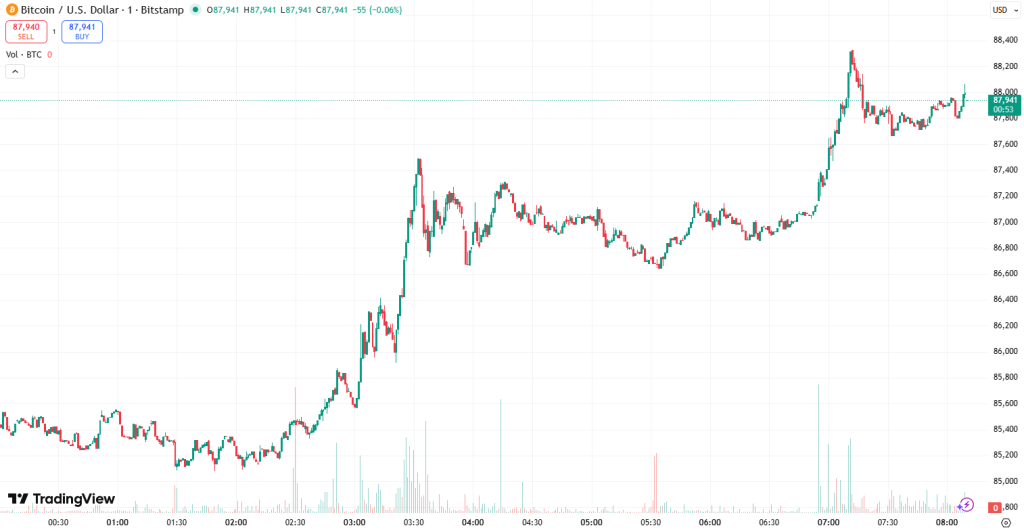
At the time of writing on Friday morning, BTC stood at $87,906. After a sideways trading period early in the day, BTC jumped to the intraday high of $89,219, before plummeting to $84,581 and then recovering to the current level.
Moreover, BTC is down 5% in a week, 3.4% in a month, 13.2% in a year, and 30% from the October all-time high of $126,080.
Investors are now looking to see if the price will move above $90,000 and then hold that level. This would open doors for another leg up towards $100,000. Conversely, a fall may lead the coin to the $74,000 zone.
Bitcoin Price Chart. Source: TradingView
Ethereum is currently changing hands at $2,953. The highest point it reached over the past 24 hours (by the time of writing) is $2,989, before plunging to the low of $2,781. It has recovered to the current price since.
Over the past week, ETH fell 9.2%, as well as 2.9% in a month and 19.8% in a year. It has also decreased by 40% from its August ATH of $4,946.
Should the price reclaim the $3,000, it could proceed to $3,130 and $3,250. However, a decrease would pull the price back to the $2,900 zone and possibly into the $2,700 territory.
Ethereum (ETH)
24h7d30d1yAll time
Moreover, the crypto market sentiment has decreased yet again within the fear territory.
The crypto fear and greed index stands at 21 today, compared to 22 yesterday. It is now back on the verge of the extreme fear zone.
Market participants remain highly cautious of the incoming development, as well as uncertain over the market trajectory. They’re waiting for further signals to decide on their next moves.
ETFs Go Red
After a single day of inflows, the US BTC spot exchange-traded funds (ETFs) posted negative flows of $161.32 million on Thursday. The total net inflow rose slightly to $57.57 billion.
Of the twelve BTC ETFs, three saw outflows and one saw inflows. BlackRock posted $32.76 million in inflows.
On the other hand, Fidelity leads the red list with $170.28 million in negative flows. It’s followed by Ark&21Shares’ $12.27 million and Bitwise’s $11.54 million.
Moreover, the US ETH ETFs continues with outflows, posting a sixth day of negative flows, with $96.62 million in outflows on 18 December. The total net inflow pulled back to $12.52 billion.
Two of the nine funds recorded inflows, but one saw higher outflows. Grayscale took in $5.63 in total on this day.
However, BlackRock recorded $102.24 million in outflows.
According to CoinGecko ETH treasury data, the company has purchased 407,331 ETH in the last 30 days. BitMine says it owns over 3.2% of the ETH token supply.
TOM LEE IS STILL BUYING: $229M THIS WEEK
Two fresh wallets just withdrew $88.73M of $ETH from FalconX. This acquisition matches prior Bitmine purchase patterns.
The crypto market saw an increase over the past 24 hours, while the US stock market closed higher on Thursday. By the closing time on 18 December, the S&P 500 was up by 0.79%, the Nasdaq-100 increased by 1.51%, and the Dow Jones Industrial Average rose by 0.14%. The increases follow the release of delayed Consumer Price Index data, which ended up being better than expected.
Is this rally sustainable?
The rise may continue in the short term, but the analysts expect another decrease at any given moment currently. That said, many argue that we’re still in for a significant rally as the new year begins, possibly in Q1.
The U.S. Senate has confirmed crypto-friendly lawyer Mike Selig as the next chair of the Commodity Futures Trading Commission (CFTC), ending a prolonged period of leadership uncertainty at one of the country’s most important financial regulators.
The confirmation passed Thursday as part of a mass approval of federal nominees, with senators voting 53–43 under the provisions of Senate Resolution 532.
Confirmed, 53-43: Confirmation of the en bloc nominations provided for under the provisions of S.Res.532.
Selig’s confirmation comes as President Donald Trump’s second administration moves to fill some of the most consequential regulatory vacancies affecting the digital asset sector.
Alongside Selig, the Senate also elevated Travis Hill to chair the Federal Deposit Insurance Corporation (FDIC), placing permanent leadership at two agencies that play central roles in how crypto markets operate and how crypto companies interact with the banking system.
Power Without a Mandate: The CFTC’s Quiet Struggle Over Crypto Oversight
At the CFTC, the absence of a Senate-confirmed chair had become a growing operational problem. The agency, which is structured as a five-member independent commission, has been operating for months with just a single commissioner.
Acting Chair Caroline Pham remained the only seated member after a wave of resignations earlier in the year, a situation that concentrated authority while also limiting deliberation and long-term planning.
The chair of the U.S. Commodity Futures Trading Commission (CFTC), Rostin Behnam, has announced his resignation, effective January 20, according to a Financial Times report.#CFTC#CryptoRegulationshttps://t.co/1AY9hfcCKv
Although an acting chair can legally carry out agency functions, the lack of a permanent leader and full commission constrained the CFTC’s ability to build staff, coordinate with other regulators, and advance major new rulemakings.
That leadership gap mattered most for crypto policy. While Congress continues to debate legislation that would expand the agency’s mandate, the absence of a confirmed chair made it harder for the CFTC to set a clear regulatory direction or prepare for an expanded role.
Senate introduces new Crypto Market Structure Bill draft to expand @CFTC authority over digital commodities like $BTC and $ETH.
During this interim phase, Pham focused on internal reforms rather than sweeping regulatory changes.
Her tenure emphasized clearing compliance backlogs, streamlining enforcement processes, and launching limited pilot initiatives tied to digital assets.
Pham led a “back-to-basics” approach, resolving internal backlogs and launching early digital asset initiatives, but the lack of a permanent, Senate-confirmed chair made it harder to advance complex rulemakings or coordinate closely with other regulators such as the Securities and Exchange Commission.
Selig’s Term Begins as CFTC Prepares for a Larger Role in Crypto Markets
Selig now takes on the role with a full and permanent mandate. He is a former CFTC official and most recently served as chief counsel to the SEC’s Crypto Task Force. He was nominated in October, replacing the administration’s earlier choice for the position.
His term as chair will run through April 2029. During his confirmation process, Selig said crypto would be a priority and also pointed to ongoing challenges at the agency, including limited staffing, tight resources, and governance concerns.
The CFTC currently employs about 543 full-time staff, far fewer than the SEC’s roughly 4,200 employees, even as lawmakers in both chambers consider bills that would give the CFTC primary oversight of crypto spot markets.
While operating with a single commissioner may allow faster internal decision-making, it also raises questions about legal durability and bipartisan balance.
Several senators have already stated that confirming additional commissioners will be a key issue in 2026.
Bitcoin’s latest market cycle has entered a new phase, with onchain and derivatives data pointing to demand exhaustion and a transition into bear market territory, according to CryptoQuant’s latest Crypto Weekly Report.
After multiple demand-driven rallies since 2023, the firm says the structural pillars that supported higher prices are now weakening.
Bitcoin’s demand boom is fading.
This cycle ran on three spot demand waves, and the latest one looks like it’s rolling over.
Since early October, demand is below trend, which can stay bearish for price. pic.twitter.com/7IWnRscD8H
The current cycle featured three major spot demand waves: the launch of U.S. spot Bitcoin ETFs, optimism surrounding the U.S. presidential election outcome, and a surge of interest from Bitcoin Treasury Companies.
With these catalysts largely priced in, incremental demand has diminished, removing a key source of price support that previously sustained upward momentum.
The firm notes that when demand growth rolls over in this manner, it has historically marked the end of bullish phases, regardless of broader narratives around supply shocks or halving events.
Institutional and Large-Holder Demand Reverses
Institutional behavior is now reinforcing the bearish signal. U.S. spot Bitcoin ETFs have shifted from accumulation to distribution in the fourth quarter of 2025, with net holdings declining by approximately 24,000 BTC. This stands in stark contrast to Q4 2024, when ETFs were strong net buyers and a central driver of market strength.
At the same time, onchain data shows that addresses holding between 100 and 1,000 BTC—often associated with ETFs, funds, and corporate treasuries—are growing below historical trend.
CryptoQuant compares this pattern to late 2021, when similar demand deterioration preceded the 2022 bear market.
Derivatives Markets Signal Weakening Risk Appetite
Derivatives data adds further confirmation. Funding rates in perpetual futures, measured using a 365-day moving average, have declined to their lowest level since December 2023. Falling funding rates typically indicate reduced willingness among traders to maintain leveraged long positions.
Historically, such conditions have been more consistent with bear market regimes than bull phases, reflecting declining risk appetite and lower conviction among market participants.
Price Structure and Downside Scenarios
From a technical perspective, Bitcoin has broken below its 365-day moving average, a key long-term indicator that has historically separated bull and bear market conditions.
CryptoQuant stresses that Bitcoin’s four-year cycle is driven primarily by demand expansions and contractions rather than the halving itself.
Despite the bearish shift, downside projections suggest a relatively shallow cycle. Past bear market bottoms have aligned with Bitcoin’s realized price, currently near $56,000.
This would imply a drawdown of roughly 55% from the recent all-time high—potentially the smallest bear market decline on record. Interim support is expected around the $70,000 level, offering a key zone to watch as the cycle continues to reset.
The 15th iteration of the UK government’s flagship cloud computing procurement framework is due to go live in 2026, and looks set to be very different compared with previous versions of the purchasing agreement
Diciembre es un mes intenso para la industria del juguete, el momento cumbre de la campaña de Navidad. La elevada demanda lo convierte en fundamental para las cuentas de resultados: según las proyecciones de la Asociación Española de Fabricantes de Juguetes (AEFJ), en ella se concentrarán el 60% de las ventas anuales.
Sea en Navidad o fuera de ella, la industria del juguete es un potente actor económico. A nivel global, y según datos de 2023 de Circana para la International Council of Toy Industries, mueve unas ventas por valor de 108.700 millones de dólares. Las cuentas de Euromonitor (de 2024 y que incluyen en el total también a los videojuegos) hablan ya de 279.000 millones de dólares. En España, la AEFJ prevé para este año una subida del 2,5% de la facturación, con un gasto medio por niño en juguetes en la campaña de Navidad de 195 euros.
La lista de los juguetes más deseados incluye toda clase de productos. El ranking anual que elabora cada Navidad Amazon lista juegos de construcción, robots, muñecas, cocinitas y clásicos como juegos de cartas. Este amplio abanico evidencia otra de las cuestiones que transpiran los análisis del sector, el de que este es un mercado complejo, que debe atender a muchas variables. La industria del juguete no solo tiene a niños y niñas como clientes finales (y todos los familiares que se encargan de hacer realmente esa compra), sino también a personas adultas que compran para ellas mismas. Es la emergente categoría de los kidults, “un segmento clave de crecimiento”, como concluye Euromonitor. De hecho, muchos juguetes se compran por nostalgia, confort emocional, conexiones sociales o hasta escapismo, según esta firma de análisis.
A la variedad del propio público objetivo del juego y de sus razones para la compra se suman la regulación, las crecientes expectativas sobre el alcance y valores de los juguetes o los retos marcados por las tendencias cambiantes de mercado. Jugar puede parecer muy sencillo, pero cumplir con las expectativas no lo es tanto. “La industria del juguete evoluciona continuamente, integrando nuevas narrativas y valores sin renunciar a la esencia del juego”, asegura Marta Salmón, presidenta de la AEFJ, al hilo de la presentación de previsiones de la asociación. “Esta capacidad de renovación constante es clave para mantener un mercado dinámico y competitivo”, suma.
Ante un mercado complejo y variado, se necesita innovación y tecnología.
Tecnología para innovar y seguir el ritmo
“El sector del juguete siempre ha sido en cierto modo pionero a la hora de adoptar algunas tecnologías e incorporarlas en los productos”, explica a CIO ESPAÑA Joaquín Vilaplana, director de innovación y sostenibilidad en AIJU Instituto Tecnológico de Productos Infantiles y Ocio, situado en el epicentro juguetero español, el Valle del Juguete. “Es un sector que es atrevido a la hora de innovar en el producto”, añade. Esto se traduce no solo en el lanzamiento de juguetes de base tecnológica (que deben, eso sí, mantener unos precios lo suficientemente competitivos como para ser atractivos en un mercado sensible al coste: “tiene que ser bueno, bonito y barato”), sino también en el uso de herramientas tecnológicas en su día a día.
El sector “avanza a la industria 4.0”, incorporando soluciones para monitorizar y planificar la producción, sistemas de control y demás herramientas para una fabricación optimizada y eficiente. “Dependiendo del tamaño de las empresas, existe una continua actualización en las metodologías”, indica Vilaplana. La tecnología no está solo “en el producto en sí, sino también en la fase previa de diseño y fabricación”. El sector armoniza el uso de “formas tradicionales de fabricar y producir” con la incorporación de nuevas herramientas punteras.
El análisis de datos ayuda a comprender las tendencias y afinar el lanzamiento de productos (que, aunque hagan su agosto en diciembre, ya deben pasar por las ferias sectoriales de inicio del año), así como mejorar la planificación de fabricación. “Es muy importante tener una capacidad de previsión buena, porque si no es imposible llegar a todo”, señala el experto, explicando que cada vez es más complicado gestionar el riesgo y que los modelos de compromisos de compras en ferias está cambiando. “Te confirman los pedidos cada vez más tarde y la capacidad de reacción es cada vez más ajustada”, indica.
Igualmente, la propia naturaleza del mercado del juguete hace más clave a la tecnología. Al ser un sector con una estacionalidad muy clara, se necesita ser capaces de gestionar ese pico sin que nada falle. Las herramientas de gestión logística son fundamentales. Al tiempo, el boom de internet también ha cambiado el estado de las cosas: el sector ha tenido que adaptarse a la venta online. “La empresa tiene que ser capaz de suministrar o entregar en plazos muy ajustados y estrechos”, suma el experto.
AJIU
Juguetes ante los retos del siglo XXI
La tecnología también está ayudando a que los juguetes naveguen los retos del siglo XXI, como ser más sostenibles o afrontar nuevas materias primas, al tiempo que ha abierto nuevas oportunidades, como el de hacerlos potencialmente más inclusivos.
“Hay infinidad de familias de productos que, siendo clásicos, tienen un potencial a la hora de integrar nuevas tecnologías o conseguir ese enfoque de inclusividad”, apunta Vilaplana. En su centro tecnológico, hacen “evaluaciones de usabilidad y jugabilidad del producto” que ayudan a comprender cómo funcionan los juguetes con cada grupo poblacional y a abrir nuevas características que hagan del producto algo “más inclusivo”, ya que “puede ser utilizado por públicos con ciertas limitaciones”. Al hacerlo, también ganan en valor educativo sobre la diversidad. “Un juguete es un elemento educativo”, recuerda, que puede “potenciar determinadas capacidades y desarrollar determinadas habilidades y actitudes”.
Otro de los grandes retos es el uso de materias primas. Algunas estimaciones señalan que el 90% de los juguetes se siguen haciendo a nivel global con plástico, lo que convierte a la juguetera en una de las industrias más intensas en el uso de este material del planeta. Muchas compañías han lanzado programas de I+D para encontrar alternativas mucho más responsables o más fácilmente reciclables. Abandonar por completo el plástico no es del todo sencillo. Ahí está el caso de Lego, que en 2023 dejó de usar plástico reciclado de botellas cuando descubrió que no reducía su huella de carbono (la compañía, aun así, insistía entonces en que seguían comprometidos con la sostenibilidad y buscando formas alternativas). Desde la industria del juguete recuerdan, con todo, que el plástico de los juguetes se puede reciclar, aunque no sea sencillo porque no hay tanta escala como puede haber en, por ejemplo, el plástico de los envases.
Y, finalmente, los juguetes deben enfrentarse también a las diferentes regulaciones, algo para lo que la tecnología está muy presente. “Un requisito que acabará afectando es el pasaporte digital del producto”, explica Vilaplana. Es un reto que tocará a todos los sectores manufactureros, pero que el juguete tendrá también que abordar con sus propias peculiaridades.
AIJU
La era de la IA
Sin duda, otro de los grandes retos a los que tendrá que enfrentarse la industria del juguete es el de la inteligencia artificial, que está también llegando ya a sus productos finales. Más allá de lo que pueda suponer como apoyo en la fabricación o comercialización, la IA se podría asentar como un complejo elemento más de la propia identidad del juguete, una pieza más del juego. Compañías de nuevo cuño, como Curio, están integrando IA directamente en los juguetes, creando muñecos que son al tiempo chatbots. “Combinamos tecnología, seguridad e imaginación, creando un mundo de juego en el que la ciencia y las historias toman vida”. Así es como se presenta esta empresa.
A las startups que experimentan con productos potenciales se suman los movimientos de los grandes gigantes. Este mismo diciembre, Disney anunció un acuerdo estratégico con Open AI. El gran titular es que Sora podrá generar vídeos cortos (no comerciales, puesto que son para fans) con los personajes del universo de la multinacional. Sin embargo, el potencial podría ir más allá, puesto que en la nota de prensa aseguran que se integrará potencialmente en más áreas. Más claro es el movimiento de Mattel, que cerró su propio acuerdo con Open AI, en este caso a principios de verano. “Cada uno de nuestros productos y experiencias está diseñado para inspirar a los fans, entretener a las audiencias y enriquecer la vida mediante el juego. La IA tiene el poder de expandir esa misión y ampliar el alcance de nuestras marcas en nuevas y emocionantes vías”, señalaba entonces Josh Silverman, el máximo responsable de franquicias de Mattel. El comunicado ya dejaba claro que se avecinaban “productos alimentados por IA”.
Aun así, este movimiento sectorial no está exento de críticas y de dudas. Al fin y al cabo, la IA ya protagoniza estos debates fuera del mundo de los juguetes. Es más que esperable que lo haga también dentro de ellos. Como muestra una prueba de The Guardian con uno de estos muñecos IA, se cuestiona el impacto en privacidad, relaciones sociales y hasta salud mental. Se teme que abra lo que ya se ha bautizado como el empathy gap (la brecha de la empatía), perdiendo de vista que aquello son juguetes y no personas, o que se genere una nueva brecha digital entre las familias capaces de navegar este nuevo contexto y las que no. En resumidas cuentas, los juguetes deben enfrentarse a los mismos retos que esta tecnología encuentra en otros sectores.
Germany’s national parliament has approved a procurement order for Dutch defense manufacturer Defenture to deliver 49 mobile battlefield platforms to the Bundeswehr’s Special Forces Command, known as Kommando Spezialkräfte, or KSK. The vehicles are scheduled to enter service starting in 2027, according to information released on December 18, 2025. The order covers two variants developed […]
Lockheed Martin’s Skunk Works and XTEND have completed a new integration effort aimed at improving command and control of uncrewed aerial systems across multiple classes, a development tied to evolving joint all-domain command and control concepts. According to information released on December 18, 2025, the two companies integrated XTEND’s Operating System, known as XOS, into […]
The Arleigh Burke-class guided-missile destroyer USS Jack H. Lucas (DDG 125) has emerged as the U.S. Navy’s first Flight III warship, introducing a new generation of surface combatant capability centered on advanced radar, power, and combat systems. Commissioned on October 7, 2023, Jack H. Lucas has been designated by the Chief of Naval Operations as […]
 Login
Login