Normal view

There are new articles available, click to refresh the page.
Yesterday — 17 December 2025Main stream

Bitcoin Price Prediction: Active Wallets Drop to 2023 Lows as Liquidity Thins — Can BTC Reclaim $100K and Invalidate the Bears?

17 December 2025 at 18:30

On-chain data reveals that the number of active Bitcoin wallets has declined to 2023 lows, indicating that even as prices fluctuate, fewer market participants are conducting transactions.

Bitcoin price prediction metrics suggest that the price must reclaim the $100,000 psychological threshold to prevent a deep bear market decline.

Fear Index Hits Extreme Territory as Year-End Approaches

Bitcoin’s Fear & Greed Index has plummeted to 11, signaling Extreme Fear.

Crypto Markets Enter a Slowdown Phase

“The number of active Bitcoin wallets has fallen to its lowest level in the past year, indicating that even when prices move, fewer participants are actually transacting.” – By @xwinfinance pic.twitter.com/pt9RAEwx0M

— CryptoQuant.com (@cryptoquant_com) December 17, 2025

According to a Japanese analyst at XWIN Research, fresh capital inflows into Bitcoin are beginning to diminish, and as year-end nears, both participation and capital typically become less active, further reducing market liquidity.

“In such an environment, price action tends to become more volatile due to thin liquidity. At the same time, reduced noise allows the underlying supply and demand dynamics to become clearer,” the analysts explained.

Crypto analyst Moreno also observed that Bitcoin sits at a level carrying more significance than appearances suggest.

The current $86,000 price rests above the True Market Mean Price (TMMP), which represents the average on-chain acquisition price of investors, excluding miners.

Moreno projects that if Bitcoin maintains above the TMMP ($81,500), the bull trend would be well alive.

Bitcoin Price Prediction: Weekly Chart Shows Critical $81K Defense Zone

Bitcoin’s weekly chart displays a clear transition from expansion to correction following repeated failures above the $100,000 psychological resistance.

Price has definitively lost the $100,000 level and now trades below key moving averages, which have begun rolling over and functioning as dynamic resistance around the $103,000–$108,000 zone.

The most crucial structural level on the downside sits at $81,000, marked as the average cost basis support.

Bitcoin Price Prediction - Bitcoin Price Chart
Source: TradingView

Price currently hovers just above this zone, making it a critical inflection point for the broader market.

The MACD remains firmly bearish with expanding negative histogram bars, signaling downside momentum still dominates despite the recent slowdown in selling pressure.

Moreover, a sustained weekly close below $81,000 would expose the final bull-market defense near $74,000, where stronger long-term buyers are expected to emerge.

Conversely, reclaiming $100,000 and maintaining above it would be necessary to invalidate bearish momentum and reopen pathways for advancement back toward the $105,000–$110,000 range.

Pepenode Raises $2.3M Ahead of Bitcoin Post-Breakout Rally

If Bitcoin finally breaks the $100,000 resistance and initiates the 2026 bull run, meme coins like Pepenode (PEPENODE) would experience increased demand.

Pepenode is a new crypto project that’s already raised over $2.3 million despite the crypto market losing over 30% of its value since October.

It’s a game where you can mine coins without needing expensive hardware setups.

Bitcoin Price Prediction - Pepenode banner

You play the game in your web browser, set up virtual mining rigs, and upgrade your facilities to earn PEPENODE tokens.

Now that more people are investing in Pepenode’s mining rigs, the presale price is advancing rapidly.

To join the presale before the ongoing round sells out, go to the official Pepenode website, and connect a crypto wallet like Best Wallet.

You can then buy PEPENODE tokens for $0.0012016 and pay with crypto using ETH or USDT, or use a bank card for fast payment.

Visit the Official Pepenode Website Here

The post Bitcoin Price Prediction: Active Wallets Drop to 2023 Lows as Liquidity Thins — Can BTC Reclaim $100K and Invalidate the Bears? appeared first on Cryptonews.
💾

Tether Launches PearPass, a Peer-to-Peer Password Manager Without Cloud Storage

17 December 2025 at 12:19

Tether unveiled PearPass, a peer-to-peer password manager that eliminates the need for cloud storage and centralized servers, amid major breaches that have exposed billions of credentials.

The stablecoin giant announced that its free application synchronizes encrypted passwords directly between user devices via a peer-to-peer architecture, removing traditional cloud infrastructure vulnerabilities that have plagued competitors.

PearPass addresses escalating cybersecurity threats as cloud-based password managers face persistent attacks from sophisticated hackers targeting centralized databases.

The application stores credentials exclusively on user devices while enabling encrypted synchronization across platforms without intermediaries, giving users complete control over digital security through locally stored data.

Introducing🍐🔒 PearPass — the password manager that keeps your data on your devices.

No servers to hack. No cloud to leak.

Just pure local security.

Follow @Pears_p2p & Download the App https://t.co/gP9FIPn2dW pic.twitter.com/ObIuyfToMo

— Tether (@Tether_to) December 17, 2025

Decentralized Architecture Removes Single Point of Failure

The password manager eliminates server dependencies through peer-to-peer synchronization, unlike traditional cloud-based competitors that store millions of credentials on centralized infrastructure.

PearPass employs end-to-end encryption powered by open-source cryptographic libraries, allowing users to recover their accounts using personal keys rather than relying on external systems that are vulnerable to breaches.

Every major breach proves the same point: if your secrets live in the cloud, they’re not really yours,” said Paolo Ardoino, CEO of Tether.

PearPass removes the single point of failure. No servers, no intermediaries, no back doors. Recovery and synchronization across users’ devices happens peer-to-peer, with your keys, under your control, without gatekeepers.

PearPass is the first super-secure password manager. 🍐🍐
It synchronizes your info across your devices, without the need of any server. No middlemen. No reliance on pinky swear security.
Fully peer-to-peer and open-source.
You can review it for yourself.

It's available for… https://t.co/sxHtBOyihK

— Paolo Ardoino 🤖 (@paoloardoino) December 17, 2025

The application underwent independent security auditing by Secfault Security, a specialist in offensive security and cryptographic analysis, to ensure resilience against real-world threats.

PearPass includes built-in password generation and continues to function during outages or in high-threat environments, maintaining operability when centralized systems fail.

The fully open-source code allows community auditing, enabling developers to review security implementations independently.

Growing Demand for Privacy-First Communication Tools

PearPass represents Tether’s first fully open-source application developed on the Pears ecosystem, which builds decentralized solutions for sovereignty, efficiency, privacy, and security.

The launch follows growing adoption of peer-to-peer technologies as users seek alternatives to centralized platforms facing regulatory pressure and surveillance concerns.

Jack Dorsey’s Bitchat messaging app recorded over 360,00 downloads since launch, with 48,781 downloads in Nepal during September protests against government corruption and social media bans.

The Bluetooth Low Energy mesh network application operates without an internet connection, enabling encrypted communication between devices within 30 meters during network shutdowns.

Madagascar experienced similar adoption spikes during violent protests over utility shortages, with Google Trends showing searches spiking from zero to 100 in Antananarivo as demonstrators sought censorship-resistant communication.

📱 Dorsey's Bitchat explodes in Madagascar as protesters adopt censorship-resistant messaging during violent protests over infrastructure failures.#BitChat #Madagascarhttps://t.co/oZS9WNukd2

— Cryptonews.com (@cryptonews) September 29, 2025

The peer-to-peer app recorded over 21,000 downloads within 24 hours during civil unrest that prompted government curfews across the capital.

Elon Musk also announced XChat, a development for the X platform featuring Bitcoin-style encryption, promising cross-platform communication without phone number requirements.

WhatsApp knows enough about what you’re texting to know what ads to show you,Musk alleged during a recent podcast interview. “That’s a massive security vulnerability.

The messaging service is expected to launch within months as part of Musk’s broader “everything app” ambitions.

Regulatory Scrutiny Intensifies Across Jurisdictions

Privacy-focused platforms face mounting regulatory pressure as governments demand access to encrypted communications for law enforcement purposes.

The European Union is advancing Chat Control regulations requiring messaging apps to scan content before encryption, with 15 countries currently supporting the controversial proposal despite privacy advocates warning of mass-surveillance implications.

Telegram CEO Pavel Durov remains out on bail of €5 million following a French arrest under warrants related to the encrypted messaging platform.

The 40-year-old billionaire criticized charges as “legally and logically absurd” while avoiding infrastructure deployment in jurisdictions with aggressive surveillance demands.

Despite this tightening of regulations across Europe, Worldcoin also introduced World Chat in March, integrating encrypted messaging with World ID verification and distinguishing verified users with blue chat bubbles.

🌎 @worldcoin has launched World Chat, an encrypted messaging feature within World App that enables users to communicate and send crypto.#worldcoin #wldhttps://t.co/uwWgL1r9bH

— Cryptonews.com (@cryptonews) March 6, 2025

The feature enables crypto transfers within conversations while supporting over 100 Mini Apps that launched more than 250 million times in early 2025.

For this new privacy app, Tether emphasized that PearPass represents technology designed to withstand future centralization pressures from governments, corporations, and intermediaries seeking to control data.

The company plans additional ecosystem applications restoring internet control to individual users through decentralized infrastructure resilient against external seizure or compromise.

The post Tether Launches PearPass, a Peer-to-Peer Password Manager Without Cloud Storage appeared first on Cryptonews.

💾

HashKey Shares Drop 3% in Disappointing Hong Kong Debut Despite $200M Raise

17 December 2025 at 12:18

HashKey Holdings saw its shares slip 3% on Wednesday during its Hong Kong trading debut, closing at HK$6.51 after pricing near the top of its marketed range at HK$6.68, according to CNBC.

The crypto exchange raised $206 million in its initial public offering, marking the first public listing by a digital asset company in the city, even as bitcoin tumbled 36% from its October all-time high above $126,000.

The underwhelming performance came despite robust investor demand, with the institutional tranche drawing subscriptions 5.5 times the available stock and retail investors oversubscribing by nearly 394 times.

Cornerstone investors, including Fidelity, UBS, CDH Investments, and Cithara Fund, participated in the offering, while JPMorgan and Guotai Haitong served as joint bookrunners.

📉 HashKey’s Hong Kong debut briefly jumped 6% before slipping below its IPO price, as a $206M listing met cautious sentiment in a volatile crypto market. @HashKeyExchange #Hashkey #HongKong https://t.co/AHWJZQLtGQ

— Cryptonews.com (@cryptonews) December 17, 2025

Hong Kong’s Crypto Hub Ambitions Face Market Headwinds

Founded in 2018, HashKey operates the city’s largest licensed virtual asset trading platform and secured one of the earliest approvals under Hong Kong’s 2022 digital asset regime.

The company holds more than 75% of Hong Kong’s onshore digital asset trading volume, providing exchange services alongside over-the-counter trading, staking, tokenization, and asset management solutions for institutional and retail clients.

Speaking with Reuters, CEO Xiao Feng emphasized his long-term confidence despite near-term volatility.

My confidence is only growing stronger and I am more optimistic than 10 years ago because there’s more regulation and compliance guidelines for us to follow which will allow the industry to grow further,” he said at the listing ceremony.

The exchange facilitated HK$1.7 trillion in trading volume through September 2025, though first-half revenue fell 26% year over year to HK$284 million.

HashKey posted a HK$506.7 million loss during that period, narrowing from HK$772.6 million the previous year as the company invested heavily in compliance infrastructure and market expansion.

Mainland Ban Contrasts With Hong Kong’s Digital Asset Push

Hong Kong’s embrace of cryptocurrencies stands in sharp contrast to mainland China, which banned crypto trading in 2021 and recently renewed warnings about virtual assets.

The city launched a stablecoin licensing system this year and is considering allowing exchanges to connect local platforms with global operations, positioning itself as a testing ground for regulated digital asset adoption.

Xiao distinguished Hong Kong’s approach from Beijing’s crackdown, noting mainland measures targeted pyramid schemes and stablecoin fraud.

Hong Kong continues to promote policies regarding digital assets and we have benefited from that,” he said. “We should firmly adhere to ‘one country’, but wisely take advantage of ‘two systems.’

CFO Eric Zhu expressed confidence that the Asian market would catch up with U.S. crypto penetration rates.

We are confident that the penetration rate in Hong Kong, in the Asian market, is going to catch up with what happens in the U.S,” he told CNBC.

The company plans to deploy IPO proceeds toward technology infrastructure upgrades, market expansion partnerships, and enhanced risk management systems.

HashKey will prioritize cash flow over profitability in the near term while continuing investments as the sector develops, according to Xiao.

💰@HashKeyExchange is poised to price its Hong Kong IPO near the top of the range, with strong institutional demand suggesting the raise could reach about $206M.#HashKey #IPOhttps://t.co/cDu3Bqa2i9

— Cryptonews.com (@cryptonews) December 15, 2025

The listing arrived during a challenging period for global crypto equities.

As reported earlier by Cryptonews, stablecoin provider Circle lost 70% of its value since peaking in June, while exchanges Bullish and Gemini declined over 30% and 60% respectively, since their summer debuts.

Bitcoin has fallen roughly 30% from October highs amid concerns about geopolitical tensions and broader market jitters.

Hong Kong Financial Secretary Paul Chan attended the listing ceremony, which shows the city’s official support for its digital asset initiatives.

The debut contributed to Hong Kong’s strongest IPO year since 2021, with over $34 billion raised from new listings through December, according to data obtained by Reuters, reclaiming the top global ranking from U.S. exchanges for the first time since 2019.

The post HashKey Shares Drop 3% in Disappointing Hong Kong Debut Despite $200M Raise appeared first on Cryptonews.

💾

Bitcoin Price Prediction: Can the BTC Price Push Above $95,000 in December? American Bitcoin Stacks Up in Anticipation

17 December 2025 at 09:33

Bitcoin price prediction indicates BTC is positioned to push above $95,000 before December’s end as American Bitcoin Corp (ABTC) accumulated another 54 bitcoin in anticipation of a Santa rally.

Eric Trump’s Firm Joins Top 20 Bitcoin Treasury Companies

The Nasdaq-listed firm, co-founded by Eric Trump, revealed Tuesday that recent acquisitions have expanded the company’s Bitcoin holdings beyond 5,000 BTC, placing it among the top 20 publicly traded bitcoin treasury firms, according to bitcointreasuries.net.

The company has achieved a 96.5% bitcoin yield since its Nasdaq debut, alongside 533 satoshis per share as of December 14.

Glassnode data reveals whales are aggressively buying the dip.

In the last 30 days alone, whales accumulated 269,822 BTC worth $23.3 billion, the largest monthly purchase in the last 13 years.

Analysts view this as a significant boost for Bitcoin price prediction as December progresses, with markets anticipating a bounce from the current $85,000-$87,000 level toward $95,000, with potential extension into six figures before year-end.

Bitcoin Price Prediction: Daily Chart Shows Compression Pattern Before Breakout

Bitcoin’s daily chart displays price compressing into a tightening structure following an extended downtrend, with the market now trading between a descending trendline from the cycle high and a rising base around the $85,000 support zone.

This price action suggests sellers are exhausting momentum, as each downward push is absorbed near the same demand area, forming a higher-low structure against the broader downtrend line.

Bitcoin Price Prediction - Bitcoin Price Chart
Source: TradingView

The $85,000 level represents the most crucial near-term support and must hold to preserve the developing reversal setup.

On the upside, the descending trendline and the $95,000 region act as confluence resistance, and a decisive daily close above this zone would confirm a bullish breakout from the compression pattern.

Volume has diminished during consolidation, typical behavior preceding a directional move, while the RSI remains below 50 but has stabilized and is attempting to curl higher, signaling fading bearish momentum rather than strong selling pressure.

Provided Bitcoin maintains above $85,000, the bias favors a continuation higher toward $95,000, with a successful breakout opening the door to a return to the upper-$90,000 region.

A breakdown below $85,000 would invalidate the bullish setup and redirect focus toward deeper support levels, preserving the broader corrective trend.

Maxi Doge Offers Investors Early Access Before Bull Market Returns

If Bitcoin finally breaks the $95,000 resistance and sets the stage for a 2026 bull run, presale projects like Maxi Doge ($MAXI) would benefit from the market revival.

Maxi Doge is an early-stage memecoin following the Dogecoin playbook, generating over 100x gains during the last bull run.

The MAXI presale has raised over $4.3 million and offers 72% annual staking rewards for those entering early at the current $0.000273 price before it increases.

Bitcoin Price Prediction - Maxi doge banner

The project has also established an alpha channel where traders exchange insider tips, share early trade ideas, and discover hidden opportunities to capitalize on the upcoming bull run.

To buy early, visit the official Maxi Doge website and connect a crypto wallet like Best Wallet.

You can pay with existing crypto like USDT and ETH, or use a bank card to complete your purchase immediately.

Visit the Official Maxi Doge Website Here

The post Bitcoin Price Prediction: Can the BTC Price Push Above $95,000 in December? American Bitcoin Stacks Up in Anticipation appeared first on Cryptonews.

💾

Bhutan Pledges $1 Billion in Bitcoin to Build ‘Mindfulness City’ Without Selling Reserves

17 December 2025 at 04:41

Bhutan unveiled a national Bitcoin Development Pledge on Tuesday, committing up to 10,000 BTC, worth approximately $1 billion, to fund construction of Gelephu Mindfulness City without liquidating its sovereign digital asset reserves.

King Jigme Khesar Namgyel Wangchuck announced the allocation during his National Day Address, framing the commitment as a generational investment in youth employment and national prosperity tied to a new economic hub in southern Bhutan.

The pledge channels Bitcoin holdings into GMC development through mechanisms including collateralized lending, risk-managed yield strategies, and long-term holding approaches designed to preserve capital while financing infrastructure.

This development became possible due to a multi-year commitment to leverage Bitcoin’s compounding value over time, rather than converting reserves to cash.

Officials said the final implementation details are expected in the coming months, under governance frameworks that emphasize capital preservation, appropriate oversight, and transparency.

Bhutan Bitcoin Mindfulness City - King Jigme Khesar Namgyel Wangchuck image
Source: Breathe Bhutan

Sovereign Mining and Clean Energy Foundation

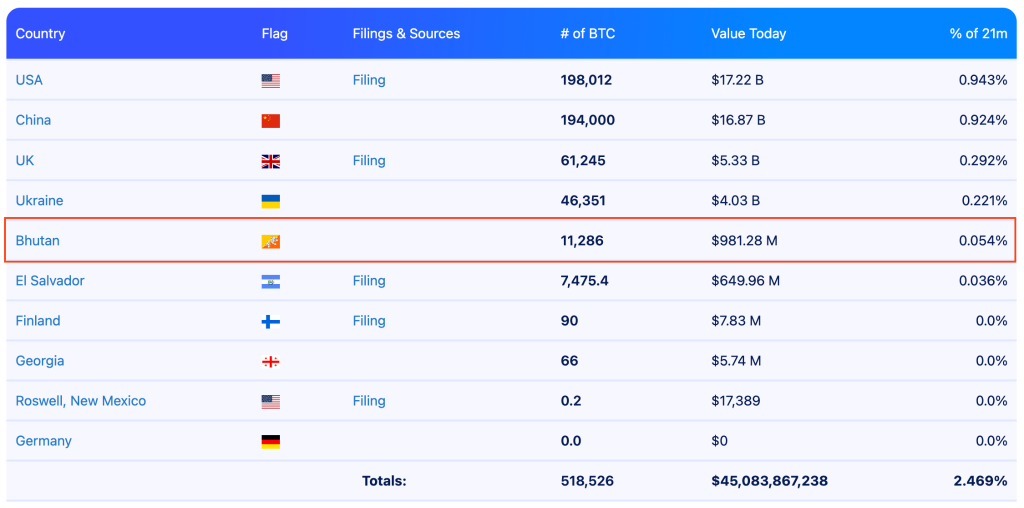
Bhutan ranks as the world’s fifth-largest government Bitcoin holder, having mined 13,011 BTC since 2021 using surplus hydroelectric power from Himalayan rivers.

The renewable energy-powered mining operation converts excess national grid capacity into digital assets without additional environmental impact, with crypto holdings now exceeding 11,286 BTC, valued at $1.28 billion, according to Bitbo data.

Bhutan Bitcoin Mindfulness City - Government Bitcoin Holder table
Source: Bitbo

The Kingdom’s hydroelectric resources at times exceed domestic demand, enabling clean energy to be converted into long-term national assets through the national power generation utility.

This mining strategy accounts for over 25% of Bhutan’s GDP while maintaining environmental sustainability commitments central to the nation’s development philosophy, which balances economic progress with ecological stewardship.

The Kingdom established Green Digital Ltd through GMC to develop blockchain infrastructure and, recently, partnered with Cumberland DRW on digital asset trading frameworks, sustainable mining expansion, AI compute facilities, and national stablecoin development.

Gelay Jamtsho, Green Digital chairman, said the collaboration connects Bhutan’s renewable energy infrastructure with institutional-grade liquidity to support the country’s diversification agenda beyond traditional economic sectors.

Blockchain Integration Across National Systems

Beyond mining, Bhutan has deployed blockchain-based national identity systems serving 800,000 citizens on Ethereum after migrating from Polygon, with the transition completed in October, enabling Verifiable Credentials and digital signing capabilities.

Prime Minister Tshering Tobgay said leveraging Ethereum’s globally distributed network strengthens the security, transparency, and resilience of digital infrastructure serving nearly the entire population.

🇧🇹 Bhutan has migrated its self-sovereign identity system to Ethereum, enabling 800K citizens to verify their identity on a public blockchain.#Bhutan #EthereumBlockchain #BhutanNDIhttps://t.co/GxMSpUcuN3

— Cryptonews.com (@cryptonews) October 14, 2025

Back in May, the Kingdom enabled crypto payments across tourism merchants through partnerships with DK Bank and Binance Pay, allowing visitors to use over 100 cryptocurrencies for everything from airline tickets and hotel stays to roadside fruit stalls.

Over 100 local merchants now accept digital assets, with Damcho Rinzin, tourism director, describing the system as advancing innovation and inclusion while supporting sustainable development goals.

Most recently, Bhutan launched TER, a Solana-based token backed by physical gold reserves distributed through DK Bank, positioning the nation among the few experimenting with state-backed tokenized assets.

Mindfulness City as Economic Catalyst

Gelephu Mindfulness City operates as a Special Administrative Region designed to attract international capital through regulatory clarity and modern financial connectivity while preserving cultural values.

King Jigme Khesar Namgyel Wangchuck framed GMC as a shared national enterprise in which citizens function as stakeholders, with new land policies ensuring that Bhutanese from all regions benefit from development proceeds, since most acreage remains state-owned.

As your King, I must ensure that every Bhutanese is a custodian, stakeholder, and beneficiary of GMC,” the monarch said. “Think of GMC as a company and landowners as its shareholders.

Market Outlook Supports Strategic Holding

Bitcoin traded at $87,274 today, up 1.9% in Asian hours as exchange reserves hit record lows and traders awaited US inflation data.

Major asset managers, including Bitwise and Grayscale, project that Bitcoin will exceed its previous all-time highs in 2026, despite traditional cycle theory predicting corrections, as institutional capital inflows through platforms like Morgan Stanley and Wells Fargo accelerate adoption.

🚀 Bitwise and Grayscale predict Bitcoin will break its four-year cycle and reach new all-time highs in 2026 driven by institutional capital and regulatory clarity.#Bitcoin #Bitwise #Grayscalehttps://t.co/mL6smmtfjl

— Cryptonews.com (@cryptonews) December 16, 2025

Bhutan’s pledge aligns with the growing sovereign and corporate adoption of digital assets, as global crypto ETPs have attracted $87 billion in net inflows since US products launched in January 2024.

The post Bhutan Pledges $1 Billion in Bitcoin to Build ‘Mindfulness City’ Without Selling Reserves appeared first on Cryptonews.

SBF’s Ex-Girlfriend Caroline Ellison Transferred to Early Community Confinement

17 December 2025 at 02:23

Caroline Ellison has been transferred from federal prison to community confinement after serving approximately 11 months of her two-year sentence for her role in the $11 billion FTX fraud scheme.

The former Alameda Research CEO was moved from Danbury Federal Correctional Institution in Connecticut to either home confinement or a halfway house on October 16, according to Federal Bureau of Prisons records obtained by Business Insider.

Ellison’s projected release date is now February 20, 2026, nearly 9 months ahead of the completion of her original sentence.

The 31-year-old former Alameda executive, who served as a star witness against her ex-boyfriend, Sam Bankman-Fried, during his criminal trial, began her sentence at the low-security Connecticut facility in early November 2024 after receiving a two-year prison term from U.S. District Judge Lewis Kaplan.

Caroline Ellison Community Confinement - Caroline Ellison image
Bloomberg via Getty Images

Cooperation Earns Leniency Despite Serious Fraud Charges

Judge Kaplan praised Ellison’s “substantial” cooperation during Bankman-Fried’s prosecution while maintaining that the case’s severity still warranted incarceration.

Ellison had pleaded guilty in December 2022 to conspiracy charges, including wire fraud, money laundering, securities fraud, and commodities fraud, offenses carrying a potential maximum sentence of 110 years in prison.

During her September 2024 sentencing hearing, Ellison expressed deep remorse while holding back tears.

“On some level, my brain doesn’t even comprehend all the people I harmed,” she told the court. “That doesn’t mean I don’t try.”

Her attorneys had requested no prison time, but Kaplan rejected what he termed a “literal get-out-of-jail-free card” despite acknowledging her unprecedented cooperation.

Federal prosecutors emphasized Ellison’s critical testimony in their September 17 letter recommending leniency.

“The ‘what’ and ‘how’ of the crimes, as well as the ‘why,’ would have been difficult to prove without Ellison’s testimony,” they wrote, noting she endured extraordinary public attention and harassment for her cooperation.

During Bankman-Fried’s month-long October 2023 trial, Ellison testified for three days, painting the FTX founder as an image-conscious and power-hungry figure who orchestrated the fraudulent scheme.

Ellison revealed that Bankman-Fried instructed her and other executives to use Alameda Research to invest billions of dollars in customer assets that had been secretly siphoned from FTX.

She described feeling like an “unequal partner” in their romantic relationship due to his position of power.

I would always ultimately defer to Sam,” Ellison testified, explaining concerns about the intersection of their personal and professional relationship.

FTX Associates Face Divergent Legal Outcomes

Ellison’s early community placement follows contrasting fates for other FTX executives involved in the collapse.

Former FTX CTO Gary Wang and engineering director Nishad Singh both received time-served sentences with supervised release after testifying against Bankman-Fried, avoiding additional prison time entirely.

Both testified that Bankman-Fried directed them to create an “allow negative” feature on Alameda’s FTX-linked account, granting access to nearly unlimited customer funds.

Meanwhile, former FTX Digital Markets CEO Ryan Salame serves a seven-year sentence at a Maryland federal facility after pleading guilty to campaign finance violations and operating an unlicensed money transmitter.

Salame refused to cooperate with prosecutors and has vocally criticized the disparate treatment, claiming authorities offered “get out of jail free cards” to witnesses supporting their narrative.

The government hands get out of jail free cards if you parrot the narrative they want and everyone who would provide any counterpoint is frightened,Salame told journalist Tucker Carlson.

Bankman-Fried remains incarcerated at a California federal prison serving his 25-year sentence following conviction on all seven fraud and conspiracy counts.

The FTX founder’s appeal hearing was scheduled for November 4, as his legal team argues he was “presumed guilty” and denied a fair trial.

🏛 Sam Bankman-Fried (SBF) is pushing for a new trial this week following his 2023 conviction tied to his time at FTX.#SBF #FTXhttps://t.co/xEIAr7gcJE

— Cryptonews.com (@cryptonews) November 3, 2025

His family has called for presidential clemency while he continues to contest that FTX was never truly insolvent, claiming the exchange always had sufficient assets to repay customers in full.

Federal Bureau of Prisons spokesperson Randilee Giamusso declined to specify Ellison’s exact location or conditions within community confinement, citing privacy and security protocols.

Ellison’s attorneys have not commented on her early transfer to supervised community placement, as FTX creditors continue to receive bankruptcy distributions exceeding $16 billion in recovered funds.

The post SBF’s Ex-Girlfriend Caroline Ellison Transferred to Early Community Confinement appeared first on Cryptonews.

Before yesterdayMain stream

Bitcoin Price Prediction: Saylor Says Quantum Computing Will ‘Harden’ Bitcoin — Is the 2026 Bull Run Locked In?

16 December 2025 at 18:30

Bitcoin billionaire and MicroStrategy executive Michael Saylor contends that, contrary to widespread fears, quantum computing won’t destroy Bitcoin but will instead “harden it.

Analysts view this as a significant boost for the Bitcoin price prediction heading into 2026, as many had dismissed next year’s bull run prospects due to quantum threats.

Saylor Says Network Upgrades Will Strengthen Bitcoin

In a December 16 X post, Saylor explained the Bitcoin network would upgrade following a quantum breakthrough, with active coins migrating while lost coins remain frozen.

The Bitcoin Quantum Leap: Quantum computing won’t break Bitcoin—it will harden it. The network upgrades, active coins migrate, lost coins stay frozen. Security goes up. Supply comes down. Bitcoin grows stronger.

— Michael Saylor (@saylor) December 16, 2025

He concluded, “Security goes up. Supply comes down. Bitcoin grows stronger.”

This statement counters numerous fearmongering predictions claiming Bitcoin encryption faces quantum hacking risks that could trigger network collapse.

However, when Cryptonews interviewed David Carvalho, CEO and chief scientist of Naoris’ post-quantum protocol, about quantum threats to traditional cryptography, the former ethical hacker predicted that 30% of all circulating BTC could face theft risk when “Q-Day” arrives.

Nevertheless, he stressed that “the timeline for such breakthroughs remains uncertain, and exchanges are unlikely to allow compromised coins to circulate freely.”

Bitcoin Price Prediction: Monthly Chart Mirrors 2022 Bottoming Pattern

Bitcoin’s monthly chart shows price consolidating below the critical $108,000–$110,000 resistance zone, which has capped upside and must be reclaimed to confirm continuation of the 2026 upward leg.

This level sits above recent cycle highs and aligns with historical areas where previous bull markets paused before accelerating.

Structurally, the chart highlights strong similarities to the 2022 bottoming phase.

Bitcoin Price Prediction - Bitcoin Price Chart
Source: TradingView

After a deep drawdown marked by consecutive red monthly candles, Bitcoin formed a base and delivered a near-2x rally from lows, followed by consolidation before the next expansion.

The current market appears to be repeating that sequence since October, with price holding well above long-term support and forming higher monthly closes despite recent volatility.

The RSI remains above the neutral 50 level, suggesting the long-term trend stays bullish.

Provided Bitcoin maintains above the mid-$80,000 region, the probability favors this consolidation resolving upward.

A decisive monthly close above $108,000 would likely open pathways to a renewed 2026 bull run rally toward the $140,000–$150,000 region.

Pepenode Raises $2.3M To Position for 2026 Meme Coin Season

If Bitcoin finally breaks the $108,000 resistance and begins the 2026 bull run, meme coins like Pepenode (PEPENODE) would see increased demand.

Pepenode is a new crypto project that’s already raised over $2.3 million despite the crypto market losing over $1.2 trillion of its value this Q4.

It’s a game where you can mine coins without needing expensive hardware setups. You play the game in your web browser, set up virtual mining rigs, and upgrade your facilities to earn PEPENODE tokens.

Bitcoin Price Prediction - Pepenode Banner

The project is copying PEPE’s success strategy, which contributed to its 1,000x rally during the 2023-24 run when Bitcoin broke out from bear market lows.

Now that more people are buying Pepenode’s mining rigs, the presale price is going up very fast.

To join the presale before the ongoing round sells out:

  • Go to the official Pepenode website.
  • Connect a crypto wallet like Best Wallet, and buy PEPENODE tokens for $0.0011968.
  • Then pay with crypto using ETH or USDT, or use a bank card in just a few clicks.
Visit the Official Pepenode Website Here

The post Bitcoin Price Prediction: Saylor Says Quantum Computing Will ‘Harden’ Bitcoin — Is the 2026 Bull Run Locked In? appeared first on Cryptonews.

Bitcoin Price Prediction: Cathie Wood Says the Bottom Might Be In – Are Institutions About to Trigger the Next Bull Run?

16 December 2025 at 12:45

Cathie Wood, founder of ARK Invest, believes the post-October 10 crash bottom for Bitcoin may already be established as prices stabilize around $86,000.

Bitcoin price prediction metrics indicate institutions are positioned to lead the next bull cycle heading into 2026.

Institutions Now Hold Nearly 30% of Bitcoin Supply

Wood emphasized that Bitcoin represents a revolutionary global monetary system and asset class, functioning as institutions’ preferred gateway into cryptocurrency and deserving frontline status in institutional portfolios.

🚨 CATHIE WOOD SAYS THE BITCOIN $BTC 4 YEAR CYCLE IS DEAD AND THAT THE BOTTOM IS ALREADY IN

WE ARE BACK 🔥 pic.twitter.com/m21Y8riEx3

— BlockNews (@blocknewsdotcom) December 9, 2025

Glassnode data reveals institutions now control 29.8% of the total Bitcoin circulating supply. Public companies alone custody over 1 million BTC, U.S. spot ETFs hold 1.31 million, and exchanges maintain nearly 3 million BTC.

Despite Bitcoin trading beneath the Short-Term Holders’ realized price of $104,000, placing recent market participants under sustained loss pressure, institutions continue accumulating.

Just yesterday, Bitcoin advocate Michael Saylor’s MicroStrategy doubled down on its conviction, announcing another massive Bitcoin purchase worth nearly $1 billion.

In a Form 8-K filing dated December 15, MicroStrategy disclosed acquiring 10,645 BTC between December 8 and December 14, spending $980.3 million at an average price of $92,098 per coin.

Additionally, Eric Trump’s World Liberty Financial recently purchased 416 Bitcoin worth $38 million, expanding the company’s holdings to 5,000 BTC.

Bitcoin Price Prediction: Daily Chart Shows Early Stabilization Signs

Bitcoin’s daily chart displays price attempting recovery after a sharp corrective downtrend, with the market recently breaking above a short-term descending trendline.

This movement signals potential transition from bearish control to early stabilization, particularly as price maintains above the highlighted demand zone in the low-$80,000 region, which previously absorbed substantial selling pressure.

The most crucial overhead level sits at the short-term holders’ realized price near $104,000, aligning with prior range support turned resistance.

Bitcoin Price Prediction - Bitcoin Price Chart
Source: TradingView

While Bitcoin trades below this zone, upside attempts will likely encounter supply from trapped buyers, restricting follow-through.

The RSI has risen from oversold conditions but stays below the 50 midpoint, suggesting improving momentum without a complete bullish reset.

This favors a scenario where price can advance toward the $92,000–$98,000 region near term, but a sustained bull run remains unlikely unless Bitcoin reclaims and maintains above $100,000–$104,000 on strong volume.

Maxi Doge Offers Investors 72% APY Ahead of Institutional Rally

Increased institutional buying could drive Bitcoin above $100,000 soon, and when this occurs, presale projects like Maxi Doge ($MAXI) would benefit from the massive demand surge.

Maxi Doge is an early-stage meme coin following the Dogecoin playbook that generated over 1000x gains in the years since its launch.

The MAXI presale has raised over $4.3 million and offers 72% annual staking rewards for those entering early at the current price of $0.000273 per token.

Bitcoin Price Prediction - Maxidoge banner

The project offers an alpha channel where traders exchange insider tips, share early trade ideas, and discover hidden opportunities to capitalize on the upcoming bull run.

To buy early, visit the official Maxi Doge website and connect a crypto wallet like Best Wallet.

You can pay with existing crypto like USDT and ETH, or use a bank card to complete your purchase in seconds.

Visit the Official Maxi Doge Website Here

The post Bitcoin Price Prediction: Cathie Wood Says the Bottom Might Be In – Are Institutions About to Trigger the Next Bull Run? appeared first on Cryptonews.

Bitwise Chief: Bitcoin to Hit Fresh Records in 2026 and Break Four-Year Cycle

16 December 2025 at 11:06

Major asset managers are forecasting that Bitcoin will shatter its traditional four-year cycle and reach new all-time highs in 2026, driven by massive institutional capital inflows and regulatory clarity.

Bitwise Chief Investment Officer Matt Hougan and Grayscale Research both project BTC will exceed its previous peak despite conventional wisdom suggesting 2026 should be a pullback year.

Bitcoin has historically followed a four-year cycle tied to halving events, with three significant up years followed by sharp corrections.

Bitcoin 2026 - Bitcoin Four Year Cycle Chart
Source: Cryptonews

Since the most recent halving occurred in April 2024, more than 18 months ago, traditional cycle theory would predict 2026 as a down year.

However, Hougan argues that the forces driving previous cycles have weakened substantially, while new structural dynamics are taking hold.

We believe the wave of institutional capital that began entering the space with the approval of spot bitcoin ETFs in 2024 will accelerate in 2026, as platforms like Morgan Stanley, Wells Fargo, and Merrill Lynch begin allocating,” Hougan wrote in Bitwise’s annual predictions report.

He expects Bitcoin to reach new all-time highs, relegating the four-year cycle to the dustbin of history.

Institutional Era Replaces Retail-Driven Volatility

Grayscale’s 2026 outlook echoes this transformation, projecting Bitcoin will set fresh records in the first half of next year as the market transitions into what it calls the institutional era.

The asset manager identifies two pillars supporting this view:

  • Macro demand for alternative stores of value amid rising public debt
  • Fiat currency risks, plus improving regulatory clarity that deepens blockchain integration with traditional finance.

The changing market structure has already altered Bitcoin’s price behavior. Previous bull markets saw gains exceeding 1,000% in a single year, while this cycle’s maximum year-over-year increase reached only 240% through March 2024.

Grayscale attributes this moderation to steadier institutional buying rather than retail momentum chasing, arguing the probability of deep, prolonged drawdowns has declined significantly.

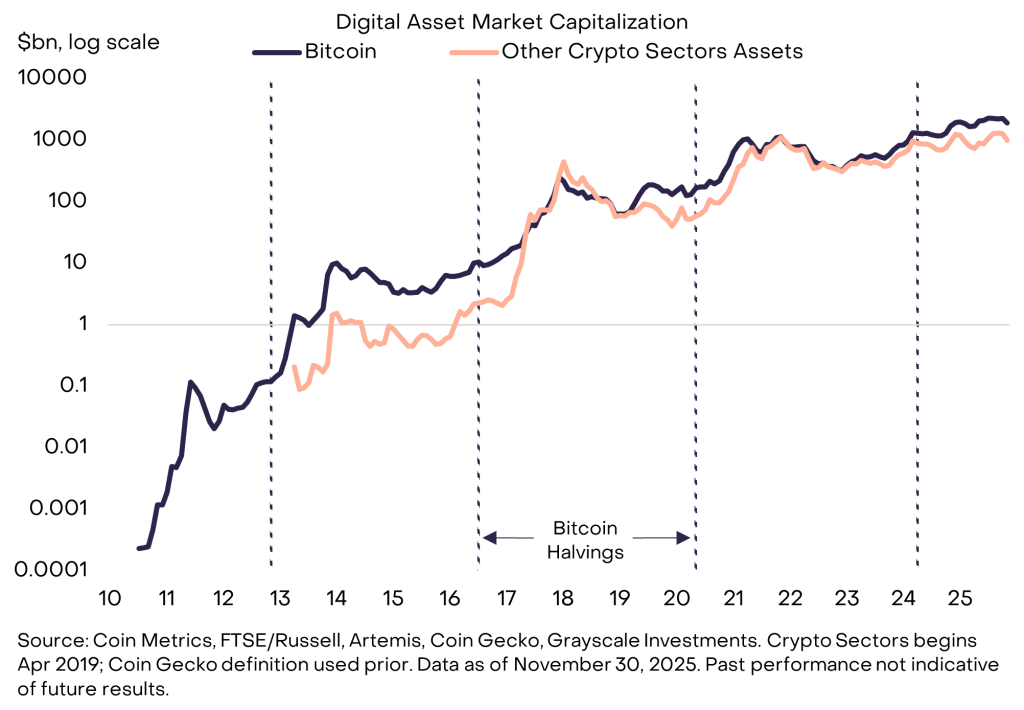
Grayscale expects rising valuations in the crypto sector in 2026, and as a result, Bitcoin could exceed its previous high in the first half of the year.

Bitcoin 2026 - Digital Asset Market Capitalization
Source: GrayScale

Bitwise’s analysis also highlights how Bitcoin volatility has steadily decreased over the past decade, with BTC now less volatile than Nvidia throughout 2025.

Hougan predicts Bitcoin’s correlation with stocks will fall in 2026 as crypto-specific factors like regulatory progress and institutional adoption power the asset higher even if equities struggle.

Regulatory Clarity and Monetary Policy Alignment

Katherine Dowling, president of Bitcoin Standard Treasury Company, recently forecast that Bitcoin would reach $150,000 by the end of 2026, citing “the trifecta of a positive regulatory environment, quantitative easing, and institutional inflows.

President Trump recently signed the GENIUS Act, establishing stablecoin regulatory framework, while the Office of the Comptroller of the Currency permitted national banks to offer crypto brokerage services.

Just this month, Bank of America now allows its financial advisers to recommend Bitcoin ETFs, potentially channeling portions of the bank’s $3.5 trillion in client assets into digital assets.

The Federal Reserve cut rates three times in 2025 and expects to continue easing next year.

Notably, Grayscale expects bipartisan crypto market structure legislation to become US law in 2026, which will solidify blockchain-based finance in capital markets.

Since US Bitcoin ETPs launched in January 2024, global crypto ETPs have attracted $87 billion in net inflows, yet less than 0.5% of US advised wealth is allocated to crypto.

On the technical level, according to a CryptoQuant analyst, on-chain data shows long-term holders distributing coins at one of the largest 30-day rates in the past 5 years, typically indicating late-cycle behavior.

However, CryptoQuant data also shows short-term holders are facing pressure, as Bitcoin has traded below their $104,000 cost basis since October 30, resulting in unrealized losses averaging 12.6%.

As reported by Cryptonews today, Bitcoin dropped nearly 4% to approximately $85,940 amid investor risk reduction ahead of crucial US economic data.

Despite near-term volatility, like other major players, Bitfinex maintains that the groundwork is being laid for BTC to regain all-time highs in 2026, supported by looser monetary policy and steady adoption by ETFs, corporates, and sovereign entities that are absorbing multiples of the yearly mined supply.

The post Bitwise Chief: Bitcoin to Hit Fresh Records in 2026 and Break Four-Year Cycle appeared first on Cryptonews.
FCA Opens Consultation on UK’s First Comprehensive Crypto Rulebook

16 December 2025 at 07:57

The Financial Conduct Authority launched a public consultation on comprehensive crypto regulations designed to establish clear standards across trading, staking, lending, and decentralized finance while protecting consumers and supporting innovation.

The proposals, published across three consultation papers, seek feedback until February 12, 2026, as Britain positions itself as a global hub for digital assets ahead of the regime’s 2027 implementation.

The regulatory framework applies similar principles to crypto as traditional finance, requiring transparency for consumers, proportionate requirements for firms, and flexibility for innovation.

David Geale, executive director for payments and digital finance at the FCA, said: “Regulation is coming – and we want to get it right. We’ve listened to feedback, and now we’re setting out our proposals for the UK’s crypto regime.

Comprehensive Framework Covers Eight Core Areas

The consultation addresses admissions and disclosures, requiring firms to provide clear information before investors commit capital to cryptoassets.

Market abuse measures target insider trading and manipulation to ensure fair markets, while trading platform standards aim to keep exchanges safe and reliable.

Intermediary requirements establish responsibilities for brokers and middlemen handling crypto transactions.

Staking services must clearly disclose risks when offering yield-generating products that lock up customer assets.

Lending and borrowing rules protect both crypto lenders and borrowers through standardized safeguards.

The proposals extend to decentralized finance, questioning whether traditional finance rules should apply to protocols enabling trading and lending without intermediaries.

Prudential requirements establish financial safeguards that help firms better manage operational risks.

The framework builds on earlier feedback and new research published alongside the consultation, aligning with government legislation introduced on December 15.

🇬🇧 The UK Treasury said that it will implement  “firm and proportionate” rules for crypto regulation overseen by the UK FCA.#CryptoRegulation #UKFCA #HMTreasuryhttps://t.co/5KM6LoLf6K

— Cryptonews.com (@cryptonews) December 15, 2025

Government Legislation Backs Regulatory Expansion

The Treasury introduced the Financial Services and Markets Act 2000 (Cryptoassets) Regulations 2025, bringing new crypto activities under FCA supervision from 2027.

Chancellor Rachel Reeves said, “Bringing crypto into the regulatory perimeter is a crucial step in securing the UK’s position as a world-leading financial centre in the digital age.

Economic Secretary Lucy Rigby also added that “We want the UK to be at the top of the list for cryptoassets firms looking to grow and these new rules will give firms the clarity and consistency they need to plan for the long term.

The legislation places crypto firms under the same supervision as traditional financial products, including transparency standards.

Britain’s approach follows the European Union’s Markets in Crypto-Assets Regulation, while the US is developing its own framework.

The UK established the Transatlantic Taskforce with America to coordinate crypto standards. Around 12% of UK adults now hold cryptocurrency, according to FCA data.

Regulatory Progress Follows Market Development

The consultation caps significant regulatory evolution since Britain formally recognized Bitcoin and crypto assets as legal property under the Property (Digital Assets etc) Bill.

The law confirmed digital assets can be owned, inherited, and recovered under property law protections previously limited to traditional assets.

Parliament’s approval resolved legal ambiguity around ownership disputes, stolen funds, and inheritance cases.

CryptoUK called the property law “a massive step forward,” noting it provides a clearer legal footing for proving ownership and recovering tokens after fraud.

👨🏻‍⚖️ The UK has formally recognized cryptocurrencies and stablecoins as legal property through a new Act of Parliament.#UK #Cryptohttps://t.co/I68t8BBZoD

— Cryptonews.com (@cryptonews) December 3, 2025

In September, the FCA accelerated crypto application reviews, cutting approval times from 17 months to 5 months while raising acceptance rates from 15% to 45%.

BlackRock and Standard Chartered secured registrations since April as the regulator improved processes through pre-approval meetings and industry roundtables.

The Bank of England separately proposed stablecoin regulations last month, with both institutions promising final rules by the end of 2026.

The government also appointed a “digital markets champion” to coordinate the development of blockchain-based financial infrastructure, including tokenized securities and digital gilts, under the DIGIT framework.

Last month, the Treasury also advanced DeFi tax reforms, backing a “no gain, no loss” model deferring capital gains until users withdraw tokens rather than taxing every deposit.

The changes follow two years of consultations with industry participants, including Aave, Binance, and major accounting firms, to align tax events with actual economic outcomes.

The post FCA Opens Consultation on UK’s First Comprehensive Crypto Rulebook appeared first on Cryptonews.

Wyoming Crypto Bank Files Petition Demanding Full Court Review of Fed Account Denial

16 December 2025 at 04:40

Wyoming-chartered crypto bank Custodia has filed a petition with the full Tenth Circuit Court of Appeals, seeking reconsideration of the Federal Reserve’s denial of its master account application, escalating a five-year legal battle.

The bank argues that the October panel decision misinterpreted federal law and raises constitutional concerns about the Fed’s authority.

The petition, filed on December 15, requests en banc review, asking all active circuit judges to examine whether regional Federal Reserve Banks can exercise unreviewable discretion over master account access for legally eligible institutions.

Custodia contends the three-judge panel’s 2-1 ruling conflicts with the Monetary Control Act’s mandate that payment services “shall be available” to nonmember depository institutions, creating what it describes as an unconstitutional veto power over state banking charters.

🚨NEW: Wyoming crypto bank @custodiabank has filed a petition for rehearing en banc, meaning it’s asking the full Tenth Circuit (not just the original three-judge panel) to reconsider its October decision siding with the @federalreserve in denying Custodia a master account.

The… pic.twitter.com/RDfeorIKGc

— Eleanor Terrett (@EleanorTerrett) December 16, 2025

State Banking Authority Under Threat

The filing raises federalism concerns about the Fed effectively overriding Wyoming’s 2020 decision to charter Custodia as a Special Purpose Depository Institution.

Without master account access, the bank cannot utilize core Federal Reserve payment services, including wire transfers and automated clearinghouse systems, rendering its state-issued charter largely meaningless despite meeting all statutory eligibility requirements.

When the Fed denies a master account to a state-chartered financial institution, it effectively vetoes a bank charter that State regulators have approved,” the petition states.

Wyoming created its SPDI framework specifically to attract digital asset companies, requiring 100% reserve backing and prohibiting lending to reduce risk.

Custodia argues the Fed’s rejection undermines this carefully crafted state regulatory regime designed to foster blockchain innovation within stringent safety parameters.

The constitutional implications extend beyond federalism.

Custodia’s legal team contends that if regional Reserve Bank presidents hold unreviewable discretion over master accounts, they effectively become “Officers of the United States” wielding significant executive authority without proper constitutional appointment.

Federal Reserve Bank presidents are selected by private bank directors and approved by the Board of Governors, a process Custodia argues violates the Appointments Clause if those officials exercise the discretionary power the majority opinion affirmed.

Deep Judicial Split Emerges

The petition highlights growing disagreement among Tenth Circuit judges on statutory interpretation.

Judge Timothy Tymkovich’s dissent joined Judge Bacharach’s 2017 opinion in Fourth Corner Credit Union v. Federal Reserve Bank of Kansas City, creating a 2-2 split among circuit judges on whether the Monetary Control Act mandates master account access.

Tymkovich wrote that the Fed’s interpretation grants “unreviewable discretion” that raises “thorny questions” under Article II while contradicting the MCA’s plain language, which requires services to be “available to nonmember depository institutions.

The Kansas City Fed denied Custodia’s application in January 2023 after 27 months of review, citing risks from its “crypto-asset activities” despite initially telling the bank there were “no showstoppers” with its application.

❌ A federal appeals court in Denver has upheld the Federal Reserve’s right to deny crypto-focused bank @custodiabank access to a master account.#Crypto #Custodiahttps://t.co/MAHuPSXT5x

— Cryptonews.com (@cryptonews) November 1, 2025

Internal Fed documents revealed that staff deemed Custodia’s capital “adequate” and praised its “impressive” executive team, only for Board of Governors officials to intervene.

Federal Reserve Governor Christopher Waller has since acknowledged publicly that the Fed possesses sufficient tools to manage risks without denying master accounts entirely.

In an October interview, Waller suggested the Fed can “tailor” account structures to match individual bank risk profiles, undermining the necessity argument for blanket denials.

OCC Exposes Systematic Crypto Debanking

Custodia’s legal fight unfolds as federal regulators confront widespread debanking practices targeting crypto firms.

The Office of the Comptroller of the Currency released findings in December showing all nine largest national banks imposed “inappropriate” restrictions on lawful businesses, including digital asset companies, between 2020 and 2023.

JPMorgan Chase, Bank of America, Citibank, Wells Fargo, and others maintained internal policies requiring escalated approvals or imposing blanket restrictions on sectors deemed to conflict with institutional values.

The review examined thousands of complaints about political and religious debanking, as well as crypto exclusions.

🚨 @USOCC reveals nine major banks, including @jpmorgan “debanked” crypto and other lawful industries with inappropriate restrictions #CryptoNews #Bankinghttps://t.co/hZYJOCY88v

— Cryptonews.com (@cryptonews) December 11, 2025

Banks insisted they did not discriminate, but the OCC found many restrictive policies were publicly visible.

In fact, Strike CEO Jack Mallers recently claimed his accounts were abruptly closed under vague references to “concerning activity,” fueling allegations of coordinated exclusion despite regulatory denials.

The controversy intensified after President Trump signed an executive order in August intended to prevent banks from debanking customers solely for crypto-related activity.

The post Wyoming Crypto Bank Files Petition Demanding Full Court Review of Fed Account Denial appeared first on Cryptonews.

US Financial Watchdog No Longer Sees Crypto as Systemic Threat: Report

16 December 2025 at 04:06

The Financial Stability Oversight Council has removed crypto from its list of systemic financial threats in its 2025 annual report. This is a dramatic regulatory shift attributable to the transformation happening under the Trump administration.

The 86-page document, approved December 11, eliminates the dire warnings about digital assets that dominated previous years, instead emphasizing responsible growth and regulatory clarity for the sector.

The FSOC’s latest assessment contrasts sharply with its 2024 report, which warned that stablecoins represented an acute vulnerability to runs absent appropriate risk-management standards.

This year’s report acknowledges crypto’s role in innovation and economic development, while noting that recent legislative progress has addressed many of the concerns that previously existed.

The council now describes digital assets as facilitating secure, efficient transactions through distributed ledger technology rather than framing them as destabilizing forces.

US Crypto Systemic Threats - FSOC Report Cover
Source: FSOC

Legislative Progress and Banking Access Reforms

The transformation stems largely from the passage of the GENIUS Act in July, which established America’s first comprehensive federal framework for payment stablecoins.

The legislation requires licensed issuers to maintain reserves in highly liquid assets, such as U.S. Treasuries, and prohibits rehypothecation except for limited purposes.

Treasury Secretary Scott Bessent noted in the report that continued use of dollar-denominated stablecoins supports the dollar’s role in international finance.

Beyond stablecoins, federal agencies have systematically withdrawn restrictive guidance that previously discouraged banks from engaging with crypto firms.

The SEC eliminated prior-notification requirements for offering digital asset custody services, while banking regulators rescinded joint statements that effectively pushed crypto activity outside traditional finance.

The Federal Reserve ended its novel activities supervision program, returning oversight to normal supervisory processes.

The Office of the Comptroller of the Currency released preliminary findings showing all nine largest national banks imposed inappropriate restrictions on lawful crypto businesses between 2020 and 2023.

JPMorgan Chase, Bank of America, Citibank, Wells Fargo, and others maintained internal policies requiring escalated approvals or blanket limitations on digital asset companies, alongside sectors such as firearms and adult entertainment.

Comptroller Jonathan Gould described the practices as “harmful to lawful enterprises” and an inappropriate use of national bank charters.

The findings build on President Trump’s August executive order guaranteeing fair banking access and state-level fair access laws in Florida, Idaho, and Tennessee, designed to prevent ideological account closures.

Market Structure Legislation Races Senate Deadline

Last week, Senator Cynthia Lummis pushed for immediate Senate Banking Committee markup of the Responsible Financial Innovation Act before the holiday recess, warning negotiations cannot drift into February without risking election-year paralysis.

She told the Blockchain Association Policy Summit that bipartisan drafts have been rewritten repeatedly, exhausting staff members as lawmakers struggle to reconcile the House and Senate approaches to defining which tokens fall outside securities classification.

@SenLummis says she wants a markup on the crypto market structure bill next week even as staff are “exhausted” from nonstop revisions. #Crypto #USPolicy #Lummishttps://t.co/RadNIvnWLp

— Cryptonews.com (@cryptonews) December 9, 2025

The House passed the Digital Asset Market Clarity Act in July, giving the CFTC primary oversight of digital commodities while preserving SEC authority over fundraising.

The Senate version uses the term “ancillary assets” and faces tension over decentralized finance regulation.

Senator Thom Tillis warned that missing the December window could freeze the bill for the rest of 2026.

However, Senator Mark Warner also suggested completing everything before the holiday recess would be difficult, noting the White House still hadn’t provided final language on quorum and ethics rules.

Traditional Finance Embraces Tokenized Products

JPMorgan Chase demonstrated the sector’s mainstreaming by launching its first tokenized money-market fund on the Ethereum network.

The My OnChain Net Yield Fund begins with $100 million of the bank’s capital before opening to qualified investors with minimum investments of $1 million.

The MONY fund accepts subscriptions in cash or USDC, demonstrating institutional adoption of crypto-native payment rails for settlement alongside traditional cash.

🏦 JPMorgan is launching its first tokenized money-market fund on Ethereum, reports the WSJ. #JPMorgan #Ethereum https://t.co/bjjIFNFRnJ

— Cryptonews.com (@cryptonews) December 15, 2025

The launch follows the GENIUS Act’s regulatory clarity, with Wall Street accelerating tokenization efforts across equities, bonds, and real-world assets.

John Donohue, JPMorgan’s global liquidity head, cited a “massive amount of interest from clients around tokenization” and the bank’s intention to lead the space with product lineups that match traditional money-market fund choices on the blockchain.

The integration of blockchain into core financial products, once considered distant from crypto, indicates the technology is progressing from experimental to infrastructure-grade status within traditional finance.

The post US Financial Watchdog No Longer Sees Crypto as Systemic Threat: Report appeared first on Cryptonews.

Bitcoin Price Prediction: BTC Nears a Break Below Key 2-Year Support at $81K — Can a Low Sweep Spark a Rally Back to $100K?

15 December 2025 at 18:30

Today’s Bitcoin liquidation is approaching $400 million and has pushed prices toward a critical 2-year support level maintained since 2023.

Bitcoin price prediction now points to a potential sweep of the $80,000 lows before a bullish reversal toward $100,000.

On-Chain Data Shows $81K as Critical Support

Data from Glassnode reveals Bitcoin’s True Market Mean, the average on-chain purchase price held by active market participants, stands near $81,000, serving as strong support during today’s 3.6% decline that sent prices below $86,000.

Bitcoin's True Market Mean—the average on-chain purchase price of Bitcoin held by active participants—stood near $81K as strong support during the last drawdown.

Bitcoin first broke above it in October 2023 and hasn't traded below since. pic.twitter.com/2Wz1EWPzIi

— Bitcoin News (@BitcoinNewsCom) December 15, 2025

Crypto analyst Darkfost observed that inflows to Binance from “wholecoiners” (transactions exceeding 1 BTC) are collapsing compared to previous years.

The yearly average now sits around 6,500 BTC, a level not seen since 2018.

“What is particularly interesting is the trend these inflows have followed during this cycle compared to past ones.

Instead of increasing as they did previously, wholecoiner inflows to Binance have steadily declined, even as Bitcoin continued pushing higher,” Darkfost explained.

BTC demand on spot orderbooks currently sits at elevated levels, from $85,000 down to $80,000, suggesting continued downward pressure on the asset.

However, analyst Ted Pillows reveals that defending the $81,000 support could enable Bitcoin to target the next major resistance zone around $92,000-$94,000.

Bitcoin Price Prediction: Weekly Chart Shows Bearish Momentum Cooling

Bitcoin’s weekly chart displays clear momentum deterioration after failing to maintain above the $100,000 psychological resistance, which now represents the key threshold required to resume a sustained uptrend.

Price has since reversed and trades in the mid-$80,000 region, with sellers driving it toward a critical support band around $81,000.

The RSI has dropped into the mid-30s, indicating growing bearish pressure, but approaches levels where downside momentum typically begins slowing.

Bitcoin Price Prediction - Bitcoin Price Chart
Source: TradingView

If the $81,000 support maintains, the chart favors a short-term relief rally toward the $90,000–$95,000 region, with a larger move back toward $100,000 only probable if buyers reclaim that level on strong volume.

However, a decisive weekly close below $81,000 would bring the final bull-market structure support near $76,000 into focus, and losing that level would significantly increase the risk of a deeper corrective phase.

Pepenode Offers Investors 553% APY Ahead of 2026 Bull Run

If Bitcoin finally breaks the $100,000 level and starts climbing again, meme coins like Pepenode (PEPENODE) could see another explosive rally.

Pepenode is a new crypto project that’s already raised over $2.3million despite tough market conditions.

It’s a game where you can mine coins without needing expensive hardware setups.

Bitcoin Price Prediction - Pepenode banner

You play the game in your web browser, set up virtual mining rigs, and upgrade your facilities to earn PEPENODE tokens.

The project is copying PEPE’s success strategy, which surged over 1,000x during the 2023-24 run when Bitcoin entered “up only” mode.

Now that more people are buying Pepenode’s mining rigs, the token price is expected to rise quickly.

To join the presale before the price increases:

  • Go to the official Pepenode website.
  • Connect a crypto wallet like Best Wallet.
  • Then buy PEPENODE tokens for $0.0011968 and pay with crypto, using ETH, or USDT, or use a bank card in just a few clicks.
Visit the Official Pepenode Website Here

The post Bitcoin Price Prediction: BTC Nears a Break Below Key 2-Year Support at $81K — Can a Low Sweep Spark a Rally Back to $100K? appeared first on Cryptonews.

Solana Dominates Crypto Attention for Second Straight Year: Analysis

15 December 2025 at 14:30

Solana captured 26.79% of global interest in blockchain-specific narratives throughout 2025, securing its position as the most popular crypto ecosystem for the second consecutive year despite facing mounting competition and declining market share.

Base and Ethereum rounded out the top three positions while newer entrants like Sui and BNB Chain surged into prominence, according to CoinGecko’s latest blockchain ecosystem analysis.

The layer-1 network’s market share dropped 12.0 percentage points from 38.79% in 2024, due to struggles to expand beyond meme-coin speculation even as institutional adoption accelerated through U.S. ETF launches.

The decline pushed Solana out of the top five most popular crypto narratives ranking after being overtaken by AI agents and Made in USA themes.

Most Popular Blockchain Ecosystems in 2025 By Mindshare

1. Solana – 26.79%
2. Base – 13.94%
3. Ethereum – 13.43%
4. Sui – 11.77%
5. BNB Chain – 9.05%
6. XRP Ledger – 4.68%
7. Sonic – 2.29%
8. Cardano – 1.92%
9. Bittensor – 1.91%
10. Hyperliquid – 1.57%
11. TON – 1.23%
12.…

— CoinGecko (@coingecko) December 15, 2025

Base and Ethereum Hold Ground

Coinbase’s Base ecosystem maintained second place with 13.94% of investor interest, down 2.9 percentage points from 16.81% in 2024.

The smaller decline came despite major developments, including the Coinbase Wallet rebrand into the Base app, Shopify’s USDC payment integration, and x402 facilitation rollout.

Ethereum secured third position with 13.43% mindshare, posting a 2.7 percentage point year-over-year increase that narrowed its gap with Base.

The growth occurred while investors remained critical about ETH price performance and the blockchain’s competitive positioning amid intensifying rivalry from faster networks.

However, Ethereum’s scaling layer faces severe consolidation pressure, as Base, Arbitrum, and Optimism now process nearly 90% of all L2 transactions, with Base alone accounting for over 60%.

According to 21Shares, most of the 50-plus competing L2s are unlikely to survive through 2026 as smaller rollups have seen activity plunge 61% since June, creating what analysts call ‘zombie chains’ with minimal usage and evaporating liquidity.

Sui and BNB Chain Double Their Market Presence

Sui and BNB Chain emerged as the year’s biggest gainers, after more than doubling their market share to claim fourth and fifth positions, respectively.

Sui recorded the largest growth, with a 6.9 percentage-point jump to 11.77%, positioning itself close behind Ethereum and establishing credibility as a serious competitor in chain-specific narratives.

BNB Chain captured 9.05% mindshare following a 4.9 percentage point increase, driven by Binance Alpha’s May launch that propelled the network to lead onchain trading volumes.

The ecosystem also benefited from founder CZ’s renewed involvement and resilient BNB price action throughout the year.

Solana’s momentum continued to build through major platform integrations, as Coinbase activated native DEX trading for Solana tokens in its mobile application in early December, allowing users to swap assets on-chain for the first time.

The exchange separately announced plans to acquire Vector, a Solana-native trading platform, in a deal expected to close by year-end.

Solana Dominates Crypto - CoinGecko Top Blockchain by interest list
Source: CoinGecko

New Entrants Reshape Competitive Landscape

XRP Ledger and Bittensor led new additions to the top rankings, with XRP securing sixth place at 4.68% mindshare and the AI-focused Bittensor capturing 1.91% for ninth position.

Berachain and Abstract also broke into the top 20 among new ecosystems tracked this year.

Hyperliquid delivered the most dramatic rise after increasing from 0.01% mindshare in 2024 to 1.57% this year, climbing 44 positions in the rankings.

The perpetuals-focused platform marked a key stablecoin milestone with its USDH launch while building robust DEX infrastructure and community engagement that demonstrated scalability beyond single-product offerings.

Meanwhile, the TON ecosystem saw its ranking slide following a 5.0 percentage-point year-over-year decline in mindshare, contrasting sharply with Sui’s ascent as a serious contender for a chain-specific narrative.

Notably, Jupiter reinforced Solana’s ecosystem depth by announcing seven coordinated upgrades at Breakpoint, headlined by JupUSD stablecoin developed with Ethena.

The Solana DEX, which processed $1.08 trillion in combined spot and perpetual volume year-to-date while maintaining $2.7 billion in total value locked, also exited beta for Jupiter Lend after reaching $1 billion in supply within eight days.

🚀 Jupiter launches JupUSD stablecoin with Ethena and unveils six ecosystem upgrades including Developer Platform and https://t.co/ox0G6lqvMl acquisition to expand Solana DeFi infrastructure.#jupiter #Solanahttps://t.co/TyQzmfb9XB

— Cryptonews.com (@cryptonews) December 12, 2025

Bhutan further validated Solana’s institutional appeal by launching TER, a gold-backed digital token running on the network and distributed through DK Bank.

The sovereign-backed initiative positions Bhutan among nations experimenting with state-issued tokenized assets while leveraging Solana’s speed and efficiency.

The post Solana Dominates Crypto Attention for Second Straight Year: Analysis appeared first on Cryptonews.

Bitcoin Price Prediction: Japan’s Next Rate Hike Could Flip the Global Risk Trade – Is Bitcoin the Big Winner?

15 December 2025 at 12:01

Japan’s central bank is scheduled to hold its Monetary Policy Meeting (MPM) on December 18–19, 2025, with markets anticipating a possible rate hike to 0.75% from 0.5%, a move that could flip the global risk trade and significantly impact the Bitcoin price prediction outlook.

Japan’s Rate Hike Is Risky For Bitcoin

Analysts view the potential rate hike as ending the “Carry Trade” era.

Higher rates make yen assets more appealing, prompting investors to pull capital from overseas holdings like crypto.

This strengthens the yen, raises borrowing costs worldwide, and dampens Bitcoin speculation, historically causing 20-30% price drops.

🚨 HOW WILL BITCOIN REACT TO JAPAN's RATE HIKE?

🏦The Bank of Japan is expected to raise rates to 0.75%, a level not seen since 1995, and #Bitcoin is already not liking it.

WHY?🤷

Because history isn’t kind to Bitcoin here…

🗓During the last 3 BOJ rate hikes, BTC drops 20%+… pic.twitter.com/KaEsxZyHc8

— Coin Bureau (@coinbureau) December 15, 2025

Macro investor Afsheen Jafry explained that while markets focus on Powell and the Fed, the BOJ actually controls something more fundamental: global liquidity flows.

“When the BOJ tightens, capital floods back to Japan. When they ease, it floods out, and crypto is always first in line to catch that overflow,” she noted.

She cited July 2024 when the BOJ’s rate increase triggered a massive selloff, crushing Bitcoin from $73,000 to $53,000.

“That wasn’t random. That was carry trade unwinding on a massive scale.”

The BOJ also holds roughly ¥83 trillion ($534 billion) in ETFs accumulated since 2010, representing 7-8% of Japan’s ETF market.

Reports indicate officials plan gradual sales of these ETFs starting in January 2026.

These sales would reverse years of liquidity injections, potentially pressuring Japanese stocks and reducing global risk appetite.

Bitcoin Price Prediction: Defending $80K Support Critical for Price Recovery

Bitcoin is holding firm above the $80,000 level after November’s sharp drop, showing buyers are defending this key support that has held since late 2024.

The recent push toward the upper $80,000s hints at early signs of recovery, but BTC remains trapped below the critical $100,000 to $109,000 resistance zone.

Breaking through this range could flip momentum and confirm a true reversal. Otherwise, this bounce may fade.

Bitcoin Price Prediction - Bitcoin Price Chart
Source: TradingView

RSI has climbed from oversold levels into the mid-40s, signaling that selling pressure is cooling, though upside momentum is not yet convincing.

If Bitcoin keeps holding $80,000, a retest of $100,000 is likely, with $109,000 as the next target. On the flip side, a breakdown could send BTC sliding toward the $62,000 to $71,000 demand zone.

As Bitcoin prepares for its next move, traders are pouring millions of dollars into presales, investing in meme coins before they list on exchanges.

Don’t Miss Out on One of the Hottest Meme Presales Right Now

Maxi Doge ($MAXI) has quickly become one of the most talked‑about presales in crypto, gathering millions in early support and standing out in a crowded meme coin market.

This is not just another token, it’s a high‑energy community‑driven play built for traders who want early exposure before listings hit major exchanges.

The MAXI presale has established an alpha channel where traders exchange tips, early trade ideas, and hidden opportunities to capitalize on the upcoming bull run.

Bitcoin Price Prediction - Maxidoge banner

Traders are already comparing $MAXI’s momentum to Dogecoin’s early days, with strong social engagement and visibility rising fast.

To get involved before the next price increase:

Visit the Official Maxi Doge Website Here

The post Bitcoin Price Prediction: Japan’s Next Rate Hike Could Flip the Global Risk Trade – Is Bitcoin the Big Winner? appeared first on Cryptonews.

Agnelli Family Rejects Tether’s $1 Billion Bid for Juventus Stake

15 December 2025 at 06:42

The Agnelli family has unanimously rejected Tether’s binding all-cash proposal to acquire majority control of Juventus Football Club, dismissing the stablecoin issuer’s €1 billion ($1.17 billion) investment pledge just one day after the offer became public.

According to Dow Jones Newswires, Exor, the family’s holding company, said Saturday it has no intention of selling its 65.4% stake to the El Salvador-based crypto firm or any third party, ending what would have been one of European football’s most audacious takeover attempts this year.

Tether submitted its formal proposal on Friday, seeking to purchase Exor’s controlling position and subsequently launch a public tender for all remaining shares at an undisclosed price.

As per Reuters, Juventus shares surged more than 12% Monday morning, reaching their highest level since November 25, after the rejection implied a 21% premium to Friday’s close despite the family’s refusal to negotiate.

@Tether_to has launched an all-cash bid to acquire Italy’s @juventusfcen, an offer that was reportedly swiftly turned down.#Tether #Cryptohttps://t.co/4iTBXWjo5V

— Cryptonews.com (@cryptonews) December 13, 2025

Century-Old Legacy Defends Against Crypto Ambition

Exor’s board emphasized that Juventus represents more than a commercial asset for the Agnelli dynasty, which has maintained ownership for over a century.

Juventus is a storied and successful club, of which Exor and the Agnelli family are the stable and proud shareholders for over a century, and they remain fully committed to the club,” the holding company stated, closing the door on further discussions.

Tether CEO Paolo Ardoino positioned the rejected offer as a long-term commitment rooted in his personal connection to the Turin-based Serie A club.

As a boy, I learned what commitment, resilience, and responsibility meant by watching Juventus face success and adversity with dignity,” Ardoino said, adding that Tether was prepared to support the club with stable capital across a lengthy investment horizon.

The stablecoin issuer framed its proposal as a strategic move to help Juventus navigate a rapidly changing global sports and media landscape.

Despite the rebuff, Tether maintains significant influence within Juventus after quietly purchasing an initial stake in February and expanding holdings beyond 10% by April.

The company successfully placed deputy investment chief Zachary Lyons and Francesco Garino on Juventus’s board in October, with shareholders approving Garino’s appointment last month.

Private Equity Reshapes European Football Landscape

Tether’s rejected bid arrives amid accelerating private-equity interest in European football clubs, as they seek to capitalize on lucrative media rights and player transfer markets.

According to Newswires, Apollo Global Management agreed last month to acquire majority control of Spanish club Atletico de Madrid, while RedBird Capital purchased AC Milan for $1.2 billion in 2022 and Oaktree Capital seized FC Inter Milan last year.

Financial groups have rushed into European football as clubs generate increasing revenue from international broadcasting deals and player transactions.

Juventus, valued at roughly €944 million, represents a particularly attractive target given its status as Italy’s most successful club with a global fanbase and established commercial infrastructure.

However, crypto partnerships have drawn sharp criticism when clubs partner with questionable firms.

FC Barcelona faced backlash in November after signing a three-year sponsorship deal with Zero-Knowledge Proof, a blockchain startup registered in Samoa with minimal social media presence.

⚽ FC Barcelona draws backlash over sponsorship with obscure crypto firm ZKP amid concerns about transparency and financial desperation.#Barcelona #Cryptohttps://t.co/kvkBEK0a5j

— Cryptonews.com (@cryptonews) November 28, 2025

The club later distanced itself from ZKP’s FCB token, clarifying it had “no connection whatsoever” to the digital asset.

Sports crypto adoption is growing. Paris Saint-Germain became the first sports entity to adopt a Bitcoin treasury strategy in May, while football accounted for 43% of crypto and digital asset sponsorships during the 2024/25 season, up 64% year-over-year.

Tether’s Aggressive Expansion Across Multiple Sectors

Tether’s broader expansion push has accelerated dramatically across multiple sectors, with the company on track to generate approximately $15 billion this year from its $183.8 billion USDT market capitalization.

Recent reports also suggest Tether may seek $20 billion in new capital for a 3% ownership stake, establishing a valuation near $500 billion that would approach Mastercard while eclipsing Netflix and Samsung.

The firm has simultaneously deployed approximately $1.5 billion in commodity trade lending across oil, cotton, and agricultural markets while expanding its gold reserves beyond $12 billion to support this aggressive diversification strategy beyond its core stablecoin operations.

The post Agnelli Family Rejects Tether’s $1 Billion Bid for Juventus Stake appeared first on Cryptonews.

Do Kwon Could Face Second Trial in Korea After 15-Year US Sentence

15 December 2025 at 04:45

Terraform Labs co-founder Do Kwon faces the possibility of an additional trial and lengthy prison term in South Korea following his 15-year sentence from a Manhattan federal court for orchestrating the $40 billion TerraUSD collapse.

According to The Korea Times, the 34-year-old Korean national could apply to be transferred to his home country after serving half his US term, where prosecutors are seeking a sentence exceeding 30 years for violations of capital markets laws.

US District Judge Paul Engelmayer delivered the sentence last week, rejecting both the prosecution’s 12-year recommendation and the defense’s five-year request.

In the history of federal prosecutions, there are few frauds that have caused as much harm as you have,” Engelmayer told Kwon directly.

Do Kwon Korea Sentence - Do Kwon Arrest Picture
Source: The Korea Times

Korean Authorities Prepare Separate Prosecution

South Korean prosecutors obtained an arrest warrant for Kwon in September 2022 through the Seoul Southern District Prosecutors’ Office joint financial crimes unit.

A senior prosecutor told the local report that prosecuting Kwon domestically would serve local victims most effectively, as approximately 200,000 Korean investors have suffered losses totaling roughly 300 billion won ($204 million).

Ten alleged accomplices have faced trial in Korea for nearly three years while authorities awaited Kwon’s potential return.

The separate Korean charges center on violations of the Capital Markets Act stemming from the same conduct underlying his US conviction.

However, Korean prosecutors maintain they can pursue independent punishment regardless of the American proceedings.

Kwon initially sought extradition to Korea rather than to the United States after his March 2023 arrest in Montenegro on charges of possessing forged documents.

He spent nearly two years detained there before transfer to America in December 2024, with his defense team describing the conditions as “brutal.”

⚖ US prosecutors demand 12-year sentence for Do Kwon after Terra's $40B collapse that destabilized crypto markets and aided FTX implosion.#FTX #DoKwon #TerraFormhttps://t.co/LfzwEWH4XG

— Cryptonews.com (@cryptonews) December 6, 2025

Terra Collapse Mechanics and Fraudulent Claims

Between 2018 and 2022, Kwon admitted to knowingly participating in schemes to defraud Terraform Labs’ crypto purchasers.

The Singapore-based firm issued the TerraUSD stablecoin and its sister token, Luna, claiming that Terra maintained a one-to-one dollar peg through its protocol design.

When Terra fell below $1 in May 2021, Kwon publicly stated the protocol had restored its value autonomously.

US prosecutors later discovered that an investment firm contracted by Terraform Labs had secretly purchased Terra to artificially prop up its price, with Jump Trading’s role deliberately concealed from investors.

Both tokens plunged again in May 2022, wiping out tens of billions in investor value and triggering cascading failures across cryptocurrency markets.

Federal prosecutors specifically cited the collapse’s contribution to Sam Bankman-Fried’s FTX implosion as evidence of broader systemic damage beyond Terra’s immediate losses.

Kwon was convicted on nine counts, including fraud and money laundering, and Judge Engelmayer ordered the forfeiture of $19 million in illicit gains.

The initial potential sentence under US guidelines was 130 years, but the August plea agreement capped prosecutorial recommendations at 12 years.

Sentencing Disparities and Transfer Mechanics

Judge Engelmayer called the 12-year recommendation “unreasonable” while dismissing the five-year request as “implausible,” ultimately imposing 15 years as “the least I can impose.”

The defense argued that dual prosecution should be factored into sentencing calculations, particularly given the overlap in allegations across jurisdictions.

The court rejected this reasoning, with Engelmayer stating that one court cannot base rulings on speculation about another court’s decisions.

US prosecutors indicated they would not oppose a transfer request under the International Prisoner Transfer Program after Kwon serves half his sentence, leaving the pathway to Korean prosecution open.

🏦 US District Judge Paul A. Engelmayer handed down a 15-year prison sentence to Terraform Labs co-founder Do Kwon for Terra's $40 billion crash.#DoKwon #TerraUSD #CryptoFraudhttps://t.co/7N3WlnQrTB

— Cryptonews.com (@cryptonews) December 12, 2025

The contrasting treatment compared to Bankman-Fried’s 25-year sentence has raised questions about consistency, as Kwon’s guilty plea significantly reduced exposure despite Terra’s larger loss.

Legal experts note that federal guidelines for fraud at Terra’s scale typically suggest advisory ranges approaching life imprisonment before statutory caps.

Kwon will receive credit for time served in US custody, though questions remain about whether his 21-month detention in Montenegro will count toward his American term.

The sentencing comes amid escalating crypto-related criminal activity worldwide.

Spanish and Danish authorities recently arrested nine suspects in a violent kidnapping and murder targeting a victim’s crypto holdings.

Just last month, South Australia Police also filed 800 charges against 55 individuals in a massive crypto-linked crime ring.

The post Do Kwon Could Face Second Trial in Korea After 15-Year US Sentence appeared first on Cryptonews.

Major JavaScript Library Breach Puts All Crypto Websites at Risk

15 December 2025 at 04:04

A critical security flaw in React Server Components has prompted urgent warnings across the crypto industry, as threat actors are rapidly exploiting it to drain wallets and deploy malware.

Security Alliance announced that crypto-drainers are actively weaponizing CVE-2025-55182, urging all websites to review their front-end code immediately for suspicious assets.

The vulnerability affects not only Web3 protocols but all websites using React, with attackers targeting permit signatures across platforms.

Users face immediate risk when signing any transaction, as malicious code intercepts wallet communications and redirects funds to attacker-controlled addresses.

Crypto Drainers using React CVE-2025-55182

We are observing a big uptick in drainers uploaded to legitimate (crypto) websites through exploitation of the recent React CVE.

All websites should review front-end code for any suspicious assets NOW.

— Security Alliance (@_SEAL_Org) December 13, 2025

Critical Flaw Enables Remote Code Execution

React’s official team disclosed CVE-2025-55182 on December 3, rating it CVSS 10.0 following Lachlan Davidson’s November 29 report through Meta Bug Bounty.

The unauthenticated remote code execution vulnerability exploits how React decodes payloads sent to Server Function endpoints, allowing attackers to craft malicious HTTP requests that execute arbitrary code on servers.

The flaw impacts React versions 19.0, 19.1.0, 19.1.1, and 19.2.0 across react-server-dom-webpack, react-server-dom-parcel, and react-server-dom-turbopack packages.

Major frameworks, including Next.js, React Router, Waku, and Expo, require immediate updates. Patches arrived in versions 19.0.1, 19.1.2, and 19.2.1, with Next.js users needing upgrades across multiple release lines from 14.2.35 through 16.0.10.

Unfortunately, the researchers have again detected two major new flaws.

Researchers have found two new vulnerabilities in React Server Components while attempting to exploit the patches last week.

These are new issues, separate from the critical CVE last week. The patch for React2Shell remains effective for the Remote Code Execution exploit.

— React (@reactjs) December 11, 2025

Vercel deployed Web Application Firewall rules to automatically protect projects on its platform, though the company emphasized that WAF protection alone remains insufficient.

Immediate upgrades to a patched version are required,” Vercel stated in its December 3 security bulletin, adding that the vulnerability affects applications that process untrusted input in ways that permit remote code execution.

Multiple Threat Groups Launch Coordinated Attacks

Google Threat Intelligence Group documented widespread attacks beginning on December 3, tracking criminal groups ranging from opportunistic hackers to government-backed operations.

Chinese hacking groups installed various malware types on compromised systems, primarily targeting cloud servers on Amazon Web Services and Alibaba Cloud.

These attackers employed sophisticated techniques to maintain long-term access to victim systems.

Some groups installed software creating secret tunnels for remote control, while others deployed programs that continuously download additional malicious tools disguised as legitimate files. The malware hides in system folders and automatically restarts to avoid detection.

Several groups disguised malicious software as common programs or used legitimate cloud services, such as Cloudflare Pages and GitLab, to hide their communications.

New details on multiple state and criminal actors now exploiting React2Shell. https://t.co/4M21rqLndT

— John Hultquist (@JohnHultquist) December 13, 2025

Financially motivated criminals joined the attack wave starting on December 5, installing crypto-mining software that secretly uses victims’ computing power to generate Monero.

These miners run constantly in the background, driving up electricity costs while generating profits for attackers. Underground hacking forums quickly filled with discussions sharing attack tools and exploitation experiences.

Historic Supply Chain Attack Pattern Continues

The React vulnerability follows a September 8 attack in which hackers compromised Josh Goldberg’s npm account and published malicious updates to 18 widely used packages, including chalk, debug, and strip-ansi.

These utilities collectively account for over 2.6 billion weekly downloads, and researchers have discovered crypto-clipper malware that intercepts browser functions to swap legitimate wallet addresses with attacker-controlled ones.

Ledger CTO Charles Guillemet described that incident as a “large-scale supply chain attack,” advising users without hardware wallets to avoid on-chain transactions.

The attackers gained access through phishing campaigns impersonating npm support, claiming accounts would be locked unless two-factor authentication credentials were updated by September 10.

🚨 Hackers are stealing more crypto and moving it faster. One laundering process took only 2 minutes 57 seconds. Can the industry cope?#CryptoSecurity #Web3 #Blockchain #DeFihttps://t.co/lGwutYsT6Q

— Cryptonews.com (@cryptonews) August 12, 2025

Global Ledger data shows hackers stole over $3 billion across 119 incidents in the first half of 2025, with 70% of breaches involving funds being moved before they became public.

Only 4.2% of stolen assets were recovered, as laundering now takes seconds rather than hours.

For now, organizations using React or Next.js are advised to patch immediately to versions 19.0.1, 19.1.2, or 19.2.1, deploy WAF rules, audit all dependencies, monitor network traffic for wget or cURL commands initiated by web server processes, and hunt for unauthorized hidden directories or malicious shell configuration injections.

The post Major JavaScript Library Breach Puts All Crypto Websites at Risk appeared first on Cryptonews.

Solana Price Prediction: Analysts See $180 Breakout as Spot ETF Inflows Reach $674M

14 December 2025 at 08:47

Solana spot ETFs, which debuted in late November 2025, have recorded net inflows for seven consecutive trading days, accumulating $674 million in total.

Analysts suggest this institutional buying pressure could propel the Solana price prediction toward a $180 breakout.

Bitwise Dominates Solana ETF Inflow Rankings Ahead of $180 Breakout

Data from Sosovalue reveals Bitwise commands the lead with $608.81 million in inflows, while Grayscale and Fidelity follow with $97.74 million and $54.8 million, respectively.

🚨 Last week, $SOL spot ETFs recorded 7 straight days of net inflows. pic.twitter.com/oSVTls5SzV

— DustyBC Crypto (@TheDustyBC) December 14, 2025

Despite a 2% price decline over the past week, analysts say the growing institutional appetite for Solana is a necessary catalyst to finally breach the 2-month $180 resistance barrier.

Beyond institutional interest through ETFs, Solana has been earning credibility from Wall Street in its campaign to become the blockchain infrastructure for capital markets.

At the recently concluded Solana Breakpoint conference, Marc Antonio, Head of DeFi at asset manager Galaxy Digital, declared that Solana represents the only blockchain capable of processing tokenized securities at the scale that Wall Street executives like Larry Fink have long championed.

Antonio emphasized, “We want Solana to be so dominant and we want Solana to have such good prices that when you compare the price of Nasdaq-listed Forward Industries on Solana versus Nasdaq, you want to buy on Solana. That’s the end state.”

Solana Price Prediction: Technical Setup Shows Accumulation Before $180 Breakout

Solana is consolidating below a long-term descending trendline following an extended corrective period, with price currently maintaining within a clearly defined accumulation zone spanning $120–$135.

This area has repeatedly absorbed selling pressure, indicating sellers are exhausting their control, though the market hasn’t yet demonstrated a decisive reversal.

The failure to recapture the $180 level maintains the broader structure as technically bearish, with that zone now functioning as the primary upside obstacle.

Solana Price Prediction - Solana Price Chart
Source: TradingView

Momentum remains subdued, but the RSI is stabilizing in the low-40s and has begun printing mild bullish signals after a prolonged bearish stretch, suggesting downside momentum is diminishing.

If SOL can break above the descending trendline and reclaim $180, the chart opens pathways for a stronger recovery toward the $210 region, which aligns with the next major resistance level.

Pepenode Raises $2.3M To Position for Meme Coin Explosion

If SOL finally breaks through $180 resistance and converts the $200 psychological level into support, meme coins like Pepenode (PEPENODE) could experience 10-50x post-TGE rallies.

Pepenode is a new crypto project that’s already raised over $2.3 million despite challenging market conditions.

It’s a game where you can “mine” coins without needing expensive computer equipment.

Solana Price Prediction - Pepenode Banner

You play the game in your web browser, set up virtual mining nodes, and upgrade your facilities to earn more tokens.

The project is replicating the success strategies of PEPE and popular Solana memecoins that saw dozens of projects rally over 100x during the 2024 summer season.

Now that more people are starting to purchase Pepenode’s mining rigs, the token price is expected to rise rapidly.

To join the presale before the price increases, visit the official Pepenode website and connect a crypto wallet like Best Wallet.

You can buy tokens now for $0.001192 each and pay with crypto coins like ETH, BNB, or USDT.

Visit the Official Pepenode Website Here

The post Solana Price Prediction: Analysts See $180 Breakout as Spot ETF Inflows Reach $674M appeared first on Cryptonews.

Bitcoin Price Prediction: Analysts Warn BTC Could Slide Toward $70K if Bank of Japan Hikes Rates on Dec. 19

14 December 2025 at 07:13

Macro analysts are cautioning that Bitcoin could decline toward $70,000 as the Bank of Japan prepares to implement a 25-basis-point rate increase on December 19.

Bitcoin analyst AndrewBTC emphasized that Japan holds the largest position in U.S. government debt, making a rate hike bearish for the Bitcoin price prediction outlook.

Historical Pattern: BOJ Hikes Trigger 20%+ BTC Drops

In a December 13 X post, the analyst examined the BTC chart and noted a consistent pattern: every Bank of Japan rate hike has preceded Bitcoin declines exceeding 20%.

The data reveals that Bitcoin dropped 23% following the March 2024 rate hike, then fell 26% after the July 2024 increase, and most recently declined 31% following the January 2025 adjustment.

🚨 BREAKING: JAPAN WILL CRASH $BTC

Bank of Japan is set to hike rates +25 bps on Dec 19. Japan = largest holder of US government debt 🇯🇵

📉 Look at the $BTC chart:

Every BoJ rate hike → Bitcoin dumps over 20%+👇

• March 2024 → -23%
• July 2024 → -26%
• January 2025 →… pic.twitter.com/grN3QRNUg4

— AndrewBTC (@cryptoctlt) December 13, 2025

With another rate decision scheduled for next Friday, the analyst believes volatility from the BOJ announcement could drive Bitcoin down to the $70,000 support level.

Historically, BOJ rate increases have strengthened the Japanese yen, elevating borrowing costs and making investments in higher-risk assets less attractive.

In conversation with Cryptonews, Ignacio Aguirre, CMO at Bitget, explained that a stronger yen “raises the risk of unwinding yen carry trades which is a move that can temporarily weigh on crypto valuations as leveraged positions reset across global markets.”

Bitcoin now faces mounting pressure as investors reduce leverage and scale back exposure amid growing risk-off sentiment.

Bitcoin Price Prediction: Weekly Chart Shows Broken Bull Structure

The weekly Bitcoin chart reveals clear momentum deterioration following repeated failures to maintain support above the $100,000 psychological threshold, which has now converted back into solid resistance.

Price has broken down from the previous distribution zone near cycle highs and is trending lower, with bearish structure validated by consecutive lower peaks and steady descent toward the upper-$80,000 region.

Bitcoin Price Prediction - Bitcoin Price Chart
Source: TradingView

The RSI divergence indicator remains decisively bearish, currently positioned in the high-30s, displaying persistent weakness without any significant bullish divergence emerging.

If this momentum continues, the next major weekly support zone sits near $70,000, aligning with the prior range floor and representing the first area where substantial buying interest is likely to materialize.

A more severe correction toward the $53,000 zone cannot be dismissed if $70,000 fails to hold, potentially marking a cycle bottom.

MAXI Presale Opens Early Investment Access Before Bull Run Resumes

If Bitcoin successfully defends the $90,000 level and avoids crashing to the $70,000 lows, a 2026 bull run would remain intact, and early-stage projects like Maxi Doge ($MAXI) would benefit from the upcoming liquidity flowing into risk assets.

Maxi Doge has established an alpha channel where traders exchange insider tips, early trade ideas, and hidden opportunities to capitalize on the upcoming bull run.

Bitcoin Price Prediction - Maxidoge banner

The $MAXI presale has raised over $4.3 million and offers one of the most accessible entry points for everyday investors in this market cycle.

Participants who join now can still purchase at the current $0.00275 price before it increases and benefit from 72% annual staking rewards.

To buy early, visit the official Maxi Doge website and connect a crypto wallet like Best Wallet.

You can pay with existing crypto like USDT and ETH, or use a bank card to complete your purchase immediately.

Visit the Official Maxi Doge Website Here

The post Bitcoin Price Prediction: Analysts Warn BTC Could Slide Toward $70K if Bank of Japan Hikes Rates on Dec. 19 appeared first on Cryptonews.

❌
❌