
Normal view

There are new articles available, click to refresh the page.
Yesterday — 5 December 2025Main stream

Exposed: “Ramarxyz” Sniped 70% of $WET Presale With 1,000+ Wallets – Then Demanded Refund

5 December 2025 at 14:00

A chaotic token launch on Solana has placed decentralized finance platform HumidiFi and Jupiter Exchange under intense scrutiny after blockchain investigators linked a single actor to the mass botting of the $WET public presale, capturing the majority of the allocation within seconds.

According to a detailed on-chain investigation published by Bubblemaps, one entity operating under the alias “Ramarxyz” used more than 1,000 wallets to claim roughly 70% of the $WET public presale allocation.

BREAKING: We found the identity of the $WET sniper

"Ramarxyz" claimed 70% of the @HumidiFi presale using 1,000+ wallets

Then dared to ask for a refund

🧵pic.twitter.com/YhWnOrZRNZ

— Bubblemaps (@bubblemaps) December 5, 2025

The sale, which took place through Jupiter’s Decentralized Token Formation (DTF) launchpad, sold out in just two seconds before most retail participants could interact.

HumidiFi Confirms Bot Attack as Blockchain Data Traces Sale to One Actor

HumidiFi later confirmed that a large bot farm had overwhelmed the public sale. Bubblemaps found that at least 1,100 of the 1,530 participating addresses were controlled by the same actor.

The wallets followed a repetitive funding pattern, with each receiving exactly 1,000 USDC from centralized exchanges shortly before the sale.

Source: Bubblemaps

One wallet allegedly broke the pattern by receiving funds from a private address that could be traced to the Twitter handle @ramarxyz through previous public blockchain activity.

Rather than acknowledging the activity, the individual later publicly suggested that HumidiFi should refund the sniper’s allocation, despite being linked to the exploit.

Shortly afterward, HumidiFi confirmed that all suspected bot allocations had been canceled and that legitimate presale participants would instead receive a prorated airdrop.

A separate on-chain analysis by trader Gautam Mgg showed that 4% of the public allocation went to just 10 wallets, with four wallets alone committing 40% of the entire public sale supply using bots.

🚨 $WET @humidifi : 4% Public Sale Supply went to just 10 wallets

Presale was completely botted, basically rugged And yes, @JupiterExchange is also at fault.

Here’s the proof: These 4 wallets alone committed 40% of the 4% public sale allocation using bots (finding more… pic.twitter.com/5dGz3bHwjZ

— Gautamgg 🕵 (@Gautamguptagg) December 4, 2025

The wallets were publicly listed using Solana explorers. Gautam also blamed Jupiter Exchange for failing to introduce basic bot protection measures, such as CAPTCHA or last-minute address rotation.

Jupiter had earlier announced that the $WET token sale was fully completed, raising $5.57 million across its Wetlist, JUP stakers, and public sale phases.

It’s official: Public sale phase for $WET has SOLD OUT!

The Decentralized Token Formation for @HumidiFi is now officially concluded, raising a grand total of $5.57m across the Wetlist, JUP stakers and public sale phases.$WET token for successful contributors will be claimable… pic.twitter.com/o5Hleg91z1

— Jupiter (🐱, 🐐) (@JupiterExchange) December 4, 2025

The public phase offered 30 million tokens at $0.069 per token, capped at $1,000 USDC per wallet. The token is scheduled to become claimable on December 9 alongside the launch of liquidity pools.

HumidiFi to Reissue Token After Aborting Disrupted $WET Launch

Following the incident, HumidiFi announced it would abandon the compromised launch and create a new token instead.

The protocol said all legitimate Wetlist and JUP staker participants would receive a pro-rata airdrop under a newly deployed contract that has been audited. A new public sale is now scheduled.

Some real dry shit happened today.

Humidifi started 6 months ago from nothing, straight from the trenches of DeFi 1.0.

In those 6 months, for SOL-USD, we started quoting tighter and doing more volume than Binance. We did not kiss any ass or bend the knee to anyone. We started…

— HumidiFi (@humidifi) December 5, 2025

HumidiFi launched in mid-2025 and has grown into one of Solana’s most active decentralized exchanges, processing over $1 billion in daily trading volume and often accounting for more than one-third of all spot trading on the network.

According to DefiLlama, its Dex volume currently sits close to $30 billion over 30 days, while its cumulative volume sits at over $122 billion.
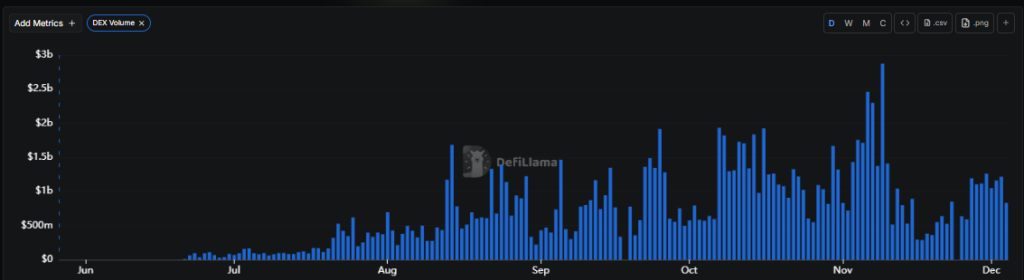
The $WET token was introduced as the protocol’s staking and fee-rebate asset and was promoted as a community-driven distribution using Jupiter’s DTF platform.

The incident has revived broader concerns over token distribution fairness across launchpads.

In September, Bubblemaps also flagged a separate Sybil attack linked to the MYX token airdrop, where roughly 100 newly created wallets claimed nearly $170 million in tokens after being funded simultaneously from OKX.

That case similarly raised questions about identity controls and launch design weaknesses.

Jupiter DTF was introduced as a transparent, trust-minimized alternative to traditional token launches, combining curation and on-chain verification. The $WET sale was its first live deployment, making the failure a major test for the model.

Neither Jupiter Exchange nor the individuals accused have issued a detailed technical breakdown of what failed at the infrastructure level.

The post Exposed: “Ramarxyz” Sniped 70% of $WET Presale With 1,000+ Wallets – Then Demanded Refund appeared first on Cryptonews.

Before yesterdayMain stream

BTC staking platform Babylon teams up with Aave for Bitcoin-backed DeFi insurance

3 December 2025 at 09:37
  • Babylon and Aave partner to enable native BTC as collateral for DeFi lending.
  • BTC can now back decentralised insurance pools, earning yield if unused.
  • Users retain full control of their Bitcoin while accessing DeFi liquidity.

In a groundbreaking move for the decentralised finance (DeFi) ecosystem, Bitcoin staking platform Babylon has announced a partnership with Aave, one of the largest decentralised lending protocols.

The collaboration aims to allow Bitcoin (BTC) holders to use their native, unwrapped BTC as collateral for lending and to participate in a pioneering DeFi insurance model.

This will reshape how Bitcoin interacts with DeFi, unlocking liquidity while maintaining the security that Bitcoin users expect.

Native Bitcoin collateral comes to DeFi

Traditionally, using Bitcoin in DeFi required wrapping it into a tokenised version such as WBTC, which introduced custodial risk and extra steps.

Babylon’s partnership with Aave eliminates this barrier by enabling users to deposit their native BTC directly as collateral.

Through Babylon’s trustless Bitcoin Vaults, BTC can be locked in a time-locked contract on its own blockchain and recognised by Aave’s hub-and-spoke lending architecture.

This allows users to borrow stablecoins or other crypto assets while keeping full control of their Bitcoin keys.

The move is expected to significantly expand BTC liquidity in DeFi. Currently, even the largest wrapped Bitcoin initiatives account for less than 1% of Bitcoin’s total market cap.

Babylon’s own staking product secures over 56,000 BTC, demonstrating strong demand for productive uses of Bitcoin.

By unlocking native BTC for lending, the partnership could bring a substantial portion of the dormant Bitcoin supply into productive DeFi applications, potentially transforming lending markets.

DeFi insurance backed by Bitcoin

Beyond lending, Babylon is preparing to extend its vaults into the insurance sector, a development that could redefine how DeFi protocols manage risk.

The proposed model allows BTC holders to deposit their Bitcoin into decentralised insurance pools.

These pools would serve as coverage against protocol hacks and other failures.

Depositors earn yield if no claims occur, while the pool provides liquidity for payouts in the event of a validated exploit.

This approach turns Bitcoin into a foundational asset for DeFi risk management, offering a new avenue for yield generation while safeguarding the ecosystem.

Babylon co-founder David Tse told CoinDesk that the insurance initiative is still in development, with an official announcement expected in January 2026.

Testing for the integrated BTC lending and insurance products is scheduled to begin in early 2026, with a broader rollout planned around April of the same year.

The combination of Babylon’s secure vault design and Aave’s extensive liquidity network creates a framework that prioritises both safety and usability, a balance often missing in cross-chain and custodial solutions.

The post BTC staking platform Babylon teams up with Aave for Bitcoin-backed DeFi insurance appeared first on CoinJournal.

Grayscale to launch first US spot Chainlink ETF through Trust conversion

1 December 2025 at 05:32
  • The company is set to launch the first US spot LINK ETF this week.
  • Grayscale plans to convert its existing LINK trust into an ETF.
  • LINK price remains under pressure amid broader bearishness.

The cryptocurrency market is trading in the red on Monday, with the value of all digital tokens down by 5% the past day to $2.94 trillion.

While risk-off mood dominates the landscape, Grayscale Investment is preparing to debut the first US spot Chainlink exchange-traded fund.

ETF expert Nate Gerace expects the product to arrive this week, marking a crucial milestone for Chainlink and the overall altcoin ETF sector.

Notably, Grayscale will create this ETF by converting and up-listing its existing Chainlink Trust, offering traditional investors compliant access to Chainlink.

Set to launch this week…

First spot link ETF.

Grayscale will be able to uplist/convert Chainlink private trust to ETF. pic.twitter.com/i7z0WAKKvC

— Nate Geraci (@NateGeraci) December 1, 2025

Meanwhile, this adds to the latest wave of altcoin ETF launches in the United States.

We have had multiple altcoin ETFs, including XRP and Dogecoin, since Solana, Hedera, and Litecoin kick-started the wave in late October.

Now, the first spot LINK ETF is set to debut in the United States this week, reflecting demand for these products despite the broader market turmoil.

More about the Chainlink ETF

A spot exchange-traded fund holds LINK assets instead of derivatives, offering individuals direct and regulated exposure to Chainlink as an investment vehicle.

That’s crucial in cementing Chainlink’s legitimacy among traditional investors, many of whom have ignored crypto due to the associated complexities.

Indeed, a LINK ETF alleviates the need for private keys, wallets, and off-exchange asset storage.

The fund will open Chainlink to individuals who prefer the safety of traditional retirement and brokerage accounts.

The strategic conversion

Grayscale took a notable approach, converting a private trust into an exchange-traded fund.

The strategy has crucial benefits.

First and foremost, the LINK ETF will meet an in-built investor base as trust holders access a more liquid ETF model.

Also, the approach streamlines valuation and custody as the trust already has LINK assets.

Lastly, the move eases regulatory challenges as the trust adheres to compliant standards.

LINK price outlook

Chainlink exhibits substantial selling pressure today.

It has lost more than 6% of its value after a sudden dip on the daily chart, fueled by a broader market crash.

LINK is trading at $12.16, with a 125% uptick in daily trading volume reflecting increased activity from participants, possibly reducing exposure to avoid further losses.

Sellers target the nearest support zone at $11 and $9.8 amid intensified declines.

Failure to hold $8.20 – $8.50 would catalyze deeper slides to $6.80 – $7.20.

On the other hand, bulls should reclaim and defend $13.

Steadying above $15.50 will likely trigger buyer resurgence and stable momentum.

LINK can rally to $19, then $23, and clear the path to $30.

However, prevailing conditions suggest short-term struggles before LINK establishes a decisive directional bias.

The post Grayscale to launch first US spot Chainlink ETF through Trust conversion appeared first on CoinJournal.

Aerodrome Finance locks 609K AERO tokens in strategic buyback

24 November 2025 at 14:07
  • The project confirmed acquiring and locking 609,000 tokens today.
  • Its total buyback for November surpasses 3 million AERO.
  • The altcoin’s performance mirrors broader market downsides.

While uncertainty engulfed the overall crypto landscape, Aerodrome Finance has showcased its dedication to supporting and strengthening its native AERO.

The project has taken it to X to announce a significant buyback of 609,000 AERO tokens.

Meanwhile, this repurchase is part of Aerodrome’s programmatic strategy to react to fluctuating market conditions without compromising the altcoin’s tokenomics.

Aerodrome has completed buybacks of more than 3 million AERO this month, reflecting the team’s commitment to boosting investor confidence and token stability. The official X post read:

The Aerodrome Public Goods Fund has acquired and locked 609K AERO as part of its programmatic market-aware buyback, bringing total buybacks this month to 3M+.

609K AERO Buyback ✈️

The Aerodrome Public Goods Fund has acquired and locked 609K $AERO as part of its programmatic market-aware buyback, bringing total buybacks this month to 3M+.

More than 150M AERO has been acquired and locked to date via the PGF, Flight School, and Relay. pic.twitter.com/XUO7vj825K

— Aerodrome (@AerodromeFi) November 24, 2025

Notably, the project’s Public Goods Fund oversees AERO’s buybacks and has been monitoring the alt’s performance while strategically accumulating and locking native assets to reduce supply and potentially boost demand.

Such an approach remains crucial to stabilize price actions and ensure investor confidence as digital assets see increased fluctuations.

Inside Aerodrome’s buybacks, so far

The latest purchase brings total buybacks for November to over 3 million AERO coins, reflecting a significant step toward strengthening the asset’s market status.

Moreover, the Public Goods Fund has accumulated and locked over 150 million tokens since its debut, leveraging initiatives like Relay programs, Flight School, and the PGF itself.

These programs aim to reduce supply pressure on AERO while rewarding loyal holders.

The predictable supply reduction guarantees a resilient ecosystem even during heightened volatility.

Market players often interpret such buybacks as an indicator of the team’s confidence in the project.

Aerodrome hits fresh volume milestone

The project followed the buyback announcement with another post reflecting impressive user activity.

Notably, Aerodrome has topped $200 billion in trading volume this year – an approximately three-times increase year-to-date.

$200 Billion in Volume YTD ✈️

Aerodrome just surpassed $200B in volume in 2025—locking in ~3x growth year-over-year on @base.

And Aero is coming. pic.twitter.com/nafYnIzgHX

— Aerodrome (@AerodromeFi) November 24, 2025

Such a volume demonstrates Aerodrome’s rapid growth and increasing influence in the blockchain sector.

With strategic buybacks and ecosystem initiatives, Aerodrome is establishing itself as a serious player within the DeFi space.

Understanding Aerodrome Finance

Aerodrome Finance is a decentralized exchange and automated market maker (AMM) that serves as the primary liquidity on Coinbase’s Base project.

It facilitates streamlined token swaps by ensuring adequate liquidity.

AERO price outlook

Native AERO saw a brief rebound following the latest updates.

The cryptocurrency is trading at $0.7070, with a slight 1.47% uptick on the daily chart.

The surging trading volume reflects revived interest in the AMM.

Nevertheless, AERO has underperformed in recent sessions as sellers dominated the crypto landscape.

It lost nearly 25% of its value in the last 30 days.

The post Aerodrome Finance locks 609K AERO tokens in strategic buyback appeared first on CoinJournal.

Aave rolls out V4 testnet with developer preview of upcoming “Pro” experience

19 November 2025 at 13:19
  • The upgrade introduces unified Liquidity Hubs to replace fragmented markets.
  • Spokes introduces modular lending setups with independent risks.
  • V4 aims to enhance capital efficiency and open new grounds for developers.

Lending protocol Aave is preparing for one of its most ground-breaking upgrades.

Two days after unveiling a mobile savings app, the team has released the update’s testnet, signalling progress towards Aave V4, which aims to change how liquidity moves within the protocol.

Aave V4 testnet, featuring a developer preview of our new interface, Aave Pro, is now live. pic.twitter.com/q7ltPy0pxC

— Aave (@aave) November 19, 2025

V4 will replace the common multi-market system with an innovative, unified “Hub and Spoke” architecture.

The version 4 update aims to transform how decentralized finance lending works, prioritising developers looking to launch risk markets or experiment with assets that do not perfectly fit into Aave’s current structure.

The official blog highlighted:

Each L1 or L2 will have at least one Aave V4 Liquidity Hub, with the potential for multiple Hubs per network. Spokes allow for greater experimentation within these ecosystems without liquidity becoming a limiting factor. This design makes it easier to support new risk profiles and enable innovation without fragmenting liquidity, while also providing a way to seed liquidity for new Spokes.

To understand why the V4 upgrade matters, let’s check how Aave V3 operates and the challenges that pushed the team to seek a flexible model.

A glance at Aave V3

Each market works independently in Aave version 3.

Deployments like Ethereum Prime and Ethereum Core maintain their own asset lists and liquidity pools.

Individuals supply to a definite market, and they can only borrow from that avenue.

While this structure is helpful for risk separation, it creates some crucial limitations.

For instance, liquidity stuck in a certain market cannot support borrowing in another.

Also, building new markets requires bootstrapping funds from scratch.

That slows adoption while fragmenting the entire user base.

Further, governance becomes challenging and experimentation heavier as each distinct market requires its unique pool.

The Aave team added:

It also limits economies of scale for borrowing and makes it harder to support novel assets or implement unique borrow configurations, which end up siloed and harder to use.

A unified Liquidity Hub to replace independent markets

Meanwhile, version 4 overhauls the Aave lending ecosystem with a Liquidity Hub, which is a shared pool comprising assets for the whole platform.

The innovative Hub serves as the only source of liquidity, ensuring that borrowers and suppliers leverage the same capital base, replacing segmented ones.

Most importantly, users will not interact with the Hub directly, though all deposits will eventually end up there.

The Hub handles everything, including interest calculations, accounting, and borrowing limits.

Each L1 or L2 platform can host at least one Hub, except chains with specialised needs or massive traffic.

The team expects this consolidation to substantially enhance capital efficiency by reducing idle liquidity and enriching borrowing conditions.

AAVE outlook

Aave’s native token displayed significant selling pressure on its daily chart.

It lost more than 6% the past 24 hours to $166.

The 27% dip in daily trading volume confirms bearish sentiment in AAVE.

Meanwhile, its downward stance coincides with the broader weakness.

The global cryptocurrency market cap declined by over 4% the past day to $3.04 trillion as Bitcoin plummeted below $90,000, trading at $89,478.

The post Aave rolls out V4 testnet with developer preview of upcoming “Pro” experience appeared first on CoinJournal.

Ireland becomes DeFi gateway as Aave Labs wins MiCA approval for fiat-crypto bridge

14 November 2025 at 04:26
  • The Central Bank of Ireland granted the licence through Aave’s local subsidiary.
  • Push allows users to convert euros to crypto assets, including GHO, with no fees.
  • Ireland is emerging as a hub for regulated decentralised finance in Europe.

Decentralised finance infrastructure took a decisive step into Europe’s regulated fintech ecosystem as Aave Labs secured authorisation under the Markets in Crypto-Assets (MiCA) framework.

The regulatory nod, granted by the Central Bank of Ireland, enables Aave Labs’ fiat-to-crypto platform, Push, to operate across the European Economic Area (EEA).

This means European users can now convert between euros and digital assets, including Aave’s native stablecoin, GHO, without relying on centralised exchanges.

The approval makes Push one of the first DeFi-native platforms legally authorised to offer stablecoin ramps in Europe.

Operated through Push Virtual Assets Ireland Limited, a wholly-owned subsidiary, the platform introduces zero-fee euro-crypto conversions, giving it a price advantage over traditional financial service providers and exchanges.

However, Aave Labs did not clarify whether this pricing model is permanent.

Aave’s decision to launch Push from Ireland reinforces the country’s position as a rising regulatory hub for digital assets in Europe.

Push targets centralised exchange reliance on stablecoin onboarding

Push aims to eliminate the friction associated with fiat on-ramping by creating a direct, regulated pathway between euros and crypto assets within Aave’s ecosystem.

The platform’s focus on euro liquidity and GHO integration supports the broader goal of reducing DeFi’s reliance on centralised exchanges for stablecoin access.

Aave Labs described regulatory infrastructure as essential to onboarding the next wave of mainstream DeFi users.

With Push, the protocol creates a gateway for users and developers to interact with stablecoins under a framework that complies with MiCA’s legal and auditing requirements.

That assurance of regulatory transparency is particularly relevant as stablecoin use continues to expand in lending, borrowing, and yield farming protocols.

Stablecoin regulation fuels Europe’s crypto market integration

MiCA’s stablecoin framework plays a central role in enabling services like Push to thrive.

The legislation, which came into effect earlier in 2025, establishes clear rules for stablecoin issuance and crypto-asset service providers (CASPs) in the EU.

Aave’s authorisation under MiCA signals that regulators are increasingly open to DeFi-native firms participating in the financial system, so long as compliance benchmarks are met.

As a DeFi-first platform offering institutional-grade liquidity, Aave’s move to operate within MiCA guidelines marks a turning point in how decentralised services are integrated with traditional financial structures.

Push’s entry is likely to be watched closely by peers and competitors, especially as the stablecoin sector continues to scale at pace.

While Push currently centres on euro and GHO conversions, the groundwork laid in Ireland could see broader service expansions as MiCA regulations continue to shape Europe’s crypto infrastructure.

Aave’s success may prompt other DeFi protocols to follow suit, potentially turning the EEA into a hub for regulated stablecoin innovation.

The post Ireland becomes DeFi gateway as Aave Labs wins MiCA approval for fiat-crypto bridge appeared first on CoinJournal.

Hyperliquid’s $5m wipeout shows how DeFi vaults can collapse from within

13 November 2025 at 05:30
  • An attacker withdrew $3 million in USDC from OKX and split it across 19 wallets.
  • They opened $26 million in leveraged long positions on POPCAT perpetuals.
  • A $20 million buy wall was placed to falsely signal market strength.

A sharp and deliberately executed sequence of trades has exposed a serious vulnerability in decentralised finance infrastructure.

Hyperliquid, a derivatives platform known for its POPCAT-denominated perpetual futures, recorded a loss of $4.9 million after one entity manipulated internal liquidity to set off a cascade of liquidations.

This was not a conventional exploit for profit, but a calculated test of how much stress an automated liquidity provider can endure before it breaks.

It began with the movement of $3 million in USDC, withdrawn from the OKX crypto exchange. The funds were distributed evenly across 19 new wallets, each routing assets into Hyperliquid.

There, the trader opened over $26 million in leveraged long positions tied to HYPE, the perpetual contract priced in POPCAT.

This aggressive positioning was then reinforced with a synthetic buy wall worth around $20 million, placed near the $0.21 price level.

This wall functioned as a temporary illusion of demand strength. Price responded to the signal, rising as participants interpreted the buy wall as structural support.

However, once the wall vanished, that support disappeared, and liquidity thinned.

With no bids to absorb market movement, highly leveraged positions began liquidating en masse. The protocol’s Hyperliquidity Provider vault, built to absorb such events, took the full impact.

A deliberate architecture stress test with real losses

What separates this incident from typical price manipulation is that the initiator made no profit.

The $3 million in initial capital was entirely consumed in the process. This strongly suggests that the goal was not financial gain but architectural disruption.

By introducing false liquidity signals, removing them at a precise point, and triggering liquidation thresholds, the attacker was able to manipulate the internal logic of the vault system.

The vault, designed to balance risk across positions and supply liquidity in volatile moments, was pulled into a liquidation cascade that it could not fully contain.

This raised questions about how automated liquidity mechanisms handle synthetic volatility events, particularly when faced with malicious but structurally informed participants.

The entire sequence unfolded onchain and was flagged by Lookonchain, which traced the trades back to their source and identified the attack’s distinct phases.

Withdrawal freeze sparks questions about platform stability

Shortly after the vault was impacted, Hyperliquid’s withdrawal bridge was temporarily disabled.

A developer associated with the protocol stated that the platform had been paused using a function called “vote emergency lock.”

This mechanism allows contract administrators to halt certain operations during suspected manipulation events or infrastructure risks.

The withdrawal function was re-enabled within roughly an hour. Hyperliquid did not release any official communication linking the freeze directly to the POPCAT trading event.

However, the timing suggested a precautionary action intended to prevent additional outflows or manipulation during a period of platform instability.

This marked one of the largest losses Hyperliquid has suffered from a single coordinated event, highlighting that even in the absence of external code exploits, internal systems can be compromised through precise liquidity attacks.

Community reaction underscores DeFi volatility

Community responses varied from technical analysis to satire. One observer described it as “the costliest research ever,” while another suggested the entire $3 million burn was “performance art.”

Others focused on what the attack revealed about perpetual futures markets with thin liquidity buffers, noting how easily they can be pushed into self-reinforcing failure.

One user described the event as “peak degen warfare,” referring to the high-risk strategy used to exploit predictable vault reactions.

Despite no direct theft, the outcome was functionally equivalent to a targeted denial-of-liquidity assault.

The attacker had no gain, but the protocol suffered a measurable financial hit, and its architecture showed clear signs of stress under pressure.

This incident has become a case study in how decentralised systems can be stressed from within using only publicly available tools and capital.

In this instance, no vulnerability was found in the codebase. Instead, the vulnerability lay in the assumptions that underpinned market structure and risk containment.

Hyperliquid has not announced any changes to its vault mechanics following the attack.

However, the broader DeFi ecosystem is likely to take note of the strategy and review how vaults absorb or reflect risk under coordinated synthetic pressure.

The post Hyperliquid’s $5m wipeout shows how DeFi vaults can collapse from within appeared first on CoinJournal.

❌
❌