
Normal view

There are new articles available, click to refresh the page.
Yesterday — 5 December 2025Main stream

Indiana Lawmakers Push Bill to Make State a Bitcoin Leader

5 December 2025 at 11:08

Bitcoin Magazine

Indiana Lawmakers Push Bill to Make State a Bitcoin Leader

Indiana lawmakers are taking a bold step toward embracing bitcoin. A new proposal would let the state invest in digital assets like Bitcoin through regulated funds while blocking local governments from restricting crypto companies.

The measure, House Bill 1042, reflects growing political and financial interest in crypto. Digital assets once seen as fringe now have backing from top U.S. leaders, including President Donald Trump, and major financial institutions. 

Congress also passed its first major crypto bill earlier this year.

Indiana wants in. Lawmakers gave HB 1042 an early hearing as they juggle redistricting, signaling the issue is a top priority for Republicans.

“Digital assets are quickly becoming part of everyday finances, and Indiana should be ready to engage in a smart, responsible way,” said bill author Rep. Kyle Pierce, R-Anderson. “This bill gives Hoosiers more investment choices while establishing guardrails and helping us explore how blockchain and digital asset technology can benefit communities across our state.”

A cautious bitcoin and crypto approach

The Indiana bill would let public investment funds gain exposure to digital assets, but only indirectly. It does not allow direct crypto purchases. 

Instead, it authorizes cryptocurrency exchange-traded funds, or ETFs. These funds track crypto prices and operate under federal oversight.

ETFs offer more stability than holding tokens directly, but risks remain. The SEC has warned that crypto markets still lack strong safeguards and are vulnerable to fraud and manipulation.

That concern surfaced in testimony from Tony Green, deputy executive director of the Indiana Public Retirement System. He said INPRS was neutral on the bill but would want clear disclaimers about volatility. He also noted members have shown little interest in crypto options.

Under the bill, several major programs in Indiana must offer at least one crypto ETF. That list includes the 529 education savings plan, the Hoosier START plan, and retirement systems for teachers, public employees, and lawmakers. 

Other state funds would also gain authority to invest in crypto ETFs. The state treasurer could place assets in stablecoin ETFs as well.

Guardrails and a task force

The bill goes beyond investments. It would restrict how Indiana state agencies and local governments regulate digital assets. Pierce said the aim is fairness. The measure bars local rules that target crypto use, mining operations, or self-custody.

It also protects private keys as privileged information.

The proposal creates a Blockchain and Digital Assets Task Force. The group would study potential government and consumer uses of the technology. It would also recommend pilot projects across the state.

Bitcoin is a national trend

States are increasingly exploring crypto in pension funds and public accounts. The push comes as Bitcoin gains traction as a potential store of value for governments. Some federal proposals have even floated using Bitcoin reserves to offset national debt.

Last week, Texas became the first U.S. state to purchase Bitcoin through a spot ETF, buying $5 million worth via BlackRock’s iShares Bitcoin Trust, according to Texas Blockchain Council President Lee Bratcher. 

The acquisition is the state’s first move under its new Strategic Bitcoin Reserve, created by legislation signed in June. 

Texas plans to eventually self-custody its BTC but used IBIT for the initial allocation while the procurement process continues. The purchase highlights rising state and institutional interest in Bitcoin as a reserve asset. 

Harvard University recently tripled its IBIT holdings to $442.8 million, while Emory University and Abu Dhabi’s Al Warda Investments have also boosted exposure. 

Texas had previously explored a Bitcoin reserve proposal that called for cold storage, resident donations, and annual audits.

Meanwhile, New Hampshire approved a $100 million Bitcoin-backed municipal bond, the first of its kind globally, requiring borrowers to over-collateralize with BTC.

At the time of writing, the bitcoin price is flirting with $90,000.

Indiana

This post Indiana Lawmakers Push Bill to Make State a Bitcoin Leader first appeared on Bitcoin Magazine and is written by Micah Zimmerman.
Crypto Interest Fades Among US Investors as Risk Tolerance Declines: FINRA Study

5 December 2025 at 07:02

Interest in crypto among US investors has cooled significantly, with fewer considering new purchases despite maintained ownership levels, according to a comprehensive study released by the FINRA Investor Education Foundation.

The findings reveal a broader retreat from high-risk investment behaviors as market conditions and investor attitudes shift dramatically from the pandemic-era surge.

The Financial Industry Regulatory Authority study, based on survey data from 2,861 US investors with non-retirement investment accounts, found that while 27% still hold cryptocurrency, unchanged from 2021, only 26% are now considering purchasing digital assets, down sharply from 33% three years earlier.

Crypto US Investors FINRA Study - Awareness of crypto
Source: FINRA

New Investors Retreat as Market Enthusiasm Wanes

The pace of Americans entering the investment market has slowed dramatically since the cryptocurrency boom years.

Only 8% of current investors began investing within the past two years, a steep drop from 21% who started during the two years preceding the 2021 study.

The shift suggests the tide of pandemic-era market participation has entirely ebbed, with younger adults particularly affected by the reversal.

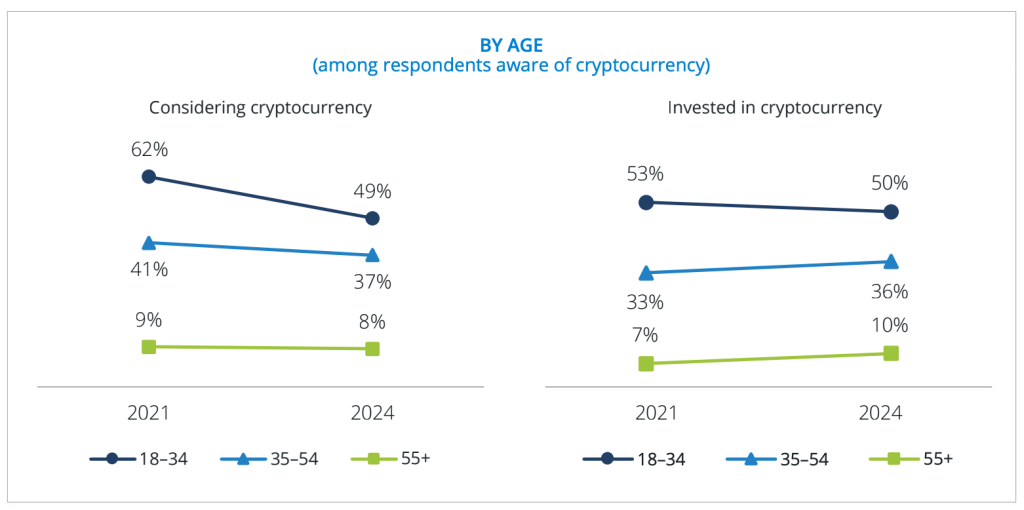
Young investors under 35 saw their participation rate fall from 32% in 2021 to 26% in 2024, erasing gains made during the market surge.

Crypto US Investors FINRA Study - Investment by age
Source: FINRA

Similarly, investment rates declined among people of color and men, reversing increases observed just three years earlier.

The median age of investors who entered the market around 2019-2021 rose from 31 to 38, indicating many younger participants left the market entirely.

Beyond slower entry rates, investors pulled back from various high-risk positions. Cryptocurrency is now viewed as extremely or very risky by 66% of those aware of digital assets, up from 58% in 2021.

The percentage holding penny stocks, REITs, private placements, and structured notes all declined to 2018 levels after brief increases.

Risk Appetite Shrinks Across Demographics

Investors’ willingness to embrace substantial portfolio risk dropped to just 8% in 2024 from 12% in 2021, with the decline most pronounced among younger market participants.

Among investors under 35, those willing to take substantial risks fell from 24% to 15%, creating a notable contradiction; 62% of this age group still believe they need big risks to reach financial goals.

The latest FINRA Foundation research on investors provides rich insights into how market conditions, technology and generational shifts are changing the profile of investing and reshaping investor behaviors and attitudes,” said Jonathan Sokobin, FINRA Foundation Chair and Chief Economist.

Despite reduced risk appetite, younger investors continue to engage in behaviors that carry greater potential losses.

43% of those under 35 trade options, compared to 10% of investors 55 and older, while 22% make margin purchases, versus just 4% of older participants.

Meanwhile, 13% of all investors report buying meme stocks or viral investments, including 29% of those under 35.

The crypto decline appears most dramatic among new investors. Those with less than 2 years’ experience who are considering digital assets dropped from 61% in 2021 to 48% in 2024, while consideration among experienced investors fell less sharply.

Among investors under 35 specifically, cryptocurrency consideration plummeted from 62% to 49%, compared to smaller declines in older age groups.

Social Media Influence Grows Despite Market Caution

The study found social media “Finfluencers” now guide investment decisions for 26% of investors, rising to 61% among those under 35.

YouTube remains the dominant platform for investment information, with 30% overall usage, rising to 61% among younger investors.

Word of mouth from friends and family emerged as the top information source for 85% of investors under 35, surpassing recommendations from financial professionals at 67%.

Concern over investment fraud has risen somewhat, with 37% of investors worried about losing money to scams, up from 31% in 2021.

However, the vast majority, 89%, do not believe they have been targeted in investment fraud.

When presented with a fraudulent offer promising “guaranteed, risk-free 25% annual returns,” half of investors said they would invest, revealing significant gaps in fraud awareness.

FINRA Foundation President Gerri Walsh emphasized the continuing importance of investor education.

They still struggle with gaps in investing knowledge and risk assessment, which can leave them vulnerable to costly missteps,” Walsh said. “Investor education efforts remain critically important.

Notably, the findings oppose broader market trends showing that crypto adoption continues to grow, with separate surveys indicating that over 50 million American adults now own digital assets.

Another also links declining homeownership affordability to increased crypto speculation among younger generations seeking alternative wealth-building strategies.

The post Crypto Interest Fades Among US Investors as Risk Tolerance Declines: FINRA Study appeared first on Cryptonews.

CZ Pushes to Make America a Global Crypto Capital as Binance Eyes US Expansion

5 December 2025 at 01:06

Changpeng Zhao (CZ), founder of the world’s largest cryptocurrency exchange Binance, announced plans to help make America a global crypto hub. CZ shared his thoughts on the United States market during a private press conference at Binance Blockchain Week, which took place at the Coca Cola Arena in Dubai Dec. 3-4.

When asked by a member of the media about his involvement in the US following President Trump’s pardon, CZ explained that he is “very appreciative of the pardon from Trump,” noting that this allows Binance to conduct business more “freely” in every part of the world – America included.

“It’s my full intention to help make America the capital of crypto,” CZ stated. “Also, America is an emerging land for Binance. For the last few years we have been dealing with the Biden administration so much that we have tried to withdraw from the US as much as possible. We didn’t invest in the US and we tried to pull out. But now I fully intend to help crypto businesses in the US.”

You heard it here first: ⁦@cz_binance⁩ of ⁦@binance⁩ says he has nothing to do with the Trump family. CZ also has plans to help blockchain & crypto companies innovate in the United States, 🇺🇸 such an insightful and inspiring fireside chat at #binanceblockchainweek pic.twitter.com/J4dFAJYtiZ

— Rachel Wolfson (@Rachelwolf00) December 4, 2025

The United States Becomes Strategic Market For Binance

CZ added that Binance US – which was launched in September 2019 to legally service US residents – still exists, yet it remains a small business.

He explained that in 2023 the SEC sued Binance US, causing the business to lose all banking access and a few state licenses. However, CZ now views the US as “a very important market” and a leading region in terms of tech talent. However, he believes that leaders in the blockchain industry still reside outside of the United States.

“Large businesses like Binance and a few other large players are not technically in the US, so I do want to help bring many of those businesses back into the region,” he said “Also, many institutional investors do not have access or exposure to BNB, so we want to help with that.”

CZ speaks at private press conference alongside Nina Rong, BNB Director of Growth. Source: Rachel Wolfson, Cryptonews Reporter

CZ Says US Has Clear Crypto Regulations

Cryptonews further asked CZ about challenges holding back crypto adoption globally and how Binance aims to combat this moving forward.

CZ mentioned that first and foremost regulatory frameworks have to become clarified in many parts of the world. To enable this, he explained his involvement with more than a dozen different countries on ways to develop and implement regulations.

CZ added that currently only a handful of countries have clear regulations around digital assets, yet pointed out that the US is leading the way.

“Now the US is leading – which is good, but the US is only just starting. Trump has only been in power for a year,” he stated.

CZ further remarked that progress has been made with the recent passing of the GENIUS Act, which establishes clear rules around stablecoins. He added that the CLARITY Act, which aims to define digital assets, remains a work in progress.

“Also the first draft of regulations will not be perfect – it takes time to evolve. After this, the banks will need to work closely with crypto businesses. We need to integrate with existing financial systems to enable mainstream adoption, as that’s the best way for growth,” CZ remarked.

CZ Speaks Out About Prison Time

In addition to sharing his thoughts on the importance of the US market for crypto expansion, CZ described his time in prison. The executive was sentenced to four months in a US prison in April 2024 after pleading guilty to violating US money laundering laws.

You heard it here first: ⁦@cz_binance⁩ founder of ⁦@binance⁩ reflects on time in US prison, noting that he went through a lot of challenges but thankfully no one got hurt 💯
Thank you CZ for all that you do for the crypto ecosystem #binanceblockchainweek #binance pic.twitter.com/SwMKuSW8ok

— Rachel Wolfson (@Rachelwolf00) December 5, 2025

“I went through a lot of challenges – I went to jail, etc. but I know that no one got hurt,” CZ stated. “There was no fraud, there were no users that got hurt because of my actions, so when I sleep at night I sleep very well because I know I am helping a lot of people.”

The post CZ Pushes to Make America a Global Crypto Capital as Binance Eyes US Expansion appeared first on Cryptonews.

Before yesterdayMain stream

US FDIC set to unveil its first GENIUS Act stablecoin guidelines this month

By: Rony Roy
2 December 2025 at 04:32
US Federal Deposit Insurance Corporation Chairman Travis Hill has confirmed that his agency will propose a new application framework for stablecoin issuers later this month. Through a written testimony to be delivered before the House Financial Services Committee on Dec.…

Crypto tax write-offs: fees, losses, and mining costs explained

1 December 2025 at 08:00
Crypto users can trim tax bills by deducting eligible fees, tools, and operating costs, strategically harvesting losses, and using long-term holds and donations to reduce taxable gains, subject to jurisdiction rules and documentation requirements. Cryptocurrency users face tax obligations on…

Trump Doubles Down on Crypto Leadership, Defends CZ Pardon on 60 Minutes

3 November 2025 at 11:43

Bitcoin Magazine

Trump Doubles Down on Crypto Leadership, Defends CZ Pardon on 60 Minutes

President Donald Trump made headlines Sunday in a wide-ranging interview on 60 Minutes, emphasizing that maintaining U.S. dominance in the crypto space is a top priority for him. 

“I only care about one thing: will we be number one in crypto,” Trump told Norah O’Donnell, highlighting what he described as the importance of the sector due to global competition.

President Trump framed crypto as a high-stakes, winner-takes-all industry, likening it to artificial intelligence in terms of national importance. 

“In crypto, it’s a kind of industry where basically you’re going to have number one and you’re not going to have a number two. And right now we’re number one by a long shot,” he said. 

President Trump also pointed to China’s booming crypto initiatives, noting, “China is getting into it very big,” and insisted that U.S. leadership is crucial to prevent other nations from dominating the market.

The President credited his sons with being more engaged in the industry than he is, while highlighting that their business pursuits demonstrate the sector’s growth and potential. 

Trump also suggested that his previous campaigns, which openly supported crypto, helped secure what he called the “crypto vote,” framing his advocacy as a continuation of his broader efforts to bolster American technological leadership.

BREAKING: 🇺🇸 President Trump says, “I only care about one thing: will we be number one in crypto”

“China is getting into it very big” pic.twitter.com/LuMHAQLlnf

— Bitcoin Magazine (@BitcoinMagazine) November 3, 2025

Trump’s pardon of CZ 

The whole conversation around crypto also touched on Trump’s semi-controversial pardon of Binance founder Changpeng Zhao, known as CZ. 

U.S. prosecutors accused Binance of allowing illicit transactions with sanctioned entities and failing to implement proper anti-money-laundering controls. CZ pleaded guilty, stepped down as CEO, and paid a personal fine of $50 million.

On October 23, President Donald Trump granted a full pardon to Zhao following months of lobbying by Zhao and allies, who argued his prosecution was politically motivated, and comes amid his efforts to explore partnerships with Trump family crypto ventures. 

White House press secretary Karoline Leavitt framed the move as ending the “Biden Administration’s war on crypto.” The decision cleared Zhao’s record and could reshape U.S. policy toward cryptocurrency.

Trump defended the pardon in his 60 Minutes interview, framing it as a corrective action against what he described as political bias from the Biden administration. 

“I know nothing about the guy, other than I hear he was a victim of weaponization by government… It’s a corrupt government,” Trump said, emphasizing that his decision was guided by his belief in protecting U.S. crypto leadership rather than personal connections or political gain.

This post Trump Doubles Down on Crypto Leadership, Defends CZ Pardon on 60 Minutes first appeared on Bitcoin Magazine and is written by Micah Zimmerman.

Spamouflage’s advanced deceptive behavior reinforces need for stronger email security

By: slandau
3 September 2024 at 16:43

EXECUTIVE SUMMARY:

Ahead of the U.S. elections, adversaries are weaponizing social media to gain political sway. Russian and Iranian efforts have become increasingly aggressive and transparent. However, China appears to have taken a more carefully calculated and nuanced approach.

China’s seeming disinformation efforts have little to do with positioning one political candidate as preferable to another. Rather, the country’s maneuvers may aim to undermine trust in voting systems, elections and America, in general; amplifying criticism and sowing discord.

Spamouflage

In recent months, the Chinese disinformation network, known as Spamouflage, has pursued “advanced deceptive behavior.” It has quietly launched thousands of accounts across more than 50 domains, and used them to target people across the United States.

The group has been active since 2017, but has recently reinforced its efforts.

Fake profiles

The Spamouflage network’s fake online accounts present fake identities, which sometimes change on a whim. The accounts/profiles have been spotted on X, TikTok and elsewhere.

For example:

Harlan claimed to be a New York resident and an Army veteran, age 29. His profile picture showed a well-groomed young man. However, a few months later, his account shifted personas. Suddenly, Harlan appeared to be from Florida and a 31 year-old
Republican influencer. 

At least four different accounts were found to mimic Trump supporters – part of a tactic with the moniker “MAGAflage.”

The fake profiles, including the fake photos, may have been generated through artificial intelligence tools, according to analysts.

Accounts have exhibited certain patterns, using hashtags like #American, while presenting themselves as voters or groups that “love America” but feel alienated by political issues that range from women’s healthcare to Ukraine.

In June, one post on X read “Although I am American, I am extremely opposed to NATO and the behavior of the U.S. government in war. I think soldiers should protect their own country’s people and territory…should not initiate wars on their own…” The text was accompanied by an image showing NATO’s expansion across Europe.

Email security implications

Disinformation campaigns that create (and weaponize) fake profiles, as described above, will have a high degree of success when crafting and distributing phishing emails, as the emails will appear to come from credible sources.

This makes it essential for organizations to implement and for employees to adhere to advanced verification methods that can ensure the veracity of communications.

Advanced email security protocols

Within your organization, if you haven’t done so already, consider implementing the following:

  • Multi-factor authentication. Even if credentials are compromised via phishing, MFA can help protect against unauthorized account access.
  • Email authentication protocols. Technologies such as SPF, DKIM and DMARC can assist with verifying the legitimacy of email senders and spoofing prevention.
  • Advanced threat detection. Advanced threat detection solutions that are powered by AI and machine learning can enhance email traffic security.
  • Employee awareness. Remind employees to not only think before they click, but to also think before they link to information – whether in their professional roles or their personal lives.
  • Incident response plans. Most organizations have incident response plans. But are they routinely updated? Can they address disinformation and deepfake threats?

Further thoughts

To effectively counter threats, organizations need to pursue a dynamic, multi-dimensional approach. But it’s tough.

To get expert guidance, please visit our website or contact our experts. We’re here to help!

The post Spamouflage’s advanced deceptive behavior reinforces need for stronger email security appeared first on CyberTalk.

Everything we know so far about the ransomware attack on Los Angeles schools

9 September 2022 at 10:30
Los Angeles Unified School District, or LAUSD — the second largest district in the U.S. with more than 1,000 schools and 600,000 students — confirmed this week that it was hit by a cyberattack over the weekend, disrupting access to its IT systems. Details about the incident, described as “criminal in nature” and later confirmed […]

NetWalker ransomware operator extradited to the US, over $28M in bitcoin seized

11 March 2022 at 10:44
A former Canadian government employee accused of carrying out dozens of ransomware attacks has been extradited to the United States, with more than $28 million in bitcoin seized in connection with the case. Sebastien Vachon-Desjardins, who worked as an IT consultant for Public Works and Government Services in Canada, according to his LinkedIn profile, was […]

Ring’s latest security updates are good, but still opt-in

13 July 2021 at 09:30
Ring, the video doorbell maker dubbed the “largest civilian surveillance network the U.S. has ever seen,” is rolling out new but long overdue security and privacy features. The Amazon-owned company’s reputation was bruised after a spate of account breaches in late 2019, in which hackers broke into Ring user accounts and harassed children in their own […]

DOJ says it seized over $1 billion in bitcoin from the Silk Road drugs marketplace

5 November 2020 at 12:17
Two days ago, about $1 billion worth of bitcoin that had sat dormant since the seizure of the Silk Road marketplace in 2013, one of the biggest underground drug websites on the dark web, suddenly changed hands. Who took it? Mystery over. It was the U.S. government. In a statement Thursday, the Justice Department confirmed […]

ICE used ‘stingray’ cell phone snooping tech hundreds of times since 2017

27 May 2020 at 09:00

Newly released documents show U.S. immigration authorities have used a secretive cell phone snooping technology hundreds of times across the U.S. in the past three years.

The documents, obtained through a public records lawsuit by the American Civil Liberties Union and seen by TechCrunch, show that U.S. Immigration and Customs Enforcement (ICE) deployed cell site simulators — known as stingrays — at least 466 times between 2017 and 2019, which led to dozens of arrests and apprehensions. Previously obtained figures showed ICE used stingrays more than 1,885 times over a four-year period between 2013 and 2017.

The documents say that stingrays were not deployed for civil immigration investigations, like removals or deportations.

Although the numbers offer a rare insight into how often ICE uses this secretive and controversial technology, the documents don’t say how many Americans also had their phones inadvertently ensnared by these surveillance devices.

“We are all harmed by government practices that violate the Constitution and undermine civil liberties,” said Alexia Ramirez, a fellow with the ACLU’s Speech, Privacy, and Technology Project. “ICE’s use of cell site simulators affects all people, regardless of their immigration status.”

“When cell site simulators search for an individual, they necessarily also sweep in sensitive, private information about innocent bystanders,” said Ramirez. “This is part of the reason courts have said there are serious Fourth Amendment concerns with this technology.”

A letter from Harris Corp., which builds cell site simulators — known as “stingrays,” describing the non-disclosure terms for its Crossbow cell site simulator. (Source: ACLU)

Stingrays impersonate cell towers and capture the calls, messages, location and in some cases data of every cell phone in their range. Developed by Harris Corp., stingrays are sold exclusively to law enforcement. But their purchase and use are covered under strict non-disclosure agreements that prevent police from discussing how the technology works. These agreements are notoriously prohibitive; prosecutors have dropped court cases rather than disclose details about the stingrays.

The newly released documents are heavily redacted and offer little more about what we know of how stingrays work. One document did, however, reveal for the first time the existence of Harris’ most recent stingray, Crossbow. An email from 2012 refers to Crossbow as the “latest, most technologically up-to-date version of a Stingray system.”

But the civil liberties group said its public records lawsuit is not over. Customs and Border Protection (CBP), which was also named in the suit, has not yet turned over any documents sought by the ACLU, despite spending $2.5 million on buying at least 33 stingrays, according to a 2016 congressional oversight report.

“We are deeply skeptical of CBP’s assertion that they do not possess records about cell site simulators,” said Ramirez. “Given public information, the agency’s claim just doesn’t pass the sniff test.”

CBP has until June 12 to respond to the ACLU’s latest motion.

When reached, a spokesperson for CBP was unable to comment by our deadline. ICE did not respond to a request for comment.

ICE used ‘stingray’ cell phone snooping tech hundreds of times since 2017 by Zack Whittaker originally published on TechCrunch

❌
❌