Elon Musk Slapped With $140 Million Fine Over Deceptive Blue Checks on X
The fine would put a big dent in one Musk's only revenue-generating moves after taking over Twitter.


Elon Musk’s X became the first large online platform fined under the European Union’s Digital Services Act on Friday.
The European Commission announced that X would be fined nearly $140 million, with the potential to face “periodic penalty payments” if the platform fails to make corrections.
A third of the fine came from one of the first moves Musk made when taking over Twitter. In November 2022, he changed the platform’s historical use of a blue checkmark to verify the identities of notable users. Instead, Musk started selling blue checks for about $8 per month, immediately prompting a wave of imposter accounts pretending to be notable celebrities, officials, and brands.


© NurPhoto / Contributor | NurPhoto

Bitcoin Magazine
![]()
Lava Abandons Self-Custody Amidst Fund Raise, Sparking Controversy
Lava, the Bitcoin-backed loans software company, sparked controversy among Bitcoin CEOs recently, after a series of announcements following a $200 million fundraise. The company, led by Shehzan Maredia, had previously been marketed as a self-custody wallet and platform, mirroring the functionality of DeFi or decentralized finance products. The new update to the Lava app changed the custody model to a fully custodial and trusted fintech platform, raising questions about the lending company’s legal status.
The announcement about the fund raise drew the attention of Bitcoin industry leaders, who raised questions about the nature of the investment and the implications of the change in custody model, which Shehzan confirmed in follow-up X posts.
“The security of our users and their funds is our top priority. Every change we’ve made is guided by that. Lava no longer uses DLCs — discrete log contracts — for loans because the technology doesn’t meet our security standards. Our team built the largest application using DLCs, but we discovered vulnerabilities that we weren’t comfortable having (ex., client-side key risk, hot keys).”
Shezhan added that “Risks we previously thought were impossible, such as thinking oracles couldn’t be manipulated to liquidate individual users, we figured out were possible in practice. We are unwilling to compromise on security for our users at any level, and we take a very holistic view on removing trust, dependencies, and counterparty risk.”
DLCs are a kind of Bitcoin smart contract that can anchor the spendability of a bitcoin balance to an external event, such as the price of bitcoin in dollar terms, through the use of a third-party “oracle”. Oracle-based decentralized finance technology (DeFi) was recently exploited, resulting in a 20 billion dollar liquidation event, specifically targeting Binance’s stablecoin orderbook.
Their previous technology, which Shehzan says is still used by users who did not choose to update to the new version of the software, gave end users cryptographic control over part of the account via 2 of 2 multi-signature DLC smart contracts, limiting how the Bitcoin put up by users as collateral could move.
Lava’s terms of service still claim — as of the time of writing — that the company has “no exclusive custody or control over the contents of your wallet and has no ability to retrieve or transfer its contents.” Yet this contradicts statements made by Shehzan in recent days regarding the company’s pivot to a cold storage custody model.

Despite Shehzan’s clarification and posts on X, critics were skeptical of the reasoning. Some users were alarmed at the fundamental change in the custody model, which caught many by surprise and was communicated poorly, if at all.
One user, Owen Kemeys of Foundation devices, wrote, “Did Lava get my informed consent?” sharing a series of screenshots of the app update messaging, which says nothing about the change in custody model.
Will Foxley of Blockspace media complained, “Why did they roll legacy loans over without contact first. Plus, how did they do this if it was DLCs? Did I sign a bunch of pre-signed transactions that gave them control over the entire loan?”
The pivot has also raised questions about the company’s regulatory status and licenses, as centralized and custodial bitcoin-backed loan providers are arguably regulated under more traditional frameworks. Such regulations tend not to apply to DeFi-style self-custody products, precisely because user funds remain under user control, rather than under the complete control of a third party. With trust custodial trust becoming the Lava model overnight, what regulatory status does the company fall under?
Jack Mallers, CEO of Strike — a competing Bitcoin company with a Bitcoin-backed loans product line and a market leader — questioned the move, particularly in terms of licensing, which Strike has been working to acquire for years:
“If they’re custodial, how is what they’re doing legal?
Strike has been acquiring licenses for years. You can’t just “flip a switch” from non-custodial to custodial and start offering brokerage, trading, or lending services. That’s unlicensed activity, and it’s very illegal.
What licenses does Lava actually have that allow them to do what they’re doing?”
Bitcoin Magazine has not independently verified Lava’s licensing status. When asked for comment on the legal strategy and status of Lava, Shezhan pointed Bitcoin Magazine to the company’s FAQ, which does not appear to address the questions directly at all.


The nature of the investment announced by Lava was also called into question last week, as Cory Klipsten, CEO of Swan — a likely competitor to Lava — has also been actively engaging the story, suggesting it is specifically a line of credit agreement rather than an equity-style VC investment into the company. When asked, Shehzan told Bitcoin Magazine, “we raised both venture and debt,” referring to the 200 million raise announcement, though he did not go into details.
While the story is still developing and mostly involves discussions and debate on Bitcoin Twitter, the drama highlights the high value Bitcoiners place on self-custody and the risk of closed-source crypto applications, which can be updated without proper transparency or information being delivered to users about how their capital is secured.
This post Lava Abandons Self-Custody Amidst Fund Raise, Sparking Controversy first appeared on Bitcoin Magazine and is written by Juan Galt.
![]()
What do hacktivist campaigns look like in 2025? To answer this question, we analyzed more than 11,000 posts produced by over 120 hacktivist groups circulating across both the surface web and the dark web, with a particular focus on groups targeting MENA countries. The primary goal of our research is to highlight patterns in hacktivist operations, including attack methods, public warnings, and stated intent. The analysis is undertaken exclusively from a cybersecurity perspective and anchored in the principle of neutrality.
Hacktivists are politically motivated threat actors who typically value visibility over sophistication. Their tactics are designed for maximum visibility, reach, and ease of execution, rather than stealth or technical complexity. The term “hacktivist” may refer to either the administrator of a community who initiates the attack or an ordinary subscriber who simply participates in the campaign.
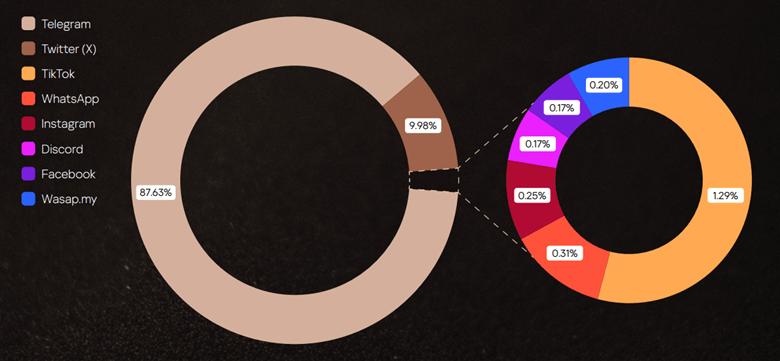
While it may be assumed that most operations unfold on hidden forums, in fact, most hacktivist planning and mobilization happens in the open. Telegram has become the command center for today’s hacktivist groups, hosting the highest density of attack planning and calls to action. The second place is occupied by X (ex-Twitter).
Although we focused on hacktivists operating in MENA, the targeting of the groups under review is global, extending well beyond the region. There are victims throughout Europe and Middle East, as well as Argentina, the United States, Indonesia, India, Vietnam, Thailand, Cambodia, Türkiye, and others.
One notable feature of hacktivist posts and messages on dark web sites is the frequent use of hashtags (#words). Used in their posts constantly, hashtags often serve as political slogans, amplifying messages, coordinating activity or claiming credit for attacks. The most common themes are political statements and hacktivist groups names, though hashtags sometimes reference geographical locations, such as specific countries or cities.
Hashtags also map alliances and momentum. We have identified 2063 unique tags in 2025: 1484 appearing for the first time, and many tied directly to specific groups or joint campaigns. Most tags are short-lived, lasting about two months, with “popular” ones persisting longer when amplified by alliances; channel bans contribute to attrition.
Operationally, reports of completed attacks dominate hashtagged content (58%), and within those, DDoS is the workhorse (61%). Spikes in threatening rhetoric do not by themselves predict more attacks, but timing matters: when threats are published, they typically refer to actions in the near term, i.e. the same week or month, making early warning from open-channel monitoring materially useful.
The full version of the report details the following findings:
For defenders and corporate leaders, we recommend the following:
Even organizations outside geopolitical conflict zones should assume exposure: hacktivist campaigns seek reach and spectacle, not narrow geography, and hashtags remain a practical lens for separating noise from signals that demand action.
To download the full report, please fill in the form below.


During a California court appearance Monday, when questioned about a 420 tweet, Elon Musk suddenly forgot the significance of the number in pot culture. The tech billionaire responded after being cornered by a prosecutor representing Tesla employees for a class action lawsuit alleging he tweeted and misled shareholders about the price of Tesla shares.
The fiasco began several years ago. In 2018, Musk rounded up Tesla shares from $419 to $420, announcing his plan to go private in a tweet. “Am considering taking Tesla private at $420,” Musk tweeted on Aug. 7, 2018. “Funding secured.”—sending officials from The Securities and Exchange Commission (SEC) into a tailspin.
Am considering taking Tesla private at $420. Funding secured.
— Elon Musk (@elonmusk) August 7, 2018
Musk said he tweeted the share price based on what he said was a “firm commitment” from Saudi Arabia’s Public Investment Fund (PIF) to take Tesla private. But about 10 days later, Musk admitted that the Tesla buyout he had envisioned wasn’t going to materialize.
After an investigation, the SEC fined Musk $40 million, forcing the billionaire to step down as chair of Tesla’s board. The SEC said that Musk misled investors. In the SEC’s complaint, Musk was accused of rounding up the share price to $420 from $419 “because he had recently learned about the number’s significance in marijuana culture.”
Musk caused instantaneous uproar about a month later, sparking a blunt with Joe Rogan on his show “The Joe Rogan Experience” on Sept. 3, 2018, shocking Tesla investors and officials across the board. His troubles didn’t end there. High Times asked if it was “the most expensive blunt of all time” due to the fallout, with NASA- and SpaceX-associated officials reviewing his security clearance.
The Verge reports that Nicholas Porritt is an attorney for a class of Tesla investors suing Musk for millions of dollars that they say resulted from his failure to take Tesla private.
The courtroom got tense: “You rounded up to 420 because you thought that would be a joke that your girlfriend will enjoy, isn’t that correct?” Porritt asked. “No,” Musk said, adding, “there is some, I think, karma around 420. I should question whether that is good or bad karma at this point.”
Musk said that 420 wasn’t a weed joke, but a roughly 20% premium on the $419 stock price at the time. “420 was not chosen because of a joke,” Musk testified. “It was chosen because there was a 20 percent premium over the stock price.” Musk also claimed that it was a “coincidence.”
The jury will decide if Musk should have to pay out up to billions of dollars in damages to Tesla shareholders for the money they lost due to his tweets.
Judge Edward Chen ruled that the jury should be aware that Musk’s 2018 tweets are false. Jurors will now need to decide whether Musk deceived Tesla shareholders because of his tweets.
Musk said that he was not relying on a commitment for the Saudi PIF when he tweeted “funding secured,” adding that his shares in SpaceX would also help fund the deal to take Tesla private. “Just as I sold stock in Tesla to buy Twitter… I didn’t want to sell Tesla stock, but I did sell Tesla stock,” Musk said. “My SpaceX shares alone would have meant that funding was secured.”
Musk has also been sued by a group of former Twitter employees after a mass firing. Musk recently became the CEO of Twitter after buying the platform for $44 billion in October 2022. Saudi Prince Alwaleed bin Talal bin Abdulaziz is Twitter’s second-largest shareholder after Musk.
The post Elon Musk Denies 420 Tweet Was About Weed appeared first on High Times.
Reinstate former President Trump
— Elon Musk (@elonmusk) November 19, 2022
The people have spoken.
— Elon Musk (@elonmusk) November 20, 2022
Trump will be reinstated.
Vox Populi, Vox Dei. https://t.co/jmkhFuyfkv
In a recent tweet, Elon Musk revealed that Twitter Blue will probably be back by the end of next week.
Here is the Tweet:
Probably end of next week
— Elon Musk (@elonmusk) November 13, 2022
If you have been following the recent developments on Twitter, you have probably heard that Musk's $8 blue check mark policy backfired badly: The trouble began after some online trolls started making "verified" parody accounts of Elon Musk, Tesla, and many others.
The one that caused the most problems was the parody account of Eli Lilly which send out a tweet saying "we are excited to announce insulin is free now". Believe it or not, that single tweet caused Eli Lilly to lose $15 billion in stock market value.
Do you remember when Elon Musk tweeted "power to the people"? I never thought he would provide this much power to the common people. 🤣🤣🤣
Has Twitter become unfixable? I would say no because I believe Elon Musk can fix it, but Elon should rethink his approach and do what he did with Tesla and SpaceX: instead of trying to make the company profitable, he should focus on making an awesome product.