Kalshi CEO Says He Wants to Monetize βAny Difference in Opinionβ
Now if that isn't late-stage capitalism, I don't know what is.


Prediction markets platform Kalshi has secured a major media breakthrough after signing a partnership with CNN, making the company the networkβs official prediction markets partner while closing a $1 billion funding round at an $11 billion valuation.
Key Takeaways:
Under the agreement, Kalshiβs real-time market data will be used inside CNNβs newsroom to support reporting on politics, economics, and major cultural events.
CNN staff will have access to Kalshiβs probability data, which reflects how users price future outcomes based on trading activity.
The network will also introduce a live, Kalshi-powered ticker during coverage segments that use market data.
The integration will be overseen by CNN Chief Data Analyst Harry Enten, whose work focuses on applying data-driven insights to political and social reporting.
Kalshi said the partnership is designed to provide viewers with clearer signals on emerging trends by showing how markets are reacting in real time.
The announcement comes as Kalshi confirms a $1 billion Series E funding round led by crypto-focused investment firm Paradigm, with participation from Sequoia Capital, Andreessen Horowitz, and ARK Invest.
The round more than doubles Kalshiβs previous $5 billion valuation from an October raise.
Kalshi chief executive Tarek Mansour said markets are becoming a new way to measure public expectations.
βKalshi is replacing debate and opinion with markets and accuracy,β he said, adding that users increasingly want information reflected through price action rather than speculation.
Kalshi raised $1B at an $11B valuation.
β Tarek Mansour (@mansourtarek_) December 2, 2025
A decade ago, only a few thousand people knew what a prediction market was.
Eighteen months ago, most prediction markets were banned β until we overcame the government to set them free.
Over the past seven years, our community has opened⦠pic.twitter.com/hGDkYxkSlh
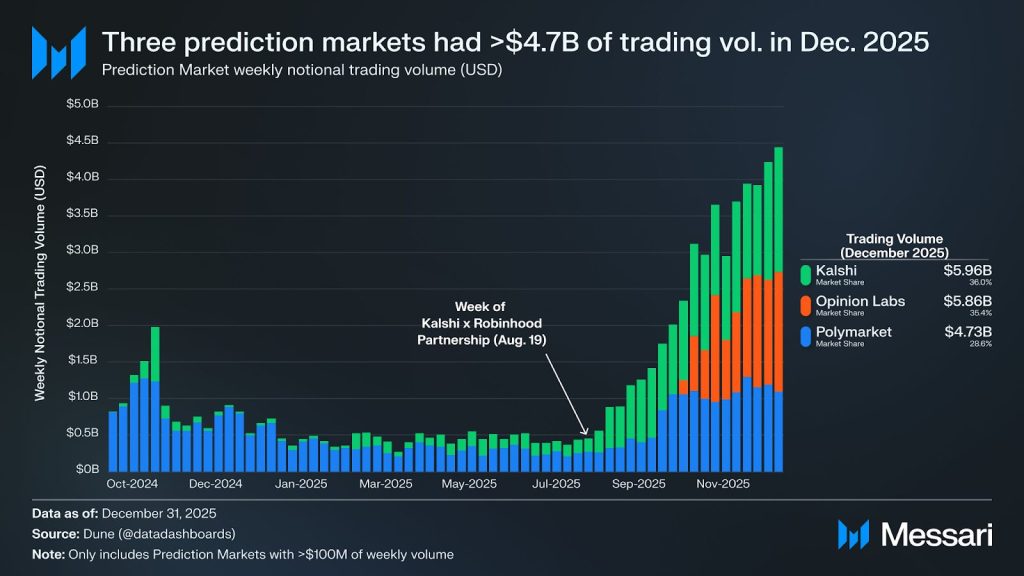
The funding follows a surge in activity across prediction platforms. According to Token Terminal data cited by the company, Kalshi posted record trading volume of $4.54 billion in November, beating Octoberβs $4.49 billion.
Kalshi said weekly volumes are now exceeding $1 billion, representing growth of more than 1,000% since 2024.
Its closest competitor, Polymarket, also recorded a strong November, hitting a monthly total of $3.76 billion after crossing $3 billion in October.
Polymarket CEO Shayne Coplan recently said prediction markets are among the most reliable indicators for forecasting real-world outcomes.
As reported, Mike Novogratzβs Galaxy Digital is in talks with Polymarket and Kalshi about becoming a liquidity provider, as on-chain betting on real-world events draws more attention from both retail traders and Wall Street.
Galaxy, which has built its brand around providing crypto infrastructure and services to institutional clients, would act as a market-maker on the platforms, posting regular bids and offers to deepen trading.
Meanwhile, Kalshi is currently facing a nationwide class action lawsuit alleging the platform operates like an unlicensed sportsbook and misrepresents pricing advantages versus traditional betting markets. The company has not admitted wrongdoing.
The post Kalshi Becomes CNNβs Official Prediction Market Partner After Raising $1B appeared first on Cryptonews.

Kalshi has switched on tokenized versions of its event contracts on Solana, making its first explicit play to court the same crypto-native traders who have funneled billions of dollars into rival prediction platform Polymarket.
Instead of holding positions solely as traditional off-chain contracts on Kalshiβs regulated venue, users can now buy and sell tokenized representations of those wagers on Solana. The economic exposure is identical, but the wrapper is crypto-native: the bet becomes a transferable token on a public blockchain.
βThe tokenized versions of the contracts work the same way as the regular ones found previously on Kalshiβs platform,β the company told CNBC. The key difference is market structure. By trading the tokens rather than the contracts themselves, users can operate with greater pseudonymity and more flexibility in how they custody and move positions, putting Kalshi βon par with Polymarket, which allows users to trade directly on-chain.β
Support for these tokenized wagers is already live on Solana. Decentralized finance protocols DFlow and Jupiter are onboarding as institutional conduits, effectively bridging Kalshiβs off-chain orderbook into Solanaβs liquidity. That link is designed to let crypto-native traders discover, route and size positions through the DeFi stack while Kalshi continues to run its core matching and settlement infrastructure in a regulated environment.
The timing coincides with a sharp upswing in prediction market activity. Combined trading volume in prediction markets reached almost $28 billion through October 2025, with a weekly record of $2.3 billion in the week of October 20, according to data cited from Crypto.comβs research arm. Kalshiβs thesis is that the next leg of growth will be driven by the digital asset market, which it pegs at roughly $3 trillion and heavily populated by traders already comfortable with on-chain risk.
βThereβs a lot of power users in crypto,β said John Wang, Kalshiβs head of crypto. βThis is about tapping into the billions of dollars of liquidity that crypto has, and then also enabling developers to build third party front ends that utilize Kalshiβs liquidity.β
Founded in 2018, Kalshi was the first exchange to roll out federally regulated event contracts on US congressional races for American traders in late 2024, following a years-long legal battle with the Commodity Futures Trading Commission. Since then, it has expanded to roughly 3,500 markets, raised more than $300 million at a $5 billion valuation, and grown its footprint to over 140 countries, according to the company.
That regulatory and capital advantage is being tested as Polymarket moves to relaunch in the US and other competitors scale. Kalshiβs leadership is effectively betting that deeper liquidity is the decisive differentiator β and that crypto traders are the marginal source of that liquidity.
Digital asset holders tend to trade prediction markets at higher volumes than non-crypto users, Wang said, arguing that their funds can meaningfully thicken orderbooks and sharpen pricing across Kalshiβs markets. βIf you have a market with no liquidity, then you donβt really have a market,β he said. βPeople canβt really trade size or get the prices that they want.β
At press time, Solana (SOL) traded at $126.86.

Bitcoin Magazine
![]()
Bitcoin Price Prediction Markets Are Flashing a Signal
Bitcoin Price Prediction Markets have become an emerging tool for gauging sentiment and price expectations in real time. Traders on platforms such as Polymarket and Kalshi wager on Bitcoinβs future price outcomes, producing aggregated odds that reflect where market participants believe BTC is heading. As trading volumes expand and odds shift with volatility, these prediction markets are gaining credibility as a forward-looking sentiment gauge for the Bitcoin economy.
In early October, traders on Polymarket were betting that BTC would close 2025 around $144,000, but as volatility picked up and BTC dipped, that forecast has since slipped closer to $129,000. These odds update in real time, meaning they reflect the collective positioning and sentiment of thousands of participants and millions of dollars.
By tracking the ratio between BTCβs spot price and the predicted year-end price, clear sentiment trends begin to emerge. When this ratio spikes, meaning the spot price trades well below the marketβs forecast, it often reflects a period of excessive fear or undervaluation. Conversely, when BTC trades close to the predicted price, the market tends to be overheated and nearer to local peaks.
Normalizing this data to account for how prediction volatility narrows as the year progresses gives an even clearer signal. The top percentile of days, where the ratio shows the widest gap between prediction and spot, has historically aligned with market lows, and vice-versa for the lowest percentile of days aligning with local highs.
Despite the impressive 91% accuracy figure often cited by Polymarket, deeper analysis shows that this number is inflated by markets with extreme odds β scenarios like βBitcoin to hit $250,000 by year-end,β which overwhelmingly resolve to βno.β Removing these outliers gives a more realistic accuracy rate closer to 71% for BTC-related prediction markets, still notable but far from predictive certainty.
Interestingly, when comparing the standardized ratio of prediction-market expectations to BTCβs actual price, the data moves inversely to the Fear and Greed Index. When fear dominates, the ratio signals that traders are undervaluing Bitcoin, while periods of extreme greed coincide with markets pricing BTC near or above forecast levels. This overlap suggests that prediction markets, much like sentiment gauges, can help identify when emotions in the market have swung too far in one direction.
Used alone, prediction markets donβt provide a consistent trading edge β their crowd-based probabilities are efficient but not omniscient. However, when combined with sentiment indicators like the Fear and Greed Index or on-chain data, they can highlight asymmetry in market perception.
Historically, strategies that accumulate BTC during extreme fear and reduce exposure during euphoria have outperformed a simple buy-and-hold approach. When prediction markets align with those same fear periods, the data strengthens the case for opportunistic accumulation.
Prediction markets are not crystal balls, but they reflect the aggregated conviction of thousands of informed participants putting real money on the line. While not perfectly accurate, their probabilities track human sentiment remarkably well. When these odds diverge sharply from spot price β especially in periods of widespread fear β they may offer a data-driven contrarian signal worth paying attention to.
For deeper data, charts, and professional insights into bitcoin price trends, visitΒ BitcoinMagazinePro.com.
Subscribe to Bitcoin Magazine Pro on YouTubeΒ for more expert market insights and analysis!

Disclaimer: This article is for informational purposes only and should not be considered financial advice. Always do your own research before making any investment decisions.
This post Bitcoin Price Prediction Markets Are Flashing a Signal first appeared on Bitcoin Magazine and is written by Matt Crosby.