Sysdig TRT analysis reveals VoidLink as a revolutionary Linux threat. Using Serverside Rootkit Compilation and Zig code, it targets AWS and Azure with adaptive stealth.
Managing a photo library is easy when it’s just yours. It got a lot harder for me when I also became responsible for keeping photos organized for my wife and mother-in-law. Different habits, different expectations, and everyone still wants their pictures to be easy to find and safely backed up. Over time, that turns into a messy sprawl of folders, duplicates, and “where did that photo go?” conversations.
Vega Cloud’s technology helps companies track and manage their cloud spending. (Vega Cloud Images, GeekWire Illustration)
Vega Cloud, a Spokane-area tech startup that makes software to help companies manage their cloud spending, has been placed into the hands of a receiver after declaring it could no longer pay its debts.
Among those debts: nearly $830,000 owed to cloud giant Amazon Web Services.
Vega Cloud, founded in 2018 and based in Liberty Lake, Wash., had raised $12.2 million and reached about $7 million in annual revenue as of 2023, according to PitchBook data. It had also cracked the GeekWire 200 — ranking #181 in the most recent quarterly update of our Pacific Northwest startup index.
What brought Vega Cloud to this point isn’t clear. Responding to our email inquiry this weekend, co-founder and CEO Kris Bliesner said the company is going through a restructuring via receivership, and said he wished he could say more about the situation.
The company had less than $17,000 in the bank when it was placed into receivership Thursday, Jan. 15, in King County Superior Court in Seattle, the filing shows. It employed about 35 people as of earlier this month, down from about 65 two years ago, according to LinkedIn.
Receivership is a state-level process often used as an alternative to bankruptcy. In this case, Vega Cloud executed what’s known as an Assignment for the Benefit of Creditors, which puts a neutral party in charge of the company, pauses creditor collections, and places decisions about asset sales and payments under court supervision.
Sometimes those assets sell mostly intact, allowing new investors to give a business another try. But at this point, it’s not yet clear what will happen to the company’s employees or product.
Past ambitions for an IPO
In a March 2024 interview for GeekWire’s special series on Spokane, Bliesner described Vega Cloud’s trajectory in optimistic terms, saying the company was planning a $20 million to $30 million funding round and eyeing the public markets.
“We’re trying to push the envelope at Vega to maybe do the IPO route,” Bliesner said at the time. “We think that’s a viable thing for us.”
Vega Cloud operates in the sector known as FinOps, short for financial operations, helping companies get a handle on their cloud spending by bringing together finance and technical teams to track costs and avoid waste.
This is becoming more and more important as businesses pour money into cloud computing, often without realizing how much they’re spending on unused resources. Vega Cloud focused specifically on helping mid-sized companies manage spending across AWS, Azure, and Google Cloud, using automated tools to spot problems and recommend fixes.
In the tight-knit Spokane tech community, Vega Cloud has been seen as a startup with the potential to make it big. We took note of the company in 2022, when it raised $9 million.
Investor and entrepreneur Martin Tobias, a longtime fixture in Pacific Northwest enterprise tech, invested in Vega Cloud shortly after moving from Seattle to Spokane during the pandemic. He told us in early 2024 that it would probably be one of his most successful investments.
Tobias said Bliesner was exactly the kind of founder he looks for: someone with deep experience in a market who had tried to solve something one way, realized it wasn’t going to scale, and came up with a better solution.
“He took a new approach to an old problem,” Tobias said at the time.
Bliesner previously co-founded cloud migration startup 2nd Watch, which raised about $56 million before selling a majority interest to Singapore-based investor ST Telemedia.
Financial details from the filing
Vega Cloud’s court filings give an inside look at the privately held business.
First, the company had real customers and revenue. The filings list contracts with companies including Paramount, Hearst, Deloitte, Molina Healthcare, John Wiley & Sons, and Cal Poly, among others. It lists roughly $264,000 in accounts receivable.
The largest secured creditor is Sun Mountain Private Credit Fund I, owed $3.5 million. That debt is backed by Vega Cloud’s intellectual property — its software, patents, trademarks, and domain names. Any proceeds from a sale of those assets would go first to that lender.
In addition to the roughly $830,000 owed to AWS, the court records show convertible promissory notes totaling about $2.5 million that were issued to investors throughout 2025.
The records list current and former employees who are owed unpaid commissions, bonuses, and expense reimbursements, with some bonus obligations dating back to 2023. The company also owes payroll and withholding taxes to the IRS and multiple state tax agencies.
Bliesner is the largest shareholder at about 30%. Other significant investors include Album Ventures (10%), Cowles Company (3%), Rudeen & Company (3%), Kick-Start III and IV (combined 4%), Tacoma Venture Fund (1.5%), and Pitbull Ventures (1%).
The shareholder list also includes Voyager Capital, Alliance of Angels, Incisive Ventures, and Morning Star Foundation, along with dozens of individual investors.
Under court supervision, the receiver can now take possession of Vega Cloud’s assets and records, secure its bank accounts and data, evaluate and sell assets such as intellectual property, collect remaining receivables, and distribute proceeds to creditors in priority order.
The filings do not include a timeline for asset sales or any plan for the business to continue operating. Those details typically emerge later through receiver reports.
Rackspace’s new pricing for its email hosting services is “devastating,” according to a partner that has been using Rackspace as its email provider since 1999.
In recent weeks, Rackspace updated its email hosting pricing. Its standard plan is now $10 per mailbox per month. Businesses can also pay for the Rackspace Email Plus add-on for an extra $2/mailbox/month (for “file storage, mobile sync, Office-compatible apps, and messaging”), and the Archiving add-on for an extra $6/mailbox/month (for unlimited storage).
As recently as November 2025, Rackspace charged $3/mailbox/month for its Standard plan, and an extra $1/mailbox/month for the Email Plus add-on, and an additional $3/mailbox/month for the Archival add-on, according to the Internet Archive’s Wayback Machine.
A supply chain vulnerability in AWS CodeBuild recently put the entire AWS Console at risk. Learn how Wiz Research found the flaw and how Amazon responded to prevent a global security crisis.
With the latest move and partnership from Cardano, the financial sector could be set for a major shift. A new financial audit has been launched from the recent partnership that aims at bolstering accountability in the broader finance landscape, which reflects the blockchain’s focus on transparency.
New Audit On Cardano To Boost Financial Oversight
Recently, the Cardano Foundation announced a new partnership with global professional services firm Grant Thornton as they step toward enhancing transparency and institutional credibility. By joining forces, both leading firms have collectively launched a new comprehensive financial audit.
The partnership was disclosed by the Cardano Foundation on their official page on the social media platform X. According to the Foundation, this audit is cryptographically secured and attested directly on-chain using their Virtual LEI (vLEI).
This new audit is being described as a global first for financial trust and transparency in the blockchain industry. Powered by Reeve, this new gold standard is the Cardano Foundation’s enterprise-grade financial data management solution.
By hiring one of the top audit firms in the world, the foundation is demonstrating its dedication to regulatory-ready standards and accountability, which are essential elements for drawing in long-term investors and enterprise adoption. In a world driven by data, trust, and verification, the Foundation claims that accountability is everything, and Cardano is at the forefront of this narrative.
Frederik Gregaard, the Chief Executive Officer (CEO) of the Foundation, stated that this audit was executed in two on-chain transactions. “For me personally, it closes one chapter and opens a much larger one. A future where financial trust is native to infrastructure, not bolted on through intermediaries,” the CEO added.
Institutions Are Choosing The Blockchain
Cardano’s position as a blockchain project focused on rigor and trust is evidenced by its growing adoption on the institutional level. A few days ago, one of the world’s largest companies, Google, took a bold step by investing in the blockchain’s infrastructure.
According to the report from ADA Advocate, the Google Cloud stake pool can now be found on the network and the newly launched Midnight chain. Google’s involvement and recognition of Cardano’s security and stability is a significant advancement in the use of blockchain technology by actual business behemoths.
Amid the rising demand, the price of Cardano has begun to display bullish momentum, pushing back above $0.4. Market expert and veteran financial trader, Matthew Dixon, highlighted that ADA currently holds tremendous upside potential with 5 waves up from the low, as either an A wave or wave 1.
More than two times the potential is given by even the most cautious interpretation of an A wave, and much more if wave 1. As a result, the expert has placed the altcoin among his favorites for Q1 2026.
MontyCloud, a Redmond, Wash.-based startup that helps companies optimize their cloud operations, raised a fresh Series B round to fuel growth.
The company announced the funding in a press release this week but did not reveal the amount raised. A new SEC filing shows $11.4 million raised. We’ve reached out to the company for details.
Founded in 2018, MontyCloud builds software that helps companies run and control their cloud infrastructure automatically, from enforcing governance policies to optimizing cloud spend. MontyCloud is part of a broader push to use AI not just for apps, but for automating back-end IT operations.
The company says cloud spend under management has grown more than 400% over two years, with recurring revenue nearly tripling (both measured by compound annual growth). MontyCloud targets Managed Service Providers (MSPs) as well as enterprise companies.
The latest round was led by Riverside Acceleration Capital. Other backers include Lytical Ventures, S3 Ventures, Madrona Venture Group, and Raptor Group.
MontyCloud is led by CEO Walter Rogers, a tech industry vet who joined the company in 2022. The company was founded by Venkat Krishnamachari, chief product officer, and Kannan Parthasarathy, chief technology officer.
“Our growth reflects a fundamental shift in how organizations approach CloudOps,” Rogers said in a statement. “The industry is moving away from manual processes and fragmented tools toward a model that enables teams to optimize and operate cloud environments while unlocking new opportunities to monetize CloudOps.”
MontyCloud has 85 employees, with a majority based in India, according to LinkedIn.
NASA Data Helps Maine Oyster Farmers Choose Where to Grow
The Landsat satellites are helping oyster farmers in Maine see which coves run warmer or cooler from space.
Credits: NASA/Ross Walter and Allison Nussbaum
When oyster farmer Luke Saindon went looking for a place to grow shellfish in Maine, he knew that picking the wrong patch of water could sink the farm before it began. So Saindon did something oyster farmers couldn’t have done a generation ago: He used NASA satellite data to view the coastline from space.
“Starting a farm is a big venture,” said Saindon, the director for The World Is Your Oyster farm in Wiscasset, Maine. “If you choose the wrong spot, you can blow through a lot of money without ever bringing oysters to market.”
NASA satellites had been passing over these waters for years, recording temperatures and other conditions. Using a site-selection tool created by University of Maine researchers, Saindon examined satellite maps showing where water temperatures and food levels might be best for growing oysters. The maps pointed him toward a wide, shallow bay near his home. Four years later, the farm is still there — and the oysters are thriving.
Luke Saindon, director of The World Is Your Oyster farm in Wiscasset, Maine, checks oyster cages on the farm’s floating platform.
Saindon believes that using the satellite data to select his oyster farm site resulted in faster-than-average growth rates.
“This is an example of how NASA’s Earth science program supports our nation,” said Chris Neigh, the Landsat 8 and 9 project scientist at NASA’s Goddard Space Flight Center in Greenbelt, Maryland. “We collect global data, but its value grows when it’s used locally to help communities work smarter and make their livelihoods more sustainable.”
From orbit to oyster
That same satellite-based approach is now the foundation of a study published Jan. 15 in the journal Aquaculture. Led by University of Maine scientists Thomas Kiffney and Damian Brady, the research demonstrates how temperature data from Landsat — the joint NASA and U.S. Geological Survey mission — combined with European Sentinel-2 satellite estimates of oyster food availability, namely plankton, can predict how quickly eastern oysters (Crassostrea virginica) reach market size.
The team built a satellite data–driven model of how oysters divide their energy among growth, survival, and reproduction. Feed the model sea surface temperature and satellite estimates of chlorophyll and particulate organic matter — signals of how much plankton and other edible particles are in the water — and it predicts how fast oysters will grow, a big step beyond just spotting good or bad sites for farms.
“By showing where oysters grow faster, the model can help farmers plan ahead,” Kiffney said. “That could mean better decisions about when to seed, when to harvest, and how much product to expect, all of which reduces financial risk.”
That kind of insight is increasingly valuable in Maine, where oyster farming has grown rapidly over the last decade. From 2011 to 2021, the industry’s value increased 78%, rising from about $2.5 million to more than $10 million. As the sector scales up, understanding the finer details of Maine’s coastal waters has become essential — and that’s where NASA satellites come in.
The stakes are considerable. “It takes two to three years of scoping in order to get your permit to grow, and then it can take two years for those oysters to reach market,” Brady said. “So if you’ve chosen the wrong site, you’re four years in the hole right off the bat.”
Sharper eyes on coast
Maine’s coastline measures about 3,400 miles (5,500 kilometers) if you follow the tide line. It is a coast of drowned valleys and glacier-scoured granite. Water depth, temperature, and circulation can shift dramatically within a few miles. This complexity makes oyster site selection notoriously difficult, and some satellites that see the coast in broad strokes miss the small, patchy places where oysters live.
“What makes Landsat so powerful for aquaculture is its ability to see finer-scale patterns along the coast,” where farmers put oyster cages in the water, Neigh said.
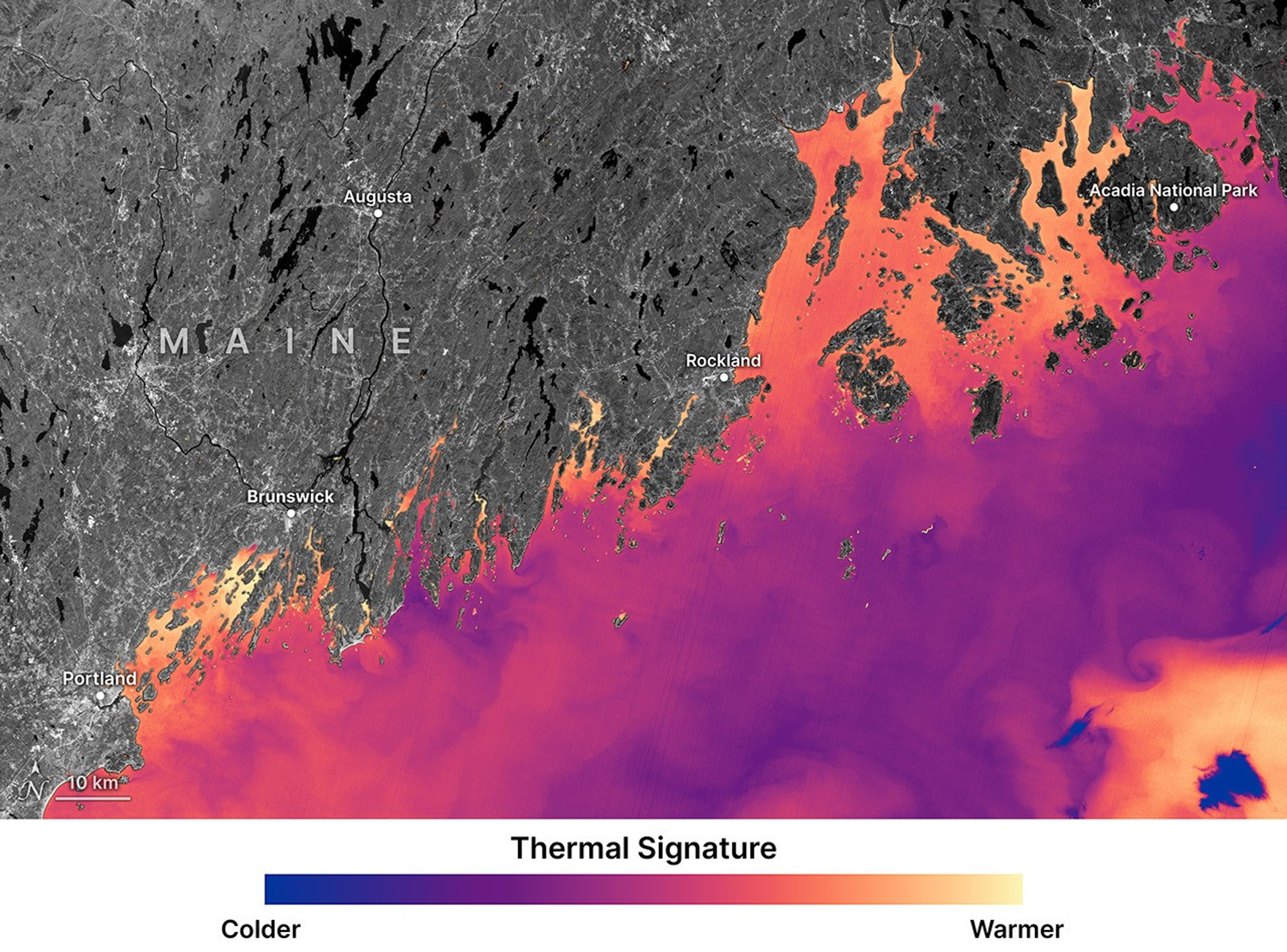
This false-color image from Landsat 9’s Thermal Infrared Sensor, acquired Oct. 11, 2025, shows the thermal signature of waters off the coast of Maine — revealing finer-scale temperature differences between neighboring coves. Cooler waters appear purple and blue, while warmer water shows up in orange and yellow.
NASA/Ross Walter and Allison Nussbaum
Landsat 8 and 9’s pixels — 98 to 328 feet (30 to 100 meters) across — are able to distinguish more subtle temperature differences between neighboring coves. For a cold-blooded oyster, those distinctions can translate into months of growth. Warm water accelerates feeding and shell development. Cold water slows both.
A challenge for satellites is clouds. Maine’s sky is frequently overcast, and together Landsat 8 and 9 pass over any given point only every eight days. To work around this, the research team analyzed 10 years of Landsat data (2013–2023) and built seasonal “climatologies,” or average temperature patterns for every 98-foot (30-meter) pixel along the coast. Sentinel-2 imagery added estimates of chlorophyll and particulate organic matter, the drifting microscopic food that oysters pull from the water column with rhythmic contractions of their gills.
Field tests at multiple sites showed the technique’s accuracy. “We validated the model against seven years of field data,” Brady said. “It’s a strong indication that these remotely sensed products can inform not just where to grow, but how long it will take to harvest.”
Turning satellite science into tools for growers
The University of Maine team is now developing an online tool to put this model into practice. A grower will be able to click on a coastal location and receive an estimate for time-to-market.
The researchers also assist with workshops through Maine’s Aquaculture in Shared Waters program, teaching farmers how to interpret temperature and water clarity data and apply them to their own sites.
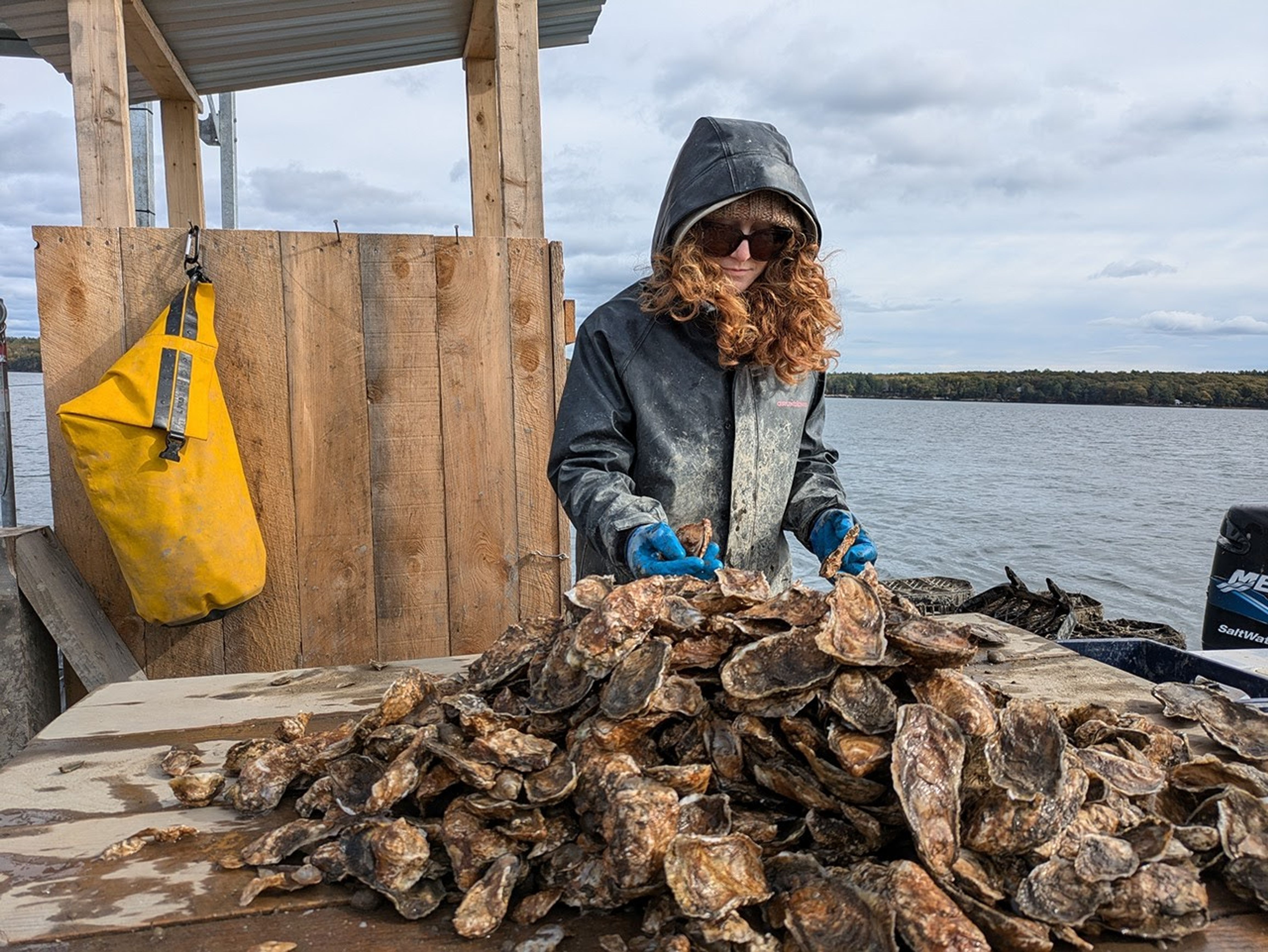
Monique Boutin, an aquaculture technician with The World Is Your Oyster farm, sorts oysters during harvest work on the water in Maine.
For farmers like Saindon, that translates into something simpler: confidence and efficiency. “Having these kinds of tools lowers the barrier for new people to get into aquaculture,” he said. “It gives you peace of mind that you’re not just guessing.”
The Maine project is helping pave the way for other NASA missions. The PACE satellite (Plankton, Aerosol, Cloud, ocean Ecosystem) launched in 2024 and is now delivering hyperspectral observations of coastal waters. Where earlier sensors could estimate how much plankton was present, PACE can begin to identify the different plankton species themselves. For oysters, mussels, and other filter feeders, that specificity matters. Not all plankton are equal food: Different kinds offer different nutrition, and some plankton are harmful to oysters.
A next step will be turning that richer picture of coastal life into forecasts people working on the water can use, helping farmers trade some of the coast’s mystery for evidence they can apply to their harvest.
By Emily DeMarco
NASA’s Goddard Space Flight Center, Greenbelt, Md.
As the price of Ethereum slowly picks up pace following a brief rebound, a significant portion of the leading altcoin is currently being locked away in staking activity. Many institutions, such as Bitmine Immersion, have ventured into ETH staking, demonstrating the growing faith and interest in the investment method.
Bitmine’s Ethereum Staking Gets A Boost
In the burgeoning cryptocurrency market, Bitmine Immersion, a leading public company, continues to make decisive steps into the growing Ethereum ecosystem. Bitmine Immersion’s step into the ecosystem is evidenced by the company’s rising participation in ETH staking.
The public firm keeps extending its staking operations and reinforcing its commitment to on-chain yield generation following its latest move. This move was reported by Lookonchain, a popular on-chain data analytics platform, in a recent post on the X platform. Furthermore, the move coincides with staking’s continued development from a specialized tactic to a fundamental element of institutional cryptocurrency involvement, providing both recurrent benefits and a closer alignment with network security.
As seen in the report, the firm, led by industry leader and billionaire Tom Lee, has staked another 154,208 ETH valued at a staggering $478.77 million. Interestingly, the massive ETH staking was carried out within a 6-hour time frame, reflecting the firm’s robust conviction in the altcoin’s long-term prospects.
After the latest staking operation, the company has now staked a total of 1.344,224 ETH worth approximately $4.17 billion. By increasing its ETH stake, Bitmine Immersion is demonstrating its interest in Ethereum, from scaling upgrades to the ongoing expansion of DeFi and tokenized assets.
SharpLink Deepens Exposure With Expanded Staking Efforts
Another company making waves in the Ethereum staking is SharpLink Gaming, a move that was initiated alongside the launch of its ETH treasury since June 2. According to a report from the firm’s official page on X, they recently generated over 500 ETH in staking rewards last week.
SharpLink ETH staking rewards underscore its expanded participation in on-chain yield and increasing interest in the altcoin and its ecosystem. This growth highlights a larger trend as more businesses are moving from passive holding to active network participation, making Ethereum staking a key component of their business strategy.
With this additional ETH, SharpLink’s total cumulative staking rewards are now sitting at 11,157 ETH since it was launched. By dedicating more of its ETH holdings to validators, the firm is indirectly contributing to Ethereum’s security and decentralization while reaping the benefits of a constant flow of rewards.
Prior to the development, SharpLink deployed $170 million in ETH with a first-of-its-kind enhanced yield on Linea. Specifically, this move integrates native ETH yield, restaking rewards from Eigencloud, and direct incentives from Linea and Etherfi within an institutional-grade qualified custodian with the help of Anchorage. SharpLink has declared this the most productive way to hold ETH with institutional-grade infrastructure.
Researchers have discovered VoidLink, a sophisticated new Linux malware framework designed to infiltrate AWS, Google Cloud, and Azure. Learn how this Chinese-affiliated toolkit uses adaptive stealth to stay hidden.
Amazon founder Jeff Bezos once told an audience that he views local PC hardware the same way he views a 100-year-old electric generator he saw in a brewery museum -- as a relic of a pre-grid era, destined to be replaced by centralized utilities that users simply rent rather than own. The anecdote, shared at a talk a few years ago, positioned Amazon Web Services and Microsoft Azure as the inevitable successors to the desktop tower. Bezos argued that users would eventually abandon local computing for cloud-based solutions, much as businesses once abandoned on-site power generation for the electrical grid.
Current market dynamics have made that prediction feel more plausible. DRAM prices have become increasingly untenable for consumers, and companies like Dell and ASUS have signaled price increases across their PC ranges. Micron has shut down its consumer DRAM operations entirely, prioritizing AI datacenter demand instead. SSD storage is expected to face similar constraints. Cloud gaming services from Amazon Luna, NVIDIA GeForce Now and Xbox are seeing steady growth.
Microsoft previously developed a consumer version of its business-grade Windows 365 cloud PC product, though the company deprioritized it -- the economics didn't work when cheap laptops remained available. That calculus could shift. Xbox Game Pass's 1440p cloud gaming runs $30 monthly and NVIDIA recently imposed a 100-hour cap on its cloud platform. The infrastructure remains expensive to operate, but rising local hardware costs may eventually close that gap.
Researchers have discovered a never-before-seen framework that infects Linux machines with a wide assortment of modules that are notable for the range of advanced capabilities they provide to attackers.
The framework, referred to as VoidLink by its source code, features more than 30 modules that can be used to customize capabilities to meet attackers' needs for each infected machine. These modules can provide additional stealth and specific tools for reconnaissance, privilege escalation, and lateral movement inside a compromised network. The components can be easily added or removed as objectives change over the course of a campaign.
A focus on Linux inside the cloud
VoidLink can target machines within popular cloud services by detecting if an infected machine is hosted inside AWS, GCP, Azure, Alibaba, and Tencent, and there are indications that developers plan to add detections for Huawei, DigitalOcean, and Vultr in future releases. To detect which cloud service hosts the machine, VoidLink examines metadata using the respective vendor’s API.

 Login
Login