With NASA’s first launch toward the moon in five decades potentially only a few months away, the space agency has just released the first episode of a new show that focuses on the highly anticipated mission. Moonbound — Charting the Course runs for 22 minutes and offers a deep dive into the preparations being made […]
NASA is marking America’s 250th year with a bold new symbol of the nation’s relentless drive to explore.
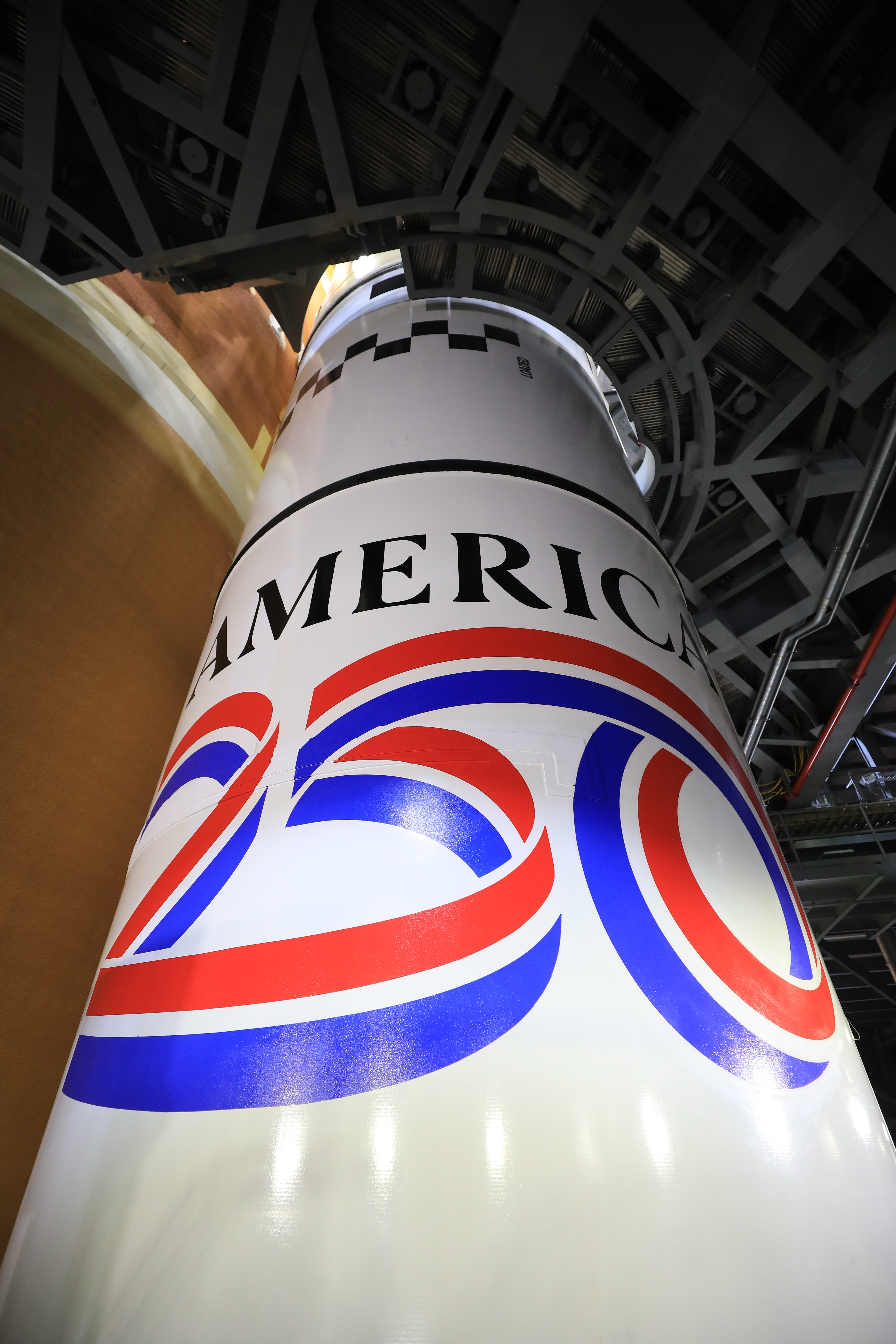
The America 250 emblem is now on the twin solid rocket boosters of the SLS (Space Launch System) rocket for Artemis II — the powerhouse that will launch a crew of four around the Moon next year. Unveiled Tuesday, the design echoes the America 250 Commission’s Spirit of Innovation theme, honoring a country that has never stopped pushing the horizon forward.
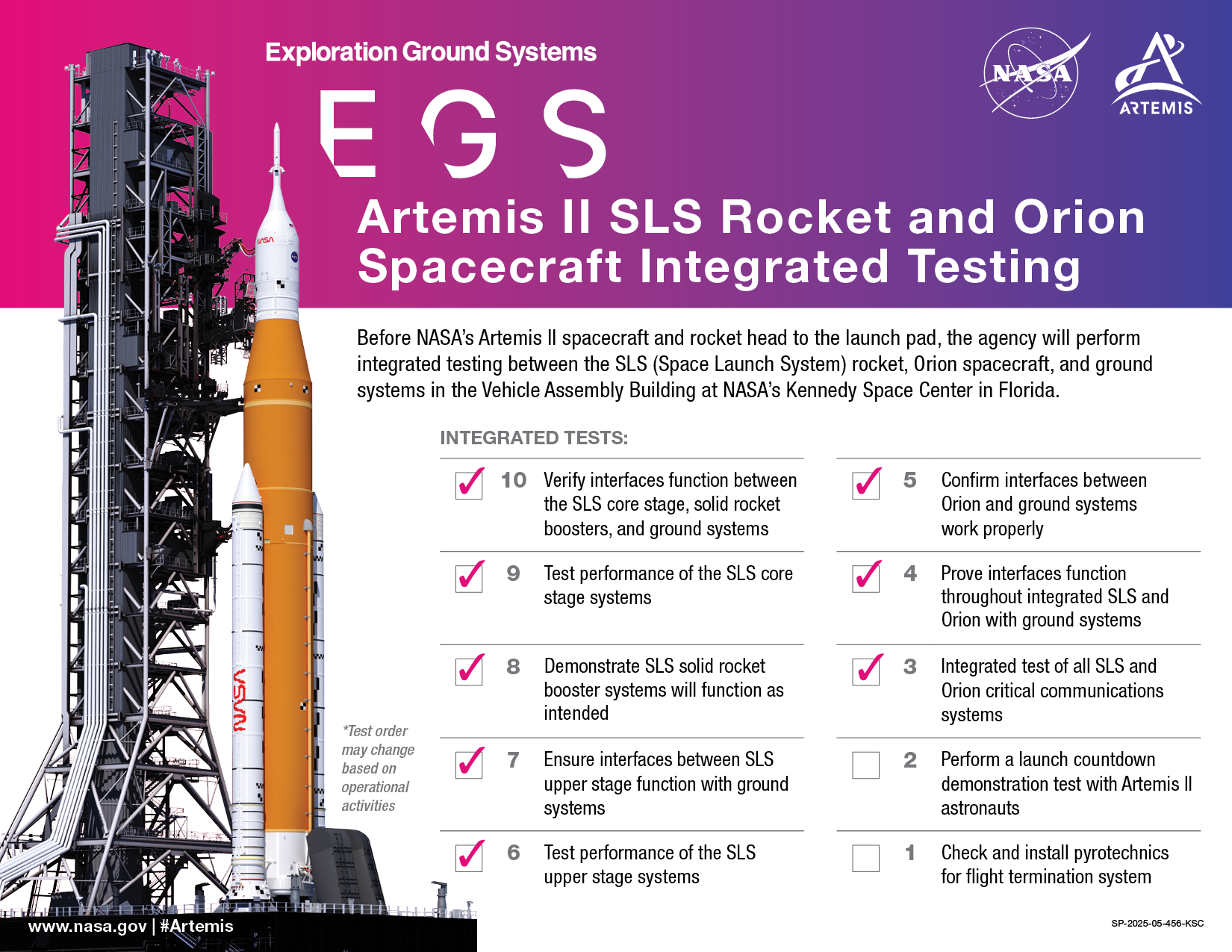
At NASA’s Kennedy Space Center in Florida, technicians spent recent weeks carefully applying the emblem on the rocket inside the Vehicle Assembly Building — the same place where rockets for Apollo once stood. Engineers are running final tests on SLS and the Orion spacecraft as preparations intensify for Artemis II.
The roughly 10-day Artemis II journey around the Moon will mark a defining moment in this new era of American exploration — paving the way for U.S. crews to land on the lunar surface and ultimately push onward to Mars.
America’s spirit of discovery is alive, and Artemis is carrying it to the Moon and beyond.
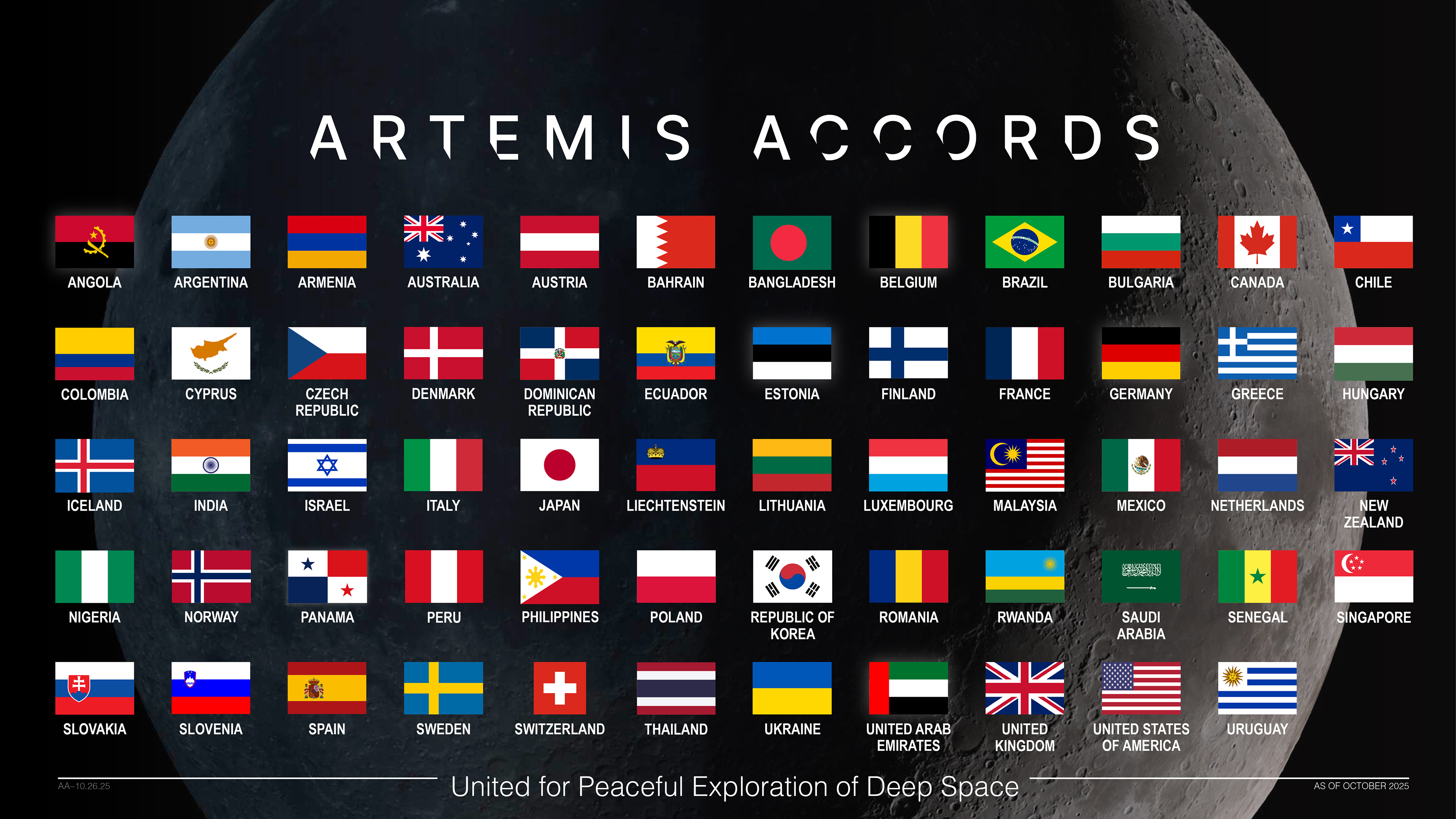
October marked the fifth anniversary of NASA and the original founders signing the Artemis Accords, as well as the recognition of Hungary, Malaysia and the Philippines joining the expanding coalition dedicated to the peaceful exploration of space. The number of countries involved now totals 59.
“NASA welcomes the newest signatories, whose participation strengthens the global commitment to responsible exploration,” said acting NASA Administrator Sean Duffy. “Their decision to sign the Artemis Accords affirms a shared commitment to safe, transparent, and peaceful exploration — at a time when others seek to weaponize the final frontier. Together we are building the foundation for the Golden Age of space exploration.”
Both Malaysia and the Philippines signed the Artemis Accords as part of President Trump’s visit to Kuala Lumpur for the annual Association of Southeast Asian Nations Summit. The separate signings were announced by the White House on Oct. 26.
Foreign Minister Péter Szijjártó of Hungary signed the Artemis Accords on Oct. 22 while in Washington during an official visit, in the lead up to President Trump’s meeting with Prime Minister Viktor Orbán.
Hungary’s signing came three months after Hungarian to Orbit (HUNOR) astronaut Tibor Kapu launched to space in a mission aboard a SpaceX Dragon spacecraft to the International Space Station. The private astronauts, part of the NASA-supported Axiom Mission 4 crew, spent about two weeks conducting science, outreach, and commercial activities, alongside NASA astronauts.
Five years of progress
On Oct. 13, 2020, during the first Trump Administration, the United States, led by NASA and the U.S. Department of State, joined with seven other founding nations to establish the Artemis Accords, responding to the growing interest in lunar activities by both governments and private companies.
Since then, the Artemis Accords have grown into an international coalition. What began with a handful of founding nations has multiplied with seven countries signing in 2025 alone. The surge in participation highlights an increased global commitment to shaping a safe, peaceful, and prosperous future in space.
In September, NASA co-chaired the Artemis Accords Principals’ Meeting in Sydney alongside the space agencies of Australia and the United Arab Emirates. The gathering brought together dozens of signatory nations to deepen dialogue and strengthen shared commitments to the sustainable and responsible use of space. Global space leaders discussed the following topics:
Non-interference in each other’s space activities, including transparency on expected launch dates, general nature of activities, and landing location
Orbital debris mitigation
Interoperability of systems for safer and more efficient operations
Release of scientific data
At the meeting, NASA committed to hosting an Artemis Accords workshop in 2026 for signatories focused on transparency and the sharing of data. The agency has taken additional steps since the accords were established to release more information about lunar missions, promoting openness and preventing harmful interference.
The progress made by signatories, and their continued commitment to implementing the accords’ principles, is essential to advancing sustainable exploration of the Moon under the Artemis campaign, Mars, and beyond. Following a call to Artemis Accords signatories, four CubeSats from South Korea, Saudi Arabia, Argentina, and Germany, will fly on Artemis II.
More nations are expected to sign the accords in the months and years ahead, as NASA and its partners continue to advance the principles of the accords.
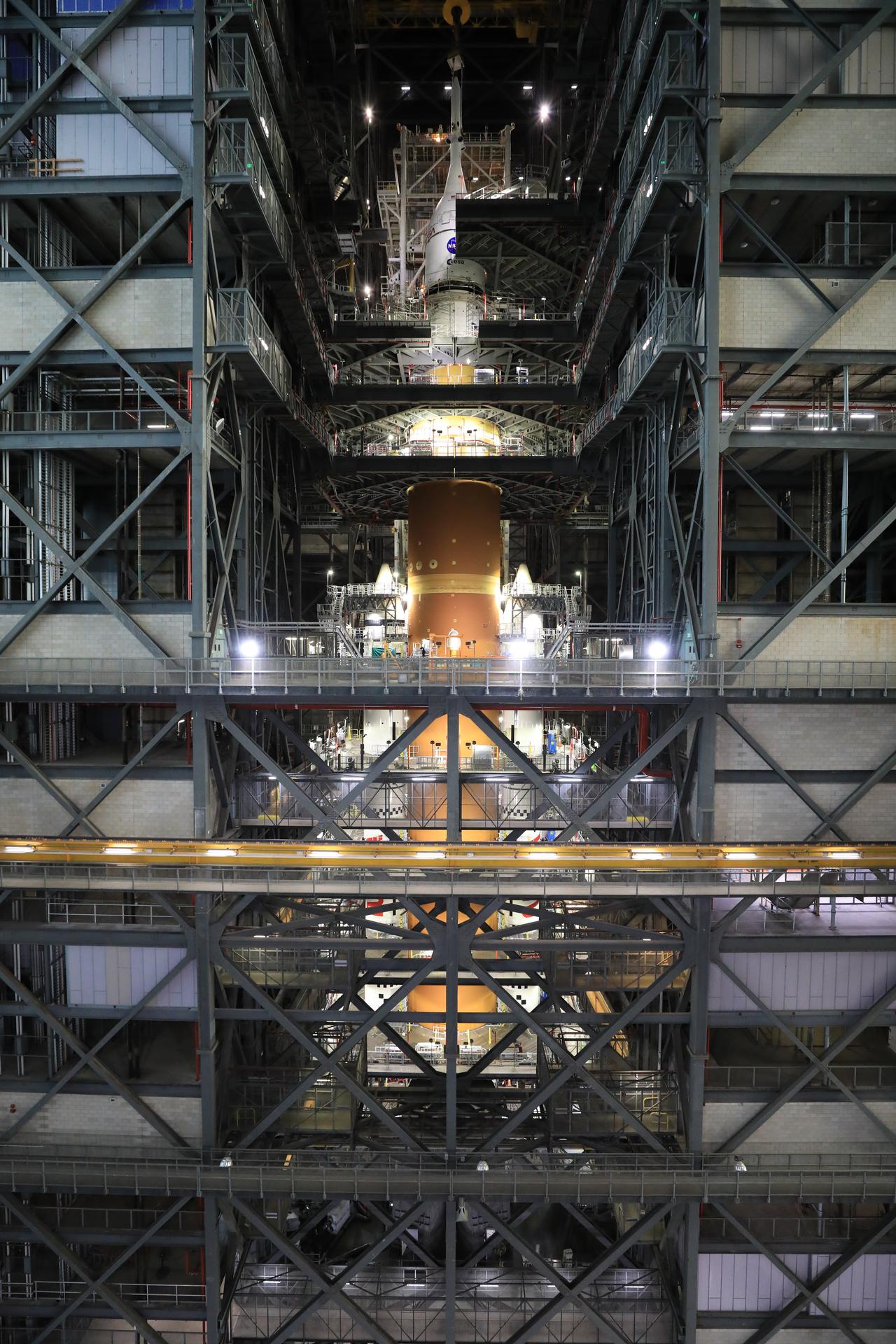
Technicians with NASA’s Exploration Ground Systems team use a crane to lift and secure NASA’s Orion spacecraft on top of the SLS (Space Launch System) rocket in High Bay 3 of the Vehicle Assembly Building at NASA’s Kennedy Space Center in Florida on Saturday, Oct. 18, 2025, for the agency’s Artemis II mission. Set to launch in 2026, the spacecraft will carry NASA astronauts Reid Wiseman, Victor Glover, Christina Koch, and CSA (Canadian Space Agency) astronaut Jeremy Hansen on a 10-day mission around the Moon and back. Once stacked, teams will begin conducting a series of verification tests ahead of rolling out to Launch Complex 39B for the wet dress rehearsal at NASA Kennedy.
NASA/Kim Shiflett
As 2026 nears, NASA continues moving forward to launching and flying Artemis II, the first crewed mission under the Artemis campaign, no later than April next year.
NASA’s Orion spacecraft, complete with its launch abort system escape tower, is now integrated with the SLS (Space Launch System) rocket in the Vehicle Assembly Building (VAB) at the agency’s Kennedy Space Center in Florida. Following Orion stacking, teams completed testing critical communications systems between SLS and Orion, and confirmed the interfaces function properly between the rocket, Orion, and the ground systems, including end-to-end testing with the Near Space Network and Deep Space Network, which aid in communications and navigation.
“NASA remains focused on getting ready to safely fly four astronauts around the Moon and back,” said acting NASA Administrator Sean Duffy. “Our mission will lay the groundwork for future missions to the lunar surface and to Mars.”
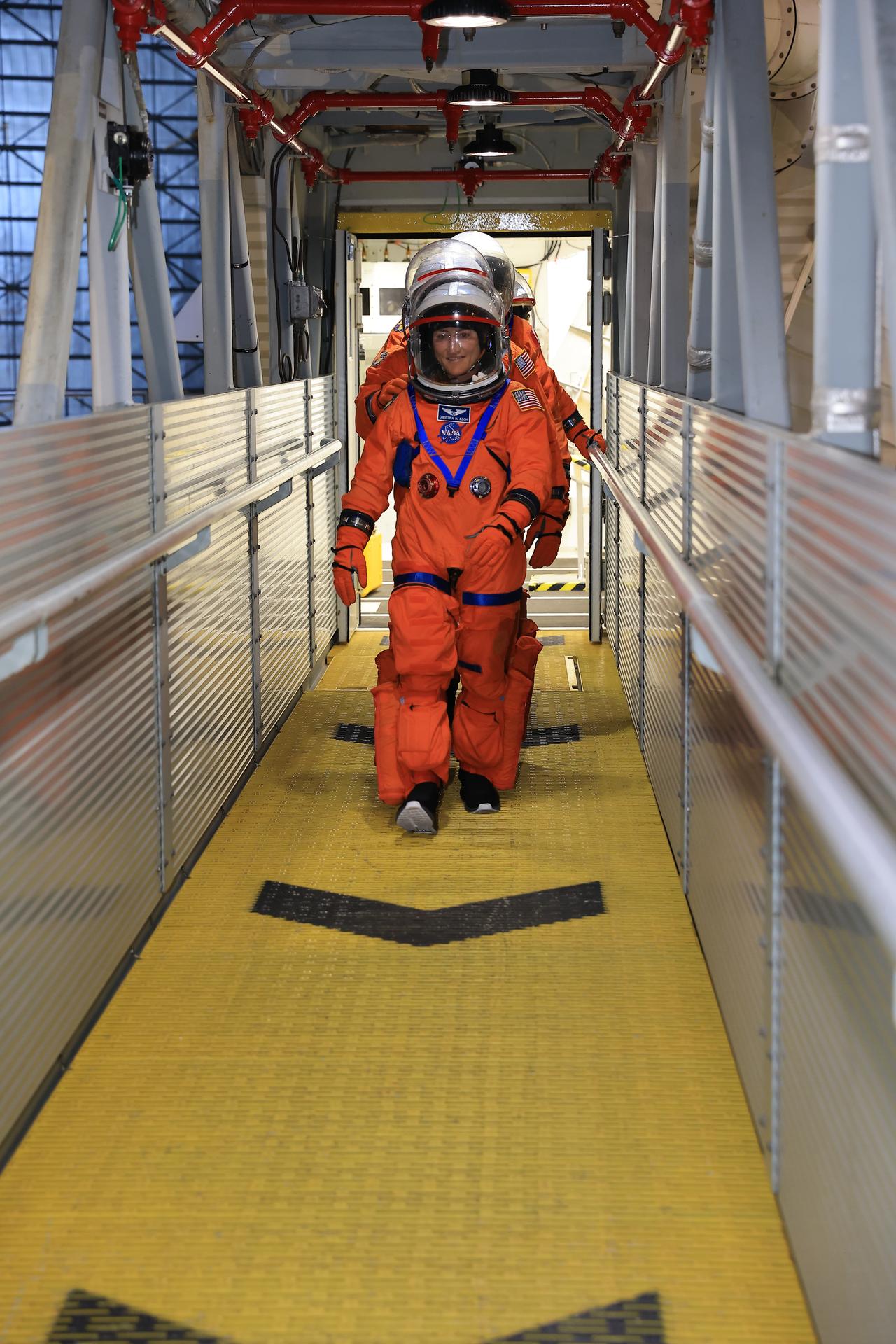
In the coming weeks, engineers and the Artemis II crew will conduct the first part of a Countdown Demonstration Test at Kennedy, a dress rehearsal for launch day. The crew will don their Orion crew survival system spacesuits and venture to their rocket before being secured inside Orion, which the crew recently named Integrity, simulating the final moments of the countdown. Because the rocket and spacecraft are not yet at the launch pad, the crew will board Orion inside the VAB. The test will serve as a final verification of the timeline for the crew and supporting teams on the ground. A second part of the test, preparing for an emergency at the launch pad, will occur after the rocket and spacecraft roll out to Launch Pad 39B.
NASA astronaut Christina Koch, Artemis II mission specialist, and the remaining Artemis II crew members walk on the crew access arm of the mobile launcher in the Vehicle Assembly Building at NASA’s Kennedy Space Center in Florida on Tuesday, Aug. 12, 2025.
NASA/Kim Shiflett
The Artemis II crew and ground personnel responsible for launching and flying the mission are preparing to conduct additional integrated simulations across teams and facilities to prepare for any scenario that could arise as the crew of four launches from Florida and flies their approximately 10-day mission.
NASA astronauts Reid Wiseman, Victor Glover, and Christina Koch, and CSA (Canadian Space Agency) astronaut Jeremy Hansen, have a busy schedule over the next several months reviewing procedures for all phases of flight until their preparations are second nature, practicing for different mission scenarios, and maintaining their familiarity with every element of their spacecraft.
Through Artemis, NASA will send astronauts to explore the Moon for scientific discovery, economic benefits, and build the foundation for the first crewed missions to Mars.
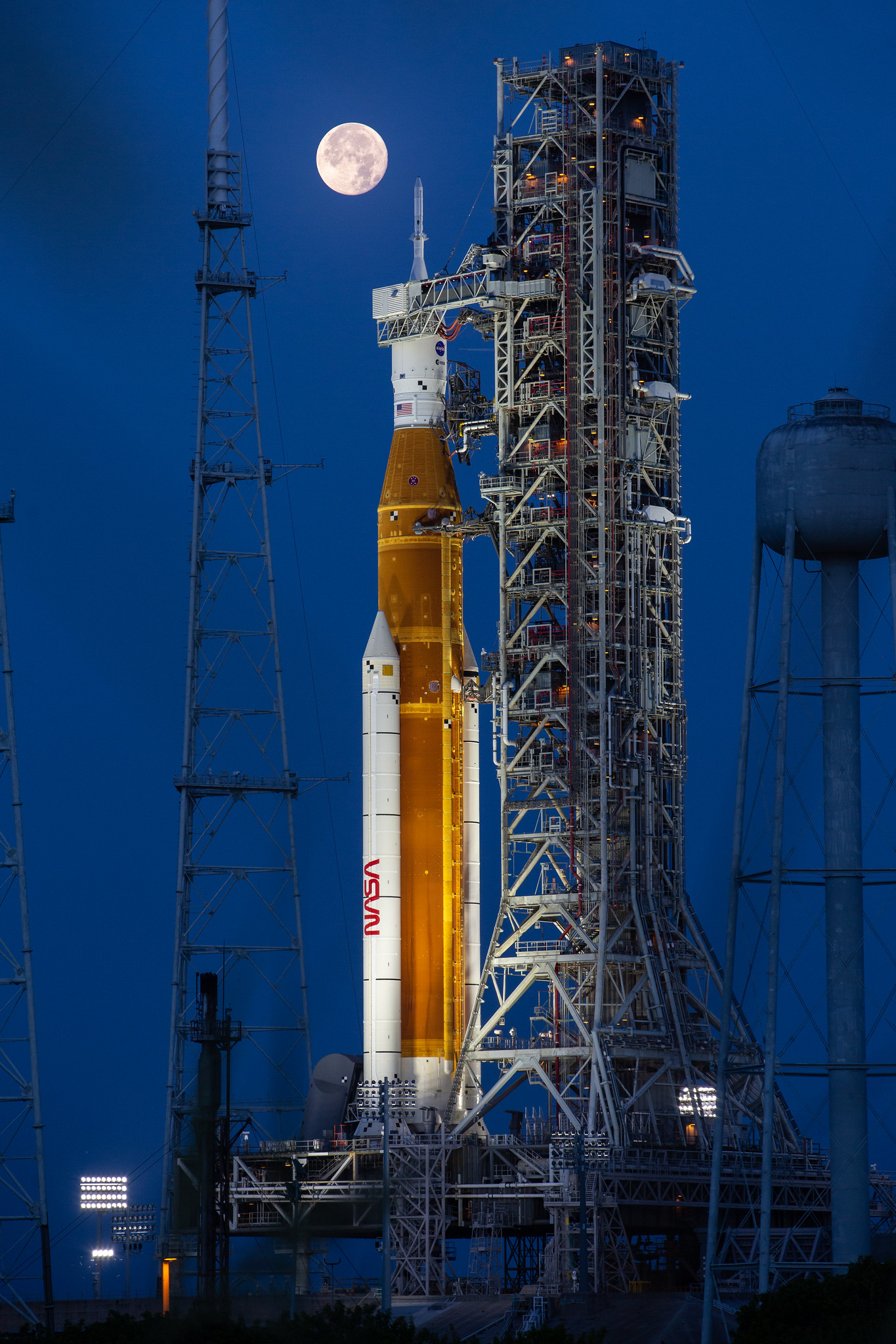
El cohete SLS (Sistema de Lanzamiento Espacial) y la nave espacial Orion de la misión Artemis I, en la plataforma móvil de lanzamiento en el Centro Espacial Kennedy de la NASA en Florida, con la luna llena al fondo. Imagen tomada el 14 de junio de 2022.
Ya está abierto el plazo de acreditación de medios de comunicación para el lanzamiento de la primera misión lunar tripulada de la campaña Artemis de la NASA.
Con un lanzamiento previsto para principios de 2026, el vuelo de prueba Artemis II enviará a los astronautas de la NASA Reid Wiseman, Victor Glover y Christina Koch y al astronauta de la CSA (Agencia Espacial Canadiense) Jeremy Hansen en un viaje de aproximadamente 10 días alrededor de la Luna y de regreso.
La tripulación despegará desde el Centro Espacial Kennedy de la agencia en Florida, a bordo de la nave espacial Orion de la NASA, transportada por el poderoso cohete Sistema de Lanzamiento Espacial (SLS, por sus siglas en inglés) de la agencia, con el fin de ayudar a validar los sistemas y el hardware necesarios para la exploración humana del espacio profundo.
Los miembros de los medios que no dispongan de ciudadanía estadounidense deben solicitar el acceso para ver el lanzamiento antes del domingo 30 de noviembre. Los miembros de medios con ciudadanía estadounidense deben solicitarlo antes del lunes 8 de diciembre. Los periodistas que ya dispongan de acreditaciones anuales para el centro Kennedy de la NASA también deben solicitar acceso para este lanzamiento. Aquellos que estén acreditados para asistir al despegue de Artemis II recibirán también acreditación para asistir a eventos previos al lanzamiento, incluyendo la presentación del cohete y la nave espacial integrados, un evento que se dará varias semanas antes del despegue. Más adelante proporcionaremos detalles adicionales sobre las fechas del lanzamiento.
Los medios de comunicación pueden enviar sus solicitudes de acreditación en línea, en:
Debido al gran interés suscitado, la disponibilidad de plazas para asistir a las actividades del lanzamiento es limitada. Los medios acreditados recibirán un correo electrónico de confirmación tras la aprobación, junto con información adicional sobre las actividades previas al lanzamiento y actividades del lanzamiento. La política de acreditación de medios de la NASA está disponible en línea (en inglés). Si tiene alguna pregunta sobre la acreditación, envíe un correo electrónico en inglés a: ksc-media-accreditat@mail.nasa.gov. Para otras preguntas, póngase en contacto con la sala de prensa del centro Kennedy de la NASA a través del número: +1 321-867-2468.
Como parte de una edad dorada de innovación y exploración, Artemis allanará el camino para nuevas misiones tripuladas estadounidenses en la superficie lunar, en preparación para la primera misión tripulada a Marte.
Para obtener más información (en inglés) sobre la misión Artemis II, visite:
The Artemis I SLS (Space Launch System) rocket and Orion spacecraft atop the mobile launcher at NASA’s Kennedy Space Center in Florida with a full Moon in the background on June 14, 2022.
Media accreditation is open for the launch of the first crewed Moon mission under NASA’s Artemis campaign.
Targeted to launch in early 2026, the Artemis II test flight will send NASA astronauts Reid Wiseman, Victor Glover, Christina Koch, and CSA (Canadian Space Agency) astronaut Jeremy Hansen on an approximately 10-day journey around the Moon and back.
The crew will lift off from the agency’s Kennedy Space Center in Florida inside NASA’s Orion spacecraft on the agency’s powerful (SLS) Space Launch System rocket to help confirm the systems and hardware needed for human deep space exploration.
International media without U.S. citizenship must apply to view the launch by Sunday, Nov. 30. U.S. media must apply by Monday, Dec. 8. Journalists who already have annual badges to NASA Kennedy also must apply. Those who are accredited to attend the Artemis II launch also will be accredited to attend pre-launch events, including rollout of the integrated rocket and spacecraft several weeks before launch. Additional details about launch dates will be provided later.
Media may submit accreditation requests online at:
Due to high interest, space is limited to attend launch activities. Credentialed media will receive a confirmation email upon approval, along with additional information about pre-launch and launch activities. NASA’s media accreditation policy is available online. For questions about accreditation, please email: ksc-media-accreditat@mail.nasa.gov. For other questions, please contact the NASA Kennedy newsroom at: 321-867-2468.
As part of a Golden Age of innovation and exploration, Artemis will pave the way for new U.S.-crewed missions on the lunar surface in preparation toward the first crewed mission to Mars.
To learn more about the Artemis II mission, visit:

 Login
Login